2 Kings 1:7

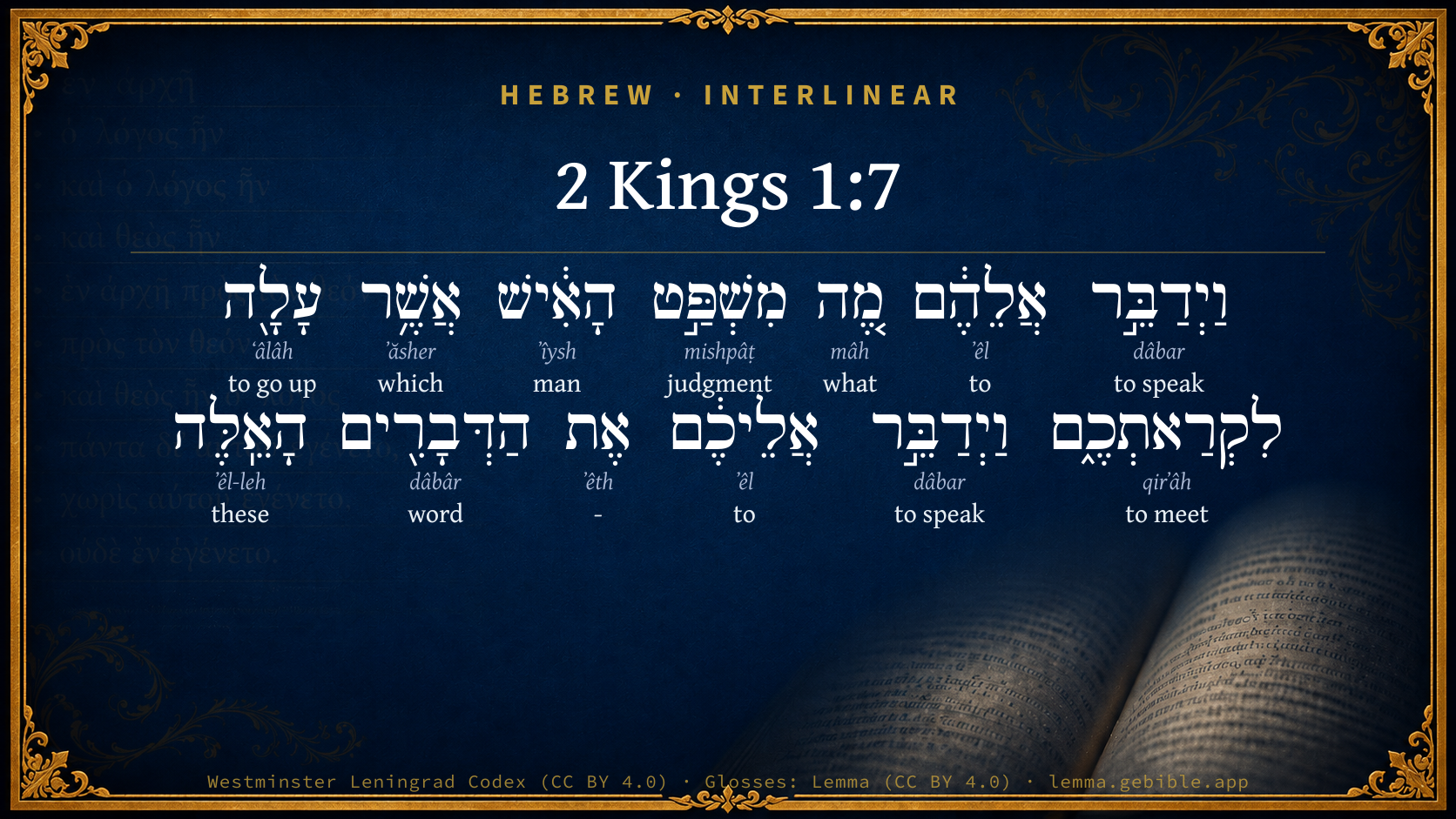
Hebrew (Westminster Leningrad Codex) 2 Kings 1:7 appears in the Hebrew Old Testament. The text above is from the Westminster Leningrad Codex. Each word links to its Strong’s number, a concise gloss, and parsing drawn from the Open Scriptures Hebrew Bible morphology. Click any word for its full Brown-Driver-Briggs (BDB) entry.
Download image
Cite this verse

2 Kings 1:7 (World English Bible). Public Domain. Lemma interlinear Bible study tool, https://lemma.gebible.app/v/2-kings/1/7.

Show BibTeX & RIS
BibTeX
RIS
English Translation
He said to them, What manner of man was he who came up to meet you, and told you these words?
World English Bible · Public Domain
Download a study sheet

One document with this verse’s original text, its word-by-word gloss line, the meaning frame, cross-references with their text, attributed commentary, and full source and license credits — printable, and it pastes into notes with its structure intact.

This verse Autodidact and up

Study sheet (.html) Plain text (.txt)

A passage Seminary Student

Up to 50 verses in one chapter. A passage sheet keeps up to 6 commentary sources and 12 cross-references per verse, in the order this page ranks them, and says so on the sheet whenever that leaves anything out. Ask for a single verse and you get the Autodidact verse sheet above.

Everything on this page stays free to read, with no account — the sheet is a download of what is already on screen, not access to it.

Want to remove ads? Support Godless Engineer
Compare translations 3

The same verse in 3 English versions, stacked beneath the original-language interlinear above. Click any original word for its lexicon entry.

Each is an independent rendering of the whole verse — the interlinear is not word-aligned to these translations.

Highlighted words mark where these versions differ — a whole-verse word diff, not a word-by-word alignment.

  • World English Bible Public Domain
    He said to them, What manner of man was he who came up to meet you, and told you these words?
  • King James Version Public Domain
    And he said unto them, What manner of man was he which came up to meet you, and told you these words?
  • unfoldingWord Literal Text CC BY-SA 4.0
    And he said to them, “What the custom of the man who came up to meet you and spoke these words to you?”

unfoldingWord Literal Text — © unfoldingWord, licensed CC BY-SA 4.0. Word-aligned USFM3 via Door43 (git.door43.org/unfoldingWord/en_ult).

Versions to compare (up to 4)

3 of 4 selected

Show all 18 translations

Every available English version of this verse, each an independent rendering of the whole verse.

  • World English Bible Public Domain
    He said to them, What manner of man was he who came up to meet you, and told you these words?
  • Berean Standard Bible Public Domain
    The king asked them, “What sort of man came up to meet you and spoke these words to you?”
  • Majority Standard Bible Public Domain
    The king asked them, “What sort of man came up to meet you and spoke these words to you?”
  • King James Version Public Domain
    And he said unto them, What manner of man was he which came up to meet you, and told you these words?
  • American Standard Version (1901) Public Domain
    And he said unto them, What manner of man was he that came up to meet you, and told you these words?
  • Revised Version (1885) Public Domain
    And he said unto them, What manner of man was he which came up to meet you, and told you these words?
  • Geneva Bible (1599) Public Domain
    And he saide vnto them, What maner of man was he which came and met you, and tolde you these wordes?
  • Douay-Rheims (1899) Public Domain
    And he said to them: What manner of man was he who met you, and spoke these words?
  • Young's Literal Translation Public Domain
    And he saith unto them, `What `is' the fashion of the man who hath come up to meet you, and speaketh unto you these words?'
  • Literal Standard Version CC BY-SA 4.0
    And he says to them, “What [is] the fashion of the man who has come up to meet you, and speaks these words to you?”
  • Unlocked Literal Bible CC BY-SA 4.0
    Ahaziah said to his messengers, “What sort of man was he, the one who came up to meet you and said these words to you?”
  • unfoldingWord Literal Text CC BY-SA 4.0
    And he said to them, “What the custom of the man who came up to meet you and spoke these words to you?”
  • Darby Bible Public Domain
    And he said to them, What manner of man was he that came up to meet you, and told you these words?
  • World Messianic Bible Public Domain
    He said to them, “What kind of man was he who came up to meet you and told you these words?”
  • Webster's Bible Public Domain
    And he said to them, What manner of man was he who came up to meet you, and told you these words?
  • Free Bible Version CC BY-SA 4.0
    “What was he like, this man who met you and told you all this?” the king asked.
  • Bible in Basic English Public Domain
    And he said to them, What sort of a man was it who came and said these words to you?
  • JPS Tanakh (1917) Public Domain
    And he said unto them: 'What manner of man was he that came up to meet you, and told you these words?'

Literal Standard Version (2020), Covenant Press — licensed CC BY-SA 4.0. Text via the HelloAO Bible API (eBible.org). Unlocked Literal Bible (unfoldingWord) — licensed CC BY-SA 4.0. Text via the HelloAO Bible API (eBible.org). unfoldingWord Literal Text — © unfoldingWord, licensed CC BY-SA 4.0. Word-aligned USFM3 via Door43 (git.door43.org/unfoldingWord/en_ult). Free Bible Version, Dr. Jonathan Gallagher — licensed CC BY-SA 4.0. Text via the HelloAO Bible API (eBible.org).

Word by word

More ways to search: Search by grammar → Find every occurrence → Compare this word →

Practice this passage: Drill this verse → Learn its vocabulary →

לִקְרַאתְכֶ֑ם
qirʼâh
H7125
“to meet · you”
Preposition + Verb, Qal, Infinitive Construct + Suffix, Personal, 2nd Person, Masculine, Plural
Part of Speech
Preposition + Verb
Stem
Qal
Form
Infinitive Construct
Full BDB Definition

Origin: from H7122

TWOT: 2064

to encounter, befall, meet - (Qal) - to meet, encounter - to befall (figuratively)
  1. וַיְדַבֵּ֣ר dâbar H1696 “and · to speak” Conjunction + Verb, Piel, Sequential Imperfect, 3rd Person, Masculine, Singular
  2. אֲלֵהֶ֔ם ʼêl H413 “to · them” Preposition + Suffix, Personal, 3rd Person, Masculine, Plural
  3. מֶ֚ה mâh H4100 “what” Particle, Interrogative
  4. מִשְׁפַּ֣ט mishpâṭ H4941 “judgment of” Noun, Common, Masculine, Singular, Construct
  5. הָאִ֔ישׁ ʼîysh H376 “the · man” Particle, Definite Article + Noun, Common, Masculine, Singular, Absolute
  6. אֲשֶׁ֥ר ʼăsher H834 “which” Particle, Relative
  7. עָלָ֖ה ʻâlâh H5927 “to go up” Verb, Qal, Perfect, 3rd Person, Masculine, Singular
  8. וַיְדַבֵּ֣ר dâbar H1696 “and · to speak” Conjunction + Verb, Piel, Sequential Imperfect, 3rd Person, Masculine, Singular
  9. אֲלֵיכֶ֔ם ʼêl H413 “to · you” Preposition + Suffix, Personal, 2nd Person, Masculine, Plural
  10. אֶת ʼêth H853 “-” Particle, Direct Object
  11. הַדְּבָרִ֖ים dâbâr H1697 “the · words” Particle, Definite Article + Noun, Common, Masculine, Plural, Absolute
  12. הָאֵֽלֶּה ʼêl-leh H428 “the · these” Particle, Definite Article + Pronoun, Demonstrative, Common, Plural

About this verse

These counts appear in no published source. They are computed here, from the morphology-tagged text and Lemma’s own curated glosses. What Lemma adds →

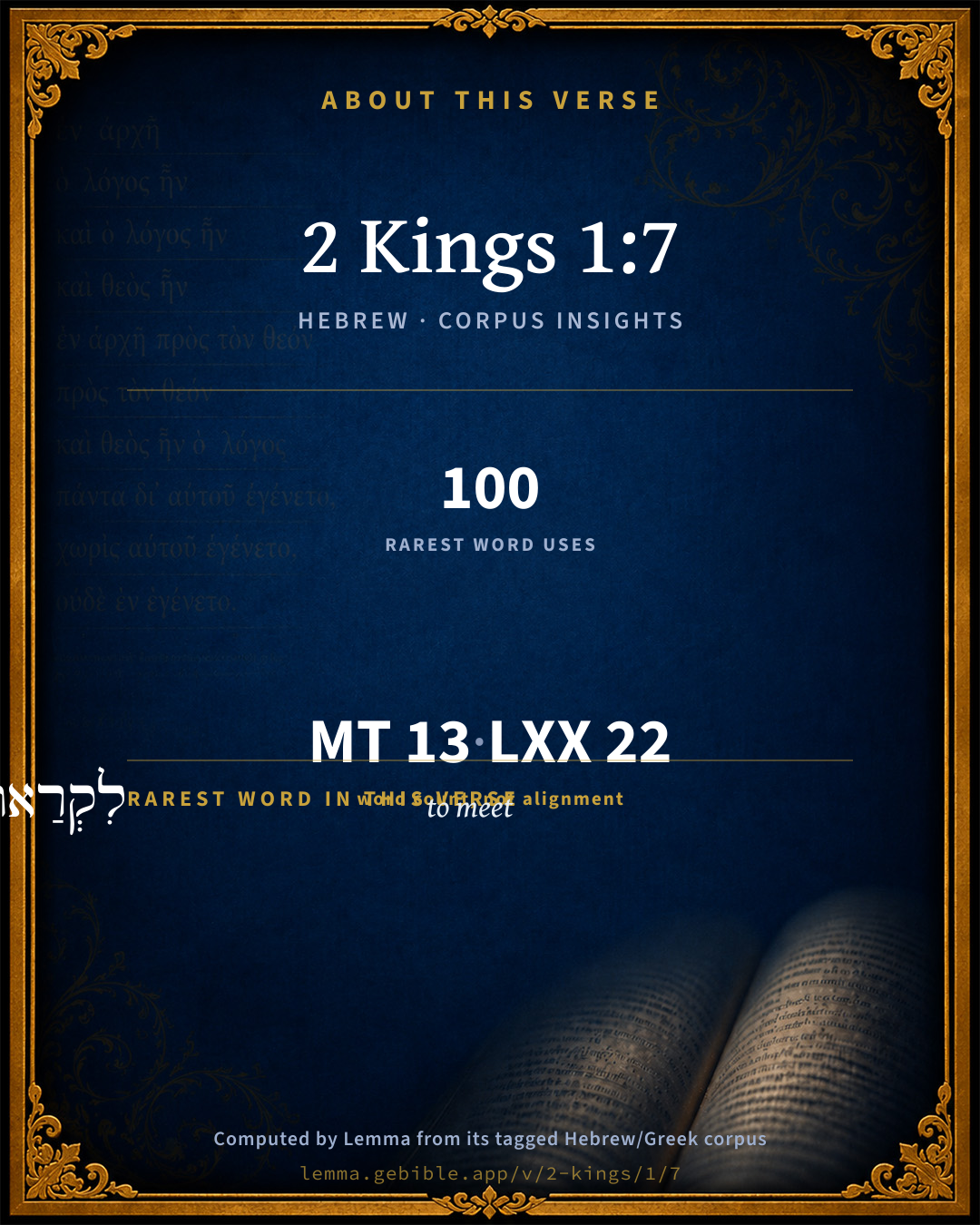
13
words
11
distinct lemmas
Historical
section

Grammatical profile

  • 4 verbs
  • 3 nouns
  • 1 pronoun
  • 2 prepositions
  • 3 particles

Verb forms

  • וַיְדַבֵּ֣ר Piel · Sequential Imperfect
  • עָלָ֖ה Qal · Perfect
  • לִקְרַאתְכֶ֑ם Qal · Infinitive Construct
  • וַיְדַבֵּ֣ר Piel · Sequential Imperfect

Repetition

Words recur within this verse — often emphatic in Hebrew:

  • וַיְדַבֵּ֣ר to speak H1696 ×2
  • אֲלֵהֶ֔ם to H413 ×2

Hebrew & Septuagint length

In English translation the verse runs 21 words from the Hebrew and 35 from the Septuagint (LXX English) — the Septuagint runs noticeably longer here. See the side-by-side →

A rough comparison of the two English renderings, which tokenize alike — not a word-level alignment.

Word counts can differ between the Hebrew and the Greek without any difference in meaning — e.g. the Hebrew direct-object marker אֵת has no separate Greek word, and Greek often adds the article ὁ.

In the original languages it is 13 Hebrew tokens and 22 Greek tokens — but the two are counted differently (Hebrew bundles its prefixes and suffixes into one token; the Greek is in lemma form), so that isn’t a like-for-like length.

Cross-references

2

Topical passages linked to 2 Kings 1:7 in the Treasury of Scripture Knowledge — connected by theme and wording, ordered by reader-vote popularity; previews shown in the World English Bible.

  • Judges 8:18 Then said he to Zebah and Zalmunna, What manner of men were they whom you killed at Tabor? They answered, As you are, so were they; each one resembled the children of a king.
  • 1 Samuel 28:14 He said to her, What form is he of? She said, An old man comes up; and he is covered with a robe. Saul perceived that it was Samuel, and he bowed with his face to the ground, and did obeisance.

Cross-references courtesy of OpenBible.info (CC BY 4.0).

Hebrew and Greek witnesses Masoretic Hebrew ↔ Greek Septuagint

The same verse in the two great witnesses to the Old Testament, shown verse-for-verse.

Here the Septuagint runs noticeably longer than the Hebrew — LXX2012 (modern English Septuagint) 35 words vs World English Bible 21. A rough length comparison of the two English translations, not a word-level alignment — read both below.

These are two independent witnesses, not word-aligned to each other, and the Septuagint is shown in lemma (dictionary) form.

Hebrew 2 Kings 1:7 Masoretic · Westminster Leningrad Codex

וַיְדַבֵּ֣ר אֲלֵהֶ֔ם מֶ֚ה מִשְׁפַּ֣ט הָאִ֔ישׁ אֲשֶׁ֥ר עָלָ֖ה לִקְרַאתְכֶ֑ם וַיְדַבֵּ֣ר אֲלֵיכֶ֔ם אֶת הַדְּבָרִ֖ים הָאֵֽלֶּה

He said to them, What manner of man was he who came up to meet you, and told you these words?

World English Bible · Public Domain

Greek LXX 2 Kings 1:7 Septuagint · lemma form

καί λαλέω πρός αὐτός λέγω τίς ὁ κρίσις ὁ ἀνήρ ὁ ἀναβαίνω εἰς συνάντησις σύ καί λαλέω πρός σύ ὁ λόγος οὗτος

So they returned and reported to the king as Eliu said: and he said to them, What was the manner of the man who went up to meet you, and spoke to you these words?

LXX2012 (modern English Septuagint) · Public Domain

On this verse, Ellicott's Commentary for English Readers discusses the Septuagint’s reading. Read the note in Commentary ↓

Hebrew: Westminster Leningrad Codex (CC BY 4.0). Greek: Septuagint (public domain); English from LXX2012 (modern English Septuagint) (Public Domain). How the Septuagint differs from the Hebrew →

Targum (Aramaic paraphrase)

1

The Targum is the ancient Jewish Aramaic paraphrase of the Hebrew Scriptures — an interpretive translation, not the Hebrew text itself. Onkelos (literal) and Pseudo-Jonathan (expansive) render the Torah, and Jonathan the Prophets. Coverage is partial: where no permissively-licensed English translation exists for a verse, only the Aramaic is shown. This is verse-level text, not a word-by-word alignment to the Hebrew.

  1. Targum Jonathan Prophets (Joshua–Malachi)
    וּמַלֵיל עִמְהוֹן מָא נִמוֹסָא דְגַרְבָא דְסָלֵיק לִקֳדָמוּתְכוֹן וּמַלֵיל עִמְכוֹן יַת פִּתְגָמַיָא הָאִלֵין:

    (no public-domain English translation for this verse)

    Targum Jonathan — Aramaic: “Mikraot Gedolot” (public domain). English: “Sefaria Community Translation” (CC0 1.0 (public-domain dedication)); “London "Chaldee Paraphrase," 1871” (public domain). Text via Sefaria.

Commentary

Notes on 2 Kings 1:7 from classic Christian and Jewish commentators (each source and its license shown beneath its notes). The classic Christian expositions comment on the surrounding passage and are grouped to its opening verse, so a note may address several verses; the Jewish commentaries on the Tanakh (Rashi and others) are per-verse, so they appear only where the commentator wrote on this verse.

Lemma curates 59 commentaries, every one of them public domain or Creative Commons licensed, each selected and text-cleaned for this edition rather than reprinted as found. About our sources →

Trapp's Complete Commentary

John Trapp

2Ki 1:7 And he said unto them, What manner of man [was he] which came up to meet you, and told you these words?

Ver. 7. What manner of man was he?] What was his stature, habit, and shape?

John Trapp, A Commentary or Exposition upon All the Books of the Old and New Testament (1647–1656) — public domain. Text from a community e-Sword module.

Ellicott's Commentary for English Readers

(7) He said.—Spake. (See Note on 2Ki_1:3.)

What manner of man?—See margin. The word mishpat here denotes the external characteristics and visible peculiarities by which a man is distinguished (shâphat) from his fellows. (Comp. our expressions “sort,” “fashion,” “style,” and the Vulgate, “Cujus figuræ et habitus est vir ille?” LXX., ἡ κρίσις. Syriac, “appearance,” “look.” Targum, νόμος.)

A Bible Commentary for English Readers, edited by Charles John Ellicott (1878–1897) — public domain. Text from a community e-Sword module.

The Cambridge Bible for Schools and Colleges

gen. ed. J. J. S. Perowne

7. What manner of man was he?] The Hebrew noun which is usually rendered ‘judgement’ is applied sometimes to external appearances of things. Thus Exo_26:30, ‘Thou shalt rear up the tabernacle according to the fashion thereof which was shewed thee’. From the answer of the messengers it is clear that the dress and external peculiarities are what is here meant. From them Ahaziah was able to judge who the man must be.

The Cambridge Bible for Schools and Colleges (gen. ed. J. J. S. Perowne; Cambridge University Press, 1878–1918) — public domain. Text from a community e-Sword module.

John Gill's Exposition

And he said unto them, what manner of man was he,.... What appearance or figure did he make? what his habit or clothing?

which came up to meet you, and told you these words? they had related to him.

John Gill's Exposition of the Whole Bible (1746–1763) — public domain (CC PDM 1.0). Text via the HelloAO Bible API.

The Pulpit Commentary

What manner of man was he? literally, what was the manner of the man? What was his appearance? Were there any marks about him by which he might be recognized and known? Ahaziah may have already suspected that the man who had denounced woe on him would be the same who had denounced woe on his father. (see 1Ki_21:20-22)

The Pulpit Commentary (1880–1919), ed. H.D.M. Spence-Jones & Joseph S. Exell — public domain. Text from a community e-Sword module.

unfoldingWord translationNotes

Door43 World Missions Community

He wore a garment made of hair

Possible meanings are 1) this is a metaphor that speaks of him being very hairy as if his hair were a garment. AT: "He was very hairy" or 2) "His clothes were made from animal hair" (See: Assumed Knowledge and Implicit Information)

translationWords

word

unfoldingWord translationNotes — © Distant Shores Media and the Door43 World Missions Community, licensed CC BY-SA 4.0. Source: git.door43.org/Door43/en_tn.

Lesson kit

Teaching starters — assembled from the data on this page, not authored interpretation. Every prompt links to the verse data it draws on. Edit before teaching.

2 Kings, in the Historical, opens this verse with 13 words (11 distinct Hebrew lemmas). Its most distinctive word is qirʼâh (“to meet”). The Greek Septuagint runs longer here. A historical commentator’s framing appears above. Read the whole chapter for the surrounding context.

Discussion questions

  1. The word qirʼâh carries the sense “to meet.” How does it shape the verse?
  2. Judges 8:18 shares this passage’s theme. How do the two illuminate each other?
  3. “to speak” occurs 2× in this one verse. What is the effect of the repetition?
  4. Compared with the Hebrew, the Septuagint runs longer here. What questions does that raise?
  5. These translations render this verse differently. What is at stake in choosing one wording over another?
  6. The verb «וַיְדַבֵּ֣ר» is Piel Sequential Imperfect. How does its form color the action?
  7. Reading how Trapp's Complete Commentary and Ellicott's Commentary for English Readers read this verse, where do the two commentators agree and where do they part?

Things to notice

Reading settings

Reading text

Shown beneath each verse's original-language words.

Old Testament
Old Testament edition

Read the OT as the Masoretic Hebrew (MT) or the Greek Septuagint (LXX).

English shown for the Greek Septuagint (in the Hebrew ↔ Greek comparison).

Comparing translations? Open the Compare panel on any verse page to stack up to four side by side.