
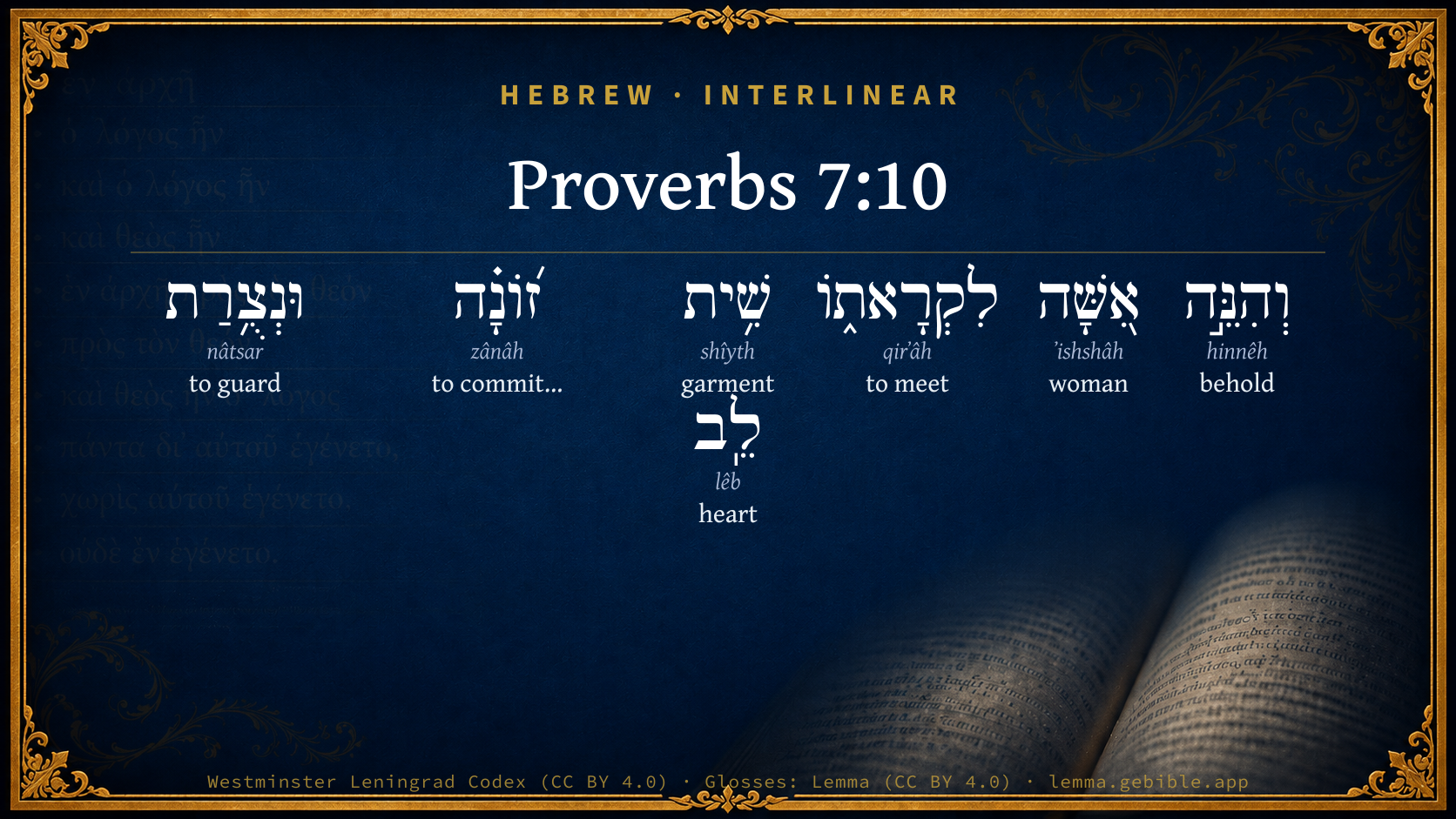
Proverbs 7:10

Hebrew (Westminster Leningrad Codex) Proverbs 7:10 appears in the Hebrew Old Testament. The text above is from the Westminster Leningrad Codex. Each word links to its Strong’s number, a concise gloss, and parsing drawn from the Open Scriptures Hebrew Bible morphology. Click any word for its full Brown-Driver-Briggs (BDB) entry.
Download image
Cite this verse

Proverbs 7:10 (World English Bible). Public Domain. Lemma interlinear Bible study tool, https://lemma.gebible.app/v/proverbs/7/10.

Show BibTeX & RIS
BibTeX
RIS
English Translation
Behold, there a woman met him with the attire of a prostitute, And with crafty intent.
World English Bible · Public Domain
Download a study sheet

One document with this verse’s original text, its word-by-word gloss line, the meaning frame, cross-references with their text, attributed commentary, and full source and license credits — printable, and it pastes into notes with its structure intact.

This verse Autodidact and up

Study sheet (.html) Plain text (.txt)

A passage Seminary Student

Up to 50 verses in one chapter. A passage sheet keeps up to 6 commentary sources and 12 cross-references per verse, in the order this page ranks them, and says so on the sheet whenever that leaves anything out. Ask for a single verse and you get the Autodidact verse sheet above.

Everything on this page stays free to read, with no account — the sheet is a download of what is already on screen, not access to it.

Want to remove ads? Support Godless Engineer
Compare translations 3

The same verse in 3 English versions, stacked beneath the original-language interlinear above. Click any original word for its lexicon entry.

Each is an independent rendering of the whole verse — the interlinear is not word-aligned to these translations.

Highlighted words mark where these versions differ — a whole-verse word diff, not a word-by-word alignment.

  • World English Bible Public Domain
    Behold, there a woman met him with the attire of a prostitute, And with crafty intent.
  • King James Version Public Domain
    And, behold, there met him a woman with the attire of an harlot, and subtil of heart.
  • unfoldingWord Literal Text CC BY-SA 4.0
    And behold, a woman to meet him, the garment of a prostitute and guarded of heart.

unfoldingWord Literal Text — © unfoldingWord, licensed CC BY-SA 4.0. Word-aligned USFM3 via Door43 (git.door43.org/unfoldingWord/en_ult).

Versions to compare (up to 4)

3 of 4 selected

Show all 18 translations

Every available English version of this verse, each an independent rendering of the whole verse.

  • World English Bible Public Domain
    Behold, there a woman met him with the attire of a prostitute, And with crafty intent.
  • Berean Standard Bible Public Domain
    Then a woman came out to meet him, with the attire of a harlot and cunning of heart.
  • Majority Standard Bible Public Domain
    Then a woman came out to meet him, with the attire of a harlot and cunning of heart.
  • King James Version Public Domain
    And, behold, there met him a woman with the attire of an harlot, and subtil of heart.
  • American Standard Version (1901) Public Domain
    And, behold, there met him a woman With the attire of a harlot, and wily of heart.
  • Revised Version (1885) Public Domain
    And, behold, there met him a woman with the attire of an harlot, and wily of heart.
  • Geneva Bible (1599) Public Domain
    And beholde, there met him a woman with an harlots behauiour, and subtill in heart.
  • Douay-Rheims (1899) Public Domain
    And behold a woman meeteth him in harlot's attire prepared to deceive souls; talkative and wandering,
  • Young's Literal Translation Public Domain
    And, lo, a woman to meet him -- (A harlot's dress, and watchful of heart,
  • Literal Standard Version CC BY-SA 4.0
    And behold, a woman to meet him—(A harlot’s dress, and watchful of heart,
  • Unlocked Literal Bible CC BY-SA 4.0
    There a woman met him, dressed like a prostitute, with a false heart.
  • unfoldingWord Literal Text CC BY-SA 4.0
    And behold, a woman to meet him, the garment of a prostitute and guarded of heart.
  • Darby Bible Public Domain
    And behold, there met him a woman in the attire of a harlot, and subtle of heart.
  • World Messianic Bible Public Domain
    Behold, there a woman met him with the attire of a prostitute, and with crafty intent.
  • Webster's Bible Public Domain
    And behold, there met him a woman with the attire of a harlot, and subtil of heart.
  • Free Bible Version CC BY-SA 4.0
    Then out came a woman to meet him. She was dressed as a prostitute and had deceptive intentions.
  • Bible in Basic English Public Domain
    And the woman came out to him, in the dress of a loose woman, with a designing heart;
  • JPS Tanakh (1917) Public Domain
    And, behold, there met him a woman with the attire of a harlot, and wily of heart.

Literal Standard Version (2020), Covenant Press — licensed CC BY-SA 4.0. Text via the HelloAO Bible API (eBible.org). Unlocked Literal Bible (unfoldingWord) — licensed CC BY-SA 4.0. Text via the HelloAO Bible API (eBible.org). unfoldingWord Literal Text — © unfoldingWord, licensed CC BY-SA 4.0. Word-aligned USFM3 via Door43 (git.door43.org/unfoldingWord/en_ult). Free Bible Version, Dr. Jonathan Gallagher — licensed CC BY-SA 4.0. Text via the HelloAO Bible API (eBible.org).

Word by word

More ways to search: Search by grammar → Find every occurrence → Compare this word →

Practice this passage: Drill this verse → Learn its vocabulary →

About this verse

These counts appear in no published source. They are computed here, from the morphology-tagged text and Lemma’s own curated glosses. What Lemma adds →

7
words
7
distinct lemmas
Wisdom
section

Notable vocabulary

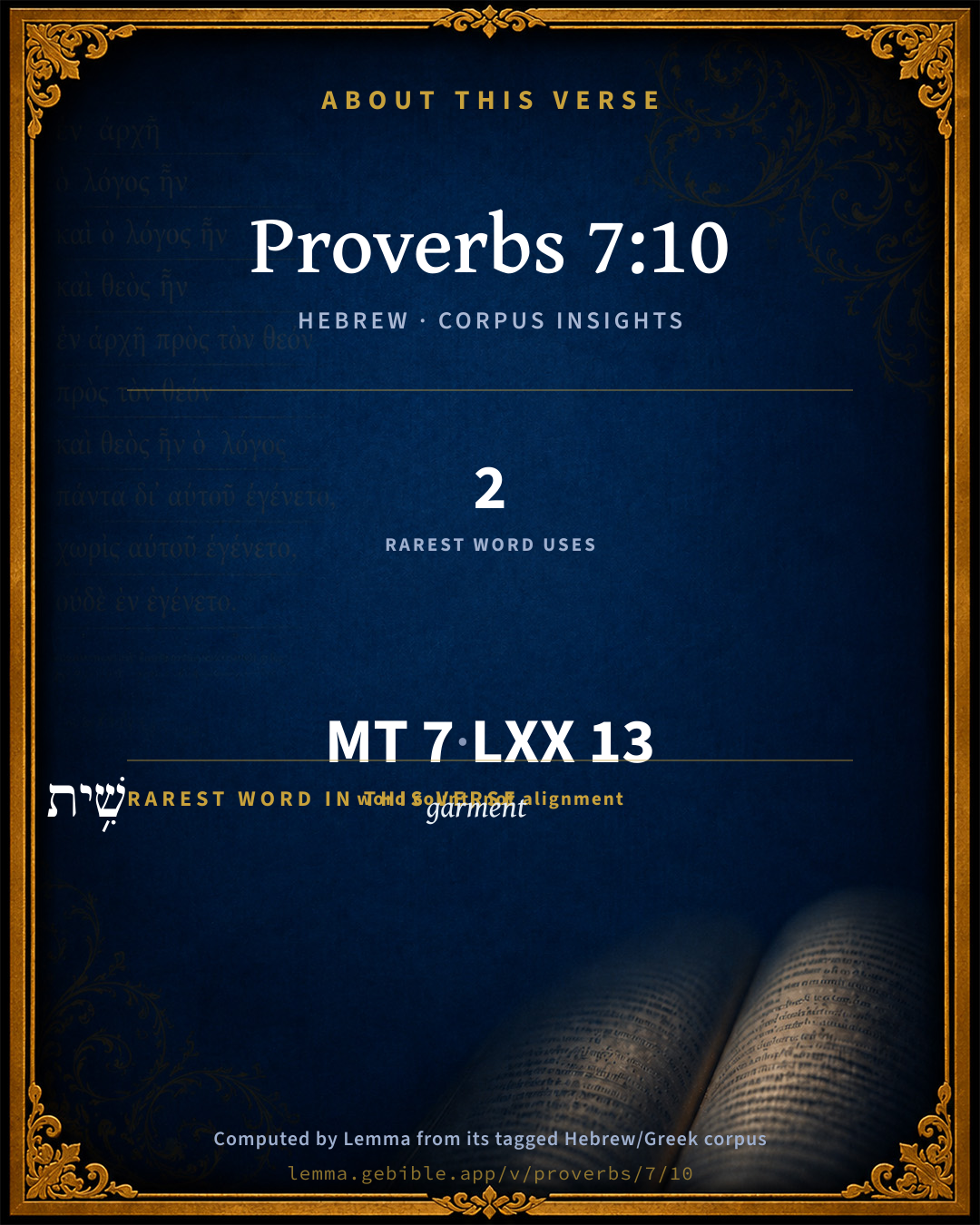
The rarest word here is שִׁ֥ית garment H7897 — appearing just 2 times in the whole Hebrew Bible.

Shared distinctive vocabulary

שִׁ֥ית garment H7897 occurs in 2 verses of the Hebrew Bible. Also found in:

Grammatical profile

  • 3 verbs
  • 3 nouns
  • 1 particle

Verb forms

  • לִקְרָאת֑וֹ Qal · Infinitive Construct
  • ז֝וֹנָ֗ה Qal · Participle Active
  • וּנְצֻ֥רַת Qal · Participle Passive

Hebrew & Septuagint length

In English translation the verse runs 16 words from the Hebrew and 20 from the Septuagint (LXX English) — closely comparable.

A rough comparison of the two English renderings, which tokenize alike — not a word-level alignment.

Word counts can differ between the Hebrew and the Greek without any difference in meaning — e.g. the Hebrew direct-object marker אֵת has no separate Greek word, and Greek often adds the article ὁ.

In the original languages it is 7 Hebrew tokens and 13 Greek tokens — but the two are counted differently (Hebrew bundles its prefixes and suffixes into one token; the Greek is in lemma form), so that isn’t a like-for-like length.

Cross-references

10

Topical passages linked to Proverbs 7:10 in the Treasury of Scripture Knowledge — connected by theme and wording, ordered by reader-vote popularity; previews shown in the World English Bible.

  • Isaiah 3:16–24 Moreover Yahweh said, "Because the daughters of Zion are haughty, And walk with outstretched necks and flirting eyes, Walking to trip as they go, Jingling ornaments on their feet;
  • 2 Corinthians 11:2–3 For I am jealous over you with a godly jealousy. For I married you to one husband, that I might present you as a pure virgin to Christ.
  • 1 Timothy 2:9 In the same way, that women also adorn themselves in decent clothing, with modesty and propriety; not just with braided hair, gold, pearls, or expensive clothing;
  • 2 Kings 9:30 When Jehu was come to Jezreel, Jezebel heard of it; and she painted her eyes, and attired her head, and looked out at the window.
  • Jeremiah 4:30 You, when you are made desolate, what will you do? Though you clothe yourself with scarlet, though you deck you with ornaments of gold, though you enlarge your eyes with paint, in vain do you make yourself beautiful; [your] lovers despise you, they seek your life.
  • Genesis 38:14–15 She took off of her the garments of her widowhood, and covered herself with her veil, and wrapped herself, and sat in the gate of Enaim, which is by the way to Timnah; for she saw that Shelah was grown up, and she wasn't given to him as a wife.
  • 2 Kings 9:22 It happened, when Joram saw Jehu, that he said, Is it peace, Jehu? He answered, What peace, so long as the prostitution of your mother Jezebel and her witchcraft abound?
  • Isaiah 23:16 Take a harp, go about the city, you prostitute that has been forgotten; make sweet melody, sing many songs, that you may be remembered.
  • Genesis 3:1 Now the serpent was more subtle than any animal of the field which Yahweh God had made. He said to the woman, "Yes, has God said, 'You shall not eat of any tree of the garden?'"
  • Revelation 17:3–5 He carried me away in the Spirit into a wilderness. I saw a woman sitting on a scarlet-colored animal, full of blasphemous names, having seven heads and ten horns.

Cross-references courtesy of OpenBible.info (CC BY 4.0).

Hebrew and Greek witnesses Masoretic Hebrew ↔ Greek Septuagint

The same verse in the two great witnesses to the Old Testament, shown verse-for-verse.

These are two independent witnesses, not word-aligned to each other, and the Septuagint is shown in lemma (dictionary) form.

Hebrew Proverbs 7:10 Masoretic · Westminster Leningrad Codex

וְהִנֵּ֣ה אִ֭שָּׁה לִקְרָאת֑וֹ שִׁ֥ית ז֝וֹנָ֗ה וּנְצֻ֥רַת לֵֽב

Behold, there a woman met him with the attire of a prostitute, And with crafty intent.

World English Bible · Public Domain

Greek LXX Proverbs 7:10 Septuagint · lemma form

ὁ δέ γυνή συνἀντάω αὐτός εἶδος ἔχω πορνικός ὅς ποιέω νέος ἐκἵπτομαι καρδία

and the woman meets him having the appearance of a harlot, that causes the hearts of young men to flutter.

LXX2012 (modern English Septuagint) · Public Domain

On this verse, The Cambridge Bible for Schools and Colleges discusses the Septuagint’s reading. Read the note in Commentary ↓

Hebrew: Westminster Leningrad Codex (CC BY 4.0). Greek: Septuagint (public domain); English from LXX2012 (modern English Septuagint) (Public Domain). How the Septuagint differs from the Hebrew →

Commentary

Notes on Proverbs 7:10 from classic Christian and Jewish commentators (each source and its license shown beneath its notes). The classic Christian expositions comment on the surrounding passage and are grouped to its opening verse, so a note may address several verses; the Jewish commentaries on the Tanakh (Rashi and others) are per-verse, so they appear only where the commentator wrote on this verse.

Lemma curates 59 commentaries, every one of them public domain or Creative Commons licensed, each selected and text-cleaned for this edition rather than reprinted as found. About our sources →

Trapp's Complete Commentary

John Trapp

Pro 7:10 And, behold, there met him a woman [with] the attire of an harlot, and subtil of heart.

Ver. 10. And behold there met him a woman.] Fit lettuce for such lips, a fit handle for such a hatchet. Every corner is full of such dust heaps, the land is even darkened with them, as Egypt once was with the locusts. {Exo 10:15}

With the attire of an harlot.] {See Trapp on "Pro 6:25"} The Hebrew word here signifies a set habit or ornament finely fitted to the body: vestitus in quo plicae, saith Lavater, plaited tarments, plaited hair, &c. Let such take heed of the plica poloniea, that dreadful disease.

And subtile of heart.] Or, Trussed up about the breasts, with her upper parts naked. So Levi Ben. Gersom: Erat nudo collo et pectore, corde tenus, &c. She met him with her naked breasts; at this day too commonly used by such as would be held no harlots.

John Trapp, A Commentary or Exposition upon All the Books of the Old and New Testament (1647–1656) — public domain. Text from a community e-Sword module.

Tyndale Open Study Notes

Tyndale Open Resources

7:10 The woman, seductively dressed, looks good on the outside but inside is full of trouble.

Tyndale Open Study Notes — © Tyndale Open Resources, licensed CC BY-SA 4.0. Text via the HelloAO Bible API.

Geneva Bible (1599)

Geneva Bible translators

Or, garment.

Or, hid.

Geneva Bible (1599) marginal notes — public domain. Text via Bolls.life.

Jamieson, Fausset & Brown

Robert Jamieson, A. R. Fausset & David Brown

attire--that of harlots was sometimes peculiar.

subtile--or, "wary," "cunning."

Jamieson, Fausset & Brown — Commentary Critical and Explanatory on the Whole Bible (1871) — public domain (CC PDM 1.0). Text via the HelloAO Bible API.

Adam Clarke's Commentary

Verse 10. A woman with the attire of a harlot] It appears that sitting in some open place, and covering the face, or having a veil of a peculiar kind on, was the evidence of a harlot, Ge 38:14; Ge 38:15-19. No doubt, in Solomon's time, they had other distinctions. In all other countries, and in all times, the show of their countenance did testify against them; they declared their sin as Sodom; they hid it not. However, this does not seem to have been a mere prostitute; for she was, according to her own declaration, a married woman, and kept house, Pr 7:19, if her assertions relative to this were not falsehoods, and calculated the better to render him secure, and prevent the suspicion of endangering himself by cohabiting with a common woman; which I am rather inclined to think was the case, for she was subtle of heart.

Adam Clarke's Commentary on the Bible (1810–1826) — public domain. Text from a community e-Sword/MySword module.

Ellicott's Commentary for English Readers

(10) Subtil of heart.—Feigning love to her husband and devotion to her lovers, yet caring for none, only to satisfy her own passions.

A Bible Commentary for English Readers, edited by Charles John Ellicott (1878–1897) — public domain. Text from a community e-Sword module.

The Cambridge Bible for Schools and Colleges

gen. ed. J. J. S. Perowne

10. attire of a harlot] Comp. Gen_38:14; Eze_16:16; Eze_16:25; Bar_6:43.

subtil] Lit. hidden, or kept close, and so, subtil, or wily, because she keeps such strict watch over her heart as not to allow its true motives and feelings to appear.

The LXX. and Vulg. understand it to refer to her action on the hearts or passions of her victims, ἣ ποιεῖ νέων ἐξίπτασθαι καρδίας, præparata ad capiendas animas.

The Cambridge Bible for Schools and Colleges (gen. ed. J. J. S. Perowne; Cambridge University Press, 1878–1918) — public domain. Text from a community e-Sword module.

John Gill's Exposition

She is loud and stubborn,.... "Loud"; not that her voice may be heard, and so be found by those that seek her in the dark, as Aben Ezra interprets it; but rather clamorous, noisy, and talkative, when she has got her gallant with her; pouring out foolish and unchaste words to allure and entice him; unless it is to be understood of her bawling and scolding, when within doors, at her husband, in order to get him out, and be rid of him; to whom she is "stubborn" or "rebellious", as the Targum, breaking covenant with him, and disobeying his commands; and departing from him, declining out of the way, as Jarchi; speaking rebellion, as Aben Ezra: all which agree with the whore of Rome, who is rebellious against Christ, whose spouse she professes to be; is perfidious to him, disobedient to his commandments; is gone out of the way of his truths and ordinances, and publishes and encourages everything that is contrary thereunto; as well as has a mouth speaking blasphemies, Rev 13:5;

her feet abide not in her house; to attend the business of it; but site is gadding abroad to seek her lovers, and bring them in; it is the character of good women that they are keepers at home, but it is the sign of a harlot to gad abroad, which is enlarged upon in Pro 7:11.

John Gill's Exposition of the Whole Bible (1746–1763) — public domain (CC PDM 1.0). Text via the HelloAO Bible API.

Haydock's Catholic Bible Commentary

Attire. Covered with a veil, (Genesis xxxviii. 15.) though different from that of honest women. (Calmet) --- The wanton are commonly the most gaudy; nullarum fere pretiosior cultus est quam quarum pudor vilis est. (St. Cyprian, de Habitu.) --- Prepared, &c. Hebrew, "guarded," (Calmet) or "subtle of heart." (Protestants) "who makes the hearts of youths take flight." (Septuagint) (Canticle of Canticles vi. 4.) (Haydock)

George Leo Haydock (1774–1849), Haydock's Catholic Family Bible and Commentary, 1859 edition — public domain. Excludes Psalms (Douay-Rheims chapter numbering differs from Protestant) and Deuterocanonical books (Catholic canon only).

Matthew Poole's English Annotations

With the attire of an harlot; with a habit and carriage agreeable to her quality and design.

Subtle, or wary, or reserved, as she showed in her following discourse; wherein she proposeth all things which might invite him, and conceals whatsoever might discourage him.

Matthew Poole's English Annotations on the Holy Bible (1683–1685) — public domain. Text from a community e-Sword/MySword module.

Whedon's Commentary on the Bible

Daniel D. Whedon

10. Attire of a harlot — Such persons usually have some means of making their character known. Their dress or manner shows what they are. שׁית, (shith,) rendered attire, means something put on, some particular article, possibly, which indicated her occupation. Comp. Gen_38:15; Gen_38:19.

Subtile of heart — The idea may be, rather, guarded or reserved of heart; that is, having no affection, though pretending to much. “Wary of mind.” — Stuart. “Hidden in heart.” — Miller. Instead of “attire,” the Geneva has, “behaviour.”

Daniel D. Whedon (gen. ed.), Commentary on the Old and New Testaments (1874–1909) — public domain. Text from a community e-Sword module.

The Pulpit Commentary

And, behold, there met him a woman. His long watch is rewarded; the woman comes forth from her house into the street a proceeding which would at once show what she was, especially in the East, where females are kept secluded, and never appear at night or unattended. With the attire of a harlot. There is no "with" in the original, "woman" and "attire" being in apposition: "There met him a woman, a harlot"s dress"; (shith, Psa_73:6) her attire catches the eye at once, and identifies her. (comp. Gen_38:14) In Rev_17:4 the harlot is "arrayed in purple and scarlet, and decked with gold and precious stones and pearls;" and in the present case the female is dressed in some conspicuous garments, very different from the sober clothing of the pure and modest. Subtil of heart (ble trxun); literally, of concealed heart; i.e. she hides her real feelings, feigning, perhaps, affection for a husband, or love for her paramour, while she seeks only to satisfy her evil passions. The versions have used a different reading. Thus the Septuagint: "Who makes the hearts of young men flutter (eziptasyai );" Vulgate, praeparata ad capiendas animas, "ready to catch souls."

The Pulpit Commentary (1880–1919), ed. H.D.M. Spence-Jones & Joseph S. Exell — public domain. Text from a community e-Sword module.

Keil & Delitzsch

C. F. Keil & F. Delitzsch

Finally, the young man devoid of understanding sees his waiting rewarded: like meets like.

10 And, lo, a woman coming to meet him,

In the attire of an harlot and of subtle heart.

11 Boisterous is she, and ungovernable;

Her feet have no rest in her own house.

12 At one time before her door, at another in the street,

And again at every corner she places herself on the watch.

"Pro 7:12 (Hitzig) expresses what is wont to be, instead of a single event, Pro 7:11, viz., the custom of a street harlot. But she who is spoken of is not such an one; lurking is not applicable to her (cf. Job 31:9), and, Pro 7:11, it is not meant that she is thus inclined." But Hitzig's rendering of Pro 7:11, "she was boisterous ... in her house her feet had no rest," is inaccurate, since neither היאו nor שׁכנוּ is used. Thus in Pro 7:11 and Pro 7:12 the poet gives a characteristic of the woman, introduced by הנּהו into the frame of his picture, which goes beyond that which then presented itself to his eyes. We must with Pro 7:12 reject also Pro 7:11; and even that would not be a radical improvement, since that characteristic lying behind the evident, that which was then evident begins with וּנצרת לב (and subtle in heart). We must thus suppose that the woman was not unknown to the observer here describing her. He describes her first as she then appeared. שׁית Hitzig regards as equivalent to שׁוית, similitude (from שׁוה), and why? Because שׁית does not mean "to lay against," but "to place." But Exo 33:4 shows the contrary, and justifies the meaning attire, which the word also has in Psa 73:6. Meri less suitably compares Kg2 9:30, but rightly explains תקון (dressing, ornament), and remarks that שׁית elliptical is equivalent to בּשׁית. It is not the nominative (Bertheau), but the accusative, as תבנית, Psa 144:12, Ewald, 279d. How Hitzig reaches the translation of ונצרת לב by "and an arrow in her heart" (et saucia corde)

(Note: Virgil's Aeneid, iv. 1.)

one can only understand by reading his commentary. The usage of the language, Pro 4:23, he remarks, among other things, would stamp her as a virtuous person. As if a phrase like נצר לב could be used both sensu bono and sensu malo! One can guard his heart when he protects it carefully against moral danger, or also when he purposely conceals that which is in it. The part. נצוּר signifies, Isa 1:8, besieged (blockaded), Eze 16:12, protected, guarded, and Isa 48:6; Isa 65:4, concealed, hidden. Ewald, 187b, refers these three significations in the two passages in Isaiah and in the passage before us to צרר, Niph. נצר (as נגל); but (1) one would then more surely take צוּר (cf. נמּול, נבכים) as the verbal stem; (2) one reaches the idea of the concealed (the hidden) easier from that of the preserved than from that of the confined. As one says in Lat. homo occultus, tectus, abstrusus, in the sense of κρυψίνους, so it is said of that woman נצרת לב, not so much in the sense of retenta cor, h.e. quae quod in corde haberet non pandebat, Fr. retenue (Cocc.), as in the sense of custodita cor, quae intentionem cordis mentemque suam callide novit premere (Mich.): she is of a hidden mind, of a concealed nature; for she feigns fidelity to her husband and flatters her paramours as her only beloved, while in truth she loves none, and each of them is to her only a means to an end, viz., to the indulgence of her worldly sensual desire. For, as the author further describes here, she is המיּה (fem. of המה = המי, as Pro 1:21; Isa 22:2), tumultuosa, externally as internally impetuous, because full of intermingling lust and deceit (opp. ἡσύχιος, Pe1 3:4; Ti1 2:11), and סררת, self-willed, not minding the law of duty, of discretion, or of modesty (from סרר, Arab. sharr, pervicacem, malum esse). She is the very opposite of the noiseless activity and the gentle modesty of a true house-wife, rude, stubborn, and also vagrant like a beast in its season (Hos 4:14): in domo ipsius residere nequeunt pedes ejus; thus not οἰκουρός or οἰκουργός (Tit 2:5), far removed from the genuine woman - like εἴσω ἥσυχον μένειν δόμων

(Note: Eurip. Herac.) - a radt, as they call such a one in Arab. (Wnsche on Hos 12:1)

or as she is called in Aram. נפקת בּרא.

Pro 7:12

This verse shows how she conducts herself when she wanders abroad. It is no common street-walker who is designated (no "Husterin," Arab. ḳaḥbt, after which also the female demon-name (Arab.) se'alâ is explained), but that licentious married wife, who, no better than such a strumpet when she wanders abroad, hunts after lovers. The alternating פּעם (properly a stroke) Fleischer compares with the Arab. synonyms, marrt, a going over, karrt, a going back, una volta, una fiata, une fois (Orelli, Synon. der Zeit und Ewigkeit, p. 51). Regarding חוּץ, vid., at Pro 5:16 : it is the free space without, before the house-door, or also before the gate of the city; the parallelism speaks here and at Pro 1:20 more in favour of the former signification.

Keil & Delitzsch — Biblical Commentary on the Old Testament (1861–1891) — public domain (CC PDM 1.0). Text via the HelloAO Bible API. (Old Testament only.)

unfoldingWord translationNotes

Door43 World Missions Community

with a false heart

Here "heart" represents intentions or plans. AT: "she planned to deceive someone" (See: Metaphor)

She was loud and wayward

"She talked loudly and acted in the ways she wished to"

her feet did not stay at home

The phrase "her feet" represent the woman. AT: "she did not stay at home" (See: Synecdoche)

she waited in ambush

Here the woman is spoken of as if she were preparing to physically trap a person or an animal. Also, the idea of trapping someone here represents persuading someone to commit sin. AT: "she waited to trap someone" or "she waited to find someone she could persuade to sin" (See: Metaphor)

translationWords

prostitute

unfoldingWord translationNotes — © Distant Shores Media and the Door43 World Missions Community, licensed CC BY-SA 4.0. Source: git.door43.org/Door43/en_tn.

Rashi

Rabbi Shlomo Yitzchaki (Rashi)

And behold a woman As its apparent meaning. Another explanation: One of the enticers.

the nakedness of a harlot Heb. שית, as in (II Sam. 10:4): “their buttocks (שתותיהם),” i.e., the nakedness of a harlot.

with her heart besieged Heb. ונצרת לב. As a besieged city is surrounded by bulwarks, so is this one’s heart surrounded by lewdness and foolishness.

Rashi on the Tanakh — English translations: “The Judaica Press complete Tanach with Rashi, translated by A. J. Rosenberg” (CC BY 4.0); “Pentateuch with Rashi's commentary by M. Rosenbaum and A.M. Silbermann, 1929-1934” (public domain); “The Metsudah Tanach series, Lakewood, N.J” (CC BY 4.0); and “The Book of Joshua, Metsudah Publications, 1997” (CC BY 4.0). Text via Sefaria.

Lesson kit

Teaching starters — assembled from the data on this page, not authored interpretation. Every prompt links to the verse data it draws on. Edit before teaching.

Proverbs, in the Wisdom, opens this verse with 7 words (7 distinct Hebrew lemmas). Its most distinctive word is shîyth (“garment”). A historical commentator’s framing appears above. Read the whole chapter for the surrounding context.

Discussion questions

  1. How does “garment” (shîyth) shape what this verse is saying?
  2. How does Psalms 73:6, which shares the word «garment», read alongside this verse?
  3. These translations render this verse differently. What is at stake in choosing one wording over another?
  4. «לִקְרָאת֑וֹ» is a Qal Infinitive Construct verb. How does that grammatical form shape the action described?
  5. Compare how Trapp's Complete Commentary and Tyndale Open Study Notes read this verse. Where do they agree or differ?

Things to notice

Reading settings

Reading text

Shown beneath each verse's original-language words.

Old Testament
Old Testament edition

Read the OT as the Masoretic Hebrew (MT) or the Greek Septuagint (LXX).

English shown for the Greek Septuagint (in the Hebrew ↔ Greek comparison).

Comparing translations? Open the Compare panel on any verse page to stack up to four side by side.