
2 Kings 9:21

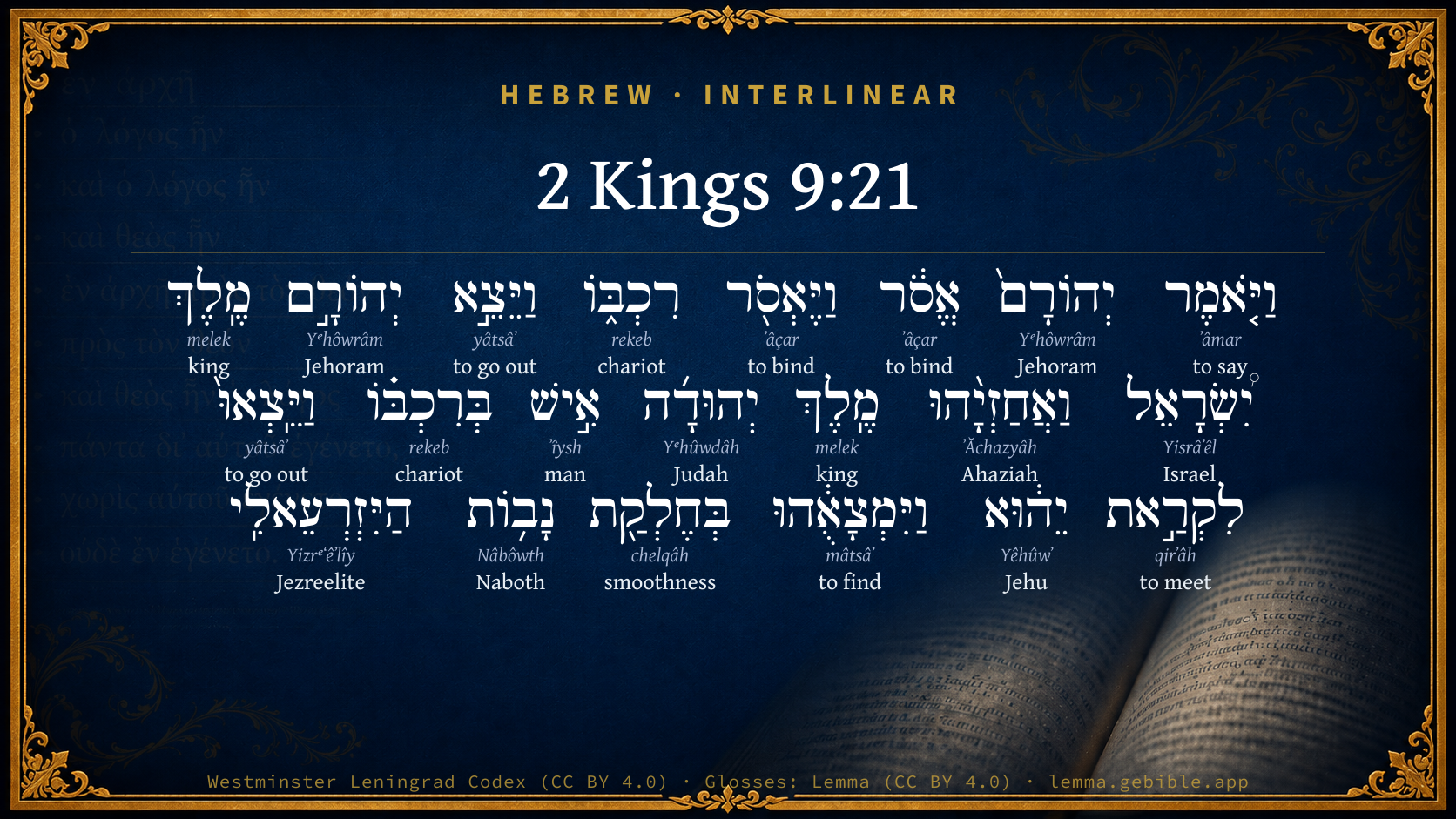
Hebrew (Westminster Leningrad Codex) 2 Kings 9:21 appears in the Hebrew Old Testament. The text above is from the Westminster Leningrad Codex. Each word links to its Strong’s number, a concise gloss, and parsing drawn from the Open Scriptures Hebrew Bible morphology. Click any word for its full Brown-Driver-Briggs (BDB) entry.
Download image
Cite this verse

2 Kings 9:21 (World English Bible). Public Domain. Lemma interlinear Bible study tool, https://lemma.gebible.app/v/2-kings/9/21.

Show BibTeX & RIS
BibTeX
RIS
English Translation
Joram said, Make ready. They made ready his chariot. Joram king of Israel and Ahaziah king of Judah went out, each in his chariot, and they went out to meet Jehu, and found him in the portion of Naboth the Jezreelite.
World English Bible · Public Domain
Download a study sheet

One document with this verse’s original text, its word-by-word gloss line, the meaning frame, cross-references with their text, attributed commentary, and full source and license credits — printable, and it pastes into notes with its structure intact.

This verse Autodidact and up

Study sheet (.html) Plain text (.txt)

A passage Seminary Student

Up to 50 verses in one chapter. A passage sheet keeps up to 6 commentary sources and 12 cross-references per verse, in the order this page ranks them, and says so on the sheet whenever that leaves anything out. Ask for a single verse and you get the Autodidact verse sheet above.

Everything on this page stays free to read, with no account — the sheet is a download of what is already on screen, not access to it.

Want to remove ads? Support Godless Engineer
Compare translations 3

The same verse in 3 English versions, stacked beneath the original-language interlinear above. Click any original word for its lexicon entry.

Each is an independent rendering of the whole verse — the interlinear is not word-aligned to these translations.

Highlighted words mark where these versions differ — a whole-verse word diff, not a word-by-word alignment.

  • World English Bible Public Domain
    Joram said, Make ready. They made ready his chariot. Joram king of Israel and Ahaziah king of Judah went out, each in his chariot, and they went out to meet Jehu, and found him in the portion of Naboth the Jezreelite.
  • King James Version Public Domain
    And Joram said, Make ready. And his chariot was made ready. And Joram king of Israel and Ahaziah king of Judah went out, each in his chariot, and they went out against Jehu, and met him in the portion of Naboth the Jezreelite.
  • unfoldingWord Literal Text CC BY-SA 4.0
    And Joram said, “Harness.” And one harnessed his chariot. And Jehoram, the king of Israel, went out with Ahaziah, the king of Judah, a man in his chariot, and they went out to meet Jehu. And they found him on the portion of Naboth the Jezreelite.

unfoldingWord Literal Text — © unfoldingWord, licensed CC BY-SA 4.0. Word-aligned USFM3 via Door43 (git.door43.org/unfoldingWord/en_ult).

Versions to compare (up to 4)

3 of 4 selected

Show all 18 translations

Every available English version of this verse, each an independent rendering of the whole verse.

  • World English Bible Public Domain
    Joram said, Make ready. They made ready his chariot. Joram king of Israel and Ahaziah king of Judah went out, each in his chariot, and they went out to meet Jehu, and found him in the portion of Naboth the Jezreelite.
  • Berean Standard Bible Public Domain
    “Harness!” Joram shouted, and they harnessed his chariot. Then Joram king of Israel and Ahaziah king of Judah set out, each in his own chariot, and met Jehu on the property of Naboth the Jezreelite.
  • Majority Standard Bible Public Domain
    “Harness!” Joram shouted, and they harnessed his chariot. Then Joram king of Israel and Ahaziah king of Judah set out, each in his own chariot, and met Jehu on the property of Naboth the Jezreelite.
  • King James Version Public Domain
    And Joram said, Make ready. And his chariot was made ready. And Joram king of Israel and Ahaziah king of Judah went out, each in his chariot, and they went out against Jehu, and met him in the portion of Naboth the Jezreelite.
  • American Standard Version (1901) Public Domain
    And Joram said, Make ready. And they made ready his chariot. And Joram king of Israel and Ahaziah king of Judah went out, each in his chariot, and they went out to meet Jehu, and found him in the portion of Naboth the Jezreelite.
  • Revised Version (1885) Public Domain
    And Joram said, Make ready. And they made ready his chariot. And Joram king of Israel and Ahaziah king of Judah went out, each in his chariot, and they went out to meet Jehu, and found him in the portion of Naboth the Jezreelite.
  • Geneva Bible (1599) Public Domain
    Then Iehoram sayd, Make ready: and his charet was made ready. And Iehoram King of Israel and Ahaziah King of Iudah went out eyther of them in his charet against Iehu, and met him in the fielde of Naboth the Izreelite.
  • Douay-Rheims (1899) Public Domain
    And Joram said: Make ready the chariot. And they made ready his chariot, and Joram king of Israel, and Ochozias king of Juda went out, each in his chariot, and they went out to meet Jehu, and met him in the field of Naboth the Jezrahelite.
  • Young's Literal Translation Public Domain
    And Jehoram saith, `Harness;' and his chariot is harnessed, and Jehoram king of Israel goeth out, and Ahaziah king of Judah, each in his chariot, and they go out to meet Jehu, and find him in the portion of Naboth the Jezreelite.
  • Literal Standard Version CC BY-SA 4.0
    And Jehoram says, “Harness”; and his chariot is harnessed, and Jehoram king of Israel goes out, and Ahaziah king of Judah, each in his chariot, and they go out to meet Jehu, and find him in the portion of Naboth the Jezreelite.
  • Unlocked Literal Bible CC BY-SA 4.0
    So Joram said, “Get my chariot ready.” They prepared his chariot, and Joram king of Israel and Ahaziah king of Judah rode out, each in his chariot, to meet Jehu. They found him at the property of Naboth the Jezreelite.
  • unfoldingWord Literal Text CC BY-SA 4.0
    And Joram said, “Harness.” And one harnessed his chariot. And Jehoram, the king of Israel, went out with Ahaziah, the king of Judah, a man in his chariot, and they went out to meet Jehu. And they found him on the portion of Naboth the Jezreelite.
  • Darby Bible Public Domain
    Then Joram said, Make ready! And they made ready his chariot. And Joram king of Israel and Ahaziah king of Judah went out, each in his chariot; and they went out to meet Jehu, and met him in the plot of Naboth the Jizreelite.
  • World Messianic Bible Public Domain
    Joram said, “Get ready!” They got his chariot ready. Then Joram king of Israel and Ahaziah king of Judah went out, each in his chariot; and they went out to meet Jehu, and found him on Naboth the Jezreelite’s land.
  • Webster's Bible Public Domain
    And Joram said, Make ready. And his chariot was made ready. And Joram king of Israel and Ahaziah king of Judah went out, each in his chariot, and they went out against Jehu, and met him in the portion of Naboth the Jezreelite.
  • Free Bible Version CC BY-SA 4.0
    “Prepare my chariot!” Joram shouted, and they had his chariot ready. Then Joram, king of Israel, and Ahaziah, king of Judah, set off in their separate chariots, and met Jehu on the plot of ground that was previously owned by Naboth from Jezreel.
  • Bible in Basic English Public Domain
    Then Joram said, Make ready. So they made his carriage ready; and Joram, king of Israel, with Ahaziah, king of Judah, went out in their carriages for the purpose of meeting Jehu; and they came face to face with him at the field of Naboth the Jezreelite.
  • JPS Tanakh (1917) Public Domain
    And Joram said: 'Make ready.' And they made ready his chariot. And Joram king of Israel and Ahaziah king of Judah went out, each in his chariot, and they went out to meet Jehu, and found him in the portion of Naboth the Jezreelite.

Literal Standard Version (2020), Covenant Press — licensed CC BY-SA 4.0. Text via the HelloAO Bible API (eBible.org). Unlocked Literal Bible (unfoldingWord) — licensed CC BY-SA 4.0. Text via the HelloAO Bible API (eBible.org). unfoldingWord Literal Text — © unfoldingWord, licensed CC BY-SA 4.0. Word-aligned USFM3 via Door43 (git.door43.org/unfoldingWord/en_ult). Free Bible Version, Dr. Jonathan Gallagher — licensed CC BY-SA 4.0. Text via the HelloAO Bible API (eBible.org).

Word by word

More ways to search: Search by grammar → Find every occurrence → Compare this word →

Practice this passage: Drill this verse → Learn its vocabulary →

הַיִּזְרְעֵאלִֽי
Yizrᵉʻêʼlîy
H3158
“the · Jezreelite”
Particle, Definite Article + Noun, Gentilic, Masculine, Singular, Absolute
Part of Speech
Particle + Noun
Type
Gentilic
Gender
Masculine
Number
Singular
State
Absolute
Full BDB Definition

Origin: patronymically from H3157

TWOT: None

Jezreelite = see Jezreel " sown of God" - an inhabitant of Jezreel
  1. וַיֹּ֤אמֶר ʼâmar H559 “and · to say” Conjunction + Verb, Qal, Sequential Imperfect, 3rd Person, Masculine, Singular
  2. יְהוֹרָם֙ Yᵉhôwrâm H3088 “Jehoram” Noun, Proper
  3. אֱסֹ֔ר ʼâçar H631 “bind” Verb, Qal, Imperative, 2nd Person, Masculine, Singular
  4. וַיֶּאְסֹ֖ר ʼâçar H631 “and · to bind” Conjunction + Verb, Qal, Sequential Imperfect, 3rd Person, Masculine, Singular
  5. רִכְבּ֑וֹ rekeb H7393 “chariot · his” Noun, Common, Masculine, Singular, Construct + Suffix, Personal, 3rd Person, Masculine, Singular
  6. וַיֵּצֵ֣א yâtsâʼ H3318 “and · to go out” Conjunction + Verb, Qal, Sequential Imperfect, 3rd Person, Masculine, Singular
  7. יְהוֹרָ֣ם Yᵉhôwrâm H3088 “Jehoram” Noun, Proper
  8. מֶֽלֶךְ melek H4428 “king of” Noun, Common, Masculine, Singular, Construct
  9. יִ֠שְׂרָאֵל Yisrâʼêl H3478 “Israel” Noun, Proper
  10. וַאֲחַזְיָ֨הוּ ʼĂchazyâh H274 “and · Ahaziah” Conjunction + Noun, Proper
  11. מֶֽלֶךְ melek H4428 “king of” Noun, Common, Masculine, Singular, Construct
  12. יְהוּדָ֜ה Yᵉhûwdâh H3063 “Judah” Noun, Proper
  13. אִ֣ישׁ ʼîysh H376 “man” Noun, Common, Masculine, Singular, Absolute
  14. בְּרִכְבּ֗וֹ rekeb H7393 “in/at · chariot · his” Preposition + Noun, Common, Masculine, Singular, Construct + Suffix, Personal, 3rd Person, Masculine, Singular
  15. וַיֵּֽצְאוּ֙ yâtsâʼ H3318 “and · to go out” Conjunction + Verb, Qal, Sequential Imperfect, 3rd Person, Masculine, Plural
  16. לִקְרַ֣את qirʼâh H7125 “to meet” Preposition + Verb, Qal, Infinitive Construct
  17. יֵה֔וּא Yêhûwʼ H3058 “Jehu” Noun, Proper
  18. וַיִּמְצָאֻ֔הוּ mâtsâʼ H4672 “and · to find · him” Conjunction + Verb, Qal, Sequential Imperfect, 3rd Person, Masculine, Plural + Suffix, Personal, 3rd Person, Masculine, Singular
  19. בְּחֶלְקַ֖ת chelqâh H2513 “in/at · smoothness of” Preposition + Noun, Common, Feminine, Singular, Construct
  20. נָב֥וֹת Nâbôwth H5022 “Naboth” Noun, Proper

About this verse

These counts appear in no published source. They are computed here, from the morphology-tagged text and Lemma’s own curated glosses. What Lemma adds →

21
words
16
distinct lemmas
Historical
section

Notable vocabulary

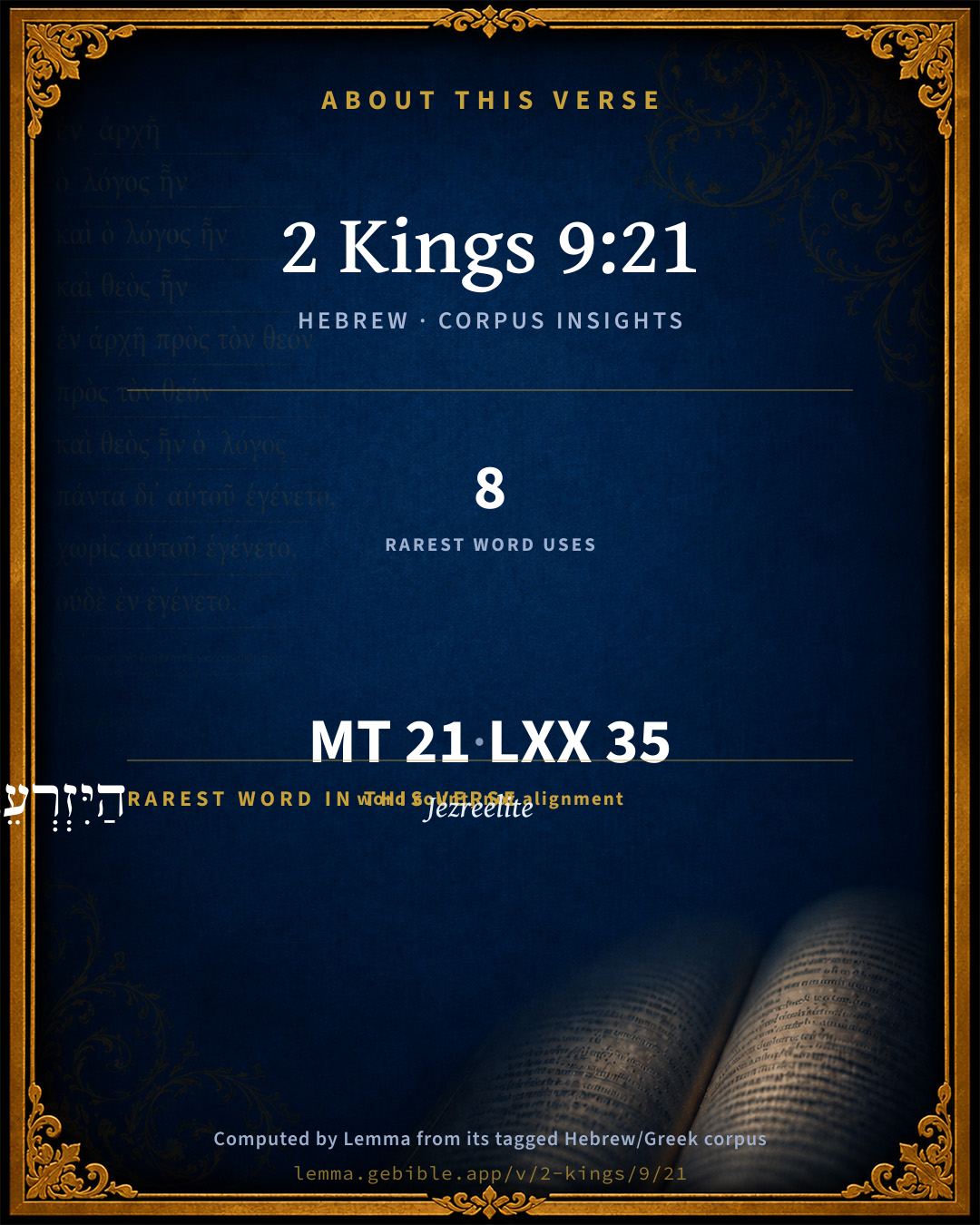
The rarest word here is הַיִּזְרְעֵאלִֽי Jezreelite H3158 — appearing just 8 times in the whole Hebrew Bible.

Shared distinctive vocabulary

הַיִּזְרְעֵאלִֽי Jezreelite H3158 occurs in 8 verses of the Hebrew Bible. Also found in:

Grammatical profile

  • 7 verbs
  • 14 nouns

Verb forms

  • וַיֹּ֤אמֶר Qal · Sequential Imperfect
  • אֱסֹ֔ר Qal · Imperative
  • וַיֶּאְסֹ֖ר Qal · Sequential Imperfect
  • וַיֵּצֵ֣א Qal · Sequential Imperfect
  • וַיֵּֽצְאוּ֙ Qal · Sequential Imperfect
  • לִקְרַ֣את Qal · Infinitive Construct
  • וַיִּמְצָאֻ֔הוּ Qal · Sequential Imperfect

Repetition

Words recur within this verse — often emphatic in Hebrew:

  • יְהוֹרָם֙ Jehoram H3088 ×2
  • אֱסֹ֔ר to bind H631 ×2
  • רִכְבּ֑וֹ chariot H7393 ×2
  • וַיֵּצֵ֣א to go out H3318 ×2
  • מֶֽלֶךְ king H4428 ×2

Hebrew & Septuagint length

In English translation the verse runs 41 words from the Hebrew and 44 from the Septuagint (LXX English) — closely comparable.

A rough comparison of the two English renderings, which tokenize alike — not a word-level alignment.

Word counts can differ between the Hebrew and the Greek without any difference in meaning — e.g. the Hebrew direct-object marker אֵת has no separate Greek word, and Greek often adds the article ὁ.

In the original languages it is 21 Hebrew tokens and 35 Greek tokens — but the two are counted differently (Hebrew bundles its prefixes and suffixes into one token; the Greek is in lemma form), so that isn’t a like-for-like length.

Cross-references

7

Topical passages linked to 2 Kings 9:21 in the Treasury of Scripture Knowledge — connected by theme and wording, ordered by reader-vote popularity; previews shown in the World English Bible.

  • 1 Kings 21:1–7 It happened after these things, that Naboth the Jezreelite had a vineyard, which was in Jezreel, hard by the palace of Ahab king of Samaria.
  • 2 Chronicles 22:7 Now the destruction of Ahaziah was of God, in that he went to Joram: for when he was come, he went out with Jehoram against Jehu the son of Nimshi, whom Yahweh had anointed to cut off the house of Ahab.
  • Numbers 20:14 Moses sent messengers from Kadesh to the king of Edom, Thus says your brother Israel, You know all the travail that has happened to us:
  • 1 Kings 20:14 Ahab said, By whom? He said, Thus says Yahweh, By the young men of the princes of the provinces. Then he said, Who shall begin the battle? He answered, You.
  • 1 Kings 21:15–19 It happened, when Jezebel heard that Naboth was stoned, and was dead, that Jezebel said to Ahab, Arise, take possession of the vineyard of Naboth the Jezreelite, which he refused to give you for money; for Naboth is not alive, but dead.
  • 2 Kings 9:25–26 Then said [Jehu] to Bidkar his captain, Take up, and cast him in the portion of the field of Naboth the Jezreelite; for remember how that, when I and you rode together after Ahab his father, Yahweh laid this burden on him:
  • Micah 1:13 Harness the chariot to the swift steed, inhabitant of Lachish. She was the beginning of sin to the daughter of Zion; For the transgressions of Israel were found in you.

Cross-references courtesy of OpenBible.info (CC BY 4.0).

Hebrew and Greek witnesses Masoretic Hebrew ↔ Greek Septuagint

The same verse in the two great witnesses to the Old Testament, shown verse-for-verse.

These are two independent witnesses, not word-aligned to each other, and the Septuagint is shown in lemma (dictionary) form.

Hebrew 2 Kings 9:21 Masoretic · Westminster Leningrad Codex

וַיֹּ֤אמֶר יְהוֹרָם֙ אֱסֹ֔ר וַיֶּאְסֹ֖ר רִכְבּ֑וֹ וַיֵּצֵ֣א יְהוֹרָ֣ם מֶֽלֶךְ יִ֠שְׂרָאֵל וַאֲחַזְיָ֨הוּ מֶֽלֶךְ יְהוּדָ֜ה אִ֣ישׁ בְּרִכְבּ֗וֹ וַיֵּֽצְאוּ֙ לִקְרַ֣את יֵה֔וּא וַיִּמְצָאֻ֔הוּ בְּחֶלְקַ֖ת נָב֥וֹת הַיִּזְרְעֵאלִֽי

Joram said, Make ready. They made ready his chariot. Joram king of Israel and Ahaziah king of Judah went out, each in his chariot, and they went out to meet Jehu, and found him in the portion of Naboth the Jezreelite.

World English Bible · Public Domain

Greek LXX 2 Kings 9:21 Septuagint · lemma form

καί εἶπον ιωραμ ζευγνύω καί ζευγνύω ἅρμα καί ἐκἔρχομαι ιωραμ βασιλεύς ἰσραήλ καί οχοζιας βασιλεύς ιουδα ἀνήρ ἐν ὁ ἅρμα αὐτός καί ἐκἔρχομαι εἰς ἀπαντή ιου καί εὑρίσκω αὐτός ἐν ὁ μερίς ναβουθαι ὁ ιεζραηλῖτις

And Joram said, Make ready. And one made ready the chariot: and Joram the king of Israel went forth, and Ochozias king of Juda, each in his chariot, and they went to meet Ju, and found him in the portion of Nabuthai the Jezraelite.

LXX2012 (modern English Septuagint) · Public Domain

On this verse, The Pulpit Commentary discusses the Septuagint’s reading. Read the note in Commentary ↓

Hebrew: Westminster Leningrad Codex (CC BY 4.0). Greek: Septuagint (public domain); English from LXX2012 (modern English Septuagint) (Public Domain). How the Septuagint differs from the Hebrew →

Targum (Aramaic paraphrase)

1

The Targum is the ancient Jewish Aramaic paraphrase of the Hebrew Scriptures — an interpretive translation, not the Hebrew text itself. Onkelos (literal) and Pseudo-Jonathan (expansive) render the Torah, and Jonathan the Prophets. Coverage is partial: where no permissively-licensed English translation exists for a verse, only the Aramaic is shown. This is verse-level text, not a word-by-word alignment to the Hebrew.

  1. Targum Jonathan Prophets (Joshua–Malachi)
    וַאֲמַר יְהוֹרָם אִזְדְרַז וְטַקֵיס רְתִיכֵיהּ וּנְפַק יְהוֹרָם מַלְכָּא דְיִשְׂרָאֵל וַאֲחַזְיָהוּ מֶלֶךְ שִׁבְטָא דְבֵית יְהוּדָה גְבַר בִּרְתִיכֵיהּ וּנְפַקוּ לָקֳדָמוּת יֵהוּא וְאַשְׁכְּחוֹהִי בְּאַחֲסָנַת חֲקַל נָבוֹת יִזְרְעֶאלָה:

    (no public-domain English translation for this verse)

    Targum Jonathan — Aramaic: “Mikraot Gedolot” (public domain). English: “Sefaria Community Translation” (CC0 1.0 (public-domain dedication)); “London "Chaldee Paraphrase," 1871” (public domain). Text via Sefaria.

Commentary

Notes on 2 Kings 9:21 from classic Christian and Jewish commentators (each source and its license shown beneath its notes). The classic Christian expositions comment on the surrounding passage and are grouped to its opening verse, so a note may address several verses; the Jewish commentaries on the Tanakh (Rashi and others) are per-verse, so they appear only where the commentator wrote on this verse.

Lemma curates 59 commentaries, every one of them public domain or Creative Commons licensed, each selected and text-cleaned for this edition rather than reprinted as found. About our sources →

Trapp's Complete Commentary

John Trapp

2Ki 9:21 And Joram said, Make ready. And his chariot was made ready. And Joram king of Israel and Ahaziah king of Judah went out, each in his chariot, and they went out against Jehu, and met him in the portion of Naboth the Jezreelite.

Ver. 21. And Joram king of Israel and Ahaziah.] These never dreamed of an enemy, though the messengers were detained, but thought, likely, that Jehu came with good news from the army, whereof himself would be the first messenger. Sic Deus quem destruit dementat, God infatuateth those whom he meaneth to destroy.

John Trapp, A Commentary or Exposition upon All the Books of the Old and New Testament (1647–1656) — public domain. Text from a community e-Sword module.

Joseph Benson's Commentary

2Ki 9:21. They went out against him — Or rather, to meet him, that they might know his intention, and, by their presence, repress any seditious inclinations which might be in Jehu or his followers. And met him in the portion of Naboth — The very sight of that ground was enough to make Jehu triumph, and Joram tremble. The circumstances of events are sometimes so ordered by Divine Providence as to make the punishment answer the sin, as face answers face in a glass.

Joseph Benson's Commentary on the Old and New Testaments (1811–1818) — public domain. Text from a community e-Sword module.

Tyndale Open Study Notes

Tyndale Open Resources

9:21 the plot of land that had belonged to Naboth: The property Ahab took from Naboth became the location for the demise of Ahab’s line, fulfilling Elijah’s prophecy (1 Kgs 21:19-24).

Tyndale Open Study Notes — © Tyndale Open Resources, licensed CC BY-SA 4.0. Text via the HelloAO Bible API.

Adam Clarke's Commentary

Verse 21. Joram - and Ahaziah - went out] They had no suspicion of what was done at Ramoth-gilead; else they would not have ventured their persons as they now did.

Adam Clarke's Commentary on the Bible (1810–1826) — public domain. Text from a community e-Sword/MySword module.

Ellicott's Commentary for English Readers

(21) Make ready.—Literally, bind—i.e., the horses to the chariot.

And his chariot was made ready.—Literally, And one bound his chariot.

Against Jehu.—Rather, to meet Jehu. Joram was curious to know why his messengers had not returned, as well as why the commander-in-chief had left the seat of war. Had he suspected treachery, he would hardly have left the shelter of the walls of Jezreel, and ventured forth without a guard.

In the portion of Naboth.—Naboth’s vineyard, which now formed part of the pleasure-grounds of the palace. (See 1Ki_21:16.)

A Bible Commentary for English Readers, edited by Charles John Ellicott (1878–1897) — public domain. Text from a community e-Sword module.

The Cambridge Bible for Schools and Colleges

gen. ed. J. J. S. Perowne

21. Make ready] Literally as in margin of R.V. ‘yoke’. The mention of Jehu has shewn Joram that the reason must be a weighty one which brings the commander of the army from Ramoth at full speed. So he goes to meet him that he may know what has happened. Apparently he set forth without any body guard, and thus is easily put to flight when Jehu attacks him. The two kings went forth in somewhat of a state array. Both had been in the defence of Ramoth-gilead and so were both interested in what they expected would be news from the army.

went out against Jehu] R.V. to meet Jehu. There is not necessarily an adverse sense in the word, and the kings had no suspicion of what Jehu’s real errand was. It might be disaster in the army, but rebellion was out of their thoughts.

in the portion of Naboth the Jezreelite] This was ‘hard by the palace’ (1Ki_21:1) so that the royal chariots had not gone far before they came upon Jehu. The spot was no longer ‘a vineyard’ as when it belonged to Naboth, but had been converted by Ahab and Jezebel to some other purpose.

The Cambridge Bible for Schools and Colleges (gen. ed. J. J. S. Perowne; Cambridge University Press, 1878–1918) — public domain. Text from a community e-Sword module.

John Gill's Exposition

And Jehu drew a bow with his full strength,.... To give the arrow all the force he could:

and smote Jehoram between his arms; that is, between his shoulders, his back being turned to him, and the chariot an open one:

and the arrow went out at his heart: quite through him:

and he sunk down in his chariot; and died immediately.

John Gill's Exposition of the Whole Bible (1746–1763) — public domain (CC PDM 1.0). Text via the HelloAO Bible API.

Albert Barnes' Notes on the Bible

Make ready - literally, (as in margin) “Blind,” i. e., “Harness the horses to the chariot.” The king had no suspicion of Jehu’s treason. Probably he imagined that he was bringing him important news from the seat of war. Ahaziah’s accompanying him is significant of the close friendship which united the uncle and the nephew. They went out not “against” Jehu, but rather “to meet him.”

In the portion of Naboth - This is no longer called a “vineyard” 1 Kings 21:1-18; probably because it had been thrown into the palace garden, and applied to the purpose for which Ahab originally wanted it. The approach to the city on this side must have lain either through it, or close by it.

Albert Barnes' Notes on the Bible (1834–1885) — public domain. Text from a community e-Sword/MySword module.

Matthew Poole's English Annotations

Against Jehu, or, to meet Jehu, to know his intentions, and by his presence to repress any seditious inclinations which might be in Jehu or his followers.

In the portion of Naboth the Jezreelite; in that field which formerly belonged to Naboth, part whereof was enclosed by Ahab, and made a garden.

Matthew Poole's English Annotations on the Holy Bible (1683–1685) — public domain. Text from a community e-Sword/MySword module.

Whedon's Commentary on the Bible

Daniel D. Whedon

21. Met him in the portion of Naboth — Fatal spot for the son of Ahab, for long before there had gone forth the oracle, that in that spot the dogs should lick his blood. 1Ki_21:19; 1Ki_21:29.

Daniel D. Whedon (gen. ed.), Commentary on the Old and New Testaments (1874–1909) — public domain. Text from a community e-Sword module.

The Pulpit Commentary

And Joram said, Make ready rather, harness; literally, attach i.e. "attach the horses to the chariotand his chariot was made ready literally, and one attached, or harnessed, his chariot and Joram King of Israel and Ahaziah King of Judah went out, each in his chariot. The uncle and the nephew went out together, still, as it would seem, unapprehensive of any danger, though the circumstances were certainly such as might well have amused suspicion. Joram was probably anxious to know the reasons which had induced the captain of his host to quit his post at Ramoth-Gilead. Ahaziah probably accompanied him out of politeness, though he too may have been curious to learn the news. If any disaster had overtaken the army of Israel, the safety of Judah might also be endangered. "Tun res agitur, paries cum proximus ardet." And they went out against Jehu rather, to meet Jehu eijv ajpanthn jIou (LXX); see the Revised Versionand met him in the portion of Naboth the Jezreelite. Humanly speaking, this was accidental. The "portion of Naboth," or his plot of ground, lay outside the southeastern gate of the city, at no great distance from the walls; and it happened that Joram and Jehu met within its limits. Had the king started a little sooner, or had Jehu made less haste, the meeting would have taken place further from the town, and outside the "portion of Naboth." But Divine providence so ordered matters that vengeance for the sin of Ahab was exacted upon the very scene of his guilt, and a prophecy made, probably by Elisha, years previously, and treasured up in the memory of Jehu (ver. 26), was fulfilled to the letter.

The Pulpit Commentary (1880–1919), ed. H.D.M. Spence-Jones & Joseph S. Exell — public domain. Text from a community e-Sword module.

John Wesley's Explanatory Notes

Portion of Naboth - The very sight of that ground was enough to make Jehu triumph and Joram tremble. The circumstances of events are sometimes so ordered by Divine providence, as to make the punishment answer the sin, as face answers face in a glass.

John Wesley, Explanatory Notes Upon the Whole Bible (1754–1765) — public domain. Text via the GEBible commentary corpus.

unfoldingWord translationNotes

Door43 World Missions Community

each in his chariot

"each in his own chariot"

They found him at

"When they reached Jehu, he was at"

Naboth

This is the name of a man. (See: How to Translate Names)

Jezreelite

This refers to a person from Jezreel. (See: How to Translate Names)

What peace is there, when the idolatrous acts of prostitution and witchcraft of your mother Jezebel are so many?

Jehu uses this rhetorical question to state why he is not coming in peace. This can be stated in active form. AT: "There can be no peace as long as your mother Jezebel practices and promotes so much idolatry in the form of prostitution and witchcraft." (See: Rhetorical Question)

translationWords

Joram

chariot

Ahaziah

Jezreel

false god

prostitute

Jezebel

unfoldingWord translationNotes — © Distant Shores Media and the Door43 World Missions Community, licensed CC BY-SA 4.0. Source: git.door43.org/Door43/en_tn.

Lesson kit

Teaching starters — assembled from the data on this page, not authored interpretation. Every prompt links to the verse data it draws on. Edit before teaching.

2 Kings, in the Historical, opens this verse with 21 words (16 distinct Hebrew lemmas). Its most distinctive word is Yizrᵉʻêʼlîy (“Jezreelite”). A historical commentator’s framing appears above. Read the whole chapter for the surrounding context.

Discussion questions

  1. The word Yizrᵉʻêʼlîy carries the sense “Jezreelite.” How does it shape the verse?
  2. 1 Kings 21:1 shares the word «Jezreelite» with this verse. How do the two illuminate each other?
  3. “Jehoram” occurs 2× in this one verse. What is the effect of the repetition?
  4. The translations on this page render this verse differently — a whole-verse word diff, not a word-by-word alignment. What might account for the different wordings?
  5. The verb «וַיֹּ֤אמֶר» is Qal Sequential Imperfect. How does its form color the action?
  6. Reading how Trapp's Complete Commentary and Joseph Benson's Commentary read this verse, where do the two commentators agree and where do they part?

Things to notice

Reading settings

Reading text

Shown beneath each verse's original-language words.

Old Testament
Old Testament edition

Read the OT as the Masoretic Hebrew (MT) or the Greek Septuagint (LXX).

English shown for the Greek Septuagint (in the Hebrew ↔ Greek comparison).

Comparing translations? Open the Compare panel on any verse page to stack up to four side by side.