Isaiah 48:2

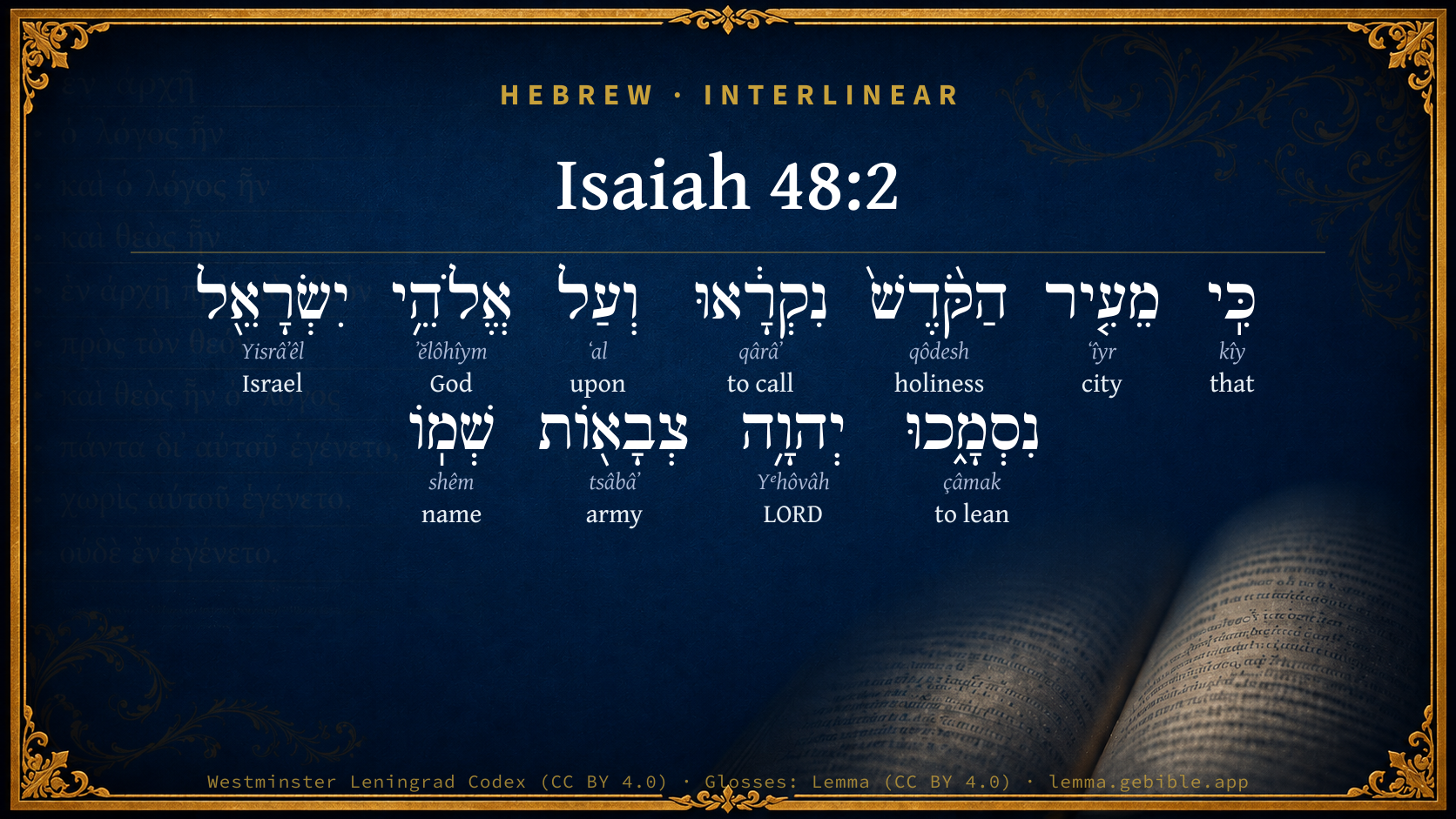
Hebrew (Westminster Leningrad Codex) Isaiah 48:2 appears in the Hebrew Old Testament. The text above is from the Westminster Leningrad Codex. Each word links to its Strong’s number, a concise gloss, and parsing drawn from the Open Scriptures Hebrew Bible morphology. Click any word for its full Brown-Driver-Briggs (BDB) entry.
Download image
Cite this verse

Isaiah 48:2 (World English Bible). Public Domain. Lemma interlinear Bible study tool, https://lemma.gebible.app/v/isaiah/48/2.

Show BibTeX & RIS
BibTeX
RIS
English Translation
(for they call themselves of the holy city, and stay themselves on the God of Israel; Yahweh of Hosts is his name):
World English Bible · Public Domain
Download a study sheet

One document with this verse’s original text, its word-by-word gloss line, the meaning frame, cross-references with their text, attributed commentary, and full source and license credits — printable, and it pastes into notes with its structure intact.

This verse Autodidact and up

Study sheet (.html) Plain text (.txt)

A passage Seminary Student

Up to 50 verses in one chapter. A passage sheet keeps up to 6 commentary sources and 12 cross-references per verse, in the order this page ranks them, and says so on the sheet whenever that leaves anything out. Ask for a single verse and you get the Autodidact verse sheet above.

Everything on this page stays free to read, with no account — the sheet is a download of what is already on screen, not access to it.

Want to remove ads? Support Godless Engineer
Compare translations 3

The same verse in 3 English versions, stacked beneath the original-language interlinear above. Click any original word for its lexicon entry.

Each is an independent rendering of the whole verse — the interlinear is not word-aligned to these translations.

Highlighted words mark where these versions differ — a whole-verse word diff, not a word-by-word alignment.

  • World English Bible Public Domain
    (for they call themselves of the holy city, and stay themselves on the God of Israel; Yahweh of Hosts is his name):
  • King James Version Public Domain
    For they call themselves of the holy city, and stay themselves upon the God of Israel; The LORD of hosts is his name.
  • unfoldingWord Literal Text CC BY-SA 4.0
    For they call themselves after the city of holiness, and they support themselves on the God of Israel, Yahweh of Armies his name. q1

unfoldingWord Literal Text — © unfoldingWord, licensed CC BY-SA 4.0. Word-aligned USFM3 via Door43 (git.door43.org/unfoldingWord/en_ult).

Versions to compare (up to 4)

3 of 4 selected

Show all 18 translations

Every available English version of this verse, each an independent rendering of the whole verse.

  • World English Bible Public Domain
    (for they call themselves of the holy city, and stay themselves on the God of Israel; Yahweh of Hosts is his name):
  • Berean Standard Bible Public Domain
    who indeed call yourselves after the holy city and lean on the God of Israel; the LORD of Hosts is His name.
  • Majority Standard Bible Public Domain
    who indeed call yourselves after the holy city and lean on the God of Israel; the LORD of Hosts is His name.
  • King James Version Public Domain
    For they call themselves of the holy city, and stay themselves upon the God of Israel; The LORD of hosts is his name.
  • American Standard Version (1901) Public Domain
    (for they call themselves of the holy city, and stay themselves upon the God of Israel; Jehovah of hosts is his name):
  • Revised Version (1885) Public Domain
    For they call themselves of the holy city, and stay themselves upon the God of Israel; the LORD of hosts is his name.
  • Geneva Bible (1599) Public Domain
    For they are called of the holy citie, and staie themselues vpon the God of Israel, whose Name is the Lord of hostes.
  • Douay-Rheims (1899) Public Domain
    For they are called of the holy city, and are established upon the God of Israel: the Lord of hosts is his name.
  • Young's Literal Translation Public Domain
    For from the Holy City they have been called, And on the God of Israel been supported, Jehovah of Hosts `is' His name.
  • Literal Standard Version CC BY-SA 4.0
    For they have been called from the Holy City, || And been supported on the God of Israel, || YHWH of Hosts [is] His Name.
  • Unlocked Literal Bible CC BY-SA 4.0
    For they call themselves people of the holy city and trust in the God of Israel. Yahweh of hosts is his name.
  • unfoldingWord Literal Text CC BY-SA 4.0
    For they call themselves after the city of holiness, and they support themselves on the God of Israel, Yahweh of Armies his name. q1
  • Darby Bible Public Domain
    For they are named after the holy city, and stay themselves upon the God of Israel: Jehovah of hosts is his name.
  • World Messianic Bible Public Domain
    for they call themselves citizens of the holy city, and rely on the God of Israel; the LORD of Hosts is his name.
  • Webster's Bible Public Domain
    For they call themselves of the holy city, and stay themselves upon the God of Israel; The LORD of hosts is his name.
  • Free Bible Version CC BY-SA 4.0
    You say you're from the “Holy City,” and claim you're trusting in the God of Israel, whose name is the Lord Almighty.
  • Bible in Basic English Public Domain
    For they say that they are of the holy town, and put their faith in the God of Israel: the Lord of armies is his name.
  • JPS Tanakh (1917) Public Domain
    For they call themselves of the holy city, and stay themselves upon the God of Israel, the LORD of hosts is His name.

Literal Standard Version (2020), Covenant Press — licensed CC BY-SA 4.0. Text via the HelloAO Bible API (eBible.org). Unlocked Literal Bible (unfoldingWord) — licensed CC BY-SA 4.0. Text via the HelloAO Bible API (eBible.org). unfoldingWord Literal Text — © unfoldingWord, licensed CC BY-SA 4.0. Word-aligned USFM3 via Door43 (git.door43.org/unfoldingWord/en_ult). Free Bible Version, Dr. Jonathan Gallagher — licensed CC BY-SA 4.0. Text via the HelloAO Bible API (eBible.org).

Word by word

More ways to search: Search by grammar → Find every occurrence → Compare this word →

Practice this passage: Drill this verse → Learn its vocabulary →

נִסְמָ֑כוּ
çâmak
H5564
“to lean”
Verb, Niphal, Perfect, 3rd Person, Common, Plural
Part of Speech
Verb
Stem
Niphal
Form
Perfect
Person
3rd Person
Gender
Common
Number
Plural
Full BDB Definition

Origin: a primitive root

TWOT: 1514

to lean, lay, rest, support, put, uphold, lean upon - (Qal) - to lean or lay upon, rest upon, lean against - to support, uphold, sustain - (Niphal) to support or brace oneself - (Piel) to sustain, refresh, revive
  1. כִּֽי kîy H3588 “that” Conjunction
  2. מֵעִ֤יר ʻîyr H5892 “from · city of” Preposition + Noun, Common, Feminine, Singular, Construct
  3. הַקֹּ֨דֶשׁ֙ qôdesh H6944 “the · holiness” Particle, Definite Article + Noun, Common, Masculine, Singular, Absolute
  4. נִקְרָ֔אוּ qârâʼ H7121 “to call” Verb, Niphal, Perfect, 3rd Person, Common, Plural
  5. וְעַל ʻal H5921 “and · upon” Conjunction + Preposition
  6. אֱלֹהֵ֥י ʼĕlôhîym H430 “God(s) of” Noun, Common, Masculine, Plural, Construct
  7. יִשְׂרָאֵ֖ל Yisrâʼêl H3478 “Israel” Noun, Proper
  8. יְהוָ֥ה Yᵉhôvâh H3068 “LORD” Noun, Proper
  9. צְבָא֖וֹת tsâbâʼ H6635 “armies” Noun, Common, Both, Plural, Absolute
  10. שְׁמֽוֹ shêm H8034 “name · his” Noun, Common, Masculine, Singular, Construct + Suffix, Personal, 3rd Person, Masculine, Singular

About this verse

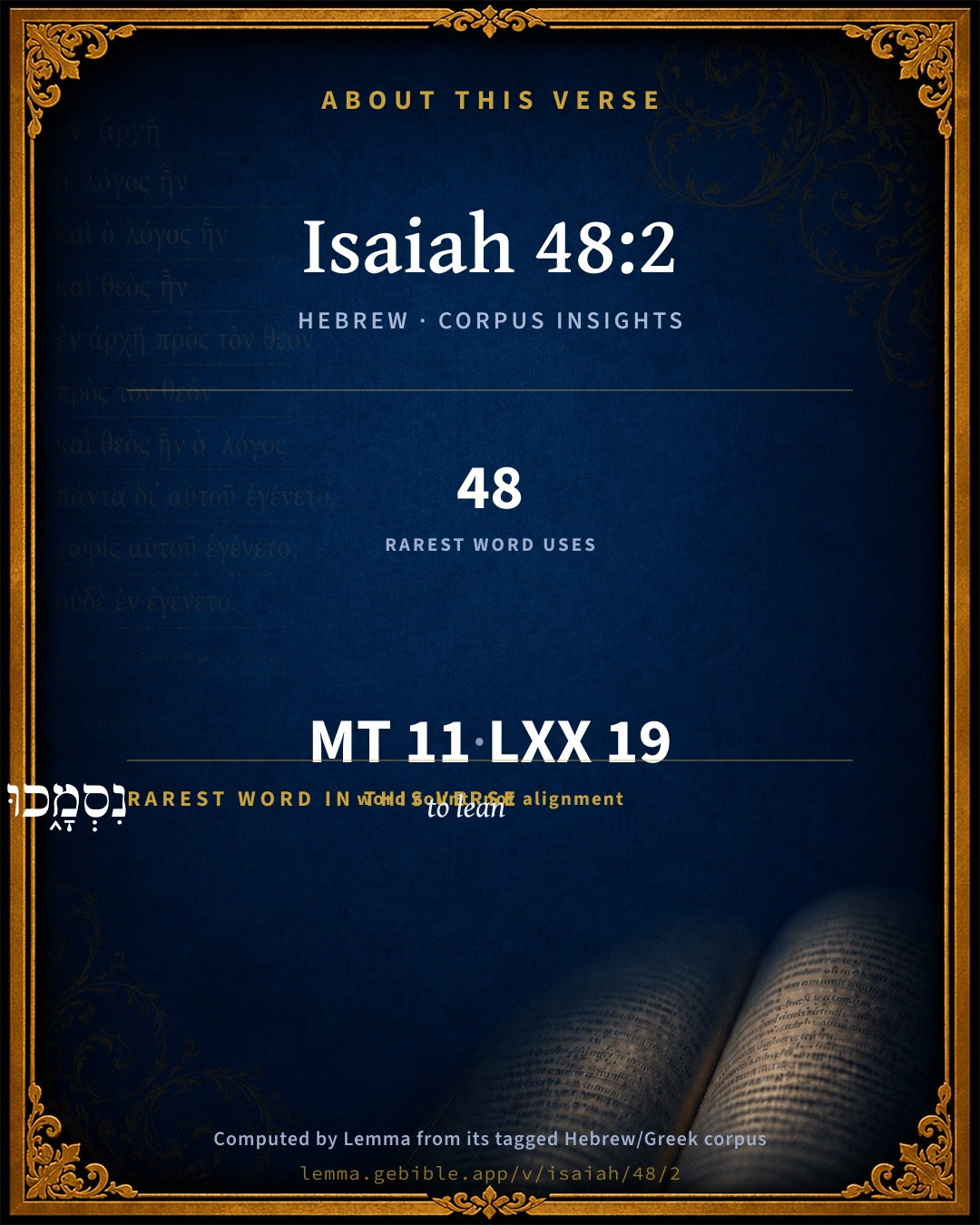
These counts appear in no published source. They are computed here, from the morphology-tagged text and Lemma’s own curated glosses. What Lemma adds →

11
words
11
distinct lemmas
Prophets
section

Shared distinctive vocabulary

נִסְמָ֑כוּ to lean H5564 occurs in 47 verses of the Hebrew Bible. Also found in:

Grammatical profile

  • 2 verbs
  • 7 nouns
  • 1 preposition
  • 1 conjunction

Verb forms

  • נִקְרָ֔אוּ Niphal · Perfect
  • נִסְמָ֑כוּ Niphal · Perfect

Hebrew & Septuagint length

In English translation the verse runs 22 words from the Hebrew and 30 from the Septuagint (LXX English) — closely comparable.

A rough comparison of the two English renderings, which tokenize alike — not a word-level alignment.

Word counts can differ between the Hebrew and the Greek without any difference in meaning — e.g. the Hebrew direct-object marker אֵת has no separate Greek word, and Greek often adds the article ὁ.

In the original languages it is 11 Hebrew tokens and 19 Greek tokens — but the two are counted differently (Hebrew bundles its prefixes and suffixes into one token; the Greek is in lemma form), so that isn’t a like-for-like length.

Cross-references

23

Topical passages linked to Isaiah 48:2 in the Treasury of Scripture Knowledge — connected by theme and wording, ordered by reader-vote popularity; previews shown in the World English Bible.

  • Micah 3:11 Her leaders judge for bribes, And her priests teach for a price, And her prophets of it tell forturnes for money: Yet they lean on Yahweh, and say, Isn't Yahweh in the midst of us? No disaster will come on us.
  • Isaiah 10:20 It shall come to pass in that day, that the remnant of Israel, and those who are escaped of the house of Jacob, shall no more again lean on him who struck them, but shall lean on Yahweh, the Holy One of Israel, in truth.
  • Isaiah 52:1 Awake, awake, put on your strength, Zion; put on your beautiful garments, Jerusalem, the holy city: for henceforth there shall no more come into you the uncircumcised and the unclean.
  • Romans 2:17 Indeed you bear the name of a Jew, and rest on the law, and glory in God,
  • Jeremiah 21:2 Please inquire of Yahweh for us; for Nebuchadrezzar king of Babylon makes war against us: peradventure Yahweh will deal with us according to all his wondrous works, that he may go up from us.
  • Matthew 27:53 and coming out of the tombs after his resurrection, they entered into the holy city and appeared to many.
  • Judges 17:13 Then said Micah, Now know I that Yahweh will do me good, seeing I have a Levite to my priest.
  • 1 Samuel 4:3–5 When the people were come into the camp, the elders of Israel said, Why has Yahweh struck us today before the Philistines? Let us get the ark of the covenant of Yahweh out of Shiloh to us, that it may come among us, and save us out of the hand of our enemies.
  • Nehemiah 11:1 The princes of the people lived in Jerusalem: the rest of the people also cast lots, to bring one of ten to dwell in Jerusalem the holy city, and nine parts in the [other] cities.
  • Nehemiah 11:18 All the Levites in the holy city were two hundred eighty-four.
  • Psalms 48:1 Great is Yahweh, and greatly to be praised, In the city of our God, in his holy mountain.
  • Psalms 87:3 Glorious things are spoken about you, city of God. Selah.
  • Isaiah 47:4 Our Redeemer, Yahweh of hosts is his name, the Holy One of Israel.
  • Isaiah 51:13 and have forgotten Yahweh your Maker, who stretched forth the heavens, and laid the foundations of the earth; and fear continually all the day because of the fury of the oppressor, when he makes ready to destroy? and where is the fury of the oppressor?
  • Isaiah 64:10–11 Your holy cities are become a wilderness, Zion is become a wilderness, Jerusalem a desolation.
  • Jeremiah 7:4–11 Don't you trust in lying words, saying, The temple of Yahweh, the temple of Yahweh, the temple of Yahweh, are these.
  • Jeremiah 10:16 The portion of Jacob is not like these; for he is the former of all things; and Israel is the tribe of his inheritance: Yahweh of Hosts is his name.
  • Daniel 9:24 Seventy weeks are decreed on your people and on your holy city, to finish disobedience, and to make an end of sins, and to make reconciliation for iniquity, and to bring in everlasting righteousness, and to seal up vision and prophecy, and to anoint the most holy.
  • Matthew 4:5 Then the devil took him into the holy city. He set him on the pinnacle of the temple,
  • John 8:40–41 But now you seek to kill me, a man who has told you the truth, which I heard from God. Abraham didn't do this.
  • Revelation 11:2 Leave out the court which is outside of the temple, and don't measure it, for it has been given to the gentiles. They will tread the holy city under foot for forty-two months.
  • Revelation 21:2 I saw the holy city, New Jerusalem, coming down out of heaven from God, made ready like a bride adorned for her husband.
  • Revelation 22:19 If anyone takes away from the words of the book of this prophecy, may God take away his part from the tree of life, and out of the holy city, which are written in this book.

Cross-references courtesy of OpenBible.info (CC BY 4.0).

Hebrew and Greek witnesses Masoretic Hebrew ↔ Greek Septuagint

The same verse in the two great witnesses to the Old Testament, shown verse-for-verse.

These are two independent witnesses, not word-aligned to each other, and the Septuagint is shown in lemma (dictionary) form.

Hebrew Isaiah 48:2 Masoretic · Westminster Leningrad Codex

כִּֽי מֵעִ֤יר הַקֹּ֨דֶשׁ֙ נִקְרָ֔אוּ וְעַל אֱלֹהֵ֥י יִשְׂרָאֵ֖ל נִסְמָ֑כוּ יְהוָ֥ה צְבָא֖וֹת שְׁמֽוֹ

(for they call themselves of the holy city, and stay themselves on the God of Israel; Yahweh of Hosts is his name):

World English Bible · Public Domain

Greek LXX Isaiah 48:2 Septuagint · lemma form

καί ἀντιἔχω ὁ ὄνομα ὁ πόλις ὁ ἅγιος καί ἐπί ὁ θεός ὁ ἰσραήλ ἀντιστηρίζω κύριος σαβαωθ ὄνομα αὐτός

maintaining also the name of the holy city, and staying themselves on the God of Israel: the Lord of hosts is his name. The former things I have already declared;

LXX2012 (modern English Septuagint) · Public Domain

Hebrew: Westminster Leningrad Codex (CC BY 4.0). Greek: Septuagint (public domain); English from LXX2012 (modern English Septuagint) (Public Domain). How the Septuagint differs from the Hebrew →

Targum (Aramaic paraphrase)

1

The Targum is the ancient Jewish Aramaic paraphrase of the Hebrew Scriptures — an interpretive translation, not the Hebrew text itself. Onkelos (literal) and Pseudo-Jonathan (expansive) render the Torah, and Jonathan the Prophets. Coverage is partial: where no permissively-licensed English translation exists for a verse, only the Aramaic is shown. This is verse-level text, not a word-by-word alignment to the Hebrew.

  1. Targum Jonathan Prophets (Joshua–Malachi)
    אֲרֵי בְקַרְתָּא דְקוּדְשָׁא חוּלָקְהוֹן וְעַל אֱלָהָא דְיִשְׂרָאֵל רוֹחֲצָנְהוֹן יְיָ צְבָאוֹת שְׁמוֹ:

    For their portion is in the holy city, and their confidence is in the God of Israel; The Lord of hosts is His name.

    Targum Jonathan — Aramaic: “Mikraot Gedolot” (public domain). English: “Sefaria Community Translation” (CC0 1.0 (public-domain dedication)); “London "Chaldee Paraphrase," 1871” (public domain). Text via Sefaria.

Commentary

Notes on Isaiah 48:2 from classic Christian and Jewish commentators (each source and its license shown beneath its notes). The classic Christian expositions comment on the surrounding passage and are grouped to its opening verse, so a note may address several verses; the Jewish commentaries on the Tanakh (Rashi and others) are per-verse, so they appear only where the commentator wrote on this verse.

Lemma curates 59 commentaries, every one of them public domain or Creative Commons licensed, each selected and text-cleaned for this edition rather than reprinted as found. About our sources →

Trapp's Complete Commentary

John Trapp

Isa 48:2 For they call themselves of the holy city, and stay themselves upon the God of Israel; The LORD of hosts [is] his name.

Ver. 2. For they call themselves of the holy city.] Inhabitants of Jerusalem and men of Judah; yea, they swore by their city and temple, as appeareth in the gospel, and cried out, ad ravim usque, "The temple of the Lord, the temple of the Lord," {Jer 7:4} like as the Romists now do, The Church, the Church, glorying in the false and empty title of Roman Catholics. Sed grande est Christianum esse, non dici, saith Jerome; and it is a great vanity, saith the poet,

“ Respicere ad fumos et nomina vana Catonum. ”

And stay themselves.] As far as a few good words will go. See on Mic 3:11.

The Lord of hosts is his name.] So said these hypocrites, bearing themselves bold upon so great a God, who had all creatures at his command.

John Trapp, A Commentary or Exposition upon All the Books of the Old and New Testament (1647–1656) — public domain. Text from a community e-Sword module.

Geneva Bible (1599)

Geneva Bible translators

They make a show, as though they would have none other God.

Geneva Bible (1599) marginal notes — public domain. Text via Bolls.life.

Jamieson, Fausset & Brown

Robert Jamieson, A. R. Fausset & David Brown

For--Ye deserve these reproofs; "for" ye call yourselves citizens of "the holy city" (Isa 52:1), but not in truth (Isa 48:1; Neh 11:1; Dan 9:24); so the inscription on their coins of the time of the Maccabees. "Jerusalem the Holy."

Jamieson, Fausset & Brown — Commentary Critical and Explanatory on the Whole Bible (1871) — public domain (CC PDM 1.0). Text via the HelloAO Bible API.

Ellicott's Commentary for English Readers

(2) They call themselves of the holy city . . .—The words of praise are spoken, as the preceding words show, with a touch of irony. Those who so boasted were not true citizens of Zion (Psa_15:1; Mat_3:9). They did not enter into all that was implied in their confession of Jehovah Sabaoth.

A Bible Commentary for English Readers, edited by Charles John Ellicott (1878–1897) — public domain. Text from a community e-Sword module.

The Cambridge Bible for Schools and Colleges

gen. ed. J. J. S. Perowne

2. of (or by) the holy city] The phrase is here applied to Jerusalem for the first time in the O.T. It occurs again in ch. Isa_52:1, elsewhere only in the books of Nehemiah and Daniel (comp. Mat_4:5).

3–6 a inculcate the lesson of the “former things,” i.e. the events that have now taken place, especially the appearance of Cyrus. These were predicted in advance, that Israel might not be able to say they were done by the false gods (Isa_48:5).

The Cambridge Bible for Schools and Colleges (gen. ed. J. J. S. Perowne; Cambridge University Press, 1878–1918) — public domain. Text from a community e-Sword module.

John Gill's Exposition

For they call themselves of the holy city,.... The city Jerusalem, so called because the temple, the place of divine worship, was in it, the residence of the Holy One of Israel: they valued themselves, not only upon their being of the family of Jacob, and of the tribe of Judah, but that they were inhabitants of Jerusalem, the holy city; as many now call themselves fellow citizens with the saints, and of the household of God, when they are strangers both to God and his people in the experimental knowledge of things:

and stay themselves upon the God of Israel; professed to trust in the Lord, and lean upon him, and rely upon his power and providence, his mercy and goodness, and expect all needful things from him, renouncing all confidence in the creature; and yet at the same time acted an hypocritical part, their faith was feigned: see Mic 3:11.

The Lord of hosts is his name; whom they professed to be their God and Father, their Lord and Husband, their Saviour and Redeemer; who has all power in heaven and in earth, and does according to his will in both worlds, having the hosts of angels and armies of men at his command, and therefore so called.

John Gill's Exposition of the Whole Bible (1746–1763) — public domain (CC PDM 1.0). Text via the HelloAO Bible API.

Albert Barnes' Notes on the Bible

For they call themselves of the holy city - Of Jerusalem (see Isa 52:1; Neh 11:1; Mat 4:5; Mat 27:53; Rev. 21:2-27). The word rendered ‘for’ here, (כי kı̂y) means, as it often does, “although”; and the sense is, although they call themselves of the holy city, they do not worship God in sincerity and truth. Jerusalem was called ‘the holy city,’ because the temple, the ark, and the symbol of the divine presence were there, and it was the place where God was worshipped. It was deemed sacred by the Jews, and they regarded it as sufficient proof of goodness, it would seem, that they had dwelt there. Even in Babylon they would pride themselves on this, and suppose, perhaps, that it entitled them to divine protection and favor.

And stay themselves upon the God of Israel - In time of danger and trial they profess to seek him, and to commit their cause to him.

The Lord of hosts is his name - (See the notes at Isa 1:9). The object of the prophet in here mentioning his holy name is, probably, to show them the guilt of their conduct. He was Yahweh, the source of all existence. He was the God of all the hosts of heaven, and all the armies on earth. How wicked, therefore, it was to come before him in a false and hypocritical manner, and while they were professedly worshipping him, to be really offering their hearts to idols, and to be characteristically inclined to relapse into idolatry!

Albert Barnes' Notes on the Bible (1834–1885) — public domain. Text from a community e-Sword/MySword module.

Haydock's Catholic Bible Commentary

City: citizens of Jerusalem, Daniel iii. 28., and Matthew iv. 5.

George Leo Haydock (1774–1849), Haydock's Catholic Family Bible and Commentary, 1859 edition — public domain. Excludes Psalms (Douay-Rheims chapter numbering differs from Protestant) and Deuterocanonical books (Catholic canon only).

Matthew Poole's English Annotations

For; or, as others render it, and this particle frequently signifies, Though. And so this is added as a great aggravation of their want and neglect of truth and righteousness.

They shall call themselves of the holy city: they glory in this, that they are citizens of Jerusalem, a city sanctified by God himself to be the only place of his true worship and gracious presence; which as it is a great privilege, so it laid a great obligation upon them to walk more holily than they did.

Stay themselves; not by a true and well-grounded faith, but by a vain and presumptive confidence, flattering themselves, as that people commonly did, that they should enjoy peace and safety, notwithstanding all their wickedness, because they were the Lord’s people, and had his temple and ordinances among them; which disposition the prophets frequently observe and sharply censure in them.

The Lord of hosts is his name; or, whose name is the Lord of hosts.

Matthew Poole's English Annotations on the Holy Bible (1683–1685) — public domain. Text from a community e-Sword/MySword module.

The Pulpit Commentary

For they call themselves of the holy city. It is an indication of their real want of truth and righteousness, that they lay such stress upon what is so entirely outward and formal, as the fact of their belonging to" the holy city," Jerusalem. Compare the boast of the Jews in our Lord"s time, "We be Abraham"s seed". (Joh_8:33) Stay themselves upon the God of Israel. Not resting upon him in real faith and true humble dependence, as those Israelites who are mentioned in Isa_10:20. but trusting to the facts that they were "Israel," and that God was "the God of Israel," and therefore bound to protect them. God reminds them that, if he is "the God of Israel," he is also "the Lord of hosts a term, as Dr. Kay notes, especially connected with the holiness of God.

The Pulpit Commentary (1880–1919), ed. H.D.M. Spence-Jones & Joseph S. Exell — public domain. Text from a community e-Sword module.

John Wesley's Explanatory Notes

Though - They glory that they are citizens of Jerusalem, a city sanctified by God, to be the place of his true worship, and gracious presence. And stay - Not by a true faith, but a vain confidence.

John Wesley, Explanatory Notes Upon the Whole Bible (1754–1765) — public domain. Text via the GEBible commentary corpus.

J. A. Alexander on Isaiah

Joseph Addison Alexander

“For from the Holy City they are called.” The same name is given to Jerusalem below, (Isa 51:1}, and also in the later books (Dan 9:24; Neh 12:1), and the New Testament (Mat 4:5; Mat 27:53). It is so called as the seat of the true religion, the earthly residence of God, and the center of the church. That the reference is not to mere locality is plain from the application of the name to the whole people. The particle at the beginning of this verse has somewhat perplexed interpreters. The safest, because the simplest course, is to take it in its ordinary sense of ‘for, because’, and to regard it as continuing the previous description, or rather as resuming it after a momentary interruption, for which reason ‘for’ is used instead of ‘and’. The connection may be thus rendered clear by a paraphrase: ‘I speak to those who bear the name of Israel and worship Israel’s God, however insincerely and imperfectly; for they are still the chosen people, and as such entitled to rely upon Jehovah.’ This last is then descriptive not of a mere professed, nor of a real yet presumptuous reliance, but of the prerogative of Israel considered as the church or chosen people, a prerogative not forfeited by their unfaithfulness, so long as its continuance was necessary to the end for which it was originally granted. The false interpretations of the passage have arisen from applying it directly to the faith or unbelief of individuals, in which case there appears to be an incongruity between the parts of the description; but as soon as we apply it to the body, this apparent incongruity is done away, it being not only consistent with Isaiah’s purpose, but a necessary part of it, to hold up the prerogatives of Israel as wholly independent of all merit upon, their part. “Jehovah of Hosts (is) His name.” These words are added to identify the object of reliance more completely, as the being who was called the God of Israel and Jehovah of Hosts. At the same time they suggest the attributes implied in both parts of the name. As if he had said, they rely upon the God of Israel, whom they acknowledge as an independent and eternal Being, and the Sovereign of the universe.

Joseph Addison Alexander, The Prophecies of Isaiah (1846–1847; New York: Scribner, 1870–1878) — public domain. Text from a community e-Sword module.

Rashi

Rabbi Shlomo Yitzchaki (Rashi)

and they leaned on the God of Israel in the days of Hezekiah, about whom it is written (2 Kings 18:5): “He trusted in the Lord God of Israel.” That caused them not to be exiled except in the days of Nebuchadnezzar, who exiled them to Babylon, and they had a redemption through Cyrus.

Rashi on the Tanakh — English translations: “The Judaica Press complete Tanach with Rashi, translated by A. J. Rosenberg” (CC BY 4.0); “Pentateuch with Rashi's commentary by M. Rosenbaum and A.M. Silbermann, 1929-1934” (public domain); “The Metsudah Tanach series, Lakewood, N.J” (CC BY 4.0); and “The Book of Joshua, Metsudah Publications, 1997” (CC BY 4.0). Text via Sefaria.

Ibn Ezra

Rabbi Abraham ibn Ezra

For they call themselves of the holy city, namely children of Zion.

And stay themselves upon the God of Israel with their lips.

Ibn Ezra on the Tanakh — English translations: “Sefaria Community Translation” (CC0 1.0 (public-domain dedication)); “Yalkut, Sifsei Chachomim Chumash, Metsudah Publications, 2009” (CC BY 4.0); and “Commentary of Ibn Ezra on Isaiah - trans. by M. Friedlander, 1873” (public domain). Text via Sefaria.

Lesson kit

Teaching starters — assembled from the data on this page, not authored interpretation. Every prompt links to the verse data it draws on. Edit before teaching.

Isaiah, in the Prophets, opens this verse with 11 words (11 distinct Hebrew lemmas). Its most distinctive word is çâmak (“to lean”). A historical commentator’s framing appears above. Read the whole chapter for the surrounding context.

Discussion questions

  1. What does “to lean” (çâmak) contribute to the verse as a whole?
  2. How does Genesis 27:37, which shares the word «to lean», read alongside this verse?
  3. The translations on this page render this verse differently — a whole-verse word diff, not a word-by-word alignment. What might account for the different wordings?
  4. «נִקְרָ֔אוּ» is a Niphal Perfect verb. How does that grammatical form shape the action described?
  5. Compare how Trapp's Complete Commentary and Geneva Bible (1599) read this verse. Where do they agree or differ?

Things to notice

Reading settings

Reading text

Shown beneath each verse's original-language words.

Old Testament
Old Testament edition

Read the OT as the Masoretic Hebrew (MT) or the Greek Septuagint (LXX).

English shown for the Greek Septuagint (in the Hebrew ↔ Greek comparison).

Comparing translations? Open the Compare panel on any verse page to stack up to four side by side.