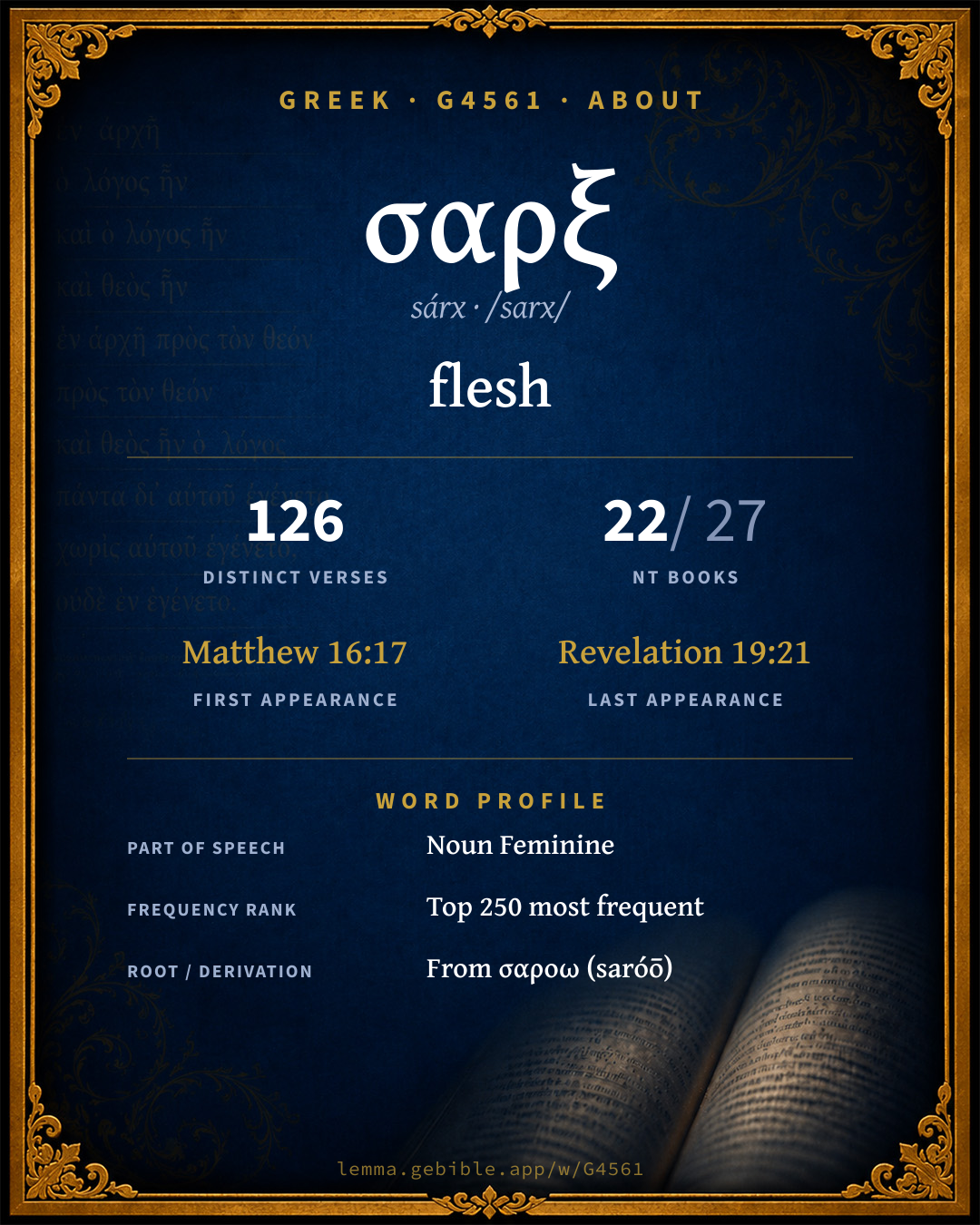
σάρξ
flesh
‘flesh’ is one of 6 main senses fuller range ↓
Full lexicon entry — Thayer's Greek Lexicon
From Thayer's Greek Lexicon
Where this word appears
See every Accusative-case word in the Greek New Testament →
Grammar key — what these labels mean
Part of speech
- Noun
- A naming word — a person, place, thing, or idea.
Case
- Dative
- The case of the indirect object, means, or location — “to / for / with / in.”
- Genitive
- The case of source, possession, or “of” — answers “whose / from what.”
- Accusative
- The case of the direct object and of extent.
- Nominative
- The case of the subject (and the predicate nominative).
Gender
- Feminine
- Grammatically feminine.
Number
- Singular
- One.
- Plural
- More than one.
Grammatical forms
- Noun, Dative, Singular, Feminine 39 times (27%)
- Noun, Genitive, Singular, Feminine 37 times (25%)
- Noun, Accusative, Singular, Feminine 36 times (24%)
- Noun, Nominative, Singular, Feminine 26 times (18%)
- Noun, Accusative, Plural, Feminine 8 times (5%)
- Noun, Genitive, Plural, Feminine 1 time (1%)
Parsed forms decoded from the imported morphology (Robinson–Tischendorf, public domain), counted across 147 parsed occurrences — not distinct verses.
Every verse where G4561 appears — 126 distinct verses across 22 books. Click any verse to open its interlinear word-by-word view. Verse text shown in the World English Bible for context — . Each verse’s Greek form is shown with its reference; the English is not keyword-highlighted, since the data carries no word-level English alignment. Use “Compare translations” on any verse to read it across multiple English versions. This concordance covers the Greek New Testament; Septuagint (Greek Old Testament) occurrences of this word are not indexed here.
Matthew 5 verses
- Matthew 16:17 σὰρξ n nom sg fem Jesus answered him, "Blessed are you, Simon Bar Jonah, for flesh and blood has not revealed this to you, but my Father who is in heaven.
- Matthew 19:5 σάρκα n acc sg fem and said, 'For this cause a man shall leave his father and mother, and shall join to his wife; and the two shall become one flesh?'
- Matthew 19:6 σὰρξ n nom sg fem So that they are no more two, but one flesh. What therefore God has joined together, don't let man tear apart."
- Matthew 24:22 σάρξ n nom sg fem Unless those days had been shortened, no flesh would have been saved. But for the sake of the chosen ones, those days will be shortened.
- Matthew 26:41 σὰρξ n nom sg fem Watch and pray, that you don't enter into temptation. The spirit indeed is willing, but the flesh is weak."
Mark 3 verses
- Mark 10:8 σάρκα σάρξ n acc sg fem n nom sg fem and the two will become one flesh,' so that they are no longer two, but one flesh.
- Mark 13:20 σάρξ n nom sg fem Unless the Lord had shortened the days, no flesh would have been saved; but for the sake of the chosen ones, whom he picked out, he shortened the days.
- Mark 14:38 σὰρξ n nom sg fem Watch and pray, that you may not enter into temptation. The spirit indeed is willing, but the flesh is weak."
Luke 2 verses
John 12 verses
- John 1:13 σαρκὸς n gen sg fem who were born not of blood, nor of the will of the flesh, nor of the will of man, but of God.
- John 1:14 σὰρξ n nom sg fem The Word became flesh, and lived among us. We saw his glory, such glory as of the one and only Son of the Father, full of grace and truth.
- John 3:6 σαρκὸς σάρξ n gen sg fem n nom sg fem That which is born of the flesh is flesh. That which is born of the Spirit is spirit.
- John 6:51 σάρξ n nom sg fem I am the living bread which came down out of heaven. If anyone eats of this bread, he will live forever. Yes, the bread which I will give for the life of the world is my flesh."
- John 6:52 σάρκα n acc sg fem The Jews therefore contended with one another, saying, "How can this man give us his flesh to eat?"
- John 6:53 σάρκα n acc sg fem Jesus therefore said to them, "Most assuredly I tell you, unless you eat the flesh of the Son of Man and drink his blood, you don't have life in yourselves.
- John 6:54 σάρκα n acc sg fem He who eats my flesh and drinks my blood has eternal life, and I will raise him up at the last day.
- John 6:55 σάρξ n nom sg fem For my flesh is food indeed, and my blood is drink indeed.
- John 6:56 σάρκα n acc sg fem He who eats my flesh and drinks my blood lives in me, and I in him.
- John 6:63 σὰρξ n nom sg fem It is the spirit who gives life. The flesh profits nothing. The words that I speak to you are spirit, and are life.
- John 8:15 σάρκα n acc sg fem You judge according to the flesh. I judge no one.
- John 17:2 σαρκός n gen sg fem even as you gave him authority over all flesh, he will give eternal life to all whom you have given him.
Acts 3 verses
- Acts 2:17 σάρκα n acc sg fem 'It will be in the last days, says God, That I will pour out my Spirit on all flesh. Your sons and your daughters will prophesy. Your young men will see visions. Your old men will dream dreams.
- Acts 2:26 σάρξ n nom sg fem Therefore my heart was glad, and my tongue rejoiced. Moreover my flesh also will dwell in hope;
- Acts 2:31 σὰρξ n nom sg fem he foreseeing this spoke about the resurrection of the Christ, that neither was his soul left in Hades, nor did his flesh see decay.
Romans 22 verses
- Romans 1:3 σάρκα n acc sg fem concerning his Son, who was born of the seed of David according to the flesh,
- Romans 2:28 σαρκὶ n dat sg fem For he is not a Jew who is one outwardly, neither is that circumcision which is outward in the flesh;
- Romans 3:20 σὰρξ n nom sg fem Because by the works of the law, no flesh will be justified in his sight. For through the law comes the knowledge of sin.
- Romans 4:1 σάρκα n acc sg fem What then will we say that Abraham, our forefather, has found according to the flesh?
- Romans 6:19 σαρκὸς n gen sg fem I speak in human terms because of the weakness of your flesh, for as you presented your members as servants to uncleanness and to wickedness upon wickedness, even so now present your members as servants to righteousness for sanctification.
- Romans 7:5 σαρκί n dat sg fem For when we were in the flesh, the sinful passions which were through the law, worked in our members to bring forth fruit to death.
- Romans 7:18 σαρκί n dat sg fem For I know that in me, that is, in my flesh, dwells no good thing. For desire is present with me, but I don't find it doing that which is good.
- Romans 7:25 σαρκὶ n dat sg fem I thank God through Jesus Christ, our Lord! So then with the mind, I myself serve God's law, but with the flesh, the sin's law.
- Romans 8:3 σαρκός σαρκὸς σαρκί n gen sg fem n gen sg fem n dat sg fem For what the law couldn't do, in that it was weak through the flesh, God did, sending his own Son in the likeness of sinful flesh and for sin, he condemned sin in the flesh;
- Romans 8:4 σάρκα n acc sg fem that the ordinance of the law might be fulfilled in us, who walk not after the flesh, but after the Spirit.
- Romans 8:5 σάρκα σαρκὸς n acc sg fem n gen sg fem For those who live according to the flesh set their minds on the things of the flesh, but those who live according to the Spirit, the things of the Spirit.
- Romans 8:6 σαρκὸς n gen sg fem For the mind of the flesh is death, but the mind of the Spirit is life and peace;
- Romans 8:7 σαρκὸς n gen sg fem because the mind of the flesh is hostile towards God; for it is not subject to God's law, neither indeed can it be.
- Romans 8:8 σαρκὶ n dat sg fem Those who are in the flesh can't please God.
- Romans 8:9 σαρκὶ n dat sg fem But you are not in the flesh but in the Spirit, if it is so that the Spirit of God dwells in you. But if any man doesn't have the Spirit of Christ, he is not his.
- Romans 8:12 σαρκὶ σάρκα n dat sg fem n acc sg fem So then, brothers, we are debtors, not to the flesh, to live after the flesh.
- Romans 8:13 σάρκα n acc sg fem For if you live after the flesh, you must die; but if by the Spirit you put to death the deeds of the body, you will live.
- Romans 9:3 σάρκα n acc sg fem For I could wish that I myself were accursed from Christ for my brothers' sake, my relatives according to the flesh,
- Romans 9:5 σάρκα n acc sg fem of whom are the fathers, and from whom is Christ as concerning the flesh, who is over all, God, blessed forever. Amen.
- Romans 9:8 σαρκὸς n gen sg fem That is, it is not the children of the flesh who are children of God, but the children of the promise are counted as a seed.
- Romans 11:14 σάρκα n acc sg fem if by any means I may provoke to jealousy those who are my flesh, and may save some of them.
- Romans 13:14 σαρκὸς n gen sg fem But put on the Lord Jesus Christ, and make no provision for the flesh, for its lusts.
1 Corinthians 8 verses
- 1 Corinthians 1:26 σάρκα n acc sg fem For you see your calling, brothers, that not many are wise according to the flesh, not many mighty, and not many noble;
- 1 Corinthians 1:29 σὰρξ n nom sg fem that no flesh should boast before God.
- 1 Corinthians 5:5 σαρκός n gen sg fem are to deliver such a one to Satan for the destruction of the flesh, that the spirit may be saved in the day of the Lord Jesus.
- 1 Corinthians 6:16 σάρκα n acc sg fem Or don't you know that he who is joined to a prostitute is one body? For, "The two," says he, "will become one flesh."
- 1 Corinthians 7:28 σαρκὶ n dat sg fem But if you marry, you have not sinned. If a virgin marries, she has not sinned. Yet such will have oppression in the flesh, and I want to spare you.
- 1 Corinthians 10:18 σάρκα n acc sg fem Consider Israel after the flesh. Don't those who eat the sacrifices have communion with the altar?
- 1 Corinthians 15:39 σὰρξ σάρξ σὰρξ σὰρξ n nom sg fem n nom sg fem n nom sg fem n nom sg fem All flesh is not the same flesh, but there is one flesh of men, another flesh of animals, another of fish, and another of birds.
- 1 Corinthians 15:50 σὰρξ n nom sg fem Now I say this, brothers, that flesh and blood can't inherit the Kingdom of God; neither does corruption inherit incorruption.
2 Corinthians 9 verses
- 2 Corinthians 1:17 σάρκα n acc sg fem When I therefore was thus determined, did I show fickleness? Or the things that I purpose, do I purpose according to the flesh, that with me there should be the "Yes, yes" and the "No, no?"
- 2 Corinthians 4:11 σαρκὶ n dat sg fem For we who live are always delivered to death for Jesus' sake, that the life also of Jesus may be revealed in our mortal flesh.
- 2 Corinthians 5:16 σάρκα σάρκα n acc sg fem n acc sg fem Therefore we know no one after the flesh from now on. Even though we have known Christ after the flesh, yet now we know him so no more.
- 2 Corinthians 7:1 σαρκὸς n gen sg fem Having therefore these promises, beloved, let us cleanse ourselves from all defilement of flesh and spirit, perfecting holiness in the fear of God.
- 2 Corinthians 7:5 σὰρξ n nom sg fem For even when we had come into Macedonia, our flesh had no relief, but we were afflicted on every side. Fightings were outside. Fear was inside.
- 2 Corinthians 10:2 σάρκα n acc sg fem Yes, I beg you that I may not, when present, show courage with the confidence with which I intend to be bold against some, who consider us to be walking according to the flesh.
- 2 Corinthians 10:3 σαρκὶ σάρκα n dat sg fem n acc sg fem For though we walk in the flesh, we don't wage war according to the flesh;
- 2 Corinthians 11:18 σάρκα n acc sg fem Seeing that many boast after the flesh, I will also boast.
- 2 Corinthians 12:7 σαρκί n dat sg fem By reason of the exceeding greatness of the revelations, that I should not be exalted excessively, there was given to me a thorn in the flesh, a messenger of Satan to buffet me, that I should not be exalted excessively.
Galatians 16 verses
- Galatians 1:16 σαρκὶ n dat sg fem to reveal his Son in me, that I might preach him among the Gentiles, I didn't immediately confer with flesh and blood,
- Galatians 2:16 σάρξ n nom sg fem yet knowing that a man is not justified by the works of the law but through the faith of Jesus Christ, even we believed in Christ Jesus, that we might be justified by faith in Christ, and not by the works of the law, because no flesh will be justified by the works of the law.
- Galatians 2:20 σαρκί n dat sg fem I have been crucified with Christ, and it is no longer I that live, but Christ living in me. That life which I now live in the flesh, I live by faith in the Son of God, who loved me, and gave himself up for me.
- Galatians 3:3 σαρκὶ n dat sg fem Are you so foolish? Having begun in the Spirit, are you now completed in the flesh?
- Galatians 4:13 σαρκὸς n gen sg fem but you know that because of weakness of the flesh I preached the Gospel to you the first time.
- Galatians 4:14 σαρκί n dat sg fem That which was a temptation to you in my flesh, you didn't despise nor reject; but you received me as an angel of God, even as Christ Jesus.
- Galatians 4:23 σάρκα n acc sg fem However, the son by the handmaid was born according to the flesh, but the son by the free woman was born through promise.
- Galatians 4:29 σάρκα n acc sg fem But as then, he who was born according to the flesh persecuted him who was born according to the Spirit, so also it is now.
- Galatians 5:13 σαρκί n dat sg fem For you, brothers, were called for freedom. Only don't use your freedom for gain to the flesh, but through love be servants to one another.
- Galatians 5:16 σαρκὸς n gen sg fem But I say, walk by the Spirit, and you won't fulfill the lust of the flesh.
- Galatians 5:17 σὰρξ σαρκός n nom sg fem n gen sg fem For the flesh lusts against the Spirit, and the Spirit against the flesh; and these are contrary to one other, that you may not do the things that you desire.
- Galatians 5:19 σαρκός n gen sg fem Now the works of the flesh are obvious, which are: adultery, sexual immorality, uncleanness, lustfulness,
- Galatians 5:24 σάρκα n acc sg fem Those who belong to Christ have crucified the flesh with its passions and lusts.
- Galatians 6:8 σάρκα σαρκὸς n acc sg fem n gen sg fem For he who sows to his own flesh will from the flesh reap corruption. But he who sows to the Spirit will from the Spirit reap eternal life.
- Galatians 6:12 σαρκί n dat sg fem As many as desire to look good in the flesh, they compel you to be circumcised; only that they may not be persecuted for the cross of Christ.
- Galatians 6:13 σαρκὶ n dat sg fem For even they who receive circumcision don't keep the law themselves, but they desire to have you circumcised, that they may boast in your flesh.
Ephesians 7 verses
- Ephesians 2:3 σαρκὸς σαρκὸς n gen sg fem n gen sg fem among whom we also all once lived in the lust of our flesh, doing the desires of the flesh and of the mind, and were by nature children of wrath, even as the rest.
- Ephesians 2:11 σαρκί σαρκὶ n dat sg fem n dat sg fem Therefore remember that once you, the Gentiles in the flesh, who are called "uncircumcision" by that which is called "circumcision," (in the flesh, made by hands);
- Ephesians 2:15 σαρκὶ n dat sg fem having abolished in the flesh the hostility, the law of commandments contained in ordinances, that he might create in himself one new man of the two, making peace;
- Ephesians 5:29 σάρκα n acc sg fem For no man ever hated his own flesh; but nourishes and cherishes it, even as the Lord also does the assembly;
- Ephesians 5:31 σάρκα n acc sg fem "For this cause a man will leave his father and mother, and will be joined to his wife. The two will become one flesh."
- Ephesians 6:5 σάρκα n acc sg fem Servants, be obedient to those who according to the flesh are your masters, with fear and trembling, in singleness of your heart, as to Christ;
- Ephesians 6:12 σάρκα n acc sg fem For our wrestling is not against flesh and blood, but against the principalities, against the powers, against the world's rulers of the darkness of this age, and against the spiritual hosts of wickedness in the heavenly places.
Philippians 4 verses
- Philippians 1:22 σαρκί n dat sg fem But if I live on in the flesh, this will bring fruit from my work; yet I don't make known what I will choose.
- Philippians 1:24 σαρκὶ n dat sg fem Yet, to remain in the flesh is more needful for your sake.
- Philippians 3:3 σαρκὶ n dat sg fem For we are the circumcision, who worship God in the Spirit, and rejoice in Christ Jesus, and have no confidence in the flesh;
- Philippians 3:4 σαρκί σαρκί n dat sg fem n dat sg fem though I myself might have confidence even in the flesh. If any other man thinks that he has confidence in the flesh, I yet more:
Colossians 9 verses
- Colossians 1:22 σαρκὸς n gen sg fem yet now he has reconciled in the body of his flesh through death, to present you holy and without blemish and blameless before him,
- Colossians 1:24 σαρκί n dat sg fem Now I rejoice in my sufferings for your sake, and fill up on my part that which is lacking of the afflictions of Christ in my flesh for his body's sake, which is the assembly;
- Colossians 2:1 σαρκί n dat sg fem For I desire to have you know how greatly I struggle for you, and for those at Laodicea, and for as many as have not seen my face in the flesh;
- Colossians 2:5 σαρκὶ n dat sg fem For though I am absent in the flesh, yet am I with you in the spirit, rejoicing and seeing your order, and the steadfastness of your faith in Christ.
- Colossians 2:11 σαρκός n gen sg fem in whom you were also circumcised with a circumcision not made with hands, in the putting off of the body of the sins of the flesh, in the circumcision of Christ;
- Colossians 2:13 σαρκὸς n gen sg fem You were dead through your trespasses and the uncircumcision of your flesh. He made you alive together with him, having forgiven us all our trespasses,
- Colossians 2:18 σαρκὸς n gen sg fem Let no one rob you of your prize by a voluntary humility and worshipping of the angels, dwelling in the things which he has not seen, vainly puffed up by his fleshly mind,
- Colossians 2:23 σαρκός n gen sg fem Which things indeed appear like wisdom in self-imposed worship, and humility, and severity to the body; but aren't of any value against the indulgence of the flesh.
- Colossians 3:22 σάρκα n acc sg fem Servants, obey in all things those who are your masters according to the flesh, not just when they are looking, as men-pleasers, but in singleness of heart, fearing God.
1 Timothy 1 verse
Philemon 1 verse
Hebrews 6 verses
- Hebrews 2:14 σαρκός n gen sg fem Since then the children have shared in flesh and blood, he also himself in like manner partook of the same, that through death he might bring to nothing him who had the power of death, that is, the devil,
- Hebrews 5:7 σαρκὸς n gen sg fem He, in the days of his flesh, having offered up prayers and petitions with strong crying and tears to him who was able to save him from death, and having been heard for his godly fear,
- Hebrews 9:10 σαρκὸς n gen sg fem being only (with meats and drinks and various washings) fleshly ordinances, imposed until a time of reformation.
- Hebrews 9:13 σαρκὸς n gen sg fem For if the blood of goats and bulls, and the ashes of a heifer sprinkling those who have been defiled, sanctify to the cleanness of the flesh:
- Hebrews 10:20 σαρκὸς n gen sg fem by the way which he dedicated for us, a new and living way, through the veil, that is to say, his flesh;
- Hebrews 12:9 σαρκὸς n gen sg fem Furthermore, we had the fathers of our flesh to chasten us, and we paid them respect. Shall we not much rather be in subjection to the Father of spirits, and live?
James 1 verse
1 Peter 6 verses
- 1 Peter 1:24 σὰρξ n nom sg fem For, "All flesh is like grass, And all of man's glory like the flower in the grass. The grass withers, and its flower falls;
- 1 Peter 3:18 σαρκὶ n dat sg fem Because Christ also suffered for sins once, the righteous for the unrighteous, that he might bring you to God; being put to death in the flesh, but made alive in the spirit;
- 1 Peter 3:21 σαρκὸς n gen sg fem This is a symbol of baptism, which now saves you-- not the putting away of the filth of the flesh, but the answer of a good conscience toward God, through the resurrection of Jesus Christ,
- 1 Peter 4:1 σαρκὶ σαρκὶ n dat sg fem n dat sg fem Forasmuch then as Christ suffered for us in the flesh, arm yourselves also with the same mind; for he who has suffered in the flesh has ceased from sin;
- 1 Peter 4:2 σαρκὶ n dat sg fem that you no longer should live the rest of your time in the flesh for the lusts of men, but for the will of God.
- 1 Peter 4:6 σαρκὶ n dat sg fem For to this end was the Gospel preached even to the dead, that they might be judged indeed as men in the flesh, but live as to God in the spirit.
2 Peter 2 verses
- 2 Peter 2:10 σαρκὸς n gen sg fem but chiefly those who walk after the flesh in the lust of defilement, and despise authority. Daring, self-willed, they are not afraid to speak evil of dignitaries;
- 2 Peter 2:18 σαρκὸς n gen sg fem For, uttering great swelling words of emptiness, they entice in the lusts of the flesh, by licentiousness, those who are indeed escaping from those who live in error;
1 John 2 verses
- 1 John 2:16 σαρκὸς n gen sg fem For all that is in the world, the lust of the flesh, the lust of the eyes, and the pride of life, isn't the Father's, but is the world's.
- 1 John 4:2 σαρκὶ n dat sg fem By this you know the Spirit of God: every spirit who confesses that Jesus Christ has come in the flesh is of God,
2 John 1 verse
Jude 3 verses
- Jude 1:7 σαρκὸς n gen sg fem Even as Sodom and Gomorrah, and the cities around them, having, in the same way as these, given themselves over to sexual immorality and gone after strange flesh, are set forth as an example, suffering the punishment of eternal fire.
- Jude 1:8 σάρκα n acc sg fem Yet in like manner these also in their dreaming defile the flesh, despise authority, and slander celestial beings.
- Jude 1:23 σαρκὸς n gen sg fem and some save, snatching them out of the fire with fear, hating even the clothing stained by the flesh.
Revelation 3 verses
- Revelation 17:16 σάρκας n acc pl fem The ten horns which you saw, and the beast, these will hate the prostitute, and will make her desolate, and will make her naked, and will eat her flesh, and will burn her utterly with fire.
- Revelation 19:18 σάρκας σάρκας σάρκας σάρκας σάρκας n acc pl fem n acc pl fem n acc pl fem n acc pl fem n acc pl fem that you may eat the flesh of kings, the flesh of captains, the flesh of mighty men, and the flesh of horses and of those who sit on them, and the flesh of all men, both free and slave, and small and great."
- Revelation 19:21 σαρκῶν n gen pl fem The rest were killed with the sword of him who sat on the horse, the sword which came forth out of his mouth. All the birds were filled with their flesh.
About this entry
At a glance — auto-summarized from this page’s data, not written by a person. Every figure links to its source below. This summary describes the numbers; it doesn’t interpret them.
σαρξ (sárx) is a Greek noun most often rendered “flesh.” Ranging over 6 senses, it is not a single-sense word. It turns up in 126 verses across 22 books, a common footprint. Scripture first uses it in Matthew 16:17. It clusters with σαροω, σαρκικος and σαρκινος under a shared root. For the data behind this summary, explore the sense tree and the renderings breakdown below.
Gloss history
Strong's 1890 vs modern scholarship

About this word
Strong's G4561 catalogs a Greek word from the Greek New Testament.
These counts are not copied from any lexicon or concordance. They are computed here, from the morphology-tagged Greek New Testament. What Lemma adds →
- 126
- distinct verses
- The word appears in 126 distinct verses.
- 22 / 27
- NT books
- The word appears in 22 of 27 New Testament books.
- #110
- by frequency
- Top 250 most frequent Greek words (rank 110 of 5,347 Greek words by occurrence).
View all 126 occurrences in the concordance →
By section of the New Testament
By traditional corpus
Conventional, traditional groupings — biblical authorship is debated, so this is a traditional corpus grouping, not an authorship claim. Some books belong to more than one corpus (Luke is in both the Gospels and the Lukan corpus, and so on), so these shares overlap and need not total 100%. Each figure is a share of the word’s 126 distinct verses.
- Pauline corpus 77 verses · 61%
- Gospels 22 verses · 17%
- Johannine 18 verses · 14%
- General (Catholic) Epistles 15 verses · 12%
- Hebrews 6 verses · 5%
- Lukan (Luke–Acts) 5 verses · 4%
- Revelation 3 verses · 2%
How translations render this word
Counts come from each version’s own published word-to-Strong’s tagging or interlinear alignment — an approximate guide to how each version renders this word, not a word-level alignment the data otherwise carries. Because each total is that version’s own tagged count, the per-version totals vary from one another and need not match the appearance or distinct-verse counts above. These counts may also differ from a printed concordance because Lemma counts each distinctly tagged rendering and does not collapse phrase taggings into a single head-word total. This is a fixed set of word-tagged versions (KJV, ASV, BSB, ULT) and does not change with the reading translation you choose elsewhere. Each version’s license is shown beside its name below (and on Sources).
- King James Version: Flesh 145×, Carnal 2×
- American Standard Version: Flesh 140×, Of 2×
- Berean Standard Bible: Flesh 84×, Body 17×, Bodies 3×
- unfoldingWord Literal Text: Flesh 144×, Of 9×, Body 3×
King James Version Public Domain
Renders G4561 across 150 tagged occurrences — most commonly:
Plus 3 renderings that appear only once — usually multi-word phrases or single function words the recovered tagging swept in, not distinct renderings. Not rendered by a distinct English word in 1 further occurrence.
American Standard Version Public Domain
Renders G4561 across 149 tagged occurrences — most commonly:
Plus 7 renderings that appear only once — usually multi-word phrases or single function words the recovered tagging swept in, not distinct renderings.
Berean Standard Bible Public Domain
Renders G4561 across 124 tagged occurrences — most commonly:
Plus 11 renderings that appear only once — usually multi-word phrases or single function words the recovered tagging swept in, not distinct renderings. Not rendered by a distinct English word in 23 further occurrences.
unfoldingWord Literal Text CC BY-SA 4.0
Renders G4561 across 160 tagged occurrences — most commonly:
Plus 1 rendering that appears only once — usually multi-word phrases or single function words the recovered tagging swept in, not distinct renderings.
Senses in Thayer's
The 6 senses Thayer's distinguishes for this word, in lexicon order (not ranked by frequency or importance). The full entry — with sub-senses — is in the Lexicon Entry tab.
- flesh (the soft substance of the living body, which covers the bones and is permeated with blood) of both man and beasts
- the body of a man
- used of natural or physical origin, generation or relationship
- the sensuous nature of man, "the animal nature"
- a living creature (because possessed of a body of flesh) whether man or beast
- the flesh, denotes mere human nature, the earthly nature of man apart from divine influence, and therefore prone to sin…
Word origin
Derived from σαροω (saróō) (G4563) — to sweep.
Probably from the base of G4563 ; flesh (as stripped of the skin) that is (strictly) the meat of an animal (as food) or (by extension) the body (as opposed to the soul (or spirit) or as the symbol of what is external or as the means of kindred or (by implication) human nature (with its frailties (physically or morally) and passions) or (specifically) a human being (as such): - carnal (-ly + -ly minded) flesh ([-ly]).
— Strong’s Exhaustive Concordance (1890), public domain.
Forms in the corpus
The 9 distinct written forms G4561 takes in the Greek New Testament, most frequent first — each parse links to that case’s occurrences in the concordance.
| Form | Parsing | Example | Uses |
|---|---|---|---|
| σάρκα sárka | Noun, Accusative, Singular, Feminine | Matthew 19:5 | 36 |
| σαρκὸς sarkòs | Noun, Genitive, Singular, Feminine | John 1:13 | 29 |
| σαρκὶ sarkì | Noun, Dative, Singular, Feminine | Romans 2:28 | 23 |
| σὰρξ sàrx | Noun, Nominative, Singular, Feminine | Matthew 16:17 | 17 |
| σαρκί sarkí | Noun, Dative, Singular, Feminine | Romans 7:5 | 16 |
| σάρξ sárx | Noun, Nominative, Singular, Feminine | Matthew 24:22 | 9 |
| σάρκας sárkas | Noun, Accusative, Plural, Feminine | Luke 24:39 | 8 |
| σαρκός sarkós | Noun, Genitive, Singular, Feminine | John 17:2 | 8 |
| σαρκῶν sarkō̂n | Noun, Genitive, Plural, Feminine | Revelation 19:21 | 1 |
Same root — word family
Other Thayer's entries built from the same root as G4561, grouped by Strong’s listed origin. These share a root / origin per the lexicon — not necessarily a shared meaning. Each links to that word’s own entry.
Derives from
Derived from this word
Compare all same-root words → They share a root, not necessarily a meaning.
Septuagint usage
The same Greek word σαρξ appears 158 times in the Greek Old Testament (Septuagint), across 146 verses in 25 books.
- 158
- LXX occurrences
- Tagged occurrences of this Greek word in the Septuagint.
- 146
- verses
- Distinct Septuagint verses containing this word.
- 25 / 39
- OT books
- The word appears in 25 of the 39 Old Testament books.
Sample Septuagint occurrences
- Genesis 2:21 σάρξ
- Exodus 4:7 σάρξ
- Leviticus 4:11 σάρξ
- Numbers 12:12 σάρξ
- Deuteronomy 5:26 σάρξ
- Judges 8:7 σάρξ
- 1 Samuel 17:24 σάρξ
- 2 Samuel 5:1 σάρξ
- 2 Kings 4:34 σάρξ
- 1 Chronicles 11:1 σάρξ
- Ezra 15:5 σάρξ
- Job 2:5 σάρξ
Septuagint occurrences (same lexeme)
Every verse where the same Strong’s number (G4561) appears in the Greek Septuagint — showing the first 50 of 146. Verse text shown in the World English Bible for context; the Greek form is the matched word — the English is not keyword-highlighted.
- Genesis 2:21 σάρξ Yahweh God caused a deep sleep to fall on the man, and he slept; and he took one of his ribs, and closed up the flesh in its place.
- Genesis 2:23 σάρξ The man said, "This is now bone of my bones, and flesh of my flesh. She will be called Woman, because she was taken out of Man."
- Genesis 2:24 σάρξ Therefore a man will leave his father and his mother, and will join with his wife, and they will be one flesh.
- Genesis 6:3 σάρξ Yahweh said, "My Spirit will not strive with man forever, because he also is flesh; yet will his days be one hundred twenty years."
- Genesis 6:12 σάρξ God saw the earth, and saw that it was corrupt, for all flesh had corrupted their way on the earth.
- Genesis 6:17 σάρξ I, even, I do bring the flood of waters on this earth, to destroy all flesh having the breath of life from under the sky. Everything that is in the earth will die.
- Genesis 6:19 σάρξ Of every living thing of all flesh, you shall bring two of every sort into the ark, to keep them alive with you. They shall be male and female.
- Genesis 7:15 σάρξ They went to Noah into the ark, by pairs of all flesh with the breath of life in them.
- Genesis 7:16 σάρξ Those who went in, went in male and female of all flesh, as God commanded him; and Yahweh shut him in.
- Genesis 7:21 σάρξ All flesh died that moved on the earth, including birds, cattle, animals, every creeping thing that creeps on the earth, and every man.
- Genesis 8:17 σάρξ Bring forth with you every living thing that is with you of all flesh, including birds, cattle, and every creeping thing that creeps on the earth; that they may breed abundantly in the earth, and be fruitful, and multiply on the earth."
- Genesis 8:21 σάρξ Yahweh smelled the sweet savor. Yahweh said in his heart, "I will not again curse the ground any more for man's sake, because the imagination of man's heart is evil from his youth; neither will I ever again strike everything living, as I have done.
- Genesis 9:11 σάρξ I will establish my covenant with you; neither will all flesh be cut off any more by the waters of the flood; neither will there any more be a flood to destroy the earth."
- Genesis 9:15 σάρξ and I will remember my covenant, which is between me and you and every living creature of all flesh, and the waters will no more become a flood to destroy all flesh.
- Genesis 9:16 σάρξ The rainbow will be in the cloud. I will look at it, that I may remember the everlasting covenant between God and every living creature of all flesh that is on the earth."
- Genesis 9:17 σάρξ God said to Noah, "This is the token of the covenant which I have established between me and all flesh that is on the earth."
- Genesis 17:11 σάρξ You shall be circumcised in the flesh of your foreskin. It will be a token of a covenant between me and you.
- Genesis 17:13 σάρξ He who is born in your house, and he who is bought with your money, must be circumcised. My covenant will be in your flesh for an everlasting covenant.
- Genesis 17:14 σάρξ The uncircumcised male who is not circumcised in the flesh of his foreskin, that soul shall be cut off from his people. He has broken my covenant."
- Genesis 17:24 σάρξ Abraham was ninety-nine years old, when he was circumcised in the flesh of his foreskin.
- Genesis 17:25 σάρξ Ishmael, his son, was thirteen years old when he was circumcised in the flesh of his foreskin.
- Genesis 29:14 σάρξ Laban said to him, Surely you are my bone and my flesh. He lived with him for a month.
- Genesis 34:24 σάρξ All who went out of the gate of his city listened to Hamor, and to Shechem his son; and every male was circumcised, all who went out of the gate of his city.
- Genesis 37:27 σάρξ Come, and let's sell him to the Ishmaelites, and not let our hand be on him; for he is our brother, our flesh." His brothers listened to him.
- Genesis 40:19 σάρξ Within three more days, Pharaoh will lift up your head from off you, and will hang you on a tree; and the birds will eat your flesh from off you."
- Genesis 41:2 σάρξ Behold, there came up out of the river seven cattle, well-favored and fat-fleshed, and they fed in the reed-grass.
- Genesis 41:3 σάρξ Behold, seven other cattle came up after them out of the river, ill-favored and lean-fleshed, and stood by the other cattle on the brink of the river.
- Genesis 41:4 σάρξ The ill-favored and lean-fleshed cattle ate up the seven well-favored and fat cattle. So Pharaoh awoke.
- Genesis 41:18 σάρξ and, behold, there came up out of the river seven cattle, fat-fleshed and well-favored. They fed in the reed-grass,
- Genesis 41:19 σάρξ and, behold, seven other cattle came up after them, poor and very ill-favored and lean-fleshed, such as I never saw in all the land of Egypt for ugliness.
- Exodus 4:7 σάρξ He said, "Put your hand inside your cloak again." He put his hand inside his cloak again, and when he took it out of his cloak, behold, it had turned again as his other flesh.
- Exodus 30:32 σάρξ It shall not be poured on man's flesh, neither shall you make any like it, according to its composition: it is holy. It shall be holy to you.
- Leviticus 4:11 σάρξ The bull's skin, all its flesh, with its head, and with its legs, its innards, and its dung,
- Leviticus 12:3 σάρξ In the eighth day the flesh of his foreskin shall be circumcised.
- Leviticus 13:10 σάρξ and the priest shall examine him. Behold, if there is a white rising in the skin, and it has turned the hair white, and there is raw flesh in the rising,
- Leviticus 13:18 σάρξ "When the body has a boil on its skin, and it has healed,
- Leviticus 13:24 σάρξ "Or when the body has a burn from fire on its skin, and the raw flesh of the burn becomes a bright spot, reddish-white, or white,
- Leviticus 13:38 σάρξ "When a man or a woman has bright spots in the skin of the body, even white bright spots;
- Leviticus 13:39 σάρξ then the priest shall examine them; and, behold, if the bright spots on the skin of their body are a dull white, it is a harmless rash, it has broken out in the skin; he is clean.
- Leviticus 13:43 σάρξ Then the priest shall examine him; and, behold, if the rising of the plague is reddish-white in his bald head, or in his bald forehead, like the appearance of leprosy in the skin of the flesh,
- Leviticus 17:11 σάρξ For the life of the flesh is in the blood; and I have given it to you on the altar to make atonement for your souls: for it is the blood that makes atonement by reason of the life.
- Leviticus 17:14 σάρξ For as to the life of all flesh, its blood is with its life: therefore I said to the children of Israel, "You shall not eat the blood of any kind of flesh; for the life of all flesh is its blood. Whoever eats it shall be cut off."
- Leviticus 18:6 σάρξ "'None of you shall approach anyone who are his close relatives, to uncover their nakedness: I am Yahweh.
- Leviticus 21:5 σάρξ "'They shall not shave their heads, neither shall they shave off the corners of their beards, nor make any cuttings in their flesh.
- Leviticus 25:49 σάρξ or his uncle, or his uncle's son, may redeem him, or any who is a close relative to him of his family may redeem him; or if he has grown rich, he may redeem himself.
- Leviticus 26:29 σάρξ You will eat the flesh of your sons, and you will eat the flesh of your daughters.
- Numbers 12:12 σάρξ Let her not, I pray, be as one dead, of whom the flesh is half consumed when he comes out of his mother's womb.
- Numbers 16:22 σάρξ They fell on their faces, and said, God, the God of the spirits of all flesh, shall one man sin, and will you be angry with all the congregation?
- Numbers 18:15 σάρξ Everything that opens the womb, of all flesh which they offer to Yahweh, both of man and animal shall be yours: nevertheless the firstborn of man shall you surely redeem, and the firstborn of unclean animals shall you redeem.
- Numbers 27:16 σάρξ Let Yahweh, the God of the spirits of all flesh, appoint a man over the congregation,
These are occurrences of the same Greek lexeme (G4561) in the Septuagint — not a translation of any one Hebrew word. The store carries no word-level Hebrew↔Greek alignment, so no Hebrew original is asserted here. Counts come from the recovered LXX Strong's tagging — high-frequency vocabulary is well covered, while rare or late forms may be untagged — so they reflect tagged occurrences and may slightly undercount.