
Ephesians 6:12

Greek (Tischendorf 8th ed.) Ephesians 6:12 appears in the Greek New Testament. The text above is from the Tischendorf 8th edition. Each word links to its Strong’s number and a concise gloss. Click any word for its full Thayer’s Greek Lexicon entry.
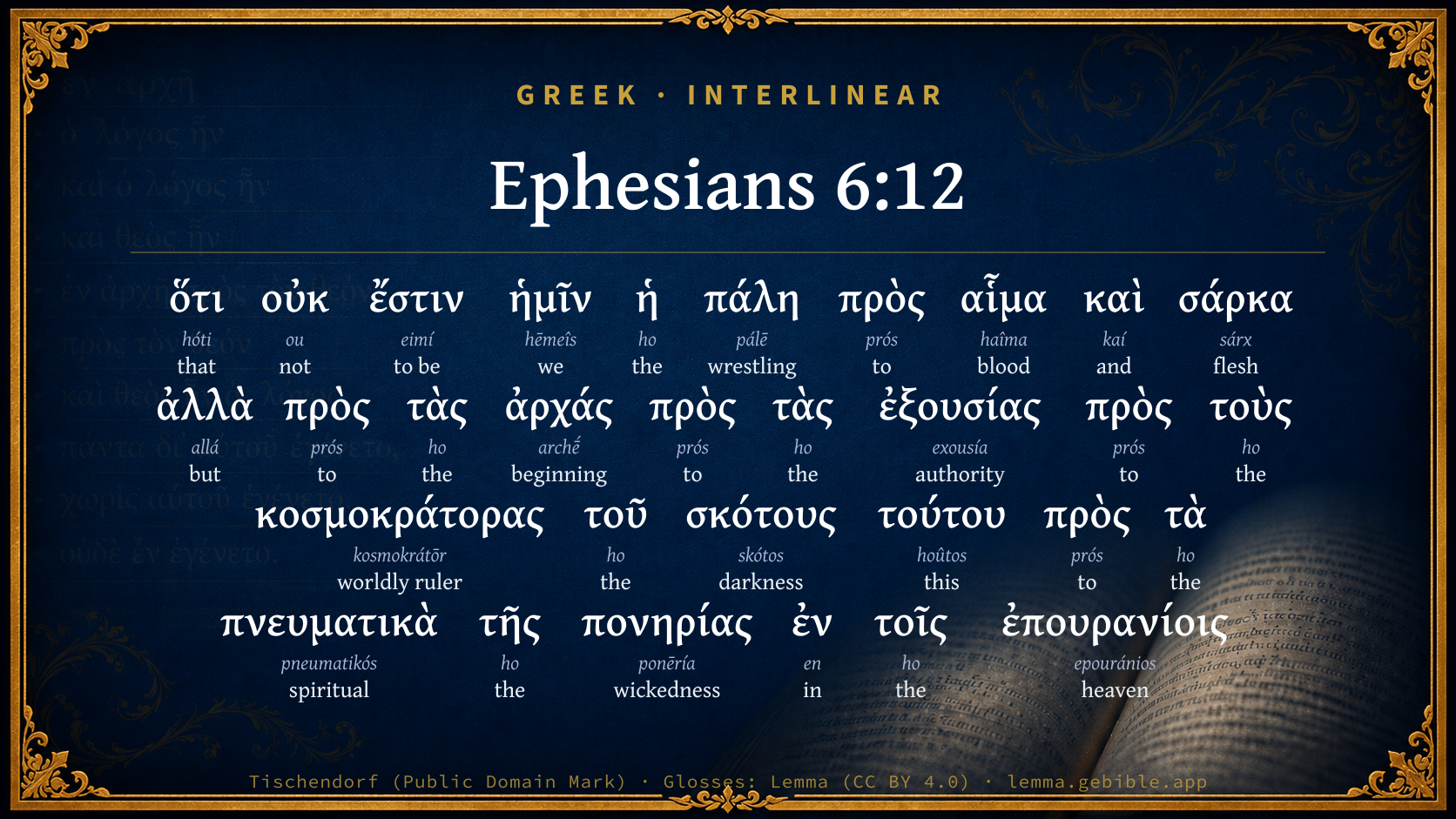
Download image
Cite this verse

Ephesians 6:12 (World English Bible). Public Domain. Lemma interlinear Bible study tool, https://lemma.gebible.app/v/ephesians/6/12.

Show BibTeX & RIS
BibTeX
RIS
English Translation
For our wrestling is not against flesh and blood, but against the principalities, against the powers, against the world's rulers of the darkness of this age, and against the spiritual hosts of wickedness in the heavenly places.
World English Bible · Public Domain
Highlights
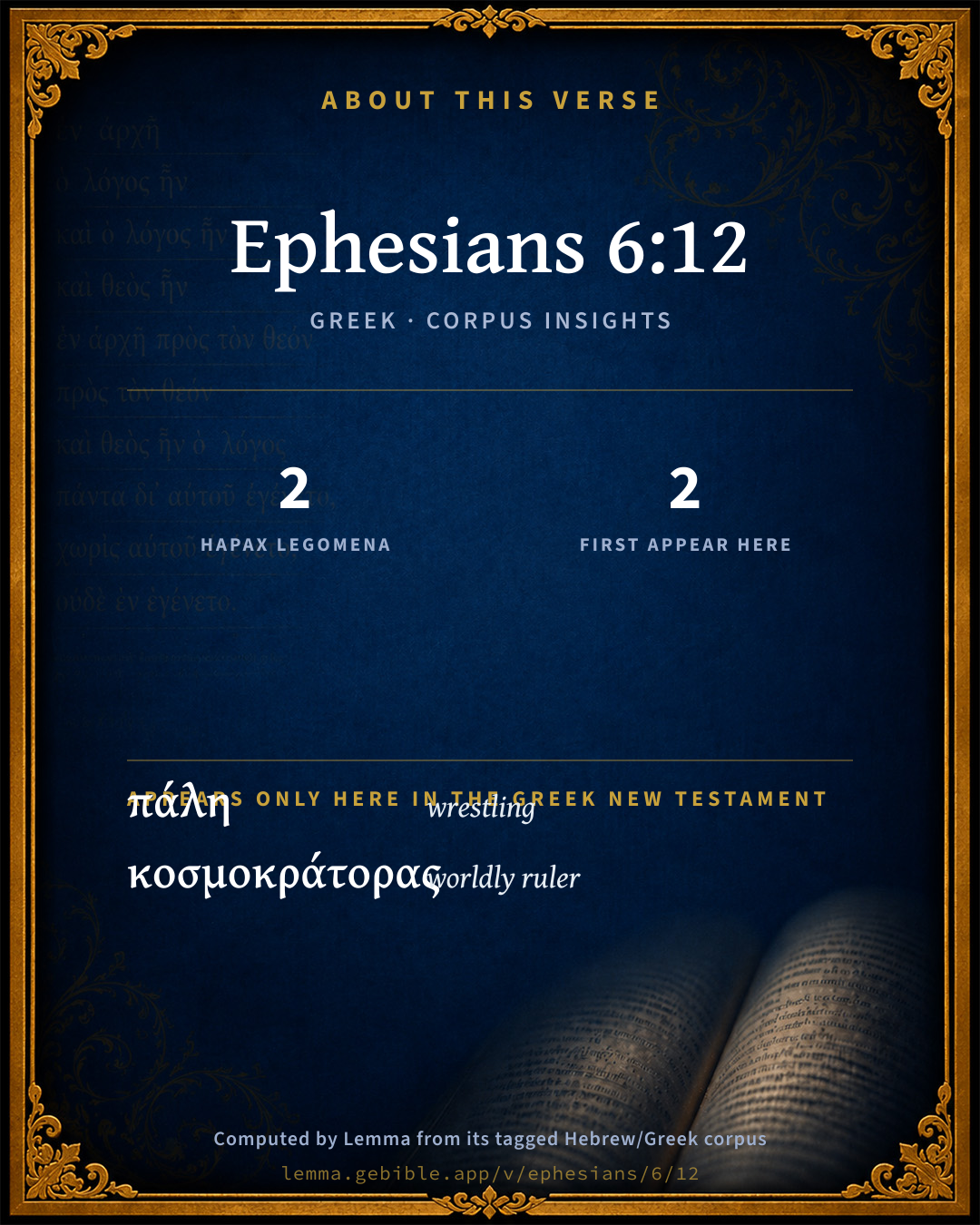
  • 2 hapax legomena — only here in the Greek New Testament
  • 2 first appearances in the Greek New Testament
Full analysis ↓
Download a study sheet

One document with this verse’s original text, its word-by-word gloss line, the meaning frame, cross-references with their text, attributed commentary, and full source and license credits — printable, and it pastes into notes with its structure intact.

This verse Autodidact and up

Study sheet (.html) Plain text (.txt)

A passage Seminary Student

Up to 50 verses in one chapter. A passage sheet keeps up to 6 commentary sources and 12 cross-references per verse, in the order this page ranks them, and says so on the sheet whenever that leaves anything out. Ask for a single verse and you get the Autodidact verse sheet above.

Everything on this page stays free to read, with no account — the sheet is a download of what is already on screen, not access to it.

Want to remove ads? Support Godless Engineer
Compare translations 3

The same verse in 3 English versions, stacked beneath the original-language interlinear above. Click any original word for its lexicon entry.

Each is an independent rendering of the whole verse — the interlinear is not word-aligned to these translations.

Highlighted words mark where these versions differ — a whole-verse word diff, not a word-by-word alignment.

  • World English Bible Public Domain
    For our wrestling is not against flesh and blood, but against the principalities, against the powers, against the world's rulers of the darkness of this age, and against the spiritual hosts of wickedness in the heavenly places.
  • King James Version Public Domain
    For we wrestle not against flesh and blood, but against principalities, against powers, against the rulers of the darkness of this world, against spiritual wickedness in high places.
  • unfoldingWord Literal Text CC BY-SA 4.0
    For our struggle is not against blood and flesh, but against the rulers, against the authorities, against the world-controllers of this darkness, against the spiritual forces of evil in the heavenly.

unfoldingWord Literal Text — © unfoldingWord, licensed CC BY-SA 4.0. Word-aligned USFM3 via Door43 (git.door43.org/unfoldingWord/en_ult).

Versions to compare (up to 4)

3 of 4 selected

Show all 19 translations

Every available English version of this verse, each an independent rendering of the whole verse.

  • World English Bible Public Domain
    For our wrestling is not against flesh and blood, but against the principalities, against the powers, against the world's rulers of the darkness of this age, and against the spiritual hosts of wickedness in the heavenly places.
  • Berean Standard Bible Public Domain
    For our struggle is not against flesh and blood, but against the rulers, against the authorities, against the powers of this world’s darkness, and against the spiritual forces of evil in the heavenly realms.
  • Majority Standard Bible Public Domain
    For our struggle is not against flesh and blood, but against the rulers, against the authorities, against the powers of this world’s darkness, and against the spiritual forces of evil in the heavenly realms.
  • King James Version Public Domain
    For we wrestle not against flesh and blood, but against principalities, against powers, against the rulers of the darkness of this world, against spiritual wickedness in high places.
  • American Standard Version (1901) Public Domain
    For our wrestling is not against flesh and blood, but against the principalities, against the powers, against the world-rulers of this darkness, against the spiritual `hosts' of wickedness in the heavenly `places'.
  • Revised Version (1885) Public Domain
    For our wrestling is not against flesh and blood, but against the principalities, against the powers, against the world-rulers of this darkness, against the spiritual hosts of wickedness in the heavenly places.
  • Geneva Bible (1599) Public Domain
    For we wrestle not against flesh and blood, but against principalities, against powers, and against the worldly gouernours, the princes of the darkenesse of this worlde, against spirituall wickednesses, which are in ye hie places.
  • Douay-Rheims (1899) Public Domain
    For our wrestling is not against flesh and blood; but against principalities and power, against the rulers of the world of this darkness, against the spirits of wickedness in the high places.
  • Young's Literal Translation Public Domain
    because we have not the wrestling with blood and flesh, but with the principalities, with the authorities, with the world-rulers of the darkness of this age, with the spiritual things of the evil in the heavenly places;
  • Literal Standard Version CC BY-SA 4.0
    because our wrestling is not with flesh and blood, but with the principalities, with the authorities, with the world-rulers of the darkness of this age, with the spiritual [forces] of evil in the heavenly [places];
  • Unlocked Literal Bible CC BY-SA 4.0
    For our struggle is not against flesh and blood, but against the rulers, against the authorities, against the powers over this present darkness, against the spiritual forces of evil in the heavenly places.
  • unfoldingWord Literal Text CC BY-SA 4.0
    For our struggle is not against blood and flesh, but against the rulers, against the authorities, against the world-controllers of this darkness, against the spiritual forces of evil in the heavenly.
  • Darby Bible Public Domain
    because our struggle is not against blood and flesh, but against principalities, against authorities, against the universal lords of this darkness, against spiritual [power] of wickedness in the heavenlies.
  • World Messianic Bible Public Domain
    For our wrestling is not against flesh and blood, but against the principalities, against the powers, against the world’s rulers of the darkness of this age, and against the spiritual forces of wickedness in the heavenly places.
  • Webster's Bible Public Domain
    For we wrestle not against flesh and blood, but against principalities, against powers, against the rulers of the darkness of this world, against spiritual wickedness in high places.
  • Free Bible Version CC BY-SA 4.0
    We're not fighting against human forces, but against supernatural rulers and powers, the dark lords of this world, against the spiritual forces of evil in the heavens.
  • Bible in Basic English Public Domain
    For our fight is not against flesh and blood, but against authorities and powers, against the world-rulers of this dark night, against the spirits of evil in the heavens.
  • Text-Critical English NT CC BY 4.0
    For we wrestle not against flesh and blood, but against the rulers, against the authorities, against the cosmic powers of the darkness of this age, and against the spiritual forces of evil in the heavenly places.
  • Tyndale New Testament (1534) Public Domain
    For we wrestle not agaynst flesshe and bloud: but agaynst rule agaynst power and agaynst worldy rulars of the darckenes of this worlde agaynst spretuall wickednes for hevenly thinges.

Literal Standard Version (2020), Covenant Press — licensed CC BY-SA 4.0. Text via the HelloAO Bible API (eBible.org). Unlocked Literal Bible (unfoldingWord) — licensed CC BY-SA 4.0. Text via the HelloAO Bible API (eBible.org). unfoldingWord Literal Text — © unfoldingWord, licensed CC BY-SA 4.0. Word-aligned USFM3 via Door43 (git.door43.org/unfoldingWord/en_ult). Free Bible Version, Dr. Jonathan Gallagher — licensed CC BY-SA 4.0. Text via the HelloAO Bible API (eBible.org).

Word by word

More ways to search: Search by grammar → Find every occurrence → Compare this word →

Practice this passage: Drill this verse → Learn its vocabulary →

πάλη
pálē
G3823
“wrestling”
Noun, Nominative, Singular, Feminine
Part of Speech
Noun
Case
Nominative
Number
Singular
Gender
Feminine
Full Thayer's Definition

Origin: from pallo (to vibrate, another form for G906 )

TDNT: 17:01,8

1. wrestling (a contest between two in which each endeavours to throw the other, and which is decided when the victor is able to hold his opponent down with his hand upon his neck) a. the term is transferred to the Christian's struggle with the power of evil
  1. ὅτι hóti G3754 “that” Conjunction
  2. οὐκ ou G3756 “not” Particle, Negative
  3. ἔστιν eimí G1510 “to be” Verb, Present, Active, Indicative, 3rd person, Singular
  4. ἡμῖν hēmeîs G2249 “we” Personal pronoun, 1st person, Dative, Plural
  5. ἡ ho G3588 “the” Article, Nominative, Singular, Feminine
  6. πρὸς prós G4314 “to” Preposition
  7. αἷμα haîma G129 “blood” Noun, Accusative, Singular, Neuter
  8. καὶ kaí G2532 “and” Conjunction
  9. σάρκα sárx G4561 “flesh” Noun, Accusative, Singular, Feminine
  10. ἀλλὰ allá G235 “but” Conjunction
  11. πρὸς prós G4314 “to” Preposition
  12. τὰς ho G3588 “the” Article, Accusative, Plural, Feminine
  13. ἀρχάς archḗ G746 “beginning” Noun, Accusative, Plural, Feminine
  14. πρὸς prós G4314 “to” Preposition
  15. τὰς ho G3588 “the” Article, Accusative, Plural, Feminine
  16. ἐξουσίας exousía G1849 “authority” Noun, Accusative, Plural, Feminine
  17. πρὸς prós G4314 “to” Preposition
  18. τοὺς ho G3588 “the” Article, Accusative, Plural, Masculine
  19. κοσμοκράτορας kosmokrátōr G2888 “worldly ruler” Noun, Accusative, Plural, Masculine
  20. τοῦ ho G3588 “the” Article, Genitive, Singular, Neuter
  21. σκότους skótos G4655 “darkness” Noun, Genitive, Singular, Neuter
  22. τούτου hoûtos G3778 “this” Demonstrative pronoun, Genitive, Singular, Masculine
  23. πρὸς prós G4314 “to” Preposition
  24. τὰ ho G3588 “the” Article, Accusative, Plural, Neuter
  25. πνευματικὰ pneumatikós G4152 “spiritual” Adjective, Accusative, Plural, Neuter
  26. τῆς ho G3588 “the” Article, Genitive, Singular, Feminine
  27. πονηρίας ponēría G4189 “wickedness” Noun, Genitive, Singular, Feminine
  28. ἐν en G1722 “in” Preposition
  29. τοῖς ho G3588 “the” Article, Dative, Plural, Neuter
  30. ἐπουρανίοις epouránios G2032 “heaven” Adjective, Dative, Plural, Neuter

About this verse

These counts appear in no published source. They are computed here, from the morphology-tagged text and Lemma’s own curated glosses. What Lemma adds →

31
words
20
distinct lemmas
Pauline Epistles
section

Notable vocabulary

2 hapax legomena — words that appear only here in the entire Greek New Testament:

  • πάλη wrestling G3823
  • κοσμοκράτορας worldly ruler G2888

First appearance in Scripture

These words make their first canonical appearance in the Greek New Testament here:

  • πάλη wrestling G3823
  • κοσμοκράτορας worldly ruler G2888

Shared distinctive vocabulary

πονηρίας wickedness G4189 occurs in 7 verses of the Greek New Testament. Also found in:
Repetition

Words recur within this verse:

Cross-references

23

Topical passages linked to Ephesians 6:12 in the Treasury of Scripture Knowledge — connected by theme and wording, ordered by reader-vote popularity; previews shown in the World English Bible.

  • Colossians 1:13 who delivered us out of the power of darkness, and translated us into the Kingdom of the Son of his love;
  • 2 Corinthians 4:4 in whom the god of this world has blinded the minds of the unbelieving, that the light of the Gospel of the glory of Christ, who is the image of God, should not dawn on them.
  • Ephesians 2:2 in which you once walked according to the course of this world, according to the prince of the powers of the air, the spirit who now works in the children of disobedience;
  • Colossians 2:15 having stripped the principalities and the powers, he made a show of them openly, triumphing over them in it.
  • Acts 26:18 to open their eyes, that they may turn from darkness to light and from the power of Satan to God, that they may receive remission of sins and an inheritance among those who are sanctified by faith in me.'
  • Ephesians 1:21 far above all rule, and authority, and power, and dominion, and every name that is named, not only in this age, but also in that which is to come.
  • Romans 8:38 For I am persuaded, that neither death, nor life, nor angels, nor principalities, nor things present, nor things to come, nor powers,
  • 1 Corinthians 9:25–27 Every man who strives in the games exercises self-control in all things. Now they do it to receive a corruptible crown, but we an incorruptible.
  • Ephesians 3:10 to the intent that now through the assembly the manifold wisdom of God might be made known to the principalities and the powers in the heavenly places,
  • Ephesians 1:3 Blessed be the God and Father of our Lord Jesus Christ, who has blessed us with every spiritual blessing in the heavenly places in Christ;
  • 1 Corinthians 15:50 Now I say this, brothers, that flesh and blood can't inherit the Kingdom of God; neither does corruption inherit incorruption.
  • 1 Peter 3:22 who is at the right hand of God, having gone into heaven, angels and authorities and powers being made subject to him.
  • John 14:30 I will no more speak much with you, for the prince of the world comes, and he has nothing in me.
  • Hebrews 12:1 Therefore let us also, seeing we are surrounded by so great a cloud of witnesses, lay aside every weight and the sin which so easily entangles us, and let us run with patience the race that is set before us,
  • John 12:31 Now is the judgment of this world. Now the prince of this world will be cast out.
  • John 16:11 about judgment, because the prince of this world has been judged.
  • Job 2:2 Yahweh said to Satan, "Where have you come from?" Satan answered Yahweh, and said, "From going back and forth in the earth, and from walking up and down in it."
  • Luke 22:53 When I was with you in the temple daily, you didn't stretch out your hands against me. But this is your hour, and the power of darkness."
  • Matthew 16:17 Jesus answered him, "Blessed are you, Simon Bar Jonah, for flesh and blood has not revealed this to you, but my Father who is in heaven.
  • Luke 13:24 "Strive to enter in by the narrow door, for many, I tell you, will seek to enter in, and will not be able.
  • 2 Timothy 2:5 Also, if anyone competes in athletics, he isn't crowned unless he has competed by the rules.
  • Hebrews 12:4 You have not yet resisted to blood, striving against sin;
  • Galatians 1:16 to reveal his Son in me, that I might preach him among the Gentiles, I didn't immediately confer with flesh and blood,

Cross-references courtesy of OpenBible.info (CC BY 4.0).

Where the printed editions differ

1 variant

Places in this verse where the major printed Greek editions disagree on the wording in a way that affects the translation — a comparison of editions, not a manuscript-by-manuscript collation. The editions are the modern critical texts (Nestlé-Aland 28/27, SBL, Westcott-Hort, Tregelles, Tyndale House) and the traditional texts behind the KJV (the Textus Receptus and the Byzantine/Majority text). It is not a claim about which reading is original.

  1. Extra text
    αἰῶνος

    “age”

    In TRByz Not in NA28NA27TynSBLWHTreg

    αἰῶνος (aiōnos) 'age' is only in traditional manuscripts (TR+Byz)

Textual data: Translators Amalgamated Greek New Testament (STEPBible TAGNT) · CC BY 4.0.

Commentary

Notes on Ephesians 6:12 from classic Christian and Jewish commentators (each source and its license shown beneath its notes). The classic Christian expositions comment on the surrounding passage and are grouped to its opening verse, so a note may address several verses; the Jewish commentaries on the Tanakh (Rashi and others) are per-verse, so they appear only where the commentator wrote on this verse.

Lemma curates 59 commentaries, every one of them public domain or Creative Commons licensed, each selected and text-cleaned for this edition rather than reprinted as found. About our sources →

The Cambridge Bible for Schools and Colleges

gen. ed. J. J. S. Perowne

12. we wrestle] Lit., our wrestling is. War and the games are associated in the language of 2Ti_2:4-5. But here, as Ellicott observes, there need be no mingling of metaphors. War involves wrestling, in many a hand to hand encounter.—The Gr. word (palê, wrestling) is found only here in Gr. literature, but is cognate to palæstra, and other familiar words.

The Apostle takes it for granted that the Christian life is, from one point of view, essentially a conflict. “We” obviously, by context, means all Christians as such. Cp. 1Co_9:25, &c. But it is a conflict maintained, in Christ, with Divine power and from a dominating position.

flesh and blood] Lit., “blood and flesh”; but English usage makes the other order better, as a rendering. The phrase occurs (in the opposite order of words) Mat_16:17; 1Co_15:50; Gal_1:16; Heb_2:14. It denotes (as 1 Corinthians 15) humanity in its present mortal conditions, or (other reff.) humanity simply. “Man,” as now constituted, will not inherit the eternal kingdom; “man” did not illuminate St Peter; “man” did not teach the Gospel to St Paul; Christ so became “Man” as to be able to taste death. The thought here is not that we are not wrestling with our bodily desires, or weaknesses, but that we are not wrestling with mere mortal men. True, they may be our ostensible and immediate enemies or obstacles, but behind them is the central force of evil in the spirit-world. See the language of Rev_2:10, and Abp Trench’s note upon it (Epistles to the Seven Churches, p. 104). It will be observed how forcible is the testimony of the Apostle here to the objective existence of the world of evil spirits. He not merely takes it for granted, but carefully distinguishes it from the world of humanity. See further, Appendix G.

principalities … powers] Lit., the principalities, &c. See Eph_1:21, Eph_3:10; and notes. Here, as Rom_8:38; Col_2:15; the ref. obviously is to personal evil spirits as members and leaders of an organized spirit-world. For allusions to such organization, under its head, cp. the visions of the Revelation, esp. Rev_12:7; Rev_12:9. And cp. Mat_25:41; 2Co_12:7. Note also the “Legion” of evil spirits (Mar_5:9; Mar_5:15; Luk_8:30), compared with the “more than twelve Legions of (holy) angels”, Mat_26:53. Great numbers and organized action are at once suggested by the military word; a word used on both occasions with profound earnestness and appeal to fact.

The leaders of the host of evil are alone mentioned here, and in the parallels, as are the leaders of the host of good in Eph_1:21, &c. The “plebeian angels militant” (Par. Lost, x. 442), are taken for granted, represented in their chiefs.

the rulers of the darkness of this world] Lit. as R. V., the world-rulers of this darkness. The words “of this world” (or rather “age”) are probably an explanatory insertion.

“This darkness” is the present order of things on earth, in its aspect as a scene of sin. As such it is dark, with the shadows of delusion, woe, and death. See Luk_22:53 (a suggestive parallel) and other reff. under Eph_4:18.

“The world-rulers”:—the context obviously points to personal evil spirits, exercising rule, in some real sense, over the world; and the question is, what does the world (cosmos) mean here? See in reply Eph_2:2 and note. “The world” here, as very often in St John, and often in St Paul (esp. in 1 Cor.), denotes not the Universe, nor the earth and sea, but humanity as fallen and rebel. As such, it is the realm of these powers of evil. Their Head is the usurping, but permitted, Cæsar of this empire, which is not so much local as moral; and his subordinate spirits are accordingly “imperial rulers” within it, for him.—The Gr. word (cosmocratôr) appears in Rabbinic literature, transliterated (see Ellicott here). It is used sometimes there as a mere magniloquent synonym for “king.” But we may be sure of a more special meaning in a passage like this.

For allusions to the mysterious “authority” of the Evil Power over the human “world,” in its ethical aspect at least, cp. Luk_4:6; Joh_14:30; Joh_16:11; 2Co_4:4; 1Jn_5:18. It has been asked whether this authority is connected with a previous lawful presidency of the great Spirit now fallen, over this region of the Universe. But “God knoweth” is the best answer to such enquiries, till the veil is lifted. The fact of the present authority is our chief concern; and in this respect we are plainly warned that there is a real antagonism between the Kingdom of God and the Kingdom of the Evil One, and that in both cases we have the phenomenon of a spiritual dominion expressing itself through human organization and institution. See further on Eph_2:2, above.

spiritual wickedness in high places] Lit., the spiritual things of wickedness in the heavenly places. R.V. paraphrases “the spiritual hosts, &c.”; and this well gives the meaning. The idea is of beings and forces, spiritual as distinguished from material, belonging to and working for “wickedness.” Wickedness is viewed as having its visible and invisible agents, and these are the invisible.

“In the heavenly places”:—the fifth occurrence of the phrase in this Epistle (cp. Eph_1:3; Eph_1:20, Eph_2:6, Eph_3:10). The adjective occurs also Mat_18:35; Joh_3:12; 1Co_15:40; 1Co_15:48-49; Php_2:10; 2Ti_4:18; Heb_3:1; Heb_6:4; Heb_8:5; Heb_9:23; Heb_11:16; Heb_12:22. The connexion of it with anything evil is confined to this passage, and is confessedly startling. Of the several expositions offered, the oldest, given by St Jerome here, seems best to meet the case; that which interprets “heaven” as the large antithesis to “earth” (cp. Mat_6:26, “birds of the heaven”; &c.), and “heavenly,” accordingly, as “un-earthly,” super-terrestrial, belonging to the region of things unseen and (in power) superior to man, of which the impalpable sky is the parable. See above on Eph_2:2, “the authority of the air.” The import of the words, then, is that we have to deal, in the combat of the soul and of the Church, with spiritual agents of evil occupying a sphere of action invisible and practically boundless.—In St Ignatius’ Ep. to the Ephesians, c. xiii, the same Gr. adjective is used, with an almost certainly similar reference. See Bp Lightfoot there (Ignatius, vol. ii. p. 66), and our Introduction, p. 28.

G. THE CONFLICT WITH PERSONAL EVIL SPIRITS. (Ch. Eph_6:12.)

We have remarked in the notes on the strong testimony given by this verse, with its exact wording, to the real and objective existence of such personal beings. We may add that such testimony still gains in strength when it is remembered that it was first addressed (at least among other destinations) to Ephesus, and that Ephesus (see Acts 19) was a peculiarly active scene of asserted magical and other dealings with the unseen darkness. Supposing that the right line to take in dealing with such beliefs and practices had been to say that the whole basis of them was a fiction of the human mind, not only would such a verse as this not have been written, but, we may well assume, something would have been written strongly contradictory to the thought of it. As it stands, the passage is in full accord with main lines of Scripture doctrine, in both Testaments.

H. OLD TESTAMENT QUOTATIONS AND REFERENCES IN THE EPISTLE

Genesis

Gen_2:24,

quoted

Eph.

Eph_5:31.

Exodus

Exo_20:12,

quoted

Eph.

Eph_6:2.

Psalm

Psa_4:4,

quoted

Eph.

Eph_4:26

(see note).

Psalm

Psa_8:6,

referred to

Eph.

Eph_1:22.

Psalm

Psa_68:18,

quoted

Eph.

Eph_4:8.

Psalm

Psa_118:22,

referred to

Eph.

Eph_2:20.

Canticles

Psa_4:7,

referred to

Eph.

Eph_5:27

(possibly).

Isaiah

Isa_57:19,

referred to

Eph.

Eph_2:17.

Isaiah

Isa_60:1,

quoted

Eph.

Eph_5:14;

with probable recognition also of Isa_51:17; Isa_52:1 (see note).

In view of the fact that the Church addressed in the Epistle is a Church of Gentile converts, these quotations and allusions illustrate instructively the degree to which the Apostle took it for granted that all his converts would study the Old Testament as the Word of God.

The Cambridge Bible for Schools and Colleges (gen. ed. J. J. S. Perowne; Cambridge University Press, 1878–1918) — public domain. Text from a community e-Sword module.

The Biblical Illustrator

Joseph S. Exell

Eph_6:12

For we wrestle not against flesh and blood, but against principalities.

The invisible enemies of man

Does it not appear, philosophically speaking, a somewhat violent assumption to decide that man is really the highest being in the created universe, or, at least, that between man and his Maker there are no gradations with different moral colourings of intermediate life? Would it not be, rather, reasonable to suppose that the graduated series of living beings, graduated as it is so delicately, which we trace from the lowest of the zoophytes up to man, does not stop abruptly with man, that it continues beyond, although we may be unable to follow the invisible steps of the continuing ascent? Surely, I submit, the reasonable probability would incline this way, and revelation does but confirm and reveal these anticipations when it discovers to faith, on the one hand, the hierarchies of the blessed angels, and on the other, as in this passage of Scripture, the corresponding gradations of evil spirits, principalities, and powers, who have abused their freedom, and who are ceaselessly labouring to impair and to destroy the moral order of the universe. Two great departments of moral life among men are watched over, each one of them, beyond the sphere of human life, by beings of greater power, greater intelligence, greater intensity of purpose, than man in the world of spirits. These spiritual beings, good and evil, act upon humanity as clearly, as certainly, and as constantly as man himself acts upon the lower creatures around, and thus it is that we wrestle not against flesh and blood, but against principalities, against powers, against the rulers of the darkness of this world, against spiritual wickedness in high places. Does not our experience, my brethren, bear this out, at least sometimes in our darker hours? Have we never known what it is, as we phrase it, to be carried away by a sudden impulse--to be driven, we know not why, hither and thither in conscious humiliation and shame before some strong, overmastering gust of passion? Have we, too, never seen another law in our members, warring against the law of our minds, and bringing us into captivity to the law of sin that is in our members? And what is this at bottom but to feel ourselves in the strong embrace and gripe of another power, who, for the moment, has overmastered us, and holds us down? We may be unable to discern his form; we may be unable to define the precise limits and nature of his power; we may despair to decide what it is that we supply to the dread result out of our own fund of perverted passion, and what it is that he adds from the hot breath of an intenser furnace. But then the most ordinary processes of our vital functions themselves defy analysis, however we may be certain of their reality. No, depend upon it, it is not any mere disposition, inseparable from the conditions of human thought, to personify, to externalize passion which has peopled the imagination of Christendom with demons. As well, just as well, might you say that the fearful epidemic which has ravaged London this autumn was itself a creation of human fancy, that it had in itself no real existence, that it was the real cause of no real disease in the individuals who succumbed to it. Our imagination may, no doubt, do much; but there are limits to its activity, and the higher facts are just as much beyond it as are the facts of nature. The contests of which St. Paul is speaking were not only to be waged on the great scenes of history. St. Paul is speaking of contests humbler, less public, but certainly not less tragical, the contests which are waged, sooner or later, with more or less intensity, and with the most divergent results, around and within each human soul. It is within ourselves, my brethren, that we meet now, as the first Christians met, the onset of the principalities and the powers. It is in resisting them--aye, at any cost--in driving them from us at the name of Christ, in driving from us the spirits of untruthfulness, of sloth, of anger, and of impure desire--that we really contribute our little share to the issue of the great battle which rages still, as it raged then, and which will rage on between good and evil until the end comes, and the combatants meet with their rewards. (Canon Liddon.)

The holy war

I. The foes. Spiritual enemies. Our danger arises from--

1. The advantage they find in this world. It is in many respects their own.

2. Our natural inclinations.

3. Their number--Legion.

4. Their mightiness.

5. Their invisibility.

6. Their artfulness.

7. Their malignity.

II. The armour.

1. The articles in which it consists. None provided for the back. He who flees is wholly defenceless, and sure to perish.

2. Its nature--Divine.

(1) Appointed by God.

(2) Provided by God.

3. The appropriation of it. You must apply it to the various purposes for which it has been provided. There are some who are ignorant of it; these cannot take it to themselves, and they are perishing for lack of knowledge. There are others who know it, but despise it; they never make use of it; their religion is all speculation; they know these things, but they do them not; they believe--and the devils believe and tremble.

4. The entireness of the application--The whole armour. Every part is necessary. A Christian may be considered with regard to his principles, with regard to his practice, with regard to his experience, with regard to his comfort, and with regard to his profession; and oh! how important is it in each of these that neither of them is to be left in him exposed and undefended. He is to stand complete in all the will of his heavenly Father; he is to be perfect and entire, lacking nothing. Nothing less: than this must be our aim.

III. The success. Three inquiries are here to be answered. The first regards the posture; what does the apostle mean by standing? It is a military term; and standing is opposed to falling. A man is said to fall when he is slain in battle; and he does so literally. It is opposed to fleeing. We often read of fleeing before the enemy in the Scriptures: this cannot be standing. It is opposed to yielding or keeping back; and so the apostle says, Neither give place to the devil. Every inch you yield he gains, and every inch he gains you lose; every inch he gains favours his gaining another inch, and every inch you lose favours your losing another inch. The second regards the period; what does the apostle mean when he says, Stand in the evil day? All the time of the Christians warfare may be so called in a sense, and a very true sense; but the apostle refers also to some days which are peculiarly evil days. Days of suffering are such. The days in which the poor martyrs lived were evil days; they could not confess and follow Christ without exposing their substance and their liberty and their lives; but they stood in the evil day, and rejoiced that they were counted worthy to suffer shame for His Dame. There are evil days morally considered--perilous periods, in which iniquity abounds and the love of many waxes cold, in which many may turn aside from the faith and give themselves to vain janglings. The third regards the preeminence of the advantage gained; stand in the evil day, and, having done all, stand. Some of Gods servants have been foiled after various successes, and have become affecting examples to show us that we are never out of the reach of danger as long as we are in the body and in the world. The battle of Eylau, between the French and the Russians, was a dreadful conflict; more than fifty thousand perished. Both parties claimed the victory. What, then, is the historian to do? To do? Why, he will inquire, Who kept the field? And these were the French, while the Russians all withdrew. Oh, my brethren! it is the keeping of the field to the last--to see all the adversaries withdrawn--that is to make us more than conquerors through Him that loved us. It is this that gives decision to the battle. Some have overcome, and then, alas! they have been overcome. What is it to gain success and yield it at last? The Romans often were checked: they often met with a defeat; but then they succeeded upon the whole, and having done all, they stood. Of Gad it is said, A troop shall overcome him, but he shall overcome at the last. And this will be the case with every real Christian. What comes from God will be sure to lead back to God. (W. Jay.)

The Christian soldiers warfare

I. The enemies with whom, as Christian soldiers, we are called to contend.

1. Spirits.

2. Wicked spirits.

3. Formidable spirits.

(1) On account of their strength.

(2) On account of their weapons.

(3) On account of their extensive influence.

(4) On account of their wiles.

II. In what manner we are instructed to contend with them.

1. In the armour of God.

(1) This must be all put on.

(2) We must retain it till our warfare be past.

(3) We must take and use it whenever assaulted.

2. In the spirit of prayer and watchfulness.

3. In the exercise of firm resistance. Let your resistance be--

(1) Early. At the first approach of the enemy.

(2) Courageous.

(3) Unwearied. Till you conquer.

III. The reasons by which we should be induced thus to contend.

1. Because the most important objects depend on this contention.

(1) Your steadfastness;

(2) your liberty;

(3) your glory;

(4) your eternal life.

2. Because victory is certain to the faithful soldiers of Christ.

(1) Victory over the world;

(2) victory over sin;

(3) victory over Satan;

(4) victory over tribulation;

(5) victory over death.

3. Because victory will be attended with certain glory.

(1) A glorious rest from all painful toil and contention;

(2) glorious exemption from all penal evil;

(3) glorious honours;

(4) a glorious throne, crown, kingdom. (Theological Sketchbook.)

The existence of evil spirits

Against the existence of evil spirits, against the possibility of their exerting a malignant influence on the moral and spiritual life of mankind, nothing has ever been alleged, as far as I am aware, that has any force in it. Some people appear to suppose that they have said enough to justify their disbelief when they have recited the grotesque and incredible legends, the monstrous and childish superstitions about the devil which laid so firm a hold on the imagination and the fears of Europe in the Middle Ages; or when they have illustrated the history and growth of analogous legends and superstitions among savage or half-civilized races. But they could justify atheism by a precisely similar line of reasoning. The mythologies of Greece and of Scandinavia are incredible; their original and central elements are obviously nothing more than the product of the imagination under the excitement of the glories and the terrors, the majesty and the beauty, of the visible universe. But because these mythologies are incredible shall I refuse to believe in the living God, the Creator of the heavens and of the earth, the God that loveth righteousness and hateth iniquity? The attributes and deeds attributed to Kali, the black and blood-stained goddess, with her necklace of human skulls, fills me with horror and fierce disgust; but is this horror, this disgust, any reason for withholding my faith from the revelation of Gods infinite love in the Lord Jesus Christ? Many false, childish, dreadful things have been imagined and believed about invisible and Divine powers; but this does not prove that there is no God. Many monstrous and absurd things have been imagined and believed about invisible and evil spirits; but this does not prove that there is no devil. Three hundred years ago men received popular stories about grotesque and malicious appearances of evil spirits without evidence and without inquiry. It was the habit of the age to believe in such things; men believed, in the absence of all solid reasons for believing. And now we disbelieve, without evidence and without inquiry, what Christ Himself and His apostles have told us about the devil and his temptations. It is the habit of the age to disbelieve in such things; we disbelieve, in the absence of solid reasons for disbelieving. We do not care to investigate the question. We go with the crowd. We think that everybody cannot be wrong. We regard with great complacency the contrast between our own clear intelligence and the superstition of our ancestors. But when we are challenged to state our reasons for refusing to accept what Christ has revealed on this subject, we have nothing to answer except that other people refuse to accept it; and our ancestors had just as good an apology for accepting the superstitions of their times--everybody accepted them. It is not quite clear that there is any good ground for our self-complacency; the belief of our ancestors was as rational as our own disbelief.

1. The subject is confessedly difficult, obscure, and mysterious; but there is nothing incredible in the existence of unseen and evil powers, from whose hostility we are in serious danger. Give the faculty of vision to the blind, and they see the sun and the clouds and the moon and the stars, of whose existence they had known nothing except by hearsay; give a new faculty to the human race, and we might discover that we are surrounded by principalities and powers, some of them loyal to God and bright with a Divine glory; some of them in revolt against Him, and scarred with the lightnings of the Divine anger. The moral objections to the existence of evil spirits can hardly be sustained in the presence of the crimes of which our own race has been guilty. There may be other worlds in which the inhabitants are as wicked as the most wicked of ourselves; we cannot tell. We may be surrounded--we cannot tell--by creatures of God, who hate righteousness and hate God with a fiercer hatred than ever burned in the hearts of the most profligate and blasphemous of our race. And they may be endeavouring to accomplish our moral ruin, in this life and the life to come.

2. Our Lord plainly taught the existence of evil spirits (Mat_13:19; Mat_13:39; Luk_10:18; Luk_22:31; Joh_12:31; Mat_25:41). No use to say that as He spoke the language, He thought the thoughts, of His country and His time; for it was impossible that He should mistake shadows for realities in that invisible and spiritual world which was His true home, and which He had come to reveal to man. Nor can we believe that Christ Himself knew that evil spirits had no existence, and yet consciously and deliberately fell in with the common way of speaking about them. The subject was one of active controversy between rival Jewish sects, and in using the popular language Christ took sides with one sect against another. That He should have supported controverted opinions which He knew to be false is inconceivable. Again: He came to preach glad tidings; can we suppose that, if the popular dread of evil spirits had no foundation, He would have deliberately fostered such a falsehood?

3. The teaching of Christ on this point is sustained by all the apostles (Jam_3:7; 2Co_4:4; 2Co_11:14; Eph_4:26; 1Pe_5:8; 1Jn_2:13-14; 1Jn_3:8; 1Jn_3:10; 1Jn_3:12; 1Jn_5:18-19, etc.).

4. The teaching of Christ and His apostles is confirmed by our religious experience. Evil thoughts come to us which are alien from all our convictions and from all our sympathies. There is nothing to account for them in our external circumstances or in the laws of our intellectual life. We abhor them and repel them, but they are pressed upon us with cruel persistency. They come to us at times when their presence is most hateful; they cross and trouble the current of devotion; they gather like thick clouds between our souls and God, and suddenly darken the glory of the Divine righteousness and love. We are sometimes pursued and harassed by doubts which we have deliberately confronted, examined, and concluded to be absolutely destitute of force, doubts about the very existence of God, or about the authority of Christ, or about the reality of our own redemption. Sometimes the assaults take another form. Evil fires which we thought we had quenched are suddenly rekindled by unseen hands; we have to renew the fight with forms of moral and spiritual evil which we thought we had completely destroyed. There is a Power not ourselves that makes for righteousness; light falls upon us which we know is light from heaven; in times of weariness strength comes to us from inspiration which we know must be Divine; we are protected in times of danger by an invisible presence and grace; there are times when we are conscious that streams of life are flowing into us which must have their fountains in the life of God. And there are dark and evil days when we discover that there is also a power not ourselves that makes for sin. We are at war, the kingdom of God on earth is at war, with the kingdom of darkness. We have to fight against the principalities, etc. And therefore we need the strength of God and the armour of God. The attacks of these formidable foes are not incessant; but as we can never tell when the evil day may come, we should be always prepared for it. After weeks and months of happy peace, they fall upon us without warning, and without any apparent cause. If we are to withstand them, and if after one great battle in which we have left nothing unattempted or unaccomplished for our own defence and the destruction of the enemy we are still to stand, to stand with our force unexhausted and our resources undiminished, ready for another and perhaps fiercer engagement, we must be strong in the Lord and in the strength of His might, and we must take up the whole armour of God. (R. W. Dale, LL. D.)

The nature of the contest

Wrestle. It denotes--

1. That our enemies aim at us personally.

2. The nearness of the parties to each other.

3. The severity of the struggle, παλη.

4. The continuance of it. The present tense. (H. J. Foster.)

The evil angels

I. Here are presented beings whose attributes are very appalling.

1. Actual beings, possessing an angelic order of existence.

2. Beings deeply and fearfully characterized by evil.

3. Beings who possess wide power and authority over the world.

II. The beings here presented are engaged in active and malignant conflict against the interests of redeemed men.

1. Notice the manner in which that conflict is conducted. These principalities, etc., fight against the children of God through the medium of their own thoughts; as those thoughts may be influenced independent of external objects, or as those thoughts may be influenced by the thoughts and passions of other men; and by the various events and occurrences which are transpiring in this sublunary and terrestrial world. It is intended by this power and instrumentality to lead to principles, to actions, and to habits which are inconsistent with the maintenance of the Christian character.

2. Mark the spirit in which that warfare is conducted. It is precisely such as we might expect from the character and attributes of the principalities, the powers, and the rulers against whom we wrestle. It is, for instance, conducted with subtlety and cunning. We find that Satan is said to transform himself into an angel of light. Hence, again, we read of the devices of Satan and the rulers of Satan as being the old serpent. It is, further, conducted in cruelty, Hence, we read of Satan as being the adversary; we read of his fiery darts; and we are told that he goeth about as a roaring lion seeking whom he may devour. It is, again, conducted in perseverance. All the statements which are urged with regard to subtlety on the one hand, and cruelty on the other, show that there is one incessant labour, which is perfectly unvaried and unremitting on their part, to accomplish the great designs they have in view with respect to the character and the final destiny of the soul.

3. Observe for what purpose the conflict is designed. That there may be a failure on the part of the redeemed, in their character, their consistency, and their hopes; and this, under the impulse of one dark and fearful result, as bearing both upon God and upon man. As regards God, it is intended that the purpose of the Father should be foresworn; that the atonement of the Son should be inefficacious; and that the influence of the Spirit should be thwarted. And, as bearing on man, it is intended that his life should become bereft of honour, comfort, and peace; that his death should be a scene of agitation, pain, and darkness; that his judgment should he an event of threatening and bitter condemnation; that his eternity should be the habitation of torment and woe; and that over spirits, who once had the prospects of redemption, there shall be pronounced that fearful sentence, Depart ye cursed, into everlasting fire, prepared for the devil and his angels.

III. The knowledge, on the part of redeemed men, of such a conflict, ought, at once, to bind on thee those practical impressions which are essential to their perseverance and victory.

1. The nature of the means of preservation.

(1) A constant and diligent attempt, in the strength of the living God, to live in practical conformity with the doctrines and precepts of the gospel.

(2) Watchfulness.

(3) Prayer.

2. The effect which these means, when used aright, will secure. That the Christian warrior, fighting against these mighty and invisible foes, shall, although faint, yet pursue, and although feeble, shall yet conquer. (J. Parsons.)

The craft of our invisible foes

The great art of these invisible world rulers consists in never seeming to be against us. They conceal themselves in our affections, and plead for our wishes. And, as though from quite a motherly consideration for our weakness, and a warm concern for our enjoyment, they make it appear that the claims of God are unreasonable, and that the way to heaven is cold and forbidding. Seated in the warmth of our hearts, they reason warmly for our pleasure, and then flatter us that we reason well. We are taken by the wiles, we suck in the flattering honey, and know not that we are being poisoned unto the second death. These spirits are too much for us. Their strongholds are in our hearts. Before we can successfully oppose those who clothed themselves with the armour of our own life, we must put on the armour of God. Jesus is the only man who ever prevailed in this war. He came to the encounter, not in natures heats, nor with natures reasonings; but clothed with truth and purity, guilelessness and perfect love. We must put on Christ. (J. Pulsford.)

Our spiritual foes

The apostle brings out into bold relief the terrible foes which Christians are summoned to encounter.

1. Their position. They are no subalterns, but foes of mighty rank, the nobility and chieftains of the spirit world.

2. Their office. Their domain is this darkness in which they exercise imperial sway.

3. Their essence. Not encumbered with an animal frame, but spirits.

4. Their character--evil. Their appetite for evil only exceeds their capacity for producing it. (J. Eadie, D. D.)

Every part must be protected against the adversary

It is reported by the poets of Achilles, the Grecian captain, that his mother, being warned by the oracle, dipped him--being a child--in the river Lethe, to prevent any danger that might ensue by reason of the Trojan war; but Paris, his inveterate enemy, understanding also by the oracle that he was impenetrable all over his body, except the heel or small part of his leg, which his mother held him by when she dipped him, took his advantage, shot him in the heel, and killed him. Thus every man is, or ought to be, armed cap-a-pie with that panoply--the whole armour of God. For the devil will be sure to hit the least part that he finds unarmed; if it be the eye, he will dart in at that casement by the presentation of one lewd object or other; if it be the ear, he will force that door open by bad counsel; if the tongue, that shall be made a world of mischief; if the feet, they shall be swift to shed blood, etc.

Spiritual wrestling is personal

At the battle of Crecy, in 1316, the Prince of Wales, finding himself heavily pressed by the enemy, sent word to his father for help. The father, watching the battle from a windmill, and seeing his son was not wounded and could gain the day if he would, sent word: No, I will not come. Let the boy win his spurs, for, if God will, I desire that this day be his with all its honours. Young man, fight your own battle, all through, and you shall have the victory. Oh, it is a battle worth fighting! Two monarchs of old fought a duel, Charles V and Francis, and the stakes were kingdoms, Milan and Burgundy. You fight with sin, and the stake is heaven or hell. (Dr. Talmage.)

The Biblical Illustrator, edited by Joseph S. Exell (c. 1880s–1900s) — public domain. Text from a community e-Sword module.

Joseph Benson's Commentary

Eph 6:12. For we wrestle not — Greek, ουκ εστιν ημιν η παλη, our struggle is not; against flesh and blood — Not merely against human adversaries, however powerful, subtle, and cruel, nor against fleshly appetites; but against principalities, against powers — The mighty princes of all the infernal legions: and great is their power, and that likewise of the legions which they command. Against the rulers of the darkness of this world — Greek, προς τους κοσμοκρατορας του σκοτους, του αιωνος τουτου, against the rulers of the world, of the darkness of this age. Dr. Whitby explains this of “those evil spirits that ruled in the heathen nations which were yet in darkness,” and of “those that had their stations in the region of the air.” “Perhaps,” says Mr. Wesley, “these principalities and powers” (spoken of in the former clause) “remain mostly in the citadel of the kingdom of darkness; but there are other evil spirits who range abroad, to whom the provinces of the world are committed.” By the darkness of this age, that spiritual darkness is intended, which prevails during the present state of things. “Evil spirits,” Macknight thinks, “are called rulers of this world, because the dominion which, by the permission of God, they exercise, is limited to the darkness of this world; that is, this world darkened by ignorance, wickedness, and misery, and which is the habitation or prison assigned them, until the judgment of the great day, Jude, Eph 6:6.” Against spiritual wickedness — Or rather, wicked spirits, as the Syriac translates the expression. The word πονηρια, rendered wickedness, properly signifies malice joined with cunning, and is fitly mentioned as the characteristic of those wicked spirits with whom we are at war; and it is a quality so much the more dangerous, in that it exists in beings whose natural faculties are very great. And it must be observed, that they continually oppose faith, love, holiness, either by force or fraud, and labour to infuse unbelief, pride, idolatry, malice, envy, anger, hatred. In high places — Greek, εν τοις επουρανιοις, in, or about, heavenly places. Those who translate it in the former way, think the expression refers to those places where they rebelled against the God of heaven, and drew in multitudes who were before holy and happy spirits, to take part with them in their impious revolt. But it seems more probable the sense is, about heavenly places; namely, the places which were once the abodes of those spirits, and which they still aspire to, as far as they are permitted; labouring at the same time to prevent our obtaining them. Dr. Goodwin, however, thinks that not heavenly places, but heavenly things are intended; namely, spiritual and eternal blessings, about which we may be properly said to wrestle with them, while we endeavour to secure these blessings to ourselves, and they to hinder us from attaining them.

Joseph Benson's Commentary on the Old and New Testaments (1811–1818) — public domain. Text from a community e-Sword module.

Tyndale Open Study Notes

Tyndale Open Resources

6:12 Believers should not consider human beings to be their enemies. Instead, the opposition they face comes from the unseen world of spiritual evil, and Christ has authority over that realm (see 1:21-22).

Tyndale Open Study Notes — © Tyndale Open Resources, licensed CC BY-SA 4.0. Text via the HelloAO Bible API.

Bengel's Gnomon

Johann Albrecht Bengel

Eph 6:12. Οὐκ ἔστιν, is not) The evil spirits lurk concealed behind the men who are hostile to us.—ἡ πάλη) the wrestling.—πρὸς αἷμα καὶ σάρκα, against blood and flesh) Comp. Mat 16:17, note. דם ובשר, blood and flesh, viz. (mere) men, were weak, even at Rome, where they kept Paul a prisoner.—ἀγγὰ, but) After a very distinct mention of good angels, ch. Eph 1:21, Eph 3:10, he thus appropriately speaks also of bad spirits, especially to the Ephesians; comp. Act 19:19. The more plainly any book of Scripture treats of the Christian dispensation and the glory of Christ, the more clearly, on the other hand, does it present to our view the opposite kingdom of darkness.—πρὸς, against) Against occurs four times [after ἀλλὰ]. In three of the clauses the power of our enemies is pointed out; in the fourth, their nature and disposition.—κοσμοκράτορες, the rulers of the world) ‘mundi tenentes,’ The holders of the world, to use the word of Tertullian. It is well that they are not holders of all things; yet the power not only of the devil himself, but also of those over whom he exercises authority, is great. There seem to be other kinds of evil spirits, that remain more at home in the citadel of the kingdom of darkness: principalities, powers. This third class is different, inasmuch as they go abroad and take possession, as it were, of the provinces of the world: rulers [holders] of the world.—τοῦ σκότους, of the darkness) Herein they are distinguished from angels of light. This is mostly spiritual darkness, ch. Eph 5:8; Eph 5:11; Luk 22:53, which has wickedness presently after as its synonym; yet even to them natural darkness is more congenial than light. The contest is much more difficult in darkness.—τοῦ αἰῶνος τούτου, of this world) The word κοσμοκράτορας, the holders (rulers) of the world, directly governs the two genitives σκότους and αἰῶνος, of the darkness and of this world, according to [in relation to] either part of the compound word. Κόσμος, world, and αἰῶν, age, are to be referred mutually to each other, as time and place.[99] The term, Holders (rulers) of the world, is the ground on which this wickedness is practised. There are princes of the darkness of the world in the present age. The connection between κόσμος, world, and αἰὼν, age, is not grammatical but logical: κόσμος, world (mundus), in all its extent; αἰὼν, world, age (sæculum), the present world, in its disposition (character), course, and feeling. I cannot say κόσμος τοῦ αἰῶνος, as, on the contrary, I can say αἰὼν τοῦ κόσμου.—τὰ πνευματικὰ, the spiritual things) The antithesis is blood and flesh. These spiritual things are opposed to the spiritual things of grace, 1Co 12:1, and are contrary to faith, hope, love, the gifts [of the Spirit], either in the way of a force opposite [to those graces], or by a false imitation of them. Moreover, as in the same epistle, 1Co 14:12, spirits are used for spiritual things, so here spiritual things are very aptly used for spirits. For these spirits make their assault with such quickness and dexterity, that the soul does not almost think [generally is not aware] of the presence of these foreign existences lurking beneath, but believes that it is something in itself within which produces the spiritual temptation; and even πνευματικόν, spiritual, in the singular, may be taken as a kind of military force, in the same way as τὸ ἱππικὸν, horsemen, is applied in Rev 9:16, and τὸ στρατιωτικὸν is else where used of an army; so that here τὰ πνευματικὰ, viz. τάγματα, may be used as in Zosimus, 1. 3: τὰ πεζικὰ τάγματα, ξενικόν, The bands of infantry, a foreign force. Aristot. 3, pol. 10, p. 210.—ἐν τοῖς ἐπουρανίοις, in places above the heavens) Even enemies, but as captives (ch. Eph 4:8, note), may be in a royal palace, and adorn it.

[99] Κόσμος refers to place; αἰὼν to time: The world-rulers of the age; the world-rulers of the darkness. But Engl. V. makes αἰῶνος governed by σκότους, of the darkness of this world.—ED.

Bengel's Gnomon of the New Testament — English translation (T&T Clark, Edinburgh, 1860) — public domain. Text from a community e-Sword module.

Meyer's Critical & Exegetical Commentary

Heinrich August Wilhelm Meyer

Eph_6:12. I am warranted in saying πρὸς τὰς μεθοδ. τοῦ διαβόλου; for we have not the wrestling with feeble men, but we have to contend with the diabolic powers. This contrast Paul expresses descriptively, and with what rhetorical power and swelling fulness! Observe, moreover, that the conflict to which Paul here refers is, according to Eph_6:13, still future; but it is by ἔστιν realized as present.

οὐκ … ἀλλά] The negation is not non tam, or non tantum (Cajetanus, Vatablus, Grotius, and others), but absolute (Winer, p. 439 ff. [E. T. 622]); since the conflict on the part of our opponents is one excited and waged not by men, but by the devilish powers (though these make use of men too as organs of their hostility to the kingdom of God).[299]

ἡ πάλη] The article denotes generically the kind of conflict, which does not take place in the case of the Christians (ἡμῖν); they have not the wrestling with blood and flesh. Nothing else, namely, than lucta, a wrestling, is the meaning of the πάλη (Hom. Il. xxiii. 635, 700 ff.; Xen. Mem. iv. 8. 27; Plat. Legg. vii. 795 D; and Ast, ad Legg. p. 378), a word occurring only here in the N.T., and evidently one specially chosen by the apostle (who elsewhere employs ἀγών or ΜΆΧΗ), with the view of bringing out the more strongly in connection with ΠΡῸς ΑἿΜΑ ΚΑῚ ΣΆΡΚ. the contrast between this less perilous form of contest and that which follows. Now, as the notion of the ΠΆΛΗ is not appropriate to the actual conflict of the Christians ΠΡῸς ΤᾺς ἈΡΧΆς Κ.Τ.Λ., because it is not in keeping either with the ΠΑΝΟΠΛΊΑ in general or with its several constituent parts afterwards mentioned Eph_6:14 ff., but serves only to express what the Christian conflict is not; after ἀλλά we have not mentally to supply again Ἡ ΠΆΛΗ, but rather the general notion of kindred signification ἡ μάχη, or ΜΑΧΕΤΈΟΝ,[300] as frequently with Greek writers (see Döderlein, de brachyl. in his Reden u. Aufs. ii. p. 269 ff. Krüger, Regist. zu Thucyd., p. 318), and in the N.T. (Buttmann, Neutest. Gramm. p. 336 [E. T. 392]) we have to derive from a preceding special notion an analogous more general one. What we have to sustain, Paul would say, is not the (less perilous) wrestling contest with blood and flesh, but we have to contend with the powers and authorities, etc. We have accordingly neither to say that with πάλη Paul only lighted in passing on another metaphor (my own former view), nor to suppose (the usual opinion) that he employed πάλη in the general sense of certamen, which, however, is only done in isolated poetic passages (Lycophr. 124, 1358), and hence we have the less reason to overlook the designed choice of the expression in our passage, or to depart from its proper signification.

πρὸς αἷμα καὶ σάρκα] i.e. against feeble men, just as Gal_1:16. Only here and Heb_2:14 (Lachmann, Tischendorf) does αἷμα stand first, which, however, is to be regarded as accidental. Matthies (so already Prudentius, Jerome, Cajetanus) understands the lusts and desires having their root in ones own sensuous individuality; but this idea must have been expressed by πρὸς τὴν σάρκα alone without αἷμα (Gal_5:17; Gal_5:24, al.), and is, moreover, at variance with the context, since the contrast is not with enemies outside of us, but with superhuman and superterrestrial enemies.

πρὸς τὰς ἀρχάς] This, as well as the following πρὸς τὰς ἐξουσίας, designates the demons, and that according to their classes (analogous to the classes of angels),[301] of which the ἀρχαί seem to be of higher rank than the ἐξουσίαι (see on Eph_1:21), in which designation there is at the same time given the token of their power, and this their power is then in the two following clauses (πρὸς τοὺς … ἐπουρανίοις) characterized with regard to its sphere and to its ethical quality.[302] The exploded views, according to which human potentates of different kinds were supposed to be denoted by ἀρχ., ἐξουσ. κ.τ.λ., may be seen in Wolf.

πρὸς τοὺς κοσμοκράτ. τοῦ σκότ. τούτου] i.e. against the rulers of the world, whose domain is the present darkness. The σκότος τοῦτο is the existing, present darkness, which, namely, is characteristic of the αἰὼν οὗτος, and from which only believers are delivered, inasmuch as they have become φῶς ἐν κυρίῳ, τέκνα τοῦ φωτός (Eph_4:8-9), being translated out of the domain opposed to divine truth into the possession of the same, and thus becoming themselves ὡς φωστῆρες ἐν κόσμῳ (Php_2:15). The reading τοῦ σκότους τοῦ αἰῶνος τούτου is a correct gloss. This pre-Messianic darkness is the element adverse to God, in which the sway of the world-ruling demons has its essence and operation, and without which their dominion would not take place. The devils are called κοσμοκράτορες (comp. Orph. H. viii. 11, xi. 11), because their dominion extends over the whole world, inasmuch as all men (the believers alone excepted, Eph_2:2) are subject to them. Thus Satan is called ὁ θεὸς τοῦ αἰῶνος τούτου, 2Co_4:4, ὁ ἄρχων τοῦ κόσμου τούτου, Joh_12:31; Joh_16:11 (comp. Joh_14:30), and of the world it is said that ὁ κόσμος ὅλος ἐν τῷ Πονηρῷ κεῖται, 1Jn_5:19. The Rabbins, too, adopted the word קזמוקרטור, and employed it sometimes of kings, while they also say of the angel of death that God has made him κοσμοκράτωρ. See Schoettgen, Horae, p. 790; Buxtorf, Lex. Talmud, p. 2006 f.; Wetstein, p. 259. Later also the Gnostics called the devil by this name (Iren. i. 1), and in the Testamentum Salomonis (Fabricius, Pseudepigr. i. p. 1047) the demons say to Solomon: ἡμεῖς ἐσμεν τὰ λεγόμενα στοιχεῖα, οἱ κοσμοκράτορες τοῦ κόσμου τούτου. The opinion that the compound has been weakened into the general signification rulers (Harless) is not susceptible of proof, and not to be supported by such Rabbinical passages as Bresh. rabba, sect. 58 f., 57. Ephesians 1 : Abrahamus persecutus quatuor κοσμοκράτορας, where κοσμοκράτ. denotes the category of the kings, and this chosen designation has the aim of glorifying. See also, in opposition to this alleged weakening, Shir. R. 3, Ephesians 4 : Tres reges κοσμοκράτορες: dominantes ab extremitate mundi ad extremitatem ejus, Nebucadnezar, Evilmerodach, Belsazar.

ΠΡῸς ΤᾺ ΠΝΕΥΜΑΤΙΚᾺ Τῆς ΠΟΝΗΡΊΑς] against the spirit-hosts of wickedness. The adjective neuter, singular or plural, is collective, comprehending the beings in question according to their qualitative category as a corporate body, like τὸ πολιτικόν, the burgess-body (Herod. vii. 103); τὸ ἱππικόν, the cavalry (Rev_9:16); τὰ ληστρικά, the robbers (Polyaen. v. 14, 141), τὰ δοῦλα, τὰ αἰχμάλωτα κ.τ.λ. See Bernhardy, p. 326. Winer, p. 213 [E. T. 299], correctly compares τὰ δαιμόνια according to its original adjectival nature.

Τῆς ΠΟΝΗΡΊΑς] genitivus qualitatis, characterizing the spirit-hosts meant; ἐπειδὴ γάρ εἰσι καὶ οἱ ἄγγελοι πνεύματα, προσέθηκε τῆς πονηρίας, Theodoret. Moral wickedness is their essential quality; hence the devil is pre-eminently ὁ πονηρός. The explanation spirituales nequitias (Erasmus, Beza, Castalio, Clarius, Zeger, Cornelius a Lapide, Wolf, and others) is impossible, since, if ΤᾺ ΠΝΕΥΜΑΤΙΚΆ expressed the quality substantively and raised it to the position of subject (see Matthiae, p. 994; Kühner, II. p. 122), we should have to analyse it as: the spiritual nature, or the spiritual part, the spiritual side of wickedness, all of which are unsuitable to the context.

ἘΝ ΤΟῖς ἘΠΟΥΡΑΝΊΟΙς] Chrysostom, Theodoret, Photius, Oecumenius, Cajetanus, Castalio, Camerarius, Heinsius, Clarius, Calovius, Glass, Witsius, Wolf, Morus, Flatt, and others incorrectly render: for the heavenly possessions, so that it would indicate the object of the conflict, and ἐν would stand for ὑπέρ or διά. Against this view we may urge not the order of the words, since in fact this element pushed on to the end would be brought out with emphasis (Kühner, II. p. 625), but certainly the ἘΝ, which does not mean on account of,[303] and τὰ ἐπουράνια, which in our Epistle is always meant in a local sense (see on Eph_1:3). The view of Matthies is also incorrect, that it denotes the place where of the conflict: in the kingdom of heaven, in which the Christians, as received into that kingdom, are also constantly contending against the enemies of God. τὰ ἐπουράνια does not signify the kingdom of heaven in the sense of Matthies, but the heavenly regions, heaven. Rückert, too, is incorrect, who likewise understands the place where of the conflict, holding that the contest is to be sustained, as not with flesh and blood, so also not upon the same solid ground, but away in the air, and is thus most strictly mars iniquus. Apart from the oddness of this thought, according to it the contrast would in fact be one not of terrestrial and superterrestrial locality, but of solid ground and baseless air, so that Paul in employing ἐν τοῖς ἐπουραν. would have selected a quite inappropriate designation, and must have said ἐν τῷ ἀέρι. Baumgarten-Crusius gives us the choice between two incorrect interpretations: the kingdom of spirits, to which the kingdom of Christ too belongs, or the affairs of that kingdom. The correct connection is with τὰ πνευματικὰ τῆς πονηρίας, so that it expresses the seat of the evil spirits. So Jerome, Ambrosiaster, Luther, Beza, Calvin, Vatablus, Estius, Grotius, Erasmus Schmid, Bengel, Koppe, and many, including Usteri, Meier, Holzhausen, Harless, Olshausen, de Wette, Bleek. This in the heavenly regions is not, however, in accordance with the context, to be understood of the abode of God, of Christ, and of the angels (Eph_3:10);[304] but, according to the popular view (comp. Mat_6:26)in virtue of the flexible character of the conception heaven, which embraces very different degrees of height (compare the conception of the seven heavens, 2Co_12:2)of the superterrestrial regions, which, although still pertaining to the domain of the earths atmosphere, yet relatively appear as heaven, so that in substance τὰ ἐπουράνια here denotes the same as ὁ ἀήρ, by which at Eph_2:2 the domain of the Satanic kingdom is accurately and properly designated.[305] This passage serves as a guide to the import of ours, which is wrongly denied by Hahn (Theol. d. N.T. I. p. 336 f.) on the basis of an erroneous interpretation of ἀήρ, Eph_2:2. According to the Rabbins, too, the lower of the seven heavens still fall within the region of the atmosphere. See Wetstein, ad 2Co_12:2. And the reason why Paul does not here say ἐν τῷ ἀέρι is, that he wishes to bring out as strongly as possible the superhuman and superterrestrial nature of the hostile spirits, for which purpose to name the air as the place of their dwelling might be less appropriate than to speak of the heavenly regions, an expression which entirely accords with the lively colouring of his picture.[306] Semler and Storr, ignoring this significant bearing and suitableness of the expression, have arbitrarily imported a formerly, as though the previous abode of the demons had any connection with the matter! Schenkel has even imported the irony of a paradox, which has the design of making the assumption of divine power and glory on the part of the demons ridiculous, as though anything of the sort were at all in keeping with the whole profound seriousness of our passage, or could have been recognised by any reader whatever! Hofmann finally (Schriftbeweis, I. p. 455) has, after a rationalizing fashion, transformed the simple direct statement of place into the thought: not limited to this or that locality of the earthly world, but overruling the same, as the heavens encircle the earth. The thought of this turn so easily made Paul would have known how to expresseven though he had but said: τὰ ὄντα ὡς ἐν τοῖς ἐπουρανίοις, or more clearly: τὰ ὄντα πανταχοῦ ὑπὸ τὸν οὐρανόν. The absence of a connective article is not at all opposed to our interpretation, since τὰ πνευματικὰ τῆς πονηρίας ἐν τοῖς ἐπουρανίοις might the more be combined into one idea, as it was the counterpart of such spirits upon earth. Comp. τοῖς πλουσίοις ἐν τῷ νῦν αἰῶνι, 1Ti_6:17, and see on Eph_2:11, Eph_3:10.

The πρός, four times occurring after ἀλλά, has rhetorical emphasis, as it needed to be used but once. Comp. Dem. 842, 7: πρὸς παίδων, πρὸς γυναικῶν, πρὸς τῶν ὄντων ὑμῖν ἀγαθῶν, Winer, p. 374 [E. T. 524]; Buttmann, Neutest. Gramm. p. 341 [E. T. 398].

As at Eph_2:2, so here also, Gnosticism is found by Baur in expression and conception, because, forsooth, Marcion and the Valentinians designated the devil as the κοσμοκράτωρ, and the demoniac powers as τὰ πνευματικὰ τῆς πονηρίας (Iren. i. 5. 4, i. 28. 2). This is the inverting method of critical procedure.

[299] Comp. already Augustine, De verbo Dom. 8: Non est nobis colluctatio adversus carnem et sanguinem, i.e. adversus homines, quos videtis saevire in nos. Vasa sunt, alius utitur; organa sunt, alius tangit.

[300] Comp. Plato, Soph. p. 249 C: πρός γε τοῦτον παντὶ λόγῳ μαχετέον.

[301] As every kingdom as such is inwardly organised, so also is the kingdom of the evil spirits, Hahn, Theol. d. N.T. I. p. 347.

[302] Observe how in our passage every word rises up as a witness against all attempts to make of the devil a mere abstraction, a personified cosmic principle, and the like. Beyschlag too, Christol. d. N.T. p. 244 f., contests, without, however, at the time entering into a detailed argument, the personality of Satan, as of the world of angels and spirits in general, and regards him as the vital principle of matter, the self-seeking of nature, etc.

[303] Where it is rendered so according to the approximate sense, the analysis follows another course. See on Mat_6:7; Joh_16:30; Act_7:29; 2Co_9:4.

[304] In opposition to Hahn, Theol. d. N.T. I. p. 345.

[305] Comp. Philippi, Glaubensl. III. p. 309 f. Prudentius has already, Hamartigenia, S13 ff., in a poetic paraphrase of our passage, correctly apprehended the meaning:

[306] Entirely uncalled for, therefore, and less in keeping with the colouring of the passage, would be the alteration already discussed in Photius, Quaest. Amphiloch. 94, whereby, namely, τίνες had changed the ἐπουρανίοις into ὑπουρανίοιςa conjecture approved by Erasmus, Beza, and Grundling (in Wolf). Luther, who translates under the heaven, probably did so, not as taking ἐν for ὑπό,like Alting subsequently (in Wolf),but by way of explanation. Already in Homer οὐρανός is, as is well known, employed of the higher region of air (under the firmament). See Nägelsbach, Hom. Theol. p. 19.

Sed cum spiritibus tenebrosis nocte dieque

Congredimur, quorum dominatibus humidus iste

Et pigris densus nebulis obtemperat aër.

Scilicet hoc medium coelum inter et infima terrae,

Quod patet ac vacuo nubes suspendit hiatu,

Frena potestatum variarum sustinet ac sub

Principe Belial rectoribus horret iniquis.

His conluctamur praedonibus, ut sacra nobis

Oris apostolici testis sententia prodit.

Comp. Photius, Quaest. Amphil. 144.

According to Ascens. Isaiah 10, it is the Jirmamentum, in which the devil dwells.

Meyer — Critical and Exegetical Commentary on the New Testament — English translation by Peter Christie, edited by Frederick Crombie (T&T Clark, 1880) — public domain. Text from a community e-Sword module.

Expositor's Greek Testament

ed. W. Robertson Nicoll

Eph 6:12 . ὅτι οὐκ ἔστιν ἡμῖν [ ὑμῖν ] ἡ πάλη πρὸς αἶμα καὶ σάρκα : for our [ your ] wrestling is not against flesh and blood . Reason for speaking of the μεθοδεῖαι τοῦ διαβόλου as dangers against which the Christian must stand his ground. The ὅτι is explanatory, = “the wiles of the Devil, I say, for it is not mere men we have to face”. The term πάλη , which occurs only this once in the NT, is used in classical Greek occasionally in the general sense of a battle or combat (in the poets, e.g. , Aesch., Cho. , 866; Eurip., Heracl. , 159), but usually in the specific sense of a contest in the form of wrestling . If it has its proper sense here, as is most probable, there is a departure for the time being from the figure of the panoply, and a transition to one which brings up different ideas. Has Paul, then, who elsewhere uses the more general figures of the μάχη , the ἁγών , etc., any special object in view in selecting πάλη here? There is nothing to indicate any such special object, unless it be to bring out the hand to hand nature of the conflict, “the personal, individualising nature of the encounter” (Ell.). The ἡ defines the πάλη in view, viz. , the physical struggle, as not the kind of πάλη with which we are concerned which is “for us” ( ἡμῖν ). The ἡμῖν of the TR has the support of [803] [804] [805] 3 [806] [807] [808] , most cursives, and most Versions; ὑμῖν is read by [809] [810] * [811] , Eth., Goth., etc. The case is somewhat evenly balanced. TrWH place ὑμῖν in the margin; Lach., Tisch., etc., keep ἡμῖν . The form αἷμα καὶ σάρξ occurs only here and (acc. to the best critics) in Heb 2:14 . Elsewhere it is σὰρξ καὶ αἷμα ; but the sense is the same, = feeble humanity . The phrase occurs four times in the NT, always with the same general sense of man in the character of his weakness and dependence , but with slightly varying references; e.g. , with regard to our corporeal being in 1Co 15:50 ; Heb 2:14 ; our intellectual power in Mat 16:17 ; our spiritual capacity as contrasted with invisible, diabolic agents ( cf. Ell. on Gal 1:16 ). The idea of carnal desires or passions which is ascribed to the phrase here by some (Jer., Matthies, etc.) would be expressed by σάρξ without αἷμα . ἀλλὰ πρὸς τὰς ἀρχάς : but against the principalities . The formula οὐκ ἀλλά indicates not a comparative negation, as if = “not so much against flesh and blood as against the ἀρχαί ,” but an absolute. Meyer regards the clause as a case of brachylogy, some term of more general sense than πάλη , e.g. , μάχη or μαχετέον having to be understood, = “for us there is not a wrestling with flesh and blood, but a fight with the principalities”. This on the ground that the idea of wrestling is inconsistent with that of the panoply . But while it is true that there is a change in the figure for the time being, there is nothing strange in that, neither is there any incongruity in representing the Christian’s conflict as a wrestling an individual encounter and one at close quarters . On the sense of ἀρχαί , principalities or rulers applied here to the powers of evil , see on Eph 1:21 above. πρὸς τὰς ἐξουσίας : against the authorities . On ἐξουσίαι , here designating demonic authorities, see on Eph 1:21 above. πρὸς τοὺς κοσμοκράτορας τοῦ σκότους [ τοῦ αἰῶνος ] τούτου : against the world-rulers of the darkness of this world (or, of this darkness ). τοῦ αἰῶνος is inserted after σκότους by the TR, and is found in most cursives, and in such uncials as [812] 3 [813] 3 [814] [815] [816] [817] . It is omitted in [818] [819] [820] [821] * [822] [823] , 17, 67 2 , etc., and is rejected by LTTrWHRV. In the NT we have such designations as ὁ ἄρχων τοῦ κόσμους τούτου (Joh 14:30 ), ὁ Θεὸς τοῦ αἰῶνος τούτου (2Co 4:4 ), applied to Satan. The phrase κοσμοκράτωρ τοῦ σκότους τούτου occurs only here. The noun κοσμοκράτωρ is found in the Orphic Hymns (iii., 3, of Satan), in inscriptions (C. I., 5892, with ref. to the emperor), in Gnostic writings (of the devil), and in the Rabbinical literature in transliterated Hebrew form (of the angel of death, and of kings like the four pursued by Abraham, and Nebuchadnezzar, Evil-Merodach, Belshazzar; cf. Wetstein, in loc. ; Fischer’s Buxtorf, Lex. , p. 996, etc.). According to usage as well as formation, therefore, it means not merely rulers (Eth., Goth.), but world-rulers , powers dominating the world as such and working everywhere. τοῦ σκότους limits their dominion, however, to the world as it now is in the darkness of its ignorance and evil, and suggests the destined termination of their operation. πρὸς τὰ πνευματικὰ τῆς πονηρίας : against the spirit-forces of wickedness . The repetition of the πρὸς before each of the four powers named in the clause has rhetorical force. Such renderings as “spiritual wickedness” (Tynd., Bish., AV), “spiritual craftiness” (Cran.), spirituales nequitiae (Erasm., Beza, Wolf., etc.), are inadequate. The phrase τὰ πνευματικά is not the same as τὰ πνεύματα , but means properly speaking the spiritual things (so Wicl., “the spiritual things of wickedness”). It is possible that the neut. adj. has the collective force here; in support of which Meyer and others adduce such phrases as τὸ πολιτικόν , τὸ ἱππικόν , τὰ λῃστρικά , etc. But τὸ πολιτικόν seems to mean the whole of that section of the community which consists of πολῖται ; τὸ ἱππικόν , also τὰ ἱππικά (Polyb., iii., 114, 5) means cavalry ; and τὰ λῃστρικά is used for pirate-vessels. The form τὸ λῃστικόν , however, has both the sense of piracy (Thucyd., i., 4, 13), and that of a band of robbers (Thucyd., ii., 69). This may perhaps justify the sense of spirit-bands or spiritual hosts here. But it seems most consonant with usage to give the term τὰ πνευματικὰ τῆς πονηρίας the simple sense of “the spiritual things,” i.e. , “ elements or forces of wickedness,” without connecting with it the doubtful connotation of armies, hosts , or hordes ( cf. Abb., in loc. ). The πονηρίας is the gen. of quality , = the spirit-forces whose essential character is wickedness. ἑν τοῖς ἐπουρανίοις : in the heavenly regions . On τὰ ἐπουράνια see under Eph 1:3 above. The phrase, of which this is the fifth occurrence in the Epistle, is most naturally understood in the local sense which it has in the previous instances. Some depart from this sense and make it = the heavenly blessings , giving at the same time the meaning of “for,” “in behalf” to ἐν , = “for the heavenly possessions”. So even Chrys., Theod., and Oec., followed by Witsius, Wolf., etc. But ἐν cannot = ὑπέρ or περί , not even in Mat 6:7 ; Joh 16:30 ; Act 7:29 ; 1Co 9:4 . Others, retaining the local sense, take the phrase as a designation of the scene of the combat, e.g. = “in the kingdom of heaven,” that being the region in which Christians contend with the enemies of God (Matthies), or “in the air” as contrasted with the solid ground (Rück.). But the term qualifies τὰ πνευματικά . Forming one idea with that, it dispenses with the article; cf. τὰ πετεινὰ τοῦ ἀέρος , Mat 6:26 ; τοῖς πλουσίοις ἐν τῷ νῦν αἰῶνι , 1Ti 6:17 , etc. It defines the domain of these spirit-forces. Their haunts are those superterrestrial regions, not the highest heavens which are the abode of God, Christ, and angels, but those lower heavens which are at once subcelestial and superterrestrial. The phrase and the idea may be suggested by the Jewish notion of a series of seven heavens, each distinguished from the other, the third or (later) the fourth, e.g. , being identified with Paradise. Cf. Morfill and Charles, Book of the Secrets of Enoch , p. xl. The phrase expresses, therefore, much the same idea as the phrase τοῦ ἀέρος in Eph 2:2 . The reason why Paul uses ἐν τοῖς ἐπουρανίοις and not ἐν τῷ ἀέρι here may be, as Meyer suggests, his wish to “bring out as strongly as possible the superhuman and superterrestrial nature of these hostile spirits”.

[803] Codex Sinaiticus (sæc. iv.), now at St. Petersburg, published in facsimile type by its discoverer, Tischendorf, in 1862.

[804] Codex Alexandrinus (sæc. v.), at the British Museum, published in photographic facsimile by Sir E. M. Thompson (1879).

[805] Codex Claromontanus (sæc. vi.), a Græco-Latin MS. at Paris, edited by Tischendorf in 1852.

[806] Codex Mosquensis (sæc. ix.), edited by Matthæi in 1782.

[807] Codex Angelicus (sæc. ix.), at Rome, collated by Tischendorf and others.

[808] Codex Porphyrianus (sæc. ix.), at St. Petersburg, collated by Tischendorf. Its text is deficient for chap. Eph 2:13-16 .

[809] Codex Vaticanus (sæc. iv.), published in photographic facsimile in 1889 under the care of the Abbate Cozza-Luzi.

[810] Codex Claromontanus (sæc. vi.), a Græco-Latin MS. at Paris, edited by Tischendorf in 1852.

[811] Codex Boernerianus (sæc. ix.), a Græco-Latin MS., at Dresden, edited by Matthæi in 1791. Written by an Irish scribe, it once formed part of the same volume as Codex Sangallensis ( δ ) of the Gospels. The Latin text, g, is based on the O.L. translation.

[812] Codex Sinaiticus (sæc. iv.), now at St. Petersburg, published in facsimile type by its discoverer, Tischendorf, in 1862.

[813] Codex Claromontanus (sæc. vi.), a Græco-Latin MS. at Paris, edited by Tischendorf in 1852.

[814] Codex Sangermanensis (sæc. ix.), a Græco-Latin MS., now at St. Petersburg, formerly belonging to the Abbey of Saint-Germain-des-Prés. Its text is largely dependent upon that of D. The Latin version, e (a corrected copy of d), has been printed, but with incomplete accuracy, by Belsheim (18 5).

[815] Codex Mosquensis (sæc. ix.), edited by Matthæi in 1782.

[816] Codex Angelicus (sæc. ix.), at Rome, collated by Tischendorf and others.

[817] Codex Porphyrianus (sæc. ix.), at St. Petersburg, collated by Tischendorf. Its text is deficient for chap. Eph 2:13-16 .

[818] Codex Vaticanus (sæc. iv.), published in photographic facsimile in 1889 under the care of the Abbate Cozza-Luzi.

[819] Autograph of the original scribe of א .

[820] Autograph of the original scribe of א .

[821] Codex Claromontanus (sæc. vi.), a Græco-Latin MS. at Paris, edited by Tischendorf in 1852.

[822] Codex Augiensis (sæc. ix.), a Græco-Latin MS., at Trinity College, Cambridge, edited by Scrivener in 1859. Its Greek text is almost identical with that of G, and it is therefore not cited save where it differs from that MS. Its Latin version, f, presents the Vulgate text with some modifications.

[823] Codex Boernerianus (sæc. ix.), a Græco-Latin MS., at Dresden, edited by Matthæi in 1791. Written by an Irish scribe, it once formed part of the same volume as Codex Sangallensis ( δ ) of the Gospels. The Latin text, g, is based on the O.L. translation.

The Expositor's Greek Testament, edited by W. Robertson Nicoll (1897–1910) — public domain. Text from a community e-Sword module.

International Critical Commentary

12. ὅτι οὐκ ἔστιν ἡμῖν ἡ πάλη πρὸς αἷμα καὶ σάρκα.

ἡμῖν, with א A Dc K L P and most MSS. and vss.

ὑμῖν, B D* G, Goth., Aeth., adopted by Lach., and admitted to the margin by Treg. and WH. The second person would very readily occur to a scribe, the whole context being in the second person.

ἡ πάλη. “Our wrestling.” The word is suitable to πρὸς αἷμα καὶ ς., but not to the struggle in which the πανοπλία is required. The word is indeed found in a more general sense (see Ellicott), but only in poetry, as “wrestling “also might be used in our own tongue. But as the word is here used to describe what the struggle is not, it is most natural to supply a more general word, such as ἡ μάχη or μαχετέον, in the following clause, according to an idiom frequent in Greek writers.

αἷμα καὶ σάρκα, in this order here only. Jerome understands this of our own passions; but that would be πρὸς τὴν σάρκα without αἷμα. Moreover, the contrast is clearly not between foes within and foes without, but between human and superhuman powers.

πρὸς τὰς ἀρχάς, πρὸς τὰς ἐξουσίας. See on 1:21.

πρὸς τοὺς κοσμοκράτορας. “World-rulers.” The word κοσμοκρατωρ occurs in the Orphica (viii. 11, xi. 11), and is used by the Schol. on Aristoph. Nub. 397, Σεσάγχωσις ὁ βασιλεὺς τῶν Αἰγυπτίων κοσμοκράτωρ γεγονώς. It frequently occurs in Rabbinical writers (transliterated), sometimes of kings whose rule was world-wide, as “tres reges κοσμοκράτορες, dominatores ab extremitate mundi ad extremitatem ejus, Nebucadnesar, Evilmerodach, Belsazar” (Shir Rab. iii. 4, ap. Wetst.); also of the four kings whom Abraham pursued (Bereshith Rabba, fol. 57. 1). These are so called to add glory to Abraham’s victory. Also the angel of death is so called, and by the Gnostics the Devil (Iren. i. I). In the Test. XII Patr., Test. Sol. the demons say: ἡμεῖς ἐσμεν τὰ λεγόμενα στοιχεῖα, οἱ κοσμοκράτορες τοῦ κόσμου τούτου. It appears, therefore, that it differs from “rulers” in implying that their rule extends over the κόσμος. Schoettgen supposes that St. Paul means the Rabbis and Doctors of the Jews, and he cites a passage from the Talmud where it is argued that the Rabbis are to be called kings; he also compares Act 4:26. But the context appears to be decisive against such a view. The contest is clearly a spiritual one. Compare the designation of Satan as ὁ Θεὸς τοῦ αἰῶνος τούτου, 2Co 4:4; ὁ ἄρχων τοῦ κόσμου τούου, Joh 14:30.

τοῦ σκότους τούτου.

So, without τοῦ αἰῶνος, א* A B D* G 17 672, Vulg. Boh. Syr-Pesh and Harcl (text), etc.

After σκότους, τοῦ αἰῶνος is added by אca Dc K L P most MSS. The words were not likely to be omitted because they seemed superfluous or difficult to explain; and an omission from homoeoteleuton is not to be supposed in the face of so many documents. They might, on the contrary, have been added as a gloss, the phrase σκότους τούτου being rare.

πρὸς τὰ πνευματικὰ τῆς πονηρίας. “Against the spirit forces of wickedness,” which belong to or are characterised by πονηρία. RV. has “hosts of wickedness.” So Alford, Ellicott, Meyer, comparing τὸ ἱππικόν, “the cavalry,” Rev 9:16; τὸ πολιτικόν, Herod. vii. 103; τὰ λῃστρικά, Polyaen. v. 14. 141. But these are not really parallel; ἱππικόν, primarily meaning “appertaining to ἵπποι, ” hence “equestrian,” was naturally used for brevity to designate the cavalry of an army, as πεζικά the infantry, just like our “horse and foot.” Thus Polyb. xv. 3. 5, Ἁννιβὰς ἐλλείπων τοῖς ἱππικοῖς, “in the matter of cavalry”; ib. xviii. 5. 5, Αἴτωλοι … καθʼ ὅσον ἐν τοῖς πεζικοῖς ἐλλιπεῖς εἶσι … κατὰ τοσοῦτον τοῖς ἱππικοῖς διαφέρουσι πρὸς τὸ βέλτιον τε͂ν ἄλλεν Ἑλλήνων: ib. iii. 114. 5, τὸ τῶν ἱππικῶν πλῆθος τὸ σύμπαν τοῖς Καρχηδονίοις εἰς μυρίους. … In Rev 9:16 we have ὁ ἀριθμὸς τῶν στρατευμάτων τοῦ ἱππικοῦ. But πνευματικόν never had such a signification, nor would its etymology lead us to expect that it could be so used; for it does not mean what relates to πνεύματα, but to τὸ πνεῦμα. It would be almost as reasonable to conclude from the use of the English “horse” and “foot,” that “spirit” could be used for a host of spirits, as to draw a like conclusion about πνευματικά from the use of ἱππικά, etc. Moreover, τὰ ἱππικά does not mean “hosts or armies” of horses or of horsemen; and, if we were to follow the analogy of its meaning, we should interpret τὰ πν. τῆς πον. as = the πνευματικόν constituent of πονηρία. τὰ λῃστρικά, too, does not mean “bands of robbers,” but of “pirate ships,” which are themselves called λῃστρικαί, Polyaenus, v. 14. 141; and τὸ πολιτικόν, in Herod. vii. 103, means that part of the population which consists of πολίται. This word, like ἱππικόν, used in such a connexion as it has there, at once conveys this meaning. But to give πνενματικά here the meaning “spiritual armies, or hosts,” is to depart wholly from the ordinary use of the word.

Giving up, therefore, this rendering as untenable, we may translate “the spiritual forces, or elements of wickedness.”

ἐν τοῖς ἐπουρανίοις is connected by Chrysostom with ἡ πάλη ἐστίν. Thus: ἑν τοῖς ἐπ. ἡ μάχη κεῖται … ὡς ἂν εἰ ἔλεγεν, ἡ συνθήκη ἐν τίνι κεῖται: ἐν χρυσῷ, i.e. our contest is for the heavenly blessings, and so Theodoret, Oecum. al. But in the illustration cited it is the connexion with κεῖται that makes this sense possible; the idea is “rests in, or depends on,” which does not suit ἡ πάλη ἑστίν.

The view generally adopted by modern expositors is that τὰ ἐπ. means the seat of the evil spirits or spiritual hosts referred to, corresponding to the τοῦ ἀέρος of 2:2. As Alford expresses it, that habitation which in 2:2, when speaking of mere matters of fact, was said to be in the ἀήρ, is, now that the difficulty and importance of the Christian conflict is being set forth, represented as ἐν τοῖς ἐπ.—over us and too strong for us without the panoply of God. He compares τὰ πετεινὰ τοῦ οὐρανοῦ, Mat 6:26. This comment seems to amount to this, that these spiritual hosts dwell in the air; but to impress us the more with the difficulty of the combat, the air is called “heaven.” There is, however, no proof that τὰ ἐπουράνια meant the atmosphere, and this is not the meaning of the word elsewhere, e.g. 1:3, 20, 2:6.

The view of Eadie, al., is that τὰ ἐπ. means the celestial spots occupied by the Church, and in them this combat is to be maintained, “These evil spirits have invaded the Church, are attempting to pollute, divide, and overthrow it.” Barry, while adopting the former view of τὰ ἐπ., yet adds that the meaning points to the power of evil as directly spiritual, not acting through physical and human agency, but attacking the spirit in that higher aspect in which it contemplates heavenly things and ascends to the communion with God.

In the Book of the Secrets of Enoch, which is pre-Christian, and perhaps as early as b.c. 30, we have “a scheme of the seven heavens which, in some of its prominent features, agrees with that conceived by St. Paul. Paradise is situated in the third heaven as in 2Co 12:2, 2Co 12:3, whereas, according to later Judaism, it be longed to the fourth heaven. In the next place the presence of evil in some part of the heavens is recognised. Thus, in Eph 6:12, we meet with the peculiar statement, Against the spiritual hosts of wickedness in the heavens” (Morfill and Charles, p. xl). Charles points out other parallels between the Epistle and the Book of the Secrets of Enoch; e.g. Eph 3:10, Eph 3:4:10, 25 (pp. xxii, xli); and the possibility that the present passage has been influenced by these speculations must be admitted.

International Critical Commentary — older volumes (1896–1929), various authors — public domain. Text from a community e-Sword module.

Hodge's Commentary on Romans, Ephesians & First Corinthians

Charles Hodge

Eph_6:12

This is the point on which the apostle most earnestly insists. He would awaken his readers to a due sense of the power of the adversaries with whom they are to contend. He lifts the veil and discloses to them the spiritual world; the hosts of the kingdom of darkness. We have to stand against the wiles of the devil, ὅτι οὐκ ἔστιν ἡμῖν ἡ πάλη πρὸς αἷμα καὶ σάρκα, because our conflict is not with flesh and blood, i.e. with men. The word πάλη means a wrestling. The apostle either changes the figure immediately, or he uses the word here in a more general sense. The latter is the more probable. Flesh and blood does not here or anywhere else, mean our corrupt nature, as flesh by itself so often means; but men. So in Gal_1:16, I conferred not with flesh and blood, means, I did not consult with man. The apostle after his conversion sought no instruction or counsel from man; all his knowledge of the Gospel was received by immediate revelation.

Our conflict is not with man, but against principalities, against powers, against the rulers of the darkness of this world, against spiritual wickedness in high places. The signification of the terms here used, the context, and the analogy of Scripture, render it certain that the reference is to evil spirits. They are called in Scripture, δαιμόνια, demons, who are declared to be fallen angels, 2Pe_2:4; Jud_1:6, and are now subject to Satan their prince. They are called ἀρχαί, princes, those who are first or high in rank; and ἐξουσίαι, potentates, those invested with authority. These terms have probably reference to the relation of the spirits among themselves. The designation κοσμοκράτορες, rulers of the world, expresses the power or authority which they exercise over the world. The κόσμος, i.e. mankind, is subject to them; Compare 2Co_4:4; Joh_16:11. The word is properly used only of those rulers whose dominion was universal. And in this sense the Jews called the angel of death κοσμοκράτωρ. In the following clause τοῦ σκότους τοῦ αἰῶνος τούτου, of the darkness of this world; the words τοῦ αἰῶνος, on the authority of the best manuscripts, are generally omitted. The sense is substantially the same whichever reading be adopted. These evil spirits are the rulers of this darkness. The meaning either is, that they reign over the existing state of ignorance and alienation from God; i.e. the world in its apostasy is subject to their control; or this darkness is equivalent to kingdom of darkness. Rulers of the kingdom of darkness, which includes in it, according to the scriptural doctrine, the world as distinguished from the true people of God. The word σκότος is used elsewhere, the abstract for the concrete, for those in darkness, i.e. for those who belong to, or constitute the kingdom of darkness, Luk_22:53; Col_1:13. Our conflict, therefore, is with the potentates who are rulers of the kingdom of darkness as it now is.

They are further called τὰ πνευματικὰ τῆς πονηρίας, spiritual wickedness, as the phrase is rendered in our version. But this cannot be its meaning; it is not wickedness in the abstract, but wicked spirits, the context and the force of the words themselves show to be intended. Beza and others understand the words as equivalent to πνευματικαὶ πονηρίαι, spiritual wickedness. This would give a good sense. As these spirits are called ἀρχαί, and ἐξουσίαι, so they may be called πονηρίαι. But τὰ πνευματικὰ τῆς πονηρίας cannot be resolved into πνευματικαὶ πονηρίαι. Τὰ πνευματικὰ is equivalent to τὰ πνεύματα, as in so many other cases the neuter adjective in the singular or plural is used substantively, as τὸ ἱππικόν, the cavalry; τά αἰχμάλωτα, the captivity, i.e. captives. Spirits of wickedness then means wicked spirits. The beings whom the apostle in the preceding clauses describes as principalities, powers, and rulers, he here calls wicked spirits, to express their character and nature.

The principal difficulty in this verse concerns the words ἐν τοῖς ἐπουρανίοις. A very large class of commentators, ancient and modern, connect them with the beginning of the verse, and translate, our conflict is for heavenly things; heaven is the prize for which we contend. There are two objections to this interpretation, which are generally considered decisive, although the sense is good and appropriate. The one is, that ἐν τοῖς ἐπουρανίοἰ always in this Epistle means heaven; and the other is that ἐν does not mean for. The connection is with the preceding clause. These wicked spirits are said to be in heaven. But what does that mean? Many say that heaven here means our atmosphere, which is assumed to be the dwelling place of evil spirits; see Eph_2:2. But τὰ ἐπουράνια is not elsewhere in this epistle used for atmospheric heavens; neither do the Scriptures give any countenance to the popular opinion of the ancient world, that the air is the region of spirits; nor does this idea harmonize with the context. It is no exaltation of the power of these spirits to refer to them as dwelling in our atmosphere. The whole context, however, shows that the design of the apostle is to present the formidable character of our adversaries in the most impressive point of view. Others suppose that Paul means to refer to the former, and not to the present residence of these exalted beings. They are fallen angels, who once dwelt in heaven. It is better to take the word heaven in a wide sense. It is very often used antithetically to the word earth. Heaven and earth, include the whole universe. Those who do not belong to the earth belong to heaven. All intelligent beings are terrestrial or celestial. Of the latter class some are good and some are bad, as of the angels, who once dwelt in heaven. But this is obviously inconsistent with the natural meaning of his words. He speaks of them as in heaven. It is better to take the word heaven in a wide sense. It is very often used antithetically to the word earth. Heaven and earth, include the whole universe. Those who do not belong to the earth belong to heaven. All intelligent beings are terrestrial or celestial. Of the latter class some are good and some are bad, as of the angels some are holy and some unholy. These principalities and potentates, these rulers and spirits of wickedness, are not earthly magnates, they belong to the order of celestial intelligences, and therefore are the more to be dreaded, and something more than human strength and earthly armor is required for the conflict to which the apostle refers. This indicates the connection with the following verse.

Charles Hodge — Commentary on Romans (1835), First Corinthians (1857), and Ephesians (1856) — public domain. Text from a community e-Sword module.

Geneva Bible (1599)

Geneva Bible translators

Secondly he declareth that our chiefest and mightiest enemies are invisible, that we may not think that our chiefest conflict is with men.

Against men, which are of a frail and brittle nature, against which are set spiritual subtleties, more mighty than the other by a thousand parts.

He giveth these names to the evil angels, reason of the effects which they work: not that they are able to do the same of themselves, but because God giveth them the bridle.

Geneva Bible (1599) marginal notes — public domain. Text via Bolls.life.

Jamieson, Fausset & Brown

Robert Jamieson, A. R. Fausset & David Brown

Greek, "For our wrestling ('the wrestling' in which we are engaged) is not against flesh," &c. Flesh and blood foes are Satan's mere tools, the real foe lurking behind them is Satan himself, with whom our conflict is. "Wrestling" implies that it is a hand-to-hand and foot-to-foot struggle for the mastery: to wrestle successfully with Satan, we must wrestle with GOD in irresistible prayer like Jacob (Gen 32:24-29; Hos 12:4). Translate, "The principalities . . . the powers" (Eph 1:21; Col 1:16; see on Eph 3:10). The same grades of powers are specified in the case of the demons here, as in that of angels there (compare Rom 8:38; Co1 15:24; Col 2:15). The Ephesians had practiced sorcery (Act 19:19), so that he appropriately treats of evil spirits in addressing them. The more clearly any book of Scripture, as this, treats of the economy of the kingdom of light, the more clearly does it set forth the kingdom of darkness. Hence, nowhere does the satanic kingdom come more clearly into view than in the Gospels which treat of Christ, the true Light.

rulers of the darkness of this world--Greek, "age" or "course of the world." But the oldest manuscripts omit "of world." Translate, "Against the world rulers of this (present) darkness" (Eph 2:2; Eph 5:8; Luk 22:53; Col 1:13). On Satan and his demons being "world rulers," compare Joh 12:31; Joh 14:30; Joh 16:11; Luk 4:6; Co2 4:4; Jo1 5:19, Greek, "lieth in the wicked one." Though they be "world rulers," they are not the ruler of the universe; and their usurped rule of the world is soon to cease, when He shall "come whose right it is" (Eze 21:27). Two cases prove Satan not to be a mere subjective fancy: (1) Christ's temptation; (2) the entrance of demons into the swine (for these are incapable of such fancies). Satan tries to parody, or imitate in a perverted way, God's working (Co2 11:13-14). So when God became incarnate, Satan, by his demons, took forcible possession of human bodies. Thus the demoniacally possessed were not peculiarly wicked, but miserable, and so fit subjects for Jesus' pity. Paul makes no mention of demoniacal possession, so that in the time he wrote, it seems to have ceased; it probably was restricted to the period of the Lord's incarnation, and of the foundation of His Church.

spiritual wickedness--rather as Greek, "The spiritual hosts of wickedness." As three of the clauses describe the power, so this fourth, the wickedness of our spiritual foes (Mat 12:45).

in high places--Greek, "heavenly places": in Eph 2:2, "the air," see on Eph 2:2. The alteration of expression to "in heavenly places," is in order to mark the higher range of their powers than ours, they having been, up to the ascension (Rev 12:5, Rev 12:9-10), dwellers "in the heavenly places" (Job 1:7), and being now in the regions of the air which are called the heavens. Moreover, pride and presumption are the sins in heavenly places to which they tempt especially, being those by which they themselves fell from heavenly places (Isa 14:12-15). But believers have naught to fear, being "blessed with all spiritual blessings in the heavenly places" (Eph 1:3).

Jamieson, Fausset & Brown — Commentary Critical and Explanatory on the Whole Bible (1871) — public domain (CC PDM 1.0). Text via the HelloAO Bible API.

Adam Clarke's Commentary

Verse 12. For we wrestle not against flesh and blood] Ουκ εστιν ἡμιν ἡ παλη προς αἱμα και σαρκα· Our wrestling or contention is not with men like ourselves: flesh and blood is a Hebraism for men, or human beings. See Clarke on Ga 1:16.

The word παλη implies the athletic exercises in the Olympic and other national games; and παλαιστρα was the place in which the contenders exercised. Here it signifies warfare in general.

Against principalities] αρχας. Chief rulers; beings of the first rank and order in their own kingdom.

Powers] εξουσιας, Authorities, derived from, and constituted by the above.

The rulers of the darkness of this world] Τους κοσμοκρατορας του σκοτους του αιωνος τουτου· The rulers of the world; the emperors of the darkness of this state of things.

Spiritual wickedness] Τα πνευματικα της πονηριας· The spiritual things of wickedness; or, the spiritualities of wickedness; highly refined and sublimed evil; disguised falsehood in the garb of truth; Antinomianism in the guise of religion.

In high places.] Εν τοις επουρανιοις· In the most sublime stations. But who are these of whom the apostle speaks? Schoettgen contends that the rabbins and Jewish rulers are intended. This he thinks proved by the words τουαιωνοςτουτου, of this world, which are often used to designate the Old Testament, and the Jewish system; and the words εντοις επουρανιοις, in heavenly places, which are not unfrequently used to signify the time of the NEW TESTAMENT, and the Gospel system.

By the spiritual wickedness in heavenly places, he thinks false teachers, who endeavoured to corrupt Christianity, are meant; such as those mentioned by St. John, 1Jo 2:19: They went out from us, but they were not of us, c. And he thinks the meaning may be extended to all corrupters of Christianity in all succeeding ages. He shows also that the Jews called their own city שר של עולם sar shel olam, κοσμοκρατωρ, the ruler of the world and proves that David's words, Ps 2:2, The kings of the earth set themselves, and the rulers take counsel together, are applied by the apostles, Ac 4:26, to the Jewish rulers, αρχοντες, who persecuted Peter and John for preaching Christ crucified. But commentators in general are not of this mind, but think that by principalities, c., we are to understand different orders of evil spirits, who are all employed under the devil, their great head, to prevent the spread of the Gospel in the world, and to destroy the souls of mankind.

The spiritual wickedness are supposed to be the angels which kept not their first estate who fell from the heavenly places but are ever longing after and striving to regain them; and which have their station in the regions of the air. "Perhaps," says Mr. Wesley, "the principalities and powers remain mostly in the citadel of their kingdom of darkness; but there are other spirits which range abroad, to whom the provinces of the world are committed; the darkness is chiefly spiritual darkness which prevails during the present state of things, and the wicked spirits are those which continually oppose faith, love, and holiness, either by force or fraud; and labour to infuse unbelief, pride, idolatry, malice, envy, anger, and hatred." Some translate the words εντοιςεπουρανιοις, about heavenly things; that is: We contend with these fallen spirits for the heavenly things which are promised to us; and we strive against them, that we may not be deprived of those we have.

Adam Clarke's Commentary on the Bible (1810–1826) — public domain. Text from a community e-Sword/MySword module.

John Calvin's Commentaries

12. For we wrestle not. To impress them still more deeply with their danger, he points out the nature of the enemy, which he illustrates by a comparative statement, Not against flesh and blood. The meaning is, that our difficulties are far greater than if we had to fight with men. There we resist human strength, sword is opposed to sword, man contends with man, force is met by force, and skill by skill; but here the case is widely different. All amounts to this, that our enemies are such as no human power can withstand. By flesh and blood the apostle denotes men, who are so denominated in order to contrast them with spiritual assailants. This is no bodily struggle.

Let us remember this when the injurious treatment of others provokes us to revenge. Our natural disposition would lead us to direct all our exertions against the men themselves; but this foolish desire will be restrained by the consideration that the men who annoy us are nothing more than darts thrown by the hand of Satan. While we are employed in destroying those darts, we lay ourselves open to be wounded on all sides. To wrestle with flesh and blood will not only be useless, but highly pernicious. We must go straight to the enemy, who attacks and wounds us from his concealment, — who slays before he appears.

But to return to Paul. He describes our enemy as formidable, not to overwhelm us with fear, but to quicken our diligence and earnestness; for there is a middle course to be observed. When the enemy is neglected, he does his utmost to oppress us with sloth, and afterwards disarms us by terror; so that, ere the engagement has commenced, we are vanquished. By speaking of the power of the enemy, Paul labors to keep us more on the alert. He had already called him the devil, but now employs a variety of epithets, to make the reader understand that this is not an enemy who may be safely despised.

Against principalities, against powers. Still, his object in producing alarm is not to fill us with dismay, but to excite us to caution. He calls them κοσμοκράτορας, that is, princes of the world; but he explains himself more fully by adding — of the darkness of the world. The devil reigns in the world, because the world is nothing else than darkness. Hence it follows, that the corruption of the world gives way to the kingdom of the devil; for he could not reside in a pure and upright creature of God, but all arises from the sinfulness of men. By darkness, it is almost unnecessary to say, are meant unbelief and ignorance of God, with the consequences to which they lead. As the whole world is covered with darkness, the devil is called “the prince of this world.” (John 14:30.)

By calling it wickedness, he denotes the malignity and cruelty of the devil, and, at the same time, reminds us that the utmost caution is necessary to prevent him from gaining an advantage. For the same reason, the epithet spiritual is applied; for, when the enemy is invisible, our danger is greater. There is emphasis, too, in the phrase, in heavenly places; for the elevated station from which the attack is made gives us greater trouble and difficulty.

An argument drawn from this passage by the Manicheans, to support their wild notion of two principles, is easily refuted. They supposed the devil to be (ἀντίθεον) an antagonist deity, whom the righteous God would not subdue without great exertion. For Paul does not ascribe to devils a principality, which they seize without the consent, and maintain in spite of the opposition, of the Divine Being, — but a principality which, as Scripture everywhere asserts, God, in righteous judgment, yields to them over the wicked. The inquiry is, not what power they have in opposition to God, but how far they ought to excite our alarm, and keep us on our guard. Nor is any countenance here given to the belief, that the devil has formed, and keeps for himself, the middle region of the air. Paul does not assign to them a fixed territory, which they can call their own, but merely intimates that they are engaged in hostility, and occupy an elevated station.

John Calvin's Commentaries (1540-1563) — public domain. Text from the Calvin Translation Society English edition (1840s-50s) via the Christian Classics Ethereal Library (ccel.org). Calvin's coverage is partial (roughly two-thirds of the Bible); uncommented books and verses are honest gaps, never fabricated. The 19th-century editor's footnotes and remarks are omitted so the notes are faithfully Calvin's own voice.

Ellicott's Commentary for English Readers

(12) For we wrestle.—Properly, For our wrestling is. That there is a struggle, a “battle of life,” must be assumed at once by all who look at the world as it is; the question is whether it is against flesh and blood, or against a more unearthly power of evil.

Flesh and blood.—Or rather (as perhaps also in Heb_2:14), blood and flesh. So in Joh_1:13, “Not of blood, nor of the will of the flesh.” In Mat_16:17, 1Co_15:50, we have “flesh and blood.” The sense is clearly, as the comparison of all these passages shows, “mere human power.” Possibly the word “blood” is here put first to prevent even a moment’s confusion with the idea of wrestling against “the flesh” as an evil power within ourselves. In many passages of this Epistle St. Paul had dwelt on the opposition of the Christian to the heathen life, and the duty of rebuking and putting to shame the works of darkness; but here he warns us that the struggle is not a struggle with the “flesh and blood” of wicked men—a struggle which may still admit of some reserve of sympathy—but a truceless war with the spiritual powers of evil themselves.

Against principalities, against powers.—See Note on Eph_1:21.

Against the rulers . . .—“Principalities” and “powers” describe simply angelic powers, whether of good or evil. But in the following clauses St. Paul defines them as powers of evil, and appears to indicate two different aspects of this evil power. The original phrase is striking and powerful, “against the world-rulers of this darkness, against the spiritual powers of wickedness in the heavenly places.”

The rulers of the darkness.—Properly, the world-rulers of this darkness. This phrase is simply a poetical expression of the idea conveyed by the title “the prince of this world,” applied to Satan in Joh_12:31; Joh_14:30; Joh_16:11 (on which see Notes). For “this darkness” is obviously (as our version renders it, following an early gloss on the passage) “the darkness of this present world,” as a world overshadowed by sin, and so kept, wholly or partially, from the light of God. The title “the prince of this world,” was applied by the Jews to Satan, especially in reference to his power over the heathen, as lying outside the safety of the covenant. St. Paul applies it in a corresponding sense here to those outside the wider covenant of the gospel; just as in 1Co_5:5, 1Ti_1:20, he speaks of excommunication from the Church as a “delivery to Satan.” The spirits of evil are therefore spoken of as wielding the power which the Tempter claims for himself (in Luk_4:6) over such souls as are still in darkness and alienation from God. This is a power real, but limited and transitory, able only to enslave those who “yield themselves” to it, and destined to be overcome; and it seems to refer especially to the concrete power of evil, exercised through physical and human agency.

Spiritual wickedness in high places.—The “spiritual powers” are not spiritual principles, but “spiritual hosts” of wickedness; and the phrase “in the heavenly places,” corresponding to “the power of the air” in Eph_2:2 (where see Note), stands obviously in antithesis to “the darkness of this world.” The sense, as in all other cases, seems to be local. (See Note on Eph_1:3.) The spiritual hosts of evil are described as fighting in the region above the earth. But the meaning underlying this figure surely points to the power of evil as directly spiritual, not acting through physical and human agency, but attacking the spirit in that higher aspect, in which it contemplates heavenly things and ascends to the communion with God. As the former idea corresponds to the gross work of temptation on the high mountain, so this to the subtler spiritual temptation on the pinnacle of the temple.

A Bible Commentary for English Readers, edited by Charles John Ellicott (1878–1897) — public domain. Text from a community e-Sword module.

John Gill's Exposition

For we wrestle not against flesh and blood,.... The Syriac, Arabic, and Ethiopic versions, and some copies, read "you", instead of "we". This is a reason why saints should be strong in the Lord, and why they should put on the whole armour of God, and prepare for battle, since their enemies are such as here described: not "flesh and blood"; frail mortal men, such as were wrestled against in the Olympic games, to which the apostle alludes. For this wrestling, as Philo the Jew says (e), concerning Jacob's wrestling, is not of the body, but of the soul; see Mat 16:17; and the meaning is, not with men only, for otherwise the saints have a conflict with men; with profane men, and wrestle against them, by bearing a testimony against their enormities, and by patiently enduring their reproaches, and conquer them by a constant adherence to Christ, and an exercise of faith upon him, which gets the victory over the world; and with heretical men, and maintain a conflict with them, by watching and observing the first appearance of their errors and heresies, and declaring against them, and by using Scripture arguments to confute them, and by rejecting the stubborn and incorrigible from church communion: yet they wrestle not against these only,

but against principalities, against powers; by whom are meant not civil magistrates, or the Roman governors, though these are sometimes so called, Tit 3:1, and may be said to be the rulers of the darkness of this world, or of the dark Heathen world, and were in high places, and were of wicked and malicious spirits, against the people of Christ; yet these cannot be opposed to flesh and blood, or to men, since they were such themselves; and though they were in high, yet not in heavenly places; and the connection with the preceding verse shows the contrary, the enemy being the devil, and the armour spiritual; wherefore the devils are here designed, who are described from their power, rule, and government; see Gill on Eph 1:21, both in this clause, and in the next:

and against the rulers of the darkness of this world; that is, over wicked men in it, who are in a state of darkness itself; and so Satan is called the prince, and god of the world, Joh 12:31. The Jews use this very word, the apostle does here, of the angel of death; who is called darkness (f); and the devil is called by them, , "the prince of darkness" (g); and mention is made by them of , "the darkness of the world" (h); from whom the apostle seems to have taken these phrases, as being in common use among the Jews; who also use it of civil governors (i), and render it, as here, "the rulers of the world", and say it signifies monarchs, such as rule from one end of the world to the other (k): some copies, and the Ethiopic version, leave out the phrase, of this world. It follows,

against spiritual wickedness in high places; or wicked spirits, as the devils are, unclean, proud, lying, deceitful, and malicious; who may be said to be in "high" or "heavenly places"; not in places super celestial, or in the highest heavens, in the third heaven, where God, angels, and saints are; but in the aerial heavens, where the power or posse of devils reside, and where they are above us, over our heads, overlooking us, and watching every advantage against us; and therefore we should have on our armour, and be in a readiness to engage them; and so the Syriac and Ethiopic versions render it, "under", or "beneath heaven"; and the Arabic version, "in the air".

(e) Leg. Allegor. l. 2. p. 96, (f) Vajikra Rabba, sect. 18. fol. 160. 1. & Shirhashirim Rabba, fol. 25. 4. (g) Pesikta in Kettoreth Hassammim in Targum in Gen. fol. 9. 4. Raziel, fol. 13. 1. (h) Zohar in Lev. fol. 19. 3. (i) Bereshit Rabba, sect. 58. fol. 51. 2. (k) Tanchuma & Aruch in Guidon. Diet. Syr. Chal. p. 169.

John Gill's Exposition of the Whole Bible (1746–1763) — public domain (CC PDM 1.0). Text via the HelloAO Bible API.

Trapp's Complete Commentary

John Trapp

12 For we wrestle not against flesh and blood, but against principalities, against powers, against the rulers of the darkness of this world, against spiritual wickedness in high places.

Ver. 12. Not against flesh and blood] Hereby the apostle meaneth not so much the corruption as the weakness of our natures, q.d. We have not only to conflict with weak, frail men, but with puissant devils. Look to it therefore, and lie open at no place; but get on every piece of this spiritual armour, whether those of defence (as the girdle of truth, breastplate of righteousness, the shoes of peace and patience, the helmet of hope), or those of offence, as the sword of the Spirit, and the darts of prayer. Fetch all these out of the Holy Scriptures, which are like Solomon’s tower, where hang a thousand shields and all the weapons of strong men. The apostle here soundeth the alarm, crying, Arm, arm, &c.

But against principalities] So wicked men make the devils, by being at their beck and obedience. Observe here, saith an interpreter, in the Holy Ghost a wonderful pattern of candour: he praiseth what is praiseworthy in very enemies. How then shall not the saints be accepted and acknowledged, since they sin not of malicious wickedness, as devils do?

Against spiritual wickedness] Gr. πνευματικα της πονηριας, The spirituals of wickedness, those hellish plots and satanical suggestions, black and blasphemous temptations, horrid and hideous injections, &c. Whereby he seeks to dispirit and defeat us, by setting before us the difficulties of Christian warfare; like as some inhospitable savages make fearful delusions by sorcery upon their shore, to fright strangers from landing.

In high places] εν τοις επουρανιοις, or, about our interest in those heavenly privileges, which the devil would wring from us, and rob us of. He strove with the angel about the body of Moses; but with us about our precious souls. And herein he hath the advantage, that he is above us, and doth out of the air assault us, being upon the upper ground, as it were.

John Trapp, A Commentary or Exposition upon All the Books of the Old and New Testament (1647–1656) — public domain. Text from a community e-Sword module.

Albert Barnes' Notes on the Bible

For we wrestle - Greek, “The wrestling to us;” or, “There is not to us a wrestling with flesh and blood.” There is undoubtedly here an allusion to the ancient games of Greece, a part of the exercises in which consisted in wrestling; see the notes on 1Co 9:25-27. The Greek word used here - πάλη palē - denotes a “wrestling;” and then a struggle, fight, combat. Here it refers to the struggle or combat which the Christian has to maintain - the Christian warfare.

Not against flesh and blood - Not with people; see the notes on Gal 1:16. The apostle does not mean to say that Christians had no enemies among men that opposed them, for they were exposed often to fiery persecution; nor that they had nothing to contend with in the carnal and corrupt propensities of their nature, which was true of them then as it is now; but that their main controversy was with the invisible spirits of wickedness that sought to destroy them. They were the source and origin of all their spiritual conflicts, and with them the warfare was to be maintained.

But against principalities - There can be no doubt whatever that the apostle alludes here to evil spirits. Like good angels, they were regarded as divided into ranks and orders, and were supposed to be under the control of one mighty leader; see the notes on Eph 1:21. It is probable that the allusion here is to the ranks and orders which they sustained before their fall, something like which they may still retain. The word “principalities” refers to principal rulers, or chieftains.

Powers - Those who had power, or to whom the name of “powers” was given. Milton represents Satan as addressing the fallen angels in similar language:

“Thrones, dominations, princedoms, virtues, powers.”

Against the rulers of the darkness of this world - The rulers that preside over the regions of ignorance and sin with which the earth abounds, compare notes on Eph 2:2. “Darkness” is an emblem of ignorance, misery, and sin; and no description could be more accurate than that of representing these malignant spirits as ruling over a dark world. The earth - dark, and wretched and ignorant, and sinful - is just such a dominion as they would choose, or as they would cause; and the degradation and woe of the pagan world are just such as foul and malignant spirits would delight in. It is a wide and a powerful empire. It has been consolidated by ages. It is sustained by all the authority of law; by all the omnipotence of the perverted religious principle; by all the reverence for antiquity; by all the power of selfish, corrupt, and base passions. No empire has been so extended, or has continued so long, as that empire of darkness; and nothing on earth is so difficult to destroy.

Yet the apostle says that it was on that kingdom they were to make war. Against that, the kingdom of the Redeemer was to be set up; and that was to be overcome by the spiritual weapons which he specifies. When he speaks of the Christian warfare here, he refers to the contest with the powers of this dark kingdom. He regards each and every Christian as a soldier to wage war on it in whatever way he could, and wherever he could attack it. The contest therefore was not primarily with people, or with the internal corrupt propensities of the soul; it was with this vast and dark kingdom that had been set up over mankind. I do not regard this passage, therefore, as having a primary reference to the struggle which a Christian maintains with his own corrupt propensities. It is a warfare on a large scale with the entire kingdom of darkness over the world. Yet in maintaining the warfare, the struggle will be with such portions of that kingdom as we come in contact with and will actually relate:

(1)To our own sinful propensities - which are a part of the kingdom of darkness;

(2)With the evil passions of others - their pride, ambition, and spirit of revenge - which are also a part of that kingdom;

(3)With the evil customs, laws, opinions, employments, pleasures of the world - which are also a part of that dark kingdom;

(4)With error, superstition, false doctrine - which are also a part of that kingdom; and,

(5)With the wickedness of the pagan world - the sins of benighted nations - also a part of that kingdom. Wherever we come in contact with evil - whether in our own hearts or elsewhere - there we are to make war.

Against spiritual wickedness - Margin, “or wicked spirits.” Literally, “The spiritual things of wickedness;” but the allusion is undoubtedly to evil spirits, and to their influences on earth.

In high places - ἐν τοῖς ἐπουράνιοις - “in celestial or heavenly places.” The same phrase occurs in Eph 1:3; Eph 2:6, where it is translated, “in heavenly places.” The word (ἐπουράνιος epouranios) is used of those that dwell in heaven, Mat 18:35; Phi 2:10; of those who come from heaven, 1Co 15:48; Phi 3:21; of the heavenly bodies, the sun, moon, and stars, 1Co 15:40. Then the neuter plural of the word is used to denote the heavens; and then the “lower” heavens, the sky, the air, represented as the seat of evil spirits; see the notes on Eph 2:2. This is the allusion here. The evil spirits are supposed to occupy the lofty regions of the air, and thence to exert a baleful influence on the affairs of man. What was the origin of this opinion it is not needful here to inquire. No one can “prove,” however, that it is incorrect. It is against such spirits, and all their malignant influences, that Christians are called to contend. In whatever way their power is put forth - whether in the prevalence of vice and error; of superstition and magic arts; of infidelity, atheism, or antinomianism; of evil customs and laws; of pernicious fashions and opinions, or in the corruptions of our own hearts, we are to make war on all these forms of evil, and never to yield in the conflict.

Albert Barnes' Notes on the Bible (1834–1885) — public domain. Text from a community e-Sword/MySword module.

Haydock's Catholic Bible Commentary

Flesh and blood, which may either signify temptations of the flesh, or raised by mortal men. --- Principalities and powers; i.e. devils, or apostate angels, who before their fall were in such ranks of spirits, and who are permitted to rule over the wicked in this world of darkness. (Witham) --- By which we are to understand the fallen angels. For as by nature, and from their creation, they were the governors of this corporeal world, and were deprived of this their power on account of their pride, they received it (though limited by certain restrictions) in order to tempt man. (Estius) --- Rulers of the world of this darkness. By these are meant the devils who exercise their power and authority in our inferior and dark atmosphere, by raising winds, storms, tempests, &c. By darkness may be understood the wicked, in whom Satan reigns as in a citadel. (Menochius) --- Our inferior world is called dark and misty in comparison of the world above, which is always bright, serene, and clear. Our atmosphere is called the cloudy and dark heavenly. Cicero, in his Tuscul Quæst. Prudentius likewise, in Hamartigenia, writes thus: Non mentem sua membra premunt, nec terrea virtus

Oppugnat sensus liquidos, bellove lacessit;

Sed cum spiritibus tenebrosis nocte deique

Congredimur quorum dominatibus humidus iste

Et pigris densus nebulis obtemperat aer.

Scilicet hoc medium cœlum inter et infima terræ

Quod patet ac vacuo nubes suspendit hiatu,

Frena potestatum variarum sustinet, ac suo

Principe Belial rectoribus horret iniquis.

His colluctamur prædoribus, at sacra nobis

Oris Apostoli testis sententia prodit. ------ (Estius)

--- Against the spirits of wickedness: or wicked spirits in the air, says St. Jerome. Literally, in celestials. (Witham) --- High places. That is to say, in the air, the lowest of the celestial regions in which God permits these wicked spirits or fallen angels to wander. (Challoner)

George Leo Haydock (1774–1849), Haydock's Catholic Family Bible and Commentary, 1859 edition — public domain. Excludes Psalms (Douay-Rheims chapter numbering differs from Protestant) and Deuterocanonical books (Catholic canon only).

Matthew Poole's English Annotations

We wrestle not; not only, or not principally.

Against flesh and blood; men, consisting of flesh and blood, Mat 16:17; Gal 1:16.

But against principalities, against powers; devils, Col 2:15; see Eph 1:21.

Against the rulers of the darkness of this world; either that rule in the dark air, where God permits them to be for the punishment of men; see Eph 2:2; or rather, that rule in the dark places of the earth, the dark minds of men, and have their rule over them by reason of the darkness that is in them; in which respect the devil is called the god of this world, 2Co 4:4, and the prince of it, Joh 14:30. So that the dark world here seems to be opposed to children of light, Eph 5:8.

Against spiritual wickedness; either wicked spirits, or, emphatically, spiritual wickednesses, for wickedncsses of the highest kind; implying the intenseness of wickedness in those angelical substances, which are so much the more wicked, by how much the more excellent in themselves their natures are.

In high places; or heavenly, taking heaven for the whole expansum, or spreading out of the air, between the earth and the stars, the air being the place from whence the devils assault us, as Eph 2:2. Or rather, in for about heavenly places or things, in the same sense as the word rendered heavenly is taken four times before in this Epistle, Eph 1:3,20; 2:6; 3:10; being in none of them taken for the air; and then the sense must be, that we wrestle about heavenly places or things, not with flesh and blood, but with principalities, with powers, &c.

Objection. The Greek preposition will not bear this construction.

Answer. Let Chrysostom and other Greeks answer for that. They understood their language best, and they give this interpretation.

Matthew Poole's English Annotations on the Holy Bible (1683–1685) — public domain. Text from a community e-Sword/MySword module.

Whedon's Commentary on the Bible

Daniel D. Whedon

12. Wrestle—The wrestle is to us. But as the wrestle requires no armour, St. Paul uses the word in the more extended sense of struggle.

Flesh and blood—Of which human bodies are composed, and which metal weapons mar and destroy. The real battle is super-earthly, in which men are the prizes of the victor, Christ or Satan. And St. Paul, in this picture of the war, looks upon men not as the true enemies, but as the proper objects, of salvation. The wrestle is not with physical bodies any more than with material weapons.

Principalities—The same terms as in Rom_8:38; there applied to the holy dominances, here designating their unholy adversaries.

Rulers… of this world—A single powerful term, κοσμοκρατορας, cosmocrators, (the English language has not naturalized cosmocrat as it has democrat and autocrat,) world-rulers. The Rabbies adopted the expressive Greek word in Hebrew characters and said: “Three kings were cosmocrators, ruling the world from one extremity to the other, Nebuchadnezzar, Evilmerodach, and Belshazzar.” And as this wrestle is not with men, but with higher powers in whose hands men are but mere instruments, so these cosmocrators are diabolic powers, extending their infernal power over our world.

Rulers of the darkness of this world— The true reading unquestionably is, The world-rulers of this darkness. The term cosmocrators expresses the extent of their rule, and the phrase this darkness, the limitation of their territory and the moral nature of their realm. This darkness need not be rendered this “state of darkness” with Afford; but, if we mistake not, it is Paul’s appellation, simple and literal, for this world, just as in Eph_5:8, the unregenerate world is called darkness. There may be many darknesses in the universe of worlds; and our own world is this darkness overruled by its own world-rulers.

Spiritual wickedness—Literally, The spiritual (the word being a plural adjective, requiring a plural substantive to be supplied) of wickedness. As the substantive after spiritual Alford supplies “armies,” Braune “hosts.” As comprehending these and more we should rather propose forces, the spiritual forces of wickedness.

High places—The word high is an unsuitable rendering for the same word as is rendered heavenly in Eph_1:3, where see note, and notes on Eph_2:2; Eph_2:6, and 2Co_12:2-4. High here signifies super-earthly or supernal; and here specifically intends that region in the supernal in which the spirits of good and the spirits of evil have their range. St. Paul uses the very generic Greek word rendered by us supernal, to include, specifically, either the “third heaven,” as in Eph_2:6, or the “aerial heaven,” (the air, of Eph_2:2,) as here; just as a European might, under the generic term America, specifically intend what takes place either in New York or New Orleans.

Paul’s terse description in this verse of the entire hostile array may therefore be rendered, principalities, powers, the world-rulers of this darkness, the spiritual forces of evil in the aerial regions.

89504e470d0a1a0a0000000d4948445200000091000000f10803000000fcf2a54b000002f7504c54450000000101010202020303030404040505050606060707070808080909090a0a0a0b0b0b0c0c0c0d0d0d0e0e0e0f0f0f1010101111111212121313131414141515151616161717171818181919191a1a1a1b1b1b1c1c1c1d1d1d1e1e1e1f1f1f2020202020202222222323232424242424242626262727272828282828282a2a2a2b2b2b2c2c2c2c2c2c2e2e2e2f2f2f3030303030303232323333333434343434343636363737373838383838383a3a3a3b3b3b3c3c3c3c3c3c3e3e3e3f3f3f4040404141414141414343434444444545454646464747474848484949494949494b4b4b4c4c4c4d4d4d4e4e4e4f4f4f5050505151515151515353535454545555555656565757575858585959595959595b5b5b5c5c5c5d5d5d5e5e5e5f5f5f6060606161616161616363636464646565656666666767676868686969696969696b6b6b6c6c6c6d6d6d6e6e6e6f6f6f7070707171717171717373737474747575757676767777777878787979797979797b7b7b7c7c7c7d7d7d7e7e7e7f7f7f8080808181818282828383838383838585858686868787878888888989898a8a8a8b8b8b8c8c8c8d8d8d8e8e8e8f8f8f9090909191919292929393939393939595959696969797979898989999999a9a9a9b9b9b9c9c9c9d9d9d9e9e9e9f9f9fa0a0a0a1a1a1a2a2a2a3a3a3a3a3a3a5a5a5a6a6a6a7a7a7a8a8a8a9a9a9aaaaaaabababacacacadadadaeaeaeafafafb0b0b0b1b1b1b2b2b2b3b3b3b3b3b3b5b5b5b6b6b6b7b7b7b8b8b8b9b9b9babababbbbbbbcbcbcbdbdbdbebebebfbfbfc0c0c0c1c1c1c2c2c2c3c3c3c3c3c3c5c5c5c6c6c6c7c7c7c8c8c8c9c9c9cacacacbcbcbcccccccdcdcdcecececfcfcfd0d0d0d1d1d1d2d2d2d3d3d3d3d3d3d5d5d5d6d6d6d7d7d7d8d8d8d9d9d9dadadadbdbdbdcdcdcdddddddedededfdfdfe0e0e0e1e1e1e2e2e2e3e3e3e3e3e3e5e5e5e6e6e6e7e7e7e8e8e8e9e9e9eaeaeaebebebecececedededeeeeeeefefeff0f0f0f1f1f1f2f2f2f3f3f3f3f3f3f5f5f5f6f6f6f7f7f7f8f8f8f9f9f9fafafafbfbfbfcfcfc8e9b76a100000001624b47440088051d48000000097048597300000ec400000ec401952b0e1b0000200049444154789c4cbd77b454d5d23dba25e79c330292838828025e1511c584396002738ed72c7ac5ac1831a01810415024c3219d1c3bef9cf3dedd7d0e70fdbeef8531de78effdf166addddcdfeb312ef778e8eebd76adaa597356d5da70aa2e09baa159055eb66cd3f20dc7b56ccfb55cc7b66cc7f3c362e858a2e87ab661b99e639ab665b9a1ab59b6ebf978d95ee8e3738e833ff01bcf927949d3754bd13551d02ccbd66c33f0f39a8bcfa9826c698aa2ea86aecaaaa6a9aa662805d9360cc7d675d9f3aca2aa70a62a4af88589bfc65b4d0bdf1bb8baee38ae1744a1ef8471601996a99aa6a1c9b2aadb06be063f0a8a816b9896619abaa2e8167e364ddc83a16bb8942458b8a8a2aaaaad29aa5cc80b868ebfd00dc370434f93547c505575cbb6e328f47033761c47be6518a6cdf1d9548697655196045ec01535cdb00d49d2b0525ec41271af92a4ebaae338f880e5e0fa1afb3a5a976e600db6a9e257062ea91ba6855fb9be6b6a9e8325da8e636aba652aa2e47b64250b7767198a6238962689926698b82393fef07dcfa12f3439a9902bc83023ae24e356b1590e6ca499b68e55eaa6ade8baa29a36bbb465399ea1299ae590a5341895d949932549617b8055624141e8c1a6baa66ab0b9242aa629f3826532ebe14a741ddbb334912ca0c90a2d0b17a42fc2271ccec0f75af0080766d62c3885eb856c9fe02858b669bb8e8e0bc1c4b81ab6146fd36d984b2447c08ab1d9b2280802ad88ecc60ca14930bb24e13d8622c93a5c55c28b5d1cebc77ec3b03a2e8c9bd2f11df019ec0eb61f0b0e39559665cd745c5d8515e99e75ddb6990bc04ed81dd336694b79992d091e6cd25619aaa0c0e734059f9615bc643db180e99a2a5d5d241bd2b55d6c858a55696cfdae67199a893f558b42c336e014f8355c849c0afb6c851c96a9d07fe9ccf3f15b0d26c09e583a6e913c065e206be4bcb02bb6ce35715716ed24be572964c9d2f8947166453619043723c1a105b83f768ccf67f332ed0c59113ee378ae2ed11604d83b5914f1265522ab38361c8f835bc1232d87b604ff4d61886083c7180a6c8ec5618d58980efb25efc4e69267c3e55c782caf51c890a7e3ce706bf03a5c42b71c5156c47c4e50252c279fc909b0186dae40ee6f1aaa0cbf62aec9b6d5d4240dd8e1dad8400eb706d3ab8628614b711b8a205284c3f4b26690bd35452848125f10b135d80e421293c00296a2152a78a3aa8a05f21b7c8faacab02d164737234b1a05bf49f7a4b34dd0d9d2e113d80319376939b18ba882e3d15e523422fa4d5930643128089a6dc8ba0f2bc0b0363043360c0570228aaa81ebe3e38028cfb359509bb264e87c41774c45d2f279b95050f25636ef49869acd898224e7f8eae3270ed60b6939cb63bd7c565145c0232f62d97058c5d06d4b1634c737616ae008fd8a3c5c5139c990785d4cf3b202b0c55eb936ae0fabf926e108024ac8f385745b8a27f0806b527c2800e59cac8a22ccad8a0acf23bac5b4d496d2055bcae6785c379fcdb5d6d536a4143e271b7c5610f0c94caaade01a155b6904a6e4cc4804702c7c731001915d9d938157be6fda997ca6a5e04716ee40a4db1073195aa522e67202bc4f166478824ce65228284ddc03fe1f7e2409226d98c1c3db2dd9c57b11f4784f64e69542aea8c976a0c3535478281cd1d71501261479dd7691746c8557348213c27bd7a5d4c509b290e3351bbb26f285025f1010c7b8b46248b91c5cb22ddbd696170a051116a28b2b700c8a3ce41e05a9a4c0eb5a41d1e9b6f2a26ea9998c8c0ca3c2f8822ee46431af798aea02be25f8b8ec3a62ce54008c8a90a5eb07a12d15246c0456a451a8c22f1d2ef4c4235b7edeb16befe166a9d09c36528226679a5bd2b94c2a5da0f58b5857737d3d8f38e1795e28b4b5f2aa94cb506e5105d1908c8ca88a5641ccb7f12a9f6d6a11f34dadcdf5cd6d5555d8b45455fdaeedfb8ed71cfa4df72ddc8f6c840ecbaba2873483ec809ce5587680044a2f98cde1e46cd54777aebc76e58baf7df8ed379f6dfce5b73ffefa63ebaf3bf7efd97fe040555d4b6bedd1c35587f6ecdab57fdf812335f5b527fef86dc7a1ea23070f3657d7b6a5ea9bf89afcb1ea86fa42d589fa0387aaaaea0eef3876e0b76d5bbedff2f5eb6f7efcf137dfad7beda17b9f78f9f5e7d7eeca798867e734d22a905793008f30888b2c8025ba2e808ea884e7999c6f0bbbd7bff4ca53375df78f3933664f1a346164df4edc593d078c3b7bc2b0fe03870e1dd8a777ff017dfbf4ebdbabf7900993c60eedd6b5f7b061fd078c3c7be498e9d3c68c993671f1c4f193a75f3474f0ec29e3860c983078e0b471bd7a75e13af7ead2a57bcf3ebdbb74e5b85e7dfb0fe8f5fede1c79188080f0060cc806285bccb964e45595013ab657e50aa259385add7478d7b677d63efefe2b37ac5e36a92747af9efdfbf61b75ceac29e3c78c193d74d0a02e1cd77dc8b0de5ca72ebd0774e73a0f19d4b3efe811ddceea3362d19861a3272dec35e6aaab2f993e66c6c8e1f3a6f4eddb95ebccf5eec6d16ab8ce83460e1a3066d291ac24da812927694cd52413990144008bd240b610d9702b302d99633919018dcc47812da9d9da234ff43cff93772e5a5e9dcac29933cd8dcd2d4d0defbdf6defbcf3ef7c6734b56dd72c3aae52b1fb8f5ca57b61dbda45be79faf1c3071437df3c6a59fede7f3474f1cfdf3d8879d6f5af7f157b5753547f6ed3970b4aabab1a5350de4b1088001d06418601af0d0a2141000171d2f0891320002206f1cfe160443122d425559c8cb8dfffb4f93ba5eb7eeeba9079a52f9742b9f4ba7d2d95c2ed7c44b0dcd425b4daab5a9f9c4318085a9ef5ec0f53fb66b2e37b3ed50c3910bcfaf29675cb1f1c8aadeeb8fc9a6a248d9e6c6960c912f0101ec10c2eb0a320319046918899b90093b0904672fa24e9ace598ce0080546f0143e9bd59ac776bae8d1e9ebe6d7567778812b332a2721bc342b2fdaaa013aa7f31981e068c3055c1f5efe7d39f7d0064bfdece147771d97b36dbff41ffe4da3aad8e07db94c8e37c169c87988ef1199adec9a0af0605889ecc478081133906220a4c168a95828509ed681878d9ff7eab5e0d3b3d75e77b0e014722d5838b2396cad3a2e804377412090853559578d4716f41bdc906d32fb77e9ffdb9e54cbdaf3d3350affc5c0ab7723bbc17d856c2657601919d9d9a6156137684586cef8ad4e6483516958058b0119087c83032ce10d8a9ce70958f974c3778bb887262f7c75ca3542a600214009150409808d7c2ac2eabc80481141988cfc548eeb93cf64c4ef3b738be6359e68faedc2cfabf7afe1ceff98cf49e434c4cb992df0137905ed93883d02c04209180a48aa4df08e64a7d02a4d22049c5e7949c4b18574933cfb2ceec9ab46bf31f2c7fd8f5aad3edb667c01e3d0841936be451655a59057f56b47761f9e8e9a9c86f76f3cabe7dacd5585a913be3df16aa7a12ff202e3f9d80e8bd114d03a93fd4253f2bc28e286146269d03f3a8908788542a41fe0ae5b1cf617b168c01361ea425bc3ee2983b91bef1bf5c1f8a3774f979b2dd805590c4198c3e7801db627690e580692534afbe21f5cdfe3b54e2a7ff4f0bc11dd26b5541dbf75e2bbdf0fecf4765b2e4bcc85b488c6e80adb0746cd899d2249912783b8c82ac28eb613d0ed47c51814930b4043c1e04de2c1129f6ed9d2bd73f7c9cb173cfaeaa1f7d61f759b72207912fcb0407909e9c77373828984cb67837476d7e5dcac96545b5ab19af66ce9c52ddf72e4f883433f1fd8696b4e679c03995a42d01424a455c655b1088fd207cc2d6b8c6c13ffb389826a060931601327549c5e72cdbcda5438f626c75dbf74ee7d733f7d6fdccf6d8ac4d36a727991e8387b59c4dc41b3f53635f7c50d5dcfcb290a2f87e996a647c670031a1bb670b7749ab023001ada842a5897aaab204c2aa39972212d938c800113ca09e500ab417104d05496229b01d8081308f07bcb52ac4ceab3655db895efddb96edcc64593f72232e4847d281ac920a2b5205560b59a98c91b2d4f0ce31666e474aa201bed856583060e374edc3ee686ee93f7e63320c3a43620fc68e770cbcc3740456845e49412b903d6c4ae4f041e6410d7b3038ea9405c0e4bb26db1f9f621dc59d3af99fef9e8bfe66dc865793f0f28675e601192e2c6f08741f247f26dfe9fe3a77cd5a2e615a9aef5d0e1517d7efc63dbf33d373fdb6f7c93281213d5c916b0a966039eb54457405092f6757de6fa20450a012316cfb811de55a0153191a189862d4badf3386ef08c7973de5cf6c7c4b65443ce03f95218b337180b5799e8254cb58254fae5c123fea5ea2dcd6dfcc94d0f72030ea70f4f9b77ec06ae678bc2d819f9b144c9c922ddcb56442f8bc91192b2b8ac4d97471c2a4c9e829a1738955915b126287aaa901ddf79043762c59b376dd837b939158a29f8355300327d9a080c53a67090ac967237cf1afd4a734b26dddab4b73b37e9dbda9ab9cbf77d3fa7cfe88614df564997a0f70870481f2264741d52a5642f9279e44bccab195e1a4e00cf363839119bba08606ece6487f7eac6cd98b769dacfeb6f57f325ad397f4683a84c335358406a0a9003b6a07c3aa1cb536273ae215dfbdbe05eef551f3f3a61eba1fdb346cc6954844693a96aa0aa6a426741de1060835d7ac8b04c901360c2ec2cdf018a883e8611923f2731c844c6d3f34a36d3d287e3ce7e71fa1723375cf046be35256a521ee982cff30abd8b6e0b32a490c9e605a8b0ec37cba66fcf345892f6dac55d0637d63d3e6c6b6da1aa2f37e368e8980c67129cd4c908f00c408242d2906a1416b16c648e4427e267fc090610780147241f545d176d8048b6eeacb37a4c7d6cea07a376adde51638959e834d554f3199e4c4e5c4b734d29dbda96e525c1b577df37fda76cad922e5cd665de5de99a91e38e37670ef7ee79e561391752aea225317d0c0108f40119d74c99a4a2e707248f898023f4593e4b38a41f385c8e1407d68ecd956d29dd8b9bf5cebbf35e3877e7c42df5b99c69664daa0700eff2b2e55285c5c8c9072e3e7ffd911aabd1dd39f6c6bfb24a6bfeda6edcc1c61f572dda28b61a077a8e78566e13cd00c407aad98e6d38119890475a19fecde21c7f83058018f9711c53950a99368c8bb16f1b2e07edc35604adac432a0cec7cf96bdfcc7ce11f7b46ffcc0799b4e6e804f670355ea1808620919bb6de73dbbdf590cce2c6a9b755e59a8cd6219d278bad6be73c70c0358ffdd5b5cfa37c1a7c08770e2fb6038b4a29a0d6083b9b6a3989ba7749c102a8f1df2ceec1e0e8fdb6e571055a11cc29a88e61e63383cf7efaf597573cbfe6e30955402f91f7102a2ab111856a437002953fd67d4cff110bb7f211ffc3858fb5e9eefe37babc7578e76bd3171cb0eb35776b67eebe4c4155910143ba79c702b737edc0a16f80560ea972889c4d5b46e99e1697d4ba2ab1cc417f52b5452d48d059e9a69e7d9e7f72d186973f7970608b960ddc6643a1921b38208b50bcc4fa7bb8657507df9bffabd8b265f63d47e4e343c7ce3c622c3fffdbe3ba9df1a56fbb71f7661453615725e38087d9ba1561250e5987d5da684db83cf94e0077a60db612e00c038ef221ab0e40686a993a8e7bfb9ea9fbeffaf099450df852296d2a06b43d888c40750360ab7960f4e0a7a4d49ef1abdb725b675ff547d5c1bec39ea83b74fe9c63f94649f39bd7f7e11ece192e55fd58b670bd20b014c8342288f81dad90ca62b4228f3c8afc1a2faae0c182b1c5552a763244a56215eab94edf2d9ffbe3920d0d75428b97cafa1ad5b5a8349785668543e8b5bff63eebb57d05eda10b056beba557effaeacab31f3d7eff055f1fd1d472395bc83ed8877bae607866e851350edb84103215dda3ba2dd5c0746455dfd115ac0536a31aa241611ff96c7161a473308e024e000e646866b6fe2ceecd4963bfbbe4d7c6acd1a836cb25912a97c06c857119e063f3f1297daf6f96d3f7df91cf6f5f76ffb6cb873fbda9fefc49d5f5bc26640d2f7759b7ceafe714c709104a2cc2f13f4b333c5e338964030de977a60eaf87739b94931c8a7b0080475e5ee4d4ca8a721278524b4d67eed1693d772f7efbbcc5b5aa2e906a220883e40f6c9de5705bd83592eb77fd8299bf2b6d8d577dfee790c1bf1edbdf79ced16ca69055cdd6d474aecb5b19814adbc96e30096b989ee13a0ae1374ba27841be06711c42a42100601fb6227898c569c44fc02c5382d4ac4bbf76e59ebf68f88ff33fb8687eaba2080261ab63104176cc44bee49d03d777ef3268e0a4a319affed1a75e3e7bc8bd0ddbc68fdc5f032e251961cd18aec7fa8ca8f3e4c57091909218dcdb06316432083243425261f620570fa3c8c7fe2a21393832b2030549352c9db624af357dc07177cf19b27dfafa89c30fa6f95cde0a185a105b010b4156d395d8abf97d6f6326eff9cddf4c7e6dcf9d537a9d7778ffbf86cd6f6814ec36b169e1d0313fc27b2d8555d210ef44750c22b5480d84f9ac97e07a06138c6652aac53eb8e4e7b095c711c5a4a22b622eaf1c7fa307b77c4abf2d03d78fbca0554046259d9ba426898a7d505af91c2f21e3f1e0e0d2d7a31e3ef8ce15dcbc6d47b72e1ebcbb9e2a328d8b868cdde1e20a673805fcd6255244e91ac91e549f1144a82b8b3052912a656996dcb0cb1ec7d2a1228b542a2aec7f7adc9055178cfd73c0f68bd73a92a8e9729a55e6616c62c974ab2560b0594867f381aabe38eb9a2a233591ebf543c31f27fa0da9c948b9ea295cdf1dc8861aabe4c31ac0337cd6f4c810249a55b6548d982895c5195f34898ab8147151e472ec6f916e7528b0fcaf57f51dbe6adee83f871ebcf4cad6e60cec2e028b2ca0ac0bc942e1a633dd853fb26adda18b07ae3c582ffcf0de845eb3733bb72fbdfcfd82553f8aebb54f10f8ff7425701b32548cef27d1ae52c4eb10ba4488ccc4d5a8346cc1c3a3388a429ba39a22312790454ffa7126d7e9cae17db78cfc6dcc8ca36da29095ed42260f7a2519b0b0c4235878e464cdd205fe886ede37e49d2635a5d7bd3f90bb7dcb81c6f9e7351dd93a821b788257049dbc961c062b900b20e2701fc7a37802ba51fe2742c7b089fa41f020b20f7ef22d8e978891c94a462898e22f53b8b31e9b75f6f669bf8f5e9616753923e885744e3304a08989fc26a9664b2a07fd28094eb3e2dec0bd7da42886f9d44bd70f9d7fa0faf7f58bff6a1ec18d6cca6ba2ec51285122c19e50a5152c1d11e60776c2f824264528d300d35da7c245881470a91c2f1448682a69beedc789ddb80fae5cf0e3946d331e3132797c91044213c6b619007f0dea11b9126f58625e14ff6e0b2ee9ff628deca96eba75efd4418bd6b51cedb66ce3a8ee13b382c738396570f82d48b5a3cb8852c83ccb26e4843f0b05522526cbf9a40b7456de8721e147b46554f694e56c6afba8115d3e3a77ce37176d1dbaf0b81588d982a126ed0cdf3459e7046ac9f0409a5dc51395873b7dda92ef28184d99d4f7737b4eda7fec857e5f725d6fcdb47aa22d27bd193597132d209fcb983fc8160b2bd67152a12b6dc30701a196218b7d86907a223621cc0a62ebce8b7b70ebce99b36de1efc3af4f814bc340ace0839830992054d432f48c6d2b05d557ada7fa6dce9dae17dad37af34b0b7af6dd2c5c3af99dde7d5eb704974f1a6eb8bcaa183ef2be97e87a5323ae4ee2321147961901ae4317004a6c044b75b84485298a6865cdf4be07396ec3dc095b66edea7675b690d23c59e325a4481d7fcd98bcaefb862818beab298eee3d336a9724177dada1503fa4fb353fd76c9cf6eae66edc376a415558e7871a50b806421a5734d98ad8fe90305318ca611b4127282733818b7d33b84485e1d3866c09558f717d362f9eb77bf2beb3a7d5cb7949c99ac44228d332d0c0d7166499b8b72119baf3d8b8c3a29571ebb37f5dd37be2deaa8f2f3c78e8e15edc8eb6b6bce133b5a65035d1f43ccbb048e7b19daf74d7e86b89d7b1ce141c943695c89bc529959a9ba339b27cf0e64edc4b9317fdd97de392f155222ff059a322cfa9afc6ea3baaa608bc20f2e4e9f78cad15f8b010359cdf65e4eb2dbba75ef187f9fce09e47527cc130c84b493ce3f61d18c82678a29dd72a453619d14b3a2eb4c9f31d9fa516b852c0913222fb05729097f6ddc8715befbe73ffb9db6ffe47555b4180bb930975db0f1dba23dc63d19434840740d351ae1fd92a9bb9d2a1f3b809add5cfcd3fb2e354ed546ec0c19ca5d906eb24dbd4dc35bdc0f542d653c51f9e4738298b2cd0f006b622d70dbd0a210142d282606157b544e5c4bfb8ae55cfacfeeee26f6f597db859932c5766c88b607349dbe8aa18a8a2cca7a492ae5ad9a5fdd37260a6eb670d587922337dba70d4689bcb4dde2bbab80535919cd4ab0f70b988b834e125123c15b734a6d960138fd59041ec3cb6224fe75833172409be6699d9235d867c7de5dd9f9ef3cf7fdeb32f134b5ac0da8aa4d55dea876932af4a72dbb64f7e2b88bcd230a75b4a5232ebfe31baa1f9d013177e778c2f56adea717dade308aacf5a2fe084343de083c0251cd73418d94df23e2cefbbb10b76ed05c533181970665212807891042d53cb75f966eddb6fcc7c71fd6d5b845ce8c6824e2570f812eb3d4392ca765bc3bd733f94d332afcf1a502d9ad50f0f7db429ffcab90f7c5bab99e2d5dcb2c69c9d8d3458d5f1435807b16d1a9667d3fa02c7a45e280d2b24f4dff30d2a6f5b6e6812ff46ac051cc92712c4965268cd36d777e5bebbfdb3cbef7871c7c2afb037f54248150bc6626023aafd64d60f9d7bf692e9e35bc47cdb00ee58dba147260c6bfdf5d51b7e6ec636c9d567775e8e48ccb9ac2663238960236cbab642ad78ea81eb0e8d03505662954dfaade386459670b06a8763f20d2f47e3b1a2c61edc9167de9fb6f2f12fa63edd2469852024e724dcb05898184679ced4fe0f7c7a53dfea8292eed53bddf0c1c5e7bc90ff6ac13b3b337c8be8a5ceee76a96ccb22030a9ba52ba2dbb884481d62ec3fd5d3c0b11d3d71506adf5309206402c9f623ec1a2b965836ae27ebd9c6ae9d36ef7d7adcbf16fcd473e961352b9fca30da9f14b5a812ae1e1e3cf8d3945537a32aadf3fd07d77f3bf8a686ccf6a56b8ef391cdebc6e11e9d96e4740110efd2dc801f144397b818556828d5fb6ccf0cdb8f139e66033ec146e85764246c6cc899acbfa7e9a2626a56bea91bf7e7b617a76f9eb4bdcb0a100d3e52937a11555659df403edaaff71799faadb36a527c6b9fdedb1f9efa5d5b76dbb5db3cc190b4d83931a6f3d529450aa1e35d1fbcde2b2183d09004296db88a472d7ea2b7061b32c12ac0fe69176542188a358bc3ea6531d1b5bc94490de87fcfe1c557fc3a70f7850f1d6bf17d252461e7b012338309e5d8595da61f3a71d7b96921d73a6264d507236fcca6c62cf9fab8a48b929efa7370f7670aaa1ebb26b6c37714cd4fc2da23df60bbc73287a108b4a9c4fe6d520864428ba409f68eb30c6abf52655f2bc879712c37fabde1ef3f73d79ff75df6c951cf2d288415017432810855c25a0eceeac98d5bbe39a30bf92967f3ad779df3fcf6d4f25ebf1fccc388fca1519d36d2000e58a166387a9e6786a11862631f88119add89035b654330f0655c9c9ac7a66ef92447828814a4acd9418ce5ea8e664eeed3eba539df3cf3f0e62786bc6b497c4ca2d60d3c043dcb22802c63f5d0696b7ead6dd484f4e8de75d22f2f8f5dd7f8e1aaab3f382e412a1c1ec06d934559c4bdeb90dad99c81eb81119bc427013f0eb22a442cbc38294b5aa620483a85b3c9746418fbac564ba5490b7653ac9afb869f33e9fc97a6adfde4db2177b76aa666b3491e2413902c9e7abe90653c92604ece65eafa0ecc5a4a6ad2d0db5299950b0e34f14edd57fdfaec69c89a548a32112cd4a3c68d502f0d2b730ca2486652532b87361b43a10a2d9bd171c16bc1b56dcef3181058a2209b92917f7f7cff41ab5e9ef5d4bd7f747ab059501d87d8b0c18ac68cf8d3b400d237e03297adedd9bb0504eafa8923f7b4fcf8d27727daa4bfb69d352b8ffd92f5503659d793411d2b5e25ccd54b183f70d2b558cfc863ed5928cca0582a158b259ba3792ad6a32e48565e32f75fdbaddbabcf2ffc70e141eede545ef5545a11c457c28e0097a663c9309594c9e66bbb76adcb0b19be6ee0654fd41ebd6c419d5cf8ad67b783a24a348f4a7dc4f5a8efe9d125890420f489f123e5fb04d9c066200a251353a67a048581c631268e68847fdbf98cd9f2490f6ee3ea453f4cdb3e76494a308c2cf22b189be124f52c2f808be3fd62ae35cbd775e95a9beb50adda297dce3f26deb5ec604beb57a347d45aaea548594aab89c207ca10a58776260c678d2178379b0571586b04dcdb14935c07f6c299ac1563e21e644748296dfb3a73df5f72f157f33f5ad37f6fde10f3c8af16310aea5a12bed28c956ec9a9e69c58d7b55733f87b466b5ad0f7a91f0f1ebef687bd3f745d21c09856c434b3437d611ab7438a8f8aa538f049440019c9c9c98440aac803c944f07961b154640a12aa205f1089278a969657d3f56775fa7ec96deb6e79ea67eeed3649268a8748d61d62a8046b0e2954574db7e685daee03b2aa906ac9878f5e39f196801f7ddf918f87dc92cd225bc47066eae8eb94aa5861c68fcb45e0a46f26821af997801d62cd31483541b0c5c5380c439373596fc90f6543c27e987cba6b9fcf963e7ff7ab371e1d7b472667f8a48369d24ea9e87fcf52f2bc2c66323c5fdd6308af9a9edbaab46eef39b6e6eb5963de9bd6fd05c7ea8835354f738af439700df26b5767b38b3a9336d8500a78466349509070630352f8bdce59cc650d537434031ba7e4baf47ae5fc57977eb8f4c8e597ab296c2c8da5f17921591002da145b1b5ad2e9825838de63280fa06fe4ebee1c3bfdc61debaebdefc4d22ecf0b69285eaf8868309402d59c69460e90090f8e433b19b362c5dba483c08825228daac711159c38565f44141223b774dcfc8cce779cffd8b40f2654dd734ebdae053a4b8910fe60d8d057ba236a7c5ae2334a9b50cf0d68b2d5825dd83c99fbe6d06533f6655a968dfb3d17207d064e653c92e655c85562407810f9a642d8871f632fc09b6047da5d68fe80896c449b469508d62711646ac443b42cea7acef2e7066e3da7f6a5b3ab85bc94343010673a741a993a96d38151af7b527e2f3721a7f0617561c1ac87b6ad7f706d93de3885fb2b472367640322fe5890099e0d2f09288330566632cf0e6932d37643222b4c8bb3a482cf709539454d49060014e1817edd9f5ecbfd30e3c457a38f5904bc7a62260013e2d36ab55d4d4ae53ab035fbcebac4963399c68746bc9f5abde2979676e3f0f42947a8baa66b2c6791bc082103a0a3cda26f320501a722e5e6c71148881b9658c11db620f9850000200049444154ce4c1c09ab0cfd4ae7188043d8002468fb6952978f2f1ffec305bffdd4fd27c9aaec190d7be2d620233ca1b5b551f053926ed4f65fa5e4e5fa95ddaf3df0fc05afe66cdfcf2f9f5f2fe196b1db2cbd02034ad832c87e1990446d239d55ae2b651297f29847bb16f871b154c6ab1452d58f6928aa10d07ca354732bf7cc794b7f7bfc9bfd43decada4aa5184fe141a404eefac015dbb24d79806d53bf5569a56d73e7297baf9cfc4bb3a78872fde2c1f502e9549daa9d5441f74224091379912e1fbaba48eadb204fb75983862a2854a909bda49564075c45eb3a8cc11056d4fdcc5d306bf6d31f3e7564c1dab6d023d8ad54c389092afab673b95e97ff58a76952ddc0b585e096f9fffaea9b19cf07a6ae98c2b6a95daa791a09d129e6a908435224b035936e98097ea3c21d11640023971aa5b69b10169a45d4dd335d512b294c38ae916aeb3a78ee9c05ef9cfbd78d17ef57f564cb6c2ad5fb44ac1af64ce0e64cbde2cbb422d58f7872ef4f63e7d4564ffde1682e165a557fe7e4ae35aaa31ad81a3fb908ec8add74dcc8660a1698c43aa3e43aae4fceedd3c0081cc6ab1490906949f5c2bd634ac658bcea3776eeb978ede21fa635bc79d11e29a91730b0c65de31e5a17724f1d6ddc73719d6e340cbde7f1e95f6dfbfab96b0a394b08623bfbd690731add92e59622db4f9a594ee4985e8460a3410c87f458b239764c42174b2a83d592c35486b47c9ba34833dda8843f4236fd67ebe3b885af0edede6dcbfb03bed1f8c4cca61939c894409f2d43b99f32cdeabcafd554cb45df4e7f3d7d64c09d728ba7397ac6d3deebfce8b12c9c200c0cda32a0308d09bb343dccfc979a2536bc0a70cef0115925b18ceb8018c0bfc3a2c5d1de51e709ccdf25997b52c8cce1fa5e326c53df77378f7ca12e5059615ad5029bf48521bedca9f3bb2df681915f6b56dbb8c72fddd878a4cf1d27da45d9d1f28ef8708f275a15b00900aec7da9e701e83cd60da94a92292d810a42a654a9a5ac586312a1b900ac3b23c70598e4d76c366a202760cdff20bfa937d3b4f18fac4edcbeb168ccbf0342d2502ac10b86c66b86a1ad77ff9c76fde566b59b59da78c9f51df7a45b72f5bb3a625e58cecc5035e30a2a24b6ba0a8a6be35c1201548c0dbd88a003326b5e7911003ea3d529d92fc972412cd6af9ff519064467a639b55fc7de2806533963cb7b47645df2a9ea6e3659a24277ee3184aeb824efd264c98f6962e694d83a6af9effddfef797dd589531f5425a4c8f19fe9ae98770d32822fae583a051b079b091ce522e15eb6c3b1987272fb7a8dcc64a4711110348378fa380a7bc6625f449cb87e2f1737a3e73d7a8a717fdf55cef9f35d2733473ce98bfa18ad9a36fcc9dfde0d7e08b7e73dff39b0e0c9b73b471c1a22fb39ad8964ff51ebc2e0f3a27a80921a4152197fa944592ef270a51197b26f266da0952328cf4a25229b09358233331c9cb802725ddd4f9c157a73dbce2b35fbb3f9ba3d90f999a6c042534cc251dfcfe9b2d277855708e737364f9927336d67c36f02e310fe191eadbe3dd82a42a2478ceec1a8c82d481cc4a2ba01a361b81a77a880d2140d1c7983ed848586c2f068ecdb1a2b26d26529b52b569445f0e98faf48a791f5eb5fbd29982c2da0fc97c3925be38f285b4e12a6a5eae1ebc924f9d78abd39587debef2fdc36abe901eddf97bcd2211044155f16c8bda90b6ed453eb309097ef26b9badd020ec66ad00d2b494fb7da82362bf70167626012fd528893b4772779d3766e38863f72d522b2bf59276af639f4c07a112b8b12aab75236e694be7fe9a38f4d0ce4f6ff8892ff099695df62826a96bc73f13fda4c4105d3a150008a601eea4b65891cc4e5ab3a0253ab5fdf1113f8ab9d8a5e6250bcf103e69b5fcbfa695bd88bbe0ce419b2eb9e1e7a90d9a487328b24b533934a2a1d0441bd48963645a478e84541176de33ad915f33bea9395f3fbe4b33750521f1103654cb7793fa22e96c383b48b54689d5271cb7c17dcba049091d710dbfdc1ec3f52cceb7e80b1085961d0458d6bf4bbca76c9fd679fdd3977c33f6c7775595115ad965c5695393c8bd75d85ee41b6bfaf6a36979e3f89c31ab8e1c9b7b7d83d065fa76b60b6c3d7e326990b4f61caad022ed5a3476e0d96e1cd005c148e0690671710a75a609386810eca143d6752900f5ace9d734cfe6d6dcd8ef87519bbf3f2c9baaa0687ae5f88922d2810fcd8648c8371eefd13d23ea025fb8931b56d3b4e2926335a3c6d4209218c180df40f163217632554ced42378a480151f5ad4c00cedec1cec5247309249e3c52472ae21346c452e1f065036c4fb9a2d788dbc7fcf0c4b3db3e4e07c4449d84df191af05be645247e55cf35f6ee9537044d70f6afeebde8bea3db2ff860c094029d3aa0b7d2300b842b3b7743c8076f71fd6231a085d28a8a349301694dc662e863797147c991c1fce1d42ef5b5a06408d43dddcf05f5cf76ea72ffd2773ebd7ae3fd7f00c202377498e2a37327aa5c10b0979623b7f5c38a24db89e54f270f5a547d78f603dcfc2c1b0b80f93d60bc1ff936d52fc01b82280ebda0540a4306536e5c84db60657139f2d9be124a946253d03912ba5e44c768e85416a0defb1f23ca55f7eb3272de8c8f2e7b73e4faaca8864e4ce4d76469c6d244f047009dd0dab7675a727d9d177ebd6ce2e896a3cb47f6b88f874f327171a6165b6910dbac26091b21d323b61045c5320c1610b9052d89a2184ccc273b72941d9c043758b72094322d56204ce7069c33fcd5dbff35fce9b4ac059aaf32b763231eb422a26e7c6a70ffbc4c27b9e47553e6fd235b75767feeeb4c92d3dd808d7f631501231f1643e7b004a0748322fe0c9032e238696053ccc71df4cbb8580c396a52423b20842c38bc6e88a7435f55d21bbbcd7efcf2a95b16bef494689abe600bec54864ba1a1147845930d5b11c68ed22cb3c0cbbb260ea9cabeb6b4f5cffe37e96c60c16417a16ea7cd2019afb8dc5e2a95233a228764e1853af9501c10725261c04f78aa63391c131a9086ec4ea8f8adbab6e4cb5bfb73d75d35e1b7f9af5d2b4aff2d397c4cb41df01b484636ddd86a099e20485326a9b15d67b53e327a662ebbe496a307b855121bdec1dd52a6b7485150258238009846a9187a90587e8253ac791d0239c9f123664b8a36aed221f1d866536945b12dc9350e0ee2b8b9573d31f596a9f56daea5e58484f5da767ef3dc4e937abe9b03c465478dcd6484537b3e1ab8b7e6f91b9adaf42323b6b0e0a79381d01625d2a82ea3fc3ee23c88b0275ea95c8a7cec1fc34d6acefa4ea2019829b10e2e19e1a5f645655089f6c37252377363df7875c9bd5f2d6b51a522d582e968a16d28cf8fe626ae1e35e6cd1ac9e7478e96a2e0c49d73ef3ad236f3e2d3b9da2fba1dccc15fc84f71e152b9a3bd5cf471e138265ecb1cc7833f03ade14b5451c34242b6a2c4e92813ea5ca5099e0019fd12e8641a8eb6bdf792f5ebfa2effe9eecf0b2db66a47e4f59ea3f12339eec77d1ba64c69ce098539b305b9eee3f117667f78e99513766bcd73038e0696075314a9f212446524739a0f8962d6afc652036c19ab18153bc856b03b852310de4f8c446721c264ffbc04eb69bec38ba9855933839bf6c1e0d96f3fbae49860f94ac04a09ae56e0faf5a96d918e4dfb2e1bf253660ac2f70b2fd928cc99daa26494034bbaed96811f315e4510fa10bbe432a7a1a44e468a2ad70d42b648725dfcca27dd1f8701dbb790636c9c4d03269e84b7c7e492fc8461dc8a5567bffdedf82d50a85a91fcd5770d791137f87b295b3ffea54cb961d4dcd69d8387d435af7bad3e2c94cc5df3fbd404e414740daa7252f59ca29bf4d819edca620a32cbb293144c8bc5821815217ff60821a999ad274338783f649d0f05d1f2de5903864f7a61ee96918f37b7092a9b5f24effe951b72d173abcf1b57adb71d3cf7822f2e9d776b757a4d4a978cf6d477d3873444b80e15e5590085b42a6200ac63e3325b31ecb734c964676383900d42211893527c18599c9ba43a4faff020b7e8eb8e67ead601aed3859ffe3967ddc0cb9b74b30884a17133d7cfde3fb7ff8011d33e6851797e61df472ea96a3afe7075bb8560f2bf1936ad417192310c5b31c81310f1942568bec873929022b648a2baf2fa0fc0e3e288c672c851d12d080c41540c2b49bf490ed64f4ce8c5bdb081bb7dfe3d5146f70ce2ec042c6276c74f1fbdbdbfe098f9e609439ffaee78edcacb6447f17c3d7864c4bc563599d961476dbd627b7b29b4ada018911ed64912c6b439c866274b11f00d7ced547bc4f655369163e05a0647ec80aab78a5e91f76ec28ff9ba1edcbc651c376adc2d82e0880295c3d8b9c040f1b45633904c2377f6801bafda7bfb4d7f6a86a688b6b162e0ca0ccdeeb1175545d9282856868df3480d388993331fa7921129f844e15a16429c42d1b538664b763cc965419780b9a148d5633acfbc9c1b3c6cf69a16b3430bce549e200efd888dca187583fbde31e3cf2fc77fd9281b8e1aca0b27bd97c9b0c64e525a482a9094e31c2728682ed146b6225a43b27232584863a301d56de9bf0c4eb37db6c576720cd1498e322bbc5a3da3f7903577def0f2fd6fe724b3e056ea0a76d1a17924db6d37e4ea21633eb96bed9f5bee7f5f55cc72989f36f817cd4d4439adde0f926919b892eb9768c057375ca660e94a45865ac0f528663fc26ca4b2c1b3459d31a8984de01946127074043ad3aff3e49bd7bef2fbaa97c5bca4471572ea447e5c045dd6bdbc2ecd9b7d7cf3c2b5dbab96a885a85050570cd8a6979809c8972bb11604a040ae5724e14337cdb695c459c0fc85d09c9da6c1c260aab81472a24639242812d1a05a138330dc4e5eeadb65caf26b6efc7ef41a5333e3886d26feb0746a4f0baa2f5adaf9e70899dd173ef7d181396b5b744dbe77f2095d227c63e76ebda464e439c4ae81e45844b9684b4ce4c3784c9b9cd168c4cb815e947d90d7d8e44c1079950eafc774b8652ab9493d47dd73e7d2df463e0cd7d10a1671627c7b6cc68611ebd4c06f9e3a4cb6f6adbafecafcf5b3d3a962eb4d935a48ca57e61e48d65344db308bc376312ec5b6ca9c05972f818920b184487d11ab44d051796c5a9163a0ce5e744bae4fb5483626d1389e9bfdfa3d4f6cec7f774a31c3d8a01581ed796ac90b4fc98a12f8755306e50591bf64f89ab6e3d75ed9a4bfb8a4596180c3164ef57cec42d1a373204e8229ec843ebbb1a85252d3584389f4b745a5193fd038839551e298c63629825c76825c53b2d2c86e2b37bdf6feb73d57f04aac2160702360c7be2149a49b4b8eda3a68685615b36fce9a58937befd27dc275730a118df3b3eabe0a7c29837d00a43d12b948641e1444103a20f61e29356ca5ef180ccbf187a4538a8e63854b2617205b42b6fa645cd1d61547bf961bf1f605d76de9b158f04c9f1d176132dc5421a4b1eda6921a3e2a4743d7c766dcb8f9c4bfeefee9eee90d6681508fc689c91c947269be88ea69cc3ad4e9a37e0df115fc8eb6ce6713c8ac6d449e5e0a3827098a80dcde4d3a1648369696556e9b7cd10b975ebfb3db62b12c944d2fa920d282d9993c48e1ece8b17949d0b2cea5339f6fac9e73df45e764d95c38419707eff0292b14a9300c9721bc8e8856133cc2ab01017eb11debf3d8ac386d19d606a6cd5526a48933b1a173768a0c56ffbbe585ae03df5e78ef2f3d6f9563a56845096d7158ff0edf8ab8cc8f1859305afdb6dce2a5df64b65fbd66eecad6f4ff2563ed54dd2f517d91a83cc23fa6192d1800462b624fb0349f8d66d0981f2d9c951bc3527b892690b90a3ef8816d3a4003c6d489bae5b3bf74eabbe3b2511f0e7a41350256a26395af045bfd0017cd0f1e94f7cafe4b975c90b3672cac96275f7af2b4eec5ede5c0712b884cb803eae358ac8bee47a576e24eed08b00ad3b78b5148fe13414012cb23ddcfe09c46b6ffb3228ad540f57ee83ae0f7e7263f39e1194d6e578233ac3399350d7c80466e40ff8cd39cbee7dc8f843faf7b4a3496ae36639bfc93e405f34e183ba0960c8d1ab3799562a91c87ac2640a48d381bad88f85d32e18ed57309ff0ec33313d204568ce535578f1dbef3aa61abe72d0719d169ff91814a6536e310311ccc0d19d42abcb9e2c277ecab2fc83429ade3af708b6aa5d76924f92aa04f1581d99147cec51288c986f4222c0eb9de3bc3d892315f2026e725e3ac911b77146d0de2d8234a035fe9a819d973d3f3136e5a3cd2408a0908f698eaf3929a06b45d6ee4b0a696157d9fadaa5df48060f18501e7c9929becabef900de84559a4e807258a246c043d3c839de5c30e92ab7995587380e827db61b0768ed0801cdb0a40488b91057467a53643ae9dd8e5ba7b475f71fe05a66ffe77d1a1517c6a134a39492c137e85f9b12b3ebff51f4fe6334b0e8abaece4faafe3815701289a17b55396a2bc16b173996e396662c027414de1c57835ed0f1b3a74599e658067b1e86793ff2e554610962c89c0ac46f3146edc357d17cd9b2559626c52878c9e5ba146d943475b23deb24377fc84cb667ed27060e765baa5a98503833e36cb118b23384cc29b69cca118db8ace028adc82717e249124eb553a2e49a99b8ab54527c123f223cba05302113bff43d31466eba2ee235e9a327bc154d1133d1d3b0536a18955374e59bc7cd1bed3b0a233bcf7dcc753472e5e9ef3db4e75a4be9bf0531819749889029d6d092ed854706247d1bc3331cdcece94c0218b318b59a64448f723bfc14fdb7deecc5c74a883e4d96e89f08f00d34b575fdd77fcf6f163964ccc7b2a544c1cd0030fb25bc75fb7e1ddabb7a49d485106f7fbc75e7eff396b8493a6d37ee89969db03df20ae4ac2a29d520870a4ba550b7d437702e6585140392d640a939644b9296094edf4a993f808de7006b3c3d0602b2a1aecaca4eb9e12a5d7fa0dff83ebb9626cb3266b66187a48ea426aea98c339392d8a0ade39bec7b87bf9130b56674a8e216e5a31673b2835953791c24c3f51663e551e8a8ea6e23f89b6ba5632af9614711075951308f4b745aa5d049ccb401c5198cc25065496b76891f6e93d83ba7dc1f57a6476b3a28336212b9aa69c1d3bbd36a3ec7f9bd7434d9ddd6d78afa6a6d51735153291f5cb652bf7194139a210a3e226d59c09281d9b5ac726c90dfa0ec66a4c9ae04c0e1cf954a4897d1bc9b258c656634515f1e0134b07648615e65b908d2343b8e7668cf86c595aa4414ad69a33f8955dd76cdd72e79cddb66d880b063db6ecc5fd2d5b97ede7e5f29e2b1faea31b2d25cca732431358ac76e7522bcda5e8a7b00289b2bc84f4060449c054aa2297da3b4e9e8cb96441a00c4413a34023618738000fce564fedf6f443637fbdae25ada8acd6ed86b6bc7744b771fd2e785693b4d8be685cfdf6514bf9dcd56f1cb1e52d8b9f6aa5444045a1a07cba9d16062bb4c3615cdd8a3a8af076e40486439479d9c1150f59c68fcae5c08a93ca40b1c4b1d9e884ad2161d12358d82374c021a4632b7a2c7e72ee4fe7d5d852bb964860df979f3bef8e5f1a795bb13c6b5aefdae6157d7e4cef99726ece7967fc4787e2b243601452fc139b349206264c173383d004ab4b3cdd63756c9a6ba3ec423998da120e40a3cc911e474016ff53c370130685bbd05ee0b83e5d7eb9e6e77ab99cf59251bc28ccb5888690576c47e567763f5ed874fbc50fe5fe31f6afaab7cede9c51e476f2511f44a35268b092b305be9f148be05641b144b576aadfd013462893d0feb944a9b0589f6399332ab6d352401e4aac56c17accbcb8a9efb0c1676d7dfa97b6bcea8409e90d79bb580293d25d5f112eed7d58b1b68eecf5abb2e7dcb52fcfd9aa0534434b1c2be860b9df634d3c301297fc8665747ad009b90ea53c5a231574d8050914b1ad3e474f74426a8e8990d1c6267c3cf0f3d0b9fb878c19dc69e3866ff30adf518ad8e3b290680c01f45db502cb5b3b6caf6c4577cf5b59ddb878f635a3779851a4f9acf8e51693d90b3f71605c82753f1dd6b8a6627ec8201a2b2926ccd5213252842837399adfa2832f4963c5d609dad9779d0caceafe232ee6d6fdf2dc9176cb8c98aaa50f967c5dd60970e2e786ef12ecf2c1adfd1e3fbceb9e095cb59d25a9e5d3249f6326072e93c228e50976e28906555d6a9446844974e711eb9ec04c206ca50e64218e64273b7b47370358a081564a87ff15a951dbf821cf5ff3c45fcf56c574e68875d803d05617e051c27e588ff6fb8b0f35cd5ff4cce1c2fe73fbb4486a48a32091ad2889644b0e39da4cf930ed0aeac09e761214b108045691a87680f02bc5eded2550b9f814476b4c26b95dd6337498288b23c332fead2de5967c75dd6fcfee9184d84ec4bc7d2a344d3ff6cdc88eb435dd0f149cb261ff7cf13d62f6e249f5e97f9f22570b6dc5608d6b9b4d8957385e92452246aea05829872295c4c4408a652c07ab89cbed459b03c987de839267d39c96497e461f754ebb46ee096ec1bb93375cf17e21f14b7aa4938a2f0bda4b566c9f72d676afcafe6dd9f9e317be9339317a601d5f922362ed96e6529d867804d16b8a2037192fa0c77af8440e02467291c69259322c063b1696f1298ed8015b859f6803003abe24f0ccff4754c39bfb5df6f0a0bbce7daad6e1198051f9257f3aee90ff0d5e6cfcd74b2b37b6fa4173aad72f35fb2ee7fad6e703bf44c6f14347752b2fbff23add1e872cfe891e16db4f9dfaf7bf3be2302e9f3ed5512691026cc5df238eb9042d822849b8ec1144ac92a8ff17b8e773fda62deb79c3ed1fb51779aa273226752a544f9e8aa2d3be1dbf7fd92b62586afc644c9df0fee55c8fba02f26ac84aa211091dda14722c8fb27b29295cb924e1f0df6070e512611216414220a2f7d2f57d8e8db4e03be01c31516802349f6644ca654fda31fa9cd57d07cc3a3f638784fcb4e1bae57478c5f8546075845f4eb8365d30c78d3d219fb863e3d48959b918b753879c3a3254216689c4fb5f957412dac4f2591f92320652b0053a7dea6499b22c1b1a2b726c8c039e0619c08a988026929b81e3976d393361fe1dfdbadd394b0e69c69369092f7244c529fdedd8e5f29f536e3e60ecec35e760cbe6bd99cba665725463f15d6aac794cbc87a40c93da1551da644e95c592078b143bdae1231e241392202b6be1d5ce8561b21fe00150769e8d5b23b51e48a6a328e92153fe39becf6be38eaa227bc897e93871d948ff8fcd3ba74b5ab1f5deef4ebc36ebfe4da92befcf36cf1f5b500812c146e1bd6e07a5d862b114565e3001f18222ebd992dac6de01826236bf9628c6802d97234a4bb547c81eb28ec3920dfe56713dc36d9c31f8e3f386be3b6fa77532797281e769b27ef0bbb6ffc3f44e5961c35b7b73e70edf78fcf08aada7a5f346897ab1bd23649da1283c05940f29cccebc70c7c4541c96117071a43d5a1dd30324122b5c16fc88ba83f85d5c29ef529d8e303ba4bdcbbf306a56975edfbeb1bb56600c195eabdc3af3d38b973e96cb85b15bfbc9da8fc7ded45c7f85904f7be70dcde50d3f768bd088709662b20bcc5b63ea9b1110123361f93c64932b940412facdca9feca780aba85b927a40770f66a68c1b05ed2e3dbae0c8ccbb178e7aefab2d078bc9d3802c6dd387633f7bebe341b722dfe8c61fdd47a78323afec2828913c7b0c38571440668774d152b9fd644747b9c456447da4282a759cec68a7de044595ee10be9996e15019d14feafff069ea8bd0f3ac90fb5975de0bcf145a7dc3297a76cb885997cd7be5d7276b5430513bf06d75df5517579fa8bdf0625e2f99f983c327aa85cd9765b19fc6a5f344ff7f334f5231b1dcd1d10ec73d79b2fde47f9f84c3d0f220f0a89b50c66a59998ff5283c36d1c23c8b6409eb0a701e6b80c5450250afb297a4ac22acd9d0eafa757972d28d3b27ac891d76ca4711964cfc3a1334ae3c57b4ca8ed134a2cfafe937a7fd61655461c13939a9a4b52767071d4755ed227cd33b83ac6015d4130d03d68c6c3f45a37dac1fe0d3886f1c59ac16596c2f7276a581e1312f0162b13214932d96a4d6f6e8f9d6b997fd38e5c9546029a22489fcc5835e3d26b72d9ddb24048ad432e5ec3bfffae1a9eded6ebe65da7841f0cc98d806355a4d4d07d3701307014bc64e513bdda3aa4c47c7c9d3346d4810c48a09581265e3b8d87eb29d6399109b4d4d0956ac489ef9e59a082bc16aedc76dba7beaab432fac0f5df6683e7967b7119f6fbb69fc0f7e5094047f7dddd8951bfef86c43555de3b409a60e5324e2172ade510d6c0d7934cb041d253aed63fba69328eaa400522992e0a79861644c3c9b3c1e69d8f3d904b547b38ad492375d4f93fcfcb0ae4fdcd6fbe6a98379d60fb44dedf8046efc1313ee3d28176c35db78df8e15332f7b75db139ba4a60513358da62a82620c502ab743c8129450958f68247ef6281fd8ac13c1347fa54c94f809752c8b6c6694041ae2ad4c07238acce919eb8b60274bf50ba3275d7f0737e5c9a90d6c060704216efee8d9dd27fec7b1e4d2df71cdf46bf403174ca839f0e1337b168dcbe425927a11eb0543d8c329808c112befc419d52fb59f2c870c0590c91846c5ffebc5b80940c36327a11c567ba75b89197a9015230484e1e627f6beef758efb70e21136558657c13d213736664e4164f34a66e98d99c2cd635ea8fa75c50b33c7b609bc5c79f29ce7b597caa74f9799d9c92b82bc0e9f3ed9413310ac4bc9901aafe487085c2262270f62d6cb2604c727b1cc22237ac4a9425d774d979f3ab0ef9a059d6bfe594bdd7562aa08d24c7b199b1b9e344c79f19282d6b4a5df92ef9f5e3c621cef690a4d98db48917189b6c6f613e02682449a296e2fb787d473d735bf525dac34d55d4a9aa098710747753818b25c445eef2887ae61d1fc3b34a623064694bfe4ac81abefbc64ff1b1b5d5d561d80292b879bf434d70e5bd6ce9d96eb684cdd327bd4de1d23c68bd5d66981f83df50eaca08c6fa35148866ea43458b3165b50a2122d0931e218ac7c06e74eeaea944588b011a7a36a4944d4dfa2d925171eaab89ac3dfbfb8dfb8eeddbef9fc752abcdbfeff6f52c08e75495a305e354ff0b5d37b1ddb3962b001f17c927ad9212b904003928a08586fd6ab34d37daa731723d764ff415e0d96c29e13913427106b145704537f9f2c31ad40a3a390c9a15d362c5593bebc83ebd66dc886bfd6b20727b1630449cdc3363d55e6970ea5d3d327ba5fb2e789c9939bb5b219d0d99880009e201a62881832e9d64a8a4f2aef81ad33511931c2cb8aa8043d08f7b2cbd1f4760864fafb14b54c404cc21215c53bbc939067aa5cb5b11337e6dc37eb6f970c97ba08fe994970978e9f0bab0667da32e2ebcb375d72c9d4c58d6d1dbec24e86e8c9781acd8db087bfe0336718005c9591b69001156c92d0a0c4bf290172061dac038cb231a225130000200049444154b61b400c6e09591eb5471d0ee04c69dbd5959b38f3f6dfe649664065e990a9ed6428d7f5e4c746e484ec1f93dffee5aa57c6cc094dc72e123eb3f9503a29c74eef91864df42bbd4e816f13512ab142651455aac9b84176cc278e399b8d6e33b58fbbb2a9209b74ad22ead16bf90fceea3a77e0d8972f904dd048e469a6e1491bd23d2aeb27b66abfdd3260fded35cd1386530f344ace7d04ffa97c32d64c3304093189da5950530a29263220488a33ba1d328c34392fa9605bcc88ec304052290dadd0337c5bdcd4adc775a3b81b1f9275d6198c932eab4303d87e207e33ed48edb271af7cbaaa609c372c2745a191f0ad807422553a633613e984c5331cb1d29b204d4de57fa6fa99de408893888c383acd420070aa3dc1227c8a786fe4a9454f7403b59a3beb8b67078ebd4452d861b8a8f2802f45a52667e1a7997bea06f6d9fbd40fb672d158c9f2dd76765adfa4b122935548e9cc1a4dae50a58796e4fa1180b294c035580af51d3bc05ba8694b83fe2147d98ef6b14ca438f648b0528584cdec2091e8a97edc0b4f8c19fda4a79ba66abaa62f1535e3d8a1cff6d7f892db71ecd19fbf9cfdc21b7fa886f2fafc8ce49c32dac95589f100a22977c23cb14ba399e532d5431167408500da83eacbf0e5d3a74f962b104511d65126ddcff206f6b5dc0e4ca323808031c67de9c8a43060c0fbef4fe29ecc140c17b74a911c3cd68f1b37fadc6f4bf9ec91479ebae0ca86dd6fefcbc5bf3ff44ec1974e32b442ea0aa80103ef4d0a9e48b331cdff146142e8cb003fd38aa8dc59192071d863f48a7199342da1f5492ae2e25d3ed056d53da606a88aa17adcc8375f59d865557d818613f17d8e925ad16bc4e2abc65defca62eb3b8fdf78dbe67d97dd63c8e9edf737472576f69266e2938a3ff0869c06ff610525629260073e984f7b29291e07547161531b7476046a29883856fb6b3f79ba027fa4d834dd615c9c1ecbac2823b81ecf3c39e9a7aa1c1d89b3745d0cbe1833e44f51be7fc26159a9db3cfbf66e83ffdcf1e6278d2d6dc31f34056acd69d4732db2221af51e70c7e522561453bb18aaa854f6c3724c899e40e8747b117e15393e69e0d8b35cce2689011d6e24a74989823a747a81b50860a3c6195d7abcf3e1e26fb7368b0583f84b36dcd4ab67ad7ee2a6e18754b17adbd59b2e1d78fdfec3ab36179aa72d13e9fcac6d12774ec098b5ce6845111d7c208ecf561494a840c3e0072b2ab6977ce3ccf43456e4b12981f6e430bb1fd2142775c458f11736e998d7abe7c5373cf8f5a70d2620c9c6b7aabbfb9d7becf8d50366b55856fec7211b52276e58f6d6a6076edfb466fca1b8d949d84dc45644c3ac0923a3fd73a8f2895d0ba9674a3146f4038bc50f91c7d8108b3587309af4505c647adc0e48ea41b7b3a7293956f55dfdb95b6e7866d33d7bb0e3ba6409ff23ef9e3469c3f611631e69d5ccccafa35665e5d7064c3fb869f2bbeba7ffa895d9b14b56046177ed5bf4382dd216441be8c14b90e0961bd1e45458216b943ccac45aca274f9e0c39a4106aa382e8c6acd048474dc1f64a20316ca2a4f8eb92216beefffcd5891f8b3690a51cea0567fb901103273f97b6dbcd8c307854a6e5d87de7acfdf187c5bf6f5a82886483d0be7f66e48a3a22947d10fd312585122ee42019e9ecd15074dc9e3d052da2e30f640197f31342609dc933ac524f91af290e0d7d39bbd6ccbaf7962f9f1c7a53871498b6a8485aeebbeb278d7d709beab9b6949d3fb289cfbe7ffdb227b7feebce8f66ecb072aa1e05c55c4c355bba18ebaa53e18fe6219173c34a03376951043eab9e103a30251df8258eaadf89104f6eeaccd1cec0a4535e90b1f58f759ebbfaf79b56dd9c6fd078b1b9a14509f4a646be46b655d3c8d44c1f744c74d5ad533a1fc88f79fa91997fd5e0d3796429166aac0a9d74e3cb94f3012fcc9df162b322b84098b48fa233c33fc8b4956941b6402627e9613bb641be6d0259ccfc5b5cbf155f8d7aede6820009ad1365333517044f172d4f97978ffeb9b6c11646cccd1c7821bfabebd9b55a4be869aa9a4c83501741d55c72599a26f0d8737392e610fd25a44442b68ba524e7814d736cbcb5c8cefb161363c166ecdf2c30e981f49e75fc955e5d67bcde7fd99436c3e05d47a5879778c08e8ec8b5a4827e758f7b0eeb62dbd933b4df36ecdf377dc89746bafd34709215a8a8296aa84680e450a47116e00babd4b3e91ea658e98016a41fdc9ef51d6115ce624f1b8f22860e211374a05aa68eecaed139c368ebad5ce7f9df5ed495ab5304c156c02f0cdd322485c6ad14c1dab974f873f2e19d77eddb74b3d122fdd57b5ece91da7843605f8670023c79009c80e54d24144aef8ca8256106b40969a8247098d62f421db1fc9c1005a2d966d26487cfbbf4cc66c70e77ddc6f5b979dfe23e5c836016437a5292a8dabe27c99251845aaf7defecbbac2fd73cf7c7c75714cc4cf5fccbb7d6c10961e730892152ad34c442b3b664a82821dc0ca56873e0eaf438269ab5a06900ea8a522ac45f9ea955b0e3494c78bb34b6aa665bdfe286dcf5fbe8895d8f366aa122c52cbf78617bd9d65cbb903a7160f2dcea479756e526adc9a45aaa4facbbe8c6363ddbca238068f23ba96b53879f4e185341c8ae3c8fcd4fd889578c2d330808c588c795034248c2f332fd1775d6d98831256f282427b0c583f24f7dfaacdc347a6e9fe3cda69da3733bd4f88e45d7a5076c68d9ccf459e9354376ef5cf575b3d066b6ed19b928952ba86c2e92fec509b8af414f94674f1984dd2cf6cc0fdbf02ab3c67eb904f70e0ca6088858733a3b580f6e42c737a9da2e86aa9a978bec194534b8ddb283e3d6ed9c73fed0470ed86ecea513fa8e6fcb2e3df13ad673d98e0fc71f18b638b37fd3ded6a6742197fff99c876b9b75ad2970b5a2df1e3ac9bf544225f4762a1bffbbfd643b4822a87ca91806c59365a07aa923b24a71093ffb34c34e1e4534fde4e94893c0bce0424c08d9c9136ad5c6b77b9df5e981551776793c23bb6e965a158eefdb79d06248db9290abbefda7a96fd56dbfe1da4f77fd7e48cf1e7960f9279a2eff9de1dbddf8ff1659f598aac215f9d30e24f07c6a487694d8313fa430085d1bac928a01c86b5ee513e04c107f8e6c9cccf882171a76e5e5d63ed5a9ebc3df5eb468e2ea8356d13f8d68a54a9d7fd232f9c6fa7cb6d496ad1dfbc7c17d0dbb8e88273e7ce4befb577d75e7cacbf6e94268943b74eb74327a806c449535da183014300398a74c0546a60a68b69dfd0689b7cc25e75e5def7429b0537bb7fcf2edfe2f94bc17184ee595dbfd4f6efc95df5fb4eaea3b769866be884c6cd123ef1529dc71e70daf3fbbc716ffebfa27df5b36e9aef55f6cfce55055f3a6070ebd377fce4f7a64c676f994c1baf9c89850959474211da2981ac2c98414f1eeca98321d4ca05e12974c4e53ebd038fae8b8e1172dbcedc6ba8273e66c8ee3b4cb9f7799b4ecb34b270d3fffcf363d560d3fa213ad56a9f1f531f35f3dbcedbe3f23ad3061ce9aab6e583073fac40b56aefdb3b9ed85e7564cfe0e625b6ea7062813b5742a9ac8b2ebe3961cb0113621452663d4206e4fc6e420b6b90415a808dd1e556df8596c6c3df4773b3c29797e8465651aeee9d9fbf16f5ebbfae6abaae8e193168d8400d8da4a5f8c7ff16821bfe4463f27ad5bf9cdeefcd1eaa69d7f1dbca3479bb0bfa1f5a6897fa6b1f6f4ffc946b0d98431955e10ccd04f0e70d24f9e8d18b2d630a048756856025a9763720e29e4a4e7849e6a7674848aa6d8d169f67424049bf4d7e2cedd5f7eeb9db3af1db741d50b310d9c911017cc977abe9d551ba75d616bcaa13d731e2f200fd7675a774ef9acf6e3acd878d7aa8725f554984fca496001e42e318133b351586685a5a47a468b4ae984aa117876f220024aba45243e259bca1a752903cb63c3edba667fb5903bf7e3cfbeed3d75c82fbc152b74b6dac17b1deddbc9b77d72f8e7f31e8dc45c9439efbc9d4d522c87f1c1e18f373ffda9242b4f2cd85e2f4b2536404a4c887a4561b1a3039cc4b25cb3bd989420a88fd41e3b5a9d846d8ee248e720f64814101b50f2ebef7ffe81471f59ffc5915683462a406b0d71f72caefb571bf68e7d67d83abe03848b1ad4b8eb62b17e47cf816396bcb85381aa4b1f7e62f1edf4d0b360cb8885475ebb4791f3b91f56ae6acd18aeaed80dc59243f940a7f61f6517c04a99cae7eca0a6cfc6c7644987f0c58e72c953403c2f8e3ac27fb7d5670fb5648cb6424aa47f230910a0a7de1ad9f7ac5f3fdb39ff8751dfe89912437f9aa1d0cb66eafa1bee7b7b4fda0ba07744f5e6791fec35ec4cdba87e475aa61e14c5b8e5e9f3973ddc22159ca2ff776b32b047b93f3940eb976845ac6b9abc4c4df70242698efd9b3434956686b2abba6a4197edb498d705fa27390c4395360c193462dbf37f4c7c6ce92eb560b4bb89d455ccc02f36e74557a17f2b899e26c2bfbff056de52841f477dd2f44c4b5b944f65f62e3ff7b5dfff565451fdf729d67461a79dd9580a041de91deac4d3f3475c7afc27325e58f6396ca10ed26207a5ff5624c56f93f2275aeac54c5654e919859aa47c30b4cfc477fff5db8a5b6e3d603972547902b68e446c9c6a0fac98461a2074e5bcfcf5bddb8fe78483f3ffd5542fb439ae72bce6d56b86ce6fa849ffcd675556e0c136d149588a1a9ae5a27c4f0f1532a01ea3a4125772b8c8d60c504edf34f29f3d76f3aab9d3175ff7e6b7c78ed5d0e3d2544d151bae1cd19f1b73fbf06b57ccf95e974e159247dbdbae60d8392b2fd2b30223df504d47caa6d2bf5c70cbf13fae39a7f9cf1b3ed978ffcdabdf78f08e09f7cfdfd85843330ec9292187cea6d2c1dd80b22ee8173d098855fd985cc0967274e6a6d85186be2a7cf4f0d52bcebf77dda69a5a50338b1e7642ffa2cd3f86769dbae0f307878fb9f14751f60d7a7229dd94aaeb52e0c727e95f1d5204c98872aad958fbf8ccefabdebde460f3d82b573ffce98ffbf67c76c3c357ad7ebac5af315cfa57c5e85fa7624fd0d014c4197e767c365d50391449452b9f03787944a5e4ffafa6f3fe8bf2dad6f86b89d8c51845ec062b76628fd1d84b0cd1a329468ded241abd5114d01c0b96684ed4281662ec1a11838a0a520507868161fabcbdd76980c6e49e7bef3f70f7da43fc113f0c7bde7797b5f65acff731e46a67b5c3fddc4de91e32a88279828c1eb26ddaf8f7f30e7ebda5c7f0fc2a4e6dd2656c97a59baf2d4ed5630a6545f1f16435d51535098a3d706a6ae2a8618565c2fda3df6d99da7b48ee918c9533d3b3823eec292328461b9f9d813845c3c91dee4a06fc9105e502d0651bb8426b354b558e3bb9976f1795386dee7ab4fcb1d79aa8f6499e7bfa4cfa960e230fdf08903a1f2772292aa7686f0468760e41482fd30d17320a2a3c74b0e9fcfb89c99f5f7b742c7d60f2a0be1dce9dda78fdf8a049350d3c702a055903b71332180cca26563aca101ce27e4f94884175af95c01138fac92bebd7037bf6aedeb67751f6bf8bcacb513c016e5e2ae9e8d0e5c8ed9329e9f32e9c3970ba5ae16312492b10092b02da28236139c26a6f02fcef3bee79eeefd01a9d12cfd98fa77549985756575f69bfd96bc4c39ccbe38981cbaa04c5e640a1a0041491e6163e2ec78e44b15c027d778ed7a5a0f1c68a117a3ce1d763adb5c54f2a0bca0b8beaeb1b3d9cac836196c07bfd09edcee46e1f37fc5649f0e1ea53af554f73448e458d3f9b413285223d5156a3af34714fea131b75e999530871acd2f0c3ec9e033fcb7b62ab2b1f927467f6c729ddde1e9effac8672055adc28f737650d6f49d0db1fc36289284ab8a468330a5ed9088141c8d0a11913d98048cb4e8d9658c90880ae4b54e480fdedc49c0f86cee9eeaca14b564dca2e169c3e039a85a23a08f4c1b9221a95e48651a9058f7c3f5d6734b4eeb4904279d840d5f6b56fcfff6c6df6a333e78eddc81931e397da3a8ab45c125c082996d2061b6b3105860773394642b3bce58f108c085f1ca886cc06245d6d20dd22233132279986ac6b6463b7de5f268efa8aa8b29b54e1fa8f7e9202acae475e8574602e010d8f8de98c649f9cbceee6bdd5777845464fccd7442a5e4528aedd38f1fd21a93f7d7a323befd6d4550b726a6d6e3baf0b349adb569c7cafa92809e3a45073f32b2cd888fe81f2358cfb80fb79a6fae195e3dfe49c7bfaf8c98b1b4f1bfc92ccc942d37de2c39d7d67652e99b9ca4535319efb475e089468a9c06d17791ab0aca66084d58bff48ec3df03d7f332b855a5b5b5a63a6d4f2ca20bd1e8fafe2dfbb3a779ede634ccff6c4c29cccebe56e346a86823f8bebdd4a04b25d8921d10e6219021322f0dd379aedb160c1be83272e5efcf550f6f46fee3fa8a80f282223728e7f75ccccec93b2ab6cd1ca488c7df3a66ed5c29314af44fca0dc475b3b2d490665aa16ebab29b23b4d14d099202a0c5b6f228d11eafc9af42d4f1abc81a6bb85e595e70f2c4f4aee98b0e83755715697e1133662199019a1604cf5d3f5a52ed3922cdc9f8dbb015ad5aac0cbc737effdfce3f28bf945776abd5cd045927519233296f71bbbd1fefe7c2d64f081d0cd598bf2bd722b7aa12876216939ac46699946fba5de80b64d5af0715673c430a3e22b26ea481bbdebd87c9793335caae122edd7d7f72288fefb4acbaa036e9a03f0202063591431686459c5f96fcf055b2ca3edecd7552eca3c709615163cf82567f2da09fbaf14d7345497d91b2b3e5e953bafffc89585dd07f19aa04811b97cd9d4dbf5cf31cf5515d458447cad1800b5e264c3af371b614502cca9011da6c1239e4075ffac00dbca46d4164e117ede91bb6a48dfa4c415b72ad08800dac65b21255097bf6fd1b0b4bec4e267baa21158fb8e462484d1d16a7f515cf94be6aa1dd3b7eefcfef48ffbd7ef6e2c4effe8d4276ff71ff7a4db2091524cc9649bce6ecaba56ce90801d833b840844763cc36b1acfa3885e68895a2207ba9ebf4821b3d2ebee7ab529823edd122dd1537defc1bd5d13bab5ebb330f3711de92125558c9881fa9b73d3523fcaf99cd8ce486185c0004048ce632ce5a9ac2c2b7c547779d7cc7dbbae5f7b507834f352f5b1feb746be953cb37460322747622283562e7571fcc0cd456831716c3000668fa2058093908e92263dcc3112fa1f5d73057872c9b2158bbfae0ad4fe8f978d40bb96c2d08af3c1c1395d3b267521161e9e9775e4e1fd4bd7468feb32685bfdd5c903ee067c6a04f4b450e909a34d44f7175e3b7ba1eaf4cc8d1b37a72f4edff4cfb97397d5dc1afbfbd884b1279e2426900698dd28a49729df3c66cac6db24176443fff1d09497360c0e9dbf805b5304afc232928b11a39ac85ecb3b7cff0ed72c344474b451a93c69b62892d098bbb83bd1e9ed3e93ba0e1eb1fdf0f031a3bfddf2cfe70f77b41b51e233507c8499726872bf8a084af0657db5bfa6a2d6feebc5bb174aeede3c716e1f7f6bfea58f7a4eb9feec837e018593c261b9d9920db9a93affc0ccb19b728f6fb8f1aceae9a3678faee75fcdbb9af743d6ee5d87efecfb62db82f903df1df5c5ae5d79ce1752bd8f912991437bb0410a147ab7bac1386b6fe56dffe0c2892949a9c3c714bd74d5dd1e4fb4df8abe13ad10c08b829e5b86a60c99169d4df565cf0aee1ecbf8ea6a7646fac7cb1fdf9d72727697a17b2a370dadf304d5880106a302cd68dee7d933464d4a9bbc78d3ae8dab567fb2f88bf495abd33f98382665c65733de7daf5f52daec199f7eb4203debe21ddb139f187e6dc8be009accb88d8f6344d36d2bcf71bdfcbc4f97c1436b03e5b756ce26265de064abd9c0512dc01c5afef8eb7fe5ea1bdb56ac99336358eab4dcdbcfae5614fd7cb02e6f756e9784fe470a862534b03c276a2d2a0744dfa01295edc5f9572e5e2d2a2bb876eb4161e9f34a87c7e5b03baa7c6e3fefe25ca6ceb8dda50f6e0c5b3b6dc3822bb66a57189da601f05650744361dd7fec5df7cd471f2f3e768ff4170ced3bbdeb909bb419526893c0c43f1491d39ca0cbba78a7e2ead923d30f1edf47a4dd72e52e5d5e9df3c5994e5de7e49c4dece6e5d1b27cc35a313928c7c29aca50a2c8700141a2bc415187db2fb4c108ad3227707e37699282d91a74b042c3f3a7bf1f1c3569c4d2fcca46b99656799f8bd2143afb62dfb4acecb297950d817f2cea44b46f9f2df9fc22ec4758de8cb21d01c573b2419e3e9db37fefbb7326af5936e678eed18d8b2e64f7d893d2f99b4967d6bc7bef5abd269bcdba155559881d284aa08218f20f44704a565082a3f07e5d46491f4791f22b1f17a46801fc5a9a8af357a54ced9bba61d68a8c5f6d3e4f635df5c2b4e7c54d7ed1e5f9797d3782207acfaf52e93f59450b1398918902a410a6a3805d069fbbf6fda449e3c6b74bfaf6c2c9f55f1313fa0fd8b472e3a5ccef0bab2d8fea8fbdf28aa4c5f1414f83dd4379049af5beb0079afc016fa3d3e76bf23538249fb7b2ae96f1d16465b51765c54d1149903c0d770fac9b3d266dd194599f9fb97934b3b68ef4eb5ea9b2784097be3d888e535ce839e3b22e111723e3b21270d0f898ab70cde03ec4e0de7367a4a6cd5cbafa7cc7a1b326e66e9af9b2e154a3e8fc5fd322035ed925a9ee00edb87ffe68c6ba2f3edfb57fe39a3d5f6fde9671e8e0de9dfb4f9cbf7a3eef5f67ce3e2e0f080e274b51219ef34a94ae536e9fe385a3aee4d953bbdf25fa835c3da33c983fa85f77e2adce636cbc62e14e409550b09a300c8a1205bc2749526f28b9b377f7e609c389fe2b3a779c4774499b7fe5937fd43cb9f62444d6bd4447a28761dc37b6ed3dfcedbc51439227cc1a93f6f1c88e6317ecdc31b1638fc1c943bf9dbd79c3d459bd074e9bbd7adbb683bfda5dbe5a9157242f4d5301473da9d06443a3d7856621c79305337a774f20127a7f714c86aa2bbe1a2414c3d265d98c61911cca167451a338c9e9af2af83ca5dfdbc95d3b131d3a242d4d59776645f9b3175499cd5ef2f259feeded7dbaf79dbae9e8e9cc554bb72d1ef3c1d4a441a3474c9839ba6bf7913b6e0d1e396d6af6e6acdc736733a6f6ebfd4eeaeef3f79f076b3d4e6780f6fb18d61b081a66a3bdb1f4f4dead4b3a6d99d28198f161353a0ea1db1d2e070815a59582a0c0dd058ac451ca888e84d6282b082efbc3dfafae4d1ddd6e30f80cb69b92342675f3eab4d403d3c74c9cb571d367bb734eef9d37b46f62a76149c43bb3e6a426f71a3071447b2271fefad4ae5d93da75ee3373c9da65fddbb71fd37feb861ebdb6acf97ec7ae1f6fdfbf7de5a70319df1d3bb5edb3511f4e4b1abda15f62b7857baaea628d34e64944622d21e889400351b0ad0cc43c282766049633c9ff6e92f81af5b9edd7d3d327b4ebdeab1b9a5b3bbf5c3a6bdfa6cce3c7ae657cb920e52d82481a39b447f7c46e5d532626110347f622baf6e9d973e2905eed12882e9dde698fbe48a75144b745cb26268e9fd1b9e7b8254b167cbc6ec5b421ed3b7627daf72226ac486c9792f573752d4f094dadd89f02fae889b6daa3012440d0409911f47332c034eb61c68f167483613d7fb87670cfae44ffa94487a15d3b0f9a3a7ac0dc5e4467ecd0d81baddcb7faf61f376bd27b8386cc5d3ea14fcffed37bbcdb93e88c9e56c7b712da0d993fa45f970ea3ba751e4110c3df1bdc77dada05d346742412daf5e8de7168eac2aca7a5ba482b42e4b51ab6f0157c044e5a1594a5a188c652aca4a169c41931a8861b7faa7e91e6793f1311e8a6df76ef7e77d880de44e7be89c90386adfbf297dbbf57daaa1d7e6f8064c88028538cd32d0a8df541776d71d0e7b5d5dcab287a78ebc4d9df1eaedf9c997db2a6aaf44e7ed1ed6b8fabea1d8d9535f525cf6d7e8fe3b587d1fd4654e049d52ff022947243218217b510a8edfef62716e5b8b224bef604ecba247254a0eec9a5efb77e32372d6dd9e68c9377aa9a1a1bb1fb0128e48c90a5703445312800a069b423320c4d7b7d5e4f5383c3e1785951617351e813fc01347e066590144a2049becd8e06a3bd780e9736704d8650e262400d6b36d13000411442592fb68c9631d14b14d0e7291c09664d3c29826bb884a27430b215f8b86a5ad3da78cd1276c610e2d6d1710a28d42222d043ac2b8218f7a3132570f202d97c486fc3eafdcd190d11f8d25205035bdccc86c5dd96213198178f22276083825530b6b164588e643986064fe936ef305ce4905570080076bcfef73db809ca45b8fdc2724ea88e992113d0eb7100a1c943a92c1c8dfecd9082cb50e8300e1318b8853daee275520ba5bcba2e7320f493f033c2c68371ff06cc058e37e8433d16f67a510be35649b88f6351ea893ba64056108a5ff662a50e7854a269022208b3ed565ac2bf821de2d4bfe90b717e365879c27b8be0ee640b30f9d0861d87dd4273597c0d2ae0b30e825860f0009511df765ac0e30b47b06335382d736db23534fce670bc806fc5cb9d61341868f76dc12557f07d5430058b97e2683a4c1650a1fa45e07e015c96c41eb1f024b062048385d0506350f7456f2e4e2c01773a0e20b421e00082b801e6208c1c33d4402b03285f6c1c2963da1a9e4eb8370edad7cc7831164d13287040c7415c29aa29f18634f4d489389a08d024181e85490ed0f9d4e6d714c7e1a1c42adc765f298355a328a158d2c45d06d1f82faa184319d77c63e6840666d23a540e01de176e0d61a2ae1c37c84123c2fd2ed02e829f35d6b6e2662b93d0e3f8260dab7ce08ba12c396ce0ae2f405ec5751d68c603a7c540b92fb494998a1651213c0b38eb705b9e25835d1c10b414d3887b07440dd8e96092cae00561800e193d91c8dfc634b87c0cd53aa869437686d18b30220cd704df33b4325aff6ad5e26543605d03334ad142e8b1b3021aa2283a29aade14fe7236082fc4469e1599ab97f31ea3c88835b83013f436fe41478b6f3f7d9afff497eb597b2bef3ffe25afe2e1e9534addedf51b33d3fd612bca47c1b7468d2f6b301983698a9e0eac7bd98a8555d96ac13da32656a38386ba258ad13f18972a61ae961e92042ec8280a1b7d74af947a19643df6c70ff36f9e2f2ff5b92e1f3e55997ffd3e2dfb434cd12fbe30cb9dfdead37f7d979eb17cd8fee0919d93a617de5e30ee45d9da0759735358af17e458af309013453f505a877920c196013876e86d32c2ad26f63c80ed2984f912567cf790444987fb75944a5b92c0f8489e7996bde585f3c2d8b3aad63425a9b429afdf36f3f59d959f969c3830619714a13d879695789ba4a0fb5ed27fa96aee43ca1df5bc935cfaace0a867ca887b0d67060882c1a1d4c18671bca084829bbe380326de1c819ba2e1ec8721c3acc23b759c8d04ce1b0af08e504e8086270b24cd788e4cbbd248558f3ca77a5d2bfbdaf8a2b7d7d6c94d3919a51b32276f93fe0cdcd8fcce41f09439760000054449444154a8a9861c49efd97cbfb1763560eb36d0fea4bebe71d1f87da71e2c12b598d727bc5630cc1d24036d038ab4b541627532d47288388451d3e2de873ab42162a606dcc103864bd7207ea21da93d199bc3bffa905f0afd989c77f1c3ccca8861cf5c973bf9b0d340c7cdb6fcd1a941094e9a23a3aed41578b5304d0e69b7644c5965e3fddd5b97b61ff2f8056b195e1f48e5b0ad031c3e7a1c718493215dc71284904ee0ca04467a01ba5933e39e9ee861018d5381d3018d48a46c9d084a92aab22e2a64fde5ee3bf72fb9f38a359d7b66ae9afd6fbd41e5e81d854b86f99a63accf79b9cf37d7eef9a28c56df21e5d4f240c0967d2c373779dcc9068fcb6df86960ba62aa0e0099e3da7a09ec10e04de13e0d428fb328b12380294b1a2762e69c6c022500ad35f402d15916a8eed5a9f862d6d61e29054ce068173bffd3674c91f174eb37d53b7e383b5fa7ca6e380ecdcaccf7cb5125b43461af5b35e486860e6fd90a1f3efa61c5744f25ffdb86ca3d13179372bc131e7d6359e0d19163a8183d8cb650a8aae1d637c28403124aec2a10e07985e6246c0007ddc721b45d8061a72be8abea4ed8ab0b1ef55cdc18749feafed27e6561f13f7d3587f63b72b24e4e948b7fb3b92eaf5f78236cd1267568c08920fa4af6aa843e4d25257b323fe95de3f03ece727f9a3891a13518003ae29a019e6e84404e60a8c0a71541cd1d0e474d8241fbb161ca9ada76668b9a8ad27249808668acabd100e5e9737f9772eb69c5fdc1df3a1aae6f49ddfef3a96e49bb4a8f8f9db0e3cab6b4d5c7be78ffbb4b3b164c5f7ed416d24547bac3fd7f24bb63f5a849c5b51bb75f2bc8ddf9e9ee133e366ff9cec6570a76d5500d4b00e0a82661c037686b745132a101df40ab5fa0692514c6e57d28185a968c32e6b823127ac670fd0e2600deabab3ffb2c6dce32fae5c5dd2b4f95d4e45eb3abcec2c26297aba6b6eee6559fabbac6e9a505d6afab8f545ea7d5c660559dee275d96c2063d2817923d36cac2bd10e0eb23616c7c3c92d1306654562c502b9b84c85b16af356bd89d0d7d01a080f2a28c51d72a7435c7b1288aa896945616793c4ad02b7ab490810e40550a593eb70cd6e47ca805855868173158438aea3a1b6225938f29352db4ecf2a2d913e4593ef68784562ada64c0ca09eadbd80343c10e042a488cc2d8c553e2a261572024e390109cdb4409dbdb41c8a5e1b335ce4b67a4ff88ace9d5d420a98a680942c33f5aa25cbd9be694d61829064808a7549d6a0c73961489889207ec6dd56651348d08588c319ca0b760b323604e60cf55f47cc0a302686f12f6cf345522a618fec27235fc77b40903c7525e341c7c1ab7b19b35d907cc6eab39a4d1a4148d68c08250043dc046a2bc60082a27838489e79a8232da85394d7dad0743518a0da3483308fe2502c3595103a222885eda90d4f0a4d188a0fa07153ff4e7886838ca54d8e488dcf60f826bac80476347492526e782439b6931aa4533bc970fb18aa43382a908560445fcb41ee229d908f1d83c4ee3b9564e639b250e0c67258a142d56507959a4bc0cbc7c06ae74604418a4080187ae6025680858327000138215b380c1cd8bf1308143a1180a06317c0a6ebac02e4e00c335bf140c30fed7e875074db9b9d988296cf895815e332b415327472b70544a6ab895e31933f43ac6aa6fa268c28678358c763b4bd0a3e8ccc0bdb13880c2a715500e701c1409a38304eaa506414a1c051a033410d0a7c133429f2b1be0bf270ad86c0a3bcd691ac5a377c59982cebe168db08532cd1683b7f49829a271cb31cd008c82c618709453509a3478de64d8b06a99acacf1524825b56601574300456169024d01b52daec334a2111423a1bff9ffcc351dde66c75e8f0000000049454e44ae426082

Daniel D. Whedon (gen. ed.), Commentary on the Old and New Testaments (1874–1909) — public domain. Text from a community e-Sword module.

The Pulpit Commentary

For we wrestle not against flesh and blood. Our conflict is not with men, here denoted by "flesh and blood," which is usually a symbol of weakness, therefore denoting that our opponents are not weak mortals, but powers of a far more formidable order. But against the principalities, against the powers. The same words as in Eph_1:21; therefore the definite article is prefixed, as denoting what we are already familiar with: for though all of these, evil as well as good, have been put under Christ the Head, they have not been put under the members, but the evil among them are warring against these members with all the greater ferocity that they cannot assail the Head. Against the world-rulers of this state of) darkness. (comp. Psa_144:1; Php_2:12, 13) We are not called to do merely as well as our neighbors; nor even to do well on the whole, but to do all to leave nothing undone that can contribute to the success of the battle; then we shall be able to stand, or stand firm.

Vers. 13-17.

The whole armor of God.

I CHRISTIANS NEED TO BE ARMED. Aldershot cannot dispense with Woolwich. The army must be equipped before it can take the field. The knight must don his coat of mail and draw his sword if he is to make any use of his martial skill and prowess. So the Church must be prepared for the great conflict with unbelief, worldliness, and immorality. The individual Christian must be armed to meet temptation and to win a triumph. Many a sanguine young Christian soldier has fallen shamefully through rushing rashly into the fray without due preparation.

II THE REQUISITE ARMOR MUST BE DIVINE. "Armor of God.

1. Provided by God. We cannot forge our own armor. Our own resolutions, like home-made weapons, will be sure to betray some weakness and clumsiness. The Christian armor consists of God-given graces. The pilgrim had his armor given him at the house "Beautiful.

2. God-like. A steel breastplate is no protection against a poison-cup. The character of our defenses must be spiritual and holy, like the character of God, in order that we may be able to withstand great spiritual foes.

III IT IS NECESSARY TO SECURE A COMPLETE SUIT OF ARMOR. "The whole armor." We are assailable in every part of our nature. It is useless to be only half-armed, for the subtle tempter is sure to aim his dart at the most vulnerable spot. We are all inclined to make much of favorite graces and to fortify ourselves against certain selected sins.

Where we think ourselves most secure we are likely to be most open to attack. It will not be sufficient to be sound on all points but one. Achilles was said to be vulnerable only on the heel. But that was enough. His one weak place was fatal to him. God knows both the variety of foes we have to face and the different susceptibilities of our own constitution, and has provided complete armor accordingly.

IV THE CHRISTIAN ARMOR IS VARIOUS IS KIND.

1. Defensive.

(1) We have first to be braced and girded by a firm grasp of the eternal verities of the faith. Looseness of conviction is a fatal source of weakness. Truth being the girdle we are not to embrace it, but it is to encircle us, i.e. we not to be satisfied with holding the truth, we must let the truth hold us.

(2) Our heart must be protected by righteousness. An evil conscience, with sin unrepented, unforgiven, and unamended, is fatal to future firmness.

(3) We must be active in spreading the gospel of peace.

(4) Where we have not sufficient resisting power in our own persons let us trust the defending grace of God. Then if the breastplate of righteousness is thin, the shield of faith held before it may still protect us.

(5) Salvation in part secured, in whole promised, will help us to hold our head erect in calm confidence.

2. Offensive. We have not only to stand the shock of the enemy"s blows; we have to return them. The necessary weapons are supplied from the Divine armory.

(1) The Word of God. This is the sword of the Spirit, because God"s Spirit inspired it and now gives it edge and penetrating power. Christ used this sword in his temptation. We resist evil by dwelling on Divine truths.

(2) Prayer. In the garden Christ prayed and Peter slept; in the house of Caiaphas Christ was faithful and Peter fell. W.F.A.

The Pulpit Commentary (1880–1919), ed. H.D.M. Spence-Jones & Joseph S. Exell — public domain. Text from a community e-Sword module.

John Wesley's Explanatory Notes

For our wrestling is not only, not chiefly, against flesh and blood - Weak men, or fleshly appetites. But against principalities, against powers - The mighty princes of all the infernal legions. And great is their power, and that likewise of those legions whom they command. Against the rulers of the world - Perhaps these principalities and powers remain mostly in the citadel of their kingdom of darkness. But there are other evil spirits who range abroad, to whom the provinces of the world are committed. Of the darkness - This is chiefly spiritual darkness. Of this age - Which prevails during the present state of things. Against wicked spirits - Who continually oppose faith, love, holiness, either by force or fraud; and labour to infuse unbelief, pride, idolatry malice, envy, anger, hatred. In heavenly places - Which were once their abode, and which they still aspire to, as far as they are permitted.

John Wesley, Explanatory Notes Upon the Whole Bible (1754–1765) — public domain. Text via the GEBible commentary corpus.

Burkitt's Expository Notes on the New Testament

William Burkitt

The apostle mentioned our enemy in the former verse; here he describes the combat in this verse, We wrestle. A Christian’s life is a perpetual warfare, a continual wrestling; but with what, and with whom?

Ans. Negatively, Not with flesh and blood; that is, not only or chiefly with flesh and blood, with human enemies; but we must grapple and contend with angelical powers, with devils, who are principalities and powers, & c.

Here note, How the devil and his angels are described:

1. By their prince-like authority and government which they exercise in the world, called therefore principalities and powers, to denote that Satan is a great and mighty prince: a prince that has the heart and knee of all his subjects.

2. By the seat of his empire: he rules in this world, not in the other; the highest the devil can go, is the air; heaven fears him not. And he is a ruler of the darkness of this world: that is, in such sinners as labour under the darkness of sin and ignorance.

3. Satan and his angels are here described by their spiritual nature, called spiritual wickedness, that is, wicked spirits: intimating to us, that the devils are spirits; that they are spirits extremely wicked; and that these wicked spirits do chiefly annoy Christians with, and provoke them to, spiritual wickedness.

4. They are described by their residence or place of abode: in high places; that is, in the air, of which he is called the prince.

From the whole note, How plainly Christ our captain deals with all his soldiers, and the difference between Christ’s dealing with his followers, and Satan with his: Satan durst not let sinners know who that God is whom they fight against, but Christ is not afraid to show his saints their enemy in all his power and strength; well he might, because the weakness of God is stronger than the powers of hell.

William Burkitt's Expository Notes on the New Testament (1700–1703) — public domain. Text from a community e-Sword module.

The People's New Testament

B. W. Johnson

12. For we wrestle. Fights then were a hand to hand grapple. Not against flesh and blood. While flesh and blood may seem to assail us, the real enemies are evil spiritual powers. Principalities and powers. These terms designate different rank of evil spirits. These were fallen angels. In 1:21, The same terms are applied to the different ranks of holy angels. Against the rulers of the darkness of this world. Satan is described as the ruler of this world (John 12:31; 14:30; 16:11) and the god of this world (2 Cor. 4:4). He uses for his dominion not only evil spirits, but wicked men, and his sway is darkness rather than light. Spiritual wickedness. See the Revision. It is likely that the meaning is the same as in 2:2. The high places, the air, is a dwelling-place and medium of these evil influences.

B. W. Johnson's The People's New Testament with Notes (1889–1891) — public domain. Electronic text from the Christian Classics Ethereal Library (CCEL) ThML edition.

unfoldingWord translationNotes

Door43 World Missions Community

flesh and blood

This expression refers to people, not spirits who do not have human bodies. (See: Synecdoche)

against the powers over this present darkness

Here it is implied that "the powers" refers to powerful spiritual beings. Here "darkness" is a metaphor for things that are evil. AT: "against the powerful spiritual beings that rule over people during this present evil time" (See: Assumed Knowledge and Implicit Information and Metaphor)

Therefore put on the whole armor of God

Christians should use the protective resources God gives them in fighting the devil in the same way a soldier puts on armor to protect himself against his enemies. (See: Metaphor)

so that you may be able to stand in this time of evil

The words "stand firm" represent successfully resisting or fighting something. AT: "so that you may be able to resist evil" (See: Metaphor)

translationWords

flesh

blood

spirit

authority

rule

evil

demon

heaven

armor

God

unfoldingWord translationNotes — © Distant Shores Media and the Door43 World Missions Community, licensed CC BY-SA 4.0. Source: git.door43.org/Door43/en_tn.

Cambridge Greek Testament for Schools and Colleges

12. ὅτι οὐκ ἔστιν ἡμῖν ἡ πάλη. The figure is changed to a wrestling match, which does justice to the ‘tricks,’ but does not fit with the armour. St Paul however would not be conscious of the incongruity because he would never visualize his symbols pictorially.

πρὸς αἷμα καὶ σάρκα. In this order Heb 2:14. Our real foes are not our human and visible antagonists.

πρὸς τὰς ἀρχάς, πρὸς τὰς ἐξουσίας. Cf. Eph 1:21, Eph 3:10; Col 2:10; Col 2:15. In the sense of antagonistic spiritual forces in Col 2:15 only, but cf. 1Co 2:8 where οἱ ἄρχοντες τοῦ αἰῶνος τούτου are probably to be distinguished from the human instruments through which they worked their will on the Lord of Glory. The climax of the conflict for our Lord, in both these cases, was on the Cross.

πρὸς τοὺς κοσμοκράτορας. ‘The potentates.’ κοσμοκράτωρ was used of Kings of Egypt as well as of Roman Emperors. So we are not bound to infer that the power of these spiritual forces is literally world-wide. At the same time the whole of the present order is regarded as being in its alienation from God under the domination of the Evil One, 1Jn 5:19; Joh 12:31; Joh 14:30; Joh 16:11. Nor is this conception confined to St John, see Luk 4:6; 1Co 2:8.

τοῦ σκότους τούτου. This darkness has already been defined in Eph 5:8.

τὰ πνευματικὰ. The spiritual powers in antithesis to the material resources and human instruments through which they work, ὅπλα σαρκικὰ 2Co 10:4.

τῆς πονηρίας taking the place of ἡ ἀπάτη, ἡ πλάνη, τὸ ψεῦδος, ἡ ἀπειθία, in view of ὁ πονηρός to come in Eph 6:16, probably under the influence of the Pater Noster.

ἐν τοῖς ἐπουρανίοις. See Intr. pp. xlviii ff. Here it is the scene of ἡ πάλη qualifying the whole sentence and not merely the last phrase in it.

Cambridge Greek Testament for Schools and Colleges (Cambridge University Press, 1896; 21 vols, various authors incl. Carr, Maclear, Plummer, Farrar, Lumby, Moule, M. R. James, Simcox) — public domain. Text from a community e-Sword module.

Alford’s Greek Testament

Henry Alford

12.] For (confirms τ. μεθ. τοῦ διαβ. preceding) our (or ‘your:’ the ancient authorities are divided) wrestling (πάλη must be literally taken—it is a hand to hand and foot to foot ‘tug of war’—that in which the combatants close, and wrestle for the mastery) is not (Meyer well remarks, that the negative is not to be softened down into non tam, or non tantum, as Grot., &c.—the conflict which the Apostle means (qu.? better, ἡ πάλη, the only conflict which can be described by such a word—our life and death struggle, there being but one such) is absolutely not with men but &c. He quotes from Aug., “Non est nobis colluctatio adversus carnem et sanguinem, i.e. adversus homines, quos videtis sævire in nos. Vasa sunt, alius utitur: organa sunt, alius tangit”) against blood and flesh (i.e. men: see reff.), but (see above) against the governments, against the powers (see note on ch. 1:21), against the world-rulers (munditenentes, as Tert. c. Marc. v. 18, vol. ii. p. 58. Cf. Joh 12:31 note; 14:30; 16:11; 2Co 4:4; 1Jn 5:19. The Rabbis (see Schöttg.) adopted this very word קוסמוקרתור, and applied it partly to earthly kings (as on Gen_13), partly to the Angel of Death; ‘quamvis te feci κοσμοκράτορα super homines &c.’ So that the word must be literally understood, as in the places cited. Cf. Ellicott’s note) of this (state of) darkness (see ch. 2:2; 5:8, 11), against the spiritual (armies) (so we have (Mey.) τὸ πολιτικόν (Herod. vii. 103), τὸ ἱππικόν (Rev 9:16), τὰ λῃστρικά (Polyæn. v. 14), τὰ δοῦλα, τὰ αἰχμάλωτα &c. Winer, Gr. § 34, remark 3, compares τὰ δαιμόνια, originally a neuter-adjective form. See Bernhardy, Synt. p. 326, for more examples. Stier maintains the abstract meaning, ‘the spiritual things:’ but as Ellic. remarks, the meaning could not be ‘spiritales malignitates,’ as Beza, but ‘spiritualia nequitiæ,’ as the Vulg., i.e. ‘the spiritual elements,’ or ‘properties,’ ‘of wickedness,’ which will not suit here) of wickedness in the heavenly places (but what is the meaning? Chrys. connects ἐν τοῖς ἐπουρανίοις with ἡ πάλη ἐστὶν—ἐν τοῖς ἐπ. ἡ μάχη κεῖται … ὡς ἂν εἰ ἔλεγεν, ἡ συνθήκη ἐν τίνι κεῖται; ἐν χρυσῷ. And so Thdrt., Phot., Œc., al. But it is plain that ἐν will not bear this (Chrys. says, τὸ ἐν, ὑπέρ ἐστι, καὶ τὸ ἐν, διὰ ἐστι), though possibly the order of the sentence might. Rückert, Matth., Eadie, al., interpret of the scene of the combat, thus also joining ἐν τ. ἐπ. with ἔστ. ἡμ. ἡ πάλη. The objection to this is twofold: 1) that the words thus appear without any sort of justification in the context: nay rather as a weakening of the following διὰ τοῦτο, instead of a strengthening: and 2) that according to Eadie’s argument, they stultify themselves. He asks, “How can they (the heavenly places, the scenes of divine blessing, of Christ’s exaltation, &c.) be the seat or abode of impure fiends?” But if they are “the scene of” our “combat” with these fiends, how can our enemies be any where else but in them? Two ways then remain: to join ἐν τοῖς ἐπουρ. a) with τὰ πνευματικὰ τῆς πονηρίας—b) with τῆς πονηρίας only. The absence of an article before ἐν forms of course an objection to both: but not to both equally. Were b) to be adopted, the specifying τῆς would appear to be required—because the sense would be, ‘of that wickedness,’ viz., the rebellion of the fallen angels, ‘which was (or is) in the heavenly places.’ If a), we do not so imperatively require the τά before ἐν, because ἐν τοῖς ἐπουρ. only specifies the locality,—does not distinguish τὰ πνευματικὰ τῆς πονηρ. ἐν τοῖς ἐπουρ. from any other πνευματικὰ τῆς πονηρίας elsewhere. So that this is in grammar the least objectionable rendering. And in sense it is, notwithstanding what Eadie and others have said, equally unobjectionable. That habitation of the evil spirits which in ch. 2:2 was said, when speaking of mere matters of fact, to be in the ἀήρ, is, now that the difficulty and importance of the Christian conflict is being forcibly set forth, represented as ἐν τοῖς ἐπουρανίοις—over us, and too strong for us without the panoply of God. Cf. τὰ πετεινὰ τοῦ οὐρανοῦ, Mat 6:26; and reff.).

Henry Alford, The Greek Testament (1849–1861) — public domain. Text from a community e-Sword module.

Vincent's Word Studies in the New Testament

Marvin R. Vincent

We wrestle [εστιν ημιν η παλη] . Rev., more literally and correctly, our wrestling is. Palh wrestling, only here.

Flesh and blood. The Greek reverses the order.

Principalities and powers. See on Col 1:16.

Rulers of the darkness of this world [κοσμοκρατορας του σκοτους τουτου] . Rev., more correctly, world - rulers of this darkness.

World - Rulers only here. Compare Joh 14:30; Joh 16:11; 1Jo 5:19; 2Co 4:4.

Spiritual wickedness [τα πνευματικα της πονηριας] Lit., the spiritual things of wickedness. Rev., spiritual hosts of wickedness. The phrase is collective, of the evil powers viewed as a body. Wickedness is active evil, mischief. Hence Satan is called oJ ponhrov the wicked one. See on Luk 3:19; Luk 7:21; 1Jo 2:13.

In high places [εν τοις επουρανιοις] . Rev., more literally, in the heavenly places. Used in the general sense of the sky or air. See on ch. Eph 2:2.

Marvin R. Vincent, Word Studies in the New Testament (1887–1900) — public domain. Text from a community e-Sword/MySword module.

Lesson kit

Teaching starters — assembled from the data on this page, not authored interpretation. Every prompt links to the verse data it draws on. Edit before teaching.

Ephesians, in the Pauline Epistles, opens this verse with 31 words (20 distinct Greek lemmas). Its most distinctive word is pálē (“wrestling”). A historical commentator’s framing appears above. Read the whole chapter for the surrounding context.

Discussion questions

  1. What does “wrestling” (pálē) contribute to the verse as a whole?
  2. 2 words here appear nowhere else in the Greek New Testament. Why might the author reach for such rare wording?
  3. 2 words make their first appearance in Scripture here. What does this debut establish?
  4. How does Matthew 22:18, which shares the word «wickedness», read alongside this verse?
  5. What does the repetition of “the” (8× in this one verse) do in this verse?
  6. The translations on this page render this verse differently — a whole-verse word diff, not a word-by-word alignment. What might account for the different wordings?
  7. Compare how The Cambridge Bible for Schools and Colleges and The Biblical Illustrator read this verse. Where do they agree or differ?

Things to notice

  • 2 words in this verse appear nowhere else in the Greek New Testament.
  • 2 words make their first canonical appearance in Scripture here.
  • These translations choose different wording for 18 words in this verse.
  • “the” occurs 8× in this single verse.
  • 20 distinct Greek lemmas span 31 words in this verse.

Reading settings

Reading text

Shown beneath each verse's original-language words.

Old Testament
Old Testament edition

Read the OT as the Masoretic Hebrew (MT) or the Greek Septuagint (LXX).

English shown for the Greek Septuagint (in the Hebrew ↔ Greek comparison).

Comparing translations? Open the Compare panel on any verse page to stack up to four side by side.