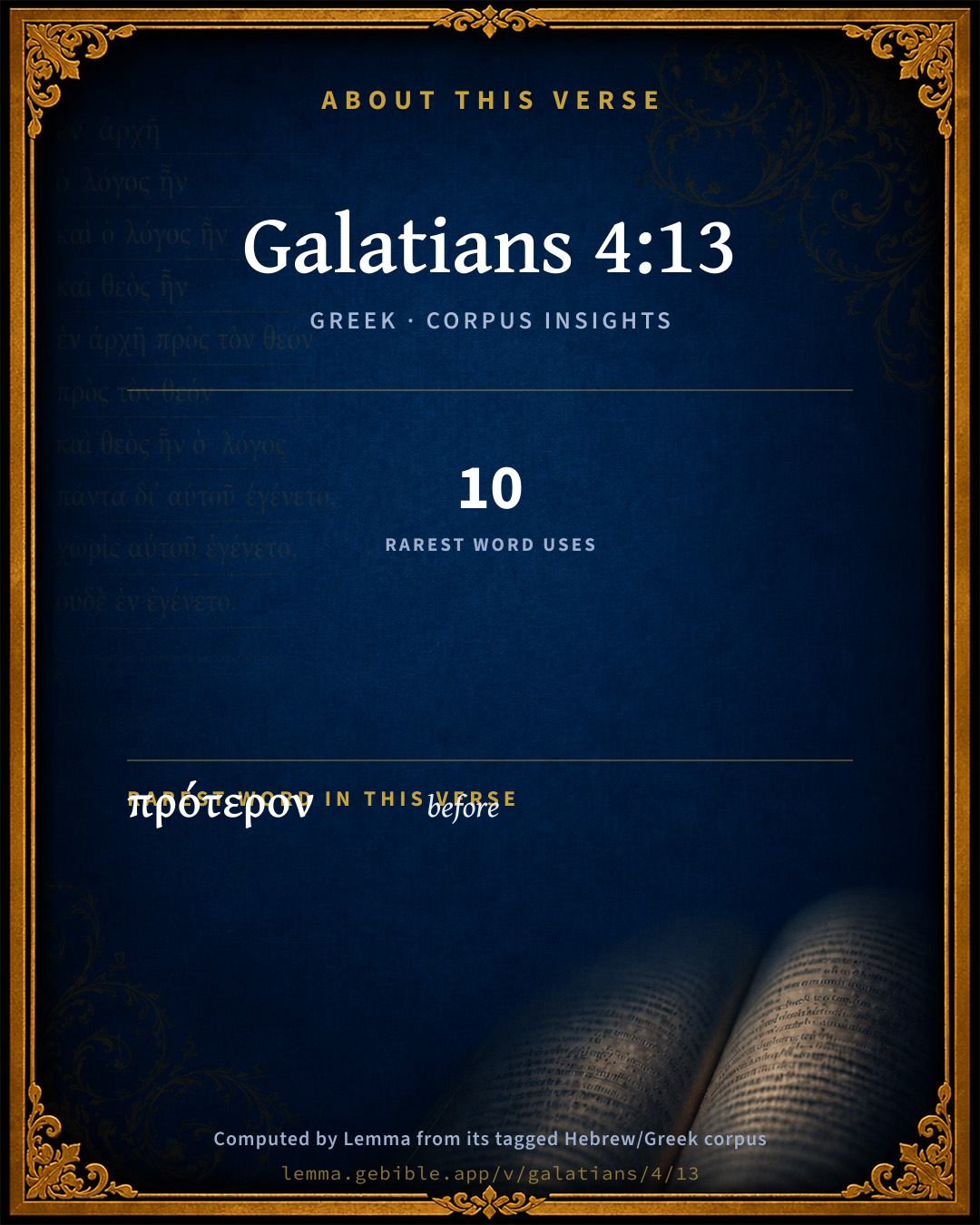
Galatians 4:13

Greek (Tischendorf 8th ed.) Galatians 4:13 appears in the Greek New Testament. The text above is from the Tischendorf 8th edition. Each word links to its Strong’s number and a concise gloss. Click any word for its full Thayer’s Greek Lexicon entry.

Download image
Cite this verse

Galatians 4:13 (World English Bible). Public Domain. Lemma interlinear Bible study tool, https://lemma.gebible.app/v/galatians/4/13.

Show BibTeX & RIS
BibTeX
RIS
English Translation
but you know that because of weakness of the flesh I preached the Gospel to you the first time.
World English Bible · Public Domain
Download a study sheet

One document with this verse’s original text, its word-by-word gloss line, the meaning frame, cross-references with their text, attributed commentary, and full source and license credits — printable, and it pastes into notes with its structure intact.

This verse Autodidact and up

Study sheet (.html) Plain text (.txt)

A passage Seminary Student

Up to 50 verses in one chapter. A passage sheet keeps up to 6 commentary sources and 12 cross-references per verse, in the order this page ranks them, and says so on the sheet whenever that leaves anything out. Ask for a single verse and you get the Autodidact verse sheet above.

Everything on this page stays free to read, with no account — the sheet is a download of what is already on screen, not access to it.

Want to remove ads? Support Godless Engineer
Compare translations 3

The same verse in 3 English versions, stacked beneath the original-language interlinear above. Click any original word for its lexicon entry.

Each is an independent rendering of the whole verse — the interlinear is not word-aligned to these translations.

Highlighted words mark where these versions differ — a whole-verse word diff, not a word-by-word alignment.

  • World English Bible Public Domain
    but you know that because of weakness of the flesh I preached the Gospel to you the first time.
  • King James Version Public Domain
    Ye know how through infirmity of the flesh I preached the gospel unto you at the first.
  • unfoldingWord Literal Text CC BY-SA 4.0
    Now you know that because of a weakness of the flesh I proclaimed the gospel to you previously.

unfoldingWord Literal Text — © unfoldingWord, licensed CC BY-SA 4.0. Word-aligned USFM3 via Door43 (git.door43.org/unfoldingWord/en_ult).

Versions to compare (up to 4)

3 of 4 selected

Show all 19 translations

Every available English version of this verse, each an independent rendering of the whole verse.

  • World English Bible Public Domain
    but you know that because of weakness of the flesh I preached the Gospel to you the first time.
  • Berean Standard Bible Public Domain
    You know that it was because of an illness that I first preached the gospel to you.
  • Majority Standard Bible Public Domain
    You know that it was because of an illness that I first preached the gospel to you.
  • King James Version Public Domain
    Ye know how through infirmity of the flesh I preached the gospel unto you at the first.
  • American Standard Version (1901) Public Domain
    but ye know that because of an infirmity of the flesh I preached the gospel unto you the first time:
  • Revised Version (1885) Public Domain
    but ye know that because of an infirmity of the flesh I preached the gospel unto you the first time:
  • Geneva Bible (1599) Public Domain
    And ye know, how through infirmitie of the flesh, I preached ye Gospel vnto you at the first.
  • Douay-Rheims (1899) Public Domain
    And you know, how through infirmity of the flesh, I preached the gospel to you heretofore: and your temptation in my flesh,
  • Young's Literal Translation Public Domain
    and ye have known that through infirmity of the flesh I did proclaim good news to you at the first,
  • Literal Standard Version CC BY-SA 4.0
    and you have known that through weakness of the flesh I proclaimed good news to you at the first,
  • Unlocked Literal Bible CC BY-SA 4.0
    But you know that it was because of a physical illness that I proclaimed the gospel to you the first time.
  • unfoldingWord Literal Text CC BY-SA 4.0
    Now you know that because of a weakness of the flesh I proclaimed the gospel to you previously.
  • Darby Bible Public Domain
    But ye know that in weakness of the flesh I announced the glad tidings to you at the first;
  • World Messianic Bible Public Domain
    but you know that because of weakness in the flesh I preached the Good News to you the first time.
  • Webster's Bible Public Domain
    Ye know that in infirmity of the flesh I preached the gospel to you at the first.
  • Free Bible Version CC BY-SA 4.0
    You remember that it was because I was sick that I shared with you the good news on my first visit.
  • Bible in Basic English Public Domain
    But you have knowledge that with a feeble body I was preaching the good news to you the first time;
  • Text-Critical English NT CC BY 4.0
    But you know that it was because of a physical infirmity that I preached the gospel to you the first time.
  • Tyndale New Testament (1534) Public Domain
    Ye knowe how thorow infirmite of the flesshe I preached the gospell vnto you at the fyrst.

Literal Standard Version (2020), Covenant Press — licensed CC BY-SA 4.0. Text via the HelloAO Bible API (eBible.org). Unlocked Literal Bible (unfoldingWord) — licensed CC BY-SA 4.0. Text via the HelloAO Bible API (eBible.org). unfoldingWord Literal Text — © unfoldingWord, licensed CC BY-SA 4.0. Word-aligned USFM3 via Door43 (git.door43.org/unfoldingWord/en_ult). Free Bible Version, Dr. Jonathan Gallagher — licensed CC BY-SA 4.0. Text via the HelloAO Bible API (eBible.org).

Word by word

More ways to search: Search by grammar → Find every occurrence → Compare this word →

Practice this passage: Drill this verse → Learn its vocabulary →

About this verse

These counts appear in no published source. They are computed here, from the morphology-tagged text and Lemma’s own curated glosses. What Lemma adds →

11
words
10
distinct lemmas
Pauline Epistles
section

Notable vocabulary

The rarest word here is πρότερον before G4386 — appearing just 10 times in the whole Greek New Testament.

Shared distinctive vocabulary

πρότερον before G4386 occurs in 10 verses of the Greek New Testament. Also found in:

Repetition

A word recurs within this verse:

Cross-references

8

Topical passages linked to Galatians 4:13 in the Treasury of Scripture Knowledge — connected by theme and wording, ordered by reader-vote popularity; previews shown in the World English Bible.

  • 1 Corinthians 2:3 I was with you in weakness, in fear, and in much trembling.
  • 2 Corinthians 12:7–10 By reason of the exceeding greatness of the revelations, that I should not be exalted excessively, there was given to me a thorn in the flesh, a messenger of Satan to buffet me, that I should not be exalted excessively.
  • 2 Corinthians 10:10 For, "His letters," they say, "are weighty and strong, but his bodily presence is weak, and his speech is despised."
  • 2 Corinthians 11:30 If I must boast, I will boast of the things that concern my weakness.
  • 2 Corinthians 11:6 But though I am unskilled in speech, yet I am not unskilled in knowledge. No, in every way we have been revealed to you in all things.
  • 2 Corinthians 13:4 For he was crucified through weakness, yet he lives through the power of God. For we also are weak in him, but we will live with him through the power of God toward you.
  • Galatians 1:6 I marvel that you are so quickly deserting him who called you in the grace of Christ to a different gospel;
  • Acts 16:6 When they had gone through the region of Phrygia and Galatia, they were forbidden by the Holy Spirit to speak the word in Asia.

Cross-references courtesy of OpenBible.info (CC BY 4.0).

Commentary

Notes on Galatians 4:13 from classic Christian and Jewish commentators (each source and its license shown beneath its notes). The classic Christian expositions comment on the surrounding passage and are grouped to its opening verse, so a note may address several verses; the Jewish commentaries on the Tanakh (Rashi and others) are per-verse, so they appear only where the commentator wrote on this verse.

Lemma curates 59 commentaries, every one of them public domain or Creative Commons licensed, each selected and text-cleaned for this edition rather than reprinted as found. About our sources →

The Biblical Illustrator

Joseph S. Exell

Gal_4:13

Ye know how through infirmity of the flesh.

Preaching in the infirmity of the flesh

I. That we might not exalt our teachers unduly, who are only instruments of grace (Act_14:15).

II. That we might ascribe the whole work of our conversion to God alone (2Co_4:7).

III. That God might by this means confound the wisdom of the world, and cause men that would be wise to become fools that they might be wise (1Co_3:18).

IV. That we might be assured that the doctrine is of God because it prevails without the strength and policy of man. (W. Perkins.)

The Gospel

I have been delighted, on a calm summers evening, to hear the tones of a sweet human voice borne to my ears from the other side of the valley. The shadows of the evening were around me, the birds had gone to their rest, a sadness was over the land; not a sound was heard save that voice, singing some tender Welsh air. The voice wandered among the hills, or seemed to linger in the eaves; then it trembled among the branches; by and by it became more powerful as it passed over the clear plain below. There was in it an indescribable pathos--it was a sigh swelling into a song--and it created in me unutterable longings for the perfect good, for that state in which life is musical, harmonious, and not filled with wild, discordant notes, as our present life is. The gospel resembles that voice, it comes to us trembling with Divine love; a tender, melting, pathetic voice, speaking of God and His love and His heaven, and the blessedness that shall be revealed. (Thomas Jones.)

Why no record of Paul s preaching

While we have more or less acquaintance with all the other important Churches of Pauls founding, not a single name of a person or place, and scarcely a single incident connected with the apostles preaching in Galatia is preserved in either the Acts or the Epistle. This may partly be accounted for by the circumstances of the Church. The same delicacy which has concealed from us the name of the Corinthian offender may have led the apostle to avoid all special allusions in addressing a community to which he wrote in a strain of severest censure. And the historian would seem to have purposely drawn a veil over the infancy of a Church which swerved so soon and so widely from the purity of the gospel. (Bp. Lightfoot.)

The indisposition of St. Paul

Nothing is more natural than that the traversing of vast distances over the burning plains and freezing mountain passes of Asia Minor--the constant changes of climate, the severe bodily fatigue, the storms of fine and blinding sand, the bites and stings of insects, the coarseness and scantiness of daily fare--should have brought on a return of his malady to one whose health was so shattered as that of St. Paul. (Farrar.)

The climate and the prevailing maladies of Asia Minor may have been modified by lapse of centuries; and we are without the guidance of St. Lukes medical language which sometimes throws a light on diseases alluded to in Scripture; but two Christian sufferers, in widely different ages of the Church, occur to the memory as we look on the map of Galatia. We could hardly mention any two men more thoroughly imbued with the spirit of St. Paul than John Chrysostom and Henry Martyn. And when we remember how these two saints suffered in their last hours from fatigue, pain, rudeness, and cruelty, among the mountains of Asia Minor which surround the place where they rest, we can well enter into the meaning of St. Pauls expression of gratitude to those who received him kindly in the hour of his weakness. (Conybeare and Howson.)

Personal suffering a means of the worlds progress

The hopes of humanity do not lie in the fulness with which science discovers and employs the forces of nature. On the contrary, there is no danger which is more imminent than the appropriation of those powers by the coarsest despotism which can enslave and corrupt its subjects. It does not consist in what is called culture, because art and poetry are easily made slaves of that wealth which is willing to have its existence certified and its power acknowledge by the homage of cultivated parasites. It is not learning that can save man; for at best learning only influences a few, and is apt, in those who possess it, to degenerate into self-sufficiency and ease. Least of all do the hopes of man lie in the aggregation of wealth; for experience tells us that wealth is not only apt to be arrogant and domineering, but to form a coarse and harsh oligarchy, degraded by low tastes and prone to ferocious fears. Nor, finally, do the hopes of humanity reside in any form of polity. It may be that one form of administration is better than another, because it offers least resistance to the influence which ought to leaven society, gives a freer course to those forces which can chasten and exalt mankind. Despotism degrades us, but it does not follow that liberty purifies us. The atmosphere is cleared of its accumulated poisons by some furious storm, which does in the end bring health to the many, but bestows its benefits amidst the waste and the rain of those whom it smites. And so the moral purification of society is affected by the suffering of those whom the cleansing storm catches in its course; the victory of the most righteous cause demands the suffering and death of some among those who enter into the battle. When the stronghold of truth and virtue is to be built, the foundations are laid in the firstborn, and the youngest perishes before the walls are finished. (Paul of Tarsus.)

Affliction a means of moral influence

The sunlight falls upon a clod, and the clod drinks it in, is itself warmed by it, but lies as black as ever, and sheds out no light. But the sun touches a diamond, and the diamond almost chills itself as it sends out in radiance on every side the light that has fallen upon it. So God helps one man to bear his pain, and nobody but that one man is a whir the richer. God comes to another sufferer--reverent, unselfish, and humble--and the lame leap, and the dumb speak, and the wretched are comforted all around by the radiated comfort of that happy soul. (Phillips Brooks, D. D.)

The Biblical Illustrator, edited by Joseph S. Exell (c. 1880s–1900s) — public domain. Text from a community e-Sword module.

Tyndale Open Study Notes

Tyndale Open Resources

4:13-14 I was sick: Paul might have had a chronic physical ailment, but it is not certain what it was (cp. 2 Cor 12:7). Paul’s condition was serious and apparently caused difficulty or even offense to the new church in Galatia. Physical trouble was often regarded by both Jews and Gentiles as a sign of God’s judgment (cp. John 9:1-2; Acts 28:4). The Galatians saw past Paul’s outward condition and received him as God’s messenger (literally angel; Greek angelos). • or even Christ Jesus himself: Cp. Luke 10:16.

Tyndale Open Study Notes — © Tyndale Open Resources, licensed CC BY-SA 4.0. Text via the HelloAO Bible API.

Bengel's Gnomon

Johann Albrecht Bengel

Gal 4:13. Δἰ ἀσθενείαν) διὰ, on account of, by reason of infirmity. Infirmity had not been the cause of his preaching: but yet it proved an advantage [an assistance], owing to which Paul preached more effectively; 2Co 12:9; though it might have seemed that the Galatians would have been the more easily disposed to reject him on account of it.

Bengel's Gnomon of the New Testament — English translation (T&T Clark, Edinburgh, 1860) — public domain. Text from a community e-Sword module.

Meyer's Critical & Exegetical Commentary

Heinrich August Wilhelm Meyer

Gal_4:13-14. Contrast to the preceding οὐδέν με ἠδικ. Comp. Chrysostom: Ye have done nothing to injure me; but ye doubtless know, that I on account of weakness of the flesh preached the gospel to you the former time, and that ye, etc.

διʼ ἀσθένειαν τῆς σαρκός] The only correct explanation, because the only one agreeable to linguistic usage, is that adopted by Flatt, Fritzsche, Hilgenfeld, Wieseler, and others, also by Winer, Gramm. p. 373 [E. T. 499], on account of weakness of the flesh:[193] so that it is clear, that on Pauls first journey through Galatia (Act_16:6) he was compelled by reason of bodily weakness to make a stay there, which properly did not form a part of his plan; and that during this sojourn, forced on him by necessity, he preached the gospel to the Galatians. How he suffered, and from what cause, whether from natural sickness (comp. 2Co_12:7),[194] or from ill-treatment which he had previously endured on account of the gospel (comp. Gal_6:17), we do not know. The mention of an involuntary or rather quite unpremeditated working among the Galatians is not opposed to the apostles aim (as Rückert objects), but favourable to it; because the love which received him so heartily and joyfully must have been all the greater, the less it depended on the duty of befitting gratitude for a benefit previously destined for the recipients, and for exertions made expressly on their account. Many others have understood διά as denoting the apostles condition: amidst bodily weakness, which is then referred by some, and indeed most expositors, following Chrysostom and Luther, to persecutions and sufferings, by others to his insignificant appearance (Calvin), by others to sickness (Rückert, Matthies, Olshausen, Ewald; comp. also in Jerome), and by others even to embarrassment and perplexity on account of the strange circumstances (Baumgarten-Crusius). But in this case διά must have been used with the genitive (see Matthiae, p. 1353; Fritzsche, ad Rom. I. p. 138); for expressions such as διὰ δῶμα, ΔΙᾺ ΝΎΚΤΑ, ΔΙᾺ ΣΤΌΜΑ, ΔΙʼ ΑἸΘΈΡΑ, Κ.Τ.Λ., in which ΔΙΆ denotes stretching through, are merely poetical (see Schaefer, ad Mosch. 4. 91; Bernhardy, p. 236 f.; Kühner, II. p. 282). We should be obliged to think of the occasioning state (as in διὰ τοῦτο, ΔΙᾺ ΠΟΛΛΆ, Κ.Τ.Λ.), which would just bring us back to our interpretation. Hence we must reject also the explanation of Grotius: per varios casus, per mille pericula rerum perrexi, ut vos instituerem. Others still have gone so far as to refer ΔΙʼ ἈΣΘ. Τῆς ΣΑΡΚΌς to weakness of the Galatians, to which Paul accommodated himself. So Jerome, Estius, Hug, and Rettig l.c. p. 108 ff.: I have preached to you on account of the weakness of your flesh, which is supposed to mean: I have in my preaching had respect to the infirmity of your flesh. Utterly mistaken: because Paul must necessarily have added a modal definition to εὐηγγ. (even if it had only been an ΟὝΤΩς), or must have written ΚΑΤʼ ἈΣΘ. instead of ΔΙʼ ἈΣΘ.; moreover, ἘΝ Τῇ ΣΑΡΚΊ ΜΟΥ in Gal_4:14 shows that Paul meant the ἈΣΘΈΝΕΙΑ Τῆς ΣΑΡΚΌς to apply to himself.

τὸ πρότερον] may mean either: earlier, at an earlier time, so that it would be said from the standpoint of the present (Thuc. i. 12. Galatians 2 : τὴν νῦν Βοιωτίαν, ΠΡΌΤΕΡΟΝ ΔῈ ΚΑΔΜΗΐΔΑ ΓῆΝ ΚΑΛΟΥΜΈΝΗΝ, Isocr. de pace, § 121 and Bremi in loc.), which in relation to the past is the later time (Joh_6:62; Joh_7:51; Joh_9:8; 2Co_1:15; 1Ti_1:13; 1Pe_1:14; Heb_10:32; LXX. Deu_2:12; 1Ch_9:2; 1Ma_11:27); or the former time, so that the same fact (the preaching) took place twice (Heb_4:6; Heb_7:27). It is interpreted in the former sense by Usteri and Fritzsche, and in the latter by Koppe, Winer, Rückert, Matthies, Baumgarten-Crusius, de Wette, Wieseler, Hilgenfeld, Ewald, Hofmann, and others.[195] The latter is the correct view, so that τὸ πρότερον presupposes a second sojourn of the apostle among the Galatians. For if he had preached among them only once, τὸ πρότερον would have been quite an idle, superfluous addition. But Paul adds it just in order to denote quite distinctly his first visit, during which he founded the churches (Act_16:6): at his second visit (Act_18:23), the happy experiences which he had enjoyed τὸ πρότερον were not repeated in such full measure; the churches were already tainted by Judaism. Comp. Introd. § 2, 3. Fritzsche, indeed, maintains that Gal_4:18-19 imply that Paul before the composition of the epistle had only once visited the Galatians; but see on Gal_4:19.

[193] Bengel also translates correctly: propter infirmitatem, but erroneously explains that the weakness was not indeed causa praedicationis ipsius, but adjumentum, cur P. efficacius praedicaret, cum Galatae facilius rejicere posse viderentur. Similarly, but still more incorrectly, Schott, who detects an acumen singulare in Pauls saying: per ipsam aegritudinem carnis doctrinam divinam vobis tradidi; for the fact that Paul, although sick, had preached very zealously, had been of great influence in making his preaching more successful. In this interpretation everything is mistaken: for διά must have been used with the genitive; the ipsam and the thought of successful preaching are quite gratuitously imported; and the whole of the alleged acumen would be completely out of place here, where Paul wishes to remind his readers of their love then shown to him, and not of the efficacy of his preaching.

[194] In respect to 2 Cor. l.c., Holsten, in Hilgenfelds Zeitschrift, 1861, p. 250 f., conceives it to refer to epileptical disturbances of the circulatory and nervous system, such as occur among visionaries. Comp. his Ev. d. Paul. u. Petr. p. 85.

[195] The older expositors, translating it jam pridem (Vulgate), or prius (Erasmus, Beza, Calvin), or antea (Castalio), do not for the most part attempt any more precise explanation. Luther: for the first time. Chrysostom, Theodoret, and Theophylact do not give any explanation of τὸ πρότ.

Meyer — Critical and Exegetical Commentary on the New Testament — English translation by Peter Christie, edited by Frederick Crombie (T&T Clark, 1880) — public domain. Text from a community e-Sword module.

Expositor's Greek Testament

ed. W. Robertson Nicoll

Gal 4:13 . διʼ ἀσθένειαν . This can only mean owing to infirmity of the flesh, i.e. , to illness. διά with accusative has the same causal force in the N.T. as in Attic Greek. A phrase like διά νύκτα , by night , is found in Homer, but διά subsequently lost its temporal force, and only regained it in the Latinised Greek of later centuries from confusion with the Latin per. The position of διʼ ἀσθένειαν before the verb lays stress upon the fact that the ministry was due to illness alone, and not to spontaneous resolve.

It appears from this and the following verses that the illness occurred under the eyes of the Galatians, who watched its progress, were familiar with its repulsive symptoms, and displayed tender sympathy with the sufferer. They were aware also of the alteration it had made in his plans. The inference from these facts is clear, that he did not intend at the time of his arrival in Galatia to preach there at all, but was prostrated immediately after by sudden illness, and so forced to relinquish his previous project and abandon for the present any further journey. The only conceivable way, in short, in which an attack of illness in Galatia can have occasioned his preaching there was by involuntary detention. Here, accordingly, the motive for mentioning it is to show how little claim he had on the gratitude of the Galatians at that time, and how little he had deserved the tender sympathy which they exhibited. The historical connection of this illness with the ministry of Paul and Barnabas is investigated in the Introduction (pp. 135 7).

It has been suggested that this attack was perhaps identical with the σκόλοψ τῇ σαρκί mentioned in 2Co 12:7 , and this may be true, but the real nature of the σκόλοψ is unknown. Some features of this attack on the contrary may be inferred from the description given of its effects: it incapacitated the patient for travel, produced disfigurement and offensive symptoms, but allowed free intercourse with those around him. His success in winning the hearts of those who visited him in his sick chamber suggests a chronic ailment prolonged for a considerable time, as does also the complete change in his plans. The only definite hint given of a specific malady is the language of Gal 4:15 : from which I gather that the eyesight was imperilled by a virulent attack of ophthalmia. That disease was notoriously prevalent in the lowlands of Pamphylia through which he had been travelling, and if so contracted, would produce the symptoms described. The pathetic appeal to Galatian sympathy on the score of imperfect sight in Gal 6:11 confirms this view. If his sight had been impaired by an illness to which they had themselves ministered with tender solicitude, they would be quick to feel for his privation. τὸ πρότερον . Lightfoot contends with justice that this phrase cannot on account of the prefixed article refer to an indefinite period in time past. The author clearly had in his mind two distinct periods, an earlier and a later, during the earlier of which he states that his preaching had been occasioned by illness. Lightfoot suggests that he referred perhaps to the two visits which he had paid to the Galatian Churches: and the suggestion is reasonable if his theory be accepted of sites in Northern Galatia, for no details are known of either visit. But it is quite incompatible with the history of his ministry in Southern Galatia recorded in Act 13:14 . That lasted over two winters at the very least, comprised two visits at considerable intervals to each of the Churches, and displayed throughout as resolute an initiative, as determined energy, as vigorous activity, as can be found in the whole course of his apostolic career. That ministry gave certainly no sign of illness, but the contrary. We have seen, however, that it was preceded by a prolonged illness, during which he was probably confined to his sick chamber and could only minister to those who visited him there. His first ministry in Galatia passed in short through two distinct stages, first the private ministrations of a sick man, and then a public career of unexampled vigour and success. The last verse placed the readers on the division line between the two, for it reminded them of the memorable petition addressed to him and Barnabas at the close of his first public address in the synagogue of the Pisidian Antioch. It is, therefore, of the preceding period that he writes here, “You know that it was owing to illness that I had preached to you up to that time ( τὸ πρότερον )”. It is needless to dwell on the complete harmony of this interpretation with the context.

The Expositor's Greek Testament, edited by W. Robertson Nicoll (1897–1910) — public domain. Text from a community e-Sword module.

Geneva Bible (1599)

Geneva Bible translators

Many afflictions.

Geneva Bible (1599) marginal notes — public domain. Text via Bolls.life.

Jamieson, Fausset & Brown

Robert Jamieson, A. R. Fausset & David Brown

how through infirmity--rather, as Greek, "Ye know that because of an infirmity of my flesh I preached," &c. He implies that bodily sickness, having detained him among them, contrary to his original intentions, was the occasion of his preaching the Gospel to them.

at the first--literally, "at the former time"; implying that at the time of writing he had been twice in Galatia. See my Introduction; also see on Gal 4:16, and Gal 5:21. His sickness was probably the same as recurred more violently afterward, "the thorn in the flesh" (Co2 12:7), which also was overruled to good (Co2 12:9-10), as the "infirmity of the flesh" here.

Jamieson, Fausset & Brown — Commentary Critical and Explanatory on the Whole Bible (1871) — public domain (CC PDM 1.0). Text via the HelloAO Bible API.

Adam Clarke's Commentary

Verse 13. Ye know how through infirmity] The apostle seems to say that he was much afflicted in body when he first preached the Gospel to them. And is this any strange thing, that a minister, so laborious as St. Paul was, should be sometimes overdone and overcome by the severity of his labours? Surely not. This might have been only an occasional affliction, while labouring in that part of Asia Minor; and not a continual and incurable infirmity, as some have too hastily conjectured.

Adam Clarke's Commentary on the Bible (1810–1826) — public domain. Text from a community e-Sword/MySword module.

John Calvin's Commentaries

13. Ye know that, through infirmity of the flesh. He recalls to their recollection the friendly and respectful manner in which they had received him, and he does so for two reasons. First, to let them know that he loved them, and thus to gain a ready ear to all that he says; and secondly, to encourage them, that, as they had begun well, they would go on in the same course. This mention of past occurrences, then, while it is an expression of his kind regards, is intended likewise as an exhortation to act in the same manner as they had done at an earlier period.

By infirmity of the flesh he means here, as in other places, what had a tendency to make him appear mean and despised. Flesh denotes his outward appearance, which the word infirmity describes to have been contemptible. Such was Paul when he came among them, without show, without pretense, without worldly honors or rank, without everything that could gain him respect or estimation in the eyes of men. Yet all this did not prevent the Galatians from giving him the most honorable reception. The narrative contributes powerfully to his argument, for what was there in Paul to awaken their esteem or veneration, but the power of the Holy Spirit alone? Under what pretext, then, will they now begin to despise that power? Next, they are charged with inconsistency, since no subsequent occurrence in the life of Paul could entitle them to esteem him less than before. But this he leaves to be considered by the Galatians, contenting himself with indirectly suggesting it as a subject of consideration.

John Calvin's Commentaries (1540-1563) — public domain. Text from the Calvin Translation Society English edition (1840s-50s) via the Christian Classics Ethereal Library (ccel.org). Calvin's coverage is partial (roughly two-thirds of the Bible); uncommented books and verses are honest gaps, never fabricated. The 19th-century editor's footnotes and remarks are omitted so the notes are faithfully Calvin's own voice.

Ellicott's Commentary for English Readers

(13) Through infirmity of the flesh.—Rather, because (or, on account) of infirmity of flesh—i.e., some bodily weakness or ill-health. We should gather from this that St. Paul was detained in Galatia accidentally by illness, and that this led to his preaching the gospel there.

At the first.—The first time; on my first visit. This would be the one mentioned in Act_16:6, in distinction from that referred to in Act_18:23. (See Introduction.)

A Bible Commentary for English Readers, edited by Charles John Ellicott (1878–1897) — public domain. Text from a community e-Sword module.

The Cambridge Bible for Schools and Colleges

gen. ed. J. J. S. Perowne

13. through infirmity of the flesh] Rather, as R.V. ‘because of an infirmity of the flesh’, owing to bodily sickness.

What was this infirmity? Most commentators identify it with the ‘thorn in the flesh’, 2Co_12:7. Bp Lightfoot (p. 169 foll.) enumerates in chronological order the different conjectures which have been put forward in early and more modern times. They are (1) some bodily ailment, (2) persecution, (3) fleshly desires, (4) spiritual trials, such as temptations to despair, blasphemous suggestions of the Devil. The most recent expositors recur to the earliest view of this infirmity—that it was some bodily ailment. Bp Lightfoot conjectures that it was ‘of the nature of epilepsy’. Between this suggestion and that of some defect of eye-sight, perhaps acute ophthalmia, it is not easy to choose. The passages adduced in support of this latter conjecture are not conclusive in its favour, though their cumulative evidence is strong. They are discussed in an interesting note by Bp. Lightfoot, p. 174, note 1.

at the first] Probably, ‘on the former occasion’, i.e. on the earlier of my two visits, mentioned Act_16:6. The second or later visit is named Act_18:23. We may fairly infer from the Apostle’s language that on the former occasion he had not intended to preach the Gospel in Galatia, but that sickness of some kind (probably acute disorder) detained him there, and that notwithstanding weakness and pain—distress to himself, and disadvantage to the reception of his message—he proclaimed the Gospel of his Lord.

The Cambridge Bible for Schools and Colleges (gen. ed. J. J. S. Perowne; Cambridge University Press, 1878–1918) — public domain. Text from a community e-Sword module.

John Gill's Exposition

And my temptation which was in my flesh,.... The same with the infirmity of his flesh, and which was a trial of his faith and patience, and every other grace, as the afflictions of the saints be. The Alexandrian copy, and some others, and the Vulgate Latin version read, "your temptation in my flesh"; that which was a trial of them, whether they would receive him or not. This

ye despised not; nor the apostle on the account of it, nor his ministry; they thought never the worse of him, nor of the Gospel he preached, because of this:

nor rejected; him, nor the counsel of God declared by him,

but received me; as they did, into their cities and places of worship, into their houses, and into their hearts and affections: and that

as an angel of God; with all that reverence and respect, that high esteem, veneration, and affection, as if one of the celestial inhabitants had been sent down from heaven to bring them the good tidings of the Gospel: or "as a messenger of God", as the phrase may be rendered: as one that had his mission and commission from God, which was not at all disputed by them: but they looked upon him under that character, and regarded him as such,

even as Christ Jesus; as his ambassador, as representing him, as being in his stead; yea, if he had been personally present as man among them, they could not have shown greater respect to him as such, than they did to the apostle; for as for any religious worship and adoration, that they did not offer to him; and had they, he would have addressed them in like manner he did the inhabitants of Lystra, Act 14:14. Now since they showed him so much respect, notwithstanding all his infirmities, temptations, and afflictions, when he first preached the Gospel; what should hinder that they should not pay the same regard to him now, by abiding in his doctrine and following his example, since he was the same man in his principles and practices now as then?

John Gill's Exposition of the Whole Bible (1746–1763) — public domain (CC PDM 1.0). Text via the HelloAO Bible API.

Trapp's Complete Commentary

John Trapp

13 Ye know how through infirmity of the flesh I preached the gospel unto you at the first.

Ver. 13. Through infirmity of the flesh] That is, though much broken with many miseries, yet I spared not to take pains among you. Zachariah, though he ceased to speak, yet he ceased not to minister; he took not his dumbness for a dismission, but stayed out the eight days of his course, Luk 1:23.

John Trapp, A Commentary or Exposition upon All the Books of the Old and New Testament (1647–1656) — public domain. Text from a community e-Sword module.

Albert Barnes' Notes on the Bible

Ye know how - To show them the folly of their embracing the new views which they had adopted, he reminds them of past times, and particularly of the strength of the attachment which they had evinced for him in former days.

Through infirmity of the flesh - Greek “Weakness” (ἀσθένειαν astheneian); compare the 1Co 2:3 note; 2Co 10:10; 2Co 12:7 notes.

Albert Barnes' Notes on the Bible (1834–1885) — public domain. Text from a community e-Sword/MySword module.

Haydock's Catholic Bible Commentary

Through infirmity of the flesh....and your temptation in my flesh. St. Jerome thinks the apostle had some bodily infirmity upon him. St. John Chrysostom understands his poverty, and want, and persecutions, and that some were inclined to contemn him and his preaching on these accounts. Yet others among them did not esteem him less: they received him, respected him as an Angel of God, as Christ Jesus; they would have given him their eyes, as one may say, and all that was dear to them. He puts them in mind how happy then they thought themselves, and asketh why they are now so much changed? (Witham)

George Leo Haydock (1774–1849), Haydock's Catholic Family Bible and Commentary, 1859 edition — public domain. Excludes Psalms (Douay-Rheims chapter numbering differs from Protestant) and Deuterocanonical books (Catholic canon only).

Matthew Poole's English Annotations

The Scripture having not given us a particular account of Paul’s circumstances when he first preached the gospel to the Galatians, we are at a loss to determine what those infirmities were which Paul here speaketh of, more than that he calls them

infirmities of the flesh: by which may be understood, either the baseness and contemptibleness of his presence, (which the false teachers at Corinth objected to him, 2Co 10:10), or some bodily sickness which Paul had at that time, (as some of the ancients guess), or his sufferings for the gospel, which were those infirmities wherein he chose to glory, 2Co 11:30.

Matthew Poole's English Annotations on the Holy Bible (1683–1685) — public domain. Text from a community e-Sword/MySword module.

Whedon's Commentary on the Bible

Daniel D. Whedon

13. Through infirmity—Rather, on account of infirmity, or bodily illness. A visitation of St. Paul’s thorn in the flesh (note, 2Co_12:7) detained him at Galatia; and in spite of its drawback on his oratory the Galatians cordially received him and his message.

At the first—The Greek meaning seems to be, at the former of two visits.

Daniel D. Whedon (gen. ed.), Commentary on the Old and New Testaments (1874–1909) — public domain. Text from a community e-Sword module.

The Pulpit Commentary

Ye know (oidate de); and ye know. The apostle very often uses the verb oidamen, or oidate, conjoined with either de, gar, or kaqwv, when recalling some circumstance of personal history (1Co_16:15; Php_4:15; 1Th_2:1, 1Th_2:2, 1Th_2:5, 1Th_2:11; 2Ti_1:15) or to introduce the statement of a doctrine as one which would be at once recognized as certain or familiar (Rom_2:2 Rom_3:19 Rom_8:28; 1Ti_1:8; 2Th_2:6) The phrase as so used is equivalent to "We or, "you" do not need to be told," etc.; and with de is simply a formula introducing such a reminiscence, this conjunction having in such cases head versative force, but being simply the de of transition (meta-batic); equivalent to "now" or "and," or not needing to be represented at all in translation; so that the Authorized Version is perfectly justified in omitting it in the present instance. The phrase may be taken as meaning "And you will well remember." If the apostle had intended to introduce a statement strongly adversative to the last preceding sentence, he would probably have written ajllaon (ch. 2:7) or some such phrase. How through infirmity of the flesh I preached the gospel unto you (oti dij ajsqeneian thv sarkomhn uJmin) that because of an infirmity of the flesh I preached the gospel unto you.

"An infirmity of the flesh;" that is, a bodily illness. The noun ajsqeneia is used for "illness" in Joh_11:4; Act_28:9; 1Ti_5:23; Mat_8:17. It also denotes a nervous disablement, as Luk_13:11, Luk_13:12; w Joh_5:5. The verb ajsqene is the common word for "being sick," as Luk_4:40 Luk_7:10; sate, Joh_11:3, etc. It is possible that the apostle meant to say that the Galatians might not unnaturally have thought themselves treated slightingly in that his remaining among them so long was owing to illness and not to his own choice; but that yet, for all that, they had shown themselves most eager in welcoming their involuntary visitor. The words, however, do not require to be thus construed, and in all probability intend no more than to bring back to their remembrance the disorder under which he was then suffering. The illness would seem to have been of a nature to make his personal appearance in some way unsightly, and even repulsive; for the ejxeptu spat out, of the next verse suggests even the latter idea. Evidently this disorder, as also the one noted in 2Co_12:7, 2Co_12:8, did not disqualify him for ministerial work altogether. He adverts to the circumstance, as making it yet more remarkable and more grateful to his feelings, that, notwithstanding the disagreeable aspect which in some way his disorder presented to those about him, they had cherished his presence among them with so much kindness as they did and also with such reverential respect. How it was that his illness brought about this protracted stay, whether it was that he fell ill while journeying through the country so as to be unable to pursue his way to his ulterior destination, or whether the remarkable healthiness of the climate either first attracted him thither or detained him there for convalescence (see Bishop Lightfoot, "Galatians," p. 10, note 2, for the character of the climate at Angora, the ancient Ancyra), it is impossible for us to determine. It is noticeable that St. Chrysostom"s comments on the passage appear to show that he considered the apostle to be simply stating the circumstances under which and not those in consequence of which he preached the gospel to them; and so also OEcumenius and Theophylact paraphrase dij ajsqenein by metaav, suggesting the conjecture that they and St. Chrysostom understood the words as equivalent to "during a period of infirmity of the flesh." But this gives to dia with an accusative a sense which, to say the least, is not a common one. Is this illness of body to be connected with the affliction, most probably a bodily affliction, mentioned in 2Co_12:7, 2Co_12:8, "the stake in the flesh"? This latter affliction has been discussed very fully by Dean Stanley and Meyer on the Corinthians, by Bishop Lightfoot in his commentary on the Galatians, and by Dr. Farrar in his "Life of St. Paul." It appears to have first befallen the apostle after the "revelations" accorded to him fourteen years before he wrote his Second Epistle to the Corinthians, which he is supposed to have done in the autumn of A.D. 57. This would bring us back to about A.D. 43. The apostle"s first visit to Galatia, according to Bishop Lightfoot, p. 22, took place about A.D. 51. When we consider that no doubt many of those wearing labours and hardships, interspersed with frequent suffering of gross personal outrage, recounted in 2Co_11:23-27, had been undergone in the eight first of those fourteen years (the stoning at Lystra certainly had) it must seem very precarious to conjecture that the malady here referred to was a recurrence of just that particular disorder experienced eight years before. How many other ailments might not the apostle have been subject to, amid the cruel allotment of suffering and hardship which prevailingly marked his course! It is quite as probable, to say the least, that he may then have been suffering in health or in limb from some assault of personal violence recently undergone. St. Luke gives no particulars whatever of this portion of St. Paul"s journey, which is only just mentioned in Act_16:6. The apostle visited Corinth for the first time not many months after this first sojourn in Galatia; and it is interesting to observe that he speaks of his having then ministered to them in "feebleness" (ajsqenei) (1Co_2:3) in a manner strongly suggestive of bodily weakness. At the first (toteron); the first time an expression plainly implying that there had been a subsequent sojourn. Respecting this latter visit, all we know is what we have so cursorily stated Act_18:23; unless, perchance, we may be able to draw some inferences relating to it from what we read in this Epistle itself. Chronologers are pretty well agreed in placing the commencement of this third apostolical journey about three years after the commencement of the second.

Vers. 13-16.

A retrospect with its lessons.

The apostle seeks an explanation of their changed attitude toward himself.

I HE RECALLS THE CIRCUMSTANCES OF HIS FIRST RELATIONS WITH THE GALATIANS. "Ye know how on account of an infirmity of the flesh I preached the gospel unto you at the first.

1. His visit was not designed, but accidental. He was travelling through their country on his way to regions beyond, when he was seized with illness and detained so long that he found an opportunity to preach the gospel. Precious infirmity to the Galatians! It was an opportunity providentially created.

2. His preaching was therefore in a sense compulsory; a circumstance which greatly enhanced the enthusiastic welcome of the Galatians. His infirmity might not admit of travel, but it was compatible with a considerable evangelistic activity.

II THE NATURE OF HIS INFIRMITY.

1. It was sharp physical distress. (2Co 12)

2. It must have been humiliating to himself; for it was designed as a check to spiritual pride: "Lest I should be exalted above measure.

3. It must have been a severe trial to a man with such sleepless zeal; for it threatened to hinder his activity as an apostle.

4. It could not be concealed from others.

5. It had a tendency to cause loathing in those who had intercourse withhim. Perhaps it accounted for "his speech being contemptible" and "his presence weak.

6. It was chronic. It is impossible to know what it was, though learned opinion gravitates between the theory of falling sickness and that of disease of the eyes. It had the effect, at all events, of checking him in his travels at a momentous period, when the Galatians became his debtors for the gospel.

III THE SYMPATHETIC TEMPER OF THE GALATIANS.

1. They did not treat him with either indifference or loathing. "And your temptation which was in my flesh, ye despised not nor loathed." His bodily ailment might have led them to the rejection of his preaching.

2. They conferred upon him unusual honour and affection. "But received me as an angel of God, even as Jesus Christ." Angels are the highest of created beings, and it is good "to entertain angels unawares." But Christ is higher than angels. The passage implies the Galatian attachment to Christ, for they received Paul as they would have received Christ. "He that receiveth you receiveth me.

3. They would have undergone personal suffering on his account. "I bear you record, that, if it had been possible, you would have plucked out your own eyes, and have given them to me." An extraordinary mark of affection! But it is merely a proverbial mode of speech taken from the indispensableness of the eyes. "We owe more than the eyes of the body to those who have given us the eyes of the soul.

4. They had congratulated themselves upon their unspeakable privilege in having such a teacher. Where is then the blessedness ye spake of?

IV SUGGESTED CAUSE OF THE GALATIAN CHANGE. "So then am I become your enemy by speaking the truth to you?" The apostle refers not to the plain-speaking of the Epistle nor to the occasion of his first visit, but to a second visit which brought to light the incipient action of Judaist principles.

1. Enmity created by truth-speaking implies a grave departure from the truth. The truth-teller is disliked because he inflicts pain, but the pain shows there is something wrong within. People generally dislike to think that others know their particular faults. "Truth breeds hatred as the fair nymphs the ugly fauns and satyrs" (Trapp).

2. The truth-speaker is our best friend. "Faithful are the wounds of a friend, but the kisses of an enemy are deceitful". (Pro_27:6)

3. Think of the courage of the apostle. He tells the Galatians the truth at the sacrifice of their personal friendship and love. Truth was a more precious thing than man"s esteem. It was the very truth of the gospel, with man"s salvation hanging upon it, and therefore incapable of being betrayed or surrendered through any spirit of unworthy compliance or men-pleasing.

The Pulpit Commentary (1880–1919), ed. H.D.M. Spence-Jones & Joseph S. Exell — public domain. Text from a community e-Sword module.

John Wesley's Explanatory Notes

I preached to you, notwithstanding infirmity of the flesh - That is, notwithstanding bodily weakness, and under great disadvantage from the despicableness of my outward appearance.

John Wesley, Explanatory Notes Upon the Whole Bible (1754–1765) — public domain. Text via the GEBible commentary corpus.

Luther on Galatians

Martin Luther

VERSES 13, 14. Ye know how through infirmity of the flesh I preached the gospel unto you at the first. And my temptation which was in my flesh ye despised not, nor rejected; but received me as an angel of God, even as Christ Jesus.

"You Galatians were very good to me. When I began to preach the Gospel to you in the infirmity of my flesh and in great temptation you were not at all offended. On the contrary, you were so loving, so kind, so friendly towards me, you received me like an angel, like Jesus Himself."

Indeed, the Galatians are to be commended for receiving the Gospel from a man as unimposing and afflicted all around as Paul was. Wherever he preached the Gospel, Jews and Gentiles raved against him. All the influential and religious people of his day denounced him. But the Galatians did not mind it. That was greatly to their honor. And Paul does not neglect to praise them for it. This praise Paul bestows on none of the other churches to which he wrote.

St. Jerome and others of the ancient fathers allege this infirmity of Paul’s to have been some physical defect, or concupiscence. Jerome and the other diagnosticians lived at a time when the Church enjoyed peace and prosperity, when the bishops increased in wealth and standing, when pastors and bishops no longer sat over the Word of God. No wonder they failed to understand Paul.

When Paul speaks of the infirmity of his flesh he does not mean some physical defect or carnal lust, but the sufferings and afflictions which he endured in his body. What these infirmities were he himself explains in 2Co 12:9-10 : "Most gladly therefore will I rather glory in my infirmities, that the power of Christ may rest upon me. Therefore I take pleasure in infirmities, in reproaches, in necessities, in persecutions, in distresses for Christ’s sake: for when I am weak, then am I strong." And in the eleventh chapter of the same Epistle the Apostle writes: "In labors more abundant, in stripes above measure, in prisons more frequent, in deaths oft. Of the Jews five times received I forty stripes save one. Thrice was I beaten with rods, once was I stoned, thrice I suffered shipwreck," etc. (2Co 11:23-25.) By the infirmity of his flesh Paul meant these afflictions and not some chronic disease. He reminds the Galatians how he was always in peril at the hands of the Jews, Gentiles, and false brethren, how he suffered hunger and want.

Now, the afflictions of the believers always offend people. Paul knew it and therefore has high praise for the Galatians because they over looked his afflictions and received him like an angel. Christ forewarned the faithful against the offense of the Cross, saying: "Blessed is he, whosoever shall not be offended in me." (Mat 11:6.) Surely it is no easy thing to confess Him Lord of all and Savior of the world who was a reproach of men, and despised of the people, and the laughing stock of the world. (Psa 22:7.) I say, to value this poor Christ, so spitefully scorned, spit upon, scourged, and crucified, more than the riches of the richest, the strength of the strongest, the wisdom of the wisest, is something. It is worth being called blessed.

Paul not only had outward afflictions but also inner, spiritual afflictions. He refers to these in 2Co 7:5-6, "Without were fightings, within were fears." In his letter to the Philippians Paul makes mention of the restoration of Epaphroditus as a special act of mercy on the part of God, "lest I should have sorrow upon sorrow."

Considering the many afflictions of Paul, we are not surprised to hear him loudly praising the Galatians for not being offended at him as others were. The world thinks us mad because we go about to comfort, to help, to save others while we ourselves are in distress. People tell us: "Physician, heal thyself." (Luk 4:23.)

The Apostle tells the Galatians that he will keep their kindness in perpetual remembrance. Indirectly, he also reminds them how much they had loved him before the invasion of the false apostles, and gives them a hint that they should return to their first love for him.

Martin Luther — Commentary on the Epistle to the Galatians (1535), English translation by Theodore Graebner (Zondervan, 1939) — public domain (U.S. copyright not renewed). Text from a community e-Sword module.

Burkitt's Expository Notes on the New Testament

William Burkitt

Observe here, 1. A singular instance which St. Paul gives of his sincere affection towards these Galatians, he preached the gospel to them at first, and this both with difficulty and danger, through the infirmity of the flesh; that is, through much bodily weakness and imperfections. The ancients say St. Paul was little man, and had some deformity or crookedness of body, and imperfection in his utterance, which rendered both his person and his speech contemptible. These bodily infirmities he calls a temptation; intimating, that the afflictions of the body are great temptations to the soul. And besides these bodily infirmities, he encountered also with persecutions in preaching the gospel to them; which were evidences and convincing demonstrations of his fervent love and affectionate regard towards them: Ye know how through infirmity of the flesh I preached the gospel to you at the first.

Observe, 2. The reciprocal returns of love and affection which the Galatians made to St. Paul, at his first coming among them to preach the gospel; they received him as an angel of God, or as a messenger from God sent unto them, yea, as Jesus Christ, as if Christ himself had been there in person, and preached to them: Nay, so warm were their affections then to St. Paul at his first coming amongst them, that they did not only pull open their purses, but had it been possible for them, or profitable to him, they could even have plucked out their very eyes for him. But note, it was at his first coming amongst them, and preaching to them.

Whence we may observe, that the first years of a minister’s preaching to, and amongst a people, are usually most successful: then our people’s affections are warmest, and perhaps our own too: Our people then hear us without any kind of prejudice against us, with great desire and delight; afterwards their affections cool, either through their own inconstancy, or our inadvertency, or by the malice of Satan, or by the mischievous designs and misrepresentations of some of his instruments.

Observe farther, that the love and reverence which the people owe to their ministers, should not be verbal and in profession only, but real and in sincerity; they ought to part with what is dear to them, to promote the work of God in their houses. There was a time when these Galatians would have given all they had to the apostle, money out of their purse, bread from their table, yea, blood out of their veins, and the very eyes out of their head: I bear you record, that you would even have plucked out your own eyes, and have given them to me.

Learn, lastly, that it is a high commendation to a people, when neither poverty nor deformity, nor any deficiency, which may render a minister of the gospel base and contemptible in the estimation of the world, can possibly diminish anything of that respect which they know to be due and payable unto him. Notwithstanding the Galatians knew the infirmity and temptation of the apostle, yet they received him (at first) as an angel of God.

William Burkitt's Expository Notes on the New Testament (1700–1703) — public domain. Text from a community e-Sword module.

McGarvey & Pendleton's Commentaries

J. W. McGarvey

but ye know that because of an infirmity of the flesh I preached the gospel unto you the first time

J. W. McGarvey (with Philip Y. Pendleton), Commentaries on the New Testament (The Fourfold Gospel, 1914; Acts; and the epistles) — public domain. Text from a community e-Sword/MySword module.

The People's New Testament

B. W. Johnson

13. Ye know how, through infirmity, etc. The Revision is clearer. Some fact, not explained to us, but well known to the Galatians, is referred to. It is implied that some physical weakness caused him to preach in Galatia the first time. Perhaps he was passing through and was stopped by an infirmity that prevented him from traveling. The first time. This implies he had preached there more than once. The Acts speak of two visits to Galatia.

B. W. Johnson's The People's New Testament with Notes (1889–1891) — public domain. Electronic text from the Christian Classics Ethereal Library (CCEL) ThML edition.

Cambridge Greek Testament for Schools and Colleges

13. οἴδατε δὲ. δὲ contrasts the supposition of ἠδικήσατε. So far from unkindness was your treatment of me that even when it might have been unkind, it was not.

ὅτι διʼ ἀσθένειαν τῆς σαρκὸς, “that because of infirmity of the flesh.” Illness was the cause of St Paul’s first evangelistic efforts among the Galatians. Of the nature of the illness we know nothing, save that Gal 4:15 suggests that it seriously affected his eyes. “A very early tradition defined the complaint; ‘per dolorem, ut aiunt, auriculae vel capitis’ says Tertullian, de Pudic. § 13. And this statement is copied or confirmed by Jerome (in loco) ‘tradunt eum gravissimum capitis dolorem saepe perpessum’ ” (Lightfoot, Gal. p. 183).

Ramsay (Gal. pp. 420 sqq.), in the interests of the S. Galatian theory, argues that this illness explains the visit to the interior in Act 13:14, saying that St Paul had intended to stay on the coast, and that it was this sudden change of plan which made John Mark leave. But this is to make John Mark’s fault greater than ever, if he left St Paul when the latter was ill. It is more likely that Mark’s experience of difficulties had already been too much for him, and that as he saw they were likely to increase when St Paul followed out his plan of going inland he felt he could stand them no longer and therefore returned to Jerusalem.

There is no special difficulty in supposing that St Paul was travelling in haste through North Galatia, and was stopped in his journey by illness, and therefore preached to those among whom he was delayed. He does not say that he came, but that he preached, to them because he was ill. See Introduction, pp. xxiii. sq.

εὐηγγελισάμην ὑμῖν τὸ πρότερον. (1) In itself this may mean “formerly” (1Ti 1:13; Joh 6:62; Joh 9:8; cf. Heb 10:32; see Blass, Gram. § 11. 5). But in each of these instances there is a sharp contrast to the present time, and τὸ πρότερον is necessary. In our verse this is not so. There is of course a contrast between this verse and Gal 4:16 sq., but if τὸ πρότερον means “formerly,” “long ago,” it adds nothing to the thought, and is in fact tautological.

(2) Hence it must mean “the former time” (cf. R.V. marg.; Deu 9:18; cf. 1Ch 15:13), in contrast to a second visit paid since. If he was writing to South Galatians the first visit was that of the first Missionary Journey, Act 13:14 to Act 14:23, the second that of the second Missionary Journey, Act 16:1-5, for Mr D. Round’s interpretation is very improbable (see Introd. p. xxxi.). If he was writing to North Galatians the first visit was that of Act 16:6 (second M. J.), and the second Act 18:23 (third M. J.).

εὐηγγελισάμην. For naturally he would not only build up the converts but also preach to the unconverted.

Cambridge Greek Testament for Schools and Colleges (Cambridge University Press, 1896; 21 vols, various authors incl. Carr, Maclear, Plummer, Farrar, Lumby, Moule, M. R. James, Simcox) — public domain. Text from a community e-Sword module.

Alford’s Greek Testament

Henry Alford

13.] διʼ ἀσθένειαν τῆς σαρκός can surely bear but one rendering,—on account of bodily weakness: all others (e.g. ‘in weakness,’ as E. V., μετὰ ἀσθενείας, as Œc., Thl., ‘per infirmitatem,’ as vulg., Luth., Beza, Grot., Estius, Jowett (comparing Php 1:15, where see note), ‘during a period of sickness,’ as Mr. Bagge) are ungrammatical, or irrelevant, as ‘on account of the infirmity of (your) flesh’ (Jer., Estius, Hig., Rettig), which would require some qualifying adverb such as οὕτως with εὐηγγελισάμην, and would besides be wholly out of place in an Epistle in which he is recalling them to the substance of his first preaching. The meaning then will be, that it was on account of an illness that he first preached in Galatia: i.e. that he was for that reason detained there, and preached, which otherwise he would not have done. On this, see Prolegomena, § ii. 3: the fact itself, I cannot help thinking, is plainly asserted here. Beware of conjectural emendation, such as διʼ ἀσθενείας of Peile, for which there is neither warrant nor need.

τὸ πρότερον may mean ‘formerly,’ but is more probably ‘the first time,’ with reference to that second visit hinted at below, ver. 16, and ch. 5:21. See Prolegomena, § v. 3.

Henry Alford, The Greek Testament (1849–1861) — public domain. Text from a community e-Sword module.

Vincent's Word Studies in the New Testament

Marvin R. Vincent

Ye know [οιδατε δε] . The A. V. omits de which is wanting in some Mss. De not oppositional as commonly explained : "Ye did not injure me, but on the contrary ye know, etc. "; but introducing an explanation of ye did not injure me by reference to the fact that they might easily have been moved to do him wrong by the unfavorable circumstances under which he first preached the gospel to them (through infirmity of the flesh). The formulas oida de, oidamen de, oidate de, are habitually used by Paul to introduce an explanation of what precedes, from a new point of view. See Rom 2:2; Rom 3:19; Rom 14:29; Phi 4:15. The general sense therefore is :" Ye did not wrong me at all as you might easily have been moved to do; for [δε] you know in what an unfavorable light my infirmities placed me when I first came among you. "

Through infirmity [δι ασθενειαν] . On account of infirmity. Referring to the fact that Paul, in his first journey, was compelled by sickness to remain in Galatia, and preached to the Galatians during this enforced sojourn. This fact made their kindly reception the more commendable. 73 At the first [το προτερον] . Either generally, at an earlier time than the present (as Joh 6:62; Joh 9:8; 1Ti 1:13), or the first time (as Heb 7:27). Here in the latter sense. Paul had visited the Galatians twice before he wrote this letter.

Marvin R. Vincent, Word Studies in the New Testament (1887–1900) — public domain. Text from a community e-Sword/MySword module.

Lesson kit

Teaching starters — assembled from the data on this page, not authored interpretation. Every prompt links to the verse data it draws on. Edit before teaching.

Galatians, in the Pauline Epistles, opens this verse with 11 words (10 distinct Greek lemmas). Its most distinctive word is próteron (“before”). A historical commentator’s framing appears above. Read the whole chapter for the surrounding context.

Discussion questions

  1. The word próteron carries the sense “before.” How does it shape the verse?
  2. John 6:62 shares the word «before» with this verse. How do the two illuminate each other?
  3. “the” occurs 2× in this one verse. What is the effect of the repetition?
  4. These translations render this verse differently; the difference is in the English rendering, not the original. What questions does that raise?
  5. Reading how The Biblical Illustrator and Tyndale Open Study Notes read this verse, where do the two commentators agree and where do they part?

Things to notice

Reading settings

Reading text

Shown beneath each verse's original-language words.

Old Testament
Old Testament edition

Read the OT as the Masoretic Hebrew (MT) or the Greek Septuagint (LXX).

English shown for the Greek Septuagint (in the Hebrew ↔ Greek comparison).

Comparing translations? Open the Compare panel on any verse page to stack up to four side by side.