2 Corinthians 11:18

Greek (Tischendorf 8th ed.) 2 Corinthians 11:18 appears in the Greek New Testament. The text above is from the Tischendorf 8th edition. Each word links to its Strong’s number and a concise gloss. Click any word for its full Thayer’s Greek Lexicon entry.
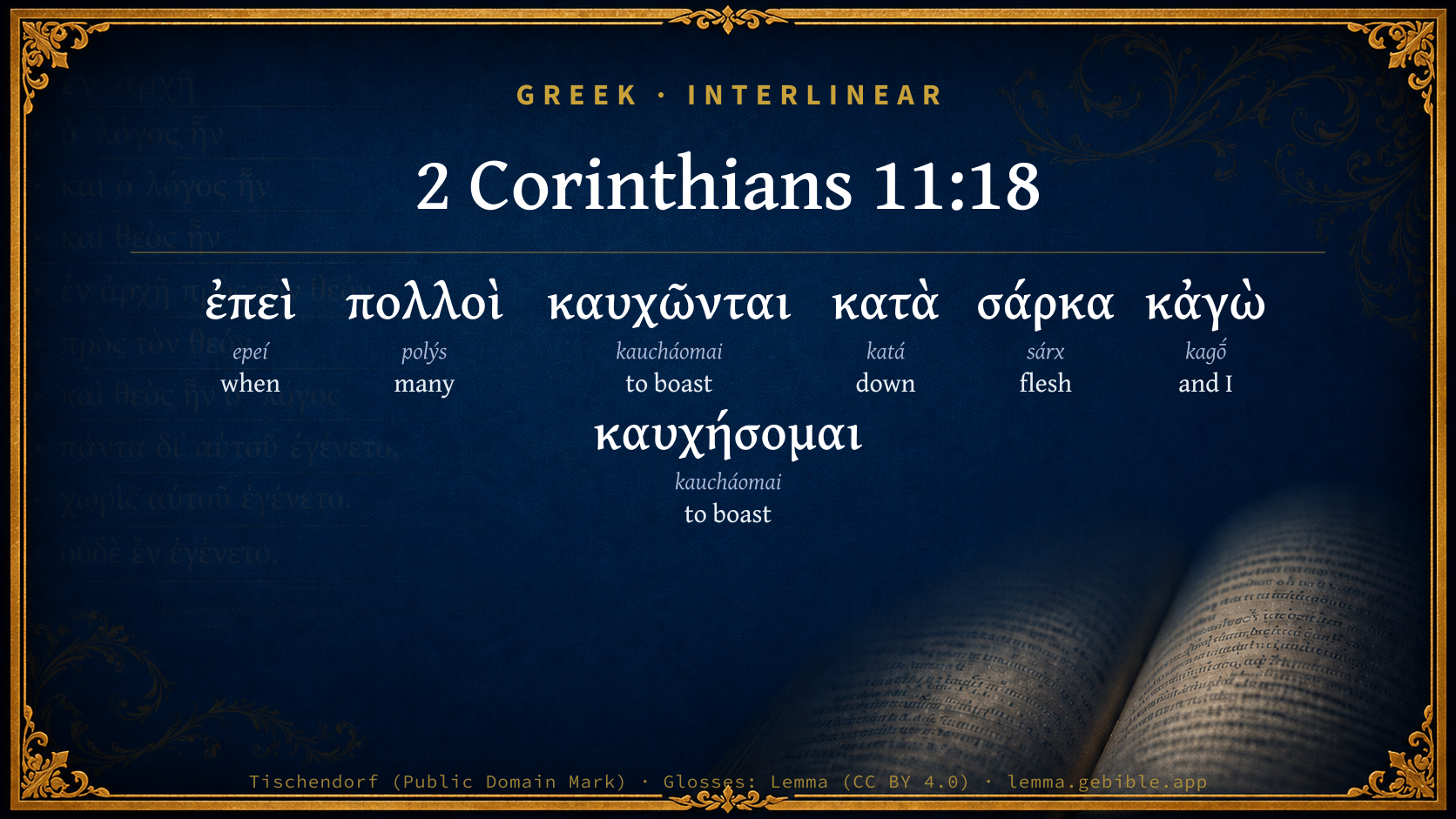
Download image
Cite this verse

2 Corinthians 11:18 (World English Bible). Public Domain. Lemma interlinear Bible study tool, https://lemma.gebible.app/v/2-corinthians/11/18.

Show BibTeX & RIS
BibTeX
RIS
English Translation
Seeing that many boast after the flesh, I will also boast.
World English Bible · Public Domain
Download a study sheet

One document with this verse’s original text, its word-by-word gloss line, the meaning frame, cross-references with their text, attributed commentary, and full source and license credits — printable, and it pastes into notes with its structure intact.

This verse Autodidact and up

Study sheet (.html) Plain text (.txt)

A passage Seminary Student

Up to 50 verses in one chapter. A passage sheet keeps up to 6 commentary sources and 12 cross-references per verse, in the order this page ranks them, and says so on the sheet whenever that leaves anything out. Ask for a single verse and you get the Autodidact verse sheet above.

Everything on this page stays free to read, with no account — the sheet is a download of what is already on screen, not access to it.

Want to remove ads? Support Godless Engineer
Compare translations 3

The same verse in 3 English versions, stacked beneath the original-language interlinear above. Click any original word for its lexicon entry.

Each is an independent rendering of the whole verse — the interlinear is not word-aligned to these translations.

Highlighted words mark where these versions differ — a whole-verse word diff, not a word-by-word alignment.

  • World English Bible Public Domain
    Seeing that many boast after the flesh, I will also boast.
  • King James Version Public Domain
    Seeing that many glory after the flesh, I will glory also.
  • unfoldingWord Literal Text CC BY-SA 4.0
    Since many boast according to the flesh, I too will boast.

unfoldingWord Literal Text — © unfoldingWord, licensed CC BY-SA 4.0. Word-aligned USFM3 via Door43 (git.door43.org/unfoldingWord/en_ult).

Versions to compare (up to 4)

3 of 4 selected

Show all 19 translations

Every available English version of this verse, each an independent rendering of the whole verse.

  • World English Bible Public Domain
    Seeing that many boast after the flesh, I will also boast.
  • Berean Standard Bible Public Domain
    Since many are boasting according to the flesh, I too will boast.
  • Majority Standard Bible Public Domain
    Since many are boasting according to the flesh, I too will boast.
  • King James Version Public Domain
    Seeing that many glory after the flesh, I will glory also.
  • American Standard Version (1901) Public Domain
    Seeing that many glory after the flesh, I will glory also.
  • Revised Version (1885) Public Domain
    Seeing that many glory after the flesh, I will glory also.
  • Geneva Bible (1599) Public Domain
    Seeing that many reioyce after the flesh, I will reioyce also.
  • Douay-Rheims (1899) Public Domain
    Seeing that many glory according to the flesh, I will glory also.
  • Young's Literal Translation Public Domain
    since many boast according to the flesh, I also will boast:
  • Literal Standard Version CC BY-SA 4.0
    since many boast according to the flesh, I also will boast:
  • Unlocked Literal Bible CC BY-SA 4.0
    Since many people boast according to the flesh, I will also boast.
  • unfoldingWord Literal Text CC BY-SA 4.0
    Since many boast according to the flesh, I too will boast.
  • Darby Bible Public Domain
    Since many boast according to flesh, *I* also will boast.
  • World Messianic Bible Public Domain
    Seeing that many boast after the flesh, I will also boast.
  • Webster's Bible Public Domain
    Seeing that many glory after the flesh, I will glory also.
  • Free Bible Version CC BY-SA 4.0
    But since many others are boasting in the way the world does, let me boast too.
  • Bible in Basic English Public Domain
    Seeing that there are those who take credit to themselves after the flesh, I will do the same.
  • Text-Critical English NT CC BY 4.0
    Since many boast according to the flesh, I too will boast.
  • Tyndale New Testament (1534) Public Domain
    Seynge that many reioyce after the flesshe I will reioyce also.

Literal Standard Version (2020), Covenant Press — licensed CC BY-SA 4.0. Text via the HelloAO Bible API (eBible.org). Unlocked Literal Bible (unfoldingWord) — licensed CC BY-SA 4.0. Text via the HelloAO Bible API (eBible.org). unfoldingWord Literal Text — © unfoldingWord, licensed CC BY-SA 4.0. Word-aligned USFM3 via Door43 (git.door43.org/unfoldingWord/en_ult). Free Bible Version, Dr. Jonathan Gallagher — licensed CC BY-SA 4.0. Text via the HelloAO Bible API (eBible.org).

Word by word

More ways to search: Search by grammar → Find every occurrence → Compare this word →

Practice this passage: Drill this verse → Learn its vocabulary →

About this verse

These counts appear in no published source. They are computed here, from the morphology-tagged text and Lemma’s own curated glosses. What Lemma adds →

7
words
6
distinct lemmas
Pauline Epistles
section

Shared distinctive vocabulary

ἐπεὶ when G1893 occurs in 26 verses of the Greek New Testament. Also found in:

Repetition

A word recurs within this verse:

  • καυχῶνται to boast G2744 ×2

Cross-references

10

Topical passages linked to 2 Corinthians 11:18 in the Treasury of Scripture Knowledge — connected by theme and wording, ordered by reader-vote popularity; previews shown in the World English Bible.

  • Jeremiah 9:23–24 Thus says Yahweh, Don't let the wise man glory in his wisdom, neither let the mighty man glory in his might, don't let the rich man glory in his riches;
  • 1 Corinthians 4:10 We are fools for Christ's sake, but you are wise in Christ. We are weak, but you are strong. You have honor, but we have dishonor.
  • 2 Corinthians 10:12–18 For we are not bold to number or compare ourselves with some of those who commend themselves. But they themselves, measuring themselves by themselves, and comparing themselves with themselves, are without understanding.
  • 2 Corinthians 11:12 But what I do, that I will do, that I may cut off occasion from them that desire an occasion, that in which they boast, they may be found even as we.
  • 2 Corinthians 11:21–23 I speak by way of disparagement, as though we had been weak. Yet however any is bold (I speak in foolishness), I am bold also.
  • 2 Corinthians 12:5–6 On behalf of such a one I will boast, but on my own behalf I will not boast, except in my weaknesses.
  • 2 Corinthians 12:9 He has said to me, "My grace is sufficient for you, for my power is made perfect in weakness." Most gladly therefore I will rather glory in my weaknesses, that the power of Christ may rest on me.
  • 2 Corinthians 12:11 I have become foolish in boasting. You compelled me, for I ought to have been commended by you, for in nothing was I inferior to the very best apostles, though I am nothing.
  • Philippians 3:3–4 For we are the circumcision, who worship God in the Spirit, and rejoice in Christ Jesus, and have no confidence in the flesh;
  • 1 Peter 1:24 For, "All flesh is like grass, And all of man's glory like the flower in the grass. The grass withers, and its flower falls;

Cross-references courtesy of OpenBible.info (CC BY 4.0).

Commentary

Notes on 2 Corinthians 11:18 from classic Christian and Jewish commentators (each source and its license shown beneath its notes). The classic Christian expositions comment on the surrounding passage and are grouped to its opening verse, so a note may address several verses; the Jewish commentaries on the Tanakh (Rashi and others) are per-verse, so they appear only where the commentator wrote on this verse.

Lemma curates 59 commentaries, every one of them public domain or Creative Commons licensed, each selected and text-cleaned for this edition rather than reprinted as found. About our sources →

Joseph Benson's Commentary

2Co 11:18-21. Seeing that many glory after the flesh — In circumcision, Jewish extraction, and other outward privileges and qualifications; I will glory also — In the same manner; nor can my seeming folly offend you; for ye — The disciples of the false apostles; suffer fools gladly, seeing ye yourselves are wonderfully wise — And in your extraordinary wisdom can cherish that arrogant temper in others. As if he had said, Being such very wise men, I hope you will bear with this piece of folly in me as you bear with it in others. This is written in the highest strain of ridicule, as is plain from the next verse, where, in mockery, he mentions their abjectly bearing the contumelious and injurious behaviour of the false teachers, as an example of their wisdom in bearing. But it was a bearing, not with fools, but with knaves, to their own cost. By taking notice of that circumstance, therefore, the apostle placed their pretended wisdom in a truly ridiculous light. For, &c. — Your patience in bearing is indeed very great; for ye suffer — Not only the folly, but the gross abuses of those false teachers; ye take it patiently if a man — Any of the false teachers; bring you into bondage — Lord it over you in the most arbitrary manner. If a man devour you — By his exorbitant demands, notwithstanding his boast of not being burdensome; if he take of you — Gifts and presents, pretending to exact nothing as due; if he exalt himself — By the most unbounded self- commendation; if he smite you on the face — Treat you as disgracefully as if he did so. I speak — What I have now said; concerning reproach — Namely, the reproach which they cast upon you Gentiles as uncircumcised and profane, while they are all of a holy nation: or, I mean it of those reproaches with which they load me and my fellow-labourers; as though we had been weak — Or contemptible, in comparison of them, and could have used no such authority over you. Howbeit, whereinsoever any is bold — Thinks he may value and extol himself; (I speak foolishly — That is, in appearance;) I am bold also — I have as much to say for myself, as he has for himself.

Joseph Benson's Commentary on the Old and New Testaments (1811–1818) — public domain. Text from a community e-Sword module.

Bengel's Gnomon

Johann Albrecht Bengel

2Co 11:18. Πολλοὶ, many) What is allowed to many, is the more easily granted as an indulgence to one.—κατὰ σάρκα, according to the flesh) for example, that they are Hebrews, 2Co 11:22.

Bengel's Gnomon of the New Testament — English translation (T&T Clark, Edinburgh, 1860) — public domain. Text from a community e-Sword module.

Meyer's Critical & Exegetical Commentary

Heinrich August Wilhelm Meyer

2Co_11:18. That which carries him away to such foolishness, 2Co_11:16 : ἵνα κἀγὼ μικρ. τι καυχήσ.

Seeing that many boast according to their flesh, so will I boast too, namely, κατὰ τ. σάρκα.

Since κατὰ τὴν σάρκα is opposed to the κατὰ κύριον in 2Co_11:17, and is parallel to the ὡς ἐν ἀφροσύνῃ, it cannot express the objective norm (comp. 2Co_5:16), or the object of the boasting (comp. Php_3:3 ff.; Gal_6:13), as Chrysostom and most expositors, including Emmerling, Flatt, and Osiander, explain it: on account of external advantages,[332] but it must denote the subjective manner of the καυχᾶσθαι, namely: so that the καυχᾶσθαι is not guided by the Holy Spirit, but proceeds according to the standard of their natural condition as material, psychically determined, and striving against the Divine Spirit, whence they are urged on to conceit, pride, ambition, etc.[333] Comp. Rückert: according to the impulse of self-seeking personality; also de Wette, Ewald, Neander. Billroth, in accordance with his philosophy, takes it: as individual, according to what one is as a single human being. κατὰ ἄνθρωπον in 1Co_9:8 is not parallel. See on that passage.

Rückert denies that Paul after κἀγὼ καυχήσομαι has again supplied in thought κατὰ τ. σάρκα, and thinks that he has prudently put it only in the protasis and not said it of his own glorying. But it necessarily follows, as well from the previous οὐ λαλῶ κατὰ κύριον, in which the κατὰ τ. σάρκα is already expressed implicite, as also from the following ΤῶΝ ἈΦΡΌΝΩΝ, among whom Paul is included as ΚΑΤᾺ ΤῊΝ ΣΆΡΚΑ ΚΑΥΧΏΜΕΝΟς. It is otherwise in Joh_8:15.

[332] To this category belongs also the interpretation of Baur, who, however, refers σάρξ quite specially to Judaism as what is inherited, and therefore understands a boasting, the object of which is only inherited accidental advantages. The διάκονοι Χριστοῦ, ver. 23, and the apostles subsequent glorying in suffering, ought to have dissuaded Baur from adopting such a view.

[333] Osiander is quite wrong in objecting to this interpretation that the article is against it, since Paul, when he means σάρξ in this sense, never puts the article after κατά. Paul, in fact, has the article only in this single passage, and elsewhere writes always κατὰ σάρκα (i.e. conformably to flesh) whether he uses σάρξ in the subjective or objective sense; hence, so far as the article is concerned, there is no means at all of comparison. Besides, τήν here is very doubtful critically, because it is wanting in D* F G א* min. Chrys. Dam., and is at variance with the Pauline usage. Osianders further objection, that κατὰ τὴν σάρκα, as understood by us, is in the apostles mouth unworthy of him for the apodosis, is likewise incorrect, for he is speaking ironically; he wishes, in fact, to deal in boasting like a fool! As to the distinction between κατὰ σάρκα and κατὰ τὴν σάρκα, we may add that the one means: after the manner of natural humanity, the other, after the manner of their natural humanity. Comp. on Php_1:24; Php_1:22. In substance they are equivalent; the latter only individualizes more concretely.

Meyer — Critical and Exegetical Commentary on the New Testament — English translation by Peter Christie, edited by Frederick Crombie (T&T Clark, 1880) — public domain. Text from a community e-Sword module.

Expositor's Greek Testament

ed. W. Robertson Nicoll

2Co 11:18 . ἐπεὶ πολλοὶ καυχῶνται κ . τ . λ .: seeing that many, sc. , of the Corinthian Judaisers against whom this whole polemic is directed ( cf. 2Co 2:17 , where they are also alluded to as οἱ πολλοὶ , glory after the flesh, i.e. , in external circumstances which are really no fit subject for glorying (see, on ἐν προσώπῳ , chap. 2Co 5:12 and reff.), I too will glory, sc. , after the flesh; i.e. , he proceeds to explain how much better external grounds he has for boasting than his Judaising rivals.

The Expositor's Greek Testament, edited by W. Robertson Nicoll (1897–1910) — public domain. Text from a community e-Sword module.

Jamieson, Fausset & Brown

Robert Jamieson, A. R. Fausset & David Brown

many--including the "false teachers."

after the flesh--as fleshly men are wont to boast, namely, of external advantages, as their birth, doings, &c. (compare Co2 11:22).

I will glory also--that is, I also will boast of such fleshly advantages, to show you that even in these I am not their inferiors, and therefore ought not to be supplanted by them in your esteem; though these are not what I desire to glory in (Co2 10:17).

Jamieson, Fausset & Brown — Commentary Critical and Explanatory on the Whole Bible (1871) — public domain (CC PDM 1.0). Text via the HelloAO Bible API.

Adam Clarke's Commentary

Verse 18. Seeing that many glory after the flesh] Boast of external and secular things.

Adam Clarke's Commentary on the Bible (1810–1826) — public domain. Text from a community e-Sword/MySword module.

John Calvin's Commentaries

18. Since many glory. The meaning is — Should any one say to me, by way of objection, that what I do is faulty, what then as to others? Are not they my leaders? Am I alone, or am I the first, in glorying according to the flesh? Why should that be reckoned praiseworthy in them, that is imputed to me as a fault?” So far then is Paul from ambition in recounting his own praises, that he is contented to be blamed on that account, provided he exposes the vanity of the false apostles.

To glory after the flesh, is to boast one’s self, rather in what has a tendency towards show, than in a good conscience. For the term flesh, here, has a reference to the world — when we seek after praise from outward masks, which have a showy appearance before the world, and are regarded as excellent. In place of this term he had a little before made use of the expression — in appearance. (2 Corinthians 10:7.)

John Calvin's Commentaries (1540-1563) — public domain. Text from the Calvin Translation Society English edition (1840s-50s) via the Christian Classics Ethereal Library (ccel.org). Calvin's coverage is partial (roughly two-thirds of the Bible); uncommented books and verses are honest gaps, never fabricated. The 19th-century editor's footnotes and remarks are omitted so the notes are faithfully Calvin's own voice.

Ellicott's Commentary for English Readers

(18) Seeing that many glory after the flesh.—To glory, or boast, after the flesh, as interpreted by 2Co_5:16 (where see Note), is to lay stress on things which are the accidents of the spiritual life, not of its true essence—on descent, prerogatives, rank, reputation, and the like. There is a touch half of irony, half of impatience, in the way in which the Apostle says that he too will for once descend to their level and do as they do.

A Bible Commentary for English Readers, edited by Charles John Ellicott (1878–1897) — public domain. Text from a community e-Sword module.

The Cambridge Bible for Schools and Colleges

gen. ed. J. J. S. Perowne

18–33. St Paul permits himself to enumerate his labours for the Gospel’s sake

18. after the flesh] See note on after the Lord, and Php_3:4. Also note on ch. 2Co_10:3. St Paul means after the manner of those who judge only by what is outward and visible, or perhaps he may mean boasting of things, such as “high birth, wealth, wisdom, of being circumcised, of Hebrew ancestry, of popular renown” (Chrysostom), on which fleshly men set high value.

I will glory also] “It is remarkable that St Paul does not glory in what he has done, but what he has borne.” Robertson.

The Cambridge Bible for Schools and Colleges (gen. ed. J. J. S. Perowne; Cambridge University Press, 1878–1918) — public domain. Text from a community e-Sword module.

John Gill's Exposition

Seeing that many glory after the flesh,.... Or with respect to things external, such as their high birth and parentage, carnal descent, circumcision, learned education, and the like; of which the false apostles, being Jews, boasted, who it seems were many; and though a multitude is not to be followed to do evil, yet the apostle thought, that since there were so many who were indulged by this church in this way, he might be allowed to boast also of such like things, so far as he could with truth and a good conscience, and in order to secure some valuable ends:

I will glory also; for he was of the seed of Abraham as well as they, of the stock of Israel, and tribe of Benjamin, circumcised the eighth day, and brought up at the feet of Gamaliel; but these are not all the things he could, and would, and did glory of; he gloried of these, and of others besides them, which the false apostles could not, and thereby proved himself to be superior to them, even in external things, of which they bragged so much.

John Gill's Exposition of the Whole Bible (1746–1763) — public domain (CC PDM 1.0). Text via the HelloAO Bible API.

Trapp's Complete Commentary

John Trapp

18 Seeing that many glory after the flesh, I will glory also.

Ver. 18. Glory after the flesh] Or in the flesh, Gal 6:13, or have confidence in the flesh, Php 3:4.

John Trapp, A Commentary or Exposition upon All the Books of the Old and New Testament (1647–1656) — public domain. Text from a community e-Sword module.

Albert Barnes' Notes on the Bible

Seeing that many glory ... - The false teachers in Corinth. They boasted of their birth, rank, natural endowments, eloquence, etc.; see 2Co 11:22. Compare Phi 3:3-4.

I will glory also - I also will boast of my endowments, which though somewhat different yet pertain in the main to the “flesh” also; see 2Co 11:23 ff. His endowments “in the flesh,” or what he had to boast of pertaining to the flesh, related not so much to birth and rank, though not inferior to them in these, but to what the flesh had endured - to stripes and imprisonments, and hunger and peril. This is an exceedingly delicate and happy turn given to the whole subject.

Albert Barnes' Notes on the Bible (1834–1885) — public domain. Text from a community e-Sword/MySword module.

Matthew Poole's English Annotations

By the flesh is meant, carnal and external things; which though they be the gifts and favours of God, yet do not at all commend a man to God. The apostle saith, there are

many that glory after the flesh; and there needs must be such in all places, because there are many that walk after the flesh: now, it is but natural for men to boast and glory in those attainments, which it hath been the business of their lives to pursue after. Such there were, doubtless, in this famous church, who gloried that they were native Jews, or in their riches, or in their knowledge and learning. Now, though (saith the apostle) I know there is nothing in these things truly to be gloried in, yet, others glorying in them:

I will glory also; and let them know, that if I thought these things worth the glorying in, I have as much to glory in of that nature as any of them have.

Matthew Poole's English Annotations on the Holy Bible (1683–1685) — public domain. Text from a community e-Sword/MySword module.

Whedon's Commentary on the Bible

Daniel D. Whedon

18. I will glory also—But not after the flesh.

Daniel D. Whedon (gen. ed.), Commentary on the Old and New Testaments (1874–1909) — public domain. Text from a community e-Sword module.

The Pulpit Commentary

After the flesh (see note 2Co_10:3; comp. Php_3:4) I will glory also. But, as Robertson admirably observes, he "does not glory in what he has done, but in what he has borne."

The Pulpit Commentary (1880–1919), ed. H.D.M. Spence-Jones & Joseph S. Exell — public domain. Text from a community e-Sword module.

John Wesley's Explanatory Notes

After the flesh - That is, in external things.

John Wesley, Explanatory Notes Upon the Whole Bible (1754–1765) — public domain. Text via the GEBible commentary corpus.

Burkitt's Expository Notes on the New Testament

William Burkitt

Here our apostle, with some kind of salt and smartness, reflects upon the Corinthians (whom ironically he calls wise men) for suffering themselves to be imposed upon by their false teachers, to be tyrannized over, to be spunged upon and exhausted, to be brought again into bondage to Jewish ceremonies, to be smitten on the face; that is, to be upbraided to their very faces, because they had subjected themselves to so mean and weak a person as Paul, a tentmaker. However, he assures them, that in any thing according to the flesh, wherein the false apostles could glory, he could glory also.

Here note, That by glorying after the flesh, is meant glorying in any external privileges and outward advantages, particularly in glorying that they were the seed of Abraham according to the flesh; for the Jews had a very high opinion of themselves, as being the seed of Abraham, and the only people of God, by visible profession, at that time in the world; having contemptible thoughts of all others, whom they called the profane, and the people of the earth, likening them to dogs.

Now the apostle tells the Corinthians plainly, That although there is nothing after the flesh which deserves greatly to be gloried in, yet seeing that the false apostles did pride themselves in these things, he could boast of the same carnal privileges with them, and glory after the flesh as well as themselves; and accordingly, thus he speaks in the following verses:

William Burkitt's Expository Notes on the New Testament (1700–1703) — public domain. Text from a community e-Sword module.

McGarvey & Pendleton's Commentaries

J. W. McGarvey

Seeing that many glory after the flesh, I will glory also . [I am about to follow the carnal example of the boasters, that I may defeat them with their own weapon.]

J. W. McGarvey (with Philip Y. Pendleton), Commentaries on the New Testament (The Fourfold Gospel, 1914; Acts; and the epistles) — public domain. Text from a community e-Sword/MySword module.

The People's New Testament

B. W. Johnson

18. I will glory also. This is the folly for which he apologizes. He will show that he is not behind those who have been claiming so much credit at Corinth.

B. W. Johnson's The People's New Testament with Notes (1889–1891) — public domain. Electronic text from the Christian Classics Ethereal Library (CCEL) ThML edition.

Cambridge Greek Testament for Schools and Colleges

18. It is hard to decide between κατὰ τὴν σάρκα (א3BD3KLMP) and κατὰ σάρκα (אDFGR 17, 71, 73).

18. κατὰ[τὴν]σάρκα. See critical note. Everywhere else, and very frequently (2Co 1:17, 2Co 5:16, 2Co 10:2-3; 1Co 1:26; 1Co 10:18; &c.), S. Paul writes κατὰ σάρκα, which might account for τήν being accidentally or deliberately omitted in some early copies. If the article is original, it is inserted to mark a difference, which may be this, that κατὰ σάρκα is ‘from a low point of view,’ and κατὰ τὴν σάρκα, ‘from their low point of view.’ There may be many points of view, all κατὰ σάρκα, which are taken by different people. The R.V. reads κ. τὴν σ., but makes no change in translation. The πολλοί includes others besides the false teachers: many people, from their own worldly points of view, glory of their birth, possessions, performances, &c. The Apostle can do the same. Comp. Php 3:3-5. With the construction ἐπεὶ πολλοὶ … κἀγώ comp. ἐπειδήπερ πολλοὶ … ἔδοξε κἀμοί (Luk 1:1-3).

κἀγὼ καυχήσομαι. Understand κατὰ τὴν σάρκα μου. He is going to show the Corinthians what this kind of rivalry in glorying involves. See the analysis of what follows (2Co 11:19-31) in Appendix D.

Cambridge Greek Testament for Schools and Colleges (Cambridge University Press, 1896; 21 vols, various authors incl. Carr, Maclear, Plummer, Farrar, Lumby, Moule, M. R. James, Simcox) — public domain. Text from a community e-Sword module.

Alford’s Greek Testament

Henry Alford

18.] Since many (viz. the false teachers, but not only they:—‘since it is a common habit,’—for he is here speaking as εἷς τῶν ἀφρόνων, see Job 2:10) boast according to the flesh (not = ἐν σαρκί, as Chrys., al., but ‘in a spirit of fleshly regard,’—‘having regard to their extraction, achievements, &c.’ as below vv. 22 ff.), I also will boast (scil. κατὰ τὴν σάρκα. Rückert thinks these words are omitted purposely, thereby to imply that tbe Apostle’s boasting was not fleshly; but this is distinctly contradicted by the context: he is speaking as one of the πολλοί, of οἱ ἄφρονες, see next verse).

Henry Alford, The Greek Testament (1849–1861) — public domain. Text from a community e-Sword module.

International Critical Commentary

18. κατὰ [τὴν] σάρκα. See below. Nowhere else does St Paul insert the art. in this phrase, which is very freq. in his writings; everywhere we find κατὰ σάρκα (1:17, 5:16, 10:2, 3; etc.), and this fact may have led to the omission of the art here. If we accept the τήν as original, the difference may be that, while κατὰ σάρκα means ‘from a human point of view,’ κατὰ τὴν ς may mean ‘from their human point of view.’ But this is precarious. These Judaizers from Palestine boast of their country, of their ancestry, of their high rank as missionaries,—things which men are naturally proud of, but which do not count for much in the service of Christ. Nevertheless, whether they count for much or little, St Paul is more than their equal. But the πολλοί probably refers to people generally, and not merely to the numerous Judaizers. Many people are proud of their nation, birth, position, etc. We have a similar constr., in a much more elaborate sentence, Luk 1:1-3, where ἔδοξε κἀμοι answers to ἐπειδήπερ πολλοί just as κἀγώ to ἐπεὶ πολλοί here.

κἀγὼ καυχήσομαι. He means not merely that he intends to glory, but to glory on the same low level as they do, κατὰ σάρκα. It is a miserable position that they have taken, but he will not shrink from contending with them on their own ground.

It is difficult to decide between κατὰ τὴν σάρκα (א B D 3 E K L M P) and κατὰ σάρκα (א * D * G R 17), but the former is probably right.

International Critical Commentary — older volumes (1896–1929), various authors — public domain. Text from a community e-Sword module.

Lesson kit

Teaching starters — assembled from the data on this page, not authored interpretation. Every prompt links to the verse data it draws on. Edit before teaching.

2 Corinthians, in the Pauline Epistles, opens this verse with 7 words (6 distinct Greek lemmas). Its most distinctive word is epeí (“when”). A historical commentator’s framing appears above. Read the whole chapter for the surrounding context.

Discussion questions

  1. How does “when” (epeí) shape what this verse is saying?
  2. How does Matthew 18:32, which shares the word «when», read alongside this verse?
  3. What does the repetition of “to boast” (2× in this one verse) do in this verse?
  4. These translations render this verse differently. What is at stake in choosing one wording over another?
  5. Compare how Joseph Benson's Commentary and Bengel's Gnomon read this verse. Where do they agree or differ?

Things to notice

  • These translations choose different wording for 8 words in this verse.
  • “to boast” occurs 2× in this single verse.
  • 6 distinct Greek lemmas span 7 words in this verse.

Reading settings

Reading text

Shown beneath each verse's original-language words.

Old Testament
Old Testament edition

Read the OT as the Masoretic Hebrew (MT) or the Greek Septuagint (LXX).

English shown for the Greek Septuagint (in the Hebrew ↔ Greek comparison).

Comparing translations? Open the Compare panel on any verse page to stack up to four side by side.