
Leviticus 12:3

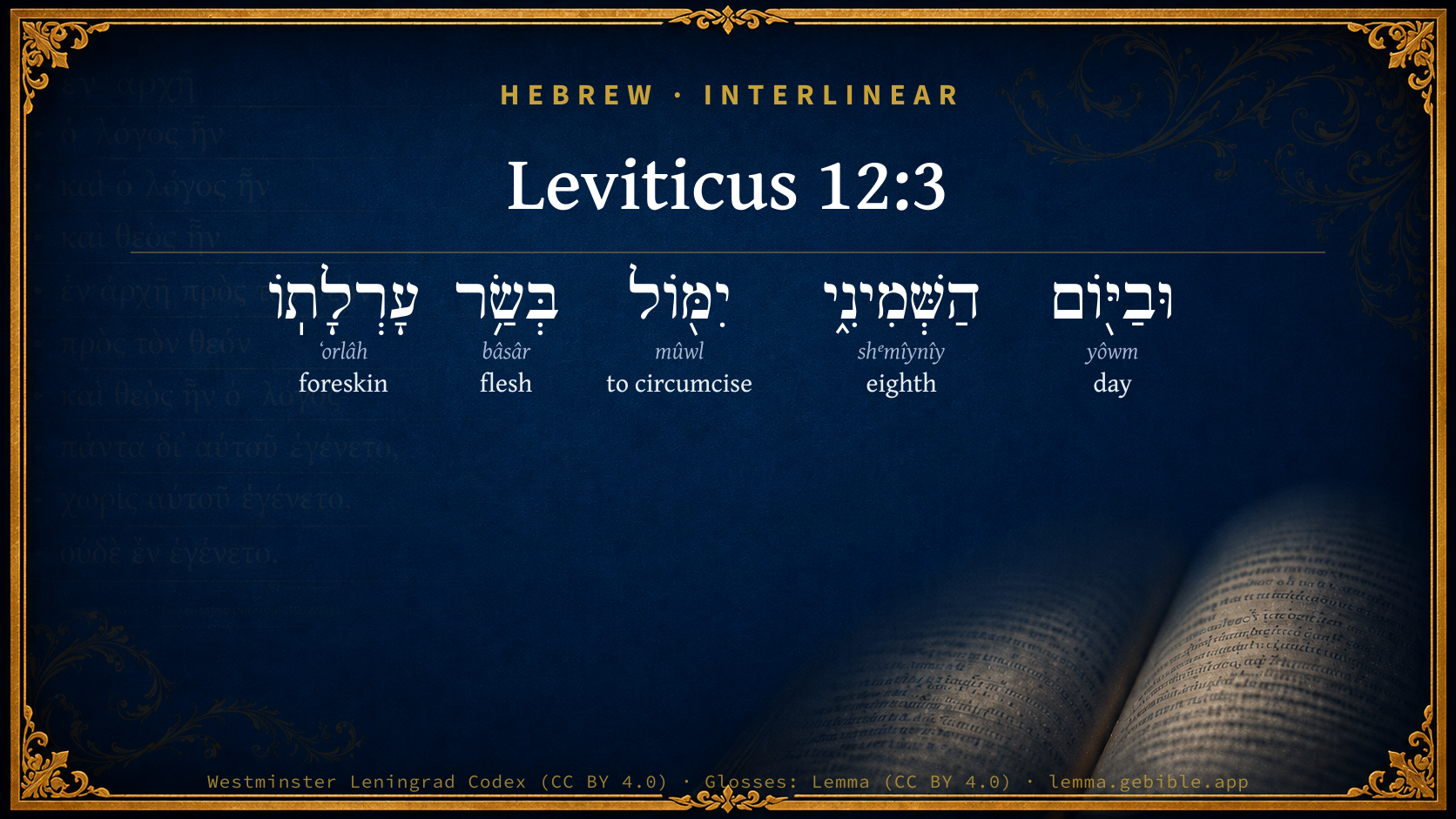
Hebrew (Westminster Leningrad Codex) Leviticus 12:3 appears in the Hebrew Old Testament. The text above is from the Westminster Leningrad Codex. Each word links to its Strong’s number, a concise gloss, and parsing drawn from the Open Scriptures Hebrew Bible morphology. Click any word for its full Brown-Driver-Briggs (BDB) entry.
Download image
Cite this verse

Leviticus 12:3 (World English Bible). Public Domain. Lemma interlinear Bible study tool, https://lemma.gebible.app/v/leviticus/12/3.

Show BibTeX & RIS
BibTeX
RIS
English Translation
In the eighth day the flesh of his foreskin shall be circumcised.
World English Bible · Public Domain
Download a study sheet

One document with this verse’s original text, its word-by-word gloss line, the meaning frame, cross-references with their text, attributed commentary, and full source and license credits — printable, and it pastes into notes with its structure intact.

This verse Autodidact and up

Study sheet (.html) Plain text (.txt)

A passage Seminary Student

Up to 50 verses in one chapter. A passage sheet keeps up to 6 commentary sources and 12 cross-references per verse, in the order this page ranks them, and says so on the sheet whenever that leaves anything out. Ask for a single verse and you get the Autodidact verse sheet above.

Everything on this page stays free to read, with no account — the sheet is a download of what is already on screen, not access to it.

Want to remove ads? Support Godless Engineer
Compare translations 3

The same verse in 3 English versions, stacked beneath the original-language interlinear above. Click any original word for its lexicon entry.

Each is an independent rendering of the whole verse — the interlinear is not word-aligned to these translations.

Highlighted words mark where these versions differ — a whole-verse word diff, not a word-by-word alignment.

  • World English Bible Public Domain
    In the eighth day the flesh of his foreskin shall be circumcised.
  • King James Version Public Domain
    And in the eighth day the flesh of his foreskin shall be circumcised.
  • unfoldingWord Literal Text CC BY-SA 4.0
    And on the eighth day, the flesh of his foreskin shall be circumcised.

unfoldingWord Literal Text — © unfoldingWord, licensed CC BY-SA 4.0. Word-aligned USFM3 via Door43 (git.door43.org/unfoldingWord/en_ult).

Versions to compare (up to 4)

3 of 4 selected

Show all 18 translations

Every available English version of this verse, each an independent rendering of the whole verse.

  • World English Bible Public Domain
    In the eighth day the flesh of his foreskin shall be circumcised.
  • Berean Standard Bible Public Domain
    And on the eighth day the flesh of the boy’s foreskin is to be circumcised.
  • Majority Standard Bible Public Domain
    And on the eighth day the flesh of the boy’s foreskin is to be circumcised.
  • King James Version Public Domain
    And in the eighth day the flesh of his foreskin shall be circumcised.
  • American Standard Version (1901) Public Domain
    And in the eighth day the flesh of his foreskin shall be circumcised.
  • Revised Version (1885) Public Domain
    And in the eighth day the flesh of his foreskin shall be circumcised.
  • Geneva Bible (1599) Public Domain
    (And in the eight day, the foreskin of the childes flesh shalbe circumcised)
  • Douay-Rheims (1899) Public Domain
    And on the eighth day the infant shall be circumcised:
  • Young's Literal Translation Public Domain
    and in the eighth day is the flesh of his foreskin circumcised;
  • Literal Standard Version CC BY-SA 4.0
    and in the eighth day the flesh of his foreskin is circumcised;
  • Unlocked Literal Bible CC BY-SA 4.0
    On the eighth day the flesh of a baby boy's foreskin must be circumcised.
  • unfoldingWord Literal Text CC BY-SA 4.0
    And on the eighth day, the flesh of his foreskin shall be circumcised.
  • Darby Bible Public Domain
    And on the eighth day shall the flesh of his foreskin be circumcised.
  • World Messianic Bible Public Domain
    In the eighth day the flesh of his foreskin shall be circumcised.
  • Webster's Bible Public Domain
    And in the eighth day the flesh of his foreskin shall be circumcised.
  • Free Bible Version CC BY-SA 4.0
    The boy's foreskin must be circumcised on the eighth day.
  • Bible in Basic English Public Domain
    And on the eighth day let him be given circumcision.
  • JPS Tanakh (1917) Public Domain
    And in the eighth day the flesh of his foreskin shall be circumcised.

Literal Standard Version (2020), Covenant Press — licensed CC BY-SA 4.0. Text via the HelloAO Bible API (eBible.org). Unlocked Literal Bible (unfoldingWord) — licensed CC BY-SA 4.0. Text via the HelloAO Bible API (eBible.org). unfoldingWord Literal Text — © unfoldingWord, licensed CC BY-SA 4.0. Word-aligned USFM3 via Door43 (git.door43.org/unfoldingWord/en_ult). Free Bible Version, Dr. Jonathan Gallagher — licensed CC BY-SA 4.0. Text via the HelloAO Bible API (eBible.org).

Word by word

More ways to search: Search by grammar → Find every occurrence → Compare this word →

Practice this passage: Drill this verse → Learn its vocabulary →

About this verse

These counts appear in no published source. They are computed here, from the morphology-tagged text and Lemma’s own curated glosses. What Lemma adds →

5
words
5
distinct lemmas
Pentateuch
section

Notable vocabulary

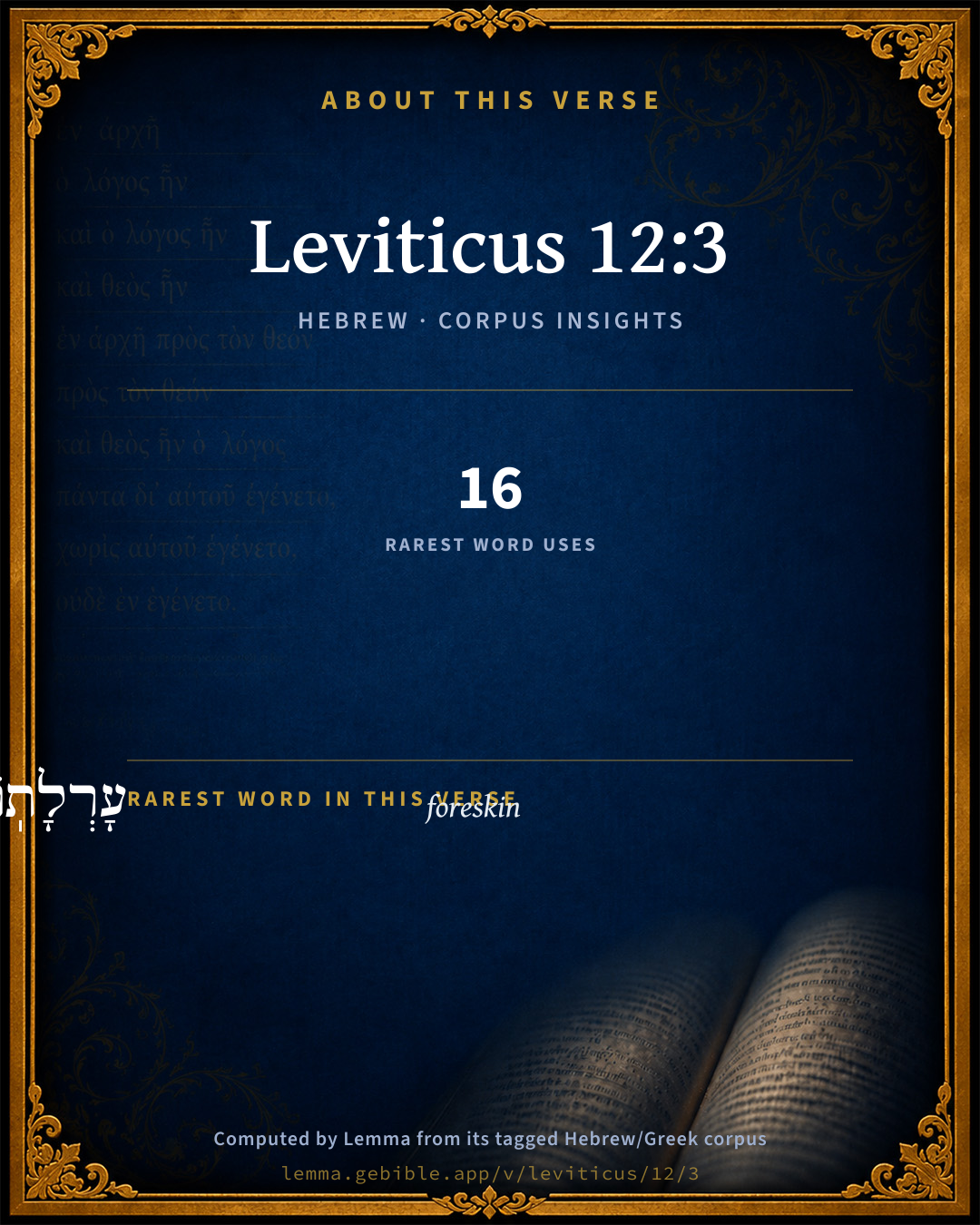
The rarest word here is עָרְלָתֽוֹ foreskin H6190 — appearing just 16 times in the whole Hebrew Bible.

Shared distinctive vocabulary

עָרְלָתֽוֹ foreskin H6190 occurs in 16 verses of the Hebrew Bible. Also found in:

Grammatical profile

  • 1 verb
  • 3 nouns
  • 1 adjective

Verb forms

  • יִמּ֖וֹל Niphal · Imperfect

Hebrew & Septuagint length

In English translation the verse runs 12 words from the Hebrew and 13 from the Septuagint (LXX English) — closely comparable.

A rough comparison of the two English renderings, which tokenize alike — not a word-level alignment.

Word counts can differ between the Hebrew and the Greek without any difference in meaning — e.g. the Hebrew direct-object marker אֵת has no separate Greek word, and Greek often adds the article ὁ.

Cross-references

11

Topical passages linked to Leviticus 12:3 in the Treasury of Scripture Knowledge — connected by theme and wording, ordered by reader-vote popularity; previews shown in the World English Bible.

  • Luke 2:21 When eight days were fulfilled for the circumcision of the child, his name was called Jesus, which was given by the angel before he was conceived in the womb.
  • Luke 1:59 It happened on the eighth day, that they came to circumcise the child; and they would have called him Zacharias, after the name of the father.
  • John 7:22–23 Moses has given you circumcision (not that it is of Moses, but of the fathers), and on the Sabbath you circumcise a boy.
  • Genesis 17:11–12 You shall be circumcised in the flesh of your foreskin. It will be a token of a covenant between me and you.
  • Philippians 3:5 circumcised the eighth day, of the stock of Israel, of the tribe of Benjamin, a Hebrew of Hebrews; concerning the law, a Pharisee;
  • Romans 3:19 Now we know that whatever things the law says, it speaks to those who are under the law, that every mouth may be closed, and all the world may be brought under the judgment of God.
  • Romans 4:11–12 He received the sign of circumcision, a seal of the righteousness of the faith which he had while he was in uncircumcision, that he might be the father of all those who believe, though they be in uncircumcision, that righteousness might also be accounted to them.
  • Galatians 3:17 Now I say this. A covenant confirmed beforehand by God in Christ, the law, which came four hundred thirty years after, does not annul, so as to make the promise of no effect.
  • Galatians 5:3 Yes, I testify again to every man who receives circumcision, that he is a debtor to do the whole law.
  • Colossians 2:11 in whom you were also circumcised with a circumcision not made with hands, in the putting off of the body of the sins of the flesh, in the circumcision of Christ;
  • Deuteronomy 30:6 Yahweh your God will circumcise your heart, and the heart of your seed, to love Yahweh your God with all your heart, and with all your soul, that you may live.

Cross-references courtesy of OpenBible.info (CC BY 4.0).

Hebrew and Greek witnesses Masoretic Hebrew ↔ Greek Septuagint

The same verse in the two great witnesses to the Old Testament, shown verse-for-verse.

These are two independent witnesses, not word-aligned to each other, and the Septuagint is shown in lemma (dictionary) form.

Hebrew Leviticus 12:3 Masoretic · Westminster Leningrad Codex

וּבַיּ֖וֹם הַשְּׁמִינִ֑י יִמּ֖וֹל בְּשַׂ֥ר עָרְלָתֽוֹ

In the eighth day the flesh of his foreskin shall be circumcised.

World English Bible · Public Domain

Greek LXX Leviticus 12:3 Septuagint · lemma form

καί ὁ ἡμέρα ὁ ὄγδοος περιτέμνω ὁ σάρξ ὁ ἀκροβυστία αὐτός

And on the eighth day she shall circumcise the flesh of his foreskin.

LXX2012 (modern English Septuagint) · Public Domain

Hebrew: Westminster Leningrad Codex (CC BY 4.0). Greek: Septuagint (public domain); English from LXX2012 (modern English Septuagint) (Public Domain). How the Septuagint differs from the Hebrew →

Targum (Aramaic paraphrase)

2

The Targum is the ancient Jewish Aramaic paraphrase of the Hebrew Scriptures — an interpretive translation, not the Hebrew text itself. Onkelos (literal) and Pseudo-Jonathan (expansive) render the Torah, and Jonathan the Prophets. Coverage is partial: where no permissively-licensed English translation exists for a verse, only the Aramaic is shown. This is verse-level text, not a word-by-word alignment to the Hebrew.

  1. Targum Onkelos Torah (Genesis–Deuteronomy)
    וּבְיוֹמָא תְּמִינָאָה יִגְזַר בִּסְרָא דְעָרְלְתֵהּ

    (no public-domain English translation for this verse)

    Targum Onkelos — Aramaic: “Onkelos Genesis” (public domain); “Onkelos Exodus” (public domain); “Onkelos Leviticus” (public domain); “Onkelos Numbers” (public domain); “Onkelos Deuteronomy” (public domain). English: “Sefaria Community Translation” (CC0 1.0 (public-domain dedication)); “J.W. Etheridge. The Targums of Onkelos and Jonathan Ben Uzziel on the Pentateuch. London: Longmans, Green, 1862” (public domain). Text via Sefaria.

  2. Targum Pseudo-Jonathan Torah (Genesis–Deuteronomy)
    וּבְיוֹמָא תְמִינָאֵי תִּשְׁתְּרֵי וּבָרָא יִתְגְזַר בְּשַר עָרְלָתֵיהּ

    But on the eighth day she shall be loosed, and her child shall be circumcised in the flesh of his foreskin.

    Targum Pseudo-Jonathan — Aramaic: “Targum Jonathan on Genesis” (public domain); “Targum Jonathan on Exodus” (public domain); “Targum Jonathan on Leviticus” (public domain); “Targum Jonathan on Numbers” (public domain); “Targum Jonathan on Deuteronomy” (public domain). English: “The Targum of Jonathan ben Uzziel, trans. J. W. Etheridge, London, 1862” (public domain). Text via Sefaria.

Commentary

Notes on Leviticus 12:3 from classic Christian and Jewish commentators (each source and its license shown beneath its notes). The classic Christian expositions comment on the surrounding passage and are grouped to its opening verse, so a note may address several verses; the Jewish commentaries on the Tanakh (Rashi and others) are per-verse, so they appear only where the commentator wrote on this verse.

Lemma curates 59 commentaries, every one of them public domain or Creative Commons licensed, each selected and text-cleaned for this edition rather than reprinted as found. About our sources →

Trapp's Complete Commentary

John Trapp

Lev 12:3 And in the eighth day the flesh of his foreskin shall be circumcised.

Ver. 3. And in the eighth day.] {See Trapp on "Gen 17:13"} {See Trapp on "Gen 17:14"}

John Trapp, A Commentary or Exposition upon All the Books of the Old and New Testament (1647–1656) — public domain. Text from a community e-Sword module.

The Expositor's Bible

THE ORDINANCE OF CIRCUMCISION

Lev_12:3

"And in the eighth day the flesh of his foreskin shall be circumcised."

Although the rite of circumcision here receives a new and special sanction, it had been appointed long before by God as the sign of His covenant with Abraham. {Gen_17:10-14} Nor was circumcision, probably, even then a new thing. That the ancient Egyptians practised it is well known; so also did the Arabs and Phoenicians; in fact, the custom has been very extensively observed, not only by nations with whom the Israelites came in contact, but by others who have not had, in historic times, connection with any civilised peoples; as, for example, the Congo negroes, and certain Indian tribes in South America.

The fundamental idea connected with circumcision, by most of the peoples who have practised it, appears to have been physical purification; indeed, the Arabs call it by the name tatur, which has this precise meaning. And it deserves to be noticed that for this idea regarding circumcision there is so much reason in fact, that high medical authorities have attributed to it a real hygienic value, especially in warm climates.

No one need feel any difficulty in supposing that this common conception attached to the rite also in the minds of the Hebrews. Rather all the more fitting it was, if there was a basis in fact for this familiar opinion, that God should thus have taken a ceremony already known to the surrounding peoples, and in itself of a wholesome physical effect, and constituted it for Abraham and his seed a symbol of an analogous spiritual fact; namely, the purification of sin at its fountainhead, the cleansing of the evil nature with which we all are born. It should be plain enough that it makes nothing against this as the true interpretation of the rite, even if that be granted which some have claimed, that it has had, in some instances, a connection with the phallic worship so common in the East, or that it has been regarded by some as a sacrificial ceremony. Only the more noteworthy would it thus appear that the Hebrews should have held strictly to that view of its significance which had a solid basis in physical fact, -a fact, moreover, which made it a peculiarly fitting symbol of the spiritual grace which the Biblical writers connect with it. For that it was so regarded by them will not be disputed. In this very book {Lev_26:41} we read of an "uncircumcised heart"; as also in Deuteronomy, the prophecies of Jeremiah and Ezekiel, and other books of Scripture.

All this, as intimating the signification of circumcision as here enjoined, is further established by the New Testament references. Of these the most formal is perhaps that in Col_2:10-11, where we read that believers in Christ, in virtue of their union with Him in whom the unclean nature has been made clean, are said to be "circumcised with a circumcision not made with hands, in the putting off of the body of the flesh, in the circumcision of Christ"; so that Paul elsewhere writes to the Philippians: {Php_3:3} "We are the circumcision, who worship by the Spirit of God, and glory in Christ Jesus, and have no confidence in the flesh."

And that God, in selecting this ancient rite to be the sign of His covenant in the flesh of Abraham and his seed, {Gen_17:13} had regard to the deep spiritual meaning which it could so naturally carry is explicitly declared by the Apostle Paul, {Rom_4:11} who tells us that this sign of circumcision was "a seal of the righteousness of faith," even the righteousness and the faith concerning which, in the previous context, he was arguing; and which are still, for all men, the one, the ground, and the other, the condition, of salvation. It is truly strange that, in the presence of these plain words of the Apostle, any should still cling to the idea that circumcision had reference only to the covenant with Israel as a nation, and not, above all, to this profound spiritual truth which is basic to salvation, whether for the Jew or for the Gentile.

And so, when the Hebrew infant was circumcised, it signified for him and for his parents these spiritual realities. It was an outward sign and seal of the covenant of God with Abraham and with his seed, to be a God to him and to his seed after him; and it signified further that this covenant of God was to be carried out and made effectual only through the putting away of the flesh, the corrupt nature with which we are born, and of all that belongs to it, in order that, thus circumcised with the circumcision of the heart, every child of Abraham might indeed be an Israelite in whom there should be no guile.

And the law commands, in accord with the original command to Abraham, that the circumcision should take place on the eighth day. This is the more noticeable, that among other nations which practised, or still practise, the rite, the time is different. The Egyptians, for example, circumcised their sons between the sixth and tenth years, and the modern Mohammedans between the twelfth and fourteenth year. What is the significance of this eighth day?

In the first place, it is easy to see that we have in this direction a provision of Gods mercy; for if delayed beyond infancy or early childhood, as among many other peoples, the operation is much more serious, and may even involve some danger; while in so early infancy it is comparatively trifling, and attended with no risk.

Further, by the administration of circumcision at the very opening of life, it is suggested that in the Divine ideal the grace which was signified thereby, of the cleansing of nature, was to be bestowed upon the child, not first at a late period of life, but from its very beginning, thus anticipating the earliest awakening of the principle of inborn sin. It was thus signified that before ever the child knew, or could know, the grace that was seeking to save him, he was to be taken into covenant relation with God. So even under the strange form of this ordinance we discover the same mind that was in Him who said concerning infant children: {Luk_18:16} "Suffer the little children to come unto Me, and forbid them not: for of such is the kingdom of God." Thus we may well recollect, in passing, that, although the law has passed away in the Levitical form, the mind of the Lawgiver concerning the little children of His people is still the same.

But the question still remains, Why was the eighth day selected, and not rather, for instance, the sixth or the seventh, which would have no less perfectly represented these ideas? The answer is to be found in the symbolic significance of the eighth day. As the old creation was completed in six days, with a following Sabbath of rest, so that six is ever the number of the old creation, as under imperfection and sin; the eighth day, which is the first day of a new week, everywhere in Scripture appears as the number symbolic of the new creation, in which all things shall be restored in the great redemption through the Second Adam. The thought finds its fullest expression in the resurrection of Christ, as the Firstborn from the dead, the Beginning and the Lord of the new creation, who in His resurrection body manifested the first fruits in physical life of the new creation, rising from the dead on the first, or, in other words, the day after the seventh, the eighth day. This gives the key to the use of the number eight in the Mosaic symbolism. Thus in the law of the cleansing of the man or the woman that had an issue, the sacrifices which effectuated their formal deliverance from the curse under which, through the weakness of their old nature, they had suffered, were to be offered on the eighth day; {Lev_15:14; Lev_15:29} the priestly cleansing of the leper from the taint of his living death was also effected on the eighth day; {Lev_14:10} so also the cleansing of the Nazarite who had been defiled by the dead. {Num_6:10} So also the holy convocation which closed the feast of tabernacles or ingathering - the feast which, as we shall see, typically prefigured the great harvest ofwhich Christ was the First fruits-was ordained, in like manner, for the eighth day. {Lev_23:36} With good reason, then, was circumcision ordered for the eighth day, seeing that what it symbolically signified was precisely this: the putting off of the flesh with which we are born through the circumcision of Christ, and therewith the first beginning of a new and purified nature-a change so profound and radical, and in which the Divine efficiency is so immediately concerned, that Paul said of it that if any man was in Christ, in whose circumcision we are circumcised, {Col_2:11} "there is a new creation". {2Co_5:17, margin, R.V}

William Robertson Nicoll, ed., The Expositor's Bible (London: Hodder & Stoughton, 1887–1910) — public domain. 65 of 66 books (1 Corinthians is not separately keyed, as that volume carries no machine-parseable verse references); section-level commentary keyed to the opening verse. Introductory and overview sections not keyed to a specific passage are excluded.

Tyndale Open Study Notes

Tyndale Open Resources

12:3 By the eighth day, a baby’s system has developed to a point where the blood can clot properly, rendering circumcision relatively safe.

Tyndale Open Study Notes — © Tyndale Open Resources, licensed CC BY-SA 4.0. Text via the HelloAO Bible API.

Adam Clarke's Commentary

Verse 3. And in the eighth day] Before this time the child could scarcely be considered as having strength sufficient to bear the operation; after this time it was not necessary to delay it, as the child was not considered to be in covenant with God, and consequently not under the especial protection of the Divine providence and grace, till this rite had been performed. On circumcision See Clarke on Ge 17:10. Circumcision was to every man a constant, evident sign of the covenant into which he had entered with God, and of the moral obligations under which he was thereby laid. It was also a means of purity, and was especially necessary among a people naturally incontinent, and in a climate not peculiarly favourable to chastity. This is a light in which this subject should ever be viewed, and in which we see the reasonableness, propriety, expediency, and moral tendency of the ceremony.

Adam Clarke's Commentary on the Bible (1810–1826) — public domain. Text from a community e-Sword/MySword module.

Ellicott's Commentary for English Readers

(3) And in the eighth day.—When the seven days had passed by during which the mother remained un clean, the boy is to be circumcised, since on the eighth day the first period of her extreme state of impurity ceases, and she no more imparts defilement to whomsoever or to whatsoever she touches. For the rite of circumcision, see Gen_17:10; Gen_17:13.

A Bible Commentary for English Readers, edited by Charles John Ellicott (1878–1897) — public domain. Text from a community e-Sword module.

John Gill's Exposition

And in the eighth day the flesh of his foreskin shall be circumcised. Or the foreskin of his flesh, that is, of the man child born according to the law, Gen 17:12 and this seems to furnish out a reason why a male child was not circumcised before the eighth day, and why it was then, because before that its mother was in her separation and uncleanness, and then was freed from it; and so the Targum of Jonathan. The circumcision of a male child on the eighth day was religiously observed, and even was not omitted on account of the sabbath, when the eighth day happened to be on that; see Gill on Joh 7:22, Joh 7:23. It is an observation of Aben Ezra on this place, that the wise men say "in the day", and not in the night, lo, he that is born half an hour before the setting of the sun is circumcised after six days and a half, for the day of the law is not from time to time.

. It is an observation of Aben Ezra on this place, that the wise men say "in the day", and not in the night, lo, he that is born half an hour before the setting of the sun is circumcised after six days and a half, for the day of the law is not from time to time.

Leviticus 12:4

lev 12:4

lev 12:4

lev 12:4And she shall continue in the blood of her purifying three and thirty days,.... That is, so many more, in all forty; for though at the end of seven days she was in some respects free from her uncleanness, yet not altogether, but remained in the blood of her purifying, or in the purifying of her blood, which was more and more purified, and completely at the end of forty days: so with the Persians it is said, a new mother must avoid everything for forty days; when that time is passed, she may wash and be purified (n); and which perhaps Zoroastres, the founder of the Persian religion, at least the reformer of it, being a Jew, as is by some supposed, he might take it from hence:

she shall touch no hallowed thing; as the tithe, the heave offering, the flesh of the peace offerings, as Aben Ezra explains it, if she was a priest's wife:

nor come into the sanctuary; the court of the tabernacle of the congregation, or the court of the temple, as the same writer observes; and so with the Greeks, a pregnant woman might not come into a temple before the fortieth day (o), that is, of her delivery:

until the days of her purifying be fulfilled; until the setting of the sun of the fortieth day; on the morrow of that she was to bring the atonement of her purification, as Jarchi observes; See Gill on Lev 12:6.

(n) Lib. Shad-der, port. 86. apud Hyde Hist. Relig. Vet. Pers. p. 478. (o) Censorinus apud Grotium in loc.

John Gill's Exposition of the Whole Bible (1746–1763) — public domain (CC PDM 1.0). Text via the HelloAO Bible API.

Albert Barnes' Notes on the Bible

On circumcision, see Gen 17:5 note.

Albert Barnes' Notes on the Bible (1834–1885) — public domain. Text from a community e-Sword/MySword module.

Haydock's Catholic Bible Commentary

Eighth. Nothing but the child’s health could retard the day, (Calmet) unless the parents were under the necessity of taking a journey, as they were in the desert, &c. (Haydock)

George Leo Haydock (1774–1849), Haydock's Catholic Family Bible and Commentary, 1859 edition — public domain. Excludes Psalms (Douay-Rheims chapter numbering differs from Protestant) and Deuterocanonical books (Catholic canon only).

Matthew Poole's English Annotations

Which law is here repeated, because the woman’s uncleanness lasting for seven days, was one, though not the only, reason why the child’s circumcision was put off till the eighth day.

Matthew Poole's English Annotations on the Holy Bible (1683–1685) — public domain. Text from a community e-Sword/MySword module.

Whedon's Commentary on the Bible

Daniel D. Whedon

3. Foreskin… circumcised — The sign of the covenant (Gen_17:11) in the excision of a portion of the genitals, expresses with painful emphasis the fact that impurity presides over the very fountain of humanity and taints all its issues. Circumcision implies depravity and symbolizes spiritual regeneration, (Deu_30:6; Jer_4:4,) as does water-baptism, which takes its place in the new covenant. Col_2:11-12. While all are born sinful, none are born guilty, because our race is propagated under the dispensation of mercy extending from the first gospel promise (Gen_3:15) to the day of judgment. As every Hebrew male child inherited a right to the sign of the first covenant, so, now that the middle wall is broken down (Eph_2:14, note) and the disabilities of sex are abolished, (Gal_3:28, note,) every infant has a right to the seal of the new covenant, through which he is saved until he wilfully rejects it. Under both covenants God designed that grace should flow down the ages in the family relation.

Daniel D. Whedon (gen. ed.), Commentary on the Old and New Testaments (1874–1909) — public domain. Text from a community e-Sword module.

Keil & Delitzsch

C. F. Keil & F. Delitzsch

After the expiration of this period, on the eighth day, the boy was to be circumcised (see at Gen 17). She was then to sit, i.e., remain at home, thirty-three days in the blood of purification, without touching anything holy or coming to the sanctuary (she was not to take any part, therefore, in the sacrificial meals, the Passover, etc.), until the days of her purification were full, i.e., had expired.

Keil & Delitzsch — Biblical Commentary on the Old Testament (1861–1891) — public domain (CC PDM 1.0). Text via the HelloAO Bible API. (Old Testament only.)

Sforno

Rabbi Ovadia Sforno

On the eighth day shall be circumcised. By this time the ritually unclean menstrual blood from which the embryo was nourished in his mother’s womb has been completely digested and the infant is now pure to enter the holy covenant.

Sforno on the Tanakh — English translation: “Yalkut, Sifsei Chachomim Chumash, Metsudah Publications, 2009” (CC BY 4.0). Text via Sefaria.

Lesson kit

Teaching starters — assembled from the data on this page, not authored interpretation. Every prompt links to the verse data it draws on. Edit before teaching.

Leviticus, in the Pentateuch, opens this verse with 5 words (5 distinct Hebrew lemmas). Its most distinctive word is ʻorlâh (“foreskin”). A historical commentator’s framing appears above. Read the whole chapter for the surrounding context.

Discussion questions

  1. How does “foreskin” (ʻorlâh) shape what this verse is saying?
  2. Genesis 17:11 shares the word «foreskin» with this verse. How do the two illuminate each other?
  3. The verb «יִמּ֖וֹל» is Niphal Imperfect. How does its form color the action?
  4. Reading how Trapp's Complete Commentary and The Expositor's Bible read this verse, where do the two commentators agree and where do they part?

Reading settings

Reading text

Shown beneath each verse's original-language words.

Old Testament
Old Testament edition

Read the OT as the Masoretic Hebrew (MT) or the Greek Septuagint (LXX).

English shown for the Greek Septuagint (in the Hebrew ↔ Greek comparison).

Comparing translations? Open the Compare panel on any verse page to stack up to four side by side.