2 Corinthians 10:2

Greek (Tischendorf 8th ed.) 2 Corinthians 10:2 appears in the Greek New Testament. The text above is from the Tischendorf 8th edition. Each word links to its Strong’s number and a concise gloss. Click any word for its full Thayer’s Greek Lexicon entry.
Download image
Cite this verse

2 Corinthians 10:2 (World English Bible). Public Domain. Lemma interlinear Bible study tool, https://lemma.gebible.app/v/2-corinthians/10/2.

Show BibTeX & RIS
BibTeX
RIS
English Translation
Yes, I beg you that I may not, when present, show courage with the confidence with which I intend to be bold against some, who consider us to be walking according to the flesh.
World English Bible · Public Domain
Download a study sheet

One document with this verse’s original text, its word-by-word gloss line, the meaning frame, cross-references with their text, attributed commentary, and full source and license credits — printable, and it pastes into notes with its structure intact.

This verse Autodidact and up

Study sheet (.html) Plain text (.txt)

A passage Seminary Student

Up to 50 verses in one chapter. A passage sheet keeps up to 6 commentary sources and 12 cross-references per verse, in the order this page ranks them, and says so on the sheet whenever that leaves anything out. Ask for a single verse and you get the Autodidact verse sheet above.

Everything on this page stays free to read, with no account — the sheet is a download of what is already on screen, not access to it.

Want to remove ads? Support Godless Engineer
Compare translations 3

The same verse in 3 English versions, stacked beneath the original-language interlinear above. Click any original word for its lexicon entry.

Each is an independent rendering of the whole verse — the interlinear is not word-aligned to these translations.

Highlighted words mark where these versions differ — a whole-verse word diff, not a word-by-word alignment.

  • World English Bible Public Domain
    Yes, I beg you that I may not, when present, show courage with the confidence with which I intend to be bold against some, who consider us to be walking according to the flesh.
  • King James Version Public Domain
    But I beseech you, that I may not be bold when I am present with that confidence, wherewith I think to be bold against some, which think of us as if we walked according to the flesh.
  • unfoldingWord Literal Text CC BY-SA 4.0
    Now I am pleading that, being present, not to be bold with the confidence with which I plan to be courageous against some of the ones regarding us as walking according to the flesh.

unfoldingWord Literal Text — © unfoldingWord, licensed CC BY-SA 4.0. Word-aligned USFM3 via Door43 (git.door43.org/unfoldingWord/en_ult).

Versions to compare (up to 4)

3 of 4 selected

Show all 19 translations

Every available English version of this verse, each an independent rendering of the whole verse.

  • World English Bible Public Domain
    Yes, I beg you that I may not, when present, show courage with the confidence with which I intend to be bold against some, who consider us to be walking according to the flesh.
  • Berean Standard Bible Public Domain
    I beg you that when I come I may not need to be as bold as I expect toward those who presume that we live according to the flesh.
  • Majority Standard Bible Public Domain
    I beg you that when I come I may not need to be as bold as I expect toward those who presume that we live according to the flesh.
  • King James Version Public Domain
    But I beseech you, that I may not be bold when I am present with that confidence, wherewith I think to be bold against some, which think of us as if we walked according to the flesh.
  • American Standard Version (1901) Public Domain
    yea, I beseech you, that I may not when present show courage with the confidence wherewith I count to be bold against some, who count of us as if we walked according to the flesh.
  • Revised Version (1885) Public Domain
    yea, I beseech you, that I may not when present shew courage with the confidence wherewith I count to be bold against some, which count of us as if we walked according to the flesh.
  • Geneva Bible (1599) Public Domain
    And this I require you, that I neede not to be bolde when I am present, with that same confidence, wherewith I thinke to bee bolde against some, which esteeme vs as though wee walked according to the flesh.
  • Douay-Rheims (1899) Public Domain
    But I beseech you, that I may not be bold when I am present, with that confidence wherewith I am thought to be bold, against some, who reckon us as if we walked according to the flesh.
  • Young's Literal Translation Public Domain
    and I beseech `you', that, being present, I may not have courage, with the confidence with which I reckon to be bold against certain reckoning us as walking according to the flesh;
  • Literal Standard Version CC BY-SA 4.0
    and I implore [you], that, being present, I may not have courage, with the confidence with which I reckon to be bold against certain reckoning us as walking according to the flesh;
  • Unlocked Literal Bible CC BY-SA 4.0
    I beg of you that, when I am present with you, I will not need to be bold with self-confidence. But I think I will need to be bold when I oppose those who assume that we are living according to the flesh.
  • unfoldingWord Literal Text CC BY-SA 4.0
    Now I am pleading that, being present, not to be bold with the confidence with which I plan to be courageous against some of the ones regarding us as walking according to the flesh.
  • Darby Bible Public Domain
    but I beseech that present I may not be bold with the confidence with which I think to be daring towards some who think of us as walking according to flesh.
  • World Messianic Bible Public Domain
    Yes, I beg you that I may not, when present, show courage with the confidence with which I intend to be bold against some, who consider us to be walking according to the flesh.
  • Webster's Bible Public Domain
    But I beseech you, that I may not be bold when I am present with that confidence, with which I think to be bold against some, who think of us as if we walked according to the flesh.
  • Free Bible Version CC BY-SA 4.0
    I'm pleading with you, so that the next time I'm with you I won't have to be as tough as I think I'll have to be, boldly dealing with those who think we behave in worldly ways.
  • Bible in Basic English Public Domain
    Yes, I make my request to you, so that when I am with you I may not have to make use of the authority which may be needed against some to whom we seem to be walking after the flesh.
  • Text-Critical English NT CC BY 4.0
    I ask that when I am present I need not show boldness by daring to oppose those who think that we walk according to the flesh.
  • Tyndale New Testament (1534) Public Domain
    I besech you that I nede not to be bolde when I am present (with that same confidence wher with I am supposed to be bolde) agaynst some which repute vs as though we walked carnally.

Literal Standard Version (2020), Covenant Press — licensed CC BY-SA 4.0. Text via the HelloAO Bible API (eBible.org). Unlocked Literal Bible (unfoldingWord) — licensed CC BY-SA 4.0. Text via the HelloAO Bible API (eBible.org). unfoldingWord Literal Text — © unfoldingWord, licensed CC BY-SA 4.0. Word-aligned USFM3 via Door43 (git.door43.org/unfoldingWord/en_ult). Free Bible Version, Dr. Jonathan Gallagher — licensed CC BY-SA 4.0. Text via the HelloAO Bible API (eBible.org).

Word by word

More ways to search: Search by grammar → Find every occurrence → Compare this word →

Practice this passage: Drill this verse → Learn its vocabulary →

θαρρῆσαι
tharrhéō
G2292
“to be of good courage”
Verb, Aorist, Active, Infinitive
Part of Speech
Verb
Tense
Aorist
Voice
Active
Mood
Infinitive
Full Thayer's Definition

Origin: another form for G2293

TDNT: 03:25,3

1. to be of good courage, be of good cheer 2. to be bold
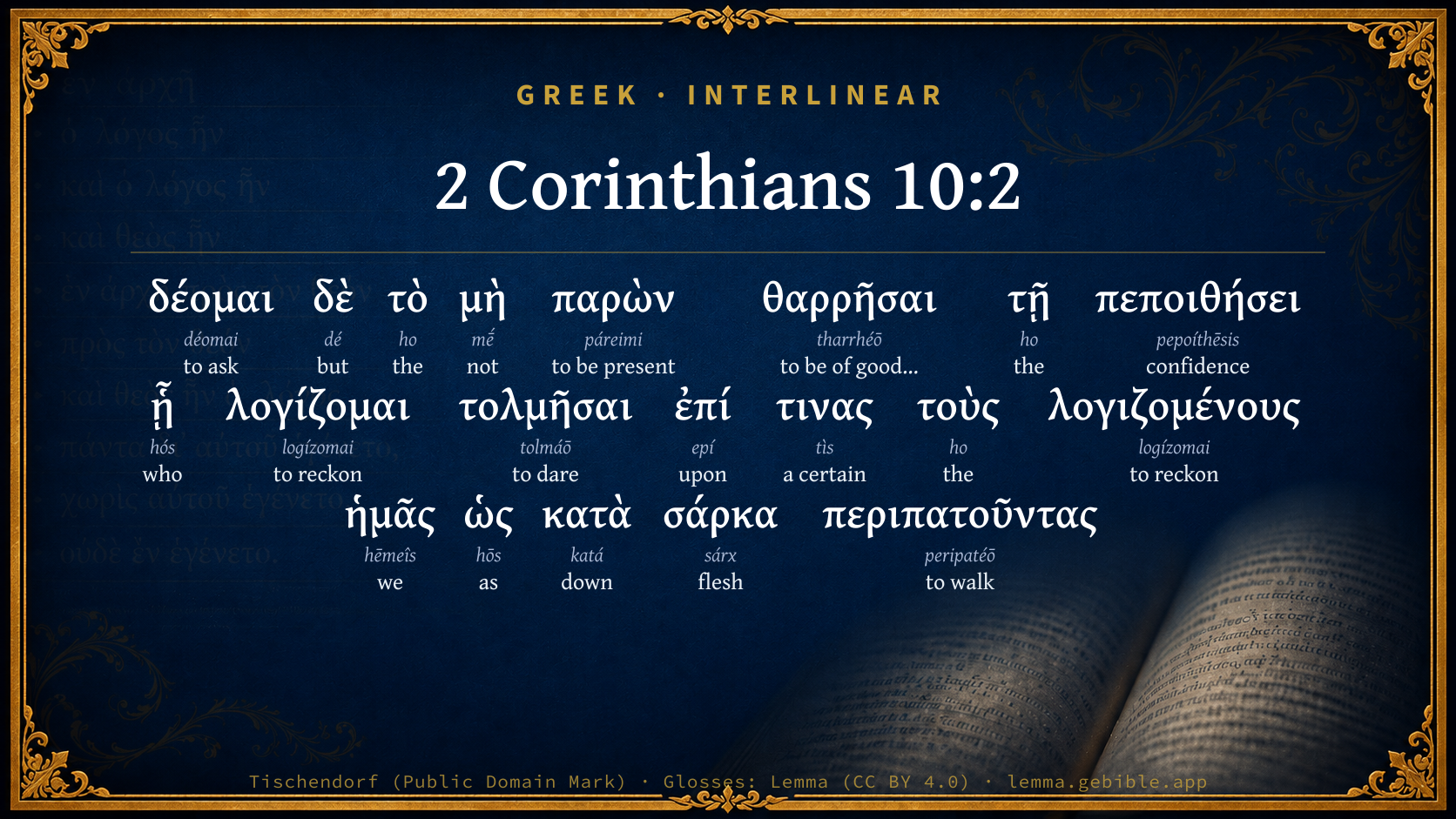
  1. δέομαι déomai G1189 “to ask” Verb, Present, Middle or Passive deponent, Indicative, 1st person, Singular
  2. δὲ dé G1161 “but” Conjunction
  3. τὸ ho G3588 “the” Article, Accusative, Singular, Neuter
  4. μὴ mḗ G3361 “not” Particle, Negative
  5. παρὼν páreimi G3918 “to be present” Verb, Present, Active, Participle, Nominative, Singular, Masculine
  6. τῇ ho G3588 “the” Article, Dative, Singular, Feminine
  7. πεποιθήσει pepoíthēsis G4006 “confidence” Noun, Dative, Singular, Feminine
  8. ᾗ hós G3739 “who” Relative pronoun, Dative, Singular, Feminine
  9. λογίζομαι logízomai G3049 “to reckon” Verb, Present, Middle or Passive deponent, Indicative, 1st person, Singular
  10. τολμῆσαι tolmáō G5111 “to dare” Verb, Aorist, Active, Infinitive
  11. ἐπί epí G1909 “upon” Preposition
  12. τινας tìs G5100 “a certain” Indefinite pronoun, Accusative, Plural, Masculine
  13. τοὺς ho G3588 “the” Article, Accusative, Plural, Masculine
  14. λογιζομένους logízomai G3049 “to reckon” Verb, Present, Middle or Passive deponent, Participle, Accusative, Plural, Masculine
  15. ἡμᾶς hēmeîs G2249 “we” Personal pronoun, 1st person, Accusative, Plural
  16. ὡς hōs G5613 “as” Adverb
  17. κατὰ katá G2596 “down” Preposition
  18. σάρκα sárx G4561 “flesh” Noun, Accusative, Singular, Feminine
  19. περιπατοῦντας peripatéō G4043 “to walk” Verb, Present, Active, Participle, Accusative, Plural, Masculine

About this verse

These counts appear in no published source. They are computed here, from the morphology-tagged text and Lemma’s own curated glosses. What Lemma adds →

20
words
17
distinct lemmas
Pauline Epistles
section

Notable vocabulary

The rarest word here is θαρρῆσαι to be of good courage G2292 — appearing just 6 times in the whole Greek New Testament.

Shared distinctive vocabulary

θαρρῆσαι to be of good courage G2292 occurs in 6 verses of the Greek New Testament. Also found in:

Repetition

Words recur within this verse:

  • λογίζομαι to reckon G3049 ×2
  • τὸ the G3588 ×3

Cross-references

9

Topical passages linked to 2 Corinthians 10:2 in the Treasury of Scripture Knowledge — connected by theme and wording, ordered by reader-vote popularity; previews shown in the World English Bible.

  • 2 Corinthians 13:10 For this cause I write these things while absent, that I may not deal sharply when present, according to the authority which the Lord gave me for building up, and not for tearing down.
  • 2 Corinthians 13:2 I have said beforehand, and I do say beforehand, as when I was present the second time, so now, being absent, I write to those who have sinned before now, and to all the rest, that, if I come again, I will not spare;
  • Galatians 5:16–25 But I say, walk by the Spirit, and you won't fulfill the lust of the flesh.
  • Ephesians 2:2–3 in which you once walked according to the course of this world, according to the prince of the powers of the air, the spirit who now works in the children of disobedience;
  • 1 Corinthians 4:18–21 Now some are puffed up, as though I were not coming to you.
  • 2 Corinthians 12:13–20 For what is there in which you were made inferior to the rest of the assemblies, unless it is that I myself was not a burden to you? Forgive me this wrong.
  • Romans 8:1 There is therefore now no condemnation to those who are in Christ Jesus, who don't walk according to the flesh, but according to the Spirit.
  • Romans 8:5 For those who live according to the flesh set their minds on the things of the flesh, but those who live according to the Spirit, the things of the Spirit.
  • 2 Corinthians 11:9–13 When I was present with you and was in need, I wasn't a burden on anyone, for the brothers, when they came from Macedonia, supplied the measure of my need. In everything I kept myself from being burdensome to you, and I will continue to do so.

Cross-references courtesy of OpenBible.info (CC BY 4.0).

Commentary

Notes on 2 Corinthians 10:2 from classic Christian and Jewish commentators (each source and its license shown beneath its notes). The classic Christian expositions comment on the surrounding passage and are grouped to its opening verse, so a note may address several verses; the Jewish commentaries on the Tanakh (Rashi and others) are per-verse, so they appear only where the commentator wrote on this verse.

Lemma curates 59 commentaries, every one of them public domain or Creative Commons licensed, each selected and text-cleaned for this edition rather than reprinted as found. About our sources →

Bengel's Gnomon

Johann Albrecht Bengel

2Co 10:2. Δέομαι, I beseech) God; as at 2Co 13:7, or here it is, I beseech you. Paul intimates, that, as he may beseech in his letters, so he can nevertheless act with severity in their presence.—λογίζομαι, I am thought [but Engl. Vers., I think to be bold]) Passive as in Rom 4:4-5.—ἐπί τινας [against] as to, with respect to some) construe with to be bold.—τοὺς λογιζομένους, thinking) in the middle voice.—ὡς, as if) Connect it with according to the flesh.—κατὰ σάρκα, according to the flesh) as if they may despise us with impunity.

Bengel's Gnomon of the New Testament — English translation (T&T Clark, Edinburgh, 1860) — public domain. Text from a community e-Sword module.

Meyer's Critical & Exegetical Commentary

Heinrich August Wilhelm Meyer

2Co_10:2. After the previous relative clause, the παρακαλῶ is in substance resumed by means of δέομαι δέ, and that in such a way that δέ has its adversative reference in the contents of the relative clause (Hartung, Partikell. I. p. 174; Klotz, ad Devar. p. 377), and the δέομαι now substituted for παρακαλῶ betrays the increasing earnestness softened by the mention of Christs gentleness and meekness. Emmerling and Rückert refer δέομαι not to the Corinthians, but to God: but I pray God that I when present may not be obliged to act with the confidence and boldness, etc. So also Ewald and Hofmann. But how strangely Paul would have written, if he had left his παρακαλῶ ὑμᾶς to stand quite abruptly at the very beginning of the new address! It is all the more arbitrary not to refer δέομαι also to the readers, and not to be willing to supply a ὑμῶν with δέομαι from the previous παρακαλῶ ὑμᾶς. Chrysostom and most expositors rightly give it this reference. And how little does what is attached to δέομαι δέ (observe especially ᾗ λογίζομαι κ.τ.λ.) sound like the contents of prayer!

τὸ μὴ παρὼν θαῤῥῆσαι κ.τ.λ.] I entreat the not being courageous in presence, i.e. that I may not when present (this παρών has the emphasis) be of brave courage with the confidence, etc. The meaning is: that you may not let it come to this, that I, etc. Comp. Chrysostom: μή με ἀναγκάσητε κ.τ.λ. On the infinitive with the article, see Buttmann, neut. Gr. p. 225 [E. T. 261]. The nominative παρών with the infinitive is quite according to Greek usage. See Kühner, II. p. 344; Matthiae, p. 1248. The πεποίθησις is not specially fiducia in Deum (Grotius, against the context), but generally the official confidentia, assurance.

ᾗ λογίζομαι τολμῆσαι] with which I reckon (am minded) to be bold towards certain people, etc. On λογίζομαι, comp. Herod. vii. 176; Xen. Anab. ii. 2. 13; 1Ma_4:35; 1Ma_6:19; LXX. 1Sa_18:25; Jer_26:3; and on τολμῆσαι, 2Co_11:21; Hom. Il. x. 232; Maetzner, ad Antiph. p. 173. Others, such as the Vulgate, Anselm, Luther, Beza, Piscator, Estius, Er. Schmid, Calovius, Bengel, Semler, Schulz, take λογίζομαι passively (qua efferri ducor, Emmerling). In that case we should have had an ἀπών with τολμῆσαι, because in this lay the most essential point of the hostile criticism; besides, the boldness of the expression, which lies in the correlation of λογίζομαι τοὺς λογιζομένους, would be obliterate.

ἐπί τινας τοὺς λογιζομ.] against certain, who reckon us, etc., is to be connected with τολμῆσαι, since only by the erroneous course of taking the previous λογίζομαι, as passive would the connection with θαῤῥῆσαι be required (Luther, Beza, Estius, Emmerling, also Billroth).

τινάς denotes quosdam, quos nominare nolo. See on 1Co_15:12. These are then characterized in their definite quality by τοὺς λογιζομ. See on Luk_18:9, and Doederl. ad Oed. Col. p. 296.

ὡς κατὰ σάρκα περιπατοῦντας] as people who walk according to the standard of the flesh. ὡς with the participle as the object of a verb of believing or saying. See Kühner, II. p. 375. Comp. Rom_8:36; 1Co_4:1; LXX. Gen_31:15, al. The περιπατεῖν κατὰ σάρκα is not an expression of weakness,[299] since ΠΕΡΙΠΑΤΕῖΝ denotes the moral conduct. Hence the meaning is: as those, whose way of thinking and of acting follows, not the influence of the Holy Spirit, but the lusts opposed to God, which have their seat in the materio-psychical nature of man. Comp. on Rom_8:4. This general interpretation is not at variance with the context, since, in fact, a κατὰ σάρκα περιπατεῖν would have shown such a demeanour in the apostles position as his opponents blamed him for,bold at a distance, timid when near, full of the fear of men and of the desire to please men. In that special accusation there was therefore expressed this general one of the κατὰ σάρκα περιπατεῖν; διέβαλλον γὰρ αὐτὸν ὡς ὑποκριτῆν, ὡς πονηρὸν, ὡς ἁλαζόνα, Chrysostom. Thus the expression is to be explained from the immediate context, and not of the reproach made to him by the representatives of a false spirituality, that he acted on too free principles (Ewald).

[299] Beza: non alio praesidio freti, quam quod prae nobis ferimus, qui videlicet homines sumus viles, si nihil aliud quam hominem spectes. Comp. Bengel, Mosheim, Flatt, Emmerling, also Billroth.

Meyer — Critical and Exegetical Commentary on the New Testament — English translation by Peter Christie, edited by Frederick Crombie (T&T Clark, 1880) — public domain. Text from a community e-Sword module.

Expositor's Greek Testament

ed. W. Robertson Nicoll

2Co 10:2 . δέομαι δὲ τὸ μὴ παρὼν κ . τ . λ .: nay ( sc. , “however that be,” δέ recommencing the sentence) I beseech you, that I may not (the use of the article with μή and the inf. is somewhat unusual; but cf. 2Co 2:1 , Rom 14:13 ; τὸ adds emphasis to the thing asked), when present, shew courage with the confidence (almost = “peremptoriness”) wherewith I count on myself (mid., not passive) to be bold against some (for the vague τινες see on 2Co 3:1 ) which count of us as if we walked according to the flesh . His opponents charged him with low motives ( cf. 2Co 2:17 ) which he will indignantly and sternly repudiate.

The Expositor's Greek Testament, edited by W. Robertson Nicoll (1897–1910) — public domain. Text from a community e-Sword module.

Geneva Bible (1599)

Geneva Bible translators

As though I had no other aid and help than that which outwardly I seem to have: and therefore Paul setteth his flesh, that is, his weak condition and state, against his spiritual and Apostolic dignity.

Geneva Bible (1599) marginal notes — public domain. Text via Bolls.life.

Jamieson, Fausset & Brown

Robert Jamieson, A. R. Fausset & David Brown

I beseech you--Intimating that, as he can beseech in letters, so he can be severe in their presence.

that I may not be--that I may not have to be bold, &c.

with that confidence--that authoritative sternness.

I think--I am minded to be.

as if we walked according to the flesh--His Corinthian detractors judged of him by themselves, as if he were influenced by fleshly motives, the desire of favor or fear of giving offense, so as not to exercise his authority when present.

Jamieson, Fausset & Brown — Commentary Critical and Explanatory on the Whole Bible (1871) — public domain (CC PDM 1.0). Text via the HelloAO Bible API.

Adam Clarke's Commentary

Verse 2. Some, which think of us as if we walked according to the flesh.] As it is customary for cowards and overbearing men to threaten the weak and the timid when present; to bluster when absent; and to be very obsequious in the presence of the strong and courageous. This conduct they appear to have charged against the apostle, which he calls here walking after the flesh- acting as a man who had worldly ends in view, and would use any means in order to accomplish them.

Adam Clarke's Commentary on the Bible (1810–1826) — public domain. Text from a community e-Sword/MySword module.

John Calvin's Commentaries

2. I beseech you, that I may not be bold, when I am present. Some think, that the discourse is incomplete, and that he does not express the matter of his request. I am rather of opinion, however, that what was wanting in the former clause is here completed, so that it is a general exhortation. “Show yourselves docile and tractable towards me, that I may not be constrained to be more severe.” It is the duty of a good pastor to allure his sheep peacefully and kindly, that they may allow themselves to be governed, rather than to constrain them by violence. Severity, it is true, is, I acknowledge, sometimes necessary, but we must always set out with gentleness, and persevere in it, so long as the hearer shews himself tractable. Severity must be the last resource. “We must,” says he, “try all methods, before having recourse to rigor; nay more, let us never be rigorous, unless we are constrained to it.” In the mean time, as to their reckoning themselves pusillanimous and timid, when he had to come to close quarters, he intimates that they were mistaken as to this, when he declares that he will stoutly resist face to face the contumacious “They despise me,” says he, “as if I were a pusillanimous person, but they will find that I am braver and more courageous than they could have wished, when they come to contend in good earnest.” From this we see, when it is time to act with severity — after we have found, on trial being made, that allurements and mildness have no good effect. “I shall do it with reluctance,” says Paul, “but still I have determined to do it.” Here is an admirable medium; for as we must, in so far as is in our power, draw men rather than drive them, so, when mildness has no effect, in dealing with those that are stern and refractory, rigor must of necessity be resorted to: otherwise it will not be moderation, nor equableness of temper, but criminal cowardice.

Who account of us. Erasmus renders it — “Those who think that we walk, as it were, according to the flesh.” The Old Interpreter came nearer, in my opinion, to Paul’s true meaning — “Qui nos arbitrantur, tanquam secundum carnem ambulemus;” — (“Those who think of us as though we walked according to the flesh;” ) though, at the same time, the phrase is not exactly in accordance with the Latin idiom, nor does it altogether bring out the Apostle’s full meaning. For λογιζεσθαι is taken here to mean — reckoning or esteeming. “They think of us,” says Paul, “or they take this view of us, as though we walked according to the flesh.”

To walk according to the flesh, Chrysostom explains to mean — acting unfaithfully, or conducting one’s self improperly in his office; and, certainly, it is taken in this sense in various instances in Paul’s writings. The term flesh, however, I rather understand to mean — outward pomp or show, by which alone the false Apostles are accustomed to recommend themselves. Paul, therefore, complains of the unreasonableness of those who looked for nothing in him except the flesh, that is, visible appearance, as they speak, or in the usual manner of persons who devote all their efforts to ambition. For as Paul did not by any means excel in such endowments, as ordinarily procure praise or reputation among the children of this world, (Luke 16:8,) he was despised as though he had been one of the common herd. But by whom? Certainly, by the ambitious, who estimated him from mere appearance, while they paid no regard to what lay concealed within.

John Calvin's Commentaries (1540-1563) — public domain. Text from the Calvin Translation Society English edition (1840s-50s) via the Christian Classics Ethereal Library (ccel.org). Calvin's coverage is partial (roughly two-thirds of the Bible); uncommented books and verses are honest gaps, never fabricated. The 19th-century editor's footnotes and remarks are omitted so the notes are faithfully Calvin's own voice.

Ellicott's Commentary for English Readers

(2) But I beseech you . . .—There is, of course, an implied warning, almost a menace, in the entreaty. He would fain be spared the necessity for boldness when he and those of whom he speaks meet face to face; but if the necessity comes it will be the worse for them. They “reckon” him as walking “after the flesh,” with low and selfish aims and tortuous arts. (Comp. 2Co_1:17; Rom_8:12-13; 1Co_1:26.) He “reckons” that he has daring enough to confront those who take that estimate of him.

A Bible Commentary for English Readers, edited by Charles John Ellicott (1878–1897) — public domain. Text from a community e-Sword module.

The Cambridge Bible for Schools and Colleges

gen. ed. J. J. S. Perowne

2. I beseech you, that I may not be bold] Literally, I entreat the not being bold. Compliance or non-compliance with this request rested entirely with the Corinthians. The word here translated beseech is not the same as the one used in the last verse.

with that confidence, wherewith I think to be bold] It does not clearly appear from this passage what St Paul meant to do when he arrived at Corinth. He speaks of ‘pulling down of strongholds,’ of ‘casting down whatever exalteth itself’ against Christ. But he never says what he intends to do. Calvin (1) interprets the passage of excommunication. Others (2) of bodily punishments, such as those inflicted on Elymas (Act_13:6-11), or on Ananias and Sapphira (Act_5:1-10). Or (3) we may regard it as referring to the authoritative proclamation of the Gospel by one fully inspired, which must of necessity bring about in the end the disappearance of error. This is thought to be implied by 2Co_10:11, which implies the immediate exercise when present, of the same power which when absent is exercised by letter. But a comparison of 2Co_10:11 with 1Co_4:21; 1Co_5:1-5 would lead to the idea of a formal delivery over to Satan of those who wilfully corrupted the doctrine of Christ, and gainsaid the authority of His Apostle. See note on 1Co_5:5. The word rendered ‘bold’ here is not the same as that in the former part of the verse. It implies (1) to dare, (2) to bear oneself boldly, i.e. to others, while the former word seems to imply confidence in oneself.

against some] i.e. the false teachers.

according to the flesh] See ch. 2Co_5:16; Rom_8:1.

The Cambridge Bible for Schools and Colleges (gen. ed. J. J. S. Perowne; Cambridge University Press, 1878–1918) — public domain. Text from a community e-Sword module.

John Gill's Exposition

But I beseech you, that I may not be bold when I am present,.... That is, he entreated them that they would so behave for the future, that he might have no occasion, when he came among them, to use that power and authority they called boldness, which he had received from Christ for edification, and not destruction; as for that asperity and roughness with which he wrote, and which was thought to be too severe, it was in order to reclaim them, and so prevent that sharpness he was empowered by Christ to use: for though he had said in his former epistle, Co1 4:21 "shall I come unto you with a rod or in love? and in the spirit of meekness?" he chose to come in the latter, rather than with the former; namely, not

with that confidence wherewith, says he,

I think to be bold: by "confidence" he means the faith of miracles he was possessed of, and particularly the power he, and other apostles had, of striking dead or blind incorrigible offenders, or of delivering them to Satan to undergo some corporeal punishment; which he had been thinking of, and reasoning about in his own mind, and was almost come to a conclusion concerning it, to inflict it upon, and with it to be bold,

against some which think of us as if we walked according to the flesh; who not barely thought so within themselves, but reasoned the matter with others, and would fain persuade them to believe that they did walk in a carnal manner; not that they had the face to say, that they walked after the dictates of corrupt nature, or lived in open vice and profaneness; but that they walked in craftiness, had their conversation in the world with fleshly wisdom, seeking their own worldly interest and secular advantage; which is denied by the apostle, Co2 1:12 and was the real case, and true picture of the false teachers themselves.

John Gill's Exposition of the Whole Bible (1746–1763) — public domain (CC PDM 1.0). Text via the HelloAO Bible API.

Trapp's Complete Commentary

John Trapp

2 But I beseech you, that I may not be bold when I am present with that confidence, wherewith I think to be bold against some, which think of us as if we walked according to the flesh.

Ver. 2. That I may not be bold] That you necessitate me not. Non nisi coactus hoc facio, said that emperor that subscribed a warrant to put one to death.

With that confidence] It was but confidence, but they made the worst of it, and called it boldness, Quam vitio verterunt. Evil will never speaks well.

John Trapp, A Commentary or Exposition upon All the Books of the Old and New Testament (1647–1656) — public domain. Text from a community e-Sword module.

Albert Barnes' Notes on the Bible

That I may not be bold - I entreat you so to act that I may not have occasion to exercise the severity which I fear I shall be compelled to use against those who accuse me of being governed wholly by worldly motives and policy. In other words, that I may not be compelled to be bold and decisive in my measures by your improper conduct.

Which think of us - Margin, “reckon.” They suppose this; or, they accuse me of it. By the word “us” here Paul means himself, though it is possible also that he speaks in the name of his fellow apostles and laborers who were associated with him, and the objections may have referred to all who acted with him.

As if we walked - As if we lived or acted. The word “walk” in the Scriptures is often used to denote the course or manner of life; see the Rom 4:12, note; 2Co 5:7, note.

According to the flesh - see the note on 2Co 1:17. As if we were governed by the weak and corrupt principles of human nature. As if we had no higher motive than carnal and worldly policy. As if we were seeking our own advantage and not the welfare of the world. The charge was, probably, that he was not governed by high and holy principles, but by the principles of mere worldly policy; that he was guided by personal interests, and by worldly views - by ambition, or the love of dominion, wealth, or popularity, and that he was destitute of every supernatural endowment and every evidence of a divine commission.

Albert Barnes' Notes on the Bible (1834–1885) — public domain. Text from a community e-Sword/MySword module.

Haydock's Catholic Bible Commentary

I beg of you now to hear my apology, that I may not be obliged to make us of my authority, when present among you, which they say I have abused, and usurped over you. There is in this discourse a little irony against the facility with which the Corinthians heard the enemies of St. Paul. He alludes to those false teachers who decried his doctrine, by preaching up the observance of the ceremonial parts of the law, for they were Jews, and had introduced many new practices into the Church. We may here take notice, that these observations are applicable to the epistles of St. Paul to the Galatians, and Philippians, for they are the same false teachers whom he there attacks, and who accused St. Paul of being a hypocrite, a seducer, in a word, one who walked according to the flesh. (Estius and St. John Chrysostom)

George Leo Haydock (1774–1849), Haydock's Catholic Family Bible and Commentary, 1859 edition — public domain. Excludes Psalms (Douay-Rheims chapter numbering differs from Protestant) and Deuterocanonical books (Catholic canon only).

Matthew Poole's English Annotations

It is true, (saith the apostle), when I have been with you I have made it my business to behave myself with all obliging sweetness, not using that authority which I might have used; and I beseech you, as not to blame me for that, (remembering the meekness and gentleness of Christ), so by your conversation not to force me to another kind of conversation amongst you; that you would not constrain me to a severer behaviour towards you when I am present with you, to be so free with some of you, as at present I am resolved to be; such, I mean, as have traduced me, as if I

walked according to the flesh, that is, not guided by the Holy Spirit of God, and the directions of his word, but by some external, carnal considerations, respecting my own profit, pleasure, or reputation, indulging my own passions or corrupt affections. Walking after the flesh is opposed to a walking after the Spirit, Rom 8:1. He walketh after the flesh, to whom the fleshly appetite is the principle, rule, and end of his actions; as he, on the contrary, to whom those habits of grace which are wrought in the soul by the Holy Spirit, or the Spirit himself more immediately by his motions or impulses, are the principle of his actions, and the word dictated by the Spirit is the rule of his actions, and the glory of God is the end of his actions, is truly said to walk after the Spirit.

Matthew Poole's English Annotations on the Holy Bible (1683–1685) — public domain. Text from a community e-Sword/MySword module.

Whedon's Commentary on the Bible

Daniel D. Whedon

2. But, here, may be omitted in thought; and I beseech you is a reiteration (though a different Greek word) of the same phrase in the previous verse. That, is essentially dependent upon beseech you, in 2Co_10:1. Paul begs that he may not need to be bold; especially may not be obliged to display a boldness destructive to his assailants.

Confidence—Official, apostolic firmness.

Some—This some is the arraigned, but unnamed, party of assailants.

According to the flesh—As a false apostle, deceiving the people for my own self-interest.

Daniel D. Whedon (gen. ed.), Commentary on the Old and New Testaments (1874–1909) — public domain. Text from a community e-Sword module.

The Pulpit Commentary

I beseech you. The "beseech" is here right (deomai). The "you" is not in the Greek, but is rightly supplied. It rests with them to avert the necessity of personal severity, and he entreats them to do so. (comp. 2Co_13:2, 2Co_13:10; 1Co_4:21) Against some. He leaves these undefined till the vehement outburst of 2Co_11:13, 2Co_11:14. As if we walked according to the flesh. (see note on 2Co_5:16) To say this of St. Paul was to charge him with being insincere and not disinterested.

The Pulpit Commentary (1880–1919), ed. H.D.M. Spence-Jones & Joseph S. Exell — public domain. Text from a community e-Sword module.

John Wesley's Explanatory Notes

Do not constrain me when present to be bold - To exert my apostolical authority. Who think of us as walking after the flesh - As acting in a cowardly or crafty manner.

John Wesley, Explanatory Notes Upon the Whole Bible (1754–1765) — public domain. Text via the GEBible commentary corpus.

McGarvey & Pendleton's Commentaries

J. W. McGarvey

yea, I beseech you, that I may not when present show courage with the confidence wherewith I count to be bold against some, who count of us as if we walked according to the flesh . [Hitherto the apostle had associated Timothy as a joint author of this letter, but as he now prepares to deal with his enemies and matters personal to himself, he disengages himself from all entangling fellowships and steps forth alone to defend his name and influence. That there may be no doubt as to his purpose in thus standing alone, and that his enemies may understand the spirit in which he presents himself before them, he quotes their own belittling description of him: for they had described him as a coward who threatened and thundered when absent, but was meek and lowly enough when present. Accepting for the moment this false estimate of himself, he beseeches them by the meekness and gentleness of Christ (for Jesus ever preferred gentleness to severity) that they may so amend their conduct as to make their estimate of him true thus far; viz.: that at his coming he may indeed be permitted to show them gentleness, and may not, as he now confidently expected, be compelled to show his severity toward those who accused him of conducting himself as an unprincipled worldling.]

J. W. McGarvey (with Philip Y. Pendleton), Commentaries on the New Testament (The Fourfold Gospel, 1914; Acts; and the epistles) — public domain. Text from a community e-Sword/MySword module.

The People's New Testament

B. W. Johnson

2. I beseech you. He asks that, when he comes, he may not have to exercise that boldness which he fears he will have to use in censuring some opposers. He desires that all may so act that he can be lowly and gentle when present. As if we walked according to the flesh. Were led by worldly motives.

B. W. Johnson's The People's New Testament with Notes (1889–1891) — public domain. Electronic text from the Christian Classics Ethereal Library (CCEL) ThML edition.

Cambridge Greek Testament for Schools and Colleges

2. δέομαι δὲ τὸ μὴ παρὼν θαρρῆσαι, Yea, I beseech you that I may not when present show courage. The δέ follows up the παρακαλῶ: I exhort, yea, I beseech. The A.V. misses a point in having ‘beseech’ for both παρακαλῶ (2Co 10:1) and δέομαι. And the change from exhortation to entreaty is not sufficiently marked in either the Vulgate (obsecro, rogo) or the R.V. (‘intreat,’ ‘beseech’). The παρών implies that he means to visit them again. The nom. with infin. is regular, being attracted to δέομαι: comp. Rom 1:22; Rom 15:24; Php 4:11.

τῇ πεποιθήσει ᾖ λογίζομαι τολμῆσαι ἐπί τινας τ. λ. ἡ. The A.V. misses another point in having ‘be bold’ for both θαρρῆσαι and τολμῆσαι. By changing his word S. Paul intimates that the boldness which he expects to exhibit is not quite the same as the courage (or θρασυδειλία) attributed to him by his critics; that I may not when present show courage with the confidence wherewith I count to be bold against some which count of us &c. For πεποιθησις see on 2Co 1:15, and comp. the stronger ὑπόστασις in 2Co 9:4. With S. Paul λογίζομαι, ‘count, account, reckon,’ is a favourite word (2Co 3:5, 2Co 5:19, 2Co 11:5, 2Co 12:6), especially in Romans (Rom 2:3; Rom 2:26; Rom 3:28, &c.). In other N.T. writers it is rare; in the LXX. very frequent. The Vulg. takes λογίζομαι as passive, qua existimor audere in quosdam, qui arbitrantur nos (comp. Rom 4:5), which makes needless tautology. Doubtless both λογίζομαι and λογιζομένος are middle; but there is a characteristic play of words in the shades of meaning, λογίζομαι of expectation or intention (1Sa 18:25), λογιζομένους of supposition or view. As in 1Co 15:12, he does not specify who the τινες are; they are only a fraction of the Corinthians. This shows that these chapters (10–13) are addressed to the majority, or to the whole Church of Corinth, not to the hostile minority.

ὡς κατὰ σάρκα περιπατοῦντας. ‘As if our thoughts and acts were guided by carnal and worldly principles’: Rom 8:4. For ὡς after λογίζεσθαι comp. 1Co 4:1; Rom 8:36; it gives their point of view: διέβαλλον γὰρ αὑτὸν ὡς ὑποκριτήν, ὡς πονηρόν, ὡς ἀλαζόνα (Chrys.): comp. 2Co 2:17, 2Co 4:2; 1Th 2:3. In κατὰ σάρκα there is no reference to his physical infirmities: comp. 2Co 1:17, 2Co 5:16. In περιπατοῦντας we have a Hebraism, which is frequent in S. Paul (2Co 4:2, 2Co 5:7, 2Co 12:18; &c.) and S. John, but is not found in S. James or S. Peter. Comp. κατὰ ἄνθρωπον περιπατεῖτε (1Co 3:3) and ἀνεστράφημεν (2Co 1:12).

Cambridge Greek Testament for Schools and Colleges (Cambridge University Press, 1896; 21 vols, various authors incl. Carr, Maclear, Plummer, Farrar, Lumby, Moule, M. R. James, Simcox) — public domain. Text from a community e-Sword module.

Alford’s Greek Testament

Henry Alford

2.] but (however this may be, assuming this character of me to be true or not, as you please;—or, notwithstanding that I may have been hitherto ταπεινός among you) I pray (you) (not, God, as Bengel (1), al.) that I may not (τὸ μή sets the object of δέομαι in a stronger light, see reff.) when present (‘as I intend to be:’—‘at my next visit’) have to be bold (see above) with the confidence (official peremptoriness, and reliance on my authority) with which I reckon (am minded: not passive, ‘am reckoned,’ as Vulg., Luther, Beza, Estius, Bengel, al., which, as Meyer remarks, would naturally require ἀπών with τολμῆσαι to be bold towards [against] some, (namely) those who reckon (of) us as walking according to the flesh (περιπατεῖν κατὰ σάρκα is well explained by Estius, ‘hoc est, secundum carnales et humanos affectus vitam et actiones instituere.… Putabaut enim Paulum, quando præsens erat, sive captandæ gratiæ causa, sive quod timeret offendere, vel simili affectu humano prohibitum fuisse, ne potestatem exerceret, quam absens per literas venditabat’).

Henry Alford, The Greek Testament (1849–1861) — public domain. Text from a community e-Sword module.

International Critical Commentary

2. δέομαι δὲ τὸ μὴ παρὼν θαρρῆσαι. The appeal to the meekness and gentleness of Christ influences the Apostle himself, and he drops from magisterial exhortion to earnest entreaty. RV. does not sufficiently mark this with ‘intreat’ and ‘beseech,’ nor Vulg. with obsecro and rogo, while AV does not mark it at all, but has ‘beseech’ for both verbs. Δέομαι δέ takes up παρακαλῶ and repeats it in a lower key; ‘I exhort, nay I beseech you, that I may not when present show courage.’ Lit. ‘I beg of you the not, when I am present, showing courage.’ Chrys. has μή με ἀναγκάσητε. On the constr. see Blass, § 71. 1; παρῶν is attracted to the nom. of δέομαι. Cf. ἔμαθον αὐτάρκης εἶναι (Php 4:11), φάσκοντες εἶναι σοφοί (Rom 1:22). Bachmann follows Rückert and B. Weiss in thinking that δέομαι is addressed to God, which is not probable. As δέομαι must be distinguished in translation from παρακαλῶ, so also must θαρρῆσαι from τολμῆσαι, and here again AV ignores the change. The change of word is probably neither accidental nor merely for the sake of variety, but marks the difference between the feigned courage which his critics attributed to him and the uncompromising boldness which he is confident of exhibiting if his opponents render it necessary. He beseeches them so to behave that he may be spared the distress of proving that he can be unflinching when he is face to face with them.

τῇ πεποιθήσει ᾗ λογίζομαι τολμῆσαι κ.τ.λ. ‘With the confidence (1:15) wherewith I count on being bold against certain persons who count of us as, etc.’ The Corinthians of course would understand who the τινας, quosdam, whom he does not care to mention, are, cf. 3:1; 1Co 15:12. They are a malignant coterie in the Church which he is addressing. The thought of them changes his tone once more, and he again becomes minatory. We must give the same rendering to λογίζομαι and λογιζομένους, both of which are midd. and not pass. Nevertheless there is a difference of signification, the one meaning ‘I reckon’ = ‘I expect,’ the other meaning ‘who reckon’ = ‘who suppose.’ The verb is very freq. in Paul, esp. in Rom. and 2 Cor. Vulg. here has qua existimor audere in quosdam, qui arbitrantur nos, etc., using two different verbs and taking λογίζομαι as passive. It uses both these verbs elsewhere, and also cogito (vv. 7, 11, 3:5; etc.), reputo (5:19; Gal 3:6; 2Ti 4:6; etc.), imputo (Rom 4:3, Rom 4:8), cui accepto fero (Rom 4:6), and aestimo (Rom 8:36, Rom 9:8). Rom 4:3 is remarkable, for in Gen 15:6 Vulg. has reputo.

ὡς κατὰ σάρκα περιπατοῦντας. ‘As if our conduct were guided by carnal principles’; see on Rom 8:4. His opponents attributed to him unspiritual and worldly motives and conduct; that he was capricious and shuffling, verbose and vain-glorious, at once a coward and a bully, and so forth. That they accused him of unchastity is not probable; had they done so, he would have been more definite. Nor is there any reference to his physical infirmities. See on 1:17, last note; and for the Hebraistic περιτατεῖν of daily conduct see on 4:2 and 1Co 3:3, also on ἀνεστράφημεν, 2Co 1:12. The metaphor which follows suggests that κατὰ σάρκα refers, among other things, to a charge of being a coward.

International Critical Commentary — older volumes (1896–1929), various authors — public domain. Text from a community e-Sword module.

Vincent's Word Studies in the New Testament

Marvin R. Vincent

But I beseech you [δεομαι δε] . In ver. 1, parakalw is used for beseech. It is doubtful whether the two words can be strictly distinguished as indicating different degrees of feeling. It may be said that deomai and its kindred noun dehsiv are frequently used of prayer to God, while parakalw occurs only twice in this sense, Mt 26:53; 2Co 12:8. On the other hand, parakalw is used of God 's pleading with men, while in the same passage deomai is used of men's entreating men; ch. 5 20. Rev., in ver. 1, renders entreat, which, according to older English usage, is the stronger word, meaning to prevail by entreaty, just as persuade, which originally meant to use persuasion, now signifies to prevail by persuasion.

The construction of the passage is difficult. Literally it is : I pray the not showing courage when present, with the confidence, etc. The sense is : I pray you that you may not make it necessary for me to show, when I am present, that official peremptoriness which I am minded to show against those who charge me with unworthy motives.

May not be bold - think to be bold [θαρρησαι - τολμησαι] . The A. V. thus misses the distinction between the two verbs. The former signifies to be stout - hearted or resolutely confident in view of one's conscious strength or capacity; the latter, to carry this feeling into action; to dare. The distinction is not easy to represent by single English words. It might be approximately given by brave and bold, though, in common usage, this distinction practically disappears. QarjrJhsai does not so much emphasize fearlessness as the tore positive quality of cheerful confidence in the presence of difficulty and danger, the sense which appears in the earlier usage of brave as gay (see the various uses in Shakespeare). Hence Rev. is on the right line in the use of courage, from cor heart, through the French coeur. Rev. renders, show courage - be bold. In classical Greek, the kindred noun qarsov is sometimes, though not often, used in a bad sense, audacity, as in Homer, where Minerva is rebuking Mars for exciting strife among the gods with stormy or furious courage (qarsov ahton "Iliad," 21, 395). So the reckless daring of Hector is described qarsov muihv the effrontery of a fly (" Iliad, " 17, 570).

Marvin R. Vincent, Word Studies in the New Testament (1887–1900) — public domain. Text from a community e-Sword/MySword module.

Lesson kit

Teaching starters — assembled from the data on this page, not authored interpretation. Every prompt links to the verse data it draws on. Edit before teaching.

2 Corinthians, in the Pauline Epistles, opens this verse with 20 words (17 distinct Greek lemmas). Its most distinctive word is tharrhéō (“to be of good courage”). A historical commentator’s framing appears above. Read the whole chapter for the surrounding context.

Discussion questions

  1. The word tharrhéō carries the sense “to be of good courage.” How does it shape the verse?
  2. How does 2 Corinthians 5:6, which shares the word «to be of good courage», read alongside this verse?
  3. What does the repetition of “to reckon” (2× in this one verse) do in this verse?
  4. These translations render this verse differently; the difference is in the English rendering, not the original. What questions does that raise?
  5. Compare how Bengel's Gnomon and Meyer's Critical & Exegetical Commentary read this verse. Where do they agree or differ?

Things to notice

  • These translations choose different wording for 24 words in this verse.
  • “to reckon” occurs 2× in this single verse.
  • 17 distinct Greek lemmas span 20 words in this verse.

Reading settings

Reading text

Shown beneath each verse's original-language words.

Old Testament
Old Testament edition

Read the OT as the Masoretic Hebrew (MT) or the Greek Septuagint (LXX).

English shown for the Greek Septuagint (in the Hebrew ↔ Greek comparison).

Comparing translations? Open the Compare panel on any verse page to stack up to four side by side.