Genesis 7:21

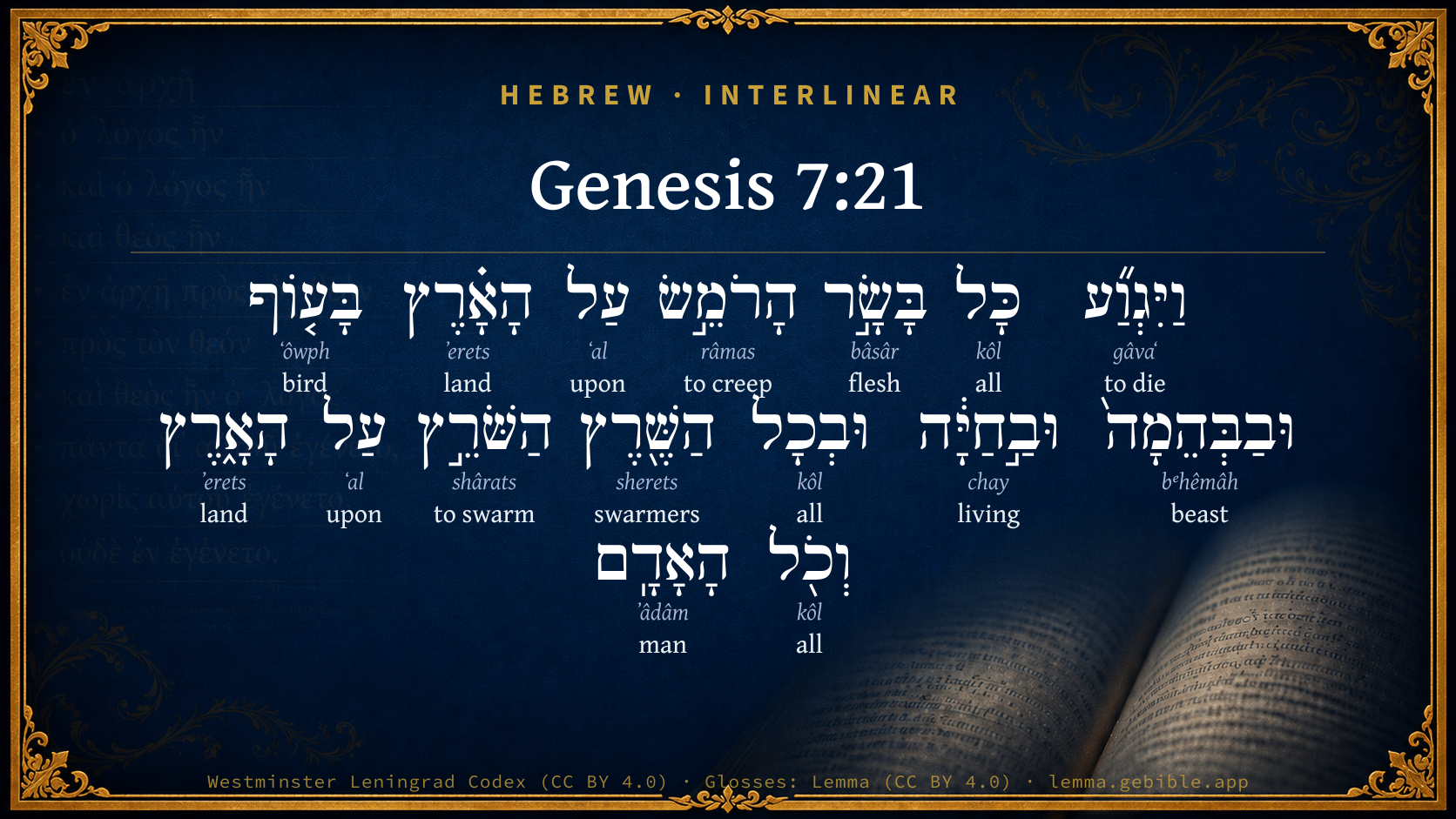
Hebrew (Westminster Leningrad Codex) Genesis 7:21 appears in the Hebrew Old Testament. The text above is from the Westminster Leningrad Codex. Each word links to its Strong’s number, a concise gloss, and parsing drawn from the Open Scriptures Hebrew Bible morphology. Click any word for its full Brown-Driver-Briggs (BDB) entry.
Download image
Cite this verse

Genesis 7:21 (World English Bible). Public Domain. Lemma interlinear Bible study tool, https://lemma.gebible.app/v/genesis/7/21.

Show BibTeX & RIS
BibTeX
RIS
English Translation
All flesh died that moved on the earth, including birds, cattle, animals, every creeping thing that creeps on the earth, and every man.
World English Bible · Public Domain
Download a study sheet

One document with this verse’s original text, its word-by-word gloss line, the meaning frame, cross-references with their text, attributed commentary, and full source and license credits — printable, and it pastes into notes with its structure intact.

This verse Autodidact and up

Study sheet (.html) Plain text (.txt)

A passage Seminary Student

Up to 50 verses in one chapter. A passage sheet keeps up to 6 commentary sources and 12 cross-references per verse, in the order this page ranks them, and says so on the sheet whenever that leaves anything out. Ask for a single verse and you get the Autodidact verse sheet above.

Everything on this page stays free to read, with no account — the sheet is a download of what is already on screen, not access to it.

Want to remove ads? Support Godless Engineer
Compare translations 3

The same verse in 3 English versions, stacked beneath the original-language interlinear above. Click any original word for its lexicon entry.

Each is an independent rendering of the whole verse — the interlinear is not word-aligned to these translations.

Highlighted words mark where these versions differ — a whole-verse word diff, not a word-by-word alignment.

  • World English Bible Public Domain
    All flesh died that moved on the earth, including birds, cattle, animals, every creeping thing that creeps on the earth, and every man.
  • King James Version Public Domain
    And all flesh died that moved upon the earth, both of fowl, and of cattle, and of beast, and of every creeping thing that creepeth upon the earth, and every man:
  • unfoldingWord Literal Text CC BY-SA 4.0
    Then all flesh that moved on the earth expired, including the birds and the livestock and the living things and all the swarming things swarming on the earth, and all mankind.

unfoldingWord Literal Text — © unfoldingWord, licensed CC BY-SA 4.0. Word-aligned USFM3 via Door43 (git.door43.org/unfoldingWord/en_ult).

Versions to compare (up to 4)

3 of 4 selected

Show all 18 translations

Every available English version of this verse, each an independent rendering of the whole verse.

  • World English Bible Public Domain
    All flesh died that moved on the earth, including birds, cattle, animals, every creeping thing that creeps on the earth, and every man.
  • Berean Standard Bible Public Domain
    And every living thing that moved upon the earth perished—birds, livestock, animals, every creature that swarms upon the earth, and all mankind.
  • Majority Standard Bible Public Domain
    And every living thing that moved upon the earth perished—birds, livestock, animals, every creature that swarms upon the earth, and all mankind.
  • King James Version Public Domain
    And all flesh died that moved upon the earth, both of fowl, and of cattle, and of beast, and of every creeping thing that creepeth upon the earth, and every man:
  • American Standard Version (1901) Public Domain
    And all flesh died that moved upon the earth, both birds, and cattle, and beasts, and every creeping thing that creepeth upon the earth, and every man:
  • Revised Version (1885) Public Domain
    And all flesh died that moved upon the earth, both fowl, and cattle, and beast, and every creeping thing that creepeth upon the earth, and every man:
  • Geneva Bible (1599) Public Domain
    Then all flesh perished that moued vpon the earth, both foule and cattell and beast, and euery thing that creepeth and moueth vpon the earth, and euery man.
  • Douay-Rheims (1899) Public Domain
    And all flesh was destroyed that moved upon the earth, both of fowl, and of cattle, and of beasts, and of all creeping things that creep upon the earth: and all men.
  • Young's Literal Translation Public Domain
    and expire doth all flesh that is moving on the earth, among fowl, and among cattle, and among beasts, and among all the teeming things which are teeming on the earth, and all mankind;
  • Literal Standard Version CC BY-SA 4.0
    and all flesh expires that is moving on the earth, among bird, and among livestock, and among beast, and among every teeming thing which is teeming on the earth, and all mankind;
  • Unlocked Literal Bible CC BY-SA 4.0
    All living beings that moved upon the earth died—birds, livestock, wild animals, all the living creatures that lived in great numbers upon the earth, and all mankind.
  • unfoldingWord Literal Text CC BY-SA 4.0
    Then all flesh that moved on the earth expired, including the birds and the livestock and the living things and all the swarming things swarming on the earth, and all mankind.
  • Darby Bible Public Domain
    And all flesh that moved on the earth expired, fowl as well as cattle, and beasts, and all crawling things which crawl on the earth, and all mankind:
  • World Messianic Bible Public Domain
    All flesh died that moved on the earth, including birds, livestock, animals, every creeping thing that creeps on the earth, and every man.
  • Webster's Bible Public Domain
    And all flesh died that moved upon the earth, both of fowl, and of cattle, and of beast, and of every creeping animal that creepeth upon the earth, and every man:
  • Free Bible Version CC BY-SA 4.0
    Everything living on earth died—the birds, livestock, wild animals, all creatures that run along the ground, and all the people.
  • Bible in Basic English Public Domain
    And destruction came on every living thing moving on the earth, birds and cattle and beasts and everything which went on the earth, and every man.
  • JPS Tanakh (1917) Public Domain
    And all flesh perished that moved upon the earth, both fowl, and cattle, and beast, and every swarming thing that swarmeth upon the earth, and every man;

Literal Standard Version (2020), Covenant Press — licensed CC BY-SA 4.0. Text via the HelloAO Bible API (eBible.org). Unlocked Literal Bible (unfoldingWord) — licensed CC BY-SA 4.0. Text via the HelloAO Bible API (eBible.org). unfoldingWord Literal Text — © unfoldingWord, licensed CC BY-SA 4.0. Word-aligned USFM3 via Door43 (git.door43.org/unfoldingWord/en_ult). Free Bible Version, Dr. Jonathan Gallagher — licensed CC BY-SA 4.0. Text via the HelloAO Bible API (eBible.org).

Word by word

More ways to search: Search by grammar → Find every occurrence → Compare this word →

Practice this passage: Drill this verse → Learn its vocabulary →

הַשֹּׁרֵ֣ץ
shârats
H8317
“the · swarming”
Particle, Definite Article + Verb, Qal, Participle Active, Masculine, Singular, Absolute
Part of Speech
Particle + Verb
Stem
Qal
Form
Participle Active
Gender
Masculine
Number
Singular
State
Absolute
Full BDB Definition

Origin: a primitive root

TWOT: 2467

(Qal) to teem, swarm, multiply - to swarm, teem - to swarm
  1. וַיִּגְוַ֞ע gâvaʻ H1478 “and · to die” Conjunction + Verb, Qal, Sequential Imperfect, 3rd Person, Masculine, Singular
  2. כָּל kôl H3605 “all of” Noun, Common, Masculine, Singular, Construct
  3. בָּשָׂ֣ר bâsâr H1320 “flesh” Noun, Common, Masculine, Singular, Absolute
  4. הָרֹמֵ֣שׂ râmas H7430 “the · creeping” Particle, Definite Article + Verb, Qal, Participle Active, Masculine, Singular, Absolute
  5. עַל ʻal H5921 “upon” Preposition
  6. הָאָ֗רֶץ ʼerets H776 “the · land” Particle, Definite Article + Noun, Common, Both, Singular, Absolute
  7. בָּע֤וֹף ʻôwph H5775 “in/at the · bird” Preposition, Determined + Noun, Common, Masculine, Singular, Absolute
  8. וּבַבְּהֵמָה֙ bᵉhêmâh H929 “and · in/at the · beast” Conjunction + Preposition, Determined + Noun, Common, Feminine, Singular, Absolute
  9. וּבַ֣חַיָּ֔ה chay H2416 “and · in/at the · living” Conjunction + Preposition, Determined + Noun, Common, Feminine, Singular, Absolute
  10. וּבְכָל kôl H3605 “and · in/at · all of” Conjunction + Preposition + Noun, Common, Masculine, Singular, Construct
  11. הַשֶּׁ֖רֶץ sherets H8318 “the · swarmers” Particle, Definite Article + Noun, Common, Masculine, Singular, Absolute
  12. עַל ʻal H5921 “upon” Preposition
  13. הָאָ֑רֶץ ʼerets H776 “the · land” Particle, Definite Article + Noun, Common, Both, Singular, Absolute
  14. וְכֹ֖ל kôl H3605 “and · all of” Conjunction + Noun, Common, Masculine, Singular, Construct
  15. הָאָדָֽם ʼâdâm H120 “the · man” Particle, Definite Article + Noun, Common, Masculine, Singular, Absolute

About this verse

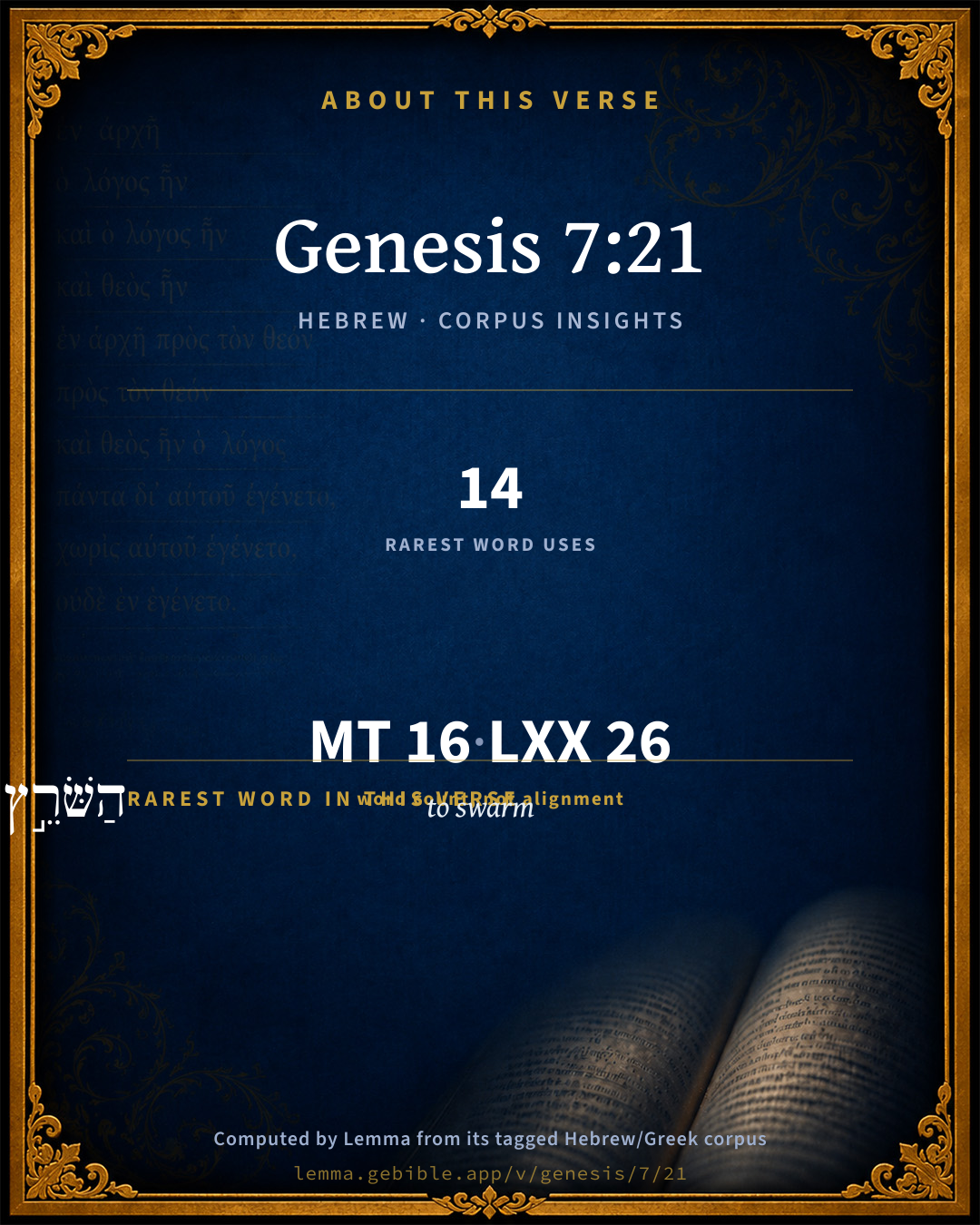
These counts appear in no published source. They are computed here, from the morphology-tagged text and Lemma’s own curated glosses. What Lemma adds →

16
words
12
distinct lemmas
Pentateuch
section

Notable vocabulary

The rarest word here is הַשֹּׁרֵ֣ץ to swarm H8317 — appearing just 14 times in the whole Hebrew Bible.

Shared distinctive vocabulary

הַשֹּׁרֵ֣ץ to swarm H8317 occurs in 14 verses of the Hebrew Bible. Also found in:

Grammatical profile

  • 3 verbs
  • 11 nouns
  • 2 prepositions

Verb forms

  • וַיִּגְוַ֞ע Qal · Sequential Imperfect
  • הָרֹמֵ֣שׂ Qal · Participle Active
  • הַשֹּׁרֵ֣ץ Qal · Participle Active

Repetition

Words recur within this verse — often emphatic in Hebrew:

  • כָּל all H3605 ×3
  • עַל upon H5921 ×2
  • הָאָ֗רֶץ land H776 ×2

Hebrew & Septuagint length

In English translation the verse runs 23 words from the Hebrew and 29 from the Septuagint (LXX English) — closely comparable.

A rough comparison of the two English renderings, which tokenize alike — not a word-level alignment.

Word counts can differ between the Hebrew and the Greek without any difference in meaning — e.g. the Hebrew direct-object marker אֵת has no separate Greek word, and Greek often adds the article ὁ.

In the original languages it is 16 Hebrew tokens and 26 Greek tokens — but the two are counted differently (Hebrew bundles its prefixes and suffixes into one token; the Greek is in lemma form), so that isn’t a like-for-like length.

Cross-references

18

Topical passages linked to Genesis 7:21 in the Treasury of Scripture Knowledge — connected by theme and wording, ordered by reader-vote popularity; previews shown in the World English Bible.

  • Genesis 6:13 God said to Noah, "The end of all flesh has come before me, for the earth is filled with violence through them. Behold, I will destroy them with the earth.
  • Genesis 6:17 I, even, I do bring the flood of waters on this earth, to destroy all flesh having the breath of life from under the sky. Everything that is in the earth will die.
  • Genesis 7:4 In seven days, I will cause it to rain on the earth for forty days and forty nights. Every living thing that I have made, I will destroy from the surface of the ground."
  • Genesis 6:6–7 Yahweh was sorry that he had made man on the earth, and it grieved him in his heart.
  • Romans 8:20 For the creation was subjected to vanity, not of its own will, but because of him who subjected it, in hope
  • Job 22:15–17 Will you keep the old way Which wicked men have trodden,
  • Isaiah 24:6 Therefore has the curse devoured the earth, and those who dwell therein are found guilty: therefore the inhabitants of the earth are burned, and few men left.
  • Isaiah 24:19 The earth is utterly broken, the earth is torn apart, the earth is shaken violently.
  • Jeremiah 4:22–27 For my people are foolish, they don't know me; they are foolish children, and they have no understanding; they are wise to do evil, but to do good they have no knowledge.
  • Jeremiah 12:3–4 But you, Yahweh, know me; you see me, and try my heart toward you: pull them out like sheep for the slaughter, and prepare them for the day of slaughter.
  • Hosea 4:3 Therefore the land will mourn, And everyone who dwells therein will waste away. All living things in her, Even the animals of the field and the birds of the sky; Yes, the fish of the sea also die.
  • Joel 1:17–20 The seeds rot under their clods. The granaries are laid desolate. The barns are broken down, for the grain has withered.
  • Joel 2:3 A fire devours before them, And behind them, a flame burns. The land is as the garden of Eden before them, And behind them, a desolate wilderness. Yes, and no one has escaped them.
  • Zephaniah 1:3 I will sweep away man and animal. I will sweep away the birds of the sky, the fish of the sea, and the heaps of rubble with the wicked. I will cut off man from the surface of the earth, says Yahweh.
  • Matthew 24:39 and they didn't know until the flood came, and took them all away, so will be the coming of the Son of Man.
  • Luke 17:27 They ate, they drank, they married, they were given in marriage, until the day that Noah entered into the ark, and the flood came, and destroyed them all.
  • Romans 8:22 For we know that the whole creation groans and travails in pain together until now.
  • 2 Peter 2:5 and didn't spare the ancient world, but preserved Noah with seven others, a preacher of righteousness, when he brought a flood on the world of the ungodly;

Cross-references courtesy of OpenBible.info (CC BY 4.0).

Hebrew and Greek witnesses Masoretic Hebrew ↔ Greek Septuagint

The same verse in the two great witnesses to the Old Testament, shown verse-for-verse.

These are two independent witnesses, not word-aligned to each other, and the Septuagint is shown in lemma (dictionary) form.

Hebrew Genesis 7:21 Masoretic · Westminster Leningrad Codex

וַיִּגְוַ֞ע כָּל בָּשָׂ֣ר הָרֹמֵ֣שׂ עַל הָאָ֗רֶץ בָּע֤וֹף וּבַבְּהֵמָה֙ וּבַ֣חַיָּ֔ה וּבְכָל הַשֶּׁ֖רֶץ הַשֹּׁרֵ֣ץ עַל הָאָ֑רֶץ וְכֹ֖ל הָאָדָֽם

All flesh died that moved on the earth, including birds, cattle, animals, every creeping thing that creeps on the earth, and every man.

World English Bible · Public Domain

Greek LXX Genesis 7:21 Septuagint · lemma form

καί ἀποθνήσκω πᾶς σάρξ κινέω ἐπί ὁ γῆ ὁ πετεινόν καί ὁ κτῆνος καί ὁ θηρίον καί πᾶς ἑρπετόν κινέω ἐπί ὁ γῆ καί πᾶς ἄνθρωπος

And there died all flesh that moved upon the earth, of flying creatures and cattle, and of wild beasts, and every reptile moving upon the earth, and every man.

LXX2012 (modern English Septuagint) · Public Domain

Hebrew: Westminster Leningrad Codex (CC BY 4.0). Greek: Septuagint (public domain); English from LXX2012 (modern English Septuagint) (Public Domain). How the Septuagint differs from the Hebrew →

Targum (Aramaic paraphrase)

2

The Targum is the ancient Jewish Aramaic paraphrase of the Hebrew Scriptures — an interpretive translation, not the Hebrew text itself. Onkelos (literal) and Pseudo-Jonathan (expansive) render the Torah, and Jonathan the Prophets. Coverage is partial: where no permissively-licensed English translation exists for a verse, only the Aramaic is shown. This is verse-level text, not a word-by-word alignment to the Hebrew.

  1. Targum Onkelos Torah (Genesis–Deuteronomy)
    וּמִית כָּל בִּשְׂרָא דְּרָחֵשׁ עַל אַרְעָא בְּעוֹפָא וּבִבְעִירָא וּבְחַיְתָא וּבְכָל רִחֲשָׁא דְּרָחֵשׁ עַל אַרְעָא וְכֹל אֱנָשָׁא

    and all flesh died which moved upon the earth, of fowl, and of cattle, and of the wild beast, and of every reptile which creepeth upon the earth, and every man.

    Targum Onkelos — Aramaic: “Onkelos Genesis” (public domain); “Onkelos Exodus” (public domain); “Onkelos Leviticus” (public domain); “Onkelos Numbers” (public domain); “Onkelos Deuteronomy” (public domain). English: “Sefaria Community Translation” (CC0 1.0 (public-domain dedication)); “J.W. Etheridge. The Targums of Onkelos and Jonathan Ben Uzziel on the Pentateuch. London: Longmans, Green, 1862” (public domain). Text via Sefaria.

  2. Targum Pseudo-Jonathan Torah (Genesis–Deuteronomy)
    וְאִתְחַמְסִי כָּל בִּשְרָא דִרְחֵישׁ עַל אַרְעָא בְּעוֹפָא וּבִבְעִירָא וּבְחַיְתָא וּבְכָל רִיחֲשָׁא דְרָחֵישׁ עַל אַרְעָא וְכָל בְּנֵי נְשָׁא

    And all flesh expired which moveth upon the earth; of fowl, and of cattle, and of wild beasts, and every moving thing that moveth upon the earth, and all the sons of men,

    Targum Pseudo-Jonathan — Aramaic: “Targum Jonathan on Genesis” (public domain); “Targum Jonathan on Exodus” (public domain); “Targum Jonathan on Leviticus” (public domain); “Targum Jonathan on Numbers” (public domain); “Targum Jonathan on Deuteronomy” (public domain). English: “The Targum of Jonathan ben Uzziel, trans. J. W. Etheridge, London, 1862” (public domain). Text via Sefaria.

Commentary

Notes on Genesis 7:21 from classic Christian and Jewish commentators (each source and its license shown beneath its notes). The classic Christian expositions comment on the surrounding passage and are grouped to its opening verse, so a note may address several verses; the Jewish commentaries on the Tanakh (Rashi and others) are per-verse, so they appear only where the commentator wrote on this verse.

Lemma curates 59 commentaries, every one of them public domain or Creative Commons licensed, each selected and text-cleaned for this edition rather than reprinted as found. About our sources →

Matthew Henry's Commentary

Here is, I. The general destruction of all flesh by the waters of the flood. Come, and see the desolations which God makes in the earth (Psa 46:8), and how he lays heaps upon heaps. Never did death triumph, from its first entrance unto this day, as it did then. Come, and see Death upon his pale horse, and hell following with him, Rev 6:7, Rev 6:8.

1. All the cattle, fowl, and creeping things, died, except the few that were in the ark. Observe how this is repeated: All flesh died, Gen 7:21. All in whose nostrils was the breath of life, of all that was on the dry land, Gen 7:22. Every living substance, Gen 7:23. And why so? Man only had done wickedly, and justly is God's hand against him; but these sheep, what have they done? I answer, (1.) We are sure God did them no wrong. He is the sovereign Lord of all life, for he is the sole fountain and author of it. He that made them as he pleased might unmake them when he pleased; and who shall say unto him, What doest thou? May he not do what he will with his own, which were created for his pleasure? (2.) God did admirably serve the purposes of his own glory by their destruction, as well as by their creation. Herein his holiness and justice were greatly magnified; by this it appears that he hates sin, and is highly displeased with sinners, when even the inferior creatures, because they are the servants of man and part of his possession, and because they have been abused to be the servants of sin, are destroyed with him. This makes the judgment the more remarkable, the more dreadful, and, consequently, the more expressive of God's wrath and vengeance. The destruction of the creatures was their deliverance from the bondage of corruption, which deliverance the whole creation now groans after, Rom 8:21, Rom 8:22. It was likewise an instance of God's wisdom. As the creatures were made for man when he was made, so they were multiplied for him when he was multiplied; and therefore, now that mankind was reduced to so small a number, it was fit that the beasts should proportionably be reduced, otherwise they would have had the dominion, and would have replenished the earth, and the remnant of mankind that was left would have been overpowered by them. See how God considered this in another case, Exo 23:29, Lest the beast of the field multiply against thee.

2. All the men, women, and children, that were in the world (except that were in the ark) died. Every man (Gen 7:21 and Gen 7:23), and perhaps they were as many as are now upon the face of the earth, if not more. Now, (1.) We may easily imagine what terror and consternation seized on them when they saw themselves surrounded. Our Saviour tells us that till the very day that the flood came they were eating and drinking (Luk 17:26, Luk 17:27); they were drowned in security and sensuality before they were drowned in those waters, crying Peace, peace, to themselves, deaf and blind to all divine warnings. In this posture death surprised them, as Sa1 30:16, Sa1 30:17. But O what an amazement were they in then! Now they see and feel that which they would not believe and fear, and are convinced of their folly when it is too late; now they find no place for repentance, though they seek it carefully with tears. (2.) We may suppose that they tried all ways and means possible for their preservation, but all in vain. Some climb to the tops of trees or mountains, and spin out their terrors there awhile. But the flood reaches them, at last, and they are forced to die with the more deliberation. Some, it is likely, cling to the ark, and now hope that this may be their safety which they had so long made their sport. Perhaps some get to the top of the ark, and hope to shift for themselves there; but either they perish there for want of food, or, by a speedier despatch, a dash of rain washes them off that deck. Others, it may be, hoped to prevail with Noah for admission into the ark, and pleaded old acquaintance, Have we not eaten and drunk in thy presence? Hast thou not taught in our streets? "Yes," might Noah say, "that I have, many a time, to little purpose. I called but you refused; you set at nought all my counsel (Pro 1:24, Pro 1:25), and now it is not in my power to help you: God has shut the door, and I cannot open it." Thus it will be at the great day. Neither climbing high in an outward profession, nor claiming relation to good people, will bring men to heaven, Mat 7:22; Mat 25:8, Mat 25:9. Those that are not found in Christ, the ark, are certainly undone, undone for ever; salvation itself cannot save them. See Isa 10:3. (3.) We may suppose that some of those that perished in the deluge had themselves assisted Noah, or were employed by him, in the building of the ark, and yet were not so wise as by repentance to secure themselves a place in it. Thus wicked ministers, though they may have been instrumental to help others to heaven, will themselves be thrust down to hell.

Let us now pause awhile and consider this tremendous judgment! Let our hearts meditate terror, the terror of this destruction. Let us see, and say, It is a fearful thing to fall into the hands of the living God; who can stand before him when he is angry? Let us see and say, It is an evil thing, and a bitter, to depart from God. The sin of sinners will, without repentance, be their ruin, first or last; if God be true, it will. Though hand join in hand, yet the wicked shall not go unpunished. The righteous God knows how to bring a flood upon the world of the ungodly, Pe2 2:5. Eliphaz appeals to this story as a standing warning to a careless world (Job 22:15, Job 22:16), Hast thou marked the old way, which wicked men have trodden, who were cut down out of time, and sent into eternity, whose foundation was overflown with the flood?

II. The special preservation of Noah and his family: Noah only remained alive, and those that were with him in the ark, Gen 7:23. Observe, 1. Noah lives. When all about him were monuments of justice, thousands falling on his right hand and ten thousands on his left, he was a monument of mercy. Only with his eyes might he behold and see the reward of the wicked, Psa 91:7, Psa 91:8. In the floods of great waters, they did not come nigh him, Psa 32:6. We have reason to think that, while the long-suffering of God waited, Noah not only preached to, but prayed for, that wicked world, and would have turned away the wrath; but his prayers return into his own bosom, and are answered only in his own escape, which is plainly referred to, Eze 14:14, Noah, Daniel, and Job, shall but deliver their own souls. A mark of honour shall be set on intercessors. 2. He but lives. Noah remains alive, and this is all; he is, in effect, buried alive - cooped up in a close place, alarmed with the terrors of the descending rain, the increasing flood, and the shrieks and outcries of his perishing neighbours, his heart overwhelmed with melancholy thoughts of the desolations made. But he comforts himself with this, that he is in the way of duty and in the way of deliverance. And we are taught (Jer 45:4, Jer 45:5) that when desolating judgments are abroad we must not seek great nor pleasant things to ourselves, but reckon it an unspeakable favour if we have our lives given us for a prey.

Matthew Henry's Commentary on the Whole Bible (1708–1710) — public domain (CC PDM 1.0). Text via the HelloAO Bible API.

Trapp's Complete Commentary

John Trapp

Gen 7:21 And all flesh died that moved upon the earth, both of fowl, and of cattle, and of beast, and of every creeping thing that creepeth upon the earth, and every man:

Ver. 21. And every man died.] Now these mockers behold that ark with envy, that erst they beheld with scorn; they wish themselves in the darkest corner of it, that lately laughed at it, and perhaps did what they could to hinder the finishing of it. {a} Yea, some, likely, to save them from drowning, caught at and clung as fast to the outside of the ark as Joab, for the same cause, did to the horns of the altar. But all in vain; for,

{a} Verisimile eat non abstinuisse manus ab opere turbando . - Piscator.

John Trapp, A Commentary or Exposition upon All the Books of the Old and New Testament (1647–1656) — public domain. Text from a community e-Sword module.

Joseph Benson's Commentary

Gen 7:21. All flesh died; all that was on the dry land — And why so? Man only had done wickedly, and justly is God’s hand against him, but these sheep, what have they done? I answer, 1st, We are sure God did them no wrong. He is the sovereign Lord of all life; for he is the sole fountain and author of it. He that made them as he pleased, might unmake them when he pleased, and who shall say unto God, What dost thou? 2d, God did admirably serve the purposes of his own glory by their destruction, as well as by their creation. Herein his holiness and justice were greatly magnified: by this it appears that he hates sin, and is highly displeased with sinners, since even the inferior creatures, because they are the servants of man, and part of his possession, and because they had been abused to be the servants of sin, are destroyed with him. It was likewise an instance of God’s wisdom. As the creatures were made for man when he was made, so they were multiplied for him when he was multiplied; and, therefore, now mankind was reduced to so small a number, it was fit that the beasts should proportionably be reduced, otherwise they would have had the dominion, and would have replenished the earth, and the remnant of mankind that was left would have been overpowered by them.

Joseph Benson's Commentary on the Old and New Testaments (1811–1818) — public domain. Text from a community e-Sword module.

Jamieson, Fausset & Brown

Robert Jamieson, A. R. Fausset & David Brown

all flesh died . . . fowl . . . cattle, and . . . creeping thing--It has been a uniform principle in the divine procedure, when judgments were abroad on the earth, to include every thing connected with the sinful objects of His wrath (Gen 19:25; Exo 9:6). Besides, now that the human race was reduced to one single family, it was necessary that the beasts should be proportionally diminished, otherwise by their numbers they would have acquired the ascendancy and overmastered the few that were to repeople the world. Thus goodness was mingled with severity; the Lord exercises judgment in wisdom and in wrath remembers mercy.

Jamieson, Fausset & Brown — Commentary Critical and Explanatory on the Whole Bible (1871) — public domain (CC PDM 1.0). Text via the HelloAO Bible API.

John Gill's Exposition

And every living substance was destroyed which was upon the face of the ground,.... Not everything, particularly trees; for after the flood was abated there was an olive tree, a leaf of which was brought to Noah by the dove, Gen 8:11 but all animals:

both men and cattle, and the creeping things, and the fowl of the heaven, and they were destroyed from the earth; this is repeated, partly for explanation of the preceding clause, and partly for confirmation of this general destruction, which might seem almost incredible; there never was such a destruction of creatures before, or since, nor never will be till the general conflagration; and is a proof of the sovereignty of God, his almighty power, the purity and holiness of his nature, and the strictness and severity of his justice, and shows what a fearful thing it is to fail into his hands:

and Noah only remained alive, and they that were with him in the ark; besides those, of the millions of mankind that were upon the earth, not one was left, the flood came and destroyed them all, Luk 17:27 the fable some Jewish writers relate of Og being found alive, and which they gather from Deu 3:11 by sitting upon a piece of wood of one of the ladders of the ark, to whom Noah reached out food every day, and so he remained alive (q), deserves no regard; though perhaps from hence arose the Grecian fable of the flood of Ogyges, which seems to be the same with this of Noah.

(q) Pirke Eliezer, c. 23. fol. 23. 1, 2.

John Gill's Exposition of the Whole Bible (1746–1763) — public domain (CC PDM 1.0). Text via the HelloAO Bible API.

Matthew Poole's English Annotations

All flesh that moved, i.e. lived; for motion is a sign of life.

Matthew Poole's English Annotations on the Holy Bible (1683–1685) — public domain. Text from a community e-Sword/MySword module.

Whedon's Commentary on the Bible

Daniel D. Whedon

21. And all flesh died — In the land inhabited by man. Far as the narrator could see the mountains were covered, and all living things were swept away. See the introductory note on the extent of the deluge.

Daniel D. Whedon (gen. ed.), Commentary on the Old and New Testaments (1874–1909) — public domain. Text from a community e-Sword module.

The Pulpit Commentary

Vers. 21, 22 describe the effect of the Deluge in its destruction of all animal and human life. And all flesh died that moved upon the earth. A general expression for the animal creation, of which the particulars are then specified. Both of fowl, and of cattle, and of beast, and of every creeping thing that creepeth on the earth. Literally, in fowl, and in cattle, &c. (cf. ver. 14). ;And every man. i.e. all the human race (with the exception of the inmates of the ark), which is further characterized as all in whose nostrils was the breath of life. Literally, the breath of the spirit of lives, i.e. all mankind. A clear pointing backwards to Gen_2:7, which leads Davidson to ascribe vers. 22, 23 to the Jehovist, although Eichhorn, Tuch, Bleek, Vaihinger, and others leave them in the fundamental document, but which is rather to be regarded as a proof of the internal unity of the book. Of all that was in the dry land, a further specification of the creatures that perished in the Flood,died. It is obvious the construction of vers. 21, 22 may be differently understood. Each verse may be taken as a separate sentence, as in the A.V, or the second sentence may commence with the words, "And every man," as in the present exposition. Thus far the calamity is simply viewed in its objective result, In the words which follow, which wear the aspect of an unnecessary repetition, it is regarded in its relation to the Divine threatening.

The Pulpit Commentary (1880–1919), ed. H.D.M. Spence-Jones & Joseph S. Exell — public domain. Text from a community e-Sword module.

John Wesley's Explanatory Notes

All flesh died, all in whose nostrils was the breath of life, of all that was on the dry land, every living substance - And why so? Man only had done wickedly, and justly is God's hand against him, but these sheep what have they done? I answer,

1. We are sure God did them no wrong. He is the sovereign Lord of all life, for he is the sole fountain and author of it. He that made them as he pleased, might unmake them when he pleased, and who shall say unto him, What dost thou?

2. God did admirably serve the purposes of his own glory by their destruction, as well as by their creation. Herein his holiness and justice were greatly magnified: by this it appears that he hates sin, and is highly displeased with sinners, when even the inferior creatures, because they are the servants of man, and part of his possession, and because they have been abused to be the servants of sin, are destroyed with him. It was likewise an instance of God's wisdom. As the creatures were made for man when he was made, so they were multiplied for him when he was multiplied; and therefore, now mankind was reduced to so small a number, it was fit that the beasts should proportionable be reduced, otherwise they would have had the dominion, and would have replenished the earth, and the remnant of mankind that was left would have been overpowered by them.

John Wesley, Explanatory Notes Upon the Whole Bible (1754–1765) — public domain. Text via the GEBible commentary corpus.

unfoldingWord translationNotes

Door43 World Missions Community

moved upon

"moved about" or "roamed"

all the living creatures that lived in great numbers upon the earth

This refers to all the animals that move around on the ground in large groups.

who breathed the breath of life through their noses

Here "noses" represent the whole animal or human. AT: "everyone that breathed" (See: Synecdoche)

the breath of life

The words "breath" and "life" represent the power that causes people and animals to be alive. (See: Metonymy)

died

This refers to physical death.

translationWords

life

livestock

breath

die

unfoldingWord translationNotes — © Distant Shores Media and the Door43 World Missions Community, licensed CC BY-SA 4.0. Source: git.door43.org/Door43/en_tn.

Radak

Rabbi David Kimhi (Radak)

ויגוע...וכל האדם, the reason the word האדם is mentioned last, is to tell us that even man, who thanks to his intelligence and foresight could have been expected to find ways of escaping this disaster by taking refuge on top of the mountains, etc., was unable to save himself. The 15 cubits of water that covered even the tallest of the mountains made it impossible for any person to survive. The addition of the word וכל, includes even the giants drowned in these waters. The expression גויעה as a description of dying, refers to prompt death, as opposed to lingering death. People who drown die without prolonged agony.

Radak on the Tanakh — English translations: “Sefaria Community Translation” (CC0 1.0 (public-domain dedication)); “Eliyahu Munk, HaChut Hameshulash” (CC BY 4.0); “Rabbi Mike Feuer, Jerusalem Anthology” (CC BY 4.0); and “R. David Kimhi on the first book of Psalms, Translated by R.G. Finch, London, 1919” (public domain). Text via Sefaria.

Lesson kit

Teaching starters — assembled from the data on this page, not authored interpretation. Every prompt links to the verse data it draws on. Edit before teaching.

Genesis, in the Pentateuch, opens this verse with 16 words (12 distinct Hebrew lemmas). Its most distinctive word is shârats (“to swarm”). A historical commentator’s framing appears above. Read the whole chapter for the surrounding context.

Discussion questions

  1. What does “to swarm” (shârats) contribute to the verse as a whole?
  2. Genesis 1:20 shares the word «to swarm» with this verse. How do the two illuminate each other?
  3. “all” occurs 3× in this one verse. What is the effect of the repetition?
  4. These translations render this verse differently. What is at stake in choosing one wording over another?
  5. The verb «וַיִּגְוַ֞ע» is Qal Sequential Imperfect. How does its form color the action?
  6. Reading how Matthew Henry's Commentary and Trapp's Complete Commentary read this verse, where do the two commentators agree and where do they part?

Things to notice

Reading settings

Reading text

Shown beneath each verse's original-language words.

Old Testament
Old Testament edition

Read the OT as the Masoretic Hebrew (MT) or the Greek Septuagint (LXX).

English shown for the Greek Septuagint (in the Hebrew ↔ Greek comparison).

Comparing translations? Open the Compare panel on any verse page to stack up to four side by side.