
2 Corinthians 1:17

Greek (Tischendorf 8th ed.) 2 Corinthians 1:17 appears in the Greek New Testament. The text above is from the Tischendorf 8th edition. Each word links to its Strong’s number and a concise gloss. Click any word for its full Thayer’s Greek Lexicon entry.
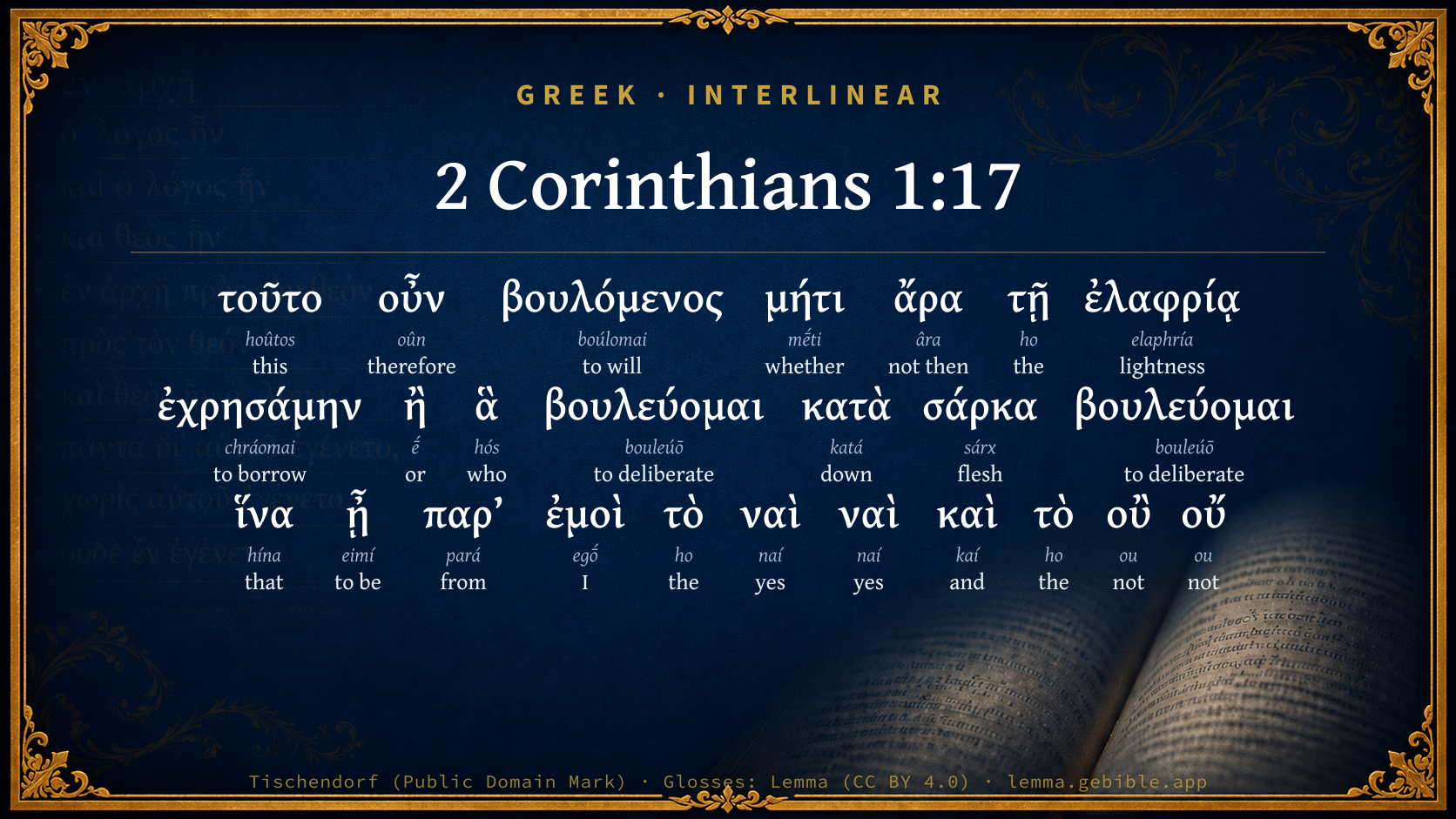
Download image
Cite this verse

2 Corinthians 1:17 (World English Bible). Public Domain. Lemma interlinear Bible study tool, https://lemma.gebible.app/v/2-corinthians/1/17.

Show BibTeX & RIS
BibTeX
RIS
English Translation
When I therefore was thus determined, did I show fickleness? Or the things that I purpose, do I purpose according to the flesh, that with me there should be the "Yes, yes" and the "No, no?"
World English Bible · Public Domain
Highlights
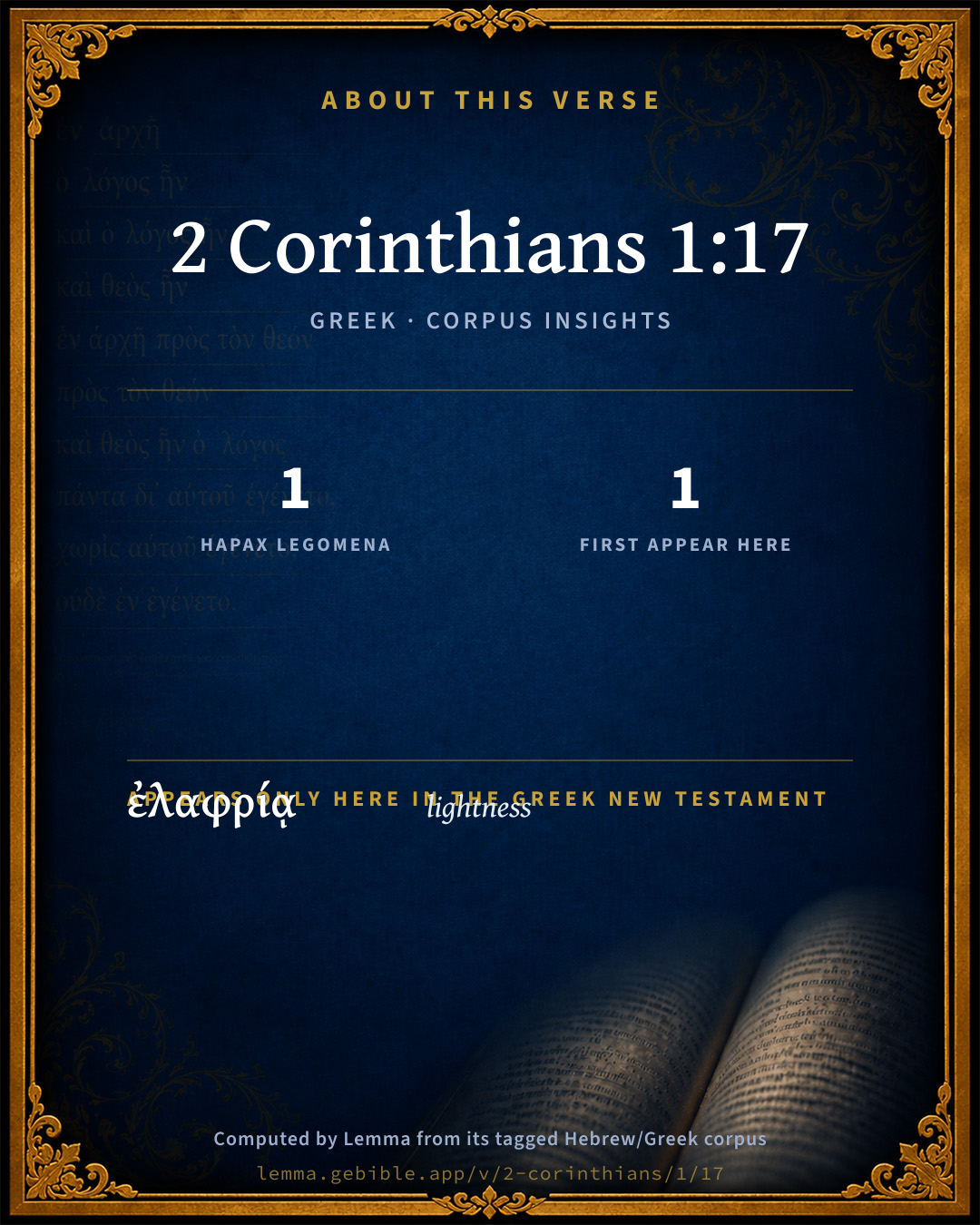
  • 1 hapax legomenon — only here in the Greek New Testament
  • 1 first appearance in the Greek New Testament
Full analysis ↓
Download a study sheet

One document with this verse’s original text, its word-by-word gloss line, the meaning frame, cross-references with their text, attributed commentary, and full source and license credits — printable, and it pastes into notes with its structure intact.

This verse Autodidact and up

Study sheet (.html) Plain text (.txt)

A passage Seminary Student

Up to 50 verses in one chapter. A passage sheet keeps up to 6 commentary sources and 12 cross-references per verse, in the order this page ranks them, and says so on the sheet whenever that leaves anything out. Ask for a single verse and you get the Autodidact verse sheet above.

Everything on this page stays free to read, with no account — the sheet is a download of what is already on screen, not access to it.

Want to remove ads? Support Godless Engineer
Compare translations 3

The same verse in 3 English versions, stacked beneath the original-language interlinear above. Click any original word for its lexicon entry.

Each is an independent rendering of the whole verse — the interlinear is not word-aligned to these translations.

Highlighted words mark where these versions differ — a whole-verse word diff, not a word-by-word alignment.

  • World English Bible Public Domain
    When I therefore was thus determined, did I show fickleness? Or the things that I purpose, do I purpose according to the flesh, that with me there should be the "Yes, yes" and the "No, no?"
  • King James Version Public Domain
    When I therefore was thus minded, did I use lightness? or the things that I purpose, do I purpose according to the flesh, that with me there should be yea yea, and nay nay?
  • unfoldingWord Literal Text CC BY-SA 4.0
    Therefore, intending this, I did not then act in fickleness, did I? Or what I intend, do I intend according to the flesh, so that there would be with me “Yes, yes” and “No, no”?

unfoldingWord Literal Text — © unfoldingWord, licensed CC BY-SA 4.0. Word-aligned USFM3 via Door43 (git.door43.org/unfoldingWord/en_ult).

Versions to compare (up to 4)

3 of 4 selected

Show all 19 translations

Every available English version of this verse, each an independent rendering of the whole verse.

  • World English Bible Public Domain
    When I therefore was thus determined, did I show fickleness? Or the things that I purpose, do I purpose according to the flesh, that with me there should be the "Yes, yes" and the "No, no?"
  • Berean Standard Bible Public Domain
    When I planned this, did I do it carelessly? Or do I make my plans by human standards, so as to say “Yes, yes” when I really mean “No, no”?
  • Majority Standard Bible Public Domain
    When I planned this, did I do it carelessly? Or do I make my plans by human standards, so as to say “Yes, yes” and also “No, no”?
  • King James Version Public Domain
    When I therefore was thus minded, did I use lightness? or the things that I purpose, do I purpose according to the flesh, that with me there should be yea yea, and nay nay?
  • American Standard Version (1901) Public Domain
    When I therefore was thus minded, did I show fickleness? or the things that I purpose, do I purpose according to the flesh, that with me there should be the yea yea and the nay nay?
  • Revised Version (1885) Public Domain
    When I therefore was thus minded, did I shew fickleness? or the things that I purpose, do I purpose according to the flesh, that with me there should be the yea yea and the nay nay?
  • Geneva Bible (1599) Public Domain
    When I therefore was thus minded, did I vse lightnesse? or minde I those thinges which I minde, according to the flesh, that with me should be, Yea, yea, and Nay, nay?
  • Douay-Rheims (1899) Public Domain
    Whereas then I was thus minded, did I use lightness? Or, the things that I purpose, do I purpose according to the flesh, that there should be with me, It is, and It is not?
  • Young's Literal Translation Public Domain
    This, therefore, counselling, did I then use the lightness; or the things that I counsel, according to the flesh do I counsel, that it may be with me Yes, yes, and No, no?
  • Literal Standard Version CC BY-SA 4.0
    This, therefore, intending, did I then use the lightness; or the things that I counsel, [did] I counsel according to the flesh, that it may be with me Yes, yes, and No, no?
  • Unlocked Literal Bible CC BY-SA 4.0
    When I was thinking this way, was I hesitating? Do I plan things according to human standards, so that I say “Yes, yes” and “No, no” at the same time?
  • unfoldingWord Literal Text CC BY-SA 4.0
    Therefore, intending this, I did not then act in fickleness, did I? Or what I intend, do I intend according to the flesh, so that there would be with me “Yes, yes” and “No, no”?
  • Darby Bible Public Domain
    Having therefore this purpose, did I then use lightness? Or what I purpose, do I purpose according to flesh, that there should be with me yea yea, and nay nay?
  • World Messianic Bible Public Domain
    When I therefore planned this, did I show fickleness? Or the things that I plan, do I plan according to the flesh, that with me there should be the “Yes, yes” and the “No, no?”
  • Webster's Bible Public Domain
    When I therefore was thus minded, did I use levity? or the things that I purpose, do I purpose according to the flesh, that with me there should be yea, yea, and nay, nay?
  • Free Bible Version CC BY-SA 4.0
    Why did I change my original plan? Do you think I make my decisions lightly? Do you think that when I plan I'm like some worldly person who says Yes and No at the same time?
  • Bible in Basic English Public Domain
    If then I had such a purpose, did I seem to be changing suddenly? or am I guided in my purposes by the flesh, saying, Yes, today, and, No, tomorrow?
  • Text-Critical English NT CC BY 4.0
    Was I vacillating when I planned to do this? Or do I make my plans in a worldly manner, ready to say “Yes” and “No” at the same time?
  • Tyndale New Testament (1534) Public Domain
    When I thus wyse was mynded: dyd I vse lightnes? Or thinke I carnally those thinges which I thinke? that with me shuld be ye ye and naye naye.

Literal Standard Version (2020), Covenant Press — licensed CC BY-SA 4.0. Text via the HelloAO Bible API (eBible.org). Unlocked Literal Bible (unfoldingWord) — licensed CC BY-SA 4.0. Text via the HelloAO Bible API (eBible.org). unfoldingWord Literal Text — © unfoldingWord, licensed CC BY-SA 4.0. Word-aligned USFM3 via Door43 (git.door43.org/unfoldingWord/en_ult). Free Bible Version, Dr. Jonathan Gallagher — licensed CC BY-SA 4.0. Text via the HelloAO Bible API (eBible.org).

Word by word

More ways to search: Search by grammar → Find every occurrence → Compare this word →

Practice this passage: Drill this verse → Learn its vocabulary →

ἐλαφρίᾳ
elaphría
G1644
“lightness”
Noun, Dative, Singular, Feminine
Part of Speech
Noun
Case
Dative
Number
Singular
Gender
Feminine
Full Thayer's Definition

Origin: from G1645

TDNT: None

1. lightness a. used of levity and fickleness of mind
  1. τοῦτο hoûtos G3778 “this” Demonstrative pronoun, Accusative, Singular, Neuter
  2. οὖν oûn G3767 “therefore” Conjunction
  3. βουλόμενος boúlomai G1014 “to will” Verb, Present, Middle or Passive deponent, Participle, Nominative, Singular, Masculine
  4. μήτι mḗti G3385 “whether” Particle, Interrogative
  5. ἄρα âra G687 “not then” Particle, Interrogative
  6. τῇ ho G3588 “the” Article, Dative, Singular, Feminine
  7. ἐχρησάμην chráomai G5530 “to borrow” Verb, Aorist, Middle deponent, Indicative, 1st person, Singular
  8. ἢ ḗ G2228 “or” Particle
  9. ἃ hós G3739 “who” Relative pronoun, Accusative, Plural, Neuter
  10. βουλεύομαι bouleúō G1011 “to deliberate” Verb, Present, Middle or Passive deponent, Indicative, 1st person, Singular
  11. κατὰ katá G2596 “down” Preposition
  12. σάρκα sárx G4561 “flesh” Noun, Accusative, Singular, Feminine
  13. βουλεύομαι bouleúō G1011 “to deliberate” Verb, Present, Middle or Passive deponent, Indicative, 1st person, Singular
  14. ἵνα hína G2443 “that” Conjunction
  15. ᾖ eimí G1510 “to be” Verb, Present, Active, Subjunctive, 3rd person, Singular
  16. παρ’ pará G3844 “from” Preposition
  17. ἐμοὶ egṓ G1473 “I” Personal pronoun, 1st person, Dative, Singular
  18. τὸ ho G3588 “the” Article, Nominative, Singular, Neuter
  19. ναὶ naí G3483 “yes” Particle
  20. ναὶ naí G3483 “yes” Particle
  21. καὶ kaí G2532 “and” Conjunction
  22. τὸ ho G3588 “the” Article, Nominative, Singular, Neuter
  23. οὒ ou G3756 “not” Particle, Negative
  24. οὔ ou G3756 “not” Particle, Negative

About this verse

These counts appear in no published source. They are computed here, from the morphology-tagged text and Lemma’s own curated glosses. What Lemma adds →

25
words
20
distinct lemmas
Pauline Epistles
section

Notable vocabulary

1 hapax legomenon — a word that appears only here in the entire Greek New Testament:

  • ἐλαφρίᾳ lightness G1644

First appearance in Scripture

This word makes its first canonical appearance in the Greek New Testament here:

  • ἐλαφρίᾳ lightness G1644

Shared distinctive vocabulary

βουλεύομαι to deliberate G1011 occurs in 6 verses of the Greek New Testament. Also found in:
Repetition

Words recur within this verse:

  • βουλεύομαι to deliberate G1011 ×2
  • ναὶ yes G3483 ×2
  • τῇ the G3588 ×3
  • οὒ not G3756 ×2

Cross-references

10

Topical passages linked to 2 Corinthians 1:17 in the Treasury of Scripture Knowledge — connected by theme and wording, ordered by reader-vote popularity; previews shown in the World English Bible.

  • Matthew 5:37 But let your 'Yes' be 'Yes' and your 'No' be 'no.' Whatever is more than these is of the evil one.
  • James 5:12 But above all things, my brothers, don't swear, neither by heaven, nor by the earth, nor by any other oath; but let your "yes" be "yes," and your "no," "no;" so that you don't fall into hypocrisy.
  • 2 Corinthians 10:2–3 Yes, I beg you that I may not, when present, show courage with the confidence with which I intend to be bold against some, who consider us to be walking according to the flesh.
  • John 8:15 You judge according to the flesh. I judge no one.
  • 2 Corinthians 1:18–20 But as God is faithful, our word toward you was not "Yes and no."
  • Jeremiah 23:32 Behold, I am against those who prophesy lying dreams, says Yahweh, and do tell them, and cause my people to err by their lies, and by their vain boasting: yet I didn't send them, nor commanded them; neither do they profit this people at all, says Yahweh.
  • Judges 9:4 They gave him seventy [pieces] of silver out of the house of Baal Berith, with which Abimelech hired vain and light fellows, who followed him.
  • Zephaniah 3:4 Her prophets are arrogant and treacherous people. Her priests have profaned the sanctuary. They have done violence to the law.
  • 2 Corinthians 1:12 For our boasting is this: the testimony of our conscience, that in holiness and sincerity of God, not in fleshly wisdom but in the grace of God we behaved ourselves in the world, and more abundantly toward you.
  • 1 Thessalonians 2:18 because we wanted to come to you--indeed, I, Paul, once and again-- but Satan hindered us.

Cross-references courtesy of OpenBible.info (CC BY 4.0).

Commentary

Notes on 2 Corinthians 1:17 from classic Christian and Jewish commentators (each source and its license shown beneath its notes). The classic Christian expositions comment on the surrounding passage and are grouped to its opening verse, so a note may address several verses; the Jewish commentaries on the Tanakh (Rashi and others) are per-verse, so they appear only where the commentator wrote on this verse.

Lemma curates 59 commentaries, every one of them public domain or Creative Commons licensed, each selected and text-cleaned for this edition rather than reprinted as found. About our sources →

Joseph Benson's Commentary

2Co 1:17-20. When I therefore was thus minded — Having, therefore, purposed this; did I use lightness — Did I lightly change my purpose? or, the things that I purpose in general; do I purpose according to the flesh — Are my purposes grounded on carnal or worldly considerations? that with me there should be yea and nay — Sometimes one, sometimes the other; that is, variableness and inconstancy in my counsels and actions, that none should know how to depend upon me for what they had to expect from me? But as God is true — I solemnly protest, that, as the God whom I serve is faithful; our word to you — On this and other occasions, and the doctrine we have preached to you; was not yea and nay — Wavering and uncertain; but that my behaviour and testimony have been always uniform, invariable, and consistent with my professions. For the Son of God, who was preached by us — That is, our preaching concerning him, was not yea and nay — Was not variable and inconsistent with itself; but in him was yea — As he is the same yesterday, to-day, and for ever, the declarations of his Word, and the engagements of his covenant, are inviolably the same. For all the promises of God — Many and precious as they are; in him are yea and amen — Are made with truth, and fulfilled with fidelity; or are surely established and accomplished in and through him. They are yea with respect to God promising; amen with respect to men believing; yea with respect to the apostles; amen with respect to their hearers. Unto the glory of God by us — As is declared by us in our ministry.

Joseph Benson's Commentary on the Old and New Testaments (1811–1818) — public domain. Text from a community e-Sword module.

Tyndale Open Study Notes

Tyndale Open Resources

1:17 Paul’s apparent indecisiveness and failure to keep his promise were being criticized. Paul’s protest is indignant.

Tyndale Open Study Notes — © Tyndale Open Resources, licensed CC BY-SA 4.0. Text via the HelloAO Bible API.

Bengel's Gnomon

Johann Albrecht Bengel

2Co 1:17. Τῇ ἐλαφρίᾳ, lightness) by promising more than I performed.—ἢ) or? [an? the second part of a disjunctive interrogation].—κατὰ σάρκα, according to the flesh) Paul gives them to understand that, if he were to consult according to [to listen to the suggestions of] the flesh, he must rather have come, than not; for they who consult according to the flesh, endeavour by all means to make the yea of the promise, whatever may occur, to appear in the fulfilment, for the purpose of maintaining their consistency [whether good or evil may result from it.—V. g.] But the Apostle was neither inconsistent, nor carnally consistent: either of which might have been suspected by persons under the influence of prejudice against him. He had made a conditional promise, and afterwards he delayed his visit for an important reason, which had occurred to prevent it.—τὸ ναὶ καὶ τὸ οὐ) See Appendix. Crit. Ed. ii. on this passage. Simple yea and nay[6] is quite approved of by Paul in the following verse, in which he denies the yea and nay, concerning the same things; but he affirms it, 2Co 1:17, concerning different things. The word ᾖ, should be, is emphatic; as it may be said, for example, of an unsteady [inconsistent] person. You can never be sure of finding either his “It is,” or his “it is not,” to be as he says—that is, no one can trust his word; or as if it were to be said of a consistent man, His “It is,” and his “It is not,” always hold good.

[6] Although this reading is declared to be not quite so good in the margin of 2d Ed., yet, with the previous concurrence of the Gnomon, it is introduced into the Germ. Ver.—E. B.

All the old authorities, excepting the Vulgate, support the double ναὶ and οὐ; even the Fuld. MS. of the Vulg. as corrected by Victor of Capua, has “Est, est, non, non,” and so agrees with the weightiest authorities (est, est= ναὶ, ναὶ; non, non=οὐ, οὐ.)—ED.

Bengel's Gnomon of the New Testament — English translation (T&T Clark, Edinburgh, 1860) — public domain. Text from a community e-Sword module.

Meyer's Critical & Exegetical Commentary

Heinrich August Wilhelm Meyer

2Co_1:17. Wishing this therefore (according to what has just been said), did I then behave thoughtlessly? Was this proposal of mine made without duly taking thought for its execution? μήτι supposes a negative answer, as always, in which case ἄρα (meaning: as the matter stands) makes no alteration, such as the suggesting, perhaps, a thought of possible affirmation. Such a sense, as it were, of a mere tentative nature feeling its way, which is foreign here, could only be suggested by the context, and would have nothing to do with ἄρα (in opposition to Hartung, whom Hofmann follows). See Klotz, ad Devar. p. 176 f.

τῇ ἐλαφρίᾳ] The article marks the thoughtlessness not as that with which the apostle was reproached by the Corinthians (Billroth, Olshausen, Rückert, de Wette), which he must have indicated more precisely, in order that it might be so understood, but thoughtlessness as such in general, in abstracto: have I then made myself guilty of thoughtlessness? ἐλαφρία belongs to the substantives in -ρια formed late from adjectives in -ρος. See Lobeck, ad Phryn. p. 343. For the ethical sense (wantonness), comp. Schol. Aristoph. Av. 195, and ἐλαφρός in Polyb. vi. 56. 11; ἐλαφρόνοος, Phocylides in Stob. Flor. app. iii. 7.

ἢ ἃ βουλεύομαι, κατὰ σάρκα βουλεύομαι] ἤ is not aut (Billroth, Rückert, Osiander, Hofmann, after the Vulgate and most expositors), but an; for without any interrogation the relation of the two sentences is: My proposal was not thoughtless, unless it should be the case that I form my resolves κατὰ σάρκα. See Hartung, II. p. 61.

Mark the difference between ἐχρησάμην as aorist (historical event) and βουλεύομαι as present (behaviour generally).

κατὰ σάρκα] according to the flesh, after the standard of the σάρξ, i.e. so that I let myself be guided by the impulses of human nature sinfully determined, Gal_5:16 ff.

ἵνα ᾖ παρʼ ἐμοὶ τὸ ναὶ ναὶ καὶ τὸ οὒ οὔ] By ἵνα is expressed simply the immoral purpose, which would be connected with the βουλεύεσθαι κατὰ σάρκα; in order that with me there may be the Yea, yea, and Nay, nay, i.e. in order that with me affirmation and denial may exist together; that I, according as the case stands, may assent to the fleshly impulse, and in turn renounce it; to-day yea, and to-morrow nay, or yea and nay as it were in one breath. Billroth errs in thinking that in this explanation καί must be taken as also. That it means and, is proved by 2Co_1:18-19. The duplication of the ναί and οὔ strengthens the picture of the untrustworthy man who affirms just as fervently as he afterwards denies. Failing to discern this, Grotius and Estius wished to prefer the reading of the Vulgate, τὸ ναὶ καὶ τὸ οὔ, which has very weak attestation. The article marks the ναὶ ναί and the οὒ οὔ as well-known and solemn formulae of affirmative and negative asseveration (as they were also in Jewish usage; see Wetstein, ad Mat_5:37). Comp. on ναὶ ναί, Soph. O. C. 1743. As to the main point, namely, that the ναὶ ναί and the οὒ οὔ are taken as the subject of ᾖ, this explanation has the support of Erasmus, Beza, Calvin, Estius (though conjecturing ἵνα μή instead of ἵνα), Cornelius a Lapide, Grotius, Mill, Wolf, and others; also of Rosenmüller, Emmerling, Flatt, Schrader, Rückert, de Wette, Osiander, Neander, Maier, and others; even Olshausen, who, however, sets up for ναί and οὔ the peculiar signification (assumed without any instance of its being so used) of truth and falsehood. The diplasiasmus ναὶ ναί and οὒ οὔ is not without reason (as Billroth and Hofmann object), but quite accords with the passionate excitement of the moral consciousness; whereas afterwards, in 2Co_1:18, where his words go on quietly with a glance towards the faithful God, the bare ναὶ καὶ οὔ is quite in its place. Note, further, that the simple expression of the coexistence of the yea and nay (to which Hofmann objects) is more striking, than if Paul had given a more precise explanation of the maxims of yea and nay. The readers knew him, and even his evil-wishers could not but know that he was no yea-and-nay man. Others consider the second ναί and the second οὔ as predicates, so that a wholly opposite sense is made out of the words: in order that with me the Yea may be yea, and the Nay be nay, i.e. in order that I may stubbornly carry through what I have proposed to myself. Comp. Jam_5:12. So Chrysostom, Theodoret, Theophylact, Oecumenius, Erasmus, Castalio, Bengel, and others, and recently Billroth; Winer, p. 429 [E. T. 481], gives no decision. The context, however, before (levitatis et inconstantiae, non autem pertinaciae crimen hic a se depellere studet, Estius) and after (2Co_1:18-19), is decisive against this view. Hofmann imports into παρʼ ἐμοί a contrast to παρὰ τῷ Θεῷ, so that the idea would be: to assent to or refuse anything on grounds taken from ones own self, without reservation, because purely as an expression of self-will, with which Jam_4:13 is compared.[132] Such a contrast could not but be based upon what went before, in itself as well as in the sense assumed. Besides, to this pretended emphasis on παρʼ ἐμοί the order ἵνα παρʼ ἐμοὶ ᾖ would have been suitable; and the idea of speaking no absolute yea or nay, would have demanded not καί but ἤ between the ναί and the οὔ. And was Paul, then, the man in whose resolves the yea is always meant with the reservation of a nay? Luthers translation (comp. Ambrosiaster and Erasmus) comes back to the result, that the mark of interrogation is placed after κατὰ σ. βουλ., and in that case there is supplied nequaquam, of which negation ἵνα κ.τ.λ. specifies the purpose. This is intolerably arbitrary. Regarding the erroneous translation of the Peshito (Grotius agrees with it), which distorts the meaning from misconception, see Fritzsche, Diss. II. p. 2.

[132] Similarly Ewald, but he takes παρʼ ἐμοί (with Camerarius) as penes me (merely after my own pleasure to say and to do the one or the other), as if, therefore, it were ἐν ἐμοί. Ewald compares Psa_12:5.

Meyer — Critical and Exegetical Commentary on the New Testament — English translation by Peter Christie, edited by Frederick Crombie (T&T Clark, 1880) — public domain. Text from a community e-Sword module.

Expositor's Greek Testament

ed. W. Robertson Nicoll

2Co 1:17 . τοῦτο οὖν βουλόμενος κ . τ . λ .: when therefore I was thus minded, did I shew fickleness? The article τῇ before ἐλαφρίᾳ can hardly be pressed so as to convey the meaning “ that fickleness which you lay to my charge”; it is merely generic. ἢ ἃ βουλεύομαι κ . τ . λ .: or the things that I purpose, do I purpose according to the flesh, that there should be with me the Yea, yea, and the Nay, nay? That is, “Are my plans made like those of a worldly man, that they may be changed according to my own caprice, Yes to-day, No to-morrow?” His argument is that, although the details of his original plan had been altered, yet in spirit and purpose it was unchanged; there is no room for any charge of inconsistency or fickleness. His principles of action are unchangeable, as is the Gospel which he preaches. He had promised to go to Corinth, and he would go. For a similar use of the phrase κατὰ σάρκα see reff., and cf. chap. 2Co 5:16 . The reduplication ναὶ ναὶ … οὔ οὔ is not altogether easy to explain; but we have ναὶ ναὶ repeated similarly in Mat 5:37 , and perhaps we may also compare the Ἀμὴν , Ἀμήν of St. John’s Gospel ( e.g. , 2Co 10:1 ). Some critics ( e.g. , Steck) have regarded ναὶ ναὶ … οὔ οὔ here as an actual quotation from Mat 5:37 . But apart from the fact that this opinion rests on a quite untenable theory as to the date of this Epistle (see Introd. , p. 12), the context of the words will not lend itself to any such interpretation (see above).

The Expositor's Greek Testament, edited by W. Robertson Nicoll (1897–1910) — public domain. Text from a community e-Sword module.

Geneva Bible (1599)

Geneva Bible translators

As men do, which will rashly promise anything, and change their purpose at every turning of an hand.

He putteth away their slander and false report by denying it, and first of all in that divers went about to persuade the Corinthians, that in the preaching of the Gospel, Paul agreed not to himself: for this was the matter and the case.

That I should say and unsay a thing?

Geneva Bible (1599) marginal notes — public domain. Text via Bolls.life.

Jamieson, Fausset & Brown

Robert Jamieson, A. R. Fausset & David Brown

use lightness--Was I guilty of levity? namely, by promising more than I performed.

or . . . according to the flesh, that with me there should be yea, yea . . . nay, nay?--The "or" expresses a different alternative: Did I act with levity, or (on the other hand) do I purpose what I purpose like worldly (fleshly) men, so that my "yea" must at all costs be yea, and my "nay" nay [BENGEL, WINER, CALVIN], (Mat 14:7, Mat 14:9)? The repetition of the "yea" and "nay" hardly agrees with ALFORD'S view, "What I purpose do I purpose according to the changeable purposes of the fleshly (worldly) man, that there may be with me the yea yea, and the nay nay (that is, both affirmation and negation concerning the same thing)?" The repetition will thus stand for the single yea and nay, as in Mat 5:37; Jam 5:12. But the latter passage implies that the double "yea" here is not equivalent to the single "yea": BENGEL'S view, therefore, seems preferable.

Jamieson, Fausset & Brown — Commentary Critical and Explanatory on the Whole Bible (1871) — public domain (CC PDM 1.0). Text via the HelloAO Bible API.

Adam Clarke's Commentary

Verse 17. Did I use lightness?] When I formed this purpose, was it without due consideration? and did I abandon it through fickleness of mind?

That with me there should be yea, &c.] That I should act as carnal men, who change their purposes, and falsify their engagements, according as may seem best to their secular interest?

Adam Clarke's Commentary on the Bible (1810–1826) — public domain. Text from a community e-Sword/MySword module.

John Calvin's Commentaries

17. Did I use fickleness? There are two things, more especially, that prevent the purposes of men from being carried into effect, or their promises from being faithfully performed. The one is that they make changes upon them almost every hour, and the other is that they are too rash in forming their plans. It is a sign of changeableness to purpose or promise what you almost immediately afterwards regret. With that fault Paul declares he had not been chargeable. “I have not,” says he, “through fickleness drawn back from the promise that I made.” He declares also that he had been on his guard against rashness and misdirected confidence; for such is the way in which I explain the expression — purpose according to the flesh For it is, as I have stated, the common practice of men, as though they were not dependent on God’s providence, and were not subject to his will, to determine rashly and presumptuously what they will do. Now God, with the view of punishing this presumption, defeats their plans, so as to prevent them from having a prosperous issue, and in many instances holds up themselves to ridicule.

The expression, it is true, according to the flesh, might be extended farther, so as to include all wicked schemes, and such as are not directed to a right end, as for example such as are dictated by ambition, avarice, or any other depraved affection. Paul, however, in my opinion, did not intend here to refer to any thing of that nature, but merely to reprove that rashness which is but too customary on the part of man, and in daily use in the forming of plans. To purpose, therefore, according to the flesh, is not owning God as our ruler, but, instead of this, being impelled by a rash presumption, which is afterwards justly derided by God, and punished. The apostle, with the view of clearing himself from these faults, proposes a question, as if in the person of his opponents. Hence it is probable, as I have already said, that some unfavorable report had been put in circulation by wicked persons.

That with me there should be yea, yea Some connect this statement with what goes before, and explain it thus: “As if it were in my power to perform whatever I purpose, as men determine that they will do whatever comes into their mind, and order their ways, as Solomon speaks, (Proverbs 16:1,) while they cannot so much as govern their tongue.” And, undoubtedly, the words seem to imply this much — that what has been once affirmed must remain fixed, and what has been once denied must never be done. So James in his Epistle (James 5:12) says,

Let your yea be yea, and your nay nay, lest ye fall into dissimulation.

Farther, the context would in this way suit exceedingly well as to what goes before. For to purpose according to the flesh is this — when we wish that, without any exception, our determinations shall be like oracles. This interpretation, However, does not accord with what immediately follows — God is faithful, etc., where Paul makes use of the same form of expression, when he has it in view to intimate, that he had not been unfaithful in his preaching. Now it were absurd, if almost in the same verse he reckoned it as a fault that his yea should be yea, and his nay nay, and yet at the same time laid claim to it as his highest praise. I am aware of what could be said in reply, if any one were disposed to sport himself with subtleties, but I have no relish for anything that is not solid.

I have, therefore, no doubt, that in these words Paul designed to reprove fickleness, although they may seem to be susceptible of another meaning, for the purpose of clearing himself from that calumny — that he was accustomed to promise in words what he failed to perform in deeds. Thus the reiterating of the affirmation and negation will not have the same meaning as in Matthew 5:37 and in James, but will bear this meaning — “that yea should with me be in this instance yea, and on the other hand, when it pleases me, nay, nay ” At the same time it is possible that it may have crept in through the ignorance of transcribers, as the old translation does not redouble the words, However this may be, we ought not to be very solicitous as to the words, provided we are in possession of the apostle’s intention, which, as I have said, clearly appears from what follows.

John Calvin's Commentaries (1540-1563) — public domain. Text from the Calvin Translation Society English edition (1840s-50s) via the Christian Classics Ethereal Library (ccel.org). Calvin's coverage is partial (roughly two-thirds of the Bible); uncommented books and verses are honest gaps, never fabricated. The 19th-century editor's footnotes and remarks are omitted so the notes are faithfully Calvin's own voice.

Ellicott's Commentary for English Readers

(17) Did I use lightness?—This, then, was the charge which he is anxious to refute. The question meets us, however, When had the Corinthians heard of the plan thus detailed? It had been already abandoned, as we have seen, before the first Epistle was despatched. Had it been communicated in a lost letter (see Note on 1Co_5:9)? or was this what Timotheus, who started before the first letter was written (1Co_4:17), had been authorised to announce? Either alternative is possible, and there is no evidence to enable us to decide which is most probable.

Do I purpose according to the flesh . . .?—The construction is somewhat involved. He may mean: (1) “Do I form my purposes after the flesh” (i.e., from worldly motives), “so as to catch the praise of consistency from those who harp on the rule that ‘Yes should be yes, and No, no’?” or (2) “Am I weak and worldly in my purpose, changing my plans, and saying ‘Yes’ and ‘No’ in almost the same breath?” On the whole, (2) seems to give the better sense. It is obvious that the words on which he dwells had been used of him by others. Some teacher of the party of the circumcision had, apparently, quoted the rule of the Sermon on the Mount (Mat_5:37) and of St. James (Jas_5:12), and had asked, with a sneer, when the First Epistle came and showed that the original plan had been abandoned, whether this was the way in which St. Paul acted on it? The passage has accordingly the interest of being indirectly a reference to our Lord’s teaching, showing, like Act_20:35, that “the words of the Lord Jesus” were habitually cited as rules of life.

A Bible Commentary for English Readers, edited by Charles John Ellicott (1878–1897) — public domain. Text from a community e-Sword module.

The Cambridge Bible for Schools and Colleges

gen. ed. J. J. S. Perowne

17. did I use lightness?] Literally, the lightness, i.e. either the lightness with which St Paul had been reproached, or perhaps merely the abstract quality. The reproach of fickleness was cast upon the Apostle for his change of purpose. It is to be remarked that this is the only charge he is attempting to meet in this and the next six verses. One of the special features of this Epistle, according to Robertson, is its exhibition of “the way in which a Christian may defend himself when maligned or misrepresented … An uncontradicted slander is believed readily, and often for long, and meanwhile influence is crippled or lost. Conceive what might have ensued, had St Paul not met the slander against his character with denial at once! For few persons take the trouble to sift a charge which is not denied.”

according to the flesh] i.e. ‘Are they the decisions of my human will, which is subject to change through caprice, or are they decisions made according to the promptings of God’s Spirit, and, as such, removed out of the region of human inconstancy of purpose?’ Cf. Act_19:21. See also note on ch. 2Co_5:16, and ch. 2Co_10:2-3.

that with me there should be yea yea, and nay nay] Some have rendered this (1) that with me the yea should be yea and the nay nay, as though in this last member of the sentence St Paul was shewing how impossible it was for him to be obstinate and to refuse to change his purpose for a reasonable cause. But the context is against this. Chrysostom, who adopts this view, lays the stress upon the words ‘with me,’ as though St Paul’s private and individual will were contrasted with the dictates of the Spirit, which he was bound to follow, whether they laid him open to the charge of inconsistency or not. But the best way is (2) to interpret the passage in the usual manner, and to regard the Apostle as denying that he was infirm of purpose, and as reminding the Corinthians that he had but one definite end in view which he was resolutely bent upon attaining, namely, the ministering to them the Spirit of Jesus Christ To this one purpose all minor plans and resolutions must give way. See last note on 2Co_1:19.

The Cambridge Bible for Schools and Colleges (gen. ed. J. J. S. Perowne; Cambridge University Press, 1878–1918) — public domain. Text from a community e-Sword module.

John Gill's Exposition

When I was therefore thus minded, did I use lightness?.... When I had thus determined to come to you, and had signified the same by writing, or messengers, did I use lightness in my resolutions and promises? did I act rashly, unadvisedly, and without consideration? did I promise certainly that I would come, without annexing any condition to it? did I not say, I would come to you shortly, if the Lord will? see Co1 4:19.

Or the things that I purpose, do l purpose according to the flesh? do I consult myself? my own interest and advantage? do I seek the gratification of any carnal affection, as covetousness, ambition, or vain glory? &c. what sinister end could have been obtained, if I had come as I purposed, or is answered by my not coming? or when I have purposed anything, have I resolved upon it in my own strength? have I thought it lay in my own power to effect it?

that with me there should be yea, yea, and nay, nay? as if I could make my "yea" continue "yea", and my "nay, nay?" when all actions are weighed by God, and all events are at his dispose; man appoints, and God disappoints; and who can help these things? or thus, has there appeared such contradictions in my words, and such inconstancy in my conduct, that my "yeas" are "nays", and my "nays yeas?" that I say one thing at one time, and another at another time, or both in the same breath? that I should say one thing, and mean another, on purpose to deceive, and change my mind and conduct without any reason?

John Gill's Exposition of the Whole Bible (1746–1763) — public domain (CC PDM 1.0). Text via the HelloAO Bible API.

Trapp's Complete Commentary

John Trapp

17 When I therefore was thus minded, did I use lightness? or the things that I purpose, do I purpose according to the flesh, that with me there should be yea yea, and nay nay?

Ver. 17. Did I use lightness] So the false apostles suggested against him. Ministers must carefully clear themselves of suspicions and aspersions cast upon them, either by a verbal or real apology.

John Trapp, A Commentary or Exposition upon All the Books of the Old and New Testament (1647–1656) — public domain. Text from a community e-Sword module.

Albert Barnes' Notes on the Bible

When I therefore was thus minded - When I formed this purpose; when I willed this, and expressed this intention.

Did I use lightness? - The word ἐλαφρια elaphria (from ἐλαφρός elaphros) means properly lightness in weight. Here it is used in reference to the mind; and in a sense similar to our word levity, as denoting lightness of temper or conduct; inconstancy, changeableness, or fickleness. This charge had been probably made that he had made the promise without any due consideration, or without any real purpose of performing, it; or that he had made it in a trifling and thoughtless manner. By the interrogative form here, he sharply denies that it was a purpose formed in a light and trifling manner.

Do I purpose according to the flesh - In such a manner, as may suit my own convenience and carnal interest. Do I form plans adapted only to promote my own ease and gratification, and to be abandoned when they are attended with inconvenience? The phrase “according to the flesh” here seems to mean “in such a way as to promote my own ease and gratification; in a manner such as the people of the world form; such as would be formed under the influence of earthly passions and desires, and to be forsaken when those plans would interfere with such gratifications.” Paul denies in a positive manner that he formed such plans; and they should have known enough of his manner of life to be assured that that was not the nature of the schemes which he had devised? Probably no man ever lived who formed his plans of life less for the gratification of the flesh than Paul.

That with me there should be yea, yea, and nay, nay? - There has been a great variety in the interpretation of this passage; see Bloomfield, Critical Digest in loco. The meaning seems to be, “that there should be such inconstancy and uncertainty in my counsels and actions, that no one could depend on me, or know what they had to expect from me.” Bloomfield supposes that the phrase is a proverbial one, and denotes a headstrong, self-willed spirit which will either do things, or not do them as pleases, without giving any reasons. He supposes that the repetition of the words “yea and nay” is designed to denote positiveness of assertion - such positiveness as is commonly shown by such persons, as in the phrases, “what I have written I have written,” “what I have done I have done.” It seems more probable, however, that the phrase is designed to denote the ready compliance which an inconstant and unsettled man is accustomed to make with the wishes of others; his expressing a ready assent to what they propose; falling in with their views; readily making promises; and instantly, through some whim, or caprice, or wish of others, saying “yea, nay,” to the same thing; that is, changing his mind, and altering his purpose without any good reason, or in accordance with any fixed principle or settled rule of action. Paul says that this was not his character. He did not affirm a thing at one time and deny it at another; he did not promise to do a thing one moment and refuse to do it the next.

Albert Barnes' Notes on the Bible (1834–1885) — public domain. Text from a community e-Sword/MySword module.

Haydock's Catholic Bible Commentary

When, therefore, I had a mind, and purposed to come to you, did I use levity? was it an effect of levity, of a fickle mind, and of a want of sincerity? or do I purpose and promise things according to the flesh, to human motives and interest, which make me say, and unsay again, so that in me is yes and no? (Witham)

George Leo Haydock (1774–1849), Haydock's Catholic Family Bible and Commentary, 1859 edition — public domain. Excludes Psalms (Douay-Rheims chapter numbering differs from Protestant) and Deuterocanonical books (Catholic canon only).

Matthew Poole's English Annotations

When I therefore was thus minded, did I use lightness? Though the apostle doth not in so many words tell us so, yet it is apparent from this verse, that some of the Corinthians had taken occasion from his not coming at this time to Corinth, to charge him with levity and inconstancy, as if his words were not to be regarded. It is very observable, how little things the men of the world will take advantage from, to vilify and lessen the reputation of God’s faithful ministers and people. How many others might have promised to be in such a place at such a time, and have failed, without the reproach of the men of the world! Who would have been so charitable to them, as to have excused them, by saying: They spake according to their present intentions and resolutions, but they were hindered by the providence of God; but if Paul fails, they will interpret it to be from the lightness and inconstancy of his mind: so charitable is the world to its own; so uncharitable to those who are not of the world, but by God called out of the world. From this imputation the apostle cleareth himself, denying that he used lightness, and that his not coming proceeded from any levity or inconstancy of mind; for he did fully purpose to have come.

Or the things that I purpose, do I purpose according to the flesh? Or (saith he) did I purpose after the manner of carnal men, who make no conscience of their word, who promise and deny both in a breath?

That with me there should be yea yea, and nay nay; should there be in me such a spirit as to speak a thing with my lips which my heart doth not agree to? This lets us know, that truth and steadiness are things which do highly commend either a minister or a Christian, but especially him who is a minister of the gospel.

Matthew Poole's English Annotations on the Holy Bible (1683–1685) — public domain. Text from a community e-Sword/MySword module.

Whedon's Commentary on the Bible

Daniel D. Whedon

17. Lightness—Volatility, fickleness.

According to the flesh—From self-seeking and desire to be idolized.

With me—Instead of with God, my divine director.

Yea… nay—An independent, selfish claim, to decide affirmatively or negatively, as he should see fit, from worldly motives.

Daniel D. Whedon (gen. ed.), Commentary on the Old and New Testaments (1874–1909) — public domain. Text from a community e-Sword module.

The Pulpit Commentary

When I therefore was thus minded. Without saying in so many words that all this plan was now given up, he proceeds to defend himself against the charges which had been evidently brought against him by his opponents. The Corinthians were aware that he no longer meant to come to them direct from Ephesus. They had certainly been informed of this by Titus, and he had indeed briefly stated it in 1Co_16:5. Their disappointment had led some of them into angry criticisms upon the "indecision" of the apostle, the more so because he had (out of kindness, as he here shows) spared them the pain of expressing his reasons. Did I use lightness? Was this change of plan a sign of "the levity" with which some of you charge me? Or the things that I purpose, do I purpose according to the flesh, etc.? Every phrase in this clause is of ambiguous meaning. For instance, the "or" may imply another charge, namely, that his purposes are carnal, and therefore capricious; or it may be the alternative view of his conduct, stated by way of self-defence namely, "Does my change of plan imply that I am frivolous? or, on the contrary, are not my plans of necessity mere human plans, and therefore liable to be overruled by God"s will?" Thus the meaning of the "or" is doubtful, and also the meaning of" according to the flesh." Generally this phrase is used in a bad sense, as in 2Co_10:2 and Rom_8:1; but it may also be used to mean "in a human way," as in 2Co_5:16. That with me there should be yea yea, and nay nay. There is probably no clause in the New Testament of which the certain sense must be left so indeterminate as this.

(1) The Authorized Version gives one way of taking the clause. The grammar equally admits of the rendering.

(2) That with me the yea should be yea, and the nay nay. Whichever rendering we adept, it may be explained in accordance with the view

indicated in the last note. "I was not showing the levity which my opponents speak of, but my purposes are necessarily mere human purposes, and therefore my "yes" and "no" can be only "yes" and "no" when I make a plan. My "yes" or "no" may be overruled by the Spirit (Act_16:7) or even hindered by Satan, and that more than once." (1Th_2:18) "With me," i.e. as far as I am concerned, I can only say "yes" or" no;" but lhomme propose, Dieu dispose. His intended double visit to them was prevented, not by any frivolity of his, but, as he afterwards shows, by their own unfaithfulness and his desire to spare them. There is yet a third way of taking it which involves a different meaning order that with me the "yea yea" may be also "nay nay, Am I inconsistent? or, are my purposes merely carnal purposes, in order that my "yes yes" may be, as far as I am concerned, no better than "no no like the mere shifting feebleness of an aimless man? A fourth way of taking the clause, adopted by St. Chrysostom and many others, is, "Do I plan after the flesh, i.e. with carnal obstinacy, so that my "yea" and "nay" must be carried out at all costs?" This suggestion can hardly be right; for St. Paul was charged, not with obstinacy, but with indecision. The phrases, "yea" and "nay," as mentioned in Mat_5:37 and Jam_5:12, throw no light on the passage, unless indeed some one had misquoted against St. Paul our Lord"s words as a reason for adhering inviolably to a plan once formed. Of these various methods I adopt the first, because it seems to be, on the whole, most in accordance with the context. For on that view of the passage he contents himself with the remark that it cannot be inconsistency or levity on his part to alter plans which are liable to all the chance and change of ordinary circumstances; and then tells them that there was one part of his teaching which has nothing to do with mere human weakness, but was God"s everlasting, "yes;" after which he explains to them the reason why he decided not to come to them until he had first visited Macedonia, and so to give them one visit, not two.

Vers. 17-20.

Unchangeableness.

I THE UNCHANGEABLENESS OF CHRIST. He is "the same yesterday, and today, and forever". (Heb_13:8) Paul, compelled by circumstances to alter his plans, and charged with fickleness, dreaded lest inconstancy should be associated with his Master or with the doctrines of the gospel. He passes rapidly from a defence of himself to defend that which is of so much more importance. Well would it be if we were equally jealous of the honour of Christ, equally anxious that through us no shadow should fall upon his glory. Christ is unchangeable as

(1) a Saviour,

(2) a Teacher,

(3) an Example,

(4) an Advocate,

(5) a Master,

(6) a Friend.

II THE UNCHANGEABLENESS OF GOD. Illustrated by the fulfilment of Divine promises in Christ (ver. 20). Not one jot or tittle has fallen to the ground. In Christ is the "yea the affirmation, the accomplishment of Divine promise. True believers acknowledge this; "through him is the Amen" (ver. 20, new version); they say "Amen" to the Divine faithfulness which they see so strikingly illustrated in Christ. This is "to the glory of God." The glory of his character is proclaimed. God is not inconstant. A promise made by him is, to all intents and purposes, a promise fulfilled. This unchangeableness applies to all Divine dealing. Threat will as certainly be fulfilled as promise. Many believe in the semi-unchangeableness of God. They think he will fulfil all that they wish to be fulfilled, and kindly dispense with the remainder. They make their own god, as the heathen do.

III THE UNCHANGEABLENESS OF CHRISTIAN DOCTRINE. Christian doctrine is certain, definite, abiding. It is not "yea" today and "nay" tomorrow (ver. 18). As there is no change in Christ, there is no room for change in statements respecting him. The apostle was assured that what he promulgated was the truth about the Truth. To change from that would have been to embrace error. If we change our utterances concerning the Saviour, we are justified only in so far as our prior statement was erroneous. The "old gospel" is the gospel for all new times. In Christianity the truest progress is to go back to go back to what God himself revealed. As we do that, more light will break from God"s Word." But note, it will break from Gods Word, not from the poor constellations of human wisdom. There, in the Word, we have the doctrine, which, like him in whom it centres, is" the same yesterday, and today, and forever." There is no development in Christian doctrine as the ages roll on. There may be much development in our knowledge of it. The same doctrine is to come from the lips of all preachers at all times. The doctrine preached by Paul was preached also by Silvanus and Timothy (ver. 19).

IV THE UNCHANGEABLENESS OF THE TRUE BELIEVER. This is relative, not absolute. But in proportion as we resemble Christ we shall become unchangeable unchangeable in principle, in bent of mind, in love of holiness, in life purpose, etc. We are not to be fickle, but steadfast. Men are to find us ever the same in loyalty to Christ, in devotion to his service. Paul was charged with lightness, instability of purpose (ver. 17); but it was a false charge. He altered his movements that he might not be altered himself. The same principles which led him to form his plans led him to change them. Change in them was evidence of unchangeableness in him. Inconstancy and inconsistency were grievous charges in apostolic eyes. H.

The Pulpit Commentary (1880–1919), ed. H.D.M. Spence-Jones & Joseph S. Exell — public domain. Text from a community e-Sword module.

John Wesley's Explanatory Notes

Did I use levity - Did I lightly change my purpose? Do I purpose according to the flesh - Are my purposes grounded on carnal or worldly considerations? So that there should be with me yea and nay - Sometimes one, sometimes the other; that is, variableness and inconstancy.

John Wesley, Explanatory Notes Upon the Whole Bible (1754–1765) — public domain. Text via the GEBible commentary corpus.

Burkitt's Expository Notes on the New Testament

William Burkitt

Here our apostle begins to make his apology and defence for himself, for changing his purpose in coming to Corinth according to promise, and to free himself from the imputation of levity, inconstancy, and falsehood, cast upon him by his back friends, the false apostles, for promising to come to Corinth, and not performing it; for they aggravated the matter so far, as if he were one that said and unsaid, one that took no care about keeping his word; and thence inferred, that no regard was to be had to anything that he delivered. "He that is not to be relied upon, say the false apostles, in his ordinary promises, how can you depend upon what he says to you in his preaching?"

Hence learn, That lightness and inconstancy is a great sin and reproach in any, but especially in the ministers of the gospel, who yet are often charged with it, when they are in no degree guilty of it.

Observe, 2. As our apostle frees himself from the charge of inconstancy, so from the suspicion of acting for worldly advantage: The things which I purpose, do I purpose according to the flesh? that is, for carnal ends or secular interest, that with me there should be now. Yea, Yea, and anon, Nay, Nay?

Behold here what truth and steadiness was found in and with our holy apostle; how his words and intentions, his tongue and his heart, his pen and his purpose, were one, namely, in reality to come unto them, though he was providentially hindered and obstructed.

Here let us remark and note, what little things the men of the world will rake advantage from, to vilify and lessen the reputation of God’s faithful servants, especially his ministers. How many persons might have promised to be in such a place at such a time, and have failed without being reproached for breach of promise!

The world would have been so charitable to another person, as to have excused it, by saying, "The man spake according to his present intention and resolution, but was hindered by the providence of God;" but if Paul fails in a tittle, he must be loaded presently, upbraided for his inconstancy, or which is worse, charged with playing fast and loose for sinister ends, and worldly advantages.

Lord! give thy servants, especially thy ministers, wisdom to walk with exactness and circumspection before the men of the world, who are their watchful observers, and bold censurers, that they may cut off all occasion from them that seek occasion against them.

William Burkitt's Expository Notes on the New Testament (1700–1703) — public domain. Text from a community e-Sword module.

McGarvey & Pendleton's Commentaries

J. W. McGarvey

When I therefore was thus minded [to come to you first, etc.], did I show fickleness? [in determining to come to you second, etc.] or the things that I purpose, do I purpose according to the flesh, that with me there should be the yea yea and the nay nay? [Do I form and announce my purposes like an unprincipled worldling, who holds his yes and no subservient to his policy or his pleasure; i. e., does as he pleases, without any regard to his pledges or his promises?]

J. W. McGarvey (with Philip Y. Pendleton), Commentaries on the New Testament (The Fourfold Gospel, 1914; Acts; and the epistles) — public domain. Text from a community e-Sword/MySword module.

The People's New Testament

B. W. Johnson

17. When I therefore was thus minded, did I use lightness? Some of his detractors at Corinth had urged from his change of plans that he was fickle, or that he made ambiguous promises, and was ready to break them. His original plan was probably conveyed in the letter which has not come down to us (1 Cor. 5:9). In 1 Cor. 16:5, he declared his change of plans. Do I purpose according to the flesh? In a carnal way. So that there should be a readiness to turn a yea into a nay; that is, no fixed purpose to do as promised.

B. W. Johnson's The People's New Testament with Notes (1889–1891) — public domain. Electronic text from the Christian Classics Ethereal Library (CCEL) ThML edition.

unfoldingWord translationNotes

Door43 World Missions Community

was I hesitating?

Paul uses this question to emphasize he was sure about his decision to visit the Corinthians. The expected answer to the question is no. AT: "I was not hesitating." or "I was confident in my decision." (See: Rhetorical Question)

Do I plan things according to human standards ... at the same time?

Paul uses this question to emphasize that his plans to visit the Corinthians were sincere. AT: "I do not plan things according to human standards ... at the same time" (See: Rhetorical Question)

Do I plan things ... so that I say "Yes, yes" and "No, no" at the same time?

This means that Paul did not say both that he would visit and that he would not visit at the same time. The words "yes" and "no" are repeated for emphasis. AT: "I do not plan things ... so that I say 'Yes, I will certainly visit' and 'No, I will definitely not visit' at the same time!" (See: Assumed Knowledge and Implicit Information and Doublet)

translationWords

God

faithful

unfoldingWord translationNotes — © Distant Shores Media and the Door43 World Missions Community, licensed CC BY-SA 4.0. Source: git.door43.org/Door43/en_tn.

Cambridge Greek Testament for Schools and Colleges

17. βουλόμενος. This recalls ἐβουλόμην (2Co 1:15). As this, then, was my wish, did I at all exhibit lightness? The article is probably generic and may be omitted in English (A.V., R.V.): but it may mean ‘the levity of which you accuse me.’ Comp. τῇ ὑποταγῇ (Gal 2:5). Like πεποίθησις (2Co 1:15), ἐλαφρία (here only in Biblical Greek) is of late formation from ἐλαφρός (2Co 4:17; Mat 11:30), as πικρία from πικρός, &c. As always, μήτι = num, and expects a negative reply: 2Co 12:18; Jas 3:11; Joh 4:29; Joh 8:22; Joh 18:35, &c.

κατὰ σάρκα. Comp. ἐν σοφίᾳ σαρκικῇ (2Co 1:12). It means, according to the unprincipled motives of a worldly man, which have no unity, no seriousness, and so are ever shifting; and not according to the guidance of conscience and of the Holy Spirit: 2Co 10:3; Gal 5:16. Chrysostom defines the σαρκικός as ὁ τοῖς παροῦσι προσηλωμένος καὶ ἐν τούτοις διαπαντὸς ὤν, καὶ τῆς τοῦ Πνεύματος ἐνεργείας ἐκτὸς τυγχάνων, so that he follows his own fancies and desires.

τὸ Ναί ναὶ καὶ τὸ Οὔ οὔ. The article may again be either generic, and be omitted in English, or mean ‘that with which you charge me.’ In the latter case it corresponds to our inverted commas; comp. Eph 4:9; Gal 4:25. The repetition is for emphasis, as in ἀμήν, ἀμήν; and the meaning possibly is that, in his levity of character, what he says cannot be relied upon. There may be allusion to something in his letters. In 1Co 16:5-8 he promised to come to them. In the second lost letter, between our First and Second, he may have said something different. See notes on 2Co 2:3 and 2Co 7:8. The conjectural reading, τὸ ναὶ οὔ καὶ τὸ οὔ ναί (Baljon, Markland, Michaelis, Naber), has no authority.

Some commentators, both ancient and modern, interpret the ‘yea yea’ and ‘nay nay’ as meaning ‘that out of proud self-will, when I decide to do a thing, I do it, and when I decide not to do a thing, I refuse to do it, without considering the will of God.’ Even if the words can mean this, it does not fit the context. He was not charged with obstinacy, but with want of steadfastness: and there is no hint of an opposition between his will and God’s will. Rather, he asks them, whether they think that, like an unscrupulous man of the world, he says Yes and No in the same breath. ‘Do I follow mere whims, that there should be in my life a perpetual variation,—a decision to-day, an alteration to-morrow, refusal following on consent?’

Cambridge Greek Testament for Schools and Colleges (Cambridge University Press, 1896; 21 vols, various authors incl. Carr, Maclear, Plummer, Farrar, Lumby, Moule, M. R. James, Simcox) — public domain. Text from a community e-Sword module.

Alford’s Greek Testament

Henry Alford

17.] μή τι … Did I at all use levity (of purpose)? τῇ ἐλαφ., as ἡ ἀρετή, ἡ πίστις,—the art. being generic. Olsh., De Wette, Billroth, take it to mean ‘the levity of purpose which has been laid to my charge:’ Winer, ‘the levity of purpose inherent in human nature.’

Or those things which I plan, do I plan according to the flesh (i.e. according to the changeable, self-contradictory, and insincere purposes of the mere worldly and ungodly man), that there may be with me (not, so that there is with me: he is speaking not merely of the result, but of the design: ‘do I plan like the worldly, that I may shift and waver as suits me?’) the Yea, yea, and the Nay, nay (i.e. both affirmation and negation concerning the same thing)? Chrys, Theodoret, Theophyl., Œ, Calv., Bengel, Billroth, Winer, al., take it thus: ‘Or those things which I plan, do I plan after the flesh (as fleshly men do), so that my yea must (at all events) be yea, and my nay, nay?’ i.e. as worldly men who perform their promise at all hazards, and whatever the consequences, whereas I am under the guidance of the Spirit, and can only journey whither He permits. But this explanation is directly against the next verse, where ναὶ καὶ οὔ is clearly parallel to ναὶ ναὶ καὶ οὒ οὔ here, the words being repeated, as in ref. Matt., without altering the sense: and inconsistent with ver. 23 and ch. 2:1, where he says that his alteration of plan arose from a desire to spare them. See the whole discussed in Stanley’s note.

Henry Alford, The Greek Testament (1849–1861) — public domain. Text from a community e-Sword module.

International Critical Commentary

17. τοῦτο οὖν βουλόμενος κ.τ.λ. ‘With this, then, as my wish, did I at all show levity?’ The art. τῇ ἐλαφρίᾳ may be generic, but it possibly means ‘the levity with which you have charged me.’ Vulg. has cum ergo hoc voluissem; but vellem would be right; and ‘levity’ is perhaps nearer to ἐλαφρία than ‘fickleness.’ The word is found nowhere else in N.T. or LXX, and, like πεποίθησις belongs to late Greek. Polybius uses ἐλαφρός in an ethical sense of the unthinking multitude which needs to be kept in order by a religion of some kind (VI. Lev_11). “Ἐλαφρία does not mean change of mind; but rather the lightness of character of a man who has no mind, who makes a promise without any real intention of fulfilling it, or, if he does at the time intend to do so, forgets it almost as soon as it is made. St Paul’s answer to this charge seems to be, that, while the Corinthians supposed him to be careless about them, he was all the time wishing and planning to visit them, if only he could do so without having to exercise severity” (Kennedy, The Second and Third Epistles to the Corinthians, p. 36; cf. p. xxv). Bachmann takes a similar view (pp. 64-66). cf. v. 23. Other charges are answered 3:5, 4:2.

The μήτι here, as elsewhere (12:18), anticipates a negative answer. ‘Of course he was not exhibiting levity when he acted in this manner.’ The AV spoils Joh 4:29 by not observing this. The ἄρα after an interrogative particle points to some antecedent statement, ‘Did I in that case?’ num igitur? It is frequent in the Synoptists (Mat 18:1, Mat 18:19:25, Mat 18:27, Mat 18:24:45, etc.), but is not found elsewhere in Paul, fond as he is of argumentative questions. ‘Was then my intention so flimsy and fleeting, that I did not care whether I acted upon it or not?’

ἢ ἃ βουλεύομαι. The change from the aorist (ἐχρησάμην), of what took place on a particular occasion, to the pres. (βουλεύομαι), of what is habitual, must not be overlooked. ‘Or the things which I (at any time) purpose, do I (always) purpose them in accordance with (the fitful fancies of) my lower nature (v. 12), without reference to reason or spirit?’ The second question is far more comprehensive than the first; it covers his life as a whole.

ἴνα ᾖ παρʼ ἐμοί. In late Greek the distinction between ἳνα and ὥστε becomes somewhat blurred, and the idea of purpose can scarcely be included here (Blass, § 69. 3); see on 1Jn 1:9. But J. H. Moulton (p. 210) takes ἵνα here as final; “Paul is disclaiming the mundane virtue of unsettled convictions, which aims at saying yes and no in one breath.” So also Beet. The exact meaning of what follows is uncertain. The art. τὸ Ναὶ ναί and τὸ Οὒ οὔ, like the art. in τῇ ἐλαφρίᾳ, may be either generic or ‘that with which you charge me.’ The repetition gives emphasis. The charge which he is rebutting is probably that of blowing hot and cold with the same breath, and always having retraction of what he says in reserve. Others make the charge to be one of inflexibility, of never modifying when he has once said ‘Yes’ or ‘No’; but it is difficult to get this out of the Greek, and it does not fit the facts. It was his change of plans that had brought him into disrepute. The Greek has to be altered in order to get the meaning ‘that with me No should be Yes, and Yes No’; for there is no such reading. It is, of course, impossible that St Paul is alluding to Mat 5:37, for that Gospel was not yet written; but he may be alluding to some tradition, or even written record, of our Lord’s words which was known to him. Yet the difference between the way in which Ναὶ ναί, Οὔ οὔ is used in the Saying and in this passage is so considerable that allusion is not very probable. See J. B. Mayor on Jas 5:12, p. 155, and Plummer on Mat 5:37, p. 84. For κατὰ σάρκα, see 5:16, 10:2, 11:18; Rom 8:4, Rom 8:12, Rom 8:13; Joh 8:15: it means ‘on external grounds,’ such as expediency, likes and dislikes, without internal principle. St Paul contends that, though his plans changed, yet his principles did not; he was always loyal to the Gospel and to his converts.

βουλόμενος (א A B C F G P, Vulg. Copt.) rather than βουλευόμενο͂ (D E K, g Syrr. Arm. Aeth. Goth.) or βουλευσόμενος (L). Note that G supports βουλ and g βουλευ.

International Critical Commentary — older volumes (1896–1929), various authors — public domain. Text from a community e-Sword module.

Vincent's Word Studies in the New Testament

Marvin R. Vincent

Did I use lightness [τη ελαφρια εχρησαμην] . Rev., shew fickleness. Elafria, lightness, only here in the New Testament.

Compare ejlafrov light, Mt 11:30; 2Co 4:17. His change of plan had given rise to the charge of fickleness.

The yea, yea, and the nay, nay. That I should say "yes" at one time and "no" at another; promising to come and breaking my promise.

Marvin R. Vincent, Word Studies in the New Testament (1887–1900) — public domain. Text from a community e-Sword/MySword module.

Lesson kit

Teaching starters — assembled from the data on this page, not authored interpretation. Every prompt links to the verse data it draws on. Edit before teaching.

2 Corinthians, in the Pauline Epistles, opens this verse with 25 words (20 distinct Greek lemmas). Its most distinctive word is elaphría (“lightness”). A historical commentator’s framing appears above. Read the whole chapter for the surrounding context.

Discussion questions

  1. What does “lightness” (elaphría) contribute to the verse as a whole?
  2. 1 word here appears nowhere else in the Greek New Testament. Why might the author reach for such rare wording?
  3. This is the first place “lightness” appears in Scripture (first appears here). What does its debut here establish?
  4. How does Luke 14:31, which shares the word «to deliberate», read alongside this verse?
  5. What does the repetition of “to deliberate” (2× in this one verse) do in this verse?
  6. These translations render this verse differently. What is at stake in choosing one wording over another?
  7. Compare how Joseph Benson's Commentary and Tyndale Open Study Notes read this verse. Where do they agree or differ?

Things to notice

  • 1 word in this verse appears nowhere else in the Greek New Testament.
  • 1 word makes its first canonical appearance in Scripture here.
  • These translations choose different wording for 19 words in this verse.
  • “to deliberate” occurs 2× in this single verse.
  • 20 distinct Greek lemmas span 25 words in this verse.

Reading settings

Reading text

Shown beneath each verse's original-language words.

Old Testament
Old Testament edition

Read the OT as the Masoretic Hebrew (MT) or the Greek Septuagint (LXX).

English shown for the Greek Septuagint (in the Hebrew ↔ Greek comparison).

Comparing translations? Open the Compare panel on any verse page to stack up to four side by side.