
Leviticus 25:49

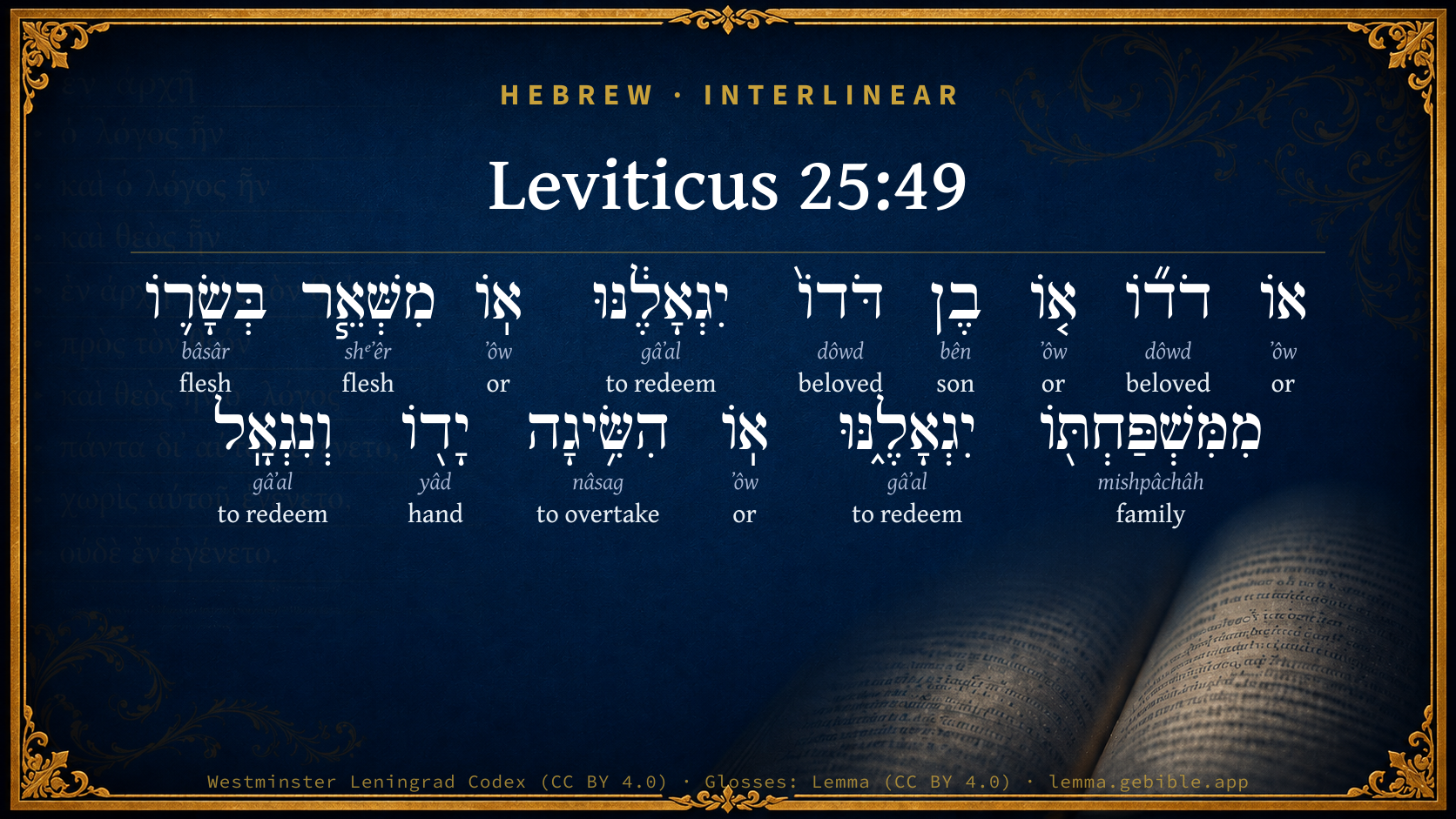
Hebrew (Westminster Leningrad Codex) Leviticus 25:49 appears in the Hebrew Old Testament. The text above is from the Westminster Leningrad Codex. Each word links to its Strong’s number, a concise gloss, and parsing drawn from the Open Scriptures Hebrew Bible morphology. Click any word for its full Brown-Driver-Briggs (BDB) entry.
Download image
Cite this verse

Leviticus 25:49 (World English Bible). Public Domain. Lemma interlinear Bible study tool, https://lemma.gebible.app/v/leviticus/25/49.

Show BibTeX & RIS
BibTeX
RIS
English Translation
or his uncle, or his uncle's son, may redeem him, or any who is a close relative to him of his family may redeem him; or if he has grown rich, he may redeem himself.
World English Bible · Public Domain
Download a study sheet

One document with this verse’s original text, its word-by-word gloss line, the meaning frame, cross-references with their text, attributed commentary, and full source and license credits — printable, and it pastes into notes with its structure intact.

This verse Autodidact and up

Study sheet (.html) Plain text (.txt)

A passage Seminary Student

Up to 50 verses in one chapter. A passage sheet keeps up to 6 commentary sources and 12 cross-references per verse, in the order this page ranks them, and says so on the sheet whenever that leaves anything out. Ask for a single verse and you get the Autodidact verse sheet above.

Everything on this page stays free to read, with no account — the sheet is a download of what is already on screen, not access to it.

Want to remove ads? Support Godless Engineer
Compare translations 3

The same verse in 3 English versions, stacked beneath the original-language interlinear above. Click any original word for its lexicon entry.

Each is an independent rendering of the whole verse — the interlinear is not word-aligned to these translations.

Highlighted words mark where these versions differ — a whole-verse word diff, not a word-by-word alignment.

  • World English Bible Public Domain
    or his uncle, or his uncle's son, may redeem him, or any who is a close relative to him of his family may redeem him; or if he has grown rich, he may redeem himself.
  • King James Version Public Domain
    Either his uncle, or his uncle's son, may redeem him, or any that is nigh of kin unto him of his family may redeem him; or if he be able, he may redeem himself.
  • unfoldingWord Literal Text CC BY-SA 4.0
    or his uncle or the son of his uncle may redeem him, or from the relatives of his flesh from his clan may redeem him, or if his hand reaches, then he may redeem himself.

unfoldingWord Literal Text — © unfoldingWord, licensed CC BY-SA 4.0. Word-aligned USFM3 via Door43 (git.door43.org/unfoldingWord/en_ult).

Versions to compare (up to 4)

3 of 4 selected

Show all 18 translations

Every available English version of this verse, each an independent rendering of the whole verse.

  • World English Bible Public Domain
    or his uncle, or his uncle's son, may redeem him, or any who is a close relative to him of his family may redeem him; or if he has grown rich, he may redeem himself.
  • Berean Standard Bible Public Domain
    either his uncle or cousin or any close relative from his clan may redeem him. Or if he prospers, he may redeem himself.
  • Majority Standard Bible Public Domain
    either his uncle or cousin or any close relative from his clan may redeem him. Or if he prospers, he may redeem himself.
  • King James Version Public Domain
    Either his uncle, or his uncle's son, may redeem him, or any that is nigh of kin unto him of his family may redeem him; or if he be able, he may redeem himself.
  • American Standard Version (1901) Public Domain
    or his uncle, or his uncle's son, may redeem him, or any that is nigh of kin unto him of his family may redeem him; or if he be waxed rich, he may redeem himself.
  • Revised Version (1885) Public Domain
    or his uncle, or his uncle’s son, may redeem him, or any that is nigh of kin unto him of his family may redeem him; or if he be waxen rich, he may redeem himself.
  • Geneva Bible (1599) Public Domain
    Or his vncle, or his vncles sonne may bye him out, or any of the kindred of his flesh among his familie, may redeeme him: either if he can get so much, he may bye him selfe out.
  • Douay-Rheims (1899) Public Domain
    Either his uncle, or his uncle's son, or his kinsman, by blood, or by affinity. But if he himself be able also, he shall redeem himself,
  • Young's Literal Translation Public Domain
    or his uncle, or a son of his uncle, doth redeem him, or any of the relations of his flesh, of his family, doth redeem him, or -- his own hand hath attained -- then he hath been redeemed.
  • Literal Standard Version CC BY-SA 4.0
    or his uncle or a son of his uncle redeems him, or any of the relations of his flesh, of his family, redeems him, or [if] his own hand has attained [means] then he has been redeemed.
  • Unlocked Literal Bible CC BY-SA 4.0
    It might be the person's uncle, or his uncle's son, who redeems him, or anyone who is his close relative from his family. Or, if he has become prosperous, he may redeem himself.
  • unfoldingWord Literal Text CC BY-SA 4.0
    or his uncle or the son of his uncle may redeem him, or from the relatives of his flesh from his clan may redeem him, or if his hand reaches, then he may redeem himself.
  • Darby Bible Public Domain
    Either his uncle or his uncle's son may redeem him, or one of his next relations of his family may redeem him; or if his means be sufficient, he may redeem himself.
  • World Messianic Bible Public Domain
    or his uncle, or his uncle’s son, may redeem him, or any who is a close relative to him of his family may redeem him; or if he has grown rich, he may redeem himself.
  • Webster's Bible Public Domain
    Either his uncle, or his uncle's son may redeem him, or any that is nigh of kin to him of his family, may redeem him; or if he is able, he may redeem himself.
  • Free Bible Version CC BY-SA 4.0
    an uncle or cousin or any close relative from their family can buy them back. If they become successful, they can buy themselves back.
  • Bible in Basic English Public Domain
    Or his father's brother, or the son of his father's brother, or any near relation; or if he gets money, he may make himself free.
  • JPS Tanakh (1917) Public Domain
    or his uncle, or his uncle's son, may redeem him, or any that is nigh of kin unto him of his family may redeem him; or if he be waxen rich, he may redeem himself.

Literal Standard Version (2020), Covenant Press — licensed CC BY-SA 4.0. Text via the HelloAO Bible API (eBible.org). Unlocked Literal Bible (unfoldingWord) — licensed CC BY-SA 4.0. Text via the HelloAO Bible API (eBible.org). unfoldingWord Literal Text — © unfoldingWord, licensed CC BY-SA 4.0. Word-aligned USFM3 via Door43 (git.door43.org/unfoldingWord/en_ult). Free Bible Version, Dr. Jonathan Gallagher — licensed CC BY-SA 4.0. Text via the HelloAO Bible API (eBible.org).

Word by word

More ways to search: Search by grammar → Find every occurrence → Compare this word →

Practice this passage: Drill this verse → Learn its vocabulary →

מִשְּׁאֵ֧ר
shᵉʼêr
H7607
“from · flesh of”
Preposition + Noun, Common, Masculine, Singular, Construct
Part of Speech
Preposition + Noun
Type
Common
Gender
Masculine
Number
Singular
State
Construct
Full BDB Definition

Origin: from H7604

TWOT: 2308a

flesh, food, body, near kin, near kinswoman - flesh - as food - for physical power (figuratively) - flesh relation, blood relation - self
  1. אוֹ ʼôw H176 “or” Conjunction
  2. דֹד֞וֹ dôwd H1730 “beloved · his” Noun, Common, Masculine, Singular, Construct + Suffix, Personal, 3rd Person, Masculine, Singular
  3. א֤וֹ ʼôw H176 “or” Conjunction
  4. בֶן bên H1121 “son of” Noun, Common, Masculine, Singular, Construct
  5. דֹּדוֹ֙ dôwd H1730 “beloved · his” Noun, Common, Masculine, Singular, Construct + Suffix, Personal, 3rd Person, Masculine, Singular
  6. יִגְאָלֶ֔נּוּ gâʼal H1350 “to redeem · him” Verb, Qal, Imperfect, 3rd Person, Masculine, Singular + Suffix, Personal, 3rd Person, Masculine, Singular
  7. אֽוֹ ʼôw H176 “or” Conjunction
  8. בְּשָׂר֛וֹ bâsâr H1320 “flesh · his” Noun, Common, Masculine, Singular, Construct + Suffix, Personal, 3rd Person, Masculine, Singular
  9. מִמִּשְׁפַּחְתּ֖וֹ mishpâchâh H4940 “from · family · his” Preposition + Noun, Common, Feminine, Singular, Construct + Suffix, Personal, 3rd Person, Masculine, Singular
  10. יִגְאָלֶ֑נּוּ gâʼal H1350 “to redeem · him” Verb, Qal, Imperfect, 3rd Person, Masculine, Singular + Suffix, Personal, 3rd Person, Masculine, Singular
  11. אֽוֹ ʼôw H176 “or” Conjunction
  12. הִשִּׂ֥יגָה nâsag H5381 “to overtake” Verb, Hiphil, Perfect, 3rd Person, Feminine, Singular
  13. יָד֖וֹ yâd H3027 “hand · his” Noun, Common, Both, Singular, Construct + Suffix, Personal, 3rd Person, Masculine, Singular
  14. וְנִגְאָֽל gâʼal H1350 “and · to redeem” Conjunction + Verb, Niphal, Sequential Perfect, 3rd Person, Masculine, Singular

About this verse

These counts appear in no published source. They are computed here, from the morphology-tagged text and Lemma’s own curated glosses. What Lemma adds →

15
words
9
distinct lemmas
Pentateuch
section

Notable vocabulary

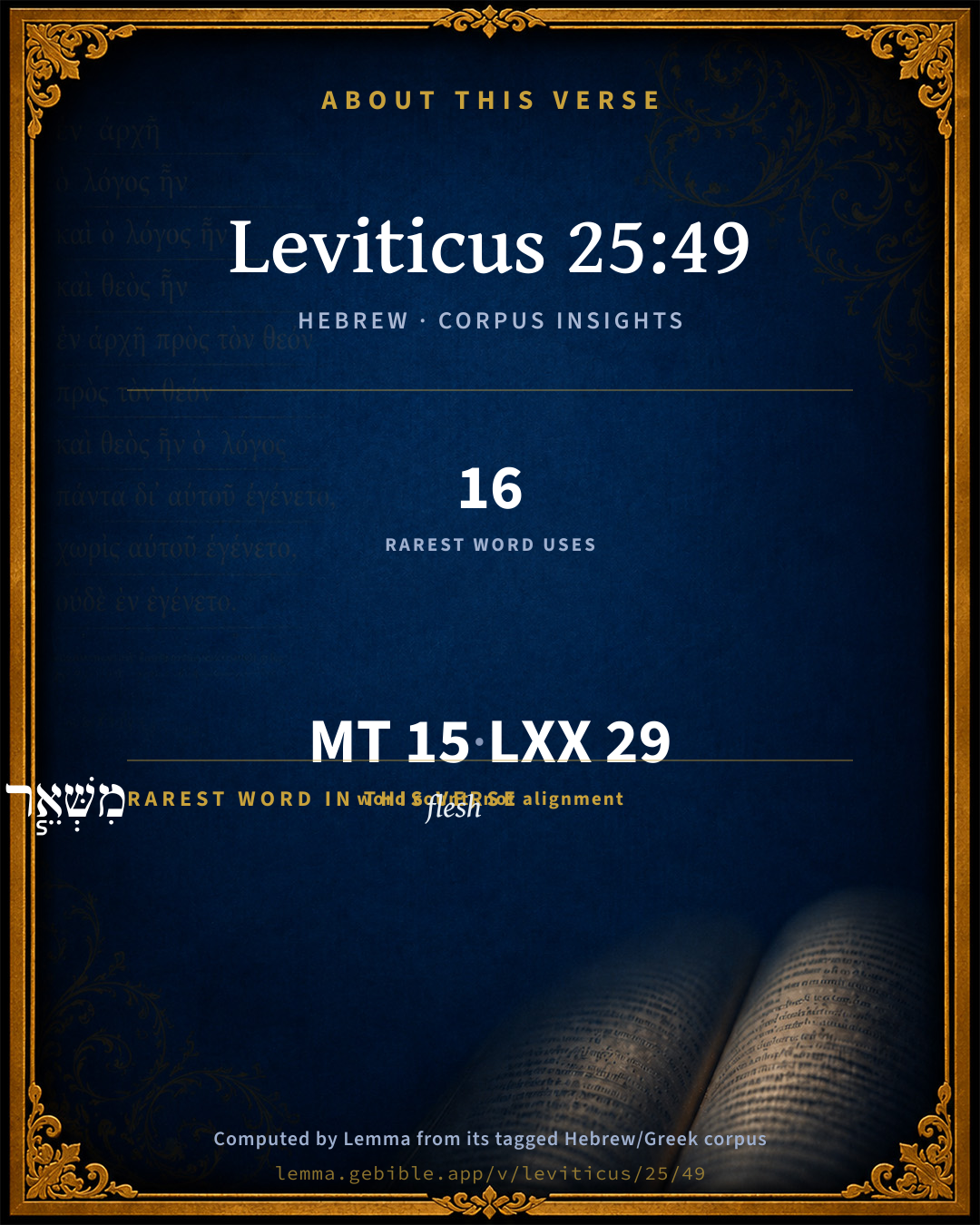
The rarest word here is מִשְּׁאֵ֧ר flesh H7607 — appearing just 16 times in the whole Hebrew Bible.

Shared distinctive vocabulary

מִשְּׁאֵ֧ר flesh H7607 occurs in 16 verses of the Hebrew Bible. Also found in:

Grammatical profile

  • 4 verbs
  • 7 nouns
  • 4 conjunctions

Verb forms

  • יִגְאָלֶ֔נּוּ Qal · Imperfect
  • יִגְאָלֶ֑נּוּ Qal · Imperfect
  • הִשִּׂ֥יגָה Hiphil · Perfect
  • וְנִגְאָֽל Niphal · Sequential Perfect

Repetition

Words recur within this verse — often emphatic in Hebrew:

  • יִגְאָלֶ֔נּוּ to redeem H1350 ×3
  • דֹד֞וֹ beloved H1730 ×2
  • אוֹ or H176 ×4

Hebrew & Septuagint length

In English translation the verse runs 35 words from the Hebrew and 36 from the Septuagint (LXX English) — closely comparable.

A rough comparison of the two English renderings, which tokenize alike — not a word-level alignment.

Word counts can differ between the Hebrew and the Greek without any difference in meaning — e.g. the Hebrew direct-object marker אֵת has no separate Greek word, and Greek often adds the article ὁ.

In the original languages it is 15 Hebrew tokens and 29 Greek tokens — but the two are counted differently (Hebrew bundles its prefixes and suffixes into one token; the Greek is in lemma form), so that isn’t a like-for-like length.

Cross-references

1

Topical passages linked to Leviticus 25:49 in the Treasury of Scripture Knowledge — connected by theme and wording, ordered by reader-vote popularity; previews shown in the World English Bible.

  • Leviticus 25:26 If a man has no one to redeem it, and he becomes prosperous and finds sufficient means to redeem it;

Cross-references courtesy of OpenBible.info (CC BY 4.0).

Hebrew and Greek witnesses Masoretic Hebrew ↔ Greek Septuagint

The same verse in the two great witnesses to the Old Testament, shown verse-for-verse.

These are two independent witnesses, not word-aligned to each other, and the Septuagint is shown in lemma (dictionary) form.

Hebrew Leviticus 25:49 Masoretic · Westminster Leningrad Codex

אוֹ דֹד֞וֹ א֤וֹ בֶן דֹּדוֹ֙ יִגְאָלֶ֔נּוּ אֽוֹ מִשְּׁאֵ֧ר בְּשָׂר֛וֹ מִמִּשְׁפַּחְתּ֖וֹ יִגְאָלֶ֑נּוּ אֽוֹ הִשִּׂ֥יגָה יָד֖וֹ וְנִגְאָֽל

or his uncle, or his uncle's son, may redeem him, or any who is a close relative to him of his family may redeem him; or if he has grown rich, he may redeem himself.

World English Bible · Public Domain

Greek LXX Leviticus 25:49 Septuagint · lemma form

ἀδελφός πατήρ αὐτός ἤ υἱός ἀδελφός πατήρ λυτρόω αὐτός ἤ ἀπό ὁ οἰκεῖος ὁ σάρξ αὐτός ἐκ ὁ φυλή αὐτός λυτρόω αὐτός ἐάν δέ εὐπορέω ὁ χείρ λυτρόω ἑαυτοῦ

A brother of his father, or a son of his father's brother shall redeem him; or let one of his near kin of his tribe redeem him, and if he should be rich and redeem himself,

LXX2012 (modern English Septuagint) · Public Domain

Hebrew: Westminster Leningrad Codex (CC BY 4.0). Greek: Septuagint (public domain); English from LXX2012 (modern English Septuagint) (Public Domain). How the Septuagint differs from the Hebrew →

Targum (Aramaic paraphrase)

2

The Targum is the ancient Jewish Aramaic paraphrase of the Hebrew Scriptures — an interpretive translation, not the Hebrew text itself. Onkelos (literal) and Pseudo-Jonathan (expansive) render the Torah, and Jonathan the Prophets. Coverage is partial: where no permissively-licensed English translation exists for a verse, only the Aramaic is shown. This is verse-level text, not a word-by-word alignment to the Hebrew.

  1. Targum Onkelos Torah (Genesis–Deuteronomy)
    אוֹ אַח אֲבוּהִּי אוֹ בַר אַח אֲבוּהִי יִפְרְקִנֵהּ אוֹ מִקָרִיב בִּשְׂרֵהּ מִזַרְעִיתֵהּ יִפְרְקִנֵהּ אוֹ דְתַדְבֵּק יְדֵהּ וְיִתְפָּרָק

    (no public-domain English translation for this verse)

    Targum Onkelos — Aramaic: “Onkelos Genesis” (public domain); “Onkelos Exodus” (public domain); “Onkelos Leviticus” (public domain); “Onkelos Numbers” (public domain); “Onkelos Deuteronomy” (public domain). English: “Sefaria Community Translation” (CC0 1.0 (public-domain dedication)); “J.W. Etheridge. The Targums of Onkelos and Jonathan Ben Uzziel on the Pentateuch. London: Longmans, Green, 1862” (public domain). Text via Sefaria.

  2. Targum Pseudo-Jonathan Torah (Genesis–Deuteronomy)
    אוֹ אַחְבוֹי אוֹ בַּר אַחְבוֹי יִפְרְקִינֵיהּ אוֹ מִקָרִיב בִּישְרֵיהּ מִזַרְעִיתֵיהּ יִפְרְקִינֵיהּ אוֹ תְּאַרַע יְדֵיהּ אוֹ יְדָא דְצִבּוּרָא וְיִתְפָּרִיק

    either the brother of his father or the son of his father's brother may redeem him; or a kinsman of the flesh of his family may redeem him; or by his own hand being made strong, or by the hand of the congregation, he may be redeemed.

    Targum Pseudo-Jonathan — Aramaic: “Targum Jonathan on Genesis” (public domain); “Targum Jonathan on Exodus” (public domain); “Targum Jonathan on Leviticus” (public domain); “Targum Jonathan on Numbers” (public domain); “Targum Jonathan on Deuteronomy” (public domain). English: “The Targum of Jonathan ben Uzziel, trans. J. W. Etheridge, London, 1862” (public domain). Text via Sefaria.

Commentary

Notes on Leviticus 25:49 from classic Christian and Jewish commentators (each source and its license shown beneath its notes). The classic Christian expositions comment on the surrounding passage and are grouped to its opening verse, so a note may address several verses; the Jewish commentaries on the Tanakh (Rashi and others) are per-verse, so they appear only where the commentator wrote on this verse.

Lemma curates 59 commentaries, every one of them public domain or Creative Commons licensed, each selected and text-cleaned for this edition rather than reprinted as found. About our sources →

Geneva Bible (1599)

Geneva Bible translators

If he be able.

Geneva Bible (1599) marginal notes — public domain. Text via Bolls.life.

Ellicott's Commentary for English Readers

(49) Either his uncle, or his uncle’s son, may redeem him.—That is, any of his relatives are to redeem him, which is not the case when an Israelite sells himself to one of his own nation. Hence the Jewish canons enacted that “if a Hebrew is sold to a stranger, and is unable to redeem himself, his kinsmen must redeem, nay, the Sanhedrin are to compel his kinsmen to redeem him lest he should be lost among the heathen. If his kindred do not redeem him, and if he cannot redeem himself, every man of Israel is commanded to redeem him. But if he is sold to an Israelite his kindred may not redeem him, nor may he borrow money to redeem himself, nor redeem himself by instalments.” In accordance with this injunction we find the Jews declare “we after our ability have redeemed our brethren the Jews which were sold unto the heathen, and will ye even sell your brethren, or shall they be sold unto us?” (Neh_5:8).

A Bible Commentary for English Readers, edited by Charles John Ellicott (1878–1897) — public domain. Text from a community e-Sword module.

John Gill's Exposition

Either his uncle, or his uncle's son, may redeem him,.... it is father's brother or his father's brother's son, as the Targums of Onkelos and Jonathan:

or any that is nigh kin unto him of his family may redeem him; from whence it appears, that it must be a near kinsman that has to be the redeemer, as in another case, the redemption of inheritances; hence the same word "goel" signifies both a redeemer and a near kinsman:

or if he be able he may redeem himself; who either has found something lost, or inherits the substance of anyone deceased, of his family, as Aben Ezra observes; that is, since he sold himself, which puts him into a capacity to redeem himself; the Targum of Jonathan adds,"or the land of the congregation;''for such a redemption was sometimes made at the expense of the public; see Neh 5:8. Baal Hatturim observes, that the words "Ben Dodo", translated "his uncle's son", wanting the letter "tau" as usual, as the same letters with Ben David, which is a known name of the Messiah with the Jews, and which that author seems to have in view; and another Jewish writer (f) expressly says,"this Redeemer is the Messiah, the son of David, of the tribe of Judah:''and indeed the whole of this case is applicable to the spiritual and eternal redemption of the people of God by Christ: they through the fall, and in a state of nature, are become poor and helpless, and in a spiritual sense have neither bread to eat, nor clothes to wear, nor money to buy either; and are in debt, owe ten thousand talents, and have nothing to pay, and so are brought into bondage to sin, Satan, and the law; nor can they redeem themselves from these by power or price; nor can a brother, or the nearest relation redeem them, or give to God a ransom for them; none but Christ could do this for them, who through his incarnation, whereby he became of the same nature, of the same flesh and blood with them, and in all things like unto them, is their "goel", and so their Redeemer, and has obtained eternal redemption for them, not with silver and gold, but by his own precious blood.

(f) R. Bechai apud Patrick in loc.

John Gill's Exposition of the Whole Bible (1746–1763) — public domain (CC PDM 1.0). Text via the HelloAO Bible API.

Haydock's Catholic Bible Commentary

Himself. He might have saved up something by greater industry. The Athenians allowed their slaves the same privilege. (Calmet)

George Leo Haydock (1774–1849), Haydock's Catholic Family Bible and Commentary, 1859 edition — public domain. Excludes Psalms (Douay-Rheims chapter numbering differs from Protestant) and Deuterocanonical books (Catholic canon only).

Whedon's Commentary on the Bible

Daniel D. Whedon

49. Nigh of kin — The Jews hold that the kindred of the enslaved Hebrew are bound, if in their power, to redeem him, lest he should be paganized, and we find that this was done on their return from the Babylonish captivity. Christians in the early centuries regarded themselves bound to ransom fellow-Christians in slavery.

He may redeem himself — This indicates that the servitude was not of that rigorous kind which absorbs all the energies, and precludes all accumulation of property for the servant.

Daniel D. Whedon (gen. ed.), Commentary on the Old and New Testaments (1874–1909) — public domain. Text from a community e-Sword module.

Scofield Reference Notes

C. I. Scofield

The Kinsman-Redeemer. The word goel is used to indicate both the redemption-- "to free by paying," and the Redeemer--"the one who pays." The case of Ruth and Boaz Rth 2:1; Rth 3:10-18; Rth 4:1-10 perfectly illustrates this beautiful type of Christ. See "Redemption, (See Scofield "Isa 59:20").

redeem Heb. "goel," Redemp. (Kinsman type).

(See Scofield "Isa 59:20").

The Scofield Reference Bible (1917 edition), notes by C. I. Scofield — public domain. Text from a community e-Sword module.

unfoldingWord translationNotes

Door43 World Missions Community

until the year of Jubilee

An Israelite could be a slave only until the year of Jubilee. These instructions are for when an Israelite wanted to buy back his freedom before the year of Jubilee.

the year of Jubilee

"the year of restoration" or "the year to return land and to free slaves"

The price of his redemption must be figured

The verb "figured" can be stated in active form. AT: "They must figure the price of his redemption" or "They must figure how much to pay for the foreigner to set the Israelite free" (See: Active or Passive)

in keeping with the rate paid to a hired servant

If the Israelite bought back his freedom, the foreigner would have to hire a servant to do the work that the Israelite would have done but will not. The verbs "paid" and "hired" can be expressed in active form. AT: "according to the rate a person would pay to hire a servant" (See: Active or Passive)

for the number of years he might continue to work

"for the number of years until the jubilee that the Israelite would have continued to work but will not"

translationWords

family

prosper

unfoldingWord translationNotes — © Distant Shores Media and the Door43 World Missions Community, licensed CC BY-SA 4.0. Source: git.door43.org/Door43/en_tn.

Lesson kit

Teaching starters — assembled from the data on this page, not authored interpretation. Every prompt links to the verse data it draws on. Edit before teaching.

Leviticus, in the Pentateuch, opens this verse with 15 words (9 distinct Hebrew lemmas). Its most distinctive word is shᵉʼêr (“flesh”). A historical commentator’s framing appears above. Read the whole chapter for the surrounding context.

Discussion questions

  1. The word shᵉʼêr carries the sense “flesh.” How does it shape the verse?
  2. Exodus 21:10 shares the word «flesh» with this verse. How do the two illuminate each other?
  3. “to redeem” occurs 3× in this one verse. What is the effect of the repetition?
  4. The translations on this page render this verse differently — a whole-verse word diff, not a word-by-word alignment. What might account for the different wordings?
  5. The verb «יִגְאָלֶ֔נּוּ» is Qal Imperfect. How does its form color the action?
  6. Reading how Geneva Bible (1599) and Ellicott's Commentary for English Readers read this verse, where do the two commentators agree and where do they part?

Things to notice

Reading settings

Reading text

Shown beneath each verse's original-language words.

Old Testament
Old Testament edition

Read the OT as the Masoretic Hebrew (MT) or the Greek Septuagint (LXX).

English shown for the Greek Septuagint (in the Hebrew ↔ Greek comparison).

Comparing translations? Open the Compare panel on any verse page to stack up to four side by side.