Romans 1:3

Greek (Tischendorf 8th ed.) Romans 1:3 appears in the Greek New Testament. The text above is from the Tischendorf 8th edition. Each word links to its Strong’s number and a concise gloss. Click any word for its full Thayer’s Greek Lexicon entry.
Download image
Cite this verse

Romans 1:3 (World English Bible). Public Domain. Lemma interlinear Bible study tool, https://lemma.gebible.app/v/romans/1/3.

Show BibTeX & RIS
BibTeX
RIS
English Translation
concerning his Son, who was born of the seed of David according to the flesh,
World English Bible · Public Domain
Download a study sheet

One document with this verse’s original text, its word-by-word gloss line, the meaning frame, cross-references with their text, attributed commentary, and full source and license credits — printable, and it pastes into notes with its structure intact.

This verse Autodidact and up

Study sheet (.html) Plain text (.txt)

A passage Seminary Student

Up to 50 verses in one chapter. A passage sheet keeps up to 6 commentary sources and 12 cross-references per verse, in the order this page ranks them, and says so on the sheet whenever that leaves anything out. Ask for a single verse and you get the Autodidact verse sheet above.

Everything on this page stays free to read, with no account — the sheet is a download of what is already on screen, not access to it.

Want to remove ads? Support Godless Engineer
Compare translations 3

The same verse in 3 English versions, stacked beneath the original-language interlinear above. Click any original word for its lexicon entry.

Each is an independent rendering of the whole verse — the interlinear is not word-aligned to these translations.

Highlighted words mark where these versions differ — a whole-verse word diff, not a word-by-word alignment.

  • World English Bible Public Domain
    concerning his Son, who was born of the seed of David according to the flesh,
  • King James Version Public Domain
    Concerning his Son Jesus Christ our Lord, which was made of the seed of David according to the flesh;
  • unfoldingWord Literal Text CC BY-SA 4.0
    concerning his Son—the one having been born from a seed of David according to the flesh,

unfoldingWord Literal Text — © unfoldingWord, licensed CC BY-SA 4.0. Word-aligned USFM3 via Door43 (git.door43.org/unfoldingWord/en_ult).

Versions to compare (up to 4)

3 of 4 selected

Show all 19 translations

Every available English version of this verse, each an independent rendering of the whole verse.

  • World English Bible Public Domain
    concerning his Son, who was born of the seed of David according to the flesh,
  • Berean Standard Bible Public Domain
    regarding His Son, who was a descendant of David according to the flesh,
  • Majority Standard Bible Public Domain
    regarding His Son, who was a descendant of David according to the flesh,
  • King James Version Public Domain
    Concerning his Son Jesus Christ our Lord, which was made of the seed of David according to the flesh;
  • American Standard Version (1901) Public Domain
    concerning his Son, who was born of the seed of David according to the flesh,
  • Revised Version (1885) Public Domain
    concerning his Son, who was born of the seed of David according to the flesh,
  • Geneva Bible (1599) Public Domain
    Concerning his Sonne Iesus Christ our Lord (which was made of the seede of Dauid according to the flesh,
  • Douay-Rheims (1899) Public Domain
    Concerning his Son, who was made to him of the seed of David, according to the flesh,
  • Young's Literal Translation Public Domain
    concerning His Son, (who is come of the seed of David according to the flesh,
  • Literal Standard Version CC BY-SA 4.0
    concerning His Son—who has come of the seed of David according to the flesh,
  • Unlocked Literal Bible CC BY-SA 4.0
    concerning his Son who was a descendant of David according to the flesh.
  • unfoldingWord Literal Text CC BY-SA 4.0
    concerning his Son—the one having been born from a seed of David according to the flesh,
  • Darby Bible Public Domain
    concerning his Son (come of David's seed according to flesh,
  • World Messianic Bible Public Domain
    concerning his Son, who was born of the offspring of David according to the flesh,
  • Webster's Bible Public Domain
    Concerning his Son Jesus Christ our Lord, who was born of the seed of David according to the flesh.
  • Free Bible Version CC BY-SA 4.0
    The good news is about his Son, whose human forefather was David,
  • Bible in Basic English Public Domain
    About his Son who, in the flesh, came from the family of David,
  • Text-Critical English NT CC BY 4.0
    concerning his Son, who was descended from David according to the flesh
  • Tyndale New Testament (1534) Public Domain
    that make mension of his sonne the which was begotte of the seed of David as pertayninge to the flesshe:

Literal Standard Version (2020), Covenant Press — licensed CC BY-SA 4.0. Text via the HelloAO Bible API (eBible.org). Unlocked Literal Bible (unfoldingWord) — licensed CC BY-SA 4.0. Text via the HelloAO Bible API (eBible.org). unfoldingWord Literal Text — © unfoldingWord, licensed CC BY-SA 4.0. Word-aligned USFM3 via Door43 (git.door43.org/unfoldingWord/en_ult). Free Bible Version, Dr. Jonathan Gallagher — licensed CC BY-SA 4.0. Text via the HelloAO Bible API (eBible.org).

Word by word

More ways to search: Search by grammar → Find every occurrence → Compare this word →

Practice this passage: Drill this verse → Learn its vocabulary →

σπέρματος
spérma
G4690
“seed”
Noun, Genitive, Singular, Neuter
Part of Speech
Noun
Case
Genitive
Number
Singular
Gender
Neuter
Full Thayer's Definition

Origin: from G4687

TDNT: 15:56,1

1. from which a plant germinates a. the seed i.e. the grain or kernel which contains within itself the germ of the future plants 1. of the grains or kernels sown b. metaph. a seed i.e. a residue, or a few survivors reserved as the germ of the next generation (just as seed is kept from the harvest for the sowing) 2. the semen virile a. the product of this semen, seed, children, offspring, progeny b. family, tribe, posterity c. whatever possesses vital force or life giving power 1. of divine energy of the Holy Spirit operating within the soul by which we are regenerated
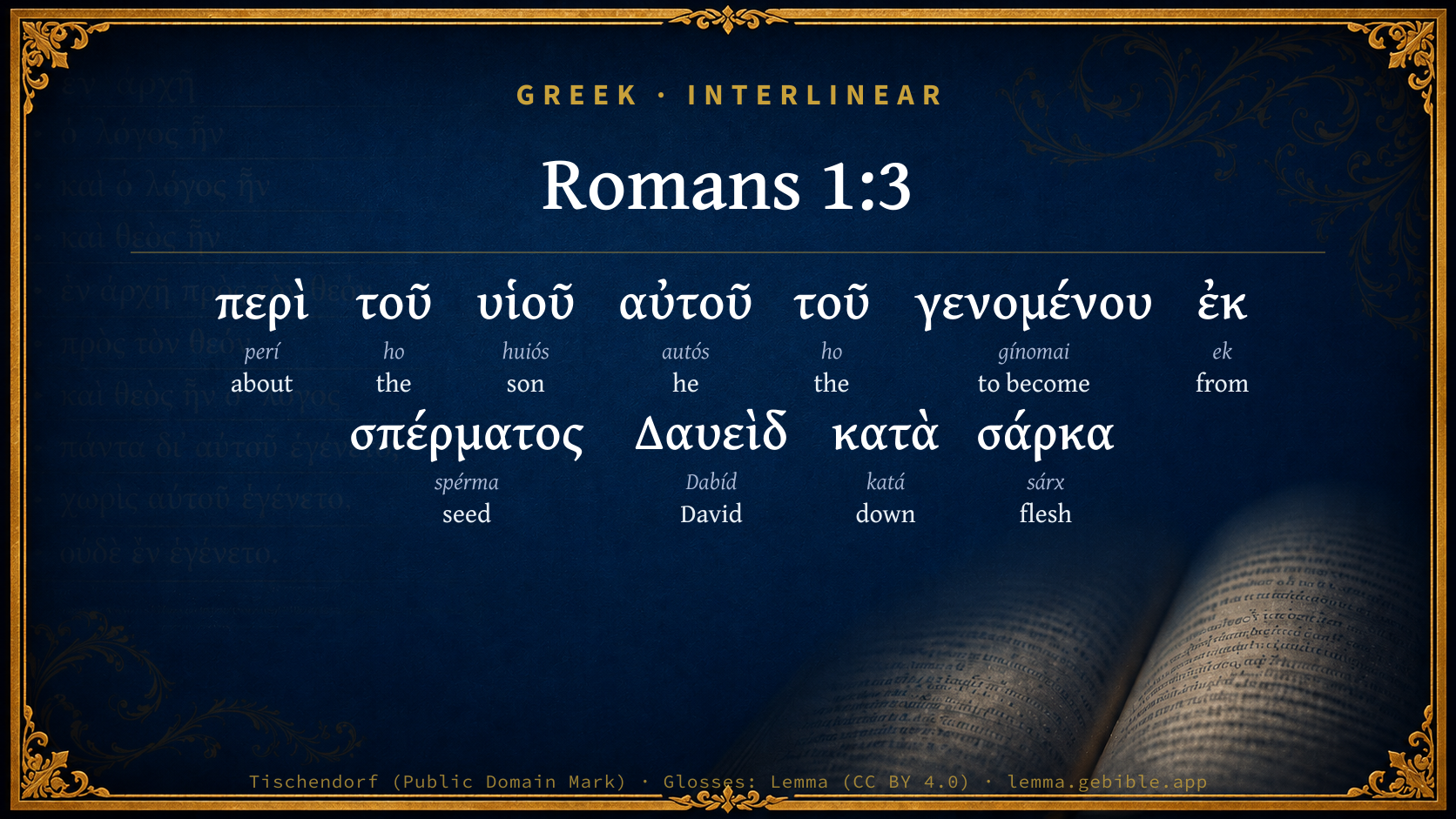
  1. περὶ perí G4012 “about” Preposition
  2. τοῦ ho G3588 “the” Article, Genitive, Singular, Masculine
  3. υἱοῦ huiós G5207 “son” Noun, Genitive, Singular, Masculine
  4. αὐτοῦ autós G846 “he” Personal pronoun, Genitive, Singular, Masculine
  5. τοῦ ho G3588 “the” Article, Genitive, Singular, Masculine
  6. γενομένου gínomai G1096 “to become” Verb, Aorist, Middle deponent, Participle, Genitive, Singular, Masculine
  7. ἐκ ek G1537 “from” Preposition
  8. Δαυεὶδ Dabíd G1138 “David” Noun, Proper, indeclinable
  9. κατὰ katá G2596 “down” Preposition
  10. σάρκα sárx G4561 “flesh” Noun, Accusative, Singular, Feminine

About this verse

These counts appear in no published source. They are computed here, from the morphology-tagged text and Lemma’s own curated glosses. What Lemma adds →

11
words
10
distinct lemmas
Pauline Epistles
section

Shared distinctive vocabulary

σπέρματος seed G4690 occurs in 41 verses of the Greek New Testament. Also found in:

Repetition

A word recurs within this verse:

Cross-references

62

Topical passages linked to Romans 1:3 in the Treasury of Scripture Knowledge — connected by theme and wording, ordered by reader-vote popularity; previews shown in the World English Bible.

  • Galatians 4:4 But when the fullness of the time came, God sent out his Son, born to a woman, born under the law,
  • Matthew 1:1 The book of the generation of Jesus Christ, the son of David, the son of Abraham.
  • Jeremiah 23:5–6 Behold, the days come, says Yahweh, that I will raise to David a righteous Branch, and he shall reign as king and deal wisely, and shall execute justice and righteousness in the land.
  • John 1:14 The Word became flesh, and lived among us. We saw his glory, such glory as of the one and only Son of the Father, full of grace and truth.
  • Luke 1:31–33 Behold, you will conceive in your womb, and bring forth a son, and will call his name 'Jesus.'
  • Matthew 1:20–23 But when he thought about these things, behold, an angel of the Lord appeared to him in a dream, saying, "Joseph, son of David, don't be afraid to take to yourself Mary, your wife, for that which is conceived in her is of the Holy Spirit.
  • Isaiah 9:6–7 For to us a child is born, to us a son is given; and the government shall be on his shoulder: and his name shall be called Wonderful, Counselor, Mighty God, Everlasting Father, Prince of Peace.
  • Amos 9:11 In that day I will raise up the tent of David who is fallen, and close up its breaches, and I will raise up its ruins, and I will build it as in the days of old;
  • Genesis 3:15 I will put enmity between you and the woman, and between your offspring and her offspring. He will bruise your head, and you will bruise his heel."
  • Psalms 2:7 I will tell of the decree. Yahweh said to me, "You are my son. Today I have become your father.
  • John 1:49 Nathanael answered him, "Rabbi, you are the Son of God! You are King of Israel!"
  • 1 John 4:9–10 By this was God's love revealed in us, that God has sent his one and only Son into the world that we might live through him.
  • Psalms 89:36–37 His seed will endure forever, His throne like the sun before me.
  • Luke 1:35 The angel answered her, "The Holy Spirit will come on you, and the power of the Most High will overshadow you. Therefore also the holy one who is born from you will be called the Son of God.
  • Jeremiah 33:15–17 In those days, and at that time, will I cause a Branch of righteousness to grow up to David; and he shall execute justice and righteousness in the land.
  • Jeremiah 33:26 then will I also cast away the seed of Jacob, and of David my servant, so that I will not take of his seed to be rulers over the seed of Abraham, Isaac, and Jacob: for I will cause their captivity to return, and will have mercy on them.
  • Matthew 1:16 Jacob became the father of Joseph, the husband of Mary, from whom was born Jesus, who is called Christ.
  • John 10:30 I and the Father are one."
  • John 20:28 Thomas answered him, "My Lord and my God!"
  • Romans 9:5 of whom are the fathers, and from whom is Christ as concerning the flesh, who is over all, God, blessed forever. Amen.
  • 1 Thessalonians 1:10 and to wait for his Son from heaven, whom he raised from the dead-- Jesus, who delivers us from the wrath to come.
  • 1 Corinthians 1:9 God is faithful, through whom you were called into the fellowship of his Son, Jesus Christ, our Lord.
  • 2 Timothy 2:8 Remember Jesus Christ, risen from the dead, of the seed of David, according to my Gospel,
  • Matthew 1:6 Jesse became the father of David the king. David became the father of Solomon by her who had been the wife of Uriah.
  • Matthew 3:17 Behold, a voice out of the heavens said, "This is my beloved Son, with whom I am well pleased."
  • Matthew 9:27 As Jesus passed by from there, two blind men followed him, calling out and saying, "Have mercy on us, son of David!"
  • Matthew 12:23 All the multitudes were amazed, and said, "Can this be the son of David?"
  • Matthew 15:22 Behold, a Canaanite woman came out from those borders, and cried, saying, "Have mercy on me, Lord, you son of David! My daughter is severely demonized!"
  • Matthew 22:42–45 saying, "What do you think of the Christ? Whose son is he?" They said to him, "Of David."
  • Matthew 26:63 But Jesus held his peace. The high priest answered him, "I adjure you by the living God, that you tell us whether you are the Christ, the Son of God."
  • Matthew 27:43 He trusts in God. Let God deliver him now, if he wants him; for he said, 'I am the Son of God.'"
  • Luke 1:69 And has raised up a horn of salvation for us in the house of his servant David
  • Luke 2:4–6 Joseph also went up from Galilee, out of the city of Nazareth, into Judea, to the city of David, which is called Bethlehem, because he was of the house and family of David;
  • John 5:25 Most assuredly, I tell you, the hour comes, and now is, when the dead will hear the Son of God's voice; and those who hear will live.
  • John 10:36 Do you say of him whom the Father sanctified and sent into the world, 'You blaspheme,' because I said, 'I am the Son of God?'
  • John 20:31 but these are written, that you may believe that Jesus is the Christ, the Son of God, and that believing you may have life in his name.
  • Acts 2:30 Therefore, being a prophet, and knowing that God had sworn with an oath to him that of the fruit of his body, according to the flesh, he would raise up the Christ to sit on his throne,
  • 2 Samuel 7:12–16 When your days are fulfilled, and you shall sleep with your fathers, I will set up your seed after you, who shall proceed out of your bowels, and I will establish his kingdom.
  • John 1:34 I have seen, and have testified that this is the Son of God."
  • John 3:16–18 For God so loved the world, that he gave his one and only Son, that whoever believes in him should not perish, but have eternal life.
  • John 3:35–36 The Father loves the Son, and has given all things into his hand.
  • John 7:42 Hasn't the Scripture said that the Christ comes of the seed of David, and from Bethlehem, the village where David was?"
  • Acts 3:13 The God of Abraham, Isaac, and Jacob, the God of our fathers, has glorified his Servant Jesus, whom you delivered up, and denied in the presence of Pilate, when he had determined to release him.
  • Acts 8:36 As they went on the way, they came to some water, and the eunuch said, "Behold, here is water. What is keeping me from being baptized?"
  • Acts 9:20 Immediately in the synagogues he proclaimed the Christ, that he is the Son of God.
  • Acts 13:22–23 When he had removed him, he raised up David to be their king, to whom he also testified, 'I have found David the son of Jesse, a man after my heart, who will do all my will.'
  • Romans 1:9 For God is my witness, whom I serve in my spirit in the Gospel of his Son, how unceasingly I make mention of you always in my prayers,
  • Romans 8:2–3 For the law of the Spirit of life in Christ Jesus made me free from the law of sin and of death.
  • Romans 8:29–32 For whom he foreknew, he also predestined to be conformed to the image of his Son, that he might be the firstborn among many brothers.
  • Colossians 1:13–15 who delivered us out of the power of darkness, and translated us into the Kingdom of the Son of his love;
  • 1 Timothy 3:16 Without controversy, the mystery of godliness is great: God was revealed in the flesh, Justified in the spirit, Seen by angels, Preached among the nations, Believed on in the world, And received up in glory.
  • 1 John 1:3 that which we have seen and heard we declare to you, that you also may have fellowship with us. Yes, and our fellowship is with the Father, and with his Son, Jesus Christ.
  • 1 John 3:8 He who sins is of the devil, for the devil has been sinning from the beginning. To this end the Son of God was revealed, that he might destroy the works of the devil.
  • 1 John 3:23 This is his commandment, that we should believe in the name of his Son, Jesus Christ, and love one another, even as he commanded.
  • 1 John 4:2–3 By this you know the Spirit of God: every spirit who confesses that Jesus Christ has come in the flesh is of God,
  • 1 John 4:15 Whoever confesses that Jesus is the Son of God, God remains in him, and he in God.
  • 1 John 5:1 Whoever believes that Jesus is the Christ is born of God. Whoever loves the father also loves the child who is born of him.
  • 1 John 5:5 Who is he who overcomes the world, but he who believes that Jesus is the Son of God?
  • 1 John 5:10–13 He who believes in the Son of God has the testimony in himself. He who doesn't believe God has made him a liar, because he has not believed in the testimony that God has given concerning his Son.
  • 1 John 5:20 We know that the Son of God has come, and has given us an understanding, that we know him who is true, and we are in him who is true, in his Son Jesus Christ. This is the true God, and eternal life.
  • 2 John 1:7 For many deceivers have gone out into the world, those who don't confess that Jesus Christ came in the flesh. This is the deceiver and the Antichrist.
  • Revelation 2:18 "To the angel of the assembly in Thyatira write: "The Son of God, who has his eyes like a flame of fire, and his feet are like burnished brass, says these things:

Cross-references courtesy of OpenBible.info (CC BY 4.0).

Commentary

Notes on Romans 1:3 from classic Christian and Jewish commentators (each source and its license shown beneath its notes). The classic Christian expositions comment on the surrounding passage and are grouped to its opening verse, so a note may address several verses; the Jewish commentaries on the Tanakh (Rashi and others) are per-verse, so they appear only where the commentator wrote on this verse.

Lemma curates 59 commentaries, every one of them public domain or Creative Commons licensed, each selected and text-cleaned for this edition rather than reprinted as found. About our sources →

The Biblical Illustrator

Joseph S. Exell

Rom_1:3-4

Concerning His Son Jesus Christ our Lord.

Christ, Gods Son

I. In what sense.

1. Not--

(1) As angels (Job_38:7).

(2) As Israel (Exo_5:22; Hos_11:1).

(3) As Adam and men in general (Luk_3:38; Act_17:29).

(4) As kings and rulers (Psa_82:6).

(5) As the godly and regenerate (Gen_6:2; Joh_1:12; 1Jn_3:1).

2. But in an entirely peculiar sense (Joh_5:17-18).

(1) Gods own Son (Rom_8:32).

(2) Only begotten Son (Joh_3:16).

(3) Equal with God (Php_2:6; Joh_5:18).

(4) One with the Father (Joh_5:30).

(5) The brightness of His glory, and express image of His person (Heb_1:3).

(6) With God from eternity (Joh_1:1-2; Pro_8:22-23).

(7) God Himself (Joh_1:1; Rom_9:3).

II. By whom declared.

1. By prophecy (Psa_2:7).

2. By the Father (Mat_3:17; Mat_17:5).

3. By Himself (Mat_26:63-64; Joh_9:35; Joh_9:39; Joh_10:30-36).

4. By the apostles (Act_3:13; Act_9:20; 1Co_1:9; 1Co_15:28; 2Co_1:19; Gal_4:4; 1Th_1:10; Heb_1:2; Heb_5:8 : 1Jn_4:9). (T. Robinson, D. D.)

Christ as Lord

He was promised as such (Psa_2:6; Psa_2:9; Psa_110:1; Psa_011:2; Isa_9:6-7; Mic_5:1-2), and assumed as by right the title (Joh_13:13; Joh_20:28). He was made so by the Father (Act_2:36; Php_2:11; Eph_1:22), and the universal confession of the fact will constitute His mediatorial reward (Php_2:11). Now He is confessed as such by men only through the Holy Ghost (1Co_12:3). As Lord, Christ.

I. Is the Sovereign of the universe; men, angels, and devils, are subject to Him (Eph_1:21).

II. Is Head of His Church and King of saints (Eph_1:22; Eph_4:15; Rev_15:3). All other headship is usurpation.

III. Abolishes the Old Testament economy (Mat_11:6; Joh_4:21; Joh_4:23; Heb_12:26-27; Rev_21:5).

IV. Sends down the Holy Spirit (Act_2:33-36).

V. Gathers men into His kingdom (Joh_10:2-4; Joh_10:14-16; Isa_55:4-5).

VI. Commissions His apostles to preach with that object (Mat_28:18-19). VII. Appoints what is to be done in His Church (1Co_9:14; 1Co_11:23; Mat_28:19-20). (T. Robinson, D. D.)

Which was made of the seed of David according to the flesh.

Christ the seed of David

Christs descent from David gave Him a claim upon the Jews as a descendant of their ancient kings; and as a scion of the stock to which the future royalty was promised (Jer_23:5; Psa_132:11). (Prof. J. A. Beet.)

Christ the seed of David

Messiah to be descended from David (Psa_132:11; Mat_22:42). He was Davids seed by Mary (Luk_3:23), also by Joseph, His adoptive Father (Mat_1:18). The promised Saviour.

1. The seed of the woman and therefore a man (Gen_3:15).

2. The seed of Abraham and therefore a Jew (Gen_22:18; Rom_15:8).

3. The seed of David and therefore a king (Psa_89:29; Luk_23:3; Joh_1:49). (T. Robinson, D. D.)

The Incarnation of God (a sermon for Christmas Day)

I. Such an event as that can have nothing like it, or parallel to it, while this world lasts. It is the turning point in the history of the world. The gospel of Christ has made the Incarnation of the Eternal Son what St. Paul made it--the centre of all teaching, worship, obedience, and morality, the fulfilment of all that was old, the starting point of all that was new--the gospel of Christ refuses to compromise with any view of religion which puts this tremendous truth in any less than its sovereign place. God has been with us, and seen our life, what we are, what we do, all our sin and all our need--seen it with the eyes of a man, with a heart as human in its sympathy and brotherhood as it was Divinely perfect in its love and righteousness. God has unveiled Himself to us here, to be as man the restorer of mankind. Is it possible that such a thing could be, and not that all things else be changed by it?

II. The Incarnation was the turning point in the history of the world; and, as a matter of fact, we have before our eyes the consequences which have followed from it. For each man, as for the world, the Son of God was made man to enable each man to reach the perfection for which he was made. His Incarnation has been made known to us, not only for the public creed of the Church, but for the personal hope and stay of each of our souls. And to know what it means, to realise what it is to us, is the turning point of each mans belief. To think that He who loved with such self-sacrifice is He of whom all may be said that the mind of man can conceive of the everlasting God--this is a revelation to a mans spirit which, whether it comes gradually or suddenly, is one of those things which lift him up out of the common places of routine religion, one of those things which bring him face to face with the real questions of his being--with those fateful alternatives, the choice of which decides the course of life and its issues. We may overload and cloud it with subordinate doctrines, with the theories and traditions of men, with a disproportionate mass of guesses on what is not given us to know--of subtleties and reasonings in the sphere of human philosophy. We may recoil from it as something which oppresses our imagination and confounds our reason; but we may be sure that on the place which we really give it in our mind and heart depends the whole character of our Christianity, depends what the gospel of Christ means to us.

III. We see in the Incarnation how God fulfils the promises He makes, and the hopes which He raises, in ways utterly unforeseen and utterly inconceivable beforehand, utterly beyond the power of man to anticipate; and, further, we see exemplified in it that widely prevailing law of His government, that in this stage of His dispensations with which we are acquainted--which we call this world and this life--that which is the greatest must stoop to begin from what is humblest, the greatest glories must pass through their hour of obscurity, the greatest strength must rise out of the poorest weakness, the greatest triumphs must have faced their outset of defeat and rebuke, the greatest goodness start unrecognised and misunderstood. Is it not something almost too great for the mind to endure--the contrast between what the eye of man really saw and what really was; between what was to be, and its present visible beginning? When wonder, adoration, and thanksgiving, if it were possible, without bounds, have had their due, there remain the practical impressions to be laid up for the serious work of life. You are the heirs--you cannot doubt it in presence of that manger cradle--of a hope which passes measuring here. You are the object of a Divine solicitude, interested in an economy of grace and recovery, of which human language is absolutely incapable to reveal the fulness. But, in the meanwhile, you are men and women, with your appointed parts to play on this earthly scene--with time to waste or to elevate, with the risks of unfaithfulness, with the sure rewards of self-discipline, with a character to fashion after the mind of Christ, with an allotted and fast shortening term to finish your work. What can you learn for your own guidance from the mystery of His Incarnation? Is it not, surely, that we must begin our eternal work, as He was pleased to begin His, according to that law which He has laid down for the kingdom of God, by which those who are to reach the highest must have known and welcomed the humblest and the lowest. Except ye become as little children, is His characteristic word, ye cannot enter into the kingdom of heaven. Let us think of ourselves as children in the presence of that supreme mystery with which all our destiny is bound up--children before the incalculable humiliation of the Son of God, before the infinity of His greatness and His love; children on the brink and threshold of that vast, unchanging life, to which this one is but a play time and a trial ground, knowing nothing except in part, yet with the fortunes of an eternal existence in our hands. (Dean Church.)

The necessity of Christs Incarnation

Whenever the Saviours character can be understood there is a felt adaptation. We do not know Him as a Jew any more; we know Him as the Son of Man, as the Saviour, as the Great Representative of the human race; we know Him as having something in common with everything that is human; we know Him as being more nearly related to human beings than any human being is to another, feeling every throb--shall I say?--every emotion, and every anxiety of every human creature with an interest, a depth, and a nearness of sympathy that no mother ever felt for her child. This is wonderful! It is an amazing provision for human want. All humanity cries out for an Incarnation. Did you ever think that the very idols which the poor heathen hath prepared throughout the whole world, wherever the gospel has not gone, are the product of the groaning there is in the human heart after God incarnate? They are groping in the dark, and yet they are reaching out after the light of heaven. It is the want of humanity reaching after something that is more tangible, more accessible, and more within the grasp and conception of human character than an invisible, intangible, inappreciable, all-pervading and infinite Spirit. It is strange that men shut themselves off in a vacuum when this wonderful provision is brought to them--God manifested in the flesh. (C. Kingsley.)

And declared to be the Son of God with power, according to the Spirit of holiness, by the resurrection from the dead.--

Christ evinced by the resurrection to be the Son of God

His resurrection then did not constitute Him the Son of God, it only evinced that He was truly so. Jesus Christ had declared Himself to be the Son of God, and on this account the Jews charged Him with blasphemy, and asserted that He was a deceiver. By His resurrection, the clear manifestation of the character He had assumed, gloriously and forever terminated the controversy which had been maintained during the whole of His ministry on earth. In raising Him from the dead God decided the contest. He declared Him to be His Son, and showed that He had accepted His death in satisfaction for the sins of His people, and consequently that He had suffered not for Himself, but for them, which none could have done but the Son of God. On this great fact of the resurrection of Jesus Christ Paul rests the truth of the Christian religion, without which the testimony of the apostles would be false, and the faith of Gods people vain. (R. Haldane.)

Christs resurrection a proof of His Divinity

I shall--

I. Explain the words.

1. Declared may signify decreed or determined. But with what propriety could Christ be said to be decreed to be that which He was from eternity. That which is the proper object of decree or destination is something future; but that which was eternal cannot be imagined in any period of time to be future. Those who deny the eternal godhead of Christ, and date His Sonship principally from His resurrection, are great friends to this exposition. But the word also means to declare, show forth, or manifest, and this signification carries a most fit and emphatic opposition to He was made of the seed of David, which word imports the human constitution that did not exist before; but here, since He had from eternity been the Son of God, it is not said of Him that He was made, but only declared or manifested to be so.

2. With power; which, though some understand of the power of Christ, as it exerted itself in His miracles; yet here it signifies rather the glorious power of His Divine nature, by which He overcame death, and properly opposed to the weakness of His human nature, by which He suffered it (2Co_13:4).

3. According to the Spirit of holiness. Christs Divine nature--in opposition to His human nature (Joh_4:24; 1Ti_3:16). This qualification of holiness is annexed because Paul considers not the Divine nature of Christ, absolutely in itself, but according to the relation it had to His other nature. For it was His Divinity which consecrated and hypostatically deified His humanity.

4. By the resurrection from the dead cannot, as some suppose, mean the general resurrection, because that was future, and the apostles design here is to demonstrate the Divinity of Christ by something already done and known. It must be understood therefore of His personal resurrection.

II. Show that Christs resurrection is the greatest argument to prove Him the Son of God.

1. The foundation and sum of the gospel lies within the compass of this proposition, that Jesus of Nazareth is the Son of God. For that which properly discriminates the Christian religion from the natural, or Judaical, is the holding of Christs Deity. Of course Christ is capable of being called the Son of God in several respects.

(1) According to His human nature, He had no natural father, but was produced in the womb of His mother by the immediate power of God.

(2) For His resemblance to God; it being proper to call Him the Son of God, who does the works of God (Joh_8:44).

(3) From His having the government of all things put into His hands upon His ascension. Yet here we are to consider the principal cause of His being called so; which is from the eternal generation that He was the Son of God in such a way as proves Him to be God Himself.

2. Now this super eminent Sonship ought in reason to be evinced by some great and conclusive argument; and such a one is supplied by His resurrection.

(1) But you will naturally reply, How can His resurrection, which supposes Him to have been dead, prove Him to have existed from all eternity, and so could not die? The answer is that we must consider it with relation to His doctrine, affirming Himself to be the Son of God, and as the seal set to the truth of that doctrine.

(2) It is much disputed, whether Christs resurrection is to be referred to His own power, or only to the power of the Father. But it is not material, for both equally prove the same thing. If Christ raised Himself, He must have done it by virtue of a power inherent in another nature, which was Divine; if the Father raised Him, it still proves Him to have been God; for the Father would not have exerted an infinite power to have confirmed a lie.

3. The resurrection is the principal proof of His Divinity, The ordinary arguments are--

(1) From the nature of the things which He taught.

(2) The fulfilling of prophecies in His person.

(3) The wonderful works that He did, which were the syllogisms of heaven, and the argumentations of omnipotence.

(4) Yet over these Christs resurrection had a vast preeminence.

(a) All His miracles, supposing that His resurrection had not followed, would not have had sufficient efficacy, but His resurrection alone had been a full and undeniable proof. The former part of the assertion is clear from 1Co_15:14; 1Co_15:17. Now before Christs death all His miracles were actually done, and yet the apostle states that if He had not risen the whole proof of the gospel had been buried with Him in the same grave. And for the other part of the assertion, that appears upon two accounts; first, that the thing considered absolutely in itself, according to the greatness of it, did transcend all the rest of His works put together. Secondly, that it had a more intimate connection with His doctrine than any of the rest; and that not only as a sign proving it, but as enabling Him to give being to the things which He promised, viz., to send the gifts of the Holy Ghost upon His disciples to fit them to promulgate the gospel, and to raise up those that believed in Him at the last day, which are two of the principal pillars of His doctrine. But for Him to have done this not rising from the dead, but continuing under a state of death, had been utterly impossible.

(b) His miracles did not convince men so potently, but that while some believed, more disbelieved, and assigned them to some other cause, short of Divine power, either devilish or magical (Mat_12:24). But now, when they came to His resurrection, they never attempted to assign any cause besides the power of God, so as to depress the miraculousness of it; but denied the fact, and set themselves to prove that there was no such thing; allowing, tacitly, that, if real, His Godhead could not be denied. Their scepticism in regard to the other miracles arose from--first, the difficulty of discerning when an action is really a miracle; i.e., above the force of nature, and therefore to be ascribed to a supernatural power. For who can assign the limits beyond which nature cannot pass? Then, secondly, supposing that an action is fully known to be a miracle, it is as difficult to know whether it proves the truth of the doctrine of that person that does it, or not. For it is by no means certain but that God may suffer miracles to be done by an impostor, for the trial of men, to see whether or no they will be drawn off from a received, established truth (Deu_13:1-5). But now neither of these exceptions take place against the resurrection. For first, though we cannot assign the determinate point where the power of nature ends, yet there are some actions that so vastly transcend it, that there can be no suspicion that they proceed from any power but a Divine. I cannot tell, e.g., how far a man may walk in a day, but I know that it is impossible for him to walk a thousand miles. Now reason tells us that the raising of a dead man to life in reference to the force of natural causes, that is not in their power to do it. And secondly, should God suffer a miracle to be done by an impostor, there is no necessity hence to gather that God did it to confirm His words; for God may do a miracle when and where He pleases. But since Christ had so often laid the stress of the whole truth of His gospel upon His resurrection, and declared to those who sought for a sign that it was the only sign that should be given to that generation, God could not have raised Him but in confirmation of what He had said and promised, and so have joined with Him in the imposture. In a word, if this does not satisfy, I affirm that its not in the power of man to invent, or of God to do any greater thing to persuade the world of the truth of a doctrine and he who believes not upon Christs resurrection from the dead would scarce believe, though he rose from the dead himself. (R. South, D. D.)

The resurrection of Christ: its evidence, and its bearing of the truth of Christianity

I. It was predicted beforehand. In the Old Testament (Psa_16:9-10; Isa_26:19), and by Himself (Mat_17:9; Mat_17:23). This was not understood by His disciples (Mar_9:10; Luk_18:33-34), and they were slow to believe the tact when it took place (Mar_16:11-14; Luk_24:21; Luk_24:25).

II. It occurred under circumstances which rendered imposture impossible.

1. Christs death was real.

2. The story of the Jews in regard to the resurrection is absurd.

III. The idea of falsehood is contradicted by the whole life and conduct of the apostles.

IV. The existence of Christianity the proof of Christs resurrection. The institution of the Christian Sabbath is due to it, and all its other institutions and distinctive doctrines stand or fall with it. The resurrection is true, or Christianity is built on a lie, to believe which requires greater credulity than the resurrection itself. (T. Robinson, D. D.)

The secret of the success of Christianity

The theophilanthropist Larevellere Lepeaux had laboured to bring into vogue a sort of improved Christianity, which should be both a benevolent and rational religion. He went to Talleyrand, and, with expressions of mortification, he admitted that he had failed, for the sceptical age would have nothing to do with religion. What, my friend, shall I do? he mournfully asked. The wily ex-bishop and diplomat hardly knew, he said, what to advise in a matter so difficult as the improvement of Christianity. Still, said he, after a moments pause, and with a smile, there is one plan you might try. His friend was all attention, but there was a somewhat prolonged pause before Talleyrand answered. I recommend to you, he said, to be crucified for mankind, and to rise again on the third day! It was a lightning flash, and the reformer stood, at least for the moment, awed and reverent before the stupendous fact suggested by the great diplomat. (W. Baxendale.)

Christs Holy Spirit

The word spirit is in contrast with flesh, and according to (Gr.) limits the assertion who was marked out as Son of God to the spirit which animated the body born of Davids seed. Looking at the material of His body, we call Him Davids Son; looking at the Spirit which moved, spoke, and acted, in that human body, we call Him Son of God. In every man there is a mysterious linking together of two worlds, of that which is akin to the clay, and that which is akin to God; of flesh and Spirit. In Christ on earth we have this in a still higher degree. The flesh of Christ was ordinary flesh; and therefore needs no further description. But the Spirit which animated that flesh is altogether different from all other human spirits. Spirit of holiness is chosen, perhaps, to distinguish the personal Spirit of Christ from the Holy Ghost, and to show that it was a personal embodiment of holiness (Psa_51:11; Isa_63:10), i.e., absolute devotion to God is a great feature of the nature of Christ, that of Him every thought, purpose, word, act, points directly towards God. This agrees with the words of Jesus about Himself (Joh_4:34; Joh_5:19; Joh_5:30; Joh_6:38). With Him holiness was not accidental or acquired; but was an essential element of His nature, arising directly from His relation to God (Rom_5:19). When we look at Christs body, we find Him like ourselves; and we call Him Davids Son; but when we look at the Spirit which moved those lips and hands and feet, which breathed in that human breast, and when we see that Spirit turning always and essentially to God, we declare Him to be the Son of God. (Prof. J. A. Beet.)

The Biblical Illustrator, edited by Joseph S. Exell (c. 1880s–1900s) — public domain. Text from a community e-Sword module.

Joseph Benson's Commentary

Rom 1:3-6. Concerning his Son Jesus Christ — The gospel is good news from God, concerning the coming of his Son to save the world. The Son of God, therefore, is the subject of the gospel, as well as its author: who was made — Gr. του γενομενου, who was, or, who was born, as the word also properly signifies; of the seed of David according to the flesh — That is, with regard to his human nature. Both the natures of our Lord are here mentioned; but the human is mentioned first, because the divine was not manifested in its full evidence till after his resurrection. And declared — Gr. του ορισθεντος, determinately marked out; the word signifies, to fix the boundaries of a thing, and consequently to make it appear what it is; to be the Son of God — In a peculiar sense, in a sense in which no creature, man or angel, is or can be his Son; see Heb 1:2-12; according to the Spirit of holiness — His holy, spiritual, divine nature. “The phrase, κατα πνευμα αγιωσυνης, according to the Spirit of holiness,” says Mr. Locke, “is here manifestly opposed to κατα σαρκα, according to the flesh, in the foregoing verse,” and so must mean his divine nature; “unless this be so understood, the antithesis is lost.” With power — Powerful evidence, or in the most convincing manner; by the resurrection from the dead — That is, by his own resurrection, not by his raising others. Jesus being put to death as a blasphemer, for calling himself the Christ, the Son of the blessed, God would not have raised him from the dead, if he had been an impostor; especially as he had often foretold his own resurrection, and appealed to it as a proof of his being the Son of God, Joh 2:19. His resurrection, therefore, was a public testimony, borne by God himself, to the truth of our Lord’s pretensions, which put the matter beyond all doubt. By whom we — I and the other apostles; have received grace — Enlightening, pardoning, and sanctifying grace; and apostleship — The apostolical commission to preach grace, and salvation by grace, to Jews and Gentiles. Some, by grace and apostleship, understand the grace, or favour of apostleship. But that rendering is not literal; and it is certain that Paul did receive grace to enlighten his mind, pardon his sins, and subdue his heart to the obedience of Christ, and fit him for the ministry of the gospel, before he received the apostolical commission, whenever we suppose that commission to have been dated. For obedience to the faith among all nations — That is, that all nations may embrace the faith of Christ; for his name — For his sake, out of regard to him, or on account of his being the Son of God. For name may here signify the character of Christ, as the Son of God, and Saviour of the world. This name Paul was appointed to bear, or publish, before the Gentiles and kings, and the children of Israel, Act 9:15; and it is on account of this name or character, that all men are bound to obey him. Among whom — The nations brought to the obedience of faith; are ye — Romans; also — But the apostle gives them no pre-eminence above others; the called of Jesus Christ — Invited by him into the fellowship of his gospel, and a participation of all its invaluable blessings.

Joseph Benson's Commentary on the Old and New Testaments (1811–1818) — public domain. Text from a community e-Sword module.

The Preacher's Complete Homiletical Commentary

Joseph S. Exell (gen. ed.)

CRITICAL NOTES

Rom_1:3. To the flesh.—σάρξ denotes a living being in distinction from the dead, which is κρέας. It denotes also body as distinguished from mind (Stuart). Our Lord.—Supreme Ruler of the Church.

Rom_1:4. Declared to be the Son of God, etc.—Endowed with power by sending the Spirit after His resurrection and exaltation.

Rom_1:6. Called of Jesus.—κλητός refers to the external and internal call. Partakers of Christ by the call.

MAIN HOMILETICS OF THE PARAGRAPH.—Rom_1:3-6

A short biography.—Some of our modern biographies are prolix, and are not warranted by either the nature of the persons whose lives are depicted or the calls made upon readers in the present day. Solomon must have said prophetically, “Of making of books there is no end.” Who reads right through the ponderous volumes which assume to describe the life-course of a man whose name will not be handed down to a distant future? It is true that the man made a stir in his sphere, but almost before the extended biography is completed the commotion has subsided. The divine Man had a short biography. How much is told and compressed in the four gospels? The extended lives of Christ written in modern days are great tributes to the intellect and industry of their authors, as well as to the influence that the Christ still wields after the lapse of eighteen centuries; but they do not make us speak, walk, and dwell with the living Christ in the land of Palestine, as do the graphic narratives of Matthew, Mark, Luke, and John. The shortest biography is that given by St. Paul in these four verses. How much we here learn of the Saviour’s greatness!

I. Christ was great in lineage.—Man was made in the image and likeness of God, and has thus a noble origin. But Christ is noblest of the sons of men. He was begotten of God before all worlds, being the brightness of the Father’s glory and the express image of His person. As to the origin of His human nature He was great, for, though “according to the flesh,” He was not brought into this world by the ordinary processes of generation. Jesus was born in a stable and laid in a manger, but the place of birth will not either demean the noble or exalt the ignoble. Jesus as to His human nature possessed a noble origin, for kings were His noble ancestors, and kings the best that Israel could boast. He was of the seed of David. Patriarchs gave splendour to the ancestral train. The riches of time and the splendours of eternity combine to give dignity to the compound nature of the God-man.

II. Christ was great in person.—Declared to be the Son of God with power. There is here set forth an unknowable Christ. If we study the personality of the Saviour as here set forth, as well as in the four gospels, we must come to the conclusion that He is more than human, and this must be admitted by the deniers of His divinity. Here then we get something more than human; and what is that something? For our part we cannot rest satisfied with a something which has no definition. He must be to us either supernatural, and therefore divine, or else be rejected. The divinity of Jesus Christ is both an article of our creed and commends itself to our reason. He rises far above the littleness of our nature, and we can believe in an unknowable Christ. Why, even going no higher than that of regarding Jesus as a superior human being He is unknowable, for He is allowed to be something more than human, and therefore is lifted out of the sphere of our knowledge. The vastness of His love, the extent of His self-sacrifice, and His all-consuming zeal for the glory of God are beyond the measures of our experience. His love passeth knowledge, and thus He is unknowable. So that whether we accept a human or divine Christ, if we accept the Christ of Paul, if we accept the Christ of the four gospels, we have to do with an unknowable Saviour. And such a Saviour is the one to command our adoration. A knowable Christ is a Christ reduced to our level and robbed of His greatness. We believe in the essential divinity of Jesus Christ, and accept without reserve the statement that He was declared to be the Son of God with power.

III. Christ was great in titles.—Boast we of titles of honour, of marks of distinction? The carpenter’s Son from the village of Nazareth, who had not where to lay His weary head, and was obliged to beg for a little water to quench His thirst, has titles which overtop the proudest names worn by the sons of man. The Son of God. How much does that imply? God has many sons. All are His sons by creation; some by adoption. Patriarchs are the eldest sons of God in time; the prophets are God’s sons, whose bright pathway glows with divine visions; the apostles are God’s sons, heralding forth with clarion peals the good time coming for a sin-stricken race; the martyrs are God’s sons, staining the earth with their seminal blood, enriching humanity, and reaching forth to grasp the martyr’s crown. Towering above all is the sonship of Jesus. He is the Son of God as no other was or could be. The very name Jesus is attractive. Do we ever tire as we sing, “How sweet the name of Jesus sounds”? Jesus, for He shall save His people from their sins. Christ, the anointed. One man is anointed to be a prophet, another to be a priest, another a king. Jesus is anointed to combine in His one person the threefold offices. Man is anointed by his fellow. This Man of Nazareth was anointed by God. Is that a mere picture? If so, Matthew was gifted with the creative faculty in the highest degree: “And Jesus went up straightway out of the water; and, lo, the heavens were opened unto Him, and He saw the Spirit of God descending like a dove, and lighting upon Him: and lo a voice from heaven, saying, This is My beloved Son, in whom I am well pleased.” His Son Jesus Christ our Lord, our ruler, the ruler of all things in heaven and in earth. He has the keys of Hades and of death.

“He everywhere hath sway,

All things serve His might;

His every act pure blessing is,

His path unsullied light.”

IV. Christ was great in character.—The spirit of holiness infused the divine nature into the human and raised the human from the dead. The spirit of holiness dwelling in Christ speaks of the immaculate purity of His nature. He was completely good. When we speak of ordinary men and say they are good, the word is not positive but comparative. But Jesus was positively good. Here is no need for comparison. He alone was good—so good that He alone could pay the price of sin. He was good in thought, in word, and in deed. Those who moved near Jesus in private found Him good. His friends adored His goodness; His enemies were forced to declare, I find no fault in Him. His goodness declared Him the Son of God.

V. Christ was great in death.—Other men see corruption, but He of whom David spoke and of whom Paul wrote saw no corruption. Whatever beauty attaches to an ordinary man in his life is removed by the touch of death. There is no beauty in the tomb:

“Youth and hope and beauty’s bloom

Are blossoms gathered for the tomb.”

Jesus Christ saw no corruption. His body rose from the new tomb just as it had been laid there by Joseph of Arimathæa. By divine power the resurrection was accomplished. Jesus led captivity captive. By death He conquered death. The resurrection of Christ is a fact of history. The very story put into the mouth of the Roman soldiers was self-defeating and strongest evidence of the truth of the Resurrection. Was Paul a fool? Some moderns seem to think he was. Honest estimates of Paul surely cannot fall so low as to believe that he would calmly write to people about an event as having recently taken place which was only a cunningly devised fable.

VI. Christ was great in ability.—We here refer not to His power of working miracles, but to the power flowing out of Himself by which men received grace and apostleship. What grace in such men as St. Paul! Grace still from Christ for all receptive natures. From His fulness men and women receive grace upon grace. Let us believe not in a dead but a living Christ. He has gifts of grace still to bestow. We too may receive grace. This grace rightly received will make us obedient to the faith. Obedience is the best test. This ability creates a large number of followers. The obedient ones to the faith are to be found among all nations. Already in the centre of the world’s greatness, in the heart of corruption, are found many called of Jesus Christ. All nations are not yet obedient to the faith. The movement is slow but sure. The nations must come. All roads lead to Rome. All modern movements, all the march and play of present events, lead to Jesus Christ; for in Him shall all the nations of the earth be blessed. God has blessed Him for ever, that He may for ever rain blessings upon mankind. Sometimes it is said “for ever” is a long word, but it is not too long to express the enduring nature of the Saviour’s blessedness. Let us love the Saviour as Paul did, and our love will by its creative force call into existence other loves, and the bright light of a universally pervading love will finally dispel all the gloom, all the darkness, all the discords of humanity.

Rom_1:3-4. Christ’s divinity proved by His resurrection.—Where the construction of the text lies so that we cannot otherwise reach the full sense of it without making our way through doubts and ambiguities, philosophical discourses are necessary in dispensing the word. The present exercise, therefore, consists of two parts:—

I. An explication of the words.—For the scheme of the Greek carries a very different face from our translation, which difference renders the sense of them very disputable. The explication is comprised in the resolution of these four inquiries:

1. Whether the translation rightly renders it that Christ was “declared to be the Son of God,” since the original admits of a different signification;

2. What is imported by the term “with power”;

3. What is intended by the following words—“according to the spirit of holiness”;

4. How those words, “by the resurrection from the dead,” are to be understood.

II. An accommodation of the words to the present occasion, which is in showing:

1. How Christ’s resurrection may be a proper argument to prove His divinity and eternal sonship;

2. That it is the greatest and principal of all others. For this we may observe, that it is not only true but more clear and evident than the other arguments for the proof of the truth of Christ’s doctrine, when we consider them as they are generally reducible to these three:

(1) the nature of the thing taught by Him;

(2) the fulfilling of prophecies in His person;

(3) the miracles and wonderful works which He did in the time of His life. And though these were undoubtedly high proofs of Christ’s doctrine, yet His resurrection had a vast pre-eminence over them upon two accounts:

1. That all the miracles He did, supposing His resurrection had not followed, would not have had sufficient efficacy to have proved Him to be the Messias. But His resurrection alone, without relation to His preceding miracles, had been a full proof of the truth of His doctrine, which appears upon these two accounts:

(1) that, considered absolutely in inself, it did outweigh all the rest of His works put together;

(2) that it had a more intimate and near connection with His doctrine than any of the rest.

2. Because of the general opinion and judgment that the world had of both.

The Jews and unbelievers never attempted to assign any causes of the Resurrection besides the power of God, so as by that means to destroy the miraculousness of it; though they constantly took exceptions to Christ’s other miracles, still resolving them into some cause short of a divine power, which exceptions may be reduced to these two heads:

1. The great difficulty of discerning when an action is really a miracle;

2. Supposing an action is known to be a miracle, it is as difficult to know whether it proves the truth of the doctrine of that person that does it or not. But neither of these exceptions takes place against the Resurrection; for

(1) though we cannot assign the determinate point where the power of nature ends, yet there are some actions that at first appearance so vastly transcend it that there can be no suspicion that they proceed from any power but a divine;

(2) should God suffer a miracle to be done by an impostor, yet there was no necessity hence to gather that God did it to confirm the words of that impostor, for God may do a miracle when and where He pleases.—South.

SUGGESTIVE COMMENTS ON Rom_1:4; Rom_1:6

“Declared” the right word.—That the word rendered “declared” has in this case that meaning may be argued:

1. From its etymology. It comes from a word signifying “limit” or “boundary,” and literally means “to set limits to,” “to define”; and such in usage is its frequent signification. “To define” is nearly related both to “appointing” and to “warning,” “declaring,” “exhibiting a person or thing in its true nature.” In the New Testament, indeed, the word, as in common Greek, is used generally to express the former idea—namely, that of constituting or appointing; but the sense which our version gives it is in many cases involved in the other.

2. The Greek commentators Chrysostom and Theodoret both so explain the word. So does the Syriac Version.

3. This explanation supposes the word to be used in a popular and general sense, but does not assign to it a new meaning.

4. Reference may be made to that familiar biblical usage according to which words are used declaratively. Thus to make guilty is to pronounce to be guilty, to make just is to pronounce to be just, to make unclean is to declare to be unclean. Hence, admitting that the words literally mean “made the Son of God by the resurrection from the dead,” they may, with the strictest regard to usage, be interpreted “exhibited as made,” “declared to be.”

5. The necessity of the place requires this interpretation, because it is not true that Christ was made the Son of God by His resurrection, since He was such before that event.

6. The passage, unless thus explained, is inconsistent with other declarations of the sacred writers, which speak of Christ’s resurrection as the evidence of what He was, but not as making Him either Son or King. The words “with power “may either be connected adjectively with the preceding phrase and the meaning be “the powerful Son of God,” or, which is preferable, adverbially with the word “declared”—“He was powerfully,” that is, “clearly declared to be the Son of God.” As when the sun shines out in his power he is seen and felt in all his glory, so Christ, when He arose from the dead, was recognised at once as the Son of God.—Hodge.

Christ’s resurrection a sign of power.—But you will here naturally reply, How can this be a proper proof of that? How can His resurrection, which supposes Him to have been dead, prove Him to be such a one as existed from all eternity, and so could not die? Is the grave a medium to demonstrate a person incorruptible? or death to enforce that he is immortal? I answer that this argumentation is so far very right, and that the resurrection, considered only in a bare relation to the person rising from the dead, proves Him only to be a wonderful man, but is so far from proving Him the eternal Son of God that it rather proves the contrary. But then, if we consider it with the relation to the doctrine of that person affirming Himself to be thus the Son of God, and as the seal set to the truth of that doctrine by an omnipotent hand and an unfailing veracity, why thus it is an infallible argument to prove the real being of all those things that were asserted by that person. Christ’s resurrection therefore proved Him to be the eternal Son of God, consequentially—that is, as it was an irrefragable confirmation of the truth of that doctrine which had declared Him to be so.

It is much disputed whether Christ’s resurrection is to be referred to His own power raising Himself from the dead or only to the power of the Father. Those who deny His eternal divinity allow only this latter, stiffly opposing the former. To give countenance to this their opposition they seem to make challenge to any one to produce but one place of Scripture where Christ is said to have raised Himself from the dead and they will yield the cause. To which I answer, Though this is nowhere affirmed in these very terms, representing it in præterito, as done, yet if Christ spoke the same thing in words importing the future the result is undoubtedly the same. And for this I desire to know what they will answer to that place where Christ, speaking of His body, says, “Destroy this temple, and in three days I will raise it up.” Does not Christ personally appropriate the action to Himself and to His own power? Wherefore that exception is a vapour and a cavil, unbecoming a rational opponent. But I add that, as to the proof of the divinity of Christ’s person, it is not material whether His resurrection be stated upon His own power or the power of His Father, for both equally prove the same thing, though in a different manner. If Christ raised Himself, it directly proves that He was God, and so had a divine nature besides His human; for if He raised that, being dead, it must needs follow that He did it by virtue of a power inherent in another nature, which was some divine spirit. But, on the other hand, if the Father raised Him, yet still it proves Him to have been God, forasmuch as He always avouched Himself to be so, and the Father would not have exerted an infinite power to have confirmed a lie or verified the words of an impostor.

That all the miracles Christ did, supposing that His resurrection had not followed, would not have had sufficient efficacy to have proved Him to be the Messias. But His resurrection alone, taking it singly and by itself and without any relation to His precedent miracles, had been a full and undeniable proof of the truth of His doctrine and the divinity of His person. The former part of the assertion is clear from that of St. Paul: “If Christ be not risen, then is our preaching vain, and your faith is also vain;” “Ye are yet in your sins.” Now before Christ’s death all His miracles were actually done, and yet, notwithstanding all these, the apostle lays this supposition—that in case, then, He had not risen from the dead, the whole proof of the gospel had fallen to the ground and been buried with Him in the same grave.—South.

ILLUSTRATIONS TO CHAPTER 1

Rom_1:3-6. The beauty of Christ shown to the faithful student and devout follower.—A sculptor once took a pupil to a statue on which much artistic skill bad been bestowed, and said to him, “Look! Do you see symmetry and expression and beauty there? Do you see accuracy of outline, delicacy of detail, harmony of design, and perfection of execution? Do you see all this? If not, look until you do, for all is there.” So we may say: Do you see in Christ all the glory and beauty which are described by the four evangelists and the apostles? Do you see a perfect humanity and a perfect divinity there? Do you see incarnate love? Do you see earth’s noble man, the God-man, heaven’s choicest treasure? If not, look till you do, for they are all there. Look by prayerfully reading the sacred books. Examine by the way of experience. Oh, taste and see that the Christ is gracious!

Rom_1:3-6. Love to Christ desired.—A Welsh clergyman, the late Rev. William Howells, minister of Long Acre Episcopal Church, once said in his pulpit that a simple-hearted, earnest Christian girl from his own country had preached Christ to him as he feared he never preached Him to his congregation. For to his question, “My dear child, do you love Christ?” she replied, “Love Christ? Yes, sir; my soul clings to Him as the limpet to the rock.”

“May we all enjoy this feeling;

In all need to Jesus go;

Prove His wounds each day more healing,

And Himself more fully know!”

Rom_1:4. Strong Son of God.—St. Paul says that Jesus was “the Son of God with power.” The expression is significant and appropriate, for strength was characteristic of the world’s Christ. And yet while we view the character drawn in the gospels, we must be struck with the fact that He was strong in love. Omnipotence was restrained; omniscience was kept in abeyance; but love never slept. He was strong in love as well when He denounced the Pharisees as when He wept at the graveside of a friend. He was indeed the incarnation of immortal love.

“Strong Son of God, immortal love.”

The Preacher's Complete Homiletical Commentary (gen. ed. Joseph S. Exell; Funk & Wagnalls, c. 1892) — public domain (pre-1929). A full-Bible homiletical/sermon-outline anthology covering 65 of 66 books (2 John is absent from the source module). Text from a community e-Sword module.

Tyndale Open Study Notes

Tyndale Open Resources

1:3-4 In the Greek, these verses are in carefully structured parallel form; Paul might be quoting an early Christian creed or hymn about Jesus Christ as God’s Son in order to establish common ground with the Roman Christians, whom he had never visited.

1:3 In his earthly life (literally As regards the flesh): Paul often uses “flesh” (Greek sarx) to refer to bodily existence in this world (e.g., 4:1; 8:3). • Paul refers to King David’s family line because God promised that a descendant of David would be the Messiah and would be given an eternal kingdom (2 Sam 7:13-16; see Isa 9:7; Jer 33:15). Jesus was born into David’s line (Matt 1:6; Luke 1:27, 32), so he was qualified to fulfill God’s promise.

Tyndale Open Study Notes — © Tyndale Open Resources, licensed CC BY-SA 4.0. Text via the HelloAO Bible API.

Bengel's Gnomon

Johann Albrecht Bengel

Rom 1:3. Περὶ, concerning) The sum and substance of the Gospel is, concerning the Son of God, Jesus Christ our Lord. An explanation is introduced in this passage, as to what this appellation, the Son of God, denotes, Rom 1:3-4.[5]—το͂υ γενομένου), who was [made Engl. Vers.] born. So Gal 4:4.—κατὰ, according to) The determinative particle, Rom 1:4; Rom 9:5.

[5] JESUS CHRIST IS THE SON OF GOD. This is the foundation of all rightful access, on the part of Jesus Christ, to His Father and His God; and, in like manner, of our approach by Him, as our Lord, to His Father and our Father, to His God and our God, who has delivered us to Him as His peculiar property. Even before His humiliation, He was indeed the Son of God; but this Sonship was in occultation by His humiliation, and was at length fully disclosed to us after His resurrection. His justification depends on these facts, 1Ti 3:16; 1Jn 2:1; and that is the foundation of our justification, Rom 4:25. Hence, in His passion, He placed all His confidence in the Father, not on account of His works (for not even did the Son give first to the Father any thing, which the Father was bound to pay back to Him), but for this reason, because He was the Son; and thus He went before us in the way, as the leader and finisher of our faith. Heb 12:2.—V. g.

Rom 1:3. On “Every one that believeth,” Rom 9:1; Rom 9:6; Rom 9:14; Rom 9:24; Rom 9:30; Rom 10:1; Rom 10:11; Rom 11:1; Rom 11:7; Rom 11:11; Rom 11:25; Rom 11:33.

Ιουδαίῳ, to the Jew) After the Babylonish captivity, all the Israelites, as Josephus informs us, were called Jews; hence the Jew is opposed to the Greek. For a different reason, the Greek is opposed to the Barbarian; Rom 1:14.—πρῶτον) concerning this particle, See Appendix. Crit. Ed. ii.,[9]) on this verse. The apostle, as I have shown, treats of faith, ch. 1 to 4; of salvation, ch. 5 to 8; of the Jew and the Greek, ch. 9 to 11. The knowledge of this division is very useful for the right understanding of the epistle. The third part of the discussion, that concerning the Jew and the Greek, neither weakens nor strengthens the genuineness of the particle πρῶτον. Paul uses it rather for the purpose of convicting [confuting their notion of their own peculiar justification by the mere possession of the law] the Jews, Rom 2:9-10; but the Gospel is the power of GOD unto salvation, not more to the believing Jew, than to the Greek.

[9] The margin of the second edition considered the reading πρῶτον less firmly established, while the larger edition had left it to the decision of the reader. The German version gives no decisive opinion.—E.B. [ACD support πρῶτον; also, Λf Vulg. and Origen. BGg, omit πρῶτον.—ED.]

Bengel's Gnomon of the New Testament — English translation (T&T Clark, Edinburgh, 1860) — public domain. Text from a community e-Sword module.

Meyer's Critical & Exegetical Commentary

Heinrich August Wilhelm Meyer

Rom_1:3-4.[286] We must, with Lachmann and Tischendorf, set aside the view which treats τοῦ γενομένου.… νεκρῶν, and Rom_1:5-6, as parentheses, because we have to deal with intervening clauses which accord with the construction, not with insertions which interrupt it. See Winer, p. 526 [E. T. 707].

περὶ τοῦ υἱοῦ αὐτοῦ] Hoc refertur ad illud quod praecessit εὐαγγέλιον; explicatur nempe, de quo agat ille sermo bona nuntians, Grotius. So, also, Toletus, Cajetanus, Calvin, Justiniani, Bengel, Flatt, Reiche, Köllner, Winzer, Baumgarten-Crusius, Krehl, Umbreit, Th Schott, Hofmann, and others. But it may be objected to this view, on the one hand, that περί is most naturally connected with the nearest suitable word that precedes it; and on the other that, εὐαγγ., frequently as it is used with the genitive of the object, nowhere occurs with περί in the N. T.;[287] and still further, that if this connection be adopted, the important thought in Rom_1:2 appears strangely isolated. Therefore, the connection of περί with Ὃ ΠΡΟΕΠΗΓΓ. is to be preferred, with Tholuck, Klee, Rückert, Fritzsche, Reithmayr, Philippi, van Hengel, Ewald, Mehring, and others, following Theodoret; so that the great personal object is introduced, to which the divine previous promise of the gospel referred; consequently, the person concerning whom was this promise of the future message of salvation. God could not (we may remark in opposition to Hofmanns objection) have previously promised the gospel in any other way at all than by speaking of Christ His Son, who was to come and to be revealed; otherwise his προεπαγγέλλεσθαι εὐαγγέλιον would have had no concrete tenor, and consequently no object.

ΤΟῦ ΓΕΝΟΜΈΝΟΥ down to νεκρῶν describes under a twofold aspect (ΚΑΤᾺ) the exalted dignity of Him who had just been designated by τοῦ υἱοῦ αὐτοῦ: (1) ΚΑΤᾺ ΣΆΡΚΑ, He entered life as Davids descendant; (2) κατὰ πνεῦμα ἁγιωσ., He was powerfully instated as Son of God by His resurrection. Nevertheless Ὁ ΥἹῸς ΤΟῦ ΘΕΟῦ, in the words ΠΕΡῚ ΤΟῦ ΥἹΟῦ ΑὐΤΟῦ (not ΑὙΤΟῦ), is not by any means to be taken in the general, merely historical theocratic sense of Messiah (Winzer, Progr. 1835, p. 5 f.; comp also Holsten, z. Ev. d. Paul. u. Petr. p. 424; and Pfleiderer, l.c[289]), because this is opposed to the constant usage of the Apostle, who never designates Christ as υἱὸς Θεοῦ otherwise[290] than from the standpoint of the knowledge which God had given to him by revelation (Gal_1:16) of the metaphysical Sonship (Rom_8:3; Rom_8:32; Gal_4:4; Col_1:13 ff.; Php_2:6 ff. al[291]); and the hypothesis of a modification having taken place in Pauls view (Usteri, Köllner; see, on the other hand, Rückert) is purely fanciful. Here also the υἱὸς τοῦ Θεοῦ is conceived in the metaphysical sense as He who had proceeded out of the essence of the Father, like Him in substance (not, as Baur thinks, as organ of the Spirit, which is the purer form of human nature itself), and is sent by Him for the accomplishment of the Messianic counsel. But since it was necessary for this accomplishment that He should appear as man, it was necessary for Him,and these essential modal definitions are now added to the υἱοῦ τοῦ αὐτοῦ,as a human phenomenon, (1) to be born κατὰ σάρκα, and indeed of the seed of David,[292] and yet (2) to be actually instated κατὰ πνεῦμα, as that which, although from the time of His birth in appearance not different from other men (Php_2:7; Gal_4:4), He really was, namely the Son of God. These two parallel clauses are placed in asyndetic juxtaposition, whereby the second, coming after the first, which is itself of lofty and honourable Messianic significance, is brought out as of still greater importance. See Bernhardy, p. 448; Dissen. a[293]. Pind. Exc. II., de Asynd. p. 275. Not perceiving this, Hofmann fails to recognise the contrast here presented between the two aspects of the Son of God, because Paul has not used κατὰ πνεῦμα δε ὁρισθέντος in the second clause.

ΚΑΤᾺ ΣΆΡΚΑ] in respect of flesh; for the Son of God had a fleshly mode of being on earth, since His concrete manifestation was that of a materially human person. Comp Rom_9:5; 1Ti_3:16; 1Pe_3:18; Php_2:7; Rom_5:15; 1Co_15:21; 1Ti_2:5. To the ΣΆΡΞ belonged in the case of Christ also, as in that of all men, the ΨΥΧΉ as the principle of the animal life of man; but this sensuous side of His nature was not, as in all other men, the seat and organ of sin. He was not ΣΑΡΚΙΚΌς (Rom_7:14), and ΨΥΧΙΚΌς (1Co_2:14), in the ethical sense, like all ordinary men, although, in virtue of that sensuous nature, he was capable of being tempted (Heb_2:18; Heb_4:15). Although in this way His body was a ΣῶΜΑ Τῆς ΣΑΡΚΌς (Col_1:22), yet He did not appear ἘΝ ΣΑΡΚῚ ἉΜΑΡΤΊΑς, but ἘΝ ὉΜΟΙΏΜΑΤΙ ΣΑΡΚῸς ἉΜΑΡΤΊΑς (Rom_8:2). With reference to His fleshly nature, therefore, i.e. in so far as He was a materially-human phenomenon, He was born (γενομένου, comp Gal_4:4), of the seed (as descendant) of David, as was necessarily the case with the Son of God who appeared as the promised Messiah (Jer_23:5; Psa_132:11; Mat_22:42; Joh_7:42; Act_13:23; 2Ti_2:8). In this expression the ἐκ σπέρματος Δαυΐδ is to be understood of the male line of descent going back to David (comp Act_2:30, ἘΚ ΚΑΡΠΟῦ Τῆς ὈΣΦΎΟς), as even the genealogical tables in Matthew and Luke give the descent of Joseph from David, not that of Mary;[297] and Jesus Himself, in Joh_5:27 (see on that passage), calls Himself, in contradistinction to His Sonship of God, son of a man, in which case the correlate idea on which it is founded can only be that of fatherhood. It is, therefore, the more erroneous to refer ἐκ σπ. Δαυ. to Mary (ex semine David, i.e. ex virgine Maria, Melancthon; comp also Philippi), especially since Paul nowhere (not even in Rom_8:3, Gal_4:4) indicates the view of a supernatural generation of the bodily nature of Jesus (Usteri, Lehrbegr. p. 328; Rich. Schmidt, Paulin. Christol. p. 140 ff.; Pfleiderer, l.c[299]), even apart from the fact that the Davidic descent of the mother of Jesus can by no means be established from the N. T. It is the more unjustifiable, to pronounce the metaphysical divine Sonship without virgin birth as something inconceivable[300] (Philippi).

There now follows the other, second mode in which the Son of God who has appeared on earth is to be contemplated, viz. with reference to the spirit of holiness, which was in Him. The parallelism between κατὰ σάρκα and ΚΑΤᾺ ΠΝΕῦΜΑ ἉΓ., apparent even in the position of the two elements, forbids us to understand ΚΑΤᾺ ΠΝ. ἉΓΙΩΣ. as denoting the presupposition and regulative cause of the state of glorious power ascribed to the Son of God (Hofmann). In that case Paul must have used another preposition, conveying the idea on account of, perhaps διά with the accusative (comp the ΔΙΌ, Php_2:9), in order to express the thought which Hofmann has discovered, namely, that the holiness of His spirit, and therefore of His life, was to make His divine Sonship a state of glorious power. Regarding the view taken of ἐν δυνάμει in connection with this, see the sequel. ἉΓΙΩΣΎΝΗ, in Pauls writings as well as in the Sept. (in Greek authors and in the other writings of the N. T. it does not occur), invariably means holiness (2Co_7:1; 1Th_3:13; Psa_96:6; Psa_97:12; Psa_144:5), not sanctification (as rendered by the Vulgate, Erasmus, Castalio, and many others, including Glöckler and Schrader). So also in 2Ma_3:12. The genitive is the gen. qualitatis (Hermann, a[302] Viger. pp. 887, 891; Kühner, II. 1, p. 226), and contains the specific character of the ΠΝΕῦΜΑ. This ΠΝΕῦΜΑ ἉΓΙΩΣ. is, in contradistinction to the ΣΆΡΞ, the other side of the being of the Son of God on earth; and, just as the ΣΆΡΞ was the outward element perceptible by the senses, so is the ΠΝΕῦΜΑ the inward mental element, the substratum of His ΝΟῦς (1Co_2:16), the principle and the power of His INNER life, the intellectual and moral Ego which receives the communication of the divinein short, the ἔσω ἄνθρωπος of Christ. His ΠΝΕῦΜΑ also was human (Mat_27:50; Joh_11:33; Joh_19:30)altogether He was an entire man, and the Apollinarian conception is without support in the N. T. teachingbut it was the seat of the divine nature belonging to His person; not excluding the specialty of the latter (in opposition to Beyschlag, Christol. pp. 212, 231), but being rather that which contained the metaphysical υἱότης Θεοῦ, oraccording to the Johannine type of doctrinethe seat and the organ of the ΛΌΓΟς, which became flesh in the human person of Jesus, as also of the fulness of the Holy Spirit which bore sway in Him (Joh_3:34; Act_1:2; 2Co_3:17). Consequently the ΠΝΕῦΜΑ of Christ, although human (comp Pfleiderer), was exalted above all other human spirits, because essentially filled with God, and thereby holy, sinless, and full of divine unpolluted life, as was no other human πνεῦμα; and for this reason His unique quality is characterized by the distinguishing designation πνεῦμα ἁγιωσύνης, i.e. spirit full of holiness. This purposely-chosen expression, which is not to be abated to the studium sanctitatis (van Hengel), must, seeing that the text sets forth the two sides of the personal nature of Christ, absolutely preclude our understanding it to refer to the πνεῦμα ἅγιον,[304] the third person of the divine Trinity, which is not meant either in 1Ti_3:16, or in Heb_9:14. Nevertheless, the majority of commentators, since Chrysostom, have so explained it; some of them taking it to mean: secundum Sp. S. ei divinitus concessum (Fritzsche; comp Beza, Calixtus, Wolf, Koppe, Tholuck, and others);[306] some referring it to the miraculous working of the Holy Spirit (Theodoret), or to the bestowal of the Spirit which took place through Christ (Chrysostom, Oecumenius, Theophylact, Luther, Estius, Böhme, and others). Since the contrast between σάρξ and ΠΝΕῦΜΑ is not that between the human and the divine, but that between the bodily and the mental in human nature, we must also reject the interpretation which refers the words to the divine nature (Melancthon, Calovius, Bengel, and many others); in which case some take ἁγιωσύνη as equivalent to ΘΕΌΤΗς (Winzer); others adduce in explanation of ΠΝΕῦΜΑ the here irrelevant ΠΝΕῦΜΑ Ὁ ΘΕΌς, Joh_4:24 (Beza, Winzer, Olshausen, Maier, Philippi); others take the expression as substantially equivalent to the Johannine ΛΌΓΟς (Rückert; comp Reiche, the principle of His higher essence), and thus have not avoided an Apollinarian conception. The correct interpretation is substantially given by Köllner, de Wette, Baumgarten-Crusius, Ewald (also in his Jahrb. 1849, p. 93), and Mehring. Comp Hofmann (spirit which supposes, wherever it is, a condition of holiness), and also Lechler, apost. u. nachapost. Zeitalt. p. 49, who nevertheless understands the divine nature of Christ as also included.[309]

ὁρισθέντος] The translation of the Vulgate, qui praedestinatus est, based on the too weakly attested reading προορισθέντος (a mistaken gloss), drew forth from old writers (see in Estius) forced explanations, which are now properly forgotten. ὉΡΊΖΕΙΝ, however, with the double accusative, means to designate a person for something, to nominate, to instate (Act_10:42; comp Meleager in the Anthol. xii. 158, 7 : σὲ θεὸν ὥρισε δαίμων), nor is the meaning different here.[311] For although Christ was already the Son of God before the creation of the world, and as such was sent (Rom_8:3; Gal_4:4), nevertheless there was needed a fact, by means of which He should receive, after the humiliation that began with His birth (Php_2:7 f.), instating into the rank and dignity of His divine Sonship; whereby also, as its necessary consequence with a view to the knowledge and conviction of men, He was legitimately established as the Son. The fact which constituted instatement was the resurrection, as the transition to His δόξα; comp on Act_13:33; and ἘΠΟΊΗΣΕ in Act_2:36. Inaccurate, because it confounds that consequence with the thing itself, is the gloss of Chrysostom: δειχθέντος, ἀποφανθέντος, κριθέντος; and that of Luther: shewn. Umbreits rendering is erroneous: separated, namely from all men.

ἐν δυνάμει] Not: through omnipotence (Umbreit), but: mightily (Luther), forcibly; for this installation of the Son of God as Son of God was a work of divine power, which (see what follows) was accomplished by means of the resurrection from the dead. Thus commanding power, divinely-energetic and effectual, forms the characteristic quality, in which the ὁρισμός took place. On ἘΝ, as paraphrase of the adverb (Col_1:29; 2Th_1:11), see Bernhardy, p. 209. ἘΝ ΔΥΝ. is not, with Melancthon, Schoettgen, Pareus, Sebastian Schmid, and others, including Paulus, Baumgarten-Crusius, Philippi, Mehring, Holsten, Hofmann, and Pfleiderer, to be connected with ΥἹΟῦ ΘΕΟῦ (as the mightily powerful Son of God); for it was here of importance to dwell, not on a special predicate of the Son of God,[313] but, in contradistinction to the ἘΚ ΣΠΕΡΜ. ΔΑΥ. ΚΑΤᾺ ΣΆΡΚΑ, upon the divine Sonship in itself; of which Sonship He was indeed the hereditary possessor, but yet needed, in order to become instated in it with glorious power, resurrection from the dead. Thus, however, ἐν δυνάμει, even when rightly connected with ὉΡΙΣΘ., is not, with Chrysostom and Theophylact, to be taken as per virtutem, i. e. per signa et prodigia (Calovius, comp Grotius); nor with Fritzsche: vi ei datâ; for Paul himself defines the how of the mighty ὁρισμός by: ἘΞ ἈΝΑΣΤ. ΝΕΚΡῶΝ. This, namely, was the causal fact, by virtue of which that ὁρισμός was accomplished; for by the resurrection of Christ, God, who raised Him up (comp 2Co_13:4), accomplished in point of fact His instating declaration: Thou art my Son, this day, etc., Act_13:33. Paul might accordingly have written διά, but ἘΚ is more expressive of the thought that Christ in virtue of the resurrection, etc. On ἐκ, used of causal issuing forth, see Buttmanns neut. Gr. p. 281; Ellendt, Lex. Soph. I. p. 550 f. The temporal explanation, since or after (Theodoret, Erasmus, Luther, Toletus, and others, including Reithmayr; comp Flatt, Umbreit, and Mehring), is to be rejected, because the raising up of Jesus from the dead was itself the great divine act, which, completed through the majesty of the Father (Rom_6:4), powerfully instated the Son in the Sons position and dignities; hence it was also the basis of the apostolic preaching, Act_1:22; Act_2:24 ff; Act_13:30; Act_17:31 f., Act_26:23; Rom_4:24; 1Co_15:3 ff. We are not to take the expression ἐξ ἀναστ. νεκρ., as is often done, for ἘΞ ἈΝΑΣΤ. ἘΚ ΝΕΚΡ., the second ἘΚ being omitted for the sake of euphony: but it must be viewed as a general designation of the category (νεκρῶν, see on Mat_2:20): through resurrection of the dead, of which category the personal rising of the dead Jesus was the concrete case in point. Comp Act_17:32. So, also, de Wette, Hofmann; comp Philippi, who however, following Erasmus and Bengel, introduces also the idea, foreign to this passage, that our resurrection is involved in that of Christ.

The following Ἰησοῦ Χριστοῦ is in apposition to ΤΟῦ ΥἹΟῦ ΑὐΤΟῦ in Rom_5:3; not necessary in itself, but in keeping with the fulness of expression throughout this opening portion of the Epistle, which exhibits a character of majesty particularly in Rom_1:3-4.

Observe, further, that the exhibition of the holy and exalted nature of Christ in our passage serves to express the high dignity of the apostolic office. Of diversities in faith and doctrine in Rome regarding the person of Christ there is not a trace in the whole Epistle.[319]

[286] Comp. Pfleiderer in Hilgenfelds Zeitschr. 1871, p. 502 ff.

[287] Hofmann erroneously thinks that Paul could not have added the object of his divine message otherwise than by περί. He would have only needed to repeat the εἰς εὐαγγέλιον with rhetorical emphasis, in order then to add the object in the genitive (τοῦ υἱοῦ ἀ.). Comp. Dissen. ad Dem. de cor. p. 315.

[289] .c. loco citato or laudato.

[290] Comp. Gess, v. d. Pers. Christi, p. 89 ff.; Weiss, bibl. Theol. p. 309.

[291] l. and others; and other passages; and other editions.

[292] But at the same time the idea of an accommodation to the Jewish-Christian mode of conception (Holsten, z. Ev. Paul. u. Petr. p. 427), is not to be entertained. Paul gives the two main epochs in the history of the Son of God, as they actually occurred and had been already prophetically announced.

[293] d refers to the note of the commentator or editor named on the particular passage.

[297] In opposition to Hofmann, Weissag. u. Erfüll. II. p. 49 (comp. the Erlangen Zeitschr. 1868, 6, p. 359 f.), who generalizes the sense of the words in such away as to convey the meaning that Christ appeared as one belonging to the collective body which traces its descent back to David. But in fact it is simply said that Christ was BORN of the seed of David. The reading γεννωμένου (in min., and MSS. used by Augustine) is a correct gloss; and Hofmann himself grants (heil. Schrift N. T., in loc.) that γίγνεσθαι ἐκ here signifies descent by birth. And even if γενομένου be taken as meaning: who appeared, who came (comp. on Mar_1:4; Php_2:7; so Ewald), still the genetic relation to the σπέρμα of David remains the same. He came κατὰ σάρκα of the seed of David, and that in no other way than through His birth. This remark holds good also against other obscure evasions to which Hofmann resorts in his Schriftbew. II. 1, p. 113; in his heil. Schr. N. T. he adheres substantially to his earlier view (come of the race which called itself after David, because tracing its descent to his ancestry). No, the σπέρμα of David is nothing else than his semen virile, out (ἐκ) of which, transmitted (comp. ἀπό, Act_13:23) through the male line from γενεὰ to γενεά (Mat_1:6 ff.), at length the Son of God κατὰ σάρμαChrist, the Davids son of promisewas born. See besides, against Hofmann, Rich. Schmidt, l.c.Because Christ was ἐκ σπέρματος of David, He might also Himself be called σπέρμα of David, in the same way as He is called in Gal_3:16 σπέρμα Ἀβραάμ; and He is so called Mat_1:1. Comp. further on ἐκ σπέρματος, in the sense of fatherhood, Soph. O. C. 214: τίνος εἶ σπέρματος.… πατρόθεν.

[299] .c. loco citato or laudato.

[300] This opinion rests on a premiss assumed ǎ priori, on an abstract postulate, the propriety of which it is impossible to prove. Comp. on Mat_1:18, note.

[302] d refers to the note of the commentator or editor named on the particular passage.

[304] This is called in the Test. XII. Patr. p. 588, πνεῦμα ἁγιωσύνης, in so far as it produces holiness.

[306] Comp. also Zeller in the theol. Jahrb. 1842, p. 486. In his view (2Co_3:17), the πνεῦμα is the element of which the higher personality of Christ consists. According to Baur, Paulus II. p. 375, it is the Messianic spirit, the intrinsic principle constituting the Messiahship of Christ. According to Holsten, z. Ev. d. Paul. u. Petr. p. 425, it is in itself a transcendent pneumatic force, which produces the ἁγιωσύνη, a radiance of the divine πνεῦμα ἅγιον.

[309] A more accurate and precise definition of the idea may be found in Weiss, bibl. Theol. p. 313; also Rich. Schmidt, p. 105 f.; Pfleiderer in Hilgenfelds Zeitschr. 1871, p. 169, 503 f.

[311] But not in the sense: destined to become something, as Hofmann thinks; nor generally, in the sense: qui destinatus est, but rather: qui constitutus est (was instated). For otherwise the aorist participle would be unsuitable, since it must necessarily indicate an act following the γενομένου, etc.; whereas the divine destination would be prior to the birth. Consequently, were that sense intended, it must have been, as in Act_10:42, ὡρισμένου.

[313] As if only a change of His attributes was concerned, or the transition into the full reality of the divine Sonship (Pfleiderer). The question concerned the installation of the Son of God as such, as it were His enthronisation, which had not taken place previously, but was accomplished by the resurrection with a mighty power. By means of the latter He receivedas the Son of God, which from the beginning and even in the days of His flesh He really wasa de facto instatement, which accomplished itself in a way divinely powerful. What accrued to Him thereby, was not the full reality (see Rom_8:3; Gal_4:4), but the full efficiency of the Son of God; because He was now exalted above all the limitations of the state of His κένωσις (Philippians 2; 2Co_8:9); comp. e.g. Rom_6:9; Rom_11:33 f.; Rom_5:10; 2Co_13:4; and numerous other passages. The Son was now the κύριος πάντων, had the name above every name, etc, etc.

[319] Comp. Gess, von d. Pers. Chr. p. 56.

Meyer — Critical and Exegetical Commentary on the New Testament — English translation by Peter Christie, edited by Frederick Crombie (T&T Clark, 1880) — public domain. Text from a community e-Sword module.

Expositor's Greek Testament

ed. W. Robertson Nicoll

Rom 1:3 f. περὶ τοῦ υἱοῦ αὐτοῦ : the subject of the Gospel of God is His Son. For the same conception, see 2Co 1:19 : ὁ τοῦ θεοῦ γὰρ υἱὸς Χ . Ἰ . ὁ ἐν ὑμῖν διʼ ἡμῶν κηρυχθείς . Taken by itself, “the Son of God” is, in the first instance, a title rather than a name. It goes back to Psa 2:7 ; the person to whom it is applied is conceived as the chosen object of the Divine love, God’s instrument for accomplishing the salvation of His people. (Weiss.) The description which follows does not enable us to answer all the questions it raises, yet it is sufficiently clear. “The Son of God” was born of the seed of David according to the flesh. For γενομένου , cf. Gal 4:4 ; for David, 2Ti 2:8 , where, as here, the Davidic descent is an essential part of the Pauline Gospel. That it was generally preached and recognised in the primitive Church is proved by these passages, as well as by Heb 7:14 and the genealogies in Matthew and Luke; yet it seems a fair inference from our Lord’s question in Mar 12:35 ff. that for Him it had no real importance. Those who did not directly see in Jesus one transcendently greater than David would not recognise in Him the Saviour by being convinced of His Davidic descent. This person, of royal lineage, was “declared Son of God, with power, according to the spirit of holiness, in virtue of resurrection from the dead”. The word ὁρισθέντος is ambiguous; in Act 10:42 ; Act 17:31 , it is used to describe the appointment of Christ to judge the living and the dead, and is rendered in A.V. “ordained”. If to be Son of God were merely an office or a dignity, like that of judge of the world, this meaning might be defended here. There is an approximation to such an idea in Act 13:33 , where also Paul is the speaker. “God,” he says, “has fulfilled His promise by raising up Jesus; as it is written also in the second Psalm, Thou art My Son, this day have I begotten Thee.” Here the resurrection day, strictly speaking, is the birthday of the Son of God; sonship is a dignity to which He is exalted after death. But in view of passages like Gal 4:4 , 2Co 8:9 , Phi 2:5 f., it is impossible to suppose that Paul limited his use of Son of God in this way; even while Jesus lived on earth there was that in Him which no connection with David could explain, but which rested on a relation to God; the resurrection only declared Him to be what He truly was just as in the Psalm, for that matter, the bold words, This day have I begotten Thee, may be said to refer, not to the right and title, but to the coronation of the King. In virtue of His resurrection, which is here conceived, not as from the dead ( ἐκ νεκρῶν ), but of the dead ( ἀναστάσεως νεκρῶν a resurrection exemplifying, and so guaranteeing, that of others), Christ is established in that dignity which is His, and which answers to His nature. The expression κατὰ πνεῦμα ἁγιωσύνης characterises Christ ethically, as κατὰ σάρκα does physically. Not that it makes the sonship in question “ethical” as opposed to “metaphysical”: no such distinctions were in the Apostle’s thought. But the sonship, which was declared by the resurrection, answered to ( κατὰ ) the spirit of holiness which was the inmost and deepest reality in the Person and life of Jesus. The sense that there is that in Christ which is explained by his connection with mankind, and that also which can only be explained by some peculiar relation to God, is no doubt conveyed in this description, and is the basis of the orthodox doctrine of the two natures in the one Person of the Lord; but it is a mistake to say that that doctrine is formulated here. The connection of the words ἐν δυνάμει is doubtful. They have been joined to ὁρισθέντος ( cf. 2Co 13:4 : ζῇ ἐκ δυνάμεως θεοῦ ): declared to be Son of God “by a miracle,” a mighty work wrought by God; and also with υἱοῦ θεοῦ = Son of God, not in humiliation, but “in power,” a power demonstrated by the gift of thè Spirit and its operations in the Church. “Jesus, Messiah, Our Lord,” summarises all this. “Our Lord” is the most compendious expression of the Christian consciousness. (A. B. Bruce, Apologetics , 398 ff.) “The whole Gospel of Paul is comprehended in this historical Jesus, who has appeared in flesh, but who, on the ground of the πνεῦμα ἁγιωσύνης , which constitutes His essence, has been exalted as Christ and Lord.” (Lipsius.)

The Expositor's Greek Testament, edited by W. Robertson Nicoll (1897–1910) — public domain. Text from a community e-Sword module.

Godet's Commentaries

Frédéric Louis Godet

Vv. 3, 4. “Concerning his Son, born of the race of David according to the flesh; established as the Son of God with power, according to the Spirit of holiness, by his resurrection from the dead: Jesus Christ our Lord.”

The apostle first designates the subject of gospel preaching in a summary way: it is Jesus Christ viewed as the Son of God. The preposition περί, concerning, might indeed depend on the substantive εὐαγγέλιον (gospel), Rom 1:1, in virtue of the verbal meaning of the word; but we should require in that case to take Rom 1:2 as a parenthesis, which is by no means necessary. Why not make this clause dependent on the immediately preceding verb: which He had promised afore? This promise of the preaching of the gospel related to His Son, since it was He who was to be the subject of the preaching.

Here begins a long period, first expressing this subject in a general way, then analyzing it in parallel propositions, which, point by point, form an antithesis to one another. They are not connected by any of the numerous particles in which the Greek language abounds; their simple juxtaposition makes the contrast the more striking.

It has been sought to explain the title Son of God merely as an official name: the theocratic King by way of eminence, the Messiah. The passages quoted in favor of this meaning would suffice, if they were needed to refute it: Joh 1:50, for example, where the juxtaposition of the two titles, Son of God and King of Israel, so far from demonstrating them to be synonymous, refutes the view, and where the repetition of the verb thou art gives of itself the proof of the contrary; and Psa 2:7, where Jehovah says to the Messiah: “Thou art my Son, this day have I begotten Thee.” This last expression is applied to the installation of the Messiah in His kingly office. But to beget never signifies to establish as king; the word denotes a communication of life.

Some explain the title by the exceptional moral perfection of Jesus, and the unbroken communion in which He lived with God. Thus the name would include nothing transcending the limits of a simple human existence. But can this explanation account for the passage, Rom 8:3 : “God sending His own Son in the likeness of sinful flesh”...? It is obvious from this phrase that Paul ascribes an existence to the Son anterior to His coming in the flesh.

The title Son is also explained by our Lord’s miraculous birth. So, for example, M. Bonnet: “In consequence of His generation by the Holy Spirit, He is really the Son of God.” Such, indeed, is the meaning of the term in the message of the angel to Mary: “The Holy Ghost shall come upon thee...wherefore that holy thing which shall be born of thee shall be called the Son of God.” But the passage, Rom 8:3, just quoted, shows that the apostle used the name in a more elevated sense still, though the notion of the miraculous birth has obviously a very close connection with that of pre-existence.

Several theologians of our day think that the title Son of God applies to Jesus only on account of His elevation to divine glory, as the sequel of His earthly existence. But our passage itself proves that, in the apostle’s view, the divine state which followed His resurrection is a recovered and not an acquired state. His personal dignity as Son of God, proceeded on from Rom 1:3, is anterior to the two phases of His existence, the earthly and the heavenly, which are afterward described.

The idea of Christ’s divine pre-existence is one familiar to St. Paul’s mind, and alone explains the meaning which he attached to the term Son of God. Comp. (besides Rom 8:3) 1Co 8:6 : “One Lord Jesus Christ, by whom are all things, and we by Him;” Paul thus ascribes to Him the double creation, the physical and the spiritual; 1Co 10:4 : “For they drank of that spiritual Rock that followed them: and that Rock was Christ;” Paul thus regards Christ as the Divine Being who accompanied the Israelites in the desert, and who, from the midst of the cloud, wrought all their deliverances; Php 2:6 : “Who, being in the form of God,...emptied Himself, and took upon Him the form of a servant, and was made in the likeness of men.” Add 2Co 8:9 : “Who, though He was rich, yet for your sakes became poor, that ye through His poverty might be rich.” The riches of which He stripped Himself, according to the last of these passages, are, according to the preceding, the form of God belonging to Him, His divine mode of being anterior to His incarnation; and the poverty to which He descended is nothing else than His servant form, or the human condition which he put on. It is through His participation in our state of dependence that we can be raised to His state of glory and sovereignty. There remains, finally, the crowning passage on this subject, Col 1:15-17.

Son of God essentially, Christ passed through two phases, briefly described in the two following propositions. The two participles with which they both open serve as points of support to all the subsequent determining clauses. The fundamental antithesis is that between the two participles γενομένου and ὁρισθέντος; to this there are attached two others; the first: of the race of David and Son of God; the second: according to the flesh and according to the Spirit of holiness. Two phrases follow in the second proposition, with power and through His resurrection from the dead, which seem to have no counterpart in the first. But the attentive reader will have no difficulty in discovering the two ideas corresponding to them. They are those of weakness, a natural attribute of the flesh and of birth; for His resurrection is to Jesus, as it were, a second birth. Let us first study the former proposition by itself. The word γενομένου may bear the meaning either of born or become. In the second case, the word relates to the act of incarnation, that mysterious change wrought in His person when He passed from the divine to the human state. But the participle γενομένου being here construed with the preposition ἐκ, out of, from, it is simpler to take the verb in the sense of being born, as in Gal 4:4: “born of a woman” (γενόμενον ἐκ γυναικός). The phrase κατὰ σάρκα, according to the flesh, serves, as Hofmann says, “to restrict this affirmation to that side of His origin whereby He inherited human nature.” For the notion of a different origin was previously implied in the phrase Son of God.

What are we to understand here by the term flesh? The word has three very distinct meanings in the Old and the New Testaments. 1. It denotes the muscular and soft parts of the body, in opposition both to the hard parts, the bones, and to the liquid parts, the blood; so Gen 2:23 : “This is bone of my bones, and flesh of my flesh;” and Joh 6:56 : “He that eateth my flesh and drinketh my blood.” 2. The word often denotes the entire human (or animal) body, in opposition to the soul; for example, 1Co 15:39 : “There is one flesh of men, another flesh of beasts,” a saying in which the word flesh, according to the context, denotes the entire organism. In this second sense the part is simply taken for the whole. 3. By the same sort of figure, only still more extended, the word flesh sometimes denotes the whole of man, body and soul, in opposition to God the Creator and His omnipotence. So Psa 65:2 : “Unto Thee shall all flesh (every creature) come;” Rom 3:20 : “No flesh (no man) shall be justified in His sight.” The first of these three meanings is inapplicable in our passage, for it would imply that Jesus received from His ancestor David only the fleshy parts of His body, not the bones and blood! The second is no less so; for it would follow from it that Jesus inherited from David only His bodily life, and not the psychical, the higher powers of human life, feeling, understanding, and will. This opinion is incompatible with the affirmation of the full humanity of Jesus, as we find in the writings of Paul (comp. Rom 5:15; 1Ti 2:5) and of John. For the latter, as well as Paul, ascribes to Jesus a human soul, a human spirit; comp. Joh 12:27 : “My soul is troubled;” Joh 11:33 : “He groaned in His spirit.” There remains, therefore, only the third meaning, which suits the passage perfectly. As a human creature, Jesus derives His origin from David. All that is human in Him, spirit, soul, and body (1Th 5:23), so far as these elements are hereditary in mankind in general, this whole part of His being is marked by the Davidic, and consequently Jewish character. This royal and national seal is impressed not only on His physical nature and temperament, but also on His moral tendencies and aspirations; and this hereditary life could alone form the basis of His Messianic calling, without, however, obliging us to forget that in the Jew there is always the man, under the national, the human element. This meaning which we give to the word flesh is absolutely the same as that in the passage of John, which forms, as it were, the text of his Gospel: “The Word was made flesh (σὰρξ ἐγένετο),” Joh 1:14.

Relation of this saying to the miraculous birth.

In expressing himself as he does here, does St. Paul think of Jesus’ Davidic descent through Joseph or through Mary? In the former case the miraculous birth would be excluded (Meyer and Reuss). But would this supposition be consistent, on the one hand, with the idea which the apostle forms of Jesus’ absolute holiness; on the other, with his doctrine of the transmission of sin to the whole human race? He says of Jesus, Rom 8:3 : “Sent in the likeness of sinful flesh;” 2Co 5:21 : “He who knew no sin;” he ascribes to Him the part of an expiatory victim (ἱλαστήριον), which excludes the barest idea of a minimum of sin. And yet, according to him, all Adam’s descendants participate in the heritage of sin (Rom 1:12; Rom 1:19, Rom 3:9). How reconcile these propositions, if his view is that Jesus descends from David and from Adam absolutely in the same sense as the other descendants of Adam or David? Paul thus necessarily held the miraculous birth; and that so much the more, as the fact is conspicuously related in the Gospel of Luke, his companion in work. A contradiction between these two fellow-laborers on this point is inadmissible. It is therefore through the intervention of Mary, and of Mary alone, that Jesus, according to Paul’s view, descended from David. And such is also the meaning of the genealogy of Jesus in Luke’s Gospel (Rom 3:23). Thus there is nothing to prevent us from placing the beginning of the operation of the Holy Spirit on the person of Jesus (to which the words: according to the Spirit of holiness, Rom 1:4, refer) at His very birth.

Yet this mode of hereditary existence does not exhaust His whole being. The title Son of God, placed foremost, contains a wealth which transcends the contents of this first assertion, Rom 1:3, and becomes the subject of the second proposition, Rom 1:4. Many are the interpretations given of the participle ὁρισθέντος. The verb ὁρίζειν (from ὅρος, boundary) signifies: to draw a limit, to separate a domain from all that surrounds it, to distinguish a person or a thing. The marking off may be only in thought; the verb then signifies: to destine to, decree, decide. So Luk 22:22, and perhaps Act 10:42; Act 17:31. Or the limitation may be traced in words; the verb then signifies: to declare. Or, finally, it may be manifested in an external act, a fact obvious to the senses, which leads to the meaning: to install, establish, or demonstrate by a sign. The first meaning: to destine to, has been here attempted by Hofmann. But this sense is incompatible with the clause: by the resurrection, and it would certainly have been expressed by the word προορισθέντος, destined beforehand (comp. Rom 8:29-30; 1Pe 1:20), it being impossible that the divine decree relative to the glorification of Jesus should be posterior to his mission to the world. Founding on the second meaning, many (Osterv., Oltram.) translate: “declared to be the Son of God.” But the notion of declaration, and even the stronger one of demonstration, are insufficient in the context. For the resurrection of Jesus not only manifested or demonstrated what He was; it wrought a real transformation in His mode of being. Jesus required to pass from His state as son of David to that of Son of God, if He was to accomplish the work described in Rom 1:5, and which the apostle has in view, that of the calling of the Gentiles. And it was His resurrection which introduced Him into this new state. The only meaning, therefore, which suits the context is the third, that of establishing. Peter says similarly, Act 2:36 : “God hath made (ἐποίησε) that same Jesus, whom ye have crucified, both Lord and Christ.” Hofmann has disputed the use of the verb ὁρίζειν in this sense. But Meyer, with good ground, adduces the following saying of a poet: σὲ Θεὸν ὥρισε δαίμων, “destiny made thee God.” Not that the apostle means, as Pfleiderer would have it, that Jesus became the Son of God by His resurrection. He was restored, and restored wholly—that is to say, with His human nature—to the position of Son of God which He had renounced on becoming incarnate. The thought of Paul is identical with that of the prayer of Jesus on the eve of His death, as we have it in John’s Gospel (Joh 17:5): “Father, glorify Thou me with the glory which I had with Thee before the world was.” Jesus always was the Son: at His baptism, through the manifestation of the Father, He recovered His consciousness of Sonship. At His resurrection He was re-established, and that as man, in His state of Sonship. The antithesis of the two terms, born and established, so finely chosen, seems thus perfectly correct.

Three clauses serve to determine the participle established. The first indicates the manner: ἐν δυνάμει, with power; the second, the moral cause: κατὰ πνεῦμα ἁγιωσύνης, according to the spirit of holiness; the third, the efficient cause: ἐξ ἀναστάσεως νεκρῶν, by His resurrection from the dead. With power, signifies: in a striking, triumphant manner. Some have thought to take this phrase as descriptive of the substantive Son of God; “the Son of God in the glory of His power,” in opposition to the weakness of His earthly state. But the antithesis of the two propositions is that between the Son of God and the son of David, and not that between the Son of God in power and the Son of God in weakness. The phrase: with power, refers therefore to the participle established: established by an act in which the power of God is strikingly manifested (the resurrection, wrought by the glory of the Father, Rom 6:4). The second clause: according to the spirit of holiness, has been explained in a multitude of ways. Some have regarded it as indicating the divine nature of Jesus in contrast to his humanity, the spirit of holiness being thus the second person of the Trinity; so Melanchthon and Bengel. But, in this case, what term would be left to indicate the third? The second divine person is designated by the names Son or Word, not Spirit. According to Theodoret, what is meant is the miraculous power which Jesus possessed on the earth; but how are we to explain the complement of holiness? and what relation is there between the virtue of working miracles, possessed by so many prophets, and the installation of Jesus in His place as Son of God? Luther understood by it the effusion of the Holy Spirit on the church, effected by Christ glorified. Then it would be necessary to translate: “demonstrated to be the Son of God by the spirit of holiness, whom he poured out.” But this meaning does not suit the third clause, whereby the resurrection is indicated as the means of the ὁρίζειν, not Pentecost. No doubt one might, in this case, translate: “since the resurrection.” But Pentecost did not begin from that time. Meyer and others regard the spirit of holiness as meaning, in opposition to the flesh: the inner man in in Jesus, the spirit as an element of His human nature, in opposition to the outer man, the body. But, as we have seen, the human nature, body and soul, was already embraced completely in the word flesh, Rom 1:3. How, then, could the spirit, taken as an element of human nature, be contrasted with this nature itself? Is, then, the meaning of the words so difficult to apprehend? The term spirit (or breath) of holiness shows clearly enough that the matter here in question is the action displayed on Christ by the Holy Spirit during his earthly existence. In proportion as Jesus was open to this influence, his whole human nature received the seal of consecration to the service of God—that is to say, of holiness. Such is the moral fact indicated Heb 9:14 : “Who through the eternal Spirit offered himself without spot to God.” The result of this penetration of his entire being by the breath of the Holy Spirit was this: at the time of His death there could be fully realized in Him the law expressed by the Psalmist: “Thou wilt not suffer thy Holy one to see corruption” (Psa 16:10). Perfect holiness excludes physical dissolution. The necessary corollary of such a life and state was therefore the resurrection. This is the relation expressed by the preposition κατά, according to, agreeably to. He was established as the Son of God in a striking manner by His resurrection from the dead, agreeably to the spirit of holiness, which had reigned in Him and in His very body. In the passage, Rom 8:11. the apostle applies the same law to the resurrection of believers, when he says “that their bodies shall rise again, in virtue of the Holy Spirit who dwells in them.” Paul is not therefore seeking, as has been thought, to establish a contrast between inward (πνεῦμα, spirit) and outward (σάρξ, flesh), nor between divine (the Holy Spirit) and human (the flesh), in the person of Jesus, which would be a needless digression in the context. What he contrasts is, on the one hand, the naturally Jewish and Davidic form of his earthly appearance; and, on the other, the higher form of being on which he entered at the close of this Jewish phase of his existence, in virtue of the principle of holy consecration which had marked all his activity here below. For this new form of existence is the condition on which alone He could accomplish the work described in the verse immediately following. The thought of the apostle does not diverge for an instant, but goes straight to its aim.

The third clause literally signifies: by a resurrection from the dead (ἐξ ἀναστάσεως νεκρῶν). He entered upon his human life by a simple birth; but in this state as a son of David he let the spirit of holiness reign over him. And therefore he was admitted by a resurrection into the glorious life of Sonship. The preposition ἐξ, out of, may here signify either since or in consequence of. The first meaning is now almost abandoned, and undoubtedly with reason; for the idea of a simple succession in time does not suit the gravity of the thought. Paul wishes to describe the immense transformation which the facts of his death and resurrection produced in the person of Jesus. He has left in the tomb his particular relation to the Jewish nation and the family of David, and has appeared through his resurrection freed from those wrappings which he had humbly worn during his earthly life; comp. the remarkable expression: minister of the circumcision, Rom 15:8. Thus it is that, in virtue of his resurrection and as the Son of God, he was able henceforth to enter into connection with all mankind, which he could not do so long as he was acting only as the son of David; comp. Mat 15:24: “I am not sent but unto the lost sheep of the house of Israel.” The absence of the article before the word resurrection and before the plural dead is somewhat strange, and must be explained in the way indicated by Hofmann: “By an event such as that which takes place when the dead rise again.” There needed a death and resurrection, if he was to pass from the state of son of David to that of Son and Christ of humanity. It is therefore on the character of the event that the apostle insists, rather than on the fact itself.

Before passing to the subject of the calling of the Gentiles, which is the direct consequence of this transformation in the person of the Messiah wrought by the resurrection, Paul sums up in three terms the analysis of his person which he has just given: Jesus; this name denotes the historical person, the common subject of those different forms of existence; the title Christ or Messiah, which sums up Rom 1:3 (Son of David), and that of Lord—that is to say, the representative of the divine sovereignty—which follows from his elevation to the position of Son (Rom 1:4). On the title of Lord, see 1Co 8:6; Php 2:9-11. When he says our, Paul thinks of all those who by faith have accepted the sovereignty of Jesus.

The intention of the passage, Rom 1:3-4, has been strangely misunderstood. Some say: it is a summary of the gospel doctrine which the apostle means to expound in this treatise. But a summary is not stated in an address. The true summary of the Epistle, besides, is found Rom 1:17. Finally, christological doctrine is precisely one of the heads, the absence of which is remarkable in our Epistle. Gess says: “One must suppose that the apostle was concerned to sum up in this introduction the most elevated sentiments which filled his heart regarding the Mediators of salvation.” But why put these reflections on the person of Christ in the address, and between what Paul says of his apostleship in general (Rom 1:1-2), and what he afterward adds regarding his apostleship to the Gentiles in particular (Rom 1:5-6)? Hofmann thinks that Paul, in referring to the relation between Jesus and the old covenant, wishes to indicate all that God gives us new in Christ. But this observation would suit any other place rather than the address. The most singular explanation is Mangold’s: “A Jewish-Christian church like that of Rome might be astonished at Paul’s addressing it as if it had been of Gentile origin; and the apostle has endeavored to weaken this impression by reminding it (Rom 1:2) that his apostleship had been predicted in the Old Testament, and (Rom 1:3) that the object of his preaching is above all the Messiah, the Son of David.” So artificial an explanation refutes itself. The apostle started (Rom 1:1-2) from the idea of his apostleship, but in order to come to that of his apostleship to the Gentiles, which alone serves to explain the step he is now taking in writing to the Christians of Rome (Rom 1:5-6). To pass from the first of these ideas to the second, he rises to the author of his apostleship, and describes Him as the Jewish Messiah, called to gather together the lost sheep of the house of Israel (Rom 1:5); then as the Son of God raised from the dead, able to put Himself henceforth in direct communication with the Gentiles through an apostolate instituted on their behalf (Rom 1:4). In reality, to accomplish this wholly new work, Jesus required to be set free from the form of Jewish nationality and the bond of theocratic obligations. He must be placed in one uniform relation to the whole race. This was the effect of the transformation wrought in His person by His death and resurrection. Thus there is no difficulty in understanding the transition from Rom 1:4 to Rom 1:5.

Frédéric Louis Godet — Commentaries on Luke, John, Romans, and 1 Corinthians — English translation (T&T Clark, Edinburgh, 1870s–1890s) — public domain. Text from a community e-Sword module.

Hodge's Commentary on Romans, Ephesians & First Corinthians

Charles Hodge

Rom_1:3

Concerning his Son. These words are either to be connected with εὐαγγέλιον, the gospel concerning his Son; or with προεπηγγείλατο, which he promised concerning his Son. The sense in either case is much the same. As most commentators and editors regard the second verse as a parenthesis, they of course adopt the former construction; but as there is no necessity for assuming any parenthesis, the natural grammatical connection is with προεπηγγείλατο. The personal object of the ancient promises is the Son of God.

It is a well known scriptural usage, that the designations employed in reference to our Lord are sometimes applied to him as a historical person, God and man, and sometimes exclusively to one or the other of the two natures, the divine and human, which enter into the constitution of the theanthropos. Thus the term Son designates the Logos in all those passages in which he is spoken of as the Creator of all things; at other times it designates the incarnate Logos; as when it is said, the Son shall make you free. Sometimes the same term is used in the same passage in reference fist to the incarnate Word, and then to the Word as the second person of the Trinity. Thus in Heb_1:2 it is said, Hath spoken unto us by his Son, (the historical person, Jesus Christ,) by whom (the eternal Word) he made the worlds. So here concerning his Son, means the Son of God as clothed in our nature, the Word made flesh; but in the next clause, declared to be the Son of God, the word Son designates the divine nature of Christ. In all cases, however, it is a designation implying participation of the divine nature. Christ is called the Son of God because he is consubstantial with the Father, and therefore equal to him in power and glory. The term expresses the relation of the second to the first person in the Trinity, as it exists from eternity. It is therefore, as applied to Christ, not a term of office, nor expressive of any relation assumed in time. He was and is the Eternal Son. This is proved from Joh_1:1-14, where the term υἱός is interchanged with λόγος. It was the Son, therefore, who in the beginning was with God, who was God, who created all things, in whom was life, who is the light of men, who is in the bosom of the Father. In Joh_5:17-31, Christ calls himself the Son of God, in a sense which made him equal to the Father, having the same power, the same authority, and a right to the same honor. In Joh_10:29-42, Christ declares God to be his Father in such a sense as to make himself God, one with the Father; and he vindicates his claim to this participation of the divine nature by appealing to his works. In Col_1:13-17, he is said as Son to be the image of the invisible God, the exact exemplar, and of course the reveler of the Divine nature; the Creator of all things that are in heaven and that are in earth, visible and invisible. In Heb_1:4-6, the title Son is adduced as proof that he is superior to the angels, and entitled to their worship. He is therefore called Gods proper Son, ἴδιος, Rom_8:32 (comp. πατέρα ἴδιον ἔλεγεν τὸν θεόν, Joh_5:18); his own Son, ἑαυτοῦ, Rom_8:3; his only begotten Son, μονογενής, Joh_1:14, Joh_1:18; Joh_3:16, Joh_3:18; 1Jo_4:9. Hence giving, sending, not sparing this Son, is said to be the highest conceivable evidence of the love of God, Joh_3:16; Rom_8:32; 1Jo_4:9. The historical sense of the terms λόγος, εἰκών, υἱός, πρωτοτόκος, as learned from the Scriptures and the usus loquendi of the apostolic age, shows that they must, in their application to Christ, be understood of his Divine nature.

Who was made of the seed of David. As γίνομαι, from the assumed theme γένω, to beget, signifies to begin to be, to come into existence, it is often used in reference to descent or birth, γενόμενον ἐκ γυναικός, Gal_4:4; ης ἐγενήθητε τέκνα, 1Pe_3:6. Made of the seed of David, is therefore equivalent to born of the seed of David. That the Messiah was to be of the family of David, was predicted in the Old Testament, and affirmed in the New. Isa_9:1; Jer_23:5; Mat_22:45; Joh_7:42; Act_13:23.

The limitation κατὰ σάρκα, according to the flesh, obviously implies the superhuman character of Jesus Christ. Were he a mere man, it had been enough to say that he was of the seed of David; but as he is more then man, it was necessary to limit his descent from David to his human nature. That the word σάρξ here means human nature is obvious both from the scriptural usage of the word, and from the nature of the case. See Joh_1:14; Rom_9:5; 1Ti_3:16; 1Jo_4:2, 1Jo_4:3. It is not the flesh or body, as opposed to the soul, but the human, as opposed to the divine nature, that is intended. Neither does σάρξ here mean the purely material element with its organic life, the σῶμα and ψυχή, to the exclusion of the πνεῦμα or rational principle, according to the Apollinarian doctrine, but the entire humanity of Christ, including a true body and a reasonable soul. This is the sense of the word in all the parallel passages in which the incarnation is the subject. As when it is said, The Word was made flesh, Joh_1:14; or, God was manifested in the flesh, 1Ti_3:16. These are explained by saying, He was found in fashion as a man, Phi_2:8. The word therefore includes everything which constitutes the nature which a child derives from its progenitors.

Charles Hodge — Commentary on Romans (1835), First Corinthians (1857), and Ephesians (1856) — public domain. Text from a community e-Sword module.

Geneva Bible (1599)

Geneva Bible translators

By declaring the sum of the doctrine of the Gospel, he stirreth up the Romans to good consideration of the matter whereof he entreateth: So then he showeth that Christ (who is the very substance and sum of the Gospel) is the only son of God the Father, who as touching his humanity, is made of the seed of David, but touching his divine and spiritual nature, whereby he sanctified himself, is begotten of the Father from everlasting, as by his mighty resurrection manifestly appeareth.

This is a plain testimony of the person of Christ, that he is but one, and of his two natures, and their properties.

Which took flesh of the virgin, David’s daughter.

As he is man: for this word Flesh, by the figure Synecdoche, is taken for man.

Geneva Bible (1599) marginal notes — public domain. Text via Bolls.life.

Jamieson, Fausset & Brown

Robert Jamieson, A. R. Fausset & David Brown

Concerning his Son Jesus Christ our Lord--the grand burden of this "Gospel of God."

made of the seed of David--as, according to "the holy scriptures," He behooved to be. (See on Mat 1:1).

according to the flesh--that is, in His human nature (compare Rom 9:5; Joh 1:14); implying, of course, that He had another nature, of which the apostle immediately proceeds to speak.

Jamieson, Fausset & Brown — Commentary Critical and Explanatory on the Whole Bible (1871) — public domain (CC PDM 1.0). Text via the HelloAO Bible API.

Adam Clarke's Commentary

Verse 3. Concerning his Son] That is, the Gospel relates every thing concerning the conception, birth, preaching, miracles, passion, death, resurrection, and ascension of Jesus Christ, who was of the seed-royal, being, as far as his humanity was considered, the son of David, and then the only rightful heir to the Israelitish throne.

Adam Clarke's Commentary on the Bible (1810–1826) — public domain. Text from a community e-Sword/MySword module.

John Calvin's Commentaries

3. Concerning his own Son, etc. — This is a remarkable passage, by which we are taught that the whole gospel is included in Christ, so that if any removes one step from Christ, he withdraws himself from the gospel. For since he is the living and express image of the Father, it is no wonder, that he alone is set before us as one to whom our whole faith is to be directed and in whom it is to center. It is then a definition of the gospel, by which Paul expresses what is summarily comprehended in it. I have rendered the words which follow, Jesus Christ our Lord, in the same case; which seems to me to be most agreeable with the context. We hence learn, that he who has made a due proficiency in the knowledge of Christ, has acquired every thing which can be learned from the gospel; and, on the other hand, that they who seek to be wise without Christ, are not only foolish, but even completely insane.

Who was made, etc. — Two things must be found in Christ, in order that we may obtain salvation in him, even divinity and humanity. His divinity possesses power, righteousness, life, which by his humanity are conveyed to us. Hence the Apostle has expressly mentioned both in the Summary he gives of the gospel, that Christ was manifested in the flesh — and that in it he declared himself to be the Son of God. So John says; after having declared that the Word was made flesh, he adds, that in that flesh there was a glory as of the only-begotten Son of God. (John 1:14.) That he specially notices the descent and lineage of Christ from his ancestor David, is not superfluous; for by this he calls back our attention to the promise, that we may not doubt but that he is the very person who had been formerly promised. So well known was the promise made to David, that it appears to have been a common thing among the Jews to call the Messiah the Son of David. This then — that Christ did spring from David — was said for the purpose of confirming our faith.

He adds, according to the flesh; and he adds this, that we may understand that he had something more excellent than flesh, which he brought from heaven, and did not take from David, even that which he afterwards mentions, the glory of the divine nature. Paul does further by these words not only declare that Christ had real flesh, but he also clearly distinguishes his human from his divine nature; and thus he refutes the impious raving of Servetus, who assigned flesh to Christ, composed of three untreated elements.

John Calvin's Commentaries (1540-1563) — public domain. Text from the Calvin Translation Society English edition (1840s-50s) via the Christian Classics Ethereal Library (ccel.org). Calvin's coverage is partial (roughly two-thirds of the Bible); uncommented books and verses are honest gaps, never fabricated. The 19th-century editor's footnotes and remarks are omitted so the notes are faithfully Calvin's own voice.

Ellicott's Commentary for English Readers

(3, 4) Who, on the human side—as if to show that the prophecies were really fulfilled in Him—was born of the seed of David, the rightful lineage of the Messiah; who, on the divine side, by virtue of the divine attribute of holiness dwelling in His spirit, was declared to be the Son of God, by that mighty demonstration, the resurrection of the dead.

According to the flesh.—The word is here used as equivalent to “in His human nature, in that lower bodily organisation which He shares with us men.”

A Bible Commentary for English Readers, edited by Charles John Ellicott (1878–1897) — public domain. Text from a community e-Sword module.

The Cambridge Bible for Schools and Colleges

gen. ed. J. J. S. Perowne

3. concerning his Son, &c.] The connexion is with the close of Rom_1:2 : the “promise through the prophets” was “concerning the Son of God.” In the Gr., the order of words in this verse and the next is peculiar and emphatic: concerning His Son, who was made [lit. who came to be, who became] of the seed of David according to the flesh; who was marked out as the Son of God, in power, according to the Spirit of holiness, in consequence of the resurrection of the dead, Jesus Christ our Lord.

of the seed of David] The N. T. begins with this assertion (Mat_1:1), and almost closes with it (Rev_22:16). In 2Ti_2:8, St Paul, at the close of his ministry, again recites it as a foundation-truth.

according to the flesh] Flesh-wards, i.e. “on the side of His manhood.” This is said in contrast to the next words, “declared to be the Son of God.” Cp. Rom_9:5 for an important parallel, where the full significance of the title “Son of God” appears. For another use of the phrase “according to the flesh,” see Rom_4:1.

The Cambridge Bible for Schools and Colleges (gen. ed. J. J. S. Perowne; Cambridge University Press, 1878–1918) — public domain. Text from a community e-Sword module.

John Gill's Exposition

Concerning his Son Jesus Christ our Lord,.... These words are in connection with "the Gospel of God", Rom 1:1, and express the subject matter of it, the Son of God, Jesus Christ our Lord; for Christ, as the Son of God, the Saviour of sinners, the only Mediator between God and men, who is Lord both of the dead and living, is the sum and substance of the Gospel: he is here described by his relation to God, his Son, of the same nature with him, equal to him, and distinct from him; by his usual names, "Jesus Christ", the one signifying a "Saviour", the other "anointed", and both, that he was anointed of God to be the Saviour of his people; and by his dominion over the saints our Lord, not merely by creation, but by redemption and grace, and happy is the person that can claim interest in him, as is here done; and by the distinction of natures in him:

which was made of the seed of David according to the flesh; this respects Christ in his human nature, who was made flesh, and of a woman; and shows his existence before his incarnation, and the immediate power and hand of God in it; and which was done, not by transmutation of him into flesh, but by an assumption of human nature into union with his divine person: he is said to be made "of the seed of David"; this points out the family from whence he sprung; designs the posterity of David, particularly Mary; has regard to the promise made to David, which God fulfilled; and shows the royal descent of Christ: it is added, "according to the flesh"; that is, according to his human nature; which phrase does not denote the corruption, but the truth of that nature; and supposes that he had another nature, otherwise there would have been no need of this limiting and restrictive clause.

John Gill's Exposition of the Whole Bible (1746–1763) — public domain (CC PDM 1.0). Text via the HelloAO Bible API.

Trapp's Complete Commentary

John Trapp

3 Concerning his Son Jesus Christ our Lord, which was made of the seed of David according to the flesh;

Ver. 3. Concerning his Son] Here is a lofty and lively description of Christ’s sacred person. The whole Epistle being the confession of our Churches, as Melancthon calleth it, who therefore went over it ten different times in his ordinary lectures (Scultet. Annal.): the Epistle being such, as never can any man possibly think, speak, or write sufficiently of its worth and excellency. Mr Perkins adviseth, in reading the Scripture, first to begin with the Gospel of John, and this Epistle to the Romans, as being the keys of the New Testament. And for this Epistle to the Romans, Cardinal Pole adviseth to begin at the twelfth chapter, and read to the end; and practise the precepts of repentance and mortification, and then set upon the former part of the Epistle, where justification and predestination are handled.

According to the flesh] i.e. Either his body or his human nature, called a swift cloud (as some will have it), Isa 19:1; "Behold, the Lord rideth upon a swift cloud, and shall come into Egypt." And the habitable part of God’s earth, Pro 8:31. For the Word dwelt among us, Joh 1:14. And here was habitatio Dei cum carne, God dwelling with flesh, which the magicians held impossible, Dan 2:11. It was much for God to "pour out his Spirit upon all flesh," the best thing upon the basest, Joe 2:28. But it was more, for the fulness of the Godhead bodily to inhabit it, Col 2:9. {See Trapp on "1Co 1:2"} St Paul seems to have learned of the holy angels, thus to salute, Luk 2:14. {See Trapp on "Luk 2:14"}

John Trapp, A Commentary or Exposition upon All the Books of the Old and New Testament (1647–1656) — public domain. Text from a community e-Sword module.

Albert Barnes' Notes on the Bible

Concerning his Son - This is connected with the first verse, with the word “gospel.” The gospel of God concerning his Son. The design of the gospel was to make a communication relative to his Son Jesus Christ. This is the whole of it. There is no “good news” to man respecting salvation except what comes by Jesus Christ.

Which was made - The word translated “was made” means usually “to be,” or “to become.” It is used, however, in the sense of being born. Thus, Gal 4:4, “God sent forth his Son made of a woman,” born of a woman. Joh 8:58, “before Abraham was (born), I am.” In this sense it seems to be used here, who was born, or descended from the seed of David.

Of the seed of David - Of the posterity or lineage of David. He was a descendant of David. David was perhaps the most illustrious of the kings of Israel. The promise to him was that there should not fail a man to sit on this throne; 1Ki 2:4; 1Ki 8:25; 1Ki 9:5; 2Ch 6:16. This ancient promise was understood as referring to the Messiah, and hence, in the New Testament he is called the descendant of David, and so much pains is taken to show that he was of his line; Luk 1:27; Mat 9:27; Mat 15:22; Mat 12:23; Mat 21:9, Mat 21:15; Mat 22:42, Mat 22:45; Joh 7:42; 2Ti 2:8. As the Jews universally believed that the Messiah would be descended from David Joh 7:42, it was of great importance for the sacred writers to make it out clearly that Jesus of Nazareth was of that line and family. Hence, it happened, that though our Saviour was humble, and poor, and obscure, yet he had that on which no small part of the world have been accustomed so much to pride themselves, an illustrious ancestry. To a Jew there could be scarcely any honor so high as to be descended from the best of their kings; and it shows how little the Lord Jesus esteemed the honors of this world, that he could always evince his deep humility in circumstances where people are usually proud; and that when he spoke of the honors of this world, and told how little they were worth, he was not denouncing what was not within his reach.

According to the flesh - The word “flesh,” σάρξ sarx, is used in the Scriptures in a great variety of significations.

(1) It denotes, as with us, the flesh literally of any living being; Luk 24:39, “A spirit hath not flesh and bones,” etc.

(2) The animal system, the body, including flesh and bones, the visible part of man, in distinction from the invisible, or the soul; Act 2:31, “Neither did his flesh (his body) “see corruption.” 1Co 5:5; 1Co 15:39.

(3) The man, the whole animated system, body and soul; Rom 8:3, “In the likeness of sinful flesh. 1Co 15:50; Mat 16:17; Luk 3:6.

(4) Human nature. As a man. Thus, Act 2:30, “God hath sworn with an oath that of the fruit of his loins according to the flesh, that is, in his human nature, he would raise up Christ to sit on his throne.” Rom 9:5, “whose are the fathers, and of whom, as concerning the flesh, Christ came, who is over all, God blessed forever.” The same is its meaning here. He was a descendant of David in his human nature, or as a man. This implies, of course, that he had another nature besides his human, or that while he was a man he was also something else; that there was a nature in which he was not descended from David.

That this is its meaning will still further appear by the following observations.

(1) The apostle expressly makes a contrast between his condition according to the flesh, and that according to the spirit of holiness.

(2) The expression “according to the flesh” is applied to no other one in the New Testament but to Jesus Christ. Though the word “flesh” often occurs, and is often used to denote man, yet the special expression, “according to the flesh” occurs in no other connection.

In all the Scriptures it is never said of any prophet or apostle, any lawgiver or king, or any man in any capacity, that he came in the flesh, or that he was descended from certain ancestors according to the flesh. Nor is such an expression ever used any where else. If it were applied to a mere man, we should instantly ask in what other way could he come than in the flesh? Has he a higher nature? Is he an angel, or a seraph? The expression would be unmeaningful. And when, therefore, it is applied to Jesus Christ, it implies, if language has any meaning, that there was a sense in which Jesus was not descended from David. What that was, appears in the next verse.

Albert Barnes' Notes on the Bible (1834–1885) — public domain. Text from a community e-Sword/MySword module.

Haydock's Catholic Bible Commentary

Who was made to him of the seed of David, according to the flesh. The sense is, that God promised, that he who was his true and only Son from eternity, should also become his son, as man; that the same son should be man, as well as God, when the word was made flesh, or when that divine person should be united to our human nature. Thus the same person, who was his only begotten Son from eternity, being made man, and of the seed of David, by his incarnation, was still his Son, both as God, and also as man. (Witham) --- The Greek text has not the particle ei, (to him) but only Greek: tou genomenou ek spermatos David. But St. Irenæus, (lib. iii. chap. 18.) St. Ambrose, St. Jerome read, Qui factus est ei. And also St. Augustine in his unfinished exposition of the epistle to the Romans; though before in his book against Faustus, (lib. xi. chap. 14.) he reads it otherwise. (Calmet)

George Leo Haydock (1774–1849), Haydock's Catholic Family Bible and Commentary, 1859 edition — public domain. Excludes Psalms (Douay-Rheims chapter numbering differs from Protestant) and Deuterocanonical books (Catholic canon only).

Matthew Poole's English Annotations

Concerning his Son Jesus Christ our Lord: this phrase either respects the Holy Scriptures, mentioned immediately before in Rom 1:2; the sum and substance of them is, concerning the Messiah, the Son of God: or else it respects the gospel, that was spoken of in the Rom 1:1,2 being only a parenthesis, as was before hinted; then the meaning is, that the apostle Paul was separated to the gospel of God, which only or mainly concerns his Son Jesus Christ. And this seems to show the excellency of the gospel, that it doth not treat of vulgar and ordinary matters. as of the gods of the Gentiles, or the actions of Alexander, Caesar, the Scipios, or such like heroes; but of the Son of God himself.

Which was made; i.e. as he afterwards expresseth it, according to the flesh, or his human nature: in regard of his Divine subsistence, he was begotten and not made; in regard of his manhood, he was made and not begotten. When he says the Son of God was made, & c., it is undeniably implied, that he did exist before his incarnation, and was the Son of God before he was the Son of man. This place proves clearly these two truths:

1. That in the person of Jesus Christ there are two natures.

2. That there is between these a communication of properties; here the Son of God is said to be made of the seed of David; and elsewhere the Son of man is said to have come down from heaven: see Joh 3:13; cf. Joh 6:62; Act 20:28; 1Co 2:8.

Of the seed of David; i.e. of the virgin Mary, who was of David’s lineage and posterity; the promise was expressly, that the Messiah should be of the fruit of his loins, Act 2:30, compared saith Isa 11:1; Jer 23:5; Eze 34:24. Yea, this promise was so fully known to the Jews, that when they spake of the Messiah, they called him the Son of David: see Mat 21:9; 22:42; Mar 10:47,48; Joh 7:42. Hence it is that the evangelists, Matthew and Luke, are so careful and industrious to prove, that the virgin Mary, and Joseph to whom she was espoused, did come of David’s line and race.

Matthew Poole's English Annotations on the Holy Bible (1683–1685) — public domain. Text from a community e-Sword/MySword module.

Whedon's Commentary on the Bible

Daniel D. Whedon

3. Concerning his Son—Depending on Gospel—the Gospel concerning his Son. The good news about the Messiah, for it should never be forgotten that, whereas Jesus is a name, Christ is a title. (See notes on Mat_1:1, and Joh_4:25.)

Seed of David—(See note on Mat_1:1.)

Daniel D. Whedon (gen. ed.), Commentary on the Old and New Testaments (1874–1909) — public domain. Text from a community e-Sword module.

The Pulpit Commentary

Which was made; or, was born. But the word in itself, genomenou , need only mean that he became a Man of the seed of David; implying, it would seem, a pre-existence of him who so became. This, however, is more evident from other passages, in which wn , or uparcwn , is opposed to genomenov . (cf. Joh_1:1, 14 Php_2:6, 7; cf. Gal_4:4, Exapesteilen o Yeomenon ek gunaikov) Of the seed of David according to the flesh. Kata sarka is here, as elsewhere, contrasted with kata pneuma . Here kata sarka denotes the merely human descent of Jesus in distinction from his Divine Being. (cf. Act_2:40 Rom_9:3, 5 2Co_5:16) His having come humanly "of the seed of David" is suitably noted here, where "the Son" is being set forth as fulfilling the Old Testament promises; for they uniformly represent the Messiah as thus descended, and it was essential to the Jewish conception of him that he should be so. (cf. Mat_22:42Jo Mat 7:42; and for the stress laid by the writers of the New Testament on the fact that Jesus was so of which fact no doubt was entertained cf. Heb_7:14, prodhlon gar , etc. See, among many other passages, Mat_1:1 Luk_2:4, 5 Act_2:30 Act_13:23 2Ti_2:8) Meyer, commenting on the verse before us, goes somewhat out of his way to set forth that only Joseph"s, not Mary"s, descent from David was in St. Paul"s mind, saying that "the Davidic descent of the mother of Jesus can by no means be established from the New Testament," and also that "Paul nowhere indicates the view of a supernatural generation of the bodily nature of Jesus." As to the first of these assertions, it may be observed that, in the opening chapters of our Gospel of St. Luke (representing certainly the early belief of the Church) our Lord seems to be regarded as actually descended from David not legally so accounted only though, at the same time, his supernatural generation is distinctly asserted. (comp. Luk_1:32 with Luk_1:35) Hence we are led to infer Mary"s, as well as Joseph"s, descent from David, whether or not either of the genealogies given in St. Matthew"s and St. Luke"s Gospels represents hers. Further, with respect to those two genealogies (evidently independent ones, and both probably got from genealogical records preserved at Jerusalem), a probable way of accounting for the two distinct lines of descent through which Joseph seems to be traced to David, is to suppose one of them to be really Mary"s, the legal representative of whose family Joseph had become by marriage, so as to be entered in legal documents as the son of her father (see art. on "Genealogy of Jesus Christ," in "Dictionary of the Bible," W. Smith, LL.D.). As to Meyer"s second assertion above alluded to, it is true that St. Paul nowhere refers to our Lord"s supernatural conception spoken of in the Gospels of St. Matthew and St. Luke. But it does not follow that it was not already included in the Church"s creed, or that St. Paul himself was unaware of it or disbelieved it. This is not the place for enlarging on the evidence, at the present day increasing in force, of the early origin of our existing Gospels, and of their being a true embodiment of the Church"s original belief. St. Paul"s silence as to the manner how the Son of God became incarnate may be accounted for by his not having had occasion, in his extant Epistles, to speak of it. He is occupied, in accordance with his peculiar mission, in setting forth the meaning and purpose of the Incarnation rather than its mode, and in preaching rather than catechetical instruction; and on the essential idea involved he is sufficiently explicit, viz. the peculiar Divine paternity of Christ, notwithstanding the human birth.

Vers. 3, 4. The theme of the gospel.

Observe how the apostle"s mind is burdened with the one great subject of his ministry. He has proceeded only a very few words with his Epistle, and behold! already he is introducing, by the force of an overmastering impulse, a full statement of the main facts and doctrines regarding the Lord Jesus Christ.

I We have here a complete and concise DESIGNATION OF THE BEING who was the theme of the gospel which Paul preached. The human name, "Jesus," "the Salvation of the Eternal," is followed by the official name of the Mediator, "Christ," "the Anointed of God," and this by the title denoting his just relationship to his Church, "our Lord.

II The HUMAN NATURE of Christ is clearly asserted. If, according to the flesh, he was born of the seed of David, he was

(1) of human descent. His humanity began to be at his birth. He was "very man," passing through human experiences, and undergoing human weaknesses and griefs, though sinless. But we are here reminded

(2) that he was of royal lineage. This was in accordance with the predictions of Old Testament Scripture. And, as he himself assured the people, he was not only David"s Son, but David"s Lord.

III The DIVINE DIGNITY of the Saviour is simply but gloriously affirmed. In the very same sentence in which he is called the Son of an earthly king, he is designated "Son of God." This he was manifested, declared, as being. We cannot fathom this mystery; but. it may be reasonably received, and cannot be reasonably rejected. This combination of the two elements in our Redeemer"s nature renders him an all-sufficient Mediator between God and man.

IV Here is SUPERNATURAL ATTESTATION to Christ"s nature and mission boldly asserted. Resurrection from the dead was not only a miracle wrought by him as an accompaniment of his mission; it was exemplified in his own Person, for he was the Firstfruits of them that sleep. Spiritual resurrection is the pledge of that which is bodily; and the resurrection was always mentioned by the first preachers of Christianity, in connection with the authority and Lordship of Christ. The lesson is pointed by the added clauses, "with power," and "by the Spirit of holiness.

APPLICATION.

1. Let us take a just and complete, not a partial, inadequate view of our Saviour"s wondrous nature.

2. What a justification and encouragement may be found in this representation for the sinner to commit his eternal interests to One so qualified, so sufficient, to care for and to save the believing soul!

The Pulpit Commentary (1880–1919), ed. H.D.M. Spence-Jones & Joseph S. Exell — public domain. Text from a community e-Sword module.

John Wesley's Explanatory Notes

Who was of the seed of David according to the flesh - That is, with regard to his human nature. Both the natures of our saviour are here mentioned; but the human is mentioned first, because the divine was not manifested in its full evidence till after his resurrection.

John Wesley, Explanatory Notes Upon the Whole Bible (1754–1765) — public domain. Text via the GEBible commentary corpus.

Scofield Reference Notes

C. I. Scofield

seed

See note on the Davidic descent of Christ, (See Scofield "Luk 3:23").

The Scofield Reference Bible (1917 edition), notes by C. I. Scofield — public domain. Text from a community e-Sword module.

Burkitt's Expository Notes on the New Testament

William Burkitt

The apostle having told us in the foregoing verses, that he was particularly called to, and by God set apart for, the preaching of the gospel, in the verses before us he declares that Jesus Christ was the main subject of that gospel which he preached, and describes him by his two-fold nature, by his human nature, ver. 3. by his divine nature, ver. 4.

According to his human nature, he was made of the seed of David; that is, descended from David, and one of his posterity by the mother’s side, who was of that house and line, according to the flesh; that is, the weakness, frailty, and mortality, of his human nature.

Where observe, 1. That our Lord Jesus Christ had a being, even an eternal existance, before his incarnation, or manifestation in our flesh and nature. He was the Son of God, before he was the Son of man; hence he is said to be made of the seed of David, intimating that he was then made what he was not before.

In regard of his divine nature, he was begotten, not made; but in regard of his human nature, he was made, not begotten.

Observe, 2. That Jesus Christ, the eternal Son of God, did in the fulness of time assume the true and perfect nature of man into a personal union with his God-head; the human nature was united to the divine nature of miraculously and extraordinarily, by the overshadowing power of the Holy Ghost, Luk 1:34-35 and also integrally and completely; that is to say, Christ took a complete and perfect human soul and body, with all the faculties of the one, and all the members of the other, that thereby he might heal the whole nature of that leprosy of sin, which had siezed upon, and diffused its malignity into every member, and every faculty.

Next, we have a demonstration of Christ’s divine nature, ver. 4. Declared to be the Son of God with power, &c. As if our apostle had said, that our Lord Jesus Christ, though according to the faculty and weakness of his human nature he was the seed of David, yet in respect of that divine power of the Holy Ghost which manifested itself in him, especially in his resurrection from the dead, he was declared to be the Son of God with power; that is, mightily and powerfully demonstrated so to be.

Learn hence, 1. That the resurrection of our Lord Jesus Christ from the dead, by the Holy Ghost, is a powerful and convincing demonstration that he was the Son of God. Christ as man is nowhere said in scripture to be the Son of God, but with relation to the divine power of the Holy Ghost, by whom he had life communicated to him from the Father, both at his conception and at his resurrection.

At his conception he was the Son of God, by being conceived by the Holy Ghost; but this was secret and invisible, known only to the mother of our Lord. Therefore at his resurrection, by the Spirit of holiness, that is, by the immediate power of the Holy Ghost, God thought fit to give a visible and public demonstration to the whole world, that Jesus was his own Son, the promised and true Messias, and consequently did thereby give testimony to the truth and divinity of our Saviour’s doctrine and miracles.

God did now publicly own his Son, in the face of the whole world, and freed him from all suspicion of being an imposter or deciever; for it is not supposable, that God should put forth an almighty power to raise him from the grave, if he had by robbery assumed that glorious title of the Son of God, therefore saith the Father of him in the morning of the resurrection; Thou art my Son, this day have I begotten thee: that is, in the words of our apostle here, declared and made thee conspicuously appear to be the Son of God with power, according to the Spirit of holiness, by the resurrection from the dead.

Yet observe, 2. That though Christ was raised from the dead by the power of God’s Holy Spirit, yet did he certanly raise himself by his own power as God, according to his own prediction, Joh 2:19, Destroy this temple of my body, and in three days I will raise it up; and according to St. Peter’s assertion, 1Pe 3:18 Being put to death in the flesh, that is, in his human nature, but quickened by the Spirit; that is, by the power of his Godhead, or divine nature, quickening himself; for had he been only raised by the power of God, and not by his own power, how could his resurrection have been a declaration that he was the Son of God? What had more appeared in Christ’s resurrection than in other men’s? for they were raised by the power of God as well as he. But here lies the difference; Christ rose by a self-quickening principle, others are raised by a quickening principle derived from Christ, with respect to which he is called resurrection and the life, Joh 11:25 that is, the principle of quickening life, by which the dead saints are raised.

Observe, 3. That the apostle doth not say, Christ was made or constituted the Son of God by his resurrection from the dead, but declared so to be: Multa tunc fieri dicuntur quando facta esse manifestantur, according to the phrase of scripture; "Things are then said to be when they conspicuously appear." Nothing can be more evident than that Christ was the Son of God before his resurrection; yea, before his incarnation, being the Father of eternity, Isa 9:6.

But the glory of his divinity was much clouded, darkened, and eclipsed, by the frailty of his humanity, by the miseries of his life, and the ignominy of his death. But by his resurrection God rolled away his reproach, and freed him from all the aspersions and accusations of his enemies, who charged him with blasphemy, for affirming that he was the Son of God: and thus our Jesus, in whom we trust, was declared to be the Son of God with power, according to the Spirit of holiness, by the resurrection from the dead.

William Burkitt's Expository Notes on the New Testament (1700–1703) — public domain. Text from a community e-Sword module.

McGarvey & Pendleton's Commentaries

J. W. McGarvey

concerning his Son, who was born of the seed of David according to the flesh ,

J. W. McGarvey (with Philip Y. Pendleton), Commentaries on the New Testament (The Fourfold Gospel, 1914; Acts; and the epistles) — public domain. Text from a community e-Sword/MySword module.

The People's New Testament

B. W. Johnson

3. Concerning his Son. The Son of God is the very center of the gospel, and the promises are all concerning him. Born of the seed of David. The two natures combined in the Son, according to the flesh, are pointed out in this and the next verse. As to his human body, he was a descendant of David, his mother being of David's lineage.

B. W. Johnson's The People's New Testament with Notes (1889–1891) — public domain. Electronic text from the Christian Classics Ethereal Library (CCEL) ThML edition.

Cambridge Greek Testament for Schools and Colleges

3. περὶ τοῦ υἱοῦ αὐτοῦ κ.τ.λ. ‘His Son’ is the subject of GOD’S Gospel promised beforehand—the words go with the whole preceding clause taken as one idea; their meaning is developed in the participial clauses following, which are strictly parallel and explain the twofold character or nature in which ‘His Son’ was revealed to men, on the human side (κατὰ σάρκα) as the son of David, on the divine side (κατὰ πν. ἁγ.) as Son of GOD. Both characters are a fulfilment of prophecy, and together form the fundamental content of the Gospel. The article marks the uniqueness of the relation, ct[53] Heb 1:2. The aorists of the participles point to two definite historic acts, the interpretation of which is the key to the mystery which makes ‘His Son’ the subject of GOD’S Gospel. The consequence of the implied argument is then summed up in the full title Ἰ. Χ. τ. κ. ἡ.

[53] ct. contrast

τοῦ γενομένου … κατὰ σάρκα. For γεν. cf. Php 2:7; Gal 4:4; Joh 1:14. The entry into a new kind of existence is implied in all these passages: the special kind is marked here and Joh. l.c[54] as κατὰ σάρκα, that is, existence as a man, ἐν ὁμοιώματι ἀνθρώπου (Phil.), ἐκ γυναικός (Gal.), σάρξ here stands for human nature as such, including all that belongs to it (cf. 1Ti 3:16), and not ‘flesh’ as contrasted with ‘spirit’; cf. Westcott on Joh 1:14, Thayer, s.v[55] 3.

[54] l.c. locus citatus

[55] s.v. sub voce

ἐκ σπέρματος Δαυείδ. The Davidic descent is referred to as marking the fulfilment of prophecy: a commonplace in the primitive argument; cf. Act 2:29 f., Act 13:34 f.; 2Ti 2:8; Rev 3:7 (v. Swete); Mar 12:35.

Cambridge Greek Testament for Schools and Colleges (Cambridge University Press, 1896; 21 vols, various authors incl. Carr, Maclear, Plummer, Farrar, Lumby, Moule, M. R. James, Simcox) — public domain. Text from a community e-Sword module.

Alford’s Greek Testament

Henry Alford

3. περὶ τοῦ υἱοῦ αὐτοῦ] belongs to ὃ προεπ. above,—which he promised beforehand, &c., concerning His Son, i.e. ‘which (good tidings) He promised beforehand, &c., and indicated that it should be concerning His Son.’ This is more natural than to bind these words to εὐαγγ. θεοῦ which went before. Either meaning will suit ver. 9 equally well. Christ, the Son of God, is the great subject of the good news.

γενομένου] not ὄντος, see Joh 1:1-3, and notes [nor as in E. V. ‘was made.’ There is nothing in the word indicating creation, however true that may have been: see Joh 1:14].

κατὰ σάρκα] On the side of His humanity, our Lord ἐγένετο; that nature of His begins only then, when He was γενόμενος ἐκ γυναικός, Gal 4:4.

σάρξ is here used exactly as in Joh 1:14, ὁ λόγος σὰρξ ἐγένετο, to signify that whole nature, body and soul, of which the outward visible tabernacle of the flesh is the concrete representation to our senses.

The words ἐκ σπέρματος Δαυείδ cast a hint back at the promise just spoken of. At the same time, in so solemn an enunciation of the dignity of the Son of God, they serve to shew that even according to the human side, His descent had been fixed in the line of him who was Israel’s anointed and greatest king.

Henry Alford, The Greek Testament (1849–1861) — public domain. Text from a community e-Sword module.

International Critical Commentary

3. γενομένου. This is contrasted with ὁρισθέντος, γενομένου denoting, as usually, ‘transition from one state or mode of subsistence to another’ (Sp. Comm. on 1Co 1:30); it is rightly paraphrased ‘[Who] was born,’ and is practically equivalent to the Johannean ἐλθόντος εἰς τὸν κόσμον.

ἐκ σπέρματος Δαβίδ. For proof that the belief in the descent of the Messiah from David was a living belief see Mar 12:35 ff. πῶς λέγουσιν οἱ γραμματεῖς ὅτι ὁ Χριστὸς υἱός ἐστι Δαβίδ; (cf. Mar 11:10 and 10:47 f.): also Ps. Sol. 17:23 ff. ἴδε, κύριε, καὶ ἀνάστησος αὐτοῖς τὸν βασιλέα αὐτῶν υἱὸν Δαυὶδ εἰς τὸν καιρὸν ὅν οἰδας σύ, ὁ Θεός, τοῦ βασιλεῦσαι ἐπὶ Ἰσραὴλ παῖδά σου κ.τ.λ.; 4 Ezra 12:32 (in three of the extant versions, Syr. Arab. Armen.); and the Talmud and Targums (passages in Weber, Altsyn. Theol. p. 341). Our Lord Himself appears to have made little use of this title: he raises a difficulty about it (Mar 12:35-37 ||). But this verse of Ep. to Romans shows that Christians early pointed to His descent as fulfilling one of the conditions of Messiahship; similarly 2Ti 2:8 (where the assertion is made a part of St. Paul’s ‘Gospel’); Act 2:30; Heb 7:14 ‘it is evident that our Lord hath sprung out of Judah’ (see also Eus. H. E. I. vii. 17, Joseph and Mary from the same tribe). Neither St. Paul nor the Acts nor Epistle to Hebrews defines more nearly how the descent is traced. For this we have to go to the First and Third Gospels, the early chapters of which embody wholly distinct traditions, but both converging on this point. There is good reason to think that St. Luk 1:2 had assumed substantially its present shape before a.d. 70 (cf. Swete, Apost. Creed, p. 49).

In Test. XII. Patriarch. we find the theory of a double descent from Levi and from Judah (Sym. 7 ἀναστήσει γὰρ Κύριος ἐκ τοῦ Λευεὶ ὡς ἀρχιερέα καὶ ἐκ τοῦ Ἰούδα ὡς βασιλέα, Θεὸν καὶ ἄνθρωπον: Gad. 8 ὅπως τιμήσωσιν Ἰούδαν καὶ Λευεί· ὅτι ἐξ αὐτῶν ἀνατελεῖ Κύριος, σωτὴρ τῷ Ἰσραήλ, &c.; cf. Harnack’s note, Patr. Apost. i. 52). This is no doubt an inference from the relationship of the Mother of our Lord to Elizabeth (Luk 1:36).

κατὰ σάρκα ̣ ̣ ̣ κατὰ πνεῦμα are opposed to each other, not as human` to ‘divine,’ but as ‘body’ to ‘spirit,’ both of which in Christ are human, though the Holiness which is the abiding property of His Spirit is something more than human. See on κατὰ πνεῦμ. ἁγιως. below.

International Critical Commentary — older volumes (1896–1929), various authors — public domain. Text from a community e-Sword module.

Vincent's Word Studies in the New Testament

Marvin R. Vincent

Concerning His son. Connect with promised afore. Christ is the great personal object to which the promise referred.

Marvin R. Vincent, Word Studies in the New Testament (1887–1900) — public domain. Text from a community e-Sword/MySword module.

Lesson kit

Teaching starters — assembled from the data on this page, not authored interpretation. Every prompt links to the verse data it draws on. Edit before teaching.

Romans, in the Pauline Epistles, opens this verse with 11 words (10 distinct Greek lemmas). Its most distinctive word is spérma (“seed”). A historical commentator’s framing appears above. Read the whole chapter for the surrounding context.

Discussion questions

  1. What does “seed” (spérma) contribute to the verse as a whole?
  2. Matthew 13:24 shares the word «seed» with this verse. How do the two illuminate each other?
  3. “the” occurs 2× in this one verse. What is the effect of the repetition?
  4. These translations render this verse differently; the difference is in the English rendering, not the original. What questions does that raise?
  5. Reading how The Biblical Illustrator and Joseph Benson's Commentary read this verse, where do the two commentators agree and where do they part?

Things to notice

Reading settings

Reading text

Shown beneath each verse's original-language words.

Old Testament
Old Testament edition

Read the OT as the Masoretic Hebrew (MT) or the Greek Septuagint (LXX).

English shown for the Greek Septuagint (in the Hebrew ↔ Greek comparison).

Comparing translations? Open the Compare panel on any verse page to stack up to four side by side.