Jude 1:23

Greek (Tischendorf 8th ed.) Jude 1:23 appears in the Greek New Testament. The text above is from the Tischendorf 8th edition. Each word links to its Strong’s number and a concise gloss. Click any word for its full Thayer’s Greek Lexicon entry.
Download image
Cite this verse

Jude 1:23 (World English Bible). Public Domain. Lemma interlinear Bible study tool, https://lemma.gebible.app/v/jude/1/23.

Show BibTeX & RIS
BibTeX
RIS
English Translation
and some save, snatching them out of the fire with fear, hating even the clothing stained by the flesh.
World English Bible · Public Domain
Download a study sheet

One document with this verse’s original text, its word-by-word gloss line, the meaning frame, cross-references with their text, attributed commentary, and full source and license credits — printable, and it pastes into notes with its structure intact.

This verse Autodidact and up

Study sheet (.html) Plain text (.txt)

A passage Seminary Student

Up to 50 verses in one chapter. A passage sheet keeps up to 6 commentary sources and 12 cross-references per verse, in the order this page ranks them, and says so on the sheet whenever that leaves anything out. Ask for a single verse and you get the Autodidact verse sheet above.

Everything on this page stays free to read, with no account — the sheet is a download of what is already on screen, not access to it.

Want to remove ads? Support Godless Engineer
Compare translations 3

The same verse in 3 English versions, stacked beneath the original-language interlinear above. Click any original word for its lexicon entry.

Each is an independent rendering of the whole verse — the interlinear is not word-aligned to these translations.

Highlighted words mark where these versions differ — a whole-verse word diff, not a word-by-word alignment.

  • World English Bible Public Domain
    and some save, snatching them out of the fire with fear, hating even the clothing stained by the flesh.
  • King James Version Public Domain
    And others save with fear, pulling them out of the fire; hating even the garment spotted by the flesh.
  • unfoldingWord Literal Text CC BY-SA 4.0
    but save, snatching from fire; and have mercy on with fear, hating even the garment having been defiled by the flesh.

unfoldingWord Literal Text — © unfoldingWord, licensed CC BY-SA 4.0. Word-aligned USFM3 via Door43 (git.door43.org/unfoldingWord/en_ult).

Versions to compare (up to 4)

3 of 4 selected

Show all 19 translations

Every available English version of this verse, each an independent rendering of the whole verse.

  • World English Bible Public Domain
    and some save, snatching them out of the fire with fear, hating even the clothing stained by the flesh.
  • Berean Standard Bible Public Domain
    save others by snatching them from the fire; and to still others show mercy tempered with fear, hating even the clothing stained by the flesh.
  • Majority Standard Bible Public Domain
    save others with fear by snatching them from the fire, hating even the clothing stained by the flesh.
  • King James Version Public Domain
    And others save with fear, pulling them out of the fire; hating even the garment spotted by the flesh.
  • American Standard Version (1901) Public Domain
    and some save, snatching them out of the fire; and on some have mercy with fear; hating even the garment spotted by the flesh.
  • Revised Version (1885) Public Domain
    and some save, snatching them out of the fire; and on some have mercy with fear; hating even the garment spotted by the flesh.
  • Geneva Bible (1599) Public Domain
    And other saue with feare, pulling them out of the fire, and hate euen that garment which is spotted by the flesh.
  • Douay-Rheims (1899) Public Domain
    But others save, pulling them out of the fire. And on others have mercy, in fear, hating also the spotted garment which is carnal.
  • Young's Literal Translation Public Domain
    and some in fear save ye, out of the fire snatching, hating even the coat from the flesh spotted.
  • Literal Standard Version CC BY-SA 4.0
    and rescue others by snatching [them] out of fire; but show mercy to others in fear, hating even the coat having been stained from the flesh.
  • Unlocked Literal Bible CC BY-SA 4.0
    Save others by snatching them out of the fire. To others be merciful with fear. Hate even the garment stained by the flesh.
  • unfoldingWord Literal Text CC BY-SA 4.0
    but save, snatching from fire; and have mercy on with fear, hating even the garment having been defiled by the flesh.
  • Darby Bible Public Domain
    but others save with fear, snatching [them] out of the fire; hating even the garment spotted by the flesh.
  • World Messianic Bible Public Domain
    and some save, snatching them out of the fire with fear, hating even the clothing stained by the flesh.
  • Webster's Bible Public Domain
    And others save with fear, pulling them out of the fire; hating even the garment spotted by the flesh.
  • Free Bible Version CC BY-SA 4.0
    Save those you can by snatching them out of the fire. Show mercy—but with great care, hating even the “clothing” that is contaminated by sinful human nature.
  • Bible in Basic English Public Domain
    And to some give salvation, pulling them out of the fire; and on some have mercy with fear, hating even the clothing which is made unclean by the flesh.
  • Text-Critical English NT CC BY 4.0
    and others save with fear by snatching them out of the fire, hating even the garment that is stained by the flesh.
  • Tyndale New Testament (1534) Public Domain
    and other save with feare pullinge them out of the fyre and hate the fylthy vesture of the flesshe.

Literal Standard Version (2020), Covenant Press — licensed CC BY-SA 4.0. Text via the HelloAO Bible API (eBible.org). Unlocked Literal Bible (unfoldingWord) — licensed CC BY-SA 4.0. Text via the HelloAO Bible API (eBible.org). unfoldingWord Literal Text — © unfoldingWord, licensed CC BY-SA 4.0. Word-aligned USFM3 via Door43 (git.door43.org/unfoldingWord/en_ult). Free Bible Version, Dr. Jonathan Gallagher — licensed CC BY-SA 4.0. Text via the HelloAO Bible API (eBible.org).

Word by word

More ways to search: Search by grammar → Find every occurrence → Compare this word →

Practice this passage: Drill this verse → Learn its vocabulary →

ἐσπιλωμένον
spilóō
G4695
“to spot”
Verb, Perfect, Passive, Participle, Accusative, Singular, Masculine
Part of Speech
Verb
Tense
Perfect
Voice
Passive
Mood
Participle
Case
Accusative
Number
Singular
Gender
Masculine
Full Thayer's Definition

Origin: from G4696

TDNT: None

1. to defile, spot
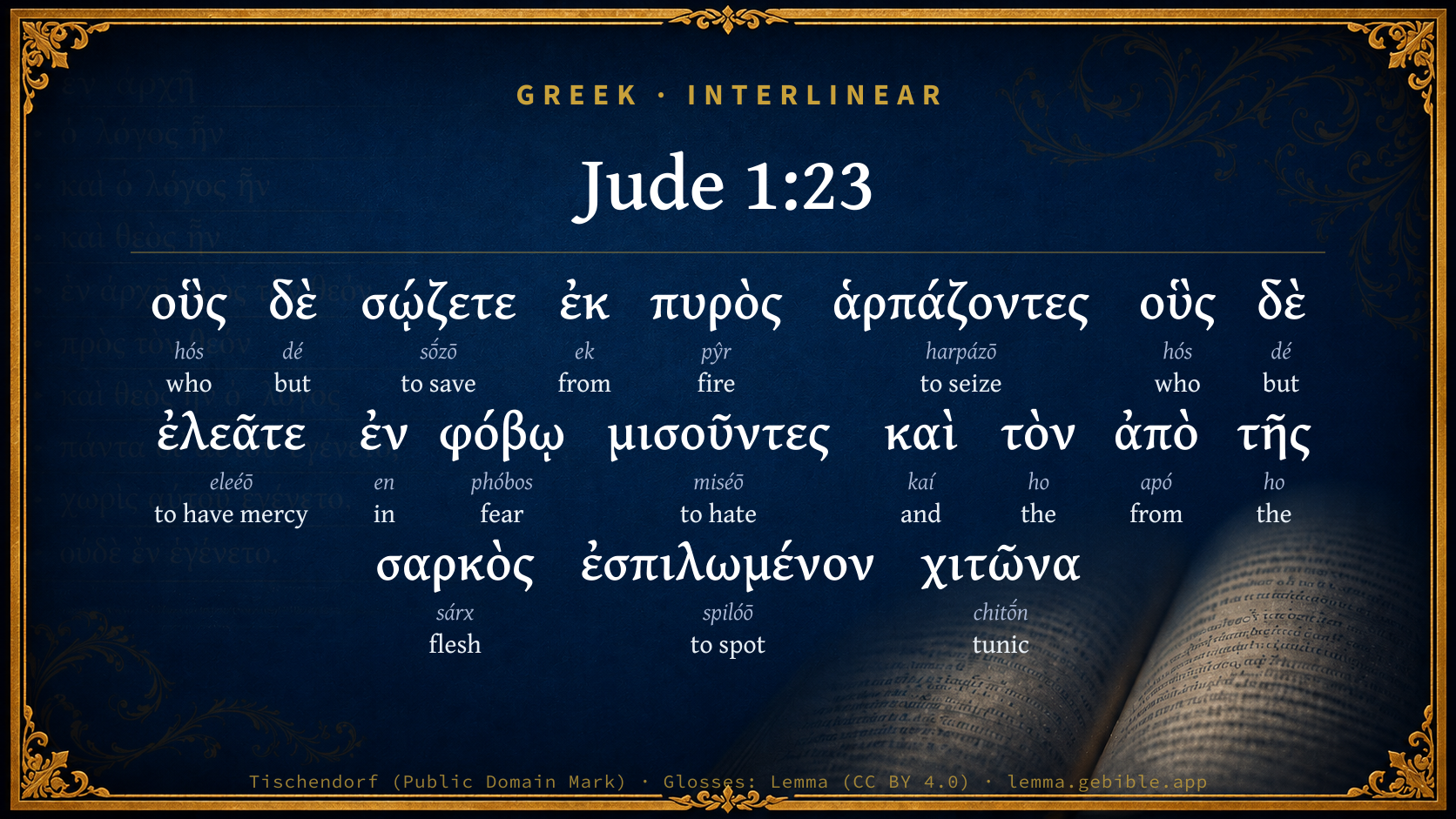
  1. οὓς hós G3739 “who” Relative pronoun, Accusative, Plural, Masculine
  2. δὲ dé G1161 “but” Conjunction
  3. σῴζετε sṓzō G4982 “to save” Verb, Present, Active, Imperative, 2nd person, Plural
  4. ἐκ ek G1537 “from” Preposition
  5. πυρὸς pŷr G4442 “fire” Noun, Genitive, Singular, Neuter
  6. ἁρπάζοντες harpázō G726 “to seize” Verb, Present, Active, Participle, Nominative, Plural, Masculine
  7. οὓς hós G3739 “who” Relative pronoun, Accusative, Plural, Masculine
  8. δὲ dé G1161 “but” Conjunction
  9. ἐλεᾶτε eleéō G1653 “to have mercy” Verb, Present, Active, Imperative, 2nd person, Plural
  10. ἐν en G1722 “in” Preposition
  11. φόβῳ phóbos G5401 “fear” Noun, Dative, Singular, Masculine
  12. μισοῦντες miséō G3404 “to hate” Verb, Present, Active, Participle, Nominative, Plural, Masculine
  13. καὶ kaí G2532 “and” Conjunction
  14. τὸν ho G3588 “the” Article, Accusative, Singular, Masculine
  15. ἀπὸ apó G575 “from” Preposition
  16. τῆς ho G3588 “the” Article, Genitive, Singular, Feminine
  17. σαρκὸς sárx G4561 “flesh” Noun, Genitive, Singular, Feminine
  18. χιτῶνα chitṓn G5509 “tunic” Noun, Accusative, Singular, Masculine

About this verse

These counts appear in no published source. They are computed here, from the morphology-tagged text and Lemma’s own curated glosses. What Lemma adds →

19
words
16
distinct lemmas
General Epistles
section

Notable vocabulary

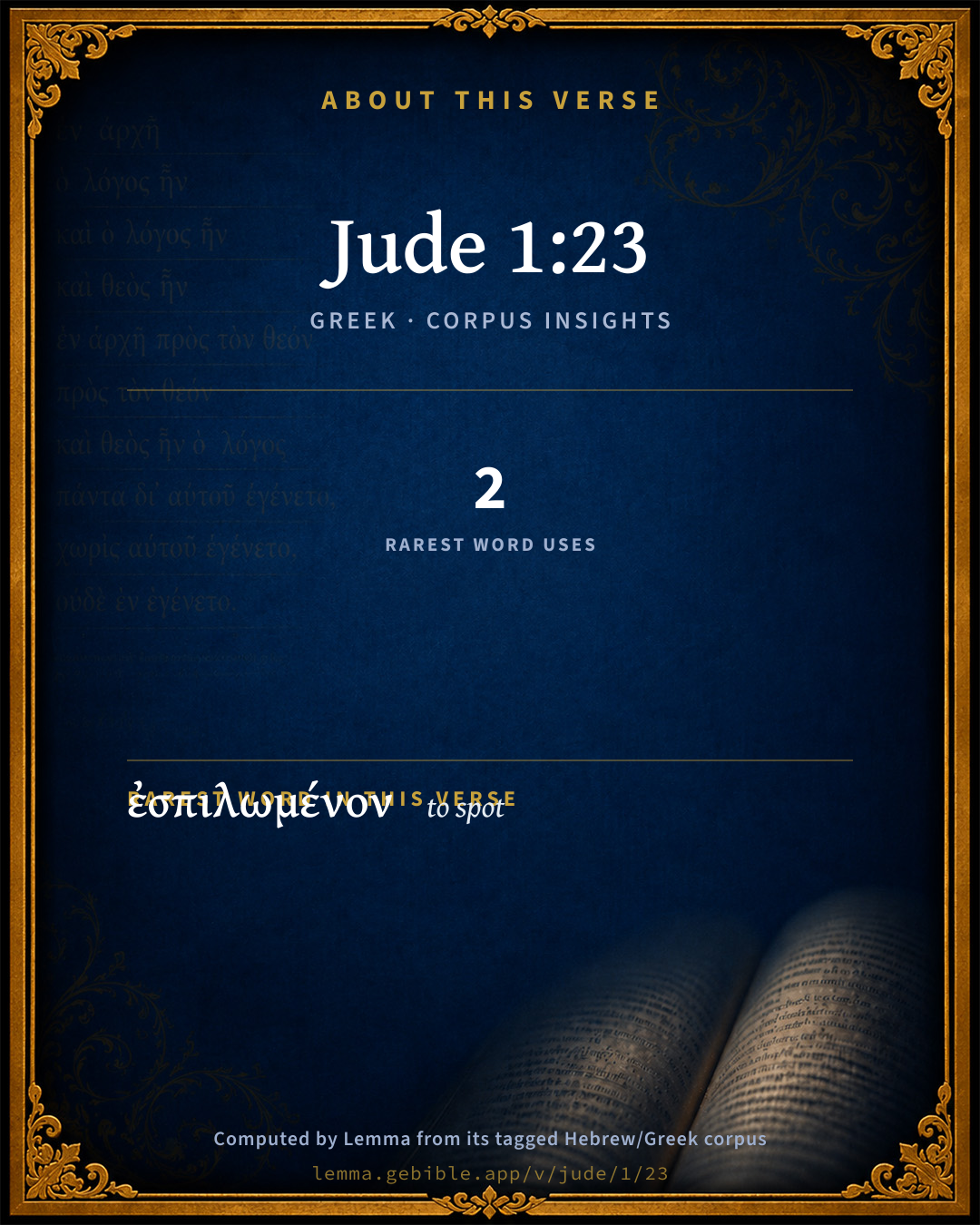
The rarest word here is ἐσπιλωμένον to spot G4695 — appearing just 2 times in the whole Greek New Testament.

Shared distinctive vocabulary

ἐσπιλωμένον to spot G4695 occurs in 2 verses of the Greek New Testament. Also found in:

Repetition

Words recur within this verse:

Cross-references

17

Topical passages linked to Jude 1:23 in the Treasury of Scripture Knowledge — connected by theme and wording, ordered by reader-vote popularity; previews shown in the World English Bible.

  • 1 Timothy 4:16 Pay attention to yourself, and to your teaching. Continue in these things, for in doing this you will save both yourself and those who hear you.
  • 1 Corinthians 15:33 Don't be deceived! "Evil companionships corrupt good morals."
  • Revelation 3:4 Nevertheless you have a few names in Sardis that did not defile their garments. They will walk with me in white, for they are worthy.
  • 2 Corinthians 7:10–12 For godly sorrow works repentance to salvation, which brings no regret. But the sorrow of the world works death.
  • 2 Thessalonians 3:14 If any man doesn't obey our word in this letter, note that man, that you have no company with him, to the end that he may be ashamed.
  • Romans 11:14 if by any means I may provoke to jealousy those who are my flesh, and may save some of them.
  • Zechariah 3:2–5 Yahweh said to Satan, "Yahweh rebuke you, Satan! Yes, Yahweh who has chosen Jerusalem rebuke you! Isn't this a burning stick plucked out of the fire?"
  • Revelation 3:18 I counsel you to buy from me gold refined by fire, that you may become rich; and white garments, that you may clothe yourself, and that the shame of your nakedness may not be revealed; and eye salve to anoint your eyes, that you may see.
  • Isaiah 64:6 For we are all become as one who is unclean, and all our righteousness are as a polluted garment: and we all do fade as a leaf; and our iniquities, like the wind, take us away.
  • 1 Corinthians 5:3–5 For I most assuredly, as being absent in body but present in spirit, have already, as though I were present, judged him who has done this thing.
  • Leviticus 13:47–59 "The garment also that the plague of leprosy is in, whether it is a woolen garment, or a linen garment;
  • Leviticus 14:47 He who lies down in the house shall wash his clothes; and he who eats in the house shall wash his clothes.
  • Lamentations 4:14 They wander as blind men in the streets, they are polluted with blood, So that men can't touch their garments.
  • Amos 4:11 "I have overthrown some of you, As when God overthrew Sodom and Gomorrah, And you were like a burning stick plucked out of the fire; Yet you haven't returned to me," says Yahweh.
  • 1 Corinthians 3:15 If any man's work is burned, he will suffer loss, but he himself will be saved, but as through fire.
  • 1 Corinthians 5:9–11 I wrote to you in my letter to have no company with sexual sinners;
  • Leviticus 15:17 Every garment, and every skin, whereon the semen is, shall be washed with water, and be unclean until the evening.

Cross-references courtesy of OpenBible.info (CC BY 4.0).

Where the printed editions differ

1 variant

Places in this verse where the major printed Greek editions disagree on the wording in a way that affects the translation — a comparison of editions, not a manuscript-by-manuscript collation. The editions are the modern critical texts (Nestlé-Aland 28/27, SBL, Westcott-Hort, Tregelles, Tyndale House) and the traditional texts behind the KJV (the Textus Receptus and the Byzantine/Majority text). It is not a claim about which reading is original.

  1. Extra text
    οὓς δὲ ἐλεᾶτε

    “to others then do show mercy”

    In NA28NA27TynSBLWHTreg Not in TRByz

    οὓς δὲ ἐλεᾶτε (hous de eleate) 'to others then do show mercy' is only in older manuscripts (NA28+NA27+Tyn+SBL+WH+Treg)

Textual data: Translators Amalgamated Greek New Testament (STEPBible TAGNT) · CC BY 4.0.

Commentary

Notes on Jude 1:23 from classic Christian and Jewish commentators (each source and its license shown beneath its notes). The classic Christian expositions comment on the surrounding passage and are grouped to its opening verse, so a note may address several verses; the Jewish commentaries on the Tanakh (Rashi and others) are per-verse, so they appear only where the commentator wrote on this verse.

Lemma curates 59 commentaries, every one of them public domain or Creative Commons licensed, each selected and text-cleaned for this edition rather than reprinted as found. About our sources →

The Biblical Illustrator

Joseph S. Exell

Jud_1:23

Pulling them out of the fire.

Gods firemen

By this text we are reminded that there are points of resemblance between sin and fire. The writer has before his mind, not a harmless fire, in range or furnace, for utility and comfort, but a dangerous, spreading conflagration, which demands immediate attention, and which makes the energy implied in the text both seemly and appropriate.

I. Sin is like fire, because it is mysterious. What is fire? Of what are its consuming properties composed? What weight, shape, or size is it? No man can answer these questions. Yet, with all the mystery, we have such palpable evidence that there is such a thing as fire that no sane man would dare to deny it. So sin is a mystery. How came it into existence in a world made and governed by a Being of almighty power and love? Yet no man, properly under the sway of reason, can allow the mystery to cause him to ignore or deny the fact of sin. We have seen the destructive work it has wrought in society, and alas! what is worse than all, every man has felt its scorching in his own heart.

II. Sin is like fire, because it exists in a twofold state--latent and active. Fire, in its active state, renders our homes habitable in winter, illuminates our cities by night, flames out in the sweeping conflagration, drives our factories and railways, flashes into the lightning, and thunders in the earthquake. Fire, in its latent state, exists in every material object about us. So sin exists in an active and latent state. In its active state it flames out in Sabbath desecration, profanity, and reckless living. It blazes up before the public in the destruction of individual character; it flashes out in deeply laid schemes of political corruption and in gigantic plans of commercial dishonesty. Sin, in its latent state, is strikingly symbolised by latent fire. It slumbers in the heart of universal humanity; it exists in every man that comes into the world. The virtue of some people is nothing more than vice sleeping; all it wants is contact with some tempting circumstance to awake it into vigour. As savages light their fire by rubbing pieces of wood together, so men stir up the latent fire of depravity by mutual contact. There is sufficient latent fire around us to burn up the globe; and there is sufficient latent sin in human nature to turn this world into a hell. Latent sin in the heart of a child is somewhat like latent fire in nature. At first it does no particular damage, and scarcely indicates its presence. Through the friction of temper, the whispers of self-love, and the gusts of provocation, however, it soon begins its destructive work, though the seriousness of its doings may not be even suspected. Thus it is that sin begins its withering, debilitating business in the human heart. Like latent fire in a forest, it soon begins to destroy the roots and fibres of the moral nature. There are persons all about us, the very fibres and roots of whose character are all charred and wasted by this latent fire of sin, and they are ready to topple over into disgrace and ruin as soon as a gale of temptation comes in the right direction.

III. Sin is like fire, because of its power to attract. How a child loves to toy with fire! how oblivious to the possible consequences! What multitudes are attracted by a conflagration; what haste they make, and what dangers they run! So there is a marvellous power in sin to lure and fascinate, especially to the young to decoy them from the path of innocence and purity into the fiery pathways of sin and death.

IV. Sin is like fire, because it is remorselessly indifferent as to what it destroys. The most splendid mansions, the most costly furniture, the most valuable paintings, the rarest gems of art, all, all are consumed as ruthlessly as the meagre contents of the beggars hovel. So with sin. The man of broadest nature and noblest parts is the most tempting mark for Satan. No conflagration is so disastrous and dreadful as the burning down of a man. I have seen the poor wretch weep and groan under the periodical consciousness of the awful destiny before him. I have watched the progress of the fire, and seen self-control give way, and self-respect give way, and regard for the good opinion of others give way, and love of wife and children give way, and hope, the longest and strongest rafter in the structure, give way, and the whole man collapse--a heap of ghastly, smouldering ruins; a disgrace to his family, and a curse to the community where he lived.

V. Sin is like fire, because it turns everything into its own essence. Not only will fire turn ordinary fuel into fire, but also princely mansions; the most precious gems and diamonds, when brought in contact with fire, are at once transformed into its own nature. There is hardly any object in nature, even the hardest granite, that fire cannot turn into fire. So it is with sin. Its uniform tendency is to make everything like itself over which it gains control--that is, a curse. When Archimedes, in order to wreak vengeance upon the Romans, brought down the genial rays of the sun by his magic glass and burned up their ships, he only dramatised the universal fact that sin ever strives to turn the greatest blessings of God into the greatest curse.

VI. Sin is like fire, because it can be resisted and put out, and must be, or it will destroy everything within its reach. You cannot set fire to the forest and accomplish the desire of burning down just one acre. So no man can kindle the fire of sin in the forest of his appetites and passions and forecast correctly the extent of the burning. Sin is like fire, then, because it must be resisted and put out, or it will destroy everything combustible within its reach. Fire, properly resisted, can be put out. So, thank God, the fire of sin can be put out, and God has His firemen to do it. (T. Kelly.)

The damager of sizzlers

A poor, guilty, secure sinner is like a drunken man that is fallen into the fire.

1. In point of security. He is ready to be burned, but he feeleth it not.

2. In point of danger. Sinners are compared to a brand in the burning (Zec_3:2; Amo_4:11). They are in the suburbs of hell, the fire is already kindled.

3. In point of impotency and inability to help themselves. Minister! art thou sensible of the danger of souls? Christian! art thou sensible of the danger of thy carnal neighbours? (T. Manton.)

Zeal in saving others

There was a medical student at Edinburgh who was half through his course of four years, and he worked very hard and had lived an entirely selfish life. One day he said, Here are four of the best years of my life, and I have never done a hands turn to make better or to help any other fellow. He then found another medical student who had come from the same part of the country as himself. He had gone to the bad. His people had given him up. He was drinking himself to death. For months he had not read a book. This first man had not seen him for months, but he went out to hunt him up. He found the man still drunk, and said to him, These are poor lodgings for you. I want to take you to my rooms. The other man said, I am in debt. Well, I will pay your bill, replied number one. They gathered up the luggage and number one led the way to his room. Next morning number one said, Look here, I have a little contract. We will mess here together for the next few months. I have written out here four articles, which we will both sign. The first is, neither of us to go out alone. The second is, if either of us have to go out alone, twenty minutes to be allowed to go to the Commons and back, overtime to be accounted for. The third, one hour to be set aside every night for pleasure, anything but study; and the fourth, that bygones shall be bygones. Things went well for a month. One night number two threw down his Anatomy and said, I cannot stand this any longer. I want to have a bust. Very well, replied the other, bust here. What do you want? I want some drink. Number one got some drink, and number two had his bust there, and was thus tided over the hour. That hour comes to every man who is trying to reform. He must treat himself like a convalescent. If there is a man who is beginning to live a better life, let him remember for the next three months that he is a convalescent. He must not go into a draught or he will take cold. He must not read the books he read last week. Number two wanted another bust, and he got it, but he did not leave the room. And so the months passed. One night number two said to number one, I notice you reading a book. I see you read the Bible, and you never talk to me about religion. Talk about religion! What was the use of talking religion when the man was living the life of Christ before him? and living is the one thing that is of value in religion. Number one said, If you choose we will read together. He read a couple of verses, but number two stopped him and said, That is enough now. Number one passed out after the two years. He did not have a brilliant record; he was only a fairly commonplace man. Number two, on the other hand, who had been picked up out of the gutter, passed out with special honour. The last I heard of them, number one was filling an appointment in London, and number two was known as the Christian Doctor. Do you think that when number one looks back upon his college course he will not see standing above it all the face of that one man whom he saved? (Prof. H. Drummond.)

Self-salvation not the only concern of Christians

A man who has been shipwrecked with a thousand others happens to get upon the shore, and the others are all down in the surf. He goes up into a fishermans cabin and sits down to warm himself. This fisherman says, Oh, this wont do. Come out and help me to get these others out of the surf. Oh, no! says the man; its my business now to warm myself. But, says the fisherman, these men are dying; are you not going to give them help? Oh, no! Ive got ashore myself, and I must warm myself! That is what people are doing in the Church to-day. (T. De Witt Talmage.)

Soul-saving--a method amusing yet effective

Some of his methods of catching men and bringing them to decision were highly amusing. While he was conducting revival services at Newark, a youth put his head inside the door to hear what was going on. This lad had a shock of curly hair that arrested Mr. Marsdens attention. Presently he walked down the aisle to the door, and spoke kindly to the lad, and invited him to come in. As he seemed timid and inclined to run away, the preacher laid hold of A handful of curls and held him fast. Then he told him how the Lord Jesus Christ wanted to make a man of him, and the devil wanted to make a fool of him; and urged him to come and seek for mercy. He pleaded with the lad, and gently pulled his curls, till the lad followed his hair and marched up the aisle to the communion rail. The preacher held him by the hair till he had safely deposited him among the penitents. The youth was converted, and became a minister in one of the sister churches, and often tells his friends that Isaac Marsden brought him to Christ by the hair of his head. (John Taylors Reminiscences of Isaac Marsden.)

A passion for the saving of souls

But what we need most is a keener appreciation of our relationship to the souls of those with whom we have to do--a profounder interest in their spiritual well-being--a stronger anxiety that men may be saved. It is written of the sainted Alleine, author of the Alarm to the Unconverted, that he was infinitely and insatiably greedy of the conversion of souls. Bunyan said, I could not be satisfied unless some fruits did appear in my work. Brainerd, on more than one occasion, said, I care not where or how I live, or what hardships I go through, so that I can but gain souls to Christ. Doddridge, writing to a friend, said, I long for the conversion of souls more sensibly than anything besides. Matthew Henry wrote, I would think it a greater happiness to gain one soul to Christ than mountains of silver and gold to myself. The sainted Fletcher said to Samuel Bradburn, when as a young man he called to see him as the Vicar of Madeley, If you should live to preach the gospel forty years, and be the instrument of saving only one soul, it will be worth all your labours. Whitfield seldom preached without weeping under the solemn impression of the value of souls. He said one day in his sermon, How can I help weeping when you will not weep for yourselves, though your immortal souls are on the verge of destruction! Dr. Lyman Beecher, when dying, said to a minister standing by his couch, The greatest of all things is not theology; it is not controversy; it is to save souls. (J. H. Hitchen.)

Pulling men out of the fire

On one occasion Charles Simeon was summoned to the dying bed of a brother. Entering the room, his relative extended his hand to him, and with deep emotion said, I am dying; and you never warned me of the state I was in, and of the danger to which I was exposed by neglecting the salvation of my soul! Nay, my brother, replied Mr. Simeon, I took every reasonable opportunity of bringing the subject of religion before your mind, and frequently alluded to it in my letters. Yes, exclaimed the dying man, you did; but that was not enough. You never came to me, closed the door, and took me by the collar of my coat, and told me that I was unconverted, and that if I died in that state I should be lost. And now I am dying; and but for Gods grace I might have been for ever undone! It is said that this affecting scene made an ineffaceable impression on Mr. Simeons mind.

Earnest to save souls

The traveller who crosses the Alps by the St.Bernard, Simplon, or Splugon Pass, finds situated near the summit a friendly hospice. Knocking timidly at the door, it is promptly opened by a good-natured monk, who bids him welcome; warming his half-frozen limbs before the blazing fire, and chatting merrily with half a dozen priests, he thinks what easy lives these men lead. Suddenly the clouds gather, the wind howls, the blinding snowflakes fall; and starting up, calling their faithful dogs around them, these bravo fellows go forth in the teeth of the tempest. Why and where are they going? To seek and succour belated travellers who may be out in the storm. Why not wait till they come and knock at the door as I did? Wait, man! Why, they would have to wait till doomsday. God help any poor creatures out on such a night! They must have lost their way. Half buried beneath the snow, they are beginning to sleep the sleep that knows no waking. So if the masses are to be aroused, the perishing rescued, we must do more than merely sit week by week in our comfortably cushioned, brilliantly lit, and cosily warmed sanctuaries. We must do more than merely stand at the church doors, waiting to welcome those who, with timid faith and dawning love, desire to be admitted to our fellowship. There are many who will never knock at the door; they are too far gone for that. They are sleeping, dying; they need to be shaken and roused. And men are wanted who will trudge forth over snow and ice; who, like the Master, will go out to seek and to save that which was lost. (E. G. Gange.)

Hating oven the garment spotted by the flesh.

Sin to be carefully shunned

Personal holiness, the concern for which called forth this admonition, is uniformly the object of Christian doctrine and Christian precept. To profess faith in Christianity is to choose a life of purity; for in our professing it we are said, according to a strong figure, to put on Christ Jesus.

I. Be warned against the influence of every degree of familiarity with what is sinful. To come so frequently in the way of sin as to see men engaged day after day, and thus to grow familiar with the view of what is criminal, may indeed easily be calculated in the amount of its evil influence. The perception of the odiousness of iniquity is thereby weakened--the sensibility of conscience is diminished--partial attention, indifference, and callousness to vice often follow in quick succession.

II. For the same important end it is suggested that these words of the apostle may warn you, not only against the vices of the world themselves, But likewise against whatever is allied to them. It is, you will observe, not the disease merely, but even the garment infected with it, which you are to turn from. That is, everything that may prove an incitement, or an accessory, or by remote and indirect ways an introduction to sin, is to be shunned for the very reasons which urge you to flee from the sin itself. The doing so is cutting off the possibility, by removing the occasions, of guilt. It is as a person extinguishing the little spark which his taper has thrown off among the combustible materials of his dwelling. It is as a person closing up every chink and aperture in his embankment against the stream. It is as a person not suffering himself to touch even a shred of raiment which has lain in the vicinity of the plague. The wisdom which these illustrations recommend does reflect, it must be owned, somewhat hardly upon many of the indulgences in common life. These indulgences are allowed and entered into, because you cannot prove that there is anything decidedly sinful in them. There is an amusement which no law, either human or Divine, can be brought to condemn. And if there be nothing criminal in it, am I not free, every one asks, to partake of it? But the person who, following the principles of Christianity, is sincerely desirous of advancing his moral improvement will deem it necessary to ascertain first what is its tendency, whither it leads, what shall be its effects on his peculiar condition or temperament. Is it the forerunner, or the means, or the attendant of aught that is wrong? To say absolutely that we are to enter into no situation where we may dread the exercise of any evil influence upon the principles and habits of the religious character would certainly be prescribing what cannot be practised. We should have, as the apostle expresses himself, to go out of the world. But still is it not true that there is frequently an uncalled-for, a premature, a rash, and hence a hazardous, intercourse with the world? Are not situations entered upon without due forethought? Are not objects pursued after with avidity, the utility or hurtfulness of which has never been seriously considered? Where the wonder, then, that the garment which no care is exerted to retain pure should, in the very centre of pollution, become spotted?

III. To the duty of shunning evil there is another which it is incumbent on us to add, the strong language of the text intimating that iniquity is to be the object of our expressed aversion. We are to hate it, and to show that we do so. Hence, if ever there is made in our hearing the attack against our blessed religion, whether through the grave objections of philosophy or the sarcasms of profane wit--if ever those immoral maxims which, for the easier diffusion, are coloured over with the fallacious names of liberality are inculcated in our presence--if ever the character and ordinances of our God and Saviour are lightly spoken of, or those works which His Spirit is sent to destroy are approved and defended before us, let us feel how urgent is the call to make that confession before men, which is to be followed with the acknowledgment of our fidelity before the Father and His holy angels. In these circumstances, however, we cannot make that confession without showing hatred to what opposes the high subject of our confession. And hatred, when turned against sin and all the appearances of sin, is the only lawful form under which that passion may be cherished. Nothing is so worthy of our hatred. Ought sin ever to be seen by us, then, without moving aversion and stirring up a holy resentment within us?

IV. But here let us be admonished, while we cherish and on every fit occasion express the feeling of zeal against iniquity, to make it ever appear that our hatred is all the while to the sin, and not to the sinner. Him we compassionate; and we are not to leave him in doubt that he is the object of our sympathy. And let us remember that there is no hope of giving efficacy to our remonstrances against sin, nor of recommending the good cause for the support of which we offer ourselves, nor of honouring the name of Jesus by our testimony to His gospel, as long as we render it hard to separate our zeal for religion from the appearance of a proud struggle for our own superiority. Pride, contempt, and overbearing haughtiness make the sinner feel that you are hostile to his person. He is stirred up, as it were, to the defence of his own interests. Charity is the subduing part of religious zeal. I repeat it therefore, Let there be hatred at the very garment spotted by sin. But show that you have none to the unhappy person who wears it. (W. Muir, D. D.)

Abstinence from sin

In these words the apostle speaks figuratively. He wishes to exhort to abstinence from all and every kind of sin. And to make his exhortation the more easily remembered and the more deeply impressed, he clothes it in metaphor. The religion which preceded Christianity was the Jewish, established amongst a peculiar people for certain wise and intelligible reasons. In this dispensation God taught His people more by signs than words, by ceremonies than by precepts Time will not permit to speak of all the figurative instruction of the Jewish religion. But, in connection with our text, I may speak of the figurative distinctions of clean and unclean. Under this dispensation, then, there were many things considered unclean. Certain animals--as, for instance, swine--came within this evil distinction; and persons with certain diseases, such as leprosy or an issue of blood, were prohibited all intercourse with their fellows during the time the disease lay upon them; and a corpse was considered unclean; and those who might happen to touch it, or to come in contact with persons already unclean through disease or other causes, were themselves for a season unclean. Now, this calling of some things clean and unclean was designed to notify unequivocally the broad immutable distinction between sin and holiness, their utter, unending contrariety. But our text has a more especial reference to the uncleanness of leprosy. Leprosy in the East was a very loathsome disease, and fitly symbolises sin. And such was the virulence of his malady that none might approach or touch him; for there was uncleanness, not only in his personal touch, but in his garments. The garments became spotted by the flesh; they partook of the infection, and brought beneath a ban the unfortunate who might touch them. There appears to have been also an independent plague, peculiarly affecting raiment. Now God commanded His priests to destroy those leprous garments (Lev_13:47-52). Do we, then, arrive at an understanding of the apostles figure? Does it not suggest a Christian precept of a like significance, but written in plain, unfigurative language? To hate the garment spotted by the flesh is to keep sin at the farthest distance; to avoid those things into which it can by subtilty infuse its fatal poison; things which, though lawful and innocent, may prove by remote possibility the occasion of falling to ourselves and to others. It is to keep far within the border-line which separates holiness from sin; not to venture out among the outposts, lest there be a sudden surprise, but to remain entrenched within the citadel, within which is safety. (R. L. Joyce, B. A.)

Purity of character

Over the beauty of the plum and the apricot there grows a bloom and beauty more exquisite than the fruit itself--a soft, delicate flush that overspreads its blushing cheek. Now, if you strike your hand over that, and it is once gone, it is gone for ever, for it never grows but once. The flower that hangs in the morning impearled with dew--arrayed as no queenly woman ever was arrayed in jewels--once shake it so that the beads roll off, and you may sprinkle water over it as you please, yet it can never be made again what it was when the dew fell silently upon it from heaven. On a frosty morning you may see the panes of glass covered with landscapes--mountains, lakes, and trees blended in a beautiful, fantastic picture. Now lay your hand upon the glass, and by the scratch of your finger or by the warmth of your palm all the delicate tracery will be obliterated. So there is in youth a beauty and purity of character which, when once touched and defiled, can never be restored. Such is the consequence of crime. Its effects cannot be eradicated; it can only be forgiven.

The Biblical Illustrator, edited by Joseph S. Exell (c. 1880s–1900s) — public domain. Text from a community e-Sword module.

Tyndale Open Study Notes

Tyndale Open Resources

1:23 Rescue others: Some believers were so open to the false teachers that they were in imminent danger of condemnation. • Show mercy to still others: The third group probably consists of the false teachers themselves or those who had subscribed to the false teachers’ program. Showing mercy might have meant praying for them (cp. Matt 5:44). • Believers need to exercise great caution when showing mercy to false teachers and those who have fallen into their sinful ways, because their sins can be enticing. Cp. Zech 3:1-4; Rev 3:4.

Tyndale Open Study Notes — © Tyndale Open Resources, licensed CC BY-SA 4.0. Text via the HelloAO Bible API.

Expositor's Greek Testament

ed. W. Robertson Nicoll

Jud 1:23 . σώζετε . Here again a word which is strictly applicable to God is transferred to him whom God uses as His instrument, cf. 1Pe 4:11 and notes on τηρήσατε , ἐλέγχετε above, especially Jas 5:20 , ὁ ἐπιστρέψας ἁμαρτωλὸν ἐκ πλάνης ὁδοῦ αὐτοῦ σώσει ψυχὴν ἐκ θανάτου .

ἐκ πυρὸς ἁρπάζοντες . The expression is borrowed from Amo 4:11 , κατέστρεψα ὑμᾶς καθὼς κατέστρεψεν ὁ Θεὸς Σόδομα καὶ Γόμορρα , καὶ ἐγένεσθε ὡς δαλὸς ἐξεσπασμένος ἐκ πυρός , καὶ οὐδʼ ὣς ἐπεσπρέψατε πρός με , λέγει Κύριος , and Zec 3:3 , οὐκ ἰδοὺ οὗτος δαλὸς ἐξεσπασμένος ἐκ πυρός ; Both passages have further connexions with our epistle, the former from the reference to Sodom (see above Jud 1:7 ), the latter as following immediately on the words, ἐπιτιμήσαι σοι Κύριος quoted in Jud 1:9 , and preceding a reference to filthy garments (see note below). In it the High Priest Joshua is a representative of Israel, saved like a brand from the captivity, which was the punishment of national sin. The image of fire is naturally suggested by the allusion to the punishment of Sodom in the passage of Amos, and of Korah (see above Jud 1:7 ) described in Num 16:35 , Psa 106:18 , ἐξεκαύθη πῦρ ἐν τῇ συνα γωγῇ αὐτῶν καὶ φλὸξ κατέφλξεν ἁμαρτωλούς . The writer may also have had in mind St. Paul’s description of the building erected on the One Foundation (see above Jud 1:20 ), which, he says, will be tried by fire, 1Co 3:13-15 , ἑκάστου τὸ ἔργον ὁ ποῖόν ἐστιν , τὸ πῦρ αὐτὸ δοκιμάσει … εἴ τινος τὸ ἔργον κατακαήσεται , ζημιωθήσεται , αὐτὸς δὲ σωθήσεται , οὕτως δὲ ὡς διὰ πυρός . Such an one may be spoken of as “a brand snatched from the fire,” not however as here, saved from the fire of temptation, but as saved through the agency of God’s purgatorial fire, whether in this or in a future life.

ἐλεᾶτε ἐν φόβῳ . The faithful are urged to show all possible tenderness for the fallen, but at the same time to have a fear lest they themselves or others whom they influence should be led to think too lightly of the sin whose ravages they are endeavouring to repair. Cf. 2Co 7:1 , καθαρίσωμεν ἑαυτοὺς ἀπὸ παντὸς μολυσμοῦ σαρκὸς καὶ πνεύματος ἐπιτελοῦντες ἁγιωσύνην ἐν φόβῳ Θεοῦ , Php 2:12 , 1Pe 1:17 ; 1Pe 3:15 . For the confusion of the contracted verbs in - έω and - άω in late Greek see Jannaris, § 850. § 854 f., Winer p. 104. The best MSS. read ἐλεᾷ in Pro 21:26 , and ἐλεῶντος Rom 9:16 , but ἐλεεῖ in Rom 9:18 .

μισοῦντες καὶ τὸν ἀπὸ τῆς σαρκὸς ἐσπιλωμένον χιτῶνα . While it is the duty of the Christian to pity and pray for the sinner, he must view with loathing all that bears traces of the sin. The form of expression seems borrowed from such passages as Isa 30:22 , Lev 15:17 , perhaps too from Zec 3:4 , Ἰησοῦς ἦν ἐνδεδυμένος ἱμάτια ῥυπαρά . Cf. Rev 3:4 , οὐκ ἐμόλυναν τὰ ἱμάτια αὐτῶν , and Apocal. Pauli quoted by Spitta, ὁ χιτών μου οὐκ ἐρυπώθη . The derivatives of σπίλος are peculiar to late Greek: the only other examples of σπιλόω in Biblical Greek are Jas 3:6 , ἡ γλῶσσα … ἡ σπιλοῦσα ὅλον τὸ σῶμα and Wis 15:4 , εἶδος σπιλωθὶν χρώμασι διηλλαγμένοις . Compare for the treatment of the erring 2Ti 2:25-26 , ἐν πραΰτητι παιδεύοντα τοὺς ἀντιδιατιθεμένους , μήποτε δῷη αὐτοῖς ὁ Θεὸς μετάνοιαν εἰς ἐπίγνωσιν ἀληθείας , καὶ ἀνανήψωσιν ἐκ τῆς τοῦ διαβόλου παγίδος .

The Expositor's Greek Testament, edited by W. Robertson Nicoll (1897–1910) — public domain. Text from a community e-Sword module.

Geneva Bible (1599)

Geneva Bible translators

By fearing them, and holding them back with godly severity.

An amplification taken from the forbidden things of the Law which did defile.

Geneva Bible (1599) marginal notes — public domain. Text via Bolls.life.

Jamieson, Fausset & Brown

Robert Jamieson, A. R. Fausset & David Brown

save with fear--The oldest manuscripts do not read "with fear" in this position: but after "snatching them out of the fire" (with which, compare Amo 4:11; Co1 3:15; Zac 3:2, said of a most narrow escape), they add the following words, forming a THIRD class, "and others compassionate with (IN) fear." Three kinds of patients require three kinds of medical treatment. Ministers and Christians are said to "save" those whom they are made the instruments of saving; the Greek for "save" is present, therefore meaning "try to save." Jude already (Jde 1:9) had reference to the same passage (Zac 3:1-3). The three classes are: (1) those who contend with you (accusative case in oldest manuscripts), whom you should convict; (2) those who are as brands already in the fire, of which hell-fire is the consummation: these you should try to save by snatching them out; (3) those who are objects of compassion, whom accordingly you should compassionate (and help if occasion should offer), but at the same time not let pity degenerate into connivance at their error. Your compassion is to be accompanied "with fear" of being at all defiled by them.

hating--Even hatred has its legitimate field of exercise. Sin is the only thing which God hates: so ought we.

even the garment--a proverbial phrase: avoiding the most remote contact with sin, and hating that which borders on it. As garments of the apostles wrought miracles of good in healing, so the very garment of sinners metaphorically, that is, anything brought into contact with their pollution, is to be avoided. Compare as to lepers and other persons defiled, Lev 13:52-57; Lev 15:4-17 : the garments were held polluted; and anyone touching them was excluded, until purified, from religious and civil communion with the sanctified people of Israel. Christians who received at baptism the white garment in token of purity, are not to defile it by any approach to what is defiled.

Jamieson, Fausset & Brown — Commentary Critical and Explanatory on the Whole Bible (1871) — public domain (CC PDM 1.0). Text via the HelloAO Bible API.

Adam Clarke's Commentary

Verse 23. And others save with fear] "Some of them snatch from the fire: but when they repent, have mercy upon them in fear."-Syriac. "And some of them rebuke for their sins; and on others have mercy when they are convicted; and others save from the fire and deliver them."-Erpen's Arabic. Mr. Wesley's note has probably hit the sense. "Meantime watch over others as well as yourselves; and give them such help as their various needs require. For instance, 1. Some that are wavering in judgment, staggered by others' or by their own evil reasoning, endeavour more deeply to convince of the truth as it is in Jesus. 2. Some snatch with a swift and strong hand out of the fire of sin and temptation. 3. On others show compassion, in a milder and gentler way; though still with a jealous fear, lest you yourselves be infected with the disease you endeavour to cure. See therefore that, while ye love the sinners, ye retain the utmost abhorrence of their sins, and of any, the least degree of or approach to them."

Having even the garment spotted by the flesh.] Fleeing from all appearance of evil. Dictum sumptum, ut apparet, a mulieribus sanguine menstruo pollutis, quarum vestes etiam pollutae censebantur: or there may be an allusion to a case of leprosy, for that infected the garments of the afflicted person, and these garments were capable of conveying the contagion to others.

Adam Clarke's Commentary on the Bible (1810–1826) — public domain. Text from a community e-Sword/MySword module.

John Calvin's Commentaries

23. Hating even the garment. This passage, which otherwise would appear obscure, will have no difficulty in it, when the metaphor is rightly explained. He would have the faithful not only to beware of contact with vices, but that no contagion might reach them, he reminds them that everything that borders on vices and is near to them ought to be avoided: as, when we speak of lasciviousness, we say that all excitements to lusts ought to be removed. The passage will also become clearer, when the whole sentence is filled up, that is, that we should hate not only the flesh, but also the garment, which, by a contact with it, is infected. The particle καὶ even serves to give greater emphasis. He, then, does not allow evil be cherished by indulgence, so that he bids all preparations and all accessories, as they say, to be cut off.

John Calvin's Commentaries (1540-1563) — public domain. Text from the Calvin Translation Society English edition (1840s-50s) via the Christian Classics Ethereal Library (ccel.org). Calvin's coverage is partial (roughly two-thirds of the Bible); uncommented books and verses are honest gaps, never fabricated. The 19th-century editor's footnotes and remarks are omitted so the notes are faithfully Calvin's own voice.

The Cambridge Bible for Schools and Colleges

gen. ed. J. J. S. Perowne

23. and others save with fear, pulling them out of the fire] Here again the MSS. present a striking variation, those of most authority giving “others save, snatching them out of the fire, and have compassion on others with fear.” If we adopt this reading we have two classes of offenders brought before us, those who are to be saved as from the fire, as on the very verge of destruction, and those who are for some reason or other objects of a more tender pity, though they do not come within the range of immediate action. That pity, however, the context shews, was not to be accompanied by any tolerance of the evils into which they had fallen. In “snatching out of the fire” we have probably a reminiscence of the “brand plucked out of the fire” of Zec_3:2.

hating even the garment spotted by the flesh] The “garment” is the inner tunic worn next to the flesh, and therefore thought of as contaminated by its impurity, and it serves accordingly as a symbol of all outer habits of life that are affected by the inner foulness of the soul that is in bondage to the flesh. As men would loathe the touch of a defiled garment, bearing the stains of a cancerous ulcer, so they were to hate whatever was analogous to it in conduct (comp. Isa_30:22). The allusion to Zec_3:2 in the previous clause makes it probable that here also there is a reference to the “filthy garments;” polluted, i.e., with some ceremonial uncleanness, in which the high-priest Joshua the son of Josedech first appears in the prophet’s vision. In the benediction of Rev_3:4 on those who “have not defiled their garments,” we have the same imagery.

The Cambridge Bible for Schools and Colleges (gen. ed. J. J. S. Perowne; Cambridge University Press, 1878–1918) — public domain. Text from a community e-Sword module.

John Gill's Exposition

And others save with fear,.... Meaning false teachers, who lead others into errors, and such as give themselves over unto sin, whether teachers or hearers, and who are obstinate and irreclaimable; even such as these, means should be used to save, if possible, by sharp admonitions and severe language; by denouncing the awful judgments of God, which threaten them; by inflicting on them church censures in a terrible manner; by declaring the terrors of the Lord, and of hell, and of everlasting damnation:

pulling them out of the fire; of their soul destroying doctrines, and of their filthy and unnatural lusts, and as it were out of the fire of hell, of which they are in great danger:

hating even the garment spotted, by the flesh; by which may be meant the conversation of those men, even their filthy conversation, which is to be hated, though their persons are not; but all ways and means should be used to save them; and this is one way, by showing a dislike unto, and a resentment at their wicked way of living, excluding them from church communion for it, and shunning all conversation with them. The allusion is not to garments defiled by profluvious persons, or menstruous women, as some think, but to garments spotted with nocturnal pollutions, or through unnatural lusts, which these persons were addicted to (l). It was reckoned very dishonourable for religious persons, in the time of divine service, or on a sabbath day, to have on a garment spotted with any thing; if a priest's garments were spotted, and he performed service in them, that service was not right (m); and if a disciple of a wise man had any grease on his garments (on a sabbath day), he was guilty of death (n),

(l) Vid. Sueton. in Vita Neronis, c. 28. (m) T. Bab. Pesachim, fol. 65. 2. & Zebachim, fol. 18. 2. & Piske Tosephot in Yoma, art. 9. & Maimon. Cele Hamikdash, c. 8. sect. 4. (n) T. Bab. Sabbat, fol. 114. 1.

John Gill's Exposition of the Whole Bible (1746–1763) — public domain (CC PDM 1.0). Text via the HelloAO Bible API.

Albert Barnes' Notes on the Bible

And others - Another class; those who were of such a character, or in such circumstances, that a more bold, earnest, and determined manner would be better adapted to them.

Save with fear - That is, by appeals adapted to produce fear. The idea seems to be that the arguments on which they relied were to be drawn from the dangers of the persons referred to, or from the dread of future wrath. It is undoubtedly true, that while there is a class of persons who can be won to embrace religion by mild and gentle persuasion, there is another class who can be aroused only by the terrors of the law. Every method is to be employed, in its proper place, that we “by all means may save some.”

Pulling them out of the fire - As you would snatch persons out of the fire; or as you would seize on a person that was walking into a volcano. Then, a man would not use the mild and gentle language of persuasion, but by word and gesture show that he was deeply in earnest.

Hating even the garment spotted by the flesh - The allusion here is not quite certain, though the idea which the apostle meant to convey is not difficult to be understood. By “the garment spotted by the flesh” there may be an allusion to a garment worn by one who had had the plague, or some offensive disease which might be communicated to others by touching even the clothing which they had worn. Or there may be an allusion to the ceremonial law of Moses, by which all those who came in contact with dead bodies were regarded as unclean, Lev 21:11; Num 6:6; Num 9:6; Num 19:11. Or there may be an allusion to the case mentioned in Lev 15:4, Lev 15:10, Lev 15:17; or perhaps to a case of leprosy. In all such instances, there would be the idea that the thing referred to by which the garment had been spotted was polluting, contagious, or loathsome, and that it was proper not even to touch such a garment, or to come in contact with it in any way. To something of this kind the apostle compares the sins of the persons here referred to. While the utmost effort was to be made to save them, they were in no way to partake of their sins; their conduct was to be regarded as loathsome and contagious; and those who attempted to save them were to take every precaution to preserve their own purity. There is much wisdom in this counsel. While we endeavor to save the “sinner,” we cannot too deeply loathe his “sins;” and in approaching some classes of sinners there is need of as much care to avoid being defiled by them, as there would be to escape the plague if we had any transaction with one who had it. Not a few have been deeply corrupted in their attempts to reform the polluted. There never could be, for example, too much circumspection and prayer for personal safety from pollution, in attempting to reform licentious and abandoned females.

Albert Barnes' Notes on the Bible (1834–1885) — public domain. Text from a community e-Sword/MySword module.

Matthew Poole's English Annotations

And others; those that are further gone, not so easily reducible, and in great danger.

Save; i.e. labour to save them, as instruments under God.

With fear; by more severe courses, sharper reprehensions, setting before them God’s judgments against obstinate sinners, 1Co 5:5.

Pulling them out of the fire: it is a proverbial speech, Zec 3:2; the sense is, that as they that are in the fire, and like to be destroyed by it, must not be gently exhorted to come out of it of themselves, but speedily and forcibly pulled out, in consideration of their eminent danger; so they that are more stubborn sinners, being in apparent danger of being destroyed by the fire of their lusts, and being as it were in the mouth of hell, must be more harshly and severely dealt with, by setting the Lord’s terrors before them, 2Co 5:11, and inflicting church censures on them.

Hating even the garment spotted by the flesh: it is an allusion to that ceremonial law, Lev 15:4,17, where he that touched a defiled garment was himself defiled. The sense is, either:

1. That where there is danger of infection from heretics and obstinate sinners, all converse with them, and any thing whereby the contagion of their doctrine or manners may reach us, is to be avoided: or:

2. That when we reprehend others, we should do it with suitable affections, and though we would save themselves, we should hate their vices, and any thing that promotes them or savours of them.

Matthew Poole's English Annotations on the Holy Bible (1683–1685) — public domain. Text from a community e-Sword/MySword module.

Whedon's Commentary on the Bible

Daniel D. Whedon

23. Others—A second class.

Save—The Greek present signifies the effort to save, but does not, as the aorist would, imply a sure saving result, or the absolute power to accomplish a success.

Pulling them out of the fire—As if they were in terrible danger of being scorched and burnt by the errorists, yet could, perhaps, be rescued with a desperate pull.

With fear—Belongs to third class. Read: Others still, compassionate with fear… hating, etc. This third class we can only pity, with a mingled feeling of fear and abhorrence of their shame-bespotted characters.

The sin and danger of the three classes increase in climax. First, there is the set in the Church inclined to be schismatic, who must be rebuked and brought to order. Second, the class tending towards the vice of the sensualists, who are to be rescued with an energetic pull from their fatal course. Third, the nearly hopeless apostate, whom we can little else than pity, and from whose contaminated natures we are obliged to shrink.

Garment spotted by the flesh—A fearful emblem of depravity. Their tunic or under-garment is foul with the spots of their debauchery. Rev_3:4.

Daniel D. Whedon (gen. ed.), Commentary on the Old and New Testaments (1874–1909) — public domain. Text from a community e-Sword module.

Scofield Reference Notes

C. I. Scofield

flesh

Flesh, Summary: "Flesh," in the ethical sense, is the whole natural or unregenerate man, spirit, soul, and body, as centered upon self, prone to sin, and opposed to God Rom 7:18. The regenerate man is not "in the sphere of the flesh," but in the sphere of the Spirit Rom 8:9 but the flesh is still in him, and he may, according to his choice, "walk after the flesh" or "in the Spirit"; 1Co 3:1-4; Gal 5:16; Gal 5:17. In the first case he is a "carnal," in the second a "spiritual," Christian. Victory over the flesh will be the habitual experience of the believer who walks in the Spirit; Rom 8:2; Rom 8:4; Gal 5:16; Gal 5:17.

The Scofield Reference Bible (1917 edition), notes by C. I. Scofield — public domain. Text from a community e-Sword module.

Burkitt's Expository Notes on the New Testament

William Burkitt

By this the apostle means every thing that doth defile, though in the least degree; he forbids all affinity and nearness to the errors and vices of these sinners, implying that some sinners are so filthy and unclean, that there is no keeping company with them without defilement; and intimating that Christians in their conversing with erroneous or vicious persons, whom they labour to recover, should take great care that they be not corrupted nor debauched by them, they being only to deal with them as physicians, not as companions. Hating the garment spotted with the flesh.

William Burkitt's Expository Notes on the New Testament (1700–1703) — public domain. Text from a community e-Sword module.

The People's New Testament

B. W. Johnson

23. And some save, snatching them out of the fire. By snatching away from sin by the most vigorous effort. By stern preaching. Some have mercy with fear. Mercifully point out the danger. Hating even the garment, etc. All the while abhorring their sins.

B. W. Johnson's The People's New Testament with Notes (1889–1891) — public domain. Electronic text from the Christian Classics Ethereal Library (CCEL) ThML edition.

Cambridge Greek Testament for Schools and Colleges

23. οὓς δὲ ἐλεᾶτε ἐν φόβῳ, μισοῦντες κ.τ.λ. In the reference to the garment there may be again a recollection of Zechariah 3, where the High Priest is clad in filthy garments.

The threefold division marks a growth of danger. The first class of those who have come under the influence of the false teachers are waverers. These the faithful are to dispute with, and convince. The next are in the fire and must be snatched out. The third cannot be touched without danger: perhaps all that can be done is to pity them.

Cambridge Greek Testament for Schools and Colleges (Cambridge University Press, 1896; 21 vols, various authors incl. Carr, Maclear, Plummer, Farrar, Lumby, Moule, M. R. James, Simcox) — public domain. Text from a community e-Sword module.

Alford’s Greek Testament

Henry Alford

23.] Exhortation as to their conduct with reference to the persons previously stigmatized in the Epistle. And some indeed convict when contending with you (or, “when separating from you.” These appear to be the only two meanings which suit the context. Œc. takes the latter, but apparently including in it the idea of hostile disputation: κακείνους δέ, εἰ μὲν ἀποδιίστανται ὑμῶν, τοῦτο γὰρ σημαίνει τὸ διακρἰνεσθαι … where the Latin renders, “illos vero si vobis resistant, nam id significat disceptantes …” The Vulg. renders it passive: “et hos quidem arguite judicatos,” which can hardly stand as giving the pres. part. διακρινομένους, and representing rather διακρίνοντες. De Wette, following Bengel, understands it “doubting”—“convince,” “persuade in the right direction,” “those who doubt.” But thus the sense of ἐλέγχετε is missed, which is never simply to convince, but always carries the punitive idea with it, to convict. Grot. gives another meaning, “reprehendite eos qui se cæteris præferunt.” Huther goes with Œc. The sense of contending, for διακρίνομαι, is found both in classical writers and in the N. T., e. g. Act 11:2, and our Epistle, ver. 9 (which is no slight indication of the meaning here): cf. διακρίνεσθαι μάχῃ Herod. ix. 58, ὅπλοις κ. λόγοις Demosth. p. 163. 15 al. in Palm and Rost’s Lex.

This is the first class: that of those who oppose themselves, who must be convicted and down-argued. According to the rec. οὓς μὲν ἐλεεῖτε διακρινόμενοι, the rendering will be, as E. V., “of some have compassion, making a difference,” viz. between them and the others); but others save (pres., attempt to save; not σώσατε, which would imply that you had the power, and must do it effectually), snatching them from the fire (the same passage in the prophets, Zec 3:1-3, which has already been before St. Jude’s mind in ver. 9, again furnishes him with the material of this figure. There we read οὐκ ἰδοὺ τοῦτο ὡς δαλὸς ἐξεσπασμένος ἐκ πυρός; cf. also ref. Amos. Notice too the repetition of διακρίνεσθαι in close connexion, which speaks not a little for the sense above given to it. The πῦρ is most probably not future eternal fire, as Œc. ἐκ τοῦ ἠπειλημένου αὐτοῖς πυρός: but the present hell into which their corrupt doctrines and practices have cast them, not however without reference to its ending in fire eternal. This is the second class; as Œc., εἰ δὲ πρὸς ἴασιν ἀφορῶσι: or rather perhaps, any over whom your influence extends, as younger members of the Church, &c., whom you can thus rescue by snatching them out of the fire of temptation and peril), and others compassionate (the form ἐλεάω, for the usual ἐλεέω is also found in reff. Rom.; and ἐλλογὰν Rom 5:13 (in ()), Phm 1:18. See Winer, edn. 6, § 15) in fear (on what account, is shewn by what follows. Œc. rightly, except that (see below) he identifies this class with the last,—προσλαμβάνεσθε δὲ μετὰ τοῦ ἐλεεῖν αὐτοὺς καὶ μετὰ φόβου, περισκεπτόμενοι μή πως ἡ πρόσληψις τούτων, ἀμελῶς ὑμῶν τὰ πρὸς αὐτοὺς διακειμένων, λύμης ὑμῖν γενηται αἰτία. This is the third class: consisting of those whom not falling in the way of so as personally to convict, nor having influence over so as to rescue, the believers could only compassionate (and on occasion given, lovingly help) as led away hopelessly to their ruin: but in shewing such compassion, they were to maintain a wholesome fear of their deadly error, for fear they themselves should become defiled by it. It may suffice to repudiate at once Bengel’s interpretation of ἐν φόβῳ, “clementer, metu duntaxat incusso.” The following clause is epexegetical of ἐν φόβῳ), hating (not, “seeing that ye hate,” as De W., nor “though ye hate,” as Jachm.: the pres. part. simply falls under and expands the verbal clause ἐλεᾶτε-ἐν-φόβῳ, thus forming part of the command) even the (or, “their,” cf. Œc. below) garment which has received defilement from the flesh (τῷ ἐλέῳ τῷ πρὸς αὐτοὺς συνεπέσθω τὸ μῖσος τὸ πρὸς τὰ μιαρὰ αὐτῶν ἔργα, μισούντων ὑμῶν καὶ βδελυσσομένων, καὶ τὸν ἀπὸ τῆς σαρκὸς αὐτῶν ἐσπιλωμένον, ἤτοι μεμιασμένον αὐτῶν χιτῶνα, ὡς τῇ πρὸς τὴν αὐτῶν σάρκα προσψαύσει, καὶ αὐτοῦ βδελυροῦ χρηματίζοντος. And so Bengel, understanding χιτῶνα of their garment, which you are to loathe, and to be afraid even to touch: “tunica est totius vitæ habitus exterior, qua ab aliis attingimur.” This may be, but it is more probable that the χιτών is literal, and the saying a proverbial one—hating not merely fleshly pollution itself, but even the traces and outskirts of it; even that, be it what it may, which has its mark and stain upon it. On the sense, see Rev 3:4).

24,

Henry Alford, The Greek Testament (1849–1861) — public domain. Text from a community e-Sword module.

Vincent's Word Studies in the New Testament

Marvin R. Vincent

Snatching them out of the fire. The writer has in mind Zec 3:2, a brand plucked from the burning. Compare Amo 4:11.

With fear [εν φοβω] . Lit., in fear; i e., of the contagion of sin while we are rescuing them.

Spotted [εσπιλωμενον] . Only here and Jas 3:6. See on 2Pe 2:13.

Marvin R. Vincent, Word Studies in the New Testament (1887–1900) — public domain. Text from a community e-Sword/MySword module.

Lesson kit

Teaching starters — assembled from the data on this page, not authored interpretation. Every prompt links to the verse data it draws on. Edit before teaching.

Jude, in the General Epistles, opens this verse with 19 words (16 distinct Greek lemmas). Its most distinctive word is spilóō (“to spot”). A historical commentator’s framing appears above. Read the whole chapter for the surrounding context.

Discussion questions

  1. What does “to spot” (spilóō) contribute to the verse as a whole?
  2. James 3:6 shares the word «to spot» with this verse. How do the two illuminate each other?
  3. “who” occurs 2× in this one verse. What is the effect of the repetition?
  4. These translations render this verse differently. What is at stake in choosing one wording over another?
  5. Reading how The Biblical Illustrator and Tyndale Open Study Notes read this verse, where do the two commentators agree and where do they part?

Things to notice

Reading settings

Reading text

Shown beneath each verse's original-language words.

Old Testament
Old Testament edition

Read the OT as the Masoretic Hebrew (MT) or the Greek Septuagint (LXX).

English shown for the Greek Septuagint (in the Hebrew ↔ Greek comparison).

Comparing translations? Open the Compare panel on any verse page to stack up to four side by side.