
Judges 8:7

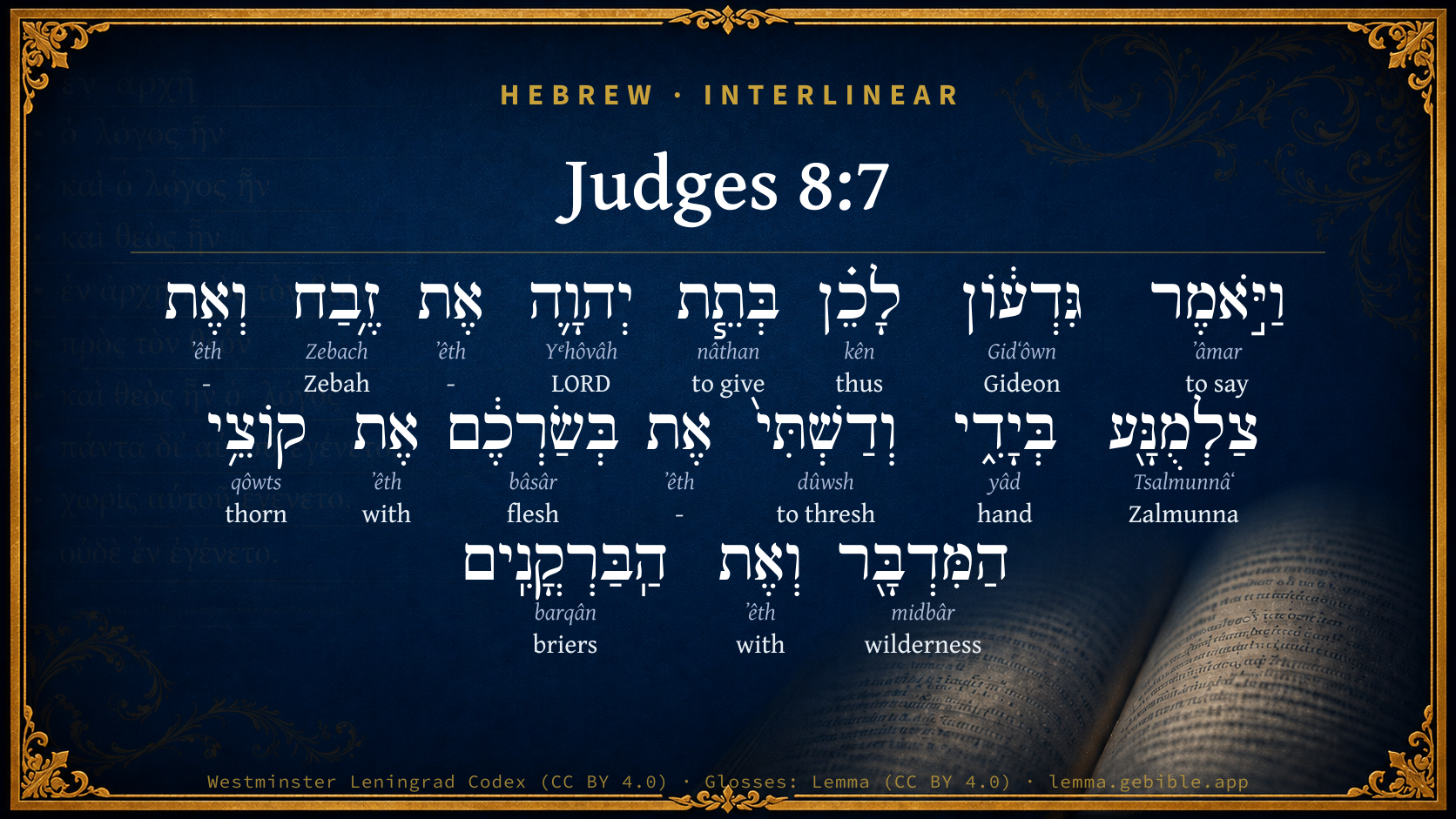
Hebrew (Westminster Leningrad Codex) Judges 8:7 appears in the Hebrew Old Testament. The text above is from the Westminster Leningrad Codex. Each word links to its Strong’s number, a concise gloss, and parsing drawn from the Open Scriptures Hebrew Bible morphology. Click any word for its full Brown-Driver-Briggs (BDB) entry.
Download image
Cite this verse

Judges 8:7 (World English Bible). Public Domain. Lemma interlinear Bible study tool, https://lemma.gebible.app/v/judges/8/7.

Show BibTeX & RIS
BibTeX
RIS
English Translation
Gideon said, Therefore when Yahweh has delivered Zebah and Zalmunna into my hand, then I will tear your flesh with the thorns of the wilderness and with briers.
World English Bible · Public Domain
Highlights
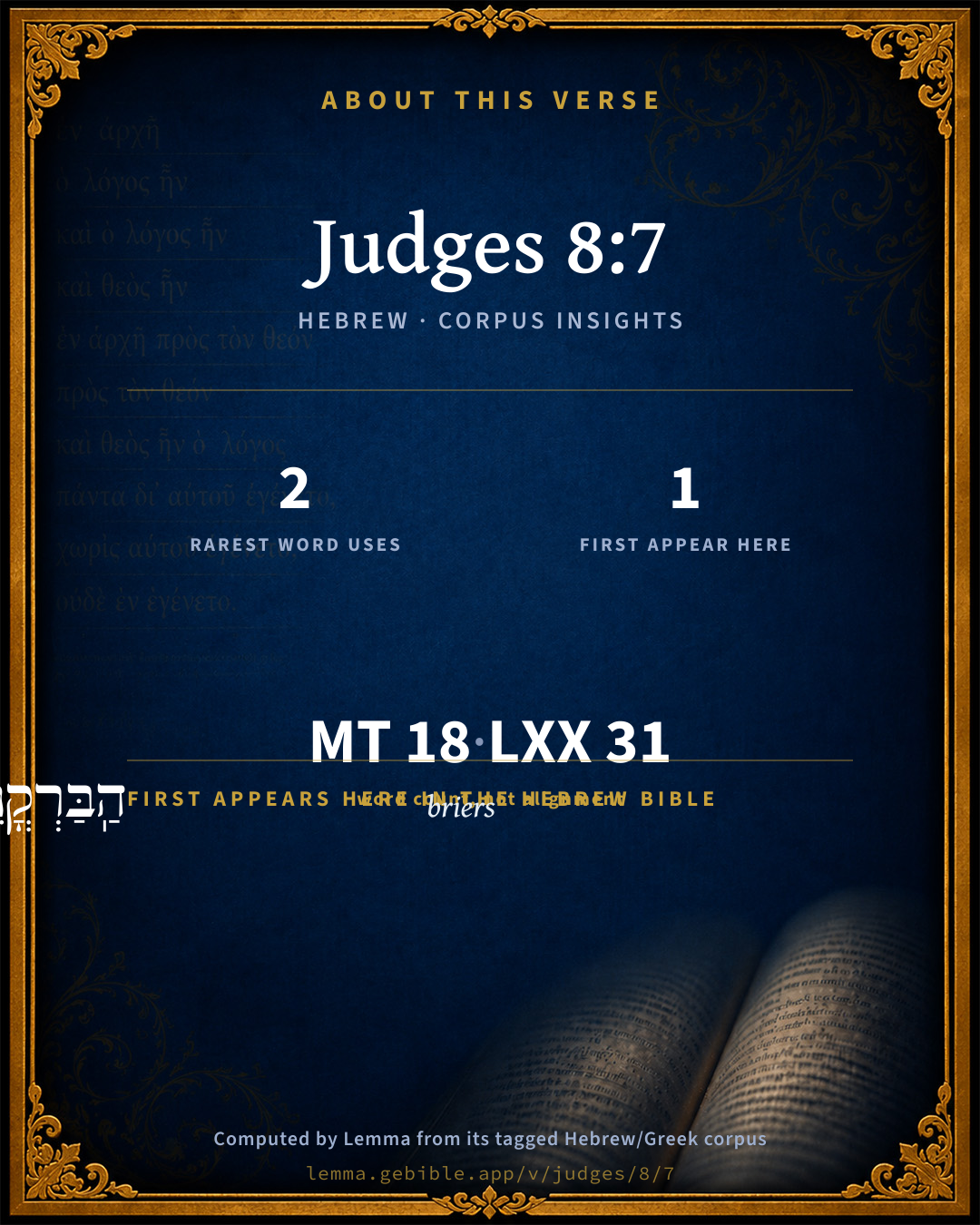
  • 1 first appearance in the Hebrew Bible
Full analysis ↓
Download a study sheet

One document with this verse’s original text, its word-by-word gloss line, the meaning frame, cross-references with their text, attributed commentary, and full source and license credits — printable, and it pastes into notes with its structure intact.

This verse Autodidact and up

Study sheet (.html) Plain text (.txt)

A passage Seminary Student

Up to 50 verses in one chapter. A passage sheet keeps up to 6 commentary sources and 12 cross-references per verse, in the order this page ranks them, and says so on the sheet whenever that leaves anything out. Ask for a single verse and you get the Autodidact verse sheet above.

Everything on this page stays free to read, with no account — the sheet is a download of what is already on screen, not access to it.

Want to remove ads? Support Godless Engineer
Compare translations 3

The same verse in 3 English versions, stacked beneath the original-language interlinear above. Click any original word for its lexicon entry.

Each is an independent rendering of the whole verse — the interlinear is not word-aligned to these translations.

Highlighted words mark where these versions differ — a whole-verse word diff, not a word-by-word alignment.

  • World English Bible Public Domain
    Gideon said, Therefore when Yahweh has delivered Zebah and Zalmunna into my hand, then I will tear your flesh with the thorns of the wilderness and with briers.
  • King James Version Public Domain
    And Gideon said, Therefore when the LORD hath delivered Zebah and Zalmunna into mine hand, then I will tear your flesh with the thorns of the wilderness and with briers.
  • unfoldingWord Literal Text CC BY-SA 4.0
    So Gideon said, “Therefore, in the giving of Yahweh Zebah and Zalmunna into my hand, then I will thrash your flesh with thorns of the wilderness and briers.”

unfoldingWord Literal Text — © unfoldingWord, licensed CC BY-SA 4.0. Word-aligned USFM3 via Door43 (git.door43.org/unfoldingWord/en_ult).

Versions to compare (up to 4)

3 of 4 selected

Show all 18 translations

Every available English version of this verse, each an independent rendering of the whole verse.

  • World English Bible Public Domain
    Gideon said, Therefore when Yahweh has delivered Zebah and Zalmunna into my hand, then I will tear your flesh with the thorns of the wilderness and with briers.
  • Berean Standard Bible Public Domain
    “Very well,” Gideon replied, “when the LORD has delivered Zebah and Zalmunna into my hand, I will tear your flesh with the thorns and briers of the wilderness!”
  • Majority Standard Bible Public Domain
    “Very well,” Gideon replied, “when the LORD has delivered Zebah and Zalmunna into my hand, I will tear your flesh with the thorns and briers of the wilderness!”
  • King James Version Public Domain
    And Gideon said, Therefore when the LORD hath delivered Zebah and Zalmunna into mine hand, then I will tear your flesh with the thorns of the wilderness and with briers.
  • American Standard Version (1901) Public Domain
    And Gideon said, Therefore when Jehovah hath delivered Zebah and Zalmunna into my hand, then I will tear your flesh with the thorns of the wilderness and with briers.
  • Revised Version (1885) Public Domain
    And Gideon said: Therefore when the LORD hath delivered Zebah and Zalmunna into mine hand, then I will tear your flesh with the thorns of the wilderness and with briers.
  • Geneva Bible (1599) Public Domain
    Gideon then sayde, Therefore when the Lord hath deliuered Zebah and Zalmunna into mine hand, I will teare your flesh with thornes of the wildernes and with breers.
  • Douay-Rheims (1899) Public Domain
    And he said to them: When the Lord therefore shall have delivered Zebee and Salmana into my hands, I will thresh your flesh with the thorns and briers of the desert.
  • Young's Literal Translation Public Domain
    And Gideon saith, `Therefore -- in Jehovah's giving Zebah and Zalmunna into my hand -- I have threshed your flesh with the thorns of the wilderness, and with the threshing instruments.'
  • Literal Standard Version CC BY-SA 4.0
    And Gideon says, “Therefore—in YHWH’s giving Zebah and Zalmunna into my hand—I have threshed your flesh with the thorns of the wilderness, and with the threshing instruments.”
  • Unlocked Literal Bible CC BY-SA 4.0
    Gideon said, “When Yahweh has given us victory over Zebah and Zalmunna, I will tear your skin with the desert thorns and briers.”
  • unfoldingWord Literal Text CC BY-SA 4.0
    So Gideon said, “Therefore, in the giving of Yahweh Zebah and Zalmunna into my hand, then I will thrash your flesh with thorns of the wilderness and briers.”
  • Darby Bible Public Domain
    And Gideon said, "Well then, when the LORD has given Zebah and Zalmun'na into my hand, I will flail your flesh with the thorns of the wilderness and with briers."
  • World Messianic Bible Public Domain
    Gideon said, “Therefore when the LORD has delivered Zebah and Zalmunna into my hand, then I will tear your flesh with the thorns of the wilderness and with briers.”
  • Webster's Bible Public Domain
    And Gideon said, Therefore when the LORD hath delivered Zebah and Zalmunna into my hand, then I will tear your flesh with the thorns of the wilderness and with briers.
  • Free Bible Version CC BY-SA 4.0
    “In that case, once the Lord has handed Zebah and Zalmunna over to me, I'll return and thrash you with thorns and briers from the desert!” Gideon replied.
  • Bible in Basic English Public Domain
    Then Gideon said, Because of this, when the Lord has given Zebah and Zalmunna into my hands, I will have you stretched on a bed of thorns of the waste land and on sharp stems, and have you crushed as grain is crushed on a grain-floor.
  • JPS Tanakh (1917) Public Domain
    And Gideon said: 'Therefore when the LORD hath delivered Zebah and Zalmunna into my hand, then I will tear your flesh with the thorns of the wilderness and with briers.'

Literal Standard Version (2020), Covenant Press — licensed CC BY-SA 4.0. Text via the HelloAO Bible API (eBible.org). Unlocked Literal Bible (unfoldingWord) — licensed CC BY-SA 4.0. Text via the HelloAO Bible API (eBible.org). unfoldingWord Literal Text — © unfoldingWord, licensed CC BY-SA 4.0. Word-aligned USFM3 via Door43 (git.door43.org/unfoldingWord/en_ult). Free Bible Version, Dr. Jonathan Gallagher — licensed CC BY-SA 4.0. Text via the HelloAO Bible API (eBible.org).

Word by word

More ways to search: Search by grammar → Find every occurrence → Compare this word →

Practice this passage: Drill this verse → Learn its vocabulary →

הַֽבַּרְקֳנִֽים
barqân
H1303
“the · briers”
Particle, Definite Article + Noun, Common, Masculine, Plural, Absolute
Part of Speech
Particle + Noun
Type
Common
Gender
Masculine
Number
Plural
State
Absolute
Full BDB Definition

Origin: from H1300

TWOT: 287e

briers, briars
  1. וַיֹּ֣אמֶר ʼâmar H559 “and · to say” Conjunction + Verb, Qal, Sequential Imperfect, 3rd Person, Masculine, Singular
  2. גִּדְע֔וֹן Gidʻôwn H1439 “Gideon” Noun, Proper
  3. לָכֵ֗ן kên H3651 “to/for · thus” Preposition + Adverb
  4. בְּתֵ֧ת nâthan H5414 “in/at · to give” Preposition + Verb, Qal, Infinitive Construct
  5. יְהוָ֛ה Yᵉhôvâh H3068 “LORD” Noun, Proper
  6. אֶת ʼêth H853 “-” Particle, Direct Object
  7. זֶ֥בַח Zebach H2078 “Zebah” Noun, Proper
  8. וְאֶת ʼêth H853 “and · -” Conjunction + Particle, Direct Object
  9. צַלְמֻנָּ֖ע Tsalmunnâʻ H6759 “Zalmunna” Noun, Proper
  10. בְּיָדִ֑י yâd H3027 “in/at · hand · my” Preposition + Noun, Common, Both, Singular, Construct + Suffix, Personal, 1st Person, Common, Singular
  11. וְדַשְׁתִּי֙ dûwsh H1758 “and · to thresh” Conjunction + Verb, Qal, Sequential Perfect, 1st Person, Common, Singular
  12. אֶת ʼêth H853 “-” Particle, Direct Object
  13. בְּשַׂרְכֶ֔ם bâsâr H1320 “flesh · your” Noun, Common, Masculine, Singular, Construct + Suffix, Personal, 2nd Person, Masculine, Plural
  14. אֶת ʼêth H854 “with” Preposition
  15. קוֹצֵ֥י qôwts H6975 “thorns of” Noun, Common, Masculine, Plural, Construct
  16. הַמִּדְבָּ֖ר midbâr H4057 “the · wilderness” Particle, Definite Article + Noun, Common, Masculine, Singular, Absolute
  17. וְאֶת ʼêth H854 “and · with” Conjunction + Preposition

About this verse

These counts appear in no published source. They are computed here, from the morphology-tagged text and Lemma’s own curated glosses. What Lemma adds →

18
words
15
distinct lemmas
Historical
section

Notable vocabulary

The rarest word here is הַֽבַּרְקֳנִֽים briers H1303 — appearing just 2 times in the whole Hebrew Bible.

First appearance in Scripture

This word makes its first canonical appearance in the Hebrew Bible here:

  • הַֽבַּרְקֳנִֽים briers H1303

Shared distinctive vocabulary

הַֽבַּרְקֳנִֽים briers H1303 occurs in 2 verses of the Hebrew Bible. Also found in:

Grammatical profile

  • 3 verbs
  • 9 nouns
  • 2 prepositions
  • 1 adverb
  • 3 particles

Verb forms

  • וַיֹּ֣אמֶר Qal · Sequential Imperfect
  • בְּתֵ֧ת Qal · Infinitive Construct
  • וְדַשְׁתִּי֙ Qal · Sequential Perfect

Repetition

A word recurs within this verse — often emphatic in Hebrew:

  • אֶת with H854 ×2

Hebrew & Septuagint length

In English translation the verse runs 28 words from the Hebrew and 29 from the Septuagint (LXX English) — closely comparable.

A rough comparison of the two English renderings, which tokenize alike — not a word-level alignment.

Word counts can differ between the Hebrew and the Greek without any difference in meaning — e.g. the Hebrew direct-object marker אֵת has no separate Greek word, and Greek often adds the article ὁ.

In the original languages it is 18 Hebrew tokens and 31 Greek tokens — but the two are counted differently (Hebrew bundles its prefixes and suffixes into one token; the Greek is in lemma form), so that isn’t a like-for-like length.

Cross-references

1

Topical passages linked to Judges 8:7 in the Treasury of Scripture Knowledge — connected by theme and wording, ordered by reader-vote popularity; previews shown in the World English Bible.

  • Judges 7:15 It was so, when Gideon heard the telling of the dream, and the interpretation of it, that he worshiped; and he returned into the camp of Israel, and said, Arise; for Yahweh has delivered into your hand the host of Midian.

Cross-references courtesy of OpenBible.info (CC BY 4.0).

Hebrew and Greek witnesses Masoretic Hebrew ↔ Greek Septuagint

The same verse in the two great witnesses to the Old Testament, shown verse-for-verse.

These are two independent witnesses, not word-aligned to each other, and the Septuagint is shown in lemma (dictionary) form.

Hebrew Judges 8:7 Masoretic · Westminster Leningrad Codex

וַיֹּ֣אמֶר גִּדְע֔וֹן לָכֵ֗ן בְּתֵ֧ת יְהוָ֛ה אֶת זֶ֥בַח וְאֶת צַלְמֻנָּ֖ע בְּיָדִ֑י וְדַשְׁתִּי֙ אֶת בְּשַׂרְכֶ֔ם אֶת קוֹצֵ֥י הַמִּדְבָּ֖ר וְאֶת הַֽבַּרְקֳנִֽים

Gideon said, Therefore when Yahweh has delivered Zebah and Zalmunna into my hand, then I will tear your flesh with the thorns of the wilderness and with briers.

World English Bible · Public Domain

Greek LXX Judges 8:7 Septuagint · lemma form

καί εἶπον γεδεων διά οὗτος ἐν ὁ δίδωμι κύριος ὁ ζεβεε καί σελμανα ἐν χείρ ἐγώ καί ἐγώ ἀλοάω ὁ σάρξ σύ ἐν ὁ ἄκανθα ὁ ἔρημος καί ἐν ὁ αβαρκηνιν

And Gedeon said, Therefore when the Lord gives Zebee and Salmana into my hand, then will I tear your flesh with the thorns of the wilderness, and the Barkenim.

LXX2012 (modern English Septuagint) · Public Domain

On this verse, Ellicott's Commentary for English Readers discusses the Septuagint’s reading. Read the note in Commentary ↓

Hebrew: Westminster Leningrad Codex (CC BY 4.0). Greek: Septuagint (public domain); English from LXX2012 (modern English Septuagint) (Public Domain). How the Septuagint differs from the Hebrew →

Targum (Aramaic paraphrase)

1

The Targum is the ancient Jewish Aramaic paraphrase of the Hebrew Scriptures — an interpretive translation, not the Hebrew text itself. Onkelos (literal) and Pseudo-Jonathan (expansive) render the Torah, and Jonathan the Prophets. Coverage is partial: where no permissively-licensed English translation exists for a verse, only the Aramaic is shown. This is verse-level text, not a word-by-word alignment to the Hebrew.

  1. Targum Jonathan Prophets (Joshua–Malachi)
    וַאֲמַר גִדְעוֹן בְּכֵן כַּד יִמְסַר יְיָ יַת זֶבַח וְיַת צַלְמֻנָע בִּידִי וְאָדוּשׁ יַת בִּסְרֵיכוֹן עַל כּוּבֵי מַדְבְּרָא וְעַל בַּרְקָנַיָא:

    (no public-domain English translation for this verse)

    Targum Jonathan — Aramaic: “Mikraot Gedolot” (public domain). English: “Sefaria Community Translation” (CC0 1.0 (public-domain dedication)); “London "Chaldee Paraphrase," 1871” (public domain). Text via Sefaria.

Commentary

Notes on Judges 8:7 from classic Christian and Jewish commentators (each source and its license shown beneath its notes). The classic Christian expositions comment on the surrounding passage and are grouped to its opening verse, so a note may address several verses; the Jewish commentaries on the Tanakh (Rashi and others) are per-verse, so they appear only where the commentator wrote on this verse.

Lemma curates 59 commentaries, every one of them public domain or Creative Commons licensed, each selected and text-cleaned for this edition rather than reprinted as found. About our sources →

Trapp's Complete Commentary

John Trapp

Jdg 8:7 And Gideon said, Therefore when the LORD hath delivered Zebah and Zalmunna into mine hand, then I will tear your flesh with the thorns of the wilderness and with briers.

Ver. 7. Then I will tear your flesh.] Heb., I will thresh your flesh with the thorns. The Chaldee hath it, upon thorns; q.d., will whip you to death repetitis ictibus, by stroke upon stroke with thorns or thistles of very sharp prickles. And this he threateneth to do, not out of passion, but on premeditation, as a just severity towards such treacherous wretches.

John Trapp, A Commentary or Exposition upon All the Books of the Old and New Testament (1647–1656) — public domain. Text from a community e-Sword module.

Joseph Benson's Commentary

Jdg 8:7; Jdg 8:9. With the thorns of the wilderness — The city was near a wilderness that abounded with thorns and briers. Penuel — Another city beyond Jordan; both were in the tribe of Gad. I will break down this tower — Some strong fort in which they greatly confided, and their confidence in which made them thus proud and presumptuous. Perhaps they pointed to it when they gave him their rude answer.

Joseph Benson's Commentary on the Old and New Testaments (1811–1818) — public domain. Text from a community e-Sword module.

Geneva Bible (1599)

Geneva Bible translators

Hebrew, beat in pieces.

Geneva Bible (1599) marginal notes — public domain. Text via Bolls.life.

Jamieson, Fausset & Brown

Robert Jamieson, A. R. Fausset & David Brown

I will tear your flesh with the thorns of the wilderness and with briers--a cruel torture, to which captives were often subjected in ancient times, by having thorns and briers placed on their naked bodies and pressed down by sledges, or heavy implements of husbandry being dragged over them.

Jamieson, Fausset & Brown — Commentary Critical and Explanatory on the Whole Bible (1871) — public domain (CC PDM 1.0). Text via the HelloAO Bible API.

Adam Clarke's Commentary

Verse 7. I will tear your flesh] What this punishment consisted in I cannot say; it must mean a severe punishment: as if he had said, I will thresh your flesh with briers and thorns, as corn is threshed out with threshing instruments; or, Ye shall be trodden down under the feet of my victorious army, as the corn is trodden out with the feet of the ox.

Succoth was beyond Jordan, in the tribe of Gad. Penuel was also in the same tribe, and not far distant from Succoth.

Adam Clarke's Commentary on the Bible (1810–1826) — public domain. Text from a community e-Sword/MySword module.

Ellicott's Commentary for English Readers

(7) And Gideon said.—Notice in this verse the mixture of heroic faith and barbarous severity. It was this courage and faith (Heb_11:32) which ennobled Gideon and made him an example for all time. The ruthlessness of the punishment which he threatened to inflict belongs to the wild times in which he lived, and the very partial spiritual enlightenment of an imperfect dispensation (Mat_5:21; Mat_19:8; Act_17:30). It is no more to be held up for approval or imitation than his subsequent degeneracy; while, at the same time, Gideon must, of course, be only judged by such light as he had.

I will tear your flesh.—Rather, as in the margin, I will thresh (LXX., aloçso, which is better than the other reading, kataxano, “will card”; Vulg., conteram). It has usually been supposed that they were scourged with thorns, which would be terrible enough; but the verb here used is stronger, and seems to imply that they were “put under harrows” after thorns and briers had been scattered over them. That Gideon should inflict a retribution so awful cannot be surprising if we remember that David seems to have done the same (2Sa_12:31; 1Ch_20:3; Amo_1:3). In this case, however, the torture was more terrible, because it was inflicted not on aliens, but on Israelites. It must be borne in mind that every man is largely influenced by the spirit of the age in which he lives, and that in the East to this day there is (1) far greater indifference than there is in Europe to the value of human life, and (2) far greater insensibility to the infliction of pain; so that the mere mention of punishments inflicted, even in this century, by such men as Djezzar and Mehemet Ali makes the blood run cold. It was only by slow degrees that (as we can trace in the writings of their prophets and historians) the Jews learnt that deeper sense of humanity which it was certainly the object of many precepts of the Mosaic Law to inspire. The defections of Succoth and Penuel were even worse than that indifference of Meroz which had called forth the bitter curse of Jdg_5:23.

With the thorns of the wilderness.—These thorns (kotsim) are again mentioned in Hos_10:8. Rabbi Tanchum could not explain what plant was meant. It is not impossible (as Kimchi suggests) that the form of the punishment was suggested by another wild play on words; for Succoth (סֻכּוֹת), though it means “booths,” suggests the idea of “thorns” (סכות),

Briers.—This word, barkanim, which the LXX. merely transliterate, occurs nowhere else. The Rabbis rightly understood it of thorny plants which grow among stones. Some modern Hebraists explain it to mean harrows formed of flints, deriving it from an obsolete word, barkan, “lightning” (see on Jdg_4:6), and so meaning “pyrites.” In that case we must suppose that the elders were laid on some open area, and harrows set with flints driven over them.

A Bible Commentary for English Readers, edited by Charles John Ellicott (1878–1897) — public domain. Text from a community e-Sword module.

The Cambridge Bible for Schools and Colleges

gen. ed. J. J. S. Perowne

7. I will tear] thresh as marg. In the East threshing is done by treading (e.g. Isa_28:28), which is what the verb here means; Gideon promises to trample their flesh together with thorns of the desert and briers, i.e. to lay them naked on a bed of thorns and tread them down; so Targ. But the text reads awkwardly; for together with the LXX has a different preposition, with as in Jdg_8:16 (‘with them’); this somewhat alters the meaning of Gideon’s threat, see on Jdg_8:16. The word rendered briers (so Verss.) occurs only here, and its exact sense is unknown; a plant like the teasel may be intended. Thorny bushes abound in the sub-tropical Ghôr where Succoth lay.

The Cambridge Bible for Schools and Colleges (gen. ed. J. J. S. Perowne; Cambridge University Press, 1878–1918) — public domain. Text from a community e-Sword module.

John Gill's Exposition

And Gideon said,.... In answer to the princes of Succoth:

therefore when the Lord hath delivered Zebah and Zalmunna into mine hand; of which he made no doubt, having the promise of God that he would deliver the host of Midian into his hand, on which his faith rested; and having it in great part performed already, most firmly believed the full performance of it, see Jdg 7:7.

then I will tear your flesh with the thorns of the wilderness, and with briers; which grew in a wilderness near this city, and from whence as Kimchi thinks, it had its name; the word "Succoth" being used for thorns in Job 41:7 and the sense is, either that he would scourge them with thorns and briers; or, as the Targum thrust their flesh upon them; which Kimchi interprets of casting their naked bodies upon thorns and briers, and then treading on them with the feet; or draw a cart over them as they thus lay, in like manner as it was usual to do when corn was threshed out; see Isa 28:27.

John Gill's Exposition of the Whole Bible (1746–1763) — public domain (CC PDM 1.0). Text via the HelloAO Bible API.

Haydock's Catholic Bible Commentary

Desert. An usual mode of punishment, (2 Kings xii., and 1 Paralipomenon xx. 3.; Calmet) which the cruel irrision of Gedeon and his army, who were fighting in the cause of God and of the nation, richly called for.

George Leo Haydock (1774–1849), Haydock's Catholic Family Bible and Commentary, 1859 edition — public domain. Excludes Psalms (Douay-Rheims chapter numbering differs from Protestant) and Deuterocanonical books (Catholic canon only).

Matthew Poole's English Annotations

With the thorns which grow abundantly in the neighbouring wilderness; I will chastise or beat your naked bodies with thorny rods, even unto death. Or, I will lay you down upon thorns on the ground, and bring the cartwheel upon you, which will both tear your flesh, and bruise you to death.

Matthew Poole's English Annotations on the Holy Bible (1683–1685) — public domain. Text from a community e-Sword/MySword module.

Whedon's Commentary on the Bible

Daniel D. Whedon

7. I will tear your flesh — I will thresh your flesh, that is, beat and lacerate, even unto death.

Thorns — Which grew strong in the desert, and afforded a whip with which the keenest torment could be inflicted.

Briers — The original word occurs here only, but without much doubt denotes some kind of prickly plant or shrub. Gesenius gives the meaning threshing sledges, but is followed by few scholars. Wilkinson relates that among the ancient Egyptians the parricide was sentenced to be lacerated with sharpened reeds, and, after being thrown on thorns, was burned to death.

Daniel D. Whedon (gen. ed.), Commentary on the Old and New Testaments (1874–1909) — public domain. Text from a community e-Sword module.

The Pulpit Commentary

I will tear your flesh, etc. These words breathe a fierce and vindictive spirit; such, however, as cannot surprise us m the age and country of which we arc reading (cf. vers. 9 and 21). The provocation, it must be allowed, was very great, but still the spirit was very different from that which dictated the prayer under far greater provocation, "Father, forgive them, for they know not what they do." Thorns of the wilderness. The nature of the punishment here threatened, and the execution of which is related in ver. 16, is uncertain. The word here rendered tear means literally to thresh,. Hence some suppose that the punishment here spoken of was a severe kind of capital punishment inflicted by threshing instruments with sharp iron points, called here "thorns of the wilderness," and "briers (though some again understand literally thorns and briers); and they compare 2Sa_12:31, where the word rendered harrows means threshing instruments, as also Isa_28:27 Isa_41:15. But others, as Bertheau, Keil, and Delitzsch, do not think it was a capital punishment at all, and take the word thresh figuratively in the sense of punishing severely, and think that literal thorns and thistles were the implements of punishment.

The Pulpit Commentary (1880–1919), ed. H.D.M. Spence-Jones & Joseph S. Exell — public domain. Text from a community e-Sword module.

Rashi

Rabbi Shlomo Yitzchaki (Rashi)

Thorns. "Ronzes" in old French.

Rashi on the Tanakh — English translations: “The Judaica Press complete Tanach with Rashi, translated by A. J. Rosenberg” (CC BY 4.0); “Pentateuch with Rashi's commentary by M. Rosenbaum and A.M. Silbermann, 1929-1934” (public domain); “The Metsudah Tanach series, Lakewood, N.J” (CC BY 4.0); and “The Book of Joshua, Metsudah Publications, 1997” (CC BY 4.0). Text via Sefaria.

Lesson kit

Teaching starters — assembled from the data on this page, not authored interpretation. Every prompt links to the verse data it draws on. Edit before teaching.

Judges, in the Historical, opens this verse with 18 words (15 distinct Hebrew lemmas). Its most distinctive word is barqân (“briers”). A historical commentator’s framing appears above. Read the whole chapter for the surrounding context.

Discussion questions

  1. How does “briers” (barqân) shape what this verse is saying?
  2. This is the first place “briers” appears in Scripture (first appears here). What does its debut here establish?
  3. How does Judges 8:16, which shares the word «briers», read alongside this verse?
  4. What does the repetition of “with” (2× in this one verse) do in this verse?
  5. These translations render this verse differently; the difference is in the English rendering, not the original. What questions does that raise?
  6. «וַיֹּ֣אמֶר» is a Qal Sequential Imperfect verb. How does that grammatical form shape the action described?
  7. Compare how Trapp's Complete Commentary and Joseph Benson's Commentary read this verse. Where do they agree or differ?

Things to notice

Reading settings

Reading text

Shown beneath each verse's original-language words.

Old Testament
Old Testament edition

Read the OT as the Masoretic Hebrew (MT) or the Greek Septuagint (LXX).

English shown for the Greek Septuagint (in the Hebrew ↔ Greek comparison).

Comparing translations? Open the Compare panel on any verse page to stack up to four side by side.