
2 Peter 2:18

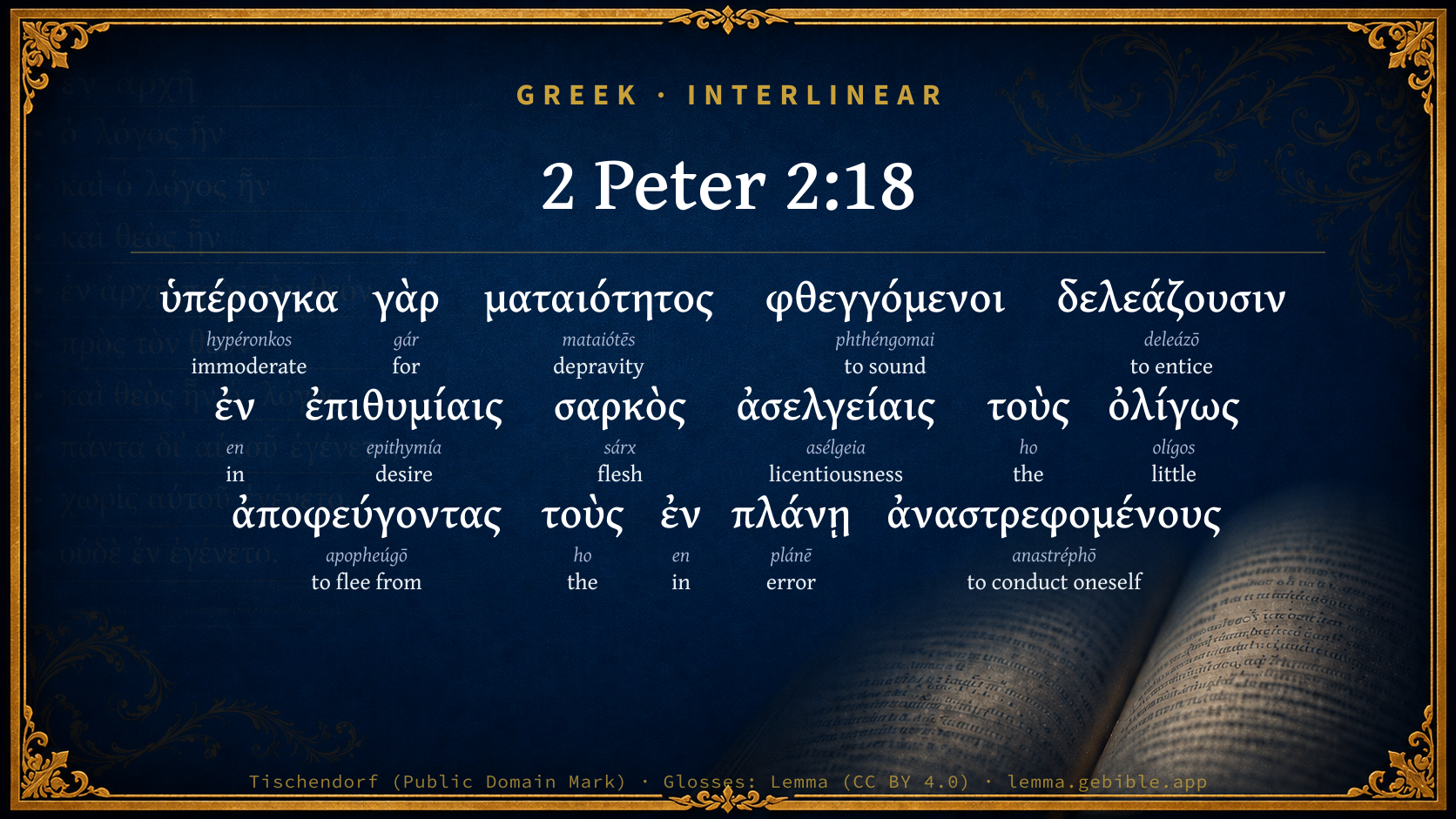
Greek (Tischendorf 8th ed.) 2 Peter 2:18 appears in the Greek New Testament. The text above is from the Tischendorf 8th edition. Each word links to its Strong’s number and a concise gloss. Click any word for its full Thayer’s Greek Lexicon entry.
Download image
Cite this verse

2 Peter 2:18 (World English Bible). Public Domain. Lemma interlinear Bible study tool, https://lemma.gebible.app/v/2-peter/2/18.

Show BibTeX & RIS
BibTeX
RIS
English Translation
For, uttering great swelling words of emptiness, they entice in the lusts of the flesh, by licentiousness, those who are indeed escaping from those who live in error;
World English Bible · Public Domain
Highlights
  • 1 first appearance in the Greek New Testament
Full analysis ↓
Download a study sheet

One document with this verse’s original text, its word-by-word gloss line, the meaning frame, cross-references with their text, attributed commentary, and full source and license credits — printable, and it pastes into notes with its structure intact.

This verse Autodidact and up

Study sheet (.html) Plain text (.txt)

A passage Seminary Student

Up to 50 verses in one chapter. A passage sheet keeps up to 6 commentary sources and 12 cross-references per verse, in the order this page ranks them, and says so on the sheet whenever that leaves anything out. Ask for a single verse and you get the Autodidact verse sheet above.

Everything on this page stays free to read, with no account — the sheet is a download of what is already on screen, not access to it.

Want to remove ads? Support Godless Engineer
Compare translations 3

The same verse in 3 English versions, stacked beneath the original-language interlinear above. Click any original word for its lexicon entry.

Each is an independent rendering of the whole verse — the interlinear is not word-aligned to these translations.

Highlighted words mark where these versions differ — a whole-verse word diff, not a word-by-word alignment.

  • World English Bible Public Domain
    For, uttering great swelling words of emptiness, they entice in the lusts of the flesh, by licentiousness, those who are indeed escaping from those who live in error;
  • King James Version Public Domain
    For when they speak great swelling words of vanity, they allure through the lusts of the flesh, through much wantonness, those that were clean escaped from them who live in error.
  • unfoldingWord Literal Text CC BY-SA 4.0
    For, speaking arrogant things of vanity, they entice by lusts of the flesh, by licentious acts, the ones barely escaping from the ones living in error,

unfoldingWord Literal Text — © unfoldingWord, licensed CC BY-SA 4.0. Word-aligned USFM3 via Door43 (git.door43.org/unfoldingWord/en_ult).

Versions to compare (up to 4)

3 of 4 selected

Show all 19 translations

Every available English version of this verse, each an independent rendering of the whole verse.

  • World English Bible Public Domain
    For, uttering great swelling words of emptiness, they entice in the lusts of the flesh, by licentiousness, those who are indeed escaping from those who live in error;
  • Berean Standard Bible Public Domain
    With lofty but empty words, they appeal to the sensual passions of the flesh and entice those who are just escaping from others who live in error.
  • Majority Standard Bible Public Domain
    With lofty but empty words, they appeal to the sensual passions of the flesh and entice those who have truly escaped from others who live in error.
  • King James Version Public Domain
    For when they speak great swelling words of vanity, they allure through the lusts of the flesh, through much wantonness, those that were clean escaped from them who live in error.
  • American Standard Version (1901) Public Domain
    For, uttering great swelling `words' of vanity, they entice in the lusts of the flesh, by lasciviousness, those who are just escaping from them that live in error;
  • Revised Version (1885) Public Domain
    For, uttering great swelling words of vanity, they entice in the lusts of the flesh, by lasciviousness, those who are just escaping from them that live in error;
  • Geneva Bible (1599) Public Domain
    For in speaking swelling wordes of vanitie, they beguile with wantonnesse through the lusts of the flesh them that were cleane escaped from them which are wrapped in errour,
  • Douay-Rheims (1899) Public Domain
    For, speaking proud words of vanity, they allure by the desires of fleshly riotousness, those who for a little while escape, such as converse in error:
  • Young's Literal Translation Public Domain
    for overswellings of vanity speaking, they do entice in desires of the flesh -- lasciviousnesses, those who had truly escaped from those conducting themselves in error,
  • Literal Standard Version CC BY-SA 4.0
    for speaking swollen words of vanity, they entice in desires of the flesh—licentiousness, those who had truly escaped from those conducting themselves in error,
  • Unlocked Literal Bible CC BY-SA 4.0
    They speak with vain arrogance. They entice people through the lusts of the flesh. They entice people who try to escape from those who live in error.
  • unfoldingWord Literal Text CC BY-SA 4.0
    For, speaking arrogant things of vanity, they entice by lusts of the flesh, by licentious acts, the ones barely escaping from the ones living in error,
  • Darby Bible Public Domain
    For [while] speaking great highflown words of vanity, they allure with [the] lusts of [the] flesh, by dissoluteness, those who have just fled those who walk in error,
  • World Messianic Bible Public Domain
    For, uttering great swelling words of emptiness, they entice in the lusts of the flesh, by licentiousness, those who are indeed escaping from those who live in error;
  • Webster's Bible Public Domain
    For when they speak great swelling words of vanity, they allure through the lusts of the flesh, through much wantonness, those that had quite escaped from them who live in error.
  • Free Bible Version CC BY-SA 4.0
    Inflated with their own nonsense, they appeal to sensual desires, luring back into immorality those who have only just escaped from those who live in error.
  • Bible in Basic English Public Domain
    For with high-sounding false words, making use of the attraction of unclean desires of the flesh, they get into their power those newly made free from those who are living in error;
  • Text-Critical English NT CC BY 4.0
    For they speak bombastic words of nonsense, and with sensual desires of the flesh they entice people who have truly escaped from others who live in error.
  • Tyndale New Testament (1534) Public Domain
    For when they have spoke the swellinge wordes of vanytie they begyle with wantanes thorowe that lustes of the flesshe them that were clene escaped: but now are wrapped in errours.

Literal Standard Version (2020), Covenant Press — licensed CC BY-SA 4.0. Text via the HelloAO Bible API (eBible.org). Unlocked Literal Bible (unfoldingWord) — licensed CC BY-SA 4.0. Text via the HelloAO Bible API (eBible.org). unfoldingWord Literal Text — © unfoldingWord, licensed CC BY-SA 4.0. Word-aligned USFM3 via Door43 (git.door43.org/unfoldingWord/en_ult). Free Bible Version, Dr. Jonathan Gallagher — licensed CC BY-SA 4.0. Text via the HelloAO Bible API (eBible.org).

Word by word

More ways to search: Search by grammar → Find every occurrence → Compare this word →

Practice this passage: Drill this verse → Learn its vocabulary →

ὑπέρογκα
hypéronkos
G5246
“immoderate”
Adjective, Accusative, Plural, Neuter
Part of Speech
Adjective
Case
Accusative
Number
Plural
Gender
Neuter
Full Thayer's Definition

Origin: from G5228 and G3591

TDNT: None

1. overswollen 2. metaph. immoderate, extravagant
  1. γὰρ gár G1063 “for” Conjunction
  2. ματαιότητος mataiótēs G3153 “depravity” Noun, Genitive, Singular, Feminine
  3. φθεγγόμενοι phthéngomai G5350 “to sound” Verb, Present, Middle deponent, Participle, Nominative, Plural, Masculine
  4. δελεάζουσιν deleázō G1185 “to entice” Verb, Present, Active, Indicative, 3rd person, Plural
  5. ἐν en G1722 “in” Preposition
  6. ἐπιθυμίαις epithymía G1939 “desire” Noun, Dative, Plural, Feminine
  7. σαρκὸς sárx G4561 “flesh” Noun, Genitive, Singular, Feminine
  8. ἀσελγείαις asélgeia G766 “licentiousness” Noun, Dative, Plural, Feminine
  9. τοὺς ho G3588 “the” Article, Accusative, Plural, Masculine
  10. ὀλίγως olígos G3641 “little” Adverb
  11. ἀποφεύγοντας apopheúgō G668 “to flee from” Verb, Present, Active, Participle, Accusative, Plural, Masculine
  12. τοὺς ho G3588 “the” Article, Accusative, Plural, Masculine
  13. ἐν en G1722 “in” Preposition
  14. πλάνῃ plánē G4106 “error” Noun, Dative, Singular, Feminine
  15. ἀναστρεφομένους anastréphō G390 “to conduct oneself” Verb, Present, Passive, Participle, Accusative, Plural, Masculine

About this verse

These counts appear in no published source. They are computed here, from the morphology-tagged text and Lemma’s own curated glosses. What Lemma adds →

16
words
14
distinct lemmas
General Epistles
section

Notable vocabulary

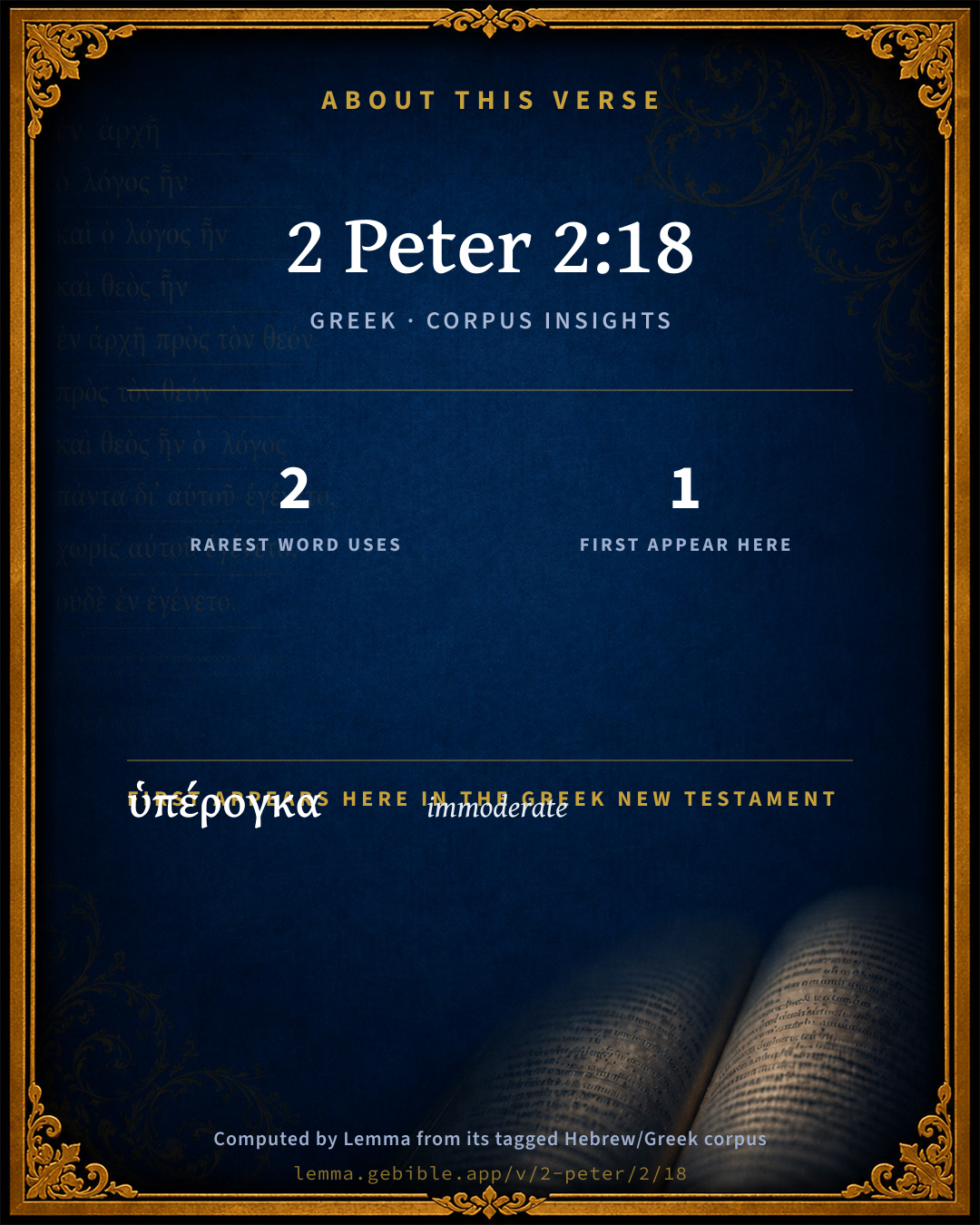
The rarest word here is ὑπέρογκα immoderate G5246 — appearing just 2 times in the whole Greek New Testament.

First appearance in Scripture

This word makes its first canonical appearance in the Greek New Testament here:

  • ὑπέρογκα immoderate G5246

Shared distinctive vocabulary

ὑπέρογκα immoderate G5246 occurs in 2 verses of the Greek New Testament. Also found in:
Repetition

Words recur within this verse:

Cross-references

15

Topical passages linked to 2 Peter 2:18 in the Treasury of Scripture Knowledge — connected by theme and wording, ordered by reader-vote popularity; previews shown in the World English Bible.

  • 2 Peter 2:20 For if, after they have escaped the defilement of the world through the knowledge of the Lord and Savior Jesus Christ, they are again entangled therein and overcome, the last state has become worse with them than the first.
  • Jude 1:15–16 to execute judgment on all, and to convict all the ungodly of all their works of ungodliness which they have done in an ungodly way, and of all the hard things which ungodly sinners have spoken against him."
  • Romans 13:13 Let us walk properly, as in the day; not in reveling and drunkenness, not in sexual promiscuity and lustful acts, and not in strife and jealousy.
  • James 5:5 You have lived delicately on the earth, and taken your pleasure. You have nourished your hearts as in a day of slaughter.
  • 2 Peter 1:4 by which he has granted to us his precious and exceedingly great promises; that through these you may become partakers of the divine nature, having escaped from the corruption that is in the world by lust.
  • Revelation 13:5–6 A mouth speaking great things and blasphemy was given to him. Authority to make war for forty-two months was given to him.
  • 2 Thessalonians 2:4 he who opposes and exalts himself against all that is called God or that is worshiped; so that he sits as God in the temple of God, setting himself up as God.
  • Psalms 73:8–9 They scoff and speak with malice. In arrogance, they threaten oppression.
  • Daniel 4:30 The king spoke and said, Is not this great Babylon, which I have built for the royal dwelling-place, by the might of my power and for the glory of my majesty?
  • Daniel 11:36 The king shall do according to his will; and he shall exalt himself, and magnify himself above every god, and shall speak marvelous things against the God of gods; and he shall prosper until the indignation be accomplished; for that which is determined shall be done.
  • Acts 2:40 With many other words he testified, and exhorted them, saying, "Save yourselves from this crooked generation!"
  • Acts 8:9 But there was a certain man, Simon by name, who used to practice sorcery in the city, and amazed the people of Samaria, making himself out to be some great one,
  • Jude 1:13 wild waves of the sea, foaming out their own shame; wandering stars, for whom the blackness of darkness has been reserved forever.
  • Revelation 13:11 I saw another beast coming up out of the earth. He had two horns like a lamb, and he spoke like a dragon.
  • Psalms 52:1–3 Why do you boast of mischief, mighty man? God's loving kindness endures continually.

Cross-references courtesy of OpenBible.info (CC BY 4.0).

Where the printed editions differ

1 variant

Places in this verse where the major printed Greek editions disagree on the wording in a way that affects the translation — a comparison of editions, not a manuscript-by-manuscript collation. The editions are the modern critical texts (Nestlé-Aland 28/27, SBL, Westcott-Hort, Tregelles, Tyndale House) and the traditional texts behind the KJV (the Textus Receptus and the Byzantine/Majority text). It is not a claim about which reading is original.

  1. Different wording
    ὀλίγως

    “scarcely”

    In NA27SBLWHTreg Not in NA28TynTRByz

    ὄντως (ontōs) 'truly' occurs in traditional manuscripts (NA28+Tyn+TR+Byz) instead of ὀλίγως (oligōs) 'scarcely' in older manuscripts (NA27+SBL+WH+Treg)

Textual data: Translators Amalgamated Greek New Testament (STEPBible TAGNT) · CC BY 4.0.

Commentary

Notes on 2 Peter 2:18 from classic Christian and Jewish commentators (each source and its license shown beneath its notes). The classic Christian expositions comment on the surrounding passage and are grouped to its opening verse, so a note may address several verses; the Jewish commentaries on the Tanakh (Rashi and others) are per-verse, so they appear only where the commentator wrote on this verse.

Lemma curates 59 commentaries, every one of them public domain or Creative Commons licensed, each selected and text-cleaned for this edition rather than reprinted as found. About our sources →

Joseph Benson's Commentary

2Pe 2:18-19. When they speak great swelling words of vanity — Propose their vain and false doctrine in a lofty style, or affect sublime strains of language, which are often void of any real meaning; they allure through the lusts of the flesh — By allowing their hearers to live in lewd courses, or to gratify some unholy desires under pretence of Christian liberty, 2Pe 2:10; 2Pe 2:19; those — Who, as Christians; were clean escaped from the spirit, customs, and company of them that live in error — That is, in sin. In other words, they bring back again to their former sensuality, and other vices, those who, having been converted, had entirely forsaken their former evil ways and wicked companions. While they promise them liberty — From needless restraints and scruples, and from the bondage of the law; they themselves are the servants of corruption — Slaves to their own lusts, to sin, the vilest of all kinds of bondage; for of whom — Or what; a man is overcome, of the same thing he is brought into bondage — Becomes a perfect slave to it. The apostle seems here to allude to the ancient custom of making those slaves who were conquered or taken in battle. It was one of the Stoical paradoxes, that the wise man is the only free man, and that all wicked men are slaves. This maxim the apostle adopts, and supports it in a sound sense by the above unanswerable argument. Hence our Lord said to the Jews, who boasted of their freedom, (Joh 8:34,)

Whosoever committeth sin is the slave of sin. Of the slavery in which every carnal man lives, St. Paul has given us a lively picture, Rom 6:16-20.

Joseph Benson's Commentary on the Old and New Testaments (1811–1818) — public domain. Text from a community e-Sword module.

Tyndale Open Study Notes

Tyndale Open Resources

2:18 those who have barely escaped: The false teachers cleverly targeted new converts, people who had only recently committed themselves to Christ.

Tyndale Open Study Notes — © Tyndale Open Resources, licensed CC BY-SA 4.0. Text via the HelloAO Bible API.

Bengel's Gnomon

Johann Albrecht Bengel

2Pe 2:18. Σαρκὸς ἀσελγείας) Σὰρξ ἀσελγείας is most polluted flesh. Many have written ἀσελγείαις instead of ἀσελγείας,[11] by an easy slip of the pen into rhythm after the word ἐπιθυμίαις.—τοὺς ὀλίγως ἀποφεύγοντας τοὺς ἐν πλάνῃ ἀναστρεφομένους, those, who for a little time had escaped from them who live in error) τοὺς repeated, is not put in apposition, but the word ἀποφεύγοντας (comp. 2Pe 2:20) governs the clause τοὺς ἐν πλάνῃ ἀναστρεφομένους, to make it known what it is that they have escaped; and these ἀναστρεφόμενοι are either the same false teachers, or others. There is here an accusative case governing an accusative; as in Luk 18:9, ἐξουθενοῦντας τοὺς λοιπούς, despising others. Instead of ὀλίγως, some read ὄντως[12]. The copyists with equal readiness hastily put either of these words for the other. The compound verb ἀποφεύγειν has of itself such force, that even without the adverb ὄντως, it denotes those who truly escape, 2Pe 2:20; 2Pe 1:4; but ὀλίγως, for a short time, added to the verb, adds remarkably to the sense of the passage. No sooner have some escaped from those who live in error, than these wretched men are afresh ensnared by them. Such haste is expressed in 2Pe 2:21-22, on account of which indeed the fool remains a fool, Pro 26:11, the dog a dog, the sow a sow. In the Critical Apparatus it has accidentally happened that I have given less weight to the reading, ὀλίγως, than the margin of the text and the arguments inclined me.

[11] AB(?)C Theb. read ἀσελγείαις; and so Rec. Text and Lachm. But Vulg. and both Syr. Versions, and inferior, viz. cursive, MSS. read ἀσελγείας; and so Tisch.—E.

[12] AB Vulg. read ὀλίγως: C and Rec. Text ὄντως, with less authority.—E.

Bengel's Gnomon of the New Testament — English translation (T&T Clark, Edinburgh, 1860) — public domain. Text from a community e-Sword module.

Meyer's Critical & Exegetical Commentary

Heinrich August Wilhelm Meyer

2Pe_2:18. Cf. Jud_1:16.

ὑπέρογκα γὰρ ματαιότητος φθεγγόμενοι] The γάρ does not serve to explain the figurative words, 2Pe_2:17 (as formerly in this commentary), for, as Hofmann justly says, the description of their conduct contained in this verse goes far beyond those figurative statements as to their nature. It must be referred either, with Wiesinger, to the judgment expressed in 2Pe_2:17,

οἷς … τετηρ. being included,or, as is done by Hofmann, to the relative clause only; the former is probably the more correct view.[79]

ὙΠΈΡΟΓΚΟς, swelling; in the classics used also of style. ΜΑΤΑΙΌΤΗς gives the nature of the swelling, high-sounding speeches (the proud words, Luther); Luther aptly: since there is nothing behind them. The word ΦΘΕΓΓΌΜΕΝΟΙ (besides in Act_4:18, to be found only here and in 2Pe_2:16) is here the more appropriate that it is used chiefly of loud speaking.

ΔΕΛΕΆΖΟΥΣΙΝ] Cf. 2Pe_2:14.

ἘΝ ἘΠΙΘΥΜΊΑΙς ΣΑΡΚῸς ἈΣΕΛΓΕΊΑΙς] ἘΝ is commonly taken as equivalent to ΔΙΆ, and ἈΣΕΛΓ. as an apposition to ἘΠΙΘ.: through the lusts of the flesh, through debauchery (de Wette, Brückner, Wiesinger, probably Schott too); but thus there is a felt want of a ΚΑΊ, or of a second ἘΝ, and the ἘΠΙΘΥΜΊΑΙ of the seducers, too, are not to be considered as the means of allurement. Hofmann explains: by means of fleshly lusts, which they awaken in them, through acts of wantonness, the enjoyment of which they hold out to them; but here relations are introduced to which the text makes no allusion. It is therefore better to take ἘΝ ἘΠΙΘΥΜΊΑΙς Σ. as designating the condition of the seducers, and ἈΣΕΛΓΕΊΑΙς as the dat. instrum.: in the lusts of the flesh (i.e. taken in them, governed by them) they allure by voluptuousness those who, etc.; Steinfass correctly: it is part of their ἐπιθ. σαρκ. that they seek to allure the members of the church; he is wrong, however, when he explains the ἈΣΕΛΓΕΊΑΙς as that to which they allure them. Luther translates wrongly: through lasciviousness to fleshly lust; ἘΝ ἘΠΙΘΥΜΊΑΙς is not equal to ΕἸς ἘΠΙΘΥΜΊΑς.

ΤΟῪς ὈΛΊΓΩς ἈΠΟΦΕΎΓΟΝΤΑς] ὈΛΊΓΩς, ἍΠ. ΛΕΓ., is hardly to be found elsewhere. It expresses both time and measure, and corresponds to the English: hardly, just (thus also Schott). Wiesinger and Hofmann understand it only of measure, equivalent to little; Hofmann understands it of space: they are a little way escaped from those who walk in error. The pres. of the verb shows that they are, as it were, still in the act of flight from their former condition, and are not yet firmly established in the new; cf. 2Pe_2:14 : ψυχὰς ἀστηρίκτους.

τοὺς ἐν πλάνῃ ἀναστρεφομένους] not an adjunct co-ordinate with what goes before; Luther: and now walk in error; but the accus. is dependent on ἈΠΟΦΕΎΓΟΝΤΑς, and ΟἹ ἘΝ ΠΛΆΝῌ ἈΝΑΣΤΡΕΦΌΜΕΝΟΙ are those from whom the persons who are being seduced have separated themselves, those who are not Christians, especially the heathen, who lead a life ἘΝ ΠΛΆΝῌ (Wiesinger, Schott, Brückner, Fronmüller, Hofmann); Steinfass incorrectly understands by the expression the ΨΕΥΔΟΔΙΔΆΣΚΑΛΟΙ.

[79] Bengel: Puteus et nubes aquam pollicentur; sic illi praegrandia jactant, quasi lumina ecclesiae; sed hi putei, hae nubes nil praebent; praegrandia illa sunt vanitatis.

Meyer — Critical and Exegetical Commentary on the New Testament — English translation by Peter Christie, edited by Frederick Crombie (T&T Clark, 1880) — public domain. Text from a community e-Sword module.

Expositor's Greek Testament

ed. W. Robertson Nicoll

2Pe 2:18 . ὑπέρογκα . Cf. Jud 1:16 . No doubt the reference is to the use of Gnostic terms. ματαιότης , used specially of moral insincerity. Cf. ματαίας ἀναστροφῆς , “heartless conduct,” 1Pe 1:18 . There is no corresponding reality behind their words. σαρκὸς , to be taken with ἀσελγείαις , which is in apposition to ἐπιθυμίαις . τοὺς ὀλίγως ἀποφεύγοντας : “those who are just escaping”; who have been impressed with Christian truth, and have had strength to separate themselves from their old surroundings and customs; but are led to return through the compromises suggested by the false teachers. The phenomenon is not uncommon in all missionary work, of men who have escaped from “Gentile vices, but are not yet established in Christian virtues” (Bigg). τοὺς ἐν πλάνῃ ἀναστρεφομένους = governed by ἀποφεύγοντας : “(escaping from) those who live in error”; i.e. from their old heathen companionships. “There is great passion in the words. Grandiose sophistry is the hook, filthy lust is the bait, with which these men catch those whom the Lord had delivered, or was delivering” (Bigg).

The Expositor's Greek Testament, edited by W. Robertson Nicoll (1897–1910) — public domain. Text from a community e-Sword module.

Geneva Bible (1599)

Geneva Bible translators

They take them as fishes are taken with the hook.

They deceive men with vain and swelling words.

Unfeignedly and indeed clean departed from Idolatry.

Geneva Bible (1599) marginal notes — public domain. Text via Bolls.life.

Jamieson, Fausset & Brown

Robert Jamieson, A. R. Fausset & David Brown

allure--Greek, "lay baits for."

through--Greek, "in"; the lusts of the flesh being the element IN which they lay their baits.

much wantonness--Greek, "by licentiousness"; the bait which they lay.

clean escaped--Greek, "really escaped." But the oldest manuscripts and Vulgate read, "scarcely," or "for but a little time"; scarcely have they escaped from them who live in error (the ungodly world), when they are allured by these seducers into sin again (Pe2 2:20).

Jamieson, Fausset & Brown — Commentary Critical and Explanatory on the Whole Bible (1871) — public domain (CC PDM 1.0). Text via the HelloAO Bible API.

Adam Clarke's Commentary

Verse 18. They speak great swelling words of vanity] The word υπερογκα signifies things of great magnitude, grand, superb, sublime; it sometimes signifies inflated, tumid, bombastic. These false teachers spoke of great and high things, and no doubt promised their disciples the greatest privileges, as they themselves pretended to a high degree of illumination; but they were all false and vain, though they tickled the fancy and excited the desires of the flesh; and indeed this appears to have been their object. And hence some think that the impure sect of the Nicolaitans is meant. See the preface.

Those that were clean escaped] Those who, through hearing the doctrines of the Gospel, had been converted, were perverted by those false teachers.

Adam Clarke's Commentary on the Bible (1810–1826) — public domain. Text from a community e-Sword/MySword module.

John Calvin's Commentaries

18. For when they speak great swelling words of vanity. He means that they dazzled the eyes of the simple by high-flown stuff of words, that they might not perceive their deceit, for it was not easy to captivate their minds with such dotages, except they were first besotted by some artifice. He then says that they used an inflated kind of words and speech, that they might fill the unwary with admiration. And then this grandiloquence, which the ample lungs of the soul send forth, (as Persius says, ) was very suitable to cover their shifts and trumperies. There was formerly a craft of this kind in Valentinus, and in those like him, as we learn from the books of Irenaeus. They made words unheard of before, by the empty sound of which, the unlearned being smitten, they were ensnared by their reveries.

There are fanatics of a similar kind at this day, who call themselves by the plausible title of Libertines or free-men. For they talk most confidently of the Spirit and of spiritual things, as though they roared out from above the clouds, and fascinate many by their tricks and wiles, so that you may say that the Apostle has correctly prophesied of them. For they treat all things jocosely and scoffingly; and though they are great simpletons, yet as they indulge in all vices, they find favor with their own people by a sort of drollery. The state of the case is this, that when the difference between good and evil is removed, everything becomes lawful; and men, loosed from all subjection to laws, obey their own lusts. This Epistle, therefore, is not a little suitable to our age.

They allure, or bait, through the lusts of the flesh. He strikingly compares to hooks the allurements of the ungodly, when they make anything they please lawful; for as the lusts of men are headstrong and craving, as soon as liberty is offered, they lay hold on it with great avidity; but soon afterwards the strangling hook within is perceived. But we must consider the whole sentence of the Apostle.

He says that they who had really escaped from the society of those in error were again deceived by a new kind of error, even when the reins were let loose to them for the indulgence of every sort of intemperance. He hereby reminds us how dangerous are the wiles of these men. For it was already a dreadful thing that blindness and thick darkness possessed almost all mankind. It was, therefore, in a manner a double prodigy, that men, freed from the common errors of the world, should, after having received the light of God, be brought back to a beastly indifference. Let us be reminded of what we ought especially to beware of, after having been once enlightened, that is, lest Satan entice us under the pretense of liberty, so as to give ourselves up to lasciviousness to gratify the lusts of the flesh. But they are safe from this danger who seriously attend to the study of holiness.

John Calvin's Commentaries (1540-1563) — public domain. Text from the Calvin Translation Society English edition (1840s-50s) via the Christian Classics Ethereal Library (ccel.org). Calvin's coverage is partial (roughly two-thirds of the Bible); uncommented books and verses are honest gaps, never fabricated. The 19th-century editor's footnotes and remarks are omitted so the notes are faithfully Calvin's own voice.

Ellicott's Commentary for English Readers

(18) Great swelling words of vanity.—Exaggeration, unreality, boastfulness, and emptiness are expressed by this phrase. It carries on the same idea as the waterless wells and the driven mists—great pretensions and no results. The rebuke here is not unlike the warning in 1Pe_5:5-6.

Allure.—Translated “beguile” in 2Pe_2:14, where see Note.

Through the lusts of the flesh.—Better, in the lusts of the flesh (as in 2Pe_2:3, and 2Pe_1:1-2; 2Pe_1:4; 2Pe_1:13). The preposition “in” points to the sphere in which the enticement takes place; “through” should be reserved for “wantonness” (see Note on 2Pe_2:2), which is the bait used to entice.

Were clean escaped.—Both verb and adverb require correction. The margin indicates the right reading for the adverb—“for a little,” or better, by a little; scarcely. The verb should be present, not past—those who are scarcely escaping, viz., the “unstable souls” of 2Pe_2:14. Wiclif has “scapen a litil;” Rheims “escape a litle.” The word translated “scarcely” occurs nowhere else in the New Testament; that translated here “clean,” and elsewhere “indeed,” or “certainly,” is frequent (Mar_11:32; Luk_23:47; Luk_24:34, &c. &c). Hence the change, an unfamiliar word being, by a slight alteration, turned into a familiar one. The two Greek words are much alike.

A Bible Commentary for English Readers, edited by Charles John Ellicott (1878–1897) — public domain. Text from a community e-Sword module.

The Cambridge Bible for Schools and Colleges

gen. ed. J. J. S. Perowne

18. For when they speak great swelling words of vanity] Literally, For speaking.… The adjective is used by classical writers both literally and figuratively of excessive magnitude. It indicates what we should call the “high-flown” character of the language of the false teachers. “Vanity” is used in its proper sense of “emptiness.” There was no substance below their show of a transcendental knowledge. Here again we trace a parallel with St Paul’s language, “Knowledge puffeth up” (1Co_8:1).

they allure through the lusts of the flesh, through much wantonness] Better, they entice in the lusts of flesh (describing the state of the tempters) by acts of lasciviousness (as the dative of the instrument). The word for “allure” is the same as in 2Pe_2:14. In “wantonness” we have the same word as in 2Pe_2:2; 2Pe_2:7.

those that were clean escaped from them who live in error] Some of the better MSS. give those who were a little (or partially) escaping … In the one case, stress is laid on the fact that the work of a real and true conversion was marred by the impurity into which the victims were afterwards betrayed; in the other, on the fact that their conversion had been but incomplete, and that therefore they yielded readily to the temptation. A possible construction of the sentence would be to take the last clause in the Greek in apposition with the first, “those that had partially escaped, those that live in error,” but the English version gives a preferable meaning. In the verb for “live” we have a cognate form of St Peter’s favourite word for “conversation” or “conduct” (1Pe_1:15; 1Pe_1:18; 1Pe_2:12; 1Pe_3:1-2; 1Pe_3:16).

The Cambridge Bible for Schools and Colleges (gen. ed. J. J. S. Perowne; Cambridge University Press, 1878–1918) — public domain. Text from a community e-Sword module.

John Gill's Exposition

For when they speak great swelling words of vanity,.... Marvellous things against the God of gods, great things and blasphemies against God, his name, his tabernacle, and his saints; see Dan 11:36; or against men, dominions, and dignities, Pe2 2:10; or it may design their self-applauses and vain glorying in themselves, and their empty boast of knowledge and learning; and also express the windiness of their doctrines, and the bombast style, and high flown strains of rhetoric in which they were delivered; as likewise the flattering titles they bestowed on men for the sake of their own worldly interest and advantage; see Jde 1:16 and hereby

they allure, through the lusts of the flesh, through much wantonness, those that were clean escaped from them who live in error: that is, from those who lived in the error of Heathenism or Judaism, from whom, and which, they were clean escaped; or truly, really, and entirely delivered, being fully convinced of the falsity thereof, and of the truth of the Christian religion; though some copies, as the Alexandrian, and two of Beza's, and two of Stephens's, read, not "truly", but "a little"; and the Vulgate Latin version renders it, "a very little"; to which agrees the Complutensian edition; and the Syriac version renders it "in a few words", or "almost"; and according to the Ethiopic version, "a few persons" are designed; but be they more or less, and truly, or but a little, and for a little while, or almost, escaped from their former errors, in which they were brought up, and lived; yet by the carnal lusts and liberties, lasciviousness and wantonness, which these false teachers indulged, they were allured, ensnared, and drawn by them into their wicked principles and practices.

John Gill's Exposition of the Whole Bible (1746–1763) — public domain (CC PDM 1.0). Text via the HelloAO Bible API.

Trapp's Complete Commentary

John Trapp

18 For when they speak great swelling words of vanity, they allure through the lusts of the flesh, through much wantonness, those that were clean escaped from them who live in error.

Ver. 18. Great swelling words] Gr. υπερογκα, bubbles of words, full of wind, big swollen fancies, sesquipedalia verba. Swenckfeldius the heretic bewitched many with those big words (ever in his mouth) of illumination, revelation, deification, the inward and spiritual man, &c. Faith, he said, was nothing else but God himself indwelling in us. And have we not those now that tell their disciples they shall be Christed, Godded, &c.?

Through much wantonness] As Hetserus and Monetarius the Anabaptists, who corrupted many matrons whom they had drawn to their side. (Joh. Manl. loc. com.) David George, a ringleader among them, was so far from accounting adulteries, fornications, incest, &c., to be sins, that he did recommend them to his most perfect scholars, as acts of grace and mortification. This man (or monster rather) was confident that the whole world would in time submit to him, and be of his mind. And are not our Ranters (as they call themselves) come up to him, and gone beyond him in their most prodigious opinions and practices?

John Trapp, A Commentary or Exposition upon All the Books of the Old and New Testament (1647–1656) — public domain. Text from a community e-Sword module.

Albert Barnes' Notes on the Bible

For when they speak great swelling words of vanity - When they make pretensions to wisdom and learning, or seem to attach great importance to what they say, and urge it in a pompous and positive manner. Truth is simple, and delights in simple statements. It expects to make its way by its own intrinsic force, and is willing to pass for what it is worth. Error is noisy and declamatory, and hopes to succeed by substituting sound for sense, and by such tones and arts as shall induce men to believe that what is said is true, when it is known by the speaker to be false.

They allure through the lusts of the flesh - The same word is used here which in 2Pe 2:14 is rendered “beguiling,” and in Jam 1:14 “enticed.” It does not elsewhere occur in the New Testament. It means that they make use of deceitful arts to allure, ensnare, or beguile others. The “means” which it is here said they employed, were “the lusts of the flesh;” that is, they promised unlimited indulgence to the carnal appetites, or taught such doctrines that their followers would feel themselves free to give unrestrained liberty to such propensities. This has been quite a common method in the world, of inducing people to embrace false doctrines.

Through much wantonness - See the notes at 2Ti 3:6. The meaning here is, that they made use of every variety of lascivious arts to beguile others under religious pretences. This has been often done in the world; for religion has been abused to give seducers access to the confidence of the innocent, only that they might betray and ruin them. It is right that for all such the “mist of darkness should be reserved forever;” and if there were not a place of punishment prepared for such men, there would be defect in the moral administration of the universe.

Those that were clean escaped from them who live in error - Margin, “for a little while.” The difference between the margin and the text here arises from a difference of reading in the Greek. Most of the later editions of the Greek Testament coincide with the reading in the margin, (ὀλίγως oligōs,) meaning “little, but a little, scarcely.” This accords better with the scope of the passage; and, according to this, it means that they had “almost escaped” from the snares and influences of those who live in error and sin. They had begun to think of their ways; they had broken off many of their evil habits; and there was hope that they would be entirely reformed, and would become decided Christians, but they were allured again to the sins in which they had so long indulged. This seems to me to accord with the design of the passage, and it certainly accords with what frequently occurs, that those who are addicted to habits of vice become apparently interested in religion, and abandon many of their evil practices, but are again allured by the seductive influences of sin, and relapse into their former habits. In the case referred to here it was by professedly religious teachers - and is this never done now? Are there none for example, who have been addicted to habits of intemperance, who had been almost reformed, but who are led back again by the influence of religious teachers? Not directly and openly, indeed, would they lead them into habits of intemperance. But, when their reformation is begun, its success and its completion depend on total abstinence from all that intoxicates. In this condition, nothing more is necessary to secure their entire reformation and safety than mere abstinence; and nothing more may be necessary to lead them into their former practices than the example of others who indulge in moderate drinking, or than the doctrine inculcated by a religious teacher that such moderate drinking is not contrary to the spirit of the Bible.

Albert Barnes' Notes on the Bible (1834–1885) — public domain. Text from a community e-Sword/MySword module.

Matthew Poole's English Annotations

Great swelling words of vanity; i.e. big words, full of sound, and void of sense, at least of truth. He seems to tax the affected, vain speech of seducers, who were wont to clothe their erroneous doctrines (if not disguise the truths of God) with strange, uncouth phrases, which made a show of some rare discoveries, or deep mysteries, whereas indeed they were empty of any thing solid, or tending to edification.

They allure: as with a bait; a metaphor taken from the manner of taking fish.

Through the lusts of the flesh; to which they give liberty, as a bait to draw men after them.

Through much wantonness; this explains the former, and shows what lusts they indulge men in, viz. wantonness and uncleanness.

Those that were clean escaped; truly, or really, which seems the better reading than that in the margin: and this is said of them:

1. In respect of the profession they made of a real conversion.

2. In respect of the assent they gave to the word by which they were called.

3. In respect of the change that appeared in their outward conversation.

From them who live in error: whether the error of Judaism, or heathenism, wherein they had been formerly involved, and others still were. This might be the case of some in whom yet there was no saving change wrought; that they might be brought off from these more foul ways of sin and error in which they had walked and yet might afterward return to the same, or as bad, Mat 12:43; 13:21.

Matthew Poole's English Annotations on the Holy Bible (1683–1685) — public domain. Text from a community e-Sword/MySword module.

Whedon's Commentary on the Bible

Daniel D. Whedon

18. Speak… vanity—Their talk is pompously grandiloquent, but full of emptiness; a pretentious sensationalism admirably adapted to catch the unthinking. Thus laying baits in their own lusts—preaching for truth doctrines that work by licentiousness—they allure those who have embraced the gospel, and are but a short time escaped from the influence of their old heathen associates.

Clean escaped—We read with the best texts, a little. Recently converted, and not yet fully instructed, they are the more easily entrapped by these deceivers.

Daniel D. Whedon (gen. ed.), Commentary on the Old and New Testaments (1874–1909) — public domain. Text from a community e-Sword module.

The Pulpit Commentary

For when they speak great swelling words of vanity; literally, for speaking. "Great swelling words" is expressed by one word in the Greek, uJperogka, St. Jude has the same word in verse 16; it is used in the classical writers of great bulk of any kind, literal or figurative. The genitive is descriptive the words are swelling, high-sounding; but they are only words, vain and meaningless; they have nothing but emptiness behind them. They allure through the lusts of the flesh, through much wantonness; rather, as in the Revised Version, they entice (as in verse 14) in the lusts of the flesh, by lasciviousness. The preposition "in" denotes the sphere in which these men live, their condition, habits of life. The dative ajselgeiaiv, literally "by lasciviousnesses," that is, by acts of lasciviousness, is the dative of the instrument; it states the means by which they entice men. Those that were clean escaped from them who live in error. The Authorized Version follows the T.R., tountav; but most of the best manuscripts have tougwv ajpofeugontav. This last reading gives a better sense, "Those who are just escaping." The adverb ojligwv may be understood of time, or, perhaps better, of measure by a little, a little way." Those who were "clean escaped "would not be so easily enticed by the false teachers. These are only beginning to escape; they have heard the word with joy, but have no root in themselves; they put their hand to the plough, but they look back. They "that live in error" are the heathen; the unhappy men who are led astray by the false teachers are just escaping from the heathen and from their mode of life. It is possible to understand these last words as a coordinate clause, a further description of those who are just escaping. The false teachers entice "those who are just escaping, those who live in error." But the common rendering seems better. The verb translated "live" (ajnastrefomenouv) is a favourite word with St. Peter. (see 1Pe_1:15, 18 2:12 3:1, 2, 16)

The Pulpit Commentary (1880–1919), ed. H.D.M. Spence-Jones & Joseph S. Exell — public domain. Text from a community e-Sword module.

John Wesley's Explanatory Notes

They ensnare in the desires of the flesh - Allowing them to gratify some unholy desire. Those who were before entirely escaped from the spirit, custom, and company of them that live in error - In sin.

John Wesley, Explanatory Notes Upon the Whole Bible (1754–1765) — public domain. Text via the GEBible commentary corpus.

Burkitt's Expository Notes on the New Testament

William Burkitt

The next sin charged upon these seducers is pride and ostentation, they speak big, great swelling words of vanity; with a lofty and affected style they propound their false doctrines to amuse the simple. It is the usual practice of seducers to speak in an high-flown strain of words, that, being not understood, they may be the more admired.

Next they allure to their party such novice Christians who had left the Heathenish bestiality, and made an outward profession of the Christian religion. The word rendered to allure, is a metaphor taken from fishers or fowlers, who produce the bait or shrape, but hide the net or snare. Seducers bait their hook with such baits as are proper to the fish they would catch, else they are no good anglers.

But observe, why the bait is here before us, it is liberty, it is licentiousness, they allure through the lusts of the flesh; no bait like this.

Learn hence, That the true reason why seducers have so many followers is this, because their doctrine is libertinism, and most agreeable to the carnal lusts and corrupt affections of men. This is the true reason why Popery has had so many proselytes; they allure through the lusts of the flesh. Never was a religion better calculated for gratifying men’s beastly lusts than Popery; it indulges a liberty to all abominable lusts and unchristian practices, yet after all will blanch over wilful violations of God’s laws with the favourable title of venial crimes. Sit anima mea cum philosophis: Let my soul, at the great day, be rather found among the sober Heathen philosophers, than among sensual and brutish Christians.

William Burkitt's Expository Notes on the New Testament (1700–1703) — public domain. Text from a community e-Sword module.

The People's New Testament

B. W. Johnson

18. For. This shows how they promise great things and disappoint. They offer great swelling words, and entice those who are about to be delivered from error.

B. W. Johnson's The People's New Testament with Notes (1889–1891) — public domain. Electronic text from the Christian Classics Ethereal Library (CCEL) ThML edition.

Cambridge Greek Testament for Schools and Colleges

18. ὑπέρογκα κ.τ.λ. ἐν ἐπιθυμίαις σαρκός. This is the last case of borrowing from Jude for some time. It answers to Jud 1:16 κατὰ τὰς ἐπιθυμίας αὐτῶν πορευόμενοι καὶ τὸ στόμα αὐτῶν λαλεῖ ὑπέρογκα.

ἐν ἐπιθυμίαις σαρκὸς ἀσελγείαις. σαρκός is best taken with ἐπιθυμίαις. The whole phrase is rather pleonastic to our ideas. ἀσελγείαις serves perhaps to define ἐπιθ. σαρκ. The general meaning is that the false teachers proclaimed to their followers the lawfulness of indulgence in passions, under the name of Christian liberty, and so converts who had been nearly drawn away, and with great difficulty, from the licence which prevailed in heathen society were now slipping back. Their first teachers had preached to them the importance of purity: these new ones told them that it was of no consequence. The havoc which such teaching must have wrought upon the morals and upon the very being of young Christian communities amply justifies the tremendous denunciation which we find here.

τοὺς ὀλίγως ἀποφεύγοντας κ.τ.λ. For ὀλίγως (AB, a corrector of א, and Syriac, Latin and Egyptian) a group including אCKLP reads ὄντως. For ἀποφεύγοντας (אABC) the aorist participle ἀποφυγόντας is read by KLP.

ὀλίγως is rendered in the Vulgate by paululum, for a little time: it is an uncommon word, but is found meaning “in a slight degree” and (inapplicable here) “quickly.” The escape is recent or incomplete.

τοὺς ἐν πλάνῃ ἀναστρεφομένους: almost certainly the heathen.

Cambridge Greek Testament for Schools and Colleges (Cambridge University Press, 1896; 21 vols, various authors incl. Carr, Maclear, Plummer, Farrar, Lumby, Moule, M. R. James, Simcox) — public domain. Text from a community e-Sword module.

Alford’s Greek Testament

Henry Alford

18.] Further designation of these false teachers, and justification of it. Cf. Jud 1:12, Jud 1:13, which is here much abridged.

18.] Justification of the description. For, speaking great swelling things (ὑπέρογκος is a classical word, occurring in Plato and Demosth., generally signifying excessive magnitude, as in μεγάλαι οὐσίαι κ. ὑπέρογκοι, Plut. Ep. iii. p. 317 c. δύναμις ὑπέρογκος as opposed to ταπεινή, Dem. p. 46. 16. Xen. Hell. v. 4. 58, uses it in the literal sense, γενομένης δὲ τῆς κνήμης ὑπερόγκου: and Plut. Lucull. 21, in a figurative,—φρόνημα τραγικὸν κ. ὑπὲρογκον ἐν ταῖς μεγάλαις εὐτυχίαις) of vanity (whose characteristic is ματαιότης: as in the genitive σῶμα τῆς ἁμαρτίας, Rom 6:6, and the like: see Winer, § 30. 2. β) they allure (above, ver. 14) in lusts (ἐν ἐπιθ. describes the state of the tempters, and the element in which their laying of enticing baits is situated) by licentiousnesses (ἀσελγ. are the instrument, the bait itself. Far better so, with Huther, than with De Wette to regard ἐν as = διὰ, and ἀσελγ. as in apposition with ἐπιθυμίαις. Œc. inverts this construction, δελεάζουσι διὰ τῆς σαρκικῆς ἐπιθυμίας ἐν ταῖς ἀσελγείαις) of the flesh those who are scarcely (οὐκ ὀλίγως occurs in the Anthol xii. 205, in the sense of “not a little:” and as a var. read. in Plato, Alcib. ii. p. 149 a. It may signify here, by degrees, = κατʼ ὀλίγον: but the other,= ὀλίγου, seems more generally accepted as the sense [with very little space, or very little time, for such escape]) escaping from them who live in error (some take τοὺς ἑν πλ. ἀναστρ. as a clause co-ordinate and in apposition with τοὺς ὀλίγως ἀποφεύγοντας: but the other rendering is far better: these unhappy persons who are but just escaping from the influence of those who live in error (the heathen), are then laid hold of by these deceivers, enticing them with licentiousness),

Henry Alford, The Greek Testament (1849–1861) — public domain. Text from a community e-Sword module.

Vincent's Word Studies in the New Testament

Marvin R. Vincent

When they speak [φθεγγομενοι] . Rev., better, uttering. See on ver. 16.

Great swelling [υπερογκα] . Only here and Jude 1:16. The word means of excessive bulk. It accords well with the peculiar word uttering, since it denotes a kind of speech full of high - sounding verbosity without substance. Fqeggomenoi, uttering, is significantly applied alike to Balaam 's beast and to these empty declaimers.

Entice. See ver. 14.

Where clean escaped. The A. V. follows the Tex. Rec., ontwv ajpofugontav; ontwv meaning really, actually, as Luk 24:34; and the participle being the aorist, and so meaning were escaped. But the best texts all read ojligwv, in a little degree, or just, or scarcely; and ajpofeugontav, the present participle, are escaping; and denoting those who are in the early stage of their escape from error, and are not safe from it and confirmed in the truth. Hence, Rev., correctly, who are just escaping. 'Oligwv, only here.

Marvin R. Vincent, Word Studies in the New Testament (1887–1900) — public domain. Text from a community e-Sword/MySword module.

Lesson kit

Teaching starters — assembled from the data on this page, not authored interpretation. Every prompt links to the verse data it draws on. Edit before teaching.

2 Peter, in the General Epistles, opens this verse with 16 words (14 distinct Greek lemmas). Its most distinctive word is hypéronkos (“immoderate”). A historical commentator’s framing appears above. Read the whole chapter for the surrounding context.

Discussion questions

  1. What does “immoderate” (hypéronkos) contribute to the verse as a whole?
  2. This is the first place “immoderate” appears in Scripture (first appears here). What does its debut here establish?
  3. How does Jude 1:16, which shares the word «immoderate», read alongside this verse?
  4. What does the repetition of “in” (2× in this one verse) do in this verse?
  5. The translations on this page render this verse differently — a whole-verse word diff, not a word-by-word alignment. What might account for the different wordings?
  6. Compare how Joseph Benson's Commentary and Tyndale Open Study Notes read this verse. Where do they agree or differ?

Things to notice

  • 1 word makes its first canonical appearance in Scripture here.
  • These translations choose different wording for 28 words in this verse.
  • “in” occurs 2× in this single verse.
  • 14 distinct Greek lemmas span 16 words in this verse.

Reading settings

Reading text

Shown beneath each verse's original-language words.

Old Testament
Old Testament edition

Read the OT as the Masoretic Hebrew (MT) or the Greek Septuagint (LXX).

English shown for the Greek Septuagint (in the Hebrew ↔ Greek comparison).

Comparing translations? Open the Compare panel on any verse page to stack up to four side by side.