
James 5:3

Greek (Tischendorf 8th ed.) James 5:3 appears in the Greek New Testament. The text above is from the Tischendorf 8th edition. Each word links to its Strong’s number and a concise gloss. Click any word for its full Thayer’s Greek Lexicon entry.
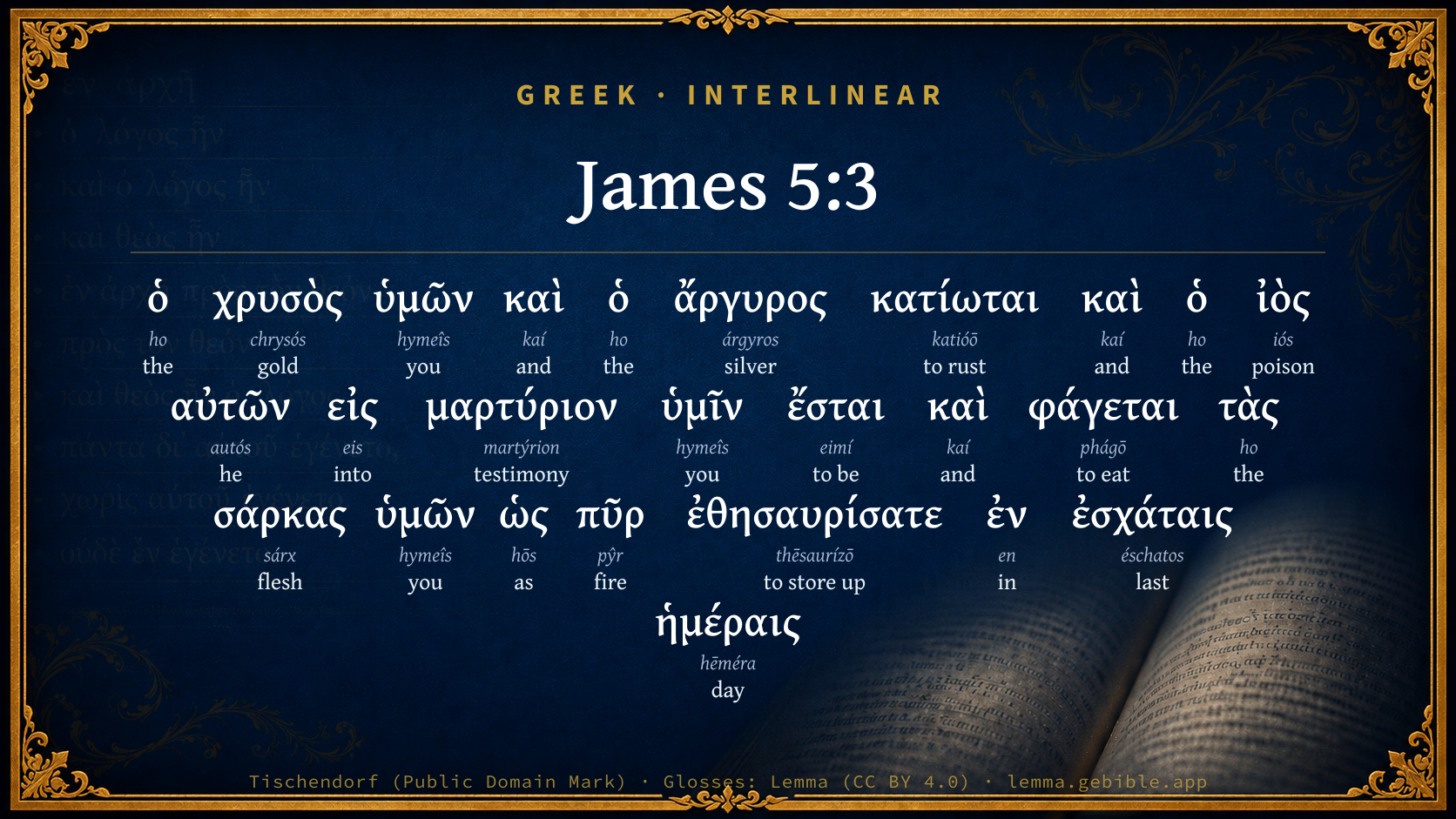
Download image
Cite this verse

James 5:3 (World English Bible). Public Domain. Lemma interlinear Bible study tool, https://lemma.gebible.app/v/james/5/3.

Show BibTeX & RIS
BibTeX
RIS
English Translation
Your gold and your silver are corroded, and their corrosion will be for a testimony against you, and will eat your flesh like fire. You have laid up your treasure in the last days.
World English Bible · Public Domain
Highlights
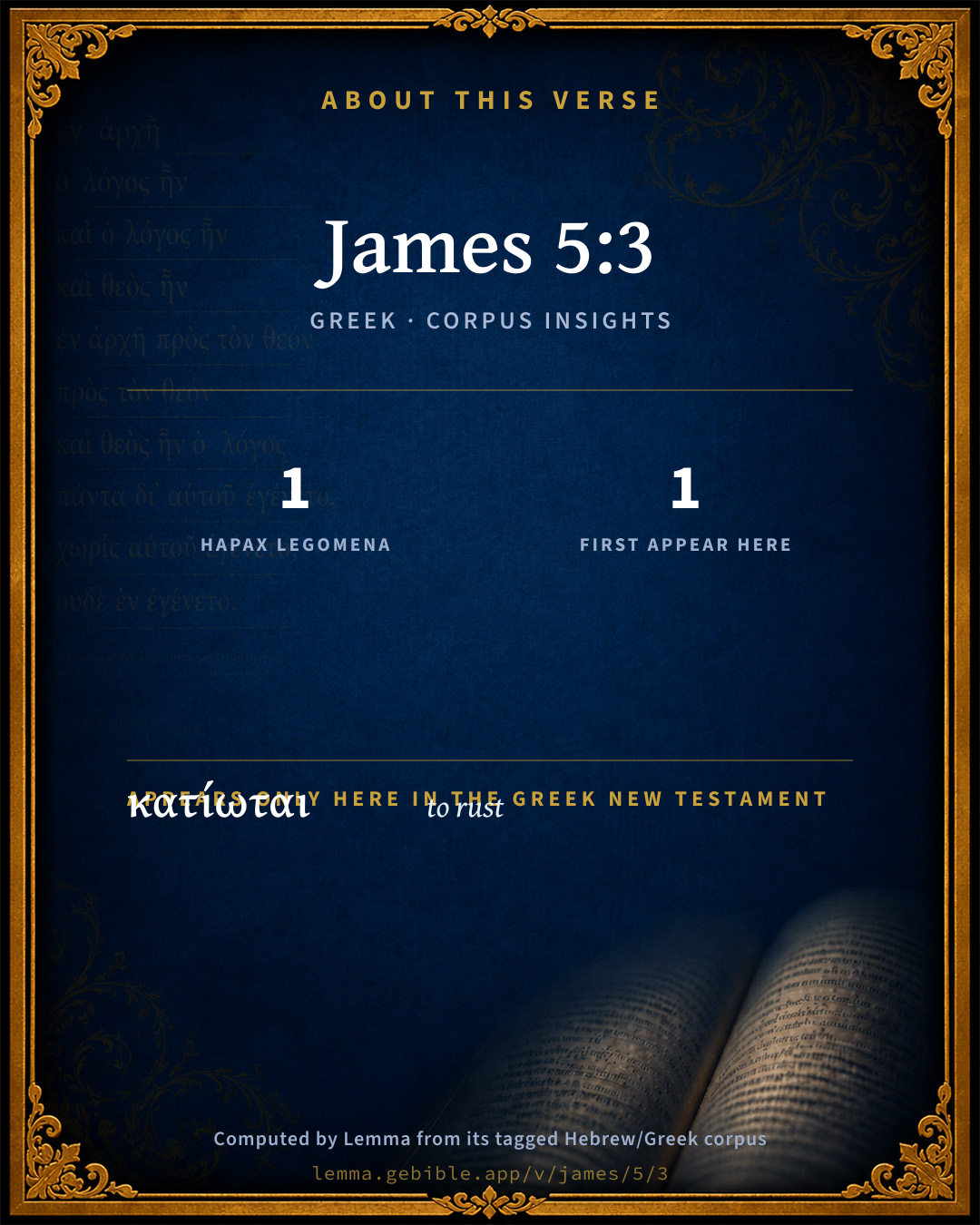
  • 1 hapax legomenon — only here in the Greek New Testament
  • 1 first appearance in the Greek New Testament
Full analysis ↓
Download a study sheet

One document with this verse’s original text, its word-by-word gloss line, the meaning frame, cross-references with their text, attributed commentary, and full source and license credits — printable, and it pastes into notes with its structure intact.

This verse Autodidact and up

Study sheet (.html) Plain text (.txt)

A passage Seminary Student

Up to 50 verses in one chapter. A passage sheet keeps up to 6 commentary sources and 12 cross-references per verse, in the order this page ranks them, and says so on the sheet whenever that leaves anything out. Ask for a single verse and you get the Autodidact verse sheet above.

Everything on this page stays free to read, with no account — the sheet is a download of what is already on screen, not access to it.

Want to remove ads? Support Godless Engineer
Compare translations 3

The same verse in 3 English versions, stacked beneath the original-language interlinear above. Click any original word for its lexicon entry.

Each is an independent rendering of the whole verse — the interlinear is not word-aligned to these translations.

Highlighted words mark where these versions differ — a whole-verse word diff, not a word-by-word alignment.

  • World English Bible Public Domain
    Your gold and your silver are corroded, and their corrosion will be for a testimony against you, and will eat your flesh like fire. You have laid up your treasure in the last days.
  • King James Version Public Domain
    Your gold and silver is cankered; and the rust of them shall be a witness against you, and shall eat your flesh as it were fire. Ye have heaped treasure together for the last days.
  • unfoldingWord Literal Text CC BY-SA 4.0
    Your gold and silver have been tarnished, and their rust will be for a testimony against you and it will eat your flesh like fire. You have stored up in the last days.

unfoldingWord Literal Text — © unfoldingWord, licensed CC BY-SA 4.0. Word-aligned USFM3 via Door43 (git.door43.org/unfoldingWord/en_ult).

Versions to compare (up to 4)

3 of 4 selected

Show all 19 translations

Every available English version of this verse, each an independent rendering of the whole verse.

  • World English Bible Public Domain
    Your gold and your silver are corroded, and their corrosion will be for a testimony against you, and will eat your flesh like fire. You have laid up your treasure in the last days.
  • Berean Standard Bible Public Domain
    Your gold and silver are corroded. Their corrosion will testify against you and consume your flesh like fire. You have hoarded treasure in the last days.
  • Majority Standard Bible Public Domain
    Your gold and silver are corroded. Their corrosion will testify against you and consume your flesh like fire. You have hoarded treasure in the last days.
  • King James Version Public Domain
    Your gold and silver is cankered; and the rust of them shall be a witness against you, and shall eat your flesh as it were fire. Ye have heaped treasure together for the last days.
  • American Standard Version (1901) Public Domain
    Your gold and your silver are rusted; and their rust shall be for a testimony against you, and shall eat your flesh as fire. Ye have laid up your treasure in the last days.
  • Revised Version (1885) Public Domain
    Your gold and your silver are rusted; and their rust shall be for a testimony against you, and shall eat your flesh as fire. Ye have laid up your treasure in the last days.
  • Geneva Bible (1599) Public Domain
    Your gold and siluer is cankred, and the rust of them shalbe a witnesse against you, and shall eate your flesh, as it were fire. Ye haue heaped vp treasure for the last dayes.
  • Douay-Rheims (1899) Public Domain
    Your gold and silver is cankered: and the rust of them shall be for a testimony against you, and shall eat your flesh like fire. You have stored up to yourselves wrath against the last days.
  • Young's Literal Translation Public Domain
    your gold and silver have rotted, and the rust of them for a testimony shall be to you, and shall eat your flesh as fire. Ye made treasure in the last days!
  • Literal Standard Version CC BY-SA 4.0
    your gold and silver have rotted, and the rust of them will be to you for a testimony, and will eat your flesh as fire. You have stored up treasure in the last days!
  • Unlocked Literal Bible CC BY-SA 4.0
    Your gold and your silver have become tarnished and their rust will be a witness against you. It will consume your flesh like fire. You have stored up your treasure for the last days.
  • unfoldingWord Literal Text CC BY-SA 4.0
    Your gold and silver have been tarnished, and their rust will be for a testimony against you and it will eat your flesh like fire. You have stored up in the last days.
  • Darby Bible Public Domain
    Your gold and silver is eaten away, and their canker shall be for a witness against you, and shall eat your flesh as fire. Ye have heaped up treasure in [the] last days.
  • World Messianic Bible Public Domain
    Your gold and your silver are corroded, and their corrosion will be for a testimony against you and will eat your flesh like fire. You have laid up your treasure in the last days.
  • Webster's Bible Public Domain
    Your gold and silver is cankered; and the rust of them shall be a testimony against you, and shall eat your flesh as it were fire. Ye have amassed treasure for the last days.
  • Free Bible Version CC BY-SA 4.0
    Your gold and your silver are corroded, and this corrosion will be evidence against you, eating away your flesh like fire. You hoarded up your wealth in these last days.
  • Bible in Basic English Public Domain
    Your gold and your silver are wasted and their waste will be a witness against you, burning into your flesh. You have put by your store in the last days.
  • Text-Critical English NT CC BY 4.0
    Your gold and silver have rusted, and their rust will be a testimony against you and will eat your flesh like fire. You have laid up treasure in the last days.
  • Tyndale New Testament (1534) Public Domain
    Youre golde and youre silver are cankred and the rust of them shalbe a witnes vnto you and shall eate youre flesshe as it were fyre. Ye have heaped treasure togedder in youre last dayes:

Literal Standard Version (2020), Covenant Press — licensed CC BY-SA 4.0. Text via the HelloAO Bible API (eBible.org). Unlocked Literal Bible (unfoldingWord) — licensed CC BY-SA 4.0. Text via the HelloAO Bible API (eBible.org). unfoldingWord Literal Text — © unfoldingWord, licensed CC BY-SA 4.0. Word-aligned USFM3 via Door43 (git.door43.org/unfoldingWord/en_ult). Free Bible Version, Dr. Jonathan Gallagher — licensed CC BY-SA 4.0. Text via the HelloAO Bible API (eBible.org).

Word by word

More ways to search: Search by grammar → Find every occurrence → Compare this word →

Practice this passage: Drill this verse → Learn its vocabulary →

κατίωται
katióō
G2728
“to rust”
Verb, Perfect, Passive, Indicative, 3rd person, Singular
Part of Speech
Verb
Tense
Perfect
Voice
Passive
Mood
Indicative
Person
3rd person
Number
Singular
Full Thayer's Definition

Origin: from G2596 and a derivative of G2447

TDNT: 3:334,*

1. to rust over, cover with rust
  1. ὁ ho G3588 “the” Article, Nominative, Singular, Masculine
  2. χρυσὸς chrysós G5557 “gold” Noun, Nominative, Singular, Masculine
  3. ὑμῶν hymeîs G5210 “you” Personal pronoun, 2nd person, Genitive, Plural
  4. καὶ kaí G2532 “and” Conjunction
  5. ὁ ho G3588 “the” Article, Nominative, Singular, Masculine
  6. ἄργυρος árgyros G696 “silver” Noun, Nominative, Singular, Masculine
  7. καὶ kaí G2532 “and” Conjunction
  8. ὁ ho G3588 “the” Article, Nominative, Singular, Masculine
  9. ἰὸς iós G2447 “poison” Noun, Nominative, Singular, Masculine
  10. αὐτῶν autós G846 “he” Personal pronoun, Genitive, Plural, Masculine
  11. εἰς eis G1519 “into” Preposition
  12. μαρτύριον martýrion G3142 “testimony” Noun, Accusative, Singular, Neuter
  13. ὑμῖν hymeîs G5210 “you” Personal pronoun, 2nd person, Dative, Plural
  14. ἔσται eimí G1510 “to be” Verb, Future, Middle deponent, Indicative, 3rd person, Singular
  15. καὶ kaí G2532 “and” Conjunction
  16. φάγεται phágō G5315 “to eat” Verb, Future, Middle deponent, Indicative, 3rd person, Singular
  17. τὰς ho G3588 “the” Article, Accusative, Plural, Feminine
  18. σάρκας sárx G4561 “flesh” Noun, Accusative, Plural, Feminine
  19. ὑμῶν hymeîs G5210 “you” Personal pronoun, 2nd person, Genitive, Plural
  20. ὡς hōs G5613 “as” Adverb
  21. πῦρ pŷr G4442 “fire” Noun, Accusative, Singular, Neuter
  22. ἐθησαυρίσατε thēsaurízō G2343 “to store up” Verb, Aorist, Active, Indicative, 2nd person, Plural
  23. ἐν en G1722 “in” Preposition
  24. ἐσχάταις éschatos G2078 “last” Adjective, Dative, Plural, Feminine, Superlative
  25. ἡμέραις hēméra G2250 “day” Noun, Dative, Plural, Feminine

About this verse

These counts appear in no published source. They are computed here, from the morphology-tagged text and Lemma’s own curated glosses. What Lemma adds →

26
words
19
distinct lemmas
General Epistles
section

Notable vocabulary

1 hapax legomenon — a word that appears only here in the entire Greek New Testament:

  • κατίωται to rust G2728

First appearance in Scripture

This word makes its first canonical appearance in the Greek New Testament here:

  • κατίωται to rust G2728

Shared distinctive vocabulary

ἰὸς poison G2447 occurs in 3 verses of the Greek New Testament. Also found in:
Repetition

Words recur within this verse:

Cross-references

18

Topical passages linked to James 5:3 in the Treasury of Scripture Knowledge — connected by theme and wording, ordered by reader-vote popularity; previews shown in the World English Bible.

  • Romans 2:5 But according to your hardness and unrepentant heart you are treasuring up for yourself wrath in the day of wrath, revelation, and of the righteous judgment of God;
  • James 5:7–8 Be patient therefore, brothers, until the coming of the Lord. Behold, the farmer waits for the precious fruit of the earth, being patient over it, until it receives the early and late rain.
  • Revelation 21:8 But for the cowardly, unbelieving, sinners, abominable, murderers, sexually immoral, sorcerers, idolaters, and all liars, their part is in the lake that burns with fire and sulfur, which is the second death."
  • Isaiah 2:2 It shall happen in the latter days, that the mountain of Yahweh's house shall be established on the top of the mountains, And shall be raised above the hills; And all nations shall flow to it.
  • Revelation 20:15 If anyone was not found written in the book of life, he was cast into the lake of fire.
  • Genesis 31:52 May this heap be a witness, and the pillar be a witness, that I will not pass over this heap to you, and that you will not pass over this heap and this pillar to me, for harm.
  • Genesis 49:1 Jacob called to his sons, and said: "Gather yourselves together, that I may tell you that which will happen to you in the days to come.
  • Deuteronomy 32:33–34 Their wine is the poison of serpents, The cruel venom of asps.
  • Joshua 24:27 Joshua said to all the people, Behold, this stone shall be a witness against us; for it has heard all the words of Yahweh which he spoke to us: it shall be therefore a witness against you, lest you deny your God.
  • Job 14:16–17 But now you number my steps. Don't you watch over my sin?
  • Job 16:8 You have shriveled me up. This is a witness against me. My leanness rises up against me, It testifies to my face.
  • Jeremiah 19:9 I will cause them to eat the flesh of their sons and the flesh of their daughters; and they shall eat everyone the flesh of his friend, in the siege and in the distress, with which their enemies, and those who seek their life, shall distress them.
  • Micah 3:3 Who also eat the flesh of my people, And flay their skin from off them, And break their bones, And chop them in pieces, as for the pot, And as flesh within the caldron.
  • Micah 4:1 But in the latter days, It will happen that the mountain of Yahweh's temple will be established on the top of the mountains, And it will be exalted above the hills; And peoples will stream to it.
  • 2 Timothy 2:17 and their word will consume like gangrene, of whom is Hymenaeus and Philetus;
  • 2 Peter 3:3 knowing this first, that in the last days mockers will come, walking after their own lusts,
  • Genesis 31:48 Laban said, "This heap is witness between me and you this day." Therefore it was named Galeed
  • Revelation 17:16 The ten horns which you saw, and the beast, these will hate the prostitute, and will make her desolate, and will make her naked, and will eat her flesh, and will burn her utterly with fire.

Cross-references courtesy of OpenBible.info (CC BY 4.0).

Commentary

Notes on James 5:3 from classic Christian and Jewish commentators (each source and its license shown beneath its notes). The classic Christian expositions comment on the surrounding passage and are grouped to its opening verse, so a note may address several verses; the Jewish commentaries on the Tanakh (Rashi and others) are per-verse, so they appear only where the commentator wrote on this verse.

Lemma curates 59 commentaries, every one of them public domain or Creative Commons licensed, each selected and text-cleaned for this edition rather than reprinted as found. About our sources →

Tyndale Open Study Notes

Tyndale Open Resources

5:3 Material wealth, represented by gold and silver, is worthless in the face of God’s judgment. In fact, it will testify against them because it was unjustly gotten (5:4) and wickedly used (5:5-6).

Tyndale Open Study Notes — © Tyndale Open Resources, licensed CC BY-SA 4.0. Text via the HelloAO Bible API.

Bengel's Gnomon

Johann Albrecht Bengel

Jas 5:3. Ὁ ἰὸς αὐτῶν, the rust of them) Synecdoche. Even the rust of their riches and garments will be a proof of the bondage in which their possessions were so held, that they were of no profit to any, but lay unemployed, without any return.—ὑμῖν, to you) against you.—φάγεται, shall eat) with death.—σάρκας, your flesh) while yet alive: he does not say κρέα.—ὡς πῦρ, as fire) A proverbial expression, respecting swift and total consumption; whereas the process of rusting was before slow and partial.—ἐν ἐσχάταις ἡμέραις, in the last days) Men are accustomed to lay up treasures for the time to come: ye have collected it too late; you will not enjoy it. The same phrase occurs, 2Ti 3:1, where see the note. The apostle here sets forth the coming of the Lord for the terror of the wicked; in the 7th and following verses, for the comfort of the holy.

Bengel's Gnomon of the New Testament — English translation (T&T Clark, Edinburgh, 1860) — public domain. Text from a community e-Sword module.

Meyer's Critical & Exegetical Commentary

Heinrich August Wilhelm Meyer

Jam_5:3. Continuation of the description of the judgment: ὁ χρυσὸς ὑμῶν καὶ ὁ ἄργυρος] a further specification of riches. κατίωται] in the N. T. ἅπ. λεγ. (Sir_12:10), equivalent to the simple verb, only in a stronger signification. Correctly Hornejus: loquitur populariter, nam aurum proprie aeruginem lion contrahit; so in the Epistle of Jeremiah 11, where it is said of gold and silver images: οὐ διασώζονται ἀπὸ ἰοῦ; see also in the same, Jer_5:23. With too minute accuracy, Bretschneider justifies the use of the verb here, that we are to think on gold and silver vessels which are alloyed with copper (similarly Bouman). It is no less incorrect, with Pott, to weaken the idea κατίωται, that it is to be understood only of amisso auri et argenti splendore, de mutato auri colore ex flavo in viridem; against this is ὁ ἰός directly following. Wiesinger thinks that because κατίωται is here used figuratively, it is a matter of indifference that rust does not affect gold; but the ideas must suit each other in the figurative expression. The verb is rather here to be justified by the fact that since rust settles on metals generally, James in his vivid concrete description did not scrupulously take into consideration the difference of metals, which, however, is not to be reckoned, with de Wette, as a poetical exaggeration.[220]

καὶ ὁ ἰὸς αὐτῶν (namely, τοῦ χρυσοῦ καὶ τοῦ ἀργύρου), εἰς μαρτύριον ὑμῖν ἔσται] Most expositors agree with the explanation of Oecumenius: καταμαρτυρήσει ὑμῶν, ἐλέγχων τὸ ἀμετάδοτον ὑμῶν; accordingly, The rust which has collected on your unused gold and silver will testify to your hardness, and that to your injury = κατʼ ὑμῶν. But since the preceding κατίωται describes the judgment overtaking earthly glory, ἰός can only be understood with reference to it; correctly Wiesinger: the rust is a witness of their own destruction; in the destruction of their treasures they see depicted their own.[221] Augusti superficially explains it: will convince you that all riches are transitory. After their riches are destroyed, the judgment seizes upon themselves; therefore καὶ φάγεται τὰς σάρκας ὑμῶν. The subject is ὁ ἰός, the corroding rust seizes also them, and will eat their flesh (Wiesinger). The figurative expression, although bold and peculiar, is not unsuitable, since ἰός is considered as an effect of judgment. φάγεται] is not the present (Schneckenburger), but in the LXX. and N. T. the ordinary future for ἔδεται; see Buttmann, Ausf. gr. Sprach. § 114 [E. T. 58], under ἐσθίω; Winer, p. 82 [E. T. 110]. The object τὰς σάρκας ὑμῶν belonging to φάγεται is neither = ὑμᾶς (Baumgarten), nor yet in itself indicates bloated bodies (Augusti, Pott: corpora lautis cibis bene pasta); also Schneckenburger lays too much stress on the expression, explaining it: emphatice, quum ejusmodi homines nihil sint nisi σάρξ. According to usage, αἱ σάρκες denotes the fleshy parts of the body, therefore the plural is also used with reference to one individual; comp. 2Ki_9:36 : καταφάγονται οἱ κύνες τὰς σάρκας Ἰεζάβελ; further, Lev_26:29; Jdt_16:17; Rev_19:18; Rev_19:21; in definite distinction from bones, Mic_3:2-3. It is to be remarked that in almost all these passages the same verb is united with the noun.[222] The context shows that what is spoken of is not the consuming of the body by care and want (Erasmus, Semler, Jaspar, Morus, Hottinger, Bouman), but the punishment of the divine judgment (Calvin, Grotius, Pott, Schneckenburger, de Wette, Wiesinger, and others). The words ὡς πῦρ may be united either with what goes before or with what follows. Most expositors prefer the first combination; yet already A, the Syriac version (where ὡς is wanting), and Oecumenius in his commentary put a stop after ὑμῶν. Grotius, Knapp, and Wiesinger, considering this construction as correct, accordingly explain it: tanquam ignem opes istas congessetis; Wiesinger states as a reason for this, that without the union with ὡς πῦρ the words ἐθησαυρίσατε κ.τ.λ. give too feeble a meaning. But this is not the case, since the chief stress rests on ἐν ἐσχάταις ἡμέραις (so also Lange); also James could not well reckon riches as a fire of judgment. Besides, in the O. T. the judgment is frequently represented as a devouring consuming fire, which was sufficient to suggest to James to add ὡς πῦρ to φάγεται; see Psa_21:10, LXX.: καταφάγεται αὐτοὺς πῦρ; Isa_10:16-17; Isa_30:27 (ἡ ὀργὴ τοῦ θυμοῦ ὡς πῦρ ἔδεται); Eze_15:7; Amo_5:6.[223] The sentiment is: After the judgment has overtaken the wealth of the rich, it will attack themselves. Kern gives the sentiment in an unsatisfactory manner: The destruction of that which was everything to the rich will punish him with torturing sorrow, as if fire devoured his flesh. That the ΤΑΛΑΙΠΩΡΊΑΙ already draw near is said in Jam_5:1, and James by the words ἘΘΗΣΑΥΡΊΣΑΤΕ ἘΝ ἘΣΧΆΤΑΙς ἩΜΈΡΑΙς indicates that the judgment is close at hand, so that this time is the last days directly preceding the judgment; accordingly, the heaping up of treasure appears as something so much the more wicked. Estius, Calvin, Laurentius, and others incorrectly supply to the verb the word ὀργήν in accordance with Rom_2:5 (comp. Pro_1:18). The object to be supplied to ΘΗΣΑΥΡΊΖΕΙΝ, which is often used absolutely (comp. Luk_12:21; 2Co_12:14; Psa_38:7), is contained in the verb itself, and also follows from what has preceded. The preposition ἘΝ is not used instead of ΕἸς, and ἜΣΧΑΤΑΙ ἩΜΈΡΑΙ are not the last days of life (Wolf: accumulavistis divitias extremae vitae parti provisuri; Morus: cumulastis opes sub finem vitae vestrae), but the last times which precede the advent of Christ (Jam_5:7), not merely the final national judgment (Lange). Jachmann most erroneously takes the sentence as interrogative: Have ye collected your (spiritual) treasures on the day (i.e. for the day) of judgment, in order to exhibit them?

[220] Lange strangely thinks that it is here intended to bring out the unnatural fact that the princes of Israel are become rebellious and companions of thieves: It is as unnatural for gold and silver to be eaten up with rust, as for the glory of Israel to be as corrupted as the glory of other nations corrupts, which may be compared to base metals.

[221] Stier incorrectly understands by rust the guilt of sin which cleaves to mammon.

[222] Although σάρκες in itself indicates only flesh according to its separate parts, yet the expression is here chosen in order to name in a concrete manner that which is carefully nourished by the rich. According to Lange, αἱ σάρκες are the externals of religious, civil, and individual life; and the thought of James is that the rotten fixity described as rust in its last stage transforms itself in the fire of a revolutionary movement!

[223] Pott: Aerugo describitur, quasi invadat membra divitum, eaque quasi, ut metallum, arrodat atque consumat et quidem … ὡς πῦρ, tanquam flamma membra quasi circumlabens carnemque lento dolore depascens.

Meyer — Critical and Exegetical Commentary on the New Testament — English translation by Peter Christie, edited by Frederick Crombie (T&T Clark, 1880) — public domain. Text from a community e-Sword module.

Expositor's Greek Testament

ed. W. Robertson Nicoll

Jas 5:3 . κατίωται : in Sir 12:11 we have καὶ γνώσῃ ὅτι οὐκ εἰς τέλος κατίωσεν in reference to a mirror; the Hebrew, which is followed by the Syriac, is corrupt, but evidently read חלאה , which is the same word used in the preceding verse ( ἰοῦται ); the Hebrew word may perhaps be used in the sense of “filth” (see Oxford Hebrew Lexicon, s.v.), and possibly this more general term is what was originally intended in the verse before us, since gold cannot strictly be said to rust. The word occurs in one other passage viz. , in Sir 29:10 , but unfortunately the Hebrew for this is wanting. The force of the κατα is intensive. ὁ ἰὸς : used in Jas 3:8 of the poison of the tongue, in a figurative sense; the meaning “rust” is secondary. εἰς μαρτύριον ὑμῖν ἔσται : this metaphor is quite in the Hebrew style; עד (= μαρτύριον ), though generally used of persons, is in a fair number of instances used of inanimate things in the O.T.; cf. in the N.T. Mar 6:11 ; Luk 9:5 . φάγεται : a Hellenistic form, unclassical, cf. Sir 33:23 (Sept.) πᾶν βρῶμα φάγεται κοιλία , cf. Sir 11:19 , Sir 45:21 (Sept.). τὰς σάρκας ὑμῶν : “The plural σάρκες is used for the fleshy parts of the body both in classical and later writers … while the singular σάρξ is used for the whole body” (Mayor); in the Septuagint we meet with a similar phrase in a number of cases, e.g. , Mic 3:3 .… κατέφαγον τὰς σάρκας τοῦ λαοῦ μου ; 2Ki 9:36 ; in these and other instances the Hebrew בשׂר (= σάρξ ) is always in the singular (unlike “blood,” which is often used in the plural). ὡς πῦρ : this comparison must probably have been suggested by the fact that fire, in a literal sense, often figures in apocalyptic pictures, cf., e.g., Enoch , cii. 1, “And in those days when He brings a grievous fire upon you, whither will ye flee, and where will ye find deliverance?” xcvii. 3, where mention is made of “the furnace of fire,” x. 13, “the abyss of fire”; this idea arose originally because “Gehenna” was conceived of as the place of torment, and a fire in the literal sense was constantly burning in the valley of Hinnom; the fire in the place of torment is referred to in Mat 25:41 τὸ πῦρ τὸ αἰώνιον , Mar 9:44 ὅπου ὁ σκώληξ αὐτῶν οὐ τελευτᾷ καὶ τὸ πῦρ οὐ σβέννυται , Jud 1:7 πυρὸς αἰωνίου … See Carr’s interesting note on ὡς πῦρ . ἐθησαυρίσατε . ἐν ἐσχάταις ἡμέραις : see prefatory note to this chapter.

The Expositor's Greek Testament, edited by W. Robertson Nicoll (1897–1910) — public domain. Text from a community e-Sword module.

Jamieson, Fausset & Brown

Robert Jamieson, A. R. Fausset & David Brown

is cankered--"rusted through" [ALFORD].

rust . . . witness against you--in the day of judgment; namely, that your riches were of no profit to any, lying unemployed and so contracting rust.

shall eat your flesh--The rust which once ate your riches, shall then gnaw your conscience, accompanied with punishment which shall prey upon your bodies for ever.

as . . . fire--not with the slow process of rusting, but with the swiftness of consuming fire.

for the last days--Ye have heaped together, not treasures as ye suppose (compare Luk 12:19), but wrath against the last days, namely, the coming judgment of the Lord. ALFORD translates more literally, "In these last days (before the coming judgment) ye laid up (worldly) treasure" to no profit, instead of repenting and seeking salvation (see on Jam 5:5).

Jamieson, Fausset & Brown — Commentary Critical and Explanatory on the Whole Bible (1871) — public domain (CC PDM 1.0). Text via the HelloAO Bible API.

Adam Clarke's Commentary

Verse 3. Your gold and silver is cankered] Instead of helping the poor, and thus honouring God with your substance, ye have, through the principle of covetousness, kept all to yourselves.

The rust of them shall be a witness against you] Your putrefied stores, your moth-eaten garments, and your tarnished coin, are so many proofs that it was not for want of property that you assisted not the poor, but through a principle of avarice; loving money, not for the sake of what it could procure, but for its own sake, which is the genuine principle of the miser. This was the very character given to this people by our Lord himself; he called them φιλαργυροι, lovers of money. Against this despicable and abominable disposition, the whole of the 12th chapter of St. Luke is levelled; but it was their easily besetting sin, and is so to the present day.

Shall eat your flesh as it were fire.] This is a very bold and sublime figure. He represents the rust of their coin as becoming a canker that should produce gangrenes and phagedenous ulcers in their flesh, till it should be eaten away from their bones.

Ye have heaped treasure together] This verse is variously pointed. The word ως, like as, in the preceding clause, is left out by the Syriac, and some others; and πυρ, fire, is added here from that clause; so that the whole verse reads thus: "Your gold and your silver is cankered; and the rust of them shall be a witness against you, and shall consume your flesh. Ye have treasured up FIRE against the last days." This is a bold and fine image: instead of the treasures of corn, wine, and oil, rich stuffs, with silver and gold, which ye have been laying up, ye shall find a treasure, a magazine of fire, that shall burn up your city, and consume even your temple. This was literally true; and these solemn denunciations of Divine wrath were most completely fulfilled. See the notes on Matt. 24, where all the circumstances of this tremendous and final destruction are particularly noted.

By the last days we are not to understand the day of judgment, but the last days of the Jewish commonwealth, which were not long distant from the date of this epistle, whether we follow the earlier or later computation, of which enough has been spoken in the preface.

Adam Clarke's Commentary on the Bible (1810–1826) — public domain. Text from a community e-Sword/MySword module.

John Calvin's Commentaries

3 A witness against you. He confirms the explanation I have already given. For God has not appointed gold for rust, nor garments for moths; but, on the contrary, be has designed them as aids and helps to human life. Therefore, even spending without benefit is a witness of inhumanity. The rusting of gold and silver will be, as it were, the occasion of inflaming the wrath of God, so that it will, like fire, consume them.

Ye have heaped treasure together: These words may also admit of two explanations: — that the rich, as they would always live, are never satisfied, but weary themselves in heaping together what may be sufficient to the end of the world, — or, that they heap together the wrath and curse of God for the last day; and this second view I embrace.

John Calvin's Commentaries (1540-1563) — public domain. Text from the Calvin Translation Society English edition (1840s-50s) via the Christian Classics Ethereal Library (ccel.org). Calvin's coverage is partial (roughly two-thirds of the Bible); uncommented books and verses are honest gaps, never fabricated. The 19th-century editor's footnotes and remarks are omitted so the notes are faithfully Calvin's own voice.

Ellicott's Commentary for English Readers

(3) Your gold and silver . . .—In like manner, the gold and silver are said to be “cankered,” or eaten up with rust. The precious metals themselves do not corrode, but the base alloy does, which has been mixed with them for worldly use and device. The rust of them shall be a witness to you: not merely against, but convincing yourselves in the day of judgment; and, moreover, a sign of the fire which shall consume you. So will the wages of the traitor, and the harlot, the spoil of the thief and oppressor, burn the hands which have clutched them; the memories of the wrong shiver through each guilty soul, like the liquid fires which Muhammedans say torture the veins of the damned in the halls of Eblis.

Ye have heaped . . .—Read, Ye heaped up treasures in the last days:—the days of grace, given you for repentance, like the years when “the long-suffering of God waited in the days of Noah” (Gen_6:3; 1Pe_3:20), or the time during which God bore with Canaan, “till the iniquity of the Amorite” was “full” (Gen_15:16).

Some expositors have seen in this verse an instance of James’s belief that he was “living in the last days of the world’s history;” and compared his delusion with that of Paul and John (1Th_4:15, and 1Jn_2:18). But there was no mistake on the part of the inspired. writers; freedom from error in their Sacred office must be vindicated, or who shall sever the false gospel from the true? The simple explanation is an old one—the potential nearness of Christ, as it is called. In many ways He has been ever near each individual, as by affliction, or death, or judgment; but His actual return was probably nearer in the first ages of faith than in the brutality of the tenth century, or the splendid atheism of the fifteenth, or the intellectual pride of the nineteenth. His advent is helped or hindered by the state of Christendom itself: “one day is with the Lord as a thousand years, and a thousand years as one day” (2Pe_3:8), there is: neither past nor future in His sight; only the presence of His own determination: and nought retards Christ’s Second Coming so much as the false and feeble Christianity which prays “Thy kingdom come” in frequent words, but waits not as the handmaid of her Lord, with “loins girded about and lights burning” (Luk_12:35), “until the day dawn, and the day star arise” (2Pe_1:19).

A Bible Commentary for English Readers, edited by Charles John Ellicott (1878–1897) — public domain. Text from a community e-Sword module.

The Cambridge Bible for Schools and Colleges

gen. ed. J. J. S. Perowne

3. Your gold and silver is cankered] Literally, rusted, the word being used generically of the tarnish that sooner or later comes over all metals that are exposed to the action of the air.

shall be a witness against you …] Better, for a witness to you. The doom that falls on the earthly possessions of the ungodly shall be, as it were, the token of what will fall on them, unless they avert it by repentance.

shall eat your flesh as it were fire] The last words have been sometimes taken as belonging to the next clause, “as fire ye laid up treasure,” but the structure of the English text is preferable. The underlying image suggested is that the rust or canker spreads from the riches to the very life itself, and that when they fail, and leave behind them only the sense of wasted opportunities and the memories of evil pleasures, the soul will shudder at their work as the flesh shudders at the touch of fire. We may perhaps trace a reminiscence of the “unquenchable fire” devouring the carcases in Gehenna, as in Mar_9:44.

Ye have heaped treasure together for the last days] Better, Ye laid (or, ye have laid) up treasure in the last days. The preposition cannot possibly have the sense of “for.” St James shared the belief of other New Testament writers that they were living in “the last days” of the world’s history, and that the “coming of the Lord” was nigh (1Jn_2:18; 1Co_15:51; 1Th_4:15). For those to whom he wrote the words had a very real truth. They were actually living in the “last days” of the polity of Israel. In the chaos and desolation of its fall their heaped-up treasures would avail but little. They would be marked out in proportion to their wealth, as the first to be attacked and plundered.

The Cambridge Bible for Schools and Colleges (gen. ed. J. J. S. Perowne; Cambridge University Press, 1878–1918) — public domain. Text from a community e-Sword module.

John Gill's Exposition

Your gold and silver is cankered,.... Or grown rusty like iron, by lying long without use; this is not easily and quickly done, but in length of time gold and silver will change, and contract a rustiness; and so this conveys the same idea of hoarding up riches and laying up money, without making use of it in trade, for the support of the poor, and without distributing it to their necessities:

and the rust of them shall be a witness against you: at the day of judgment; which will be a proof that they have not been employed to such services, and for such usefulness, for which they were designed and given.

And shall eat your flesh as it were fire; that is, a remembrance of this, a sense of it impressed upon them, shall be like fire in their bones; shall distress their minds, gnaw their consciences, and be in them the worm that never dies, and the fire that shall never be quenched:

ye have heaped treasure together for the last days; either for many years, as the fool in the Gospel, for the times of old age, the last days of men, for fear they should then want; or for the last days of the world, or of time, as if they thought they should live for ever: the Vulgate Latin version reads, "ye have treasured up wrath for yourselves in the last days"; instead of riches, as they imagined; and that by their covetousness and wickedness, by a wicked disuse of their riches, and an unrighteous detention of them; but this supplement seems to be taken from Rom 2:5 though the sense is confirmed by some copies which connect the phrase, "as it were fire", in the preceding clause, with this, "ye have treasured up as it were fire"; and the Syriac version renders it, "ye have treasured up fire"; the fire of divine wrath; this is the fruit of treasuring up riches in an ill way, and without making a proper use of them.

John Gill's Exposition of the Whole Bible (1746–1763) — public domain (CC PDM 1.0). Text via the HelloAO Bible API.

Trapp's Complete Commentary

John Trapp

3 Your gold and silver is cankered; and the rust of them shall be a witness against you, and shall eat your flesh as it were fire. Ye have heaped treasure together for the last days.

Ver. 3. And shall eat your flesh] i.e. With hell-fire, which shall consume your flesh, nay, your souls, with eternal torments. Some strong poison is made of the rust of metals; none worse than that of money.

For the last days] Wrath for the day of wrath; or store for old age, it being the old man’s care, as Plutarch observes, οτι ουκ εξει θαφοντας και θρεφοντας, that he shall not have what to keep him while alive, and what to bury him honestly when dead.

John Trapp, A Commentary or Exposition upon All the Books of the Old and New Testament (1647–1656) — public domain. Text from a community e-Sword module.

Albert Barnes' Notes on the Bible

Your gold and silver is cankered - That is, that you have heaped together, by injustice and fraud, a large amount, and have kept it from those to whom it is due, Jam 5:4, until it has become corroded. The word rendered is “cankered” (κατίωται katiōtai,) does not occur elsewhere in the New Testament. It properly means “to cause to rust; to rust out” (Passow); “to be corroded with rust” (Robinson); to be spotted with rust. It is true that gold and silver do not properly rust, or become oxidized, and that they will not be corroded like iron and steel; but by being kept long in a damp place they will contract a dark color, resembling rust in appearance. This seems to be the idea in the mind of the apostle. He speaks of gold and silver as they appear after having been long laid up without use; and undoubtedly the word which he uses here is one which would to an ancient have expressed that idea, as well as the mere literal idea of the rusting or oxidizing of metals. There is no reason to suppose that the word was then used in the strict chemical sense of rusting, for there is no reason to suppose that the nature of oxidization was then fully understood.

And the rust of them - Another word is used here - ἰὸς ios. This properly denotes something sent out or emitted, (from ἕημι hēmi), and is applied to a missile weapon, as an arrow; to poison, as emitted from the tooth of a serpent; and to rust, as it seems to be emitted from metals. The word refers to the dark discoloration which appears on gold and silver, when they have remained long without use.

Shall be a witness against you - That is, the rust or discoloration shall bear testimony against you that the money is not used as it should be, either in paying those to whom it is due, or in doing good to others. Among the ancients, the gold and silver which anyone possessed was laid up in some secret and safe place. Compare the notes at Isa 45:3. There were no banks then in which money might be deposited; there were few ways of investing money so as to produce regular interest; there were no corporations to employ money in joint operations; and it was not very common to invest money in the purchase of real estate, and stocks and mortgages were little known.

And shall eat your flesh as it were fire - This cannot be taken literally. It must mean that the effect would be as if it should corrode or consume their very flesh; that is, the fact of their laying up treasures would be followed by painful consequences. The thought is very striking, and the language in which it is conveyed is singularly bold and energetic. The effect of thus heaping up treasure will be as corroding as fire in the flesh. The reference is to the punishment which God would bring on them for their avarice and in-justice - effects that will come on all now for the same offences.

Ye have heaped treasure together for the last days - The day of judgment; the closing scenes of this world. You have been heaping up treasure; but it will be treasure of a different kind from what you have supposed. It is treasure not laid up for ostentation, or luxury, or use in future life, but treasure the true worth of which will be seen at the judgment-day. So Paul speaks of “treasuring up wrath against the day of wrath, and revelation of the righteous judgment of God,” Rom 2:5. There are many who suppose they are accumulating property that may be of use to them, or that may secure them the reputation of possessing great wealth, who are in fact accumulating a most fearful treasure against the day of final retribution. Every man who is rich should examine himself closely to see whether there is anything in the manner in which he has gained his property, or in which he now holds it, that will expose him to the wrath of God in the last day. That on which he so much prides himself may yet bring down on him the vengeance of heaven; and in the day of judgment he may curse his own madness and folly in wasting his probation in efforts to amass property.

Albert Barnes' Notes on the Bible (1834–1885) — public domain. Text from a community e-Sword/MySword module.

Matthew Poole's English Annotations

Your gold and silver is cankered; the most precious and lasting metals; yet even they, with long disuse, canker, and go to decay. Under these, other metals in esteem among them may be understood.

And the rust of them shall be a witness against you: by a prosopopoeia, that which properly belongs to living persons is ascribed to dead things, as Hab 2:11; Luk 19:40. It is as much as if he had said: The rust shall be a certain evidence against you, and which will as effectually convict you, as any living witness could do, of your folly in putting your trust in perishing things, your greediness in hoarding them up, your unmercifulness in not supplying the wants of others, and your unreasonableness in denying the use of them to yourselves, when you had rather let them lie by and perish, than enjoy the comfort of them, or do good with them. The like expression we have, Mar 6:11.

And shall eat your flesh; the rust (the witness of your covetousness and cruelty) which now eats your money, shall hereafter devour yourselves, soul and body, (which he means by flesh), viz. by procuring and kindling the wrath of God upon you, (compared to fire), and likewise by galling your consciences with a vexatious remembrance of your sin and folly; and so what in the judgment is a witness against you, in hell will be a tormentor to you.

As it were fire; as if you had reserved fire in your treasure, as well as treasure in your chests.

Ye have heaped treasure together for the last days: either this may be understood metaphorically, ye have heaped a treasure of wrath for the last days, Rom 2:5; or literally, ye have hoarded up your wealth against the last and fatal days, in which God is bringing those judgments upon you which will consume all.

Matthew Poole's English Annotations on the Holy Bible (1683–1685) — public domain. Text from a community e-Sword/MySword module.

Whedon's Commentary on the Bible

Daniel D. Whedon

3. Gold… cankered—Literally, rusted. Gold, however, never does truly rust, or oxidize, just as fire does not eat, or rust eat flesh. Such a fact is, of course, here only figured, as an image of the perishability of human fortunes. Bloomfield says, “Gold does not, properly, rust; yet by long use it contracts a green colour, and a sort of acid humour. The ancient gold and silver might be more liable to rust, from having a greater proportion of alloy.” That greening of gold coin was viewed as a sort of rust, as appears from the poet Theocritus, (Idyl 16,) where he says that no one would give poets money; nay, “not rub off the rust of their money and give it to them.”

Witness against you—Not against, but to, you. It does not testify to any crime, but prophesies that you shall be even cankered as it is.

For the last days—Literally, in last days. It is to be noted that the heaping of the treasure was within, not previous to, the last days. Both last days and day of slaughter are without the Greek article, while coming, of Jas_5:7, (where see note,) has the article. Both these terms, last days and day, clearly signify the closing days of the apostolic age of the Church, coincident with the closing days of the Jewish State. See notes on 2Th_2:7; 1Ti_4:1; 2Pe_3:3; 1Jn_2:18-22; 1Jn_4:3; 2Jn_1:7.

Daniel D. Whedon (gen. ed.), Commentary on the Old and New Testaments (1874–1909) — public domain. Text from a community e-Sword module.

The Pulpit Commentary

With this and the preceding verse contrast our Lord"s words of treasure laid up in heaven, "where moth and rust do not corrupt". (Mat_6:19) Cankered (katiwtai); better, rusted. Only here in the New Testament; never in the LXX except Ecc_12:11. The rust of them. jIov: used here for "rust" as in the LXX in Ezekiel"s parable of the boiling pot (Eze_24:6, etc.) a passage which (according to one interpretation) may have suggested the following clause, "and shall eat your flesh," etc. (see vers. 9-12). Shall he a witness against you (eijv marturion uJmin). The rendering of the A.V is quite defensible (see Winer, p. 265), but it is equally possible to take the words as the R.V margin," for a testimony unto you." "The rust of them," says Alford, "is a token of what shall happen to yourselves; in the consuming of your wealth you see depicted your own." Two interpretations of the latter part of the verse are possible, depending on the punctuation adopted.

(1) As the A.V and R.V, putting the stop after pur: "Their rust shall eat your flesh as fire. Ye have laid up your treasure in the last days." The "fire," if this rendering be adopted, may be explained from Eze_24:9, etc.

(2) Putting the stop after uJmwn and before wJv pur: "Their rust shall eat your flesh. Ye have heaped up as it were fire in the last days." This has the support of the Syriac ("Ye have gathered fire for you for the last days"), and is adopted by Drs. Westcott and Herr. The "fire" will, of course, be the fire of judgment; and the expression, wJv pur ejqhsaurisate, may easily have been suggested by Pro_16:27, jAnhssei eJautw kaka) ejpi dewn qhsaurizei pur. The whole form of expression also reminds us of St. Paul"s "treasurest up for thyself wrath in the day of wrath", (Rom_2:5) to which it is exactly parallel, the "wrath in the day of wrath" there answering to the "fire in the last days" here. (The rendering of the Vulgate is evidently influenced by this parallel, as it has thesaurizastis tram. ) For the last days; rather, in the last days (ejn ejscataiv hJmeraiv); cf. 2Ti_3:1. If the words are connected with pur as suggested above, there is no difficulty in them. If the punctuation of the A.V be retained, we must suppose that the writer is speaking from the point of view of the last day of all. "When the end came it found them heaping up treasures which they could never use" (Dean Scott) But the other view, though not so generally adopted, seems fat" preferable.

The Pulpit Commentary (1880–1919), ed. H.D.M. Spence-Jones & Joseph S. Exell — public domain. Text from a community e-Sword module.

John Wesley's Explanatory Notes

The canker of them - Your perishing stores and moth-eaten garments. Will be a testimony against you - Of your having buried those talents in the earth, instead of improving them according to your Lord's will. And will eat your flesh as fire - Will occasion you as great torment as if fire were consuming your flesh. Ye have laid up treasure in the last days - When it is too late; when you have no time to enjoy them.

John Wesley, Explanatory Notes Upon the Whole Bible (1754–1765) — public domain. Text via the GEBible commentary corpus.

The People's New Testament

B. W. Johnson

3. Your gold and silver are cankered. Rusted from disuse. These metals do not literally rust, but do tarnish from long disuse. The idea is that they show they have been hoarded, not used. A witness against you. The tarnish shows that you have hoarded instead of using. Shall eat your flesh. They shall punish you, as though heated by fire and eating into your flesh. This hoarded wealth will curse the possessor. Ye have heaped … last days. Instead of laying up treasure in heaven you have continued to pile up earthly treasure to the last, a matter of extreme folly. What James then thought of as “the last days,” the end of his nation, country and Jerusalem, was close at hand.

B. W. Johnson's The People's New Testament with Notes (1889–1891) — public domain. Electronic text from the Christian Classics Ethereal Library (CCEL) ThML edition.

Cambridge Greek Testament for Schools and Colleges

3. ὁ χρυσὸς ὑμῶν καὶ ὁ ἄργυρος κατίωται. Arrian, Epict. IV. 6, ὡς ὁπλάρια ἐπικείμενα κατίωται. The precious metals, gold and silver, are not, strictly speaking, subject to rust, but to tarnish or oxidisation, which does not destroy the metal: τοῦ χροίης καθύπερθε μέλας οὐχ ἅπτεται ἰὸς | οὐδʼ εὐρώς, αἰεὶ δʼ ἄνθος ἔχει καθαρόν, Theogn. 451. ὅτι Διὸς παῖς ὁ χρυσός· κεῖνον οὐ σὴς οὐδὲ κὶς δάπτει, Sappho, fr. 142, Wharton. The poetical image therefore must not be pressed with prosaic precision.

ὁ ἰός, first, poison, connected with Lat. virus, from a root meaning to work,—comp. ‘works like poison in the blood’—then rust, especially on iron and brass: σίδηρον γοῦν καὶ χαλκὸν καὶ τὰς τοιουτοτρὸπους οὐσίας εὔροις ἂν ἀφανιζομένας, ἐξ ἑαντῶν μὲν ὅταν ἑρπνώδους νοσήματος τρόπον ἰὸς ἐπιδραμὼν διαφάγοι, Phil. de Mundo, p. 610. 30.

εἰς μαρτύριον ὑμῖν ἔσται, for a witness against you. Comp. Mat 23:31 μαρτυρεῖτε ἑαυτοῖς. The rust or tarnish of the hoarded gold and silver is a symbol and witness of the destruction coming upon you. Comp. Book of Enoch li., ‘in those days men shall not be saved by gold and by silver.’

φάγεται, eateth or will eat: comp. Sir 36:18 πᾶν βρῶμα φάγεται κοιλία. It is a Hellenistic form not found in the classics. It is used both of future and present time, and is of interest as supporting the theory of an original identity of the present and future forms. Comp. ἔδομαι, πίομαι, and see Clyde § 33 and Lob. Phryn. 327 and 348.

τὰς σάρκας, pl. Comp. 2Ki 9:36 καταφάγονται οἱ κύνες τὰς σάρκας τῆς Ἰεζάβελ.

ὡς πῦρ, with φάγεται, R.V.; with ἐθησαυρίσατε, Westcott and Hort. The connexion with ἐθησαυρίσατε is supported by two passages in the O.T. (LXX.) Pro 16:27 ἐπὶ δὲ τῶν ἑαυτοῦ χειλέων θησαυρίζει πῦρ. In the Hebr., however, there is no word corresponding to θησαυρίζει, and there may be a confusion between the Hebrew words צָבַר, ‘to heap up’ (elsewhere used to translate θησαυρίζειν) and צָרַב, ‘to be scorched.’ The rendering of the Hebr. text is: ‘and in his lips there is a scorching fire.’ The other passage is Mic 6:10 μὴ πῦρ καὶ οἶκος ἀνόμου θησαυρίζων θησαυροὺς ἀνόμους καὶ μετὰ ὕβρεως ἀδικίας; in this passage πῦρ is not represented in the Hebrew. Its insertion is due to the similarity of אִשׁ (ish), ‘there is,’ and אֵשׁ (esh), ‘fire.’ The juxtaposition of the two words in the Greek text, especially in the first passage quoted, however, may have suggested the expression in St James. On the other hand it is more natural to take ὡς πῦρ with the words which precede rather than those which follow, and this is the view of most commentators.

ἐν ἐσχάταις ἡμέραις, in last days, days of crisis; the absence of the article marks the general character of the expression, which does not necessarily mean the end of the world. Comp. Gen 49:1 τί ἀπαντήσει ὑμῖν ἐπʼ ἐσχάτων τῶν ἡμερῶν. Pro 31:25 εὐφράνθη ἐν ἐσχάταις ἡμέραις, ‘she laugheth at the time to come’ R.V., Isa 2:2 ἔσται ἐν ταῖς ἐσχάταις ἡμέραις ἐμφανὲς τὸ ὄρος Κυρίου, Mic 4:1 (where the Hebrew is the same as in the last passage) καὶ ἔσται ἐπʼ ἐσχάτων τῶν ἡμερῶν ἐμφανὲς τὸ ὄρος Κυρίου, 2Ti 3:1 ἐν ἐσχάταις ἡμέραις ἐνστήσονται καιροὶ χαλεποί. Bishop Westcott on 1 St Joh 2:18 ἐσχάτη ὥρα ἐστίν, points out that in all these passages the expression points to a time of crisis in the distant future, in Gen 49:1 to the entrance into Canaan, in Isa 2:2, Mic 4:1 to the restoration of Israel. In St John the use of the article, ἐν τῇ ἐσχάτη ἠμέρᾳ, gives a definite meaning, as Joh 11:24 οἶδα ὅτι ἀναστήσεται ἐν τῇ ἀναστάσει ἐν τῇ ἐσχάτῃ ἡμέρᾳ. See also in the same gospel chs. Joh 6:39-40; Joh 6:44; Joh 6:54, Joh 7:37, Joh 12:48. But there is a sense in which each age is a ‘last day’ or hour, and in each there are ‘last days’ to come.

Cambridge Greek Testament for Schools and Colleges (Cambridge University Press, 1896; 21 vols, various authors incl. Carr, Maclear, Plummer, Farrar, Lumby, Moule, M. R. James, Simcox) — public domain. Text from a community e-Sword module.

Alford’s Greek Testament

Henry Alford

3.] your gold and your silver is rusted through (“Loquitur populariter, nam aurum proprie æruginem non contrahit.” Horneius, in Huther. In ref. Ep. Jer., we have of golden and silver images of idols, οὐ διασώζονται ἀπὸ ἰοῦ. Rust, happening generally to metals, is predicated of gold and silver without care for exact precision. So that there is no need to seek for some interpretation which may make the κατίωται true of gold, as that (Bretschn.) copper vessels plated with gold are intended. The stern and vivid depiction of prophetic denunciation does not take such trifles into account. In κατ-ίωται, the prep. gives the sense of entireness; ‘thoroughly rusted’), and the rust of them shall be for a testimony to you (not, as Œc., καταμαρτυρήσει ὑμῶν, ἐλέγχων τὸ ἀμετάδοτον ὑμῶν,—the rust which you have allowed to accumulate on them by want of use, shall testify against you in judgment,—but, as Wiesinger and Huther rightly, seeing that the rust is the effect of judgment begun, not of want of use,—the rust of them is a token what shall happen to yourselves: in the consuming of your wealth, you see depicted your own), and shall eat (φάγεται is a well-known future, contracted from φαγήσεται: cf. Joh 2:17, and the prophecy ref. 4 (2) Kings, καταφάγονται οἱ κύνες τὰς σάρκας Ἰεζαβέλ) your flesh (plur. in reff. Huther remarks that in almost all the places cited, the same verb is used with the noun) as fire (i. e. as fire devours the flesh; which will account for the use of τὰς σάρκας, without giving it any emphatic meaning (“your bloated bodies,” “your flesh of which alone you consist,” and the like: see De Wette), seeing that fire consumes the flesh first). The Syr., Œc., Grot., Knapp, Wiesinger, al. place the period at ὑμῶν, and connect ὡς πῦρ with ἐθησαυσίσατε, explaining it, ἐν ἐσχάταις ἡμέραις εὑρήσετε τὸν πλοῦτον ὑμῶν ὡς πῦρ ταμιευθέντα ὑμῖν εἰς ὄλεθρον(Œc.),—“quasi ignem in vestro malo asservastis” Grot.). But the reasons given for this are not satisfactory. There is in reality no confusion of metaphor in φάγεται τ. σάρ. ὑμ. ὡς πῦρ, and no want of an expressed object in ἐθησαυρίσατε ἐν ἐσχ. ἡμ., the verb θησαυρίζειν containing its object in itself. Ye laid up treasure in the last days (i. e. in these, the last days before the coming of the Lord, ye, instead of repenting and saving your souls, laid up treasure to no profit; employed yourselves in the vain accumulation of this world’s wealth. The aor., as so often when the course of life and action is spoken of, is used as if from the standing-point of the day of judgment, looking back over this life.

ἐν is not for εἰς, here or any where: nor is the meaning ‘for’ or ‘against’ the last days. Estins, Calvin, al., with this idea, follow the vulg. in supplying “iram” after “thesauravistis,” as in Rom 2:5. Wolf and Morus understand by the last days, the last days of life: “Accumulavistis divitias extremæ vitæ parti provisuri:” but this is clearly wrong in N. T. diction: cf. reff.).

Henry Alford, The Greek Testament (1849–1861) — public domain. Text from a community e-Sword module.

International Critical Commentary

3. κατίωται, “rusted,” “corroded.” The preposition κατα- has a “perfective” force, almost like “rusted out,” or “rusted through,” cf. the only other Biblical instance, Ecclus. 12:11 εἰς τέλος κατίωσεν. Hence R.V. “utterly rusted.” See J. H. Moulton, Prolegomena, pp. 111 ff. The word is found in Epict. Diss. iv, 614, but is rare.

In fact, silver does not easily corrode so as to become worthless (cf., however, Ecclus. 29:10 f.), and gold not at all. On ancient knowledge of the freedom of gold from rust, see references in Wetstein. In the apparent references to the rusting of gold in Ep. Jer_11 and 24, tarnishing is probably meant. But James’s bold figure has nothing to do with such expressions. He means that even the most permanent earthly treasure has no lasting value. “Have rusted” is equivalent to “are worthless,” and the writer is thinking of the present, although the present is illuminated by what he knows about the future.

Cf. Chaucer, Prologue to Canterbury Tales:

“And this figure he addide yit therto,

That if gold ruste, what shulde yren doo?”

εἰς μαρτύριον, used in various relations in the N. T., Mat 8:4 (Mar 1:44, Luk 5:14), 10:18, 24:14, Mar 6:11 (Luk 9:5), 13:9 (Luk 21:13), Heb 3:5. It seems to mean “for a visible (or otherwise clear and unmistakable) sign.”

It is derived from an O. T. expression, found in Gen 21:30, Gen 31:44, Deu 31:19, Deu 31:26, Jos 24:27, in all which cases it represents לְעֵד or לְעֵדָה, which means “to be a sign,” or “pledge,” or “symbol,” usually with reference to some material object, a book, a stone, a group of animals. See also Job 16:8 (Job’s sickness as μαρτύριον of his guilt), Mic 1:2. In Jos 22:27, Jos 22:28, Jos 22:34, Rth 4:7 μαρτύριον is used in a different grammatical relation but in the same sense. In 1Sa 9:24, Pro 29:14, Hos 2:12, Mic 7:18, εἰς μαρτύριον is found, due to a mistranslation but probably intended by the translator in the same sense.

So here the rust is the visible sign and symbol of the real state of the case—of the perishability of riches and hence of the certain ruin awaiting those who have no other ground of hope.

Others take εἰς μαρτύριον to mean “for witness of your rapacity” (see above on σέσηπεν) or “of your own coming destruction.” The latter view corresponds with that which takes the perfects σέσηπεν κτλ. in a future sense as prophetic of the Judgment.

ὑμῖν, “to you,” “giving you proof of the facts.”

This is better suited to the context than “against you,” viz. in the judicial process of the Last Day. Cf. Enoch 96:4 for parallel to this latter.

φάγεται τὰς σάρκας ὑμῶν, “shall consume your fleshly parts,” i. e. “the perishability of your riches will be your ruin,” “you and your riches will perish together.” The idea is of rust corroding, and so consuming, human flesh, like the wearing into the flesh of a rusty iron chain—a terrible image for the disastrous results of treating money as the reliance and the chief aim of life. For a somewhat similar turn, cf. Ecclus. 34(31):5.

φάγεται is used as future of ἐσθίω in LXX and N. T.

ἐσθίω is found in secular writers of the devouring of a fire (Hom. Il. xxiii, 182), the eating of a sore (Æsch. Philoctetes, fragm.), the effect of caustics, and the like.

σάρκας. The plural is used from Homer down, also by Attic writers and Plato, in a sense not distinguishable from that of the singular. So Lev 26:29, 2Ki 9:36, 2Ki 9:4 Macc. 15:15, Rev 17:16, 19:18, 21, Luk 24:39 (Tischendorf).

ὡς πῦρ ἐθησαυρίσατε, “since you have stored up fire,” i. e. the fire of Gehenna. There is a play in the word ἐθησαυρίσατε (cf. vv. 2 f.), as in Mat 6:19; cf. a curiously similar play in Ecclus. 29:11.Pro 16:27 ἀνὴρ ἄφρων ὀρύσσει ἑαυτῷ κακά, ἐπὶ δὲ τῶν ἑαυτοῦ χειλέων θησαυρίζει πῦρ. On the fire of hell, cf. Isa 30:33, Judith 16:17, Mat 5:22, and see P. Volz, Jüdische Eschatologie, pp. 280 f. 285 f.; W. Bousset, Die Religion des Judentums2, p. 320.

On ὡς with the meaning “since,” see Lex. s. v., I, 4, b. (not quite adequate), L. and S. s. v., B, IV.

ὡς πῦρ would more naturally be connected with the preceding (so WH. mg.), cf. Isa 30:27 καὶ ἡ ὁργὴ τοῦ θυμοῦ ὡς πῦρ ἔδεται. But this leaves ἐθησαυρίσατε without an object, which is impossible, unless, indeed, the text is defective and a word has dropped out. Windisch conjectures ὀργήν, cf. Rom 2:5. Syr omits ὡς and connects πῦρ with the following sentence. Latin vt and vg connect with the preceding; but a wide-spread alteration (Cod. Amiat., not Cod. Fuld.) has relieved the difficulty by adding iram after thesaurizastis.

Cf. Mat 6:19, Mat 19:21, Mar 10:21, Luk 18:22, Rom 2:5 θησαυρίζεις σεαυτῷ ὀργὴν ἐν ἡμέρᾳ ὀργῆς, Pro 1:18 (LXX), 2:7, Tob. 4:9 θέμα γὰρ ἀγαθὸν θησαυρίζεις σεαυτῷ εἰς ἡμέραν ἀνάγκης, 4 Ezr 6:5, 7:77 “a treasure of works laid up with the Most High,” Apoc. Baruch 24:1, and Charles’s note, Test. XII Patr. Lev 13:5, and Charles’s note.

ἐν ἐσχάταις ἡμέραις, i. e. “which shall be in the last days.” The last days are the days of judgment, when punishment will be awarded. Cf. the same phrase in 2Ti 3:1 and (with the article) Act 2:17, Didache 16:3.

For the omission of the article with a superlative, cf. Winer-Schmiedel, § 19. 9. Other similar phrases are τῇ ἐσχάτη ἡμέρᾳ (Joh 6:39 f., etc.), ἐσχάτη ὥρα (1Jn 2:18), ἐν καιρῷ ἐσχάτῳ (1Pe 1:5), ἐπʼ ἐσχάτου χρόνου (Jud 1:18, etc.); see Lex. s. v. ἔσχατος, 1 and 2, a.

The same expressions are found in the O. T., cf. Num 24:14, Deu 4:30, Isa 2:2, Isa 41:23, Jer 23:20, Eze 38:16, Dan 2:28, Hos 3:5, Hos 3:4 Ezra 13:16.

Other interpretations are possible for the last sentence of v. 3:

(1) With the punctuation, as above, by which ὡς πῦρ is connected with the following, ὡς can be taken in the sense, “as,” “as it were.” But this is less forcible, since the writer who wrote the preceding and following denunciation would not be likely to hold back from the out-and-out threat of “fire.”

(2) ὡς πῦρ can be connected with the preceding sentence, and ἐθη σαυρίσατε made to begin a new sentence (so A.V., R.V., WH. mg., following Old Latin and Vg). In that case we must read: “The rust of them will be for a witness and will eat your flesh like fire. You have laid up treasure in the Last Days,” etc. This makes a fairly suitable context for ὡς πῦρ. But the following sentence is left mutilated, for ἐθησαυρίσατε requires an object; and the sense is weakened. Under this interpretation the “Last Days” have to be understood as already here.

International Critical Commentary — older volumes (1896–1929), various authors — public domain. Text from a community e-Sword module.

Vincent's Word Studies in the New Testament

Marvin R. Vincent

Is cankered [κατιωται] . Only here in New Testament, from ijov, rust, as in the following sentence. Also poison, as ch. 3 8. The preposition kata indicates thoroughness, completely rusted.

Flesh [τας σαρκας] . The noun is plural : the fleshy parts of the body. So Sept. (2Ki 9:36) : " the flesh [τας σαρκας] of Jezebel. So Revelation 19 18.

Marvin R. Vincent, Word Studies in the New Testament (1887–1900) — public domain. Text from a community e-Sword/MySword module.

Lesson kit

Teaching starters — assembled from the data on this page, not authored interpretation. Every prompt links to the verse data it draws on. Edit before teaching.

James, in the General Epistles, opens this verse with 26 words (19 distinct Greek lemmas). Its most distinctive word is katióō (“to rust”). A historical commentator’s framing appears above. Read the whole chapter for the surrounding context.

Discussion questions

  1. What does “to rust” (katióō) contribute to the verse as a whole?
  2. This verse holds 1 word here found nowhere else in the Greek New Testament. What might the rare word draw attention to?
  3. The word “to rust” first appears here in Scripture. What is being introduced at this debut?
  4. Romans 3:13 shares the word «poison» with this verse. How do the two illuminate each other?
  5. “the” occurs 4× in this one verse. What is the effect of the repetition?
  6. The translations on this page render this verse differently — a whole-verse word diff, not a word-by-word alignment. What might account for the different wordings?
  7. Reading how Tyndale Open Study Notes and Bengel's Gnomon read this verse, where do the two commentators agree and where do they part?

Things to notice

  • 1 word in this verse appears nowhere else in the Greek New Testament.
  • 1 word makes its first canonical appearance in Scripture here.
  • These translations choose different wording for 17 words in this verse.
  • “the” occurs 4× in this single verse.
  • 19 distinct Greek lemmas span 26 words in this verse.

Reading settings

Reading text

Shown beneath each verse's original-language words.

Old Testament
Old Testament edition

Read the OT as the Masoretic Hebrew (MT) or the Greek Septuagint (LXX).

English shown for the Greek Septuagint (in the Hebrew ↔ Greek comparison).

Comparing translations? Open the Compare panel on any verse page to stack up to four side by side.