
Jude 1:7

Greek (Tischendorf 8th ed.) Jude 1:7 appears in the Greek New Testament. The text above is from the Tischendorf 8th edition. Each word links to its Strong’s number and a concise gloss. Click any word for its full Thayer’s Greek Lexicon entry.
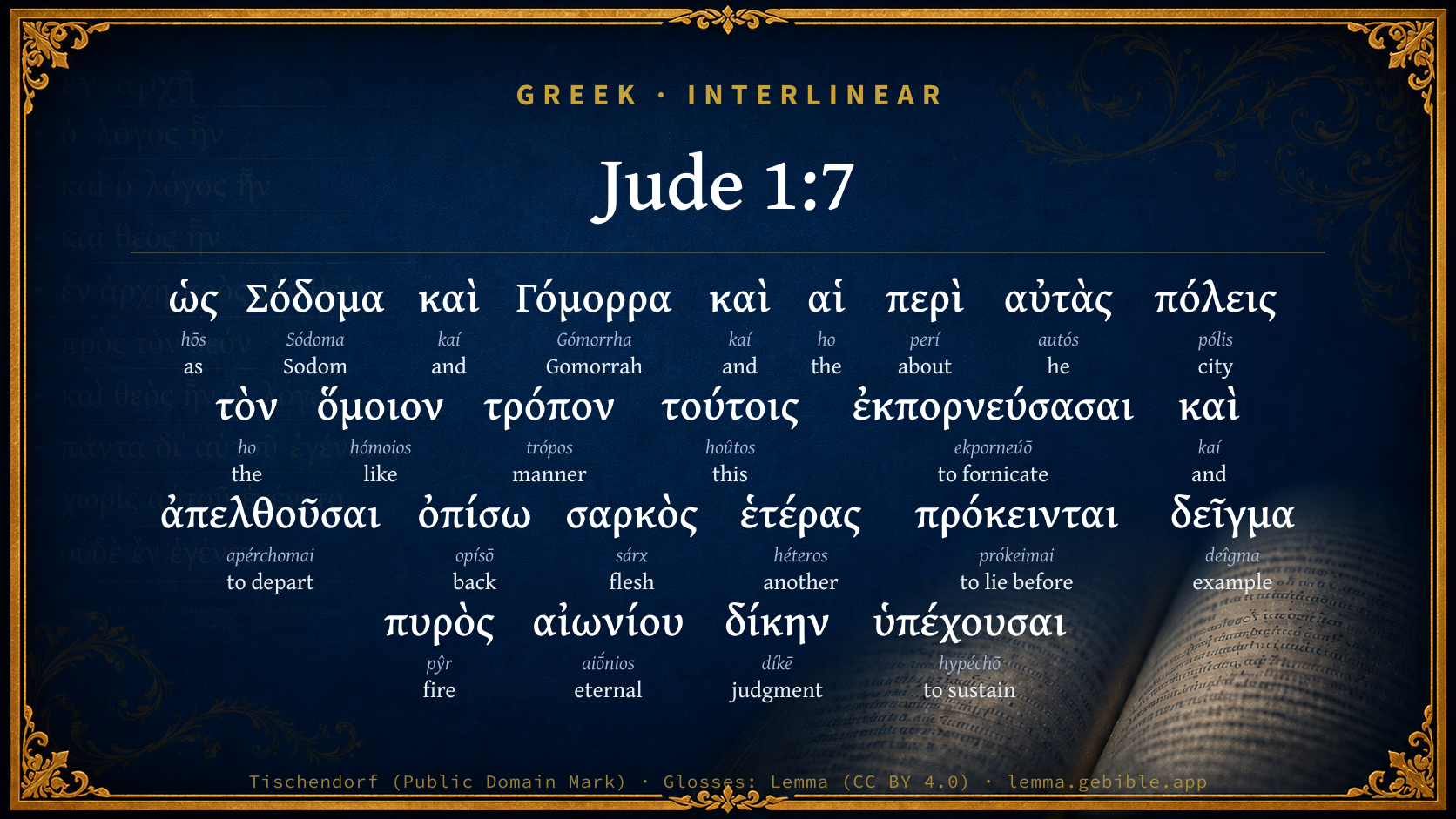
Download image
Cite this verse

Jude 1:7 (World English Bible). Public Domain. Lemma interlinear Bible study tool, https://lemma.gebible.app/v/jude/1/7.

Show BibTeX & RIS
BibTeX
RIS
English Translation
Even as Sodom and Gomorrah, and the cities around them, having, in the same way as these, given themselves over to sexual immorality and gone after strange flesh, are set forth as an example, suffering the punishment of eternal fire.
World English Bible · Public Domain
Highlights
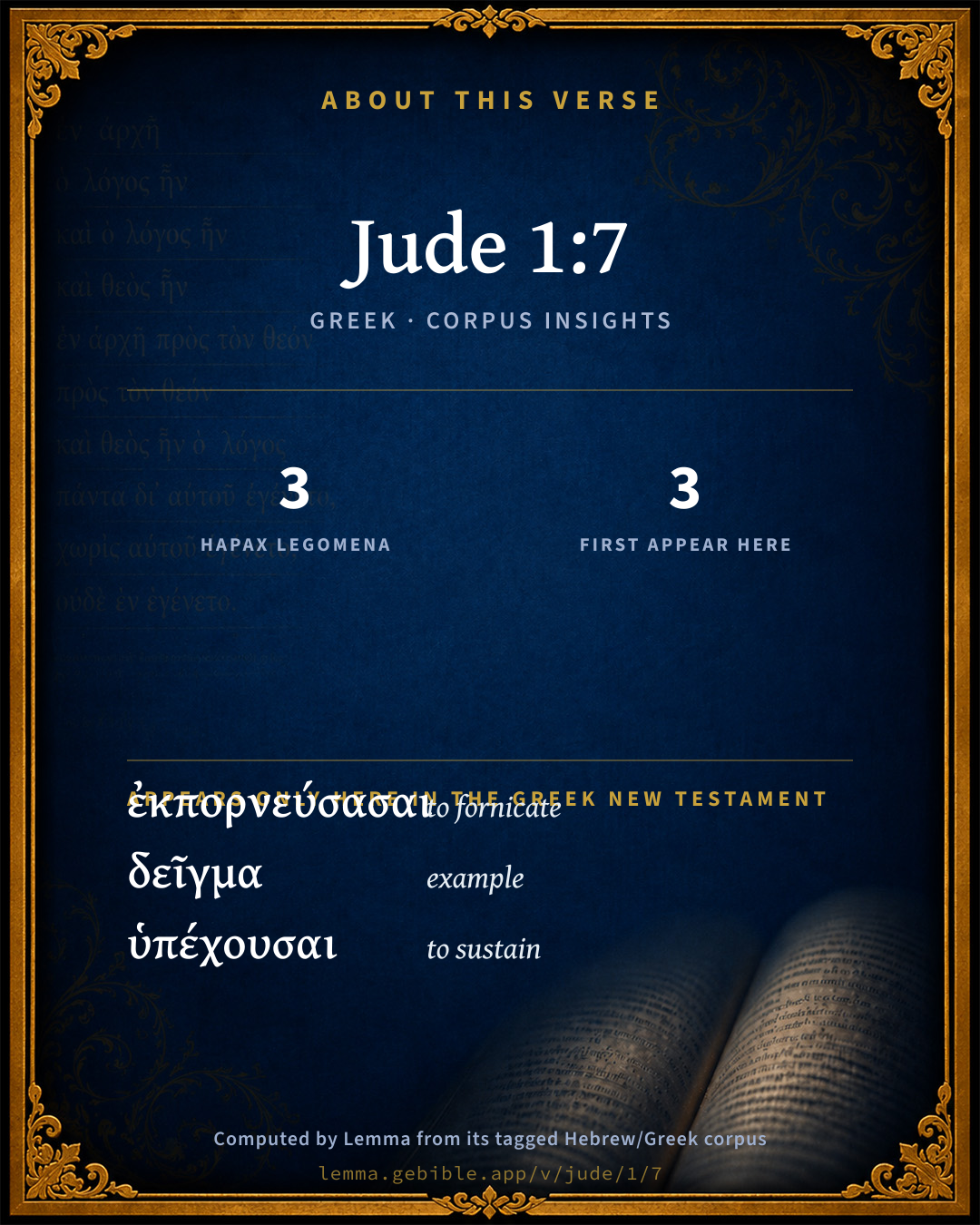
  • 3 hapax legomena — only here in the Greek New Testament
  • 3 first appearances in the Greek New Testament
Full analysis ↓
Download a study sheet

One document with this verse’s original text, its word-by-word gloss line, the meaning frame, cross-references with their text, attributed commentary, and full source and license credits — printable, and it pastes into notes with its structure intact.

This verse Autodidact and up

Study sheet (.html) Plain text (.txt)

A passage Seminary Student

Up to 50 verses in one chapter. A passage sheet keeps up to 6 commentary sources and 12 cross-references per verse, in the order this page ranks them, and says so on the sheet whenever that leaves anything out. Ask for a single verse and you get the Autodidact verse sheet above.

Everything on this page stays free to read, with no account — the sheet is a download of what is already on screen, not access to it.

Want to remove ads? Support Godless Engineer
Compare translations 3

The same verse in 3 English versions, stacked beneath the original-language interlinear above. Click any original word for its lexicon entry.

Each is an independent rendering of the whole verse — the interlinear is not word-aligned to these translations.

Highlighted words mark where these versions differ — a whole-verse word diff, not a word-by-word alignment.

  • World English Bible Public Domain
    Even as Sodom and Gomorrah, and the cities around them, having, in the same way as these, given themselves over to sexual immorality and gone after strange flesh, are set forth as an example, suffering the punishment of eternal fire.
  • King James Version Public Domain
    Even as Sodom and Gomorrha, and the cities about them in like manner, giving themselves over to fornication, and going after strange flesh, are set forth for an example, suffering the vengeance of eternal fire.
  • unfoldingWord Literal Text CC BY-SA 4.0
    as Sodom and Gomorrah and the cities around them, having committed sexual immorality in the same manner these, and having gone after other flesh, are being displayed an example, suffering punishment of eternal fire.

unfoldingWord Literal Text — © unfoldingWord, licensed CC BY-SA 4.0. Word-aligned USFM3 via Door43 (git.door43.org/unfoldingWord/en_ult).

Versions to compare (up to 4)

3 of 4 selected

Show all 19 translations

Every available English version of this verse, each an independent rendering of the whole verse.

  • World English Bible Public Domain
    Even as Sodom and Gomorrah, and the cities around them, having, in the same way as these, given themselves over to sexual immorality and gone after strange flesh, are set forth as an example, suffering the punishment of eternal fire.
  • Berean Standard Bible Public Domain
    In like manner, Sodom and Gomorrah and the cities around them, who indulged in sexual immorality and pursued strange flesh, are on display as an example of those who sustain the punishment of eternal fire.
  • Majority Standard Bible Public Domain
    In like manner, Sodom and Gomorrah and the cities around them, who indulged in sexual immorality and pursued strange flesh, are on display as an example of those who sustain the punishment of eternal fire.
  • King James Version Public Domain
    Even as Sodom and Gomorrha, and the cities about them in like manner, giving themselves over to fornication, and going after strange flesh, are set forth for an example, suffering the vengeance of eternal fire.
  • American Standard Version (1901) Public Domain
    Even as Sodom and Gomorrah, and the cities about them, having in like manner with these given themselves over to fornication and gone after strange flesh, are set forth as an example, suffering the punishment of eternal fire.
  • Revised Version (1885) Public Domain
    Even as Sodom and Gomorrah, and the cities about them, having in like manner with these given themselves over to fornication, and gone after strange flesh, are set forth as an example, suffering the punishment of eternal fire.
  • Geneva Bible (1599) Public Domain
    As Sodom and Gomorrhe, and the cities about them, which in like maner as they did, committed fornication, and followed strange flesh, are set foorth for an ensample, and suffer the vengeance of eternall fire.
  • Douay-Rheims (1899) Public Domain
    As Sodom and Gomorrha, and the neighbouring cities, in like manner, having given themselves to fornication, and going after other flesh, were made an example, suffering the punishment of eternal fire.
  • Young's Literal Translation Public Domain
    as Sodom and Gomorrah, and the cities around them, in like manner to these, having given themselves to whoredom, and gone after other flesh, have been set before -- an example, of fire age-during, justice suffering.
  • Literal Standard Version CC BY-SA 4.0
    as Sodom and Gomorrah, and the cities around them, in like manner to these [messengers], having given themselves to whoredom, and having gone after other flesh, have been set before [as] an example, undergoing the justice of continuous fire.
  • Unlocked Literal Bible CC BY-SA 4.0
    It is just like Sodom and Gomorrah and the cities around them, which also indulged themselves in sexual immorality and pursued unnatural desires. They were displayed as examples of those who suffer the punishment in eternal fire.
  • unfoldingWord Literal Text CC BY-SA 4.0
    as Sodom and Gomorrah and the cities around them, having committed sexual immorality in the same manner these, and having gone after other flesh, are being displayed an example, suffering punishment of eternal fire.
  • Darby Bible Public Domain
    as Sodom and Gomorrha, and the cities around them, committing greedily fornication, in like manner with them, and going after other flesh, lie there as an example, undergoing the judgment of eternal fire.
  • World Messianic Bible Public Domain
    Even as Sodom and Gomorrah and the cities around them, having in the same way as these given themselves over to sexual immorality and gone after strange flesh, are shown as an example, suffering the punishment of eternal fire.
  • Webster's Bible Public Domain
    Even as Sodom and Gomorrah, and the cities about them in like manner, giving themselves over to impurity, and going after strange flesh, are set forth for an example, suffering the vengeance of eternal fire.
  • Free Bible Version CC BY-SA 4.0
    In just the same way, Sodom and Gomorrah and the towns nearby that pursued immorality and perverted sex are provided as an example of those that experience the punishment of eternal fire.
  • Bible in Basic English Public Domain
    Even as Sodom and Gomorrah, and the towns near them, having like these, given themselves up to unclean desires and gone after strange flesh, have been made an example, undergoing the punishment of eternal fire.
  • Text-Critical English NT CC BY 4.0
    Likewise, Sodom and Gomorrah and the cities around them, who indulged in fornication and went after strange flesh in a manner similar to those angels, serve as an example by undergoing the punishment of eternal fire.
  • Tyndale New Testament (1534) Public Domain
    even as Sodom and Gomor and the cities aboute them (which in lyke maner defiled them selves with fornicacion and folowed straunge flesshe) are set forth for an ensample and suffre the vengeaunce of eternall fyre.

Literal Standard Version (2020), Covenant Press — licensed CC BY-SA 4.0. Text via the HelloAO Bible API (eBible.org). Unlocked Literal Bible (unfoldingWord) — licensed CC BY-SA 4.0. Text via the HelloAO Bible API (eBible.org). unfoldingWord Literal Text — © unfoldingWord, licensed CC BY-SA 4.0. Word-aligned USFM3 via Door43 (git.door43.org/unfoldingWord/en_ult). Free Bible Version, Dr. Jonathan Gallagher — licensed CC BY-SA 4.0. Text via the HelloAO Bible API (eBible.org).

Word by word

More ways to search: Search by grammar → Find every occurrence → Compare this word →

Practice this passage: Drill this verse → Learn its vocabulary →

ἐκπορνεύσασαι
ekporneúō
G1608
“to fornicate”
Verb, Aorist, Active, Participle, Nominative, Plural, Feminine
Part of Speech
Verb
Tense
Aorist
Voice
Active
Mood
Participle
Case
Nominative
Number
Plural
Gender
Feminine
Full Thayer's Definition

Origin: from G1537 and G4203

TDNT: 15:39,9

1. to go a whoring, "give one's self over to fornication"
  1. ὡς hōs G5613 “as” Adverb
  2. Σόδομα Sódoma G4670 “Sodom” Noun, Nominative, Plural, Neuter
  3. καὶ kaí G2532 “and” Conjunction
  4. Γόμορρα Gómorrha G1116 “Gomorrah” Noun, Nominative, Singular, Feminine
  5. καὶ kaí G2532 “and” Conjunction
  6. αἱ ho G3588 “the” Article, Nominative, Plural, Feminine
  7. περὶ perí G4012 “about” Preposition
  8. αὐτὰς autós G846 “he” Personal pronoun, Accusative, Plural, Feminine
  9. πόλεις pólis G4172 “city” Noun, Nominative, Plural, Feminine
  10. τὸν ho G3588 “the” Article, Accusative, Singular, Masculine
  11. ὅμοιον hómoios G3664 “like” Adjective, Accusative, Singular, Masculine
  12. τρόπον trópos G5158 “manner” Noun, Accusative, Singular, Masculine
  13. τούτοις hoûtos G3778 “this” Demonstrative pronoun, Dative, Plural, Masculine
  14. καὶ kaí G2532 “and” Conjunction
  15. ἀπελθοῦσαι apérchomai G565 “to depart” Verb, Aorist, Active, Participle, Nominative, Plural, Feminine
  16. ὀπίσω opísō G3694 “back” Adverb
  17. σαρκὸς sárx G4561 “flesh” Noun, Genitive, Singular, Feminine
  18. ἑτέρας héteros G2087 “another” Adjective, Genitive, Singular, Feminine
  19. πρόκεινται prókeimai G4295 “to lie before” Verb, Present, Middle or Passive deponent, Indicative, 3rd person, Plural
  20. δεῖγμα deîgma G1164 “example” Noun, Accusative, Singular, Neuter
  21. πυρὸς pŷr G4442 “fire” Noun, Genitive, Singular, Neuter
  22. αἰωνίου aiṓnios G166 “eternal” Adjective, Genitive, Singular, Neuter
  23. δίκην díkē G1349 “judgment” Noun, Accusative, Singular, Feminine
  24. ὑπέχουσαι hypéchō G5254 “to sustain” Verb, Present, Active, Participle, Nominative, Plural, Feminine

About this verse

These counts appear in no published source. They are computed here, from the morphology-tagged text and Lemma’s own curated glosses. What Lemma adds →

25
words
22
distinct lemmas
General Epistles
section

Notable vocabulary

3 hapax legomena — words that appear only here in the entire Greek New Testament:

  • ἐκπορνεύσασαι to fornicate G1608
  • δεῖγμα example G1164
  • ὑπέχουσαι to sustain G5254

First appearance in Scripture

These words make their first canonical appearance in the Greek New Testament here:

  • ἐκπορνεύσασαι to fornicate G1608
  • δεῖγμα example G1164
  • ὑπέχουσαι to sustain G5254

Shared distinctive vocabulary

δίκην judgment G1349 occurs in 3 verses of the Greek New Testament. Also found in:
Repetition

Words recur within this verse:

Cross-references

22

Topical passages linked to Jude 1:7 in the Treasury of Scripture Knowledge — connected by theme and wording, ordered by reader-vote popularity; previews shown in the World English Bible.

  • Deuteronomy 29:23 [and that] the whole land of it is sulfur, and salt, [and] a burning, [that] it is not sown, nor bears, nor any grass grows therein, like the overthrow of Sodom and Gomorrah, Admah and Zeboiim, which Yahweh overthrew in his anger, and in his wrath:
  • Romans 1:26–27 For this reason, God gave them up to vile passions. For their women changed the natural function into that which is against nature.
  • 2 Peter 2:6 and turning the cities of Sodom and Gomorrah into ashes, condemned them to destruction, having made them an example to those who would live ungodly;
  • Genesis 18:20 Yahweh said, "Because the cry of Sodom and Gomorrah is great, and because their sin is very grievous,
  • Genesis 19:24–26 Then Yahweh rained on Sodom and on Gomorrah sulfur and fire from Yahweh out of the sky.
  • Genesis 13:13 Now the men of Sodom were exceedingly wicked and sinners against Yahweh.
  • Jeremiah 50:40 As when God overthrew Sodom and Gomorrah and the neighbor cities of it, says Yahweh, so shall no man dwell there, neither shall any son of man sojourn therein.
  • Luke 17:29 but in the day that Lot went out from Sodom, it rained fire and sulfur from the sky, and destroyed them all.
  • 1 Corinthians 6:9 Or don't you know that the unrighteous will not inherit the Kingdom of God? Don't be deceived. Neither the sexually immoral, nor idolaters, nor adulterers, nor male prostitutes, nor homosexuals,
  • Isaiah 1:9 Unless Yahweh of hosts had left to us a very small remnant, We would have been as Sodom; We would have been like Gomorrah.
  • Matthew 25:41 Then he will say also to those on the left hand, 'Depart from me, you cursed, into the eternal fire which is prepared for the devil and his angels;
  • Genesis 19:5 They called to Lot, and said to him, "Where are the men who came in to you this night? Bring them out to us, that we may have sex with them."
  • Amos 4:11 "I have overthrown some of you, As when God overthrew Sodom and Gomorrah, And you were like a burning stick plucked out of the fire; Yet you haven't returned to me," says Yahweh.
  • Mark 9:43–49 If your hand causes you to stumble, cut it off. It is better for you to enter into life maimed, rather than having your two hands to go into Gehenna, into the unquenchable fire,
  • 2 Peter 3:7 But the heavens that now are, and the earth, by the same word have been stored up for fire, being reserved against the day of judgment and destruction of ungodly men.
  • Isaiah 13:19 Babylon, the glory of kingdoms, the beauty of the Chaldeans' pride, shall be as when God overthrew Sodom and Gomorrah.
  • Ezekiel 16:49–50 Behold, this was the iniquity of your sister Sodom: pride, fullness of bread, and prosperous ease was in her and in her daughters; neither did she strengthen the hand of the poor and needy.
  • Jeremiah 20:16 Let that man be as the cities which Yahweh overthrew, and didn't repent: and let him hear a cry in the morning, and shouting at noontime;
  • Matthew 11:24 But I tell you that it will be more tolerable for the land of Sodom, on the day of judgment, than for you."
  • Lamentations 4:6 For the iniquity of the daughter of my people is greater than the sin of Sodom, That was overthrown as in a moment, and no hands were laid on her.
  • Isaiah 33:14 The sinners in Zion are afraid; trembling has seized the godless ones: Who among us can dwell with the devouring fire? who among us can dwell with everlasting burning?
  • Hosea 11:8 "How can I give you up, Ephraim? How can I hand you over, Israel? How can I make you like Admah? How can I make you like Zeboiim? My heart is turned within me, My compassion is aroused.

Cross-references courtesy of OpenBible.info (CC BY 4.0).

Commentary

Notes on Jude 1:7 from classic Christian and Jewish commentators (each source and its license shown beneath its notes). The classic Christian expositions comment on the surrounding passage and are grouped to its opening verse, so a note may address several verses; the Jewish commentaries on the Tanakh (Rashi and others) are per-verse, so they appear only where the commentator wrote on this verse.

Lemma curates 59 commentaries, every one of them public domain or Creative Commons licensed, each selected and text-cleaned for this edition rather than reprinted as found. About our sources →

The Biblical Illustrator

Joseph S. Exell

Jud_1:7

Sodom and Gomorrah.

The sin of Sodom and Gomorrah

1. Cities and countries suffer for the evil of the inhabitants. Carnal men are usually moved by carnal arguments, and tremble more to hear of the loss of their estates than of their souls; we are startled to hear of scarcity, and famine, and fires, and pestilences; all these are the fruits of sin.

2. Those cities were utterly destroyed, and accordingly is the destruction of Sodom put for an utter overthrow (Isa_13:19; Zep_2:9; Jer_48:18; Jer_50:40; 2Pe_2:6). Observe thence, that in judgments wicked men may be brought to an utter destruction. The synagogue of Satan may be utterly destroyed, but not the city of God; in the saddest miseries there is hope of Gods children.

3. Fellowship in evil can neither excuse sin nor keep off wrath. It cannot excuse sin; nothing more usual than for men to say, they do as others do; if you do as others do you shall suffer as others do; example doth not lessen sin, but increase it, partly because their own act is an approbation of the act of others. Again, it doth not keep off wrath; multitudes and single persons are all one to avenging justice. Well, then, learn to live by rule and not by example, and propose the sins of others to your grief, not imitation: Have no fellowship with the unfruitful works of darkness, but reprove them rather; their practice will never afford you excuse nor exemption. To walk with God is praiseworthy, though none do it besides thyself; and to walk with men in the way of sin is dangerous, though millions do it besides thee.

4. The lesser cities imitated the greater. Admah and Zeboim followed the example of Sodom and Gomorrah. An error in the first concoction is seldom mended in the second. When the first sheet is done off, others are printed by the same stamps. Diodorus Siculus telleth us of a people in Ethiopia, that if their kings halted, they would maim themselves that they might halt likewise. The vices of them in place and power are authorised by their example and pass for virtues; if they be slight in the use of ordinances, it will be taken up as a piece of religion by inferiors to be so too.

5. From the first crime here specified, giving themselves over to fornication, that adulterous uncleanness doth much displease God. When they were given over to fornication they were given over to judgment.

(1) This is a sin that doth not only defile the soul but the body (1Co_6:18). It is a wrong to the body, considered either as our vessel (1Th_4:4), or as the temple of the Holy Ghost (1Co_6:19). If you consider it as our vessel or instrument for natural uses, you wrong it by uncleanness--namely, as it destroyeth the health of the body, quencheth the vigour of it, and blasteth the beauty, and so it is self-murder. If you consider it as the temple of the Holy Ghost, it is a dishonour to the body to make it a channel for lust to pass through. Shall we make a sty of a temple?

(2) It brawneth the soul; the softness of all sensual pleasures hardeneth the heart, but this sin, being the consummate act of sensuality, much more (Hos_4:11).

(3) Next to the body and soul there is the name, now it blotteth the name (Pro_6:33).

(4) It blasteth the estate (Heb_13:4). God will judge others, but surely these, and that remarkably in this life.

(5) This doth exceedingly pervert the order of human societies; Solomon maketh it worse than theft (Pro_6:29-32).

(6) It is a sin usually accompanied with impenitency--namely, as it weareth out remorse and every spark of good conscience (Pro_22:14; Pro_2:19; Ecc_7:26-28). Beware of all tendings that way; do not soak and steep the soul in pleasures. Guard the senses, cut off the provisions of the flesh, avoid occasions, be employed.

6. Again, from the other sin, and going after strange flesh, observe, sin is never at a stay; first, uncleanness, and then given over to uncleanness, and then strange flesh. When a stone runneth down hill it stayeth not till it cometh to the bottom.

7. The wicked Sodomites were not only burnt up by that temporal judgment, but cast into hell, which is here called eternal fire. The scourges of conscience that we meet with here are too great price for the short pleasures of a brutish lust, much more the worm that never dieth, the fire that shall never be quenched.

8. There is one note more, and that is from that clause, are set forth for an example. Observe thence, that Sodoms destruction is the worlds great example. You will say, What have we to do with Sodom, their sins being so unnatural, their judgments so unusual?

(1) As to their sins, I inquire, Are there none of Sodoms sins amongst us? If not going after strange flesh, yet fornication; if not fornication, yet pride and idleness and fulness of bread? We sin against more light, more love, etc.

(2) As to the judgments, though God doth not nowadays smite a country with judgments immediately from heaven, yet His displeasure is no less against sin; and if not the same, a like judgment, one very grievous, may come upon us. (T. Manton.)

The extermination of sin

I. Gods hatred of sin demonstrated by the destruction of sinners. The punishment of evil-doers forms a large portion of the sacred volume. Sin is never unpunished if not pardoned. This is a beneficent as well as just treatment. The safety of moral beings is thereby secured.

II. National sins visited by universal destruction.

III. Sin must be exterminated. God does destroy sin by reconstructing, and He reconstructs the order of society by destroying.

IV. The warning is the strongest. (T. Davies, D. D.)

The Biblical Illustrator, edited by Joseph S. Exell (c. 1880s–1900s) — public domain. Text from a community e-Sword module.

Joseph Benson's Commentary

Jdg 1:7-8. Even as Sodom and Gomorrha — See on 2Pe 2:6-9; and the cities about them — These were Admah and Zeboim. The four are mentioned Deu 29:23; Zoar, the fifth city in the plain of Sodom, was spared, at the request of Lot, for a place of refuge to him and his family. In like manner — Τον ομοιον τουτοις τροπον, in a manner like to these; that is, either like to these wicked teachers, or like to the inhabitants of these wicked cities, Sodom and Gomorrah; giving themselves over to fornication — The word is applicable to any sort of uncleanness; and going after strange flesh — Giving themselves up to unnatural lusts; are set forth for an example — To other presumptuous sinners; suffering the vengeance of eternal fire — Having their lovely and fruitful country turned into a kind of hell upon earth. The meaning is, The vengeance which they suffered is an example, or type, of eternal fire. Likewise — Ομοιως μεν τοι, in like manner, indeed; these filthy dreamers — So our translators render the word ενυπνιαζομενοι, an epithet which the persons described undoubtedly deserved. The word, however, only signifies dreamers; or rather, persons cast into a deep sleep, namely, into a state of ignorance and insensibility, of negligence and sloth, with respect to spiritual and eternal things; sleeping and dreaming all their lives. Defile the flesh — Their own bodies, which ought to be sacred, together with their spirits, to the service of God. Despise dominion — Those that are invested with it by Christ, and made by him the overseers of his flock; or, he may mean that they despised their civil rulers; and speak evil of dignities — Of persons in the most honourable stations. The Jews, fancying it sinful to obey the heathen magistrates, despised both them and their office. The ungodly teachers, of whom Jude speaks, carried the matter still further; they reviled all magistrates whatever, as enemies to the natural liberty of mankind.

Joseph Benson's Commentary on the Old and New Testaments (1811–1818) — public domain. Text from a community e-Sword module.

The Preacher's Complete Homiletical Commentary

Joseph S. Exell (gen. ed.)

CRITICAL AND EXEGETICAL NOTES

Jud_1:7. Giving themselves over.—ἐκπορνεύσασαι; the ἐκ denotes the intensity of their lust, which would be gratified at all hazards. Strange flesh.—Other flesh; præter naturam; Romans 1. Eternal fire.—As eternal is a spiritual quality, and fire a material substance, the association of the two terms must be figurative, and suggestive of moral truth. Vengeance.—Is of course “just punishment,” not “unrestrained feeling.”

Jud_1:8. Filthy dreamers.—Omit the adjective. We call similar persons “mystics”; and with such there is always peril of neglecting the moral claims of religion. “Under the plea of spiritual perfection, these men have indulged in carnal pollutions, have sinned against themselves, have held tenets subversive of all civil authority and constituted government, have formed degrading conceptions of heavenly glories, or of glorified beings, as saints and angels, reducing the hope of the Church to the sensual delights of a Mahometan paradise.”

Jud_1:9. Michael the archangel.—For the legends concerning him, see Illustrations. See Zec_3:2; Dan_10:21; Dan_12:1; Rev_12:7. There can be no doubt that an unhistorical incident is here cited as a warning; and our theories of inspiration must be such as can admit this fact.

Jud_1:10.—“What they do not know, and cannot know, they abuse by gross irreverence. What they know, and cannot help knowing, they abuse by gross licentiousness.”

Jud_1:11.—Three examples of similar wickedness. The stories of Cain, Balaam, and Korah. The root-evil in each case is covetousness. There were singular Rabbinic legends associated with Cain. Balaam’s advice to seduce Israel to moral evil is in mind (2Pe_2:15). “A strange legend placed the souls of Korah and his company in Gehenna, but represented them as not being tormented there.”

The Preacher's Complete Homiletical Commentary (gen. ed. Joseph S. Exell; Funk & Wagnalls, c. 1892) — public domain (pre-1929). A full-Bible homiletical/sermon-outline anthology covering 65 of 66 books (2 John is absent from the source module). Text from a community e-Sword module.

Tyndale Open Study Notes

Tyndale Open Resources

1:7 God’s judgment on Sodom and Gomorrah had become proverbial (see Gen 18:17–19:26; Luke 17:26-29). • neighboring towns: Deuteronomy 29:23 mentions Admah and Zeboiim. • Every kind of sexual perversion probably refers to homosexuality (Gen 19:5-10).

Tyndale Open Study Notes — © Tyndale Open Resources, licensed CC BY-SA 4.0. Text via the HelloAO Bible API.

Bengel's Gnomon

Johann Albrecht Bengel

Jud 1:7. Τούτοις) [in a manner like] to these, the ungodly, who are doomed to undergo a like punishment.—ἐκπορνεύσασαι) giving themselves to fornication. For the simple verb πορνεύω, זנה, the Septuagint often has ἐκπορνεύω. But here the word is peculiarly adapted to a lust still more abominable.—ἀπελθοῦσαι—ἑτέρας, going away after—other) unnatural lusts.—[πρόκεινται, are set forth, lie before our eyes) The cities therefore were situated, not in the Dead Sea, but upon the shore.—V. g.]—δεῖγμα—δίκην, an example—punishment) These are put in apposition; the punishment, which they endure, is an example of eternal fire, as Cassiodorus says: for the punishment of those cities is not itself eternal: Eze 16:53; Eze 16:55. Comp. 2Pe 2:6.

Bengel's Gnomon of the New Testament — English translation (T&T Clark, Edinburgh, 1860) — public domain. Text from a community e-Sword module.

Meyer's Critical & Exegetical Commentary

Heinrich August Wilhelm Meyer

Jud_1:7. Third example: the judgment on Sodom and Gomorrha and the cities about them, which, however, is not co-ordinate with the preceding two, but is closely connected with the last-mentioned, whilst here both times a permanent condition is meant, which a similar sin has had as its consequence, whereas ἀπώλεσεν (Jud_1:5) states a judgment of God already past (Hofmanns Schriftb. I. p. 428).

ὡς] is not to be connected with the following ὁμοίως, Jud_1:8; nor is ὅτι, Jud_1:5, to be connected with ὑπομνῆσαι … βούλομαι (de Wette) = how instead of that; it refers rather to what directly precedes = like as (Semler, Arnaud, Hofmann, Brückner, Wiesinger, Schott, and others; Luther: as also), whilst Jud_1:7 confirms ἀγγέλους … τετήρηκεν by the comparison with what befell Sodom and Gomorrha: God retains the angels kept unto the day of judgment, even as Sodom and Gomorrha πρόκεινται δεῖγμα κ.τ.λ. With the connection with ὑπομν. βουλ. (Jud_1:5) a preceding καί would hardly be necessary, also the words τὸν ὅμοιον τούτοις indicate the close connection with Jud_1:6.

Σόδομα καὶ Γόμοῤῥα] frequently adduced in the O. and N. T. as examples of the divine judgment; see, for example, Rom_9:29.

καὶ αἱ περὶ αὐτὰς πόλεις] according to Deu_29:23; Hos_11:8 : Admah and Zeboim.

τὸν ὅμοιον τρόπον τούτοις ἐκπορνεύσασαι] τούτοις may grammatically be referred to Σόδ. κ. Γόμ. (or, by synesis, to the inhabitants of these cities; so Krebs, Calvin, Hornejus, Vorstius, and others); but by this construction the sin of Sodom and Gomorrha would only be indirectly indicated. Since, also, τούτοις cannot refer to the false teachers, Jud_1:4, because, as de Wette correctly remarks, the thought of Jud_1:8 would be anticipated, it must refer to the angels who, according to the Book of Enoch, sinned in a similar way as the inhabitants of those cities (thus Herder, Schneckenburger, Jachmann, de Wette, Arnaud, Hofmann, and others).

ἐκπορνεύσασαι, the sin of the inhabitants, is designated as the action of the cities themselves. The verb (often in the LXX. the translation of זָנָה; also in the Apocrypha) is in the N. T. a ἅπ. λεγ. The preposition ἐκ serves for strengthening the idea, indicating that one by πορνεύειν becomes unfaithful to true moral conduct (Hofmann), but not that he goes beyond the boundaries of nature (Stier, Wiesinger, and similarly Schott).

καὶ ἀπελθοῦσαι ὀπίσω σαρκὸς ἑτέρας] The expression ἀπέρχ. ὀπίσω τινός is found in Mar_1:20 in its literal sense; here it has a figurative meaning; comp. 2Pe_2:10, πορεύεσθαι ὀπ.; Jer_2:5; Sir_46:10.

Arnaud: ces mots sont ici un euphémisme, pour exprimer lacte de la prostitution. In ἀπο is contained the turning aside from the right way. Oecumenius thus explains the import of σὰρξ ἑτέρα: σάρκα δὲ ἑτέραν, τὴν ἄῤῥηνα φύσιν λέγει, ὡς μὴ πρὸς συνουσίαν γενέσεως συντελοῦσαν; so also Brückner and Wiesinger. Stier, Schott, Hofmann proceed further, referring to Lev_18:23-24, and accordingly explaining it: not only have they practised shame man with man, but even man with beast (Stier). Only this explanation corresponds to σαρκὸς ἑτέρας, and only by it do the connection of Jud_1:7 with Jud_1:6, expressed by ὡς, and the explanation: τὸν ὅμοιον τρόπον τούτοις, receive their true meaning. The σάρξ of men was ἑτέρα σάρξ to the angels, as that of beasts is to men. In the parallel passage, 2Pe_2:6, the sin of the cities is not stated.

πρόκεινται δεῖγμα πυρὸς αἰωνίου δίκην ὑπέχουσαι] πρόκεινται: they lie before the eyes as a δεῖγμα; not: inasmuch as the example of punishment in its historical attestation is ever present (Schott); but: inasmuch as the Dead Sea continually attests that punishment, which Jude considers as enduring. There is a certain boldness in the expression, as properly it is not the cities and their inhabitants who are πρόκεινται. The genitive πυρὸς αἰωνίου may grammatically depend both on δεῖγμα and on δίκην. Most expositors (particularly Wiesinger, Schott, Brückner) consider the second construction as the correct one; but hardly rightly; as (1) δεῖγμα would then lose its exact definition; (2) πῦρ αἰώνιον always designates hell-fire, to which the condemned are delivered up at the last judgment (see Mat_25:41); (3) the juxtaposition of this verse with Jud_1:6, where the present punitive condition of the angels is distinguished from that which will occur after the judgment, favours the idea that the cities (or rather their inhabitants) are here not designated as those who even now suffer the punishment of eternal fire.[23] But Jude could designate the cities as a δεῖγμα of eternal fire, considering the fire by which they were destroyed as a figure of eternal fire. Hofmann correctly connects πυρὸς αἰωνίου with δεῖγμα, but he incorrectly designates δεῖγμα πυρ. αἰων. as a preceding apposition to δίκην: it may be seen in them (δεῖγμα = exhibition) what is the nature of eternal fire, inasmuch as the fire that has consumed them is enduring in its after-operations; by this explanation πῦρ αἰώνιον is deprived of its proper meaning. With δίκην ὑπέχουσαι the fact is indicated that they have continually to suffer punishment, since the period that punishment was inflicted upon them in the time of Lot;[24] corresponding to what is said of the angels in Jud_1:6.

δεῖγμα in N. T. ἅπ. λεγ. (Jam_5:11, and frequently: ὑπόδειγμα), not = example, but proof, testimony, sign. ὑπέχειν likewise in N. T. ἅπ. λεγ.; 2Ma_4:48, ζημίαν ὑπέχειν (2Th_1:9, δίκην τίειν).

[23] Wiesinger incorrectly observes that by this connection we must also assume that those angels also suffer the punishment of eternal fire, since precisely the contrary is the case. Wiesinger arrives at this erroneous assumption by taking δεῖγμα as equivalent to example. It is also entirely erroneous when it is asserted that πυρὸς αἰωνίου δίκη is an evident type of hell-fire, since πῦρ αἰώνιον is itself hell-fire. To be compared with this is 3Ma_2:5 : σὺ … Σοδομίτας … πυρὶ … κατέφλεξας, παράδειγμα τοῖς ἐπιγινομένοις καταστήσας; and Libanius in reference to Troy: κεῖται παράδειγμα δυστοχία; πυρὸς αἰωνίου.

[24] There is no necessity to derive this representation from Wis_10:7, and the various phenomena which lead to the supposition of a subterranean fire at the Dead Sea (see Winers bibl. Realw.; todtes Meer).

Meyer — Critical and Exegetical Commentary on the New Testament — English translation by Peter Christie, edited by Frederick Crombie (T&T Clark, 1880) — public domain. Text from a community e-Sword module.

Expositor's Greek Testament

ed. W. Robertson Nicoll

Jud 1:7 . ὡς Σόδομα καὶ Γόμορρα καὶ αἱ περὶ αὐτὰς πόλεις . The 3rd example of Divine judgment differs from the two others, as it tells only of the punishment, not of the fall from grace. Hence the difference of connexion ἀγγέλους τε .… ὡς Σόδομα . Cf. 2Pe 2:6 , πόλεις Σοδόμων καὶ Γομόρρας καταστροφῇ κατέκρινεν . The destruction was not limited to these two cities, but extended to all the neighbouring country (Gen 19:25 , called Πεντάπολις in Wis 10:6 ), including the towns of Admah and Zeboim (Deu 29:23 , Hos 11:8 ). Zoar was spared at the request of Lot.

τὸν ὅμοιον τρόπον τούτοις ἑκπορνεύσασαι . For the adverbial acc., cf. Mat 23:37 , ὃν τρόπον ἐπισυνάγει ὄρνις τὰ νοσσία , 2Ma 15:39 , ὃν τρόπον οἶνος … ἀποτελεῖ , οὕτω καὶ , Luc. Catapl. 6 τεθνᾶσι τὸν ὅμοιον τρόπον . “Like them.” i.e. the fallen angels. The two judgments are similarly joined in Test. Nepht. 3, μὴ γένησθε ὡς Σόδομα ἥτις ἐνήλλαξε τάξιν φύσεως αὐτῆς . Ὁμοίως δὲ καὶ οἱ Ἐγρήγορες ἐνήλλαξαν τάξιν φύσεως αὐτῶν , οὕς κατηράσατο Κύριος . Others understand τούτοις of the libertines who are subsequently referred to as οὖτοι (Jud 1:8 ; Jud 1:10 ; Jud 1:12 ; Jud 1:16 ; Jud 1:19 ); but the beginning of Jud 1:8 ( μέντοι καὶ οὗτοι ) seems to distinguish between them and the preceding. The verb ἐκπ . occurs in Gen 38:24 of Tamar, Exo 34:15-16 , ( μή ποτε ) ἐκπορνεύσωσιν ὀπίσω τῶν θεῶν αὐτῶν , Lev 17:7 , Hos 4:12 , Eze 16:26 ; Eze 16:28 ; Eze 16:33 .

ἀπελθοῦσαι ὀπίσω σαρκὸς ἑτέρας . In the case of the angels the forbidden flesh (lit. “other than that appointed by God”) refers to the intercourse with women; in the case of Sodom to the departure from the natural use (Rom 1:27 ), what Philo calls ἀνόμους καὶ ἑκθέσμους μίξεις ( de Gig. M i. p. 267), cf. Exo 30:9 . οὐκ ἀνοίσεις θυμίαμα ἕτερον . For the post-classical phrase cf. 2Pe 2:10 , τοὺς ὀπίσω σαρκὸς ἐν ἐπιθυμίᾳ μιασμοῦ πορευομένους , Deu 4:3 , ἐπορεύθη ὀπίσω Βεελφεγώρ Jer 2:2-3 .

πρόκεινται δεῖγμα πυρὸς αἰωνίου δίκην ὑπέχουσαι . Cf. Enoch lxvii. 12, “this judgment wherewith the angels are judged is a testimony for the kings and the mighty,” 2Pe 2:6 , ὑπόδειγμα μελλόντων ἀσεβέσιν τεθεικώς , 1Co 10:6 ; 1Co 10:11 τύποι ἐγένοντο , Heb 4:11 ἵνα μὴ ἐν τῷ αὐτῷ τις ὑποδείγματι πέσῃ τῆς ἀπειθείας . The present aspect of the Lacus Asphaltites was a conspicuous image of the lake of fire and brimstone prepared for Satan and his followers, Rev 19:20 ; Rev 20:10 ; Rev 21:8 . It is questioned whether πυρός is governed by δεῖγμα or δίκην . If by δίκην , then the burning of Sodom is itself spoken of as still going on (eternal), and this is in accordance with Jewish belief as recorded in Wis 10:7 ( πῦρ Πενταπόλεως ) ἦς ἔτι μαρτύριον τῆς πονηρίας καπνιζομένη καθέστηκε χέρσος , Philo ( De Abr. M. ii. xxi.), μέχρι νῦν καίεται . τὸ γὰρ κεραύνιον πῦρ ἥκιστα σβεννύμενον ἢ νέμεται ἢ ἐντύφεται . πίστις δὲ σαφεστάτη τὰ δρώμενα , τοῦ γὰρ συμβεβηκότος πάθους σημεῖόν ἐστιν ὅ τε ἀναδιδόμενος ἀεὶ καπνὸς καὶ ὃ μεταλλεύουσι θεῖον , ib. V. Moys. M. ii. p. 143. Some disallow this sense of αἰώνιος and think that it can only be used of hell-fire, as in 4Ma 12:12 (the words of the martyr contrasting the fires of present torture with the eternal flames awaiting the persecutor), ταμιεύεταί σε ἡ θεία δίκη πυκνοτέρῳ καὶ αἰωνίῳ πυρί , καὶ βάσανοι εἰς ὅλον τὸν αἰῶνα οὐκ ἀνήσουσί σε . For an examination of the word see Jukes, Restitution of all Things , p. 67 n. and cf. Jer 23:39-40 , Eze 16:53 ; Eze 16:55 (on the restoration of Sodom), Eze 47:1-12 (a prophecy of the removal of the curse of the Dead Sea and its borders), Enoch, x. 5 and 12, where the εἰς αἰῶνα of the former verse is equivalent to seventy generations in the latter, also Eze 47:10 where ζωὴ αἰώνιος is reckoned at 500 years. As the meaning of δεῖγμα is made clear by the following participial clause, it seems unnecessary to take it with πυρός in the sense of “an example or type of eternal fire,” which would escape the difficulty connected with αἰωνίου , but leaves δίκην ὑπέχουσαι (for which cf. Xen. Mem. ii. 1, 8, 2Ma 4:48 ) a somewhat otiose appendage. In the book of Enoch (lxvii. 4 foll.) the angels who sinned are said to be imprisoned in a burning valley (Hinnom, ch. 27) in which there was a great swelling of waters, accompanied by a smell of sulphur; and “that valley of the angels burned continually under the earth”. Charles notes on this that “the Gehenna valley here includes the adjacent country down to the Dead Sea. A subterranean fire was believed to exist under the Gehenna valley.”

The Expositor's Greek Testament, edited by W. Robertson Nicoll (1897–1910) — public domain. Text from a community e-Sword module.

Geneva Bible (1599)

Geneva Bible translators

Following the steps of Sodom and Gomorrah.

Thus he covertly setteth forth their horrible and monstrous lusts.

Geneva Bible (1599) marginal notes — public domain. Text via Bolls.life.

Jamieson, Fausset & Brown

Robert Jamieson, A. R. Fausset & David Brown

Even as--ALFORD translates, "I wish to remind you (Jde 1:5) that."

Sodom, &c.-- (Pe2 2:6).

giving themselves over to fornication--following fornication extraordinarily, that is, out of the order of nature. On "in like manner to them" (Greek), compare Note, see on Jde 1:6. Compare on spiritual fornication, "go a whoring from thee," Psa 73:27.

going after strange flesh--departing from the course of nature, and going after that which is unnatural. In later times the most enlightened heathen nations indulged in the sin of Sodom without compunction or shame.

are set forth--before our eyes.

suffering--undergoing to this present time; alluding to the marks of volcanic fire about the Dead Sea.

the vengeance--Greek, "righteous retribution."

eternal fire--The lasting marks of the fire that consumed the cities irreparably, is a type of the eternal fire to which the inhabitants have been consigned. BENGEL translates as the Greek will admit, "Suffering (the) punishment (which they endure) as an example or sample of eternal fire (namely, that which shall consume the wicked)." Eze 16:53-55 shows that Sodom's punishment, as a nation, is not eternal. Compare also Pe2 2:6.

Jamieson, Fausset & Brown — Commentary Critical and Explanatory on the Whole Bible (1871) — public domain (CC PDM 1.0). Text via the HelloAO Bible API.

Adam Clarke's Commentary

Verse 7. Even as Sodom and Gomorrha] What their sin and punishment were may be seen in Gen. 19, and the notes there. This is the third example to illustrate what is laid down Jude 1:4.

Are set forth for an example] Both of what God will do to such transgressors, and of the position laid down in Jude 1:4, viz., that God has in the most open and positive manner declared that such and such sinners shall meet with the punishment due to their crimes.

Suffering the vengeance of eternal fire.] Subjected to such a punishment as an endless fire can inflict. Some apply this to the utter subversion of these cities, so that by the action of that fire which descended from heaven they were totally and eternally destroyed; for as to their being rebuilt, that is impossible, seeing the very ground on which they stood is burned up, and the whole plain is now the immense lake Asphaltites. See my notes on Gen. 19.

The first sense applies to the inhabitants of those wicked cities; the second, to the cities themselves: in either case the word πυραιωνιον signifies an eternally destructive fire; it has no end in the punishment of the wicked Sodomites, c. it has no end in the destruction of the cities; they were totally burnt up, and never were and never can be rebuilt. ln either of these senses the word αιωνιος, eternal, has its grammatical and proper meaning.

Adam Clarke's Commentary on the Bible (1810–1826) — public domain. Text from a community e-Sword/MySword module.

John Calvin's Commentaries

7. Even as Sodom and Gomorrha. This example is more general, for he testifies that God, excepting none of mankind, punishes without any difference all the ungodly. And Jude also mentions in what follows, that the fire through which the five cities perished was a type of the eternal fire. Then God at that time exhibited a remarkable example, in order to keep men in fear till the end of the world. Hence it is that it is so often mentioned in Scripture; nay, whenever the prophets wished to designate some memorable and dreadful judgment of God, they painted it under the figure of sulfurous fire, and alluded to the destruction of Sodom and Gomorrha. It is not, therefore, without reason that Jude strikes all ages with terror, by exhibiting the same view.

When he says, the cities about them in like manner, giving themselves over to fornication, I do not apply these words to the Israelites and the angels, but to Sodom and Gomorrha. It is no objection that the pronoun τούτοις is masculine, for Jude refers to the inhabitants and not to the places. To go after strange flesh, is the same as to be given up to monstrous lusts; for we know that the Sodomites, not content with the common manner of committing fornication, polluted themselves in a way the most filthy and detestable. We ought to observe, that he devotes them to eternal fire; for we hence learn, that the dreadful spectacle which Moses describes, was only an image of a much heavier punishment.

John Calvin's Commentaries (1540-1563) — public domain. Text from the Calvin Translation Society English edition (1840s-50s) via the Christian Classics Ethereal Library (ccel.org). Calvin's coverage is partial (roughly two-thirds of the Bible); uncommented books and verses are honest gaps, never fabricated. The 19th-century editor's footnotes and remarks are omitted so the notes are faithfully Calvin's own voice.

The Cambridge Bible for Schools and Colleges

gen. ed. J. J. S. Perowne

7. the cities about them, in like manner … going after strange flesh] The words describe the form of evil for which the cities of the plain have become a byword of infamy. In saying that this sin was like that of the angels, it is clearly implied that in the latter case also there was a degradation of nature, such as is emphasized in the words that “the sons of God went in unto the daughters of men” (Gen_6:4). Impurity, and not simply or chiefly pride, as in the mediæval traditions represented in the poems of Cædmon and Milton, is thought of as the leading feature in the fall of the angels (Book of Enoch, c. 9).

suffering the vengeance of eternal fire] The words imply a reference to something more than the natural phenomena of the Dead Sea region. The fire which had destroyed them is thought of as being still their doom, as permanent as the “eternal fire” of Mat_25:41. For “vengeance,” which admits of a bad as well as a good meaning, it might be better to read “just punishment.”

The Cambridge Bible for Schools and Colleges (gen. ed. J. J. S. Perowne; Cambridge University Press, 1878–1918) — public domain. Text from a community e-Sword module.

John Gill's Exposition

Even as Sodom and Gomorrha, and the cities about them,.... Admah and Zeboiim, for Zoar was spared. This is a third instance of God's vengeance on sinners; and which, like that of the Israelites, and of the angels, was after great favours had been enjoyed: these places were delightfully situated, and very fruitful, as the garden of God; they were under a form of government, had kings over them, and had lately had a very great deliverance from the kings that carried them captive, being rescued by Abraham; they had a righteous Lot among them, who was a reprover in the gate, and Abraham made intercession for them with God. But they

in like manner giving themselves over to fornication; not as the angels, who are not capable of sinning in such a manner; though the Jews make this to be a sin of theirs, and so interpret Gen 6:2 (i), but rather the Israelites, among whom this sin prevailed, Co1 10:8; though it seems best of all to refer it to the false teachers that turned the grace of God into lasciviousness, and were very criminal this way; and then the sense is, that in like manner as they, the inhabitants of Sodom and Gomorrah, gave themselves over to the sin of fornication; wherefore these men might expect the same judgments that fell upon them, since their sin was alike; which sin is a work of the flesh, contrary to the law of God, is against the body, and attended with many evils; exposes to judgment here and hereafter, and unfits for the communion of the saints, and for the kingdom of heaven:

and going after strange flesh; or "other flesh"; meaning not other women besides their own wives, but men; and designs that detestable and unnatural sin, which, from these people, is called sodomy to this day; and which is an exceeding great sin, contrary to the light of nature and law of God, dishonourable to human nature, and scandalous to a nation and people, and commonly prevails where idolatry and infidelity do, as among the Papists and Mahometans; and arose from idleness and fulness of bread in Sodom, and was committed in the sight of God, with great impudence: their punishment follows,

are set forth for an example; being destroyed by fire from heaven, and their cities turned into a sulphurous lake, which continues to this day, as a monument of God's vengeance, and an example to all such who commit the same sins, and who may expect the same equitable punishment; and to all who live ungodly lives, though they may not be guilty of the same crimes; and to all that slight and reject the Gospel revelation, with whom it will be more intolerable than for Sodom and Gomorrah; and to antichrist, who bears the same name, and spiritually is called Sodom and Egypt; and particularly to all false teachers, who besides their strange doctrines, go after strange flesh:

suffering the vengeance of eternal fire; which may be understood of that fire, with which those cities, and the inhabitants of it, were consumed; which, Philo the (k) Jew says, burnt till his time, and must be burning when Jude wrote this epistle. The effects of which still continues, the land being now brimstone, salt, and burning; and is an emblem and representation of hell fire, between which there is a great likeness; as in the matter of them, both being fire; in the efficient cause of them, both from the Lord; and in the instruments thereof, the angels, who, as then, will hereafter be employed in the delivery of the righteous, and in the burning of the wicked; and in the circumstance attending both, suddenly, at an unawares, when not thought of, and expected; and in the nature of them, being a destruction total, irreparable, and everlasting: and this agrees with the sentiments of the Jews, who say (l), that "the men of Sodom have no part or portion in the world to come, and shall not see the world to come.

And says R. Isaac,

"Sodom is judged , "with the judgment of hell" (m).

(i) Pirke Eliezer, c. 22. Joseph. Antiqu. l. 1. c. 3. sect. 1. (k) De Abrahamo, p. 370. (l) T. Hieros. Sanhedrin, fol. 29. 3. (m) Zohar in Gen. fol. 71. 3.

John Gill's Exposition of the Whole Bible (1746–1763) — public domain (CC PDM 1.0). Text via the HelloAO Bible API.

Albert Barnes' Notes on the Bible

Even as Sodom and Gomorrha - Notes, 2Pe 2:6.

And the cities about them - Admah and Zeboim, Gen 14:2; Deu 29:23; Hos 11:8. There may have been other towns, also, that perished at the same time, but these are particularly mentioned. They seem to have partaken of the same general characteristics, as neighboring towns and cities generally do.

In like manner - “In a manner like to these,” (τὸν ὅμοιον τούτοις τρόπον ton homoion toutois tropon.) The Greek word “these,” is in the plural number. There has been much diversity in interpreting this clause. Some refer it to the angels, as if it meant that the cities of Sodom and Gomorrah committed sin in a way similar to the angels; some suppose that it refers to the wicked teachers about whom Jude was discoursing, meaning that Sodom and Gomorrah committed the same kind of sins which they did; some that the meaning is, that “the cities round about Sodom and Gomorrah” sinned in the same way as those cities; and some that they were punished in the same manner, and were set forth like them as an example. I see no evidence that it refers to the angels, and if it did, it would not prove, as some have supposed, that their sin was of the same kind as that of Sodom, since there might have been a resemblance in some respects, though not in all. I see no reason to believe, as Macknight holds, that it refers to “false teachers,” since that would be to suppose that the inhabitants of Sodom copied their example long “before” the example was set. It seems to me, therefore, that the reference is to the cities round about Sodom; and that the sense is, that they committed iniquity in the same manner as the inhabitants of Sodom did, and were set forth in the same way as an example.

Going after strange flesh - Margin: “other.” The reference seems to be to the unusual sin which, from the name Sodom, has been called “sodomy.” Compare Rom 1:27. The meaning of the phrase “going after” is, that they were greatly addicted to this vice. The word “strange, or other,” refers to that which is contrary to nature. Doddridge, however, explains it, “going after strange and detestable gratifications of their pampered and indulged flesh.”

Are set forth for an example - They furnish a warning against all such conduct, and a demonstration that punishment shall come upon the ungodly. The condemnation of any sinner, or of any class of sinners, always furnishes such a warning. See the notes, 2Pe 2:6.

Suffering the vengeance of eternal fire - The word rendered “suffering” (ὑπέχουσαι hupechousai) means, properly, “holding under” - as, for example, the hand; then to hold toward any one, as the ear - to give attention; then it is used as denoting to hold a discourse toward or with any one, or to hold satisfaction to any one, to make atonement; and then as “undergoing, paying, or suffering punishment,” when united, as it is here, with the word δίκην dikēn (punishment, or vengeance). See “Rob. Lex.” Here it expresses the idea of undergoing punishment. The word properly agrees in the construction with “cities,” (πόλεις poleis,) referring to Sodom and Gomorrah, and the cities around them; but the things affirmed relate to the “inhabitants” of those cities. The word “vengeance” means punishment; that is, such vengeance as the Lord takes on the guilty; not vengeance for the gratification of private and personal feeling, but like that which a magistrate appoints for the maintenance of the laws; such as justice demands. The phrase “eternal fire” is one that is often used to denote future punishment - as expressing the severity and intensity of the suffering. See the notes, Mat 25:41. As here used, it cannot mean that the fires which consumed Sodom and Gomorrah were literally eternal, or were kept always burning, for that was not true. The expression seems to denote, in this connection, two things:

That the destruction of the cities of the plain, with their inhabitants, was as entire and perpetual as if the fires had been always burning - the consumption was absolute and enduring - the sinners were wholly cut off, and the cities forever rendered desolate; and,

(2)That, in its nature and duration, this was a striking emblem of the destruction which will come upon the ungodly. I do not see that the apostle here means to affirm that those particular sinners who dwelt in Sodom would be punished forever, for his expressions do not directly affirm that, and his argument does not demand it; but still the “image” in his mind, in the destruction of those cities, was clearly that of the utter desolation and ruin of which this was the emblem; of the perpetual destruction of the wicked, like that of the cities of the plain. If this had not been the case, there was no reason why he should have used the word “eternal” - meaning here “perpetual” - since, if in his mind there was no image of future punishment, all that the argument would have demanded was the simple statement that they were cut off by fire.

The passage, then, cannot be used to prove that the particular dwellers in Sodom will be punished forever - whatever may be the truth on that point; but that there is a place of eternal punishment, of which that was a striking emblem. The meaning is, that the case was one which furnished a demonstration of the fact that God will punish sin; that this was an example of the punishment which God sometimes inflicts on sinners in this world, and a type of that eternal punishment which will be inflicted in the next.

Albert Barnes' Notes on the Bible (1834–1885) — public domain. Text from a community e-Sword/MySword module.

Matthew Poole's English Annotations

The cities about them; Admah and Zeboim, Jer 49:18 Hos 11:8.

In like manner, as Sodom, and Gomorrah did, likeness of sin inferring likeness of punishment.

Strange flesh; margin, other flesh; he means male flesh, which is other than what God appointed for that use they made of it; or, as we render it, strange flesh, i.e. that which is strange, improper, and unfit for such an end. It is the description of the unnatural filthiness of the Sodomites, Gen 19:5; see Rom 1:26,27.

Are set forth for an example, suffering the vengeance of eternal fire: eternal fire may be joined either:

1. With example, and the words thus placed, are set forth for an example of eternal fire, suffering vengeance; and the meaning is, that the vengeance they suffered in being destroyed by fire, is an example, or type, of eternal fire, that of hell: or:

2. With vengeance, according to our reading; and then the sense is, they are set forth for an example, ( viz. to those that after should live ungodly, 1Pe 2:6), suffering the vengeance of eternal fire; the vengeance they suffer is an example to deter others from the like wickedness. This fire is called eternal, either because of the still continuing effects of it, or rather, because it was a type or representation of the fire of hell, and to those miserable Sodomites the very beginning of it, they being brought by these temporal flames into everlasting burnings.

Matthew Poole's English Annotations on the Holy Bible (1683–1685) — public domain. Text from a community e-Sword/MySword module.

Whedon's Commentary on the Bible

Daniel D. Whedon

7. THIRD EXAMPLE.—Sodom and Gomorrah.

Even as—Rather, how that, to correspond with how that in Jud_1:5, and depend on put you in remembrance.

Like manner—Alford and many earlier commentators refer like to the angels of the previous verse, and make the likeness consist in following strange flesh, so that Jude is held to sustain the ancient legend, that the angels contaminated themselves with females of the human race. But unquestionably the like refers to the certain men of Jud_1:4. To this in like manner corresponds the likewise of next verse, containing the reference to the same men.

Strange flesh—Literally, other flesh; other than the “natural use” of Rom_1:27, implying the crime which has received its name from Sodom.

Are set forth—Literally, lie forth; lie before our eyes, both on the face of the record and on the earth’s surface.

Example—Literally, a showing of eternal fire, suffering punishment. The fires of ages on these plains are an illustration of eternal fire; as if the bituminous fires of the Dead Sea were a visible counterpart of the invisible fires of gehenna. The “slime-pits” of “the valley of Siddim” are recorded by successive writers as burning for centuries. In Deu_29:23, they are described as “brimstone, and salt, and burning.” Zep_2:9, describes them as “the breeding of nettles, and salt-pits, and a perpetual desolation.” And in the Apocrypha, the Book of Wisdom says, that “even to this day the waste land that smoketh is a testimony.” Even so near Jude’s time Philo says, “The memorials of that terrible destruction yet remain; and ruins are shown in Syria mixed with ashes, smoke, sulphur, and slight flames still occasionally playing about, as in the remains of a conflagration. Josephus says, that in his own time “the remains of a fire, sent down from God, are yet visible.” Jude, as we understand him, views the material of a perpetual fire as a visible image of the fires of eternal retribution.

Daniel D. Whedon (gen. ed.), Commentary on the Old and New Testaments (1874–1909) — public domain. Text from a community e-Sword module.

The Pulpit Commentary

The third example is taken from the history of the cities of the Plain. This example is closely connected with the immediately preceding by the even as with which the verse opens; which phrase expresses a likeness between the two cases, to wit, between the reservation of those angels in bonds for the final judgment, and the fate of those cities as subjects of the penal vengeance of God. Two of those cities of evil memory, Sodom and Gomorrah, are mentioned by name. The other two, Admah and Zeboim, are included in the phrase, and the cities about them. Attention is rightly called by some of the commentators to the remarkable frequency with which the case of Sodom and Gomorrah is brought forward, both in the New Testament and in the Old, and to the use which Paul makes of it (as he finds it cited by Isaiah) in the great argument of Ro 9. The sin charged against these cities is stated in express terms to have been the same in kind with that of the angels the indulgence of passion contrary to nature. They are described as having in like manner with these (that is, surely, in like manner with these angels just referred to; not, as some strangely imagine, with these men who corrupt the Church) given themselves over to fornication, and gone after strange flesh. The verbs are selected to bring out the intense sinfulness of the sin the one being a strong compound form expressing unreserved surrender, the other an equally strong compound form denoting a departure from the law of nature in the impurities practiced. The sin has taken its name from the city with which the Book of Genesis so fearfully connects its indulgence. It forms one of the darkest strokes in the terrible picture which Paul has given us of the state of the ancient heathen world. (Rom_1:27) With the Dead Sea probably in his view, the writer describes the doom of the cities as an example of or a witness to (the noun used being one that occurs again only Jam_5:11, and bearing either sense) the retributive justice of God. They are set forth (literally, they lie before us) for an example, suffering the vengeance (rather, the punishment) of eternal fire. So it is put by the Authorized Version and the Revised Version, as also by Wickliffe, Tyndale, Cranmer, the Genevan, and the Rhemish. There is much to be said, however, in favour of the order adopted by the Revised Version in its margin, viz. "set forth as an example of eternal fire, suffering punishment." It could not, except in a forced manner, be said that these cities, in being destroyed as they were, suffered the penalty of eternal fire, and continued to serve as an instance of that. But it could be said that, in being destroyed, they suffered punishment, and that the kind of punishment was typical of the eternal retribution of God. "A destruction," says Professor Lumby, "so utter and so permanent as theirs has been, is the nearest approach that can be found in this world to the destruction which awaits those who are kept under darkness unto the judgment of the great day.

Third example of Divine vengeance.

This is the case of the cities of the plain.

I THE CAUSE OF THEIR PUNISHMENT. "Even as Sodom and Gomorrah, and the cities about them, having in like manner with these given themselves over to fornication, and gone after strange flesh.

1. God often assigns the most fertile places to the greatest sinners. Sodom is compared to "the garden of the Lord.

2. Prosperity often becomes an occasion for much wickedness and impiety.

3. The inhabitants of these cities of the plain were guilty of fornication and unnatural crimes.

(1) These were personal sins of a heinous character. They were sins against both soul and body. No whoremonger shall enter the kingdom of God, (1Co_6:9) and fornication is a sin "against the body itself". (1Co_6:18)

(2) They were social sins. They affect the family and society.

(3) They were sacrilegious sins. The body, which is a temple of the Holy Ghost, allows its members to become those of a harlot. (1Co_6:15)

(4) They were sins not to be named among saints. (Eph_5:3)

4. The causes of these sins were

(1) fullness of bread, (Eze_16:49) and

(2) idleness.

II THE SEVERITY OF THEIR PUNISHMENT. "Suffering the vengeance of eternal fire.

1. There may be allusion to the rain of fire that destroyed the cities, and to the volcanic nature of the soil which underlies their present site.

2. But that destruction is only a type of the worse destruction that overtook the guilty inhabitants.

(1) No "dogs" shall be admitted into the New Jerusalem. (Rev_22:15) "Our God is a consuming fire". (Heb_12:29) The justice of God is not abolished by his mercy.

(2) Yet the rejection of the gospel is a worse sin than that of the Sodomites. It will be more tolerable for Sodom and Gomorrah in the day of judgment than for Capernaum and Bethsaida. (Mat_10:15)

III THESE SODOMITES WERE PUNISHED AS AN EXAMPLE.

1. God shows thus his hatred of sin.

2. His desire to prevent our ruin.

3. The inexcusableness of those who sin in the face of such examples.

4. We need under the gospel the restraints of fear as well as the allurements of love.

5. The same sins recur in every age, and therefore need to be very pointedly condemned.

6. The sins of the Sodomites are more heinous if committed in this dispensation of light and privilege.

7. Let us be thankful to God for such warnings against sin. T.C.

The Pulpit Commentary (1880–1919), ed. H.D.M. Spence-Jones & Joseph S. Exell — public domain. Text from a community e-Sword module.

John Wesley's Explanatory Notes

The cities which gave themselves over to fornication - The word here means, unnatural lusts. Are set forth as an example, suffering the vengeance of eternal fire - That is, the vengeance which they suffered is an example or a type of eternal fire.

John Wesley, Explanatory Notes Upon the Whole Bible (1754–1765) — public domain. Text via the GEBible commentary corpus.

Burkitt's Expository Notes on the New Testament

William Burkitt

Another example of God’s severity against sin and sinners, is Sodom and Gomorrah, Adma and Zeboim, who having themselves up to the lusts of uncleanness, were in an extraordinary manner destroyed by fire from heaven, which was a forerunner of that eternal fire of hell, which they are to suffer to all eternity, and so may and ought to be a terrifying example and timely warning to all persons, that they fall not into the like sins.

Learn, 1. That the sin of uncleanness doth exceedingly displease and provoke God to punish above other sins, because it defiles both soul and body; it makes a sty of a temple: and because it is a sin usually accompanied with final impenitency, "none that go into her return:" that is, very few. Whoredom is a deep ditch, the abhorred of God do fall into it.

Learn, 2. That the sin of uncleanness is remarkably followed with vengeanace, even with eternal vengeance: God returns flames for flames, and revenges the fire of lust with the fire of hell.

William Burkitt's Expository Notes on the New Testament (1700–1703) — public domain. Text from a community e-Sword module.

Godbey's Commentary on the New Testament

William B. Godbey

7. Jude also alludes to the awful doom of Sodom and Gomorrah, which, like the fallen angels, stand before us a gloomy monument of the awful retributions inevitably following in the tread of sin.

William B. Godbey, Commentary on the New Testament (1896–1900) — public domain. Text from a community e-Sword module.

The People's New Testament

B. W. Johnson

7. Even as Sodom and Gomorrha. See notes on 2 Pet. 2:6, 10; also Gen. 19:24. For their lasciviousness terrible destruction came upon them. Set forth for an example. Utterly destroyed by fire they are an example that points to the eternal fire.

B. W. Johnson's The People's New Testament with Notes (1889–1891) — public domain. Electronic text from the Christian Classics Ethereal Library (CCEL) ThML edition.

unfoldingWord translationNotes

Door43 World Missions Community

the cities around them

Here "cities" stands for the people who lived in them. (See: Metonymy)

also indulged themselves

The sexual sins of Sodom and Gomorrah were the result of the same kind of rebellion as the angels' evil ways.

as examples of those who suffer the punishment

The destruction of the people of Sodom and Gomorrah became an example of the fate of all who reject God.

these dreamers

the people who disobey God, probably because they claimed to see visions that gave them authority to do so

pollute their bodies

This metaphor says that their sin makes their bodies—that is, their actions—unacceptable the way garbage in a stream makes the water undrinkable. (See: Metaphor)

say slanderous things

"speak insults"

glorious ones

This refers to spiritual beings, such as angels.

translationWords

Sodom

Gomorrah

sexual immorality

punish

eternity

hell

dream

reject

authority

glory

unfoldingWord translationNotes — © Distant Shores Media and the Door43 World Missions Community, licensed CC BY-SA 4.0. Source: git.door43.org/Door43/en_tn.

Cambridge Greek Testament for Schools and Colleges

7. ὅμοιον τούτοις, i.e. the false teachers.

Cambridge Greek Testament for Schools and Colleges (Cambridge University Press, 1896; 21 vols, various authors incl. Carr, Maclear, Plummer, Farrar, Lumby, Moule, M. R. James, Simcox) — public domain. Text from a community e-Sword module.

Alford’s Greek Testament

Henry Alford

7.] Third Example: Sodom and Gomorrha. See 2Pe 2:6. How (not “even as,” E. V.; “wie auch,” Luther; “similiter,” Semler, al.; nor does it answer to ὁμοίως below, ver. 8; but is dependent on ὑπομνῆσαι ὑμᾶς βούλομαι above, ver. 5, and parallel with ὅτι there: see reff.) Sodom and Gomorrha, and the cities about them, following fornication (the ἐκ, as in ref. Gen., seems to mean, to its fulfilment, thoroughly, without reserve: hardly, as Stier, “beyond the bounds of nature,” though this was so) in like manner to these (τούτοις, the angels above mentioned. The manner was similar, because the angels committed fornication with another race than themselves, thus also ἀπελθόντες ὀπίσω σαρκὸς ἑτέρας. So τούτοις is taken by Lud.-Cappell., Herder, Augusti, Schneckenberger, achmann, De Wette, Arnaud, Stier, Huther. But other references have been attempted. Beza, Est., Calov., Krebs, understand the inhabitants of Sodom and Gomorrha to be intended: justifying the construction by such passages as Jos. Vita 69, τίνα τρόπον ἐξαρπάσω τὴν Τιβεριάδα τῆς Γαλιλαίων ὀργῆς ἔτι αὐτούς. But it is fatal to this, that thus we should have αἱ περὶ αὐτάς πόλεις as the main subject of the sentence, and Sodom and Gomorrha only mentioned by the way. Again, Bengel and Rosenmüller have referred τούτοις to the ungodly men who are being treated of. But this is still less likely, seeing that they come in ver. 8, evidently after a series of examples in which they have not been mentioned, with ὁμοίως μέντοι καὶ οὗτοι) and going away after (see reff. Here more stress is to be laid on the ἀπ-, than in those passages: it was a departure from the appointed course of nature and seeking after that which was unnatural) other flesh (than that appointed by God for the fulfilment of natural desire: as Œc., σάρκα ἑτέραν τὴν ἄῤῥενα φύτιν λέγει ὡς μὴ πρὸς συνουσίαν γενέσεως συντελοῦσαν: the sin of Sodom was afterwards common in the most enlightened nations of antiquity, see Rom 1:27. But in all probability Sodom and Gomorrha must be numbered among those whose sin went farther even than this: cf. Lev 18:22-25. See 2Pe 2:10), are set forth as an example (reff. Libanius says of Troy, κεῖται παράδειγμα δυστυχίας), undergoing (to this day, pres. part. alluding to the natural phænomena of the Dead sea: cf. Wisd. 10:7, οἷς ἐπὶ μαρτύριον τῆς πονηρίας καπνιζομένη καθέστηκε χέρσος: and Winer’s Realw., “Todtes Meer”) the just punishment of eternal fire (δίκην ὑπέχειν, see reff.: especially 2 Macc., and add δίκην τίειν, 2Th 1:9. πυρὸς αἰωνίου is far better joined with δίκην than with δεῖγμα as Huther: and the sense is, undergoing the punishment, as may even now be seen, of eternal fire of that fire; which shall never be quenched).

8 ff.] Designation of these evil men as following the same destructive courses. In like manner nevertheless (i. e. notwithstanding these warning examples) these men in their dreams (ἐνυπνιαζόμενοι, by the construction of the sentence which proceeds with σάρκα μὲν μιαίνουσιν, κυρ. δὲ ἀθετοῦσιν, δόξας δὲ βλασφημοῦσιν,—must belong not to the first member alone, but to all. This necessity precludes the whole class of meanings represented by “de somniis, in quibus corpus polluitur:” explained by Calv., “est metaphorica loquutio, qua significat, ipsos esse tam hebetes, ut sine ulla verecundia ad omnem turpitudinem se prostituant.” And those being got rid of, and a fortiori the interpretation given by Bretschneider, “falsis oraculis decepti, vel falsa oracula edentes” (see reff.),—we have but this left, that the word should represent that state of dreaming in the sleep of sin, out of which men are so often called on to awake to righteousness and the light of Christ: so (in Huther) Horneius: “tam insipientes sunt, ut quasi lethargo quodam sopiti non tantum impure vivant, sed etiam quæ non norunt tam audacter vituperent:” and Arnaud (ibid.), “cependant ceux-ci, comme des gens qui agissent sans savoir ce qu’ils font, comme s’ils rêvaient, pour ainsi dire, …”) defile the flesh (by unnatural lusts, as in ver. 7. σάρκα, generally: not, ‘their flesh,’ but our common flesh), and despise lordship and speak evil of glories (of what sort? Calv., Beza, Grot., Leclerc, Wolf, Semler, al., understand those of kings and Cæsars: Œc. alt., Hammond, include ecclesiastical rulers and Apostles. But to neither of these meanings can vv. 9, 10 be fitted: and it becomes therefore necessary to understand the words of celestial lordships and dignities: probably in both cases those of the holy angels. So De Wette: similarly Huther, but understanding κυριότητα of God, and δόξας of the angels. It is against this last view, that κυριότης, in reff. Eph. Col., is used of angels. Philo de Monarchia i. 6, vol. ii. p. 218, says, δόξαν δὲ σὴν εἶναι νομίζω τάς σε δορυφορούσας δυνάμεις. The ancient interpretations were curious, as given in the Oxf. Catena: τὴν μίαν κυριότητα κ. δόξαν τῆς ἁγίας Τριάδος βλασφημοῦντες:—again, δόξας ἐκάλεσε τὰς δύο διαθήκας, ὡς ὁ Παῦλος φησίν, εἰ γὰρ ἡ διακονία τῆς κατακρίσεως δόξα, πολλῷ μᾶλλον ἡ διακονία τῆς δικαιοσύνης δόξα: and so Severus also, and Œc. alt.):

Henry Alford, The Greek Testament (1849–1861) — public domain. Text from a community e-Sword module.

International Critical Commentary

7. The Third Instance; the Cities of the Plain.

Jude omits the Deluge, and here does not mention Lot.

ωσ̔ς Σόδομα καὶ Γοίμουρρα καὶ αἰ περὶ αὐτὰς πόλεις. The other cities were Admah and Zeboim, Deu 29:23; Hos 11:8. There were five cities of the plain, but Zoar was spared. Τὸν ὅμοιον τρόπον τούτοις, “like these fallen angels”; here at last the ἀσέλγεια is brought out. The compound ἐκπορνεύειν is not found elsewhere in the New Testament, but is used by the LXX. in Gen 38:24 and elsewhere. The ἐκ may, as Hofmann thinks, add the notion of going outside the moral law. In ἀπελθοῦσαι ὀπόσω σαρκὸς ἐτέρας we have another illustration of the manner in which Jude used 2 Peter. The latter has (2:10) τοὺς ὀπίσω σαρκὸς ἐν ἐπιθυμίᾳ μιασμοῦ πορευομένους. Jude has caught up this phrase, but by adding ἑτέρας has made it refer to the sin connected with the name of Sodom,—a sin which, though horribly common in heathen Greece and Rome, was never alleged against teachers who could in any sense be called Christians. The language of 2Pe 2:6, 2Pe 2:10 is greatly exaggerated here. Further, St. Peter does not fall into the error of saying that the sin of Sodom was like that of the angels, for the fallen angels could not be said ἀπελθεῖν ὀπίσω σαρκὸς ἑτέρας.

δεῖγμα (here only in the New Testament) properly means “a sample” or “specimen”; it is here used in the sense of the classical παράδειγμα or the later ὑπόδειγμα (2Pe 2:6), “a pattern,” or “example,” or “warning.” Πυρὸς αἰωνίου is best taken with δίκην: “they are set forth as a warning, suffering the punishment of eternal fire.” Jude omits all mention of Lot, fixing his mind only on the divine vengeance, and here again sharpens and hardens the words of St. Peter, ὑπόδειγμα μελλόντων ἀσεβεῖν τεθεικώς.

International Critical Commentary — older volumes (1896–1929), various authors — public domain. Text from a community e-Sword module.

Vincent's Word Studies in the New Testament

Marvin R. Vincent

The cities about them. Admah and Zeboim. Deu 29:23; Hos 11:8.

Giving themselves over to fornication [εκπορευσασαι] . Rev., more strictly, having given, etc. Only here in New Testament. The force of ejk is out and out; giving themselves up utterly. See on followed, 2Pe 1:16. Going after [απελθουσαι οπισω] . The aorist participle. Rev., having gone. The phrase occurs Mr 1:20; James and John leaving their father and going after Jesus. "The world is gone after him" (Joh 12:19). Here metaphorical. The force of ajpo is away; turning away from purity, and going after strange flesh.

Strange flesh. Compare 2Pe 2:10; and see Rom 1:27; Lev 18:22, 23. Also Jowett's introduction to Plato's "Symposium;" Plato's "Laws," 8, 836, 841; Dollinger, "The Gentile and the Jew," Darnell's trans., 2, 238 sq.

Are set forth [προκεινται] . The verb means, literally, to lie exposed. Used of meats on the table ready for the guests; of a corpse laid out for burial; of a question under discussion. Thus the corruption and punishment of the cities of the plain are laid out in plain sight.

As an example [δειγμα] . Only here in New Testament. From deiknumai, to display or exhibit; something, therefore, which is held up to view as a warning.

Suffering the vengeance of eternal fire [πυρος αιωνιου δικην υπεχουσαι] . Rev., rightly, substitutes punishment for vengeance, since dikh carries the underlying idea of right or justice, which is not necessarily implied in vengeance. Some of the best modern expositors render are set forth as an example of eternal fire, suffering punishment. This meaning seems, on the whole, more natural, though the Greek construction favors the others, since eternal fire is the standing term for the finally condemned in the last judgment, and could hardly be correctly said of Sodom and Gomorrah. Those cities are most truly an example of eternal fire. "A destruction so utter and so permanent as theirs has been, is the nearest approach that can be found in this world to the destruction which awaits those who are kept under darkness to the judgment of the great day" (Lumby). Suffering [υπεχουσαι] . Only here in New Testament. The participle is present, indicating that they are suffering to this day the punishment which came upon them in Lot's time. The verb means, literally, to hold under; thence to uphold or support, and so to suffer or undergo.

Marvin R. Vincent, Word Studies in the New Testament (1887–1900) — public domain. Text from a community e-Sword/MySword module.

Lesson kit

Teaching starters — assembled from the data on this page, not authored interpretation. Every prompt links to the verse data it draws on. Edit before teaching.

Jude, in the General Epistles, opens this verse with 25 words (22 distinct Greek lemmas). Its most distinctive word is ekporneúō (“to fornicate”). A historical commentator’s framing appears above. Read the whole chapter for the surrounding context.

Discussion questions

  1. The word ekporneúō carries the sense “to fornicate.” How does it shape the verse?
  2. This verse holds 3 words here found nowhere else in the Greek New Testament. What might the rare words draw attention to?
  3. 3 words here appear for the first time in Scripture. What is being introduced at this debut?
  4. Acts 28:4 shares the word «judgment» with this verse. How do the two illuminate each other?
  5. “and” occurs 3× in this one verse. What is the effect of the repetition?
  6. These translations render this verse differently. What is at stake in choosing one wording over another?
  7. Reading how The Biblical Illustrator and Joseph Benson's Commentary read this verse, where do the two commentators agree and where do they part?

Things to notice

  • 3 words in this verse appear nowhere else in the Greek New Testament.
  • 3 words make their first canonical appearance in Scripture here.
  • These translations choose different wording for 28 words in this verse.
  • “and” occurs 3× in this single verse.
  • 22 distinct Greek lemmas span 25 words in this verse.

Reading settings

Reading text

Shown beneath each verse's original-language words.

Old Testament
Old Testament edition

Read the OT as the Masoretic Hebrew (MT) or the Greek Septuagint (LXX).

English shown for the Greek Septuagint (in the Hebrew ↔ Greek comparison).

Comparing translations? Open the Compare panel on any verse page to stack up to four side by side.