Ephesians 2:15

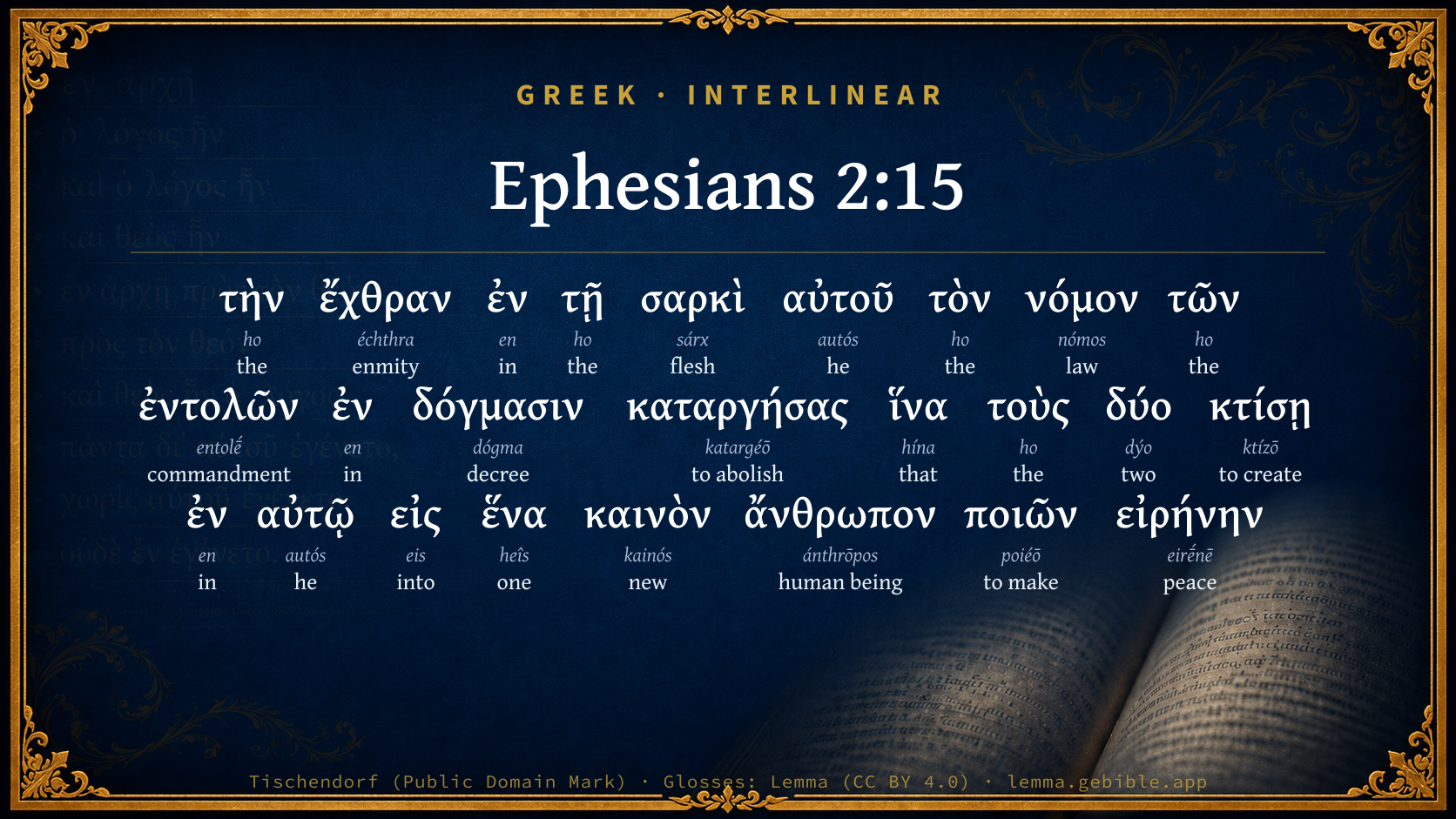
Greek (Tischendorf 8th ed.) Ephesians 2:15 appears in the Greek New Testament. The text above is from the Tischendorf 8th edition. Each word links to its Strong’s number and a concise gloss. Click any word for its full Thayer’s Greek Lexicon entry.
Download image
Cite this verse

Ephesians 2:15 (World English Bible). Public Domain. Lemma interlinear Bible study tool, https://lemma.gebible.app/v/ephesians/2/15.

Show BibTeX & RIS
BibTeX
RIS
English Translation
having abolished in the flesh the hostility, the law of commandments contained in ordinances, that he might create in himself one new man of the two, making peace;
World English Bible · Public Domain
Download a study sheet

One document with this verse’s original text, its word-by-word gloss line, the meaning frame, cross-references with their text, attributed commentary, and full source and license credits — printable, and it pastes into notes with its structure intact.

This verse Autodidact and up

Study sheet (.html) Plain text (.txt)

A passage Seminary Student

Up to 50 verses in one chapter. A passage sheet keeps up to 6 commentary sources and 12 cross-references per verse, in the order this page ranks them, and says so on the sheet whenever that leaves anything out. Ask for a single verse and you get the Autodidact verse sheet above.

Everything on this page stays free to read, with no account — the sheet is a download of what is already on screen, not access to it.

Want to remove ads? Support Godless Engineer
Compare translations 3

The same verse in 3 English versions, stacked beneath the original-language interlinear above. Click any original word for its lexicon entry.

Each is an independent rendering of the whole verse — the interlinear is not word-aligned to these translations.

Highlighted words mark where these versions differ — a whole-verse word diff, not a word-by-word alignment.

  • World English Bible Public Domain
    having abolished in the flesh the hostility, the law of commandments contained in ordinances, that he might create in himself one new man of the two, making peace;
  • King James Version Public Domain
    Having abolished in his flesh the enmity, even the law of commandments contained in ordinances; for to make in himself of twain one new man, so making peace;
  • unfoldingWord Literal Text CC BY-SA 4.0
    He abolished the law of the commandments in regulations so that he might make the two into one new man in himself, making peace,

unfoldingWord Literal Text — © unfoldingWord, licensed CC BY-SA 4.0. Word-aligned USFM3 via Door43 (git.door43.org/unfoldingWord/en_ult).

Versions to compare (up to 4)

3 of 4 selected

Show all 19 translations

Every available English version of this verse, each an independent rendering of the whole verse.

  • World English Bible Public Domain
    having abolished in the flesh the hostility, the law of commandments contained in ordinances, that he might create in himself one new man of the two, making peace;
  • Berean Standard Bible Public Domain
    by abolishing in His flesh the law of commandments and decrees. He did this to create in Himself one new man out of the two, thus making peace
  • Majority Standard Bible Public Domain
    by abolishing in His flesh the law of commandments and decrees. He did this to create in Himself one new man out of the two, thus making peace
  • King James Version Public Domain
    Having abolished in his flesh the enmity, even the law of commandments contained in ordinances; for to make in himself of twain one new man, so making peace;
  • American Standard Version (1901) Public Domain
    having abolished in the flesh the enmity, `even' the law of commandments `contained' in ordinances; that he might create in himself of the two one new man, `so' making peace;
  • Revised Version (1885) Public Domain
    having abolished in his flesh the enmity, even the law of commandments contained in ordinances; that he might create in himself of the twain one new man, so making peace;
  • Geneva Bible (1599) Public Domain
    In abrogating through his flesh the hatred, that is, the Lawe of commandements which standeth in ordinances, for to make of twaine one newe man in himselfe, so making peace,
  • Douay-Rheims (1899) Public Domain
    Making void the law of commandments contained in decrees; that he might make the two in himself into one new man, making peace;
  • Young's Literal Translation Public Domain
    the enmity in his flesh, the law of the commands in ordinances having done away, that the two he might create in himself into one new man, making peace,
  • Literal Standard Version CC BY-SA 4.0
    the enmity in His flesh, having done away [with] the Law of the commands in ordinances, that He might create the two into one new man in Himself, making peace,
  • Unlocked Literal Bible CC BY-SA 4.0
    That is, he abolished the law of commandments and regulations so that he might create one new man in himself, and so making peace.
  • unfoldingWord Literal Text CC BY-SA 4.0
    He abolished the law of the commandments in regulations so that he might make the two into one new man in himself, making peace,
  • Darby Bible Public Domain
    having annulled the enmity in his flesh, the law of commandments in ordinances, that he might form the two in himself into one new man, making peace;
  • World Messianic Bible Public Domain
    having abolished in his flesh the hostility, the law of commandments contained in ordinances, that he might create in himself one new man of the two, making peace,
  • Webster's Bible Public Domain
    Having abolished in his flesh the enmity, even the law of commandments contained in ordinances: to make in himself of two one new man, so making peace;
  • Free Bible Version CC BY-SA 4.0
    freeing us from the law with its requirements and regulations. He did this so he could create in himself one new person out of the two and so make peace,
  • Bible in Basic English Public Domain
    Having in his flesh put an end to that which made the division between us, even the law with its rules and orders, so that he might make in himself, of the two, one new man, so making peace;
  • Text-Critical English NT CC BY 4.0
    He did this by abolishing the law with its commandments and ordinances in order to make peace between the two groups and create in himself one new people.
  • Tyndale New Testament (1534) Public Domain
    and hath also put awaye thorow his flesshe the cause of hatred (that is to saye the lawe of commaundementes contayned in the lawe written) for to make of twayne one newe man in him silfe so makynge peace:

Literal Standard Version (2020), Covenant Press — licensed CC BY-SA 4.0. Text via the HelloAO Bible API (eBible.org). Unlocked Literal Bible (unfoldingWord) — licensed CC BY-SA 4.0. Text via the HelloAO Bible API (eBible.org). unfoldingWord Literal Text — © unfoldingWord, licensed CC BY-SA 4.0. Word-aligned USFM3 via Door43 (git.door43.org/unfoldingWord/en_ult). Free Bible Version, Dr. Jonathan Gallagher — licensed CC BY-SA 4.0. Text via the HelloAO Bible API (eBible.org).

Word by word

More ways to search: Search by grammar → Find every occurrence → Compare this word →

Practice this passage: Drill this verse → Learn its vocabulary →

δόγμασιν
dógma
G1378
“decree”
Noun, Dative, Plural, Neuter
Part of Speech
Noun
Case
Dative
Number
Plural
Gender
Neuter
Full Thayer's Definition

Origin: from the base of G1380

TDNT: 05:50,2

1. doctrine, decree, ordinance a. of public decrees b. of the Roman Senate c. of rulers 2. the rules and requirements of the law of Moses; carrying a suggestion of severity and of threatened judgment 3. of certain decrees of the apostles relative to right living
  1. τὴν ho G3588 “the” Article, Accusative, Singular, Feminine
  2. ἔχθραν échthra G2189 “enmity” Noun, Accusative, Singular, Feminine
  3. ἐν en G1722 “in” Preposition
  4. τῇ ho G3588 “the” Article, Dative, Singular, Feminine
  5. σαρκὶ sárx G4561 “flesh” Noun, Dative, Singular, Feminine
  6. αὐτοῦ autós G846 “he” Personal pronoun, Genitive, Singular, Masculine
  7. τὸν ho G3588 “the” Article, Accusative, Singular, Masculine
  8. νόμον nómos G3551 “law” Noun, Accusative, Singular, Masculine
  9. τῶν ho G3588 “the” Article, Genitive, Plural, Feminine
  10. ἐντολῶν entolḗ G1785 “commandment” Noun, Genitive, Plural, Feminine
  11. ἐν en G1722 “in” Preposition
  12. καταργήσας katargéō G2673 “to abolish” Verb, Aorist, Active, Participle, Nominative, Singular, Masculine
  13. ἵνα hína G2443 “that” Conjunction
  14. τοὺς ho G3588 “the” Article, Accusative, Plural, Masculine
  15. δύο dýo G1417 “two” Adjective, Numeral (indeclinable)
  16. κτίσῃ ktízō G2936 “to create” Verb, Aorist, Active, Subjunctive, 3rd person, Singular
  17. ἐν en G1722 “in” Preposition
  18. αὐτῷ autós G846 “he” Personal pronoun, Dative, Singular, Masculine
  19. εἰς eis G1519 “into” Preposition
  20. ἕνα heîs G1520 “one” Adjective, Accusative, Singular, Masculine
  21. καινὸν kainós G2537 “new” Adjective, Accusative, Singular, Masculine
  22. ἄνθρωπον ánthrōpos G444 “human being” Noun, Accusative, Singular, Masculine
  23. ποιῶν poiéō G4160 “to make” Verb, Present, Active, Participle, Nominative, Singular, Masculine
  24. εἰρήνην eirḗnē G1515 “peace” Noun, Accusative, Singular, Feminine

About this verse

These counts appear in no published source. They are computed here, from the morphology-tagged text and Lemma’s own curated glosses. What Lemma adds →

25
words
18
distinct lemmas
Pauline Epistles
section

Notable vocabulary

The rarest word here is δόγμασιν decree G1378 — appearing just 5 times in the whole Greek New Testament.

Shared distinctive vocabulary

δόγμασιν decree G1378 occurs in 5 verses of the Greek New Testament. Also found in:

Repetition

Words recur within this verse:

Cross-references

15

Topical passages linked to Ephesians 2:15 in the Treasury of Scripture Knowledge — connected by theme and wording, ordered by reader-vote popularity; previews shown in the World English Bible.

  • Colossians 2:14 wiping out the handwriting in ordinances which was against us; and he has taken it out of the way, nailing it to the cross;
  • Galatians 3:10 For as many as are of the works of the law are under a curse. For it is written, "Cursed is everyone who doesn't continue in all things that are written in the book of the law, to do them."
  • Galatians 3:28 There is neither Jew nor Greek, there is neither slave nor free man, there is neither male nor female; for you are all one in Christ Jesus.
  • Galatians 6:15 For in Christ Jesus neither is circumcision anything, nor uncircumcision, but a new creation.
  • Colossians 1:21–22 You, being in past times alienated and enemies in your mind in your evil works,
  • Hebrews 8:13 In that he says, "A new covenant," he has made the first old. But that which is becoming old and grows aged is near to vanishing away.
  • Colossians 2:20 If you died with Christ from the elements of the world, why, as though living in the world, do you subject yourselves to ordinances,
  • Colossians 3:10 and have put on the new man, that is being renewed in knowledge after the image of his Creator,
  • 2 Corinthians 5:17 Therefore if anyone is in Christ, he is a new creation. The old things have passed away. Behold, all things have become new.
  • Ephesians 4:16 from whom all the body, being fitted and knit together through that which every joint supplies, according to the working in measure of each individual part, makes the body increase to the building up of itself in love.
  • Hebrews 10:1–10 For the law, having a shadow of the good to come, not the very image of the things, can never with the same sacrifices year by year, which they offer continually, make perfect those who draw near.
  • Hebrews 7:16 who has been made, not after the law of a fleshly commandment, but after the power of an endless life:
  • Hebrews 9:9–10 which is a symbol of the present age, where gifts and sacrifices are offered that are incapable, concerning the conscience, of making the worshipper perfect;
  • Hebrews 10:19–22 Having therefore, brothers, boldness to enter into the holy place by the blood of Jesus,
  • Hebrews 9:23 It was necessary therefore that the copies of the things in the heavens should be cleansed with these; but the heavenly things themselves with better sacrifices than these.

Cross-references courtesy of OpenBible.info (CC BY 4.0).

Commentary

Notes on Ephesians 2:15 from classic Christian and Jewish commentators (each source and its license shown beneath its notes). The classic Christian expositions comment on the surrounding passage and are grouped to its opening verse, so a note may address several verses; the Jewish commentaries on the Tanakh (Rashi and others) are per-verse, so they appear only where the commentator wrote on this verse.

Lemma curates 59 commentaries, every one of them public domain or Creative Commons licensed, each selected and text-cleaned for this edition rather than reprinted as found. About our sources →

Ellicott's Commentary for English Readers

(15) The connection in the original is doubtful. The words the “enmity in His flesh” may be in apposition to the “wall of partition” in the previous verse; or, as in our version, to “the law of commandments.” The general sense, however, is but little affected in either case.

Having abolished in his flesh the enmity, even the law of commandments contained in ordinances.—In this difficult passage it will be well first to examine the particular expressions. (1) The word rendered “to abolish” is the word often used by St. Paul for “to supersede by something better than itself”—translated “to make void,” in Rom_3:31; to “bring to nought,” in 1Co_1:28, and (in the passive) “to fail,” “to vanish away,” “to be done away,” in 1Co_13:8-10. Now, of the relation of Christ to the Law, St. Paul says, in Rom_3:31, “Do we make void the Law? God forbid! Yea, we establish the Law.” The Law, therefore, is abolished as a law “in ordinances”—that is, “in the letter”—and is established in the spirit. (2) “The law of commandments in ordinances.” The word here rendered “ordinance” (dogma) properly means “a decree.” It is used only in this sense in the New Testament (see Luk_2:1; Act_16:4; Act_17:7; Heb_11:23); and it signifies expressly a law imposed and accepted, not for its intrinsic righteousness, but on authority; or, as Butler expresses it (Anal., Part ii., Ephesians 1), not a “moral,” but “a positive law.” In Col_2:14 (the parallel passage) the word is connected with a “handwriting” that is a legal “bond”; and the Colossians are reproved for subjecting themselves to “ordinances, which are but a shadow of things to come”; while “the body,” the true substance, “is Christ.” (See Eph_2:16-17; Eph_2:20-21.) (3) Hence the whole expression describes explicitly what St. Paul always implies in his proper and distinctive use of the word “law.” It signifies the will of God, as expressed in formal commandments, and enforced by penalties on disobedience. The general idea, therefore, of the passage is simply that which is so often brought out in the earlier Epistles (see Rom_3:21-31; Rom_7:1-4; Rom_8:1-4; Gal_2:15-21, et al.), but which (as the Colossian Epistle more plainly shows) now needed to be enforced under a somewhat different form—viz., that Christ, “the end of the law,” has superseded it by the free covenant of the Spirit; and that He has done this for us “in His flesh,” especially by His death and resurrection. (4) But in what sense is this Law called “the enmity,” which (see Eph_2:16) was “slain” on the Cross? Probably in the double sense, which runs through the passage: first, as “an enmity,” a cause of separation and hostility, between the Gentiles and those Jews whom they called “the enemies of the human race”; next, as “an enmity” a cause of alienation and condemnation, between man and God—“the commandment which was ordained to life, being found to be unto death” through the rebellion and sin of man. The former sense seems to be the leading sense here, where the idea is of “making both one”; the latter in the next verse, which speaks of “reconciling both to God,” all the partitions are broken down, that all alike may have “access to the Father.” Comp. Col_1:21, “You, who were enemies in your mind, He hath reconciled;” and Heb_10:19, “Having confidence to enter into the holy place by the blood of Jesus, by a new and living way, which He hath consecrated to us, through the veil, that is to say His flesh.”

For to make in himself of twain one new man, so making peace.—In this clause and the following verse the two senses, hitherto united, are now distinguished from each other. Here we have the former sense simply. In the new man “there is neither Jew nor Gentile,” but “Christ is all and in all” (Col_3:12). This phrase, “the new man” (on which see Eph_4:24, Col_3:10), is peculiar to these Epistles; corresponding, however, to the “new creature” of 2Co_5:17, Gal_6:15; and the “newness of life” and “spirit” of Rom_6:4; Rom_7:6. Christ Himself is the “second man, the Lord from Heaven” (1Co_15:47). “As we have borne the image of the first man, of the earth, earthy,” and so “in Adam die,” we now “bear the image of the heavenly,” and not only “shall be made alive,” but already “have our life hid with Christ in God” (Col_3:3). He is at once “the seed of the woman” and the “seed of Abraham”; in Him, therefore, Jew and Gentile meet in a common humanity. Just in proportion to spirituality or newness of life is the sense of unity, which makes all brethren. Hence the new creation “makes peace”—here probably peace between Jew and Gentile, rather than peace with God, which belongs to the next verse.

A Bible Commentary for English Readers, edited by Charles John Ellicott (1878–1897) — public domain. Text from a community e-Sword module.

The Biblical Illustrator

Joseph S. Exell

Eph_2:15

Having abolished in His flesh the enmity, even the law of commandments contained in ordinances; for to make in Himself of twain one new man.

Christ abolishing the enmity

In this difficult passage it will be well first to examine the particular expressions.

1. The word rendered to abolish is the word often used by St. Paul for to supersede by something better than itself--translated to make void, in Rom_3:31; to bring to nought, in 1Co_1:28, and (in the passive) to fail, to vanish away, to be done away, in 1Co_13:8-10. Now, of the relation of Christ to the Law, St. Paul says, in Rom_3:31, Do we make void the Law? God forbid! Yea, we establish the Law. The Law, therefore, is abolished as a law in ordinances--that is, in the letter--and is established in the spirit.

2. The law of commandments in ordinances. The word here rendered ordinance (dogma)

properly means a decree. It is used only in this sense in the New Testament (see Luk_2:1; Act_16:4; Act_17:7; Heb_11:23); and it signifies expressly a law imposed and accepted, not for its intrinsic righteousness, but on authority; or, as Butler expresses it (Anal., Part 2, chap. 1)

, not a moral, but a positive law. In Col_2:14 (the parallel passage) the word is connected with a handwriting, that is, a legal bond; and the Colossians are reproved for subjecting themselves to ordinances, which are but a shadow of things to come; while the body, the true substance, is Christ (see verses 16, 17, 20, 21).

3. Hence the whole expression describes explicitly what St. Paul always implies in his proper and distinctive use of the word law. It signifies the will of God, as expressed in formal commandments, and enforced by penalties on disobedience. The general idea, therefore, of the passage is simply that which is so often brought out in the earlier Epistles (see Rom_3:21-31; Rom_7:1-4; Rom_8:1-4; Gal_2:15-21, et al.), but which (as the Colossian Epistle more plainly shows) now needed to be enforced under a somewhat different form--viz., that Christ, the end of the law, had superseded it by the free covenant of the Spirit; and that He has done this for us in His flesh, especially by His death and resurrection.

4. But in what sense is thin Law called the enmity, which (see verse 16) was slain on the cross? Probably in the double sense, which runs through the passage: first, as an enmity, a cause of separation and hostility, between the Gentiles and those Jews whom they called the enemies of the human race; next, as an enmity, a cause of alienation and condemnation, between man and God--the commandment which was ordained to life, being found to be unto death through the rebellion and sin of man. The former sense seems to be the leading sense here, where the idea is of making both one; the latter in the next verse, which speaks of reconciling both to God, all the partitions are broken down, that all alike may have access to the Father. Compare Col_1:21, You, who were enemies in your mind, He hath reconciled; and Heb_10:19, Having confidence to enter into the holy place by the blood of Jesus, by a new and living way, which He hath consecrated to us, through the veil, that is to say His flesh. (A. Barry, D. D.)

Abolition of the ceremonial, but not of the moral, law

1. As Gods people, in covenant with Him, ought to be highly incensed against and averse from any voluntary entire fellowship with those who neglect and contemn the ordinances of worship prescribed by God in His Word; so those who are without the Church, yea, and all unregenerate men, do look upon the ordinances of Gods worship as base, ridiculous, and contemptible, and carry a kind of hatred and disdain to all such as make conscience of them: for so the ancient worship, prescribed in the ceremonial law, was the occasion of hatred and enmity betwixt the Gentile, who contemned it, and the Jew, who made conscience of it. And, therefore, is here called the enmity; having abolished the enmity.

2. As the moral law, contained in the Ten Commandments, was no part of that mid-wall of partition between Jew and Gentile, seeing some of the drafts and lineaments of that law are upon the hearts of all by nature (Rom_2:15); so there was no necessity to abrogate this law at Christs death, in order to the uniting of Jew and Gentile, neither was it at all abolished; for the law abolished was the law, not simply, but the law of commandments, and these not all, but such commandments as were contained in ordinances, to wit, the ceremonial law; even the law of commandments contained in ordinances, saith he.

3. As God only hath power and liberty to prescribe what manner of worship He will be served by, so He did once give a most observable evidence of this His power and liberty, by changing that external way of worship which was prescribed by Himself, under the Old Testament, unto another under the New; although the internals of His worship, to wit, the graces of faith, love, hope, joy in God, do remain the same in both (Mat_22:37; Mat_22:39); for He did abolish the law of commandments contained in ordinances, even all the ancient worship consisting in rites and ceremonies, sensibly and fleshly observations, which God did then prescribe, not as simply delighted in them, but as accommodating Himself to the childish condition of the Church in those times; and hath now appointed a more spiritual way of worship, as more suitable to the grown age of the Church (Joh_4:21; Joh_4:23).

4. It was Christs sufferings and death which put an end to the law of ceremonies, and made the binding power thereof to cease; for seeing His sufferings were the body and substance of all those shadows, they neither did nor could evanish until Christ had suffered, but then they did; it being impossible that a shadow, and the body, whereof it is a shadow, can consist in one and the same place; Having abolished in His flesh the law of commandments contained in ordinances. (James Fergusson.)

One new man in Christ

In this clause and the following verse the two senses, hitherto united, are now distinguished from each other. Here we have the former sense simply. In the new man there is neither Jew nor Gentile, but Christ is all and in all Col_3:12). This phrase, the new man (on which see Eph_4:24; Col_2:10), is peculiar to these Epistles; corresponding, however, to the new creature of 2Co_5:17; Gal_6:15; and the newness of life and spirit of Rom_6:4; Rom_7:6. Christ Himself is the second man, the Lord from Heaven (1Co_15:47). As we have borne the image of the first man, of the earth, earthy, and so in Adam die, we now bear the image of the heavenly, and not only shall be made alive, but already have our life hid with Christ in God (Col_3:3). He is at once the seed of the woman and the seed of Abraham; in Him, therefore, Jew and Gentile meet in a common humanity. Just in proportion to spirituality or newness of life is the sense of unity, which makes all brethren. Hence the new creation makes peace--here probably peace between Jew and Gentile, rather than peace with God, which belongs to the next verse. (A. Barry, D. D.)

Union in the Church

1. Union in the Church of Christ is a thing which ought to be prized by us highly, and sought after earnestly; and so much, as there is nothing in our power which we ought not to bestow upon it, and dispense with for the acquiring and maintaining of it; for so much was it prized by Christ, that He gave His own life to procure it, and did beat down all His own ordinances which stood in the way of it; He even abolished in His flesh the law of commandments contained in ordinances, for to make of twain one new man.

2. There are no divisions more hardly curable, than those which are about the religion and worship of God, in so far as they engage not only the credit, but also the consciences of the divided parties; hence one party, so engaged, doth pursue what they maintain, as that wherein Gods honour and their own salvation are most nearly concerned, and doth look upon the other party as an adversary, in so far at least, to both of those; for the apostle, speaking of Christs uniting the Jew and Gentile in one Church and religion, maketh use of a word which showeth this was a task of no small difficulty, even such, that no less than creating power was required to it, while He saith, for to make in Himself (the word signifieth to create in Himself) of twain one new man.

3. So strict and near is that conjunction and union which is especially among true believers in the Church, that all of them, how far soever dispersed through the world, do yet make up but one man and one body; as being all, whatever be their other differences, most strictly united, as members under one head, Christ (1Co_12:27), and animated, as to the inward man, by the same Spirit of God residing and acting in them (Rom_8:9); for the apostle showeth that all of them, whether Jew or Gentile, were made, not only one people, one nation, one family, but one new man; For to make of twain one new man.

4. As the essential unity of the invisible Church, without which the Church could not be a Church, doth of necessity depend upon and flow from that union which every particular member hath with Christ, as head, seeing the grace of love (whereby they are knit one to another (Col_3:14) doth flow from faith (Gal_5:6), whereby they are united to Him (Eph_3:17), so the more our union with Christ is improved unto the keeping of constant communion and fellowship with Him, the more will be attained unto of harmonious walking among ourselves, suitable unto that essential union which is in the Church of Christ; for the apostle maketh the conjunction of Jews and Gentiles in one Church to depend upon Christs uniting of them to Himself; For to make in Himself of twain one new man, saith He.

5. The peace which ought to be, and which Christ calleth for in His Church, is not a simple cessation from open strife, which may take place even when there remaineth a root of bitterness in peoples spirit (Psa_55:21); but it is such an harmonious walking together in all things as floweth from the nearest conjunction of hearts, and the total removal of all former bitterness of spirits; for the peace which Christ did make betwixt Jew and Gentile did follow upon His abolishing the enmity, and making them one man; so making peace, saith he. (James Fergusson.)

The use of the law

The wife of a drunkard once found her husband in a filthy condition, with torn clothes, matted hair, bruised face, asleep in the kitchen, having come home from a drunken revel. She sent for a photographer, and had a portrait of him taken in all his wretched appearance, and placed it on the mantel beside another portrait taken at the time of his marriage, which showed him handsome and well dressed, as he had been in other days. When he became sober he saw the two pictures, and awakened to a consciousness of his condition, from which he arose to a better life. Now, the office of the law is not to save men, but to show them their true state as compared with the Divine standard. It is like a glass, in which one sooth what manner of man he is.

The Biblical Illustrator, edited by Joseph S. Exell (c. 1880s–1900s) — public domain. Text from a community e-Sword module.

Joseph Benson's Commentary

Eph 2:15-18. Having abolished in his flesh — By the sufferings and death endured therein; the cause of enmity between the Jews and Gentiles, even the law of ceremonial commandments, contained in ordinances — Consisting in many institutions and appointments concerning the outward worship of God; such as those of circumcision, sacrifices, clean and unclean meats, washings, and holy days; which, being founded in the mere pleasure of God, might be abolished when he saw fit. These ordinances Jesus abolished, that he might make in himself — That is, by uniting them to himself as their head; of twain — Of Jews and Gentiles, who were at such a distance before; one new man — One mystical body, one church, renewed by the Holy Ghost, and uniting in one new way of gospel worship: so making peace — Between the two kinds of people, and even laying a foundation for the most sincere mutual love and friendship: And, or moreover, to complete this blessed work of making peace, that he might reconcile both, as thus united in one body, and animated by one spirit, not merely to one another, but unto God, by his death on the cross — By which he expiated the guilt of sin, and rendered God reconcileable, and ready to pardon the penitent that should believe in Jesus; and by which he procured for mankind, whether Jews or Gentiles, the Holy Spirit to work repentance and faith in them, and destroy that carnal mind, which is enmity against God, (Rom 8:7,) and all those sinful passions which are connected therewith, and which render men odious in his sight, and hostile to one another. And came — After his resurrection; and preached peace — By his authorized ambassadors, (to whom he had committed the important trust of treating with sinners in his name and stead, 2Co 5:19-20,) to you Gentiles, which were afar off — At the utmost distance from God; and to them that were nigh — To the Jews, who were comparatively nigh, being his visible church. For through him — Through his mediation, his sacrifice and intercession; we both — Believing Jews and Gentiles; have access — Have liberty of approach; by one Spirit — Inspiring us with faith, hope, and love, and rendering us sincere, spiritual, fervent, and constant, in our prayers, praises, and all acts of worship and service: unto the Father — That is, unto God as a Father reconciled in Christ, and beholding us with paternal eyes of love, complacency, and delight.

Joseph Benson's Commentary on the Old and New Testaments (1811–1818) — public domain. Text from a community e-Sword module.

Tyndale Open Study Notes

Tyndale Open Resources

2:15 ending the system of law: See Rom 10:4; Col 2:14; cp. Rom 6:14; 7:4-6. • The church is one new people, a community where love and acceptance are prized and ethnic distinctions are no longer a source of division (see Rom 15:7-12; Gal 3:28; cp. John 10:16).

Tyndale Open Study Notes — © Tyndale Open Resources, licensed CC BY-SA 4.0. Text via the HelloAO Bible API.

Bengel's Gnomon

Johann Albrecht Bengel

Eph 2:15. Τὴν ἔχθραν, enmity) The Jews held the Gentiles in abomination; the Gentiles treated the Jews with scorn on account of circumcision, the Sabbath, etc.—ἐν τῇ σαρκὶ αὐτοῦ, in His flesh) So, in one body, Eph 2:16, [i.e. by His suffering and death.—V. g.]—τὸν νόμον τῶν ἐντολῶν) the law of commandments, viz. ceremonial.—ἐν δόγμασι, in ordinances, in decrees) belonging to the Gospel, by which mercy was set forth to all, Col 2:14, note. [See the same words with the very same meaning, Act 16:4; Act 15:28.—V. g.]—καταργήσας, having abolished) Each ἐν [ἐν δόγμασιν and ἐν τῇ σαρκὶ] is construed, as we have already intimated, with this participle. Christ abolished, by His flesh, the enmity; [He abolished] the law of commandments by spreading over the whole world the ordinances of the Gospel. But if the expression, in ordinances, belonged to ἐντολῶν, of commandments, the expression, in His flesh, would not have been placed before, but after it. It is written, as it were, in the style of a lapidary [stilo lapidari].[32]

[32] The arrangement being such that the alternate pieces of stone match.—ED.

Τὴν ἔχθραν, the enmity,

ἐν τῇ σαρκὶ αὐτοῦ, in his flesh;

τὸν νόμον τῶν ἐντολῶν, the law of commandments,

ἐν δόγμασιν, in ordinances,

καταργήσας, having abolished.

—τοὺς δύο, the two) He elegantly omits men; for formerly they had scarcely maintained the name of men. The two, who were Jew and Greek.—καινὸν, new) by taking away the oldness of the letter.—ποιῶν, making) The participle making depends on the verb, might create (κτίσῃ); and having slain depends on might reconcile: each of them has the power of explaining, which is derived from what immediately precedes.—εἰρήνην, peace) This peace-making precedes its publication, Eph 2:17.

Bengel's Gnomon of the New Testament — English translation (T&T Clark, Edinburgh, 1860) — public domain. Text from a community e-Sword module.

Meyer's Critical & Exegetical Commentary

Heinrich August Wilhelm Meyer

Eph_2:15. Τὴν ἔχθραν] This, still included in dependence upon λύσας, is now the μεσότοιχον broken down by Christ: (namely) the enmity. It is, after the example of Theodoret (comp. τινές in Chrysostom), understood by the majority (including Luther, Calvin, Bucer, Clarius, Grotius, Calovius, Morus, Rosenmüller, Flatt, Meier, Holzhausen, Baumgarten-Crusius, de Wette) of the Mosaic law as the cause of the enmity between Jew and Gentile, in which case the moral law is by some included, by others excluded. But, in accordance with Eph_2:14, the reader is led to nothing else than the opposite of εἰρήνη, i.e. to the abstract enmity; and in the sequel, indeed, the abolition of the law is very definitely distinguished from the destruction of the enmity (as means from end). Hence the only mode of taking it, in harmony with the word itself and with the context, is: the enmity which existed between Jews and Gentiles, comp. Eph_2:16. So Erasmus, Vatablus, Estius, Cornelius a Lapide, Bengel, and others, including Rückert and Bleek; while Hofmann turns the notion of ἔχθρα into the mere ἀπαλλοτρίωσις of Eph_2:12, and, referring it to the estrangement on the part of the Gentiles towards the theocracy hated by them, removes the distinctive mark of reciprocalness demanded by the context. Quite erroneously, Chrysostom, Theophylact, Oecumenius, and lately Harless, hold that the enmity of the Jews and Gentiles towards God is meant. In accordance with the context, Eph_2:14, the μεσότοιχον can, in fact, only be one separating the Jews and Gentiles from each other, and not something which separates both from God; and how mistaken is such a view also on account of what follows! for the Mosaic law might be conceived of as producing enmity towards God so far doubtless as the Jews are concerned (1Co_15:56; Rom_5:20; Rom_7:13; Gal_3:19), but never as respects the Gentiles, who stood aloof from all relation to the Mosaic law (Rom_2:12).

ἐν τῇ σαρκὶ αὐτοῦ] does not belong (as Lachmann also punctuates it) to τὴν ἔχθραν, so that the national hatred in His people would be meant (Chrysostom, Bugenhagen, Schulthess, Engelwelt, p. 193); nor yet to λύσας (Oecumenius, Beza, Calvin, Grotius, Rückert, and others), because in that case this mention of the death of Jesus would be irrelevantly dissevered from the modal definition τὸν νόμον καταργήσας, to which, in the nature of the case, it belongs as an essential element; but it stands with an emphasis suitable to the context (comp. αὐτὸς γάρ, Eph_2:14) at the head of the specification that now follows, in what way Christ has effected what was said in Eph_2:14 by αὐτὸς γάρ ἐστιν … ἔχθραν: so that He by His flesh has done away with the law, namely, when He allowed His flesh to be crucified (Col_1:21 f.), dissolved thereby the tie with the law that brought men under curse (see on Gal_3:13), and thus opened up the justification through faith (Rom_3:21 ff.), whereby the institute of the law was emptied of its binding power (comp. Rom_10:4 ff; Rom_7:1 ff.; Col_2:14). The moral commands also of the law had thereby, while not ceasing to be valid, ceased to be held as constituent elements of the law-institute as such justifying in the way of compliance with it; and its fulfilment, and that in augmented power, now proceeds from the new vital principle of faith (Rom_8:4), on which account Christ, although He is the end of the law (Rom_10:4; comp. 2Co_3:11), could nevertheless say that He had come to fulfil the law (Mat_5:17), and Paul could assert: νόμον ἱστῶμεν, Rom_3:31. Hofmann imports into the ἐν τῇ σαρκὶ αὐτοῦ the thought: in and with the doing away of His life in the flesh, in respect of which He was an Israelite, Christ has rendered the appertaining to His community independent of the religious-legal status of an Israelite. As though the atoning death of Christ, in the usual dogmatic sense of the apostle, had not been most distinctly indicated already before by the ἐν τῷ αἵματι τοῦ Χριστοῦ, Eph_2:13, as afterwards by the ἀποκαταλλάξῃ κ.τ.λ., Eph_2:16, and by the προσαγωγή, Eph_2:18! This meaning is not here, any more than at Col_1:21 f., to be exegetically modified or explained away.

τῶν ἐντολῶν ἐν δόγμασι] to be taken together, yet not in such a way that ἐν stands for σύν (Flatt) or καί (Koppe, Rosenmüller), but as: the law of the commandments consisting in injunctions, whereby the dictatorial character of the legal institute (as a whole, not merely partially, as Schenkel imports) is exhibited. The genitive τῶν ἐντολῶν denotes the contents of the law, and ἐν δόγμασι the essential form in which the ἐντολαί are given. The connecting link of the article (τῶν) before ἐν δόγμασι was not requisite, since we may correctly say: ἐντέλλεσθαί τι ἐν δόγματι or ἐντολὴν διδόναι ἐν δόγματι, and therefore ἐντολὴ ἐν δόγματι may be conjoined so as to form one conception.[151] Comp. on Eph_3:13; Rom_6:4; Gal_4:14; Gal_3:26. This view of the connection is adopted, after the precedent of many older expositors, by Rückert, Matthies, Meier, Winer, pp. 123, 197 [E. T. 169, 257], Bisping, Schenkel, Bleek.[152] Comp. also Buttmann, neut. Cr. p. 80 [E. T. 92]. If one should, with the Syriac, Arabic, Vulgate, Pelagius, Chrysostom and his successors, Theodore of Mopsuestia, Grotius, Estius, Bengel, Holzhausen, and others, including Fritzsche, Diss. in 2 Corinthians 2. p. 168 f., refer ἐν δόγμ. to ΚΑΤΑΡΓΉΣΑς, there would resulteven apart from the fact that with our mode of connecting ἘΝ Τῇ ΣΑΡΚῚ ΑὐΤΟῦ, this construction is not even possiblethe wholly untrue and un-Pauline thought that Christ has through injunctions abolished the law. No doubt some have imputed to ἐν δόγμασι the sense praecepta stabiliendo (Fritzsche), in doing which they had in view the evangelical doctrine of faith and the gratia universalis (see Chrysostom, Theodore of Mopsuestia, Theodoret, Theophylact, Estius, Bengel, and others). But even thus the sense remains untrue and un-Pauline, seeing that the doing away of the law has taken place not at all in a doctrinal way, but by the fact of the death of Christ (Rom_7:1 f.; Gal_3:13; Col_2:14). And what a change would be made in the meaning of the word δόγμα, which in the N.T. signifies throughout nothing else than injunction (Col_2:4; Luk_2:1; Act_17:7; Act_16:4; comp. Plat. Legg. i. p. 644 D; Xen. Anab. iii. 3. 5, vi. 6. 8; Dem. 774. 19; Herodian, i. 7. 6; 4Ma_4:23 f.)! The distinction ought not to have been overlooked between ἐντολή and ΔΌΓΜΑ, which latter puts the meaning of the former into the more definite form of the enjoining decree. A peculiar view is taken by Harless (followed by Olshausen) likewise connecting ἐν δόγμ. with ΚΑΤΑΡΓΉΣΑς, and holding that ἘΝ denotes the side on which that efficacy of the death of Christ exerts itself; Christ did not render the law ineffectual in any such capacity as ΣΚΙᾺΝ ΤῶΝ ΜΕΛΛΌΝΤΩΝ, or as ΠΑΙΔΑΓΩΓῸΝ ΕἸς ΧΡΙΣΤΌΝ, but on the side of the δόγματα (in reference to the commanding form of its precepts, Olshausen). Incorrectly, because ΔΌΓΜΑΣΙ must of necessity have had the article, and because it is nowhere taught that the law is done away only in a single respect. The Mosaic legal institute as such, and not merely from a certain side, has in Christ its end (Rom_10:4); the σκιὰ τῶν μελλόντων in the law has only a transient typical destination (see on Col_2:17), and the work of the ΠΑΙΔΑΓΩΓΌς is at an end with the attainment of maturity on the part of his pupils (Gal_3:24 f.). Incorrect also is the view of Hofmann, p. 377, who, likewise taking ἘΝ ΔΌΓΜΑΣΙ as modal definition to ΚΑΤΑΡΓΉΣΑς, and for the expression with ἘΝ comparing 1Co_2:7, finds the meaning: by the very fact that Christ has put an end to precepts generally, He has invalidated the O. T. law of commandments. The statement that Christ has put an end to δόγματα generally, i.e. to commanding precepts in general, is at variance with the whole N.T., which contains numberless definite commands, and, in particular, with the teaching of Paul, who even places Christianity as a whole under the point of view, Rom_3:27; Rom_9:31, Gal_6:2, 1Co_9:21, of a νόμος (which, without ΔΌΓΜΑΤΑ, is not at all conceivable[153]), and specially with Col_2:14. Paul would at least have made a limiting addition to ἐν δόγμασι, and have written something like ἘΝ ΔΌΓΜΑΣΙ ΔΟΥΛΕΊΑς (comp. Rom_8:15; Gal_4:24; Gal_5:1).

ἽΝΑ ΤΟῪς ΔΎΟ … ΕἸΡΉΝΗΝ] a statement of the object aimed at in the just expressed abrogation of the law, which statement of aim corresponds to what has been said concerning Christ in Eph_2:14, more precisely defining and confirming the same. Harless arbitrarily passes over what immediately precedes, and holds that ἽΝΑ … ΕἸΡΉΝΗΝ expresses the design of Ὁ ΠΟΙΉΣΑς ΤᾺ ἈΜΦΌΤΕΡΑ ἝΝ, in which case too, we may add, there would result a tautological relation of the thought.

ΤΟῪς ΔΎΟ] The Jews and Gentiles, who before were designated in accordance with the general category under a neuter form, are here conceived of concretely as the two men under discussion, of whom the one is the totality of the Jews, and the other that of the Gentiles, out of which two men Christ has made a single new man. This is the collective subject of the καινὴ κτίσις, Gal_6:15 (the whole body of Christians).

ἘΝ ἙΑΥΤῷ] is neither, with Grotius, to be taken as: per doctrinam suam, nor, with Chrysostom, Oecumenius, and others, as equivalent to διʼ ἑαυτοῦ (Oecumenius: Οὐ ΔΙʼ ἈΓΓΈΛΩΝ Ἢ ἌΛΛΩΝ ΤΙΝῶΝ ΔΥΝΆΜΕΩΝ), but it affirms that the unity to be brought about out of the two by the new creation was to be founded in Christ Himself, that is, was to have the basis of its existence and continuance in Him, and not in any other unifying principle whateEphesians Ephesians 2 :In the case, namely, of all individuals, from among the Jews and Gentiles, who form the one new man, the death of Christ is that, wherein this new unity has its causal basis; without the death of the cross it would not exist, but, on the contrary, the two would still be just in the old duality and separation as the Jew and the Greek. Calvin well remarks that in se ipso is added, ne alibi quam in Christo unitatem quaerant. Comp. Gal_3:28. This union, negatively conditioned by the abolition of the law, and having its basis in the self-sacrifice of Christ, is positively accomplished as regards the subjects through the Spirit, 1Co_12:13. Comp. subsequently Eph_2:18. But objectively accomplishednamely, as a fact before God and apart from the subjective appropriation by means of the Spiritit is already by virtue of the death, which Christ has undergone for the reconciliation of both parties, Jews and Gentiles, with God; see Eph_2:16.

καινόν] For this one is now neither Jew nor Greek, which the two, out of which the one has been made, previously were; but both portions have laid aside their former religious and moral attitude, and without further distinction have obtained the quite new nature conditioned by Christian faith. If καινόν had not been added, the ΕἿς ἌΝΘΡΩΠΟς might be incorrectly conceived of as an amalgam of Jew and Gentile. To exclude, we may add, from ΚΑΙΝΌΝ the moral element (Meier, comp. Rückert) is not merely arbitrary, but, according to the apostolic way of looking at matters, even impossible, 2Co_5:17; Gal_4:27; Gal_6:14 f., Eph_5:6.

ποιῶν εἰρήνην] Present participle, because the establishment of peace as what was duly to set in with the designed new creation, was implied in the very scope thereof; it was that which was to be brought about in and with it. Observe that ποιῶν εἰρήνην is spoken from the standpoint of the design expressed in ἵνα τοὺς δύο κ.τ.λ., and is included as belonging to what is designed; consequently: so that He (by this new creation) makes peace (not made peace). εἰρήνη is, in accordance with the context, the opposite of ἜΧΘΡΑ, Eph_2:15, consequently peace of the two portions with each other, not: with God (Harless), nor: πρὸς τὸν Θεὸν καὶ πρὸς ἀλλήλους (Chrysostom, Oecumenius).

[151] There is consequently no need whatever for the evasive view of Theile (in Winers Exeget. Stud. I. p. 188 ff.), which is arbitrary and makes the meaning of the expression simply ambiguous, that Paul has not added the article, because ἐν δόγμ. is to he conceived of in the like relation to τὸν νόμον as to τῶν ἐντολῶν.

[152] Several of the older expositors, nevertheless, explained: legem mandatorum in decretis sitam (Erasmus, comp. Castalio, Beza, Calvin, and others), so that they connected ἐν δόγμ. with τὸν νόμον. But in that case τόν must of necessity have stood before ἐν δόγμ. And to excuse the absence of the article ob congeriem articulorum (Erasmus) is arbitrary. How often have classical writers accumulated articles! Plato, Phileb. p. 33 A; Dem. Ol. iii. 11, and many others. They avoid only the coming together of the same article, e.g. τὸ τό (Stallbaum, ad Plat. Rep. pp. 332 C, 598 B).

[153] The δόγματα of Christianity are the true ἀεὶ παρόντα δόγματα, Plato, Theaet, p. 158 D.

Meyer — Critical and Exegetical Commentary on the New Testament — English translation by Peter Christie, edited by Frederick Crombie (T&T Clark, 1880) — public domain. Text from a community e-Sword module.

Expositor's Greek Testament

ed. W. Robertson Nicoll

Eph 2:15 . τὴν ἔχθραν : to wit the enmity . Many (Luth., Calv., De Wette, etc.) take this to be a figure for the Mosaic Law. But the ἔχθρα is in antithesis to the εἰρήνη of Eph 2:14 , and the specification of the Law comes in later. It is better, therefore, to take the ἔχθρα here in the abstract sense of hostile, separating feeling . But is it the enmity of Jew and Gentile to God (Chrys., Harl., etc.) or the enmity between Jew and Gentile? The statement of the μεσότοιχον as a mid-wall between τὰ ἀμφότερα decides for the latter. The argument in favour of this view is stronger still when the former view is connected with the idea that the ἔχθρα is the Mosaic Law. For the Mosaic Law could not be said to have been the cause of hostile feeling on the part of Gentiles to God. ἐν τῇ σαρκί αὐτοῦ : in His flesh . The term σάρξ is taken by some (Stier, etc.) in a sense wide enough to cover Christ’s incarnation and His entire incarnate life. But, apart from other difficulties, this is inconsistent with the definite mention of His blood and His cross . The term refers, therefore, to His death, and means His crucified flesh ( cf. Col 1:22 ). The great difficulty here, however, is the connection. Some attach the phrase immediately to τὴν ἔχθραν (Chrys., etc.), “the enmity which was in His flesh,” as if the idea were “the hatred in the human race generally” or “the national hatred,” the hatred in the Jewish people. But this would require τήν before ἐν σαρκί , and furnishes at best a forced meaning. Most commentators connect it with καταργήσας , supposing it to be put emphatically first. So it is taken, e.g. , by Meyer, who makes ἐν σαρκί begin the new clause. The RV takes the same view, but brings the ἔχθραν under the regimen of the καταργήσας “having abolished in His flesh the enmity, even the law”. There is much to say in support of this, especially in view of the Pauline statements in Rom 3:21 ; Rom 10:14 ; Gal 3:13 ; Col 2:14 , etc. On the other hand there is an awkwardness in bringing in the predication before the verb, and the parallelism is broken ( cf. Alf.). It is best, therefore, to attach the ἐν σαρκὶ αὐτοῦ to the λύσας (Calv., Rück., Alf., etc.). The form of the sentence is better kept in this way. The appropriateness of the use of λύσας is then seen; for the verb λύειν (= subvert, dissolve ), is equally applicable to the μεσότοιχον and to the ἔχθραν , the phrase λύειν ἔχθραν being common in ordinary Greek. On the other hand καταργεῖν is much less applicable to ἔχθραν . So the sense is “who in His crucified flesh ( i.e. , by His death on the cross) broke down the middle-wall of the partition, to wit the enmity” ( i.e. , the hostile feeling between Jew and Gentile). τὸν νόμον τῶν ἐντολῶν ἐν δόγμασιν καταργήσας : having abolished (or, in that He abolished) the law of commandments (expressed) in ordinances . Further statement of the way in which Christ by His death on the cross removed the separation and the hostile feeling between Jew and Gentile viz. , by abrogating the dividing Law itself. The Law is now introduced, and the term ὁ νόμος is to be taken in its full sense, not the ceremonial law only, but the Mosaic Law as a whole, according to the stated use of the phrase. This Law is abolished in the sense of being rendered inoperative (as καταργεῖν means), and it is defined as the Law τῶν ἐντολῶν ἐν δόγμασιν . What is the point of the definition? The article, which is in place with the ἐντολῶν , is omitted before the δόγμασιν , as the latter makes one idea with the former and further is under the regimen of a prep. ( cf. Win.-Moult., pp. 139, 149, 151, 158). The Law is one of “commandments-in-decrees”. What is in view is its character as mandatory, and consisting in a multitude of prescriptions or statutes. It enjoined , and it expressed its injunctions in so many decrees, but it did not enable. The Law was made up of ἐντολαί and these ἐντολαί expressed themselves and operated in the form of δόγματα , ordinances . The word δόγμα in the NT never means anything else than statute, decree, ordinance ( cf. Luk 2:1 ; Act 16:4 ; Act 17:7 ; Col 2:14 ; in Heb 11:23 it is a variant for διάταγμα ). Hence it cannot have any such sense here as doctrines, evangelical teaching (Theod.), evangelical precepts (Fritz.), the faith (Chrys.). Some taking the ἐν as the instrumental ἐν make it = “having abolished the law by injunctions” (Syr., Vulg., Arab., Grot., Beng., etc.). But the NT uniformly speaks of the abrogation of the condemning law as being effected by Christ’s death, never by His teaching , or by evangelical precepts . Another turn is given to the sentence by taking ἐν in the sense of “in respect of,” “on the side of” (Harl.), as if the idea were that the abrogation of the Law was limited to its mandatory side, to the orders contained in it. But this would require τοῖς before the δόγμασιν ; nor is it the way of the NT to speak of the Mosaic Law as done away by Christ only on one side. ἵνα τοὺς δύο κτίσῃ ἐν ἑαυτῷ εἰς ἕνα καινὸν ἄνθρωπον : that He might create in Himself the two into one new man . Statement of the object of the καταργεῖν . The masc. δύο is introduced now, instead of the ἀμφότερα , with a view to the ἄνθρωπον . One man was to be made out of the two men . The κτίσῃ is better rendered create with the RV than make with the AV. A new creation is in view. For ἐν ἑαυτῷ of the TR (with [160] [161] [162] [163] , etc.) αὐτῷ is to be preferred as the reading of [164] [165] [166] [167] , etc. (LTTrRV); WH gives αὑτῷ . In either case the sense is “in Himself”; not “by it” (Grot.) as if the reference were to Christ’s doctrine , nor “through Himself” as if it were διʼ αὐτοῦ . The new creation and the new union have their ground and principle in Christ. What was contemplated, too, was not simply the making of one man ( ἕνα ἄνθρωπον ) where formerly there were two, but the making of one new ( καινὸν ) man . The result was not that, though the separation between them was removed, the Jew still remained Jew and the Gentile still Gentile. It was something new, the old distinctions between Jew and Gentile being lost in a third order of “man” the Christian man. ποιῶν εἰρήνην : making peace . The εἰρήνη is still peace between the estranged Jew and Gentile, and the ποιῶν ( pres. , not aor. ) belongs to the object expressed by the ἵνα . In carrying out that purpose He was to make peace the one with the other.

[160] Codex Claromontanus (sæc. vi.), a Græco-Latin MS. at Paris, edited by Tischendorf in 1852.

[161] Codex Mosquensis (sæc. ix.), edited by Matthæi in 1782.

[162] Codex Angelicus (sæc. ix.), at Rome, collated by Tischendorf and others.

[163] Codex Sinaiticus (sæc. iv.), now at St. Petersburg, published in facsimile type by its discoverer, Tischendorf, in 1862.

[164] Codex Sinaiticus (sæc. iv.), now at St. Petersburg, published in facsimile type by its discoverer, Tischendorf, in 1862.

[165] Codex Vaticanus (sæc. iv.), published in photographic facsimile in 1889 under the care of the Abbate Cozza-Luzi.

[166] Codex Alexandrinus (sæc. v.), at the British Museum, published in photographic facsimile by Sir E. M. Thompson (1879).

[167] Codex Augiensis (sæc. ix.), a Græco-Latin MS., at Trinity College, Cambridge, edited by Scrivener in 1859. Its Greek text is almost identical with that of G, and it is therefore not cited save where it differs from that MS. Its Latin version, f, presents the Vulgate text with some modifications.

The Expositor's Greek Testament, edited by W. Robertson Nicoll (1897–1910) — public domain. Text from a community e-Sword module.

Hodge's Commentary on Romans, Ephesians & First Corinthians

Charles Hodge

Eph_2:14, Eph_2:15

These verses contain a confirmation and illustration of what precedes. Ye who were far off are made nigh by the blood of Christ. For he is our peace. He has effected the twofold reconciliation above referred to. This he has accomplished by abolishing the law. The law, however, is viewed in a twofold aspect in this connection. First, it was that original covenant of works, demanding perfect obedience, whose conditions must be satisfied in order to the reconciliation of men with God. Christ by being made under the law, Gal_4:4, and fulfilling all righteousness, has redeemed those who were under the law. He delivered them from the obligation of fulfilling its demands as the condition of their justification before God. In this sense they are not under the law. Compare Rom_6:14; Rom_7:4, Rom_7:6; Gal_5:18; Col_2:14. But secondly, as Christ abolished the law as a covenant of works by fulfilling its conditions, so he abolished the Mosaic law by fulfilling all its types and shadows. He was the end of the law in both these aspects and therefore, it ceased to bind the people of God in either of these forms. Of this doctrine the whole of the New Testament is full. The epistles especially are in large measure devoted to proving that believers are not under the law in either of these senses, but under grace. Thus it is that Christ is our peace. The abolition of the law as a covenant of works reconciles us to God; the abolition of the Mosaic law removes the wall between the Jews and Gentiles. This is what is here taught. By abolishing the law of commandments, i.e. the law in both its forms, the apostle says, Christ has, first, of the twain made one new man, Eph_2:15; and secondly, he has reconciled both unto God in one body by the cross, Eph_2:16.

Though the general sense of this passage is plain, there is no little diversity as to the details of the interpretation. The Greek is printed for the convenience of the reader. Αὐτὸς γάρ ἐστιν ἡ εἰρήνη ἡμῶν, ὁ ποιήσας τὰ ἀμφότερα ἕν καὶ τὸ μεσότοιχον τοῦ φραγμοῦ λύσας, τὴν ἔχθραν ἐν τῇ σαρκὶ αὐτοῦ, τὸν νόμον τῶν ἐντολῶν ἐν δόγμασιν καταργήσας. Our translators, by assuming that ἔχθραν depends on καταργήσας and of course that νόμον is in apposition with it, have in a great measure determined thereby the interpretation of the whole passage. The words μεσότοιχον, ἔχθραν, and νόμον must all refer to the same thing. The sense would then be, For he is our peace, having made the two one by having destroyed the middle wall of partition, that is, by having destroyed, by his flesh, the enmity, viz., the law of commandments with ordinances. The preferable construction is to make ἔχθραν dependent on λύσας. It is then in apposition with μεσότοιχον but not with νόμον; and καταργήσας τὸν νόμον, instead of being a mere repetition of λύσας τὸ μεσότοιχον, is an independent clause explaining the manner in which the reconciliation of the Jews and Gentiles had been effected. The passage then means, He is our peace because he has made the two one by removing the enmity or middle wall which divided the Jews and Gentiles, and this was done by abolishing the law. The reconciliation itself is expressed by saying, He made the two one, having removed the wall or enmity between them. The mode in which this was done, is expressed by saying, He abolished the law.

In the phrase, μεσότοιχον τοῦ φραγμοῦ, middle wall of partition, the latter noun is explanatory of the former, i.e. φραγμοῦ is the genitive of apposition. The middle wall which consisted in the hedge, which separated the two parties. What that hedge was is immediately expressed by the word ἔχθραν. It was the enmity subsisting between them. Having removed the middle wall, i.e. the enmity, or their mutual hatred. By enmity, therefore, is not to be understood the law, as the cause of this alienation, but the alienation itself; because in what follows the removal of the enmity and the abolition of the law are distinguished from each other, the latter being the means of accomplishing the former.

That ἔχθραν is to be connected with λύσας and not, as our translation assumes, with καταργήσας, is argued first from the position of the words, which favors this construction; secondly, because the expression λύειν ἔχθραν is common, and καταργεῖν ἔχθραν never occurs; and thirdly, because the sense demands this construction, inasmuch as the ambiguous phrase middle wall of partition thus receives its needed explanation. The apostle first states, what it was that divided the Jews and Gentiles, viz., their mutual hatred, and then how that hatred had been removed.

The words ἐν τῇ σαρκὶ αὐτοῦ, are not to be connected with λύσας. That is, the apostle does not mean to say that Christ has removed the enmity between the Jews and Gentiles by his flesh. They are to be connected with the following participle (καταργήσας). Having by his flesh, i.e. by his death, abolished the law. This is the great truth which Paul had to teach. Christ by his death has freed us from the law. We are no longer under the law but under grace. Rom_6:14. We are no longer required to seek salvation on the ground of obedience to the law, which says: Do this, and live, and Cursed is everyone that continueth not in all things written in the book of the law to do them. Christ has freed us from the law as a covenant of works, by being himself made subject to it, Gal_4:5; by bearing its penalty, Gal_3:13; by his body, Rom_7:4; by the body of his flesh, Col_1:22; by his cross, Col_2:14. In this connection the expressions, by the blood of Christ, Eph_2:13; by his flesh, Col_2:14; by his cross, all mean the same thing. They are but different modes of expressing his sacrificial, or atoning death, by which the law was satisfied and our reconciliation to God is effected. The abolishing, therefore, of which the apostle speaks, does not consist in setting the law aside, or suspending it by a sovereign, executive act. It is a causing it to cease; or rendering it no longer binding by satisfying its demands, so that we are judicially free from it; free not by the act of a sovereign but by the sentence of a judge; not by mere pardon, but by justification, Who is he that condemns, when God justifies? Rom_8:34. The law which Christ has thus abolished is called the law of commandments in ordinances. This may mean the law of commandments with ordinances referring to the two classes of laws (ἐντολή and δόγμα), moral and positive; or it may refer to the form in which the precepts are presented in the law, as positive statutes, or commands, τῶν ἐντολῶν giving the contents of the law, and ἐν δόγμασι the form. The idea probably is that the law in all its compass, and in all its forms, so far as it was a covenant prescribing the conditions of salvation, is abolished. The law of which the apostle here speaks is not exclusively the Mosaic law. It is so described in various parallel passages, as holy, just and good, as taking cognizance of the inward feelings, as to make it evident it is the law of God in its widest sense. It is the law which binds the heathen and which is written on their hearts. It is the law from which the death of Christ redeems men. But redemption is not mere deliverance from Judaism, and therefore the law from which we are freed by the death of Christ is not merely the law of Moses. Deliverance from the Mosaic institutions could not have the effects ascribed to the freedom from the law of which Paul speaks. It could not secure reconciliation to God, justification, and holiness, all of which, according to the apostle, flow from the redemption effected by Christ. The antithetical ideas always presented in Pauls writings, on this subject, are the law and grace, the law and the gospel, the system which says: Do and live, and the system which says: Believe and live; as, however, the form in which the law was ever present to the minds of the early Christians was that contained in the Mosaic institutions; as all, who in that day were legalists, were Judaizers, and as the Mosaic economy was included in the law which Christ abolished, in many cases (as in the passage before us), special reference is had to the law in that particular form. But in teaching that men cannot be saved by obedience to the law of Moses, Paul taught that we cannot be saved by obedience to the law in any form. Or rather, by teaching that salvation is not of works of any kind, but of grace and through faith, he teaches it is not by the specific, ceremonial works enjoined in the law of Moses.

It is objected to the above interpretation of this passage, which is the common one, that in order to justify connecting ἐν δόγμασι with ἐντολῶν (the law of commandments in ordinances), the article should be used. It is therefore urged that ἐν δόγμασι must be connected with καταργήσας; and the passage read, having abolished by doctrine the law of commandments. To this, however, it is answered

l. That the connecting article is frequently omitted in cases where the qualifying word is intimately connected with the word to be qualified, so as to form one idea with it. See Eph_2:11; 2Co_7:7; Col_1:4.

2. That καταργήσας has its qualifying clause in the words ἐν τῇ σαρκὶ. It would be incongruous to say that Christ abolished the law by his death, his doctrine.

3. The word δόγμα never means doctrine in the New Testament, and therefore cannot have that meaning here.

4. And finally the sense is bad, contrary to the whole analogy of Scripture.

The law was not abolished by Christ as a teacher; but by Christ as a sacrifice. It was not by his doctrine, but by his blood, his body, his death, his cross, that our deliverance from the law was effected. The doctrine of the passage, therefore, is that the middle wall of partition between the Jews and Gentiles, consisting in their mutual enmity, has been removed by Christs having, through his death, abolished the law in all its forms, as a rule of justification, and thus, opening one new way of access to God, common to Jews and Gentiles.

The design of Christ in thus abolishing the law was two-fold. First, the union of the Jews and Gentiles in one holy, Catholic church. And, Secondly, the reconciliation of both to God. The former is expressed, by saying: In order that he might create the two, in himself, one new man, making peace. The two, τοὺς δύο, are of course the two spoken of above, the Jews and Gentiles. They were separate, hostile bodies, alike dead in trespasses and sins, equally the children of wrath. They are created anew, so as to become one body of which Christ is the head. And, therefore, it is said, ἐν αὐτῷ, in himself, i.e. in virtue of union with him. Union with Christ being the condition at once of their unity and of their holiness. They are created εἰς ἕνα καινὸν ἄνθρωπον. They are one, and they are new, i.e. renewed. Καινός means newly made, uninjured by decay or use; and in a moral sense renewed, pure. See Eph_4:24; 2Co_5:17; Gal_6:15; Col_3:10. Making peace, ποιῶν εἰρήνην. The present participle is here used, because the effect or operation is a continuous one. The union or peace which flows from the abrogation of the law by the death of Christ, is progressive, so far as it is inward or subjective. The outward work is done. The long feud in the human family is healed. The distinction between Jew and Gentile is abolished. All the exclusive privileges of the former are abrogated. The wall which had so long shut out the nations is removed. There is now one fold and one shepherd. Since the abrogation of the law there is neither Jew nor Greek, there is neither bond nor free, there is neither male nor female; for all believers are one in Christ Jesus. Gal_3:28.

Charles Hodge — Commentary on Romans (1835), First Corinthians (1857), and Ephesians (1856) — public domain. Text from a community e-Sword module.

Jamieson, Fausset & Brown

Robert Jamieson, A. R. Fausset & David Brown

Rather, make "enmity" an apposition to "the middle wall of partition"; "Hath broken down the middle wall of partition (not merely as English Version, 'between us,' but also between all men and God), to wit, the enmity (Rom 8:7) by His flesh" (compare Eph 2:16; Rom 8:3).

the law of commandments contained in--Greek, "the law of the commandments (consisting) in ordinances." This law was "the partition" or "fence," which embodied the expression of the "enmity" (the "wrath" of God against our sin, and our enmity to Him, Eph 2:3) (Rom 4:15; Rom 5:20; Rom 7:10-11; Rom 8:7). Christ has in, or by, His crucified flesh, abolished it, so far as its condemning and enmity-creating power is concerned (Col 2:14), substituting for it the law of love, which is the everlasting spirit of the law, and which flows from the realization in the soul of His love in His death for us. Translate what follows, "that He might make the two (Jews and Gentiles) into one new man." Not that He might merely reconcile the two to each other, but incorporate the two, reconciled in Him to God, into one new man; the old man to which both belonged, the enemy of God, having been slain in His flesh on the cross. Observe, too, ONE new man; we are all in God's sight but one in Christ, as we are but one in Adam [ALFORD].

making peace--primarily between all and God, secondarily between Jews and Gentiles; He being "our peace." This "peace-making" precedes its publication (Eph 2:17).

Jamieson, Fausset & Brown — Commentary Critical and Explanatory on the Whole Bible (1871) — public domain (CC PDM 1.0). Text via the HelloAO Bible API.

Adam Clarke's Commentary

Verse 15. Having abolished in his flesh] By his incarnation and death he not only made an atonement for sin, but he appointed the doctrine of reconciliation to God, and of love to each other, to be preached in all nations; and thus glory was brought to God in the highest, and on earth, peace and good will were diffused among men.

The enmity of which the apostle speaks was reciprocal among the Jews and Gentiles. The former detested the Gentiles, and could hardly allow them the denomination of men; the latter had the Jews in the most sovereign contempt, because of the peculiarity of their religious rites and ceremonies, which were different from those of all the other nations of the earth.

The law of commandments] Contained in, or rather concerning, ordinances; which law was made merely for the purpose of keeping the Jews a distinct people, and pointing out the Son of God till he should come. When, therefore, the end of its institution was answered, it was no longer necessary; and Christ by his death abolished it.

To make in himself] To make one Church out of both people, which should be considered the body of which Jesus Christ is the head. Thus he makes one new man-one new Church; and thus he makes and establishes peace. I think the apostle still alludes to the peace-offering, שלום shalom, among the Jews. They have a saying, Sephra, fol. 121: Whosoever offers a peace-offering sacrifice, brings peace to the world. Such a peace-offering was the death of Christ, and by it peace is restored to the earth.

Adam Clarke's Commentary on the Bible (1810–1826) — public domain. Text from a community e-Sword/MySword module.

John Calvin's Commentaries

15. Having abolished in his flesh the enmity. The meaning of Paul’s words is now clear. The middle wall of partition hindered Christ from forming Jews and Gentiles into one body, and therefore the wall has been broken down. The reason why it is broken down is now added — to abolish the enmity, by the flesh of Christ. The Son of God, by assuming a nature common to all, has formed in his own body a perfect unity.

Even the law of commandments contained in ordinances. What had been metaphorically understood by the word wall is now more plainly expressed. The ceremonies, by which the distinction was declared, have been abolished through Christ. What were circumcision, sacrifices, washings, and abstaining from certain kinds of food, but symbols of sanctification, reminding the Jews that their lot was different from that of other nations; just as the white and the red cross distinguish the French of the present day from the inhabitants of Burgundy. Paul declares not only that the Gentiles are equally with the Jews admitted to the fellowship of grace, so that they no longer differ from each other, but that the mark of difference has been taken away; for ceremonies have been abolished. If two contending nations were brought under the dominion of one prince, he would not only desire that they should live in harmony, but would remove the badges and marks of their former enmity. When an obligation is discharged, the handwriting is destroyed, — a metaphor which Paul employs on this very subject in another Epistle. (Colossians 2:14.)

Some interpreters, — though, in my opinion, erroneously, — connect the words, in ordinances, with abolished, making the ordinances to be the act of abolishing the ceremonies. This is Paul’s ordinary phrase for describing the ceremonial law, in which the Lord not only enjoined upon the Jews a simple rule of life, but also bound them by various statutes. It is evident, too, that Paul is here treating exclusively of the ceremonial law; for the moral law is not a wall of partition separating us from the Jews, but lays down instructions in which the Jews were not less deeply concerned than ourselves. This passage affords the means of refuting an erroneous view held by some, that circumcision and all the ancient rites, though they are not binding on the Gentiles, are in force at the present day upon the Jews. On this principle there would still be a middle wall of partition between us, which is proved to be false.

That he might make in himself. When the apostle says, in himself, he turns away the Ephesians from viewing the diversity of men, and bids them look for unity nowhere but in Christ. To whatever extent the two might differ in their former condition, in Christ they are become one man. But he emphatically adds, one new man, intimating (what he explains at greater length on another occasion) that

“neither circumcision, nor uncircumcision, availeth anything,” (Galatians 6:15,)

but that “a new creature” holds the first and the last place. The principle which cements them is spiritual regeneration. If then we are all renewed by Christ, let the Jews no longer congratulate themselves on their ancient condition, but let them be ready to admit that, both in themselves and in others, Christ is all.

John Calvin's Commentaries (1540-1563) — public domain. Text from the Calvin Translation Society English edition (1840s-50s) via the Christian Classics Ethereal Library (ccel.org). Calvin's coverage is partial (roughly two-thirds of the Bible); uncommented books and verses are honest gaps, never fabricated. The 19th-century editor's footnotes and remarks are omitted so the notes are faithfully Calvin's own voice.

The Cambridge Bible for Schools and Colleges

gen. ed. J. J. S. Perowne

15. having abolished, &c.] Lit., The enmity, in His flesh, the law of the commandments in decrees, annulling. In this difficult verse our best guide is the Ep. to the Romans, esp. Rom_7:1-6, Rom_8:2-3, passages very possibly in mind when this was written. See also the closely parallel passage, Col_1:21-22. With these in view we may interpret this to teach that the Lord, by His death (Col_1:22), “in the likeness of the flesh of sin” (Rom_8:3), broke (“annulled”) for all believers their condemning relations with the Law (in the highest sense of the word Law), as a preceptive code, prescribing but not enabling,—a code imposing absolute decrees as the absolute condition of acceptance; and thereby, ipso facto, brought to an end the Mosaic ordinances with their exclusions, which existed mainly to prefigure this Work, and to enforce the fact of its necessity, and incidentally to “fence in” the race through whom the Messiah, as the Worker, was to come.

The passage thus teaches that Christ has “annulled” the old antipathy between Jew and Gentile, by what He did in dying. But it cannot teach this without teaching also the deep underlying truth that He did it by effecting relations of acceptance and peace between Man and God; not putting aside the Preceptive Law as a thing obsolete, but so “going behind it” in his Atonement as to put believing man in a different relation to it, and so, and only so, removing the external hedges of privilege and exclusion. Comparing Col_1:21-22, it is plain that this greater reconciliation lies, in the Apostle’s thought, behind the lesser, though the lesser is more immediately in point.

“The commandments in decrees” are, doubtless, in part, the “touch not, taste not,” of ceremonial restrictions; but not these only. They are the whole system of positive edict, moral as well as ceremonial, taken apart from enabling motive, and viewed as the conditions of peace with God.

“The enmity, even the law &c.,” may be fairly paraphrased, “the enmity, expressed and emphasized (under the circumstances of the Fall) by the Law, by its existence and claims as preceptive Law.”

for to make] In order to create. “It is a new creation,” 2Co_5:17; where the reference is to the regenerate individual, as here to the community of the regenerate.

in himself] Perhaps, in Him. But the reference is in either case to Christ, the subject of the whole context. Cp. Col_1:16, where “In Him were created” is used of the First Creation. In both Creations, Old and New, Christ is the Cause and Bond of being. The New Man, like the Universe, exists and consists by vital union with Him.

one new man] The phrase “new man” occurs only here and Eph_4:24, where see note. Here the great organism of the saints, Jew and Gentile, is viewed as, so to speak, one Person; a view closely akin to that of the “One Body” of Christ; 1 Corinthians 12, &c. “We are all in God’s sight but one in Christ, as we are all one in Adam” (Alford).

The Old Race is solidaire with its Head, Adam, by solidarity of Nature in itself and of standing towards God. So the New Race is solidaire with its Head, Christ, in Whom, and at once, it both receives the standing of justified acceptance for His Merits, and derives “Divine Nature” by His Spirit. And solidarity with the Head seals the mutual solidarity of the members. As the Old Race is not only men, but Man, so the New Race is not only new men, but New Man.

so making peace] Here, as just above, the immediate thought is of the reconciliation of Jew and Gentile in Christ, but behind it lies the thought of that greater reconciliation which is expressed fully Eph_2:18; “access through Christ, for both, in one Spirit unto the Father;” and just below.

The Cambridge Bible for Schools and Colleges (gen. ed. J. J. S. Perowne; Cambridge University Press, 1878–1918) — public domain. Text from a community e-Sword module.

John Gill's Exposition

Having abolished in his flesh the enmity,.... The ceremonial law, as appears by what follows,

even the law of commandments contained in ordinances; which consisted of many precepts, and carnal ordinances; and is so called because it was an indication of God's hatred of sin, by requiring sacrifice for it; and because it was an occasion of stirring up the enmity of the natural man, it being a burden and a weariness to the flesh, by reason of its many and troublesome rites; and because it was the cause of enmity between Jew and Gentile: the Jews say (g), that Sinai, the mount on which the law was given, signifies "hatred"; and that it is so called because from it descended "hatred" or "enmity" to the nations of the world: now this Christ abolished, "in his flesh", or by it; not by his incarnation, but by the sacrifice of his flesh, or human nature, and that as in union with his divine nature; but not until he had fulfilled it in himself, which was one end of his coming into the world; and then he abolished it, so as that it ought not to be, and so as that it is not, and of no use and service; and that because it was faulty and deficient, weak and unprofitable, as well as intolerable; and because there was a change in the priesthood; and because it was contrary to a spirit of liberty, the great blessing of the Gospel; and that there might be a reconciliation and a coalition between Jew and Gentile, as follows:

for to make in himself of twain one new man, so making peace; which explains what is meant before by making both one; and expresses the strictness of the union between Jew and Gentile, they became as one man; and points at the manner in which they became so strictly united; and that is by being made new men, or new creatures, by having a work of grace upon their souls, and so baptized into one body, and made to drink of one and the same Spirit; the foundation of which union is in himself; for Jew and Gentile, male and female, bond and free, are all one in Christ Jesus; he is the cornerstone in which they all meet, and the head to which the whole body is joined.

(g) T. Bab. Sabbat, fol. 89. 1. Shemot Rabba, sect. 2. fol. 92. 4.

John Gill's Exposition of the Whole Bible (1746–1763) — public domain (CC PDM 1.0). Text via the HelloAO Bible API.

Trapp's Complete Commentary

John Trapp

15 Having abolished in his flesh the enmity, even the law of commandments contained in ordinances; for to make in himself of twain one new man, so making peace;

Ver. 15. Having abolished in his flesh] That is, by his death in the flesh, Col 1:22. At which time the veil rent, and the ceremonies died, only they were to be honourably buried.

For to make in himself] Gr. "to create;" sc. by regeneration, Gal 6:15. So by conjoining he newly created them, and by newly creating he conjoined them.

John Trapp, A Commentary or Exposition upon All the Books of the Old and New Testament (1647–1656) — public domain. Text from a community e-Sword module.

Albert Barnes' Notes on the Bible

Having abolished - Having brought to naught, or put an end to it - καταργήσας katargēsas.

In his flesh - By the sacrifice of his body on the cross. It was not by instruction merely; it was not by communicating the knowledge of God; it was not as a teacher; it was not by the mere exertion of power; it was by his flesh - his human nature - and this can mean only that he did it by his sacrifice of himself. It is such language as is appropriate to the doctrine of the atonement - not indeed teaching it directly - but still such as one would use who believed that doctrine, and such as no other one would employ. Who would now say of a moral teacher that he accomplished an important result by “his flesh?” Who would say of a man that was instrumental in reconciling his contending neighbors, that he did it “by his flesh?” Who would say of Dr. Priestley that he established Unitarianism “in his flesh?” No man would have ever used this language who did not believe that Jesus died as a sacrifice for sin.

The enmity - Between the Jew and the Gentile. Tyndale renders this, “the cause of hatred, that is to say, the law of commandments contained in the law written.” This is expressive of the true sense. The idea is, that the ceremonial law of the Jews, on which they so much prided themselves, was the cause of the hostility existing between them. That made them different people, and laid the foundation for the alienation which existed between them. They had different laws; different institutions; a different religion. The Jews looked upon themselves as the favorites of heaven, and as in possession of the knowledge of the only way of salvation; the Gentiles regarded their laws with contempt, and looked upon the unique institutions with scorn. When Christ came and abolished by his death their special ceremonial laws, of course the cause of this alienation ceased.

Even the law of commandments - The law of positive commandments. This does not refer to the “moral” law, which was not the cause of the alienation, and which was not abolished by the death of Christ, but to the laws commanding sacrifices, festivals, fasts, etc., which constituted the uniqueness of the Jewish system. These were the occasion of the enmity between the Jews and the Gentiles, and these were abolished by the great sacrifice which the Redeemer made; and of course when that was made, the purpose for which these laws were instituted was accomplished, and they ceased to be of value and to be binding.

Contained in ordinances - In the Mosaic commandments. The word “ordinance” means, decree, edict, law; Luk 2:1; Act 16:4; Act 17:7; Col 2:14.

For to make in himself - By virtue of his death, or under him as the head.

Of twain one new man - Of the two - Jews and Gentiles - one new spiritual person; that they might be united. The idea is, that as two persons who had been at enmity, might become reconciled and be one in aim and pursuit, so it was in the effect of the work of Christ on the Jews and Gentiles. When they were converted they would be united and harmonious.

Albert Barnes' Notes on the Bible (1834–1885) — public domain. Text from a community e-Sword/MySword module.

Matthew Poole's English Annotations

Having abolished; abrogated, taken away the power of binding men.

In his flesh; not the flesh of sacrificed beasts but his own flesh: before he mentioned his blood, and now his flesh, to imply the whole sacrifice of Christ, comprehending his flesh as well as blood. The ceremonies had their accomplishment in Christ, and so their abolishment by him.

The enmity; by a metonymy he so calls the ceremonies, which were the cause and the sign of enmity between Jew and Gentile: the Jews hated the Gentiles as uncircumcised, and the Gentiles despised the Jews for being circumcised.

Even the law of commandments contained in ordinances: either, by

the law of commandments, the apostle means the law of ceremonial rites, and by the word which we render

ordinances, he means doctrine, and then (the word contained not being in the Greek) the sense is, that Christ, by his doctrine or commandments, abolished those ceremonial rites: the word commandments seems thus to be used, Deu 16:12; 1Ki 2:3; Eze 18:21. Or else (which yet comes to the same) the word rendered ordinances signifies such ordinances as depended upon the sole will of the lawgiver; and is, Col 2:14, taken for ceremonial ones, and so is to be taken here. This the apostle seems to add, to show what part of the law was abrogated by Christ, viz. nothing of the moral law, but only the ceremonial.

For to make, or create, or form, in opposition to abolish.

In himself; by union with himself, as the Head, in which the several members agree.

Of twain; two bodies, or two people, Jews and Gentiles.

One new man; i.e. new body, or new (viz. Christian) people. As the body of a commonwealth is one civil person, so the body of the church is in a like sense one person.

So making peace, between Jew and Gentile, having taken away those ceremonial laws, which were the cause of the difference between them.

Matthew Poole's English Annotations on the Holy Bible (1683–1685) — public domain. Text from a community e-Sword/MySword module.

Whedon's Commentary on the Bible

Daniel D. Whedon

15. In his sacrificial flesh on the cross. The triangular enmity above named. The Mosaic ritual law, consisting of a system of commandments, and comprised in a body of ordinances or statutory regulations.

In himself—As if embodying the twain into one new man—his own mystical person.

Peace—Leading to the threefold peace by which Jew and Gentile, being one in Christ, are one with God, as next verse.

Daniel D. Whedon (gen. ed.), Commentary on the Old and New Testaments (1874–1909) — public domain. Text from a community e-Sword module.

The Pulpit Commentary

(To wit, the enmity.) It is a moot point whether thn ecqran is to be taken as governed by lusav in ver. 14, or by katarghsav in the end of this verse. Both A.V and R.V adopt the latter; but the former is more textual and natural. Another question is What enmity? Some say between Jews and Gentiles; others, between both and God. The latter seems right; where "the enmity" is so emphatically referred to, it must be the great or fundamental enmity, and the whole tenor of the passage is to the effect that in the removal of the enmity of the sinner to God, the abolition of the enmity between Jew and Gentile was provided for. In his flesh. These words are not to be connected with the enmity, for then they would require thn before them, but with lusav (ver. 14) or katarghsav (ver. 15). In his flesh, crucified, broken, for our sins, Christ virtually broke down the enmity (comp. (Col_1:22) Having abolished the law of commandments in ordinances. Some think that "in ordinances" (ejn dogmasi, doctrines) denotes the means by which the Law was abolished by means of doctrines, i.e. the doctrines of Christianity. But New Testament dogma is not equal to "doctrine." "In ordinances" limits the law of commandments. The law abolished or superseded by Christ was the law of positive requirements embodied in things decreed, evidently the ceremonial law of the Jews; certainly not the moral law. (see Rom_3:31) By removing this, Jesus removed that which had become the occasion of bitter feelings between Jew and Gentile; the Jew looking down proudly on the Gentile, and the Gentile despising what he deemed the fantastic rites of the Jews. That he might create the two in himself into one new man. The idea of a corporate body comes here into view. Christ"s object was not merely to restore individuals, but to rear a Church, composed of many units incorporated into one body. This idea is prominent in the rest of the Epistle. Hence the strong word ktish, create; not only is every believer a new creation, but the corporate organization into which they are built is also a creation. The two are made "one new man;" the Gentile is not turned into a Jew, nor the Jew into a Gentile, but both into one new man, thus removing all grounds of jealousy. This transformation is "in himself;" in vital union to Christ they are formed into one body. No Church connection of man with man is the true connection, unless it is founded on a mutual connection with Christ. So making peace; that is, between Jew and Gentile. The peacemaking with God, as we have seen, is referred to in the first words of the verse; this at the end is the subordinate peacemaking, the result of the other.

The Pulpit Commentary (1880–1919), ed. H.D.M. Spence-Jones & Joseph S. Exell — public domain. Text from a community e-Sword module.

John Wesley's Explanatory Notes

Having abolished by his suffering in the flesh the cause of enmity between the Jews and gentiles, even the law of ceremonial commandments, through his decrees - Which offer mercy to all; see Colossians ii, 14. That he might form the two - Jew and gentile. Into one new man - one mystical body.

John Wesley, Explanatory Notes Upon the Whole Bible (1754–1765) — public domain. Text via the GEBible commentary corpus.

Scofield Reference Notes

C. I. Scofield

new man

Here the "new man" is not the individual believer but the church, considered as the body of Christ in the sense of Eph 1:22; Eph 1:23; 1Co 12:12; 1Co 12:13; Col 3:10; Col 3:11. (See Scofield "Heb 12:23").

The Scofield Reference Bible (1917 edition), notes by C. I. Scofield — public domain. Text from a community e-Sword module.

The People's New Testament

B. W. Johnson

15. Having abolished in his flesh the enmity. While he was in the flesh the law condemned him and nailed him to the cross. In so doing it destroyed itself. The old covenant ended at the cross, when the new covenant was dedicated by the blood of Christ. Hence, the law, the wall between Jew and Gentile, “the enmity,” was taken away. To make in himself of twain one. Thus, the difference between Jew and Gentile being destroyed, both are made in the church one new race, “a royal priesthood, a chosen nation, a peculiar people,” at peace among themselves.

B. W. Johnson's The People's New Testament with Notes (1889–1891) — public domain. Electronic text from the Christian Classics Ethereal Library (CCEL) ThML edition.

Cambridge Greek Testament for Schools and Colleges

15. τὸν νόμον τῶν ἐντολῶν ἐν δόγμασιν. This phrase would be unintelligible apart from the comment provided by Col 2:14; Col 2:20. This clear parallel however shows that St Paul is thinking of the Law as a code of precisely formulated precepts requiring to be kept to the letter, cf. Romans 7. In Col. men were in danger of going back to a legalistic system of external regulations as the secret of sanctification, and St Paul has to speak of the Law under that aspect as ‘nailed to the Cross.’ Here the Law regarded in the same aspect is seen to be a dividing force among men until it is abrogated.

ἵνα τοὺς δύο κτίσῃ ἐν αὑτῷ εἰς ἔνα καινὸν ἄνθρωπον ποιῶν εἰρήνην. ‘In order that He might fashion (create) the two in Himself into one new man by making peace.’ Cf. Eze 37:19 καὶ ἔσονται εἰς ῥάβδον μίαν. The result of bringing together the two hitherto divided elements by taking each into vital union with Himself is the production of a new united and perfected Humanity of which the Church is the appointed witness and embodiment and instrument. For κτίσῃ cf. Psalms 101(102):19; Isa 45:8; Isa 54:16; Isa 44:2; Isa 46:11.

See Additional Note, p. 133, on the source of St Paul’s doctrine of the unity of the Church.

Cambridge Greek Testament for Schools and Colleges (Cambridge University Press, 1896; 21 vols, various authors incl. Carr, Maclear, Plummer, Farrar, Lumby, Moule, M. R. James, Simcox) — public domain. Text from a community e-Sword module.

Vincent's Word Studies in the New Testament

Marvin R. Vincent

Having abolished in His flesh the enmity [την εχθραν εν τη σαρκι αυτου καταργησας] . The enmity immediately follows the middle wall of partition, and should be rendered in apposition with and as defining it, and as dependent on brake down, not on abolished : the middle wall which was the enmity. It is used abstractly, as peace in ver. 14. The enmity was the result and working of the law regarded as a separative system; as it separated Jew from Gentile, and both from God. See Rom 3:20; Rom 4:15; Rom 5:20; Rom 7:7 - 11. For abolished, see on cumbereth, Luk 13:7, and make without effect, Rom 3:3.

The law of commandments contained in ordinances [τον νομον των εντολων εν δογμασιν] . The law, etc., depends in construction on having abolished, and is not in apposition with the enmity, as A. V. The middle wall of partition, the enmity, was dissolved by the abolition of the law of commandments. Construe in His flesh with having abolished. Law is general, and its contents are defined by commandments, special injunctions, which injunctions in turn were formulated in definite decrees. Render the entire passage : brake down the middle - wall of partition, even the enmity, by abolishing in His flesh the law of commandments contained in ordinances.

For to make [ινα κτιση] . Rev., that He might create. See on created, ver.

Eph 2:10The work was to be a new creation on a new foundation.

In Himself. As the medium of reconciliation.

Of the twain one new man [τους δυο εις ενα καινον ανθρωπον] . The Greek is livelier : make the two into one new man. Kainon new, emphasizes the new quality; not newness in point of time. See on Mt 26:29.

Marvin R. Vincent, Word Studies in the New Testament (1887–1900) — public domain. Text from a community e-Sword/MySword module.

Lesson kit

Teaching starters — assembled from the data on this page, not authored interpretation. Every prompt links to the verse data it draws on. Edit before teaching.

Ephesians, in the Pauline Epistles, opens this verse with 25 words (18 distinct Greek lemmas). Its most distinctive word is dógma (“decree”). A historical commentator’s framing appears above. Read the whole chapter for the surrounding context.

Discussion questions

  1. How does “decree” (dógma) shape what this verse is saying?
  2. Luke 2:1 shares the word «decree» with this verse. How do the two illuminate each other?
  3. “the” occurs 5× in this one verse. What is the effect of the repetition?
  4. These translations render this verse differently; the difference is in the English rendering, not the original. What questions does that raise?
  5. Reading how Ellicott's Commentary for English Readers and The Biblical Illustrator read this verse, where do the two commentators agree and where do they part?

Things to notice

Reading settings

Reading text

Shown beneath each verse's original-language words.

Old Testament
Old Testament edition

Read the OT as the Masoretic Hebrew (MT) or the Greek Septuagint (LXX).

English shown for the Greek Septuagint (in the Hebrew ↔ Greek comparison).

Comparing translations? Open the Compare panel on any verse page to stack up to four side by side.