
Genesis 17:25

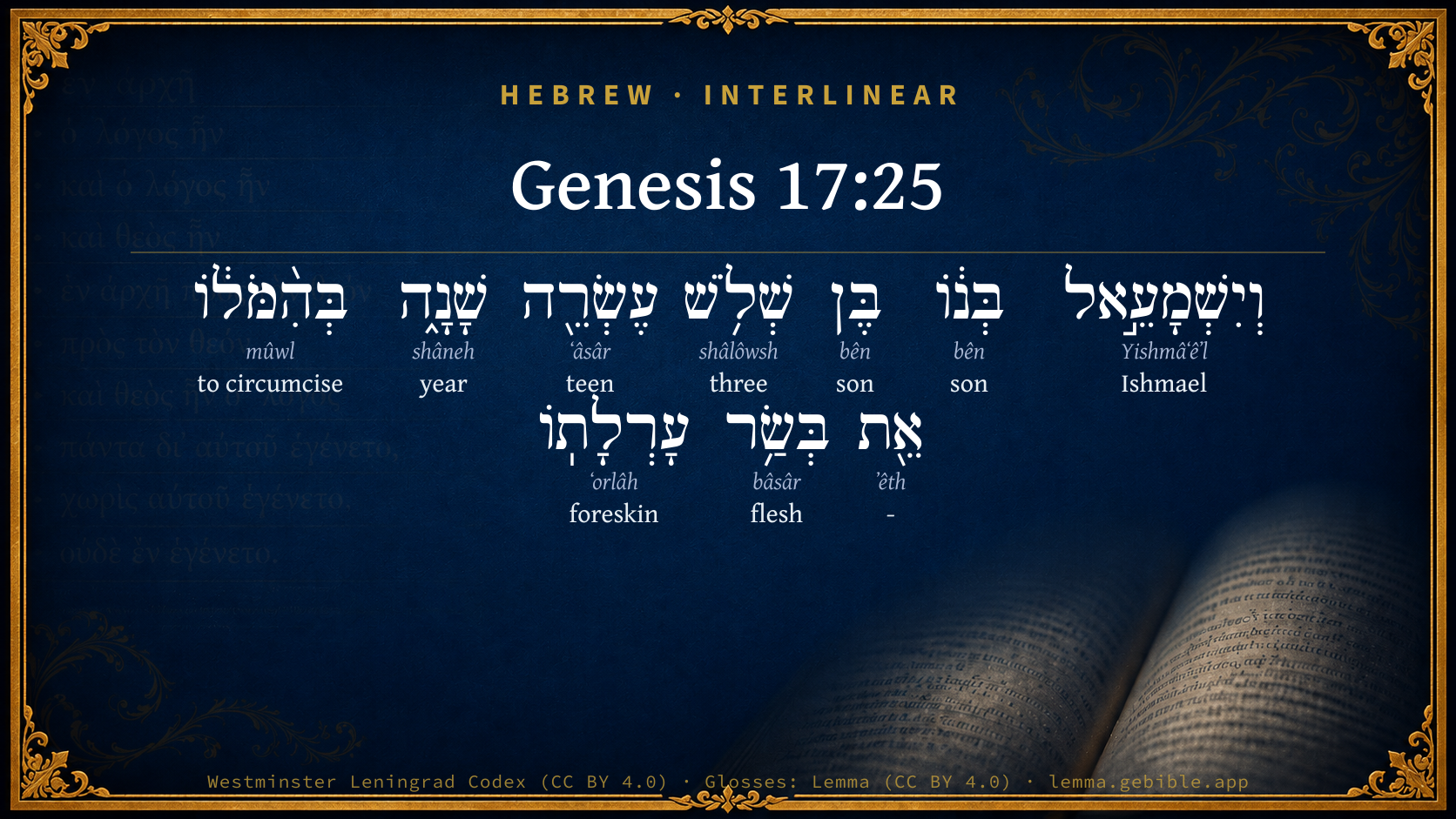
Hebrew (Westminster Leningrad Codex) Genesis 17:25 appears in the Hebrew Old Testament. The text above is from the Westminster Leningrad Codex. Each word links to its Strong’s number, a concise gloss, and parsing drawn from the Open Scriptures Hebrew Bible morphology. Click any word for its full Brown-Driver-Briggs (BDB) entry.
Download image
Cite this verse

Genesis 17:25 (World English Bible). Public Domain. Lemma interlinear Bible study tool, https://lemma.gebible.app/v/genesis/17/25.

Show BibTeX & RIS
BibTeX
RIS
English Translation
Ishmael, his son, was thirteen years old when he was circumcised in the flesh of his foreskin.
World English Bible · Public Domain
Download a study sheet

One document with this verse’s original text, its word-by-word gloss line, the meaning frame, cross-references with their text, attributed commentary, and full source and license credits — printable, and it pastes into notes with its structure intact.

This verse Autodidact and up

Study sheet (.html) Plain text (.txt)

A passage Seminary Student

Up to 50 verses in one chapter. A passage sheet keeps up to 6 commentary sources and 12 cross-references per verse, in the order this page ranks them, and says so on the sheet whenever that leaves anything out. Ask for a single verse and you get the Autodidact verse sheet above.

Everything on this page stays free to read, with no account — the sheet is a download of what is already on screen, not access to it.

Want to remove ads? Support Godless Engineer
Compare translations 3

The same verse in 3 English versions, stacked beneath the original-language interlinear above. Click any original word for its lexicon entry.

Each is an independent rendering of the whole verse — the interlinear is not word-aligned to these translations.

Highlighted words mark where these versions differ — a whole-verse word diff, not a word-by-word alignment.

  • World English Bible Public Domain
    Ishmael, his son, was thirteen years old when he was circumcised in the flesh of his foreskin.
  • King James Version Public Domain
    And Ishmael his son was thirteen years old, when he was circumcised in the flesh of his foreskin.
  • unfoldingWord Literal Text CC BY-SA 4.0
    and Ishmael his son a son of thirteen years when he was circumcised in the flesh of his foreskin.

unfoldingWord Literal Text — © unfoldingWord, licensed CC BY-SA 4.0. Word-aligned USFM3 via Door43 (git.door43.org/unfoldingWord/en_ult).

Versions to compare (up to 4)

3 of 4 selected

Show all 18 translations

Every available English version of this verse, each an independent rendering of the whole verse.

  • World English Bible Public Domain
    Ishmael, his son, was thirteen years old when he was circumcised in the flesh of his foreskin.
  • Berean Standard Bible Public Domain
    and his son Ishmael was thirteen;
  • Majority Standard Bible Public Domain
    and his son Ishmael was thirteen;
  • King James Version Public Domain
    And Ishmael his son was thirteen years old, when he was circumcised in the flesh of his foreskin.
  • American Standard Version (1901) Public Domain
    And Ishmael his son was thirteen years old, when he was circumcised in the flesh of his foreskin.
  • Revised Version (1885) Public Domain
    And Ishmael his son was thirteen years old, when he was circumcised in the flesh of his foreskin.
  • Geneva Bible (1599) Public Domain
    And Ishmael his sonne was thirteene yeere olde, when the foreskinne of his flesh was circumcised.
  • Douay-Rheims (1899) Public Domain
    And Ismael his son was full thirteen years old at the time of his circumcision.
  • Young's Literal Translation Public Domain
    and Ishmael his son `is' a son of thirteen years in the flesh of his foreskin being circumcised;
  • Literal Standard Version CC BY-SA 4.0
    and his son Ishmael [is] a son of thirteen years in the flesh of his foreskin being circumcised;
  • Unlocked Literal Bible CC BY-SA 4.0
    Ishmael his son was thirteen years old when he was circumcised in the flesh of his foreskin.
  • unfoldingWord Literal Text CC BY-SA 4.0
    and Ishmael his son a son of thirteen years when he was circumcised in the flesh of his foreskin.
  • Darby Bible Public Domain
    And Ishmael his son was thirteen years old when he was circumcised in the flesh of his foreskin.
  • World Messianic Bible Public Domain
    Ishmael, his son, was thirteen years old when he was circumcised in the flesh of his foreskin.
  • Webster's Bible Public Domain
    And Ishmael his son was thirteen years old, when he was circumcised in the flesh of his foreskin.
  • Free Bible Version CC BY-SA 4.0
    and his son Ishmael was thirteen.
  • Bible in Basic English Public Domain
    And Ishmael, his son, was thirteen years old when he underwent circumcision.
  • JPS Tanakh (1917) Public Domain
    And Ishmael his son was thirteen years old, when he was circumcised in the flesh of his foreskin.

Literal Standard Version (2020), Covenant Press — licensed CC BY-SA 4.0. Text via the HelloAO Bible API (eBible.org). Unlocked Literal Bible (unfoldingWord) — licensed CC BY-SA 4.0. Text via the HelloAO Bible API (eBible.org). unfoldingWord Literal Text — © unfoldingWord, licensed CC BY-SA 4.0. Word-aligned USFM3 via Door43 (git.door43.org/unfoldingWord/en_ult). Free Bible Version, Dr. Jonathan Gallagher — licensed CC BY-SA 4.0. Text via the HelloAO Bible API (eBible.org).

Word by word

More ways to search: Search by grammar → Find every occurrence → Compare this word →

Practice this passage: Drill this verse → Learn its vocabulary →

עָרְלָתֽוֹ
ʻorlâh
H6190
“foreskin · his”
Noun, Common, Feminine, Singular, Construct + Suffix, Personal, 3rd Person, Masculine, Singular
Part of Speech
Noun
Type
Common
Gender
Feminine
Number
Singular
State
Construct
Full BDB Definition

Origin: from H6189

TWOT: 1695a

foreskin, uncircumcised
  1. וְיִשְׁמָעֵ֣אל Yishmâʻêʼl H3458 “and · Ishmael” Conjunction + Noun, Proper
  2. בְּנ֔וֹ bên H1121 “son · his” Noun, Common, Masculine, Singular, Construct + Suffix, Personal, 3rd Person, Masculine, Singular
  3. בֶּן bên H1121 “son of” Noun, Common, Masculine, Singular, Construct
  4. שְׁלֹ֥שׁ shâlôwsh H7969 “three” Adjective, Cardinal number, Feminine, Singular, Absolute
  5. עֶשְׂרֵ֖ה ʻâsâr H6240 “teen” Adjective, Cardinal number, Feminine, Singular, Absolute
  6. שָׁנָ֑ה shâneh H8141 “year” Noun, Common, Feminine, Singular, Absolute
  7. בְּהִ֨מֹּל֔וֹ mûwl H4135 “in/at · to circumcise · him” Preposition + Verb, Niphal, Infinitive Construct + Suffix, Personal, 3rd Person, Masculine, Singular
  8. אֵ֖ת ʼêth H853 “-” Particle, Direct Object
  9. בְּשַׂ֥ר bâsâr H1320 “flesh of” Noun, Common, Masculine, Singular, Construct

About this verse

These counts appear in no published source. They are computed here, from the morphology-tagged text and Lemma’s own curated glosses. What Lemma adds →

10
words
9
distinct lemmas
Pentateuch
section

Notable vocabulary

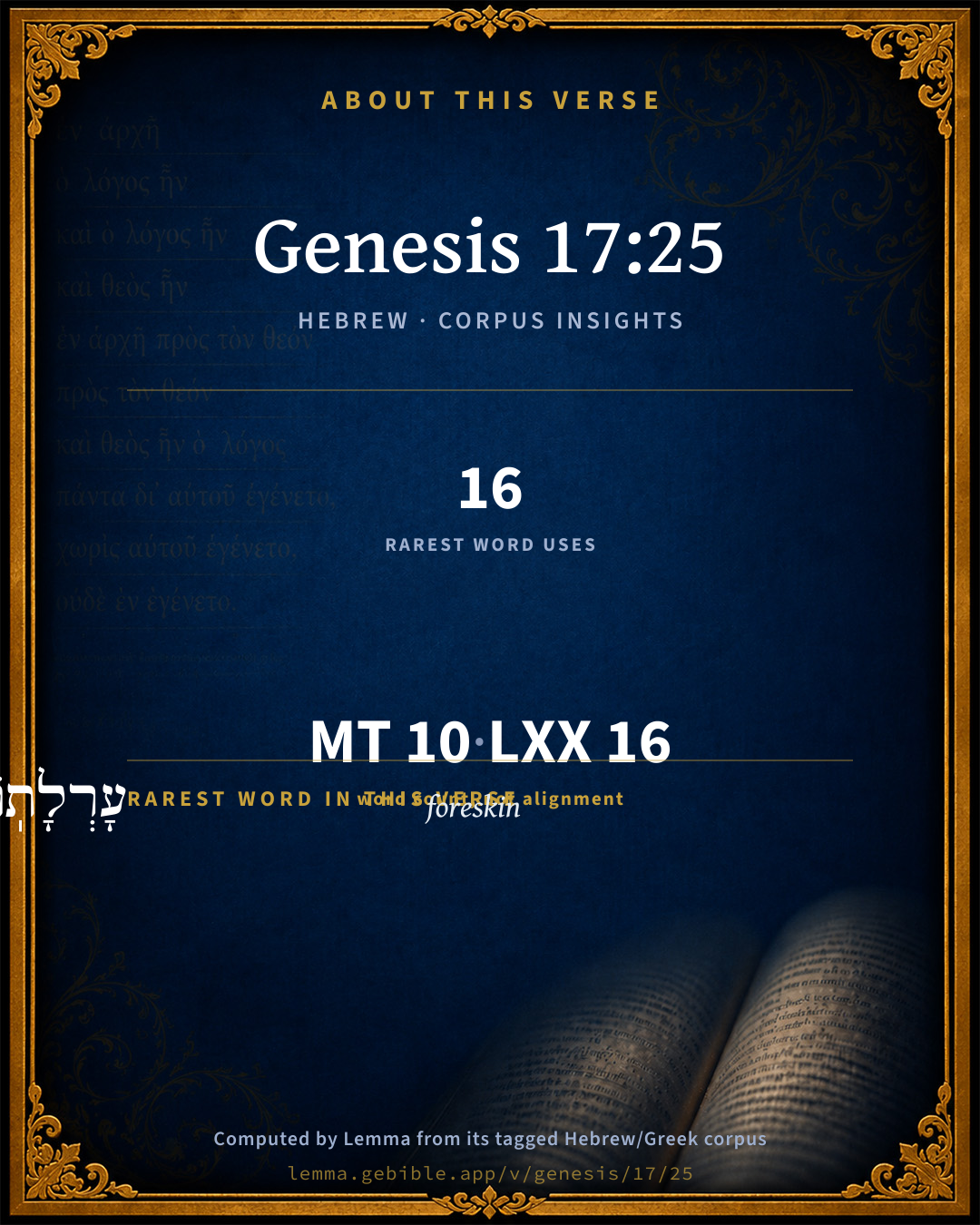
The rarest word here is עָרְלָתֽוֹ foreskin H6190 — appearing just 16 times in the whole Hebrew Bible.

Shared distinctive vocabulary

עָרְלָתֽוֹ foreskin H6190 occurs in 16 verses of the Hebrew Bible. Also found in:

Grammatical profile

  • 1 verb
  • 6 nouns
  • 2 adjectives
  • 1 particle

Verb forms

  • בְּהִ֨מֹּל֔וֹ Niphal · Infinitive Construct

Repetition

A word recurs within this verse — often emphatic in Hebrew:

  • בְּנ֔וֹ son H1121 ×2

Hebrew & Septuagint length

In English translation the verse runs 17 words from the Hebrew and 18 from the Septuagint (LXX English) — closely comparable.

A rough comparison of the two English renderings, which tokenize alike — not a word-level alignment.

Word counts can differ between the Hebrew and the Greek without any difference in meaning — e.g. the Hebrew direct-object marker אֵת has no separate Greek word, and Greek often adds the article ὁ.

In the original languages it is 10 Hebrew tokens and 16 Greek tokens — but the two are counted differently (Hebrew bundles its prefixes and suffixes into one token; the Greek is in lemma form), so that isn’t a like-for-like length.

Hebrew and Greek witnesses Masoretic Hebrew ↔ Greek Septuagint

The same verse in the two great witnesses to the Old Testament, shown verse-for-verse.

These are two independent witnesses, not word-aligned to each other, and the Septuagint is shown in lemma (dictionary) form.

Hebrew Genesis 17:25 Masoretic · Westminster Leningrad Codex

וְיִשְׁמָעֵ֣אל בְּנ֔וֹ בֶּן שְׁלֹ֥שׁ עֶשְׂרֵ֖ה שָׁנָ֑ה בְּהִ֨מֹּל֔וֹ אֵ֖ת בְּשַׂ֥ר עָרְלָתֽוֹ

Ishmael, his son, was thirteen years old when he was circumcised in the flesh of his foreskin.

World English Bible · Public Domain

Greek LXX Genesis 17:25 Septuagint · lemma form

ισμαηλ δέ ὁ υἱός αὐτός ἔτος δέκα τρεῖς εἰμί ἡνίκα περιτέμνω ὁ σάρξ ὁ ἀκροβυστία αὐτός

And Ismael his son was thirteen years old when he was circumcised in the flesh of his foreskin.

LXX2012 (modern English Septuagint) · Public Domain

Hebrew: Westminster Leningrad Codex (CC BY 4.0). Greek: Septuagint (public domain); English from LXX2012 (modern English Septuagint) (Public Domain). How the Septuagint differs from the Hebrew →

Targum (Aramaic paraphrase)

2

The Targum is the ancient Jewish Aramaic paraphrase of the Hebrew Scriptures — an interpretive translation, not the Hebrew text itself. Onkelos (literal) and Pseudo-Jonathan (expansive) render the Torah, and Jonathan the Prophets. Coverage is partial: where no permissively-licensed English translation exists for a verse, only the Aramaic is shown. This is verse-level text, not a word-by-word alignment to the Hebrew.

  1. Targum Onkelos Torah (Genesis–Deuteronomy)
    וְיִשְׁמָעֵאל בְּרֵהּ בַּר תְּלַת עַשְׂרֵי שְׁנִין כַּד גְּזַר יַת בִּשְׂרָא דְעָרְלְתֵהּ

    (no public-domain English translation for this verse)

    Targum Onkelos — Aramaic: “Onkelos Genesis” (public domain); “Onkelos Exodus” (public domain); “Onkelos Leviticus” (public domain); “Onkelos Numbers” (public domain); “Onkelos Deuteronomy” (public domain). English: “Sefaria Community Translation” (CC0 1.0 (public-domain dedication)); “J.W. Etheridge. The Targums of Onkelos and Jonathan Ben Uzziel on the Pentateuch. London: Longmans, Green, 1862” (public domain). Text via Sefaria.

  2. Targum Pseudo-Jonathan Torah (Genesis–Deuteronomy)
    וְיִשְׁמָעֵאל בְּרֵיהּ בַּר תְּלַת עַשְרֵי שְׁנִין כַּד גְזַר יַת בִּשְרָא דְעוּרְלָתֵיהּ

    And Ishmael his son was thirteen years old when he circumcised the foreskin of his flesh.

    Targum Pseudo-Jonathan — Aramaic: “Targum Jonathan on Genesis” (public domain); “Targum Jonathan on Exodus” (public domain); “Targum Jonathan on Leviticus” (public domain); “Targum Jonathan on Numbers” (public domain); “Targum Jonathan on Deuteronomy” (public domain). English: “The Targum of Jonathan ben Uzziel, trans. J. W. Etheridge, London, 1862” (public domain). Text via Sefaria.

Commentary

Notes on Genesis 17:25 from classic Christian and Jewish commentators (each source and its license shown beneath its notes). The classic Christian expositions comment on the surrounding passage and are grouped to its opening verse, so a note may address several verses; the Jewish commentaries on the Tanakh (Rashi and others) are per-verse, so they appear only where the commentator wrote on this verse.

Lemma curates 59 commentaries, every one of them public domain or Creative Commons licensed, each selected and text-cleaned for this edition rather than reprinted as found. About our sources →

Trapp's Complete Commentary

John Trapp

Gen 17:25 And Ishmael his son [was] thirteen years old, when he was circumcised in the flesh of his foreskin.

Ver. 25. And Ishmael his son was thirteen years old.] The Turks’ children are not circumcised till they are ten years old, and then they use great feasting, banqueting, music, and bringing of presents. {a} They say that Abraham loved Ishmael, and not Isaac: and that it was Ishmael whom Abraham would have sacrificed.

{a} The Grand Sign Sereg., pp. 113,191.

John Trapp, A Commentary or Exposition upon All the Books of the Old and New Testament (1647–1656) — public domain. Text from a community e-Sword module.

Whedon's Commentary on the Bible

Daniel D. Whedon

25. Thirteen years old — Josephus (Ant., 1:12, 2) says the Arabians, because of this, do not circumcise their children until the thirteenth year.

ADDITIONAL NOTE ON CIRCUMCISION.

The practice of circumcision obtained among many ancient nations, and was probably in use before the time of Abraham. See note on Gen_17:11 above. Herodotus was unable to determine whether the Egyptians learned the custom from the Ethiopians, or the Ethiopians from the Egyptians. Herod., 2:104. Both nations observed the custom from the earliest times, and it is difficult to believe that they would have borrowed it from the Hebrews. The practice also prevailed among the Colchians of Asia and the savage Troglodytes of Africa, (Diod. Sic., 3:31,) and is still continued by several African tribes and the inhabitants of many islands of the Pacific. PICKERING, Races of Men, pp. 153, 199. The Abyssinian Christians are said also to perform this rite at the present day, and upon both sexes. LUDOLF, Hist. Ethiopia, 1. 19. The practice prevailed also among the Phoenicians and Syrians (Herod., 2:104) and the Moabites, Ammonites, and Edomites. Jer_9:25. The Arabians perform the rite after the thirteenth year, thus following the example of Ishmael. Gen_17:25 above, note. Mohammed was circumcised, according to the custom of his countrymen; and, though the Koran does not enjoin the practice, circumcision is as common among the Mohammedans as among the Jews. As to the origin and reason of this practice many hold that it was introduced in those southern countries not as a religious rite, but from a physical cause. It is believed that the burning temperature of those climes, in many cases combined with a peculiar bodily structure of those races, gave rise to the custom. It was thought to prevent painful diseases and such disorders as phimosis, and gonorrhoea spuria. Modern travellers testify that it precludes great physical inconvenience among the Bush-men; and the Christian missionaries who tried to abolish it in Abyssinia, were compelled, by the dangerous physical consequences, to desist from their plans. Herodotus observes that the Egyptian priests were circumcised for the sake of cleanliness, deeming it better to be clean than handsome. Herod., 2:37. It was observed, however, in the course of time, that many tribes and nations inhabiting the same zones remained uncircumcised without perceptible injury or inconvenience. The Philistines seem never to have adopted the custom. The Edomites neglected it, (Josephus, Ant., 13:9, 1,) and some classes of the Egyptians omitted it; and when, in the time of the Persian and Greek dominion, the primitive institutions of Egypt were neglected or underwent important modifications, circumcision ceased to be a national custom. The priests alone preserved it as a mark of their superior purity. Kalisch. But whatever the occasion or reason of its origin, the Egyptian priests doubtless connected some religious significance with the rite of circumcision. Other nations also probably associated it with sacred mysteries. It has been thought that among idolatrous peoples it may have had some reference to the deification of the powers of nature, and especially those of generation. It is impossible, however, to determine exactly what religious significance the heathen nations attached to the custom. But if it seem strange that a custom practised by idolatrous tribes should have been made a sign and seal of God’s covenant with Abraham, let us consider that almost every religious ceremony of the Hebrew people was based upon some prevailing Eastern custom or tradition, and that it was divested of base and superstitious elements by such appropriation to new purposes, and exalted to be the vehicle of lofty doctrines. This accommodation to traditionary practices, says Kalisch, secured the external success of the true religion, while the transformation of rotten and idolatrous institutions into laws of indestructible vitality, constitutes its indisputable claim to originality, and commands the admiration of all ages.

With Abraham and his posterity it became the sacred token of a blood-covenant, the most solemn and obligatory conceivable, between man and God. Abraham became henceforth, ina notable sense, “the friend of God.” 2Ch_20:7; Isa_41:8; Jas_2:23. Gen_17:10-11, above, are thus paraphrased by Trumbull: “The blood-covenant of friendship shall be consummated by your giving to me of your personal blood at the very source of paternity — ’under your girdle;’ thereby pledging yourself to me, and pledging also to me those who shall come after you in the line of natural descent.” The Blood Covenant, p. 217. New York, 1885.

The rite was in the earliest times performed with a stone knife, (Exo_4:25; Jos_5:2,) sometimes by the mother, but generally by the father of the child. Afterwards it became the business of a physician, but in modern times it is performed by a special officer. The eighth day after birth was the usual time for the circumcision, (Lev_12:3; Luk_1:59,) at which time the child is named. In the course of the ceremony the following is uttered: “Blessed art thou, O Lord, our God! who hath sanctified his beloved from the womb, and ordained an ordinance for his kindred, and sealed his descendants with the mark of his holy covenant. Preserve this child to his father and mother, and let his name be called in Israel, A, the son of B. Let the father rejoice in those that go forth from his loins, and let his mother be glad in the fruit of her womb.” See more in the Biblical Cyclopedias, under the word Circumcision.

Daniel D. Whedon (gen. ed.), Commentary on the Old and New Testaments (1874–1909) — public domain. Text from a community e-Sword module.

Ellicott's Commentary for English Readers

(25) Ishmael. . . . was thirteen years old.—Hence the Mohammedans defer circumcision to the thirteenth year.

A Bible Commentary for English Readers, edited by Charles John Ellicott (1878–1897) — public domain. Text from a community e-Sword module.

The Cambridge Bible for Schools and Colleges

gen. ed. J. J. S. Perowne

25. Ishmael … thirteen years old] The mention of Ishmael and of his age, is of interest; for it implies (1) the fact that the Ishmaelite people practised circumcision; (2) the possible reminiscence of a variant custom by which it was performed at the age of thirteen years, instead of eight days; as in Israel, cf. Gen_17:12. The modern Arabian use is said to be much later in life than that of the Jews, and in some cases corresponds with the age of Ishmael. A boy at 13 was regarded as on the threshold of manhood. Origen (Euseb. Praep. Evang. vi. 11) and Ambrose (de Abrah. ii. 348) mention fourteen as the age for the practice of the rite among the Egyptians.

The Cambridge Bible for Schools and Colleges (gen. ed. J. J. S. Perowne; Cambridge University Press, 1878–1918) — public domain. Text from a community e-Sword module.

John Gill's Exposition

And Ishmael his son was thirteen years old when he was circumcised in the flesh of his foreskin. Hence the Arabians, as Josephus (w) relates, circumcise their children when at thirteen years of age, because Ishmael, the founder of their nation, was circumcised at that age; and Origen (x) asserts the same; and with which agrees what an Arabic writer says (y) of the Arabians before Mahomet, that they used to circumcise at a certain age, between the tenth and fifteenth years of their age. So Rauwolff says (z), there are some, chiefly among the Arabians, that imitate their patriarch Ishmael. As for the Mahometans, though they circumcise, they do not always do it in the thirteenth year, as some write; for it is performed by them sometimes in the thirteenth, fourteenth, fifteenth, or sixteenth, and sometimes in the sixth or seventh year (a). The Egyptians, according to Ambrose (b), circumcised their children at fourteen years of age, which comes pretty near to the time of the Ishmaelites or Arabs, from whom they might receive circumcision, if not of the Israelites, as before observed. A certain traveller says (c), the modern Egyptians, as the rest of the Mahometans, are not circumcised until the thirteenth year. The Africans circumcise on the seventh day, which comes nearer to the Jews (d).

(w) Antiqu. l. 1. c. 12. sect. 2. (x) Philocalia, c. 23. p. 77. (y) Ebnol Athir apud Pocock. Specimen Arab. Hist. p. 319. (z) Travels, part 1. ch. 7. p. 59. by Ray. (a) Vid. Reland. de Relig. Mohammed. p. 75. (b) De Abraham, l. 2. c. 11. p. 266. (c) Baumgarten. Peregrin. l. 1. c. 16. (d) Leo. African. Descriptio Africae, l. 3. p. 33.

John Gill's Exposition of the Whole Bible (1746–1763) — public domain (CC PDM 1.0). Text via the HelloAO Bible API.

Haydock's Catholic Bible Commentary

Full thirteen, or beginning his fourteenth year, at which age the Arabs and Mahometans still generally circumcise; but without any order from God. (Calmet)

George Leo Haydock (1774–1849), Haydock's Catholic Family Bible and Commentary, 1859 edition — public domain. Excludes Psalms (Douay-Rheims chapter numbering differs from Protestant) and Deuterocanonical books (Catholic canon only).

The Pulpit Commentary

And Ishmael his son was thirteen years old (the same form of expression as above), when he was circumcised. Hence among the Arabs the ceremony is usually delayed till the thirteenth year (cf. Josephus, "Ant.," 1:13).

The Pulpit Commentary (1880–1919), ed. H.D.M. Spence-Jones & Joseph S. Exell — public domain. Text from a community e-Sword module.

Radak

Rabbi David Kimhi (Radak)

וישמעאל בנו בן שלש עשרה שנה, seeing the Torah had mentioned Avraham's age at the time of his circumcision, Ishmael's age was also mentioned as a mark of honour for him. After all, we know how old Ishmael was at the time, the Torah having told us that Avraham his father was 86 years old when he was born (Genesis 15,16). Perhaps the Torah underlines the fact that Avraham circumcised his son Ishmael, as if he had not been circumcised by that age, he himself is obligated to either circumcise himself or to arrange for him circumcision. Ishmael was just young enough for this obligation still to be that of this father.

בהמלו את בשר ערלתו, seeing that the Torah added the word את here, a word which had not appeared when Avraham's circumcision is reported, the meaning of this verse is clearer than the previous verse. The word את, here, means the same as if the Torah had written מן, "from," i.e. "when his foreskin was removed from his male member." The word את is used as meaning "from" also in Genesis 44,4 הם יצאו את העיר, "when they had left the city, etc." Also in Kings I 15,23 the word את means "from," I.e. that the line חלה את רגליו, means that Asa's "ailment started from his feet." There is an allegorical explanation for our verse, mentioned by Rashi, according to which Avraham, whose flesh had become elastic, soft, due to his having engaged in sexual intercourse during many years of his life, did not need to have the membrane we referred to as פריעה removed, whereas his son who had not yet experienced the use of his male organ in a sexual function did need this membrane to be removed. According to this distinction, the word את in our verse would refer to something additional, as is customary with the word את. In this case the additional element was the removal of Ishmael's פריעה at the same time as the removal of his foreskin. The author of this explanation disagrees with the previously mentioned view of the sages who believe that at that time the command to perform פריעה had not been issued at all. I believe it is far more likely that the instruction to perform פריעה was given to Avraham at this time. Seeing that our sages state that anyone who has performed circumcision but has omitted to perform פריעה is viewed as if he had not performed any part of the commandment, (Shabbat 137) it is hard to accept that the first person performing this commandment should not have performed it in all its details, i.e. perfectly.

Radak on the Tanakh — English translations: “Sefaria Community Translation” (CC0 1.0 (public-domain dedication)); “Eliyahu Munk, HaChut Hameshulash” (CC BY 4.0); “Rabbi Mike Feuer, Jerusalem Anthology” (CC BY 4.0); and “R. David Kimhi on the first book of Psalms, Translated by R.G. Finch, London, 1919” (public domain). Text via Sefaria.

Lesson kit

Teaching starters — assembled from the data on this page, not authored interpretation. Every prompt links to the verse data it draws on. Edit before teaching.

Genesis, in the Pentateuch, opens this verse with 10 words (9 distinct Hebrew lemmas). Its most distinctive word is ʻorlâh (“foreskin”). A historical commentator’s framing appears above. Read the whole chapter for the surrounding context.

Discussion questions

  1. What does “foreskin” (ʻorlâh) contribute to the verse as a whole?
  2. How does Genesis 17:11, which shares the word «foreskin», read alongside this verse?
  3. What does the repetition of “son” (2× in this one verse) do in this verse?
  4. These translations render this verse differently; the difference is in the English rendering, not the original. What questions does that raise?
  5. «בְּהִ֨מֹּל֔וֹ» is a Niphal Infinitive Construct verb. How does that grammatical form shape the action described?
  6. Compare how Trapp's Complete Commentary and Whedon's Commentary on the Bible read this verse. Where do they agree or differ?

Things to notice

Reading settings

Reading text

Shown beneath each verse's original-language words.

Old Testament
Old Testament edition

Read the OT as the Masoretic Hebrew (MT) or the Greek Septuagint (LXX).

English shown for the Greek Septuagint (in the Hebrew ↔ Greek comparison).

Comparing translations? Open the Compare panel on any verse page to stack up to four side by side.