Genesis 17:13

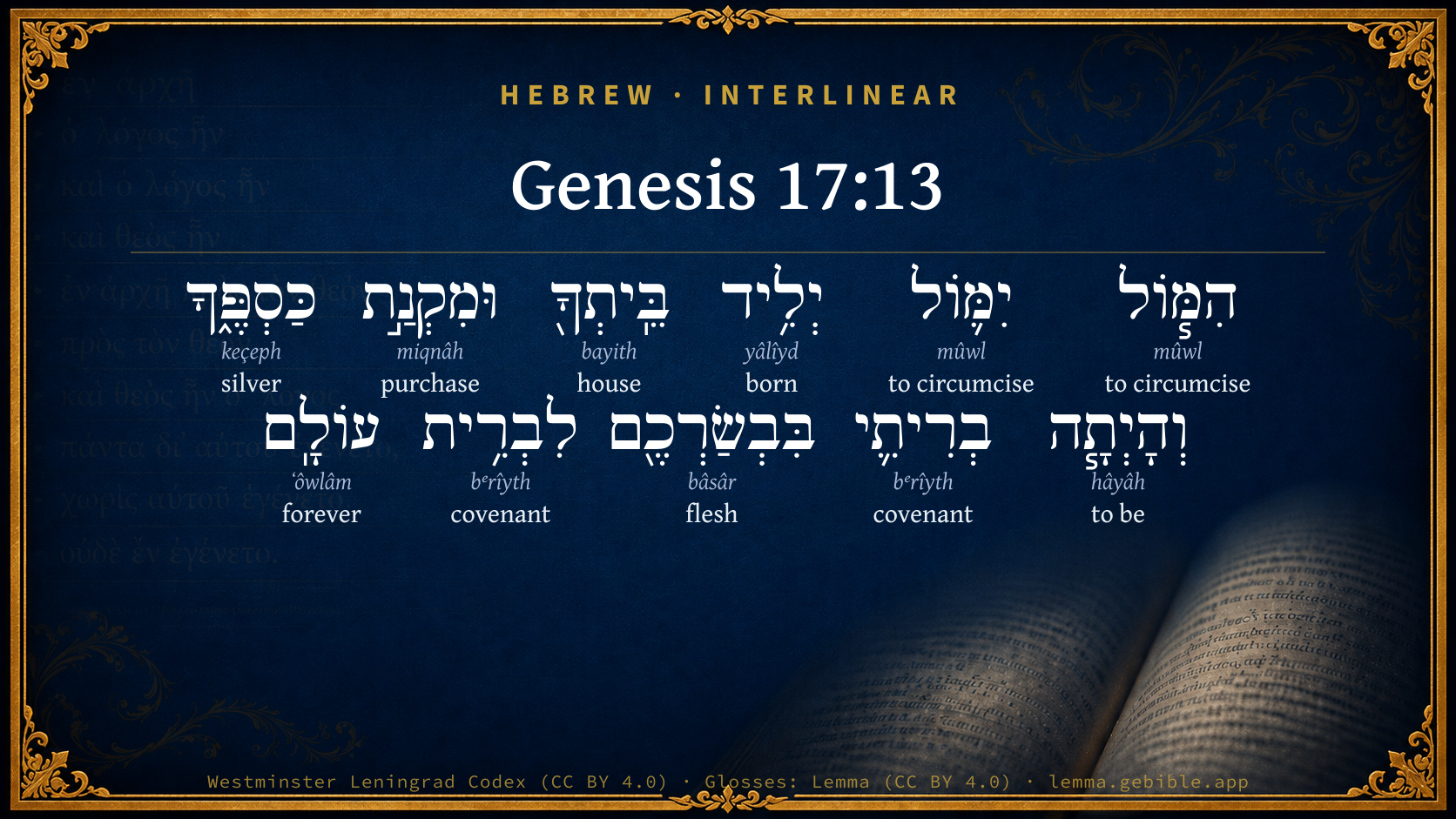
Hebrew (Westminster Leningrad Codex) Genesis 17:13 appears in the Hebrew Old Testament. The text above is from the Westminster Leningrad Codex. Each word links to its Strong’s number, a concise gloss, and parsing drawn from the Open Scriptures Hebrew Bible morphology. Click any word for its full Brown-Driver-Briggs (BDB) entry.
Download image
Cite this verse

Genesis 17:13 (World English Bible). Public Domain. Lemma interlinear Bible study tool, https://lemma.gebible.app/v/genesis/17/13.

Show BibTeX & RIS
BibTeX
RIS
English Translation
He who is born in your house, and he who is bought with your money, must be circumcised. My covenant will be in your flesh for an everlasting covenant.
World English Bible · Public Domain
Download a study sheet

One document with this verse’s original text, its word-by-word gloss line, the meaning frame, cross-references with their text, attributed commentary, and full source and license credits — printable, and it pastes into notes with its structure intact.

This verse Autodidact and up

Study sheet (.html) Plain text (.txt)

A passage Seminary Student

Up to 50 verses in one chapter. A passage sheet keeps up to 6 commentary sources and 12 cross-references per verse, in the order this page ranks them, and says so on the sheet whenever that leaves anything out. Ask for a single verse and you get the Autodidact verse sheet above.

Everything on this page stays free to read, with no account — the sheet is a download of what is already on screen, not access to it.

Want to remove ads? Support Godless Engineer
Compare translations 3

The same verse in 3 English versions, stacked beneath the original-language interlinear above. Click any original word for its lexicon entry.

Each is an independent rendering of the whole verse — the interlinear is not word-aligned to these translations.

Highlighted words mark where these versions differ — a whole-verse word diff, not a word-by-word alignment.

  • World English Bible Public Domain
    He who is born in your house, and he who is bought with your money, must be circumcised. My covenant will be in your flesh for an everlasting covenant.
  • King James Version Public Domain
    He that is born in thy house, and he that is bought with thy money, must needs be circumcised: and my covenant shall be in your flesh for an everlasting covenant.
  • unfoldingWord Literal Text CC BY-SA 4.0
    He must surely be circumcised, the one born in your house and the one bought with your money. So my covenant will be in your flesh as an eternal covenant.

unfoldingWord Literal Text — © unfoldingWord, licensed CC BY-SA 4.0. Word-aligned USFM3 via Door43 (git.door43.org/unfoldingWord/en_ult).

Versions to compare (up to 4)

3 of 4 selected

Show all 18 translations

Every available English version of this verse, each an independent rendering of the whole verse.

  • World English Bible Public Domain
    He who is born in your house, and he who is bought with your money, must be circumcised. My covenant will be in your flesh for an everlasting covenant.
  • Berean Standard Bible Public Domain
    Whether they are born in your household or purchased, they must be circumcised. My covenant in your flesh will be an everlasting covenant.
  • Majority Standard Bible Public Domain
    Whether they are born in your household or purchased, they must be circumcised. My covenant in your flesh will be an everlasting covenant.
  • King James Version Public Domain
    He that is born in thy house, and he that is bought with thy money, must needs be circumcised: and my covenant shall be in your flesh for an everlasting covenant.
  • American Standard Version (1901) Public Domain
    He that is born in thy house, and he that is bought with thy money, must needs be circumcised: and my covenant shall be in your flesh for an everlasting covenant.
  • Revised Version (1885) Public Domain
    He that is born in thy house, and he that is bought with thy money, must needs be circumcised: and my covenant shall be in your flesh for an everlasting covenant.
  • Geneva Bible (1599) Public Domain
    He that is borne in thine house, and he that is bought with thy money, must needes be circumcised: so my couenant shall be in your flesh for an euerlasting couenant.
  • Douay-Rheims (1899) Public Domain
    And my covenant shall be in your flesh for a perpetual covenant.
  • Young's Literal Translation Public Domain
    he is certainly circumcised who `is' born in thine house, or bought with thy money; and My covenant hath become in your flesh a covenant age-during;
  • Literal Standard Version CC BY-SA 4.0
    he is certainly circumcised who [is] born in your house, or bought with your money; and My covenant has become in your flesh a perpetual covenant;
  • Unlocked Literal Bible CC BY-SA 4.0
    He who is born into your household and he who is bought with your money must be circumcised. Thus my covenant will be in your flesh for an everlasting covenant.
  • unfoldingWord Literal Text CC BY-SA 4.0
    He must surely be circumcised, the one born in your house and the one bought with your money. So my covenant will be in your flesh as an eternal covenant.
  • Darby Bible Public Domain
    He who is born in thy house, and he who is bought with thy money, must be circumcised; and my covenant shall be in your flesh for an everlasting covenant.
  • World Messianic Bible Public Domain
    He who is born in your house, and he who is bought with your money, must be circumcised. My covenant shall be in your flesh for an everlasting covenant.
  • Webster's Bible Public Domain
    He that is born in thy house, and he that is bought with thy money, must needs be circumcised: and my covenant shall be in your flesh for an everlasting covenant.
  • Free Bible Version CC BY-SA 4.0
    You must circumcise those born in your household or bought from foreigners as a sign in your bodies of my eternal agreement.
  • Bible in Basic English Public Domain
    He who comes to birth in your house and he who is made yours for a price, all are to undergo circumcision; so that my agreement may be marked in your flesh, an agreement for all time.
  • JPS Tanakh (1917) Public Domain
    He that is born in thy house, and he that is bought with thy money, must needs be circumcised; and My covenant shall be in your flesh for an everlasting covenant.

Literal Standard Version (2020), Covenant Press — licensed CC BY-SA 4.0. Text via the HelloAO Bible API (eBible.org). Unlocked Literal Bible (unfoldingWord) — licensed CC BY-SA 4.0. Text via the HelloAO Bible API (eBible.org). unfoldingWord Literal Text — © unfoldingWord, licensed CC BY-SA 4.0. Word-aligned USFM3 via Door43 (git.door43.org/unfoldingWord/en_ult). Free Bible Version, Dr. Jonathan Gallagher — licensed CC BY-SA 4.0. Text via the HelloAO Bible API (eBible.org).

Word by word

More ways to search: Search by grammar → Find every occurrence → Compare this word →

Practice this passage: Drill this verse → Learn its vocabulary →

יְלִ֥יד
yâlîyd
H3211
“born of”
Noun, Common, Masculine, Singular, Construct
Part of Speech
Noun
Type
Common
Gender
Masculine
Number
Singular
State
Construct
Full BDB Definition

Origin: from H3205

TWOT: 867e

born
  1. הִמּ֧וֹל mûwl H4135 “to circumcise” Verb, Niphal, Infinitive Absolute
  2. יִמּ֛וֹל mûwl H4135 “to circumcise” Verb, Niphal, Imperfect, 3rd Person, Masculine, Singular
  3. בֵּֽיתְךָ֖ bayith H1004 “house · your” Noun, Common, Masculine, Singular, Construct + Suffix, Personal, 2nd Person, Masculine, Singular
  4. וּמִקְנַ֣ת miqnâh H4736 “and · purchase of” Conjunction + Noun, Common, Feminine, Singular, Construct
  5. כַּסְפֶּ֑ךָ keçeph H3701 “silver · your” Noun, Common, Masculine, Singular, Construct + Suffix, Personal, 2nd Person, Masculine, Singular
  6. וְהָיְתָ֧ה hâyâh H1961 “and · to be” Conjunction + Verb, Qal, Sequential Perfect, 3rd Person, Feminine, Singular
  7. בְרִיתִ֛י bᵉrîyth H1285 “covenant · my” Noun, Common, Feminine, Singular, Construct + Suffix, Personal, 1st Person, Common, Singular
  8. בִּבְשַׂרְכֶ֖ם bâsâr H1320 “in/at · flesh · your” Preposition + Noun, Common, Masculine, Singular, Construct + Suffix, Personal, 2nd Person, Masculine, Plural
  9. לִבְרִ֥ית bᵉrîyth H1285 “to/for · covenant of” Preposition + Noun, Common, Feminine, Singular, Construct
  10. עוֹלָֽם ʻôwlâm H5769 “forever” Noun, Common, Masculine, Singular, Absolute

About this verse

These counts appear in no published source. They are computed here, from the morphology-tagged text and Lemma’s own curated glosses. What Lemma adds →

11
words
9
distinct lemmas
Pentateuch
section

Notable vocabulary

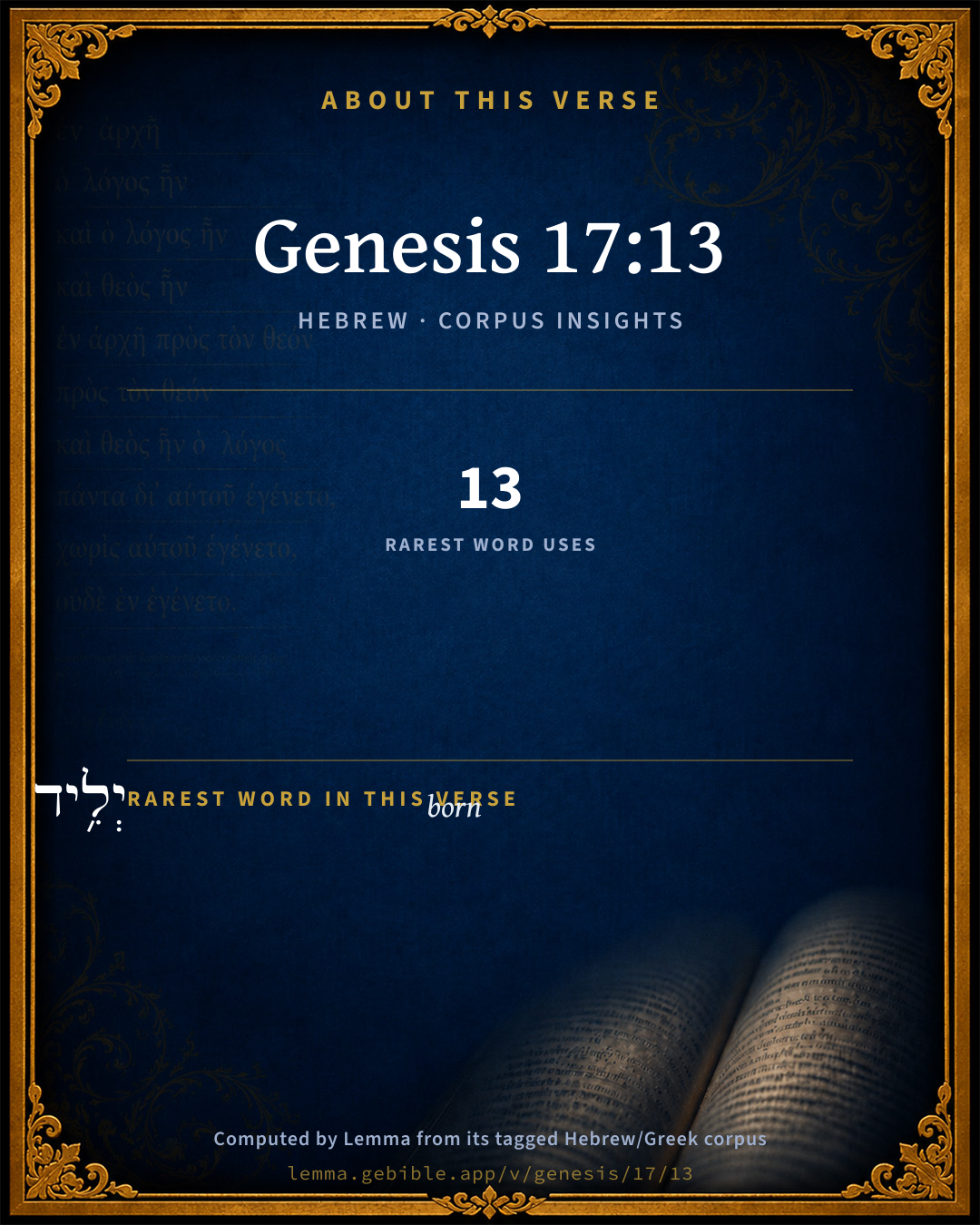
The rarest word here is יְלִ֥יד born H3211 — appearing just 13 times in the whole Hebrew Bible.

Shared distinctive vocabulary

יְלִ֥יד born H3211 occurs in 13 verses of the Hebrew Bible. Also found in:

Grammatical profile

  • 3 verbs
  • 8 nouns

Verb forms

  • הִמּ֧וֹל Niphal · Infinitive Absolute
  • יִמּ֛וֹל Niphal · Imperfect
  • וְהָיְתָ֧ה Qal · Sequential Perfect

Repetition

Words recur within this verse — often emphatic in Hebrew:

  • הִמּ֧וֹל to circumcise H4135 ×2
  • בְרִיתִ֛י covenant H1285 ×2

Hebrew & Septuagint length

In English translation the verse runs 29 words from the Hebrew and 30 from the Septuagint (LXX English) — closely comparable.

A rough comparison of the two English renderings, which tokenize alike — not a word-level alignment.

Word counts can differ between the Hebrew and the Greek without any difference in meaning — e.g. the Hebrew direct-object marker אֵת has no separate Greek word, and Greek often adds the article ὁ.

Cross-references

12

Topical passages linked to Genesis 17:13 in the Treasury of Scripture Knowledge — connected by theme and wording, ordered by reader-vote popularity; previews shown in the World English Bible.

  • Exodus 12:44 but every man's servant who is bought for money, when you have circumcised him, then shall he eat of it.
  • Genesis 37:36 The Midianites sold him into Egypt to Potiphar, an officer of Pharaoh's, the captain of the guard.
  • Nehemiah 5:8 I said to them, We after our ability have redeemed our brothers the Jews, that were sold to the nations; and would you even sell your brothers, and should they be sold to us? Then held they their peace, and found never a word.
  • Genesis 14:14 When Abram heard that his relative was taken captive, he led forth his trained men, born in his house, three hundred and eighteen, and pursued as far as Dan.
  • Genesis 15:3 Abram said, "Behold, to me you have given no seed: and, behold, one born in my house is my heir."
  • Genesis 37:27 Come, and let's sell him to the Ishmaelites, and not let our hand be on him; for he is our brother, our flesh." His brothers listened to him.
  • Genesis 39:1 Joseph was brought down to Egypt. Potiphar, an officer of Pharaoh's, the captain of the guard, an Egyptian, bought him from the hand of the Ishmaelites that had brought him down there.
  • Exodus 21:2 If you buy a Hebrew servant, he shall serve six years and in the seventh he shall go out free without paying anything.
  • Exodus 21:4 If his master gives him a wife and she bears him sons or daughters, the wife and her children shall be her master's, and he shall go out by himself.
  • Exodus 21:16 "Anyone who kidnaps someone and sells him, or if he is found in his hand, he shall surely be put to death.
  • Nehemiah 5:5 Yet now our flesh is as the flesh of our brothers, our children as their children: and, behold, we bring into bondage our sons and our daughters to be servants, and some of our daughters are brought into bondage [already]: neither is it in our power to help it; for other men have our fields and our vineyards.
  • Matthew 18:25 But because he couldn't pay, his lord commanded him to be sold, with his wife, his children, and all that he had, and payment to be made.

Cross-references courtesy of OpenBible.info (CC BY 4.0).

Hebrew and Greek witnesses Masoretic Hebrew ↔ Greek Septuagint

The same verse in the two great witnesses to the Old Testament, shown verse-for-verse.

These are two independent witnesses, not word-aligned to each other, and the Septuagint is shown in lemma (dictionary) form.

Hebrew Genesis 17:13 Masoretic · Westminster Leningrad Codex

הִמּ֧וֹל יִמּ֛וֹל יְלִ֥יד בֵּֽיתְךָ֖ וּמִקְנַ֣ת כַּסְפֶּ֑ךָ וְהָיְתָ֧ה בְרִיתִ֛י בִּבְשַׂרְכֶ֖ם לִבְרִ֥ית עוֹלָֽם

He who is born in your house, and he who is bought with your money, must be circumcised. My covenant will be in your flesh for an everlasting covenant.

World English Bible · Public Domain

Greek LXX Genesis 17:13 Septuagint · lemma form

περιτομή περιτέμνω ὁ οἰκογενής ὁ οἰκία σύ καί ὁ ἀργυρώνητος καί εἰμί ὁ διαθήκη ἐγώ ἐπί ὁ σάρξ σύ εἰς διαθήκη αἰώνιος

He that is born in your house, and he that is bought with money shall be surely circumcised, and my covenant shall be on your flesh for an everlasting covenant.

LXX2012 (modern English Septuagint) · Public Domain

Hebrew: Westminster Leningrad Codex (CC BY 4.0). Greek: Septuagint (public domain); English from LXX2012 (modern English Septuagint) (Public Domain). How the Septuagint differs from the Hebrew →

Targum (Aramaic paraphrase)

2

The Targum is the ancient Jewish Aramaic paraphrase of the Hebrew Scriptures — an interpretive translation, not the Hebrew text itself. Onkelos (literal) and Pseudo-Jonathan (expansive) render the Torah, and Jonathan the Prophets. Coverage is partial: where no permissively-licensed English translation exists for a verse, only the Aramaic is shown. This is verse-level text, not a word-by-word alignment to the Hebrew.

  1. Targum Onkelos Torah (Genesis–Deuteronomy)
    אִתְגַזָרָא יִתְגַזְרוּן (נ''י מִגְזַר יִגְזַר) יְלִיד בֵּיתָךְ וּזְבִין כַּסְפָּךְ וּתְהֵי קְיָמִי בְּבִשְׂרֵיכוֹן לִקְיָם עָלָם

    (no public-domain English translation for this verse)

    Targum Onkelos — Aramaic: “Onkelos Genesis” (public domain); “Onkelos Exodus” (public domain); “Onkelos Leviticus” (public domain); “Onkelos Numbers” (public domain); “Onkelos Deuteronomy” (public domain). English: “Sefaria Community Translation” (CC0 1.0 (public-domain dedication)); “J.W. Etheridge. The Targums of Onkelos and Jonathan Ben Uzziel on the Pentateuch. London: Longmans, Green, 1862” (public domain). Text via Sefaria.

  2. Targum Pseudo-Jonathan Torah (Genesis–Deuteronomy)
    מַאן דְהוּא גְזִיר יִגְזַר מַרְבְּיָינֵי בָּתֵּיכוֹן וּזְבִינֵי כַּסְפֵּיכוֹן וּתְהִי קְיָמִי בְּבִשְרֵיכוֹן לִקְיָם עֲלָם

    He who is circumcised shall circumcise him who is brought up among you, or bought with your silver; and it shall be My covenant in your flesh for a covenant for ever.

    Targum Pseudo-Jonathan — Aramaic: “Targum Jonathan on Genesis” (public domain); “Targum Jonathan on Exodus” (public domain); “Targum Jonathan on Leviticus” (public domain); “Targum Jonathan on Numbers” (public domain); “Targum Jonathan on Deuteronomy” (public domain). English: “The Targum of Jonathan ben Uzziel, trans. J. W. Etheridge, London, 1862” (public domain). Text via Sefaria.

Commentary

Notes on Genesis 17:13 from classic Christian and Jewish commentators (each source and its license shown beneath its notes). The classic Christian expositions comment on the surrounding passage and are grouped to its opening verse, so a note may address several verses; the Jewish commentaries on the Tanakh (Rashi and others) are per-verse, so they appear only where the commentator wrote on this verse.

Lemma curates 59 commentaries, every one of them public domain or Creative Commons licensed, each selected and text-cleaned for this edition rather than reprinted as found. About our sources →

Trapp's Complete Commentary

John Trapp

Gen 17:13 He that is born in thy house, and he that is bought with thy money, must needs be circumcised: and my covenant shall be in your flesh for an everlasting covenant.

Ver. 13. He that is born in thy house.] Householders must see to it, that their families fear God. They walk not "in a perfect way" that do otherwise, {Psa 101:2} that look not

“Aedibus in propriis, quae prava, aut recta gerantur.”

My covenant shall be in your flesh.] That is, the sign of my covenant (by a metonymy of the subject), seem it never so simple, and prove it never so painful and shameful. The foolishness of God is wiser than men, that cry, Credat Iudaeus Apella ,& c.

John Trapp, A Commentary or Exposition upon All the Books of the Old and New Testament (1647–1656) — public domain. Text from a community e-Sword module.

Adam Clarke's Commentary

Verse 13. He that is born in thy house] The son of a servant; he that is bought with thy money - a slave on his coming into the family. According to the Jewish writers the father was to circumcise his son; and the master, the servant born in his house, or the slave bought with money. If the father or master neglected to do this, then the magistrates were obliged to see it performed; if the neglect of this ordinance was unknown to the magistrates, then the person himself, when he came of age, was obliged to do it.

Adam Clarke's Commentary on the Bible (1810–1826) — public domain. Text from a community e-Sword/MySword module.

John Calvin's Commentaries

13. For an everlasting covenant The meaning of this expression may be twofold: either that God promises that his grace, of which circumcision was a sign and pledge, should be eternal; or that he intended the sign itself to be perpetually observed. Indeed, I have no doubt that this perpetuity ought to be referred to the visible sign. But they who hence infer, that the use of it ought to flourish among the Jews even of the present time, are (in my opinion) deceived. For they swerve from that axiom which we ought to regard as fixed; that since Christ is the end of the law, the perpetuity which is ascribed to the ceremonies of the law, was terminated as soon as Christ appeared. The temple was the perpetual habitation of God, according to that declaration,

“This is my rest forever, here will I dwell,” (Psalm 132:14.)

The Sabbath indicated not a temporal but a perpetual sanctification of the people. Nevertheless, it is not to be denied, that Christ brought them both to an end. In the same way must we also think of circumcision. If the Jews object, that in this manner, the law was violated by Christ; the answer is easy; that the external use of the law was so abrogated, as to establish its truth. For, at length, by the coming of Christ, circumcision was substantially confirmed, so that it should endure forever, and that the covenant which God had before made, should be ratified. Moreover, lest the changing of the visible sign should perplex any one, let that renovation of the world, of which I have spoken, be kept in mind; which renovation — notwithstanding some interposed variety — has perpetuated those things which would otherwise have been fading. Therefore, although the use of circumcision has ceased; yet it does not cerise to be an everlasting, or perpetual covenant, if only Christ be regarded as the Mediator; who, though the sign be changed, has confirmed the truth. And that, by the coming of Christ, external circumcision ceased, is plain from the words of Paul; who not only teaches that we are circumcised by the death of Christy spiritually, and not through the carnal sign: but who expressly substitutes baptism for circumcision; (Colossians 2:11;) and truly baptism could not succeed circumcision, without taking it away. Therefore in the next chapter he denies that there is any difference between circumcision and uncircumcision; because, at that time, the thing was indifferent, and of no importance. Whence we refute the error of those, who think that circumcision is still in force among the Jews, as if it were a peculiar symbol of the nation, which never ought to be abrogated. I acknowledge, indeed, that it was permitted to them for a time, until the liberty obtained by Christ should be better known; but though permitted, it by no means retained its original force. For it would be absurd to be initiated into the Church by two different signs; of which the one should testify and affirm that Christ was come, and the other should shadow him forth as absent.

John Calvin's Commentaries (1540-1563) — public domain. Text from the Calvin Translation Society English edition (1840s-50s) via the Christian Classics Ethereal Library (ccel.org). Calvin's coverage is partial (roughly two-thirds of the Bible); uncommented books and verses are honest gaps, never fabricated. The 19th-century editor's footnotes and remarks are omitted so the notes are faithfully Calvin's own voice.

Ellicott's Commentary for English Readers

(13) He that is born in thy house . . . —Two things follow from this wide extension of the rite of circumcision: the first, that all members of Abram’s household, being thus sharers in the covenant, were also numbered as belonging to the nations that sprang from him. We have seen that even in early days his followers must have numbered six or seven hundred men (Gen_14:14), and they were growing in multitude all the rest of his life, and during the lifetime of Isaac. They were then divided between Esau and Jacob at Isaac’s death (Gen_35:27; Gen_36:6-7), but the diminution in the number of Jacob’s family thus caused must have been compensated by those whom he gathered for himself in Mesopotamia (Gen_30:43). All his household went down with him into Egypt, as part of his taf, translated “little ones” in Gen_46:5, but really signifying the whole body of dependents, men, women, and children. Placed there in the fruitful Delta, they would be counted as members of that tribe to the chief of which they belonged, and would swell the numbers of the vast host which left Egypt (Exo_12:37). The second point is, that as all who were circumcised were regarded as Israelites, so also circumcision was confined to the Israelites. It was not ‘a catholic ordinance, intended, like baptism, for all people and all times. Nor was it primarily a religious institution. The bought slave was circumcised first, and instructed afterwards. No profession of faith was required, but he was admitted to the privilege in right of his master. The reason of this was that it was an admission into the Jewish nation first, and by consequence only into the church. It is one of the many points which distinguish slavery, as practised among the Jews, from the degrading form of it which existed in modem times, that from the days of Abram onwards the slave by being circumcised was proclaimed to be one of the same race and nation as his master, and thereby entitled to share in his national and religious privileges.

A Bible Commentary for English Readers, edited by Charles John Ellicott (1878–1897) — public domain. Text from a community e-Sword module.

John Gill's Exposition

He that is born in thine house, and he that is bought with thy money, must needs be circumcised,.... Or "in circumcising shall be circumcised" (l), shall certainly be circumcised; this is repeated to denote the necessity of it, and what care should be taken that this be done, because there was to be no uncircumcised male among them, Gen 17:10; nor any conversation and communion to be had among them, especially in a religious way.

And my covenant shall be in your flesh for an everlasting covenant; circumcision was to be seen in their flesh, and no methods were to be taken to draw over the foreskin again, but it was to continue as long as they lived; and so in their posterity, in all succeeding ages, as a sign of the covenant and promise which should remain until the Messiah's coming.

(l) "circumcidendo circumcidetur", Pagninus, Montanus &c.

John Gill's Exposition of the Whole Bible (1746–1763) — public domain (CC PDM 1.0). Text via the HelloAO Bible API.

Matthew Poole's English Annotations

So it was, and is properly in regard of the thing signified to all true believers; and for the sign, it is so called because it was to endure through all generations till the coming of the Messias; the word olam, here and elsewhere rendered everlasting, or for ever, being oft used to express not only simple eternity, but any long continuance, for many ages, yea, sometimes for a man’s life. See Exo 21:6; Deu 15:17; 1Ki 9:3.

Matthew Poole's English Annotations on the Holy Bible (1683–1685) — public domain. Text from a community e-Sword/MySword module.

Whedon's Commentary on the Bible

Daniel D. Whedon

13. He that is born in thy house — The bond slave of a patriarchal family as distinguished from one bought or taken in war. Comp. Gen_14:14.

Daniel D. Whedon (gen. ed.), Commentary on the Old and New Testaments (1874–1909) — public domain. Text from a community e-Sword module.

The Pulpit Commentary

He that is born in thy house, and he that is bought with thy money, must needs be circumcised. Literally, circumcised, must be circumcised, he that is born, &c., the niph. inf. abe. with the finite verb occupying the place of emphasis at the beginning of the sentence (;vide Gesenius, "Grammar," And my covenant shall be in your flesh for an everlasting covenant.

The Pulpit Commentary (1880–1919), ed. H.D.M. Spence-Jones & Joseph S. Exell — public domain. Text from a community e-Sword module.

Rashi

Rabbi Shlomo Yitzchaki (Rashi)

המול ימול יליד ביתך HE THAT IS BORN IN THY HOUSE MUST NEEDS BE CIRCUMCISED — Here the statement that one born in the house must be circumcised is repeated but it does not say “after eight days” as in 5:12, thus teaching you that there are some cases of those “born in the house” who have to be circumcised on the first day of birth, as is explained in Treatise Sabbath (Shabbat 135b).

Rashi on the Tanakh — English translations: “The Judaica Press complete Tanach with Rashi, translated by A. J. Rosenberg” (CC BY 4.0); “Pentateuch with Rashi's commentary by M. Rosenbaum and A.M. Silbermann, 1929-1934” (public domain); “The Metsudah Tanach series, Lakewood, N.J” (CC BY 4.0); and “The Book of Joshua, Metsudah Publications, 1997” (CC BY 4.0). Text via Sefaria.

Radak

Rabbi David Kimhi (Radak)

המול ימול, this refers to Avraham ensuring that all the male members of his household be circumcised now with him. The Torah had already issued instructions in the previous verse that Avraham's male descendants were to be circumcised, as well as any gentile bodily owned members of their households. Just as they were to study G'd's laws, i.e. "His ways," they would have to carry out this commandment as it is inconceivable for more than one religion to be observed within the same household. Neither were there to be members of two different nations within the same household, one of whom circumcised and the other uncircumcised.

בבשרכם, seeing that slaves are owned bodily by their Jewish master, it is quite in order to describe their flesh as בשרכם, "your flesh."

Radak on the Tanakh — English translations: “Sefaria Community Translation” (CC0 1.0 (public-domain dedication)); “Eliyahu Munk, HaChut Hameshulash” (CC BY 4.0); “Rabbi Mike Feuer, Jerusalem Anthology” (CC BY 4.0); and “R. David Kimhi on the first book of Psalms, Translated by R.G. Finch, London, 1919” (public domain). Text via Sefaria.

Lesson kit

Teaching starters — assembled from the data on this page, not authored interpretation. Every prompt links to the verse data it draws on. Edit before teaching.

Genesis, in the Pentateuch, opens this verse with 11 words (9 distinct Hebrew lemmas). Its most distinctive word is yâlîyd (“born”). A historical commentator’s framing appears above. Read the whole chapter for the surrounding context.

Discussion questions

  1. What does “born” (yâlîyd) contribute to the verse as a whole?
  2. Genesis 14:14 shares the word «born» with this verse. How do the two illuminate each other?
  3. “to circumcise” occurs 2× in this one verse. What is the effect of the repetition?
  4. These translations render this verse differently; the difference is in the English rendering, not the original. What questions does that raise?
  5. The verb «הִמּ֧וֹל» is Niphal Infinitive Absolute. How does its form color the action?
  6. Reading how Trapp's Complete Commentary and Adam Clarke's Commentary read this verse, where do the two commentators agree and where do they part?

Things to notice

  • These translations choose different wording for 8 words in this verse.
  • “to circumcise” occurs 2× in this single verse.
  • 9 distinct Hebrew lemmas span 11 words in this verse.

Reading settings

Reading text

Shown beneath each verse's original-language words.

Old Testament
Old Testament edition

Read the OT as the Masoretic Hebrew (MT) or the Greek Septuagint (LXX).

English shown for the Greek Septuagint (in the Hebrew ↔ Greek comparison).

Comparing translations? Open the Compare panel on any verse page to stack up to four side by side.