
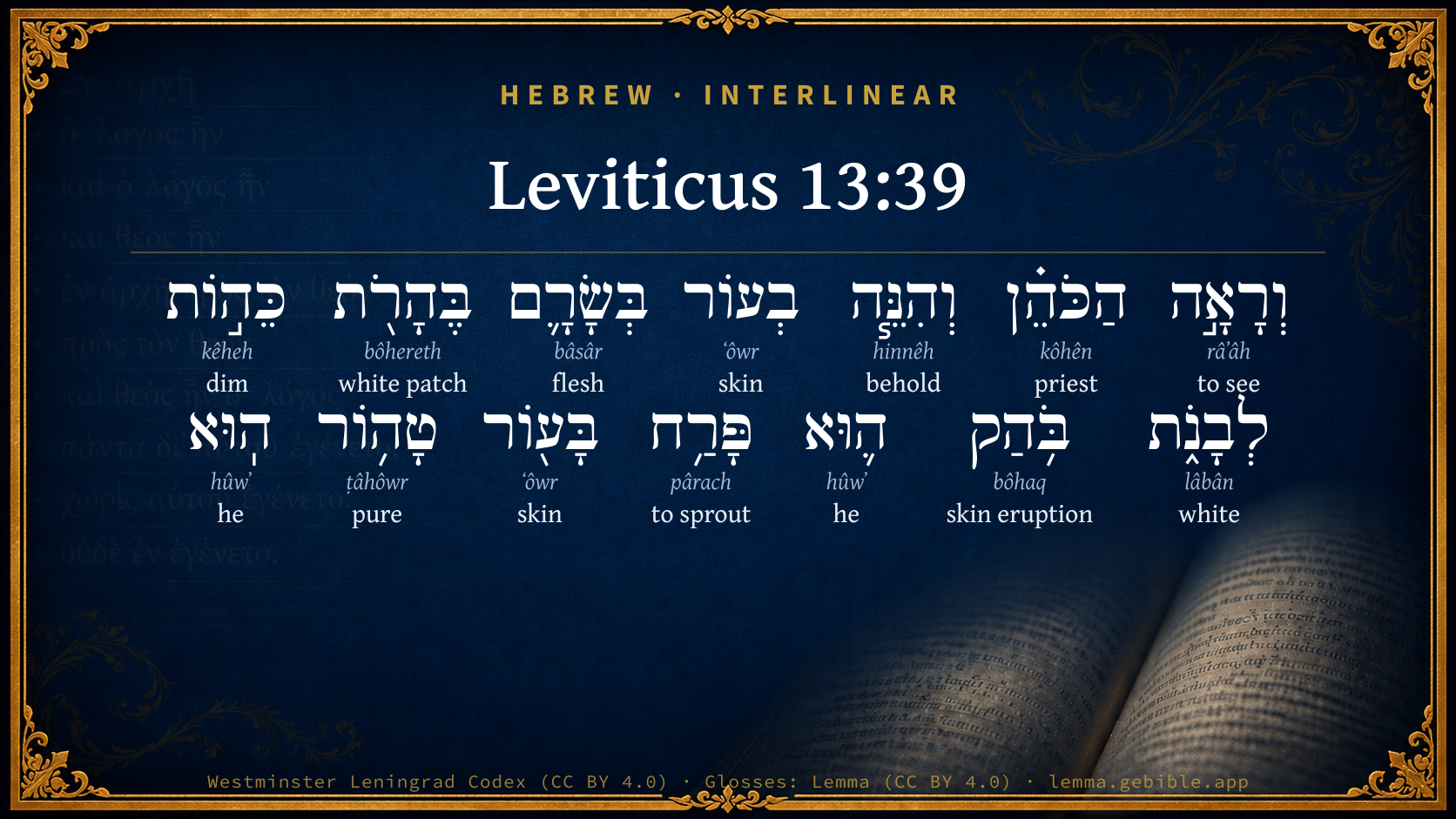
Leviticus 13:39

Hebrew (Westminster Leningrad Codex) Leviticus 13:39 appears in the Hebrew Old Testament. The text above is from the Westminster Leningrad Codex. Each word links to its Strong’s number, a concise gloss, and parsing drawn from the Open Scriptures Hebrew Bible morphology. Click any word for its full Brown-Driver-Briggs (BDB) entry.
Download image
Cite this verse

Leviticus 13:39 (World English Bible). Public Domain. Lemma interlinear Bible study tool, https://lemma.gebible.app/v/leviticus/13/39.

Show BibTeX & RIS
BibTeX
RIS
English Translation
then the priest shall examine them; and, behold, if the bright spots on the skin of their body are a dull white, it is a harmless rash, it has broken out in the skin; he is clean.
World English Bible · Public Domain
Highlights
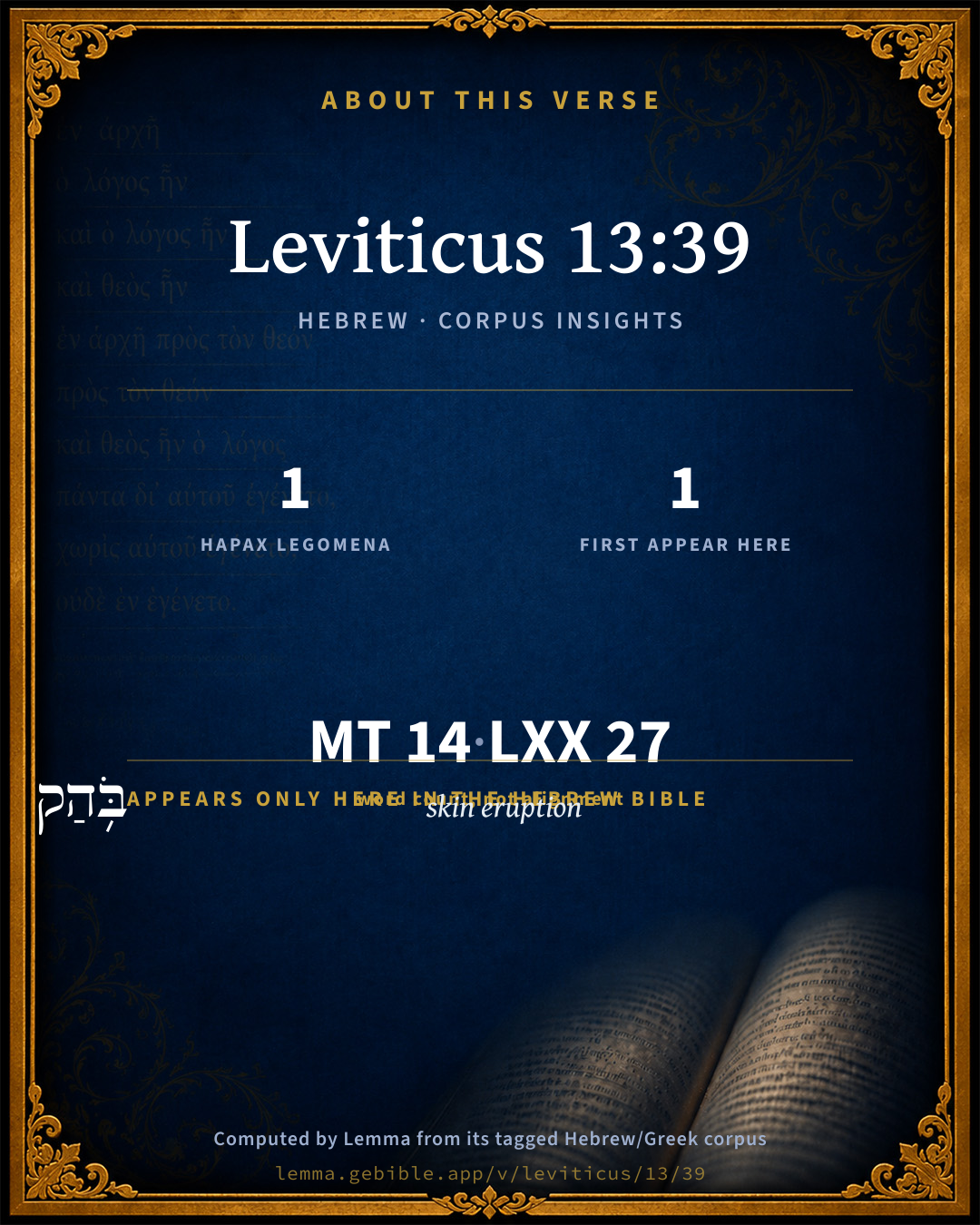
  • 1 hapax legomenon — only here in the Hebrew Bible
  • 1 first appearance in the Hebrew Bible
Full analysis ↓
Download a study sheet

One document with this verse’s original text, its word-by-word gloss line, the meaning frame, cross-references with their text, attributed commentary, and full source and license credits — printable, and it pastes into notes with its structure intact.

This verse Autodidact and up

Study sheet (.html) Plain text (.txt)

A passage Seminary Student

Up to 50 verses in one chapter. A passage sheet keeps up to 6 commentary sources and 12 cross-references per verse, in the order this page ranks them, and says so on the sheet whenever that leaves anything out. Ask for a single verse and you get the Autodidact verse sheet above.

Everything on this page stays free to read, with no account — the sheet is a download of what is already on screen, not access to it.

Want to remove ads? Support Godless Engineer
Compare translations 3

The same verse in 3 English versions, stacked beneath the original-language interlinear above. Click any original word for its lexicon entry.

Each is an independent rendering of the whole verse — the interlinear is not word-aligned to these translations.

Highlighted words mark where these versions differ — a whole-verse word diff, not a word-by-word alignment.

  • World English Bible Public Domain
    then the priest shall examine them; and, behold, if the bright spots on the skin of their body are a dull white, it is a harmless rash, it has broken out in the skin; he is clean.
  • King James Version Public Domain
    Then the priest shall look: and, behold, if the bright spots in the skin of their flesh be darkish white; it is a freckled spot that groweth in the skin; he is clean.
  • unfoldingWord Literal Text CC BY-SA 4.0
    then the priest shall see. And behold, the bright spots on the skin of their flesh dull white; it a rash. It has broken out on the skin. He clean.

unfoldingWord Literal Text — © unfoldingWord, licensed CC BY-SA 4.0. Word-aligned USFM3 via Door43 (git.door43.org/unfoldingWord/en_ult).

Versions to compare (up to 4)

3 of 4 selected

Show all 18 translations

Every available English version of this verse, each an independent rendering of the whole verse.

  • World English Bible Public Domain
    then the priest shall examine them; and, behold, if the bright spots on the skin of their body are a dull white, it is a harmless rash, it has broken out in the skin; he is clean.
  • Berean Standard Bible Public Domain
    the priest shall examine them, and if the spots are dull white, it is a harmless rash that has broken out on the skin; the person is clean.
  • Majority Standard Bible Public Domain
    the priest shall examine them, and if the spots are dull white, it is a harmless rash that has broken out on the skin; the person is clean.
  • King James Version Public Domain
    Then the priest shall look: and, behold, if the bright spots in the skin of their flesh be darkish white; it is a freckled spot that groweth in the skin; he is clean.
  • American Standard Version (1901) Public Domain
    then the priest shall look; and, behold, if the bright spots in the skin of their flesh be of a dull white, it is a tetter, it hath broken out in the skin; he is clean.
  • Revised Version (1885) Public Domain
    then the priest shall look: and, behold, if the bright spots in the skin of their flesh be of a dull white; it is a tetter, it hath broken out in the skin; he is clean.
  • Geneva Bible (1599) Public Domain
    Then the Priest shall consider: and if the spots in the skin of their flesh be somewhat darke and white withall, it is but a white spot broken out in the skin: therefore he is cleane.
  • Douay-Rheims (1899) Public Domain
    The priest shall view them. If he find that a darkish whiteness shineth in the skin, let him know that it is not the leprosy, but a white blemish, and that the man is clean.
  • Young's Literal Translation Public Domain
    and the priest hath seen, and lo, in the skin of their flesh white weak bright spots, it `is' a freckled spot broken out in the skin; he `is' clean.
  • Literal Standard Version CC BY-SA 4.0
    and the priest has seen, and behold, white [and] faded bright spots [are] in the skin of their flesh—it [is] a freckled spot broken out in the skin; he [is] clean.
  • Unlocked Literal Bible CC BY-SA 4.0
    then the priest must examine the person to see if the spots are a dull white, which is only a rash that has broken out in the skin. He is clean.
  • unfoldingWord Literal Text CC BY-SA 4.0
    then the priest shall see. And behold, the bright spots on the skin of their flesh dull white; it a rash. It has broken out on the skin. He clean.
  • Darby Bible Public Domain
    and the priest look, and behold, there are in the skin of their flesh pale white spots, it is an eruption which is broken out in the skin: he is clean.
  • World Messianic Bible Public Domain
    then the priest shall examine them. Behold, if the bright spots on the skin of their body are a dull white, it is a harmless rash. It has broken out in the skin. He is clean.
  • Webster's Bible Public Domain
    Then the priest shall look: and behold, if the bright spots in the skin of their flesh are darkish white; it is a freckled spot that groweth in the skin; he is clean.
  • Free Bible Version CC BY-SA 4.0
    the priest shall inspect them, and if the spots appear a dull white, it's just a rash that has developed on the skin; the person is clean.
  • Bible in Basic English Public Domain
    Then the priest is to see them: and if the white marks on their skin are not very bright, it is a skin disease which has come out on the skin; he is clean.
  • JPS Tanakh (1917) Public Domain
    then the priest shall look; and, behold, if the bright spots in the skin of their flesh be of a dull white, it is a tetter, it hath broken out in the skin: he is clean.

Literal Standard Version (2020), Covenant Press — licensed CC BY-SA 4.0. Text via the HelloAO Bible API (eBible.org). Unlocked Literal Bible (unfoldingWord) — licensed CC BY-SA 4.0. Text via the HelloAO Bible API (eBible.org). unfoldingWord Literal Text — © unfoldingWord, licensed CC BY-SA 4.0. Word-aligned USFM3 via Door43 (git.door43.org/unfoldingWord/en_ult). Free Bible Version, Dr. Jonathan Gallagher — licensed CC BY-SA 4.0. Text via the HelloAO Bible API (eBible.org).

Word by word

More ways to search: Search by grammar → Find every occurrence → Compare this word →

Practice this passage: Drill this verse → Learn its vocabulary →

בֹּ֥הַק
bôhaq
H933
“skin eruption”
Noun, Common, Masculine, Singular, Absolute
Part of Speech
Noun
Type
Common
Gender
Masculine
Number
Singular
State
Absolute
Full BDB Definition

Origin: from an unused root meaning to be pale

TWOT: 210a

a harmless eruption of the skin, skin spot
  1. וְרָאָ֣ה râʼâh H7200 “and · to see” Conjunction + Verb, Qal, Sequential Perfect, 3rd Person, Masculine, Singular
  2. הַכֹּהֵ֗ן kôhên H3548 “the · priest” Particle, Definite Article + Noun, Common, Masculine, Singular, Absolute
  3. וְהִנֵּ֧ה hinnêh H2009 “and · behold” Conjunction + Particle, Demonstrative
  4. בְעוֹר ʻôwr H5785 “in/at · skin of” Preposition + Noun, Common, Masculine, Singular, Construct
  5. בְּשָׂרָ֛ם bâsâr H1320 “flesh · their” Noun, Common, Masculine, Singular, Construct + Suffix, Personal, 3rd Person, Masculine, Plural
  6. בֶּהָרֹ֖ת bôhereth H934 “white patches” Noun, Common, Feminine, Plural, Absolute
  7. כֵּה֣וֹת kêheh H3544 “dim” Adjective, Adjective, Feminine, Plural, Absolute
  8. לְבָנֹ֑ת lâbân H3836 “white” Adjective, Adjective, Feminine, Plural, Absolute
  9. ה֛וּא hûwʼ H1931 “he” Pronoun, Personal, 3rd Person, Masculine, Singular
  10. פָּרַ֥ח pârach H6524 “to sprout” Verb, Qal, Perfect, 3rd Person, Masculine, Singular
  11. בָּע֖וֹר ʻôwr H5785 “in/at the · skin” Preposition, Determined + Noun, Common, Masculine, Singular, Absolute
  12. טָה֥וֹר ṭâhôwr H2889 “pure” Adjective, Adjective, Masculine, Singular, Absolute
  13. הֽוּא hûwʼ H1931 “he” Pronoun, Personal, 3rd Person, Masculine, Singular

About this verse

These counts appear in no published source. They are computed here, from the morphology-tagged text and Lemma’s own curated glosses. What Lemma adds →

14
words
12
distinct lemmas
Pentateuch
section

Notable vocabulary

1 hapax legomenon — a word that appears only here in the entire Hebrew Bible:

  • בֹּ֥הַק skin eruption H933

First appearance in Scripture

This word makes its first canonical appearance in the Hebrew Bible here:

  • בֹּ֥הַק skin eruption H933

Shared distinctive vocabulary

כֵּה֣וֹת dim H3544 occurs in 9 verses of the Hebrew Bible. Also found in:

Grammatical profile

  • 2 verbs
  • 6 nouns
  • 3 adjectives
  • 2 pronouns
  • 1 particle

Verb forms

  • וְרָאָ֣ה Qal · Sequential Perfect
  • פָּרַ֥ח Qal · Perfect

Repetition

Words recur within this verse — often emphatic in Hebrew:

  • בְעוֹר skin H5785 ×2
  • ה֛וּא he H1931 ×2

Hebrew & Septuagint length

In English translation the verse runs 37 words from the Hebrew and 37 from the Septuagint (LXX English) — the same length.

A rough comparison of the two English renderings, which tokenize alike — not a word-level alignment.

Word counts can differ between the Hebrew and the Greek without any difference in meaning — e.g. the Hebrew direct-object marker אֵת has no separate Greek word, and Greek often adds the article ὁ.

In the original languages it is 14 Hebrew tokens and 27 Greek tokens — but the two are counted differently (Hebrew bundles its prefixes and suffixes into one token; the Greek is in lemma form), so that isn’t a like-for-like length.

Cross-references

3

Topical passages linked to Leviticus 13:39 in the Treasury of Scripture Knowledge — connected by theme and wording, ordered by reader-vote popularity; previews shown in the World English Bible.

  • Ecclesiastes 7:20 Surely there is not a righteous man on earth, who does good and doesn't sin.
  • Romans 7:22–25 For I delight in God's law after the inward man,
  • James 3:2 For in many things we all stumble. If anyone doesn't stumble in word, the same is a perfect man, able to bridle the whole body also.

Cross-references courtesy of OpenBible.info (CC BY 4.0).

Hebrew and Greek witnesses Masoretic Hebrew ↔ Greek Septuagint

The same verse in the two great witnesses to the Old Testament, shown verse-for-verse.

These are two independent witnesses, not word-aligned to each other, and the Septuagint is shown in lemma (dictionary) form.

Hebrew Leviticus 13:39 Masoretic · Westminster Leningrad Codex

וְרָאָ֣ה הַכֹּהֵ֗ן וְהִנֵּ֧ה בְעוֹר בְּשָׂרָ֛ם בֶּהָרֹ֖ת כֵּה֣וֹת לְבָנֹ֑ת בֹּ֥הַק ה֛וּא פָּרַ֥ח בָּע֖וֹר טָה֥וֹר הֽוּא

then the priest shall examine them; and, behold, if the bright spots on the skin of their body are a dull white, it is a harmless rash, it has broken out in the skin; he is clean.

World English Bible · Public Domain

Greek LXX Leviticus 13:39 Septuagint · lemma form

καί ὁράω ὁ ἱερεύς καί ἰδού ἐν δέρμα ὁ σάρξ αὐτός αὔγασμα αὐγάζω λευκαθίζω ἀλφός εἰμί καθαρός εἰμί ἐκἀνθέω ἐν ὁ δέρμα ὁ σάρξ αὐτός καθαρός εἰμί

then the priest shall look; and, behold, there being bright spots of a bright whiteness in the skin of their flesh, it is a tetter; it burst forth in the skin of his flesh; he is clean.

LXX2012 (modern English Septuagint) · Public Domain

Hebrew: Westminster Leningrad Codex (CC BY 4.0). Greek: Septuagint (public domain); English from LXX2012 (modern English Septuagint) (Public Domain). How the Septuagint differs from the Hebrew →

Targum (Aramaic paraphrase)

2

The Targum is the ancient Jewish Aramaic paraphrase of the Hebrew Scriptures — an interpretive translation, not the Hebrew text itself. Onkelos (literal) and Pseudo-Jonathan (expansive) render the Torah, and Jonathan the Prophets. Coverage is partial: where no permissively-licensed English translation exists for a verse, only the Aramaic is shown. This is verse-level text, not a word-by-word alignment to the Hebrew.

  1. Targum Onkelos Torah (Genesis–Deuteronomy)
    וְיֶחֱזֵי כַהֲנָא וְהָא בִמְשַׁךְ בִּסְרְהוֹן בַּהֲרָן עָמְיָן חַוְרָן בָּהֲקָא הוּא סָגֵי בְמַשְׁכָּא דְכֵי הוּא

    (no public-domain English translation for this verse)

    Targum Onkelos — Aramaic: “Onkelos Genesis” (public domain); “Onkelos Exodus” (public domain); “Onkelos Leviticus” (public domain); “Onkelos Numbers” (public domain); “Onkelos Deuteronomy” (public domain). English: “Sefaria Community Translation” (CC0 1.0 (public-domain dedication)); “J.W. Etheridge. The Targums of Onkelos and Jonathan Ben Uzziel on the Pentateuch. London: Longmans, Green, 1862” (public domain). Text via Sefaria.

  2. Targum Pseudo-Jonathan Torah (Genesis–Deuteronomy)
    וְיֶחֱמֵי כַּהֲנָא וְהָא בִמְשׁוֹךְ בִּישְרֵיהוֹן בַּהֲקֵי עַמְיַין חִוְורָן צַחַר הוּא סַגֵי בְּמַשְׁכָא דְכֵי הוּא

    the priest shall look, and, behold, if the spots in the skin of their flesh are a greyish white, it is a bright freckle growing in the skin; he is clean.

    Targum Pseudo-Jonathan — Aramaic: “Targum Jonathan on Genesis” (public domain); “Targum Jonathan on Exodus” (public domain); “Targum Jonathan on Leviticus” (public domain); “Targum Jonathan on Numbers” (public domain); “Targum Jonathan on Deuteronomy” (public domain). English: “The Targum of Jonathan ben Uzziel, trans. J. W. Etheridge, London, 1862” (public domain). Text via Sefaria.

Commentary

Notes on Leviticus 13:39 from classic Christian and Jewish commentators (each source and its license shown beneath its notes). The classic Christian expositions comment on the surrounding passage and are grouped to its opening verse, so a note may address several verses; the Jewish commentaries on the Tanakh (Rashi and others) are per-verse, so they appear only where the commentator wrote on this verse.

Lemma curates 59 commentaries, every one of them public domain or Creative Commons licensed, each selected and text-cleaned for this edition rather than reprinted as found. About our sources →

Trapp's Complete Commentary

John Trapp

Lev 13:39 Then the priest shall look: and, behold, [if] the bright spots in the skin of their flesh [be] darkish white; it [is] a freckled spot [that] groweth in the skin; he [is] clean.

Ver. 39. A freckled spot.] Or white leprous eruption. This made not a man unclean: no more do mere infirmities make God abhor us.

John Trapp, A Commentary or Exposition upon All the Books of the Old and New Testament (1647–1656) — public domain. Text from a community e-Sword module.

Albert Barnes' Notes on the Bible

Freckled spot - If Lev 13:12 refers to the Lepra commonis, the Hebrew בהק bôhaq here may denote some kind of eczema, a skin disease of a somewhat similar external character.

Lev 13:38, Lev 13:39 would seem more in their natural place between Lev 13:17-18.

Albert Barnes' Notes on the Bible (1834–1885) — public domain. Text from a community e-Sword/MySword module.

Joseph Benson's Commentary

Lev 13:39; Lev 13:42. If the spots be darkish white — When there was no other symptom but that of whiteness in the skin, the priest was to be cautious not to pronounce it a leprosy, unless the spots were perfectly bright; for if there was any cloudiness in them, it was not a leprosy. And he is informed that a man’s losing his hair by sickness or age, which made him bald, must not be taken for a sign of leprosy. But, (Lev 13:42,) If there were a white reddish sore — It was a sign that such baldness came not from age, nor any accident, but from the leprosy.

Joseph Benson's Commentary on the Old and New Testaments (1811–1818) — public domain. Text from a community e-Sword module.

Ellicott's Commentary for English Readers

(39) Then the priest shall look.—If the priest, upon examination, finds that these elevated spots are of a dull or palish white colour, then he is to pronounce the patient clean, that is, free of leprosy, since it is simply a white eruption or tetter, which lasts for a few months, causes no inconvenience, and by degrees disappears of itself. Hence it is called bahack, or “white scurf,” and not leprosy. This nameless disorder, which still prevails in the East, is to this day called by the Biblical name bahack.

A Bible Commentary for English Readers, edited by Charles John Ellicott (1878–1897) — public domain. Text from a community e-Sword module.

John Gill's Exposition

And he that hath his hair fallen off from the part of his head towards his face,.... That is, from the crown of his head towards his forehead and temples, the fore part of his head; and so the Misnic doctors distinguish baldness, which is from the crown of the head descending behind to the channel of the neck; and that here mentioned, which is from the crown of the head descending to his face and forehead, over against the hair above (x):

he is forehead bald; to distinguish him from him that is bald behind:

yet is he clean; as the other: these cases are observed, that it might not be concluded that every man that shed his hair or was bald either before or behind was a leper, because the hair of a leper used to fall off from him; if he had not the other signs of leprosy, and which were the sure and true signs of it before mentioned.

(x) Misn. Negaim, c. 10. sect. 10.

John Gill's Exposition of the Whole Bible (1746–1763) — public domain (CC PDM 1.0). Text via the HelloAO Bible API.

Haydock's Catholic Bible Commentary

Blemish, or scab, of which Celsus speaks, B. 5.

George Leo Haydock (1774–1849), Haydock's Catholic Family Bible and Commentary, 1859 edition — public domain. Excludes Psalms (Douay-Rheims chapter numbering differs from Protestant) and Deuterocanonical books (Catholic canon only).

Matthew Poole's English Annotations

Darkish white, or contracted, or confined to the place where they are, and white.

Matthew Poole's English Annotations on the Holy Bible (1683–1685) — public domain. Text from a community e-Sword/MySword module.

Whedon's Commentary on the Bible

Daniel D. Whedon

39. A freckled spot — Hebrew, bohak. In the R.V., “tetter.” This constitutes a new case, since these peculiar spots do not appear on the parts where the hair grows thick, but only on the neck and face. It is remarkable that the modern Arabs have a kind of leprosy in which some little spots show themselves here and there, called bohak, a word containing the same consonants as the Hebrew term which we are now considering. These spots gradually spread, continuing sometimes only about two months, and then gradually disappearing. They are not contagious nor hereditary, nor specially painful. The treatment of the bohak in Lev_13:38-39 seems to be unnaturally sandwiched between the leprosy of the hairy head and that of the bald head. The sacred writers do not always observe that order of statement required by our canons of rhetoric.

Daniel D. Whedon (gen. ed.), Commentary on the Old and New Testaments (1874–1909) — public domain. Text from a community e-Sword module.

John Wesley's Explanatory Notes

If the spots be darkish white - Or, contracted, or confined to the place where they are, and white.

John Wesley, Explanatory Notes Upon the Whole Bible (1754–1765) — public domain. Text via the GEBible commentary corpus.

Rashi

Rabbi Shlomo Yitzchaki (Rashi)

כהות לבנות DULL WHITE — It means that their whiteness is not intense but a dull white.

בהק A BRIGHTNESS — just like the white which shows itself in the flesh of a ruddy man, who is termed rouge in old French, between his red spots: this is called בהק “brightness” — like a man who is covered with lentil-like spots, when between one lentil-like spot and another the flesh shows bright with a pure brightness.

Rashi on the Tanakh — English translations: “The Judaica Press complete Tanach with Rashi, translated by A. J. Rosenberg” (CC BY 4.0); “Pentateuch with Rashi's commentary by M. Rosenbaum and A.M. Silbermann, 1929-1934” (public domain); “The Metsudah Tanach series, Lakewood, N.J” (CC BY 4.0); and “The Book of Joshua, Metsudah Publications, 1997” (CC BY 4.0). Text via Sefaria.

Lesson kit

Teaching starters — assembled from the data on this page, not authored interpretation. Every prompt links to the verse data it draws on. Edit before teaching.

Leviticus, in the Pentateuch, opens this verse with 14 words (12 distinct Hebrew lemmas). Its most distinctive word is bôhaq (“skin eruption”). A historical commentator’s framing appears above. Read the whole chapter for the surrounding context.

Discussion questions

  1. How does “skin eruption” (bôhaq) shape what this verse is saying?
  2. This verse holds 1 word here found nowhere else in the Hebrew Bible. What might the rare word draw attention to?
  3. The word “skin eruption” first appears here in Scripture. What is being introduced at this debut?
  4. Leviticus 13:6 shares the word «dim» with this verse. How do the two illuminate each other?
  5. “skin” occurs 2× in this one verse. What is the effect of the repetition?
  6. These translations render this verse differently; the difference is in the English rendering, not the original. What questions does that raise?
  7. The verb «וְרָאָ֣ה» is Qal Sequential Perfect. How does its form color the action?
  8. Reading how Trapp's Complete Commentary and Albert Barnes' Notes on the Bible read this verse, where do the two commentators agree and where do they part?

Things to notice

  • 1 word in this verse appears nowhere else in the Hebrew Bible.
  • 1 word makes its first canonical appearance in Scripture here.
  • This verse counts 14 Hebrew ↔ 27 Greek words.
  • These translations choose different wording for 15 words in this verse.
  • “skin” occurs 2× in this single verse.

Reading settings

Reading text

Shown beneath each verse's original-language words.

Old Testament
Old Testament edition

Read the OT as the Masoretic Hebrew (MT) or the Greek Septuagint (LXX).

English shown for the Greek Septuagint (in the Hebrew ↔ Greek comparison).

Comparing translations? Open the Compare panel on any verse page to stack up to four side by side.