1 Corinthians 6:16

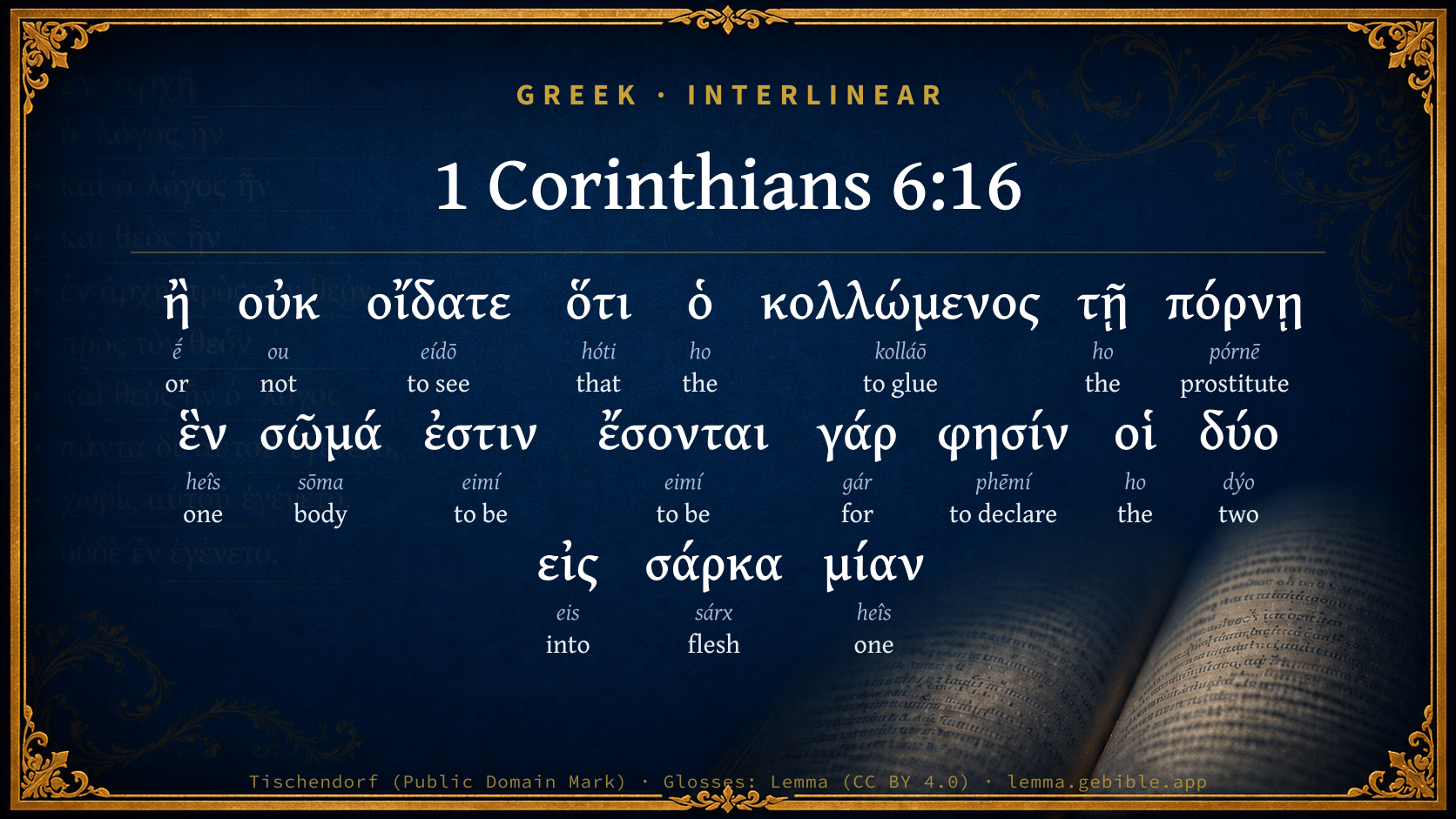
Greek (Tischendorf 8th ed.) 1 Corinthians 6:16 appears in the Greek New Testament. The text above is from the Tischendorf 8th edition. Each word links to its Strong’s number and a concise gloss. Click any word for its full Thayer’s Greek Lexicon entry.
Download image
Cite this verse

1 Corinthians 6:16 (World English Bible). Public Domain. Lemma interlinear Bible study tool, https://lemma.gebible.app/v/1-corinthians/6/16.

Show BibTeX & RIS
BibTeX
RIS
English Translation
Or don't you know that he who is joined to a prostitute is one body? For, "The two," says he, "will become one flesh."
World English Bible · Public Domain
Download a study sheet

One document with this verse’s original text, its word-by-word gloss line, the meaning frame, cross-references with their text, attributed commentary, and full source and license credits — printable, and it pastes into notes with its structure intact.

This verse Autodidact and up

Study sheet (.html) Plain text (.txt)

A passage Seminary Student

Up to 50 verses in one chapter. A passage sheet keeps up to 6 commentary sources and 12 cross-references per verse, in the order this page ranks them, and says so on the sheet whenever that leaves anything out. Ask for a single verse and you get the Autodidact verse sheet above.

Everything on this page stays free to read, with no account — the sheet is a download of what is already on screen, not access to it.

Want to remove ads? Support Godless Engineer
Compare translations 3

The same verse in 3 English versions, stacked beneath the original-language interlinear above. Click any original word for its lexicon entry.

Each is an independent rendering of the whole verse — the interlinear is not word-aligned to these translations.

Highlighted words mark where these versions differ — a whole-verse word diff, not a word-by-word alignment.

  • World English Bible Public Domain
    Or don't you know that he who is joined to a prostitute is one body? For, "The two," says he, "will become one flesh."
  • King James Version Public Domain
    What? know ye not that he which is joined to an harlot is one body? for two, saith he, shall be one flesh.
  • unfoldingWord Literal Text CC BY-SA 4.0
    Or do you not know that the one being joined to the prostitute is one body? For it says, “The two will become as one flesh.”

unfoldingWord Literal Text — © unfoldingWord, licensed CC BY-SA 4.0. Word-aligned USFM3 via Door43 (git.door43.org/unfoldingWord/en_ult).

Versions to compare (up to 4)

3 of 4 selected

Show all 19 translations

Every available English version of this verse, each an independent rendering of the whole verse.

  • World English Bible Public Domain
    Or don't you know that he who is joined to a prostitute is one body? For, "The two," says he, "will become one flesh."
  • Berean Standard Bible Public Domain
    Or don’t you know that he who unites himself with a prostitute is one with her in body? For it is said, “The two will become one flesh.”
  • Majority Standard Bible Public Domain
    Don’t you know that he who unites himself with a prostitute is one with her in body? For it is said, “The two will become one flesh.”
  • King James Version Public Domain
    What? know ye not that he which is joined to an harlot is one body? for two, saith he, shall be one flesh.
  • American Standard Version (1901) Public Domain
    Or know ye not that he that is joined to a harlot is one body? for, The twain, saith he, shall become one flesh.
  • Revised Version (1885) Public Domain
    Or know ye not that he that is joined to a harlot is one body? for, The twain, saith he, shall become one flesh.
  • Geneva Bible (1599) Public Domain
    Doe ye not knowe, that he which coupleth himselfe with an harlot, is one body? for two, sayeth he, shalbe one flesh.
  • Douay-Rheims (1899) Public Domain
    Or know you not, that he who is joined to a harlot, is made one body? For they shall be, saith he, two in one flesh.
  • Young's Literal Translation Public Domain
    have ye not known that he who is joined to the harlot is one body? `for they shall be -- saith He -- the two for one flesh.'
  • Literal Standard Version CC BY-SA 4.0
    Have you not known that he who is joined to the prostitute is one body? For it says, “The two will be into one flesh.”
  • Unlocked Literal Bible CC BY-SA 4.0
    Do you not know that he who is joined to a prostitute becomes one flesh with her? As scripture says, “The two will become one flesh.”
  • unfoldingWord Literal Text CC BY-SA 4.0
    Or do you not know that the one being joined to the prostitute is one body? For it says, “The two will become as one flesh.”
  • Darby Bible Public Domain
    Do ye not know that he [that is] joined to the harlot is one body? for the two, he says, shall be one flesh.
  • World Messianic Bible Public Domain
    Or don’t you know that he who is joined to a prostitute is one body? For, “The two”, he says, “will become one flesh.”
  • Webster's Bible Public Domain
    What? know ye not that he who is joined to a harlot is one body? for two, saith he, shall be one flesh.
  • Free Bible Version CC BY-SA 4.0
    Don't you realize that anyone who has sex with a prostitute becomes “one body” with her? Remember that Scripture says, “The two will become one body.”
  • Bible in Basic English Public Domain
    Or do you not see that he who is joined to a loose woman is one body with her? for God has said, The two of them will become one flesh.
  • Text-Critical English NT CC BY 4.0
    Do you not know that he who is joined to a prostitute is one with her in body? For it says, “The two will become one flesh.”
  • Tyndale New Testament (1534) Public Domain
    Do ye not vnderstonde that he which coupleth him selfe with an harlot is become one body? For two (saith he) shalbe one flesshe.

Literal Standard Version (2020), Covenant Press — licensed CC BY-SA 4.0. Text via the HelloAO Bible API (eBible.org). Unlocked Literal Bible (unfoldingWord) — licensed CC BY-SA 4.0. Text via the HelloAO Bible API (eBible.org). unfoldingWord Literal Text — © unfoldingWord, licensed CC BY-SA 4.0. Word-aligned USFM3 via Door43 (git.door43.org/unfoldingWord/en_ult). Free Bible Version, Dr. Jonathan Gallagher — licensed CC BY-SA 4.0. Text via the HelloAO Bible API (eBible.org).

Word by word

More ways to search: Search by grammar → Find every occurrence → Compare this word →

Practice this passage: Drill this verse → Learn its vocabulary →

κολλώμενος
kolláō
G2853
“to glue”
Verb, Present, Passive, Participle, Nominative, Singular, Masculine
Part of Speech
Verb
Tense
Present
Voice
Passive
Mood
Participle
Case
Nominative
Number
Singular
Gender
Masculine
Full Thayer's Definition

Origin: "from kolla ("glue")"

TDNT: 16:42,5

1. to glue, to glue together, cement, fasten together 2. to join or fasten firmly together 3. to join one's self to, cleave to
  1. ἢ ḗ G2228 “or” Particle
  2. οὐκ ou G3756 “not” Particle, Negative
  3. οἴδατε eídō G1492 “to see” Verb, Perfect, Active, Indicative, 2nd person, Plural
  4. ὅτι hóti G3754 “that” Conjunction
  5. ὁ ho G3588 “the” Article, Nominative, Singular, Masculine
  6. τῇ ho G3588 “the” Article, Dative, Singular, Feminine
  7. πόρνῃ pórnē G4204 “prostitute” Noun, Dative, Singular, Feminine
  8. ἓν heîs G1520 “one” Adjective, Nominative, Singular, Neuter
  9. σῶμά sōma G4983 “body” Noun, Nominative, Singular, Neuter
  10. ἐστιν eimí G1510 “to be” Verb, Present, Active, Indicative, 3rd person, Singular
  11. ἔσονται eimí G1510 “to be” Verb, Future, Middle deponent, Indicative, 3rd person, Plural
  12. γάρ gár G1063 “for” Conjunction
  13. φησίν phēmí G5346 “to declare” Verb, Present, Active, Indicative, 3rd person, Singular
  14. οἱ ho G3588 “the” Article, Nominative, Plural, Masculine
  15. δύο dýo G1417 “two” Adjective, Numeral (indeclinable)
  16. εἰς eis G1519 “into” Preposition
  17. σάρκα sárx G4561 “flesh” Noun, Accusative, Singular, Feminine
  18. μίαν heîs G1520 “one” Adjective, Accusative, Singular, Feminine

About this verse

These counts appear in no published source. They are computed here, from the morphology-tagged text and Lemma’s own curated glosses. What Lemma adds →

19
words
15
distinct lemmas
Pauline Epistles
section

Notable vocabulary

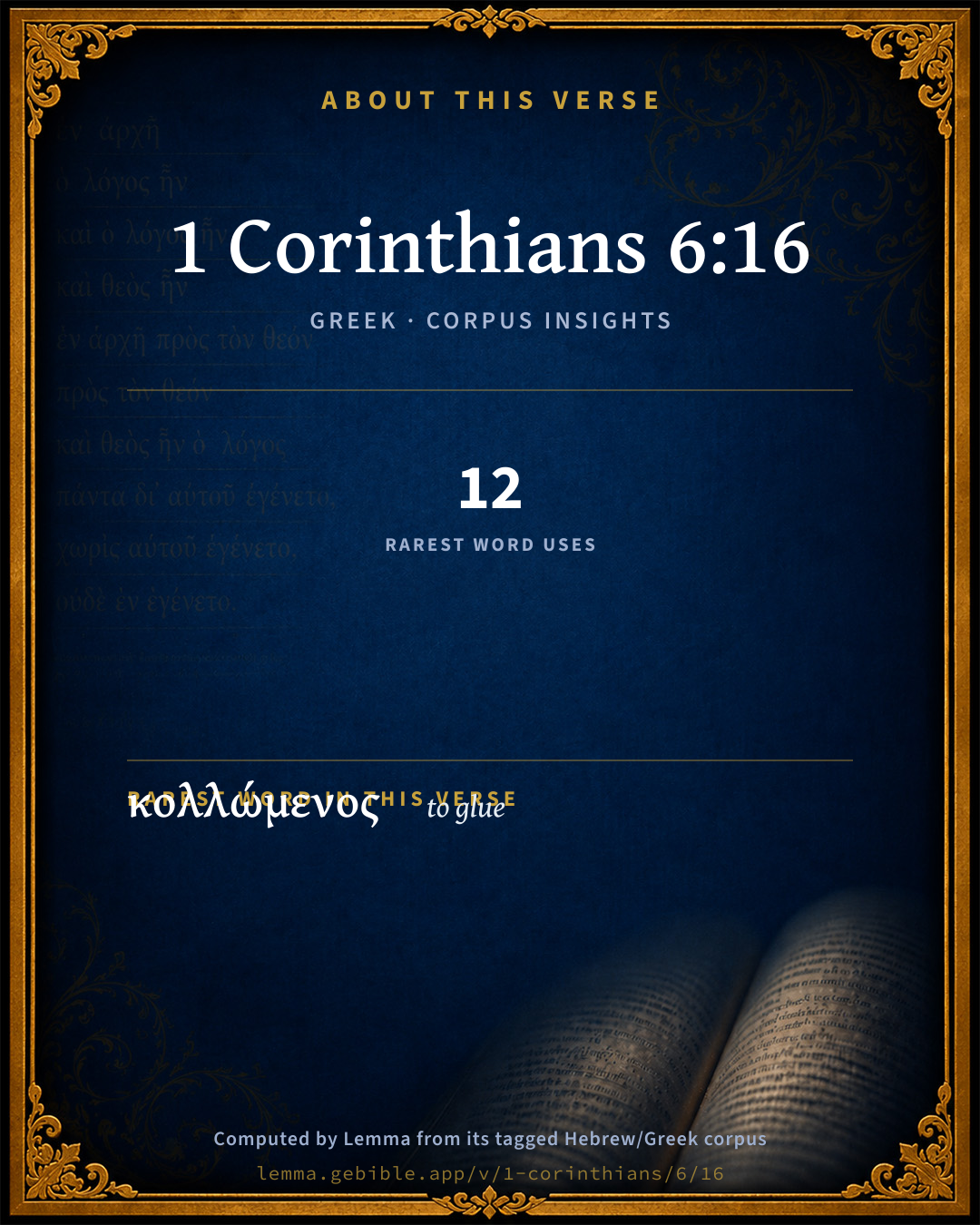
The rarest word here is κολλώμενος to glue G2853 — appearing just 12 times in the whole Greek New Testament.

Shared distinctive vocabulary

κολλώμενος to glue G2853 occurs in 12 verses of the Greek New Testament. Also found in:

Repetition

Words recur within this verse:

Cross-references

10

Topical passages linked to 1 Corinthians 6:16 in the Treasury of Scripture Knowledge — connected by theme and wording, ordered by reader-vote popularity; previews shown in the World English Bible.

  • Genesis 2:24 Therefore a man will leave his father and his mother, and will join with his wife, and they will be one flesh.
  • Ephesians 5:31 "For this cause a man will leave his father and mother, and will be joined to his wife. The two will become one flesh."
  • Mark 10:8 and the two will become one flesh,' so that they are no longer two, but one flesh.
  • Matthew 19:5–6 and said, 'For this cause a man shall leave his father and mother, and shall join to his wife; and the two shall become one flesh?'
  • Matthew 21:31–32 Which of the two did the will of his father?" They said to him, "The first." Jesus said to them, "Most assuredly I tell you that the tax collectors and the prostitutes are entering into the Kingdom of God before you.
  • Genesis 34:31 They said, "Should he deal with our sister as with a prostitute?"
  • Genesis 38:24 It happened about three months later, that it was told Judah, saying, "Tamar, your daughter-in-law, has played the prostitute; and moreover, behold, she is with child by prostitution." Judah said, "Bring her forth, and let her be burnt."
  • Judges 16:1 Samson went to Gaza, and saw there a prostitute, and went in to her.
  • Hebrews 11:31 By faith, Rahab the prostitute, didn't perish with those who were disobedient, having received the spies in peace.
  • Genesis 38:15 When Judah saw her, he thought that she was a prostitute, for she had covered her face.

Cross-references courtesy of OpenBible.info (CC BY 4.0).

Commentary

Notes on 1 Corinthians 6:16 from classic Christian and Jewish commentators (each source and its license shown beneath its notes). The classic Christian expositions comment on the surrounding passage and are grouped to its opening verse, so a note may address several verses; the Jewish commentaries on the Tanakh (Rashi and others) are per-verse, so they appear only where the commentator wrote on this verse.

Lemma curates 59 commentaries, every one of them public domain or Creative Commons licensed, each selected and text-cleaned for this edition rather than reprinted as found. About our sources →

Bengel's Gnomon

Johann Albrecht Bengel

1Co 6:16. Ὁ κολλώμενος τῇ πόρνῃ, he who is joined to a harlot) A syllepsis,[54] i.e. [by this figure, there being mentally understood] the harlot and he who is joined to her; for so the predicate, is one body, appropriately is in accordance [with such a double subject]; and the expression, these two [οἱ δύο], agrees with this view.—ἜΣΟΝΤΑΙ, they shall be) This is said in the first instance of husbands and wives; and, by parity of reasoning, is applied to those, who become one flesh without a conjugal covenant. By covenant the woman becomes the wife of the husband before the husband is joined (carnally) to her; and the reason, why their union is indissoluble, chiefly rests on this circumstance; otherwise even the union of men with harlots would also be indissoluble.

[54] See Appendix.

Bengel's Gnomon of the New Testament — English translation (T&T Clark, Edinburgh, 1860) — public domain. Text from a community e-Sword module.

Meyer's Critical & Exegetical Commentary

Heinrich August Wilhelm Meyer

1Co_6:16. Ἤ οὐκ οἴδατε] Or if this μὴ γένοιτο (conveying, as it does, a negative to that question) still appears to you to admit of doubt, even after the statement of the nature of the case given in 1Co_6:15, then ye must be ignorant that, etc. This ἤ οὐκ οἴδατε cannot correspond with the οὐκ οἴδατε of 1Co_6:15 (Hofmann: either the one or the other they must be ignorant of, etc.), for ὅτι ὁ κολλώμ. κ.τ.λ[986] manifestly refers to the conclusion from the preceding expressed in ἌΡΑς ΟὖΝ, and therefore is subordinated to the question answered shudderingly with ΜῊ ΓΈΝΟΙΤΟ. In 1Co_6:19, too, the Ἤ ΟὐΚ ΟἼΔΑΤΕ refers to what has just before been said.

ΚΟΛΛΏΜ.] who joins himself to (דָּבַק), indicating the union in licentious intercourse. Comp Sir_19:2; Gen_2:24; Ezr_4:20.

Τῇ ΠΌΡΝῌ] the harlot with whom he deals (article).

ἛΝ ΣῶΜΆ ἘΣΤΙΝ] is a single body; previous to the κολλᾶσθαι he and the person concerned were two bodies, but he who is joined to the harlotan united subjectis one body.

ἔσονται γὰρ Κ.Τ.Λ[988]] Gen_2:24 (quoted from the LXX.) speaks, indeed, of wedded, not unwedded, intercourse; but Theodoret rightly points out the paritas rationis: ἓν γὰρ καὶ τοῦτο κἀκεῖνο τῇ φύσει τοῦ πράγματος.

φησίν] Who it is that says it, is self-evident, namely, God; the utterances of the Scripture being His words, even when they may be spoken through another, as Gen_2:24 was through Adam. Comp on Mat_19:5. Similarly Gal_3:16; Eph_4:8; Heb_8:5; 1Co_15:27. Ἡ γραφή, which is what is usually supplied here, would need to be suggested by the context, as in Rom_15:10. Rückert arbitrarily prefers τὸ πνεῦμα.[990]

οἱ δύο] the two in question. The words are wanting in the Hebrew text, but are always quoted with it in the N. T. (Mat_19:5; Mar_10:8; Eph_5:31) after the LXX., and also by the Rabbins (e.g. Beresh. Rabb. 18); an addition of later date in the interests of monogamy, which, although not expressly enjoined in the law, came by degrees to prevail, in accordance with its adumbration from the first in the history of the creation (Ewald, Alterth. p. 260 f.).

εἰς σάρκα μίαν] לְבָשָׂר אֶחַד. See on Mat_19:5.

[986] .τ.λ. καὶ τὰ λοιπά.

[988] .τ.λ. καὶ τὰ λοιπά.

[990] To take it impersonally: it is said, as in 2Co_10:10, according to the well-known usage in the classics, would be without warrant from any other instance of Pauls quotations from Scripture. Comp. Winer, Gr. p. 486 [E. T. 656]; Buttmann, neut. Gr. p. 117 [E. T. 134].

Meyer — Critical and Exegetical Commentary on the New Testament — English translation by Peter Christie, edited by Frederick Crombie (T&T Clark, 1880) — public domain. Text from a community e-Sword module.

Expositor's Greek Testament

ed. W. Robertson Nicoll

1Co 6:16 justifies the strong expression πόρνης μέλη (1Co 6:15 ), implying that the alliance is a kind of incorporation: “Or (if you object to my putting it in this way), do you not know that he who cleaves to the harlot is one body (with her)?” ὁ κολλώμενος (see parls.), qui agglutinatur scorto (Bz [984] ), indicates that sexual union constitutes a permanent bond between the parties. What has been done lives, morally, in both; neither is henceforth free of the other. The Divine sentence (uttered prophetically by Adam) which the Ap. quotes to this effect was pronounced upon the first wedded pair, and holds of every such union, whether lawful or unlawful honourably true (1Co 7:4 , Heb 13:4 ), or shamefully. In Eph 5:31 the same Scripture is cited at length, where the Ap. is making out the correspondence between wedlock and Christ’s union with the Church: in that place the spiritual union is treated as parl [985] to the natural union, where this follows the Divine order; here it stands out as prohibitory to a natural union which violates that order. Here only Paul uses the parenthetical φησίν (“says He,” sc. God ) in citing Scripture; it is common in Philo, and in the Ep. of Barnabas. ἔσονται … εἰς (Hebraism) = γενήσονται .

[984] Beza’s Nov. Testamentum: Interpretatio et Annotationes (Cantab., 1642).

[985] parallel.

The Expositor's Greek Testament, edited by W. Robertson Nicoll (1897–1910) — public domain. Text from a community e-Sword module.

Godet's Commentaries

Frédéric Louis Godet

Vv. 16, 17. “Or know ye not that he which is joined to an harlot is one body [with her]; for the two, it is said, shall be one flesh. 17. And he that is joined unto the Lord is one spirit [with Him].”

The ἤ, or, is certainly authentic; as always it signifies, “Or indeed, if you deny what I have just said, are you then ignorant that...?” The proof of the truth of the expression used (members of an harlot) is given by means of the Biblical words, Gen 2:24. Are these words in the narrative of Genesis the continuation of Adam’s discourse, or a remark added by the author himself, as happens in several other cases (Gen 10:9; Gen 15:6; Gen 32:32; see Hofmann)? It matters little; for the declaration can have value in the eyes of the sacred historian only in so far as it is the expression of a Divine truth.

The reg. with her is omitted in Greek after the word one body. This ellipsis arises from the fact that the nominative ὁ κολλώμενος and the dative τῇ πόρνῃ are morally regarded as forming one and the same logical subject of the proposition. The words οἱ δύο, the two, were added to the original text by the LXX., whom St. Paul here follows.

The subject of the verb φησίν, says he, may be either Adam, or Moses, or Scripture, or God Himself; or finally, as is shown by Heinrici, the verb may be a simple formula of quotation like our: It is said. This form is frequently found in Philo. — The expression one flesh finds its confirmation in the extraordinary fact that from this union there may proceed a new personality. Therein is contained, for the reflecting mind, the undeniable proof of the profoundly mysterious character of such a union; it appears like the continuation of the creative act.

Vv. 17 is not, as has sometimes been thought, foreign to the argument as a whole. As 1Co 6:16 justifies by a Biblical quotation the strong expression of 1Co 6:15 : “Shall I make them the members of an harlot?” so 1Co 6:17, framed as it were on the words of Genesis, justifies the equally strong expression of 1Co 6:15 : “Taking the members of Christ;” comp. 1Co 15:45.

We again find here the ellipsis of 1Co 6:16; the “with Him” is understood after the words one spirit, as if to say that the believer’s union with Christ culminates in the existence of one and the same spirit, and consequently in the possession and direction by Christ of the believer’s whole person, soul and body.

According to Holsten (p. 466 seq.), the assimilation of these two unions is so untenable logically, that 1Co 6:15-17 can only be an ancient gloss intended to remove the obscurity of 1Co 6:13. I think it is better to seek to penetrate the depth of the apostolic thought than arbitrarily to recompose the text according to our own ideas.

Under the sway of this holy view (1Co 6:17), the apostle, at the thought of the crime of fornication, utters, as it were, a cry of horror (1Co 6:18 a); then he finishes his demonstration.

Frédéric Louis Godet — Commentaries on Luke, John, Romans, and 1 Corinthians — English translation (T&T Clark, Edinburgh, 1870s–1890s) — public domain. Text from a community e-Sword module.

Hodge's Commentary on Romans, Ephesians & First Corinthians

Charles Hodge

1Co_6:15, 1Co_6:16

Know ye not that your bodies are the members of Christ? shall I then take the members of Christ, and make (them) the members of an harlot? God forbid. What! know ye not that he which is joined to an harlot is one body? for two, saith he, shall be one flesh.

The design of these verses is to establish two points. First, that the relation between our bodies and Christ is of the intimate and vital character which had just been stated. And second, that the sin in question was inconsistent with that relation, and incompatible with it.

Know ye not that your bodies are the members of Christ? This is a conceded and familiar point of Christian doctrine, one with which they were supposed to be acquainted; and which proved all that the Apostle had said of the relation between the body and Christ. Our bodies are the members of Christ, because they belong to him, being included in the redemption effected by his blood; and also because they are so united to him as to be partakers of his life. It is one of the prominent doctrines of the Bible that the union between Christ and his people includes a community of life; and it is clearly taught that this life pertains to the body as well as to the soul, Rom_8:6-11; Eph_2:6, Eph_2:7; Eph_5:30. This is the truth which the Apostle recalls to the minds of the Corinthians and makes it the ground of his indignant condemnation of the sin of which he is speaking. That fornication is incompatible with the relation of the bodies of believers to Christ, arises out of the peculiar nature of that sin. The parties to it become partakers of a common life. Whether we can understand this or not, it is the doctrine of the Bible. Therefore as we cannot be partakers of the life of Christ, and of the life of Belial, so neither can our bodies be the members of Christ, and at the same time have a common life with one who is a sinner, in the scriptural sense of that phrase.

Charles Hodge — Commentary on Romans (1835), First Corinthians (1857), and Ephesians (1856) — public domain. Text from a community e-Sword module.

Geneva Bible (1599)

Geneva Bible translators

Moses doth not speak these words of fornication, but of marriage: but seeing that fornication is the corrupting of marriage, and both of them is a carnal and fleshly copulation, we cannot say that the Apostle abuseth his testimony. Again, Moses hath not this word (Two) but it is very well expresseth both here and in Matt. 29:5, because he speaketh only but of man and wife: whereupon the opinion of them that vouch it to be lawful to have many wives, is beaten down: for he that companieth with many, is sundered as it were into many parts.

A proof of the same argument: a harlot and Christ are clean contrary, so are the flesh and the Spirit: therefore he that is one with an harlot (which is done by carnal copulation of their bodies) cannot be one with Christ, which unity is pure and spiritual.

Geneva Bible (1599) marginal notes — public domain. Text via Bolls.life.

Jamieson, Fausset & Brown

Robert Jamieson, A. R. Fausset & David Brown

Justification of his having called fornicators "members of an harlot" (Co1 6:15).

joined--by carnal intercourse; literally, "cemented to": cleaving to.

one body--with her.

saith he--God speaking by Adam (Gen 2:24; Mat 19:5). "He which made them at the beginning said," &c. (Eph 5:31).

Jamieson, Fausset & Brown — Commentary Critical and Explanatory on the Whole Bible (1871) — public domain (CC PDM 1.0). Text via the HelloAO Bible API.

Adam Clarke's Commentary

Verse 16. He that is joined to a harlot is one body] In Sohar Genes., fol. 19, we have these remarkable words: Whosoever connects himself with another man's wife, does in effect renounce the holy blessed God, and the Church of the Israelites.

Adam Clarke's Commentary on the Bible (1810–1826) — public domain. Text from a community e-Sword/MySword module.

John Calvin's Commentaries

16. Know ye not that he that is joined to an harlot He brings out more fully the greatness of the injury that is done to Christ by the man that has intercourse with an harlot; for he becomes one body, and hence he tears away a member from Christ’s body. It is not certain in what sense he accommodates to his design the quotation which he subjoins from Genesis 2:24. For if he quotes it to prove that two persons who commit fornication together become one flesh, he turns it aside from its true meaning to what is quite foreign to it. For Moses speaks there not of a base and prohibited cohabitation of a man and a woman, but of the marriage connection which God blesses. For he shows that that bond is so close and indissoluble, that it surpasses the relationship which subsists between a father and a son, which, assuredly, can have no reference to fornication. This consideration has led me sometimes to think, that this quotation is not brought forward to confirm the immediately preceding statement, but one that is more remote, in this way — “Moses says, that by the marriage connection husband and wife become one flesh, but he that is jointed to the Lord becomes not merely one flesh, but one spirit with him.” And in this way the whole of this passage would tend to magnify the efficacy and dignity of the spiritual marriage which subsists between us and Christ.

If, however, any one does not altogether approve of this exposition, as being rather forced, I shall bring forward another. For as fornication is the corruption of a divine institution, it has some resemblance to it; and what is affirmed respecting the former, may to some extent be applied to the latter; not that it may be honored with the praises due to the former, but for the purpose of expressing the more fully the heinousness of the sin. The expression, therefore, that they two become one flesh, is applicable in the true and proper sense to married persons only; but it is applied to fornicators, who are joined in a polluted and impure fellowship, meaning that contagion passes from the one to the other. For there is no absurdity in saying that fornication bears some resemblance to the sacred connection of marriage, as being a corruption of it, as I have said; but the former has a curse upon it, and the other a blessing. Such is the correspondence between things that are contrasted in an antithesis. At the same time, I would prefer to understand it, in the first instance, of marriage, and then, in an improper sense, of fornication, in this way — “God pronounces husband and wife to be one flesh, in order that neither of them may have connection with another flesh; so that the adulterer and adulteress do, also, become one flesh, and involve themselves in an accursed connection. And certainly this is more simple, and agrees better with the context.

John Calvin's Commentaries (1540-1563) — public domain. Text from the Calvin Translation Society English edition (1840s-50s) via the Christian Classics Ethereal Library (ccel.org). Calvin's coverage is partial (roughly two-thirds of the Bible); uncommented books and verses are honest gaps, never fabricated. The 19th-century editor's footnotes and remarks are omitted so the notes are faithfully Calvin's own voice.

Ellicott's Commentary for English Readers

(16) What?—As if some one might question and resent the strength of the previous words, and wish them “watered down.” “Do you not know that my strong assertion is true? It is not merely my statement; it is to be found in the Old Testament, ‘Two shall be one flesh.’” This was originally (Gen_2:24) applied to marriage, as showing the intimacy of that sacred union, but here St. Paul applies it to one aspect of a union which, in one respect, was identical with marriage. Of course the other parts of the Apostle’s argument do not apply to marriage, the union being a sacred one; two becoming one flesh in marriage is no degradation of a member of Christ—nay, it is a sacred illustration of the complete unity of Christ and His body the Church. (Comp. 1Co_11:29, and Notes there.)

A Bible Commentary for English Readers, edited by Charles John Ellicott (1878–1897) — public domain. Text from a community e-Sword module.

The Cambridge Bible for Schools and Colleges

gen. ed. J. J. S. Perowne

16. for two, saith he, shall be one flesh] No words could more plainly shew than these and the preceding, what a monstrous perversion the sin here mentioned is of the mysterious union between the sexes sanctified by God in Holy Matrimony. No words could more strongly imply than those which follow, that he who is ‘joined to a harlot’ thereby separates himself from the Lord.

The Cambridge Bible for Schools and Colleges (gen. ed. J. J. S. Perowne; Cambridge University Press, 1878–1918) — public domain. Text from a community e-Sword module.

John Gill's Exposition

What? know ye not that he which is joined to an harlot,.... Not in marriage, but in carnal copulation, and unclean embraces, is one body with her

for two ("saith he", Adam, or Moses, or God, or the Scripture, or as R. Sol. Jarchi says, the Holy Spirit, Gen 2:24)

shall be one flesh; what is originally said of copulation in lawful marriage, in which man and wife, legally coupled together, become one flesh, is applied to the unlawful copulation of a man with an harlot, by which act they also become one body, one flesh; and which is made use of by the apostle, to deter the members of Christ from the commission of this sin, which makes a member of Christ one body and flesh with an harlot, than which nothing is more monstrous and detestable. The apostle here directs to the true sense of the phrase in Genesis, "and they shall be one flesh"; that is, man and wife shall only have carnal knowledge of, and copulation with each other. Some Jewish (k) writers interpret this phrase, "on account of the foetus", which is formed by the means of them both, and which becomes "their one flesh": others (l), thus as if they were, or because they are, like as if they were one flesh; but others (m), in more agreement with the apostle, think that this has respect , "to that conjunction", by which the fixing of the species is completed; and others (n) expressly thus, "they two shall be one flesh", , "that is, in the place where both of them make one flesh": which is equally done by unlawful copulation with an harlot, as with a man's own wife.

(k) Tzeror Hammor, fol. 6. 3. Jarchi in Gen. ii. 24. (l) Aben Ezra in ib. (m) R. Levi ben Gersom in ib. (n) Bereshit Rabba, sect. 18. fol. 15. 3. T. Hieros. Kiddushin, fol. 58. 3.

John Gill's Exposition of the Whole Bible (1746–1763) — public domain (CC PDM 1.0). Text via the HelloAO Bible API.

Trapp's Complete Commentary

John Trapp

16 What? know ye not that he which is joined to an harlot is one body? for two, saith he, shall be one flesh.

Ver. 16. Is one body] By a most strict but vicious and infamous bond (saith an interpreter), which is sufficient to untie or break any other bond, though lawful and holy, either corporal or spiritual.

John Trapp, A Commentary or Exposition upon All the Books of the Old and New Testament (1647–1656) — public domain. Text from a community e-Sword module.

Matthew Poole's English Annotations

The conjunction of the husband and wife, mentioned Gen 2:24, and the conjunction of the fornicator and the harlot, differ not as to the species of the act, only as to the morality of it; the former is an honest and lawful act, the other a dishonest and filthy act. So that he that is wickedly joined to a harlot, maketh himself one flesh with her with whom he committeth that folly and lewdness, and he must needs by it separate his body from its membership with Christ, whose holiness will admit no such union.

Matthew Poole's English Annotations on the Holy Bible (1683–1685) — public domain. Text from a community e-Sword/MySword module.

Whedon's Commentary on the Bible

Daniel D. Whedon

16. One body—He holds the transient union to be, as it were, a brief Satanic marriage, in which the whole being of the guilty pair is lawlessly identified, and the members of each are members of both.

Saith he—Saith God. St. Paul quotes words originally applied to holy marriage.

Daniel D. Whedon (gen. ed.), Commentary on the Old and New Testaments (1874–1909) — public domain. Text from a community e-Sword module.

The Pulpit Commentary

What, know ye not, etc.? The clause is used to explain and justify the strong expression which he had used in the previous verse. It involves an argument against the sin which is the most original and impressive which could have been used. To this passage especially is due the tone taken by Christians as to these sins, which differed so totally from that taken by heathen. They two. The words do not occur in Gen_2:24, but are always so quoted in the New Testament (Mat_19:5; Mar_10:8; Eph_5:31) Saith he. This is a vague Jewish formula of quotation, adopted to avoid the needless introduction of the sacred Name. "He" is "God" in Scripture. Shall be one flesh; rather, shall become. This appeal to Gen_2:24 (Mat_19:5) is equivalent to the rule that no intercourse between the sexes is free from sin except under the sanction of marriage.

The Pulpit Commentary (1880–1919), ed. H.D.M. Spence-Jones & Joseph S. Exell — public domain. Text from a community e-Sword module.

John Wesley's Explanatory Notes

Gen. ii, 24.

John Wesley, Explanatory Notes Upon the Whole Bible (1754–1765) — public domain. Text via the GEBible commentary corpus.

Burkitt's Expository Notes on the New Testament

William Burkitt

The sense is, "That as wedlock makes man and wife one body lawfully, so fornication makes the man and the harlot one body sinfully; all the difference is in the morality of the act, but the species or kind of act is the same: thus the fornicator and the harlot are one flesh; but he that is joined to the Lord, namely, by faith and love, hath a nearer and more noble union than that of flesh, for he is one spirit with Christ; not essentially and substantially one, but mystically and spiritually. Christ and the sincere believer are led and guided, actuated and influenced, by the same Spirit; therefore take heed what you do, for in making your bodies the members of an harlot, you dissolve the union betwixt Christ and them.

Learn from hence, How closely and intimately believers are united unto Jesus Christ: they are nearer than one flesh; they are one spirit with him, they have both one Father, one house, one home, one heart, one interest, one acquaintance. Happy they who are thus joined to the Lord, for they are one spirit.

William Burkitt's Expository Notes on the New Testament (1700–1703) — public domain. Text from a community e-Sword module.

McGarvey & Pendleton's Commentaries

J. W. McGarvey

Or know ye not that he that is joined to a harlot is one body? [as if in Satanic marriage] for, The twain, saith he [ Gen_2:24 ; Mat_19:5 ; Eph_5:31 ], shall become one flesh .

J. W. McGarvey (with Philip Y. Pendleton), Commentaries on the New Testament (The Fourfold Gospel, 1914; Acts; and the epistles) — public domain. Text from a community e-Sword/MySword module.

unfoldingWord translationNotes

Door43 World Missions Community

Do you not know that ... her?

Paul begins to teach the Corinthians by emphasizing a truth that they already know. "I want to remind you that ... her." (See: Rhetorical Question)

he who is joined to a prostitute becomes one flesh with her

This can also be stated in active form. AT: "when a man joins his body to the body of a prostitute, it is as if their bodies become one body" (See: Active or Passive)

he who is joined to the Lord becomes one spirit with him

This can also be stated in active form. AT: "when the Lord joins his spirit to the spirit of a person, it is as if their spirits become one spirit" (See: Active or Passive)

translationWords

know

prostitute

flesh

word of God

lord

spirit

unfoldingWord translationNotes — © Distant Shores Media and the Door43 World Missions Community, licensed CC BY-SA 4.0. Source: git.door43.org/Door43/en_tn.

Cambridge Greek Testament for Schools and Colleges

16. ἢ οὐκ οἴδατε. Not what? as in A.V. Rather, ‘Or do ye not know,’ introducing a fresh consideration to that in the last verse.

εἰς σάρκα μίαν. No words could more plainly shew than these and the words of the last verse, what a monstrous perversion the sin here mentioned is of the mysterious union between the sexes sanctified by God in Holy Matrimony. No words could more strongly imply than those which follow, that he who is ‘joined to a harlot’ thereby separates himself from the Lord.

Cambridge Greek Testament for Schools and Colleges (Cambridge University Press, 1896; 21 vols, various authors incl. Carr, Maclear, Plummer, Farrar, Lumby, Moule, M. R. James, Simcox) — public domain. Text from a community e-Sword module.

Alford’s Greek Testament

Henry Alford

16.] Explanation and justification of the expression πόρνης μέλη. ἤ, as De Wette well, “Do you think the expression ποιήσω πόρν. μέλη too strong?”

κολλ. “ublicher Vusdrud fur Geschlechtsvereinigung.” De Wette.

τῇ πόρνῃ] with a harlot, generic: or which in fact amounts to the same, with ‘the harlot,’ presupposed in the hypothesis.

ἓν σῶμα, viz. ‘with her.’ The full construction would be ὅτι ὁ κολλ. τῇ πόρ. καὶ ἡ πόρ. ἓν σ. εἰσιν, but he is here bringing out the criminality of the fornicator, and leaves the other out of view.

The citation is spoken of marriage; but here as above (see on ver. 13) he is treating merely of the physical act, which is the same in both cases.

φησιν, viz. God, Who is the speaker in the Scriptures: so in citing the same words, our Lord gives them to ὁ ποιήσας (αὐτοὺς) ἀπʼ ἀρχῆς, Mat 19:5. They were spoken by the mouth of Adam, but prophetically, divino afflatu. To render φησιν impersonal, ‘it says,’ ‘heißt es,’ though justified by classical usage, see Winer, edn. 6, § 58. 9, would, as Meyer remarks, be altogether without precedent in the citations of Paul. The words οἱ δύο are not in the Heb., but in the LXX and the Samaritan Pentateuch, and are found in the Rabbinical citations of the passage. See note on Mat 19:5.

Henry Alford, The Greek Testament (1849–1861) — public domain. Text from a community e-Sword module.

International Critical Commentary

16. ἢ οὐκ οἴδατε. Again (v. 2 we have this reproachful question. The Apostle proceeds to corroborate the ποιήσω πόρνης μέλη of v. 15.

ὁ κολλώμενος. The word may come from προσκολλᾶσθαι in Gen 2:24, as in Eph 5:31, or possibly from Ecclus. 19:2, ὁ κολλώμενος πόπναις τολμηρότερος ἔσται. Both the simple and the compound verb are frequent in LXX; in N.T. the compound is very rare. In both, only the passive, with reflective sense, is found. In N.T. the usual construction is the simple dat., as here. In LXX the constr. varies greatly, and there (2Ki 18:6; cf. Ecclus. 2:3) we have κολλᾶσθαι τῷ Κυρίῳ, as here, to express loyal and permanent adherence, resulting in complete spiritual union. This is placed in marked contrast to the temporary physical union which is so monstrous. The verb is frequent in Ep. Barnabas (ix. 9, x. 11, xix. 2, 6, xx. 2).

ἔσονται γάρ, φησίν, οἱ δύο εἰς ς. υ. The subject to be understood with φησίν must always depend upon the context. The word may introduce the objection of an opponent (2Co 10:10). In Heb 8:5 we must understand ‘God.’ Here we may do the same, or (what amounts to the same) supply ἡ γραφή. The εἴπῃ in 15:27, and the λέγει in 2Co 6:2, and Gal 3:16, and Eph 4:8, are similar. In each case there is divine authority for the statement. The quotation is direct from the LXX, which has οἱ δύο, as in Mat 9:5; Mar 10:8; Eph 5:31, although it is not in the original. For εἶναι εἰς = γίνεσθαι there is perhaps no exact parallel in N.T., although the expression is frequent; 14:22; 2Co 6:18; Eph 1:12; Heb 1:5, Heb 1:8:10; etc. In most of these cases εἰς may mean ‘to serve as.’ It is manifest that here no distinction is to be drawn between σῶμα and σάρξ.

International Critical Commentary — older volumes (1896–1929), various authors — public domain. Text from a community e-Sword module.

Vincent's Word Studies in the New Testament

Marvin R. Vincent

He that is joined [ο κολλωμενος] . See on Luk 14:15. Compare Aeschylus : "The family has been glued [κεκολληται] to misfortune" (" Agamemnon, " 1543). The verb is used Gen 2:24, Sept., of the relation of husband and wife : shall cleave. In Deu 10:20; Deu 11:22; Jer 13:11, of man's cleaving to God.

To a harlot [τη πορνη] . Lit., the harlot. The article is significant : his harlot, or that one with whom he is sinning at the time.

Shall be one flesh [εσονται εις σαρκα μιαν] . Lit., shall be unto one flesh : i e., from being two, shall pass into one. Hence Rev., rightly, shall become. Compare Eph 2:15.

Marvin R. Vincent, Word Studies in the New Testament (1887–1900) — public domain. Text from a community e-Sword/MySword module.

Lesson kit

Teaching starters — assembled from the data on this page, not authored interpretation. Every prompt links to the verse data it draws on. Edit before teaching.

1 Corinthians, in the Pauline Epistles, opens this verse with 19 words (15 distinct Greek lemmas). Its most distinctive word is kolláō (“to glue”). A historical commentator’s framing appears above. Read the whole chapter for the surrounding context.

Discussion questions

  1. The word kolláō carries the sense “to glue.” How does it shape the verse?
  2. Matthew 19:5 shares the word «to glue» with this verse. How do the two illuminate each other?
  3. “one” occurs 2× in this one verse. What is the effect of the repetition?
  4. These translations render this verse differently; the difference is in the English rendering, not the original. What questions does that raise?
  5. Reading how Bengel's Gnomon and Meyer's Critical & Exegetical Commentary read this verse, where do the two commentators agree and where do they part?

Things to notice

Reading settings

Reading text

Shown beneath each verse's original-language words.

Old Testament
Old Testament edition

Read the OT as the Masoretic Hebrew (MT) or the Greek Septuagint (LXX).

English shown for the Greek Septuagint (in the Hebrew ↔ Greek comparison).

Comparing translations? Open the Compare panel on any verse page to stack up to four side by side.