
Leviticus 13:38

Hebrew (Westminster Leningrad Codex) Leviticus 13:38 appears in the Hebrew Old Testament. The text above is from the Westminster Leningrad Codex. Each word links to its Strong’s number, a concise gloss, and parsing drawn from the Open Scriptures Hebrew Bible morphology. Click any word for its full Brown-Driver-Briggs (BDB) entry.
Download image
Cite this verse

Leviticus 13:38 (World English Bible). Public Domain. Lemma interlinear Bible study tool, https://lemma.gebible.app/v/leviticus/13/38.

Show BibTeX & RIS
BibTeX
RIS
English Translation
"When a man or a woman has bright spots in the skin of the body, even white bright spots;
World English Bible · Public Domain
Download a study sheet

One document with this verse’s original text, its word-by-word gloss line, the meaning frame, cross-references with their text, attributed commentary, and full source and license credits — printable, and it pastes into notes with its structure intact.

This verse Autodidact and up

Study sheet (.html) Plain text (.txt)

A passage Seminary Student

Up to 50 verses in one chapter. A passage sheet keeps up to 6 commentary sources and 12 cross-references per verse, in the order this page ranks them, and says so on the sheet whenever that leaves anything out. Ask for a single verse and you get the Autodidact verse sheet above.

Everything on this page stays free to read, with no account — the sheet is a download of what is already on screen, not access to it.

Want to remove ads? Support Godless Engineer
Compare translations 3

The same verse in 3 English versions, stacked beneath the original-language interlinear above. Click any original word for its lexicon entry.

Each is an independent rendering of the whole verse — the interlinear is not word-aligned to these translations.

Highlighted words mark where these versions differ — a whole-verse word diff, not a word-by-word alignment.

  • World English Bible Public Domain
    "When a man or a woman has bright spots in the skin of the body, even white bright spots;
  • King James Version Public Domain
    If a man also or a woman have in the skin of their flesh bright spots, even white bright spots;
  • unfoldingWord Literal Text CC BY-SA 4.0
    And a man or a woman, when he has on the skin of their flesh bright spots, white bright spots,

unfoldingWord Literal Text — © unfoldingWord, licensed CC BY-SA 4.0. Word-aligned USFM3 via Door43 (git.door43.org/unfoldingWord/en_ult).

Versions to compare (up to 4)

3 of 4 selected

Show all 18 translations

Every available English version of this verse, each an independent rendering of the whole verse.

  • World English Bible Public Domain
    "When a man or a woman has bright spots in the skin of the body, even white bright spots;
  • Berean Standard Bible Public Domain
    When a man or a woman has white spots on the skin,
  • Majority Standard Bible Public Domain
    When a man or a woman has white spots on the skin,
  • King James Version Public Domain
    If a man also or a woman have in the skin of their flesh bright spots, even white bright spots;
  • American Standard Version (1901) Public Domain
    And when a man or a woman hath in the skin of the flesh bright spots, even white bright spots;
  • Revised Version (1885) Public Domain
    And when a man or a woman hath in the skin of their flesh bright spots, even white bright spots;
  • Geneva Bible (1599) Public Domain
    Furthermore if there bee many white spots in the skin of the flesh of man or woman,
  • Douay-Rheims (1899) Public Domain
    If a whiteness appear in the skin of a man or a woman,
  • Young's Literal Translation Public Domain
    `And when a man or woman hath in the skin of their flesh bright spots, white bright spots,
  • Literal Standard Version CC BY-SA 4.0
    And when a man or woman has bright spots in the skin of their flesh, white bright spots,
  • Unlocked Literal Bible CC BY-SA 4.0
    If a man or a woman has white spots on the skin,
  • unfoldingWord Literal Text CC BY-SA 4.0
    And a man or a woman, when he has on the skin of their flesh bright spots, white bright spots,
  • Darby Bible Public Domain
    And if a man or a woman have in the skin of their flesh bright spots, white bright spots,
  • World Messianic Bible Public Domain
    “When a man or a woman has bright spots in the skin of the body, even white bright spots,
  • Webster's Bible Public Domain
    If a man also or a woman shall have in the skin of their flesh bright spots, even white bright spots;
  • Free Bible Version CC BY-SA 4.0
    If someone, man or woman, has white spots on the skin,
  • Bible in Basic English Public Domain
    And if a man or a woman has bright marks on the skin of their flesh, that is, bright white marks,
  • JPS Tanakh (1917) Public Domain
    And if a man or a woman have in the skin of their flesh bright spots, even white bright spots;

Literal Standard Version (2020), Covenant Press — licensed CC BY-SA 4.0. Text via the HelloAO Bible API (eBible.org). Unlocked Literal Bible (unfoldingWord) — licensed CC BY-SA 4.0. Text via the HelloAO Bible API (eBible.org). unfoldingWord Literal Text — © unfoldingWord, licensed CC BY-SA 4.0. Word-aligned USFM3 via Door43 (git.door43.org/unfoldingWord/en_ult). Free Bible Version, Dr. Jonathan Gallagher — licensed CC BY-SA 4.0. Text via the HelloAO Bible API (eBible.org).

Word by word

More ways to search: Search by grammar → Find every occurrence → Compare this word →

Practice this passage: Drill this verse → Learn its vocabulary →

בֶּהָרֹ֑ת
bôhereth
H934
“white patches”
Noun, Common, Feminine, Plural, Absolute
Part of Speech
Noun
Type
Common
Gender
Feminine
Number
Plural
State
Absolute
Full BDB Definition

Origin: active participle of the same as H925

TWOT: 211a

white patch of skin, brightness, bright spot (on skin) - (CLBL) bright spot, scar, blister, boil - resulting from fire - resulting from inflammation of the skin - possible sign of leprosy
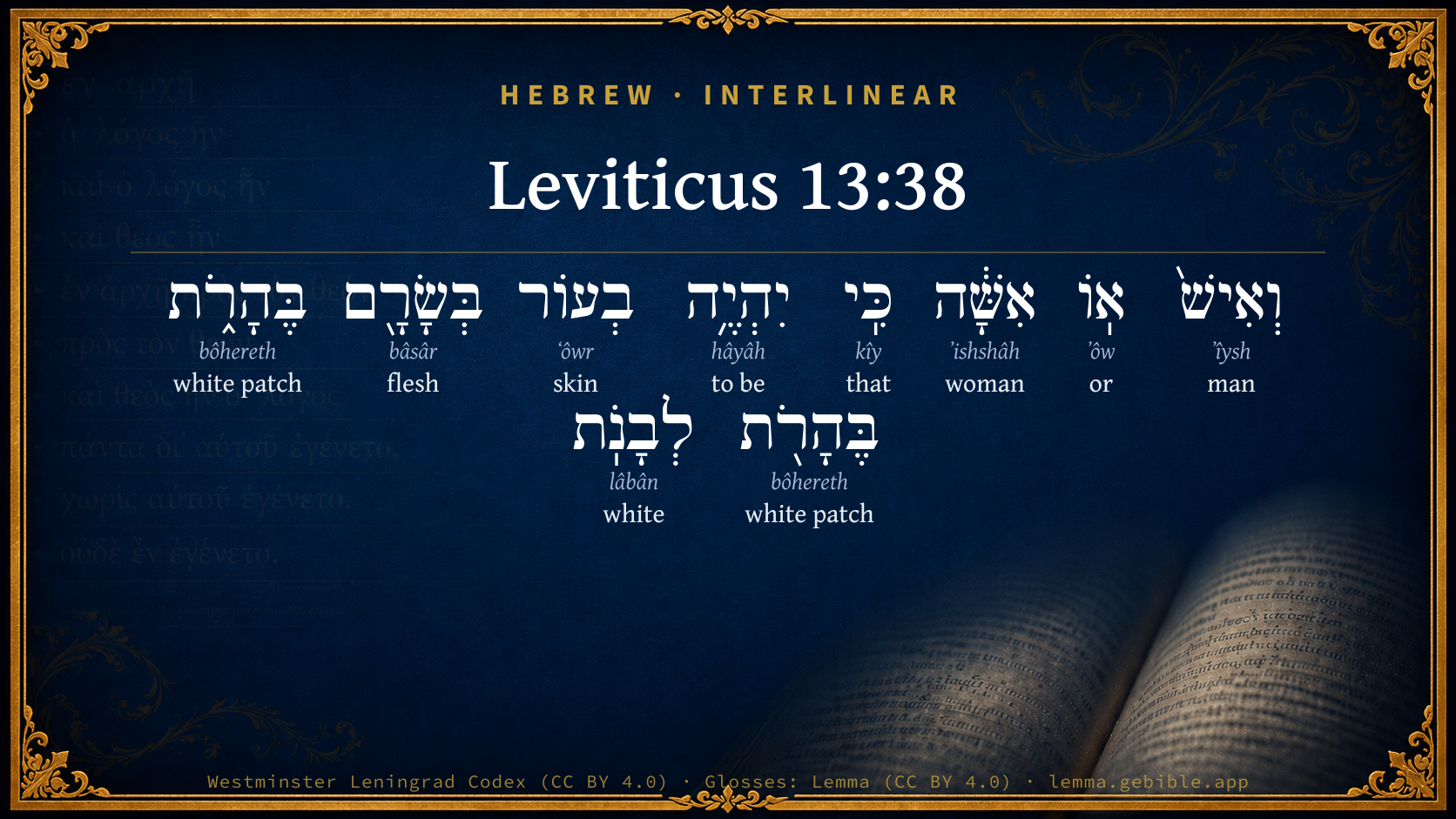
  1. וְאִישׁ֙ ʼîysh H376 “and · man” Conjunction + Noun, Common, Masculine, Singular, Absolute
  2. אֽוֹ ʼôw H176 “or” Conjunction
  3. אִשָּׁ֔ה ʼishshâh H802 “woman” Noun, Common, Feminine, Singular, Absolute
  4. כִּֽי kîy H3588 “that” Conjunction
  5. יִהְיֶ֥ה hâyâh H1961 “to be” Verb, Qal, Imperfect, 3rd Person, Masculine, Singular
  6. בְעוֹר ʻôwr H5785 “in/at · skin of” Preposition + Noun, Common, Masculine, Singular, Construct
  7. בְּשָׂרָ֖ם bâsâr H1320 “flesh · their” Noun, Common, Masculine, Singular, Construct + Suffix, Personal, 3rd Person, Masculine, Plural
  8. בֶּהָרֹ֖ת bôhereth H934 “white patches” Noun, Common, Feminine, Plural, Absolute
  9. לְבָנֹֽת lâbân H3836 “white” Adjective, Adjective, Feminine, Plural, Absolute

About this verse

These counts appear in no published source. They are computed here, from the morphology-tagged text and Lemma’s own curated glosses. What Lemma adds →

10
words
9
distinct lemmas
Pentateuch
section

Notable vocabulary

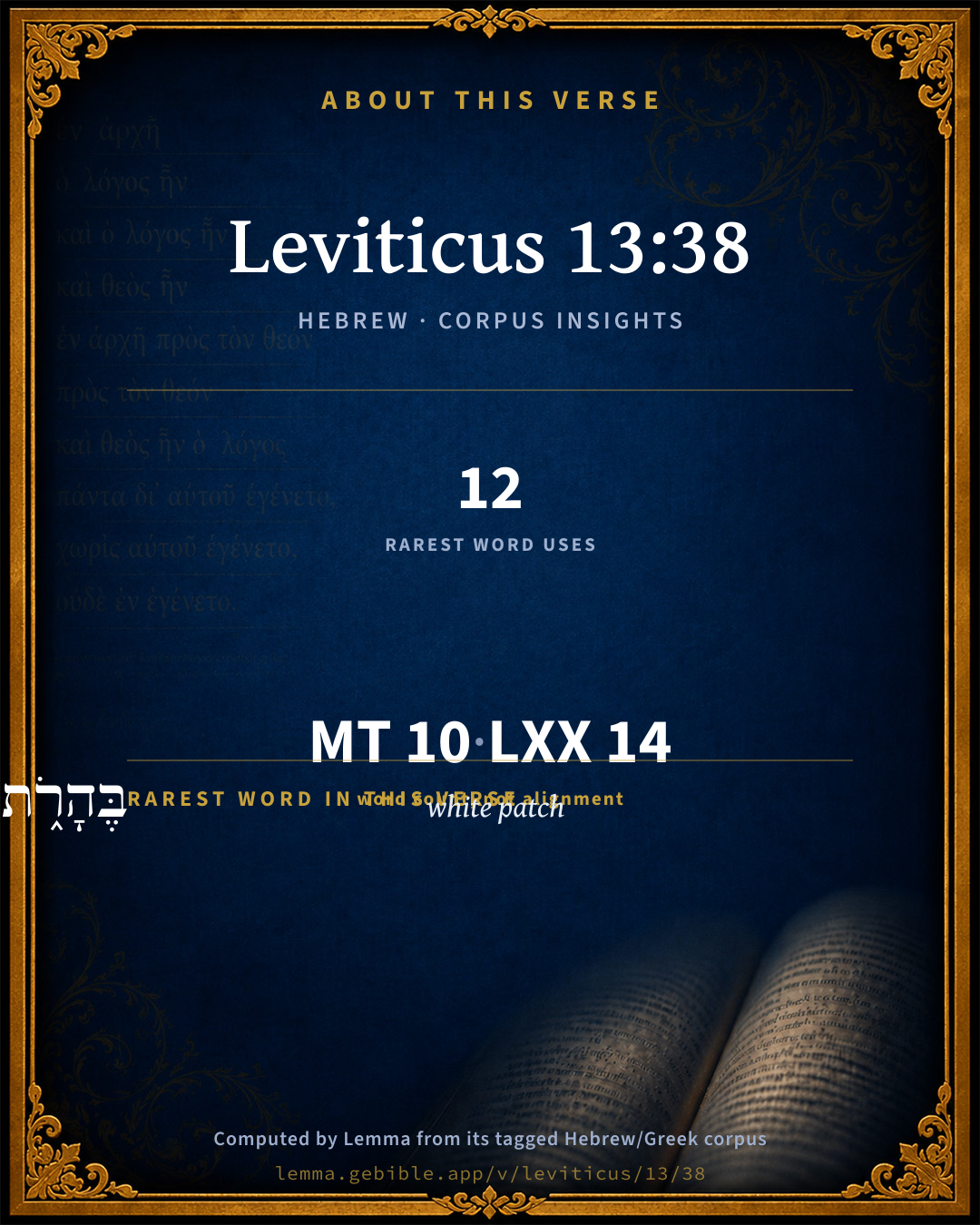
The rarest word here is בֶּהָרֹ֑ת white patch H934 — appearing just 12 times in the whole Hebrew Bible.

Shared distinctive vocabulary

בֶּהָרֹ֑ת white patch H934 occurs in 11 verses of the Hebrew Bible. Also found in:

Grammatical profile

  • 1 verb
  • 6 nouns
  • 1 adjective
  • 2 conjunctions

Verb forms

  • יִהְיֶ֥ה Qal · Imperfect

Repetition

A word recurs within this verse — often emphatic in Hebrew:

  • בֶּהָרֹ֑ת white patch H934 ×2

Hebrew & Septuagint length

In English translation the verse runs 19 words from the Hebrew and 19 from the Septuagint (LXX English) — the same length.

A rough comparison of the two English renderings, which tokenize alike — not a word-level alignment.

Word counts can differ between the Hebrew and the Greek without any difference in meaning — e.g. the Hebrew direct-object marker אֵת has no separate Greek word, and Greek often adds the article ὁ.

In the original languages it is 10 Hebrew tokens and 14 Greek tokens — but the two are counted differently (Hebrew bundles its prefixes and suffixes into one token; the Greek is in lemma form), so that isn’t a like-for-like length.

Hebrew and Greek witnesses Masoretic Hebrew ↔ Greek Septuagint

The same verse in the two great witnesses to the Old Testament, shown verse-for-verse.

These are two independent witnesses, not word-aligned to each other, and the Septuagint is shown in lemma (dictionary) form.

Hebrew Leviticus 13:38 Masoretic · Westminster Leningrad Codex

וְאִישׁ֙ אֽוֹ אִשָּׁ֔ה כִּֽי יִהְיֶ֥ה בְעוֹר בְּשָׂרָ֖ם בֶּהָרֹ֑ת בֶּהָרֹ֖ת לְבָנֹֽת

"When a man or a woman has bright spots in the skin of the body, even white bright spots;

World English Bible · Public Domain

Greek LXX Leviticus 13:38 Septuagint · lemma form

καί ἀνήρ ἤ γυνή ἐάν γίγνομαι ἐν δέρμα ὁ σάρξ αὐτός αὔγασμα αὐγάζω λευκαθίζω

And if a man or woman should have in the skin of their flesh spots of a bright whiteness,

LXX2012 (modern English Septuagint) · Public Domain

On this verse, The Pulpit Commentary discusses the Septuagint’s reading. Read the note in Commentary ↓

Hebrew: Westminster Leningrad Codex (CC BY 4.0). Greek: Septuagint (public domain); English from LXX2012 (modern English Septuagint) (Public Domain). How the Septuagint differs from the Hebrew →

Targum (Aramaic paraphrase)

2

The Targum is the ancient Jewish Aramaic paraphrase of the Hebrew Scriptures — an interpretive translation, not the Hebrew text itself. Onkelos (literal) and Pseudo-Jonathan (expansive) render the Torah, and Jonathan the Prophets. Coverage is partial: where no permissively-licensed English translation exists for a verse, only the Aramaic is shown. This is verse-level text, not a word-by-word alignment to the Hebrew.

  1. Targum Onkelos Torah (Genesis–Deuteronomy)
    וגְבַר אוֹ אִתְּתָא אֲרֵי יְהֵי בִמְשַׁךְ בִּסְרְהוֹן בַּהֲרָן בַּהֲרָן חַוְרָן

    (no public-domain English translation for this verse)

    Targum Onkelos — Aramaic: “Onkelos Genesis” (public domain); “Onkelos Exodus” (public domain); “Onkelos Leviticus” (public domain); “Onkelos Numbers” (public domain); “Onkelos Deuteronomy” (public domain). English: “Sefaria Community Translation” (CC0 1.0 (public-domain dedication)); “J.W. Etheridge. The Targums of Onkelos and Jonathan Ben Uzziel on the Pentateuch. London: Longmans, Green, 1862” (public domain). Text via Sefaria.

  2. Targum Pseudo-Jonathan Torah (Genesis–Deuteronomy)
    וּגְבַר אוֹ אִיתָא אֲרוּם יְהֵי בִמְשׁוֹךְ בִּישְרֵיהוֹן בַּהֲקֵי בַּהֲקֵי חִוְורָן

    And if a man or a woman have in the skin of their flesh bright white spots,

    Targum Pseudo-Jonathan — Aramaic: “Targum Jonathan on Genesis” (public domain); “Targum Jonathan on Exodus” (public domain); “Targum Jonathan on Leviticus” (public domain); “Targum Jonathan on Numbers” (public domain); “Targum Jonathan on Deuteronomy” (public domain). English: “The Targum of Jonathan ben Uzziel, trans. J. W. Etheridge, London, 1862” (public domain). Text via Sefaria.

Commentary

Notes on Leviticus 13:38 from classic Christian and Jewish commentators (each source and its license shown beneath its notes). The classic Christian expositions comment on the surrounding passage and are grouped to its opening verse, so a note may address several verses; the Jewish commentaries on the Tanakh (Rashi and others) are per-verse, so they appear only where the commentator wrote on this verse.

Lemma curates 59 commentaries, every one of them public domain or Creative Commons licensed, each selected and text-cleaned for this edition rather than reprinted as found. About our sources →

Matthew Henry's Commentary

We have here,

I. Provisos that neither a freckled skin nor a bald head should be mistaken for a leprosy, Lev 13:38-41. Every deformity must not forthwith be made a ceremonial defilement. Elisha was jeered for his bald head (Kg2 2:23); but it was the children of Bethel, that knew not the judgments of their God, who turned it to his reproach.

II. A particular brand set upon the leprosy if at any time it did appear in a bald head: The plague is in his head, he is utterly unclean, Lev 13:44. If the leprosy of sin have seized the head, if the judgment be corrupted, and wicked principles which countenance and support wicked practices, be embraced, it is an utter uncleanness, from which few are ever cleansed. Soundness in the faith keeps the leprosy from the head, and saves conscience from being shipwrecked.

III. Directions what must be done with the convicted leper. When the priest, upon mature deliberation, had solemnly pronounced him unclean,

1. He must pronounce himself so, Lev 13:45. He must put himself into the posture of a mourner and cry, Unclean, unclean. The leprosy was not itself a sin, but it was a sad token of God's displeasure and a sore affliction to him that was under it. It was a reproach to his name, put a full stop to his business in the world, cut him off from conversation with his friends and relations, condemned him to banishment till he was cleansed, shut him out from the sanctuary, and was, in effect, the ruin of all the comfort he could have in this world. Heman, it would seem, either was a leper or alludes to the melancholy condition of a leper, Psa 88:8, etc. He must therefore, (1.) Humble himself under the mighty hand of God, not insisting upon his cleanness when the priest had pronounced him unclean, but justifying God and accepting the punishment of his iniquity. He must signify this by rending his clothes, uncovering his head, and covering his upper lip, all tokens of shame and confusion of face, and very significant of that self-loathing and self-abasement which should fill the hearts of penitents, the language of which is self-judging. Thus must we take to ourselves the shame that belongs to us, and with broken hearts call ourselves by our own name, Unclean, unclean - heart unclean, life unclean, unclean by original corruption, unclean by actual transgression - unclean, and therefore worthy to be for ever excluded from communion with God, and all hope of happiness in him. We are all as an unclean thing (Isa 64:6) - unclean, and therefore undone, if infinite mercy do not interpose. (2.) He must give warning to others to take heed of coming near him. Wherever he went, he must cry to those he saw at a distance, "I am unclean, unclean, take heed of touching me." Not that the leprosy was catching, but by the touch of a leper ceremonial uncleanness was contracted. Every one therefore was concerned to avoid it; and the leper himself must give notice of the danger. And this was all that the law could do, in that it was weak through the flesh; it taught the leper to cry, Unclean, unclean, but the gospel has put another cry into the lepers' mouths, Luk 17:12, Luk 17:13, where we find ten lepers crying with a loud voice, Jesus, Master, have mercy on us. The law only shows us our disease; the gospel shows us our help in Christ.

2. He must then be shut out of the camp, and afterwards, when they came to Canaan, out of the city, town, or village, where he lived, and dwell alone (Lev 13:46), associating with none but those that were lepers like himself. When king Uzziah became a leper, he was banished from his palace, and dwelt in a separate house, Ch2 26:21. And see Kg2 7:3. This typified the purity which ought to be preserved in the gospel church, by the solemn and authoritative exclusion of scandalous sinners, that hate to be reformed, from the communion of the faithful. Put away from among yourselves that wicked person, Co1 5:13.

Matthew Henry's Commentary on the Whole Bible (1708–1710) — public domain (CC PDM 1.0). Text via the HelloAO Bible API.

Ellicott's Commentary for English Readers

(38) If a man also or a woman.—The fifth case, discussed in Lev_13:38-39, is the harmless leprosy, which does not render the patient unclean.

Bright spots, even white bright spots.—These white spots, which are of unequal size, and a little higher than the skin, generally appeared on the neck and face, and did not change the colour of the hair.

A Bible Commentary for English Readers, edited by Charles John Ellicott (1878–1897) — public domain. Text from a community e-Sword module.

Tyndale Open Study Notes

Tyndale Open Resources

13:38-39 If a skin rash showed pus or inflammation (13:42), it was probably an infection. If it only showed as a whitened area, it was probably vitiligo (leucoderma). With this harmless disorder, patches of skin lose their pigmentation.

Tyndale Open Study Notes — © Tyndale Open Resources, licensed CC BY-SA 4.0. Text via the HelloAO Bible API.

Jamieson, Fausset & Brown

Robert Jamieson, A. R. Fausset & David Brown

If a man . . . or a woman have in the skin of their flesh bright spots--This modification of the leprosy is distinguished by a dull white color, and it is entirely a cutaneous disorder, never injuring the constitution. It is described as not penetrating below the skin of the flesh and as not rendering necessary an exclusion from society. It is evident, then, that this common form of leprosy is not contagious; otherwise Moses would have prescribed as strict a quarantine in this as in the other cases. And hereby we see the great superiority of the Mosaic law (which so accurately distinguished the characteristics of the leprosy and preserved to society the services of those who were laboring under the uncontagious forms of the disease) over the customs and regulations of Eastern countries in the present day, where all lepers are indiscriminately proscribed and are avoided as unfit for free intercourse with their fellow men.

Jamieson, Fausset & Brown — Commentary Critical and Explanatory on the Whole Bible (1871) — public domain (CC PDM 1.0). Text via the HelloAO Bible API.

The Cambridge Bible for Schools and Colleges

gen. ed. J. J. S. Perowne

White spots in the skin (38, 39)

These, if they are dull, and not of the character described in Lev_13:3, are a ‘tetter’ (freckled spot A.V.), a skin disease which is not of a leprous character. The Heb. word bohaḳ (only in Lev_13:39) is still used by the Arabs to denote this kind of eruption.

The Cambridge Bible for Schools and Colleges (gen. ed. J. J. S. Perowne; Cambridge University Press, 1878–1918) — public domain. Text from a community e-Sword module.

John Gill's Exposition

And the man whose hair is fallen off his head,.... That is, from the back part of his head, from the crown of his head toward his neck behind:

he is bald; in that spot of the head where the hair is fallen off; and it denotes such a baldness as is occasioned by that, for it signifies one that had hair, but it is fallen off; whereas the baldness after spoken of is thought by some to be of such who never had any hair; though others will have it, that this intends a person bald all over; but it seems plain from what follows, that it designs one whose hair was fallen off behind, and was bald on that part only; and it may be observed, that this is only said of a man, not of a woman, because, as Aben Ezra remarks, she has much moisture in her, and therefore her head does not become bald; hair being like to grass, which flourishes in moist places:

yet is he clean; from the leprosy, or from the scalls, as Jarchi observes, because he is not judged by the signs of the head and beard, which are the place of hair, but by the signs of leprosy in the skin of the flesh, i.e. by the raw flesh and spreading.

John Gill's Exposition of the Whole Bible (1746–1763) — public domain (CC PDM 1.0). Text via the HelloAO Bible API.

The Pulpit Commentary

Vers. 38, 39. The method of discriminating between leprous spots and freckled spots. In case the spots in the skin of theft flesh be darkish white; that is, of a dull or pale white, then it is only a freckled spot that groweth in the skin. This is "the harmless bohak (alfov , LXX), which did not defile, and which even the Arabs, who still call it bahak, consider harmless. It is an eruption upon the skin, appearing in somewhat elevated spots or rings of unequal sizes and a pale white colour, which do not change the hair; it causes no inconvenience, and lasts from two months to two years" (Keil). The man or woman who has this is clean.

The Pulpit Commentary (1880–1919), ed. H.D.M. Spence-Jones & Joseph S. Exell — public domain. Text from a community e-Sword module.

Keil & Delitzsch

C. F. Keil & F. Delitzsch

Harmless leprosy. - This broke out upon the skin of the body in בּהרת plaits, "white rings." If these were dull or a pale white, it was the harmless bohak, ἀλφός (lxx), which did not defile, and which even the Arabs, who still call it bahak, consider harmless. It is an eruption upon the skin, appearing in somewhat elevated spots or rings of inequal sizes and a pale white colour, which do not change the hair; it causes no inconvenience, and lasts from two months to two years.

Keil & Delitzsch — Biblical Commentary on the Old Testament (1861–1891) — public domain (CC PDM 1.0). Text via the HelloAO Bible API. (Old Testament only.)

unfoldingWord translationNotes

Door43 World Missions Community

General Information:

Yahweh continues telling Moses and Aaron what the people must do when someone has a skin disease.

a dull white

"a faded white"

rash

See how you translated this word in Leviticus 13:6.

He is clean

Here "He" refers to both men and women in general. AT: "That person is clean" (See: When Masculine Words Include Women)

He is clean

The person whom other people may touch is spoken of as if he were physically clean. (See: Metaphor)

translationWords

priest

clean

unfoldingWord translationNotes — © Distant Shores Media and the Door43 World Missions Community, licensed CC BY-SA 4.0. Source: git.door43.org/Door43/en_tn.

Rashi

Rabbi Shlomo Yitzchaki (Rashi)

בהרות are SPOTS.

Rashi on the Tanakh — English translations: “The Judaica Press complete Tanach with Rashi, translated by A. J. Rosenberg” (CC BY 4.0); “Pentateuch with Rashi's commentary by M. Rosenbaum and A.M. Silbermann, 1929-1934” (public domain); “The Metsudah Tanach series, Lakewood, N.J” (CC BY 4.0); and “The Book of Joshua, Metsudah Publications, 1997” (CC BY 4.0). Text via Sefaria.

Lesson kit

Teaching starters — assembled from the data on this page, not authored interpretation. Every prompt links to the verse data it draws on. Edit before teaching.

Leviticus, in the Pentateuch, opens this verse with 10 words (9 distinct Hebrew lemmas). Its most distinctive word is bôhereth (“white patch”). A historical commentator’s framing appears above. Read the whole chapter for the surrounding context.

Discussion questions

  1. How does “white patch” (bôhereth) shape what this verse is saying?
  2. How does Leviticus 13:2, which shares the word «white patch», read alongside this verse?
  3. What does the repetition of “white patch” (2× in this one verse) do in this verse?
  4. These translations render this verse differently. What is at stake in choosing one wording over another?
  5. «יִהְיֶ֥ה» is a Qal Imperfect verb. How does that grammatical form shape the action described?
  6. Compare how Matthew Henry's Commentary and Ellicott's Commentary for English Readers read this verse. Where do they agree or differ?

Things to notice

Reading settings

Reading text

Shown beneath each verse's original-language words.

Old Testament
Old Testament edition

Read the OT as the Masoretic Hebrew (MT) or the Greek Septuagint (LXX).

English shown for the Greek Septuagint (in the Hebrew ↔ Greek comparison).

Comparing translations? Open the Compare panel on any verse page to stack up to four side by side.