
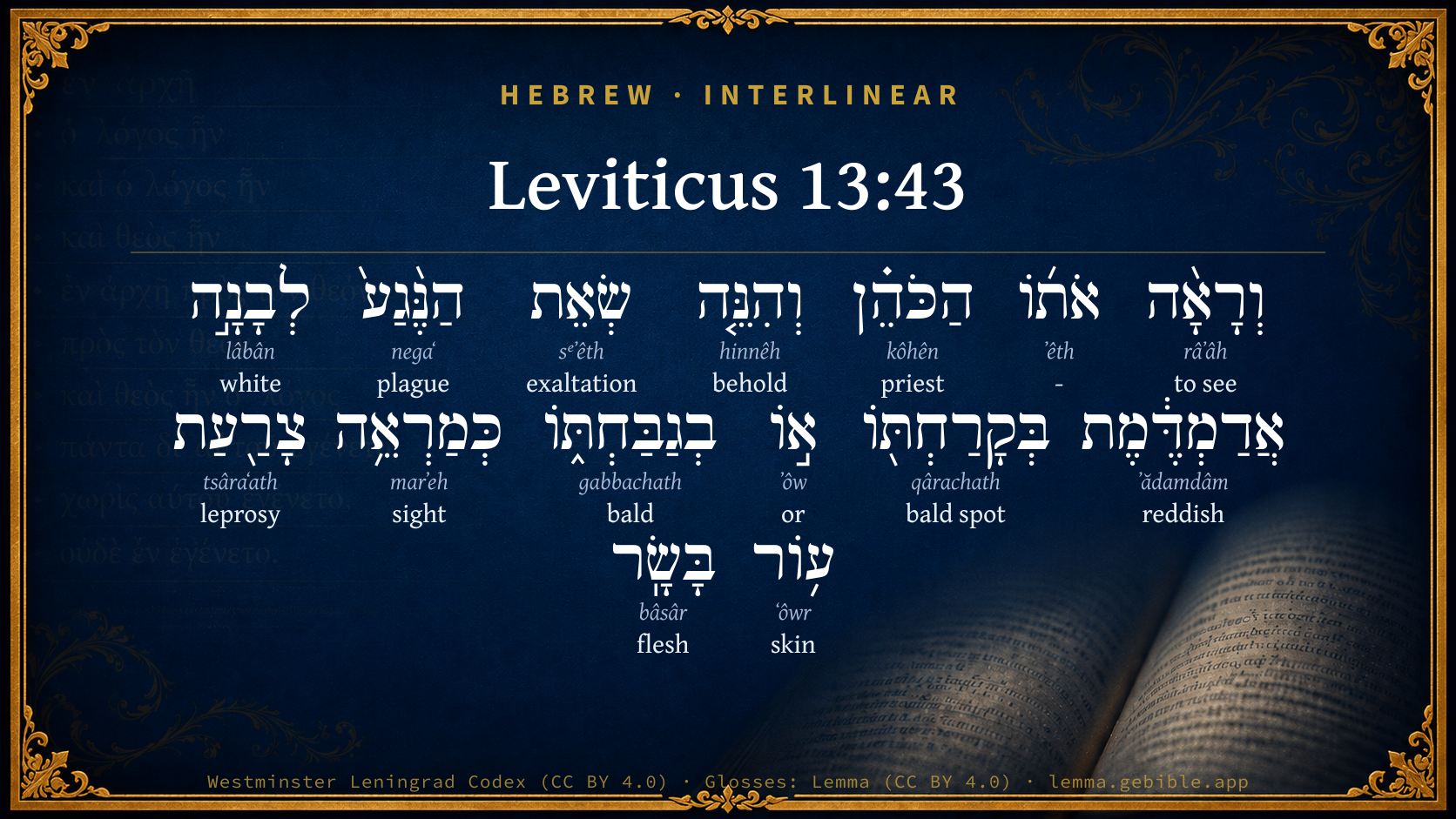
Leviticus 13:43

Hebrew (Westminster Leningrad Codex) Leviticus 13:43 appears in the Hebrew Old Testament. The text above is from the Westminster Leningrad Codex. Each word links to its Strong’s number, a concise gloss, and parsing drawn from the Open Scriptures Hebrew Bible morphology. Click any word for its full Brown-Driver-Briggs (BDB) entry.
Download image
Cite this verse

Leviticus 13:43 (World English Bible). Public Domain. Lemma interlinear Bible study tool, https://lemma.gebible.app/v/leviticus/13/43.

Show BibTeX & RIS
BibTeX
RIS
English Translation
Then the priest shall examine him; and, behold, if the rising of the plague is reddish-white in his bald head, or in his bald forehead, like the appearance of leprosy in the skin of the flesh,
World English Bible · Public Domain
Download a study sheet

One document with this verse’s original text, its word-by-word gloss line, the meaning frame, cross-references with their text, attributed commentary, and full source and license credits — printable, and it pastes into notes with its structure intact.

This verse Autodidact and up

Study sheet (.html) Plain text (.txt)

A passage Seminary Student

Up to 50 verses in one chapter. A passage sheet keeps up to 6 commentary sources and 12 cross-references per verse, in the order this page ranks them, and says so on the sheet whenever that leaves anything out. Ask for a single verse and you get the Autodidact verse sheet above.

Everything on this page stays free to read, with no account — the sheet is a download of what is already on screen, not access to it.

Want to remove ads? Support Godless Engineer
Compare translations 3

The same verse in 3 English versions, stacked beneath the original-language interlinear above. Click any original word for its lexicon entry.

Each is an independent rendering of the whole verse — the interlinear is not word-aligned to these translations.

Highlighted words mark where these versions differ — a whole-verse word diff, not a word-by-word alignment.

  • World English Bible Public Domain
    Then the priest shall examine him; and, behold, if the rising of the plague is reddish-white in his bald head, or in his bald forehead, like the appearance of leprosy in the skin of the flesh,
  • King James Version Public Domain
    Then the priest shall look upon it: and, behold, if the rising of the sore be white reddish in his bald head, or in his bald forehead, as the leprosy appeareth in the skin of the flesh;
  • unfoldingWord Literal Text CC BY-SA 4.0
    Then the priest shall see him. And behold, the swelling of the infection is reddish-white on his bald spot or on his balding spot, like the appearance of the skin disease of the skin of the flesh.

unfoldingWord Literal Text — © unfoldingWord, licensed CC BY-SA 4.0. Word-aligned USFM3 via Door43 (git.door43.org/unfoldingWord/en_ult).

Versions to compare (up to 4)

3 of 4 selected

Show all 18 translations

Every available English version of this verse, each an independent rendering of the whole verse.

  • World English Bible Public Domain
    Then the priest shall examine him; and, behold, if the rising of the plague is reddish-white in his bald head, or in his bald forehead, like the appearance of leprosy in the skin of the flesh,
  • Berean Standard Bible Public Domain
    The priest is to examine him, and if the swelling of the infection on his bald head or forehead is reddish-white like a skin disease,
  • Majority Standard Bible Public Domain
    The priest is to examine him, and if the swelling of the infection on his bald head or forehead is reddish-white like a skin disease,
  • King James Version Public Domain
    Then the priest shall look upon it: and, behold, if the rising of the sore be white reddish in his bald head, or in his bald forehead, as the leprosy appeareth in the skin of the flesh;
  • American Standard Version (1901) Public Domain
    Then the priest shall look upon him; and, behold, if the rising of the plague be reddish-white in his bald head, or in his bald forehead, as the appearance of leprosy in the skin of the flesh;
  • Revised Version (1885) Public Domain
    Then the priest shall look upon him: and, behold, if the rising of the plague be reddish-white in his bald head, or in his bald forehead, as the appearance of leprosy in the skin of the flesh;
  • Geneva Bible (1599) Public Domain
    Therefore the Priest shall looke vpon it, and if the rising of the sore bee white reddish in his balde head, or in his bald forehead, appearing like leprosie in the skin of the flesh,
  • Douay-Rheims (1899) Public Domain
    And the priest perceive this, he shall condemn him undoubtedly of leprosy which is risen in the bald part.
  • Young's Literal Translation Public Domain
    and the priest hath seen him, and lo, the rising of the very red white plague in the bald back of the head, or in the bald forehead, `is' as the appearance of leprosy, in the skin of the flesh,
  • Literal Standard Version CC BY-SA 4.0
    and the priest has seen him, and behold, the rising of the reddish-white plague in the bald back of the head, or in the bald forehead, [is] as the appearance of leprosy, in the skin of the flesh,
  • Unlocked Literal Bible CC BY-SA 4.0
    Then the priest must examine him to see if the swelling of the diseased area on his bald head or forehead is reddish-white, like the appearance of an infectious disease in the skin.
  • unfoldingWord Literal Text CC BY-SA 4.0
    Then the priest shall see him. And behold, the swelling of the infection is reddish-white on his bald spot or on his balding spot, like the appearance of the skin disease of the skin of the flesh.
  • Darby Bible Public Domain
    And the priest shall look on it, and behold, the rising of the sore is white-reddish in his bald head, or in his bald forehead, like the appearance of the leprosy in the skin of the flesh;
  • World Messianic Bible Public Domain
    Then the priest shall examine him. Behold, if the swelling of the plague is reddish-white in his bald head, or in his bald forehead, like the appearance of leprosy in the skin of the body,
  • Webster's Bible Public Domain
    Then the priest shall look upon it: and behold, if the rising of the sore is white reddish on his bald head, or on his bald forehead, as the leprosy appeareth in the skin of the flesh;
  • Free Bible Version CC BY-SA 4.0
    The priest must inspect him, and if the swelling of the sore on his bald head or forehead looks reddish-white like a skin disease,
  • Bible in Basic English Public Domain
    Then if the priest sees that the growth of the disease has become red and white on his head or on his brow where there is no hair, like the mark in the skin of a leper;
  • JPS Tanakh (1917) Public Domain
    Then the priest shall look upon him; and, behold, if the rising of the plague be reddish-white in his bald head, or in his bald forehead, as the appearance of leprosy in the skin of the flesh,

Literal Standard Version (2020), Covenant Press — licensed CC BY-SA 4.0. Text via the HelloAO Bible API (eBible.org). Unlocked Literal Bible (unfoldingWord) — licensed CC BY-SA 4.0. Text via the HelloAO Bible API (eBible.org). unfoldingWord Literal Text — © unfoldingWord, licensed CC BY-SA 4.0. Word-aligned USFM3 via Door43 (git.door43.org/unfoldingWord/en_ult). Free Bible Version, Dr. Jonathan Gallagher — licensed CC BY-SA 4.0. Text via the HelloAO Bible API (eBible.org).

Word by word

More ways to search: Search by grammar → Find every occurrence → Compare this word →

Practice this passage: Drill this verse → Learn its vocabulary →

בְּקָרַחְתּ֖וֹ
qârachath
H7146
“in/at · bald spot · his”
Preposition + Noun, Common, Feminine, Singular, Construct + Suffix, Personal, 3rd Person, Masculine, Singular
Part of Speech
Preposition + Noun
Type
Common
Gender
Feminine
Number
Singular
State
Construct
Full BDB Definition

Origin: from H7139

TWOT: 2069c

baldness of head, back baldness, bald spot
  1. וְרָאָ֨ה râʼâh H7200 “and · to see” Conjunction + Verb, Qal, Sequential Perfect, 3rd Person, Masculine, Singular
  2. אֹת֜וֹ ʼêth H853 “- · him” Particle, Direct Object + Suffix, Personal, 3rd Person, Masculine, Singular
  3. הַכֹּהֵ֗ן kôhên H3548 “the · priest” Particle, Definite Article + Noun, Common, Masculine, Singular, Absolute
  4. וְהִנֵּ֤ה hinnêh H2009 “and · behold” Conjunction + Particle, Demonstrative
  5. שְׂאֵת sᵉʼêth H7613 “exaltation of” Noun, Common, Feminine, Singular, Construct
  6. הַנֶּ֨גַע֙ negaʻ H5061 “the · plague” Particle, Definite Article + Noun, Common, Masculine, Singular, Absolute
  7. לְבָנָ֣ה lâbân H3836 “white” Adjective, Adjective, Feminine, Singular, Absolute
  8. אֲדַמְדֶּ֔מֶת ʼădamdâm H125 “reddish” Adjective, Adjective, Feminine, Singular, Absolute
  9. א֣וֹ ʼôw H176 “or” Conjunction
  10. בְגַבַּחְתּ֑וֹ gabbachath H1372 “in/at · bald · his” Preposition + Noun, Common, Feminine, Singular, Construct + Suffix, Personal, 3rd Person, Masculine, Singular
  11. כְּמַרְאֵ֥ה marʼeh H4758 “like/as · sight of” Preposition + Noun, Common, Masculine, Singular, Construct
  12. צָרַ֖עַת tsâraʻath H6883 “leprosy of” Noun, Common, Feminine, Singular, Construct
  13. ע֥וֹר ʻôwr H5785 “skin of” Noun, Common, Masculine, Singular, Construct
  14. בָּשָֽׂר bâsâr H1320 “flesh” Noun, Common, Masculine, Singular, Absolute

About this verse

These counts appear in no published source. They are computed here, from the morphology-tagged text and Lemma’s own curated glosses. What Lemma adds →

15
words
15
distinct lemmas
Pentateuch
section

Notable vocabulary

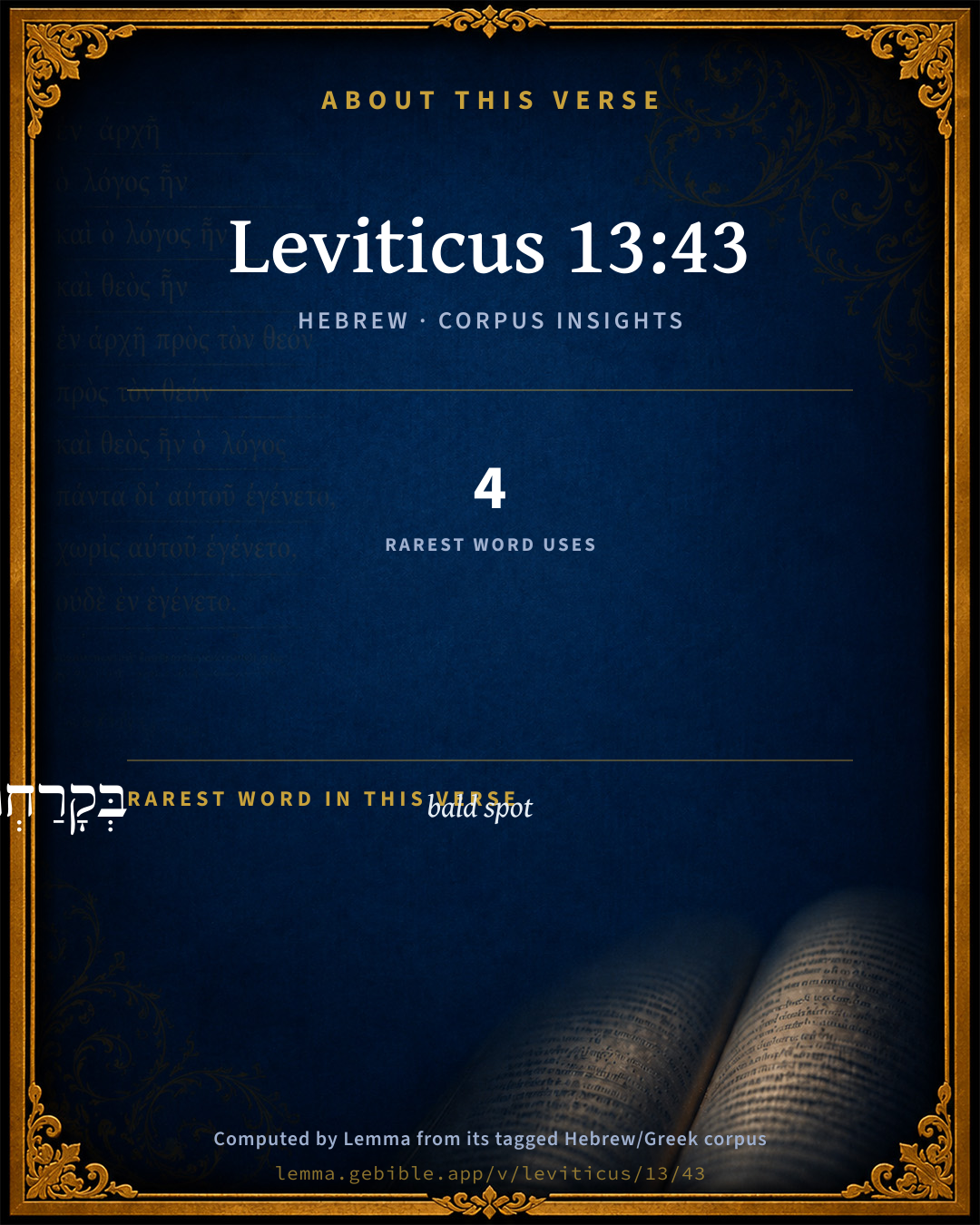
The rarest word here is בְּקָרַחְתּ֖וֹ bald spot H7146 — appearing just 4 times in the whole Hebrew Bible.

Shared distinctive vocabulary

בְּקָרַחְתּ֖וֹ bald spot H7146 occurs in 3 verses of the Hebrew Bible. Also found in:

Grammatical profile

  • 1 verb
  • 9 nouns
  • 2 adjectives
  • 1 conjunction
  • 2 particles

Verb forms

  • וְרָאָ֨ה Qal · Sequential Perfect

Hebrew & Septuagint length

In English translation the verse runs 36 words from the Hebrew and 39 from the Septuagint (LXX English) — closely comparable.

A rough comparison of the two English renderings, which tokenize alike — not a word-level alignment.

Word counts can differ between the Hebrew and the Greek without any difference in meaning — e.g. the Hebrew direct-object marker אֵת has no separate Greek word, and Greek often adds the article ὁ.

Hebrew and Greek witnesses Masoretic Hebrew ↔ Greek Septuagint

The same verse in the two great witnesses to the Old Testament, shown verse-for-verse.

These are two independent witnesses, not word-aligned to each other, and the Septuagint is shown in lemma (dictionary) form.

Hebrew Leviticus 13:43 Masoretic · Westminster Leningrad Codex

וְרָאָ֨ה אֹת֜וֹ הַכֹּהֵ֗ן וְהִנֵּ֤ה שְׂאֵת הַנֶּ֨גַע֙ לְבָנָ֣ה אֲדַמְדֶּ֔מֶת בְּקָרַחְתּ֖וֹ א֣וֹ בְגַבַּחְתּ֑וֹ כְּמַרְאֵ֥ה צָרַ֖עַת ע֥וֹר בָּשָֽׂר

Then the priest shall examine him; and, behold, if the rising of the plague is reddish-white in his bald head, or in his bald forehead, like the appearance of leprosy in the skin of the flesh,

World English Bible · Public Domain

Greek LXX Leviticus 13:43 Septuagint · lemma form

καί ὁράω αὐτός ὁ ἱερεύς καί ἰδού ὁ ὄψις ὁ ἁφή λευκός πυρρίζω ἐν ὁ φαλάκρωμα αὐτός ἤ ἐν ὁ ἀναφαλάντωμα αὐτός ὡς εἶδος λέπρα ἐν δέρμα ὁ σάρξ αὐτός

And the priest shall look upon him, and, behold, if the appearance of the plague be white or inflamed in his baldness of head or baldness in front, as the appearance of leprosy in the skin of his flesh,

LXX2012 (modern English Septuagint) · Public Domain

Hebrew: Westminster Leningrad Codex (CC BY 4.0). Greek: Septuagint (public domain); English from LXX2012 (modern English Septuagint) (Public Domain). How the Septuagint differs from the Hebrew →

Targum (Aramaic paraphrase)

2

The Targum is the ancient Jewish Aramaic paraphrase of the Hebrew Scriptures — an interpretive translation, not the Hebrew text itself. Onkelos (literal) and Pseudo-Jonathan (expansive) render the Torah, and Jonathan the Prophets. Coverage is partial: where no permissively-licensed English translation exists for a verse, only the Aramaic is shown. This is verse-level text, not a word-by-word alignment to the Hebrew.

  1. Targum Onkelos Torah (Genesis–Deuteronomy)
    וְיֶחֱזֵי יָתֵהּ כַּהֲנָא וְהָא עַמִיק מַכְתָּשָׁא חַוְרָא סַמְקָא בְּקָרָחוּתֵהּ אוֹ בִגְלוֹשׁוּתֵהּ כְּמֶחֱזֵי סְגִירוּתָא מְשַׁךְ בִּסְרָא

    (no public-domain English translation for this verse)

    Targum Onkelos — Aramaic: “Onkelos Genesis” (public domain); “Onkelos Exodus” (public domain); “Onkelos Leviticus” (public domain); “Onkelos Numbers” (public domain); “Onkelos Deuteronomy” (public domain). English: “Sefaria Community Translation” (CC0 1.0 (public-domain dedication)); “J.W. Etheridge. The Targums of Onkelos and Jonathan Ben Uzziel on the Pentateuch. London: Longmans, Green, 1862” (public domain). Text via Sefaria.

  2. Targum Pseudo-Jonathan Torah (Genesis–Deuteronomy)
    וְיֶחֱמֵי יָתֵיהּ כַּהֲנָא וְהָא שׁוּמַת מַכְתְּשָׁא חִיוְורָא סַמְקָא מְעַרְבָן בְּקוּרְחֲתֵיהּ אוֹ בְּגִלְשְׁלָשׁוּתֵיהּ הֵי כְחֵיזוֹ סְגִירוּת מְשַׁךְ בִּישְרָא

    And the priest shall look upon it, and, behold, if the spot of the plague be white mixed with red in his baldness, or partial baldness, like the appearance of leprosy in the skin of the flesh,

    Targum Pseudo-Jonathan — Aramaic: “Targum Jonathan on Genesis” (public domain); “Targum Jonathan on Exodus” (public domain); “Targum Jonathan on Leviticus” (public domain); “Targum Jonathan on Numbers” (public domain); “Targum Jonathan on Deuteronomy” (public domain). English: “The Targum of Jonathan ben Uzziel, trans. J. W. Etheridge, London, 1862” (public domain). Text via Sefaria.

Commentary

Notes on Leviticus 13:43 from classic Christian and Jewish commentators (each source and its license shown beneath its notes). The classic Christian expositions comment on the surrounding passage and are grouped to its opening verse, so a note may address several verses; the Jewish commentaries on the Tanakh (Rashi and others) are per-verse, so they appear only where the commentator wrote on this verse.

Lemma curates 59 commentaries, every one of them public domain or Creative Commons licensed, each selected and text-cleaned for this edition rather than reprinted as found. About our sources →

Ellicott's Commentary for English Readers

(43) Then the priest shall look.—It is then the duty of the priest to ascertain whether the white-reddish rising in the bald backhead or bald forehead is in appearance like the leprosy in the skin of the flesh described in Lev_13:2, excepting, of course, the white hair, which in this case could not exist.

As the leprosy appeareth in the skin of the flesh.—Better, in appearance like the leprosy in the skin of the flesh. Though the reddish-white eruption is the only symptom mentioned whereby head-leprosy is to be recognised, and nothing is said about remanding the patient if the distemper should appear doubtful, as in the other cases of leprosy, yet because it is here said “in appearance like the leprosy in the skin of the flesh,” the administrators of the law during the second Temple inferred that all the criteria specified in one are implied in the other. They interpret this phrase, “they are, and therefore must be treated like, leprosy in the skin of the flesh.” Hence they submit that there are two symptoms which render baldness in the front or at the back of the head unclean: viz., (1) live or sound flesh; and (2) spreading. “If live or sound flesh is found in the bright spot on the baldness at the back or in the front of the head, he is pronounced unclean; if there is no live flesh, he is shut up, and examined at the end of the week, and if live flesh has developed itself, and it has spread, he is declared unclean, and if not, he is shut up for another week. If it spreads during this time, or engenders live flesh, he is declared unclean, and if not, he is declared clean. He is also pronounced unclean if it spreads or engenders sound flesh after he has been declared clean.” Of course, the fact that the distemper in this instance develops itself on baldness precludes white hair being among the criteria indicating uncleanness.

A Bible Commentary for English Readers, edited by Charles John Ellicott (1878–1897) — public domain. Text from a community e-Sword module.

The Cambridge Bible for Schools and Colleges

gen. ed. J. J. S. Perowne

43. as the appearance of leprosy] The criterion of white hair is absent, but the other tests of leprosy already mentioned are sufficient to determine whether the outbreak is leprous. According to tradition, two periods of seclusion were necessary as in Lev_13:2-6 and in Lev_13:29-37.

The Cambridge Bible for Schools and Colleges (gen. ed. J. J. S. Perowne; Cambridge University Press, 1878–1918) — public domain. Text from a community e-Sword module.

John Gill's Exposition

And the leper in whom the plague is,.... Meaning not he only that has the plague of leprosy in his head, but every sort of leper before mentioned in this chapter:

his clothes shall be rent; not that he might the more easily put on his clothes without hurting him, as some have thought; or that the corrupt humours might evaporate more freely, for evaporation would rather be hindered than promoted by being exposed to cold; nor that he might be known and better avoided, for his cry after mentioned was sufficient for that; but as a token of mourning: and so Aben Ezra having mentioned the former reason, that he might be known by going in a different habit, adds, or the sense is, as a token of mourning; for he was to mourn for the wickedness of his actions; for, for his works came this plague of leprosy upon him; and so the Jews in common understand it, not as a disease arising from natural causes, but as a punishment inflicted by God for sin; wherefore this rite of rending the garments was an emblem of contrition of heart, and of sorrow and humiliation for sin, see Joe 1:13,

and his head bare; or "free" from cutting or shaving, but shall let his hair grow; and so the Targum of Jonathan and Jarchi interpret it; or free from any covering upon it, hat, or cap, or turban: Ben Gersom observes, that the making bare the head, or freeing it, is taken different ways; sometimes it is used of not shaving the head for thirty days, and sometimes for the removal of the vail, or covering of the head it has been used to; but in this place it cannot signify the nourishing of the hair, but that his head ought to be covered: and so Maimonides (a) observes, that a leper should cover his head all the days he is excluded, and this was a token of mourning also; see Sa2 15:30,

and he shall put a covering upon his upper lip; as a mourner, see Eze 24:17. Jarchi interprets it of both lips, upper and under, which were covered with a linen cloth or vail thrown over the shoulder, and with which the mouth was covered; and this was done, as Aben Ezra says, that the leper might not hurt any with the breath of his mouth:

and shall cry, Unclean, unclean; as he passed along in any public place, that everyone might avoid him, and not be polluted by him: the Targum of Jonathan is,"a herald shall proclaim and say, Depart, depart from the unclean.''So every sinner sensible of the leprosy of sin in his nature, and which appears in his actions, should freely confess and acknowledge his uncleanness, original and actual, the impurity of his heart and life, and even of his own righteousness in the sight of God, and have recourse to Christ, and to his blood, for the cleansing him from it.

(a) Hilchot Tumaat Tzarat, c. 10. sect. 6.

John Gill's Exposition of the Whole Bible (1746–1763) — public domain (CC PDM 1.0). Text via the HelloAO Bible API.

Rashi

Rabbi Shlomo Yitzchaki (Rashi)

כמראה צרעת עור בשר AS THE COLOUR OF LEPROSY IN THE SKIN OF THE FLESH — it is like the colour of the leprosy which is mentioned in the section dealing with the plague on the skin of the flesh (v. 2): “When a man hath in the skin of his flesh …”.What is stated about that? That it makes one unclean by reason of four shades of white, and that it is subject to the law of quarantine during two weeks. And it is not to be treated like the colour of the leprosy mentioned in the case of the boil (v 18) or burn (v. 24) which though also unclean by reason of four shades of white are, however, subject to the law of quarantine for one week only, (i. e if at the end of the week there is neither white hair, nor has it spread the priest at once declares him clean); nor must it be treated as the colour of נתקין on a spot where hair grows — which do not make a person unclean by cause of four colours: a שאת and its subspecies, and that of a בהרת and its subspecies.

Rashi on the Tanakh — English translations: “The Judaica Press complete Tanach with Rashi, translated by A. J. Rosenberg” (CC BY 4.0); “Pentateuch with Rashi's commentary by M. Rosenbaum and A.M. Silbermann, 1929-1934” (public domain); “The Metsudah Tanach series, Lakewood, N.J” (CC BY 4.0); and “The Book of Joshua, Metsudah Publications, 1997” (CC BY 4.0). Text via Sefaria.

Lesson kit

Teaching starters — assembled from the data on this page, not authored interpretation. Every prompt links to the verse data it draws on. Edit before teaching.

Leviticus, in the Pentateuch, opens this verse with 15 words (15 distinct Hebrew lemmas). Its most distinctive word is qârachath (“bald spot”). A historical commentator’s framing appears above. Read the whole chapter for the surrounding context.

Discussion questions

  1. The word qârachath carries the sense “bald spot.” How does it shape the verse?
  2. How does Leviticus 13:42, which shares the word «bald spot», read alongside this verse?
  3. These translations render this verse differently; the difference is in the English rendering, not the original. What questions does that raise?
  4. «וְרָאָ֨ה» is a Qal Sequential Perfect verb. How does that grammatical form shape the action described?
  5. Compare how Ellicott's Commentary for English Readers and The Cambridge Bible for Schools and Colleges read this verse. Where do they agree or differ?

Things to notice

Reading settings

Reading text

Shown beneath each verse's original-language words.

Old Testament
Old Testament edition

Read the OT as the Masoretic Hebrew (MT) or the Greek Septuagint (LXX).

English shown for the Greek Septuagint (in the Hebrew ↔ Greek comparison).

Comparing translations? Open the Compare panel on any verse page to stack up to four side by side.