Leviticus 13:10

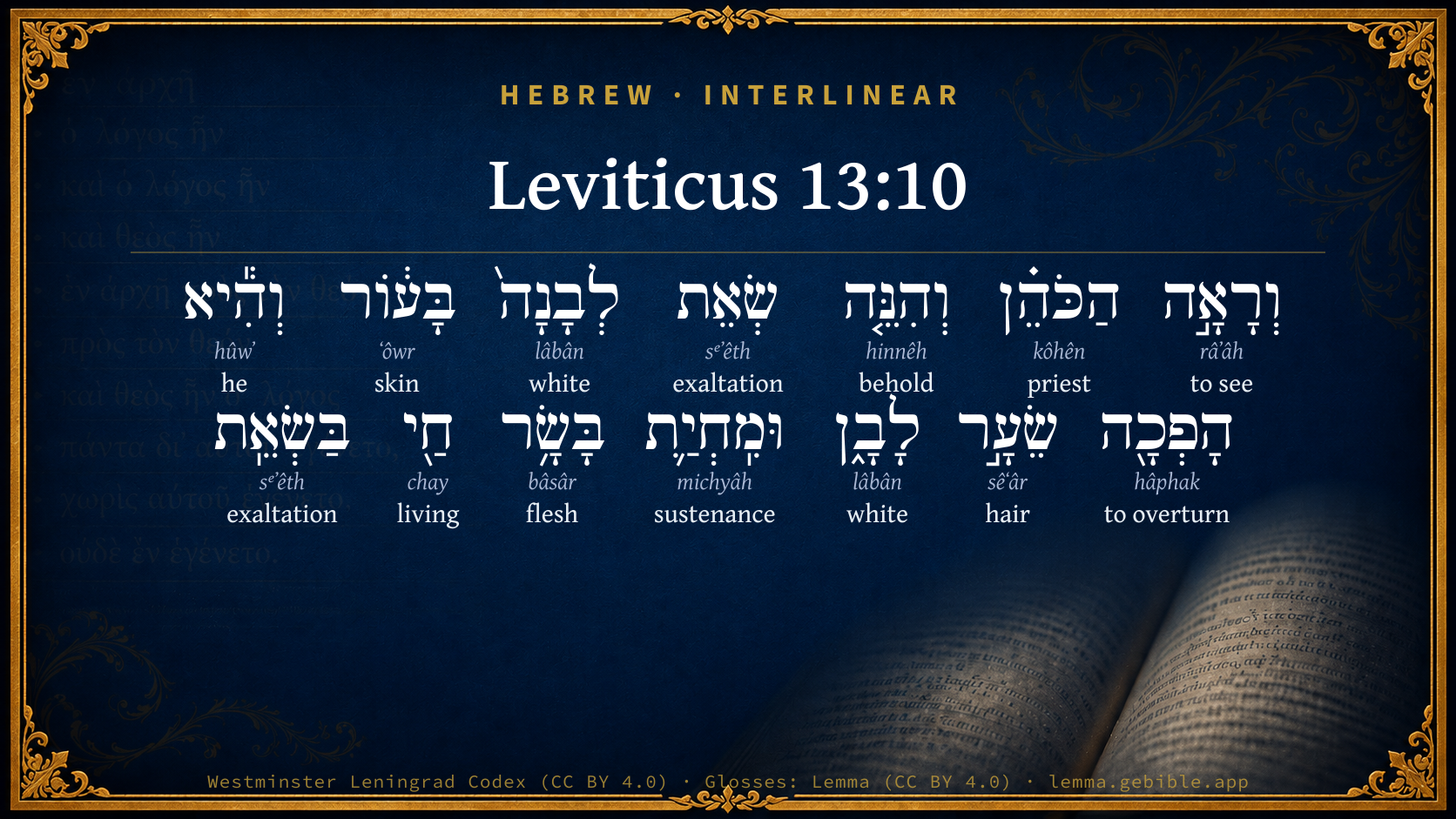
Hebrew (Westminster Leningrad Codex) Leviticus 13:10 appears in the Hebrew Old Testament. The text above is from the Westminster Leningrad Codex. Each word links to its Strong’s number, a concise gloss, and parsing drawn from the Open Scriptures Hebrew Bible morphology. Click any word for its full Brown-Driver-Briggs (BDB) entry.
Download image
Cite this verse

Leviticus 13:10 (World English Bible). Public Domain. Lemma interlinear Bible study tool, https://lemma.gebible.app/v/leviticus/13/10.

Show BibTeX & RIS
BibTeX
RIS
English Translation
and the priest shall examine him. Behold, if there is a white rising in the skin, and it has turned the hair white, and there is raw flesh in the rising,
World English Bible · Public Domain
Download a study sheet

One document with this verse’s original text, its word-by-word gloss line, the meaning frame, cross-references with their text, attributed commentary, and full source and license credits — printable, and it pastes into notes with its structure intact.

This verse Autodidact and up

Study sheet (.html) Plain text (.txt)

A passage Seminary Student

Up to 50 verses in one chapter. A passage sheet keeps up to 6 commentary sources and 12 cross-references per verse, in the order this page ranks them, and says so on the sheet whenever that leaves anything out. Ask for a single verse and you get the Autodidact verse sheet above.

Everything on this page stays free to read, with no account — the sheet is a download of what is already on screen, not access to it.

Want to remove ads? Support Godless Engineer
Compare translations 3

The same verse in 3 English versions, stacked beneath the original-language interlinear above. Click any original word for its lexicon entry.

Each is an independent rendering of the whole verse — the interlinear is not word-aligned to these translations.

Highlighted words mark where these versions differ — a whole-verse word diff, not a word-by-word alignment.

  • World English Bible Public Domain
    and the priest shall examine him. Behold, if there is a white rising in the skin, and it has turned the hair white, and there is raw flesh in the rising,
  • King James Version Public Domain
    And the priest shall see him: and, behold, if the rising be white in the skin, and it have turned the hair white, and there be quick raw flesh in the rising;
  • unfoldingWord Literal Text CC BY-SA 4.0
    And the priest shall see, and behold, a white swelling on the skin, and it has turned the hair white, and a preservation of living flesh on the swelling.

unfoldingWord Literal Text — © unfoldingWord, licensed CC BY-SA 4.0. Word-aligned USFM3 via Door43 (git.door43.org/unfoldingWord/en_ult).

Versions to compare (up to 4)

3 of 4 selected

Show all 18 translations

Every available English version of this verse, each an independent rendering of the whole verse.

  • World English Bible Public Domain
    and the priest shall examine him. Behold, if there is a white rising in the skin, and it has turned the hair white, and there is raw flesh in the rising,
  • Berean Standard Bible Public Domain
    The priest will examine him, and if there is a white swelling on the skin that has turned the hair white, and there is raw flesh in the swelling,
  • Majority Standard Bible Public Domain
    The priest will examine him, and if there is a white swelling on the skin that has turned the hair white, and there is raw flesh in the swelling,
  • King James Version Public Domain
    And the priest shall see him: and, behold, if the rising be white in the skin, and it have turned the hair white, and there be quick raw flesh in the rising;
  • American Standard Version (1901) Public Domain
    and the priest shall look; and, behold, if there be a white rising in the skin, and it have turned the hair white, and there be quick raw flesh in the rising,
  • Revised Version (1885) Public Domain
    and the priest shall look, and, behold, if there be a white rising in the skin, and it have turned the hair white, and there be quick raw flesh in the rising,
  • Geneva Bible (1599) Public Domain
    And the Priest shall see him: and if the swelling be white in ye skin, and haue made ye heare white, and there be rawe flesh in the swelling,
  • Douay-Rheims (1899) Public Domain
    And he shall view him. And when there shall be a white colour in the skin, and it shall have changed the look of the hair, and the living flesh itself shall appear:
  • Young's Literal Translation Public Domain
    and the priest hath seen, and lo, a white rising in the skin, and it hath turned the hair white, and a quickening of raw flesh `is' in the rising, --
  • Literal Standard Version CC BY-SA 4.0
    and the priest has seen, and behold, a white rising in the skin, and it has turned the hair white, and a quickening of raw flesh [is] in the rising—
  • Unlocked Literal Bible CC BY-SA 4.0
    The priest will examine him to see if there is a white swelling in the skin, if the hair has turned white, or if there is raw flesh in the swelling.
  • unfoldingWord Literal Text CC BY-SA 4.0
    And the priest shall see, and behold, a white swelling on the skin, and it has turned the hair white, and a preservation of living flesh on the swelling.
  • Darby Bible Public Domain
    and the priest shall look on him, and behold, there is a white rising in the skin, and it hath turned the hair white, and a trace of raw flesh is in the rising:
  • World Messianic Bible Public Domain
    and the priest shall examine him. Behold, if there is a white swelling in the skin, and it has turned the hair white, and there is raw flesh in the swelling,
  • Webster's Bible Public Domain
    And the priest shall see him: and behold, if the rising is white in the skin, and it hath turned the hair white, and there is raw flesh in the rising;
  • Free Bible Version CC BY-SA 4.0
    The priest will inspect them, and if there is a white swelling on the skin and the hair there has turned white, and there is an open wound in the swelling,
  • Bible in Basic English Public Domain
    And if the priest sees that there is a white growth on the skin, and the hair is turned white, and there is diseased flesh in the growth,
  • JPS Tanakh (1917) Public Domain
    And the priest shall look, and, behold, if there be a white rising in the skin, and it have turned the hair white, and there be quick raw flesh in the rising,

Literal Standard Version (2020), Covenant Press — licensed CC BY-SA 4.0. Text via the HelloAO Bible API (eBible.org). Unlocked Literal Bible (unfoldingWord) — licensed CC BY-SA 4.0. Text via the HelloAO Bible API (eBible.org). unfoldingWord Literal Text — © unfoldingWord, licensed CC BY-SA 4.0. Word-aligned USFM3 via Door43 (git.door43.org/unfoldingWord/en_ult). Free Bible Version, Dr. Jonathan Gallagher — licensed CC BY-SA 4.0. Text via the HelloAO Bible API (eBible.org).

Word by word

More ways to search: Search by grammar → Find every occurrence → Compare this word →

Practice this passage: Drill this verse → Learn its vocabulary →

וּמִֽחְיַ֛ת
michyâh
H4241
“and · sustenance of”
Conjunction + Noun, Common, Feminine, Singular, Construct
Part of Speech
Conjunction + Noun
Type
Common
Gender
Feminine
Number
Singular
State
Construct
Full BDB Definition

Origin: from H2421

TWOT: 644h

preservation of life, sustenance - preservation of life - sustenance - reviving - the quick of the flesh, live flesh, tender or raw flesh
  1. וְרָאָ֣ה râʼâh H7200 “and · to see” Conjunction + Verb, Qal, Sequential Perfect, 3rd Person, Masculine, Singular
  2. הַכֹּהֵ֗ן kôhên H3548 “the · priest” Particle, Definite Article + Noun, Common, Masculine, Singular, Absolute
  3. וְהִנֵּ֤ה hinnêh H2009 “and · behold” Conjunction + Particle, Demonstrative
  4. שְׂאֵת sᵉʼêth H7613 “exaltation of” Noun, Common, Feminine, Singular, Construct
  5. לְבָנָה֙ lâbân H3836 “white” Adjective, Adjective, Feminine, Singular, Absolute
  6. בָּע֔וֹר ʻôwr H5785 “in/at the · skin” Preposition, Determined + Noun, Common, Masculine, Singular, Absolute
  7. וְהִ֕יא hûwʼ H1931 “and · he” Conjunction + Pronoun, Personal, 3rd Person, Feminine, Singular
  8. הָפְכָ֖ה hâphak H2015 “to overturn” Verb, Qal, Perfect, 3rd Person, Feminine, Singular
  9. שֵׂעָ֣ר sêʻâr H8181 “hair” Noun, Common, Masculine, Singular, Absolute
  10. לָבָ֑ן lâbân H3836 “white” Adjective, Adjective, Masculine, Singular, Absolute
  11. בָּשָׂ֥ר bâsâr H1320 “flesh” Noun, Common, Masculine, Singular, Absolute
  12. חַ֖י chay H2416 “living” Adjective, Adjective, Masculine, Singular, Absolute
  13. בַּשְׂאֵֽת sᵉʼêth H7613 “in/at the · exaltation” Preposition, Determined + Noun, Common, Feminine, Singular, Absolute

About this verse

These counts appear in no published source. They are computed here, from the morphology-tagged text and Lemma’s own curated glosses. What Lemma adds →

14
words
12
distinct lemmas
Pentateuch
section

Notable vocabulary

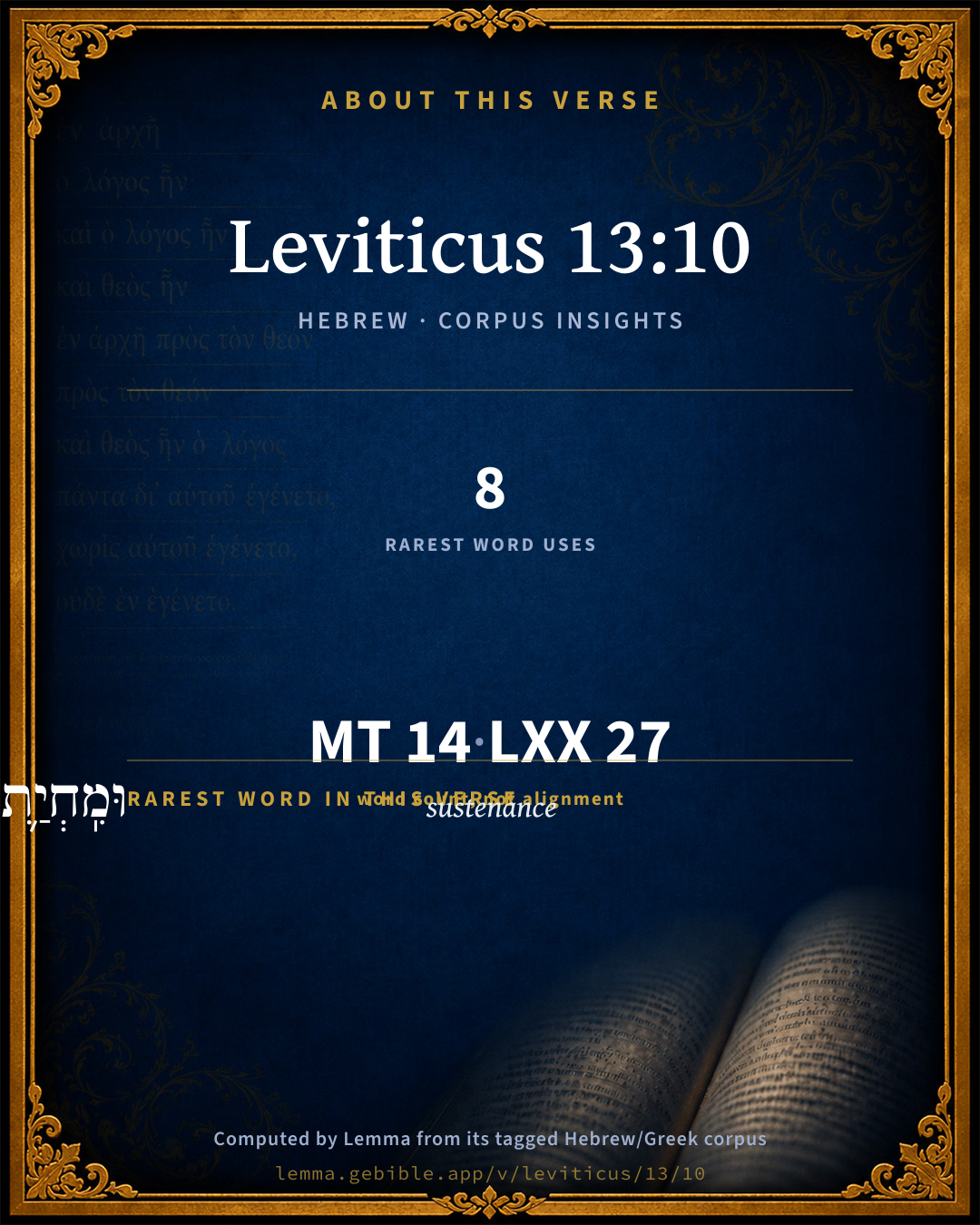
The rarest word here is וּמִֽחְיַ֛ת sustenance H4241 — appearing just 8 times in the whole Hebrew Bible.

Shared distinctive vocabulary

וּמִֽחְיַ֛ת sustenance H4241 occurs in 8 verses of the Hebrew Bible. Also found in:

Grammatical profile

  • 2 verbs
  • 7 nouns
  • 3 adjectives
  • 1 pronoun
  • 1 particle

Verb forms

  • וְרָאָ֣ה Qal · Sequential Perfect
  • הָפְכָ֖ה Qal · Perfect

Repetition

Words recur within this verse — often emphatic in Hebrew:

  • שְׂאֵת exaltation H7613 ×2
  • לְבָנָה֙ white H3836 ×2

Hebrew & Septuagint length

In English translation the verse runs 31 words from the Hebrew and 39 from the Septuagint (LXX English) — closely comparable.

A rough comparison of the two English renderings, which tokenize alike — not a word-level alignment.

Word counts can differ between the Hebrew and the Greek without any difference in meaning — e.g. the Hebrew direct-object marker אֵת has no separate Greek word, and Greek often adds the article ὁ.

In the original languages it is 14 Hebrew tokens and 27 Greek tokens — but the two are counted differently (Hebrew bundles its prefixes and suffixes into one token; the Greek is in lemma form), so that isn’t a like-for-like length.

Cross-references

10

Topical passages linked to Leviticus 13:10 in the Treasury of Scripture Knowledge — connected by theme and wording, ordered by reader-vote popularity; previews shown in the World English Bible.

  • 2 Kings 5:27 The leprosy therefore of Naaman shall cleave to you, and to your seed forever. He went out from his presence a leper [as white] as snow.
  • 2 Chronicles 26:19–20 Then Uzziah was angry; and he had a censer in his hand to burn incense; and while he was angry with the priests, the leprosy broke forth in his forehead before the priests in the house of Yahweh, beside the altar of incense.
  • Leviticus 13:3–4 and the priest shall examine the plague in the skin of the body: and if the hair in the plague has turned white, and the appearance of the plague is deeper than the body's skin, it is the plague of leprosy; and the priest shall examine him, and pronounce him unclean.
  • Leviticus 13:14–15 But whenever raw flesh appears in him, he shall be unclean.
  • Leviticus 13:24 "Or when the body has a burn from fire on its skin, and the raw flesh of the burn becomes a bright spot, reddish-white, or white,
  • Numbers 12:10–12 The cloud removed from over the Tent; and, behold, Miriam was leprous, as [white as] snow: and Aaron looked at Miriam, and, behold, she was leprous.
  • Proverbs 12:1 Whoever loves correction loves knowledge, But he who hates reproof is stupid.
  • Amos 5:10 They hate him who reproves in the gate, And they abhor him who speaks blamelessly.
  • John 3:19–20 This is the judgment, that the light has come into the world, and men loved the darkness rather than the light; for their works were evil.
  • John 7:7 The world can't hate you, but it hates me, because I testify about it, that its works are evil.

Cross-references courtesy of OpenBible.info (CC BY 4.0).

Hebrew and Greek witnesses Masoretic Hebrew ↔ Greek Septuagint

The same verse in the two great witnesses to the Old Testament, shown verse-for-verse.

These are two independent witnesses, not word-aligned to each other, and the Septuagint is shown in lemma (dictionary) form.

Hebrew Leviticus 13:10 Masoretic · Westminster Leningrad Codex

וְרָאָ֣ה הַכֹּהֵ֗ן וְהִנֵּ֤ה שְׂאֵת לְבָנָה֙ בָּע֔וֹר וְהִ֕יא הָפְכָ֖ה שֵׂעָ֣ר לָבָ֑ן וּמִֽחְיַ֛ת בָּשָׂ֥ר חַ֖י בַּשְׂאֵֽת

and the priest shall examine him. Behold, if there is a white rising in the skin, and it has turned the hair white, and there is raw flesh in the rising,

World English Bible · Public Domain

Greek LXX Leviticus 13:10 Septuagint · lemma form

καί ὁράω ὁ ἱερεύς καί ἰδού οὐλή λευκός ἐν ὁ δέρμα καί οὗτος μεταβάλλω θρίξ λευκός καί ἀπό ὁ ὑγιής ὁ σάρξ ὁ ζάω ἐν ὁ οὐλή

and the priest shall look, and, behold, if it is a white spot in the skin, and it has changed the hair to white, and there be some of the sound part of the quick flesh in the sore—

LXX2012 (modern English Septuagint) · Public Domain

On this verse, Ellicott's Commentary for English Readers discusses the Septuagint’s reading. Read the note in Commentary ↓

Hebrew: Westminster Leningrad Codex (CC BY 4.0). Greek: Septuagint (public domain); English from LXX2012 (modern English Septuagint) (Public Domain). How the Septuagint differs from the Hebrew →

Targum (Aramaic paraphrase)

2

The Targum is the ancient Jewish Aramaic paraphrase of the Hebrew Scriptures — an interpretive translation, not the Hebrew text itself. Onkelos (literal) and Pseudo-Jonathan (expansive) render the Torah, and Jonathan the Prophets. Coverage is partial: where no permissively-licensed English translation exists for a verse, only the Aramaic is shown. This is verse-level text, not a word-by-word alignment to the Hebrew.

  1. Targum Onkelos Torah (Genesis–Deuteronomy)
    וְיֶחֱזֵי כֲהֲנָא וְהָא עַמְקָא חַוְרָא בְּמַשְׁכָּא וְהִיא הֲפָכַת שֵׂעָר לְחִוָר וְרֹשֶׁם בִּסְרָא חַיְתָא בְּעַמִקְתָּא

    (no public-domain English translation for this verse)

    Targum Onkelos — Aramaic: “Onkelos Genesis” (public domain); “Onkelos Exodus” (public domain); “Onkelos Leviticus” (public domain); “Onkelos Numbers” (public domain); “Onkelos Deuteronomy” (public domain). English: “Sefaria Community Translation” (CC0 1.0 (public-domain dedication)); “J.W. Etheridge. The Targums of Onkelos and Jonathan Ben Uzziel on the Pentateuch. London: Longmans, Green, 1862” (public domain). Text via Sefaria.

  2. Targum Pseudo-Jonathan Torah (Genesis–Deuteronomy)
    וְיֶחֱמֵי כַּהֲנָא וְהָא שׁוּמָא זְקִיפָא חִיוְרָא בְּמוֹשְׁכָא כַּעֲמַר נָקִי וְהִיא הַפְכַת שַעֲרָא לְמֶחֱוַר כִּקְרוּם בֵּיעֲתָא וְרוֹשַׁם בִּישְרָא חַיָיא בְּשׁוּמָא

    And the priest shall observe; and, behold, if there be a white tumour rising on the skin like pure wool, and the hair be turned to whiteness as the white of an egg, and the sign of quick flesh be in the tumour,

    Targum Pseudo-Jonathan — Aramaic: “Targum Jonathan on Genesis” (public domain); “Targum Jonathan on Exodus” (public domain); “Targum Jonathan on Leviticus” (public domain); “Targum Jonathan on Numbers” (public domain); “Targum Jonathan on Deuteronomy” (public domain). English: “The Targum of Jonathan ben Uzziel, trans. J. W. Etheridge, London, 1862” (public domain). Text via Sefaria.

Commentary

Notes on Leviticus 13:10 from classic Christian and Jewish commentators (each source and its license shown beneath its notes). The classic Christian expositions comment on the surrounding passage and are grouped to its opening verse, so a note may address several verses; the Jewish commentaries on the Tanakh (Rashi and others) are per-verse, so they appear only where the commentator wrote on this verse.

Lemma curates 59 commentaries, every one of them public domain or Creative Commons licensed, each selected and text-cleaned for this edition rather than reprinted as found. About our sources →

Trapp's Complete Commentary

John Trapp

Lev 13:10 And the priest shall see [him]: and, behold, [if] the rising [be] white in the skin, and it have turned the hair white, and [there be] quick raw flesh in the rising;

Ver. 10. And there be quick raw flesh.] It is one of the most remarkable things in all this law, saith a learned divine, that quick or sound flesh in the sore should be judged leprosy, and the man unclean: whereas if the leprosy covered all his flesh, he was pronounced clean. {Lev 13:13} Hereby may be meant, (1.) Such as justify themselves and their wickedness, as Jonah did his anger; whereas he who judged himself, is like him who had the leprosy all over, and might be declared clean: or, (2.) Such who sin against the light of knowledge, and the quickening, yea, rawness of a galled conscience.

John Trapp, A Commentary or Exposition upon All the Books of the Old and New Testament (1647–1656) — public domain. Text from a community e-Sword module.

Tyndale Open Study Notes

Tyndale Open Resources

13:10 The presence of an open sore was the crucial factor, because it indicated infection.

Tyndale Open Study Notes — © Tyndale Open Resources, licensed CC BY-SA 4.0. Text via the HelloAO Bible API.

Ellicott's Commentary for English Readers

(10) If the rising be white.—If the distemper actually returns, one of two symptoms indicates it. A white rising will be noticed in the skin, which changes the black hair into white. The white hair only then indicates the disorder when it co-exists with the white rising or swelling which produced it. If the original white swelling, which discoloured the hair, disappears, and a fresh white swelling forms itself around the existing white hair, it is no indication of uncleanness.

And there be quick raw flesh in the rising.—Rather, or if there be, or and likewise if there be, &c. This clause gives the second of the two symptoms, either of which indicates the return of the disorder. According to the administrators of the law during the second Temple, the phrase here translated “quick raw flesh” in the Authorised Version, which literally means “the quickening of live flesh,” denotes “sound flesh,” or a spot in the flesh assuming the appearance of life after it had been paled by the whiteness which overspread the whole surface. The size of this spot of live flesh, which indicated the disease and made the patient unclean, had to be at least that of a lentil. This rendering is given by the LXX,, the Chaldee, &c. An insulated spot of sound flesh in the midst of a tubercle was considered a sign of the fretting and consuming progress which the disease made in the surrounding flesh.

A Bible Commentary for English Readers, edited by Charles John Ellicott (1878–1897) — public domain. Text from a community e-Sword module.

John Gill's Exposition

And the priest shall see him,.... Look at him, and closely and narrowly inspect and examine his case:

and, behold, if the rising be white in the skin; this is another appearance of the leprosy; the preceding were a bright spot, and the scab of it; but this a rising or white swelling in the skin, as white as pure wool, as the Targum of Jonathan:

and it have turned the hair white; to the whiteness of an egg shell, or the film of it, as the same Targum; that is, hath turned the hair of another colour, into white which was before black:

and there be quick raw flesh in the rising, or swelling; or "the quickening" or "quickness of live flesh" (l) either such as we call proud flesh, which looks raw and red; or sound flesh, live flesh being opposed to that which is mortified and putrid; and so Jarchi renders it by "saniment", a French word for "soundness": and the Septuagint version, in this and all other places where the word is used, renders it "sound": this clause may be considered disjunctively, as by Gersom, "or there be quick raw flesh"; for either the hair turning white, or quick raw flesh, one or the other, and one without the other was a sign of leprosy, so Jarchi observes; even this is a sign of uncleanness, the white hair without the quick flesh, and the quick flesh without the white hair: this may seem strange that quick and sound flesh should be a sign of the leprosy and its uncleanness; though it should be observed, it is such as is in the rising or swelling: and in things spiritual, it is a bad sign when men are proud of themselves and have confidence in the flesh; when in their own opinion they are whole and sound, and need no physician; when they trust in themselves that they are righteous, and boast of and have their dependence on their own works; he appears to be in the best state and frame that cried out as David did, that there is "no soundness in his flesh", Psa 38:3.

(l) "vivacitas carnis vivae", Montanus, Vatablus.

John Gill's Exposition of the Whole Bible (1746–1763) — public domain (CC PDM 1.0). Text via the HelloAO Bible API.

Albert Barnes' Notes on the Bible

If the rising be white - Or, If there be a white rising. The term very probably denotes the white Bulla or patch of Anaesthetic elephantiasis when it has re-appeared.

Quick raw flesh in the rising - The margin gives the literal rendering. The symptom here noted exhibits a more advanced stage of the disease. The expression might denote an ulcer or open sore with “proud flesh” appearing in it.

Albert Barnes' Notes on the Bible (1834–1885) — public domain. Text from a community e-Sword/MySword module.

Haydock's Catholic Bible Commentary

Living flesh. The leprosy is caused by immense numbers of worms, which crawl between the skin and the flesh, and sometimes infect the latter, and they very bones, garments, &c. Hence the flesh seems all in motion, and living. (Haydock) --- The different spots in the skin represent heretical opinions obscuring the true faith, of which priests are the judges. (Deuteronomy xvii.; St. Augustine, q. Evang. ii. 40.) (Worthington)

George Leo Haydock (1774–1849), Haydock's Catholic Family Bible and Commentary, 1859 edition — public domain. Excludes Psalms (Douay-Rheims chapter numbering differs from Protestant) and Deuterocanonical books (Catholic canon only).

Matthew Poole's English Annotations

If the rising be white, to wit, with a preternatural and extraordinary whiteness, as Num 12:10. And there be; or rather, or, the copulative put for the disjunctive, as hath been noted before; for either of these were signs of a leprosy, and one of these may seem inconsistent with the other; the former sign of white hair supposing the skin in which the hair was to remain, and the latter of live flesh supposing the skin to be consumed by the leprosy.

Quick raw flesh showed that this was not a superficial leprosy, but one of a deeper and more malignant nature, that had eaten into the very flesh, for which cause it is in the next verse called an old, or inveterate, or grown leprosy.

Matthew Poole's English Annotations on the Holy Bible (1683–1685) — public domain. Text from a community e-Sword/MySword module.

Whedon's Commentary on the Bible

Daniel D. Whedon

10-12. The rising — This was a decisive indication when it was white and accompanied by white hair and raw flesh in the swelling. There was in that case no doubt that the virus of leprosy had been long in the blood, making it an old leprosy.

Shall not shut him up — For the case is no longer doubtful. The man must now be excluded from the camp or city with bare head, covered face, and rent garment, the badges of his dreadful malady. See Lev_13:45, note.

Daniel D. Whedon (gen. ed.), Commentary on the Old and New Testaments (1874–1909) — public domain. Text from a community e-Sword module.

John Wesley's Explanatory Notes

White in the skin - With a preternatural and extraordinary whiteness. Raw flesh - This shewed it was not a superficial leprosy but one of a deeper and more malignant nature, that had eaten into the very flesh, for which cause it is in the next verse called an old or inveterate leprosy.

John Wesley, Explanatory Notes Upon the Whole Bible (1754–1765) — public domain. Text via the GEBible commentary corpus.

Rashi

Rabbi Shlomo Yitzchaki (Rashi)

ומחית A QUICK [RAW FLESH] — sainement in old French English healing; — it means that the part of the white within the “higher-lying white spot” (השאת) has turned to a flesh-colour; this, too, is a symptom of uncleanness; — white hair without healthy flesh, and healthy flesh without white hair. Although healthy flesh is mentioned only in connection with a spot of higher-lying colour, in the case of all pure white colours (snow-white and wool-white) and their shades (lit., derivations) it is also a symptom of uncleanness(cf. Sifra, Tazria Parashat Nega'im, Section 3 1; Mishnah Negaim 4:6).

Rashi on the Tanakh — English translations: “The Judaica Press complete Tanach with Rashi, translated by A. J. Rosenberg” (CC BY 4.0); “Pentateuch with Rashi's commentary by M. Rosenbaum and A.M. Silbermann, 1929-1934” (public domain); “The Metsudah Tanach series, Lakewood, N.J” (CC BY 4.0); and “The Book of Joshua, Metsudah Publications, 1997” (CC BY 4.0). Text via Sefaria.

Ramban (Nachmanides)

Rabbi Moshe ben Nachman (Ramban / Nachmanides)

AND THE PRIEST SHALL SEE, AND, BEHOLD, IF THERE BE A WHITE RISING IN THE SKIN, AND IT HAVE TURNED THE HAIR WHITE, AND THERE BE QUICK RAW FLESH IN THE RISING. The meaning of this verse is not that it is necessary for both to be present, namely, the white hair and the quick flesh [before the afflicted person is declared impure], since in the first section Scripture declared him impure because of white hair alone; similarly, the appearance of the live flesh alone is a symptom of impurity. If so, the meaning of the verse is: “and it have turned the hair white, or there be quick raw flesh in the rising.” It mentions here white hair in the case of se’eith (rising) although it stated it already in the case of bahereth (bright spot), Verse 4. in order to teach us that in the case of both colors white hair is a symptom of impurity. Our Rabbis have explained that the reason [why white hair is mentioned here when it has already been said above that it is a symptom of impurity] is in order to establish the minimum size of the quick flesh [mentioned here], that it must be large enough to contain the white hair, [the smallest number implied] being two.

Ramban (Nachmanides) on the Tanakh — English translation: “Commentary on the Torah by Ramban (Nachmanides). Translated and annotated by Charles B. Chavel. New York, Shilo Pub. House, 1971-1976” (CC BY 4.0). Text via Sefaria.

Lesson kit

Teaching starters — assembled from the data on this page, not authored interpretation. Every prompt links to the verse data it draws on. Edit before teaching.

Leviticus, in the Pentateuch, opens this verse with 14 words (12 distinct Hebrew lemmas). Its most distinctive word is michyâh (“sustenance”). A historical commentator’s framing appears above. Read the whole chapter for the surrounding context.

Discussion questions

  1. How does “sustenance” (michyâh) shape what this verse is saying?
  2. How does Genesis 45:5, which shares the word «sustenance», read alongside this verse?
  3. What does the repetition of “exaltation” (2× in this one verse) do in this verse?
  4. These translations render this verse differently; the difference is in the English rendering, not the original. What questions does that raise?
  5. «וְרָאָ֣ה» is a Qal Sequential Perfect verb. How does that grammatical form shape the action described?
  6. Compare how Trapp's Complete Commentary and Tyndale Open Study Notes read this verse. Where do they agree or differ?

Things to notice

Reading settings

Reading text

Shown beneath each verse's original-language words.

Old Testament
Old Testament edition

Read the OT as the Masoretic Hebrew (MT) or the Greek Septuagint (LXX).

English shown for the Greek Septuagint (in the Hebrew ↔ Greek comparison).

Comparing translations? Open the Compare panel on any verse page to stack up to four side by side.