Revelation 17:16

Greek (Tischendorf 8th ed.) Revelation 17:16 appears in the Greek New Testament. The text above is from the Tischendorf 8th edition. Each word links to its Strong’s number and a concise gloss. Click any word for its full Thayer’s Greek Lexicon entry.
Download image
Cite this verse

Revelation 17:16 (World English Bible). Public Domain. Lemma interlinear Bible study tool, https://lemma.gebible.app/v/revelation/17/16.

Show BibTeX & RIS
BibTeX
RIS
English Translation
The ten horns which you saw, and the beast, these will hate the prostitute, and will make her desolate, and will make her naked, and will eat her flesh, and will burn her utterly with fire.
World English Bible · Public Domain
Download a study sheet

One document with this verse’s original text, its word-by-word gloss line, the meaning frame, cross-references with their text, attributed commentary, and full source and license credits — printable, and it pastes into notes with its structure intact.

This verse Autodidact and up

Study sheet (.html) Plain text (.txt)

A passage Seminary Student

Up to 50 verses in one chapter. A passage sheet keeps up to 6 commentary sources and 12 cross-references per verse, in the order this page ranks them, and says so on the sheet whenever that leaves anything out. Ask for a single verse and you get the Autodidact verse sheet above.

Everything on this page stays free to read, with no account — the sheet is a download of what is already on screen, not access to it.

Want to remove ads? Support Godless Engineer
Compare translations 3

The same verse in 3 English versions, stacked beneath the original-language interlinear above. Click any original word for its lexicon entry.

Each is an independent rendering of the whole verse — the interlinear is not word-aligned to these translations.

Highlighted words mark where these versions differ — a whole-verse word diff, not a word-by-word alignment.

  • World English Bible Public Domain
    The ten horns which you saw, and the beast, these will hate the prostitute, and will make her desolate, and will make her naked, and will eat her flesh, and will burn her utterly with fire.
  • King James Version Public Domain
    And the ten horns which thou sawest upon the beast, these shall hate the whore, and shall make her desolate and naked, and shall eat her flesh, and burn her with fire.
  • unfoldingWord Literal Text CC BY-SA 4.0
    And the ten horns that you saw and the beast, they will hate the prostitute and they will make her desolated and naked and they will consume her flesh and they will burn her completely with fire,

unfoldingWord Literal Text — © unfoldingWord, licensed CC BY-SA 4.0. Word-aligned USFM3 via Door43 (git.door43.org/unfoldingWord/en_ult).

Versions to compare (up to 4)

3 of 4 selected

Show all 19 translations

Every available English version of this verse, each an independent rendering of the whole verse.

  • World English Bible Public Domain
    The ten horns which you saw, and the beast, these will hate the prostitute, and will make her desolate, and will make her naked, and will eat her flesh, and will burn her utterly with fire.
  • Berean Standard Bible Public Domain
    And the ten horns and the beast that you saw will hate the prostitute. They will leave her desolate and naked, and will eat her flesh and burn her with fire.
  • Majority Standard Bible Public Domain
    And the ten horns and the beast that you saw will hate the prostitute. They will leave her desolate and naked, and will eat her flesh and burn her with fire.
  • King James Version Public Domain
    And the ten horns which thou sawest upon the beast, these shall hate the whore, and shall make her desolate and naked, and shall eat her flesh, and burn her with fire.
  • American Standard Version (1901) Public Domain
    And the ten horns which thou sawest, and the beast, these shall hate the harlot, and shall make her desolate and naked, and shall eat her flesh, and shall burn her utterly with fire.
  • Revised Version (1885) Public Domain
    And the ten horns which thou sawest, and the beast, these shall hate the harlot, and shall make her desolate and naked, and shall eat her flesh, and shall burn her utterly with fire.
  • Geneva Bible (1599) Public Domain
    And the tenne hornes which thou sawest vpon the beast, are they that shall hate the whore, and shall make her desolate and naked, and shall eate her flesh, and burne her with fire.
  • Douay-Rheims (1899) Public Domain
    And the ten horns which thou sawest in the beast: these shall hate the harlot, and shall make her desolate and naked, and shall eat her flesh, and shall burn her with fire.
  • Young's Literal Translation Public Domain
    and the ten horns that thou didst see upon the beast, these shall hate the whore, and shall make her desolate and naked, and shall eat her flesh, and shall burn her in fire,
  • Literal Standard Version CC BY-SA 4.0
    and the ten horns that you saw, and the beast, these will hate the whore, and will make her desolate and naked, and will eat her flesh, and will burn her in fire,
  • Unlocked Literal Bible CC BY-SA 4.0
    The ten horns that you saw—they and the beast will hate the prostitute. They will make her desolate and naked, they will devour her flesh, and they will burn her completely with fire.
  • unfoldingWord Literal Text CC BY-SA 4.0
    And the ten horns that you saw and the beast, they will hate the prostitute and they will make her desolated and naked and they will consume her flesh and they will burn her completely with fire,
  • Darby Bible Public Domain
    And the ten horns which thou sawest, and the beast, these shall hate the harlot, and shall make her desolate and naked, and shall eat her flesh, and shall burn her with fire;
  • World Messianic Bible Public Domain
    The ten horns which you saw, they and the beast will hate the prostitute, will make her desolate, will strip her naked, will eat her flesh, and will burn her utterly with fire.
  • Webster's Bible Public Domain
    And the ten horns which thou sawest upon the beast, these shall hate the harlot, and shall make her desolate and naked, and shall eat her flesh, and burn her with fire.
  • Free Bible Version CC BY-SA 4.0
    The ten horns that you saw and the beast will detest the prostitute, and will take away everything she has and strip her naked, eat her flesh and burn her to ashes.
  • Bible in Basic English Public Domain
    And the ten horns which you saw, and the beast, these will be turned against the evil woman, and will make her waste and uncovered, and will take her flesh for food, and will have her burned with fire.
  • Text-Critical English NT CC BY 4.0
    The beast and the ten horns yoʋ saw will hate the prostitute. They will make her desolate and naked; they will eat her flesh and burn her with fire.
  • Tyndale New Testament (1534) Public Domain
    And the ten hornes which thou sawest apon the best are they that shall hate the whore and shall make her desolate and naked and shall eate their flesshe and burne her with fyre.

Literal Standard Version (2020), Covenant Press — licensed CC BY-SA 4.0. Text via the HelloAO Bible API (eBible.org). Unlocked Literal Bible (unfoldingWord) — licensed CC BY-SA 4.0. Text via the HelloAO Bible API (eBible.org). unfoldingWord Literal Text — © unfoldingWord, licensed CC BY-SA 4.0. Word-aligned USFM3 via Door43 (git.door43.org/unfoldingWord/en_ult). Free Bible Version, Dr. Jonathan Gallagher — licensed CC BY-SA 4.0. Text via the HelloAO Bible API (eBible.org).

Word by word

More ways to search: Search by grammar → Find every occurrence → Compare this word →

Practice this passage: Drill this verse → Learn its vocabulary →

ἠρημωμένην
erēmóō
G2049
“to lay waste”
Verb, Perfect, Passive, Participle, Accusative, Singular, Feminine
Part of Speech
Verb
Tense
Perfect
Voice
Passive
Mood
Participle
Case
Accusative
Number
Singular
Gender
Feminine
Full Thayer's Definition

Origin: from G2048

TDNT: 12:57,3

1. to make desolate, lay waste 2. to ruin, bring to desolation 3. to despoil one, strip her of her treasures
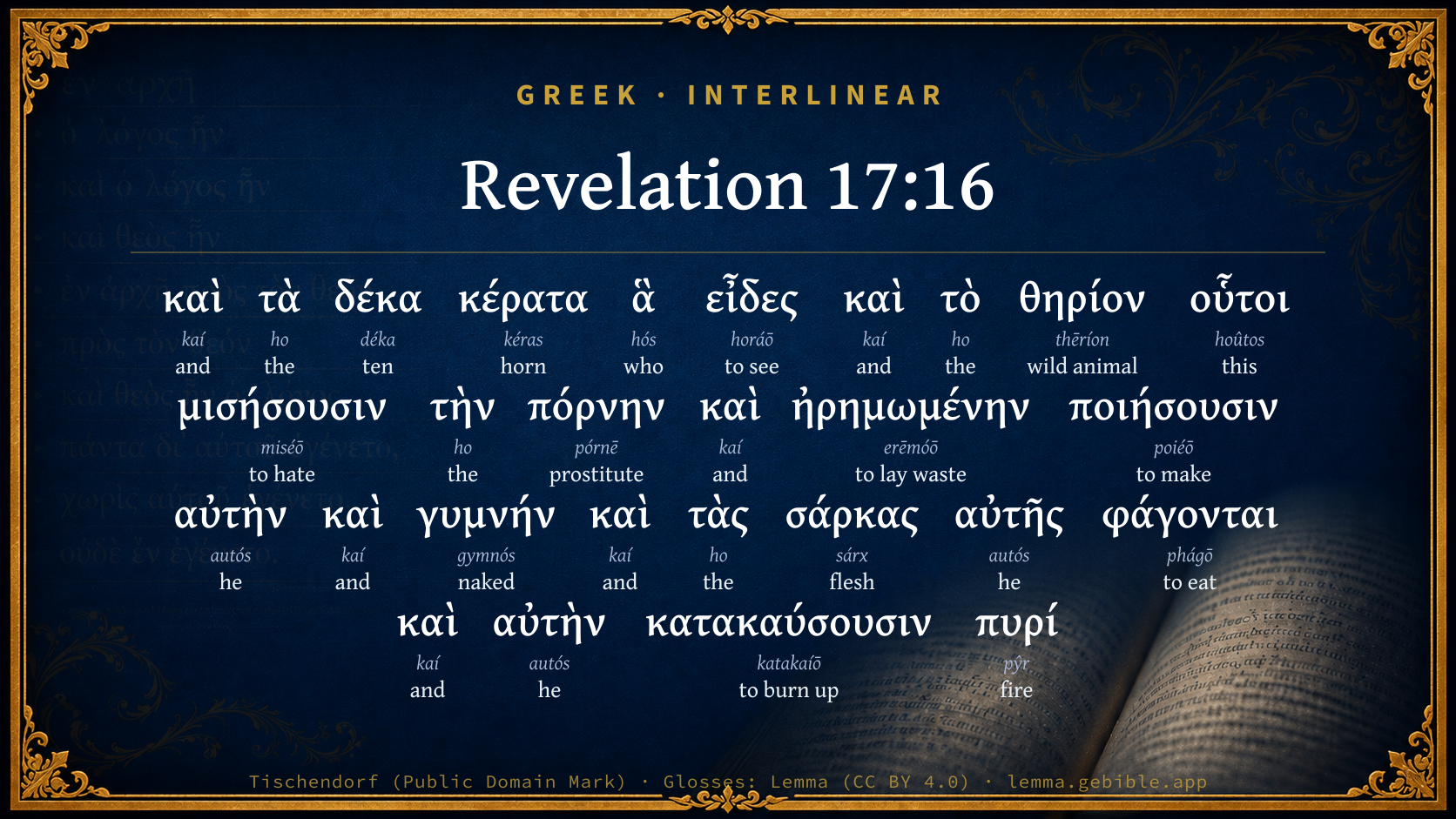
  1. καὶ kaí G2532 “and” Conjunction
  2. τὰ ho G3588 “the” Article, Nominative, Plural, Neuter
  3. δέκα déka G1176 “ten” Adjective, Numeral (indeclinable)
  4. κέρατα kéras G2768 “horn” Noun, Nominative, Plural, Neuter
  5. ἃ hós G3739 “who” Relative pronoun, Accusative, Plural, Neuter
  6. εἶδες horáō G3708 “to see” Verb, Aorist, Active, Indicative, 2nd person, Singular
  7. καὶ kaí G2532 “and” Conjunction
  8. τὸ ho G3588 “the” Article, Nominative, Singular, Neuter
  9. θηρίον thēríon G2342 “wild animal” Noun, Nominative, Singular, Neuter
  10. οὗτοι hoûtos G3778 “this” Demonstrative pronoun, Nominative, Plural, Masculine
  11. μισήσουσιν miséō G3404 “to hate” Verb, Future, Active, Indicative, 3rd person, Plural
  12. τὴν ho G3588 “the” Article, Accusative, Singular, Feminine
  13. πόρνην pórnē G4204 “prostitute” Noun, Accusative, Singular, Feminine
  14. καὶ kaí G2532 “and” Conjunction
  15. ποιήσουσιν poiéō G4160 “to make” Verb, Future, Active, Indicative, 3rd person, Plural
  16. αὐτὴν autós G846 “he” Personal pronoun, Accusative, Singular, Feminine
  17. καὶ kaí G2532 “and” Conjunction
  18. γυμνήν gymnós G1131 “naked” Adjective, Accusative, Singular, Feminine
  19. καὶ kaí G2532 “and” Conjunction
  20. τὰς ho G3588 “the” Article, Accusative, Plural, Feminine
  21. σάρκας sárx G4561 “flesh” Noun, Accusative, Plural, Feminine
  22. αὐτῆς autós G846 “he” Personal pronoun, Genitive, Singular, Feminine
  23. φάγονται phágō G5315 “to eat” Verb, Future, Middle deponent, Indicative, 3rd person, Plural
  24. καὶ kaí G2532 “and” Conjunction
  25. αὐτὴν autós G846 “he” Personal pronoun, Accusative, Singular, Feminine
  26. κατακαύσουσιν katakaíō G2618 “to burn up” Verb, Future, Active, Indicative, 3rd person, Plural
  27. πυρί pŷr G4442 “fire” Noun, Dative, Singular, Neuter

About this verse

These counts appear in no published source. They are computed here, from the morphology-tagged text and Lemma’s own curated glosses. What Lemma adds →

28
words
18
distinct lemmas
Revelation
section

Notable vocabulary

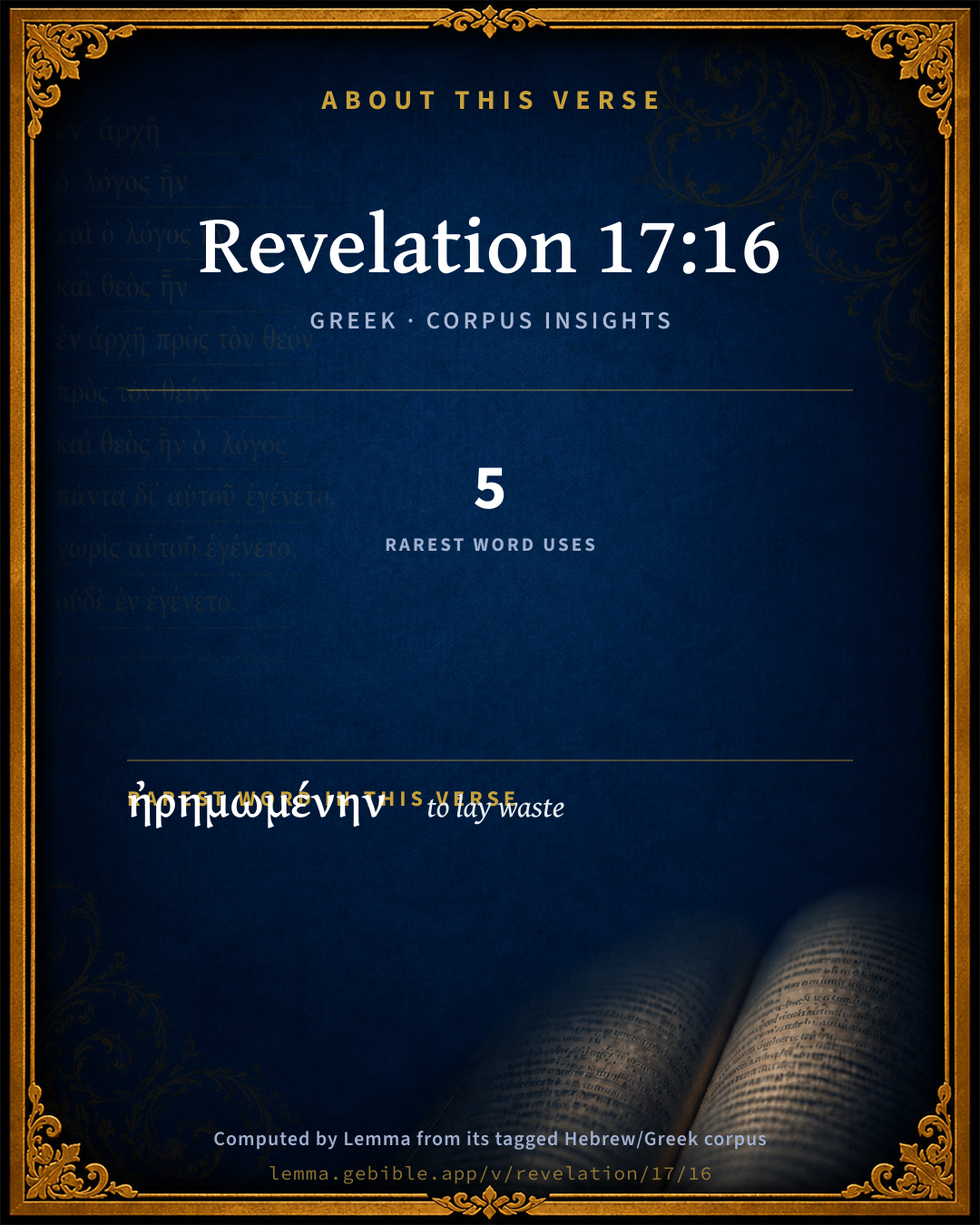
The rarest word here is ἠρημωμένην to lay waste G2049 — appearing just 5 times in the whole Greek New Testament.

Shared distinctive vocabulary

ἠρημωμένην to lay waste G2049 occurs in 5 verses of the Greek New Testament. Also found in:

Repetition

Words recur within this verse:

Cross-references

16

Topical passages linked to Revelation 17:16 in the Treasury of Scripture Knowledge — connected by theme and wording, ordered by reader-vote popularity; previews shown in the World English Bible.

  • Revelation 18:8 Therefore in one day her plagues will come: death, mourning, and famine; and she will be utterly burned with fire; for the Lord God who has judged her is strong.
  • Ezekiel 16:37–44 therefore see, I will gather all your lovers, with whom you have taken pleasure, and all those who you have loved, with all those who you have hated; I will even gather them against you on every side, and will uncover your nakedness to them, that they may see all your nakedness.
  • Leviticus 21:9 "'The daughter of any priest, if she profanes herself by playing the prostitute, she profanes her father: she shall be burned with fire.
  • Jeremiah 50:41–42 Behold, a people comes from the north; and a great nation and many kings shall be stirred up from the uttermost parts of the earth.
  • Revelation 17:1–2 One of the seven angels who had the seven bowls came and spoke with me, saying, "Come here. I will show you the judgment of the great prostitute who sits on many waters,
  • Revelation 18:16–17 saying, 'Woe, woe, the great city, she who was dressed in fine linen, purple, and scarlet, and decked with gold and precious stones and pearls!
  • Ezekiel 23:45–49 Righteous men, they shall judge them with the judgment of adulteresses, and with the judgment of women who shed blood; because they are adulteresses, and blood is in their hands.
  • Revelation 18:19 They cast dust on their heads, and cried, weeping and mourning, saying, 'Woe, woe, the great city, in which all who had their ships in the sea were made rich by reason of her great wealth!' For in one hour is she made desolate.
  • Daniel 7:5 Behold, another animal, a second, like a bear; and it was raised up on one side, and three ribs were in its mouth between its teeth: and they said thus to it, Arise, devour much flesh.
  • Revelation 16:12 The sixth poured out his bowl on the great river, the Euphrates. Its water was dried up, that the way might be made ready for the kings that come from the sunrise.
  • Revelation 17:10 They are seven kings. Five have fallen, the one is, the other has not yet come. When he comes, he must continue a little while.
  • Revelation 17:12–13 The ten horns that you saw are ten kings who have received no kingdom as yet, but they receive authority as kings, with the beast, for one hour.
  • Revelation 19:18 that you may eat the flesh of kings, the flesh of captains, the flesh of mighty men, and the flesh of horses and of those who sit on them, and the flesh of all men, both free and slave, and small and great."
  • Job 31:31 If the men of my tent have not said, 'Who can find one who has not been filled with his meat?'
  • Psalms 27:2 When evil-doers came at me to eat up my flesh, Even my adversaries and my foes, they stumbled and fell.
  • Isaiah 13:17–18 Behold, I will stir up the Medes against them, who shall not regard silver, and as for gold, they shall not delight in it.

Cross-references courtesy of OpenBible.info (CC BY 4.0).

Where the printed editions differ

1 variant

Places in this verse where the major printed Greek editions disagree on the wording in a way that affects the translation — a comparison of editions, not a manuscript-by-manuscript collation. The editions are the modern critical texts (Nestlé-Aland 28/27, SBL, Westcott-Hort, Tregelles, Tyndale House) and the traditional texts behind the KJV (the Textus Receptus and the Byzantine/Majority text). It is not a claim about which reading is original.

  1. Different wording
    καὶ

    “and”

    In NA28NA27TynSBLWHTregByz Not in TR

    ἐπὶ (epi) 'upon' occurs in traditional manuscripts (TR) instead of καὶ (kai) 'and' in older manuscripts (NA28+NA27+Tyn+SBL+WH+Treg+Byz)

Textual data: Translators Amalgamated Greek New Testament (STEPBible TAGNT) · CC BY 4.0.

Commentary

Notes on Revelation 17:16 from classic Christian and Jewish commentators (each source and its license shown beneath its notes). The classic Christian expositions comment on the surrounding passage and are grouped to its opening verse, so a note may address several verses; the Jewish commentaries on the Tanakh (Rashi and others) are per-verse, so they appear only where the commentator wrote on this verse.

Lemma curates 59 commentaries, every one of them public domain or Creative Commons licensed, each selected and text-cleaned for this edition rather than reprinted as found. About our sources →

John Gill's Exposition

And the ten horns which thou sawest upon the beast,.... Rev 17:3 and which are interpreted of ten kings, Rev 17:12. The Alexandrian copy, the Complutensian edition, and the Syriac Arabic, and Ethiopic versions, read, "and the beast"; and then the sense is, that the ten kings and states in particular, who have defended antichrist, and the whole empire in general, which has bore up and supported the whore of Rome:

these shall hate the whore; her principles and sentiments, her doctrines, which are doctrines of devils, her wicked practices, her idolatries, adulteries, murders, and thefts; they will repent of their fornications with her, and cease from them; their love will be turned to hatred, and the latter will be greater than ever the former was, like Amnon's to Tamar; and as it usually is with men towards harlots, when they see their follies, and how they have been deceived and abused by them:

and shall make her desolate; leave her, quit her communion; no more commit fornication with her, or join with her in her idolatrous worship; but come out from that apostate church, and renounce all fellowship with her, and persuade and engage as many as they can influence to do the same:

and naked; strip her of her purple, scarlet colour, gold, pearls, and precious stones; cease to give their power and strength, withhold their taxes and tribute, deprive her of her power and authority, civil and ecclesiastical, in their realms, and take away even her patrimony from her; and not only so, but expose her shame and filthiness, her abominable principles and practices, to all the world; which has been in part done already:

and shall eat her flesh; not literally, but mystically; not out of love, but hatred; they shall take that to themselves, and make use of, which have fattened her, as bishoprics, and other benefices, lands, endowments belonging to abbeys, and monasteries, and other religious houses; an instance and example of which we have in King Henry the Eighth's time; so some understand this phrase of devouring the substance of others, in Psa 27:2. So the Targumists often interpret "flesh and fatness"; by "riches, goods", or substance; the phrase in Isa 17:4 "the fatness of his flesh shall wax lean", is paraphrased, , "the riches of his glory shall be carried away"; and the words in Mic 3:3 who shall also eat the flesh of my people", &c. are rendered, "and they who spoil" , "the goods", or "substance of my people, and take away their precious mammon, or money, from them. And again, Zac 11:9 "let the rest eat, everyone the flesh of another", is in the Targum, "let a man spoil" "the goods or substance of his neighbour"; and in Rev 17:16 he shall eat the flesh of the fat; the paraphrase is, "he shall" spoil "the goods or substance of the rich".

And burn her with fire: alluding to the law in Lev 21:9 which required that the daughter of a priest, that played the whore, should be burnt with fire; and this is to be understood literally of burning the city of Rome, the seat of the whore, with fire; of which see Rev 18:8. It has been very near being burnt in times past, as by Alaricus the Goth, Attila the Hun, Genseric the Vandal, and by Totilas, and in later times by Charles the Fifth; and would have been, had they not been dissuaded or diverted from it; and which were so many preludes and warnings of its future fate: and we may learn from hence, that Rome, and the Romish antichrist, will not be destroyed by the Turks, but by the Christians; and by the same states, and kingdoms, and princes, by which the whore of Rome has been supported in her grandeur, power, and authority, who will revolt from Popery, and embrace the pure Gospel of Christ: and this shows, that the ten horns, or kingdoms, into which the Roman empire has been divided, will subsist in this form at the destruction of Rome; wherefore, it has been rightly observed by some, that not one of these kingdoms shall ever be able to rise to universal monarchy. France has been for many years attempting it, but in vain; and we may sit down easy and satisfied, assuring ourselves with the greatest confidence, that all attempts this way will be fruitless; there never will be another universal monarchy on earth but that of Christ's; see Dan 2:37.

John Gill's Exposition of the Whole Bible (1746–1763) — public domain (CC PDM 1.0). Text via the HelloAO Bible API.

Bengel's Gnomon

Johann Albrecht Bengel

Rev 17:16. Κέρατα, horns) The mention of the ten horns before the beast teaches, that the prevailing party in this most hostile laying waste of the harlot shall be parts of the horns: for even αὐτῶν, of them, Rev 17:17. has reference to the horns rather than to the beast.—καὶ τὸ θηρίον[192]) Erasmus edited, ἐπὶ τὸ θηρίω, and the editors who usually follow him, follow him here also; although Andreas of Cæsareia even by himself refutes this reading, which is made up from Latin copies of an inferior character. See App. Crit. Ed. ii. on this passage. This sentence indeed,—And the ten horns which thou sawest, καὶ, and [not ἐπὶ, upon, as in Engl. Vers.], the beast, these shall hate the whore,—is very plain, comprising, as it does, the horns and the beast by the word οὗτοι, these; and it is most accommodated to that most weighty sense, which it and it alone conveys, namely, that not only the ten horns, but even the beast himself (by which view Protestants are freed from the most invidious suspicion of sounding the trumpet against Rome), are about to hate the whore. It was provided by Divine government, that the Apocalypse should be published at Complutum, in the midst of Spain, before the Reformation, in a very genuine form, especially in the strictures, which attack Rome. And in this passage the Complutensian Edition both exhibits the reading, καὶ τὸ θηρίον, and marks it with a point, as a sign of approbation. And almost all the copies agree. The collation of so many MSS. would be useless, if the true reading even of such passages were indefinitely postponed, or at least left in doubt. By this one thing Wolf confirms my opinion in almost all the passages, in which he dissents from me.—τὴν πόρνην, the whore) A question arises, whether the beast, ascending out of the bottomless pit, first carries on war against the two witnesses (comp. Erkl. Offenb. p. 546), or lays waste Babylon. He first, as it seems, destroys Babylon, when the kingdom has as yet scarcely been given to him by the ten horns; then, having left that station, he pours out his whole fury upon the sacred city, and soon afterwards with his followers incurs final destruction. For both upon the ascent of the two witnesses into heaven, when the multitude repented after the earthquake [ch. Rev 11:13], the mystery of GOD is fulfilled: and the ten horns give their kingdom unto the beast, until the words of GOD are fulfilled.—καὶ αὐτὴν, and herself) This is emphatic, in antithesis to the flesh, and the resources of the whore.

[192] So AB Vulg. h Memph. Syr. But Rec. Test, ἐπὶ τὸ θήριον, without good authority.—E.

Bengel's Gnomon of the New Testament — English translation (T&T Clark, Edinburgh, 1860) — public domain. Text from a community e-Sword module.

Expositor's Greek Testament

ed. W. Robertson Nicoll

Rev 17:16 . Rome perishes at the hands of Nero and his ruthless allies a belief loudly echoed in the Talmud. In Sib. Or. iv. 145, 350 f. the East then and thus regains the treasures of which the Oriental provinces had been despoiled. γυμνήν … πυρί the doom of a Semitic harlot (Eze 23:45 f., Eze 28:17-18 ). But no details of the disaster are given.

The Expositor's Greek Testament, edited by W. Robertson Nicoll (1897–1910) — public domain. Text from a community e-Sword module.

Geneva Bible (1599)

Geneva Bible translators

The ten Kings as verse 12. The accomplishment of this fact and event, is daily increased in this our age by the singular providence and most mighty government of God. Wherefore the facts are propounded in this verse, and the cause of them in the verses following.

Geneva Bible (1599) marginal notes — public domain. Text via Bolls.life.

Jamieson, Fausset & Brown

Robert Jamieson, A. R. Fausset & David Brown

upon the beast--But A, B, Vulgate, and Syriac read, "and the beast."

shall make her desolate--having first dismounted her from her seat on the beast (Rev 17:3).

naked--stripped of all her gaud (Rev 17:4). As Jerusalem used the world power to crucify her Saviour, and then was destroyed by that very power, Rome; so the Church, having apostatized to the world, shall have judgment executed on her first by the world power, the beast and his allies; and these afterwards shall have judgment executed on them by Christ Himself in person. So Israel leaning on Egypt, a broken reed, is pierced by it; and then Egypt itself is punished. So Israel's whoredom with Assyria and Babylon was punished by the Assyrian and Babylonian captivities. So the Church when it goes a-whoring after the word as if it were the reality, instead of witnessing against its apostasy from God, is false to its profession. Being no longer a reality itself, but a sham, the Church is rightly judged by that world which for a time had used the Church to further its own ends, while all the while "hating" Christ's unworldly religion, but which now no longer wants the Church's aid.

eat her flesh--Greek plural, "masses of flesh," that is, "carnal possessions"; implying the fulness of carnality into which the Church is sunk. The judgment on the harlot is again and again described (Rev 18:1; Rev 19:5); first by an "angel having great power" (Rev 18:1), then by "another voice from heaven" (Rev. 18:4-20), then by "a mighty angel" (Rev 18:21-24). Compare Eze 16:37-44, originally said of Israel, but further applicable to the New Testament Church when fallen into spiritual fornication. On the phrase, "eat . . . flesh" for prey upon one's property, and injure the character and person, compare Psa 14:4; Psa 27:2; Jer 10:25; Mic 3:3. The First Napoleon's Edict published at Rome in 1809, confiscating the papal dominions and joining them to France, and later the severance of large portions of the Pope's territory from his sway and the union of them to the dominions of the king of Italy, virtually through Louis Napoleon, are a first instalment of the full realization of this prophecy of the whore's destruction. "Her flesh" seems to point to her temporal dignities and resources, as distinguished from "herself" (Greek). How striking a retribution, that having obtained her first temporal dominions, the exarchate of Ravenna, the kingdom of the LOMBARDs, and the state of Rome, by recognizing the usurper Pepin as lawful king of France, she should be stripped of her dominions by another usurper of France, the Napoleonic dynasty!

burn . . . with fire--the legal punishment of an abominable fornication.

Jamieson, Fausset & Brown — Commentary Critical and Explanatory on the Whole Bible (1871) — public domain (CC PDM 1.0). Text via the HelloAO Bible API.

Adam Clarke's Commentary

Verse 16. And the ten horns which thou sowest upon the beast, these shall hate the whore, and shall make her desolate and naked, and shall eat her flesh, and burn her with fire.] Here is a clue to lead us to the right interpretation of the horns of the beast. It is said the TEN horns shall hate the whore; by which is evidently meant, when connected with what follows, that the whole of the ten kingdoms in the interest of the Latin Church shall finally despise her doctrines, be reformed from popery, assist in depriving her of all influence and in exposing her follies, and in the end consign her to utter destruction. From this it follows that no Roman Catholic power which did not exist so late as the Reformation can be numbered among the horns of the beast; the horns must, therefore, be found among the great states of Europe at the commencement of the Reformation. These were exactly ten, viz., France, Spain, England, Scotland, The Empire, Sweden, Denmark, Poland, Hungary, and Portugal. In these were comprehended most of the minor states not styled monarchies, and which, from their first rise to the period of the Reformation, had been subdued by one or more of the ten grand Roman Catholic powers already named. Consequently, these ten constituted the power and strength of the beast; and each minor state is considered a part of that monarchy under the authority of which it was finally reduced previously to the Reformation.

But it may be asked, How could the empire, which was the revived head of the beast, have been at the same time one of its horns? The answer is as follows: Horns of an animal, in the language of prophecy, represent the powers of which that empire or kingdom symbolized by the animal is composed. Thus the angel, in his interpretation of Daniel's vision of the ram and he-goat expressly informs us that "the ram with two horns are the kings of Media and Persia." One of the horns of the ram, therefore, represented the kingdom of Media, and the other the kingdom of Persia; and their union in one animal denoted the united kingdom of Media and Persia, viz., the Medo-Persian empire. In like manner the beast with ten horns denotes that the empire represented by the beast is composed of ten distinct powers, and the ten horns being united in one beast very appropriately show that the monarchies symbolized by these horns are united together to form one empire; for we have already shown, in Clarke's notes on "Re 13:1", that a beast is the symbol of an empire. Therefore, as the horns of an animal, agreeably to the angel's explanation, (and we can have no higher authority,) represent all the powers of which that domination symbolized by the animal is composed, the Roman empire of Germany, as one of those monarchies which gave their power and strength to the Latin empire, must consequently have been A HORN of the beast. But the Germanic empire was not only a LATIN power, but at the same time was acknowledged by all Europe to have precedency of all the others. Therefore, as it is not possible to express these two circumstances by one symbol, it necessarily follows, from the nature of symbolical language, that what has been named the holy Roman empire must have a double representation. Hence the empire, as one of the powers of the Latin monarchy, was a horn of the beast, and in having precedency of all the others was its revived head. See a similar explanation of the tail of the dragon in Clarke's notes on "Re 12:4".

Adam Clarke's Commentary on the Bible (1810–1826) — public domain. Text from a community e-Sword/MySword module.

Ellicott's Commentary for English Readers

(16) And the ten horns . . .—Translate, And the ten horns which thou sawest (not, as in English version, “on the beast,” but), and the wild beast, these shall hate the harlot. The harlot was seen in splendid apparel riding on the wild beast; now the wild beast, in the day of the seventh head, turns with the ten horns of his power upon her, makes her deserted, strips her of her adornments, consumes the spoil—for this is what is meant by “eating her flesh”—and burns her with fire. The woman in the days of the Evangelist was Rome (Rev_17:18), but great and resistless as her power seemed, it was doomed; the day would come when other kingdoms would rise who would hate her for her tyranny, envy her splendour, and covet her wealth. Then the great Babylon would fall, like Jezebel of old; the painted cheek, the pencilled eyebrow, and the amorous glance have lost their fascination; those who have pandered to her vices would turn against her, and cast her out to be trampled under foot. So did the Babylon of St. John’s day fall—perishing in the blood that she had spilt, or left “childless and crownless in her voiceless woe.”

A Bible Commentary for English Readers, edited by Charles John Ellicott (1878–1897) — public domain. Text from a community e-Sword module.

The Cambridge Bible for Schools and Colleges

gen. ed. J. J. S. Perowne

16. upon the beast] Read, and the beast: he (in his personal advent) and they will act together, against Babylon as well as against the Lamb.

shall hate the whore] Though she had been the object of their unchaste love, Rev_17:2, and will be of their passionate regret, Rev_18:9. Nero’s treatment of his mistress or wife Poppaea cannot be alluded to, but is a good illustration of the image, and vindication of its consistency with vicious human nature.

naked] Cf. Isa_47:2-3; Eze_16:37-39.

eat her flesh, and burn her with fire] i.e. shall plunder and burn Rome. The threat was symbolised and almost fulfilled in the burning of the Capitol by the partisans of Vitellius, and the storming of Rome by those of Vespasian: it received a more complete fulfilment in the repeated disasters of the fifth century. The sack of Rome by Bourbon and the Germans was a less striking fulfilment: but the real and final one is no doubt still to come.

We should naturally understand from these words, that the judgement on Babylon described in the next chapter will be executed by the “kings of the earth,” the ten States among which the Roman Empire is partitioned. But it is almost as remarkable as the view of Hippolytus noted on Rev_17:12, that St Benedict is recorded (S. Greg. Dial. ii. 15) to have said, “Rome will not be destroyed by the nations, but be overthrown by thunderstorms, whirlwinds and earthquakes.” We know what he did not, that Rome stands, like Pompeii, on volcanic soil, within a few miles of volcanos that, though not active now, were so to the verge of historical times, and may be again. This book does not tell us positively how Babylon will fall, and no one has the right to pretend to say: but it is at least suggestive to know that it might fall by a convulsion which unbelievers would think quite “natural,” while believers would see its place in the scheme of providence.

The Cambridge Bible for Schools and Colleges (gen. ed. J. J. S. Perowne; Cambridge University Press, 1878–1918) — public domain. Text from a community e-Sword module.

Trapp's Complete Commentary

John Trapp

16 And the ten horns which thou sawest upon the beast, these shall hate the whore, and shall make her desolate and naked, and shall eat her flesh, and burn her with fire.

Ver. 16. These shall hate] As base fellows use to hate their harlots when they find them false.

And shall make her desolate] Shall deny to defend her.

And naked] By denying her maintenance, and laying her open to the world by their remonstrances. King Henry VIII and the French king, some half a year before their death, were at a point to have utterly rooted the bishop of Rome out of their realms, and to exhort the emperor to do the same, or else to break off from him. The realm of France was ready (upon the pope’s refusal to rebless King Henry IV upon conversion to them) to withdraw utterly from the obedience of his See, and to erect a new patriarch over all the French Church. The then archbishop of Burges was ready to accept it; and but that the pope, in fear thereof, did hasten his benediction, it had been effected, to his utter disgrace and decay. (Spec. Europ.)

And shall eat her flesh] Be so bitterly bent against her, that they could find in their hearts to tear her with their teeth. See Job 19:22. We read of two notable thieves in the kingdom of Naples (the one called himself Pater noster, and the other Ave Maria) that had slain 116 men at different times and in different places. These two were at length taken and tormented to death by the command of the magistrate, with hot burning pincers, &c., and made to die piecemeal. It were but reason that Christian princes should use like zeal and severity against that grand soul-murderer the pope.

And burn her with fire] For an old bawd. {a} It is reported that in Meroe, the priests of Jupiter had so bewitched the people with their superstition, that they would sometimes send to the king of Ethiopia for his head; which was never denied them, till it came to King Erganes, who upon so insolent a demand slew them all, and took away their priesthood. Why is not the same now done to the bridge maker of Rome?

{a} fig. He who or that which panders to any evil design or vicious practice. ŒD

John Trapp, A Commentary or Exposition upon All the Books of the Old and New Testament (1647–1656) — public domain. Text from a community e-Sword module.

Albert Barnes' Notes on the Bible

And the ten horns which thou sawest upon the beast - Rev 17:3. The ten powers or kingdoms represented by those horns. See the notes on Rev 17:12.

These shall hate the whore - There seems to be some incongruity between this statement and what was previously made. In the former Rev 17:12-14, these ten governments are represented as in alliance with the beast; as “giving all their power and strength” unto it; and as uniting with it in making war with the Lamb. What is here said must, therefore, refer to some subsequent period, indicating some great change in their feelings and policy. We have seen the evidence of the fulfillment of the former statements. This statement will be accomplished if these same powers, represented by the ten horns, that were formerly in alliance with the papacy, shall become its enemy, and contribute to its final overthrow. That is, it will be accomplished if the nations of Europe, embraced within the limits of those ten kingdoms, shall become hostile to the papacy, and shall combine for its overthrow. Is anything more probable than this? France (see the notes on Rev. 16) has already struck more than one heavy blow on that power; England has been detached from it; many of the states of Italy are weary of it, and are ready to rise up against it; and nothing is more probable than that Spain, Portugal, France, Lombardy, and the papal States themselves, will yet throw off the yoke forever, and put an end to a power that has so long ruled over people. It was with the utmost difficulty, in 1848, that the papal power was sustained, and this was done only by foreign swords; the papacy could not probably be protected in another such outbreak. And this passage leads us to anticipate that the period will come - and that probably not far in the future - when those powers that have for so many ages sustained the papacy will become its determined foes, and will rise in their might and bring it forever to an end.

And shall make her desolate and naked - Strip her of all her power and all her attractiveness. That is, applied to papal Rome, all that is so gorgeous and alluring - her wealth, and pomp, and splendor - shall be taken away, and she will be seen as she is, without anything to dazzle the eye or to blind the mind.

And shall eat her flesh - Shall completely destroy her - as if her flesh were consumed. Perhaps the image is taken from the practice of cannibals eating the flesh of their enemies slain in battle. If so, nothing could give a more impressive idea of the utter destruction of this formidable power, or of the feelings of those by whom its end would be brought about.

And burn her with fire - Another image of total destruction. Perhaps the meaning may be, that after her flesh was eaten, such parts of her as remained would be thrown into the fire and consumed. If this be the meaning, the image is a very impressive one to denote absolute and total destruction. Compare the notes on Rev 18:8.

Albert Barnes' Notes on the Bible (1834–1885) — public domain. Text from a community e-Sword/MySword module.

Matthew Poole's English Annotations

And the ten horns which thou sawest upon the beast: see Rev 17:3,12.

These shall hate the whore, &c.; the ten kings shall apostatize from the papacy, and be great instruments of God to ruin it. When we see some other kingdoms, now in vassalage to the pope, do as much as hath been done in England, and Scotland, and Sweden, and some other places, we may possibly understand this prophecy better than we yet do.

Matthew Poole's English Annotations on the Holy Bible (1683–1685) — public domain. Text from a community e-Sword/MySword module.

Whedon's Commentary on the Bible

Daniel D. Whedon

16, 17. When the hour of one mind has passed, and the victories of the Lamb have multiplied, a new turn shall come. The ten horns shall begin to hate the whore. Her capital having been destroyed, her power diminished, her deceptions refuted, and her character exposed, she will be made desolate and naked.

Eat her flesh—The great body of her wealth and substance, of which the people have been robbed by false pretences, shall be appropriated to feed the poor.

Burn her with fire—The penalty of incest, Lev_20:14, and of unchastity in a priest’s daughter, Lev_21:9. In this woman the harlot shall be burnt away and the bride of Christ shall appear in her place.

His will—That she should be permitted to fill the measure of her iniquities.

The words of God—The prophetic predictions, especially of Daniel 7.

These ten horns, or kingdoms, have a wonderful significance in prophecy. They first appear in the ten toes of Daniel’s image, proceeding from the Roman legs of the image. Then they are verified and enlarged, Dan_7:7, as the ten horns growing from the head of the Roman beast, defined (ver. 33) as ten kings—kingdoms to be developed out of the Roman empire. Next we have the ten horns (with the seven heads) of the pagan-Roman dragon. This is repeated in the papal-Roman beast, Rev_13:1, reiterated Rev_17:1, and here, Rev_17:12, the ten horns are expressly defined as ten kings=kingdoms not yet organized, but which will come up from the Roman empire, and, first uniting with the Roman harlot, ultimately destroy her.

Looking into secular history for these ten nations, as emerging from the downfall of the old Rome, we are startled to find the constant tendency of the European nations to a decimal number. This is shown by earlier and later writers, Romish and Protestant. Elliott gives such lists by Jerome, Machiavelli, Bossuet, Mede, Sir Isaac Newton, and Bishop Newton. Elliott himself furnishes a list which seems preferable to any by his predecessors.

It stays within the Western Empire; it is posterior to the disappearance of the imperial power; it is made up of Teutonic governments; it contains a three which (in accordance with Daniel’s prophecy) impeded for awhile the growth of the power of the pope, but were finally abolished and made part of his patrimony. Elliott selects the year A.D. 531, and finds the following ten kingdoms on the platform of the Western Roman Empire: “the Anglo-Saxons; the Franks of Central, Allman Franks of Eastern, and Burgundian Franks of South-eastern France; the Visigoths, the Suevi, the Vandals, the Ostrogoths, in Italy; the Bavarians, and the Lombards—still ten in all.” Of these three were nigh and obstructive neighbours to the pope at Rome; namely, the Vandals in Corsica and Sardinia, the Ostrogoths in Central Italy, and the Lombards in Northern Italy. The Vandals and the Ostrogoths were conquered by the Eastern Emperor Justinian, erected into the Greek exarchate of Ravenna, and afterward given to the pope. Lombardy held out until the eighth century, an impediment to the papal power, when it was conquered by Charlemagne and given to the Roman See. These three kingdoms became “the patrimony of Peter.”

Elliott well notes that, in spite of frequent variations of number, ten has been the ever-recurring number of Europe ever since. To this effect he quotes Gibbon, Whiston, and Cunninghame. To these we may add that Schlegel, a convert to Romanism, in his “Philosophy of History,” (re-published by Appleton,) about forty years ago reckoned ten kingdoms as constituting the modern system of Europe.

But apocalyptic thought makes provisions for world-wide extensions as time advances. The local Jerusalem, symbolized as the true Church, becomes universal, and so Babylon, as the anti-Church. The Roman-papal beast expressly includes all the preceding anti-christianities in her descent to perdition. Note Rev_17:11. As the apocalypse draws toward its close its geographical area seems to enlarge from the limits of the Roman empire to the entire surface of our globe. The “nations” of Rev_19:15, and Rev_20:3; Rev_20:8, and “the kings of the earth” of Rev_19:19, must be taken in their widest extension; and it is the whole human race of all ages that finally appears before the throne, Rev_20:11. And we seem easily bridged over this enlarging process by the double meaning (specified in our Introduction) of the word “ten.” From its literal count of the nations of the Roman empire it may emerge into its symbolical universality, and become truly world-wide. In this full sense the people of America are of the ten nations. And all the peoples of both hemispheres are clearly included in “the nations” after the ten is dropped.

Daniel D. Whedon (gen. ed.), Commentary on the Old and New Testaments (1874–1909) — public domain. Text from a community e-Sword module.

The Pulpit Commentary

And the ten horns which thou sawest upon the beast; and the ten horns which thou sawest, and the beast. There is no authority for the epi to yhrion of Erasmus except the Vulgate, in bestia, and, of course, the description given of the beast. (Rev_13:1, etc,) The two are spoken of separately, on account of the separate jurisdiction wielded according to vers. 32, 13. These shall hate the whore, and shall make her desolate and naked, and shall eat her flesh, and burn her with fire; and shall burn her utterly with fire (Revised Version). These words describe the fate in store for the faithless portion of the Church. That world, to which she trusts, shall turn and rend her a fitting sequel to her want of faith in the power of Christ. This is exactly the description given of the harlot in Eze_16:37. (cf. also Eze_23:22) "Eat her flesh" and "burn with fire" both describe similar results; possibly the one is thought of in connection with the symbol of "harlot," the other with the symbol of "city," with which the harlot is identical. (see on ver. 5; but see Gen_38:24 Lev_21:9; cf. also the judgment upon the wicked rich in Jam_5:3, "shall eat your flesh as it were fire

Vers. 16, 17 2Pe_1:19, Revised Version)

III THERE WILL BE JUDGMENTS AND PLAGUES THAT WILL CONSUMMATE HER RUIN, (Rev_18:8, 10 16:18-21) Regularity and continuity combine with catastrophe to advance the world. There is a long period of orderly, even, and regular sequents. Then there comes an upheaving, and effects in one hour that for which ages have been preparing the way. In the blasting of rocks we see the slow boring and undermining; then the laying of the train of powder. So far all is done deliberately. Then a match is applied; a spark is fired; there is a moment of suspense; then a small curling wreath of smoke, followed in an instant by a mighty blast, and lo! the rock is rent, and reels and falls. So there are wondrous works going on unobserved in the bowels of the earth that storehouse of molten flame. For years the crust is undisturbed; then comes one mighty heaving, and lo! in one awful moment cities and palaces, temples and towers, are overthrown. So shall it be at last with Babylon the great. The issue alone can explain the detail. But some six or seven words are sufficiently significant great earthquake"; (Rev_16:18) "a great hail"; (Rev_16:21) "death, and mourning, and famine," "plagues"; (Rev_18:4-8) "burned with fire"; (Rev_18:8) and at the last her judgment shall come "in one hour". (Rev_18:10)

IV THE ATTENDANTS OF HER RUIN WILL BE RETRIBUTION AND DESOLATION, Retribution; for she is to be rewarded as she rewarded others. She trifled with and even trampled on the temporal powers in time past, and now of her temporal power she herself is shorn. Desolation: the description of this is taken from the corresponding passages in Isaiah and Jeremiah concerning Babylon of old. (Isa_13:19-22 Jer_51:37) Those words have come to be literally fulfilled. Like words are on record concerning papal Rome. They too will be fulfilled. The time will come when no priests shall minister at her altars. The walls of her mighty temples will be shattered, and the shrieks of many an unclean bird shall reverberate from column to column of her dilapidated pile. "Thus terribly shall Babel fall, Thus and no more be found at all!

Note:

1. The amazing extent of the dominion of papal Rome may well fill us with wonder. It is terrible indeed to see this harlot committing fornication with the kings of the earth, seated upon many waters, intoxicating the nations with her greatness, and carrying her corruptions and abominations to the ends of the earth. But all is forewritten, that we might not be alarmed, however we may be distressed. Therefore:

2. We ought not to be dismayed, as if some calamity had unawares befallen the world. It has not come otherwise than was foretold to the apostle in Patmos. The fourteen outlines of the ground plan described in the preceding homily show an exact correspondence between the Word of God and the events of history.

3. Nor should we fear for the final issue. The word which forecast Babylon"s rise has foretold its fall.

4. Meanwhile, be it ours not to be caught by appearances. To this day the harlot is bedecked and bedizened in gold and silver and precious stones. Her pomp and pride and the prestige of her ancient date charm many into a blind compliance with her amours. Many wish to drink of the golden cup which is in her hand. But ah! even apostasy may be covered with pearls, and the beast may be clad in scarlet. What is beneath?

5. Even when, however, the fall of Babylon the great shall come, that will not be the end; one more conflict will await the Church. The ten horns that have turned round on the harlot will make war with the Lamb. There will remain the war between the beast and the King of kings and Lord of lords.

6. Therefore, finally, be it ours to be among those who are with Christ, and to whom the three epithets may be fitly applied "chosen," and "faithful." All tawdry show and carnal blaze are doomed. Only what is true and real will live on unharmed for ever. Laus Deo!

The Pulpit Commentary (1880–1919), ed. H.D.M. Spence-Jones & Joseph S. Exell — public domain. Text from a community e-Sword module.

John Wesley's Explanatory Notes

And shall eat her flesh - Devour her immense riches.

John Wesley, Explanatory Notes Upon the Whole Bible (1754–1765) — public domain. Text via the GEBible commentary corpus.

The People's New Testament

B. W. Johnson

16–18. The ten horns … shall hate the harlot. At a later period still, the ten horns shall hate and desolate the harlot. We have seen this fulfilled in the fact that the kingdoms that have been developed from these have in the last three centuries either become Protestant, or have broken with Roman rule. The historical facts given under the seven vials show how they have waged war on Rome.

B. W. Johnson's The People's New Testament with Notes (1889–1891) — public domain. Electronic text from the Christian Classics Ethereal Library (CCEL) ThML edition.

unfoldingWord translationNotes

Door43 World Missions Community

make her desolate and naked

"steal everything that she has and leave her with nothing"

they will devour her flesh

Destroying her completely is spoken of as eating all her flesh. "They will destroy her completely" (See: Metaphor)

For God has put it into their hearts to carry out his purpose by agreeing to give ... until God's words are fulfilled

They would agree to give their power to the beast, but it would not be that they want to obey God. AT: "For God has put it into their hearts to agree to give ... until God's words are fulfilled, and by doing this, they would carry out God's purpose"

God has put it into their hearts

Here "heart" is a metonym for desires. Making them want to do something is spoken of as putting it in their hearts to do it. AT: "God has made them want" (See: Metonymy and Metaphor)

power to rule

"authority" or "kingly authority"

until God's words are fulfilled

This can be stated in active form. AT: "until God fulfills what he said will happen" (See: Active or Passive)

translationWords

beast

prostitute

desolate

devour

flesh

fire

God

heart

power

word of God

fulfill

unfoldingWord translationNotes — © Distant Shores Media and the Door43 World Missions Community, licensed CC BY-SA 4.0. Source: git.door43.org/Door43/en_tn.

Cambridge Greek Testament for Schools and Colleges

16. ἐν πυρί. Tisch[614] omits ἐν with אB2P

[614] Tischendorf: eighth edition; where the text aud notes differ the latter are cited.

16. καὶ τὸ θηρίον. He (in his personal advent) and they will act together against Babylon as well as the Lamb.

μισήσουσιν τὴν πόρνην. If the interpreters who include the horns among the kings of the earth are right, she had been the object of their unchaste love, and will be of their passionate regret, Rev 18:9. Nero’s treatment of his mistress or wife Poppaea cannot be alluded to, but is a good illustration of the image, and vindication of its consistency with vicious human nature.

γυμνήν. Cf. Isa 47:2-3; Eze 16:37-39.

τὰς σάρκας αὐτῆς φάγονται, καὶ αὐτὴν κατακαύσουσιν ἐν πυρί. Cf. Mic 3:2; Gen 38:24; Jdg 15:6; i.e. shall plunder and burn Rome. The threat was symbolised and almost fulfilled in the burning of the Capitol by the partisans of Vitellius, and the storming of Rome by those of Vespasian: it received a more complete fulfilment in the repeated disasters of the fifth century. The sack of Rome by Constable Bourbon and the Germans was a less striking fulfilment: but the real and final one is no doubt still to come.

We should naturally understand from these words, that the judgement on Babylon described in the next chapter will be executed by the “kings of the earth,” the ten States among which the Roman Empire is partitioned. But it is almost as remarkable as the view of Hippolytus noted on Rev 17:12, that St Benedict is recorded (S. Greg. Dial. II. 15) to have said, “Rome will not be destroyed by the nations, but be overthrown by thunderstorms, whirlwinds and earthquakes.” We know what he did not, that Rome stands, like Pompeii, on volcanic soil, within a few miles of volcanoes that, though not active now, were so to the verge of historical times, and may be again. This book does not tell us positively how Babylon will fall, and no one has the right to pretend to say: but it is at least suggestive to know that it might fall by a convulsion which unbelievers would think quite “natural,” while believers would see its place in the scheme of providence.

Cambridge Greek Testament for Schools and Colleges (Cambridge University Press, 1896; 21 vols, various authors incl. Carr, Maclear, Plummer, Farrar, Lumby, Moule, M. R. James, Simcox) — public domain. Text from a community e-Sword module.

Vincent's Word Studies in the New Testament

Marvin R. Vincent

Upon the beast [επι] . Read kai and : "the ten horns - and the beast."

Desolate [ηρημωμενην] . Lit., desolated, the verb being in the perfect participle.

Shall eat her flesh. A token of extreme hostility. See Psa 27:2; Mic 3:3. Xenophon, speaking of the hatred between the pure Spartans and the Helots, says that no one of the pure Spartans could conceal his readiness to eat the Helot raw. Notice the plural sarkav flesh, and see on Jas 5:3.

Burn [κατακαυσουσιν] . Rev., giving the force of kata down, burn utterly. According to some interpreters the figure is changed from the woman to a city; but this is unnecessary, as the language is probably taken from the punishment of fornication on the part of a priest 's daughter (Lev 21:9; compare Lev 20:14).

Marvin R. Vincent, Word Studies in the New Testament (1887–1900) — public domain. Text from a community e-Sword/MySword module.

Lesson kit

Teaching starters — assembled from the data on this page, not authored interpretation. Every prompt links to the verse data it draws on. Edit before teaching.

Revelation, in the Revelation, opens this verse with 28 words (18 distinct Greek lemmas). Its most distinctive word is erēmóō (“to lay waste”). A historical commentator’s framing appears above. Read the whole chapter for the surrounding context.

Discussion questions

  1. What does “to lay waste” (erēmóō) contribute to the verse as a whole?
  2. Matthew 12:25 shares the word «to lay waste» with this verse. How do the two illuminate each other?
  3. “and” occurs 6× in this one verse. What is the effect of the repetition?
  4. These translations render this verse differently; the difference is in the English rendering, not the original. What questions does that raise?
  5. Reading how John Gill's Exposition and Bengel's Gnomon read this verse, where do the two commentators agree and where do they part?

Things to notice

Reading settings

Reading text

Shown beneath each verse's original-language words.

Old Testament
Old Testament edition

Read the OT as the Masoretic Hebrew (MT) or the Greek Septuagint (LXX).

English shown for the Greek Septuagint (in the Hebrew ↔ Greek comparison).

Comparing translations? Open the Compare panel on any verse page to stack up to four side by side.