1 Corinthians 10:18

Greek (Tischendorf 8th ed.) 1 Corinthians 10:18 appears in the Greek New Testament. The text above is from the Tischendorf 8th edition. Each word links to its Strong’s number and a concise gloss. Click any word for its full Thayer’s Greek Lexicon entry.
Download image
Cite this verse

1 Corinthians 10:18 (World English Bible). Public Domain. Lemma interlinear Bible study tool, https://lemma.gebible.app/v/1-corinthians/10/18.

Show BibTeX & RIS
BibTeX
RIS
English Translation
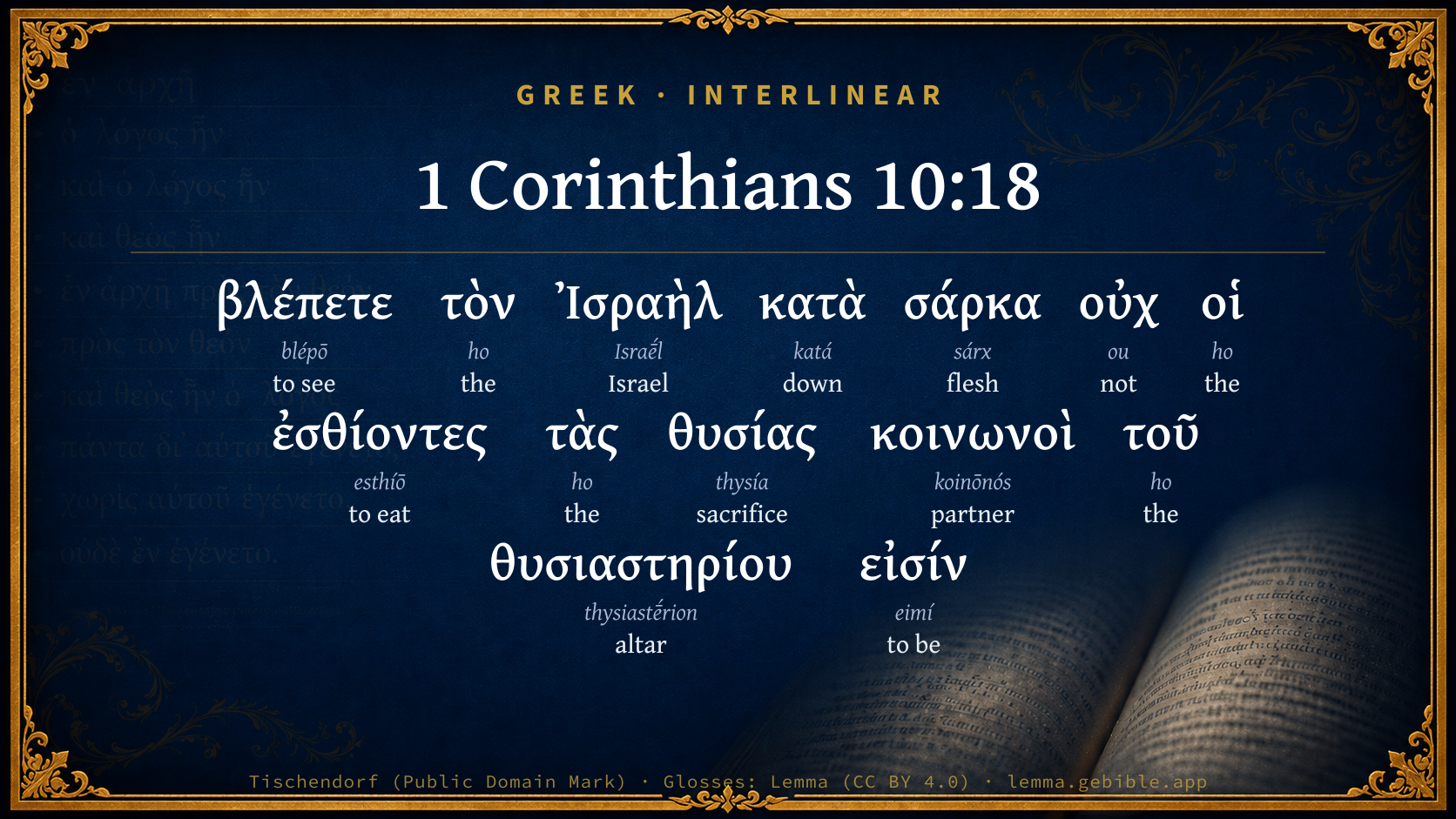
Consider Israel after the flesh. Don't those who eat the sacrifices have communion with the altar?
World English Bible · Public Domain
Download a study sheet

One document with this verse’s original text, its word-by-word gloss line, the meaning frame, cross-references with their text, attributed commentary, and full source and license credits — printable, and it pastes into notes with its structure intact.

This verse Autodidact and up

Study sheet (.html) Plain text (.txt)

A passage Seminary Student

Up to 50 verses in one chapter. A passage sheet keeps up to 6 commentary sources and 12 cross-references per verse, in the order this page ranks them, and says so on the sheet whenever that leaves anything out. Ask for a single verse and you get the Autodidact verse sheet above.

Everything on this page stays free to read, with no account — the sheet is a download of what is already on screen, not access to it.

Want to remove ads? Support Godless Engineer
Compare translations 3

The same verse in 3 English versions, stacked beneath the original-language interlinear above. Click any original word for its lexicon entry.

Each is an independent rendering of the whole verse — the interlinear is not word-aligned to these translations.

Highlighted words mark where these versions differ — a whole-verse word diff, not a word-by-word alignment.

  • World English Bible Public Domain
    Consider Israel after the flesh. Don't those who eat the sacrifices have communion with the altar?
  • King James Version Public Domain
    Behold Israel after the flesh: are not they which eat of the sacrifices partakers of the altar?
  • unfoldingWord Literal Text CC BY-SA 4.0
    Look at Israel according to the flesh; are not the ones eating the sacrifices partakers of the altar?

unfoldingWord Literal Text — © unfoldingWord, licensed CC BY-SA 4.0. Word-aligned USFM3 via Door43 (git.door43.org/unfoldingWord/en_ult).

Versions to compare (up to 4)

3 of 4 selected

Show all 19 translations

Every available English version of this verse, each an independent rendering of the whole verse.

  • World English Bible Public Domain
    Consider Israel after the flesh. Don't those who eat the sacrifices have communion with the altar?
  • Berean Standard Bible Public Domain
    Consider the people of Israel: Are not those who eat the sacrifices fellow partakers in the altar?
  • Majority Standard Bible Public Domain
    Consider the people of Israel: Are not those who eat the sacrifices fellow partakers in the altar?
  • King James Version Public Domain
    Behold Israel after the flesh: are not they which eat of the sacrifices partakers of the altar?
  • American Standard Version (1901) Public Domain
    Behold Israel after the flesh: have not they that eat the sacrifices communion with the altar?
  • Revised Version (1885) Public Domain
    Behold Israel after the flesh: have not they which eat the sacrifices communion with the altar?
  • Geneva Bible (1599) Public Domain
    Beholde Israel, which is after the flesh: are not they which eate of the sacrifices partakers of the altar?
  • Douay-Rheims (1899) Public Domain
    Behold Israel according to the flesh: are not they, that eat of the sacrifices, partakers of the altar?
  • Young's Literal Translation Public Domain
    See Israel according to the flesh! are not those eating the sacrifices in the fellowship of the altar?
  • Literal Standard Version CC BY-SA 4.0
    See Israel according to the flesh! Are those not eating the sacrifices in the fellowship of the altar?
  • Unlocked Literal Bible CC BY-SA 4.0
    Look at the people of Israel. Are not those who eat the sacrifices participants in the altar?
  • unfoldingWord Literal Text CC BY-SA 4.0
    Look at Israel according to the flesh; are not the ones eating the sacrifices partakers of the altar?
  • Darby Bible Public Domain
    See Israel according to flesh: are not they who eat the sacrifices in communion with the altar?
  • World Messianic Bible Public Domain
    Consider Israel according to the flesh. Don’t those who eat the sacrifices participate in the altar?
  • Webster's Bible Public Domain
    Behold Israel after the flesh: are not they who eat of the sacrifices, partakers of the altar?
  • Free Bible Version CC BY-SA 4.0
    Look at the people of Israel. Don't those who eat the sacrifices made on the altar share together?
  • Bible in Basic English Public Domain
    See Israel after the flesh: do not those who take as food the offerings of the altar take a part in the altar?
  • Text-Critical English NT CC BY 4.0
    Consider those who belong to Israel according to the flesh: Are they not united by eating the sacrifices of the altar?
  • Tyndale New Testament (1534) Public Domain
    Beholde Israhell which walketh carnally. Are not they which eate of the sacrifyse partetakers of the aultre?

Literal Standard Version (2020), Covenant Press — licensed CC BY-SA 4.0. Text via the HelloAO Bible API (eBible.org). Unlocked Literal Bible (unfoldingWord) — licensed CC BY-SA 4.0. Text via the HelloAO Bible API (eBible.org). unfoldingWord Literal Text — © unfoldingWord, licensed CC BY-SA 4.0. Word-aligned USFM3 via Door43 (git.door43.org/unfoldingWord/en_ult). Free Bible Version, Dr. Jonathan Gallagher — licensed CC BY-SA 4.0. Text via the HelloAO Bible API (eBible.org).

Word by word

More ways to search: Search by grammar → Find every occurrence → Compare this word →

Practice this passage: Drill this verse → Learn its vocabulary →

κοινωνοὶ
koinōnós
G2844
“partner”
Noun, Nominative, Plural, Masculine
Part of Speech
Noun
Case
Nominative
Number
Plural
Gender
Masculine
Full Thayer's Definition

Origin: from G2839

TDNT: 16:17,4

1. a partner, associate, comrade, companion 2. a partner, sharer, in anything a. of the altar in Jerusalem on which the sacrifices are offered 1. sharing in the worship of the Jews b. partakers of (or with) demons 1. brought into fellowship with them, because they are the authors of heathen worship
  1. βλέπετε blépō G991 “to see” Verb, Present, Active, Imperative, 2nd person, Plural
  2. τὸν ho G3588 “the” Article, Accusative, Singular, Masculine
  3. Ἰσραὴλ Israḗl G2474 “Israel” Noun, Proper, indeclinable
  4. κατὰ katá G2596 “down” Preposition
  5. σάρκα sárx G4561 “flesh” Noun, Accusative, Singular, Feminine
  6. οὐχ ou G3756 “not” Particle, Negative
  7. οἱ ho G3588 “the” Article, Nominative, Plural, Masculine
  8. ἐσθίοντες esthíō G2068 “to eat” Verb, Present, Active, Participle, Nominative, Plural, Masculine
  9. τὰς ho G3588 “the” Article, Accusative, Plural, Feminine
  10. θυσίας thysía G2378 “sacrifice” Noun, Accusative, Plural, Feminine
  11. τοῦ ho G3588 “the” Article, Genitive, Singular, Neuter
  12. θυσιαστηρίου thysiastḗrion G2379 “altar” Noun, Genitive, Singular, Neuter
  13. εἰσίν eimí G1510 “to be” Verb, Present, Active, Indicative, 3rd person, Plural

About this verse

These counts appear in no published source. They are computed here, from the morphology-tagged text and Lemma’s own curated glosses. What Lemma adds →

14
words
11
distinct lemmas
Pauline Epistles
section

Notable vocabulary

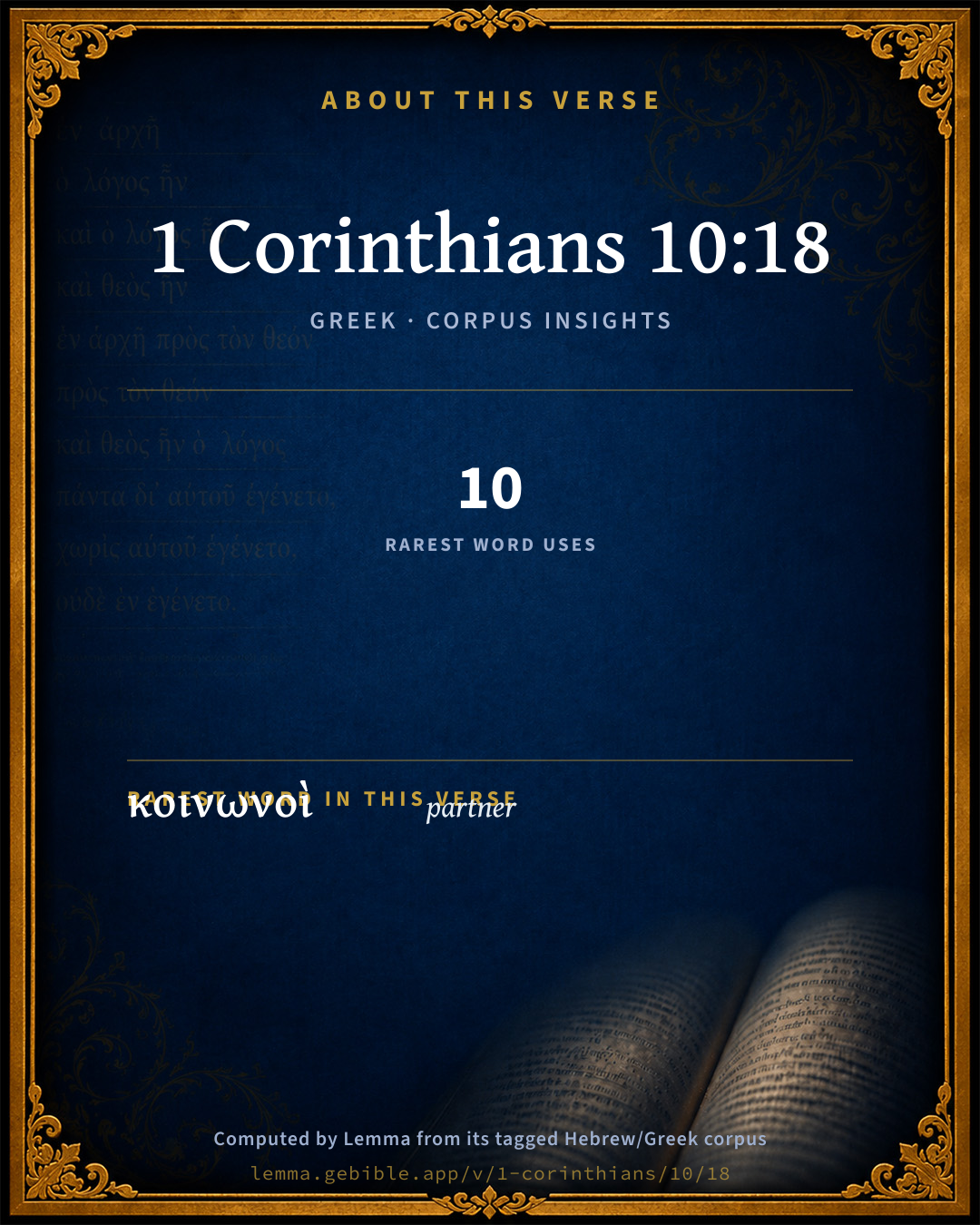
The rarest word here is κοινωνοὶ partner G2844 — appearing just 10 times in the whole Greek New Testament.

Shared distinctive vocabulary

κοινωνοὶ partner G2844 occurs in 10 verses of the Greek New Testament. Also found in:

Repetition

A word recurs within this verse:

Cross-references

15

Topical passages linked to 1 Corinthians 10:18 in the Treasury of Scripture Knowledge — connected by theme and wording, ordered by reader-vote popularity; previews shown in the World English Bible.

  • Leviticus 3:11 The priest shall burn it on the altar: it is the food of the offering made by fire to Yahweh.
  • Leviticus 7:6 Every male among the priests may eat of it. It shall be eaten in a holy place. It is most holy.
  • Galatians 6:16 As many as walk by this rule, peace and mercy be on them, and on God's Israel.
  • Ephesians 2:11–12 Therefore remember that once you, the Gentiles in the flesh, who are called "uncircumcision" by that which is called "circumcision," (in the flesh, made by hands);
  • Philippians 3:3–5 For we are the circumcision, who worship God in the Spirit, and rejoice in Christ Jesus, and have no confidence in the flesh;
  • Leviticus 3:3–5 He shall offer of the sacrifice of peace offerings an offering made by fire to Yahweh; the fat that covers the innards, and all the fat that is on the innards,
  • Romans 1:3 concerning his Son, who was born of the seed of David according to the flesh,
  • Romans 4:1 What then will we say that Abraham, our forefather, has found according to the flesh?
  • Romans 4:12 The father of circumcision to those who not only are of the circumcision, but who also walk in the steps of that faith of our father Abraham, which he had in uncircumcision.
  • 1 Corinthians 9:13 Don't you know that those who serve around sacred things eat from the things of the temple, and those who wait on the altar have their portion with the altar?
  • 2 Corinthians 11:18–22 Seeing that many boast after the flesh, I will also boast.
  • 1 Samuel 9:12–13 They answered them, and said, He is; behold, [he is] before you: make haste now, for he is come today into the city; for the people have a sacrifice today in the high place:
  • Romans 9:3–8 For I could wish that I myself were accursed from Christ for my brothers' sake, my relatives according to the flesh,
  • Leviticus 7:11–17 "'This is the law of the sacrifice of peace offerings, which one shall offer to Yahweh.
  • 1 Samuel 2:13–16 The custom of the priests with the people was that when any man offered sacrifice, the priest's servant came, while the flesh was boiling, with a flesh-hook of three teeth in his hand;

Cross-references courtesy of OpenBible.info (CC BY 4.0).

Commentary

Notes on 1 Corinthians 10:18 from classic Christian and Jewish commentators (each source and its license shown beneath its notes). The classic Christian expositions comment on the surrounding passage and are grouped to its opening verse, so a note may address several verses; the Jewish commentaries on the Tanakh (Rashi and others) are per-verse, so they appear only where the commentator wrote on this verse.

Lemma curates 59 commentaries, every one of them public domain or Creative Commons licensed, each selected and text-cleaned for this edition rather than reprinted as found. About our sources →

Joseph Benson's Commentary

1Co 10:18. Behold — Consider, by way of illustration; Israel after the flesh — How it is with the present Jews, the natural descendants of Jacob, who worship God by sacrifices, according to the Mosaic law. He says, after the flesh, to distinguish them from the spiritual Israel, consisting of believers of all nations, called the Israel of God, Gal 6:16. Are not they who eat of the sacrifices — Who feast upon the remainders of the sacrifices offered at the altar; see Lev 7:15; 1Sa 1:4-5; partakers of the altar — Do they not join in the worship there performed, and own the God there worshipped? And is not this an act of communion with that God to whom such sacrifices are offered? And is not the case the same with those who eat of the sacrifices offered to idols? This argument, drawn from the sentiments of the Jews, was used with peculiar propriety, especially in reasoning with the false teachers at Corinth, who, it seems, were Jews, and who, to ingratiate themselves with the Corinthians, are supposed to have encouraged them to eat of the idol’s sacrifices.

Joseph Benson's Commentary on the Old and New Testaments (1811–1818) — public domain. Text from a community e-Sword module.

Bengel's Gnomon

Johann Albrecht Bengel

1Co 10:18. Τοῦ θυσιαστηρίου, of the altar) and therefore, of God. He, to whom the offering is made, those things which are offered, the altar on which they are offered, have communion [a mutual tie in common], as is evident from the following verses, comp. Mat 23:20-21.

Bengel's Gnomon of the New Testament — English translation (T&T Clark, Edinburgh, 1860) — public domain. Text from a community e-Sword module.

Meyer's Critical & Exegetical Commentary

Heinrich August Wilhelm Meyer

1Co_10:18. Another[1681] analogue to prove that participation in the sacrificial feasts is idolatry.

κατὰ σάρκα] without the link of the article, because Ἰσρ. κατὰ σάρκα is regarded as a single idea. Comp on Rom_9:3. Israel after a purely human sort means the born Israelites, the Jews, as distinguished from the Ἰσρ. κατὰ πνεῦμα (Rom_2:28 f.; Gal_4:29; comp Gal_6:16), which the Christians are, in virtue of their fellowship of life with Christ the promised σπέρμα of Abraham. It was very natural for the apostle to add κατὰ σάρκα, seeing that he had just been speaking of the sacred ordinance of the Christians.

As to the Jewish sacrificial feasts, see Michaelis, Mos. R. II. pp. 282, 346 f., IV. § 189.

κοινωνοὶ τοῦ θυσιαστ.] This is the theocratic bond of participation, whereby the man stands bound to the sacrificial altar, who eats of the sacrifice belonging to it as such. The Israelite who refused to eat of the flesh of the sacrifice as such, would thereby practically declare that he had nothing to do with the altar, but stood aloof from the sphere of theocratic connection with it. The man, on the other hand, who ate a portion of the flesh offered upon the altar, gave proof of the religious relation in which he stood to the altar itself. The question which may be asked, Why did not Paul write Θεοῦ instead of θυσιαστ.? is not to be answered by affirming that he could not ascribe the κοιν. τοῦ Θεοῦ εἰσί to the Ἰσρ. κ. σάρκα (Rückert, Abendm. p. 217, and Neander; but could he not in truth, according to Rom_9:4 f., 1Co_11:1, say this of the people of God?), or by asserting that he could not well have attributed so high an effect to the sacrificial service (de Wette; but why should he not, seeing he does not specify any particular kind of fellowship with God?). But the true reply is this: the κοινωνία Θεοῦ would have been here much too vague and remote a conception; for that fellowship belonged to the Jew already in his national capacity as one of the people of God generally, even apart from partaking of the sacrifices. It was by the latter that he showed the narrower and more specific relation of worship in which he stood to God, namely, the peculiarly sacred κοινωνία (Exo_20:21 ff.) τοῦ θυσιαστηρίου. Hence the inappropriateness of the view taken by Rückert and many others, that Paul leaves the inference open: and hence, too, with God, and of that of Rodatz, that the altar is put for the offering.

[1681] Which does not therefore by any means place the Lords Supper in the light of a sacrificial feast (Olshausen, Harnack, Gemeindegottesd. p. 195; comp. also Kahnis, Abendm. p. 30). See against this view, Hofmann, Schriftbew. II. 2, p. 232.

Meyer — Critical and Exegetical Commentary on the New Testament — English translation by Peter Christie, edited by Frederick Crombie (T&T Clark, 1880) — public domain. Text from a community e-Sword module.

Expositor's Greek Testament

ed. W. Robertson Nicoll

1Co 10:18 . “For look at Israel after the flesh: are not those that eat the sacrifice communicants of the altar?” i.e. , participation in the sacrificial feast constitutes fellowship in the sacrifice. τὸν Ἰσραὴλ κατὰ σάρκα , in contrast with Ἰσρ . κατὰ πνεῦμα (Rom 2:28 f., Gal 4:29 ; Gal 6:16 , etc.: see note on οἱ πατ . ἡμῶν , 1). The Ap. is not thinking of the priests specifically, as in 1Co 9:3 (Hn [1527] ), nor of the people as sharing with them (Al [1528] ), but of the festal communion of Israelites as such e.g ., at the Passover, the sacrificial meal κατʼ ἐξοχήν : see Lev 7:11-34 , Deu 12:11-28 , 1Sa 9:12 ff. The altar furnishes the table at which Jehovah’s guests enjoy their covenant fellowship in the gifts of His salvation. The feasters are thus κοινωνοὶ τ . θυσιαστηρίου , recognising the altar as their common altar and mutually pledging themselves to its service.

[1527] C. F. G. Heinrici’s Erklärung der Korintherbriefe (1880), or 1 Korinther in Meyer’s krit.-exegetisches Kommentar (1896).

[1528] Alford’s Greek Testament .

The Expositor's Greek Testament, edited by W. Robertson Nicoll (1897–1910) — public domain. Text from a community e-Sword module.

Hodge's Commentary on Romans, Ephesians & First Corinthians

Charles Hodge

1Co_10:18

Behold Israel after the flesh: are not they which eat of the sacrifices partakers of the altar?

Israel after the flesh, i.e. the Jews, as a nation, as distinguished from Israel after the Spirit, or the spiritual Israel or true people of God. As Israel was a favorite term of honor, Paul rarely uses it for the Jews as a people without some such qualification. Comp. Rom_2:28; Rom_9:8. Gal_4:29; Gal_6:16.

Are not they which eat of the sacrifices. With the Jews, as with other nations, only a portion of most sacrifices was consumed upon the altar; the residue was divided between the priest and the offerer. Lev_7:15; Lev_8:31. Deu_12:18. To eat of the sacrifices in the way prescribed in the Law of Moses, was to take part in the whole sacrificial service. Thou must eat them before the Lord thy God, in the place which the Lord my God shall choose. Deu_12:18. Therefore the apostle says that those who eat of the sacrifices are partakers of the altar; that is, they are in communion with it. They become worshippers of the God to whom the altar is dedicated. This is the import and the effect of joining in these sacrificial feasts. The question is not as to the intention of the actors, but as to the import of the act, and as to the interpretation universally put upon it. To partake of a Jewish sacrifice as a sacrifice and in a holy place, was an act of Jewish worship. By parity of reasoning, to partake of a heathen sacrifice as a sacrifice, and in a holy place, was of necessity an act of heathen worship. As all who attended the Jewish sacrifices, to which none but Jews were admitted, professed to be Jews and to be the joint-worshippers of Jehovah, and as they could not be in communion with the altar without being in communion with each other, therefore all who attended the sacrificial feasts of the heathen brought themselves into religious communion with idolaters. It need hardly be remarked that this passage gives no ground for the opinion that the Lords supper is a sacrifice. This is not the point of comparison. The apostles argument does not imply that, because the Jewish and heathen feasts were sacrificial feasts, therefore the Christian festival had the same character. The whole stress lies on the word κοινωνία. Because participation of Christian ordinances involves communion with Christ, participation of heathen ordinances involves communion with devils.

Charles Hodge — Commentary on Romans (1835), First Corinthians (1857), and Ephesians (1856) — public domain. Text from a community e-Sword module.

Geneva Bible (1599)

Geneva Bible translators

Are consenting and guilty, both of that worship and sacrifice.

That is, as yet observe their ceremonies.

Geneva Bible (1599) marginal notes — public domain. Text via Bolls.life.

Jamieson, Fausset & Brown

Robert Jamieson, A. R. Fausset & David Brown

Israel after the flesh--the literal, as distinguished from the spiritual, Israel (Rom 2:29; Rom 4:1; Rom 9:3; Gal 4:29).

partakers of the altar--and so of God, whose is the altar; they have fellowship in God and His worship, of which the altar is the symbol.

Jamieson, Fausset & Brown — Commentary Critical and Explanatory on the Whole Bible (1871) — public domain (CC PDM 1.0). Text via the HelloAO Bible API.

Adam Clarke's Commentary

Verse 18. Behold Israel after the flesh] The Jews not yet converted to Christianity: the latter being Israel after the Spirit. As the design of the apostle was to withdraw his converts at Corinth from all temptations to idolatry, he produces two examples to show the propriety of his endeavours.

1. All who join together in celebrating the Lord's Supper, and are partakers of that one bread, give proof by this that they are Christians, and have fellowship with Christ.

2. All the Israelites who offer sacrifice, and partake of those sacrifices, give proof thereby that they are Jews, and are in fellowship with the object of their worship: so they who join in idol festivals, and eat things which have been offered to idols, give proof that they are in communion with those idolaters, and that they have fellowship with the demons they worship.

Adam Clarke's Commentary on the Bible (1810–1826) — public domain. Text from a community e-Sword/MySword module.

John Calvin's Commentaries

18. Behold Israel after the flesh He establishes it by another example, that such is the nature of all sacred observances, that they bind us in a kind of fellowship with God. For the law of Moses admits no one to a feast upon a sacrifice, but the man who has duly prepared himself. I speak not of priests merely, but of those among the common people who eat of the remains of the sacrifice. Hence it follows, that all who eat of the flesh of the sacrificed victim, are partakers with the altar, that is, of the sanctification, with which God has set apart his Temple, and the sacred rites that are performed in it.

This expression after the flesh, may seem to be added in order that the Corinthians, on comparing the two, might set a higher value on the efficacy of our Supper. “If there was so much virtue in the ancient figures and in those rudiments of youthful education, how much more must we reckon that there is in our mysteries, in which God shines forth much more fully upon us!” At the same time, it is more simple, in my opinion, to say that Paul intended merely by this mark to distinguish the Jews that were still under the law from those that had been converted to Christ. Now there was a contrast that remained to be made — that if the sacred rites appointed by God sanctify those who observe them, pollution, on the other hand, is contracted from the sacred rites rendered to idols. For it is God alone that sanctifies, and hence all strange gods pollute. Again, if mysteries unite and connect believers with God, it follows, that the wicked are in like manner introduced by their superstitious rites into fellowship with idols. But the Apostle, before proceeding to this, answers by an anthypophora (anticipation) a question that might be proposed by way of objection.

John Calvin's Commentaries (1540-1563) — public domain. Text from the Calvin Translation Society English edition (1840s-50s) via the Christian Classics Ethereal Library (ccel.org). Calvin's coverage is partial (roughly two-thirds of the Bible); uncommented books and verses are honest gaps, never fabricated. The 19th-century editor's footnotes and remarks are omitted so the notes are faithfully Calvin's own voice.

Ellicott's Commentary for English Readers

(18) Behold Israel after the flesh—i.e., Israel in its merely human aspect, not the spiritual Israel (Rom_2:28; Gal_4:29; Gal_6:16). The sacrifice was divided—a portion offered upon the altar and a portion taken and eaten (Deu_12:18; Deu_16:11): so whoever ate a portion of the same sacrifice was a partaker in common with (not “of,” as in the English translation) the altar. This is another argument against partaking of the heathen feasts. You cannot do so without connection with the heathen altar. The example of Israel proves that.

A Bible Commentary for English Readers, edited by Charles John Ellicott (1878–1897) — public domain. Text from a community e-Sword module.

The Cambridge Bible for Schools and Colleges

gen. ed. J. J. S. Perowne

18. Behold Israel after the flesh] Second reason (see 1Co_10:16). As the Christian sacrificial feasts, so are those of the Jews.

are not they which eat of the sacrifices partakers of the altar?] “In a strict and peculiar sense—the altar having part of the animal, the partaker another part.” Dean Alford. The word here translated partakers is not the same as in the last verse. It is, like the word translated communion, from κοινὸς, common, and implies that the altar and the worshipper share together in the victim. Bengel remarks that “he to whom anything is offered, the things which are offered, the altar on which they are offered,” and he might have added those who offer them, “have communion with each other.” If, therefore, any one knowingly rakes of an idol sacrifice, as such (it would seem that some went so as to contend that Christians might do so), he makes himself responsible for the worship of the idol, and all the evils with which that worship is connected.

The Cambridge Bible for Schools and Colleges (gen. ed. J. J. S. Perowne; Cambridge University Press, 1878–1918) — public domain. Text from a community e-Sword module.

John Gill's Exposition

Behold Israel after the flesh,.... So the apostle calls them, to distinguish them from the Israel of God, the spiritual Israel, whether Jews or Gentiles; who are born again, believe in the true Messiah, worship God in a spiritual manner, rejoice in Christ Jesus, and have no confidence in fleshly things; but these were the descendants of Jacob or Israel by carnal generation, were carnal men, in the flesh, in a state of unregeneracy, and were employed in a carnal worship, in the observance of carnal commandments and ordinances; these the apostle directs to, to see, consider, and take notice of what they were doing; from whence some instruction might be taken, for the further clearing of the present point:

are not they which eat of the sacrifices partakers of the altar? yes, they are. The priests and Levites who waited at the altar, and ministered about holy things there, who brought the sacrifices and laid them upon the altar of the burnt offerings, where the altar consumed and devoured one part by fire, and that which was left they ate among themselves; and so as they had communion with one another in eating, they partook of the altar, of the things, or sacrifices of the altar, and showed themselves to be of the Jewish religion, and professed and declared that they worshipped the God of Israel, and would be thought to have communion with him in so doing; in like manner, such who eat of things sacrificed to idols, declared themselves to be idolaters, to be of the Pagan religion, to be worshippers of idols, and to have fellowship with them.

John Gill's Exposition of the Whole Bible (1746–1763) — public domain (CC PDM 1.0). Text via the HelloAO Bible API.

Trapp's Complete Commentary

John Trapp

18 Behold Israel after the flesh: are not they which eat of the sacrifices partakers of the altar?

Ver. 18. Are not they which eat, &c.] See Lev 7:15; hence he infers that these Corinthians also eating of the idol’s sacrifices, were defiled with idolatry; a pari, from the like.

John Trapp, A Commentary or Exposition upon All the Books of the Old and New Testament (1647–1656) — public domain. Text from a community e-Sword module.

Albert Barnes' Notes on the Bible

Behold Israel - Look at the Jews. The design here is to illustrate the sentiment which he was establishing, by a reference to the fact that among the Jews those who partook of the same sacrifices were regarded as being one people, and as worshipping one God. So, if they partook of the sacrifices offered to idols, they would be regarded also as being fellow-worshippers of idols with them.

After the flesh - See Rom 4:1. The phrase “after the flesh” is designed to denote the Jews who were not converted to Christianity; the natural descendants of Israel, or Jacob.

Are not they which eat of the sacrifices - A portion of the sacrifices offered to God was eaten by the offerer, and another portion by the priests. Some portions of the animal, as the fat, were burnt; and the remainder, unless it was a holocaust, or whole burnt-offering, was then the property of the priests who had officiated, or of the persons who had brought it; Exo 29:13, Exo 29:22; Lev, Lev 3:4, Lev 3:10, Lev 3:15; Lev 4:9; Lev 7:3-4; Lev 8:26. The right shoulder and the breast was the part which was assigned to the priests; the remainder belonged to the offerer.

Partakers of the altar - Worshippers of the same God. They are united in their worship, and are so regarded. And in like manner, if you partake of the sacrifices offered to idols, and join with their worshippers in their temples, you will be justly regarded as “united” with them in their worship, and partaking with them in their abominations.

Albert Barnes' Notes on the Bible (1834–1885) — public domain. Text from a community e-Sword/MySword module.

Haydock's Catholic Bible Commentary

Behold Israel, according to the flesh. That is, the people that were the offspring of Israel or Jacob. Are not these they who offered sacrifices to the true God, and eat or the sacrifices, which were offered on his altars, and by offering to him such sacrifices, acknowledged him to be their God, and the only true God: and so you, if you partake, and eat of the sacrifices of idolaters, and of what they tell you was offered to their idols, you seem at least, to join with them in acknowledging, and paying reverence to their idols, which are devils: and you cannot be partakers of the table of the Lord, and of the table of devils. --- Co we provoke the Lord to jealousy? that is, how dare we provoke our Lord, who is a jealous God, and will admit of no rival, by partaking of sacrifices offered to false gods? how dare we thus contemn his power, as if we were stronger than he, or that he could not punish us? (Witham)

George Leo Haydock (1774–1849), Haydock's Catholic Family Bible and Commentary, 1859 edition — public domain. Excludes Psalms (Douay-Rheims chapter numbering differs from Protestant) and Deuterocanonical books (Catholic canon only).

Matthew Poole's English Annotations

Israel after the flesh was the whole seed of Jacob, the whole body of the Jewish church; for believers only were Israelites after the Spirit, Rom 11:6, called the Israel of God, Gal 6:16.

Are not they which eat of the sacrifices partakers of the altar? If in the Jewish church any persons ate of the flesh of sacrifices offered upon God’s altar, did they not by that act manifest that they were members of the Jewish church, and owned that God to whom those sacrifices were offered, and that way of worship by which God was so worshipped? By the same reason these Corinthians eating of the flesh of those beasts in the idol’s temple, which had been offered unto idols, did by that act declare their owning of the idol, and that idolatrous worship which had been there performed, and were really partakers of the idolatrous altar.

Matthew Poole's English Annotations on the Holy Bible (1683–1685) — public domain. Text from a community e-Sword/MySword module.

Whedon's Commentary on the Bible

Daniel D. Whedon

18. This unity and communion Paul now illustrates from the Jewish system, where partaking of the sacrifices rendered all adherents of the common altar.

Israel after the flesh—in distinction from Israel after the spirit.

Note Rom_9:8.

Partakers of the altar—If the altar be an idolatrous one, the partaker is an idolater; if it be an altar of Jehovah, then he acknowledges Jehovah. Such may not be the intention of the partaker, but such is the established and public import of the act.

Daniel D. Whedon (gen. ed.), Commentary on the Old and New Testaments (1874–1909) — public domain. Text from a community e-Sword module.

The Pulpit Commentary

Partakers of the altar. It is better to render it "Have they not communion with the altar?" for the word is different from that in the last verse. The meaning is that, by sharing in the sacrifices, the Jews stood in direct association with the altar, the victims, and all that they symbolized. (Deu_12:27) And St. Paul implied that the same thing is true of those who sympathetically partook of idol offerings.

The Pulpit Commentary (1880–1919), ed. H.D.M. Spence-Jones & Joseph S. Exell — public domain. Text from a community e-Sword module.

John Wesley's Explanatory Notes

Consider Israel after the flesh - Christians are the spiritual "Israel of God." Are not they who eat of the sacrifices partakers of the altar - Is not this an act of communion with that God to whom they are offered? And is not the case the same with those who eat of the sacrifices which have been offered to idols?

John Wesley, Explanatory Notes Upon the Whole Bible (1754–1765) — public domain. Text via the GEBible commentary corpus.

Kretzmann's Popular Commentary

Paul E. Kretzmann

The application of these truths to idolatrous practices:

v. 18. Behold Israel after the flesh; are not they which eat of the sacrifices partakers of the altar?

v. 19. What say I, then? That the idol is anything, or that which is offered in sacrifice to idols is anything?

v. 20. But I say that the things which the Gentiles sacrifice they sacrifice to devils and not to God; and I would not that ye should have fellowship with devils.

v. 21. Ye cannot drink the cup of the Lord and the cup of devils; ye cannot be partakers of the Lord’s Table and of the table of devils.

In his effort to impress upon the Corinthians the fact that participation in idolatrous feasts was equivalent to idol worship, the apostle now introduces the analogy of the Jewish form of worship: Note the people of Israel as a nation. Are not those that eat the sacrifices partakers of the altar; do they not enter into communion with the altar? This fact was brought out particularly strongly on the great festivals, such as the Passover Feast, when the entire congregation of Israel demonstrated its communion by combining in the sacrifice of Passover, and joining, at the same time and in the same manner, in the meal which was connected with it. It was probable that the readers, at this point, would gather the trend of the apostle’s remarks, that he was about to refer to their taking part in heathen feasts. But before they can offer the objection which they are likely to make, the apostle disarms them: What am I saying now? Am I contradicting myself (See chap. 8:4-, that idol sacrifice is anything, or that an idol is anything? He had denied the actual existence, the personality of idols, and thus had also decried the rites connected with their worship as meaningless observances. This position he held just as strongly as ever.

But there was another feature to which he wanted to call the attention of his readers: Rather, that which they sacrifice they sacrifice to demons, and not to God. Devils are virtually worshiped at the idol feast, and thus, by partaking in heathenish festivals, they come into communion with devils, and he does not want them to enter into fellowship with devils. The riot and debauch attending heathen festivals, not to speak of worse things, showed that foul spirits of evil presided over them. And so Paul makes his application of the truth which their cleverness must surely have shown them to be correct: You cannot drink the cup of the Lord and the cup of demons; you cannot be partakers of the Lord’s Table and of the table of demons. The Lord’s cup in the celebration of the Eucharist is the communion with the Lord and therefore demands the closest allegiance to Him; the attendance at the idol festivals, therefore, where the cup of devils was in use and the fellowship with devils was celebrated, must break the tie that binds to the Lord. And in the same way the fellowship with the Lord established at the table of the Holy Communion could not be maintained if a Christian took part in heathen festivals it was a moral impossibility. Every fiber of a Christian’s regenerated being must cry out against such blasphemous confusion. Note: The words of the apostle find their application today as well as in Corinth at that time. If Christians join in the wild and profligate revelings and debaucheries of the world, particularly such as are arranged in honor of anti-Christian persons or principles, they are no less guilty than the boastful Corinthians were in their day.

Paul E. Kretzmann, Popular Commentary of the Bible (1921–1924) — public domain. Text from a community e-Sword module.

Burkitt's Expository Notes on the New Testament

William Burkitt

Here another argument against eating things offered to idols is produced by our apostle, and it runs thus: "As in the Jewish church all persons that did eat of the peace-offerings which were laid upon God’s altar, did by that act declare themselves members of the Jewish church, and that they owned the God of the Jews to whom these sacrifices were offered: in like manner the converted Corinthians, by eating part of those beasts which were sacrificed in the idol’s temple, did by that act declare their owning of that idol, and that idolatrous worship which had been there performed, and were really partakers of that idolatrous altar; not that an idol is any thing, or that which is offered to the idol any thing, that can of its own nature pollute and defile; but the plain truth was, the heathens were seduced by the devils to offer these sacrifices, and they were devils whom they worshipped; though not in their own intention, yet in God’s estimation: and consequently those that did eat of those feasts are supposed to join in those feasts are supposed to join in those sacrifices, and thereby to hold communion with devils.

William Burkitt's Expository Notes on the New Testament (1700–1703) — public domain. Text from a community e-Sword module.

McGarvey & Pendleton's Commentaries

J. W. McGarvey

Behold Israel after the flesh: have not they that eat the sacrifices communion with the altar? [In Paul's eyes the church was the true Israel, and the Jews were Israel after the flesh. Part of the Jewish sacrifice was eaten by the worshiper as an act of worship ( Deu_12:18 ), and part was consumed upon the altar as a sacrifice to God; that is, as God's part. Thus the worshiper had communion with the altar, or, more accurately speaking, with God, who owned the altar; a portion of the meat of sacrifice entering his body and becoming part of him, and a portion of it typically entering and becoming part of the Lord. Having thus given two instances showing that sacrificial feasts establish a relationship between the worshiper and the object worshipped, Paul proceeds to make his application of them to idol feasts, and begins by anticipating an objection which the quick-witted Corinthians, seeing the drift of his argument, would begin at once to urge.]

J. W. McGarvey (with Philip Y. Pendleton), Commentaries on the New Testament (The Fourfold Gospel, 1914; Acts; and the epistles) — public domain. Text from a community e-Sword/MySword module.

The People's New Testament

B. W. Johnson

18. Behold Israel after the flesh. The natural Israel, in contrast with the spiritual Israel, the church. Are not they … partakers of the altar? A part of the sacrifice was eaten by the offerers and their friends, and as a part was burnt on the altar, as an offering to God, they were supposed to be partakers with God in the feast. So, too, those who partook of an idol feast, would be worshipers of the idol.

B. W. Johnson's The People's New Testament with Notes (1889–1891) — public domain. Electronic text from the Christian Classics Ethereal Library (CCEL) ThML edition.

unfoldingWord translationNotes

Door43 World Missions Community

Are not those who eat the sacrifices participants in the altar?

Paul is reminding the Corinthians of what they already know so that he can give them new information. AT: "those who eat the sacrifices share in the activities and the blessings of the altar" (See: Rhetorical Question)

What am I saying then?

Paul is reminding the Corinthians of what they already know so that he can give them new information. AT: "Let me review what I am saying." or "This is what I mean." (See: Rhetorical Question)

That an idol is anything?

Paul wants the Corinthians to answer the question in their minds so he does not have to tell them. AT: "You know that I am not saying that an idol is something real." (See: Rhetorical Question and Ellipsis)

Or that food sacrificed to an idol is anything?

Paul wants the Corinthians to answer the question in their minds so he does not have to tell them. AT: "You know that I am not saying that food sacrificed to an idol is not important." (See: Rhetorical Question and Ellipsis)

translationWords

Israel

sacrifice

altar

false god

unfoldingWord translationNotes — © Distant Shores Media and the Door43 World Missions Community, licensed CC BY-SA 4.0. Source: git.door43.org/Door43/en_tn.

Cambridge Greek Testament for Schools and Colleges

18. βλέπετε τὸν Ἰσραήλ. Second reason (see 1Co 10:16). As the Christian sacrificial feasts, so are those of the Jews.

κατὰ σάρκα. As distinguished from Christians, who are Israel κατὰ πνεῦμα. See Rom 2:28; Gal 4:26.

κοινωνοὶ τοῦ θυσιαστηρίου. Sharers, inasmuch as part of the victim was consumed on the altar, and part eaten by the worshipper. Bengel remarks that ‘he to whom anything is offered, the things which are offered, the altar on which they are offered,’ and he might have added those who offer them, ‘have communion with each other.’ If, therefore, any one knowingly partakes of an idol sacrifice, as such (it would seem that some went so far as to contend that Christians might do so), he makes himself responsible for the worship of the idol, and all the evils with which that worship is connected.

Cambridge Greek Testament for Schools and Colleges (Cambridge University Press, 1896; 21 vols, various authors incl. Carr, Maclear, Plummer, Farrar, Lumby, Moule, M. R. James, Simcox) — public domain. Text from a community e-Sword module.

Alford’s Greek Testament

Henry Alford

18.] Another example of κοινωνία, from the Jewish feasts after sacrifice.

τ. Ἰσρ. κατὰ σάρκα] (= τ. Ἰσρ. τὸν κατὰ σάρκα: so we have τοῖς κυρίοις κατὰ σάρκα, Eph 6:5), the actual material Israel, as distinguished from ὁ Ἰσρ. κατὰ πνεῦμα, see Rom 2:29; Gal 4:29; and ὁ Ἰσρ. τοῦ θεοῦ, Gal 6:16.

οἱ ἐσθ. τ. θυσ.] viz. those parts of the sacrifices which were not offered; see on ch. 8:1.

The parts to be offered are specified, Lev 3:3; the practice of eating the remainder of the meat sanctioned and regulated, ib. 7:15-18.

κοινωνοὶ τοῦ θυσ.] partakers with the altar (in a strict and peculiar sense,—the altar having part of the animal, the partaker another part; and by the fact of the religious consecration of the offered part, this connexion becomes a religious connexion. The question has been raised, and with reason, why the Apostle did not say κοινωνοὶ τοῦ θεοῦ? Meyer answers,—because the Jew was already in covenant with God, and the Apostle wished to express a closer connexion, brought about by the sacrifice in question:—De Wette,—because he was unwilling to ascribe so much to the mere act of sacrifice, see Heb 10:1 ff.: and to this latter view I incline, because, as De W. remarks, θεοῦ would have suited the analogy better than θυσιαστηρίου, but Paul avoids it, and evidently is reluctant to use it. But to carry this view further, and suppose with Rückert that he would not concede to the Ἰσρ. κατὰ σάρκα any κοινωνία θεοῦ, is (Meyer) contradicted by Rom 9:4, Rom 9:5. Still the inference lies open, to which our Saviour’s saying points, Mat 23:20, Mat 23:21. The altar is God’s altar).

19,

Henry Alford, The Greek Testament (1849–1861) — public domain. Text from a community e-Sword module.

International Critical Commentary

18. The sacrifices of the Jews furnish a similar argument to show that participation in sacrificial feasts is communion with the unseen.

βλέπετε τὸν Ἰσραὴλ κατὰ σάρκα. ‘Look at Israel after the flesh,’ the actual Israel of history. Christians are a new Israel, Israel after the Spirit, τὸν Ἰσραὴλ τοῦ Θεοῦ (Gal 6:16, Gal 6:3:29; Php 3:3), whether Jews or Gentiles by birth.

οὐχ οἱ ἐσθίοντες κ.τ.λ. ‘Are not they who eat the sacrifices in fellowship with the altar?’ They are in fellowship with the altar, and therefore with the unseen God, whose altar it is. To swear by the Temple is to swear by Him that dwelleth therein (Mat 23:21), and to have fellowship with the altar is to have fellowship with Him whose sacrifices are offered thereon. As in the Holy Communion, therefore, so also in the Temple services, participating in sacrificial feasts is sacrificial fellowship with an unseen power, a power that is Divine. There is something analogous to this in the sacrificial feasts of the heathen; but in that case the unseen power is not Divine. See Lev 7:6, Lev 7:14, Lev 7:6:26, and Westcott on Heb 13:10.

International Critical Commentary — older volumes (1896–1929), various authors — public domain. Text from a community e-Sword module.

Vincent's Word Studies in the New Testament

Marvin R. Vincent

Showing that partaking of the idol - feasts is idolatry, by the analogy of the Israelite who, by partaking of the sacrifices puts himself in communion with Jehovah 's altar.

Partakers of the altar [κοινωνοι του θυσιαστηριου] . An awkward phrase. Rev., better, bringing out the force of koinwnoi communers : have not they - communion with the altar ? The Israelite who partook of the sacrifices (Lev 8:31) united himself with the altar of God. Paul says with the altar rather than with God, in order to emphasize the communion through the specific act of worship or sacrifice; since, in a larger sense, Israel after the flesh, Israel regarded as a nation, was, in virtue of that fact, in fellowship with God, apart from his partaking of the sacrifices.

Possibly, also, to suggest the external character of the Jewish worship in contrast with the spiritual worship of Christians. Philo calls the Jewish priest koinwnov tou bwmou partaker of the altar.

Marvin R. Vincent, Word Studies in the New Testament (1887–1900) — public domain. Text from a community e-Sword/MySword module.

Godet's Commentaries

Frédéric Louis Godet

Vv. 18. “Behold Israel after the flesh: are not they which eat of the sacrifices in communion with the altar?”

Israel is placed here by way of transition from the Church to the heathen. There were also among the Jews sacrificial feasts celebrated in the temple precincts, over which God Himself was held to preside, in consequence of the communion established with Him by the expiatory sacrifice; comp. Leviticus 8 and Deuteronomy 12, where are found the prescriptions regarding the peace offerings. — The special call for the attention of the readers contained in the imperative βλέπετε, behold, arises from the fact that a usage is in question which is stranger to their sphere than the preceding. By the qualifying κατὰ σάρκα, after the flesh, Paul means to bring out the external character of the Israelitish worship, in opposition to the spiritual worship of the true Israel, the Church.

It is no doubt under the influence of the same thought that he says: “In communion with the altar,” rather than in communion with Jehovah. By sacrifice the guilty Israelite was replaced within the theocratic organization, of which the altar was the centre, rather than in communion with God Himself. As an analogous expression, Heinrici quotes the description of Philo, who calls the Israelitish priest κοινωνὸς τοῦ βώμου. The Epistle to the Hebrews shows why the blood of the victims could do no more.

It is evident that an Israelite who had eaten his part of the victim at Jehovah’s table, and had thus made fast the bond which united him to the theocracy, could not thereafter take part in a heathen ceremony without committing a moral enormity. In the following verses the apostle gives the application of these examples.

Frédéric Louis Godet — Commentaries on Luke, John, Romans, and 1 Corinthians — English translation (T&T Clark, Edinburgh, 1870s–1890s) — public domain. Text from a community e-Sword module.

Lesson kit

Teaching starters — assembled from the data on this page, not authored interpretation. Every prompt links to the verse data it draws on. Edit before teaching.

1 Corinthians, in the Pauline Epistles, opens this verse with 14 words (11 distinct Greek lemmas). Its most distinctive word is koinōnós (“partner”). A historical commentator’s framing appears above. Read the whole chapter for the surrounding context.

Discussion questions

  1. What does “partner” (koinōnós) contribute to the verse as a whole?
  2. How does Matthew 23:30, which shares the word «partner», read alongside this verse?
  3. What does the repetition of “the” (4× in this one verse) do in this verse?
  4. These translations render this verse differently; the difference is in the English rendering, not the original. What questions does that raise?
  5. Compare how Joseph Benson's Commentary and Bengel's Gnomon read this verse. Where do they agree or differ?

Things to notice

Reading settings

Reading text

Shown beneath each verse's original-language words.

Old Testament
Old Testament edition

Read the OT as the Masoretic Hebrew (MT) or the Greek Septuagint (LXX).

English shown for the Greek Septuagint (in the Hebrew ↔ Greek comparison).

Comparing translations? Open the Compare panel on any verse page to stack up to four side by side.