Ephesians 2:3

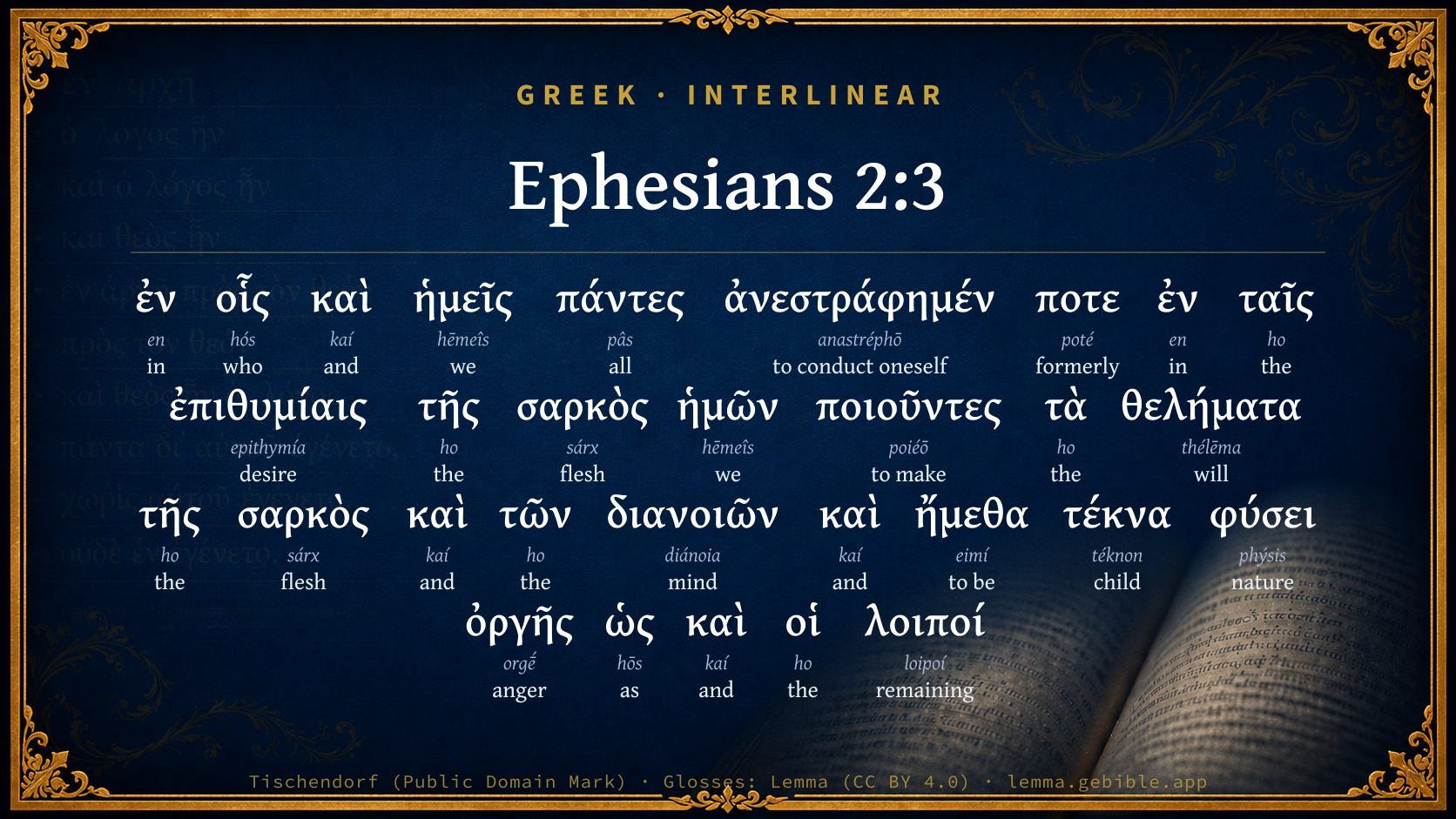
Greek (Tischendorf 8th ed.) Ephesians 2:3 appears in the Greek New Testament. The text above is from the Tischendorf 8th edition. Each word links to its Strong’s number and a concise gloss. Click any word for its full Thayer’s Greek Lexicon entry.
Download image
Cite this verse

Ephesians 2:3 (World English Bible). Public Domain. Lemma interlinear Bible study tool, https://lemma.gebible.app/v/ephesians/2/3.

Show BibTeX & RIS
BibTeX
RIS
English Translation
among whom we also all once lived in the lust of our flesh, doing the desires of the flesh and of the mind, and were by nature children of wrath, even as the rest.
World English Bible · Public Domain
Download a study sheet

One document with this verse’s original text, its word-by-word gloss line, the meaning frame, cross-references with their text, attributed commentary, and full source and license credits — printable, and it pastes into notes with its structure intact.

This verse Autodidact and up

Study sheet (.html) Plain text (.txt)

A passage Seminary Student

Up to 50 verses in one chapter. A passage sheet keeps up to 6 commentary sources and 12 cross-references per verse, in the order this page ranks them, and says so on the sheet whenever that leaves anything out. Ask for a single verse and you get the Autodidact verse sheet above.

Everything on this page stays free to read, with no account — the sheet is a download of what is already on screen, not access to it.

Want to remove ads? Support Godless Engineer
Compare translations 3

The same verse in 3 English versions, stacked beneath the original-language interlinear above. Click any original word for its lexicon entry.

Each is an independent rendering of the whole verse — the interlinear is not word-aligned to these translations.

Highlighted words mark where these versions differ — a whole-verse word diff, not a word-by-word alignment.

  • World English Bible Public Domain
    among whom we also all once lived in the lust of our flesh, doing the desires of the flesh and of the mind, and were by nature children of wrath, even as the rest.
  • King James Version Public Domain
    Among whom also we all had our conversation in times past in the lusts of our flesh, fulfilling the desires of the flesh and of the mind; and were by nature the children of wrath, even as others.
  • unfoldingWord Literal Text CC BY-SA 4.0
    in which we all also once lived in the evil desires of our flesh, fulfilling the desires of the body and of the minds. And we were by nature children of wrath, as also the rest.

unfoldingWord Literal Text — © unfoldingWord, licensed CC BY-SA 4.0. Word-aligned USFM3 via Door43 (git.door43.org/unfoldingWord/en_ult).

Versions to compare (up to 4)

3 of 4 selected

Show all 19 translations

Every available English version of this verse, each an independent rendering of the whole verse.

  • World English Bible Public Domain
    among whom we also all once lived in the lust of our flesh, doing the desires of the flesh and of the mind, and were by nature children of wrath, even as the rest.
  • Berean Standard Bible Public Domain
    All of us also lived among them at one time, fulfilling the cravings of our flesh and indulging its desires and thoughts. Like the rest, we were by nature children of wrath.
  • Majority Standard Bible Public Domain
    All of us also lived among them at one time, fulfilling the cravings of our flesh and indulging its desires and thoughts. Like the rest, we were by nature children of wrath.
  • King James Version Public Domain
    Among whom also we all had our conversation in times past in the lusts of our flesh, fulfilling the desires of the flesh and of the mind; and were by nature the children of wrath, even as others.
  • American Standard Version (1901) Public Domain
    among whom we also all once lived in the lust of our flesh, doing the desires of the flesh and of the mind, and were by nature children of wrath, even as the rest:--
  • Revised Version (1885) Public Domain
    among whom we also all once lived in the lusts of our flesh, doing the desires of the flesh and of the mind, and were by nature children of wrath, even as the rest:—
  • Geneva Bible (1599) Public Domain
    Among whom we also had our conuersation in time past, in the lustes of our flesh, in fulfilling the will of the flesh, and of the minde, and were by nature the children of wrath, as well as others.
  • Douay-Rheims (1899) Public Domain
    In which also we all conversed in time past, in the desires of our flesh, fulfilling the will of the flesh and of our thoughts, and were by nature children of wrath, even as the rest:
  • Young's Literal Translation Public Domain
    among whom also we all did walk once in the desires of our flesh, doing the wishes of the flesh and of the thoughts, and were by nature children of wrath -- as also the others,
  • Literal Standard Version CC BY-SA 4.0
    among whom we also all walked once in the desires of our flesh, doing the wishes of the flesh and of the thoughts, and were by nature children of wrath—as also the others,
  • Unlocked Literal Bible CC BY-SA 4.0
    Once we all lived among these people, fulfilling the evil desires of our sinful nature, and carrying out the desires of the body and of the mind. We were by nature children of wrath, like the rest of humanity.
  • unfoldingWord Literal Text CC BY-SA 4.0
    in which we all also once lived in the evil desires of our flesh, fulfilling the desires of the body and of the minds. And we were by nature children of wrath, as also the rest.
  • Darby Bible Public Domain
    among whom *we* also all once had our conversation in the lusts of our flesh, doing what the flesh and the thoughts willed to do, and were children, by nature, of wrath, even as the rest:
  • World Messianic Bible Public Domain
    We also all once lived among them in the lusts of our flesh, doing the desires of the flesh and of the mind, and were by nature children of wrath, even as the rest.
  • Webster's Bible Public Domain
    Among whom also we all had our manner of life in times past in the lusts of our flesh, fulfilling the desires of the flesh and of the mind; and were by nature the children of wrath, even as others.
  • Free Bible Version CC BY-SA 4.0
    All of us were once like that, our behavior determined by the desires of our sinful human nature and our evil way of thinking. Like everyone else, in our nature we were children of anger.
  • Bible in Basic English Public Domain
    Among whom we all at one time were living in the pleasures of our flesh, giving way to the desires of the flesh and of the mind, and the punishment of God was waiting for us even as for the rest.
  • Text-Critical English NT CC BY 4.0
    Among them we all once lived in the lusts of our flesh, carrying out the desires of our flesh and our impulses, and we were by nature children of wrath, like the rest of mankind.
  • Tyndale New Testament (1534) Public Domain
    amonge which we also had oure conversacion in tyme past in the lustes of oure flesshe and fullfilled the will of the flesshe and of the mynde: and were naturally the children of wrath even as wel as other.

Literal Standard Version (2020), Covenant Press — licensed CC BY-SA 4.0. Text via the HelloAO Bible API (eBible.org). Unlocked Literal Bible (unfoldingWord) — licensed CC BY-SA 4.0. Text via the HelloAO Bible API (eBible.org). unfoldingWord Literal Text — © unfoldingWord, licensed CC BY-SA 4.0. Word-aligned USFM3 via Door43 (git.door43.org/unfoldingWord/en_ult). Free Bible Version, Dr. Jonathan Gallagher — licensed CC BY-SA 4.0. Text via the HelloAO Bible API (eBible.org).

Word by word

More ways to search: Search by grammar → Find every occurrence → Compare this word →

Practice this passage: Drill this verse → Learn its vocabulary →

ἀνεστράφημέν
anastréphō
G390
“to conduct oneself”
Verb, Aorist, Passive, Indicative, 1st person, Plural
Part of Speech
Verb
Tense
Aorist
Voice
Passive
Mood
Indicative
Person
1st person
Number
Plural
Full Thayer's Definition

Origin: from G303 and G4762

TDNT: 18:55,1

1. to turn upside down, overturn 2. to turn back 3. to turn hither and thither, to turn one's self about, sojourn dwell in a place 4. metaph. to conduct one's self, behave one's self, live
  1. ἐν en G1722 “in” Preposition
  2. οἷς hós G3739 “who” Relative pronoun, Dative, Plural, Masculine
  3. καὶ kaí G2532 “and” Conjunction
  4. ἡμεῖς hēmeîs G2249 “we” Personal pronoun, 1st person, Nominative, Plural
  5. πάντες pâs G3956 “all” Adjective, Nominative, Plural, Masculine
  6. ποτε poté G4218 “formerly” Particle
  7. ἐν en G1722 “in” Preposition
  8. ταῖς ho G3588 “the” Article, Dative, Plural, Feminine
  9. ἐπιθυμίαις epithymía G1939 “desire” Noun, Dative, Plural, Feminine
  10. τῆς ho G3588 “the” Article, Genitive, Singular, Feminine
  11. σαρκὸς sárx G4561 “flesh” Noun, Genitive, Singular, Feminine
  12. ἡμῶν hēmeîs G2249 “we” Personal pronoun, 1st person, Genitive, Plural
  13. ποιοῦντες poiéō G4160 “to make” Verb, Present, Active, Participle, Nominative, Plural, Masculine
  14. τὰ ho G3588 “the” Article, Accusative, Plural, Neuter
  15. θελήματα thélēma G2307 “will” Noun, Accusative, Plural, Neuter
  16. τῆς ho G3588 “the” Article, Genitive, Singular, Feminine
  17. σαρκὸς sárx G4561 “flesh” Noun, Genitive, Singular, Feminine
  18. καὶ kaí G2532 “and” Conjunction
  19. τῶν ho G3588 “the” Article, Genitive, Plural, Feminine
  20. διανοιῶν diánoia G1271 “mind” Noun, Genitive, Plural, Feminine
  21. καὶ kaí G2532 “and” Conjunction
  22. ἤμεθα eimí G1510 “to be” Verb, Imperfect, Middle, Indicative, 1st person, Plural
  23. τέκνα téknon G5043 “child” Noun, Nominative, Plural, Neuter
  24. φύσει phýsis G5449 “nature” Noun, Dative, Singular, Feminine
  25. ὀργῆς orgḗ G3709 “anger” Noun, Genitive, Singular, Feminine
  26. ὡς hōs G5613 “as” Adverb
  27. καὶ kaí G2532 “and” Conjunction
  28. οἱ ho G3588 “the” Article, Nominative, Plural, Masculine
  29. λοιποί loipoí G3062 “remaining” Adjective, Nominative, Plural, Masculine

About this verse

These counts appear in no published source. They are computed here, from the morphology-tagged text and Lemma’s own curated glosses. What Lemma adds →

30
words
19
distinct lemmas
Pauline Epistles
section

Notable vocabulary

The rarest word here is ἀνεστράφημέν to conduct oneself G390 — appearing just 9 times in the whole Greek New Testament.

Shared distinctive vocabulary

ἀνεστράφημέν to conduct oneself G390 occurs in 9 verses of the Greek New Testament. Also found in:

Repetition

Words recur within this verse:

Cross-references

46

Topical passages linked to Ephesians 2:3 in the Treasury of Scripture Knowledge — connected by theme and wording, ordered by reader-vote popularity; previews shown in the World English Bible.

  • Titus 3:3 For we were also once foolish, disobedient, deceived, serving various lusts and pleasures, living in malice and envy, hateful, and hating one another.
  • Galatians 5:16–24 But I say, walk by the Spirit, and you won't fulfill the lust of the flesh.
  • Ephesians 4:22 that you put away, as concerning your former way of life, the old man, that grows corrupt after the lusts of deceit;
  • 1 Peter 1:14 as children of obedience, not conforming yourselves according to your former lusts as in your ignorance,
  • Romans 13:14 But put on the Lord Jesus Christ, and make no provision for the flesh, for its lusts.
  • Psalms 51:5 Behold, I was brought forth in iniquity. In sin my mother conceived me.
  • Romans 6:12 Therefore don't let sin reign in your mortal body, that you should obey it in its lusts.
  • 1 Corinthians 6:9–11 Or don't you know that the unrighteous will not inherit the Kingdom of God? Don't be deceived. Neither the sexually immoral, nor idolaters, nor adulterers, nor male prostitutes, nor homosexuals,
  • Romans 8:7–8 because the mind of the flesh is hostile towards God; for it is not subject to God's law, neither indeed can it be.
  • Ephesians 2:2 in which you once walked according to the course of this world, according to the prince of the powers of the air, the spirit who now works in the children of disobedience;
  • Ephesians 4:17–19 This I say therefore, and testify in the Lord, that you no longer walk as the rest of the Gentiles also walk, in the futility of their mind,
  • 1 John 2:16 For all that is in the world, the lust of the flesh, the lust of the eyes, and the pride of life, isn't the Father's, but is the world's.
  • Galatians 2:15–16 "We, being Jews by nature, and not Gentile sinners,
  • 1 Peter 2:10–11 who in time past were no people, but now are God's people, who had not obtained mercy, but now have obtained mercy.
  • John 8:44 You are of your Father, the devil, and you want to do the desires of your father. He was a murderer from the beginning, and doesn't stand in the truth, because there is no truth in him. When he speaks a lie, he speaks on his own; for he is a liar, and the father of it.
  • 1 Peter 4:2–3 that you no longer should live the rest of your time in the flesh for the lusts of men, but for the will of God.
  • 1 John 1:8–10 If we say that we have no sin, we deceive ourselves, and the truth is not in us.
  • Genesis 6:5 Yahweh saw that the wickedness of man was great in the earth, and that every imagination of the thoughts of his heart was only evil continually.
  • Job 15:14–16 What is man, that he should be clean? He who is born of a woman, that he should be righteous?
  • Mark 4:19 and the cares of this age, and the deceitfulness of riches, and the lusts of other things entering in choke the word, and it becomes unfruitful.
  • Acts 17:30–31 The times of ignorance therefore God overlooked. But now he commands that all people everywhere should repent,
  • Romans 3:9–19 What then? Are we better than they? No, in no way. For we previously charged both Jews and Greeks, that they are all under sin.
  • Romans 3:22–23 even the righteousness of God through faith in Jesus Christ to all and on all those who believe. For there is no distinction,
  • Romans 7:18 For I know that in me, that is, in my flesh, dwells no good thing. For desire is present with me, but I don't find it doing that which is good.
  • 1 Corinthians 4:7 For who makes you different? And what do you have that you didn't receive? But if you did receive it, why do you boast as if you had not received it?
  • 2 Corinthians 7:1 Having therefore these promises, beloved, let us cleanse ourselves from all defilement of flesh and spirit, perfecting holiness in the fear of God.
  • Genesis 8:21 Yahweh smelled the sweet savor. Yahweh said in his heart, "I will not again curse the ground any more for man's sake, because the imagination of man's heart is evil from his youth; neither will I ever again strike everything living, as I have done.
  • Job 14:4 Who can bring a clean thing out of an unclean? Not one.
  • Job 25:4 How then can man be just with God? Or how can he who is born of a woman be clean?
  • Isaiah 53:6 All we like sheep have gone astray; everyone has turned to his own way; and Yahweh has laid on him the iniquity of us all.
  • Daniel 9:5–9 we have sinned, and have dealt perversely, and have done wickedly, and have rebelled, even turning aside from your precepts and from your ordinances;
  • Mark 7:21–22 For from within, out of the hearts of men, proceed evil thoughts, adulteries, sexual sins, murders, thefts,
  • John 1:13 who were born not of blood, nor of the will of the flesh, nor of the will of man, but of God.
  • John 3:1–6 Now there was a man of the Pharisees named Nicodemus, a ruler of the Jews.
  • Romans 9:22 What if God, willing to show his wrath, and to make his power known, endured with much patience vessels of wrath made for destruction,
  • Romans 11:30 For as you in time past were disobedient to God, but now have obtained mercy by their disobedience,
  • Jude 1:16–18 These are murmurers and complainers, walking after their lusts (and their mouth speaks proud things), showing respect of persons to gain advantage.
  • Isaiah 64:6–7 For we are all become as one who is unclean, and all our righteousness are as a polluted garment: and we all do fade as a leaf; and our iniquities, like the wind, take us away.
  • Romans 1:24 Therefore God also gave them up in the lusts of their hearts to uncleanness, that their bodies should be dishonored among themselves,
  • Romans 5:12–19 Therefore, as sin entered into the world through one man, and death through sin; and so death passed to all men, because all sinned.
  • Galatians 3:22 But the Scriptures shut up all things under sin, that the promise by faith in Jesus Christ might be given to those who believe.
  • 1 Timothy 6:9 But those who are determined to be rich fall into a temptation and a snare and many foolish and harmful lusts, such as drown men in ruin and destruction.
  • James 4:1–3 Where do wars and fightings among you come from? Don't they come from your pleasures that war in your members?
  • 2 Peter 2:14 having eyes full of adultery, and who can't cease from sin; enticing unsettled souls; having a heart trained in greed; children of cursing;
  • 2 Peter 2:18 For, uttering great swelling words of emptiness, they entice in the lusts of the flesh, by licentiousness, those who are indeed escaping from those who live in error;
  • 1 John 2:8 Again, I write a new commandment to you, which is true in him and in you; because the darkness is passing away, and the true light already shines.

Cross-references courtesy of OpenBible.info (CC BY 4.0).

Commentary

Notes on Ephesians 2:3 from classic Christian and Jewish commentators (each source and its license shown beneath its notes). The classic Christian expositions comment on the surrounding passage and are grouped to its opening verse, so a note may address several verses; the Jewish commentaries on the Tanakh (Rashi and others) are per-verse, so they appear only where the commentator wrote on this verse.

Lemma curates 59 commentaries, every one of them public domain or Creative Commons licensed, each selected and text-cleaned for this edition rather than reprinted as found. About our sources →

Jamieson, Fausset & Brown

Robert Jamieson, A. R. Fausset & David Brown

also we--that is, we also. Paul here joins himself in the same category with them, passing from the second person (Eph 2:1-2) to the first person here.

all--Jews and Gentiles.

our conversation--"our way of life" (Co2 1:12; Pe1 1:18). This expression implies an outwardly more decorous course, than the open "walk" in gross sins on the part of the majority of Ephesians in times past, the Gentile portion of whom may be specially referred to in Eph 2:2. Paul and his Jewish countrymen, though outwardly more seemly than the Gentiles (Act 26:4-5, Act 26:18), had been essentially like them in living to the unrenewed flesh, without the Spirit of God.

fulfilling--Greek, doing.

mind--Greek, "our thoughts." Mental suggestions and purposes (independent of God), as distinguished from the blind impulses of "the flesh."

and were by nature--He intentionally breaks off the construction, substituting "and we were" for "and being," to mark emphatically his and their past state by nature, as contrasted with their present state by grace. Not merely is it, we had our way of life fulfilling our fleshly desires, and so being children of wrath; but we were by nature originally "children of wrath," and so consequently had our way of life fulfilling our fleshly desires. "Nature," in Greek, implies that which has grown in us as the peculiarity of our being, growing with our growth, and strengthening with our strength, as distinguished from that which has been wrought on us by mere external influences: what is inherent, not acquired (Job 14:4; Psa 51:5). An incidental proof of the doctrine of original sin.

children of wrath--not merely "sons," as in the Greek, "sons of disobedience" (Eph 2:2), but "children" by generation; not merely by adoption, as "sons" might be. The Greek order more emphatically marks this innate corruption: "Those who in their (very) nature are children of wrath"; Eph 2:5, "grace" is opposed to "nature" here; and salvation (implied in Eph 2:5, Eph 2:8, "saved") to "wrath." Compare Article IX, Church of England Common Prayer Book. "Original sin (birth-sin), standeth not in the following of Adam, but is the fault and corruption of the nature of every man, naturally engendered of Adam [Christ was supernaturally conceived by the Holy Ghost of the Virgin], whereby man is very far gone from original righteousness, and is of his own nature inclined to evil; and therefore, in every person born into this world, it deserveth God's wrath and damnation." Paul shows that even the Jews, who boasted of their birth from Abraham, were by natural birth equally children of wrath as the Gentiles, whom the Jews despised on account of their birth from idolaters (Rom 3:9; Rom 5:12-14). "Wrath abideth" on all who disobey the Gospel in faith and practice (Joh 3:36). The phrase, "children of wrath," is a Hebraism, that is, objects of God's wrath from childhood, in our natural state, as being born in the sin which God hates. So "son of death" (Sa2 12:5, Margin); "son of perdition" (Joh 17:12; Th2 2:3).

as others--Greek, "as the rest" of mankind are (Th1 4:13).

Jamieson, Fausset & Brown — Commentary Critical and Explanatory on the Whole Bible (1871) — public domain (CC PDM 1.0). Text via the HelloAO Bible API.

The Cambridge Bible for Schools and Colleges

gen. ed. J. J. S. Perowne

3. also we all] Better we also all, the “also” emphasizing the “we.”—“We all:”—all present Christians, whether Jews or heathens by origin. St Paul often insists on this one level of fallen nature, wholly unaffected by external privilege. Cp. Rom_3:9; Rom_3:23; Gal_3:22. It is met by the glorious antithesis of equal grace. Cp. just below, and Rom_1:16; Rom_3:29, Rom_10:12, &c.—Observe the emphatic statement that man as (fallen) man, whether within or without the pale of revelation, begins as a “child of disobedience.”—Observe too the change of person, from the second (Eph_2:2) to the first. The Apostle willingly, and truly, identifies his own experience with that of his converts.

had our conversation] Lit., moved up and down; engaged in the activities of life. Conversatio in Latin, like the Gr. word here, means precisely this; the goings in and out of human intercourse; not specially the exchange of speech, to which the word “conversation” is now restricted.—In Php_3:20 the Gr. original is different.

the lusts of our flesh] Better, the desires. “Lusts” is narrowed in modern usage to a special class of sensual appetites, but the older English knew no such fixed restriction; see e.g. Psa_34:12, in the Prayer Book (Cranmer’s) Version; “what man is he that lusteth to live?” and Gal_5:17, where the Spirit, as well as the flesh, “lusteth.”—Sinful “lusts” are thus all desires, whether gross or fine in themselves, which are against the will of God.

“Our flesh:”—this important word, wherever it occurs in N.T. in connexion with the doctrine of sin, means human nature as conditioned by the Fall, or, to word it otherwise, either the state of the unregenerate being, in which state the sinful principle dominates, or the state of that element of the regenerate being in which the principle, dislodged, as it were, from the centre, still lingers and is felt; not dominant in the being, but present. (For its permanence, till death, in the regenerate, see the implied statements of e.g. Gal_5:16; Php_3:3.) We may account for the use of the word flesh as a symbol for this phenomenon by the fact that sin works so largely under conditions of bodily, fleshly, life in the literal sense of those words. See further, note on Rom_8:4 in this Series.

fulfilling the desires] Lit., doing the wishes. This (see last note) does not mean that “we” were loose livers, in the common sense; we might or might not have been such. But we followed the bent of the unregenerate Ego, whatever on the whole it was.

of the mind] Lit., of the thoughts; in the sense generally of reflection and impression. The word is used (in the singular) e.g. Mat_22:37; “with all thy mind,” representing the Heb. “heart” in Deu_6:5; and 1Jn_5:20; “He hath given us an understanding.” Here probably the distinction is between sin in imagination and sin in positive action (“of the flesh”); one of the many warnings of Scripture that moral evil lies as deep as possible in the texture and motion of the fallen nature. Cp. Mat_15:19; 2Co_7:1, and see Pro_24:9.

by nature the children of wrath] On the phrase “children of wrath” see last note on Eph_2:2. “By nature we were connected with, we essentially were exposed to, wrath, the wrath of God.” It has been suggested that “children of wrath” may mean no more than “beings prone to violent anger,” or even to “ungoverned impulse” generally. But the word “wrath” is frequent with St Paul, and in 13 out of the 20 places it unmistakably means the Divine wrath, even where “of God” is not added, and where the definite article is absent. See for passages specially in point Rom_4:15; Rom_5:9; Rom_9:22; below, ch. Eph_5:6; 1Th_5:9. Add to this that this passage deals with the deepest and most general facts, and it is thus unlikely that any one special phase of sin would be instanced.—N. T. usage gives no support to the suggested explanation “ungoverned impulse” mentioned above. The word must mean “wrath,” whether of man or of God.—Translate, certainly, with A. V. and R. V.—On the truth that the fallen being, as such, lies under Divine “wrath,” see Joh_3:36, where “the wrath of God remaineth against” the soul which does not submit to the Son. Not to “possess eternal life” is to have that “wrath” for certain still impending.

And what is the Divine wrath? No arbitrary or untempered passion in the Eternal, but the antagonism of the eternal Holiness to sin; only—the antagonism of an Eternal Person. Von Gerlach, quoted by Monod on this verse, writes: “The forgetfulness at the present day of the doctrine of the wrath of God has exercised a baneful influence on the various relations in which man holds the place of God, and in particular on the government of the family and the state.” The antithesis to the truth about it is the dictum of the “Absolute Religion,” that “there is nothing in God to fear;” words in complete discord with great lines of revelation.

“By nature:”—i.e., by our unregenerate state in itself, not only by circumstances. For illustration see Gal_2:15, (“Jews by nature”) and Eph_4:8, (“by nature no Gods”). Such was our state antecedent to the new process, ab extra, of regeneration. We have here the doctrine of “Original or Birth Sin,” as given in Art ix. of the Church of England. “That which provokes the wrath of God is not only in the individual, but in the race and in the nature” (Monod). A greater mystery we could not state; but neither could we name a surer fact “Original sin is, fundamentally, simply universal sin. That is the fact which is at once the evidence and the substance of it … Universal sin must receive the same interpretation that any other universal does, namely that it implies a law, in consequence of which it is universal. Nobody supposes that anything takes place universally by chance … we know there must be some law working in the case … What we call the law is a secondary question. The great thing is to see that there is a law. If all the individuals who come under the head of a certain nature have sin in them, then one mode of expressing this law is to say that it belongs to the nature, the nature being the common property and ground in which all meet” (J. B. Mozley, Lectures, ix. pp. 136, &c.). See further, Appendix B.

even as others] Lit, as also the rest; the unregenerate world at large.

C. ORIGINAL SIN. (Ch. Eph_2:3.)

The theological literature, ancient and modern, of this great subject (the title of which we owe to St Augustine), is very extensive. The English reader will find information in Commentaries on the XXXIX Articles, such as those of Bps Beveridge and E. H. Browne. Art. ix deals expressly with the subject, and its statements underlie those of several following Articles, especially x, xi, xiii, xv, xvii. Among English discussions of the subject we specially recommend three of the late Prof. Mozley’s Lectures (one of which is quoted in the notes); “Christ alone without Sin,” “Original Sin,” and “Original Sin asserted by Philosophers and Poets.” To the quotations given in this last Essay we may add the lines of Mr Browning:

“I still, to suppose it” [the Christian faith] “true, for my part,

See reasons and reasons; this, to begin;

’Tis the faith that launched point-blank her dart

At the head of a lie—taught Original Sin,

The Corruption of Man’s Heart.”

Gold Hair; a story of Pornic.

See, for some admirable pages on Original Sin, Prof. Shedd’s Sermons to the Natural Man, especially Sermons v. and xiv. On the Pelagian Controversy, see Hagenbach’s Dogmengeschichte, or English Translation (History of Doctrines), and Period, B., i. 2; Shedd’s Hist. of Christian Doctrine, Book iv. ch. 4; Cunningham’s Historical Theology, Vol. i. ch. 11. A popular but able account of the controversy is given in Milner’s History of the Ch. of Christ, Cent. 5, cch. 3, 4.

The Cambridge Bible for Schools and Colleges (gen. ed. J. J. S. Perowne; Cambridge University Press, 1878–1918) — public domain. Text from a community e-Sword module.

The Biblical Illustrator

Joseph S. Exell

Eph_2:3

Among whom also we all had our conversation in times past in the lusts of Our flesh.

All men by nature alike

1. The chosen of God have, before conversion, nothing differing from other sinners. Even those whom God takes to mercy were sinful as others, before by His grace they are changed. And why?

(1) That the mercy of God may be magnified, and made manifest in the free grace of justification.

(2) That love may be engendered in us who have been justified. Mary, who had many sins forgiven, loved much.

2. Where there is no fear of God, no outward privileges will procure us His favour. When Gods people do not obey Him, their circumcision is made uncircumcision. How can this be, seeing the one profess the true God, while the other does not?

(1) In deeds they deny Him.

(2) In deeds they set up false gods--their lusts, pleasures, riches, etc.

3. We must not be ashamed to confess ourselves sinners with the worst. The most upright are most forward in confession. It is the proper fruit of grace, to freely confess and give glory to God.

4. By nature the state of all is such that Gods wrath abides on them.

(1) We are born separated from God.

(2) We are given up to Satan.

(3) Subject to every curse in this life, whether spiritual or corporal.

(4) To death temporal.

(5) To death eternal.

5. By nature all of us are sinful; not only in regard of Adams sin imputed, but of corruption or concupiscence with which we are conceived (Psa_51:5; Psa_58:3; Gen_8:21; Eze_16:4-6; Isa_53:6; Isa_1:4).

6. Even the children of the godly are by nature children of wrath. (Paul Bayne.)

The misery of mans natural state

A sinful state cannot but be a miserable state. If sin goes before, wrath follows of course. In the text we have four things.

1. The misery of a natural state; it is a state of wrath, as well as a state of sin. The natural man is a malefactor, dead in law, lying in chains of guilt; a criminal, held fast in his fetters, till the day of execution; which will not fail to come, unless a pardon be obtained from his God, who is his judge and his opponent too.

2. Here is the rise of this misery; men have it by nature. They owe it to their nature, not to their substance or essence; for that neither is nor was sin, and therefore cannot make them children of wrath; though, for sin, it may be under wrath: not to their nature, as qualified at mans creation by his Maker; but to their nature, as vitiated and corrupted by the Fall; to the vicious quality, or corruption of their nature, as before noticed, which is their principle of action, and, ceasing from action, the only principle in an unregenerate state.

3. The universality of this misery. All are by nature children of wrath, we, says the apostle, even as others; Jews as well as Gentiles. Those that are now, by grace, the children of God were, by nature, in no better case than those that are still in their natural state.

4. Here is a glorious and happy change intimated. We were children of wrath, but are not so now; grace has brought us out of that state. And thus, it well becomes the people of God to be often standing on the shore, and looking back to the Red Sea, or the state of wrath, which they were once weltering in, even as others. The state of nature is a state of wrath.

I. What the state of wrath is. No one can fully describe it. Enough may be discovered, however, to convince men of the absolute necessity of fleeing to Jesus to escape it.

1. There is wrath in the heart of God against the natural man.

(1) His person is under Gods displeasure (Psa_5:5).

2. There is wrath in the Word of God against him (Rev_2:16).

3. There is wrath in the hand of God against him. He is under heavy strokes of wrath already, and is liable to more.

(1) There is wrath on his body (Gen_2:17).

(2) Wrath, on his soul.

(3) Wrath on his enjoyments.

(4) He is under the power of Satan (Act_24:18).

(5) The natural man hath no security for a moments safety from the wrath of God coming on him to the uttermost.

The curse of the law, denounced against him, has already tied him to the stake: so that the arrows of justice may pierce his soul. Does he lie down to sleep? There is not a promise that he knows of, or can know, to secure him that he shall not be in hell ere he awake. He walks amidst enemies armed against him: his name may be Magor-missabib, that is, terror round about (Jer_20:3). Thus the natural man lives, but he must die too; and death is a dreadful messenger to him. It comes upon him armed with wrath, and puts three sad charges in his hand.

1. Death charges him to bid an eternal farewell to all things in this world; to leave it, and haste away to another world.

2. Death charges soul and body to part, till the great day. His soul is required of him (Luk_12:20). O what a miserable parting must this be to a child of wrath! Care was indeed taken to provide for the body things necessary for this life; but, alas! there is nothing laid up for another life. As for the soul, he was never solicitous to provide for it.

3. Death charges the soul to appear before the tribunal of God, while the body lies to be carried to the grave (Ecc_12:7).

II. I shall confirm the doctrine of the state of wrath. Consider--

1. How peremptory the threatening of the first covenant is: In the day thou eatest thereof, thou shalt surely die (Gen_2:17).

2. The justice of God requires that a child of sin be a child of wrath; that the law being broken, the sanction thereof should take place.

3. The horrors of a natural conscience prove this. Conscience, in the breasts of men, tells them that they are sinners, and therefore liable to the wrath of God.

4. The pangs of the new birth, the work of the Spirit on elect souls, in order to their conversion, demonstrate this. Hereby their natural sinfulness and misery, as liable to the wrath of God, are plainly taught them, filling their hearts with fear of that wrath. As it is the Spirits work to convince of sin, righteousness, and judgment (Joh_16:8), this testimony must needs be true; for the Spirit of truth cannot witness an untruth.

5. The sufferings of Christ plainly prove this doctrine. Wherefore was the Son of God a son under wrath, but because the children of men were children of wrath?

III. I now proceed to apply this doctrine of the misery of mans natural state. Is our state by nature a state of wrath? Then--

1. Surely we are not born innocent. Those chains of wrath, which by nature are upon us, show us to be born criminals.

2. What desperate madness is it for sinners to go on in their sinful course! What is it but to heap coals of fire on thine own head! to lay more and more fuel to the fire of wrath! (Rom_2:5).

3. Thou hast no reason to complain as long as thou art out of hell. Wherefore doth a living man complain? (Lam_3:39).

If one, who has forfeited his life, be banished from his native country, and exposed to many hardships; he may well bear all patiently, seeing his life is spared.

1. To you that are yet in an unregenerate state, I would sound the alarm, and warn you to see to yourselves, while there is yet hope. O you children of wrath, take no rest in this dismal state; but flee to Christ, the only refuge. The state of wrath is too hot a climate for you to live in. But if any desire to flee from the wrath to come, and for that end to know what course to take, I offer them these few advices.

(1) Retire to some secret place and there meditate on this your misery.

(2) Consider seriously the sin of your nature, heart, and life. A proper sight of wrath flows from a deep sense of sin.

(3) Labour to justify God in this matter. To quarrel with God about it, and to rage like a wild bull in a net, will but fix you the more in it.

(4) Turn your eyes towards the Lord Jesus Christ, and embrace Him as He offers Himself in the gospel.

2. I Shall drop a few words to the saints.

(1) Remember, that in the day our Lord first took you by the hand, you were in no better a condition than others.

(2) Remember there was nothing in you to engage Him to love you, in the day He appeared for your deliverance.

(3) Remember, you were fitter to be loathed than loved in that day.

(4) Remember, you are decked with borrowed feathers. It is His comeliness which as upon you (Eph_2:14).

(5) Remember your faults this day, as Pharaohs butler, who had forgotten Joseph. Mind how you have forgotten, and how unkindly you have treated, Him who remembered you in your low estate.

(6) Pity the children of wrath, the world that lies in wickedness. Can you be unconcerned for them, you who were once in the same condition?

(7) Admire that matchless love, which brought you out of the state of wrath. (T. Boston, D. D.)

Inherited depravity

When, nine years after his marriage, the birth of his son Nero was announced to him, he (Neros father) answered the congratulations of his friend with the remark, that from himself and Agrippina nothing could have been born but what was hateful and for the public ruin. (Archdeacon Farrar.)

The mind sinful

The wall thought it very unfair to influence a childs mind by inculcating any opinions before it should have come to years of discretion and be able to choose for itself. I showed him my garden, and told him it was my botanical garden. How so? said he, it is covered with weeds. Oh, I replied, that is only because it has not yet come to its age of discretion and choice. The weeds, you see, have taken the liberty to grow, and I thought it unfair in me to prejudice the soil towards roses and strawberries. (Coleridges Table Talk.)

Fleshly depravity

Conversation does not mean talking. There is no instance where it has this signification in the English Bible. It means, as the Greek original does, deportment, conduct, character, as in the following passages: 2Co_1:12; Gal_1:13; Eph_2:3; Eph_4:22; 1Ti_4:12; Heb_13:5; Heb_13:7; Jam_3:13; 1Pe_1:15; 1Pe_1:18; 1Pe_2:12; 1Pe_3:1-2; 1Pe_3:16; 2Pe_2:7; 2Pe_3:11. In Php_1:27, conversation signifies citizenship; so that to have a good conversation is to act worthy of the New Jerusalem to which grace has called you. But this former conduct or conversation of theirs was in the lusts of the flesh. This refers--

1. To carnal or sensual appetites, in which the heathen world was sunk, and Paul asserts in the text that the Jews were the same (Rom_6:12; Rom_7:8-9; 1Ti_6:9, and many others). This implies and includes luxuries, the pleasures of the table, drunkenness, and all such forbidden pleasures.

2. These fleshly desires are seen most perfectly in the systems of false worship adopted by the heathen world in general. Baalim was the embodiment of lewdness; Buddhism is the embodiment of the dogma of priestly rule; so is Hindooism and other forms of religion. The Greeks and the Romans deified nature and the dead. The flesh is the teeming fountain of vileness from which all these and similar systems flow:--the picture, the image, the idol, the oracle are the four head forms or developments of false worship, and they all come from the flesh.

3. Flesh is always contrasted with spirit, and in general denotes alienation from God. The law of the flesh is sin; the works of the flesh are evil; the carnal mind is enmity against God (Rom_8:6-7); to walk after the flesh is ungodliness; to be in the flesh is not to know or please God. Jesus Christ crucified it, and He gives us the principle and power of doing the same. (W. Graham, D. D.)

Original sin, a fact

Original or birth sin is not merely a doctrine in religion, it is a fact in mans world acknowledged by all, whether religious or not. Let a man be providing for an unborn child; in case of distribution of worldly property, he will take care to bind him by conditions and covenants which shall guard against his fraudulently helping himself to that which he is to hold for or to apportion to another, He never saw that child; he does not know but that child may be the most pure and perfect of men; but he knows it will not be safe to put temptation in his way, because he knows he will be born in sin, and liable to sin, and sure to commit sin. (Dean Alford.)

Man innately bad

Many inquirers find it difficult to believe themselves innately bad, simply because they have been told that such a belief is required of them. No man taught the doctrine of original sin, commonly so called, so impressively as Jesus Christ, and yet He never mentioned it. His whole scheme was founded upon the assumption that men were wrong. Every call to a new point, every frown upon sin, every encouragement of well-doing, meant that society needed regeneration. Men may come upon the doctrine of original depravity in one of two different ways; for example, they may come upon it as a dogma in theology. The first thing that some theologians do is to abuse human nature, to describe it as being, covered with wounds and bruises and putrefying sores, and as deserving nothing but eternal burning. Human nature resists this as a slander: it says, No; I have good impulses, upward desires, generous emotions towards my fellow creatures; I resent your theological calumnies. So much for the first method of approaching the doctrine. The second is totally unlike it. A man, for example, heartily accepts Jesus Christ, studies Him with most passionate devotion, and grows daily more like Him in all purity, gentleness, and self-oblivion. From this attitude he looks back upon his former self; he compares the human nature with which he started with the human nature he has attained, and involuntarily, by the sheer necessity of the contrast, he says, I was born in sin and shapen in iniquity. This conclusion he comes to, not by dogmatic teaching, but by dogmatic experience; what he never could have understood as an opinion he realizes as a fact. Suppose a tree to be conscious, and let it illustrate what is meant by growing into a right understanding of this hard doctrine. Tell the tree in April that it is bare and ungainly in appearance; very barren and naked altogether. The tree says, Nay; I am rooted in the earth; my branches are strong; I live in the light; I drink the dew; and I am beautiful; the winds rock me, and many a bird twitters on my boughs. This is its April creed. Go to the same tree after it has had a summers experience: it has felt the quickening penetration of the solar fire, quenched its thirst in summer showers, felt the sap circulating through its veins; the leaves have come out on branch and twig; the blossoms have blushed and bloomed through long days of light; fruit has been formed, and mellowed into maturity. Now hear the tree! I am not what I was in April; my very identity seems to be changed; when men called me bare and rugged I did not believe them a few months ago; now I see what they meant--their verdict was sound; I thought the April light very beautiful, but it is nothing to the blazing splendour of the later months; I liked the twitter Of the spring birds, but,. it is poor compared with the song of those that came in June. I feel as if I had been born again. The parable is broad enough to cover this bewildering, and at times horrifying, doctrine of hereditary depravity. Men cannot be in April what they will be in September. Each year says to growing hearts, I have many things to say unto you, but ye cannot bear them now. In old age men may accept the rejected doctrines of their youth. Experience brings us round many a rugged hill, and gives us better views of condemned, because misunderstood, opinions. (J. Parker, D. D.)

Universal depravity a proof of original sin

As it is absolutely impossible for a man to believe, when the dice are thrown sixes successively a thousand times, that the dice are not loaded, so is it a thousand times more impossible to believe, when every human being of all nations and generations, without a single exception, begins to sin the instant he enters moral agency, that his will is not biassed by a previous effectual tendency in his nature to sin. (Hodge.)

The state of nature and the state of grace

I. Jews and Gentiles (i.e., all)

are by nature alike prone to and lovers of sin. Before and after the flood. In Asia, Europe, Africa, etc.

II. Believers can happily say that the time of their sinful conversation is past. (See text; Isa_55:13; Rom_6:17; Tit_3:8.)

III. When a man knows himself, he will confess that his nature is sinful as others. Job; David; Isaiah; Jeremiah; Paul.

IV. The corruption of nature is sinful before it appears in thoughts, words, etc. (Mat_15:19; Rom_9:11-13).

V. The sinfulness of every mans nature justly exposes him to the wrath of God.

VI. The Scriptures tell us satisfactorily how the world comes to be so wicked. Improvement: The necessity of regeneration. That which is born of the flesh is flesh, etc. (Joh_3:6-7). The necessity of daily self-denial. The fatal delusion of Pelagians. The fatal delusion of Arminians. Grace must make one to differ from another. (H. Foster, M. A.)

A misinterpreted proof text

It is assumed far too axiomatically that the wrath referred to can mean nothing else than Gods personal wrath against sin, whether original or actual. We are ready to admit that sin in any form must draw down the Divine displeasure. God would be less than God unless sin drew down on it that consuming fire by which at present it is punished, and so held in check, and by which it will ultimately be destroyed forever when He who sits as a refiner shall have purged His silver from the last speck of dross. In this sense Gods wrath against sin--a wrath punitive and a wrath purifying; for they are both, stages of the same process--is an essential conception of His character. But while admitting this, it is going too far to assume that this wrath of God descends on us at the beginning, instead of at the end, of our moral career. If we are children of wrath in this sense, by our descent from Adam, we can easily see how this view tends to efface all moral distinctions of good and evil. The race is a doomed one from the beginning, and we are all overwhelmed alike in the same whirlpool of perdition here and hereafter. Men may shrink from such remorseless logic, and seek to soften it down; but as long as the text, that we are by nature children of wrath, stands unrevised in our so-called Revised Version, is it strange that the English reader appeals to that text as decisive on the extreme or Augustinian doctrine of birth sin and its consequences? But is this the true interpretation of the text? Will the words bear any other rendering? There must be a mistake somewhere. May it not lie in the inattention of learned men to the fact that the Apostle Paul wrote in Greek, but thought in Hebrew, and that consequently Hebraisms crop up in cases where students of classical Greek are not on the lookout for them as they should be. The present is a case in point. In the previous verse the apostle has described mankind as children of disobedience, which is a strong adjectival form in Hebrew for children thoroughly disobedient. In this verse, returning to this thought and emphasizing it, he reminds us that we all once lived in the lusts of the flesh, doing the desires of the flesh and of the mind, and were by nature children of wrath--i.e., children of a wicked, passionate impulse, even as others. The text in this sense not only confirms in this way what goes before, but it also throws a fresh, though lurid, light on human nature, Jew alike and Gentile. It reminds us that these lusts of the flesh and mind all had their root in a principle of passionate impulse (ὀργη) which is congenital to us, and which is so much our nature that we may in a sense be described as the children of this passionate desire, or the slaves of it, as we should say in modern phrase. Surely this is a dark enough description of human nature, without adding that other dark hue of Augustinian theology, that in consequence of this we are born under Gods wrath, and that the curse of God descends on us as a kind of birth, taint. (J. B. Heard, M. A.)

Children of wrath

What is it to be a child of wrath? It is to turn every blessing that this earth can give into aggravated misery. The happier we see a man--the more exalted in station, the more renowned by fame, the more endowed with wealth--the more miserable is his lot when precipitated from them all to everlasting ruin. Belshazzar was more to be commiserated and contemned than the poorest beggar within the city of Babylon, when the hand of fire came forth to write his doom upon the wall; the louder he had laughed--the more triumphantly he had praised the gods of gold, and of silver, of brass, of iron, of wood, and of stone--the deeper draughts of luscious wine that he and all his court had quaffed from the golden vessels of Jehovahs temple--the deadlier was the livid paleness of his face, the loosening of his joints, and the smiting of his knees, when the fatal characters of death and judgment were traced, before his eyes. What profit in the vast domains of wealth, when the trumpet of eternal judgment shall awake their haughty owners from the death of trespasses and sins? When they shall call, but call in vain, upon those lofty mountains, of which, in their pride of heart, they had boasted as their own, to fall on them and cover them, and hide them from the wrath of that God whom they have dishonoured and despised? (R. J. McGhee, M. A.)

Natures testimony to the wrath of God

Wrath and threatening are invariably mingled with love, and in the utmost solitudes of nature the existence of hell seems to me as legibly declared by a thousand spiritual utterances as of heaven. It is well for us to dwell with thankfulness on the unfolding of the flower, and the falling of the dew, and the sleep of the green fields in the sunshine; but the blasted trunk, the barren rock, the moaning of the bleak winds, the roar of the black, perilous whirlpools and the mountain streams, the solemn solitudes of moors and seas, the continual fading of all beauty into darkness, of all strength into dust--have these no language for us? We may seek to escape their teachings by reasonings touching the good which is wrought out of evil, but it is vain sophistry. The good succeeds to the evil as the day succeeds to the night, but so also the evil to the good. Ebal and Gerizim, birth and death, light and darkness, heaven and hell, divide the existence of man and his futurity. (Ruskin.)

Discipline of the passions

The passions may be humoured till they become our master, as a horse may be pampered till he gets the better of his rider; but early discipline will prevent mutiny, and keep the helm in the hands of reason. (Cumberland.)

The power of religion

A clergyman, having made several attempts to reform a profligate, was at length met with the decided statement, It is all in vain, sir; you cannot get me to change my religion. I do not want that, replied the good man; I wish religion to change you.

The Biblical Illustrator, edited by Joseph S. Exell (c. 1880s–1900s) — public domain. Text from a community e-Sword module.

Joseph Benson's Commentary

Eph 2:3. Among whom also we — Jews, as well as you Gentiles; had our conversation — That is, our course of life; in times past — At least in some degree, whatever our education or religious profession might have been. Here the apostle speaks in the name of the generality of the converted Jews, as his changing the expression from ye Ephesians to we, plainly declares; including himself and all other Christians, whose former character and state he affirms to have been the same with respect to sin and misery, with the character and state of the children of disobedience: and it is so professedly the design of the beginning of his epistle to the Romans, to prove that the Jews had not, in point of justification, any advantage above the Gentiles, (Rom 3:9,) that it is surprising any men of learning and knowledge should contend for the contrary. In the lusts of our flesh — To the base appetites of which we were enslaved, so as to forget the true dignity and happiness of rational and immortal spirits: fulfilling the desires of the flesh — Yielding to, and suffering ourselves to be governed by those corrupt appetites, inclinations, and passions, which had their seat in our fallen body, or in our evil nature; and of the mind — The earthly and devilish mind, that is, the desires, lusts, and passions, which were inherent in our still more corrupted souls. Observe, reader, the desires or lusts of the flesh, lead men to gluttony, drunkenness, fornication, adultery, and other gross, brutal sins: and the inclinations or desires of the mind, or imaginations, (as διανοιων may be rendered,) prompt them to ambition, revenge, covetousness, and whatever other earthly and diabolical wickedness can have place in the fallen spirit of man. And were by nature — That is, in our natural state, or by reason of our natural inclination to all sorts of evil, and this even from our birth; children of wrath — Having the wrath of God abiding on us; even as others — As well as the Gentiles. This expression, by nature, occurs also Gal 4:8; Rom 2:14; and thrice in chap. 11. But in none of those places does it signify by custom, or practice, or customary practice, as some affirm. Nor can it mean so here. For this would make the apostle guilty of gross tautology, their customary sinning having been expressed already in the former part of the verse. But all these passages agree in expressing what belongs to the nature of the persons spoken of.

Joseph Benson's Commentary on the Old and New Testaments (1811–1818) — public domain. Text from a community e-Sword module.

Tyndale Open Study Notes

Tyndale Open Resources

2:3 Unconverted people are naturally under the control of the passionate desires and inclinations of our sinful nature (see Rom 3:9-20, 23). Because of their sin, they are subject to God’s anger, because God hates sin (see Eph 5:6; Rom 1:18; 2:5, 8; 3:5, 19; 4:15; 5:9; 9:22; 12:19; 13:4-5; Col 3:6; 1 Thes 1:10; 2:16; 5:9).

Tyndale Open Study Notes — © Tyndale Open Resources, licensed CC BY-SA 4.0. Text via the HelloAO Bible API.

Bengel's Gnomon

Johann Albrecht Bengel

Eph 2:3. Καὶ ἡμεῖς) we also, viz. Jews. In the last times of the Old Testament sin had greatly prevailed, even among the Jews, in order that grace might more abound; Rom 5:6; Rom 5:20; Tit 3:3; Luk 1:17; Luk 1:79; Mat 4:16.—ἀνεστράφημεν, we were conversant [had our conversation or way of life]) This is somewhat more specious[22] [outwardly decorous] than to walk, Eph 2:2. τῆς σαρκὸς, of the flesh) without the Spirit of God.—τῆς σαρκὸς καὶ τῶν διανοιῶν, of the flesh and of the thoughts) The thoughts imply the more subtle and practised purpose of sinning; the flesh rushes on with a blind impetuosity [impulse].—φύσει, by nature) Nature denotes the state of man without the grace of God in Christ. We owe this to our nature [although we have been Jews, Isa 1:13.—V. g.], that we are the children of wrath.—ὀργῆς, of wrath) whilst we all the time thought that we were the children of God. The antithesis is in Eph 2:4.—οἱ λοιποὶ) 1Th 4:13: the others, who do not believe, or at least not yet.

[22] The Gentiles (ye) openly walked in sins. The Jews (we also., in the way of life and inward character, though not openly walking in the grosser sins of the former, were essentially like them in living to the flesh.—ED.

Bengel's Gnomon of the New Testament — English translation (T&T Clark, Edinburgh, 1860) — public domain. Text from a community e-Sword module.

Meyer's Critical & Exegetical Commentary

Heinrich August Wilhelm Meyer

Eph_2:3. After the apostle has just depicted the pre-Christian corruption of the readers, who were Gentile-Christians, the sinful corruptness of allthis basis for his enthusiastic certainty of the universality of the redemption (Rom_1:18 … Rom_2:24, Rom_3:19; Rom_3:23, Rom_11:32; Gal_2:15-16; Gal_3:22, al.)presents itself at the same time with such vividness before his mind, that he now also includes with the others the whole body of the Jewish-Christians (καὶ ἡμεῖς πάντες) in the same state of corruption, and accordingly, on the resumption of the argument at Eph_2:4, he cannot again employ the second person introduced in Eph_2:1, but must change this into ἡμᾶς. Inasmuch as καὶ ἡμεῖς, we also, must necessarily denote the class falling to be added to ὑμᾶς, Eph_2:1, we cannot understand by it the Christians generally (Estius, Koppe, and others); but, since the ὑμεῖς are Gentile-Christians, we must take it to mean the Jewish-Christians. The general moral description which follows is not opposed to this view (as de Wette objects), since it was the very object of the apostle to delineate the essential equality in the moral condition of both.[132] Comp. Rom_1:2-3. De Wette explains it quite arbitrarily: we also, who have been already a considerable time Christians.

ἐν οἷς] is not to be referred to τοῖς παραπτώματι, Eph_2:1 (Peshito, Jerome, Grotius, Estius, Bengel, Baumgarten, Koppe, Rosenmüller), for that reference is not to be supported by Col_3:7, but, on the contrary, is impossible with the reading ὑμῶν after ἁμαρτ., Eph_2:1, and is, moreover, to be rejected, because Paul has not again written ἐν αἷς, and because the reference to the nearest subject is altogether suitable; for the Jewish-Christians also all walked once among the disobedient, as belonging to the ethical category of the same, inasmuch as they likewise before their conversion were through their immoral walk disobedient towards God (Rom_2:17 ff.; Rom_2:2; Rom_3:9 ff.).

ἐν ταῖς ἐπιθυμ. τῆς σαρκὸς ἡμ.] more precise definition to what has just been said ἐν οἷς … ἀνεστράφημεν ποτέ, denoting the immoral domain of the pre-Christian state (2Co_1:12; 2Pe_2:18; comp. Xen. Ages. ix. 4; Plat. Legg. ix. p. 865 E; Polyb. ix. 21. 5), in which this walk took place, namely, in the desires of our corporeo-psychical human nature, whose impulses, adverse to God, had not yet experienced the overcoming influence of the Holy Spirit (Rom_7:14 ff; Rom_8:7; Gal_5:17; Rom_8:2, al.), and hence rendered ineffectual the moral volition directed towards the divine law (Rom_7:17-20). The opposite is: πνεύματι περιπατεῖν καὶ ἐπιθυμίαν σαρκὸς μὴ τελεῖν, Gal_5:16; comp. Rom_8:13.

ποιοῦντες κ.τ.λ.] so that we, etc., now specifies the way and manner of this walk, wherein the prefixed ποιοῦντες has the emphasis, in that it predicates what they did, as afterwards ἦμεν, what they were. The θελήματα (comp. on the plural, Act_13:22; Jer_23:26; 2Ma_1:3) are here in reality not different from the ἐπιθυμίαι, which, however, are conceived of as activities of the will, that take place on the part of the σάρξ and the διάνοιαι (both conceived of under a personified aspect as the power ruling the ego of the unconverted man). As regards τῶν διανοιῶν, which stands related to τῆς σαρκός as the special to the general, the bad connotation is not implied in the plural, as Harless conjectures (who finds therein fluctuating, changing opinions), but in the context, which makes us think of the unholy thoughts,[133] whose volitions were directed to evil, in the state of disobedience. Comp. Num_15:39 : μνησθήσεσθε πασῶν τῶν ἐντολῶν κυρίου καὶ ποιήσετε αὐτάς· καὶ οὐ διαστραφήσεσθε ὀπίσω τῶν διανοιῶν ὑμῶν; also Jer_23:26; Isa_55:9 (τὰ διανοήματα), where likewise the prejudicial connotation lies not in the plural, but in the connection.

καὶ ἦμεν τέκνα φύσει ὀργῆς] Instead of continuing the construction in uniformity with ποιοῦντες by καὶ ὄντες, the apostle passes over, as at Eph_1:20 (see on that passage), emphatically into the oratio finita, depicting, after the immoral mode of action, the unhappy condition in which withal we found ourselves. The fact that on this account ἦμεν is prefixed has been left unnoticed, and hence καὶ ἦμεν has been either tacitly (so usually) or expressly (as by Fritzsche, Conject. p. 45, who takes ἐν ταῖς ἐπιθυμ. τῆς σαρκὸς ἡμῶν ποιοῦντες κ.τ.λ. together as one clause) connected with ἐν οἷς … ἀνεστρ. Harless regards the words as only a supplemental and more exact definition and modification of the thought expressed immediately before; but in that case an isolation of the words is needlessly assumed, and likewise the correlation of the prefixed verbs ποιοῦντες and ἦμεν is overlooked.

τέκνα ὀργῆς are children of wrath (comp. on Eph_2:2), that is, however, not merely those worthy of wrath (Chrysostom, Theodoret, Oecumenius, Theophylact, Castalio, Calvin, Grotius, and others), which relation of dependence is not in keeping with the context, but, as νεκροὺς τοῖς παραπτ. shows, Eph_2:1, subject to wrath, irae dbnoxii, standing under wrath (comp. Eph_5:8; Mat_23:15; Joh_17:12). So most expositors rightly take it. To whose wrath they were subject, Paul does not indicate (for he does not write τῆς ὀργῆς, comp. Rom_12:19), but (comp. Rom_4:15) he leaves it to the reader to say for himself that it is Gods wrath he has to think of (see Eph_2:4). As to the wrath of God,which here, too, is not to be understood merely of that of the future judgment (Ritschl, de ira Dei, p. 17),the holy emotion of absolute displeasure at evil, which is necessarily posited by absolute love to the good, and is thus the necessary principle of temporal and eternal punishment on the part of God (not the punishment itself), comp. on Rom_1:18.

φύσει] dative of the more precise mode (= κατὰ φύσιν), may either attach itself merely to τέκνα (not to ἦμεν), so that the idea expressed is: nature-children, τέκνα φυσικὰ ὀργῆς (see on such datives joined on to nouns, Lobeck, ad Phryn p. 688; Heind. ad Cratyl. p. 131); or it may more precisely define the whole notion τέκνα ὀργῆς, thus: wrath-children by nature, τέκνα ὀργῆς φυσικά; so that the τέκνα ὀργ., like υἱοὶ τ. ἀπειθείας, Eph_2:2, forms a single idea. The latter is the correct view, because τέκνα is used figuratively and receives the real contents of the conception only by means of ὀργῆς, for which reason it is not to be thought of as separated therefrom.[134] The notion of φύσει must obtain its more precise definition solely from the context, as to whether, namely, it betokens an innate relation (as in Gal_2:15; Xen. Mem. i. 4. 14; Dem. 1411 ult.; Soph. Aj. 1280; O. C. 1297; Isoc. Evag. 16: τῷ μὲν γὰρ ἦν φύσει πατρίς, τὸν δὲ … νόμῳ πολίτην ἐπεποίηντο; specially instructive are Plat. Prot. p. 323 C D, Dem. 774, 7),whether it is consequently equivalent to γενέσει, and the sonship of wrath is ἔμφυτος, a qualitas innata (Wis_12:10, comp. Wis_13:1, and thereon Grimm, Handb. p. 233),or, on the other hand, a relation brought about by development of a nativa indoles, one that has been produced by virtue of natural endowment (as Rom_2:14; 1Co_11:14; Xen. Mem. i. 2. 14, iv. 1. 3; Plat. Legg. vi. p. 777 D; Ael. V. H. ii. 13. 3, xxii. 9. 1; see also Wetstein in loc., and Loesner, p. 340 f.). In the latter sense David is said by Josephus, Antt. vii. 7. 1, to have been φύσει δίκαιος καὶ θεοσεβής; comp. xiii. 10. 6. Philo, de conf. lingu. p. 327 E: ἀντιλογικοὶ φύσει, Xen. Oec. xx. 25: φύσει φιλογεωργότατος, Plut. Artax. Ephesians 6 : φύσει βαρύθυμος οὖσα, Arist. Polit. i. 1. 9: ἄνθρωπος φύσει πολιτικὸν ζῶον, and many others. According to this view, ἦμεν τέκνα φύσει ὀργῆς would have to be paraphrased by: ἦμεν, τῇ φύσει χρησάμενοι, τέκνα ὀργῆς. From early times (see, already, Augustine, Retract, i. 10. 15; de verb. Revelation 14) the word in our passage has been employed in defence of original sin as an inborn condition of culpability (inborn peccatum vere damnans), as indeed even Rückert, Harless, Olshausen, Usteri,[135] Julius Müller, Lechler, Philippi, Thomasius, and others have understood an inborn childship of wrath. Paulus nos cum peccato gigni testatur, quemadmodum serpentes suum venenum ex utero afferunt, Calvin. Hoc uno verbo, quasi fulmine, totus homo, quantus quantus est, prosternitur; neque enim naturam dicit laesam, sed mortuam per peccatum ideoque irae obnoxiam, Beza. Comp. Form. Conc. p. 639 f. But (1) the context points, in Eph_2:1-3, as again also in Eph_2:5, to an actually produced, not to an inborn state of guilt.[136] Further, (2) if Paul had wished, after touching on the sinful action, to bring into prominence the inborn state of culpability, and so had taken the course ab effectu ad causam, φύσει would have an emphasis, which would make its critically assured position, as it stands in the Recepta, appear simply inappropriate; in fact, not even the position in Lachmann (ἦμεν φύσει τέκνα ὀργῆς) would be sufficiently in keeping, but we should be obliged logically to expect: καὶ φύσει ἦμεν τέκνα ὀργῆς, and (already) by birth were we children of wrath, in which would lie the source of sinful action. But (3) the ecclesiastical dogma, that man is a born subject of wrath, from birth an object of the divine condemnation, is not at all a doctrine of the apostle, according to whom man by his actual sin falls under the wrath of God (Rom_1:18; Rom_2:8-9; Rom_7:7 f., al.), inasmuch, namely, as he becomes subject to and follows the inborn principle of sin (Rom_7:14 ff.), in opposition to his moral will, which he likewise by nature bears in himself; in connection with which, we may add, bodily death has its causal basis not in the individual sin of the particular persons, but in the connection of the whole race with the fall and death-penalty of its first progenitor (see on Rom_5:12). And (4) how could Paul, speaking of the Jews, predicate of them an inborn childship of wrath, when he regarded them as κλάδους ἁγίους τῆς ῥίζης ἁγίας (Rom_11:16)! They were in fact οἱ κατὰ φύσιν κλάδοι of the sacred olive-tree of the theocracy (Rom_11:21); how could they be at the same time the opposite (observe the κατὰ φύσιν), born τέκνα ὀργῆς? See also Gal_2:15, where the φύσει Ἰουδαῖοι are opposed to the ἐξ ἐθνῶν ἁμαρτωλοί,[137] as well as Rom_9:4, where of them is predicated the possession of the υἱοθεσία, consequently the type of the Christian childship of God, whereof the inborn childship of wrath would be the direct opposite. See, generally, on the sanctity of the people of God, Ewald, Alterth. p. 262 ff. Several have found in φύσει the sense: apart from the special relation in which they as Israelites stood to God (Thomasius, I. p. 289); but this is just a mere saving clause obtruded on the text, in connection with which there is nevertheless retained the un-Pauline conception of born liability to wrath, consequently of condemnation from the very first, without any personal participation and contracting of guilt, before one yet knows sin (Rom_7:7). This remark also holds in opposition to the essentially similar interpretation in Hofmann, p. 565, comp. Schmid, bibl. Theol. II. p. 274, and Julius Müller, v. d. Sünde, p. 377 f. Further, (5) if Paul had thought of an inborn liability to wrath, he could not have regarded even the children of Christians as holy and pure (1Co_7:14); and infant baptism must have been already ordained in the N.T., and that, indeed, with the absolute necessity, which had to be subsequently assigned to it in consistency with the elaboration of the dogma of original sin bringing eternal condemnation on every one born by ordinary generation. The explanation of an inborn state of wrath (which also does not tally with the fact that Jesus promises the kingdom of heaven to those who should be like children, Mat_18:2 f., Mat_19:14 f.) is accordingly to be rejected as opposed to the context and un-Pauline; and φύσει defines the childship of wrath to the effect, that it has arisen in virtue of natural constitution (observe the just-mentioned ἐπιθυμίαι τῆς σαρκός, comp. the νόμος ἐν τοῖς μέλεσι, which overcomes the moral law in man, Rom_7:23-24). Certainly man is born with this natural, sinful quality, i.e. with the principle of sin, by the awakening and development of which the moral will is vanquished (Romans 7; comp. also Joh_3:6); it is not, however, the mere fact of this inborn presence having its basis in his σάρξ, that in and of itself[138] makes him the child of wrath (comp. Beyschlag, Christol. d. N.T. p. 207), but he only becomes so, when that constitution of his moral nature, that mingling of two opposite principles in his natural disposition, haswhich, however, is the case with every one (Rom_3:9; Rom_11:32; Gal_3:22)brought about the victory of the sin-principle, and therewith the σαρκικόν and πεπραμένον ὑπὸ τὴν ἁμαρτίαν εἶναι (Rom_7:14).[139] Others, such as Erasmus, Balduin, Bengel, Morus, Koppe, Stolz, Flatt, Matthies, de Wette, Bleek (comp. also Weber, vom Zorn Gottes, p. 88), have explained it of the so-called natural state of man, i.e. of the state of the pre-Christian life, which was as yet aloof from the influence of χάρις (Eph_2:5 ff.) and of the Holy Spirit; but in this way, properly speaking, nothing is explained; for while the whole description, and not merely φύσει, delineates the natural state in which the redemptive activity of God found the nations (de Wette), in connection with φύσει there always remains the special question, whether the by nature denotes an inborn relation to wrath or not. Holzhausen would even combine φύσει ὀργῆς (wrath which comes from the ungodly nature-life),a view from which, even if φύσις meant nature-life, the very absence of any article ought in itself to have precluded him; τῆς τῇ φύσει ὀργῆς, or τῆς ἐκ τῆς φύσ. ὀργῆς, or the like, must have been used. Moreover, Cyril, Oecumenius, Theophylact, Grotius, erroneously hold φύσει as equivalent to ἀληθῶς (comp. others in Jerome, who take it as prorsus), which it never is, not even in Gal_4:8, to which Grotius appeals. Lastly, in a quite peculiar way Ernesti, Urspr. d. Sünde, II. p. 174 ff., obtains the exact opposite of a born liability to wrath by conducting his interpretation so as to enclose τέκνα φύσει within two commas, and to connect ὀργῆς with ἦμεν: We were in consequence of our actual sinfulness, although children [of God in the Israelitish sense, Rom_9:4] by nature, liable to wrath even as the Gentiles; according to which, therefore, ἦμεν ὀργῆς is explained from the well-known usage of εἶναί τινος in the sense of belonging to. But it may be decisively urged against this view, first, that the supplying the thought of Θεοῦ after τέκνα (as Isa_63:8; Rom_8:17; Gal_4:6) is not in any way suggested by the context, but is purely arbitrary, and the more so, inasmuch as there is already in the text a genitive which offers itself to complete the notion of τέκνα; and secondly, that there is nothing to indicate the contrast assumed by Ernesti (although, etc.), for in order to write in some measure intelligibly, Paul must at least have said: καὶ ἦμεν τέκνα μὲν φύσει, ὀργῆς δέ, although this, too, on account of the absence of a definition to τέκνα, would have been enigmatic enough. Equally to be rejected is the quite similar interpretation of Nickel (in Reuters Repert. 1860, Oct., p. 16), who explains as though the words ran: καὶ ἦμεν Θεοῦ μὲν τέκνα φύσει, ὀργῆς δὲ τέκνα.

ὡς καὶ οἱ λοιποί] sc. ἦσαν. The λοιποί are the Gentiles (Rom_3:9; 1Th_4:13), and καί is not adhuc (Grotius), but the also of comparison.

[132] In doing which Paul could, least of all, venture to except himself, although, according to Php_3:6, the justitia externa had not been wanting to him.

[133] That these were selfish, is in itself correct, but is not implied in the word itself, and is not expressed by Paul (in opposition to Hofmann, Schriftbew, I. p. 563).

[134] According to this view, there is here in the position of the words a severance (Kühner, II. p. 627) whereby the genitive is separated from its governing word (Buttm. neut. Gr. p. 332 [E. T. 387]). This hyperbaton has for its object the reserving of the whole emphasis for the closing word ὀργῆς, and letting it fall thereon. Comp. Philem. fragm. p. 354, ed. Cleric.: πολλῶν φύσει τοῖς πᾶσιν αἰτία κακῶν.

[135] Usteri, Lehrbegr. p. 30, we may add, suspects the genuineness of φύσει, partly on account of its alleged singular position, partly on account of the various readings. But as regards the position, see above. And of various readings there are none at all, since different translations are not various readings. Φύσει is omitted only in 109, Aeth. No doubt Clem. Alex. ad Gent. (Opp. ed. Pott, p. 23) is also adduced, where the passage is cited without φύσει. But in Clem. l.c. (comp. p. 560) we have no citation, but merely a free use of the passage, from which the existence of variations cannot be made good. Clement, we may add, singularly explains τέκνα ὀργῆς by τρεφόμενα ὀργῇ, ὀργῆς θρέμματα.

[136] Quite mistakenly Grotius argues from the context against the ecclesiastical exposition in this way: Non agi hic de labe originaria, satis ostendunt praecedentia, ubi describuntur vitia, a quibus multi veterum fuere immunes. See, on the other hand, Romans 1-3, Rom_11:32; Gal_3:22, al.

[137] Which Hofmann, Schriftbew. I. p. 564 (comp. his Heil. Schr. N.T. II. 1, p. 24), denies on invalid linguistic grounds; see on Gal. l.c.

[138] The objection of Lechler, p. 107 (comp. Philippi, Dogm. III. p. 205 f.)that my explanation, inasmuch as the sinful disposition is inborn, thereby after all concedes the traditional Church-viewoverlooks the essential distinction, that it is only according to the latter that man is born as object of the divine wrath; whereas, according to my view, the natural disposition to sin does not yet in and by itself make him such an object of wrath, but he becomes so only through the setting in of actual sin, which, it is true, does not fail to emerge in any one who lives long enough to be able to sin. According to the traditional view, even the newly-born unconscious child is already guilty and liable to the Divine wrath; so that in this way the imputation attaches itself not merely to the perpetration of sin, but even to the occasion to sin, which every one has by nature. This is, so far as I can see, exegetically incompatible with the anthropological teachings of the apostle elsewhere, especially with his exposition in Rom_7:7 f. Only with the actual sin, according to Paul, is the guilt connected, and consequently the wrath of God. An inborn guilt is not taught by the apostle; as is rightly brought out by Ernesti, but is only hesitatingly hinted at by Bleek.

[139] Through Christian regeneration the moral will attains, by virtue of the Spirit (Rom_8:2), the ascendancy in man, and he becomes therewithal qualitatively θείας κοινωνὸς φύσεως, 2Pe_1:4, and μεταλαμβάνων τῆς ἁγιότητος τοῦ Θεοῦ, Heb_12:10. Comp. 1Jn_5:18.

Meyer — Critical and Exegetical Commentary on the New Testament — English translation by Peter Christie, edited by Frederick Crombie (T&T Clark, 1880) — public domain. Text from a community e-Sword module.

Expositor's Greek Testament

ed. W. Robertson Nicoll

Eph 2:3 . ἐν οἷς καὶ ἡμεῖς πάντες ἀνεστράφημέν ποτε : among whom also we all had our life and walk aforetime . The AV gives “also we all”; Tynd., Cov., Gen., “we also had”; Bish., “we all had”; RV, “we also all”. The ἐν οἷς cannot mean “in which trespasses ” (so Syr., Jer., Beng., etc.); for the ὑμῶν of Eph 2:1 is against that, and the form would have been ἐν αἷς as ruled by the nearest noun ἁμαρτίαις . It can only refer to the υἱοὶ τῆς ἀπειθείας . The καὶ ἡμεῖς πάντες is in contrast with the καὶ ὑμᾶς of Eph 2:1 and the περιεπατήσατε of Eph 2:2 . Paul had begun by speaking of the moral condition of these Gentiles before their conversion. He now adds that these Gentiles were in no exceptional position in that respect, but that all, Jews as well as Greeks, Jewish-Christians like himself no less than Gentile Christians like his readers, had been among those who once lived in obstinate disobedience to God. Paul seldom misses the opportunity of declaring the universal sinfulness of men, the dire level of corruptness on which all, however they differed in race or privilege, stood. So here the ἡμεῖς πάντες is best taken in its utmost breadth not merely “all the Jewish-Christians” (Mey.), but = the whole body of us Christians, Jewish and Gentile alike included. For the περιεπατήσατε of Eph 2:2 we have now ἀνεστράφημεν , “had our conversation” (AV), “conversed” (Rhem.), “lived” (RV). Like the Heb. חָלַךְ it denotes one’s walk, his active, open life, his way of conducting himself. ἐν ταῖς ἐπιθυμίαις τῆς σαρκὸς ἡμῶν : in the lusts of our flesh . Definition of the domain or element in which their life once was spent. It kept within the confines of the appetites and impulses proper to fallen human nature or springing from it. The noun ἐπιθυμία has its usual sense of craving , the craving in particular of what is forbidden; σάρξ in like manner has its large, theological sense, human nature as such, in its physical, mental and moral entirety, considered as apart from God and under the dominion of sin. ποιοῦντες τὰ θελήματα τῆς σαρκὸς καὶ τῶν διανοιῶν : doing the desires of the flesh and of the thoughts . The ποιοῦντες is sufficiently represented by the “doing” of Wycl., Cov., Rhem., RV. The AV and other Versions give “fulfilling”. The word θέλημα is of very rare occurrence, except in biblical and ecclesiastical Greek. It denotes properly the thing willed , but is used also of the Divine purpose ( e.g. , Eph 1:9 ), or command ( e.g. , Eph 5:17 ), etc. Here, as also in Joh 1:13 , it denotes inclination or desire . The pl. διανοιῶν is best rendered “thoughts,” with Wycl., Cov., Rhem. and RV margin; RV text, following the AV and other Versions, gives “mind”. In the LXX the singular represents the OT לֵב , and denotes the mind in the large sense, inclusive of understanding, feeling and desiring. It is only the context that gives it the sense of wicked thoughts. Two sources of evil desire and impulse, therefore, are indicated here, viz. , our fallen nature in general and the laboratory of perverted thoughts, impressions, imaginations, volitions, in particular. καὶ ἦμεν τέκνα φύσει ὀργῆς : and were children by nature of wrath . “Children,” rather than “ the children,” as it is given by AV and all the other old English Versions (except Wycl., who has “the sons”). From what he and his fellow-Christians did in their pre-Christian life, Paul turns now to what they were then. The statement is so constructed as to throw the chief emphasis on the ἧμεν and the ὀργῆς . For ἦμεν the better attested form is ἤμεθα . Some good MSS. and Versions ( [133] [134] [135] [136] [137] , Syr.-Harcl., Vulg.) read φύσει τέκνα , and that order is accepted by Lachmann, while a place is given it in the margin by Tregelles. The order τέκνα φύσει , however, which is that of [138] [139] [140] , Chrys., etc., and both the TR and the RV, is to be preferred. The ἧμεν makes it clear that it is no longer doing ( ποιοῦντες ) simply that is in view, but being, condition . The τέκνα is the same kind of idiomatic phrase as the former υἱοί , only, if possible, stronger and more significant. It describes those in view as not only worthy of the ὀργή , but actually subject to it, definitely under it. But what is this ὀργή itself? It is not to be identified with punitive righteousness ( τιμωρία ), punishment ( κόλασις ), future judgment , or the effect of God’s present judgment of men, but denotes the quality or affectus of wrath. But is it man’s wrath or God’s? The word is certainly used of the passion of wrath in us (Eph 4:31 ; Col 3:8 ; Jas 1:19 , etc.), and so the whole phrase is understood by some to mean nothing more than that those referred to were given to violent anger or ungovernable impulse ( e.g. , Maurice, Unity , p. 538). But this would add little or nothing to what was said of the lusts of the flesh and thoughts, and would strip the whole statement of its point, its solemnity, and its universality. It is the Divine wrath that is in view here; as it is, indeed, in thirteen out of twenty occurrences in the Pauline writings, and that, too, whether with or without the definite article or the defining Θεοῦ ( cf. Moule, in loc ). This holy displeasure of God with sin is not inconsistent with His love, but is the reaction of that love against the denial of its sovereign rights of responsive love. The term φύσις , though it may occasionally be applied to what is habitual or to character as developed , means properly what is innate, implanted , in one by nature , and this with different shades of meaning ( cf., e.g. , Rom 2:14 ; Gal 2:15 ; Gal 4:8 , etc.). The clause means, therefore, that in their pre-Christian life those meant by the ἡμεῖς πάντες were in the condition of subjection to the Divine wrath; and that they were so not by deed merely, nor by circumstance, nor by passing into it, but by nature. Their universal sin has been already affirmed. This universal sin is now described as sin by nature. Beyond this Paul does not go in the present passage. But the one is the explanation of the other. Universal sin implies a law of sinning, a sin that is of the nature; and this, again, is the explanation of the fact that all are under the Divine wrath. For the Divine wrath operates only where sin is. Here is the essential meaning of the doctrine of original sin. That it finds any justification here is denied, indeed, by some; even by Meyer, who admits, however, that elsewhere ( e.g. , in Rom 6 ) Paul teaches that there is a principle of sin in man by nature, and that man sins actually because of that innate principle. But he argues that it is in virtue not of the principle itself, but of the acts of sin by which that principle expresses itself, that we are in a state of subjection to the Divine wrath. This, however, is to make a nature which originates sinful acts and which does that in the case of all men without exception, itself a neutral thing.

[133] Codex Alexandrinus (sæc. v.), at the British Museum, published in photographic facsimile by Sir E. M. Thompson (1879).

[134] Codex Claromontanus (sæc. vi.), a Græco-Latin MS. at Paris, edited by Tischendorf in 1852.

[135] Codex Boernerianus (sæc. ix.), a Græco-Latin MS., at Dresden, edited by Matthæi in 1791. Written by an Irish scribe, it once formed part of the same volume as Codex Sangallensis ( δ ) of the Gospels. The Latin text, g, is based on the O.L. translation.

[136] Codex Angelicus (sæc. ix.), at Rome, collated by Tischendorf and others.

[137] Codex Porphyrianus (sæc. ix.), at St. Petersburg, collated by Tischendorf. Its text is deficient for chap. Eph 2:13-16 .

[138] Codex Sinaiticus (sæc. iv.), now at St. Petersburg, published in facsimile type by its discoverer, Tischendorf, in 1862.

[139] Codex Vaticanus (sæc. iv.), published in photographic facsimile in 1889 under the care of the Abbate Cozza-Luzi.

[140] Codex Mosquensis (sæc. ix.), edited by Matthæi in 1782.

The Expositor's Greek Testament, edited by W. Robertson Nicoll (1897–1910) — public domain. Text from a community e-Sword module.

International Critical Commentary

3. ἐν οἷς καὶ ἡμεῖς. καὶ ἡμεῖς, “we also, we too.” Having spoken specially of the Gentiles in the preceding verses, the apostle now passes to the Jews. The πάντες is certainly no objection to this. “Even amongst us (the chosen people) there was no exception.” What more natural than to say “all of us also.” If πάντες included both Jews and Gentiles, ἡμεῖς would be quite superfluous; and the emphatic καὶ ἡμεῖς would be unintelligible if it included ὑμεῖς of vv. 1 and 2. ἐν οἷς is connected by Stier with παραπτώμασιν (which he thinks appropriate to Jews, as ἁμαρτίαις to Gentiles). His reasons are, first, that as υἱοὶ τῆς ἀπ. are the heathen, not all the unbelieving, it would not be suitable to reckon the Jews amongst them; secondly, that the harshness of supposing that ἐν just now used with ἐνεργοῦντος is immediately used with the same object in a different signification; and thirdly, that the parallelism of 2 and 3 compels us to take ἐν αἷς and ἐν οἷς as parallel. With the reading ὑμῶν adopted above in ver. 1 it is impossible thus to separate παρ. from ἁμ. It might more plausibly be maintained that οἷς refers to both substantives, the feminine having been adopted only because ἁμ. was the nearest substantive, and the neuter being used where that reason does not exist. But we cannot well avoid referring the relative to the nearest antecedent when that gives a suitable sense, and the change of verb from περιπατεῖν to ἀναστρέφεσθαι, which is more suitable if οἷς be persons, is in favour of this; “amongst whom we also,” belonging to the same class of the disobedient.

ἀνεστράφημεν. “Versabamur,” “lived our life”; “speciosius quam ambulare,” Bengel, but rather perhaps adopted because περιπατεῖν ἐν τοῖς υἱοῖς could not be said.

ἐν ταῖς ἐπιθυμίαις τῆς σαρκός. σάρξ, though primarily signifying the matter of the body, and hence the appetites arising from the body, is not to be limited to these, but includes the whole of the lower or psychical nature. In Rom_7. it appears in the natural man as opposed to νοῦς or ἐγώ in the higher sense; in Rom_8. in the regenerate it is opposed to πνεῦμα. Amongst the works of σάρξ are “strifes,” etc., Gal 5:19, Gal 5:22. Compare Col 2:18, puffed up by the νοῦς of his σάρξ.” The ἐπιθυμίαι of the flesh are therefore not merely the bodily appetites, but in general what Butler calls “particular propensions.” So here it includes σάρξ proper and διάνοιαι.

ποιοῦντες τὰ θελήματα, κ.τ.λ., expresses the result in act of the ἐπιθυμίαι; there is no tautology. Διάνοιαι is not found elsewhere with a bad signification. In classical authors διάνοια means the understanding, or a thought or purpose. In Aristotle virtue is προαίρεσις μετὰ λόγου καὶ δίανοιας. The plural also is used by Plutarch in a good sense. In the N.T. it occurs frequently in a good sense, 1Pe 1:13, “girding up the loins of your δ.”; 2Pe 3:1“I stir up your pure δ.”; 1Jn 5:20, “hath given us a δ.”; cf. also ch. 1:18. Harless conjectures that the plural here is used in the sense common in Greek writers, viz. purpose, the plural suggesting vacillation; and he compares the use of σοφίαι in Aristoph. Ran., and “sapientiae” in Cic. Tusc. iii. 18. But this is too refined. It deserves notice that in ch. 4:18 and Col 1:20, St. Paul speaks of his readers having been “darkened in their δίανοια” and “enemies in their δ.” Here, while by no means admitting a hendiadys, “cogitationes carnales,” we must at least allow that διανοιῶν acquires its bad significance from the preceding σαρκός so that it nearly = “the σάρξ and its δίανοιαι.”

καὶ ἤμεθα τέκνα φύσει ὀργῆς. This order, which is that of the Text. Rec., is established by א B K etc., Chrys., Lachmann adopted φύσει τέκνα, with A D G L P, Vulg., Syr-Harcl.

The change from the participle to the finite verb need occasion no difficulty; it is, in fact, required by the sense. Had ὄντες been written it would be co-ordinate with ποιοῦντες and subordinate to ἀνεστράφημεν, and explanatory of it, “doing the desires … and being the children …” Whatever view is taken of the latter clause, these two are not co-ordinate. Not merely, therefore, for emphasis, but because the latter is a distinct predication, co-ordinate with ἐν οἷς ἀνεστρ., or, more exactly, expressing a consequence of that, the verb is in the indicative,—“and so we were.”

τέκνα ὀργῆς is understood by many as = actual objects of God’s wrath, τέκνα being used as suitable to Israel, and then by a sort of irony is added, not “of Abraham” or “of God,” but “by nature of wrath.” There could be no objection to such an interpretation if it corresponded with the context; but here, if the actual wrath of God were intended, we should expect it to be defined by Θεοῦ or the article, or otherwise. But how strange, if not impossible, would be the expression “children of God’s wrath”; and especially so here, where in the same breath they are described as at the same time objects of God’s love, without anything to soften the apparent opposition ! Nor can it be said that this is at all implied in the word τέκνα. On the contrary, we have several instances in the Old Testament in which “son of” followed by a word denoting punishment cannot reasonably be given any other meaning than either “worthy of,” or “in danger of.” Thus Deu 25:2, “If the wicked man be a son of stripes, the judge shall … cause him to be beaten before his face,” etc.; rightly rendered in the Sept. ἐὰν ἄξιος ᾖ πληγῶν. 1Sa 26:16 (David to Abner), “Ye are sons of death, because ye have not kept watch over your lord.” 2Sa 12:5 (David to Nathan), “The man that hath done this is a son of death.” In these two passages the RV. has correctly “worthy to die,” and in the former no other interpretation is possible. In 1Sa 20:31, RV. has in the text (with AV.) “shall surely die,” but in the margin “is worthy to die.” In Psa 79:11 and 102:20, “sons of death” are “those who are in danger of death.”

These instances, together with the indefiniteness of ὀργῆς, justify us in understanding the words to mean “objects, i.e. fit objects of wrath,” “deserving of wrath.” And so they are interpreted by Chrysostom, “We have provoked God to wrath, τουτέστιν ὀργὴ ἦμεν καὶ οὐδὲν ἕτερον” (explaining that he who is ἀνθρώπου τέκνον is ἄνθρωπος). “πάντες ἐπράττομεν ἄξια ὀργῆς.” Similarly Oecumenius, “As those who do things worthy of perdition or of hell are called τέκνα ἀπωλείας καὶ γεέννης [e.g. 2Th 2:3; Mat 23:15] οὕτω καὶ τέκνα ὀργῆς οἱ ἄξια ὀργῆς.

Why is φύσει inserted? This question does not seem hard to answer. It must first be remarked that φύσις is opposed sometimes to νόμος, sometimes to θέσις, ἀνάγκη, etc., but does not necessarily mean “by birth.” Rom 2:14, the Gentiles do φύσει τὰ τοῦ νόμου; 1Co 11:14, ἡ φύσις teaches that if a man have long hair it is a shame. Josephus says of David that he was φύσει δίκαιος καὶ θεοσεβής (Ant. vii. 7, 1), and of the Pharisees φύσει ἐπιεικῶς ἔχουσιν (xiii. 10, 6). We have φύσει φιλογεωργότατος in Xen. Oec. xx. 25. Compare also Philo, De Conf. Ling. p. 327 E, ἀλλʼ οὐκ ἀντιλογικοὶ γεγόνασιν ὅσοι τῆς ἐπιστήμης καὶ ἀρετῆς ζῆλον ἔσχον. It is, in fact, used like our word “naturally.” Here the opposition suggested might be to χάριτι; but as the Jews are in question, it is more probably to θέσει, their covenant position as the people of God, by which they were holy branches of a holy root, to whom belonged the υἱοθεσία (Rom 11:16, Rom 11:21). “We Jews, too, just as the heathen, were, apart from the covenant, τέκνα ὀργῆς.”

From the time of Augustine these words have been supposed by many to contain a direct assertion of original sin. Thus Calvin, “Paulus nos cum peccato gigni testatur, quemadmodum serpentes suum venenum ex utero afferunt.”

But, first, this gives a very great emphasis to φύσει, which its position forbids. Secondly, it supposes καὶ ἤμεθα to refer to, or at least include, a time prior to ἐν οἶς ἀν., which seems not possible. Thirdly, it does not harmonise with the context. That treats of actual sin (including, of course, character), and the immediate context of the Jews only. It would be natural and intelligible that this description should be followed by mention of the wrath thereby incurred; it would also be intelligible, though less natural, that it should be followed by a statement that in addition to this we inherited a sinful and guilty nature. The interpretation in question supposes that neither of these is mentioned; the wrath incurred by actual sin is omitted, while that incurred by birth sin is mentioned without mention of its cause, which is left to be inferred. And fourthly, even this is stated expressly only of the Jews; it is assumed as self-evident of the Gentiles, οἱ λοιποί. The reader has to fill up the sentence somewhat in this way, “We fulfilled the desires of the flesh [and thus became objects of God’s wrath; and, in addition to this, we were even before committing any actual sin inheritors of a sinful nature, and so] already by nature objects of His wrath.”

It is true, indeed, that men are born with a sinful and corrupt nature; but to say this is not to say that the infant who has committed no actual sin is an actual object of God’s wrath; still less does it prove that the apostle’s words here imply it. Chrysostom has no trace of such an interpretation; in fact he seems even to regard these words as guarding against a similar interpretation of θελήματα σαρκός. “That is [he says], οὐδὲν πνευματικὸν φρονοῦντες. But that he may not be suspected of saying this in disparagement of the flesh, and lest one should think the offence not great, see how he guards himself. Fulfilling the desires, etc.; he (the apostle) says, we provoked God”; adding what has been quoted above. Jerome gives as alternatives, “Vel propter corpus humilitatis corpusque mortis et quod ab adolescentia mens hominum apposita sit ad malum.” “Vel quod ex eo tempore quo possumus habere notitiam Dei, et ad pubertatem venimus, omnes aut opere aut lingua aut cogitatione peccemus.” He mentions some who took φύσει here to mean “prorsus”; cf. ἀληθῶς or ἀληθῶς or γνησίως, Oecum.; but the word never has this meaning.

οἱ λοιποί, the heathen, cf. 1Th 4:13.

International Critical Commentary — older volumes (1896–1929), various authors — public domain. Text from a community e-Sword module.

Hodge's Commentary on Romans, Ephesians & First Corinthians

Charles Hodge

Eph_2:3

Among whom also we all had our conversation in times past. It appears not only from Eph_1:11, Eph_1:13, and from the connection in this place, but still more clearly from Eph_2:11 and those following, in this chapter, that by you in this whole epistle, the apostle means Gentiles; and by we, when the pronouns are contrasted as here, the Jews. The spiritual condition of the Ephesians before their conversion was not peculiar to them as Ephesians or as heathen. All men, Jews and Gentiles, are by nature in the same state. Whatever differences of individual character, whatever superiority of one age or nation over another may exist, these are but subordinate diversities. There is as to the main point, as this apostle elsewhere teaches, no difference; for all have sinned and come short of the glory of God. There is also no essential difference as to the way in which different communities or individuals manifest the depravity common to them all. There is very great difference as to the degree and the grossness of such manifestations, but in all the two comprehensive forms under which the corruption of our nature reveals itself, the desires of the flesh and of the mind, are clearly exhibited. The apostle therefore does not hesitate to associate his countrymen with the Gentiles in this description of their moral condition, although the former were in many respects so superior to the latter. Nay, he does not hesitate to include himself, though he was before his conversion as touching the righteousness which is of the law blameless. All men, whatever their outward conduct may be, in their natural state have a carnal mind as opposed to a spiritual mind. See Rom_8:5-7. They are all governed by the things which are seen and temporal, instead of those which are not seen and eternal. Paul therefore says of himself and fellow Jews that they all had their conversation among the children of disobedience. They were not separated from them as a distinct and superior class, but were associated with them, congenial in character and life.

Wherein this congeniality consisted is stated in the following clauses. As the Gentiles so also the Jews had their conversation, i.e. they lived in the lusts of the flesh. The word ἐπιθυμία, lust, means strong desire, whether good or bad. In Scripture most commonly it is taken in a bad sense, and means inordinate desire of any kind. The lusts of the flesh are those irregular desires which have their origin in the flesh. By the flesh, however, is not to be understood merely our sensuous nature, but our whole nature considered as corrupt. The scriptural usage of the word σάρξ is very extensive. It means the material flesh, then that which is external, then that which is governed by what is material, and in so far sinful; then that which is sinful without that limitation; whatever is opposed to the Spirit, and in view of all these senses it means mankind. See Phi_3:4, where the apostle includes under the word flesh, his descent from the Hebrews, his circumcision, and his legal righteousness. Gal_3:3, Gal_5:19-21. In this latter passage, envy, hatred, heresy, are included among the works of the flesh, as well as revellings and drunkenness. It depends on the immediate context whether the word, in any given place, is to be understood of our whole nature considered as corrupt, or only of the sensuous or animal part of that nature. When it stands opposed to what is divine, it means what is human and corrupt; when used in opposition to what is intellectual or spiritual in our nature, it means what is sensuous. In the present case it is to be taken in its wide sense because there is nothing to limit it, and because in the following clause it is defined as including both, the desires of the flesh (in the restricted sense of the word) and of the world. The word θελήματα rendered desires, means rather behests, commands. The things done were those which the flesh and the mind willed to be done. They were the governing principles to whose will obedience was rendered. Διανοία, mind, is used here for the whole thinking and sentient principle, so far as distinguished from the animal principle. Frequently it means the intellect, here it refers more to the affections. Compare Col_1:21, Enemies in your mind; Lev_19:7, Thou shalt not hate thy brother in thy mind; Num_15:39, Follow not after your own minds. Jews and Gentiles, all men, therefore, are represented in their natural state as under the control of evil. They fulfill the commands of the flesh and of the mind.

And were by nature the children of wrath even as others, καὶ ἤμεθα τέκνα φύσει ὀργῆς. The expression children of wrath, agreeably to a Hebrew idiom above referred to, means the objects of wrath, obnoxious to punishment. Compare Deu_25:2, son of stripes, one to be beaten; 1Sa_20:31; 2Sa_12:5, son of death, one certainly to die. The idea of worthiness is not included in the expression, though often implied in the context. The phrase son of death, means one who is to die, whether justly or unjustly. So children of wrath, means simply the objects of wrath. But as the wrath spoken of is the displeasure of God, of course the idea of ill-desert is necessarily implied.

The word φύσις in signification and usage corresponds very nearly to our word nature. When used, as in this case, to indicate the source or origin of anything in the character or condition, it always expresses what is natural or innate, as opposed to what is made, taught, superinduced, or in any way incidental or acquired. This general idea is of course variously modified by the nature of the thing spoken of. Thus when the apostle says, Gal_2:15, ἡμεῖς φύσει Ἰουδαῖοι, we by nature Jews, he means Jews by birth, in opposition to profession. In Gal_4:8, it is said of the heathen deities that they are not by nature gods, they are such only by appointment, or in virtue of the opinions of men. In Rom_2:13, men are said to do by nature the things of the law, i.e. the source of these moral acts is to be sought in their natural constitution, not in the instruction or example of others. In Rom_2:27, uncircumcision is said to be by nature, i.e. natural, not acquired. This usage is common in the classic writers. Thus Plato, de Legibus, lib. 10, says, Some teach that the gods are οὐ φύσει, ἀλλὰ τισὶ νόμοις, i.e. that they owe their divinity not to nature but to certain laws. Afterwards he says Some things are right by nature, others by law. In another place, he says, of certain persons, They were φύσει, barbarians, νόμῳ, Greeks; by birth barbarians, but by law Greeks. In these writers the expressions, by nature selfish, by nature swift to anger, by nature avaricious, etc., are of very frequent occurrence. In all such cases the general sense is the same. The thing predicated is affirmed to be natural. It is referred to the natural constitution or condition as opposed to what is acquired. According to this uniform usage the expression, We were by nature the children of wrath, can only mean, We were born in that condition. It was something natural. We did not become the children of wrath, but were already such as we were born.‹6› The simple fact is asserted, not the reason of it. It is by nature, not on account of nature that we are here declared to be the children of wrath. The Scriptures do indeed teach the doctrine of inherent, hereditary depravity, and that that depravity is of the nature of sin, and therefore justly exposes us to the divine displeasure. And this doctrine may be fairly implied in the text, but it is not asserted. In other words, φύσις does not mean natural depravity, and the dative (φύσει) does not here mean on account of. The assertion is that men are born in a state of condemnation, and not that their nature is the ground of that condemnation. This is, indeed, an old and widely extended interpretation; but it does violence to the force of the word φύσις, which means simply nature, and not either holy or corrupt nature. The idea of moral character may be implied in the context, but is not expressed by the word. When we say, a man is by nature kind, it is indeed implied that his nature is benevolent, but nature does not signify natural benevolence. Thus when it is said, men are by nature corrupt, or, by nature the children of wrath, all that is asserted is that they are born in that condition.

Others take φύσις to mean in this place simply disposition, character, inward state of mind; very much as we often use the word heart. According to this view, the word means not quod nascenti inest, sed quod consuetudo in naturam vertit. The sense then is: We, as well as others are, as to our inward disposition or state of mind, children of wrath. All the expressions quoted by Clericus and other advocates of this interpretation, are really proofs that the word φύσις has not the signification which they assign to it. When it is said that Barbarians are by nature rapacious, the Syrians by nature fickle, the Lacedemonians taciturn, more is meant than that such is the actual character of these people. The characteristic trait asserted of them is referred to what is innate or natural. In other words φύσις does not mean, in such cases, simply disposition, but innate disposition.

Still more remote from the proper meaning of the terms is the interpretation which renders φύσει, truly, really. This is substituting an idea implied in the context for the signification of the word. When Paul says, the heathen deities are not by nature gods, he does indeed say they are not really gods; but this does not prove that by nature means truly.

Another exposition of this passage is, that the apostle here refers to the incidental cause of our being the children of wrath. Our exposure to the divine displeasure is due to our nature, because that nature being what it is, filled with various active principles innocent or indifferent, leads us into sin, and we thus become children of wrath. It is not by nature, but durch Entwickelung naturlicher Disposition, through the development of natural disposition, as Meyer expresses this idea. This is a theological hypothesis rather than an interpretation. When it is said men are by nature desirous of truth, by nature honest, by nature cruel, more is affirmed than that they become such, under the influence of natural principles of which these characteristics cannot be predicated. The very reverse is the thing asserted. It is affirmed that love of truth, honesty, or cruelty are attributes of the nature of those spoken of. In like manner when it is said, We are by nature the children of wrath, the very thing denied is, that we become such by a process of development. The assertion is that we are such by nature, as we were born. The truth here taught, therefore, is that which is so clearly presented in other parts of Scripture, and so fully confirmed by the history of the world and faith of the church, viz. that mankind as a race are fallen; they had their probation in Adam, and therefore are born in a state of condemnation. They need redemption from the moment of their birth; and therefore the seal of redemption is applied to them in baptism, which otherwise would be a senseless ceremony.

Charles Hodge — Commentary on Romans (1835), First Corinthians (1857), and Ephesians (1856) — public domain. Text from a community e-Sword module.

Geneva Bible (1599)

Geneva Bible translators

The conclusion: All men are born subject to the wrath and curse of God.

Profane people which knew not God.

After that he hath severally condemned the Gentiles, he confesseth that the Jews, amongst whom he numbereth himself, are not a whit better.

By the name of flesh in the first place, he meaneth the whole man, which he divideth into two parts: into the flesh, which is the part that the Philosophers term without reason, and into the thought, which they call reasonable: so that he leaveth nothing in man half dead, but concludeth that the whole man is of nature the son of wrath.

Men are said to be children of wrath passively, that is to say, guilty of everlasting death by the judgment of God, who is angry with them.

Geneva Bible (1599) marginal notes — public domain. Text via Bolls.life.

Adam Clarke's Commentary

Verse 3. Among whom also we all had our conversation] We JEWS, as well as you Gentiles, have lived in transgressions and sins; ανεστραφημεν, this was the course of our life; we lived in sin, walked in sin, it was woven through our whole constitution, it tinged every temper, polluted every faculty, and perverted every transaction of life. The lusts - the evil, irregular, and corrupt affections of the heart, showed themselves in the perversion of the mind as well as in our general conduct. The mind was darkened by the lusts of the flesh, and both conjoined to produce acts of unrighteousness. It was not the will of God that was done by us, but the will of the flesh and of the mind.

And were by nature the children of wrath] For the import of the phrase, by nature, φυσει, See Clarke on Ga 2:15, and See Clarke on Ro 2:14. To what is said on those passages, I may add, from Dr. Macknight: - "Nature often signifies one's birth and education, Ga 2:15: We, who are Jews BY NATURE. Also, men's natural reason and conscience, Ro 2:14: The Gentiles who have not the law, do BY NATURE the things contained in the law, c. Also, the general sense and practice of mankind, 1Co 11:14: Doth not even NATURE itself teach you, that if a man have long hair, c. Also, the original constitution of any thing, Ga 4:8: Who are not gods BY NATURE, Also, a disposition formed by custom and habit thus Demetrius Phalereus said of the Lacedemonians: φυσει εβραχυλογουν λακωνες. The Lacedemonians had naturally a concise mode of speaking. Hence our word laconic a short speech, or much sense conveyed in a few words." The words in the text have often been quoted to prove the doctrine of original sin, but, though that doctrine be an awful truth, it is not, in my opinion, intended here; it is rather found in the preceding words, the lusts of the flesh, and the desires of the flesh and of the mind. The apostle appears to speak of sinful habits; and as we say HABIT is a second nature, and as these persons acted from their originally corrupt nature - from the lusts of the flesh and of the mind, they thus became, by their vicious habits, or second nature, children of wrath - persons exposed to perdition, because of the impurity of their hearts and the wickedness of their lives. Here we see that the fallen, apostate nature produces the fruits of unrighteousness. The bad tree produces bad fruit.

Children of wrath is the same as son of perdition, son of death, c. i.e. persons exposed to God's displeasure, because of their sins.

Adam Clarke's Commentary on the Bible (1810–1826) — public domain. Text from a community e-Sword/MySword module.

John Calvin's Commentaries

3. Among whom also we all had our conversation. Lest it should be supposed that what he had now said was a slanderous reproach against the former character of the Ephesians, or that Jewish pride had led him to treat the Gentiles as an inferior race, he associates himself and his countrymen along with them in the general accusation. This is not done in hypocrisy, but in a sincere ascription of glory to God. It may excite wonder, indeed, that he should speak of himself as having walked “in the lusts of the flesh,” while, on other occasions, he boasts that his life had been throughout irreproachable.

“Touching the righteousness which is in the law, blameless.” (Philippians 3:6.)

And again,

“Ye are witnesses, and God also, how holily, and justly, and unblamably, we behaved ourselves among you that believe.” (1 Thessalonians 2:10)

I reply, the statement applies to all who have not been regenerated by the Spirit of Christ. However praiseworthy, in appearance, the life of some may be, because their lusts do not break out in the sight of men, there is nothing pure or holy which does not proceed from the fountain of all purity.

Fulfilling the desires of the flesh and of the mind. To fulfill these desires, is to live according to the guidance of our natural disposition and of our mind. The flesh means here the disposition, or, what is called, the inclination of the nature; and the next expression (τῶν διανοιῶν) means what proceeds from the mind. Now, the mind includes reason, such as it exists in men by nature; so that lusts do not refer exclusively to the lower appetites, or what is called the sensual part of man, but extend to the whole.

And were by nature children of wrath. All men without exception, whether Jews or Gentiles, (Galatians 2:15,16,) are here pronounced to be guilty, until they are redeemed by Christ; so that out of Christ there is no righteousness, no salvation, and, in short, no excellence. Children of wrath are those who are lost, and who deserve eternal death. Wrath means the judgment of God; so that the children of wrath are those who are condemned before God. Such, the apostle tells us, had been the Jews, — such had been all the excellent men that were now in the Church; and they were so by nature, that is, from their very commencement, and from their mother’s womb.

This is a remarkable passage, in opposition to the views of the Pelagians, and of all who deny original sin. What dwells naturally in all is certainly original; but Paul declares that we are all naturally liable to condemnation; therefore sin dwells naturally in us, for God does not condemn the innocent. Pelagians were wont to object, that sin spread from Adam to the whole human race, not by descent, but by imitation. But Paul affirms that we are born with sin, as serpents bring their venom from the womb. Others who think that it is not in reality sin, are not less at variance with Paul’s language; for where condemnation is, there must unquestionably be sin. It is not with blameless men, but with sin, that God is offended. Nor is it wonderful that the depravity which we inherit from our parents is reckoned as sin before God; for the seeds of sin, before they have been openly displayed, are perceived and condemned.

But one question here arises. Why does Paul represent the Jews, equally with others, as subject to wrath and curse, while they were the blessed seed? I answer, they have a common nature. Jews differ from Gentiles in nothing but this, that, through the grace of the promise, God delivers them from destruction; but that is a remedy which came after the disease. Another question is, since God is the Author of nature, how comes it that no blame attaches to God, if we are lost by nature? I answer, there is a twofold nature: the one was produced by God, and the other is the corruption of it. This condemnation therefore which Paul mentions does not proceed from God, but from a depraved nature: for we are not born such as Adam was at first created, we are not

“wholly a right seed, but are turned into the degenerate” (Jeremiah 2:21)

offspring of a degenerate and sinful man.

John Calvin's Commentaries (1540-1563) — public domain. Text from the Calvin Translation Society English edition (1840s-50s) via the Christian Classics Ethereal Library (ccel.org). Calvin's coverage is partial (roughly two-thirds of the Bible); uncommented books and verses are honest gaps, never fabricated. The 19th-century editor's footnotes and remarks are omitted so the notes are faithfully Calvin's own voice.

Ellicott's Commentary for English Readers

(3) Among whom also we all . . .—Up to this point St. Paul had addressed himself especially to the Ephesians as Gentiles: now he extends the description of alienation to “all,” Jews and Gentiles alike, as formerly reckoned among the children of disobedience. It is indeed the great object of this chapter to bring out the equality and unity of both Jews and Gentiles in the Church of Christ; and this truth is naturally introduced by a statement of their former equality in alienation and sin.

In the lusts of our flesh, fulfilling the desires of the flesh and of the mind.—The parallelism of these two clauses illustrates very clearly the extended sense in which the word “flesh” is used by St. Paul, as may indeed be seen by the catalogue of the works of the flesh in Gal_5:19-20. For here “the flesh,” in the first clause, includes both “the flesh and the mind” (or, more properly, the thoughts) of the second; that is, it includes both the appetites and the passions of our fleshly nature, and also the “thoughts” of the mind itself, so far as it is devoted to this visible world of sense, alienated from God, and therefore under the influence of the powers of evil. In fact, in scriptural use the sins of “the flesh,” “the world,” and “the devil” are not different classes of sins, but different aspects of sin, and any one of the three great enemies is made at times to represent all.

And were by nature the children of wrath, even as others (or rather, the others—that is, the heathen).—From this passage the phrase “children of wrath” has passed into Christian theology as an almost technical description of the unregenerate state. Hence it needs careful examination. (1) Now the phrase “children of wrath” (corresponding almost exactly to “children of a curse,” in 2Pe_2:14) seems borrowed from the Hebrew use in the Old Testament, by which (as in 1Sa_20:30; 2Sa_12:5) a “son of death” is one under sentence of death, and in Isa_57:4 (the Greek translation) “children of destruction” are those doomed to perish. In this sense we have, in Joh_17:12, “the son of perdition;” and in Mat_23:15, “the son of hell.” It differs, therefore, considerably from the phrase “children of disobedience” (begotten, as it were, of disobedience) above. But it is notable that the word for “children” here used is a term expressing endearment and love, and is accordingly properly, and almost invariably, applied to our relation to God. When, therefore, it is used as in this passage, or, still more strikingly, in 1Jn_3:10, “children of the devil” (comp. Joh_8:44), there is clearly an intention to arrest the attention by a startling and paradoxical expression. “We were children,” not of God, not of His love, but “of wrath”—that is, His wrath against sin; “born (see Gal_3:10-22; Gal_4:4) under the law,” and therefore “shut up under sin,” and “under the curse.” (2) Next, we have the phrase “by nature,” which, in the true reading of the original, is interposed, as a kind of limitation or definition, between “children” and “of wrath.” In the first instance it was probably suggested by the reference to Israel, who were by covenant, not by nature, the chosen people of God. Now the word “nature,” applied to humanity, indicates what is common to all, as opposed to what is individual, or what is inborn, as opposed to what is acquired. But whether it refers to humanity as it was created by God, or to humanity as it has become by “fault and corruption of nature,” must always be determined by the context. Here the reference is clearly to the latter. “Nature” is opposed to “grace”—that is, the nature of man as alienated from God, to the nature of man as restored to his original birthright, the “image of God,” in Jesus Christ. (See Rom_5:12-21.) The existence of an inborn sinfulness needs no revelation to make it evident to those who have eyes to see. It needs a revelation—and such a revelation the gospel gives—to declare to us that it is not man’s true nature, and that what is really original is not sin, but righteousness. (3) The whole passage, therefore, describes the state of men before their call to union with Christ, as naturally “under wrath,” and is well illustrated by the full description, in Rom_1:18; Rom_2:16, of those on whom “the wrath of God is revealed.” There man’s state is depicted as having still some knowledge of God (Rom_1:19-21), as having “the work of the law written on the heart” (Rom_2:14-15), and accordingly as being still under a probation before God (Rom_2:6-11). Elsewhere we learn that Christ, “the Lamb slain from the foundation of the world,” died for all, even “the ungodly” (Rom_5:6-8; Rev_13:1); and that none are wholly excluded from His atonement but those who “tread under foot the Son of God, and count the blood of the covenant an unholy thing” (Heb_10:29). Hence that state is not absolutely lost or hopeless. But yet, when the comparison, as here, is with the salvation of the gospel, they are declared “children of wrath” who are “strangers to the new covenant of promise,” with its two supernatural gifts of justification by faith and sanctification in the Spirit, and their condition is described, comparatively but not absolutely, as “having no hope, and without God in the world.”

A Bible Commentary for English Readers, edited by Charles John Ellicott (1878–1897) — public domain. Text from a community e-Sword module.

John Gill's Exposition

Among whom also we all had our conversation in times past,.... What the apostle says of the Gentile Ephesians before conversion, he says of himself and other Jews; and this he does, partly to show that it was not from ill will, or with a design to upbraid the Gentiles, that he said what he did; and partly to beat down the pride of the Jews, who thought themselves better than the sinners of the Gentiles; as well as to magnify the grace of God in the conversion of them both: the sense is, that the apostle and other Jews in the time of their unregeneracy, had their conversation according to the customs of the world, and to the prince of the air, and among unbelievers, as well as the Gentiles; and that they were equally sinners, and lived a like sinful course of life:

in the lusts of our flesh; by "flesh" is meant, the corruption of nature; so called, because it is propagated by natural generation; and is opposed to the Spirit, or principle of grace; and has for its object fleshly things; and discovers itself mostly in the body, the flesh; and it makes persons carnal or fleshly: and this is called "our", because it belongs to human nature, and is inherent in it, and inseparable from it in this life: and the "lusts" of it, are the inward motions of it, in a contrariety to the law and will of God; and are various, and are sometimes called fleshly and worldly lusts, and the lust of the flesh, and the lust of the eyes, and the pride of life: and persons may be said to have their conversations in these, when these are the ground of their conversation, when they are solicitous about them, and make provision for the fulfilling of them, and constantly employ themselves in obedience to them, as follows:

fulfilling the desires of the flesh, and of the mind: or the wills of them; what they incline to, will, and crave after: various are the degrees of sin, and its several motions; and universal is the corruption of human nature; not only the body, and the several members of it, are defiled with sin, and disposed to it, but all the powers and faculties of the soul; even the more noble and governing ones, the mind, understanding, and will, as well as the affections; and great is the power and influence which lust has over them:

and were by nature children of wrath, even as others: by which is meant, not only that they were wrathful persons, living in malice, hateful, and hating one another; but that they were deserving of the wrath of God, which comes upon the children of disobedience, among whom they had their conversation; and which is revealed from heaven against such sins as they were guilty of, though they were not appointed to it: and they were such "by nature"; really, and not in opinion, and by and from their first birth: so a Jewish commentator (s) on these words, "thy first father hath sinned", Isa 43:27 has this note;

"how canst thou say thou hast not sinned? and behold thy first father hath sinned, and he is the first man, for man , "is naturally in sin";''

or by nature a sinner, or sin is naturally impressed in him; and hence being by nature a sinner, he is by nature deserving of the wrath of God, as were the persons spoken of:

even as others; as the rest of the world, Jews as well as Gentiles; and Gentiles are especially designed, in distinction from the Jews, the apostle is speaking of; and who are particularly called in the Jewish dialect "others"; See Gill on Luk 18:11.

(s) Kimchi in loc.

John Gill's Exposition of the Whole Bible (1746–1763) — public domain (CC PDM 1.0). Text via the HelloAO Bible API.

Trapp's Complete Commentary

John Trapp

3 Among whom also we all had our conversation in times past in the lusts of our flesh, fulfilling the desires of the flesh and of the mind; and were by nature the children of wrath, even as others.

Ver. 3. Among whom also we all, &c.] Let the best look back often on what they were before calling, that they may thankfully cry out with Iphicrates, εξ οιων εις οια, from what misery to what dignity are we advanced!

Fulfilling the desires] Gr. the wills of the flesh. Now therefore we must as diligently fulfil not the will, but the wills of God, as David did, Act 13:22.

The children of wrath] De ires. Gregory the Great said of the English boys that were presented to him, Angli quasi Angeli, English just as Angels. And demanding further what province they were of in this island, it was returned, that they were called De ires; which caused him again to repeat the word, and to say, that it were great pity but that by being taught the gospel, they should be saved de ira Dei, from the wrath of God. (Abbot’s Geog.) Whereunto we are subject, even as in nature a child is to the commands and restraints of his father; being damnati priusquam nati, as Augustine hath it, damned ere born into the world.

John Trapp, A Commentary or Exposition upon All the Books of the Old and New Testament (1647–1656) — public domain. Text from a community e-Sword module.

Albert Barnes' Notes on the Bible

We all had our conversation - see the notes at 2Co 1:12; compare 1Pe 4:3.

In the lusts of our flesh - Living to gratify the flesh, or the propensities of a corrupt nature. It is observable here that the apostle changes the form of the address from “ye” to “we,” thus including himself with others, and saying that this was true of “all” before their conversion. He means undoubtedly to say, that whatever might have been the place of their birth, or the differences of religion under which they had been trained, they were substantially alike by nature. It was a characteristic of all that they lived to fulfil the desires of the flesh and of the mind. The “design” of the apostle in thus grouping himself with them was, to show that he did not claim to be any better by nature than they were, and that all which any of them had of value was to be traced to the grace of God. There is much delicacy here on the part of the apostle. His object was to remind them of the former grossness of their life, and their exposure to the wrath of God. Yet he does not do it harshly. He includes himself in their number. He says that what he affirms of them was substantially true of himself - of all - that they were under condemnation, and exposed to the divine wrath.

Fulfilling the desires of the flesh and of the mind - Margin, as in Greek, “wills.” Complying with the wishes of a depraved nature. The “will of the flesh” is that to which the flesh, or the unrenewed nature of man, prompts; and Paul says that all had been engaged in fulfilling those fleshly propensities. This was clearly true of the pagan, and it was no less true of the unconverted Jew that he lived for himself, and sought to gratify the purposes of a depraved nature, though it might manifest itself in a way different from the pagan. The “will of the mind” referred to here relates to the wicked “thoughts and purposes” of the unrenewed nature - the sins which relate rather to the “intellect” than to the gross passions. Such, for instance, are the sins of pride, envy, ambition, covetousness, etc.; and Paul means to say, that before conversion they lived to gratify these propensities, and to accomplish these desires of the soul.

And were by nature - Φύσει Fusei. By birth, or before we were converted By conversion and adoption they became the children of God; before that, they were all the children of wrath. This is, I think, the fair meaning of this important declaration. It does not affirm “when” they began to be such, or that they were such as soon as they were born, or that they were such before they became moral agents, or that they became such in virtue of their connection with Adam - whatever may be the truth on these points; but it affirms that before they were renewed, they were the children of wrath. So far as This text is concerned, this might have been true at their very birth; but it does not directly and certainly prove that. It proves that at no time before their conversion were they the children of God, but that their whole condition before that was one of exposure to wrath; compare Rom 2:14, Rom 2:27; 1Co 11:14; Gal 2:15. Some people are born Jews, and some pagan; some free, and some slaves; some white, and some black; some are born to poverty, and some to wealth; some are the children of kings, and some of beggars; but, whatever their rank or condition, they are born exposed to wrath, or in a situation which would render them liable to wrath. But why this is, the apostle does not say. Whether for their own sins or for the sins of another; whether by a corrupted soul, or by imputed guilt; whether they act as moral agents as soon as born, or at a certain period of childhood, Paul does not say.

The children of wrath - Exposed to wrath, or liable to wrath. They did not by nature inherit holiness; they inherited that which would subject; them to wrath. The meaning has been well expressed by Doddridge, who refers it “to the original apostasy and corruption, in consequence of which people do, according to the course of nature, fall early into personal guilt, and so become obnoxious to the divine displeasure.” Many modern expositors have supposed that this has no reference to any original tendency of our fallen nature to sin, or to native corruption, but that it refers to the “habit” of sin, or to the fact of their having been the slaves of appetite and passion. I admit that the direct and immediate sense of the passage is that they were, when without the gospel, and before they were renewed, the children of wrath; but still the fair interpretation is, that they were born to that state, and that that condition was the regular result of their native depravity; and I do not know a more strong or positive declaration that can be made to show that people are by nature destitute of holiness, and exposed to perdition.

Even as others - That is, “do not suppose that you stand alone, or that you are the worst of the species. You are indeed, by nature, the children of wrath; but not you alone. All others were the same. You have a common inheritance with them. I do not mean to charge you with being the worst of sinners, or as being alone transgressors. It is the common lot of man - the sad, gloomy inheritance to which we all are born.” The Greek is, οἱ λοιποί hoi loipoi “the remainder, or the others,” - including all; compare the notes at Rom 5:19. This doctrine that people without the gospel are the children of wrath, Paul had fully defended in Rom. 1–3. Perhaps no truth is more frequently stated in the Bible; none is more fearful and awful in its character. What a declaration, that we “are by nature the children of wrath!” Who should not inquire what it means? Who should not make an effort to escape from the wrath to come, and become a child of glory and an heir of life?

Albert Barnes' Notes on the Bible (1834–1885) — public domain. Text from a community e-Sword/MySword module.

Haydock's Catholic Bible Commentary

Among whom, &c. St. Jerome (p. 3) refers it to trespasses or sins. --- Were by nature; not by nature according to the state of man’s first creation in paradise, but by nature infected with original sin by the fall of our first parents. --- Even as the rest; that is, all mankind. (Witham)

George Leo Haydock (1774–1849), Haydock's Catholic Family Bible and Commentary, 1859 edition — public domain. Excludes Psalms (Douay-Rheims chapter numbering differs from Protestant) and Deuterocanonical books (Catholic canon only).

Matthew Poole's English Annotations

Among whom also we all; we apostles and believers of the Jews. Either Paul by a coenosis reckons himself among them, though not guilty with them; or rather, though he were not an idolater as the Ephesians, yet he had been a blasphemer, and a persecutor, 1Ti 1:13; and though he were blameless as to the righteousness of the law, Phi 3:6, yet that was only as to his outward conversation, and still he might fulfil the desires of a fleshly mind.

Had our conversation; walked in the same way after the course of the world, &c.

In the lusts of our flesh: flesh is here taken more generally for depraved natures, the whole principle of corruption in man.

Fulfilling the desires of the flesh; the inferior and sensitive faculties of the soul, as appears by the opposition of the flesh to the mind.

And of the mind; the superior and rational powers, to denote the depravation of the whole man even in his best part, and which seems to have rectitude left in it: to the former belongs the filthiness of the flesh, to the latter that of the spirit, 2Co 7:1; see Rom 8:;7 Gal 5:19-21.

And were by nature; not merely by custom or imitation, but by nature as now constituted since the fall.

The children of wrath, by a Hebraism, for obnoxious to wrath; as sons of death, 1Sa 26:16, for worthy of or liable to death.

Matthew Poole's English Annotations on the Holy Bible (1683–1685) — public domain. Text from a community e-Sword/MySword module.

Whedon's Commentary on the Bible

Daniel D. Whedon

3. Among whom—Namely, the children of disobedience.

Conversation—Daily intercourse and conduct.

Flesh—Animal appetites and mind governed by them.

Desires—Wills or volitions.

Flesh and… mind—The lower and the higher depraved tendencies.

Were—This verb corresponds with had and walked. Contemporaneously with our evil courses, and underlying them, was a nature by which we were children of wrath. The divine wrath condemned not only our guilty persons, but it reached more deeply—to our very nature. On the phrase children of wrath, consult what we have said on the phrase children of disobedience, in Eph_2:2. But the Greek in Eph_2:2 is, properly, sons; here, children. Robinson’s New Testament Lexicon says: “By Hebrew genitive case, the child of any thing is one connected with, partaking of, or exposed to, any thing; often put instead of an adjective.” Mat_11:19 and Luk_7:35, “Wisdom is justified of her children.” Eph_5:8, “Children of light,” that is, enlightened. 1Pe_1:14, “Obedient children.” 2Pe_2:14, “Cursed children.” So Septuagint, “Children of perdition.” A survey of these cases will show:—1. The absurdity of understanding that the expression children of wrath, has the least shadow of implying that men are born of the wrath of God. 2. A survey of such phrases as “child of hell,” “son of perdition,” shows that it will not do to affirm, with Eadie, that the phrase means more than exposed to the matter of which one is child. The “child of hell” was yet untouched by hell, though exposed to it.

So the child of wrath may be not touched by the wrath of God, yet liable to become so.

A thing is said to be thus or so by nature when it is so by birth or origin, or by growth, in distinction from being made so. A free agent is so by nature when he grows so in regular and normal conditions. See our work on “The Will,” p. 249. Now the question here is, (overlooked by commentators like Eadie and Hodge,) Does the phrase by nature children of wrath mean that the wrath lies upon the child at birth, or not? We affirm the negative, and believe it can be overwhelmingly proved. It is essentially the question of “infant damnation.” Josephus says, that David was “just and pious by nature;” certainly not in his infancy, but as he developed into manhood. Herodian says, that “barbarians are property-loving by nature;” not, certainly, in infancy, but in their adult development. AElian says, “The Cean is silver-loving by nature;” that is, when he has grown old enough to contract that love. AElian says, “The Athenians were envious by nature;” not so at birth, certainly, but by the character into which they grew. So AElian again, “warlike by nature;” and Philo, “peaceful by nature.” All the examples (most of which we take from Wetstein) imply, to be sure, a natural tendency at birth to the condition or character into which they grow; but not the condition itself. That is, they prove that the infant possesses the tendency apart from grace, to come into a subjection to the wrath of God, and so prove innate depravity; but do not prove that it is born under the wrath of God. The words do not decide that the infant is responsible for its inborn tendency, and so deserving of damnation at birth. The doctrine that the child is born under damnation lies in the very centre of the standard predestinarian system. That system assumes that any and every infant might be sent to hell forever, justly, and without a Saviour. On that assumption it bases its views of the mercy of God in redemption. Arbitrary reprobation is claimed to be just because all might be justly so doomed for original sin alone, without the commission of a single sin.

We hold, on the contrary, that though sinward tendencies exist in germ in the infant, yet there is no responsibility, and no damnability, until these tendencies are deliberately and knowingly acted in real life, and by that action appropriated and sanctioned. Then the man is condemned both for the guilt of the act and the pravity of his nature, now responsibly assumed and ready to be acted out, as described in Eph_2:1-2. See note, Rom_5:18.

But if the infant is irresponsible, how can Christ be to him a pardoner of sin and a Saviour? We might reply, that it does not make Christ any pardoner of sin to imagine a factitious sin, or a guilt which has no foundation in the nature of things. The pardon will remain just as factitious, just as merely verbal, as the guilt to be pardoned. But Christ still stands a Saviour to the infant, as we hold, in the following respects: 1. We have elsewhere shown that had Christ not been given the race would, in all probability, not have been permitted to be propagated after the fall. Notes on Joh_14:19, and Rom_11:32. So the grace of Christ underlies the very existence of every human being that is born. 2. Between the infant descendant of fallen Adam and God there is a contrariety of moral nature, by which the former is irresponsibly, and in undeveloped condition, averse to the latter, and so displacent to Him. By Christ, the Mediator, that averseness is regeneratively removed, and the divine complacency restored: so that the race is enabled to persist under the divine grace. 3. Christ, in case of infant death, entirely removes the sinward nature, so as to harmonize the being with the holiness of heaven. 4. Christ is the infants’ justifier against every accuser, (note on Rom_8:29,) whether devils, evil men, or mistaken theologians; asserting their claim through his merits, in spite of their fallen lineage, to redemption and heaven. Being thus purified, justified, and glorified by Christ, none are more truly qualified to join in the song of Moses and the Lamb.

If it be said, Yes, the infant sinned in Adam, we reply, (as in our note on Rom_5:12,) that the New Testament nowhere says that he “sinned in Adam.” It is contrary to fact that he did so thousands of years before he had any existence. Still, as there are in law what are called “legal fictions,”

so in theology there may be “theological fictions.” Such fictions are modes of figurative idea by which surrounding or analogous truths may be more vividly realized; as, for instance, where it is said of man and wife, “they twain are one flesh.” But such fictions must be so applied as not to contradict axiomatic truth and good. If from the oneness of man and wife theologians literally infer that the wife must die when the husband does, and so burn her on the funeral pile, they transform the fiction into a direful lie. And yet this would not be a millionth part as bad as the theologians picture God to be, when they make him hold infants to be justly condemnable to hell forever because, forsooth, “they sinned in Adam!”

If, however, we must say that infants “sinned in Adam,” let us be consistent, and add, but they also became justified in Christ. So Fletcher of Madeley beautifully puts it; as the entire race, infants and all, sinned, died, and went to hell before they were born, but only “seminally” and conceptually in Adam, so they are all redeemed and saved conceptually in Christ; and so are born into the world justified heirs of the atonement and heaven. Then fiction meets fiction; and beauty, truth, and reason are the outcome.

But if infants die, and death is the consequent of sin, why do sinless infants die? Because, we reply, in the fall the supernatural Spirit of holiness, by which man was raised above the natural law of death, was withdrawn from Adam and his posterity; and he and they were surrendered over to nature. See notes on Rom_5:12-19; Rom_11:32. And by nature, as an animal being, and by the law of material nature, he disintegrates and dies. So the justified and sanctified adult dies. For such are, under Christ, the laws of our probationary being, established after the fall, that death arising from nature is not repaired by immediate immortality of body, but by a bodily resurrection after the era of mere nature with us has past.

Even as others—Literally, as also the rest. The rest of whom? All the commentators that we have consulted, Alford, Ellicott, Eadie, Meyer, etc., have, obviously, missed the true answer. Some, as Meyer, make it the Gentiles, as in addition to Jews; but nothing has been said of Jews or Gentiles thus far. Others, as Ellicott and Alford, make it signify the rest of mankind; but the words are too slight to cover so wide an extent. The true meaning is, the rest of the children of disobedience, in Eph_2:2. Paul’s train of ideas is: The devil worketh in the children of disobedience, among whom we indulged the same lusts, and were by nature as depraved even as the rest.

Daniel D. Whedon (gen. ed.), Commentary on the Old and New Testaments (1874–1909) — public domain. Text from a community e-Sword module.

The Pulpit Commentary

Among whom we also all once spent our life in the lusts of our flesh. The apostle here brings Jews and Gentiles together. "We also," as well as you we were all in the same condemnation, all in a miserable plight, not merely occasionally dipping into sin, but spending our very lives in the lusts or desires of our flesh, living fro" no noble ends, but in an element of carnal desire, as if there were nothing higher than to please the carnal nature. Fulfilling the desires of the flesh and of the mind. Desires of the flesh, the grosser and more animal propensities (the flesh, in Scripture, has often a wider sense; see; (Gal_5:19-21) and of the mind or thoughts, dianoiwn, the objects that we thought about, whatever they might be, the waywardness of our thoughts seems to be denoted, the random roaming of the mind hither and thither, towards this pleasure and that, sometimes serious, sometimes frivolous, but all marked by the absence of any controlling regard to the will of God. The life indicated is a life of indulgence in whatever natural feelings may arise in us-be they right or be they wrong. And we were by nature children of wrath, even as the rest. This is a substantive clause, standing on its own basis, a separate fact, not merely an inference from the previous statements. The life described would have exposed us to wrath; but beyond and before this we were by nature children of wrath. "By nature" denotes something in our constitution, in our very being; and "even as the rest" denotes that this was universal, not a peculiarity affecting some, but a general feature applicable to all. "Children of wrath" denotes that we belonged to a race which had incurred the wrath of God; our individuality was so far absorbed by the social body that we shared the lot under which it had come. If there be something in this that seems contrary to justice, that seems to condemn men for the sins of others, we remark

(1) that in actual life we constantly find individuals suffering for the sin of the corporation, domestic, social, or national, with which they are identified;

(2) that apart from this altogether, our individual offenses would expose us to God"s wrath; and

(3) that the moral and legal relations of the individual to the corporation is a subject of difficulty, and in this ease makes a strong demand on our faith. We should accept the teaching of the Word of God upon it, and leave our righteous Judge to vindicate himself. "Wrath," as applied to God, must be regarded as essentially different from the same word when used of man. In the latter case it usually indicates a disorderly, excited, passionate feeling, as of one who has lost self-control; when used of God, it denotes the holy, calm, deep opposition of his nature to sin, compelling him to inflict the appropriate punishment.

The true fountain of spiritual death.

were by nature children of wrath, even as others." The apostle traces the pedigree of all the elements that enter into this spiritual death up to our birth itself. He does not say that it is on account of "nature" or natural depravity that we are children of wrath, but "by nature;" that is, we are simply born in a state of condemnation. There is no express reference here to Adam or to our relation to his sin, though it is certainly implied that we had our probation in Adam, and are therefore born in a state of condemnation. To say that we are condemned on account of our hereditary depravity is to say that we are condemned without a probation. The doctrine of original sin is one of the" deep things of God." Pascal well says, "Original sin is folly in the sight of man, but this folly is wiser than all the wisdom of man. For without it who could have said what man is? His whole condition depends upon this imperceptible point." The recognition of the doctrine is the starting-point of the doctrines of special revelation, of redemption through Christ"s blood, of regeneration through the Holy Spirit. This passage implies

I THAT WE NEED REDEMPTION FROM THE MOMENT OF OUR BIRTH The sacrament of baptism is meaningless on any other theory. "The wicked are estranged from the womb." Why do all men certainly sin from the beginning?

II THAT ALL MEN, JEWS AND GENTILES, ARE BORN IN THIS STATE OF CONDEMNATION. Because "all in Adam die". (1Co_15:22)

III THAT GOD"S WRATH IS A REALITY. It is grounded in his essential holiness, as appears from the fact that God swears in his wrath, (Heb_3:11) and it belongs to the idea of the personal God as he acts in history, who cannot look with equal indifference or equal satisfaction upon virtue and vice, piety and impiety, wisdom and folly. It is not to be regarded as a mere modification of Divine love, as either love-sorrow or the anger of love. It is not Biblical to say that a God who has wrath is not a God of love. The objective reality of Divine wrath on account of sin is an axiom of natural theology (Rom_1:32) as well as of revealed; it is presupposed in the atonement, and must be carried into any conception we may form of future retribution. T.C.

The Pulpit Commentary (1880–1919), ed. H.D.M. Spence-Jones & Joseph S. Exell — public domain. Text from a community e-Sword module.

John Wesley's Explanatory Notes

Among whom we - Jews. Also, formerly had our conversation: doing the will of the flesh - In gross, brutal sins. And of the mind - By spiritual, diabolical wickedness. In the former clause, flesh denotes the whole evil nature; in the latter, the body opposed to the soul. And were by nature - That is, in our natural state. Children of wrath - Having the wrath of God abiding on us, even as the gentiles. This expression, by nature, occurs also, Gal. iv, 8; Rom. ii, 14; and thrice in the eleventh chapter. But in none of these places does it signify, by custom, or practice, or customary practice, as a late writer affirms. Nor can it mean so here For this would make the apostle guilty of gross tautology, their customary sinning having been expressed already, in the former part of the verse. But all these passages agree in expressing what belongs to the nature of the persons spoken of.

John Wesley, Explanatory Notes Upon the Whole Bible (1754–1765) — public domain. Text via the GEBible commentary corpus.

Burkitt's Expository Notes on the New Testament

William Burkitt

Our apostle in these words is supposed to set forth the condition of the Jews by nature, as he had done before of the Gentiles; and that he declares, that even they had their conversation amongst the number of disobedient persons, and were no less obstinately rebellious against God than the disobedient Gentiles, following the motions of their corrupt lusts and vile affections; nay, he affirms roundly, concerning himself and all the Jews, without exception, that as to their way and course, whilst unregenerate, they did whatsoever their corrupt minds willed, liked, and inclined to; and as to their state, were by nature children of wrath, as much as others; yea, even as much as the despised Gentiles were.

Here note, 1. The case of all men, Jews and Gentiles, alike described, children of wrath; that is, our estate and course is such by nature as deserves destruction, as tends to and will end in destruction, without the renewing grace of God.

Note 2. The rise of this case, expressed by nature, which implies,

1. The term from which this commences, namely, from the first receiving of our beings and natures from our immediate parents, and together with the depravation of our natures we received an obnoxiousness to the wrath and curse of God.

2. It implies the ground for which this wrath doth impend and hang over us, namely, for that depravity of nature which since the fall is found with us.

Learn hence, 1. That original corruption is universal to all mankind, both Jew and Gentile.

2. That this original corruption leads to, and will lodge under, eternal wrath, every person in whom regeneration and transplantation into Christ are not found: We were by nature the children of wrath, even as others.

William Burkitt's Expository Notes on the New Testament (1700–1703) — public domain. Text from a community e-Sword module.

The People's New Testament

B. W. Johnson

3. Among whom also we all had our conversation. In verses 1 and 2 the second person is used, meaning the Ephesians; here the person is changed to the first. Meyer thinks that “ye” refers to Gentile Christians; “we” to Paul and his Jewish brethren. The Gentile Christians had been dead in trespasses and sins; nor had the Jewish Christians differed in this respect. Fulfilling the desires of the flesh and of the mind. Not only fleshly desires, but the impulses of a sinful mind, such as malice, envy, pride, etc. And were by nature the children of wrath, even as others. This declares that “we,” now Jewish Christians, were once, when in a state of nature, under condemnation, just as the “others,” the rest of the world, or the Gentiles. Some have held that this passage teaches innate, hereditary depravity. I am sure that this was not in the apostle's mind. (1) Two classes are spoken of, “you” and “we,” Gentiles and Jews. (2) Both were equally sinful, the first “dead in trespasses and in sins,” and the second “by nature the children of wrath, even as the others.” (3) The passage then simply affirms that Jews and Gentiles alike, before conversion, were dead in trespasses and sins, and under the divine condemnation. However, “by nature” is supposed to teach that the depravity is innate, and that all are born under the wrath of God. Such an interpretation would put the passage in conflict with Paul's teaching elsewhere, and with that of Christ. For instance, Matt. 18:3 and 19:14 are inconsistent with the view that little children are born “under the wrath of God.” Indeed, it is taught in this passage that both classes have been brought into this state of condemnation by walking in sin, not by their birth. But does not by nature imply that they are born “children of wrath?” The word rendered “by nature,” is found in Rom. 2:14; 1 Cor. 11:14; Gal. 2:15; Gal. 4:8. In only one of these passages can it refer to natural birth at all, and there it refers to race (Gal. 2:15). In not one passage does it describe what is innate. It does describe custom, practice, and unconverted state. No one would say that the Gentiles, who “do by nature the things of the law,” do so because it is innate. It means that they do so without the revelation. In a similar sense it is used here, and means that “we,” as well as others, before we were converted by the gospel, were dwelling in sin like others, and were like them, “the children of wrath.” The state of nature is the unconverted state.

B. W. Johnson's The People's New Testament with Notes (1889–1891) — public domain. Electronic text from the Christian Classics Ethereal Library (CCEL) ThML edition.

Cambridge Greek Testament for Schools and Colleges

3. ἐν οἷς καὶ ἡμεῖς πάντες ἀνεστράφημέν ποτε. The Jews, in spite of their outward separation from the ‘sinners of the Gentiles’ (Gal 2:15), were in heart one with them, cf. Rom 3:23.

ἐν ταῖς ἐπιθυμίαις τῆς σαρκὸς ἡμῶν. Cf. 1Pe 1:14; 1Pe 2:11 with Hort’s notes: ‘The flesh according to St Paul includes far more than sensuality.’ It is in fact the self-regarding and self-assertive principle in human nature which claims satisfaction for every appetite or desire without regard to the claims either of God or our neighbour. St Paul regards being ‘in the flesh,’ i.e. subject to its dominion, as the ‘natural state’ of man (Rom 7:5; Rom 8:9). Deliverance from the tyranny of the flesh is found only in proportion as a man realizes his union with the Crucified (Gal 5:24) and so passes under the dominion of the Spirit. This identification with the Crucified is represented in Col 2:11 as the reality of which circumcision was the type.

ποιοῦντες τὰ θελήματα. Cf. Act 13:22, ‘the varying decisions.’

τῶν διανοιῶν, ‘quot homines tot sententiae.’ The intellectual faculty needs regeneration, cf. Eph 4:18; Col 1:21; 1Jn 5:20; Gen 8:21 ἡ διάνοια τ. ἀνθρώπου ἐπιμελῶς ἐπὶ τὰ πονηρά.

καὶ ἤμεθα τέκνα φύσει ὀργῆς. ὀργὴ in Eph 4:31; Col 3:8; Jas 1:19 f. = the wrath of man; here (cf. Col 3:6 and Eph 5:6) = the wrath of God. This is regarded partly as future, e.g. 1Th 1:10 (cf. Mat 3:7 = Luk 3:7), partly as present, see esp. Rom 1:18 ff. and Joh 3:36. According to St Paul’s argument in Romans 1-3 Jew and Gentile alike were ὑφʼ ἁμαρτίαν, and therefore, to use St John’s figure, ‘the wrath of God’ abode upon them. And it is possible that the phrase ‘children of wrath,’ like the parallel phrases in Isa 10:6 ‘The people of My wrath’; Jer 7:29 ‘The generation of His wrath,’ implies no more than exposed or liable to the wrath of God. The argument in Rom 1:18 ff. shows, however, that in St Paul’s view this exposure brings with it present consequences. Nor indeed can the attitude of God towards a man be a matter of indifference in the development of his life. Men who have grown up with no thought of God beyond that presented to them by their own guilty consciences cannot fail ‘to be moulded by it from within.’ It is therefore probable that St Paul uses the phrase τέκνα ὁργῆς, instead e.g. of ὑπʼ ὀργὴν, in view of this effect on character, the natural consequence of the consciousness of guilt unrelieved by any Gospel of forgiveness. He hastens to show in the next verse that ‘wrath’ is not a complete description of the attitude of God even to the sinner. φύσει, ‘when left to ourselves,’ as in Rom 2:14.

ὡς καὶ οἱ λοιποί. Cf. 1Th 4:13; 1Th 5:6. All outside the pale, in this case, of the covenant people.

Cambridge Greek Testament for Schools and Colleges (Cambridge University Press, 1896; 21 vols, various authors incl. Carr, Maclear, Plummer, Farrar, Lumby, Moule, M. R. James, Simcox) — public domain. Text from a community e-Sword module.

Alford’s Greek Testament

Henry Alford

3.] among whom (the υἱοὶ τ. ἀπειθείας: not merely local, but ‘numbered among whom,’—ὧν καὶ αὐτοὶ ὄντες, as Rückert: not ‘in which,’ viz. παραπτώμασιν, as Syr., Jer., Grot., Bengel, al., and Stier, who would divide off ἁμαρτίαι, allotting them to the Gentiles, and to ver. 2,—and παραπτώματα, assigning them to the Jews, and to ver. 3. See further on this below: but meantime, besides its very clumsy treatment of the ἁμαρτ. and παραπτ. which both belong to ὑμεῖς in ver. 1, it ascribes to the Apostle an unusual and unnatural precision in distinguishing the two words which he had used without any such note of distinction, such as τε—καί) we also all (who? The usage of ἡμεῖς πάντες by St. Paul must decide. It occurs Rom 4:16, ὅς ἐστιν πατὴρ πάντων ἡμῶν, undeniably for Jews and Gentiles included (for the slight difference arising from πάντων being first, and therefore emphatic, need not be insisted on): 8:32, ὑπὲρ ἡμῶν πάντων παρέδωκεν αὐτόν, where the universal reference is as undeniable: 1Co 12:13, where it is still more marked: ἡμεῖς πάντες· … εἴτε Ἰουδαῖοι εἴτε Ἕλληνες, εἴτε δοῦλοι εἴτε ἐλεύθεροι: 2Co 3:18, equally undoubted. It can hardly then be that here he should have departed from his universal usage, and placed an unmeaning πάντες after ἡμεῖς merely to signify, ‘we Jews, every one of us.’ I therefore infer that by ἡμεῖς πάντες, he means, we all, Jews and Gentiles alike; all, who are now Christians) lived our life (reff. especially 2 Cor.) once, in (as in ref. 1 Pet., of the element, in which: in 2Co 1:12, the same double use of ἐν, of the place, and the element, is found) the desires of our flesh (of our unrenewed selves, under the dominion of the body and the carnal soul. See a contrast, Gal 5:16), doing the wishes (the instances in which τὸ θέλημα manifested itself: see reff.) of our flesh and of our thoughts (the plural use is remarkable. There appears to be a reference to Num 15:39, οὐ διαστραφήσεσθε ὀπίσω τῶν διανοιῶν ὑμῶν. In Isa 55:9, a distinction is made, ἀπέχει … τὰ διανοήματα ὑμῶν ἀπὸ τῆς διανοίας μου, which is useful here, as pointing to διάνοιαι as an improper use for διανοήματα,—the instrument for its results. Thus ‘thoughts’ will be our nearest word—those phases of mind which may or may not affect the will, but which then in our natural state we allowed to lead us by the desires they excited), and were (the change of construction has been remarked by the best Commentators as intentional, not of negligence,—“to give emphasis to the weighty clause that follows, and to disconnect it from any possible relation to present time, ‘we were children of wrath by nature,—it was once our state and condition, it is now so no longer.’ ” Ellicott. And Eadie remarks: “Had he written καὶ ὄντες, as following out the idea of ποιοῦντες, there might have been a plea against the view of innate depravity (see below)—‘fulfilling the desires of the flesh and of the mind, and being,’ or ‘so being, children of wrath.’ But the Apostle says καὶ ἤμεθα—‘and we were,’ at a point of time prior to that indicated in ποιοῦντες”) children (not = υἱοί, but implying closer relation. The effect of the expression is to set those of whom it is predicated, beneath, in subjection to, as it were, the products of, ὀργή. So in the passages adduced by Harl.;—Deu 25:2, אִם־בִּן הַכּוֹת, ‘if he be the son of stripes,’ i.e. not as LXX and E. V. ἄξιος πληγῶν, but actually beaten:—1Sa 20:31, בֶּן־מָוֶת הוּא, ‘he is the son of death,’—i.e. as we express it, ‘he is a dead man,’ anticipating the effect of that which seems to be certain) by nature (the meaning of φύσει is disputed. Some of the ancients (Cyr., Œc., Thl.), and Grot. took it as = ὄντως, ἀληθῶς, which meaning it never bears; see on Gal 4:8. Others (Holzhausen, Hoffm.) would join it with ὀργῆς,—‘anger, which arises from the ungodly natural life:’ but as Mey. remarks, even granting this use of φύσις, this would require τῆς τῇ φύσει ὀργῆς or τῆς ἐκ τῆς φύσ. ὀργῆς. It can then only mean, ‘by nature.’ And what does this imply? Harl., in loc., seems to have given the distinctive sense well: “φύσις, in its fundamental idea, is that which has grown as distinguished from that which has been effected (das Gewordene in Gegensass zum Gemachten), i.e. it is that which according to our judgment has the ground of its existence in individual development, not in accessory influence of another. Accordingly, φύσις, in its concrete idea, as the sum total of all growth, is ‘rerum natura:’ and in its abstract philosophical idea, φύσις is the contrast to θέσις. The φύσις of an individual thing denotes the peculiarity of its being, which is the result of its being, as opposed to every accessory quality: hence φύσει εἶνσι or ποιεῖν τι means, ‘sua sponte facere, esse aliquid’ and ‘natura esse aliquid:’ to be and do any thing by virtue of a state (εἶναι) or an inclination (ποιεῖν), not acquired, but inherent: ἔξοιδα καὶ φύσει σε μὴ πεφυκότα | τοιαῦτα φωνεῖν, μηδὲ τεχνᾶσθαι κακά, Soph. Philoct. 80.” If this be correct, the expression will amount to an assertion on the part of the Apostle of the doctrine of original sin. There is from its secondary position (cf. Plutarch de frat. am. p. 37, in Harl., ὀργάνων φύσει τοιούτων ἔτυχεν) no emphasis on φύσει: but its doctrinal force as referring to a fundamental truth otherwise known, is not thereby lessened. And it is not for Meyer to argue against this by assuming original sin not to be a pauline doctrine. If the Apostle asserts it here, this place must stand on its own merits, not be wrested to suit an apparent preconceived meaning of other passages. But the truth is, he cites those other passages in a sense quite alien from their real one. It would be easy to shew that every one of them (Rom 1:18; Rom 2:8, Rom 2:9; Rom 5:12; Rom 7:9; Rom 11:21.Gal 2:15Gal 2:15) is consistent with the doctrine here implied. The student will do well to read the long notes in Harl., De W., Stier, and Eadie) of wrath (whose wrath, is evident: the meaning being, we were all concluded under and born in sin, and so actual objects of that wrath of God which is His mind against sin. ὀργή must not be taken as = τιμωρία, κόλασις, as Chrys., Thdrt., Basil, Thl., al.: this would in fact make the expression mean, actually punished: see above on τέκνα;—just as it now means, the actual objects of God’s wrath against sin), as also are (not, were) the rest (of mankind: not Gentiles, as those hold who take the ἡμεῖς πάντες of Jews,—see above: nor, as Stier, the rest of the Jews who disbelieved: but, all others, not like us, Christians).

Henry Alford, The Greek Testament (1849–1861) — public domain. Text from a community e-Sword module.

Vincent's Word Studies in the New Testament

Marvin R. Vincent

Had our conversation [ανεστραφημεν] . See on the kindred noun conversation, 1Pe 1:15. Rev., more simply, lived.

Fulfilling [ποιουντες] . Rev., doing. The verb implies carrying out or accomplishing, so that the A. V. is more nearly correct. See on Rom 7:15; Joh 3:21.

Desires [θεληματα] . Lit., willings. See on Col 3:12.

Mind [διανοιων] . More strictly, thoughts. See on Mr 12:30; Luk 1:51.

By nature children of wrath. See on ver. 2. Children [τεκνα] emphasizes the connection by birth; see on Joh 1:12. Wrath [οργης] is God 's holy hatred of sin; His essential, necessary antagonism to everything evil, Rom 1:18. By nature [φυσει] accords with children, implying what; is innate. That man is born with a sinful nature, and that God and sin are essentially antagonistic, are conceded on all hands : but that unconscious human beings come into the world under the blaze of God 's indignation, hardly consists with Christ 's assertion that to little children belongs the kingdom of heaven. It is true that there is a birth - principle of evil, which, if suffered to develop, will bring upon itself the wrath of God. Whether Paul means more than this I do not know. 167 Others [οι λοιποι] . Rev., correctly, the rest.

Marvin R. Vincent, Word Studies in the New Testament (1887–1900) — public domain. Text from a community e-Sword/MySword module.

Lesson kit

Teaching starters — assembled from the data on this page, not authored interpretation. Every prompt links to the verse data it draws on. Edit before teaching.

Ephesians, in the Pauline Epistles, opens this verse with 30 words (19 distinct Greek lemmas). Its most distinctive word is anastréphō (“to conduct oneself”). A historical commentator’s framing appears above. Read the whole chapter for the surrounding context.

Discussion questions

  1. The word anastréphō carries the sense “to conduct oneself.” How does it shape the verse?
  2. How does Acts 5:22, which shares the word «to conduct oneself», read alongside this verse?
  3. What does the repetition of “flesh” (2× in this one verse) do in this verse?
  4. These translations render this verse differently; the difference is in the English rendering, not the original. What questions does that raise?
  5. Compare how Jamieson, Fausset & Brown and The Cambridge Bible for Schools and Colleges read this verse. Where do they agree or differ?

Things to notice

Reading settings

Reading text

Shown beneath each verse's original-language words.

Old Testament
Old Testament edition

Read the OT as the Masoretic Hebrew (MT) or the Greek Septuagint (LXX).

English shown for the Greek Septuagint (in the Hebrew ↔ Greek comparison).

Comparing translations? Open the Compare panel on any verse page to stack up to four side by side.