1 John 2:16

Greek (Tischendorf 8th ed.) 1 John 2:16 appears in the Greek New Testament. The text above is from the Tischendorf 8th edition. Each word links to its Strong’s number and a concise gloss. Click any word for its full Thayer’s Greek Lexicon entry.
Download image
Cite this verse

1 John 2:16 (World English Bible). Public Domain. Lemma interlinear Bible study tool, https://lemma.gebible.app/v/1-john/2/16.

Show BibTeX & RIS
BibTeX
RIS
English Translation
For all that is in the world, the lust of the flesh, the lust of the eyes, and the pride of life, isn't the Father's, but is the world's.
World English Bible · Public Domain
Download a study sheet

One document with this verse’s original text, its word-by-word gloss line, the meaning frame, cross-references with their text, attributed commentary, and full source and license credits — printable, and it pastes into notes with its structure intact.

This verse Autodidact and up

Study sheet (.html) Plain text (.txt)

A passage Seminary Student

Up to 50 verses in one chapter. A passage sheet keeps up to 6 commentary sources and 12 cross-references per verse, in the order this page ranks them, and says so on the sheet whenever that leaves anything out. Ask for a single verse and you get the Autodidact verse sheet above.

Everything on this page stays free to read, with no account — the sheet is a download of what is already on screen, not access to it.

Want to remove ads? Support Godless Engineer
Compare translations 3

The same verse in 3 English versions, stacked beneath the original-language interlinear above. Click any original word for its lexicon entry.

Each is an independent rendering of the whole verse — the interlinear is not word-aligned to these translations.

Highlighted words mark where these versions differ — a whole-verse word diff, not a word-by-word alignment.

  • World English Bible Public Domain
    For all that is in the world, the lust of the flesh, the lust of the eyes, and the pride of life, isn't the Father's, but is the world's.
  • King James Version Public Domain
    For all that is in the world, the lust of the flesh, and the lust of the eyes, and the pride of life, is not of the Father, but is of the world.
  • unfoldingWord Literal Text CC BY-SA 4.0
    For everything that in the world—the lust of the flesh, and the lust of the eyes, and the arrogance of life—is not from the Father but is from the world.

unfoldingWord Literal Text — © unfoldingWord, licensed CC BY-SA 4.0. Word-aligned USFM3 via Door43 (git.door43.org/unfoldingWord/en_ult).

Versions to compare (up to 4)

3 of 4 selected

Show all 19 translations

Every available English version of this verse, each an independent rendering of the whole verse.

  • World English Bible Public Domain
    For all that is in the world, the lust of the flesh, the lust of the eyes, and the pride of life, isn't the Father's, but is the world's.
  • Berean Standard Bible Public Domain
    For all that is in the world—the desires of the flesh, the desires of the eyes, and the pride of life—is not from the Father but from the world.
  • Majority Standard Bible Public Domain
    For all that is in the world—the desires of the flesh, the desires of the eyes, and the pride of life—is not from the Father but from the world.
  • King James Version Public Domain
    For all that is in the world, the lust of the flesh, and the lust of the eyes, and the pride of life, is not of the Father, but is of the world.
  • American Standard Version (1901) Public Domain
    For all that is in the world, the lust of the flesh and the lust of the eyes and the vain glory of life, is not of the Father, but is of the world.
  • Revised Version (1885) Public Domain
    For all that is in the world, the lust of the flesh, and the lust of the eyes, and the vainglory of life, is not of the Father, but is of the world.
  • Geneva Bible (1599) Public Domain
    For all that is in this world (as the lust of the flesh, the lust of the eyes, and the pride of life) is not of the Father, but is of this world.
  • Douay-Rheims (1899) Public Domain
    For all that is in the world, is the concupiscence of the flesh, and the concupiscence of the eyes, and the pride of life, which is not of the Father, but is of the world.
  • Young's Literal Translation Public Domain
    because all that `is' in the world -- the desire of the flesh, and the desire of the eyes, and the ostentation of the life -- is not of the Father, but of the world,
  • Literal Standard Version CC BY-SA 4.0
    because all that [is] in the world—the desire of the flesh, and the desire of the eyes, and the ostentation of [one’s] life—is not of the Father, but of the world,
  • Unlocked Literal Bible CC BY-SA 4.0
    For everything that is in the world—the lust of the flesh, the lust of the eyes, and the arrogance of life—is not from the Father but is from the world.
  • unfoldingWord Literal Text CC BY-SA 4.0
    For everything that in the world—the lust of the flesh, and the lust of the eyes, and the arrogance of life—is not from the Father but is from the world.
  • Darby Bible Public Domain
    because all that [is] in the world, the lust of the flesh, and the lust of the eyes, and the pride of life, is not of the Father, but is of the world.
  • World Messianic Bible Public Domain
    For all that is in the world—the lust of the flesh, the lust of the eyes, and the pride of life—isn’t the Father’s, but is the world’s.
  • Webster's Bible Public Domain
    For all that is in the world, the lust of the flesh, and the lust of the eyes, and the pride of life, is not from the Father, but is from the world.
  • Free Bible Version CC BY-SA 4.0
    For all the things of this world—our sinful desires, wanting everything we see, boasting about what we've accomplished in life— these things don't come from the Father but from the world.
  • Bible in Basic English Public Domain
    Because everything in the world, the desire of the flesh, the desire of the eyes, and the pride of life, is not of the Father but of the world.
  • Text-Critical English NT CC BY 4.0
    For all that is in the world—the lust of the flesh, the lust of the eyes, and the pride of life—is not from the Father, but from the world.
  • Tyndale New Testament (1534) Public Domain
    For all that is in the worlde (as the lust of the flesshe the lust of the eyes and the pryde of gooddes) is not of the father: but of the worlde

Literal Standard Version (2020), Covenant Press — licensed CC BY-SA 4.0. Text via the HelloAO Bible API (eBible.org). Unlocked Literal Bible (unfoldingWord) — licensed CC BY-SA 4.0. Text via the HelloAO Bible API (eBible.org). unfoldingWord Literal Text — © unfoldingWord, licensed CC BY-SA 4.0. Word-aligned USFM3 via Door43 (git.door43.org/unfoldingWord/en_ult). Free Bible Version, Dr. Jonathan Gallagher — licensed CC BY-SA 4.0. Text via the HelloAO Bible API (eBible.org).

Word by word

More ways to search: Search by grammar → Find every occurrence → Compare this word →

Practice this passage: Drill this verse → Learn its vocabulary →

ἀλαζονία
alazoneía
G212
“empty boasting”
Noun, Nominative, Singular, Feminine
Part of Speech
Noun
Case
Nominative
Number
Singular
Gender
Feminine
Full Thayer's Definition

Origin: from G213

TDNT: 04:46,4

1. empty, braggart talk 2. an insolent and empty assurance, which trusts in its own power and resources and shamefully despises and violates divine laws and human rights 3. an impious and empty presumption which trusts in the stability of earthy things
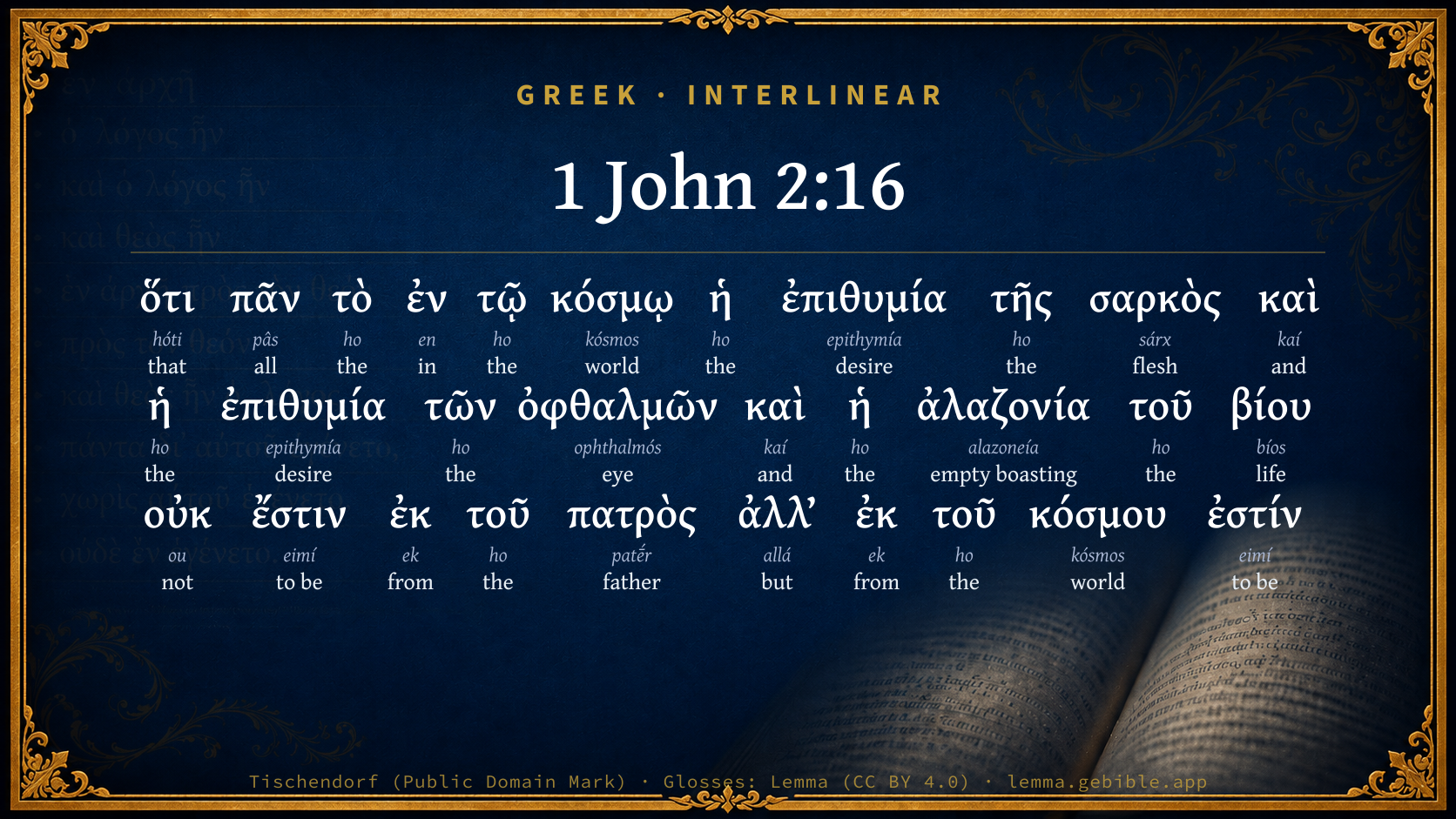
  1. ὅτι hóti G3754 “that” Conjunction
  2. πᾶν pâs G3956 “all” Adjective, Nominative, Singular, Neuter
  3. τὸ ho G3588 “the” Article, Nominative, Singular, Neuter
  4. ἐν en G1722 “in” Preposition
  5. τῷ ho G3588 “the” Article, Dative, Singular, Masculine
  6. κόσμῳ kósmos G2889 “world” Noun, Dative, Singular, Masculine
  7. ἡ ho G3588 “the” Article, Nominative, Singular, Feminine
  8. ἐπιθυμία epithymía G1939 “desire” Noun, Nominative, Singular, Feminine
  9. τῆς ho G3588 “the” Article, Genitive, Singular, Feminine
  10. σαρκὸς sárx G4561 “flesh” Noun, Genitive, Singular, Feminine
  11. καὶ kaí G2532 “and” Conjunction
  12. ἡ ho G3588 “the” Article, Nominative, Singular, Feminine
  13. ἐπιθυμία epithymía G1939 “desire” Noun, Nominative, Singular, Feminine
  14. τῶν ho G3588 “the” Article, Genitive, Plural, Masculine
  15. ὀφθαλμῶν ophthalmós G3788 “eye” Noun, Genitive, Plural, Masculine
  16. καὶ kaí G2532 “and” Conjunction
  17. ἡ ho G3588 “the” Article, Nominative, Singular, Feminine
  18. τοῦ ho G3588 “the” Article, Genitive, Singular, Masculine
  19. βίου bíos G979 “life” Noun, Genitive, Singular, Masculine
  20. οὐκ ou G3756 “not” Particle, Negative
  21. ἔστιν eimí G1510 “to be” Verb, Present, Active, Indicative, 3rd person, Singular
  22. ἐκ ek G1537 “from” Preposition
  23. τοῦ ho G3588 “the” Article, Genitive, Singular, Masculine
  24. πατρὸς patḗr G3962 “father” Noun, Genitive, Singular, Masculine
  25. ἀλλ’ allá G235 “but” Conjunction
  26. ἐκ ek G1537 “from” Preposition
  27. τοῦ ho G3588 “the” Article, Genitive, Singular, Masculine
  28. κόσμου kósmos G2889 “world” Noun, Genitive, Singular, Masculine
  29. ἐστίν eimí G1510 “to be” Verb, Present, Active, Indicative, 3rd person, Singular

About this verse

These counts appear in no published source. They are computed here, from the morphology-tagged text and Lemma’s own curated glosses. What Lemma adds →

30
words
16
distinct lemmas
General Epistles
section

Notable vocabulary

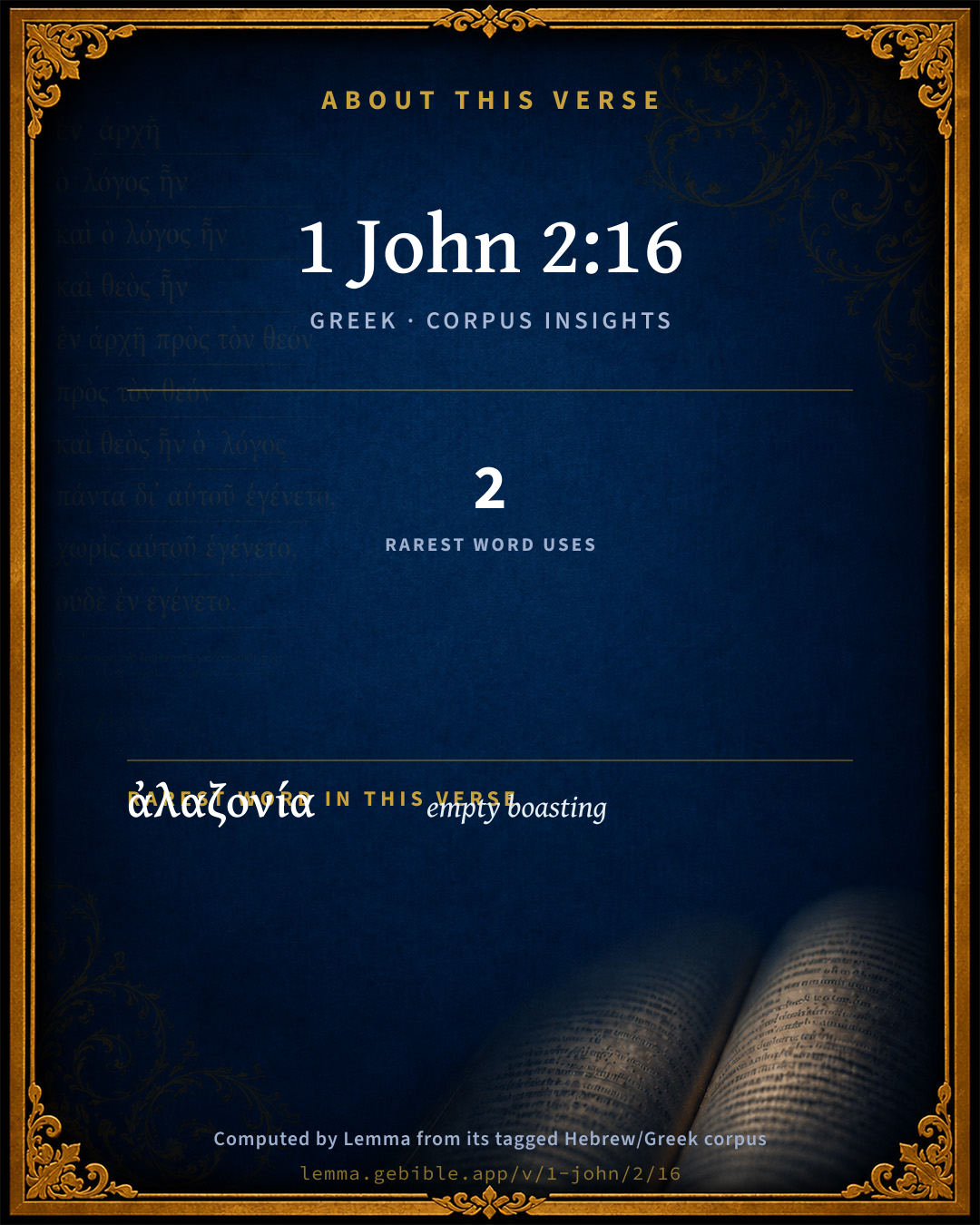
The rarest word here is ἀλαζονία empty boasting G212 — appearing just 2 times in the whole Greek New Testament.

Shared distinctive vocabulary

ἀλαζονία empty boasting G212 occurs in 2 verses of the Greek New Testament. Also found in:

Repetition

Words recur within this verse:

  • κόσμῳ world G2889 ×2
  • ἐπιθυμία desire G1939 ×2
  • ἔστιν to be G1510 ×2
  • τὸ the G3588 ×10
  • καὶ and G2532 ×2
  • ἐκ from G1537 ×2

Cross-references

33

Topical passages linked to 1 John 2:16 in the Treasury of Scripture Knowledge — connected by theme and wording, ordered by reader-vote popularity; previews shown in the World English Bible.

  • Romans 13:14 But put on the Lord Jesus Christ, and make no provision for the flesh, for its lusts.
  • Galatians 5:17 For the flesh lusts against the Spirit, and the Spirit against the flesh; and these are contrary to one other, that you may not do the things that you desire.
  • Psalms 119:36–37 Turn my heart toward your statutes, Not toward selfish gain.
  • Genesis 3:6 When the woman saw that the tree was good for food, and that it was a delight to the eyes, and that the tree was to be desired to make one wise, she took of the fruit of it, and ate; and she gave some to her husband with her, and he ate.
  • Proverbs 27:20 Sheol and Abaddon are never satisfied; And a man's eyes are never satisfied.
  • Ephesians 2:3 among whom we also all once lived in the lust of our flesh, doing the desires of the flesh and of the mind, and were by nature children of wrath, even as the rest.
  • 1 Peter 2:11 Beloved, I beg you as foreigners and pilgrims, to abstain from fleshly lusts, which war against the soul;
  • James 3:15 This wisdom is not that which comes down from above, but is earthly, sensual, and demonic.
  • 2 Peter 2:10 but chiefly those who walk after the flesh in the lust of defilement, and despise authority. Daring, self-willed, they are not afraid to speak evil of dignitaries;
  • 1 Peter 4:2–3 that you no longer should live the rest of your time in the flesh for the lusts of men, but for the will of God.
  • Psalms 78:18 They tempted God in their heart By asking food according to their desire.
  • Joshua 7:21 when I saw among the spoil a goodly Babylonian mantle, and two hundred shekels of silver, and a wedge of gold of fifty shekels weight, then I coveted them, and took them; and, behold, they are hid in the earth in the midst of my tent, and the silver under it.
  • Titus 2:12 instructing us to the intent that, denying ungodliness and worldly lusts, we would live soberly, righteously, and godly in this present world;
  • 2 Peter 2:18 For, uttering great swelling words of emptiness, they entice in the lusts of the flesh, by licentiousness, those who are indeed escaping from those who live in error;
  • Titus 3:3 For we were also once foolish, disobedient, deceived, serving various lusts and pleasures, living in malice and envy, hateful, and hating one another.
  • 1 Peter 1:14 as children of obedience, not conforming yourselves according to your former lusts as in your ignorance,
  • Jude 1:16–18 These are murmurers and complainers, walking after their lusts (and their mouth speaks proud things), showing respect of persons to gain advantage.
  • Job 31:1 "I made a covenant with my eyes, How then should I look lustfully at a young woman?
  • Psalms 73:6 Therefore pride is like a chain around their neck. Violence covers them like a garment.
  • Matthew 5:28 but I tell you that everyone who gazes at a woman to lust after her has committed adultery with her already in his heart.
  • Luke 4:5 The devil, leading him up on a high mountain, showed him all the kingdoms of the world in a moment of time.
  • Numbers 11:4 The mixed multitude that was among them lusted exceedingly: and the children of Israel also wept again, and said, Who shall give us flesh to eat?
  • Numbers 11:34 The name of that place was called Kibrothhattaavah, because there they buried the people who lusted.
  • Psalms 78:30 They didn't turn from their cravings. Their food was yet in their mouths,
  • Matthew 4:8 Again, the devil took him to an exceedingly high mountain, and showed him all the kingdoms of the world, and their glory.
  • 1 Corinthians 10:6 Now these things were our examples, to the intent we should not lust after evil things, as they also lusted.
  • Galatians 5:24 Those who belong to Christ have crucified the flesh with its passions and lusts.
  • Revelation 18:11–17 The merchants of the earth weep and mourn over her, for no one buys their merchandise any more;
  • Genesis 6:2 that God's sons saw that men's daughters were beautiful, and they took for themselves wives of all that they chose.
  • Esther 1:3–7 in the third year of his reign, he made a feast to all his princes and his servants; the power of Persia and Media, the nobles and princes of the provinces, being before him;
  • Proverbs 6:25 Don't lust after her beauty in your heart, Neither let her captivate you with her eyelids.
  • Daniel 4:30 The king spoke and said, Is not this great Babylon, which I have built for the royal dwelling-place, by the might of my power and for the glory of my majesty?
  • Ecclesiastes 5:10–11 He who loves silver shall not be satisfied with silver; nor he who loves abundance, with increase: this also is vanity.

Cross-references courtesy of OpenBible.info (CC BY 4.0).

Commentary

Notes on 1 John 2:16 from classic Christian and Jewish commentators (each source and its license shown beneath its notes). The classic Christian expositions comment on the surrounding passage and are grouped to its opening verse, so a note may address several verses; the Jewish commentaries on the Tanakh (Rashi and others) are per-verse, so they appear only where the commentator wrote on this verse.

Lemma curates 59 commentaries, every one of them public domain or Creative Commons licensed, each selected and text-cleaned for this edition rather than reprinted as found. About our sources →

The Cambridge Bible for Schools and Colleges

gen. ed. J. J. S. Perowne

16. Proof of the preceding statement by shewing the fundamental opposition in detail.

all that is in the world] Neuter singular: in 1Jn_2:15 we had the neuter plural. The material contents of the universe cannot be meant. To say that these did not originate from God would be to contradict the Apostle himself (Joh_1:3; Joh_1:10) and to affirm those Gnostic doctrines against which he is contending. The Gnostics, believing everything material to be radically evil, maintained that the universe was created, not by God, but by the evil one, or at least by an inferior deity. By ‘all that is in the world’ is meant the spirit which animates it, its tendencies and tone. These, which are utterly opposed to God, did not originate in Him, but in the free and rebellious wills of His creatures, seduced by ‘the ruler of this world’.

the lust of the flesh] This does not mean the lust for the flesh, any more than ‘the lust of the eyes’ means the lust for the eyes. In both cases the genitive is not objective but subjective, as is generally the case with genitives after ‘lust’ (ἐπιθυμία) in N. T. Comp. Rom_1:24, Gal_5:16, Eph_2:3. The meaning is the lusts which have their seats in the flesh and in the eyes respectively.

“Tell me where is fancy bred.

It is engendered in the eyes.”

Merchant of Venice, III. ii.

The former, therefore, will mean the desire for unlawful pleasures of sense; for enjoyments which are sinful either in themselves or as being excessive.

Note that S. John does not say ‘the lust of the body.’ ‘The body’ in N.T. is perhaps never used to denote the innately corrupt portion of man’s nature: for that the common term is ‘the flesh.’ ‘The body’ is that neutral portion which may become either good or bad. It may be sanctified as the abode and instrument of the Spirit, or degraded under the tyranny of the flesh.

the lust of the eyes] The desire of seeing unlawful sights for the sake of the sinful pleasure to be derived from the sight; idle and prurient curiosity. Familiar as S. John’s readers must have been with the foul and cruel exhibitions of the circus and amphitheatre, this statement would at once meet with their assent. Tertullian, though he does not quote this passage in his treatise De Spectaculis, is full of its spirit: “The source from which all circus games are taken pollutes them … What is tainted taints us” (VII., VIII.). Similarly S. Augustine on this passage; “This it is that works in spectacles, in theatres, in sacraments of the devil, in magical arts, in witchcraft; none other than curiosity.” See also Confessions VI. vii., viii., X. xxxv. 55.

the pride of life] Or, as R. V., the vainglory of life. Latin writers vary much in their renderings: superbia vitae; ambilio saeculi; jactantia hujus vitae; jactantia vitae humanae. The word (ἀλαζονεία) occurs elsewhere only Jas_4:16, and there in the plural; where A. V. has ‘boastings’ and R. V. ‘vauntings.’ The cognate adjective (ἀλάζων) occurs Rom_1:30 and 2Ti_3:2, where A. V. has ‘boasters’ and R. V. ‘boastful’. Pretentious ostentation, as of a wandering mountebank, is the radical signification of the word. In classical Greek the pretentiousness is the predominant notion; in Hellenistic Greek, the ostentation. Compare the account of this vice in Aristotle (Nic. Eth. IV. vii.) with Wis_5:8, 2Ma_9:8; 2Ma_15:6. Ostentatious pride in the things which one possesses is the signification of the term here; ‘life’ meaning ‘means of life, goods, possessions’. The word for ‘life’ (βίος) is altogether different from that used in 1Jn_1:1-2 and elsewhere in the Epistle (ζωή). This word (βίος) occurs again 1Jn_3:17, and elsewhere in N.T. only 8 times, chiefly in S. Luke. The other word occurs 13 times in this Epistle, and elsewhere in N. T. over 100 times. This is what we might expect. The word used here means (1) period of human life, as 1Ti_2:2; 2Ti_2:4; (2) means of life, as here, 1Jn_3:17, Mar_12:44; Luk_8:14; Luk_8:43; Luk_15:12; Luk_15:30; Luk_21:4 (in 1Pe_4:3 the word is not genuine). With the duration of mortal life and the means of prolonging it the Gospel has comparatively little to do. It is concerned rather with that spiritual life which is not measured by time (1Jn_1:2), and which is independent of material wealth and food. For this the other word (ζωή) is invariably used. By ‘the vainglory of life’ then is meant ostentatious pride in the possession of worldly resources.

These three evil elements or tendencies ‘in the world’ are co-ordinate: no one of them includes the other two. The first two are wrongful desires of what is not possessed; the third is a wrongful behaviour with regard to what is possessed. The first two may be the vices of a solitary; the third requires society. We can have sinful desires when we are alone, but we cannot be ostentatious without company. See Appendix A.

is not of the Father] Does not derive its origin from (ἐκ) Him, and therefore has no natural likeness to Him or connexion with Him. S. John says ‘the Father’ rather than ‘God’ to emphasize the idea of parentage. Its origin is from the world and its ruler, the devil. Comp. ‘Ye are of (ἐκ) your father the devil, and the lusts of your father ye will to do’ (Joh_8:44). The phrase ‘to be of’ is highly characteristic of S. John.

A. The Three Evil Tendencies in the World

The three forms of evil ‘in the world’ mentioned in 1Jn_2:16 have been taken as a summary of sin, if not in all its aspects, at least in its chief aspects. ‘The lust of the flesh, the lust of the eyes, and the vainglory of life’ have seemed from very early times to form a synopsis of the various modes of temptation and sin. And certainly they cover so wide a field that we cannot well suppose that they are mere examples of evil more or less fortuitously mentioned. They appear to have been carefully chosen on account of their typical nature and wide comprehensiveness.

There is, however, a wide difference between the views stated at the beginning and end of the preceding paragraph. It is one thing to say that we have here a very comprehensive statement of three typical forms of evil; quite another to say that the statement is a summary of all the various kinds of temptation and sin.

To begin with, we must bear in mind what seems to be S. John’s purpose in this statement. He is not giving us an account of the different ways in which Christians are tempted, or (what is much the same) the different sins into which they may fall. Rather, he is stating the principal forms of evil which are exhibited ‘in the world,’ i.e. in those who are not Christians. He is insisting upon the evil origin of these desires and tendencies, and of the world in which they exist, in order that his readers may know that the world and its ways have no claim on their affections. All that is of God, and especially each child of God, has a claim on the love of every believer. All that is not of God has no such claim.

It is difficult to maintain, without making some of the three heads unnaturally elastic, that all kinds of sin, or even all of the principal kinds of sin, are included in the list. Under which of the three heads are we to place unbelief, heresy, blasphemy, or persistent impenitence? Injustice in many of its forms, and especially in the most extreme form of all—murder, cannot without some violence be brought within the sweep of these three classes of evil.

Two positions, therefore, may be insisted upon with regard to this classification.

1. It applies to forms of evil which prevail in the non-Christian world rather than to forms of temptation which beset Christians.

2. It is very comprehensive, but it is not exhaustive.

It seems well, however, to quote a powerful statement of what may be said on the other side. The italics are ours, to mark where there seems to be over-statement. “I think these distinctions, the lust of the flesh, the lust of the eye, and the pride of life, prove themselves to be very accurate and very complete distinctions in practice, though an ordinary philosopher may perhaps adopt some other classification of those tendencies which connect us with the world and give it a dominion over us. To the lust of the flesh may be referred the crimes and miseries which have been produced by gluttony, drunkenness, and the irregular intercourse of the sexes; an appalling catalogue, certainly, which no mortal eye could dare to gaze upon. To the lust of the eye may be referred all worship of visible things, with the divisions, persecutions, hatreds, superstitions, which this worship has produced in different countries and ages. To the pride or boasting of life,—where you are not to understand by life, for the Greek words are entirely different, either natural or spiritual life, such as the Apostle spoke of in the first chapter of the Epistle, but all that belongs to the outside of existence, houses, lands, whatever exalts a man above his fellow,—to this head we must refer the oppressor’s wrongs, and that contumely which Hamlet reckons among the things which are harder to bear even than the ‘slings and arrows of outrageous fortune.’ In these three divisions I suspect all the mischiefs which have befallen our race may be reckoned, and each of us is taught by the Apostle, and may know by experience that the seeds of the evils so enumerated are in himself” (Maurice).

Do we not feel in reading this that S. John’s words have been somewhat strained in order to make them cover the whole ground? One sin produces so many others in its train, and these again so many more, that there will not be much difficulty in making the classification exhaustive, if under each head we are to include all the crimes and miseries, divisions and hatreds, which that particular form of evil has produced.

Some of the parallels and contrasts which have from early times been made to the Apostle’s classification are striking, even when somewhat fanciful. Others are both fanciful and unreal.

The three forms of evil noticed by S. John in this passage are only partially parallel to those which are commonly represented under the three heads of the world, the flesh, and the devil. Strictly speaking those particular forms of spiritual evil which would come under the head of the devil, as distinct from the world and the flesh, are not included in the Apostle’s enumeration at all. ‘The vainglory of life’ would come under the head of the world; ‘the lust of the flesh’ of course under that of ‘the flesh;’ while ‘the lust of the eyes’ would belong partly to the one and partly to the other.

There is more reality in the parallel drawn between S. John’s classification and the three elements in the temptation by which Eve was overcome by the evil one, and again the three temptations in which Christ overcame the evil one. ‘When the woman saw that the tree was good for food (the lust of the flesh), and that it was pleasant to the eyes (the lust of the eyes), and a tree to be desired to make one wise (the vainglory of life), she took of the fruit thereof, and did eat’ (Gen_3:6). Similarly, the temptations (1) to work a miracle in order to satisfy the cravings of the flesh, (2) to submit to Satan in order to win possession of all that the eye could see, (3) to tempt God in order to win the glory of a miraculous preservation (Luk_4:1-12).

Again, there is point in the contrast drawn between these three forms of evil ‘in the world’ and the three great virtues which have been the peculiar creation of the Gospel (Liddon Bampton Lectures VIII. iii. B), purity, charity, and humility, with the three corresponding ‘counsels of perfection,’ chastity, poverty, and obedience.

But in all these cases, whether of parallel or contrast, it will probably be felt that the correspondence is not perfect throughout, and that the comparison, though striking, is not quite satisfying, because not quite exact.

It is surely both fanciful and misleading to see in this trinity of evil any contrast to the three Divine Persons in the Godhead. Is there any sense in which we can say with truth that a lust, whether of the flesh or of the eyes, is more opposed to the attributes of the Father than to the attributes of the Son? Forced analogies in any sphere are productive of fallacies; in the sphere of religious truth they may easily become profane.

The Cambridge Bible for Schools and Colleges (gen. ed. J. J. S. Perowne; Cambridge University Press, 1878–1918) — public domain. Text from a community e-Sword module.

The Biblical Illustrator

Joseph S. Exell

1Jn_2:16

For all that is in the world, the lust of the flesh, and the lust of the eyes, and the pride of life, is not of the Father, but is of the world.

The three elements of a worldly life: love of pleasure, the love of knowledge, and the love of power

What then is the meaning of the phrase desire of the flesh? It is the desire which we naturally have to gratify our lower impulses, that animal nature which we share with the brutes, but which in man ought to be under the control of the superior faculty of reason. If we name this desire from its object, rather than from its origin or source, we might call it loosely the desire of pleasure uncontrolled by a sense of duty. It is more difficult to ascertain the exact force of the desire of the eyes. If taken literally, it would simply stand for a particular form of the desire of the flesh, a more refined and human form of sensual pleasure, the desire of seeing beautiful objects; but I am inclined to think that, so far as this is sensual, it is included under the former head, and that it is more in accordance with Hebrew ideas and with the facts of life to suppose that we have here a quite distinct class of desires, the desires of the intellect. But how, it may be asked, can the desire of knowledge be condemned as characteristic of the world. Knowledge is not dependent on society, like pleasure, and moreover the desire of knowledge is especially commended in the Bible. How then can it be to the discredit of the world, or make its influence more injurious, if it is accompanied by the desire of knowledge? The answer is that neither pleasure nor knowledge is in itself condemned in the Bible. The pleasure which is condemned in the phrase lust of the flesh, is, as we have seen, selfish and predominantly sensual, unchecked by higher thoughts and feelings. And so by the desire of the eyes is meant primarily not the desire for truth as such, but the desire for a knowledge of the world, knowledge as contrasted not with ignorance and stupidity, but with simplicity, ingenuousness and innocence. How many owe their fall to an impatience of restraint and a curiosity which is attracted to evil rather than to good! How few remember that knowledge no more than pleasure can claim our absolute allegiance! We now come to the third of these worldly lusts, as they are styled in the Epistle to Titus, the pride, or as the Revised Version has it, the vainglory of life, the desire to make a show, the desire of honour and distinction, which is as naturally characteristic of the active principle within us, as the desire of pleasure is of the passive or sensitive principle. Supposing this to be a generally correct account of St. Johns analysis of the spirit of the world, it is evident that it corresponds with the common division of mans nature into the feeling, the thinking, and the willing part; the desire of pleasure corresponding to the appetites, the desire of knowledge to the intellect, while ambition, the desire of honour and of power, corresponds to the will. But human life consists in the exercise of these different elements of mans nature. How is it possible, then, that these gifts of God should be the source of the evil that is in the world? If man were perfect, as God intended him to be, this would not be the case. His various impulses would all work harmoniously together under the control of reason and conscience, enlightened and guided by the Spirit of God himself. But we know that, whatever we may hope for the future, this is far from being the case at present. At present every impulse is a source of danger, because it is not satisfied with doing the work and attaining the end for which it was implanted in our nature, but continues to urge us on where its action is injurious, antagonistic to higher ends and higher activities, and contrary to the will of Him Who made us. It is these blind unruly impulses which constitute the spirit of the world, and are employed by him, who is described as the prince of this world, to band men together in evil, and so build up a kingdom of the world, in opposition to the kingdom of God. St. John implies the unrestrained action of these impulses when he tells us they make up all that is in the world. If we can trust contemporary evidence, the historians and satirists of Rome, no less than Christian writers, the moral condition of society in the imperial city is not too darkly coloured in St. Pauls Epistle to the Romans. In the catalogue of sin and vice there given, two main lines of evil may be distinguished, which at first sight seem to be very remote from each other, but which are in fact closely allied, being continually associated together in history, as they are in Miltons famous line, Lust hard by hate. Cruelty and profligacy were the most marked characteristics of the Caligulas and the Neros of Rome; they were the notes of that degraded aristocracy, in which even the women, dead to all sense of shame, were also dead to all feeling of pity, and could look on with a horrible delight at the sports in the arena, where gladiators were butchered to make a Roman holiday, and Christians were burnt alive at night in order to light up the chariot races of the emperor. And the profligacy of the capitol was faithfully copied in the provinces. St. Pauls epistles, with their constant warnings against impurity, show how deeply even the humbler ranks of society, from which the Church was mainly recruited, were infected with this vice of paganism. We see, then, that as regards the desire or lust of the flesh, the state of contemporary society fully bore out St. Johns description of the world. How did the case stand with regard to the second point in his description, the lust of the eyes? Understanding this of the desire of knowledge, we find St. Paul in his Epistle to the Corinthians describing it as the distinctive feature of the Greek as opposed to the Hebrew, that the Greeks seek after wisdom; but God (he says) hath chosen the foolish things of the world to confound the wise; Knowledge puffeth up, but charity edifieth. So St. Luke mentions curiosity, which is merely the undisciplined desire of knowledge, as the chief characteristic of the Athenians, all the Athenians spent their time in nothing else but either to tell or to hear some new thing. Ephesus, where St. John is believed to have spent the latter part of his life, was especially noted for the study of curious arts, prying into forbidden things. Lastly, if we ask how far that third constituent of the worldly spirit, ambition, vainglory, the pride of life, was to be found in Paganism at the time of St. Johns writing, we need not look further than the temple of Ephesus, which was held to be one of the wonders of the world; we need only think of the magnificence of the architecture, the splendour of the ceremonial, the frenzied enthusiasm of the multitudes which gathered at the festival of the great goddess Diana, whom all Asia and the world worshippeth. How hard it must have been for the little band of Christians to realise that all this pageantry and power was but an empty show, destined in a few short years to vanish away; to feel that the weakness of God was stronger than men, that God had chosen the base things of the world to confound the things which are mighty, that no flesh might glory in His presence. And if this was true of a provincial town like Ephesus, how much more of what was even then known as the eternal city, to which all the wealth and power and greatness, all the art and science and skill of the whole earth was attracted, where one man commanded the lives and fortunes of all, and was worshipped as God on earth, the only God whose worship was obligatory on all. It was such a world dominion as this, that St. John had in his mind, when he warned his disciples against being dazzled by the vainglory of life, when he spoke of the whole world lying in wicked ness, when he encouraged them with the thought that He that is born of God overcometh the world. I think that what we have seen to be true of the pagan world of St. Johns day, is also true of all the more marked historical appearances of the worldly spirit. Two such appearances may be especially noticed. One was that period of revolt against the Middle Ages, which preceded and accompanied the Reformation, the other was that period of scepticism which prepared the way for the French Revolution. In both we find the most influential classes of society, those which may be regarded as the truest embodiment of the worldly spirit of their time, characterised by the combination of these three elements, the love of pleasure, the love of knowledge, and the love of power. Enlightenment was the special boast of both eras, and the effect of this enlightenment was to shake off the old fashioned restraints of religion and morality and give free scope to the selfish instincts, whether in the direction of pleasure or ambition. Caesar Borgia was the natural outcome of the first era; Napoleon Bonaparte of the second. (J. B. Mayor, M. A.)

Transitoriness of the lust of the flesh

By the lust of the flesh I understand the animal needs and appetites, the physical strength and vigour. There is a period in life when the desires of the flesh exercise immense influence and subtle power over the imagination. They seem to promise illimitable delight and inexhaustible pleasures. The imagination runs through the world and sees everywhere alluring forms which point to intoxicating joys. That is not an unusual experience. It is common to all of us in the heyday of youth and strength, and I only allude to it to ask--Have you considered that this is passing away? Do you know that the gamut of appetite and passion is very limited after all? You can soon reach up and strike the topmost note, and downward and strike the lowest. Do you know that these violent delights have violent ends? They are soon exhausted, and the hungry passion is satiated, and the promise which it made is found a cheat. It is so. It is so if for no other reason than this--because physical life itself fails. Youth is soon gone; manhood is soon passed; old age is soon reached. You are not what you were. Already the keen edge and zest of earthly appetite is blunted. You dislike, perhaps, to admit it, and yet you know in your hearts that the best cup of wine which life has to give you is already drunk, and that life will never prepare again for you the like. (W. J. Dawson.)

The lust of the eyes

The eye is the portal of innumerable delights. It is the meeting place of many worlds. Through it there stream in upon the mind the vision of beauty, the revelation of sciences, the pomp and pageantry of earthly power, all the bright, shifting splendour of human glory. Have you ever considered that riches appeal mainly to the eye? It is the eye which interprets to a man the stateliness of the house which he has built, the beauty of the gardens which he has laid out, the pictures charm, the statues grace, the horses symmetry--in a word, all those costly embellishments with which wealth can adorn life. To the blind man they are nothing. To be blind is to lose almost everything that riches can bestow. Yet, says John, the lust of the eyes, too, is a fading passion which is soon satiated. The first house a man buys looks better and bigger to him than any house he owns afterwards. The first picture a man owns brings him more genuine pleasure than all the others put together. That lust of the eye which desires to add house to house and land to land has a lessening pleasure in its acquisitions. Like the lust of the flesh, after all it is a life of sensation, and all sensation is limited and soon exhausted. You, perhaps, have set your hope in some such direction as this. You desire to be rich; your eye lusts for the luxurious abodes of wealth and the circumstance and state of social greatness. When the lust of the flesh fails, the lust of the eye often develops; and the man who has lost the one frantically tries to recoup himself by flying to the other. But it is vain. The miseries of the idle rich, their ennui, their listlessness, their discontent, their imbecile thirst for new sensations, their perpetual invention of new and artificial joys, remind us how true are the words of John, that the lust of the eyes, too, passes away. (W. J. Dawson.)

The pride of life is transitory

It may signify either the pride of power or the pride of knowledge.

1. Take it, for instance, as the pride of power. Take it in regard to that great and splendid empire with which the apostles were familiar. It seemed built to last forever. To be a Roman was to be armed with an invincible defence. It was a proud boast which clothed the meanest man with dignity. The tramp of the legions of Rome echoed in every city; the silver eagles were borne in triumph through all the world; its laws had imposed civilisation upon the most barbarous peoples; and its power had crushed nation after nation. There was no sign in Johns day of any overthrow. Yet this solitary man told the truth when he said, not merely that it would pass away, but that it was passing away. He recognised that mysterious law of God, which seems to give to nations their chance and strengthen them with universal victory, and then depose them, lest one good custom should corrupt the world. Egypt, Chaldea, Babylon, Greece, all had had their day, and ceased to be. And so it would be with Rome. We today know that it has passed away.

2. And it is true of the pride of knowledge. The noblest pride of life, because the highest, is the pride of knowledge. Yet that, too, is transient. Nothing shifts its boundaries so often. Nothing is so illusive. Nothing passes through such strange and rapid transformations. The knowledge of Galileo would be the ignorance of today; and if Isaac Newton were alive now he would have to go to school again. A century, a half-century, a single decade, is often sufficient to thrust the most brilliant discoveries into oblivion. The steam engine has sup planted the coach; but the steam engine is already passing away, and in fifty years time will be supplanted by some greater and more serviceable power. The telegraph has bound nations together and has made all nations neighbours; but the telephone is becoming its rival, and in another century, and less perhaps, men will hear each others whispers round the globe. A thousand illustrations might be given of how knowledge perpetually effaces its past. Nor is this a mournful truth. It is no tolling bell which announces that the world is passing away. It is rather a trumpet. It means that Gods law is progress: and that is a glorious truth for those who can understand it. (W. J. Dawson.)

The worldlings trinity

Pleasure, profit, preferment (called here the lust of the flesh, etc.) are the worldlings trinity, to the which he performeth inward and outward worship. (J. Trapp.)

What is the world

The world is not altogether matter, nor yet altogether spirit. It is not man only, nor Satan only, nor is it exactly sin. It is an infection, an inspiration, an atmosphere, a life, a colouring matter, a pageantry, a fashion, a taste, a witchery. None of all these names suit it, and all of them suit it. (S. Faber.)

The Biblical Illustrator, edited by Joseph S. Exell (c. 1880s–1900s) — public domain. Text from a community e-Sword module.

Bengel's Gnomon

Johann Albrecht Bengel

1Jn 2:16. Πᾶν—ἡ ἐπιθυμία τῆς σαρκὸς, καὶ ἡ ἐπιθυμία τῶν ὀφθαλμῶν, καὶ ἡ ἀλαζονεία τοῦ βίου, all—the lust of the flesh, and the lust of the eyes, and the pride of life) The world contains all these, and nothing besides them. The lust of the flesh means those things, on which the senses of enjoyment, as they are termed, viz. the taste and touch, feed. The lust of the eyes means those things, by which the senses of investigation, the eye or sight, hearing and smelling, are occupied. Ἀλαζονεία is arrogant pomp, when any one assumes too much to himself either in words or in actions. See Raphel. It is also comprised under the word, lust, in the next verse: and therefore arrogance of life, is that which leads forth lust abroad, and diffuses it more largely into the world, so that a man wishes to be as great as possible in food, in dress, in plate, in furniture, in buildings, in estates, in servants, in his retinue, in his equipage, in his offices, etc. Comp. Rev 18:12-13. Chrysostom, in the passage referred to above, speaks of τὸν τύφον τὸν βιωτικὸν, the vanity of life, and τὴν φαντασίαν τοῦ βίου, the display of life: where he relates a youthful example of such insolence overcome by sacred love. Either kind of lust is the little fire (spark); arrogance is the conflagration. Even those who do not love arrogance of life, may possibly pursue the lust of the eyes; and they who have overpowered this, yet frequently retain the lust of the flesh: for this prevails in the greatest degree, and to the widest extent, among the poor, the middle classes, and the powerful; even among those who appear to exercise self-denial: and again, unless it is overcome, a man easily advances from it to the lust of the eyes, where he has the means [materials for it]; and from this to pride of life, where he has the opportunity [resources]. The second is included in the third, and the first in the second. The three cardinal vices, pleasure, avarice, and pride, do not coincide with these three; but yet they are comprised in them. Comp. Luk 8:14; Deu 17:16-17; Mat 4:3; Mat 4:6; Mat 4:9. And youth is especially commanded to avoid these three, comp. 2Ti 2:22, since it might abuse its great vigour. Ecclesiastes 12.

Bengel's Gnomon of the New Testament — English translation (T&T Clark, Edinburgh, 1860) — public domain. Text from a community e-Sword module.

Meyer's Critical & Exegetical Commentary

Heinrich August Wilhelm Meyer

1Jn_2:16. Confirmation of the preceding thought that love to the world is inconsistent with love to God.

ὅτι πᾶν τὸ ἐν τῷ κόσμῳ] Bede incorrectly explains the neuter here (as it certainly does appear elsewhere in John) as masculine: omnes mundi dilectores non habent nisi concupiscentiam; most commentators regard the expression as identical with the foregoing τὰ ἐν τῷ κόσμῳ; even Düsterdieck, who, in reference to the following ἡ ἐπιθυμία κ.τ.λ., thinks that a change occurs from the representation of the objects of the love of the world to the subjective desire itself and its actual manifestations. But even apart from the fact that the assumption of such a change in the form is only a makeshift, the expression of the apostle himself is opposed to this; for had he not meant by πᾶν τὸ ἐν τ. κ. something else than by τὰ ἐν τῷ κ., he would have put the neuter plural here also. Besides, it must not be overlooked why the following: ἡ ἐπιθυμία κ.τ.λ. could not be the apposition stating the sense of πᾶν τ. ἐν τ. κ. (Frommann, p. 269).[138] Accordingly, the apostle means by this expression: all that forms the contents, i.e. the substance of the κόσμος; its inner life, which animates it (Braune); in what this consists, the following words state. ἡ ἐπιθυμία τῆς σαρκὸς κ.τ.λ.] Although the ideas ἐπιθυμία and ἀλαζονεία in themselves denote a subjective disposition of man, yet several commentators think that here not this, but the objective things are meant, to which that subjective disposition is directed (Bengel, Russmeyer, Lange, Ewald), or that the otherwise subjective idea disappears into the objective (de Wette), or at least that both the subjective and the objective are to be thought of together (Lorinus, Brückner). But with the correct conception of the ideas κόσμος and πᾶν τὸ ἐν τῷ κόσμῳ there is no apparent reason for such an arbitrary explanation, by which violence is done to the words of the apostle.

ἡ ἐπιθυμία τῆς σαρκός] The genitive is here not the genitive of the object, but, as is the case with ἐπιθυμία[139] always in the N. T. (except 2Pe_2:10; on Eph_4:22 comp. Meyer on this passage), the genitive of the subject, hence not: the desire directed towards the flesh, but: the desire which the flesh, i.e. the corrupted sensual nature of man, cherishes, or which is peculiar to the flesh; comp. Gal_5:17 : ἡ σὰρξ ἐπιθυμεῖ.

Ebrard interprets, describing the genitive as that of quality and reference, for which he wrongly appeals to Eph_4:22, 2Pe_2:10 : the desire which occurs in the sphere of the flesh; the apostle scarcely conceived the idea so indefinitely. The idea may be taken in a broader or in a narrower sense; the first view in Lücke (fleshly, sensuous desire in general, in contrast to ΠΝΕΎΜΑΤΙ ΠΕΡΙΠΑΤΕῖΝ and ἌΓΕΣΘΑΙ; comp. Eph_2:3; 1Pe_2:11), de Wette, Neander, Düsterdieck; in the second, the desire of sensuality and drunkenness is specially understood; Augustine: desiderium earum rerum, quae pertinent ad carnem, sicut cibus et concubitus et caetera hujusmodi; similarly Grotius, Baumgarten-Crusius, Sander, Besser, etc.; Brückner limits the idea to the lust of the flesh in the narrower sense; Gerlach specially to every sort of pursuit of enjoyment;[140] and Ebrard to sexual enjoyments.[141] The right explanation can be found only on the consideration of the following expression.

καὶ ἡ ἐπιθυμία τῶν ὀφθαλμῶν] i.e. the desire that is inherent in the eyes, that is peculiar to them; the expression is explained in this way, that the desire of seeing something is attributed to the sense of sight itself.[142] This idea also is understood in a broader and in a narrower sense. As Lücke calls the eyes as it were the principal gates of sensual desire for the external world, he identifies this idea with the preceding one; de Wette does the same, interpreting it (in objective aspect): what the eyes see, and by what sensual desire is excited. The connection by καί, however, which is further followed by a second καί, shows that the two ideas are to be definitely distinguished. Accordingly, most commentators justly regard ἐπιθ. τῶν ὀφθαλμῶν as the description of a special sort of ἐπιθυμία; thus (against de Wette) Brückner in subjective and objective view: the lust of the eyes, and, at the same time, that in which, as sensuous and earthly, the eyes delight. Two different interpretations are found with a more exact definition. Very many commentators, as Luther, Socinus, Grotius, Hornejus, Estius, Lorinus, Wolf, Clarius, Paulus, Semler, Baumgarten-Crusius, Gerlach, etc.,[143] hold, though with some modifications, the expression to be substantially synonymous with πλεονεξία, avaritia. On behalf of this interpretation, appeal is made principally to several passages of the O. T., and especially to Ecc_4:8; Ecc_5:10, Pro_23:5; Pro_27:20; but erroneously, for even though the eye of the covetous or avaricious man looks with pleasure on his treasures, and eagerly looks out for new ones, still the possession or acquirement of wealth is to him the chief thing; the striving for it, however, is not expressed by the phrase: ἐπιθυμία τῶν ὀφθαλμῶν. Still less justifiable is the explanation of Ebrard, who partly agrees with those commentators, but regards the idea of avarice as too narrow; and, with an appeal to passages such as Psa_17:11; Psa_54:6; Psa_91:8; Psa_92:12 Pro_6:17, etc., maintains that by ἡ ἐπιθ. τ. ὀφθ. is meant the whole sphere of the desires of selfishness, envy, and avarice, of hatred and revenge (!). Other commentators, on the contrary, retain the reference to the pleasure of mere sight, but limit this too much to dramatic performances, etc.; thus Augustine: omnis curiositas in spectaculis, in theatris; similarly Neander and others. Such a limitation, however, is arbitrary; accordingly, others refer the expression to other objects of sight, thus Calvin: tam libidinosos conspectus comprehendit, quam vanitatem, quae in pompis et inani splendore vagatur; but it is more correct to take the reference to these things in a quite general way, and, with Spener, to interpret: all sinful desire by which we seek delight in the seeing itself (so also Braune); besides, it is to be observed that ἡ ἐπιθυμία τ. ὀφθ. is not the desire for wealth, etc., which is excited by the sight (Rickli and others[144]), but the desire of seeing unseemly things, and the sinful pleasure which the sight of them affords.[145] Thus, this idea is quite exclusive of the ἐπιθυμία τῆς σαρκός; if the latter is taken quite generally, then the lust of the eyes is a particular species of it, which the apostle specially mentions in order to meet the idea that the desire of seeing anything can have nothing sinful in it. But, having regard to the simple juxtaposition of the ideas by καί, it is more correct to suppose that John conceived the ἐπιθ. τῆς σαρκός not in that general sense, but in the particular sense of the lust for wealth and immoderate enjoyment, so that the two ideas stand to one another in the relation not of subordination, but of co-ordination, both being subordinate to the general idea of ἐπιθυμία.

καὶ ἡ ἀλαζονεία τοῦ βίου] ἀλαζονεία is usually translated by superbia, ambitio (Socinus: ambitio in honoribus quaerendis ac sectandis), and by similar words, and thereby is understood ambition, together with the pride and haughty contempt for others which are frequently associated with it;[146] thus Cyril interprets (Homil. Pasch. xxvii.): ἀλαζονείαν τ. β. φησὶ τῶν ἀξιωμάτων ὑπεροχὴν καὶ τὸ ἠρμένον ὕψος κατά γε τιμὴν καὶ δόξαν. Thereby, however, its peculiar meaning is not assigned to the word. In the N. T. ἀλαζονεία only appears in Jam_4:16 (in the plural); the adjective ἀλάζων in Rom_1:30 and 2Ti_3:2, in close connection with ὑπερήφανος, from which, however, it does not follow that the idea of ambition, thirst for glory, etc., is contained in it, but only that the ἀλαζ. is related to ὑπερηφανία; in James is meant therebyaccording to the contextthe haughtiness which overlooks the uncertainty of earthly happiness, and ostentatiously relies on its permanence. In the same sense = ostentatious pride in the possession, whether real or pretended, of earthly good things, such as happiness, power, knowledge, etc., the word appears also in the Apocrypha of the O. T.; comp. Wis_5:8; Wis_17:7; 2Ma_9:8; 2Ma_15:6. In classical Greek ἀλαζονεία has almost always the collateral meaning of the unreality of proud ostentation (Theophr. Charact. 23: προσποίησίς τις ἀγαθῶν οὐκ ὄντων πρὸς δόξαν; Plato, Phaedr.: ἕξις προσποιητικὴ ἀγαθοῦ ἢ ἀγαθῶν τῶν μὴ ὑπαρχόντων; antithesis of εἰρωνεία), which has obtained in Hellenistic usage only in so far that the idea here also always refers to something by its very nature worthless and trifling, and in this way certainly includes a delusion or unreality. This meaning is to be retained here also, as is rightly done by Lücke, Sander, Besser, Braune;[147] for examples in the Scriptures, comp. 1Ch_22:1 ff.; Ecc_2:1 ff.; Eze_28:16-17; Dan_4:27; Rev_17:4; Rev_18:7, etc. The genitive τοῦ βίου serves for the more particular definition of the idea; ΒΊΟς signifies in the N. T. either temporal life (1Ti_2:2; 1Pe_4:3, Rec.), or more commonly the support of life, the means (chap. 1Jn_3:17; Mar_12:44; Luk_8:43; Luk_15:12; Luk_15:30; Luk_21:4); it never has the meaning conduct of life (Ebrard). Following polyb. Hist. vi. 576: ἡ περὶ τοὺς βίους ἀλαζονεία καὶ πολυτέλεια, it is appropriate to take ΒΊΟς here in the second meaning, and the genitive as objective genitive (so Lücke); as, however, ΣΑΡΚΌς and ὈΦΘΑΛΜῶΝ are subjective genitives, it is much more correct to take ΒΊΟΥ also as subjective genitive, and accordingly to interpret: the ἈΛΑΖΟΝΕΊΑ peculiar to the ΒΊΟς; in the expression ἩΔΟΝΑῚ ΤΟῦ ΒΊΟΥ, Luk_8:14, ΤΟῦ ΒΊΟΥ may also be the objective genitive, thus: the pleasures which refer to the ΒΊΟς, the temporal good; but more probably it is the subjective genitive here also, especially if it be connected with the preceding ideas (see Meyer on this passage), thus: the pleasures peculiar to the present life.[148]

[138] According to Ebrard, πᾶν τὸ ἐν τ. κ. is a resumption of τὰ ἐν τ. κ.; as, however, he understands by it various kinds of conduct, etc., that idea is rightly interpreted by him. Myrberg agrees with the interpretation given above.

[139] It is arbitrary for Ebrard to say: ἐπιθυμία is hereas in Joh_8:44; Rom_7:8; Gal_5:16, etc.that which one lusts after, which indeed he again cancels by translating the word by lust.

[140] Even Bengel takes the expression (while, however, he understands it of the objective things) in a narrower sense: ea quibus pascuntur sensus, qui appellantur truitivi: gustus et tactus.

[141] This explanation results for Ebrard from the fact that he takes σάρξ here = σῶμα, and then describes the idea sensual as identical with sexual (!).

[142] Ebrard strangely thinks that in this view the genitive ὀφθαλμῶν is regarded as objective genitive = the desire for eyes, i.e. for enjoyment of the eyes.

[143] Sander also explains it of avarice, but would not exclude the curiositas in spectaculis, etc., regarding this, however, as merely collateral.

[144] Rickli interprets: the low, sensual style of thought, in so far as this is excited and fostered by the sight. Düsterdieck understands by it specially covetousness and avarice; but at the same time observes that every sort of desire may be excited by the eye.

[145] Bengel extends the idea beyond the limit which lies in the expression itself, when he explains: ea, quibus tenentur sensus investigativi: oculus, sive visus, auditus et olfactus.

[146] Calvin: fastus aut superbia, cui conjuncta est ambitio, jactautia, aliorum contemptus, coecus amor sui, praeceps confidentia.

[147] With this view Neander, Gerlach, and Düsterdieck substantially agree also; yet their paraphrases do not keep precisely enough within the definite limits of the extent of the idea, as they include ostentation, ambition, etc.; a definite distinction between this idea and ἐπιθυμία is requisite.Augustine not inaccurately describes the ἀλάζων thus: jactare se vult in honoribus, magnus sibi videtur, sive de divitiis, sive de aliqua potentia. Ebrard wrongly denies that according to Hellenistic usage the element of pride is contained in the idea ἀλαζονεία; neither in classical nor in Hellenistic usage has the word the meaning luxury, which he maintains for it.

[148] The commentators for the most part express themselves somewhat vaguely; de Wette explains: the enjoyment, combined with pride of (earthly) life (not: of the good things of life); Braune says that the genitive is to be taken as subjective genitive, and then interprets: the genitive τ. βίου signifies the side on which ostentatious pride usually appears; Ewald translates: swindling in money, which is not only indefinite, but even unjustifiable.

REMARK.

It has almost become traditional to find the modes of appearance of the evil fully stated in this threefold form, corresponding to the triplicity which appears in the Greek writers, as in Pythag. Clinias: φιληδονία μὲν ἐν ταῖς ἀπολαύσεσι ταῖς διὰ σώματος, πλεονεξία δὲ ἐν τῷ κερδαίνειν, φιλοδοξία δὲ ἐν τῷ καθυπερέχειν τῶν ἴσων τε καὶ ὁμοίων; for other expressions, see Wetstein.[149] This threefold form, it has been thought, is found both in the fall and again in the temptation of Christ; thus Bede, following Augustine, says: Per haec tria tantum cupiditas humana tentatur; per haec tria Adam tentatus est et victus; per haec tentatus est Christus et vicit; while a Lapide finds expressed in it even the contrast with the three Persons in the divine Trinity.[150]

Bengel opposes this view, and makes such a distinction between the ἐπιθ. τὴς σαρκός and the ἐπιθ. τ. ὀφθ., that he refers the former to the sensus fruitivi, the latter to the sensus investigativi, but says of the ἀλαζονεία τ. β.: arrogantia vitae est, quae cupiditatem foras educit et longius in mundum diffundit, ut homo velit quam plurimus esse in victu, cultu, etc.; and then observes: non concidunt cum his tribus tria vitia cardinalia: voluptas, avaritia, superbia; sed tarnen in his continentur. By the last clause Bengel shows, however, that there is a trace of that scheme to be found even in him (Düsterdieck).

Lücke has more decidedly expressed himself against it, inasmuch as he finds in that threefold form only the three chief points of worldly lust (according to the first edition, only as examples); and, moreover, the points in which it proceeds from the sensual desire to the climax of the ἀλαζονεία. But Lückes own interpretation of the particular ideas is opposed to such a progress, as he makes the first two ideas to coincide in regard to their substance, and thus no progress takes place from the one ἐπιθυμία to the other, nor is it, besides, in any way hinted at by the apostle.

Lücke rightly contends that particular leading vices are the subject here; not individual vices, but the leading forms (Lücke[151]); or, as Brückner says, the leading tendencies of worldly sense are stated by the apostle in that threefold form. But in what relation do these stand to one another? According to Düsterdieck, the ἐπιθυμία τῆς σαρκός forms the superior idea, to which the two other ideas, as mutually co-ordinate, are in subordination: The first-mentioned lust of the flesh, the most comprehensive and thorough description of the love of the world (1Jn_2:15), embraces both the lust of the eyes and the pride of life. This is incorrect. For, on the one hand, the ἈΓΆΠΗ to the ΚΌΣΜΟς is not to be identified with the ἘΠΙΘΥΜΊΑ Τῆς ΣΑΡΚΌς, as the latter rather describes the inner nature of the ΚΌΣΜΟς; the apostle warns against that love, because in the ΚΌΣΜΟς the ἘΠΙΘΥΜΊΑ which is not of God dominates; the thought that is to be supplied is this, that love to the ΚΌΣΜΟς necessarily implies an entrance into its nature; and, on the other hand, the apostles form of expression is utterly opposed to such a subordination; the two first-mentioned forms of worldly sense are by the same appellation: ἘΠΙΘΥΜΊΑ, closely connected with each other, and distinguished from the third, which is not called ἘΠΙΘΥΜΊΑ, but ἈΛΑΖΟΝΕΊΑ;[152] it is unsuitable, however, to regard the latter as ἘΠΙΘΥΜΊΑ; ἘΠΙΘΥΜΊΑ is the desire directed to the attainment of any goodthe lust for something (not exactly: the lust or delight in anything), but the ἀλαζονεία is a definite behaviour in regard to the good which one possesses. The worldly man stands in a double relationship to the perishable good things; on the one hand, he aspires after them, whether he wants to possess and enjoy them or to delight himself with looking at them; on the other hand, he fancies himself great in them when he has them as his own.

That the whole sphere of sinful life is not here surveyed, Luther has noticed when he says: The following three things are not of the Father, viz.: (1) hatred of the brethren; (2) the three idols of the world; (3) false and seductive teaching.

Sander also brings out the same trichotomy of sinful corruption, appealing for it to chap. 1Jn_2:2-12, where the subject is the first, to 1Jn_2:15-17, where it is the second, and to 1Jn_2:19 ff., where it is the third. The apostle certainly mentions these different modes of the appearance of sin; but that the organism of the Epistle rests on this, is an assertion that goes too far.

[149] Ebrard justly denies that a division of sin as such is to be sought for here; but his own view, that in that threefold form there is given a distribution of worldly conduct in its entire extent, and in this way, that first the relation of man to his own bodily and sensual nature is expressed, then the egotistical opposition to his fellow-men, and finally, his relation to them and complication with them, is, as resting on a false interpretation of the particular ideas, just as little to be justified.

[150] The counterpart of these three forms of the sinful life is, according to a Lapide, the three primariae virtutes: continentia, charitas, humilitas, which coincide very exactly with the three monastic vows of chastity, poverty, and obedience.

[151] When Lücke calls those three not merely the leading forms, but also the principles and sources of the worldly sense, this is not correct, for the worldly sense does not spring from the ἐπιθυμία κ.τ.λ., but the latter is the living motion of the former.

[152] Frommann (p. 270 ff.) justly remarks that the two leading forms are the ἐπιθυμία and the ἀλαζονεία; that the ἐπιθυμία signifies the desire, and the ἀλαζονεία the action, which in the attainment of the object desired has already found its satisfaction.

The following words: οὐκ ἔστιν ἐκ τοῦ πατρὸς κ.τ.λ.] express the anti-divine character of the worldly nature of the ἐπιθυμία κ.τ.λ.

πατήρ, as in 1Jn_2:15; κόσμος here quite in the same sense as before.

εἶναι ἐκ is, according to Paulus, Baumgarten-Crusius, de Wette, not the description of the origin, but only of the connection and similarity; by this view, however, the depth of Johns conception is ignored; the expression rather embraces both, but the second only as the result of the first (so also Ebrard); comp. Joh_8:44.

By the addition of ἀλλʼ ἐκ τοῦ κόσμου ἐστί the antagonism between God and the world, as the source of the ungodly disposition, is brought out with peculiar distinctness.

Meyer — Critical and Exegetical Commentary on the New Testament — English translation by Peter Christie, edited by Frederick Crombie (T&T Clark, 1880) — public domain. Text from a community e-Sword module.

Expositor's Greek Testament

ed. W. Robertson Nicoll

1Jn 2:16 . ἡ ἐπιθυμία τῆς σαρκός , not object. gen. (Aug.: “desiderium earum rerum quæ pertinent ad carnem, sicut cibus et concubitus, et cætera hujusmodi,”) but subject.: “the lust which the flesh feels, which resides in the flesh”. Cf. ἡ ἐπιθυμία τῶν ὀφθαλμῶν . ἀλαζονία , vain pretension, claiming what one really has not. Def. Plat. : ἕξις προσποιητικὴ ἀγαθοῦ ἤ ἀγαθῶν τῶν μὴ ὑπαρχόντωυ . Suid.: ἀλαζόνας τοὺς ψεύστας ἐκάλουν , ἐπεὶ λέγειν ἐπαγγέλλονται περὶ ὧν μὴ ἴσασιν . Theophr. Char. vi.: προσδοκία τις ἀγαθῶν οὐκ ὄντων . ζωή , the vital principle ( vita qua vivimus ), ( βίος , the outward life ( vita quam vivimus ) or livelihood ( victus ). There is here a summary of all possible sins, exemplified in the temptations of Eve (Gen 3:1-6 ) and our Lord (Mat 4:1-11 ). Cf. Aug.; Lightfoot, Hor. Heb. , on Mat 4:1 . (1) “The lust of the flesh”: cf. “The tree was good for food”; “Command that these stones become loaves”. (2) “The lust of the eyes”: cf. “It was a delight to the eyes”; “Cast thyself down” a spectacular display. (3) “The braggart boast of life”: cf. “The tree was to be desired to make one wise”: “All the kingdoms of the world and the glory of them”.

The Expositor's Greek Testament, edited by W. Robertson Nicoll (1897–1910) — public domain. Text from a community e-Sword module.

Jamieson, Fausset & Brown

Robert Jamieson, A. R. Fausset & David Brown

all that is in the world--can be classed under one or other of the three; the world contains these and no more.

lust of the flesh--that is, the lust which has its seat and source in our lower animal nature. Satan tried this temptation the first on Christ: Luk 4:3, "Command this stone that it be made bread." Youth is especially liable to fleshly lusts.

lust of the eyes--the avenue through which outward things of the world, riches, pomp, and beauty, inflame us. Satan tried this temptation on Christ when he showed Him the kingdoms of the world in a moment. By the lust of the eyes David (Sa2 11:2) and Achan fell (Jos 7:21). Compare David's prayer, Psa 119:37; Job's resolve, Psa 31:1; Mat 5:28. The only good of worldly riches to the possessor is the beholding them with the eyes. Compare Luk 14:18, "I must go and SEE it."

pride of life--literally, "arrogant assumption": vainglorious display. Pride was Satan's sin whereby he fell and forms the link between the two foes of man, the world (answering to "the lust of the eyes") and the devil (as "the lust of the flesh" is the third foe). Satan tried this temptation on Christ in setting Him on the temple pinnacle that, in spiritual pride and presumption, on the ground of His Father's care, He should cast Himself down. The same three foes appear in the three classes of soil on which the divine seed falls: the wayside hearers, the devil; the thorns, the world; the rocky undersoil, the flesh (Mat 13:18-23; Mar 4:3-8). The world's awful antitrinity, the "lust of the flesh, the lust of the eyes, and the pride of life," similarly is presented in Satan's temptation of Eve: "When she saw that the tree was good for food, pleasant to the eyes, and a tree to be desired to make one wise," Gen 3:6 (one manifestation of "the pride of life," the desire to know above what God has revealed, Col 2:8, the pride of unsanctified knowledge).

of--does not spring from "the Father" (used in relation to the preceding "little children," Jo1 2:12, or "little sons"). He who is born of God alone turns to God; he who is of the world turns to the world; the sources of love to God and love to the world, are irreconcilably distinct.

Jamieson, Fausset & Brown — Commentary Critical and Explanatory on the Whole Bible (1871) — public domain (CC PDM 1.0). Text via the HelloAO Bible API.

Adam Clarke's Commentary

Verse 16. For all that is in the world] All that it can boast of, all that it can promise, is only sensual, transient gratification, and even this promise it cannot fulfil; so that its warmest votaries can complain loudest of their disappointment.

The lust of the flesh] Sensual and impure desires which seek their gratification in women, strong drink, delicious viands, and the like.

Lust of the eyes] Inordinate desires after finery of every kind, gaudy dress, splendid houses, superb furniture, expensive equipage, trappings, and decorations of all sorts.

Pride of life] Hunting after honours, titles, and pedigrees; boasting of ancestry, family connections, great offices, honourable acquaintance, and the like.

Is not of the Father] Nothing of these inordinate attachments either comes from or leads to God. They are of this world; here they begin, flourish, and end. They deprave the mind, divert it from Divine pursuits, and render it utterly incapable of spiritual enjoyments.

Adam Clarke's Commentary on the Bible (1810–1826) — public domain. Text from a community e-Sword/MySword module.

John Calvin's Commentaries

16 The lust of the flesh, or, namely, the lust of the flesh. The old interpreter renders the verse otherwise, for from one sentence he makes two. Those Greek authors do better, who read these words together, “Whatever is in the world is not of God;” and then the three kinds of lusts they introduce parenthetically. For John, by way of explanation, inserted these three particulars as examples, that he might briefly shew what are the pursuits and thoughts of men who live for the world; but whether it be a full and complete division, it does not signify much; though you will not find a worldly man in whom these lusts do not prevail, at least one of them. It remains for us to see what he understands by each of these.

The first clause is commonly explained of all sinful lusts in general; for the flesh means the whole corrupt nature of man. Though I am unwilling to contend, yet I am unwilling to dissemble that I approve of another meaning. Paul, when forbidding, in Romans 13:14, to make provision for the flesh as to its lusts, seems to me to be the best interpreter of this place. What, then, is the flesh there? even the body and all that belongs to it. What, then, is the lust or desire of the flesh, but when worldly men, seeking to live softly and delicately, are intent only on their own advantages? Well known from Cicero and others, is the threefold division made by Epicurus; for he made this difference between lusts; he made some natural and necessary, some natural and not necessary, and some neither natural nor necessary. But John, well knowing the insubordination (ἀταξία)of the human heart unhesitantly condemns the lust of the flesh, because it always flows out immoderately, and never observes any due medium. He afterwards comes gradually to grosser vices.

The lust of the eyes He includes, as I think, libidinous looks as well as the vanity which delights in pomps and empty splendor.

In the last place follows pride or haughtiness; with which is connected ambition, boasting, contempt of others, blind love of self, headstrong self-confidence.

The sum of the whole is, that as soon as the world presents itself, our lusts or desires, when our heart is corrupt, are captivated by it, like unbridled wild beasts; so that various lusts, all which are adverse to God, bear rule in us. The Greek word, βὶος rendered life, (vita,) means the way or manner of living.

John Calvin's Commentaries (1540-1563) — public domain. Text from the Calvin Translation Society English edition (1840s-50s) via the Christian Classics Ethereal Library (ccel.org). Calvin's coverage is partial (roughly two-thirds of the Bible); uncommented books and verses are honest gaps, never fabricated. The 19th-century editor's footnotes and remarks are omitted so the notes are faithfully Calvin's own voice.

John Gill's Exposition

For all that is in the world,.... This is the sum of the evil things in the world; or these following are the objects of sin in the world, or about which wicked men are conversant; even such as are carnal or grateful to the flesh, visible to the eye, and belong to this vain life, or serve to fill with pride and vanity; or these are the main things, which men that love the world most highly value and esteem:

the lust of the flesh; by which is meant, not lust in general, or concupiscence, the corruption of nature, which is the fountain of all sin, or indwelling sin, the flesh, or that corrupt principle which lusts against the Spirit; nor the various lusts of the flesh, fleshly lusts, which war against the soul, and which are many, and are also called worldly lusts; but some particular one, "a lust of the body", as the Syriac version reads; either the lust of uncleanness, which includes all unchaste desires, thoughts, words, and actions, fornication, adultery, rape, incest, sodomy, and all unnatural lusts; and which make up a considerable part of the all that is in the world: or else intemperance in eating and drinking, gluttony and drunkenness, excess of wine, surfeitings, rioting, and revellings, and all the sensual pleasures of life, by which the carnal mind, and the lusts of it, are gratified; whereby the soul is destroyed, the body is dishonoured, and a wound, dishonour, and reproach brought on the character, not to be removed; for which reasons the world, and the things of it, are not to be loved: the next follows,

the lust of the eyes: after unlawful objects, and may design unchaste and lascivious looks, eyes full of adultery, and whereby adultery is committed; see Mat 5:28; but then this falls in with the other, unless that be confined to intemperance; rather then this may intend a sinful curiosity of seeing vain sights, and shows, with which the eye of man is never satisfied, Ecc 1:8; and against which the psalmist prays, Psa 119:37, or rather the sin of covetousness is here designed, the objects of which are visible things, as gold, silver, houses, lands, and possessions, with which riches the eyes of men are never satisfied, and which sin is drawn forth and cherished by the eyes; and indeed a covetous man has little more satisfaction than the beholding his substance with his eyes, and in which he takes much sinful pleasure; see Ecc 4:8; and what a poor vain empty thing is this! therefore, love not the world, since this is a principal thing in it: as is also

the pride of life; by which seems to be meant, ambition of honour, of chief places and high titles, as in the Scribes and Pharisees, Mat 23:6, or of grand living, for the word signifies not so much life as living; living in a sumptuous, gay, luxurious, and pompous manner, in rich diet, costly apparel, having fine seats, palaces, and stately buildings, and numerous attendance; all which is but vanity and vexation of spirit; see Ecc 2:1. The Syriac and Arabic versions read, "the pride of the age"; and every age has some peculiar things in which the pride of it appears. Now neither of these

is of the Father; of God the Father, as the Ethiopic version reads; the things which are desired and lusted after are of God, but not the lust itself; God is not the author of sin, nor is it agreeable to his will:

but is of the world; of the men of it, and agreeable to their carnal minds; and is a reason why things of the world are not to be loved by the saints, who are not of it, but chosen and called out of it; and besides, all these things are mean, base, vile, and contemptible, and unworthy of their love and affection.

John Gill's Exposition of the Whole Bible (1746–1763) — public domain (CC PDM 1.0). Text via the HelloAO Bible API.

Trapp's Complete Commentary

John Trapp

16 For all that is in the world, the lust of the flesh, and the lust of the eyes, and the pride of life, is not of the Father, but is of the world.

Ver. 16. The lust of the flesh, the lust of, &c.] That is, pleasure, profit, preferment; the worldling’s trinity, as one saith. Compare herewith Christ’s threefold temptation, Luk 4:3-9, and St James’s character of worldly wisdom, Jas 3:15. {See Trapp on "Jas 3:15"} It is his pleasure, his profit, and his honour (saith a divine) that is the natural man’s trinity, and his carnal self that is these in unity. And to the same purpose the Christian poet,

" Ambitiosus honos, et opes, et foeda voluptas,

Haec tria pro trino numine mundus habet."

But is of the world] Base and bootless. Nec verum, nec vestrum. To know the vanity of the world (as of a mist) you must go a little from it.

John Trapp, A Commentary or Exposition upon All the Books of the Old and New Testament (1647–1656) — public domain. Text from a community e-Sword module.

Albert Barnes' Notes on the Bible

For all that is in the world - That is, all that really constitutes the world, or that enters into the aims and purposes of those who live for this life. All that that community lives for may be comprised under the following things.

The lust of the flesh - The word “lust” is used here in the general sense of desire, or that which is the object of desire - not in the narrow sense in which it is now commonly used to denote libidinous passion. See the notes at Jam 1:14. The phrase, “the lust of the flesh,” here denotes that which pampers the appetites, or all that is connected with the indulgence of the mere animal propensities. A large part of the world lives for little more than this. This is the lowest form of worldly indulgence; those which are immediately specified being of a higher order, though still merely worldly.

And the lust of the eyes - That which is designed merely to gratify the sight. This would include, of course, costly clothes, jewels, gorgeous furniture, splendid palaces, pleasure-grounds, etc. The object is to refer to the frivolous vanities of this world, the thing on which the eye delights to rest where there is no higher object of life. It does not, of course, mean that the eye is never to be gratified, or that we can find as much pleasure in an ugly as in a handsome object, or that it is sinful to find pleasure in beholding objects of real beauty - for the world, as formed by its Creator, is full of such things, and he could not but have intended that pleasure should enter the soul through the eye, or that the beauties which he has shed so lavishly over his works should contribute to the happiness of his creatures; but the apostle refers to this when it is the great and leading object of life - when it is sought without any connection with religion or reference to the world to come.

And the pride of life - The word here used means, properly, ostentation or boasting, and then arrogance or pride. - Robinson. It refers to whatever there is that tends to promote pride, or that is an index of pride, such as the ostentatious display of dress, equipage, furniture, etc.

Is not of the Father - Does not proceed from God, or meet with his approbation. It is not of the nature of true religion to seek these things, nor can their pursuit be reconciled with the existence of real piety in the heart. The sincere Christian has nobler ends; and he who has not any higher ends, and whose conduct and feelings can all be accounted for by a desire for these things, cannot be a true Christian.

But is of the world - Is originated solely by the objects and purposes of this life, where religion and the life to come are excluded.

Albert Barnes' Notes on the Bible (1834–1885) — public domain. Text from a community e-Sword/MySword module.

Haydock's Catholic Bible Commentary

All that is in the world, is the concupiscence of the flesh, under which is comprehended all that pleaseth the senses, or the concupiscence of the eyes; i.e. a longing after such things which enter by the eyes, as of riches in gold and silver, in apparel, in houses and palaces, train and equipage, &c. curiosity as to vain arts and sciences; or, the pride of life, as to honours, dignities, and preferments. But the world passeth away, and all these things that belong to it. --- He that doth the will of God, abideth for ever, with God in heaven. (Witham)

George Leo Haydock (1774–1849), Haydock's Catholic Family Bible and Commentary, 1859 edition — public domain. Excludes Psalms (Douay-Rheims chapter numbering differs from Protestant) and Deuterocanonical books (Catholic canon only).

Matthew Poole's English Annotations

Here he explains his meaning, what, under the name of

the world, and the things of it, we are not to love, or under what notion we ought not to love it, viz. the world as it contains the objects and nutriment of these mentioned lusts; either more grossly sensual, called the lust of the flesh, viz. of gluttony, drunkenness, whoredom, &c. Rom 13:13,14; or that which is excited more immediately by the fancy, unto which the eye especially ministereth, the excessive appetite of much wealth, and great possessions; which the eye is therefore said to desire, and not to be satisfied with, Ecc 2:8-10, and Ecc 4:8; called therefore the lust of the eyes. And again, the ambitious affectation of the pomp and glory of the world, vain applause, the unmerited and overvalued praise and observance of other men, with power over them, affected for undue ends, or only with a self-exalting design, meant by

the pride of life, forbidden by our Saviour to his disciples, Mat 20:25,26. This triple distribution some observe to have been before used by some of the ancient learned Jews, and imitated by certain of the more refilled heathens; whence, as being formerly known and understood, the apostle might be induced to make use of it. And these lusts are therefore argued to be inconsistent with the love of the Father, as not being of him, but

of the world; not from the Divine Spirit, but the spirit of the world.

Matthew Poole's English Annotations on the Holy Bible (1683–1685) — public domain. Text from a community e-Sword/MySword module.

Whedon's Commentary on the Bible

Daniel D. Whedon

16. All that is in the world—In this world, as beheld by faith in the light of the better world, the following three classes of things comprehend all.

Lust—In the Greek the term is capable of designating a good desire; but it derives from the context a bad sense. Our desires are all good when fixed in the right degree on the right thing. When fixed upon wrong objects, or in excessive degree on right objects, our desires become lust.

Lust of the flesh—That is, lust proceeding from our animal appetites, alimentary and sexual. Rightly regulated, these appetites are right; unregulated, they are lusts.

Of the eyes—Inordinate desires for getting all our eyes can see; the lawless indulgence of the possessory desires; greed for wealth, prompting to overreaching, to breach of trust, to gambling, plunder, and robbery.

Pride of life—Tawdry love of display, selfish ambition for rank, power, and governmental conquest. To draw the line where the proper use of worldly things is divided from its abuse is a most important office of Christian ethics.

Not of the Father—Who has made a better world for us, and makes it ours through his Son.

Of the world—In contrast with his high and holy world, wherein dwelleth righteousness.

Daniel D. Whedon (gen. ed.), Commentary on the Old and New Testaments (1874–1909) — public domain. Text from a community e-Sword module.

The Pulpit Commentary

He still further emphasizes the command by explaining the negative statement just made. Everything that is in the world has as its source, not the Father, but the world. This shows clearly that tasmw cannot mean material objects capable of being desired; these have their origin in God who created them. (Joh_1:3) To assert otherwise is rank Gnosticism or Manicheism. But God did not create the evil dispositions and aims of men; these have their source in the sinful wills of his creatures, and ultimately in "the ruler of this world". (Joh_8:44) The three genitives which follow are subjective, not objective. The lust of the flesh is not merely the lust after the flesh, but all lust that has its seat in the flesh (Gal_5:16; Eph_2:3) The lust of the eyes is that lust that has its origin in sight (Augenlust) curiosity, covetousness, etc. (cf. "the lusts of their hearts," "the lusts of your body,". Rom_1:24 Rom_6:12) In the world of St. John"s day the impure and brutal spectacles of the theatre and the arena would supply abundant illustrations of these ejpiqumiai. The vain-glory of life, or arrogancy of living, is ostentation exhibited in the manner of living; the empty pride and pretentiousness of fashion and display. It includes the desire to gain credit which does not belong to us, and outshine our neighbours. In Greek philosophy biov is higher than zwh: biov is the life peculiar to man; zwh is the vital principle which he shares with brutes and vegetables, In the New Testament zwh is higher than biov is the life peculiar to man; zwh is the vital principle which he shares with God. Contrast biov here; 1Jn_3:17; Luk_8:14, 43 15:12, 30, etc., with zwh in 1Jn_1:1, 2 3:14 5:11, 12, 16; ov Joh_1:4 Joh_3:36 Joh_5:24, Joh_5:26, etc. Bi occurs only ten times in the New Testament, (in 1Pe_4:3 it is a false reading) zwh more than a hundred and twenty times. Each of the three forms of evil here cited by St. John as typos of tasmw are dangerous at different periods of a man"s life; each also has been a special danger at different periods of the world"s history.

The Pulpit Commentary (1880–1919), ed. H.D.M. Spence-Jones & Joseph S. Exell — public domain. Text from a community e-Sword module.

John Wesley's Explanatory Notes

The desire of the flesh - Of the pleasure of the outward senses, whether of the taste, smell, or touch. The desire of the eye - Of the pleasures of imagination, to which the eye chiefly is subservient; of that internal sense whereby we relish whatever is grand, new, or beautiful. The pride of life - All that pomp in clothes, houses, furniture, equipage, manner of living, which generally procure honour from the bulk of mankind, and so gratify pride and vanity. It therefore directly includes the desire of praise, and, remotely, covetousness. All these desires are not from God, but from the prince of this world.

John Wesley, Explanatory Notes Upon the Whole Bible (1754–1765) — public domain. Text via the GEBible commentary corpus.

The People's New Testament

B. W. Johnson

16. For all that is in the world. This sinful world is comprehended under three heads. The lust of the flesh. The desires which spring from the appetites and passions. The lust of the eyes. The desires that are aroused by appeals made to our eyes. The pride of life. The vain glory of the world; its foolish display. Sensuality, avarice and pride, nearly, but not quite, illustrate what is meant.

B. W. Johnson's The People's New Testament with Notes (1889–1891) — public domain. Electronic text from the Christian Classics Ethereal Library (CCEL) ThML edition.

Cambridge Greek Testament for Schools and Colleges

16. Proof of the preceding statement by shewing the fundamental opposition in detail.

πᾶν τὸ ἐν τῷ κ. Neuter singular: in 1Jn 2:15 we had the neuter plural. The material contents of the universe cannot be meant. To say that these did not originate from God would be to contradict the Apostle himself (Joh 1:3; Joh 1:10) and to affirm those Gnostic doctrines against which he is contending. The Gnostics, believing everything material to be radically evil, maintained that the universe was created, not by God, but by the evil one, or at least by an inferior deity. By ‘all that is in the world’ is meant the spirit which animates it, its tendencies and tone. These, which are utterly opposed to God, did not originate in Him, but in the free and rebellious wills of His creatures, seduced by ‘the ruler of this world.’

The Latin writers, almost without exception, translate (with some differences of wording); “All that is in the world is the lust of the flesh.’ The est appears in Cyprian four times, in Ambrose, in Augustine frequently, in Jerome twice, in Ambrosiaster, Zeno of Verona, Gelasius, &c. See Appendix G.

ἡ ἐπιθυμία τῆς σαρκός. Not ‘the lust for the flesh,’ any more than ἡ ἐπ. τῶν ὀφθαλμῶν means ‘the lust for the eyes.’ In both instances the genitive is subjective, as is generally the case with genitives after ἐπιθυμία in N.T. Comp. ἐν ταῖς ἐπ. τῶν καρδιῶν (Rom 1:24); ἀνθρώπων ἐπιθυμίαις (1Pe 4:2); τῆς ἐπ. τῆς ψυχῆς σου (Rev 18:14). See also Gal 5:16; Eph 2:3. The meaning is the lusts which have their seats in the flesh and in the eyes respectively.

“Tell me where is fancy bred.

It is engendered in the eyes.”

Merchant of Venice, III. ii.

The former, therefore, will mean the desire for unlawful pleasures of sense; for enjoyments which are sinful either in themselves or as being excessive.

Note that S. John does not say ἡ ἐπιθ. τοῦ σώματος. Σῶμα in N.T. is perhaps never used to denote the innately corrupt portion of man’s nature: for that the common term is ἡ σάρξ. S. John and S. Paul are here also in harmony: see on 1Jn 1:3; 1Jn 1:6; 1Jn 2:1; 1Jn 2:6; 1Jn 2:19. Τὸ σῶμα is the neutral portion which may become either good or bad. It may be sanctified as the abode and instrument of the Spirit, or degraded under the tyranny of the flesh. See Introduction Chap. II. § vii.

ἡ ἐπιθ. τῶν ὀφθαλμῶν. The eyes are the chief channel between the flesh and the outside world; and ‘the lust of the eyes’ is the desire of seeing unlawful sights for the sake of the sinful pleasure to be derived from the sight; idle and prurient curiosity. Familiar as S. John’s readers must have been with the foul and cruel exhibition of the circus and amphitheatre, this statement would at once meet with their assent. Tertullian, though he does not quote this passage in his treatise De Spectaculis, is full of its spirit: “The source from which all circus games are taken pollutes them … What is tainted taints us” (VII., VIII.). Similarly S. Augustine on this passage; “This it is that works in spectacles, in theatres, in sacraments of the devil, in magical arts, in witchcraft; none other than curiosity.” See also Confessions VI. vii., viii, x. xxxv, 55. In the Testament of the Twelve Patriarchs the second of the seven spirits of seduction is πνεῦμα ὁράσεως, μεθ ̓ ἦς γίνεται ἐπιθυμία (Lücke).

ἡ ἀλαζονεία τοῦ βίου. Or, as Tischendorf, Westcott and Hort prefer, ἡ ἀλαζονία τ. β.: the vainglory of life. Latin writers vary much in their renderings: superbia vitae (Vulgate Old and New); ambitio saeculi (Cyprian, Augustine, Zeno Veron., Gelasius); jactantia vitae (Ambrose); superbia hujus vitae (Jerome). Ἀλαζονεία occurs elsewhere only Jas 4:16, and there in the plural; where A.V. has ‘boastings’ and R.V. ‘vauntings.’ The cognate adjective (ἀλαζών) occurs Rom 1:30 and 2Ti 3:2, where A.V. has ‘boasters’ and R.V. ‘boastful.’ Pretentious ostentation, as of a wandering mountebank, is the radical signification of the word. In Classical Greek the pretentiousness is the predominant notion; in Hellenistic Greek, the ostentation. Compare the account of this vice in Aristotle (Nic. Eth. IV. vii.) with Wis 5:8; 2Ma 9:8; 2Ma 15:6. Ostentatious pride in the things which one possesses is the signification of the term here; ‘life’ meaning ‘means of life, goods, possessions.’ Βίος must be carefully distinguished from ζωή. Βίος occurs again 1Jn 3:17, and elsewhere in N.T. only 8 times. Ζωή occurs 13 times in this Epistle, and elsewhere in N.T. over 100 times. This is what we might expect from the meaning of the two words. Βίος means (1) period of human life, as 1Ti 2:2; 2Ti 2:4; (2) means of life, as here, 1Jn 3:17; Mar 12:44; Luk 8:14; Luk 8:43; Luk 15:12; Luk 15:30; Luk 21:4. In 1Pe 4:3 the word is not genuine. Ζωή means that vital principle which through Christ man shares with God (1Jn 1:2; Joh 1:4). With the duration of mortal life and the means of prolonging it the Gospel has comparatively little to do. It is concerned rather with that spiritual life which is not measured by time (see on 1Jn 1:2), and which is independent of material wealth and food. For this kind of life ζωή is invariably used. By ἡ ἀλ. τ. βίου, therefore, is meant ostentatious pride in the possession of worldly resources. See Trench, Synonyms of N.T., 87, 95; Cremer, 272.

These three evil elements or tendencies ‘in the world’ are co-ordinate: no one of them includes the other two. The first two are wrongful desires of what is not possessed; the third is a wrongful behaviour with regard to what is possessed. The first two may be the vices of a solitary; the third requires society. We can have sinful desires when we are alone, but we cannot be ostentatious without company. See Appendix A.

οὐκ ἔστιν ἐκ τ. πατρός. Does not derive its origin from (ἐκ) Him, and therefore has no natural likeness to Him or connexion with Him. S. John says ‘the Father’ rather than ‘God’ to emphasize the idea of parentage. Its origin is from the world and its ruler, the devil. Comp. ‘Ye are of (ἐκ) your father the devil, and the lusts of your father ye will to do’ (Joh 8:44). The phrase εἶναι ἐκ is highly characteristic of S. John.

ἀλλὰ ἐκ τοῦ κόσμου ἐστίν. Cyprian twice renders sed ex concupiscentia saeculi, and twice sed ex concupiscentia mundi. Zeno of Verona makes the same insertion. An instance of Western interpolation.

Cambridge Greek Testament for Schools and Colleges (Cambridge University Press, 1896; 21 vols, various authors incl. Carr, Maclear, Plummer, Farrar, Lumby, Moule, M. R. James, Simcox) — public domain. Text from a community e-Sword module.

Alford’s Greek Testament

Henry Alford

16.] Gives a reason for the assertion in ver. 15: viz. the entire separation from one another of the world and God. In order to understand clearly the following, it is necessary to define strictly the things mentioned, and to lay down explicitly the apposition between πᾶν τὸ ἐν τῷ κ., and the three particulars which follow as included in that category. By some Commentators this has been altogether passed over: by others very variously done. I apprehend it can only be rightly done by bearing in mind what was said before,—that, as the world is summed up in man, both those objective material things which are properly τὰ ἐν τῷ κ., and those inward subjectivities which are in man and grounded on his cosmic state, are regarded as being ἐν τῷ κ., and these pass into, and are almost interchanged with, one another. Now here, the three things spoken of as examples of τὰ ἐν τῷ κ., are all purely subjective,—ἐπιθυμία, ἐπιθυμία, ἀλαζονεία. But they are subjectivities having their ground in the objectivities of the ungodly world: the first ἐπιθυμία springs out of (see below) the σάρξ, the human nature unrenewed by God: the second resides in that sense which takes note of outward things and so is inflamed by them; and the ἀλαζονεία is that belonging to ὁ βίος, the manner of life of worldly men among one another, whereby pride as to display and pomp is cherished. Now each one of these three is included in, and includes in itself, love to the world: and he that loves the world falls into, walks after, becomes part of, these lusts, and this ἀλαζονεία, which is not of the Father but of the world. Loving the things of the world, he becomes conformed to the world, and following the lusts and pride which are in the world, he himself becomes one of the things in the world. Because every thing that is in the world, (namely, or for instance) the lust of the flesh (τῆς σαρκός is not, as made by so many Commentators, an objective gen., so that the words should mean, “lust after the flesh,” i. e. impure desire: this they include, but far more. The gen. is subjective, the flesh being that wherein the lust dwells, as in reff.: and in ἐπιθ. τῶν καρδιῶν, Rom 1:24: cf. Pro 21:26, Sir. 5:2, 18:30,—τοῦ σώματος, Rom 6:12,—τῶν ἀνθρώπων, 1Pe 4:2: cf. 2Pe 3:3, Jud 1:16, Jud 1:18,—and cf. also such expressions as ἐπιθυμίαι κοσμικαί, Tit 2:12, and σαρκικαί, 1Pe 2:11. The gen. after ἐπιθυμία is never, either in LXX or N. T., objective. Cf. some passages in which it occurs in other than the subjective sense, but never of the object desired: Eph 4:22, 2Pe 2:10. In Php 1:23, only Origen reads after ἐπιθυμίαν ἔχων, τοῦ ἀναλῦσαι instead of εἰς τὸ ἀν.), and the lust of the eyes (subjective gen. as before: the lust which the eye begets by seeing. In the apocryphal Testament of the twelve patriarchs (Fabricius, cod. Pseudepigr. Vet. Test. i. p. 522), among the seven πνεύματα τῆς πλάνης is enumerated the πνεῦμα ὁράσεως, μεθʼ ἧς γίνεται ἐπιθυμία. Sander, whose commentary, otherwise useful, is disfigured throughout by an ill-natured spirit of carping at Lücke and De Wette, denies the applicability of this passage, understanding ἐπιθυμ. τῶν ὀφθ. as (if I rightly take his meaning, which is not very clear) the desire of seeing, as of the man who would not come to the supper because he must go and see his five yoke of oxen. But his whole view of this difficult passage is very superficial), and the vainglory of life (the ἀλάζων is one who lays claim to credit or glory which is not his own: see notes on Rom 1:30 and Jas 4:16. βίος here as in ref. is men’s way or course of life. So in Polyb. vi. 57. 6, ἡ περὶ τοὺς βίους ἀλαζονεία κ. πολυτέλεια: he having before observed, τοὺς βίους γενέσθαι πολυτελεστέρους. This βίος comprehends in it the means of living and fashion of living,—table, furniture, equipage, income, rank; and the ἀλαζονεία arising out of these is that vainglorious pride, which is so common in the rich and fashionable), is not of (springs not from, has not as its source: see below) the Father (this name is again used for God, in reference to τεκνία and παιδία above), but is of the world (has its origin from the world. It is necessary, in opposition to all such interpretations as that of Socinus, “valde dissident ab eis quæ Deus per Christum nos sectari jussit,” and Rosenmüller, “non est in his perfectio moralis,” to lay down very distinctly St. John’s limits of thought and speech in this matter. “Through our whole Epistle,” says Düsterdieck (cf. especially ver. 29, ch. 3:7 ff., 4:2 ff., 7 ff., 5:1 ff.), “runs the view, which also is manifest in the Gospel of St. John, that only the mind which springs from God is directed to God. He who is born of God, loves God, knows God (vv. 3 ff.), does God’s will. God Himself, who first loved us, viz. in Christ His incarnate Son, begot in us that love which of moral necessity returns again to the Father, and of like necessity embraces our brethren also. This love is hated by the world, because it springs not from the world. It depends not on the world, any more than that perverted love which springs from the world and is directed towards the world, the lust of the flesh, &c., can be directed to the Father, or to God’s children. So that John grasps in reality down to the very foundations of the moral life, when he reminds his readers of the essentially distinct origin of the love of the world, and the love of God. The inmost kernel of the matter is hereby laid bare, and with it a glimpse is given of the whole process of the love of the world, and the love of God, even to the end; and this end is now set forth expressly with extraordinary power:” viz., in the next verse).

Henry Alford, The Greek Testament (1849–1861) — public domain. Text from a community e-Sword module.

International Critical Commentary

16. The attempt to find in the terms of this verse a complete catalogue of sins, or even of “worldly” sins, is unsatisfactory. The three illustrations of “all that is in the world” are not meant to be exhaustive. The parallelism to the mediaeval uoluptas, auaritia, superbia is by no means exact. We may compare the sentence quoted by Wettstein from Stobaeus, φιληδονία μὲν ἐν ταῖς ἀπολαύσεσι ταῖς διὰ σώματος, πλεονεξία δὲ ἐν τῷ κερδαίνειν, φιλοδοξία δὲ ἐν τῷ καθυπερέχειν τῶν ἴσων τε καὶ ὁμοίων: but it is an illustration of the natural tendency to threefold division rather than an exact parallel. Still less successful is the attempt to find instances of the three classes in the Temptation of our Lord. The “desire of the simplest support of natural life” is hardly an ἐπιθυμία τῆς σαρκός. The first temptation turned on the wish, or the suggestion, to use supernatural powers to gratify a natural want. The “offer of the kingdoms of the civilized world” is not very closely connected with the “lust of the eyes.” Nor again is the “call to claim an open manifestation of God’s protecting power” an obvious instance of the use of gifts for personal ostentation. All such endeavours to find an ideal completeness in the ad hoc statements of a letter, written to particular people to meet their special needs, are misleading.

The opposition in this verse is not strictly accurate. “The things that are in the world” suggest objects, whether material or not, which call out desires or boasting rather than the feelings of desire or pride themselves. But it is quite in keeping with the author’s style.

τῆς σαρκός] σάρξ denotes human nature as corrupted by sin. Cf. Gal 5:17 (ἡ γὰρ σὰρξ ἐπιθυμεῖ κατὰ τοῦ πνεύματος, τὸ δὲ πνεῦμα κατὰ τῆς σαρκός). The genitive is subjective, the desire which the flesh feels, in that which appeals to the man as gratifying the flesh. There is no need to narrow down the meaning any further to special forms of desire. There is really nothing in the Epistle to suggest that the grosser forms of immorality were either practised or condoned by the false teachers.

ἡ ἐπιθυμία τῶν ὀφθαλμῶν] The desire for all that appeals to the man as gratifying his sense of vision, a special form of the more general desire already described. Comp. πνεῦμα ὁράσεως, μεθʼ ἧς γίνεται ἐπιθυμία (Testament of Reuben ii. 4).

ἀλαζονεία] Cf. Jas 4:16, νῦν δὲ καυχᾶσθε ἐν ταῖς ἀλαζονίαις ὑμῶν· πᾶσα καύχησις τοιαύτη πονηρά ἐστιν, and Dr. Mayor’s note, who quotes Arist. Eth. Nic. iv. 7. 2, δοκεῖ, ὁ ἀλάζων προσποιητικὸς τῶν ἐνδόξων εἶναι καὶ μὴ ὑπαρχόντων καὶ μειζόνων ἢ ὑπάρχει. Comp. Testament of Dan i. 6; Joseph xvii. 3.

The substantive is found in Rom 1:30; 2Ti 3:2. Love of display by means of external possessions would seem to be what is chiefly intended here. Βίος is always life in its external aspect, or the means of supporting life. Cf. 3:17, ὃς ἂν ἔχῃ τὸν βίον τοῦ κόσμου: Luk 8:14, Luk 15:12.ἐκ τοῦ πατρός]All such desires and feelings are not part of that endowment of humanity which has come from the Father. They are a perversion of man’s true nature as God made him. They have their origin in the finite order in so far as it has become estranged from God.

τω] om. I a 200f. δ457 (83) I b 365-398*.

η1o] εστιν I c 114 (335).

και 2o] om. I a 382 (231) Απρ1.

η3o] om. I a 264 (233).

ουκ εστιν] post πατροςI a δ180 (1319).

International Critical Commentary — older volumes (1896–1929), various authors — public domain. Text from a community e-Sword module.

Vincent's Word Studies in the New Testament

Marvin R. Vincent

All [παν] . Not all things severally, but all that is in the world collectively, regarded as a unit.

The lust [η επιθυμια] . See on Mr 4:19.

Of the flesh. Sensual appetite. The desire which resides in the flesh, not the desire for the flesh. For this subjective usage of the genitive with lust, see Joh 8:44; Rom 1:24; Rev 18:14. Compare 1Pe 2:11; Tit 2:12. The lust of the flesh involves the appropriation of the desired object. On the flesh, see on Joh 1:14.

The lust of the eyes. This is included in the lust of the flesh, as a specific manifestation. All merely sensual desires belong to the economy which "is not of the Father." The desire of the eyes does not involve appropriation. It is satisfied with contemplating. It represents a higher type of desire than the desire of the flesh, in that it seeks mental pleasure where the other seeks physical gratification. There is thus a significant hint in this passage that even high artistic gratification may have no fellowship with God. The pride of life [η αλαζονεια του βιου] . Rev., vainglory. The word occurs only here and Jas 4:16, on which see note. It means, originally, empty, braggart talk or display; swagger; and thence an insolent and vain assurance in one's own resources, or in the stability of earthly things, which issues in a contempt of divine laws. The vainglory of life is the vainglory which belongs to the present life. On biov life, as distinguished from zwh. life, see on Joh 1:4.

Of the Father [εκ του πατρος] . Do not spring forth from the Father. On the expression einai ejk to be of, see on Joh 1:46. "He, therefore, who is always occupied with the cravings of desire and ambition, and is eagerly striving after them, must have all his opinions mortal, and, as far as man can be, must be all of him mortal, because he has cherished his mortal part. But he who has been earnest in the love of knowledge and true wisdom, and has been trained to think that these are the immortal and divine things of a man, if he attain truth, must of necessity, as far as human nature is capable of attaining immortality, be all immortal, for he is ever attending on the divine power, and having the divinity within him in perfect order, he has a life perfect and divine" (Plato, "Timsaeus," 90).

Marvin R. Vincent, Word Studies in the New Testament (1887–1900) — public domain. Text from a community e-Sword/MySword module.

Lesson kit

Teaching starters — assembled from the data on this page, not authored interpretation. Every prompt links to the verse data it draws on. Edit before teaching.

1 John, in the General Epistles, opens this verse with 30 words (16 distinct Greek lemmas). Its most distinctive word is alazoneía (“empty boasting”). A historical commentator’s framing appears above. Read the whole chapter for the surrounding context.

Discussion questions

  1. What does “empty boasting” (alazoneía) contribute to the verse as a whole?
  2. How does James 4:16, which shares the word «empty boasting», read alongside this verse?
  3. What does the repetition of “world” (2× in this one verse) do in this verse?
  4. These translations render this verse differently. What is at stake in choosing one wording over another?
  5. Compare how The Cambridge Bible for Schools and Colleges and The Biblical Illustrator read this verse. Where do they agree or differ?

Things to notice

Reading settings

Reading text

Shown beneath each verse's original-language words.

Old Testament
Old Testament edition

Read the OT as the Masoretic Hebrew (MT) or the Greek Septuagint (LXX).

English shown for the Greek Septuagint (in the Hebrew ↔ Greek comparison).

Comparing translations? Open the Compare panel on any verse page to stack up to four side by side.