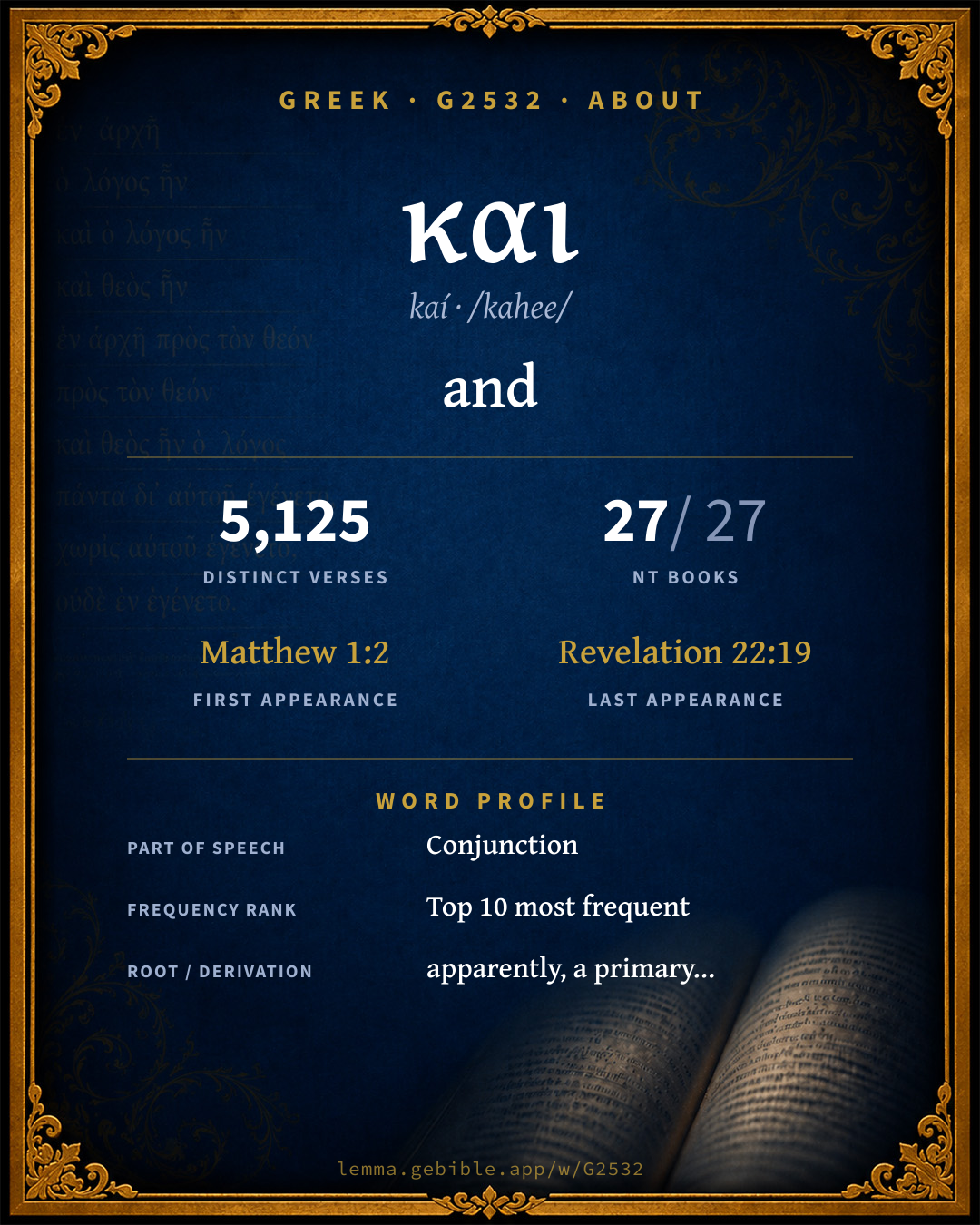
καί
and
Full lexicon entry — Thayer's Greek Lexicon
From Thayer's Greek Lexicon
Where this word appears
Grammar key — what these labels mean
Part of speech
- Conjunction
- A joining word linking words or clauses.
Page 3 of 3 — showing verses 401–530 of 530 distinct verses where G2532 appears in the Book of John. Click any verse to open its interlinear word-by-word view. Verse text shown in the World English Bible for context — . Each verse’s Greek form is shown with its reference; the English is not keyword-highlighted, since the data carries no word-level English alignment. Use “Compare translations” on any verse to read it across multiple English versions. This concordance covers the Greek New Testament; Septuagint (Greek Old Testament) occurrences of this word are not indexed here.
John
- John 15:23 καὶ conj He who hates me, hates my Father also.
- John 15:24 καὶ καὶ καὶ καὶ conj conj conj conj If I hadn't done among them the works which no one else did, they wouldn't have had sin. But now have they seen and also hated both me and my Father.
- John 15:27 καὶ conj You will also testify, because you have been with me from the beginning.
- John 16:3 καὶ conj They will do these things because they have not known the Father, nor me.
- John 16:5 καὶ conj But now I am going to him who sent me, and none of you asks me, 'Where are you going?'
- John 16:8 καὶ καὶ καὶ conj conj conj When he has come, he will convict the world about sin, about righteousness, and about judgment;
- John 16:10 καὶ conj about righteousness, because I am going to my Father, and you won't see me any more;
- John 16:13 καὶ conj However when he, the Spirit of truth, has come, he will guide you into all truth, for he will not speak from himself; but whatever he hears, he will speak. He will declare to you things that are coming.
- John 16:14 καὶ conj He will glorify me, for he will take from what is mine, and will declare it to you.
- John 16:15 καὶ conj All things whatever the Father has are mine; therefore I said that he takes of mine, and will declare it to you.
- John 16:16 καὶ καὶ καὶ conj conj conj A little while, and you will not see me. Again a little while, and you will see me."
- John 16:17 καὶ καὶ καὶ καί conj conj conj conj Some of his disciples therefore said to one another, "What is this that he says to us, 'A little while, and you won't see me, and again a little while, and you will see me;' and, 'Because I go to the Father?'"
- John 16:19 καὶ καὶ καὶ καὶ conj conj conj conj Therefore Jesus perceived that they wanted to ask him, and he said to them, "Do you inquire among yourselves concerning this, that I said, 'A little while, and you won't see me, and again a little while, and you will see me?'
- John 16:20 καὶ conj Most assuredly I tell you, that you will weep and lament, but the world will rejoice. You will be sorrowful, but your sorrow will be turned into joy.
- John 16:22 καὶ καὶ καὶ conj conj conj Therefore you now have sorrow, but I will see you again, and your heart will rejoice, and no one will take your joy away from you.
- John 16:23 καὶ conj "In that day you will ask me no questions. Most assuredly I tell you, whatever you may ask of the Father in my name, he will give it to you.
- John 16:24 καὶ conj Until now, you have asked nothing in my name. Ask, and you will receive, that your joy may be made full.
- John 16:26 καὶ conj In that day you will ask in my name; and I don't say to you, that I will pray to the Father for you,
- John 16:27 καὶ conj for the Father himself loves you, because you have loved me, and have believed that I came forth from God.
- John 16:28 καὶ καὶ conj conj I came out from the Father, and have come into the world. Again, I leave the world, and go to the Father."
- John 16:29 καὶ conj His disciples said to him, "Behold, now you speak plainly, and speak no figures of speech.
- John 16:30 καὶ conj Now we know that you know all things, and don't need for anyone to question you. By this we believe that you came forth from God."
- John 16:32 καὶ καὶ conj conj Behold, the time is coming, yes, and has now come, that you will be scattered, everyone to his own place, and you will leave me alone. Yet I am not alone, because the Father is with me.
- John 17:1 καὶ conj Jesus said these things, and lifting up his eyes to heaven, he said, "Father, the time has come. Glorify your Son, that your Son may also glorify you;
- John 17:3 καὶ conj This is eternal life, that they should know you, the only true God, and him whom you sent, Jesus Christ.
- John 17:5 καὶ conj Now, Father, glorify me with your own self with the glory which I had with you before the world existed.
- John 17:6 καὶ καὶ conj conj I revealed your name to the people whom you have given me out of the world. They were yours, and you have given them to me. They have kept your word.
- John 17:8 καὶ καὶ καὶ conj conj conj for the words which you have given me I have given to them, and they received them, and knew for sure that I came forth from you, and they have believed that you sent me.
- John 17:10 καὶ καὶ καὶ conj conj conj All things that are mine are yours, and yours are mine, and I am glorified in them.
- John 17:11 καὶ καὶ conj conj I am no more in the world, but these are in the world, and I am coming to you. Holy Father, keep them through your name which you have given me, that they may be one, even as we are.
- John 17:12 καὶ καὶ conj conj While I was with them in the world, I kept them in your name. Those whom you have given me I have kept. None of them is lost, except the son of destruction, that the Scripture might be fulfilled.
- John 17:13 καὶ conj But now I come to you, and I say these things in the world, that they may have my joy made full in themselves.
- John 17:14 καὶ conj I have given them your word. The world hated them, because they are not of the world, even as I am not of the world.
- John 17:19 καὶ καὶ conj conj For their sakes I sanctify myself, that they themselves also may be sanctified in truth.
- John 17:20 καὶ conj Not for these only do I pray, but for those also who believe in me through their word,
- John 17:21 καὶ conj that they may all be one; even as you, Father, are in me, and I in you, that they also may be one in us; that the world may believe that you sent me.
- John 17:23 καὶ καὶ conj conj I in them, and you in me, that they may be perfected into one; that the world may know that you sent me, and loved them, even as you loved me.
- John 17:25 καὶ καὶ conj conj Righteous Father, the world hasn't known you, but I knew you; and these knew that you sent me.
- John 17:26 καὶ καὶ conj conj I made known to them your name, and will make it known; that the love with which you loved me may be in them, and I in them."
- John 18:1 καὶ conj When Jesus had spoken these words, he went out with his disciples over the brook Kidron, where was a garden, into which he and his disciples entered.
- John 18:2 καὶ conj Now Judas, who betrayed him, also knew the place, for Jesus often resorted there with his disciples.
- John 18:3 καὶ καὶ καὶ καὶ conj conj conj conj Judas then, having taken a detachment of soldiers and officers from the chief priests and the Pharisees, came there with lanterns, torches, and weapons.
- John 18:4 καὶ conj Jesus therefore, knowing all the things that were happening to him, went forth, and said to them, "Who are you looking for?"
- John 18:5 καὶ conj They answered him, "Jesus of Nazareth." Jesus said to them, "I AM." Judas also, who betrayed him, was standing with them.
- John 18:6 καὶ conj When therefore he said to them, "I AM," they went backward, and fell to the ground.
- John 18:10 καὶ καὶ conj conj Simon Peter therefore, having a sword, drew it, and struck the high priest's servant, and cut off his right ear. The servant's name was Malchus.
- John 18:12 καὶ καὶ καὶ conj conj conj So the detachment, the commanding officer, and the officers of the Jews, seized Jesus and bound him,
- John 18:13 καὶ conj and led him to Annas first, for he was father-in-law to Caiaphas, who was high priest that year.
- John 18:15 καὶ καὶ conj conj Simon Peter followed Jesus, as did another disciple. Now that disciple was known to the high priest, and entered in with Jesus into the court of the high priest;
- John 18:16 καὶ καὶ conj conj but Peter was standing at the door outside. So the other disciple, who was known to the high priest, went out and spoke to her who kept the door, and brought in Peter.
- John 18:17 καὶ conj Then the maid who kept the door said to Peter, "Are you also one of this man's disciples?" He said, "I am not."
- John 18:18 καὶ καὶ καὶ καὶ conj conj conj conj Now the servants and the officers were standing there, having made a fire of coals, for it was cold. They were warming themselves. Peter was with them, standing and warming himself.
- John 18:19 καὶ conj The high priest therefore asked Jesus about his disciples, and about his teaching.
- John 18:20 καὶ καὶ conj conj Jesus answered him, "I spoke openly to the world. I always taught in synagogues, and in the temple, where the Jews always meet. I said nothing in secret.
- John 18:25 καὶ καὶ καὶ conj conj conj Now Simon Peter was standing and warming himself. They said therefore to him, "You aren't also one of his disciples, are you?" He denied it, and said, "I am not."
- John 18:27 καὶ conj Peter therefore denied it again, and immediately the rooster crowed.
- John 18:28 καὶ conj They led Jesus therefore from Caiaphas into the Praetorium. It was early, and they themselves didn't enter into the Praetorium, that they might not be defiled, but might eat the Passover.
- John 18:29 καὶ conj Pilate therefore went out to them, and said, "What accusation do you bring against this man?"
- John 18:30 καὶ conj They answered him, "If this man weren't an evildoer, we wouldn't have delivered him up to you."
- John 18:31 καὶ conj Pilate therefore said to them, "Take him yourselves, and judge him according to your law." Therefore the Jews said to him, "It is not lawful for us to put anyone to death,"
- John 18:33 καὶ καὶ conj conj Pilate therefore entered again into the Praetorium, called Jesus, and said to him, "Are you the King of the Jews?"
- John 18:35 καὶ conj Pilate answered, "I'm not a Jew, am I? Your own nation and the chief priests delivered you to me. What have you done?"
- John 18:37 καὶ conj Pilate therefore said to him, "Are you a king then?" Jesus answered, "You say that I am a king. For this reason I have been born, and for this reason I have come into the world, that I should testify to the truth. Everyone who is of the truth listens to my voice."
- John 18:38 καὶ καὶ conj conj Pilate said to him, "What is truth?" When he had said this, he went out again to the Jews, and said to them, "I find no basis for a charge against him.
- John 19:1 καὶ conj So Pilate then took Jesus, and flogged him.
- John 19:2 καὶ καὶ conj conj The soldiers twisted thorns into a crown, and put it on his head, and dressed him in a purple garment.
- John 19:3 καὶ καὶ καὶ conj conj conj They kept saying, "Hail, King of the Jews!" and they kept slapping him.
- John 19:4 καὶ conj Then Pilate went out again, and said to them, "Behold, I bring him out to you, that you may know that I find no basis for a charge against him."
- John 19:5 καὶ καὶ conj conj Jesus therefore came out, wearing the crown of thorns and the purple garment. Pilate said to them, "Behold, the man!"
- John 19:6 καὶ καὶ conj conj When therefore the chief priests and the officers saw him, they shouted, saying, "Crucify! Crucify!" Pilate said to them, "Take him yourselves, and crucify him, for I find no basis for a charge against him."
- John 19:7 καὶ conj The Jews answered him, "We have a law, and by our law he ought to die, because he made himself the Son of God."
- John 19:9 καὶ καὶ conj conj He entered into the Praetorium again, and said to Jesus, "Where are you from?" But Jesus gave him no answer.
- John 19:10 καὶ conj Pilate therefore said to him, "Aren't you speaking to me? Don't you know that I have power to release you, and have power to crucify you?"
- John 19:13 καὶ conj When Pilate therefore heard these words, he brought Jesus out, and sat down on the judgment seat at a place called "The Pavement," but in Hebrew, "Gabbatha."
- John 19:14 καὶ conj Now it was the Preparation Day of the Passover, at about the sixth hour. He said to the Jews, "Behold, your King!"
- John 19:17 καὶ conj He went out, bearing his cross, to the place called "The Place of a Skull," which is called in Hebrew, "Golgotha,"
- John 19:18 καὶ καὶ conj conj where they crucified him, and with him two others, on either side one, and Jesus in the middle.
- John 19:19 καὶ καὶ conj conj Pilate wrote a title also, and put it on the cross. There was written, "JESUS OF NAZARETH, THE KING OF THE JEWS."
- John 19:20 καὶ conj Therefore many of the Jews read this title, for the place where Jesus was crucified was near the city; and it was written in Hebrew, in Latin, and in Greek.
- John 19:23 καὶ καὶ conj conj Then the soldiers, when they had crucified Jesus, took his garments and made four parts, to every soldier a part; and also the coat. Now the coat was without seam, woven from the top throughout.
- John 19:24 καὶ conj Then they said to one another, "Let's not tear it, but cast lots for it to decide whose it will be," that the Scripture might be fulfilled, which says, "They parted my garments among them. For my cloak they cast lots." Therefore the soldiers did these things.
- John 19:25 καὶ καὶ conj conj But there were standing by the cross of Jesus his mother, and his mother's sister, Mary the wife of Clopas, and Mary Magdalene.
- John 19:26 καὶ conj Therefore when Jesus saw his mother, and the disciple whom he loved standing there, he said to his mother, "Woman, behold your son!"
- John 19:27 καὶ conj Then he said to the disciple, "Behold, your mother!" From that hour, the disciple took her to his own home.
- John 19:30 καὶ conj When Jesus therefore had received the vinegar, he said, "It is finished." He bowed his head, and gave up his spirit.
- John 19:31 καὶ conj Therefore the Jews, because it was the Preparation Day, so that the bodies wouldn't remain on the cross on the Sabbath (for that Sabbath was a special one), asked of Pilate that their legs might be broken, and that they might be taken away.
- John 19:32 καὶ καὶ conj conj Therefore the soldiers came, and broke the legs of the first, and of the other who was crucified with him;
- John 19:34 καὶ καὶ conj conj However one of the soldiers pierced his side with a spear, and immediately blood and water came out.
- John 19:35 καὶ καὶ καὶ conj conj conj He who has seen has testified, and his testimony is true. He knows that he tells the truth, that you may believe.
- John 19:37 καὶ conj Again another Scripture says, "They will look on him whom they pierced."
- John 19:38 καὶ καὶ conj conj After these things, Joseph of Arimathaea, being a disciple of Jesus, but secretly for fear of the Jews, asked of Pilate that he might take away Jesus' body. Pilate gave him permission. He came therefore and took away his body.
- John 19:39 καὶ καὶ conj conj Nicodemus, who at first came to Jesus by night, also came bringing a mixture of myrrh and aloes, about a hundred pounds.
- John 19:40 καὶ conj So they took Jesus' body, and bound it in linen cloths with the spices, as the custom of the Jews is to bury.
- John 19:41 καὶ conj Now in the place where he was crucified there was a garden. In the garden a new tomb in which no man had ever yet been laid.
- John 20:1 καὶ conj Now on the first day of the week, Mary Magdalene went early, while it was still dark, to the tomb, and saw the stone taken away from the tomb.
- John 20:2 καὶ καὶ καὶ καὶ conj conj conj conj Therefore she ran and came to Simon Peter, and to the other disciple whom Jesus loved, and said to them, "They have taken away the Lord out of the tomb, and we don't know where they have laid him!"
- John 20:3 καὶ καὶ conj conj Therefore Peter and the other disciple went out, and they went toward the tomb.
- John 20:4 καὶ καὶ conj conj They both ran together. The other disciple outran Peter, and came to the tomb first.
- John 20:5 καὶ conj Stooping and looking in, he saw the linen cloths lying, yet he didn't enter in.
- John 20:6 καὶ καὶ conj conj Then Simon Peter came, following him, and entered into the tomb. He saw the linen cloths lying,
- John 20:7 καὶ conj and the cloth that had been on his head, not lying with the linen cloths, but rolled up in a place by itself.
- John 20:8 καὶ καὶ καὶ conj conj conj So then the other disciple who came first to the tomb also entered in, and he saw and believed.
- John 20:12 καὶ καὶ conj conj and she saw two angels in white sitting, one at the head, and one at the feet, where the body of Jesus had lain.
- John 20:13 καὶ conj They told her, "Woman, why are you weeping?" She said to them, "Because they have taken away my Lord, and I don't know where they have laid him."
- John 20:14 καὶ καὶ conj conj When she had said this, she turned around and saw Jesus standing, and didn't know that it was Jesus.
- John 20:17 καὶ καὶ καὶ καὶ conj conj conj conj Jesus said to her, "Don't touch me, for I haven't yet ascended to my Father; but go to my brothers, and tell them, 'I am ascending to my Father and your Father, to my God and your God.'"
- John 20:18 καὶ conj Mary Magdalene came and told the disciples that she had seen the Lord, and that he had said these things to her.
- John 20:19 καὶ καὶ καὶ conj conj conj When therefore it was evening, on that day, the first day of the week, and when the doors were locked where the disciples were assembled, for fear of the Jews, Jesus came and stood in the midst, and said to them, "Peace be to you."
- John 20:20 καὶ καὶ conj conj When he had said this, he showed them his hands and his side. The disciples therefore were glad when they saw the Lord.
- John 20:22 καὶ καὶ conj conj When he had said this, he breathed on them, and said to them, "Receive the Holy Spirit!
- John 20:25 καὶ καὶ conj conj The other disciples therefore said to him, "We have seen the Lord!" But he said to them, "Unless I see in his hands the print of the nails, and put my hand into his side, I will not believe."
- John 20:26 καὶ καὶ καὶ καὶ conj conj conj conj After eight days again his disciples were inside, and Thomas was with them. Jesus came, the doors being locked, and stood in the midst, and said, "Peace be to you."
- John 20:27 καὶ καὶ καὶ καὶ conj conj conj conj Then he said to Thomas, "Reach here your finger, and see my hands. Reach here your hand, and put it into my side. Don't be unbelieving, but believing."
- John 20:28 καὶ καὶ conj conj Thomas answered him, "My Lord and my God!"
- John 20:29 καὶ conj Jesus said to him, "Because you have seen me, you have believed. Blessed are those who have not seen, and have believed."
- John 20:30 καὶ conj Therefore Jesus did many other signs in the presence of his disciples, which are not written in this book;
- John 20:31 καὶ conj but these are written, that you may believe that Jesus is the Christ, the Son of God, and that believing you may have life in his name.
- John 21:2 καὶ καὶ καὶ καὶ conj conj conj conj Simon Peter, Thomas called Didymus, Nathanael of Cana in Galilee, and the sons of Zebedee, and two others of his disciples were together.
- John 21:3 καὶ καὶ καὶ conj conj conj Simon Peter said to them, "I'm going fishing." They told him, "We are also coming with you." They immediately went out, and entered into the boat. That night, they caught nothing.
- John 21:6 καὶ καὶ conj conj He said to them, "Cast the net on the right side of the boat, and you will find some." They cast it therefore, and now they weren't able to draw it in for the multitude of fish.
- John 21:7 καὶ conj That disciple therefore whom Jesus loved said to Peter, "It's the Lord!" So when Simon Peter heard that it was the Lord, he wrapped his coat around him (for he was naked), and threw himself into the sea.
- John 21:9 καὶ καὶ conj conj So when they got out on the land, they saw a fire of coals there, and fish laid on it, and bread.
- John 21:11 καὶ καὶ conj conj Simon Peter went up, and drew the net to land, full of great fish, one hundred fifty-three; and even though there were so many, the net wasn't torn.
- John 21:13 καὶ καὶ καὶ conj conj conj Then Jesus came and took the bread, gave it to them, and the fish likewise.
- John 21:17 καὶ conj He said to him the third time, "Simon, son of Jonah, do you have affection for me?" Peter was grieved because he asked him the third time, "Do you have affection for me?" He said to him, "Lord, you know everything. You know that I have affection for you." Jesus said to him, "Feed my sheep.
- John 21:18 καὶ καὶ καὶ conj conj conj Most assuredly I tell you, when you were young, you dressed yourself, and walked where you wanted to. But when you are old, you will stretch out your hands, and another will dress you, and carry you where you don't want to go."
- John 21:19 καὶ conj Now he said this, signifying by what kind of death he would glorify God. When he had said this, he said to him, "Follow me."
- John 21:20 καὶ καὶ conj conj Then Peter, turning around, saw a disciple following. This was the disciple whom Jesus sincerely loved, the one who had also leaned on Jesus' breast at the supper and asked, "Lord, who is going to betray You?"
- John 21:23 καὶ conj This saying therefore went out among the brothers, that this disciple wouldn't die. Yet Jesus didn't say to him that he wouldn't die, but, "If I desire that he stay until I come, what is that to you?"
- John 21:24 καὶ καὶ conj conj This is the disciple who testifies about these things, and wrote these things. We know that his witness is true.
About this entry
At a glance — auto-summarized from this page’s data, not written by a person. Every figure links to its source below. This summary describes the numbers; it doesn’t interpret them.
At its core, και (kaí) means “and.” Scripture first uses it in Matthew 1:2. With 5,125 verses in 27 books, it is one of the most common word in the Greek New Testament. Sharing its root, it stands alongside καγω, καιγε and καιπερ. Each statement above links to its evidence; the full detail follows below.
Gloss history
Strong's 1890 vs modern scholarship

About this word
Strong's G2532 catalogs a Greek word from the Greek New Testament.
These counts are not copied from any lexicon or concordance. They are computed here, from the morphology-tagged Greek New Testament. What Lemma adds →
- 5,125
- distinct verses
- The word appears in 5,125 distinct verses.
- 27 / 27
- NT books
- The word appears in 27 of 27 New Testament books.
- #2
- by frequency
- Top 10 most frequent Greek words (rank 2 of 5,347 Greek words by occurrence).
View all 5,125 occurrences in the concordance →
By section of the New Testament
By traditional corpus
Conventional, traditional groupings — biblical authorship is debated, so this is a traditional corpus grouping, not an authorship claim. Some books belong to more than one corpus (Luke is in both the Gospels and the Lukan corpus, and so on), so these shares overlap and need not total 100%. Each figure is a share of the word’s 5,125 distinct verses.
- Gospels 2,619 verses · 51%
- Lukan (Luke–Acts) 1,489 verses · 29%
- Pauline corpus 1,026 verses · 20%
- Johannine 995 verses · 19%
- Revelation 370 verses · 7%
- General (Catholic) Epistles 277 verses · 5%
- Hebrews 173 verses · 3%
How translations render this word
Counts come from each version’s own published word-to-Strong’s tagging or interlinear alignment — an approximate guide to how each version renders this word, not a word-level alignment the data otherwise carries. Because each total is that version’s own tagged count, the per-version totals vary from one another and need not match the appearance or distinct-verse counts above. These counts may also differ from a printed concordance because Lemma counts each distinctly tagged rendering and does not collapse phrase taggings into a single head-word total. This is a fixed set of word-tagged versions (KJV, ASV, BSB, ULT) and does not change with the reading translation you choose elsewhere. Each version’s license is shown beside its name below (and on Sources).
- King James Version: And 8,097×, Also 500×, Even 101×
- American Standard Version: And 7,750×, Also 433×, Even 110×
- Berean Standard Bible: And 5,240×, Then 278×, Also 156×
- unfoldingWord Literal Text: And 7,949×, Also 596×, But 132×
King James Version Public Domain
Renders G2532 across 9,091 tagged occurrences — most commonly:
Plus other, less common renderings. Plus 72 renderings that appear only once — usually multi-word phrases or single function words the recovered tagging swept in, not distinct renderings. Not rendered by a distinct English word in 156 further occurrences.
American Standard Version Public Domain
Renders G2532 across 8,928 tagged occurrences — most commonly:
Plus other, less common renderings. Plus 227 renderings that appear only once — usually multi-word phrases or single function words the recovered tagging swept in, not distinct renderings. Not rendered by a distinct English word in 83 further occurrences.
Berean Standard Bible Public Domain
Renders G2532 across 6,415 tagged occurrences — most commonly:
Plus other, less common renderings. Plus 44 renderings that appear only once — usually multi-word phrases or single function words the recovered tagging swept in, not distinct renderings. Not rendered by a distinct English word in 2,467 further occurrences.
unfoldingWord Literal Text CC BY-SA 4.0
Renders G2532 across 9,016 tagged occurrences — most commonly:
Plus other, less common renderings. Plus 20 renderings that appear only once — usually multi-word phrases or single function words the recovered tagging swept in, not distinct renderings. Not rendered by a distinct English word in 3 further occurrences.
Senses in Thayer's
The 1 sense Thayer's distinguishes for this word, in lexicon order (not ranked by frequency or importance). The full entry — with sub-senses — is in the Lexicon Entry tab.
- and, also, even, indeed, but Frequency count based on 1894 Scrivener Greek New Testament.
Word origin
Origin: apparently, a primary particle, having a copulative and sometimes also a cumulative force
Apparently a primary particle having a copulative and sometimes also a cumulative force; and also even so then too etc.; often used in connection (or composition) with other particles or small words : - and also both but even for if indeed likewise moreover or so that then therefore when yea yet.
— Strong’s Exhaustive Concordance (1890), public domain.
Forms in the corpus
The 5 distinct written forms G2532 takes in the Greek New Testament, most frequent first — each parse links to that case’s occurrences in the concordance.
| Form | Parsing | Example | Uses |
|---|---|---|---|
| καὶ kaì | Conjunction | Matthew 1:2 | 8,661 |
| Καὶ Kaì | Conjunction | Matthew 4:21 | 274 |
| καί kaí | Conjunction | Matthew 15:4 | 29 |
| Καί Kaí | Conjunction | Luke 19:39 | 4 |
| και kai | Conjunction | John 7:53 | 1 |
Same root — word family
Other Thayer's entries built from the same root as G2532, grouped by Strong’s listed origin. These share a root / origin per the lexicon — not necessarily a shared meaning. Each links to that word’s own entry.
Derived from this word
- καγω kagṓ G2504 and I
- καιγε kaíge G2534 and indeed
- καιπερ kaíper G2539 although
- καιτοι kaítoi G2543 and yet
- κακει kakeî G2546 and there
- κακειθεν kakeîthen G2547 of place
- κακεινος kakeînos G2548 and he
- καν kán G2579 and if
Compare all same-root words → Showing 4 of 9 — not the complete family. They share a root, not necessarily a meaning.
Septuagint usage
The same Greek word και appears 47,643 times in the Greek Old Testament (Septuagint), across 18,587 verses in 38 books.
- 47,643
- LXX occurrences
- Tagged occurrences of this Greek word in the Septuagint.
- 18,587
- verses
- Distinct Septuagint verses containing this word.
- 38 / 39
- OT books
- The word appears in 38 of the 39 Old Testament books.
Sample Septuagint occurrences
- Genesis 1:1 καί
- Exodus 1:3 καί
- Leviticus 1:1 καί
- Numbers 1:1 καί
- Deuteronomy 1:1 καί
- Joshua 1:1 καί
- Judges 1:1 καί
- Ruth 1:1 καί
- 1 Samuel 1:1 καί
- 2 Samuel 1:1 καί
- 1 Kings 1:1 καί
- 2 Kings 1:1 καί
Septuagint occurrences (same lexeme)
Every verse where the same Strong’s number (G2532) appears in the Greek Septuagint — showing the first 50 of 18,587. Verse text shown in the World English Bible for context; the Greek form is the matched word — the English is not keyword-highlighted.
- Genesis 1:1 καί In the beginning God created the heavens and the earth.
- Genesis 1:2 καί Now the earth was formless and empty. Darkness was on the surface of the deep. God's Spirit was hovering over the surface of the waters.
- Genesis 1:3 καί God said, "Let there be light," and there was light.
- Genesis 1:4 καί God saw the light, and saw that it was good. God divided the light from the darkness.
- Genesis 1:5 καί God called the light Day, and the darkness he called Night. There was evening and there was morning, one day.
- Genesis 1:6 καί God said, "Let there be an expanse in the midst of the waters, and let it divide the waters from the waters."
- Genesis 1:7 καί God made the expanse, and divided the waters which were under the expanse from the waters which were above the expanse, and it was so.
- Genesis 1:8 καί God called the expanse sky. There was evening and there was morning, a second day.
- Genesis 1:9 καί God said, "Let the waters under the sky be gathered together to one place, and let the dry land appear," and it was so.
- Genesis 1:10 καί God called the dry land Earth, and the gathering together of the waters he called Seas. God saw that it was good.
- Genesis 1:11 καί God said, "Let the earth put forth grass, herbs yielding seed, and fruit trees bearing fruit after their kind, with its seed in it, on the earth," and it was so.
- Genesis 1:12 καί The earth brought forth grass, herbs yielding seed after their kind, and trees bearing fruit, with its seed in it, after their kind: and God saw that it was good.
- Genesis 1:13 καί There was evening and there was morning, a third day.
- Genesis 1:14 καί God said, "Let there be lights in the expanse of sky to divide the day from the night; and let them be for signs, and for seasons, and for days and years;
- Genesis 1:15 καί and let them be for lights in the expanse of sky to give light on the earth," and it was so.
- Genesis 1:16 καί God made the two great lights: the greater light to rule the day, and the lesser light to rule the night. He also made the stars.
- Genesis 1:17 καί God set them in the expanse of sky to give light to the earth,
- Genesis 1:18 καί and to rule over the day and over the night, and to divide the light from the darkness. God saw that it was good.
- Genesis 1:19 καί There was evening and there was morning, a fourth day.
- Genesis 1:20 καί God said, "Let the waters swarm with swarms of living creatures, and let birds fly above the earth in the open expanse of sky."
- Genesis 1:21 καί God created the large sea creatures, and every living creature that moves, with which the waters swarmed, after their kind, and every winged bird after its kind. God saw that it was good.
- Genesis 1:22 καί God blessed them, saying, "Be fruitful, and multiply, and fill the waters in the seas, and let birds multiply on the earth."
- Genesis 1:23 καί There was evening and there was morning, a fifth day.
- Genesis 1:24 καί God said, "Let the earth bring forth living creatures after their kind, cattle, creeping things, and animals of the earth after their kind," and it was so.
- Genesis 1:25 καί God made the animals of the earth after their kind, and the cattle after their kind, and everything that creeps on the ground after its kind. God saw that it was good.
- Genesis 1:26 καί God said, "Let us make man in our image, after our likeness: and let them have dominion over the fish of the sea, and over the birds of the sky, and over the cattle, and over all the earth, and over every creeping thing that creeps on the earth."
- Genesis 1:27 καί God created man in his own image. In God's image he created him; male and female he created them.
- Genesis 1:28 καί God blessed them. God said to them, "Be fruitful, multiply, fill the earth, and subdue it. Have dominion over the fish of the sea, over the birds of the sky, and over every living thing that moves on the earth."
- Genesis 1:29 καί God said, "Behold, I have given you every herb yielding seed, which is on the surface of all the earth, and every tree, which bears fruit yielding seed. It will be your food.
- Genesis 1:30 καί To every animal of the earth, and to every bird of the sky, and to everything that creeps on the earth, in which there is life, I have given every green herb for food." And it was so.
- Genesis 1:31 καί God saw everything that he had made, and, behold, it was very good. There was evening and there was morning, the sixth day.
- Genesis 2:1 καί The heavens and the earth were finished, and all the host of them.
- Genesis 2:2 καί On the seventh day God finished his work which he had made; and he rested on the seventh day from all his work which he had made.
- Genesis 2:3 καί God blessed the seventh day, and made it holy, because he rested in it from all his work which he had created and made.
- Genesis 2:4 καί This is the history of the generations of the heavens and of the earth when they were created, in the day that Yahweh God made earth and the heavens.
- Genesis 2:5 καί No plant of the field was yet in the earth, and no herb of the field had yet sprung up; for Yahweh God had not caused it to rain on the earth. There was not a man to till the ground,
- Genesis 2:6 καί but a mist went up from the earth, and watered the whole surface of the ground.
- Genesis 2:7 καί Yahweh God formed man from the dust of the ground, and breathed into his nostrils the breath of life; and man became a living soul.
- Genesis 2:8 καί Yahweh God planted a garden eastward, in Eden, and there he put the man whom he had formed.
- Genesis 2:9 καί Out of the ground Yahweh God made every tree to grow that is pleasant to the sight, and good for food; the tree of life also in the midst of the garden, and the tree of the knowledge of good and evil.
- Genesis 2:12 καί and the gold of that land is good. There is aromatic resin and the onyx stone.
- Genesis 2:13 καί The name of the second river is Gihon: the same river that flows through the whole land of Cush.
- Genesis 2:14 καί The name of the third river is Hiddekel: this is the one which flows in front of Assyria. The fourth river is the Euphrates.
- Genesis 2:15 καί Yahweh God took the man, and put him into the garden of Eden to dress it and to keep it.
- Genesis 2:16 καί Yahweh God commanded the man, saying, "Of every tree of the garden you may freely eat:
- Genesis 2:17 καί but of the tree of the knowledge of good and evil, you shall not eat of it: for in the day that you eat of it you will surely die."
- Genesis 2:18 καί Yahweh God said, "It is not good that the man should be alone; I will make him a helper suitable for him."
- Genesis 2:19 καί Out of the ground Yahweh God formed every animal of the field, and every bird of the sky, and brought them to the man to see what he would call them. Whatever the man called every living creature, that was its name.
- Genesis 2:20 καί The man gave names to all cattle, and to the birds of the sky, and to every animal of the field; but for man there was not found a helper suitable for him.
- Genesis 2:21 καί Yahweh God caused a deep sleep to fall on the man, and he slept; and he took one of his ribs, and closed up the flesh in its place.
These are occurrences of the same Greek lexeme (G2532) in the Septuagint — not a translation of any one Hebrew word. The store carries no word-level Hebrew↔Greek alignment, so no Hebrew original is asserted here. Counts come from the recovered LXX Strong's tagging — high-frequency vocabulary is well covered, while rare or late forms may be untagged — so they reflect tagged occurrences and may slightly undercount.