
John 20:8

Greek (Tischendorf 8th ed.) John 20:8 appears in the Greek New Testament. The text above is from the Tischendorf 8th edition. Each word links to its Strong’s number and a concise gloss. Click any word for its full Thayer’s Greek Lexicon entry.
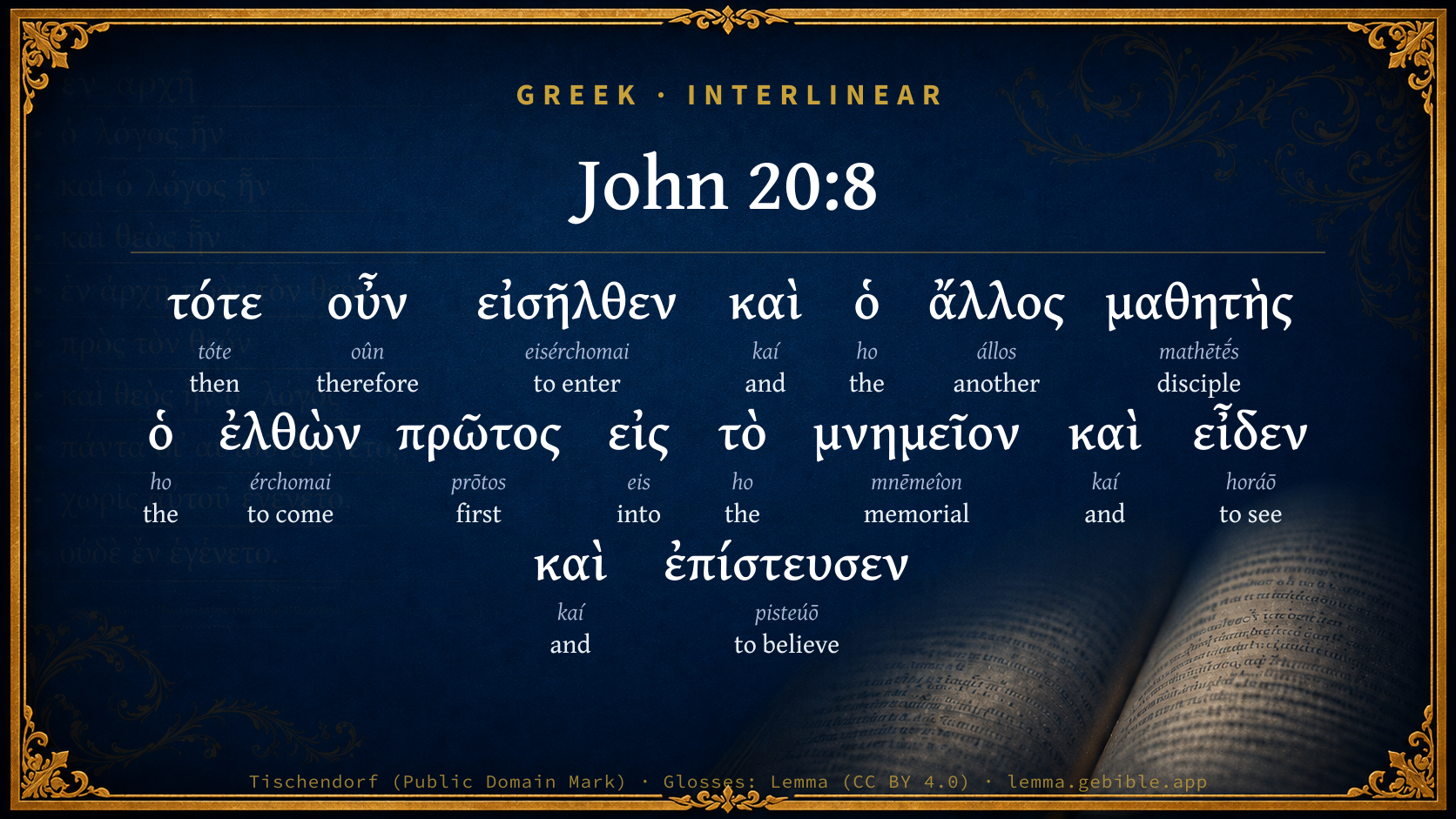
Download image
Cite this verse

John 20:8 (World English Bible). Public Domain. Lemma interlinear Bible study tool, https://lemma.gebible.app/v/john/20/8.

Show BibTeX & RIS
BibTeX
RIS
English Translation
So then the other disciple who came first to the tomb also entered in, and he saw and believed.
World English Bible · Public Domain
Download a study sheet

One document with this verse’s original text, its word-by-word gloss line, the meaning frame, cross-references with their text, attributed commentary, and full source and license credits — printable, and it pastes into notes with its structure intact.

This verse Autodidact and up

Study sheet (.html) Plain text (.txt)

A passage Seminary Student

Up to 50 verses in one chapter. A passage sheet keeps up to 6 commentary sources and 12 cross-references per verse, in the order this page ranks them, and says so on the sheet whenever that leaves anything out. Ask for a single verse and you get the Autodidact verse sheet above.

Everything on this page stays free to read, with no account — the sheet is a download of what is already on screen, not access to it.

Want to remove ads? Support Godless Engineer
Compare translations 3

The same verse in 3 English versions, stacked beneath the original-language interlinear above. Click any original word for its lexicon entry.

Each is an independent rendering of the whole verse — the interlinear is not word-aligned to these translations.

Highlighted words mark where these versions differ — a whole-verse word diff, not a word-by-word alignment.

  • World English Bible Public Domain
    So then the other disciple who came first to the tomb also entered in, and he saw and believed.
  • King James Version Public Domain
    Then went in also that other disciple, which came first to the sepulchre, and he saw, and believed.
  • unfoldingWord Literal Text CC BY-SA 4.0
    So then the other disciple, the one having first arrived at the tomb, also went in, and he saw and believed.

unfoldingWord Literal Text — © unfoldingWord, licensed CC BY-SA 4.0. Word-aligned USFM3 via Door43 (git.door43.org/unfoldingWord/en_ult).

Versions to compare (up to 4)

3 of 4 selected

Show all 19 translations

Every available English version of this verse, each an independent rendering of the whole verse.

  • World English Bible Public Domain
    So then the other disciple who came first to the tomb also entered in, and he saw and believed.
  • Berean Standard Bible Public Domain
    Then the other disciple, who had reached the tomb first, also went in. And he saw and believed.
  • Majority Standard Bible Public Domain
    Then the other disciple, who had reached the tomb first, also went in. And he saw and believed.
  • King James Version Public Domain
    Then went in also that other disciple, which came first to the sepulchre, and he saw, and believed.
  • American Standard Version (1901) Public Domain
    Then entered in therefore the other disciple also, who came first to the tomb, and he saw, and believed.
  • Revised Version (1885) Public Domain
    Then entered in therefore the other disciple also, which came first to the tomb, and he saw, and believed.
  • Geneva Bible (1599) Public Domain
    Then went in also the other disciple, which came first to the sepulchre, and he sawe it, and beleeued.
  • Douay-Rheims (1899) Public Domain
    Then that other disciple also went in, who came first to the sepulchre: and he saw, and believed.
  • Young's Literal Translation Public Domain
    then, therefore, entered also the other disciple who came first unto the tomb, and he saw, and did believe;
  • Literal Standard Version CC BY-SA 4.0
    then, therefore, the other disciple who came first to the tomb entered also, and he saw and believed;
  • Unlocked Literal Bible CC BY-SA 4.0
    Then the other disciple, the one who first arrived at the tomb, also went in, and he saw and believed.
  • unfoldingWord Literal Text CC BY-SA 4.0
    So then the other disciple, the one having first arrived at the tomb, also went in, and he saw and believed.
  • Darby Bible Public Domain
    Then entered in therefore the other disciple also who came first to the tomb, and he saw and believed;
  • World Messianic Bible Public Domain
    So then the other disciple who came first to the tomb also entered in, and he saw and believed.
  • Webster's Bible Public Domain
    Then went in also that other disciple who came first to the sepulcher, and he saw, and believed.
  • Free Bible Version CC BY-SA 4.0
    Then the other disciple who had reached the tomb first went inside as well.
  • Bible in Basic English Public Domain
    Then the other disciple who came there first went in; and he saw and belief came to him.
  • Text-Critical English NT CC BY 4.0
    Then the other disciple, who had reached the tomb first, also went in. He saw and believed.
  • Tyndale New Testament (1534) Public Domain
    Then went in also that other disciple which came fyrst to the sepulcre and he sawe and beleved.

Literal Standard Version (2020), Covenant Press — licensed CC BY-SA 4.0. Text via the HelloAO Bible API (eBible.org). Unlocked Literal Bible (unfoldingWord) — licensed CC BY-SA 4.0. Text via the HelloAO Bible API (eBible.org). unfoldingWord Literal Text — © unfoldingWord, licensed CC BY-SA 4.0. Word-aligned USFM3 via Door43 (git.door43.org/unfoldingWord/en_ult). Free Bible Version, Dr. Jonathan Gallagher — licensed CC BY-SA 4.0. Text via the HelloAO Bible API (eBible.org).

Word by word

More ways to search: Search by grammar → Find every occurrence → Compare this word →

Practice this passage: Drill this verse → Learn its vocabulary →

μνημεῖον
mnēmeîon
G3419
“memorial”
Noun, Accusative, Singular, Neuter
Part of Speech
Noun
Case
Accusative
Number
Singular
Gender
Neuter
Full Thayer's Definition

Origin: from G3420

TDNT: 15:20,6

1. any visible object for preserving or recalling the memory of any person or thing a. a memorial, monument, specifically, a sepulchral monument 2. a sepulchre, a tomb
  1. τότε tóte G5119 “then” Adverb
  2. οὖν oûn G3767 “therefore” Conjunction
  3. εἰσῆλθεν eisérchomai G1525 “to enter” Verb, Aorist, Active, Indicative, 3rd person, Singular
  4. καὶ kaí G2532 “and” Conjunction
  5. ὁ ho G3588 “the” Article, Nominative, Singular, Masculine
  6. ἄλλος állos G243 “another” Adjective, Nominative, Singular, Masculine
  7. μαθητὴς mathētḗs G3101 “disciple” Noun, Nominative, Singular, Masculine
  8. ὁ ho G3588 “the” Article, Nominative, Singular, Masculine
  9. ἐλθὼν érchomai G2064 “to come” Verb, Aorist, Active, Participle, Nominative, Singular, Masculine
  10. πρῶτος prōtos G4413 “first” Adjective, Nominative, Singular, Masculine, Superlative
  11. εἰς eis G1519 “into” Preposition
  12. τὸ ho G3588 “the” Article, Accusative, Singular, Neuter
  13. καὶ kaí G2532 “and” Conjunction
  14. εἶδεν horáō G3708 “to see” Verb, Aorist, Active, Indicative, 3rd person, Singular
  15. καὶ kaí G2532 “and” Conjunction
  16. ἐπίστευσεν pisteúō G4100 “to believe” Verb, Aorist, Active, Indicative, 3rd person, Singular

About this verse

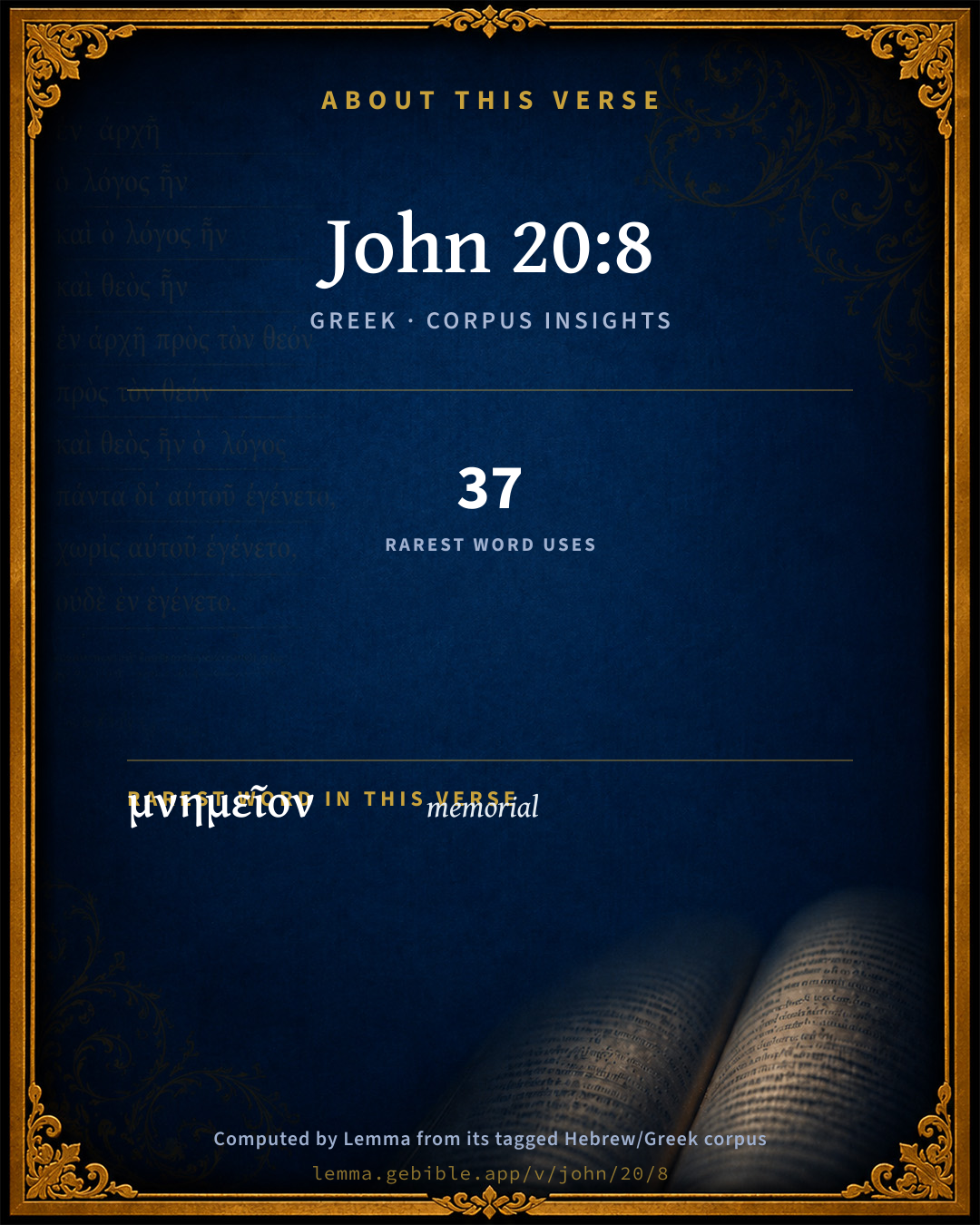
These counts appear in no published source. They are computed here, from the morphology-tagged text and Lemma’s own curated glosses. What Lemma adds →

17
words
13
distinct lemmas
Gospels
section

Shared distinctive vocabulary

μνημεῖον memorial G3419 occurs in 34 verses of the Greek New Testament. Also found in:
Repetition

Words recur within this verse:

Cross-references

4

Topical passages linked to John 20:8 in the Treasury of Scripture Knowledge — connected by theme and wording, ordered by reader-vote popularity; previews shown in the World English Bible.

  • John 20:25 The other disciples therefore said to him, "We have seen the Lord!" But he said to them, "Unless I see in his hands the print of the nails, and put my hand into his side, I will not believe."
  • John 1:50 Jesus answered him, "Because I told you, 'I saw you underneath the fig tree,' do you believe? You will see greater things than these!"
  • John 20:4 They both ran together. The other disciple outran Peter, and came to the tomb first.
  • John 20:29 Jesus said to him, "Because you have seen me, you have believed. Blessed are those who have not seen, and have believed."

Cross-references courtesy of OpenBible.info (CC BY 4.0).

Commentary

Notes on John 20:8 from classic Christian and Jewish commentators (each source and its license shown beneath its notes). The classic Christian expositions comment on the surrounding passage and are grouped to its opening verse, so a note may address several verses; the Jewish commentaries on the Tanakh (Rashi and others) are per-verse, so they appear only where the commentator wrote on this verse.

Lemma curates 59 commentaries, every one of them public domain or Creative Commons licensed, each selected and text-cleaned for this edition rather than reprinted as found. About our sources →

The Biblical Illustrator

Joseph S. Exell

Joh_20:8

Then went in also that other disciple

I.

ZEALOUS PURSUIT.

II. ENLARGED KNOWLEGE

III. INCREASED FAITH. (S. S. Times.)

Unconscious influence:

In this slight turn of history we see that men are ever touching unconsciously the springs of motion in each other. Little does Peter think, as he goes straight in, that he is drawing in his brother; and as little does John think that he is following his brother. We overrun the boundaries of our personality--we flow together. There are two sorts of influence, active or voluntary, and that which is unconscious. The importance and obligation of our efforts to do good, that is, of our voluntary influence, are often insisted on; but there needs a more thorough appreciation of the influence which is insensibly exerted.

I. EXPEL THE COMMON PREJUDICE THAT THERE CAN BE NOTHING OF CONSEQUENCE IN UNCONSCIOUS INFLUENCES, BECAUSE THEY MAKE NO REPORT, AND FALL ON THE WORLD UNOBSERVED.

1. Histories and biographies tell how men have led armies, established empires, enacted laws, &c., i.e., what they do with a purpose. But what they do without a purpose they seldom even mention. So also the public laws make men responsible only for what they do with a purpose, and take no account of the mischiefs or benefits that are communicated by their example. The same is true in the discipline of families, churches, and schools; because no human government can trace such influences with sufficient certainty to make their authors responsible.

2. But you must not conclude that they are therefore insignificant.

(1) How is it in the natural world? Nature always conceals her hand. Who ever saw or heard the exertions of that tremendous force which holds the universe together? The lightning is a mere fire-fly spark in comparison; but because it glares and thunders and blasts many think that it is a vastly more potent agent than gravity.

(2) The Bible calls the good mans life a light, and it is the nature of light to fill the world unconsciously with its beams. So the Christian shines, not so much because he will as because he is a luminous object. And yet there are many who think that light is a very tame and feeble instrument, because it is noiseless. An earthquake is to them a much more vigorous and effective agency. Little do they think that the light of every morning is an agent many times more powerful. But let the light of the morning cease; the outcries of a horror-stricken world make, as it were, the darkness audible. The globe and all the fellow planets that have lost their sun become mere balls of ice, swinging silent in death and darkness. The light would not wake an infant in his cradle. And yet it perpetually new creates the world, rescuing it each morning as a prey from night and chaos. So the Christian is the light of the world; and the insensible influences of good men are as much more potent than their active, as the great silent powers of nature are of greater consequence than her little disturbances and tumults. The outward endeavours made by good men or bad to sway others, they call their influence; whereas it is, in fact, but a very small fraction of the good or evil that flows out of their lives. Nay, how many persons do you meet, the insensible influence of whose manners and character is so decided as often to thwart their voluntary influence? And it will generally be found that where men undertake by argument or persuasion to exert a power in the face of qualities that make them odious, their insensible influence will be too strong for them.

II. THE TWOFOLD POWERS OF EFFECT AND EXPRESSION BY WHICH MAN CONNECTS WITH HIS FELLOW-MAN.

1. If we distinguish man as a creature of language, there are in him two sets or kinds of language--voluntary and involuntary; that of speech in the literal sense, and that expression of the eye, the face, the look, the gait, the tone. Speech, or voluntary language, is a door to the soul, that we may open or shut at will; the other is a door that stands open evermore.

2. Then if we go over to the subjects of influence, we find every man endowed with two inlets of impression; the ear and the understanding for the reception of speech, and the sympathetic powers for tinder to those sparks of emotion revealed by looks, tones, manners, &c. And these sympathetic powers are inlets, open on all sides to the understanding and character. Many have gone so far as to maintain that the look or expression, and even the very features of children are often changed by exclusive intercourse with nurses and attendants; but we shall find it scarcely possible to doubt that simply to look on bad and malignant faces, to become familiarized to them, is enough permanently to affect the character of persons of mature age. How dangerous, e.g., for a man to become accustomed to sights of cruelty! No more is it a thing of indifference to become accustomed to look on the manners, and receive the bad expression of any kind of sin. The door of involuntary communication is always open. But how very seldom, in comparison, do we undertake by means of speech to influence others!

3. It is by one of these modes of communication that we are constituted members of voluntary society, and by the other, parts of a general mass, or members of involuntary society. You are all, in a certain view, individuals; you are also, in another view, parts of a common body--be it the family, the Church, the state. And observe how far this involuntary communication and sympathy results in what we call the national or family spirit.

Sometimes this spirit takes a religious or an irreligious character. What was the national spirit of France--e.g., at a certain time, but a spirit of infidelity? What is the religious spirit of Spain but a spirit of bigotry? What is the family spirit in many a house but the spirit of gain or pleasure? Far down in the secret foundations of life and society, there lie concealed great laws and channels of influence, which often escape our notice altogether, but which are as gravity to the general system of Gods works.

4. But these are general considerations. I now proceed to add some proofs of a more particular nature.

(1) The instinct of imitation in children. We begin our experience by simple imitation, and under the guidance el this we lay our foundations. The childs soul is purely receptive, and for a considerable period without choice or selection. A little further on, he begins voluntarily to copy everything he sees. And thus we have a whole generation of future men receiving from us their very beginnings, and the deepest impulses of their life and immortality; and when we are meaning them no good or evil, they are drawing from us moulds of habit, which, if wrong, no heavenly discipline can wholly remove; or, if right, no bad associations utterly dissipate. It may be doubted whether, in all the active influence of our lives we do as much to shape the destiny of our fellow-men, as we do in this single article of unconscious influence over children.

(2) Further on, respect for others takes the place of imitation. We naturally desire the approbation or good opinion of others. You see the strength of this feeling in the article of fashion. How few persons have the nerve to resist a fashion; even in literature, worship, moral and religious doctrine. How many will violate the best rules of society because it is the practice of their circle! How many reject Christ because of acquaintances who have no suspicion of their influence, and will not have till the last day shows them what they have done!

(3) Again, how the most active feelings and impulses of mankind are contagious. How quick enthusiasm is to kindle, till a nation blazes in the flame! In the case of the Crusades you have an example. So with fear and superstition, the spirit of war or of party. How any slight operation in the market may spread till trade runs wild in a general infatuation t Now, in all these examples the effect is produced, net by active endeavour, but mostly by that insensible propagation which follows a flame.

(4) It is also true that the religious spirit tends to propagate itself in the same way. Spiritual influences are never separated from the laws of thought in the individual and the laws of feeling and influence in society. If every disciple is to be an epistle known and read of all men, what shall we expect, but that all men will be somehow affected by the reading? Or if he is to be a light in the world, what shall we look for but that others, seeing his good works, shall glorify God on his account? How often one, or a few good men become the leaven of a general reformation! Such men give a more vivid proof of the reality of religious faith than any words or arguments could yield.

III. THE ACTIVE INFLUENCE OF MEN IS DUE, IN A PRINCIPAL DEGREE, TO THAT INSENSIBLE INFLUENCE by which their arguments, reproofs, and persuasions are secretly invigorated.

1. It is not mere words which turn men; it is the heart mounting uncalled into the expression of the features; the look beaming with goodness; the tone, the moral character of the man that speaks is likely to be well represented in his manner. If without heart or interest you attempt to move another, the involuntary man tells what you are doing in a hundred ways at once. A hypocrite, endeavouring to exert a good influence, only tries to convey by words what the lying look, and the faithless affectation, or dry exaggeration of his manner perpetually resist.

2. Men dislike to be swayed by direct, voluntary influence, and are, therefore, best approached by conduct and feeling, and the authority of simple worth, which seem to make no purposed onset. Now, it is on this side of human nature that Christ visits us, preparing lust that kind of influence which the Spirit of truth may wield with the most persuasive and subduing effect. It is the grandeur of His character which constitutes the chief power of His ministry, not His miracles or teachings apart from His character. The Scripture writers have much to say in this connection of the image of God; and an image, you know, is that which simply represents, not that which acts, or reasons, or persuades. And here is the power of Christ--it is what of Gods beauty, love, truth, and justice shines through Him.

IV. INFERENCES.

1. That it is impossible to live in this world and escape responsibility. You cannot live without exerting influence. If you had the seeds of a pestilence in your body, you would not have a more active contagion than you have in your tempers, tastes, and principles. You say that you mean well; that you mean to injure no one. Is your example harmless? Is it ever on the side of God and duty? You cannot doubt that others are continually receiving impressions from your character. As little can you doubt that you must answer for these impressions. By a mere look or glance, you are conveying the influence that shall turn the scale of some ones immortality.

2. The true philosophy or method of doing good. It is, first of all and principally, to be good--to have a character that will of itself communicate good. It is a mistake, sad or ridiculous, to make mere stir synonymous with doing good. The Christian is called a light, not lightning.

3. Our doctrine shows how the preaching of Christ is often so unfruitful, and especially in times of spiritual coldness. It is not because truth ceases to be truth, nor of necessity, because it is preached in a less vivid manner, but because there are so many influences preaching against the preacher. He is one--the people are many; his attempt to convince and persuade is a voluntary influence. Their lives are so many unconscious influences. He preaches the truth, and they are preaching the truth down; and how can he prevail against so many, and by a kind of influence so unequal? When the people of God are glowing with spiritual devotion to Him and love to men the case is different. Then they are all preaching with the preacher, and making an atmosphere of warmth for his words to fall in. Great is the company of them that publish the truth, and proportionally great its power. (H. Bushnell, D. D.)

Unconscious influence:

A young man, away from home, slept in the same room with another young man, a stranger. Before retiring for the night, he knelt down, as was his wont, and silently prayed. His companion had long resisted the grace of God; but this noble example aroused him, and was the means of his awakening. In old age he testified, after a life of rare usefulnesss--Nearly half a century has rolled away, with all its multitudinous events, since then; but that little chamber, that humble couch, that silent, praying youth, are still present to my imagination, and will never be forgotten amid the splendours of heaven and through the ages of eternity. (Pulpit Treasury.)

Incidental results:

It is told of Thorwaldsen, the Danish sculptor, that when he returned to his native land with those rare works of art which have made his name immortal, the servants, who unpacked the statuary, scattered upon the ground the straw which was wrapped around the marble works. There were unseen seeds in that straw, and soon there were flowers from the gardens of Rome blooming in the gardens of Copenhagen. The artist, while pursuing his glorious purpose and leaving magnificent results in marble, was unconsciously scattering sweet flowers, whose beauty and perfume were to refresh and gladden his native city years after his hand was as cold as the chisel it once so magically moved. (Pulpit Treasury.)

The Biblical Illustrator, edited by Joseph S. Exell (c. 1880s–1900s) — public domain. Text from a community e-Sword module.

Tyndale Open Study Notes

Tyndale Open Resources

20:8-9 he saw and believed: Despite not fully understanding, John knew that God had been at work, and he realized that Jesus was alive.

Tyndale Open Study Notes — © Tyndale Open Resources, licensed CC BY-SA 4.0. Text via the HelloAO Bible API.

Bengel's Gnomon

Johann Albrecht Bengel

Joh 20:8. Εἶδε, καὶ ἐπίστευσεν, saw, and believed) He saw that the body of Jesus was not there, and he believed that it had been removed elsewhere, as Mary Magdalene had said, Joh 20:2, [not, he believed in the resurrection of Jesus]: comp. the following verse, “For as yet they knew not the Scripture, that He must rise again.”

Bengel's Gnomon of the New Testament — English translation (T&T Clark, Edinburgh, 1860) — public domain. Text from a community e-Sword module.

Expositor's Greek Testament

ed. W. Robertson Nicoll

Joh 20:8 . On Peter reporting what he saw τότε οὖν … ἐπίστευσεν . “then entered accordingly the other disciple also, who had first arrived at the tomb, and he saw and believed”. Standing and gazing at the folded napkin, John saw the truth. Jesus has Himself risen, and disencumbered Himself of these wrappings. Cf. Joh 11:44 . It was enough for John; ἐπίστευσεν . He visited no other tomb; he questioned no one.

The Expositor's Greek Testament, edited by W. Robertson Nicoll (1897–1910) — public domain. Text from a community e-Sword module.

Jamieson, Fausset & Brown

Robert Jamieson, A. R. Fausset & David Brown

Then went in . . . that other disciple which came first to the sepulchre--The repetition of this, in connection with his not having gone in till after Peter, seems to show that at the moment of penning these words the advantage which each of these loving disciples had of the other was present to his mind.

and he saw and believed--Probably he means, though he does not say, that he believed in his Lord's resurrection more immediately and certainly than Peter.

Jamieson, Fausset & Brown — Commentary Critical and Explanatory on the Whole Bible (1871) — public domain (CC PDM 1.0). Text via the HelloAO Bible API.

Adam Clarke's Commentary

Verse 8. That other disciple] John.

Saw] That the body was not there.

And believed.] That it had been taken away, as Mary had said; but he did not believe that he was risen from the dead. See what follows.

Adam Clarke's Commentary on the Bible (1810–1826) — public domain. Text from a community e-Sword/MySword module.

John Calvin's Commentaries

8. And he saw and believed. It is a poor exposition which some give of these words, that John believed what he had heard Mary say, namely, that Christ’s body had been carried away; for there is no passage in which the word believe bears this meaning, especially when it is used simply and without any addition. Nor is this inconsistent with the fact, that Peter and John return home, while they are still in doubt and perplexity; for in some passages John had employed this phraseology, when lie intended to describe the increase of faith. Besides, Luke 24:12 relates that Peter wondered at seeing the sepulcher in such good order; meaning by this, that Peter thought of something greater and loftier than what Mary had told him.

John Calvin's Commentaries (1540-1563) — public domain. Text from the Calvin Translation Society English edition (1840s-50s) via the Christian Classics Ethereal Library (ccel.org). Calvin's coverage is partial (roughly two-thirds of the Bible); uncommented books and verses are honest gaps, never fabricated. The 19th-century editor's footnotes and remarks are omitted so the notes are faithfully Calvin's own voice.

The Cambridge Bible for Schools and Colleges

gen. ed. J. J. S. Perowne

8. Then … that other] Better, Therefore went in also the other. He is encouraged by his older companion. Note how all the details tell of the eye-witness: he remembers even that the napkin was folded. Contrast the want of detail in Luk_24:12.

and believed] More difficulty has perhaps been made about this than is necessary. ‘Believed what?’ is asked. That Jesus was risen. The whole context implies it; and comp. Joh_20:25. The careful arrangement of the grave-cloths proved that the body had not been taken away in haste as by a foe: and friends would scarcely have removed them at all. It is thoroughly natural that S. John speaks only of himself, saying nothing of S. Peter. He is full of the impression which the empty and orderly tomb made upon his own mind. S. Luke (Luk_24:12) speaks only of S. Peter’s wonder, neither affirming nor denying his belief.

The Cambridge Bible for Schools and Colleges (gen. ed. J. J. S. Perowne; Cambridge University Press, 1878–1918) — public domain. Text from a community e-Sword module.

John Gill's Exposition

Then went in also the other disciple,.... John, being animated by the example of Peter, went down into the sepulchre likewise; whither Peter also might beckon, or call him, to be witness with him of the order and situation in which things lay:

which came first to the sepulchre; yet went last into it; so it was, that the first was last, and the last first:

and he saw; the linen clothes lie in one place, and the napkin folded up in order, lying by itself in another:

and believed; that the body was not there, but either was taken away, or was raised from the dead; but whether as yet he believed the latter is doubtful, by what follows; unless what follows is considered as an illustration, especially of the faith of John, that he should believe the resurrection of Christ, though till now he did not know nor understand the Scriptures that spake of it.

John Gill's Exposition of the Whole Bible (1746–1763) — public domain (CC PDM 1.0). Text via the HelloAO Bible API.

Trapp's Complete Commentary

John Trapp

8 Then went in also that other disciple, which came first to the sepulchre, and he saw, and believed.

Ver. 8. And he saw and believed] i.e. He believed his own eyes, that the Lord’s body was not in the sepulchre; but, as Mary Magdalene had told them, so they misbelieved, that it was taken away to some other place, further from Calvary, for honour’s sake, that he might not lie buried with the wicked. Hence it is that in the next verse it is added, that "as yet they knew not the Scripture."

John Trapp, A Commentary or Exposition upon All the Books of the Old and New Testament (1647–1656) — public domain. Text from a community e-Sword module.

Haydock's Catholic Bible Commentary

He saw and believed. He did not yet believe that Jesus was risen from the dead, because he was still ignorant that he was to rise from the dead. For although the apostles had so often heard their divine Master speak in the most plain terms of his resurrection, still being so much accustomed to parables, they did not understand, and imagined something else was meant by these words. (St. Augustine, tract. 120. in Joan.)

George Leo Haydock (1774–1849), Haydock's Catholic Family Bible and Commentary, 1859 edition — public domain. Excludes Psalms (Douay-Rheims chapter numbering differs from Protestant) and Deuterocanonical books (Catholic canon only).

Matthew Poole's English Annotations

John seeing Peter adventure in, adventures also, and seeth the same things, and believeth that Christ was risen from the dead; or (as some think) that, as the women had said, somebody had taken him away.

Matthew Poole's English Annotations on the Holy Bible (1683–1685) — public domain. Text from a community e-Sword/MySword module.

Whedon's Commentary on the Bible

Daniel D. Whedon

8. He saw, and believed—Believed what? Some say he believed just what he saw, namely, that the sepulchre was empty by the absence of the body. But this is making the apostle say a very insipid thing. The word believe is often used by the apostle without an object expressed, to designate some advance in embracing the main truths of Christianity. See notes on Joh_2:11; Joh_2:22; Joh_14:29. That he was fully convinced of the resurrection of Christ by what he saw, as he had not previously been by the understanding of the Scriptures, is clearly implied by the next verse. But while John was convinced, Peter, though John does not say it, is amazed and sorely perplexed at the strange concurrence of events. See Luk_24:12.

Daniel D. Whedon (gen. ed.), Commentary on the Old and New Testaments (1874–1909) — public domain. Text from a community e-Sword module.

The Pulpit Commentary

Then, emboldened by the observation of Peter, with a courage reviving from his awe-struck stupefaction, entered in, therefore, the other disciple also, he who came first to the sepulcher. Surely the charge that this writer, under the teaching of second-century tendencies, was systematically endeavoring to lower the common estimate of Peter in favor of John, breaks to pieces on the self-condemnation, which is here recorded. The writer, whoever he was, emphasizes his own smaller courage, his tardy recognition of the fact; but he adds, And he saw, and believed. According to Augustine, Erasmus, and Luther, he believed what Mary had said. He saw now that the tomb was empty, and believed her report, whether it went on to describe the first angelic message or not; but Lucke, Lange, Meyer, and Moulton, following Chrysostom, etc., rightly interpret "he believed" that Jesus had not been taken by others from the grave. He saw there were no signs of haste or confusion, or of a rifled tomb. He believed that he had risen, that this death of his had been done away, that he was living, as he said. This is one of the most vivid indications that the writer assumes acquaintance with the most inward experience of that disciple whom Jesus loved. Luke says that "Peter wondered in himself at that which had happened." John tells us that, from that moment, the whole thing flashed upon himself. There was something for him to see which shed a burning light upon Holy Scripture, upon the promises and acts of Jesus; and he "believed" in the triumph which had been achieved. Godet thinks more he believed in the Messiah-ship and Sonship in a sense which had not dawned upon him before. The apostle seems to link himself with those who had the smaller and less perfect benediction subsequently pronounced upon Thomas.

The Pulpit Commentary (1880–1919), ed. H.D.M. Spence-Jones & Joseph S. Exell — public domain. Text from a community e-Sword module.

John Wesley's Explanatory Notes

He saw - That the body was not there, and believed - That they had taken it away as Mary said.

John Wesley, Explanatory Notes Upon the Whole Bible (1754–1765) — public domain. Text via the GEBible commentary corpus.

unfoldingWord translationNotes

Door43 World Missions Community

the other disciple

John apparently expresses his humility by referring to himself as "the other disciple," rather than including his name in this book.

he saw and believed

When he saw that the tomb was empty, he believed that Jesus had risen from the dead. AT: "he saw these things and began to believe that Jesus had risen from the dead" (See: Assumed Knowledge and Implicit Information)

they still did not know the scripture

Here the word "they" refers to the disciples who did not understand the scripture that said Jesus would rise again. AT: "the disciples still did not understand the scripture" (See: Assumed Knowledge and Implicit Information)

rise

become alive again

from the dead

From among all those who have died. This expression describes all dead people together in the underworld.

went back home again

The disciples continued to stay in Jerusalem. AT: "went back to where they were staying in Jerusalem" (See: Assumed Knowledge and Implicit Information)

translationWords

disciple

grave

believe

word of God

raise

die

unfoldingWord translationNotes — © Distant Shores Media and the Door43 World Missions Community, licensed CC BY-SA 4.0. Source: git.door43.org/Door43/en_tn.

Cambridge Greek Testament for Schools and Colleges

8. καὶ ἐπίστευσεν. See on Joh 1:7. More difficulty has perhaps been made about this than is necessary. ‘Believed what?’ is asked. That Jesus was risen. The whole context implies it; and comp. Joh 20:25. The careful arrangement of the grave-clothes proved that the body had not been taken away in haste as by a foe: and friends would scarcely have removed them at all. It is thoroughly natural that S. John speaks only of himself, saying nothing of S. Peter. He is full of the impression which the empty and orderly tomb made upon his own mind; and it is to this that Joh 20:1-7 lead up, just as the whole Gospel leads up to Joh 20:29. S. Luke (Luk 24:12—of doubtful genuineness) speaks only of S. Peter’s wonder, neither affirming nor denying his belief.

Cambridge Greek Testament for Schools and Colleges (Cambridge University Press, 1896; 21 vols, various authors incl. Carr, Maclear, Plummer, Farrar, Lumby, Moule, M. R. James, Simcox) — public domain. Text from a community e-Sword module.

Alford’s Greek Testament

Henry Alford

8. ἐπίστευσεν] Nothing is said of Peter—did he believe too? I think not;—and that John modestly suppresses it. But what did John believe? Was it merely, “corpus fuisse translatum, ut dixerat Maria?” (Bengel, so August., Erasm., Grot., Stier, Ebrard.) Surely not; the facts which he saw would prevent this conclusion: nor does John so use the word πιστεύειν. He believed that Jesus was risen from the dead. He received into his mind, embraced with his assent, the fact of the resurrection, for the first time. He did this, on the ocular testimony before him; for as yet neither of them knew the Scripture, so as to be à priori convinced of the certainty that it would be so. But (see above) Peter does not seem to have as yet received this fact;—accounting probably for what he saw as Mary had done. Lampe beautifully says “Concludimus, ab hoc momento in ipsis monumenti tenebris animum Joannis fide salvifica resurrectionis Jesu, tanquam novo quodam orti solis justitiæ radio, collustratum fuisse.”

Henry Alford, The Greek Testament (1849–1861) — public domain. Text from a community e-Sword module.

International Critical Commentary

8. τότε οὖν εἰσῆλθεν κτλ. Peter may have told John what he saw; at any rate, John no longer refrained from entering the tomb, “and he saw and believed” (εἶδεν καὶ ἐπίστευσεν). He had no vision of the Risen Christ, but the sight of the abandoned grave-cloths was sufficient to assure him that Jesus had risen from the dead. Jn. (16:16) and the Synoptists (Mar 8:31, Mar 8:9:9, Mar 8:31, Mar 8:10:34 with parallels) agree in telling that Jesus had, on one occasion or another, assured the disciples that He would rise from the grave, and that they would see Him again. They had not understood or appreciated what He meant. But when John, the Beloved Disciple, saw the grave-cloths and the napkin in the tomb, the meaning of the strange predictions to which he had listened came to him with a flash of insight. “He saw and believed.” This was a moment in his inner life, which was so charged with consequence, that he could never forget it, and the incident is recorded here as explaining how and when it was that he reached the fulness of Christian faith. That he “believed” without “seeing” his Risen Lord was in marked contrast to the attitude of Thomas, to whom it was said, “Blessed are they that have not seen and yet have believed” (v. 29).

ἐπίστευσεν. Syr. sin. has “they believed,” and 69, 124 give ἐπίστευσαν, a mistaken correction due to a desire to include Peter as also “believing.” For, although Peter “believed,” it seems to have been after the Risen Christ had appeared to him (Luk 24:34, 1Co 15:5), and not after his first glance at the tomb. He went away, according to Luk 24:12, “wondering at that which was come to pass.”

Dsupp has the eccentric reading οὐκ ἐπίστευσεν, the scribe being misled by the words which follow.

For πιστεύειν used absolutely, without the object of belief being specified, see on 1:7.

International Critical Commentary — older volumes (1896–1929), various authors — public domain. Text from a community e-Sword module.

Vincent's Word Studies in the New Testament

Marvin R. Vincent

Believed. This word is explained by what follows. He believed (at length) that Jesus was risen; for up to this time [ουδεπω] he, with his fellow - disciple (plural, hdeisan) knew not, etc. The singular number, he believed, as Meyer profoundly remarks, "only satisfies the never - to - be - forgotten personal experience of that moment, though it does not exclude the contemporaneous faith of Peter also." On knew [ηδεισαν] , see on 2 24.

Marvin R. Vincent, Word Studies in the New Testament (1887–1900) — public domain. Text from a community e-Sword/MySword module.

Godet's Commentaries

Frédéric Louis Godet

Vv. 8-10. “Then entered in also the other disciple who had first come to the sepulchre; and he saw and believed. 9. For they did not yet understand the Scripture which says that he should rise from the dead. 10. Then the disciples returned to their own homes.”

The singular verbs he saw and he beliered are remarkable. Until this point two disciples had been spoken of, and in the following verse the story joins them again: They did not understand. These two verbs in the singular, which separate the plural verbs, cannot have been placed here unintentionally: the author evidently wishes to speak of an experience which is peculiar to himself. He cannot testify for the other disciple; but he can do so for himself. This must, indeed, have been one of the most ineffaceable moments of his life. He initiates us into an incomparable personal reminiscence, into the way by which he reached the belief in the resurrection, in the first place, and then, through this, the perfect faith in Christ as Messiah and Son of God. The idea of believing, indeed, does not refer, as some have thought, to the contents of the report of Mary Magdalene: “they have taken Him away.”

This fact was the object of sight, not of faith. By examining the condition of the tomb and the position of the linen cloths, the disciple comes to the conviction that it is Jesus Himself who has done this; consequently, that He is alive. We should have expected that he would make mention at this time of a special appearance of the Lord to His beloved disciple: He did appear, indeed, to Peter and James. But no; everything in the narrative is sober: he saw and believed. There was no need of anything more. Nevertheless, we must not find here an eulogy which John would bestow upon himself and which would resemble a boast. The following verse sufficiently shows the spirit of humility which prevails in this narrative. These words must be paraphrased in this sense: “He saw and believed at length.” John is himself astonished at the state of ignorance in which he, as well as Peter, had remained until this moment with regard to the scriptural prophecies foretelling the resurrection of the Messiah. He says ἤδεισαν, which is an imperfect in sense: “They were not understanding.” Even then they did not yet grasp the meaning of the prophecies announcing the death and resurrection of the Messiah. Only after the resurrection did they open their eyes to these prophetic revelations (Psa 16:10, Isa 53:10, etc.; comp. Luk 24:25-27; Luk 24:45).

As to Peter, we do not know whether the view of the condition of the sepulchre brought him also to faith. John does not say this; for the question here is of an inward personal fact. Perhaps there was needed, in order that this result might be fully secured in the case of Peter, the appearance of the Lord which was granted to this disciple on this same day (Luk 24:34, 1Co 15:5).

The parallel, Luk 24:12, is very probably only a gloss drawn up by means of John’s narrative.—This whole passage, relating to the disciple whom Jesus loved and to Peter, presents one of the most striking features of the autobiographical character of our Gospel.

The Tubingen school, followed by Strauss and Renan, think that this narrative is a fiction designed to raise John to the level of Peter. The author, a disciple of John, systematically endeavored to make his master the equal of Peter. What! By ascribing to him more agile limbs, yet also, on the other hand, less energy and courage! Or by ascribing to him faith of a more spiritual character, in opposition to the carnal character of the Christianity of Peter, and consequently of the Twelve? But John accuses himself also of a carnal want of understanding with regard to the prophecies. All this Machiavellism attributed to the evangelist vanishes away at the simple and unprejudiced reading of this story, which is so simple and so dramatic.

Colani sees in these words of Joh 20:9 : “They did not yet understand the Scripture,” a contradiction as related to the predictions of the resurrection which are placed in the mouth of Jesus by the Synoptics. If these predictions were real, the evangelist ought rather to have said: “They did not yet understand the predictions of Jesus.” But if there was needed only the sight of the linen cloths and the napkin to determine the faith in the heart of the disciple, this was certainly due to the promises of Jesus; they had not sufficed to make him believe in the resurrection of thebody of Jesus, because he applied them undoubtedly to His glorious return from heaven; but it was they which made this external circumstance sufficient to bring John to faith. John was not obliged to mention this fact, since of the prophecies of Jesus respecting His resurrection he had quoted only the enigmatical saying in Joh 2:19.

Frédéric Louis Godet — Commentaries on Luke, John, Romans, and 1 Corinthians — English translation (T&T Clark, Edinburgh, 1870s–1890s) — public domain. Text from a community e-Sword module.

Lesson kit

Teaching starters — assembled from the data on this page, not authored interpretation. Every prompt links to the verse data it draws on. Edit before teaching.

John, in the Gospels, opens this verse with 17 words (13 distinct Greek lemmas). Its most distinctive word is mnēmeîon (“memorial”). A historical commentator’s framing appears above. Read the whole chapter for the surrounding context.

Discussion questions

  1. What does “memorial” (mnēmeîon) contribute to the verse as a whole?
  2. How does Matthew 8:28, which shares the word «memorial», read alongside this verse?
  3. What does the repetition of “and” (3× in this one verse) do in this verse?
  4. These translations render this verse differently; the difference is in the English rendering, not the original. What questions does that raise?
  5. Compare how The Biblical Illustrator and Tyndale Open Study Notes read this verse. Where do they agree or differ?

Things to notice

Reading settings

Reading text

Shown beneath each verse's original-language words.

Old Testament
Old Testament edition

Read the OT as the Masoretic Hebrew (MT) or the Greek Septuagint (LXX).

English shown for the Greek Septuagint (in the Hebrew ↔ Greek comparison).

Comparing translations? Open the Compare panel on any verse page to stack up to four side by side.