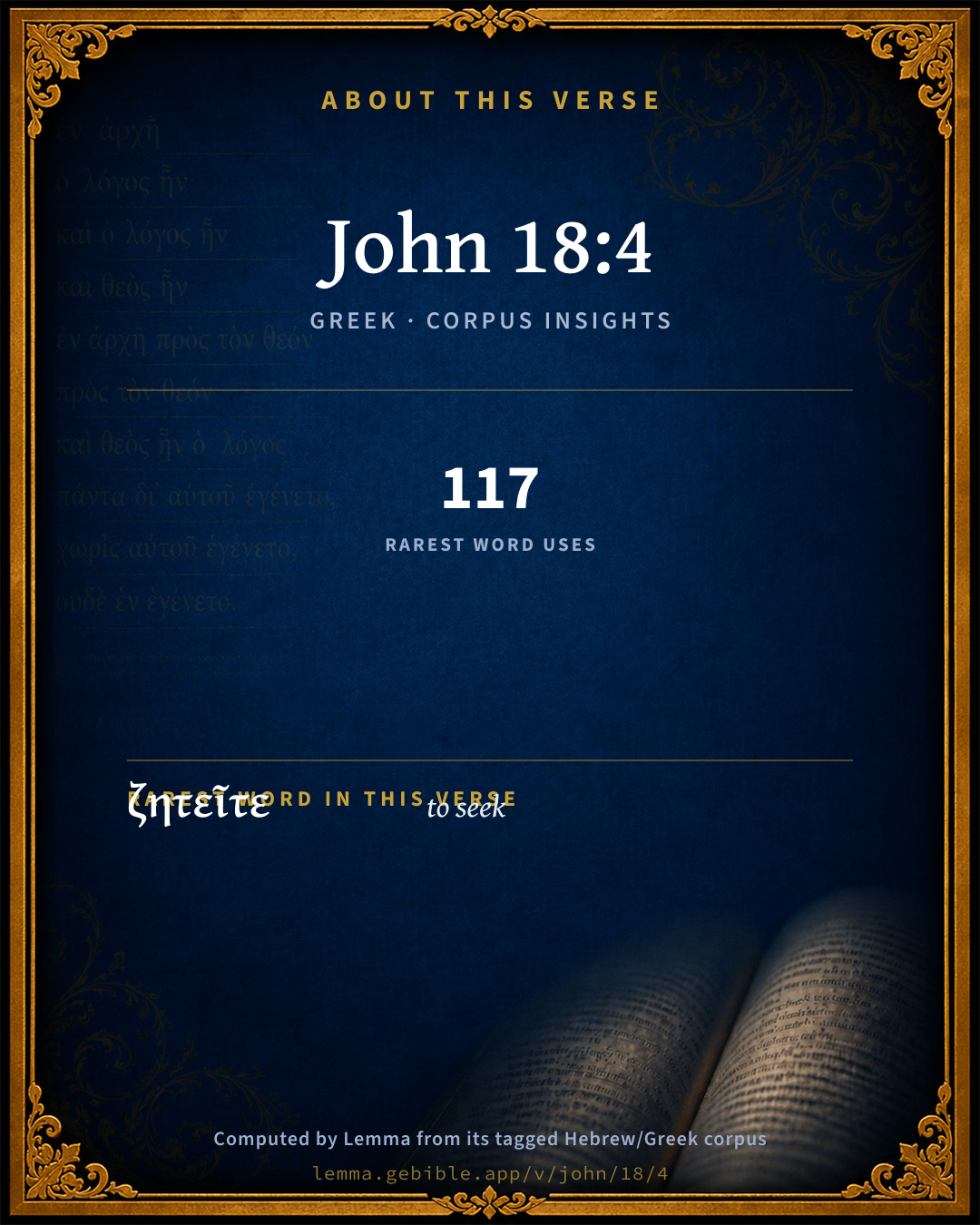
John 18:4

Greek (Tischendorf 8th ed.) John 18:4 appears in the Greek New Testament. The text above is from the Tischendorf 8th edition. Each word links to its Strong’s number and a concise gloss. Click any word for its full Thayer’s Greek Lexicon entry.
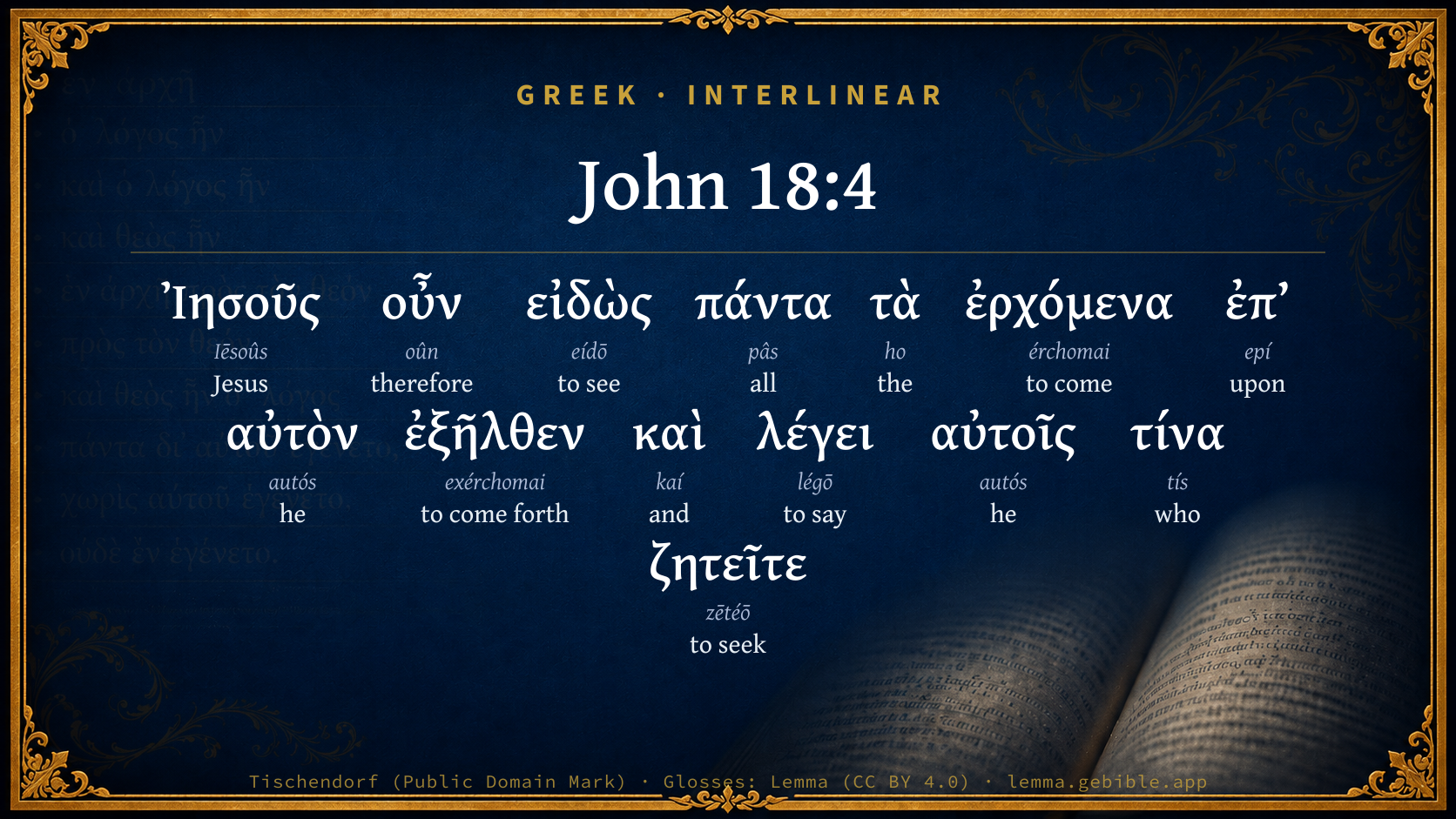
Download image
Cite this verse

John 18:4 (World English Bible). Public Domain. Lemma interlinear Bible study tool, https://lemma.gebible.app/v/john/18/4.

Show BibTeX & RIS
BibTeX
RIS
English Translation
Jesus therefore, knowing all the things that were happening to him, went forth, and said to them, "Who are you looking for?"
World English Bible · Public Domain
Download a study sheet

One document with this verse’s original text, its word-by-word gloss line, the meaning frame, cross-references with their text, attributed commentary, and full source and license credits — printable, and it pastes into notes with its structure intact.

This verse Autodidact and up

Study sheet (.html) Plain text (.txt)

A passage Seminary Student

Up to 50 verses in one chapter. A passage sheet keeps up to 6 commentary sources and 12 cross-references per verse, in the order this page ranks them, and says so on the sheet whenever that leaves anything out. Ask for a single verse and you get the Autodidact verse sheet above.

Everything on this page stays free to read, with no account — the sheet is a download of what is already on screen, not access to it.

Want to remove ads? Support Godless Engineer
Compare translations 3

The same verse in 3 English versions, stacked beneath the original-language interlinear above. Click any original word for its lexicon entry.

Each is an independent rendering of the whole verse — the interlinear is not word-aligned to these translations.

Highlighted words mark where these versions differ — a whole-verse word diff, not a word-by-word alignment.

  • World English Bible Public Domain
    Jesus therefore, knowing all the things that were happening to him, went forth, and said to them, "Who are you looking for?"
  • King James Version Public Domain
    Jesus therefore, knowing all things that should come upon him, went forth, and said unto them, Whom seek ye?
  • unfoldingWord Literal Text CC BY-SA 4.0
    Then Jesus, knowing all the things happening to him, having gone out, asked them, “Whom do you seek?”

unfoldingWord Literal Text — © unfoldingWord, licensed CC BY-SA 4.0. Word-aligned USFM3 via Door43 (git.door43.org/unfoldingWord/en_ult).

Versions to compare (up to 4)

3 of 4 selected

Show all 19 translations

Every available English version of this verse, each an independent rendering of the whole verse.

  • World English Bible Public Domain
    Jesus therefore, knowing all the things that were happening to him, went forth, and said to them, "Who are you looking for?"
  • Berean Standard Bible Public Domain
    Jesus, knowing all that was coming upon Him, stepped forward and asked them, “Whom are you seeking?”
  • Majority Standard Bible Public Domain
    Jesus, knowing all that was coming upon Him, stepped forward and asked them, “Whom are you seeking?”
  • King James Version Public Domain
    Jesus therefore, knowing all things that should come upon him, went forth, and said unto them, Whom seek ye?
  • American Standard Version (1901) Public Domain
    Jesus therefore, knowing all the things that were coming upon him, went forth, and saith unto them, Whom seek ye?
  • Revised Version (1885) Public Domain
    Jesus therefore, knowing all the things that were coming upon him, went forth, and saith unto them, Whom seek ye?
  • Geneva Bible (1599) Public Domain
    Then Iesus, knowing all things that shoulde come vnto him, went foorth and said vnto them, Whom seeke yee?
  • Douay-Rheims (1899) Public Domain
    Jesus therefore, knowing all things that should come upon him, went forth, and said to them: Whom seek ye
  • Young's Literal Translation Public Domain
    Jesus, therefore, knowing all things that are coming upon him, having gone forth, said to them, `Whom do ye seek?'
  • Literal Standard Version CC BY-SA 4.0
    Jesus, therefore, knowing all things that are coming on Him, having gone forth, said to them, “Whom do you seek?”
  • Unlocked Literal Bible CC BY-SA 4.0
    Then Jesus, who knew all the things that were happening to him, went forward and asked them, “Who are you looking for?”
  • unfoldingWord Literal Text CC BY-SA 4.0
    Then Jesus, knowing all the things happening to him, having gone out, asked them, “Whom do you seek?”
  • Darby Bible Public Domain
    Jesus therefore, knowing all things that were coming upon him, went forth and said to them, Whom seek ye?
  • World Messianic Bible Public Domain
    Yeshua therefore, knowing all the things that were happening to him, went out and said to them, “Who are you looking for?”
  • Webster's Bible Public Domain
    Jesus therefore, knowing all things that were coming upon him, went forth, and said to them, Whom seek ye?
  • Free Bible Version CC BY-SA 4.0
    Jesus knew everything that was going to happen to him. He went to meet them, and asked, “Who are you looking for?”
  • Bible in Basic English Public Domain
    Then Jesus, having knowledge of everything which was coming on him, went forward and said to them, Who are you looking for?
  • Text-Critical English NT CC BY 4.0
    Then Jesus, knowing everything that would happen to him, went out and said to them, “Who are you looking for?”
  • Tyndale New Testament (1534) Public Domain
    Then Iesus knowynge all thinges that shuld come on him went forth and sayde vnto them: whom seke ye?

Literal Standard Version (2020), Covenant Press — licensed CC BY-SA 4.0. Text via the HelloAO Bible API (eBible.org). Unlocked Literal Bible (unfoldingWord) — licensed CC BY-SA 4.0. Text via the HelloAO Bible API (eBible.org). unfoldingWord Literal Text — © unfoldingWord, licensed CC BY-SA 4.0. Word-aligned USFM3 via Door43 (git.door43.org/unfoldingWord/en_ult). Free Bible Version, Dr. Jonathan Gallagher — licensed CC BY-SA 4.0. Text via the HelloAO Bible API (eBible.org).

Word by word

More ways to search: Search by grammar → Find every occurrence → Compare this word →

Practice this passage: Drill this verse → Learn its vocabulary →

ζητεῖτε
zētéō
G2212
“to seek”
Verb, Present, Active, Indicative, 2nd person, Plural
Part of Speech
Verb
Tense
Present
Voice
Active
Mood
Indicative
Person
2nd person
Number
Plural
Full Thayer's Definition

Origin: of uncertain affinity

TDNT: 16:52,3

1. to seek in order to find a. to seek a thing b. to seek [in order to find out] by thinking, meditating, reasoning, to enquire into c. to seek after, seek for, aim at, strive after 2. to seek i.e. require, demand a. to crave, demand something from someone
  1. Ἰησοῦς Iēsoûs G2424 “Jesus” Noun, Nominative, Singular, Masculine
  2. οὖν oûn G3767 “therefore” Conjunction
  3. εἰδὼς eídō G1492 “to see” Verb, Perfect, Active, Participle, Nominative, Singular, Masculine
  4. πάντα pâs G3956 “all” Adjective, Accusative, Plural, Neuter
  5. τὰ ho G3588 “the” Article, Accusative, Plural, Neuter
  6. ἐρχόμενα érchomai G2064 “to come” Verb, Present, Middle or Passive deponent, Participle, Accusative, Plural, Neuter
  7. ἐπ’ epí G1909 “upon” Preposition
  8. αὐτὸν autós G846 “he” Personal pronoun, Accusative, Singular, Masculine
  9. ἐξῆλθεν exérchomai G1831 “to come forth” Verb, Aorist, Active, Indicative, 3rd person, Singular
  10. καὶ kaí G2532 “and” Conjunction
  11. λέγει légō G3004 “to say” Verb, Present, Active, Indicative, 3rd person, Singular
  12. αὐτοῖς autós G846 “he” Personal pronoun, Dative, Plural, Masculine
  13. τίνα tís G5101 “who” Interrogative pronoun, Accusative, Singular, Masculine

About this verse

These counts appear in no published source. They are computed here, from the morphology-tagged text and Lemma’s own curated glosses. What Lemma adds →

14
words
13
distinct lemmas
Gospels
section

Repetition

A word recurs within this verse:

  • αὐτὸν he G846 ×2

Cross-references

26

Topical passages linked to John 18:4 in the Treasury of Scripture Knowledge — connected by theme and wording, ordered by reader-vote popularity; previews shown in the World English Bible.

  • John 13:1 Now before the feast of the Passover, Jesus knowing that his time had come that he would depart from this world to the Father, having loved his own who were in the world, he loved them to the end.
  • John 18:7 Again therefore he asked them, "Who are you looking for?" They said, "Jesus of Nazareth."
  • Psalms 27:3 Though a host should encamp against me, My heart shall not fear. Though war should rise against me, Even then I will be confident.
  • Acts 2:28 You made known to me the ways of life. You will make me full of gladness with your presence.'
  • Acts 20:22–23 Now, behold, I go bound by the Spirit to Jerusalem, not knowing what will happen to me there;
  • 1 Kings 18:10 As Yahweh your God lives, there is no nation or kingdom, where my lord has not sent to seek you: and when they said, He is not here, he took an oath of the kingdom and nation, that they didn't find you.
  • 1 Kings 18:14–18 Now you say, Go, tell your lord, Behold, Elijah [is here]; and he will kill me.
  • Nehemiah 6:11 I said, Should such a man as I flee? and who is there that, being such as I, would go into the temple to save his life? I will not go in.
  • Psalms 3:6 I will not be afraid of tens of thousands of people Who have set themselves against me on every side.
  • Proverbs 28:1 The wicked flee when no one pursues; But the righteous are as bold as a lion.
  • Matthew 16:21 From that time, Jesus began to show his disciples that he must go to Jerusalem and suffer many things from the elders, chief priests, and scribes, and be killed, and the third day be raised up.
  • Matthew 17:22–23 While they were staying in Galilee, Jesus said to them, "The Son of Man is about to be delivered up into the hands of men,
  • Matthew 20:18–19 "Behold, we are going up to Jerusalem, and the Son of Man will be delivered to the chief priests and scribes, and they will condemn him to death,
  • Matthew 26:2 "You know that after two days the Passover is coming, and the Son of Man will be delivered up to be crucified."
  • Matthew 26:21 As they were eating, he said, "Most assuredly I tell you that one of you will betray me."
  • Matthew 26:31 Then Jesus said to them, "All of you will be made to stumble because of me tonight, for it is written, 'I will strike the shepherd, and the sheep of the flock will be scattered.'
  • Mark 10:33–34 "Behold, we are going up to Jerusalem. The Son of Man will be delivered to the chief priests and the scribes. They will condemn him to death, and will deliver him to the Gentiles.
  • Luke 24:6–7 He isn't here, but is risen. Remember what he told you when he was still in Galilee,
  • Luke 24:44 He said to them, "This is what I told you, while I was still with you, that all things which are written in the law of Moses, the prophets, and the psalms, concerning me must be fulfilled."
  • John 6:64 But there are some of you who don't believe." For Jesus knew from the beginning who they were who didn't believe, and who it was who would betray him.
  • John 10:17–18 Therefore the Father loves me, because I lay down my life, that I may take it again.
  • John 13:11 For he knew him who would betray him, therefore he said, "You are not all clean."
  • John 19:28 After this, Jesus, seeing that all things were now finished, that the Scripture might be fulfilled, said, "I am thirsty."
  • Acts 4:24–28 When they heard it, they lifted up their voice to God with one accord, and said, "O Lord, you are God, who made the heaven, the earth, the sea, and all that is in them;
  • Luke 18:31–33 He took the twelve aside, and said to them, "Behold, we are going up to Jerusalem, and all the things that are written through the prophets concerning the Son of Man will be completed.
  • 1 Peter 4:1 Forasmuch then as Christ suffered for us in the flesh, arm yourselves also with the same mind; for he who has suffered in the flesh has ceased from sin;

Cross-references courtesy of OpenBible.info (CC BY 4.0).

Commentary

Notes on John 18:4 from classic Christian and Jewish commentators (each source and its license shown beneath its notes). The classic Christian expositions comment on the surrounding passage and are grouped to its opening verse, so a note may address several verses; the Jewish commentaries on the Tanakh (Rashi and others) are per-verse, so they appear only where the commentator wrote on this verse.

Lemma curates 59 commentaries, every one of them public domain or Creative Commons licensed, each selected and text-cleaned for this edition rather than reprinted as found. About our sources →

Joseph Benson's Commentary

Joh 18:4-11. Jesus, knowing all things that should come upon him — That is, knowing, not only in general, that he must suffer a variety of insults, tortures, and even death itself, but also all the particular circumstances of ignominy and horror that should attend his sufferings; went forth — Namely, after his repeated supplications to his heavenly Father, and his agony, as is related at large, Mat 26:37-46; Mar 14:34-42; Luk 22:41-46; where see the notes; and said unto them — With the greatest composure of mind; Whom seek ye? — The appointed time of our Lord’s sufferings being come, he did not now, as formerly, avoid his enemies, but readily came forward, and gave them an opportunity of apprehending him, telling them, when they said they sought Jesus of Nazareth, I am he — Which expression he had no sooner uttered than the whole band went backward, and fell to the ground — By which exertion of his divine power he evidently showed them that they could not apprehend him without his consent. How amazing is it, that they should renew the assault after so sensible an experience both of his power and mercy! But probably the priests among them might persuade themselves and their attendants, that this also was done by Beelzebub, and that it was through the providence of God, not the indulgence of Jesus, that they received no further damage. See note on Mat 26:47-50. If ye seek me, let these (my disciples) go — It was an eminent instance of his power over the spirits of men, that they so far obeyed his word as not to seize even Peter, when he had cut off the ear of Malchus. Then Simon Peter, having a sword, drew it — No other evangelist names the person that drew the sword, nor could they without exposing Peter to danger. But John, writing after his death, might do it without any such inconvenience. And smote the high-priest’s servant, &c. — See note on Mat 26:51-54. Then said Jesus, Put up thy sword, &c. — For I will not have recourse to this or any other method of defence. The cup which my Father hath given me, shall I not drink it? — You look only at second causes, and have but an imperfect view of things; but I consider all the sufferings I am now to meet, as under a divine direction and appointment, and therefore willingly acquiesce in what I know to be my heavenly Father’s will.

Joseph Benson's Commentary on the Old and New Testaments (1811–1818) — public domain. Text from a community e-Sword module.

Bengel's Gnomon

Johann Albrecht Bengel

Joh 18:4. Ἐξελθὼν, having gone forth) Therefore He might even still have departed.—εἶπεν, said) in order that He might turn aside the violence of the cohort (band) from the disciples: Joh 18:8.

Bengel's Gnomon of the New Testament — English translation (T&T Clark, Edinburgh, 1860) — public domain. Text from a community e-Sword module.

Meyer's Critical & Exegetical Commentary

Heinrich August Wilhelm Meyer

Joh_18:4-5. This advance of Judas occasioned (οὖν) Jesus to come forth, since He knew all that was about to come upon Him, and consequently was far removed from any intention of withdrawing Himself from His destiny, of which He was fully and clearly conscious.

ἔρχεσθαι, of destinies, happy (Mat_10:13) and unhappy (Mat_23:35; Aesch. Pers. 436, 439; Ellendt, Lex. Soph. I. p. 686 f.), in the classics more frequently with the dative (Thuc. viii. 96. 1) than with ἐπί.

ἐξῆλθεν (see the critical notes): from the garden, Joh_18:1, Nonnus: κῆπον ἐάσας. The context yields no other meaning, and Joh_18:26 is not opposed to it. Hence not: from the garden-house (Rosenmüller, Ewald), or from the depth of the garden (Tholuck, Maier, De Wette, Luthardt), or from the circle of disciples (Schweizer, Lange, Hengstenberg).

εἱστήκει δὲ καὶ Ἰούδας, κ.τ.λ.] Tragic moment in the descriptive picture of this scene, without any further special purpose in view. Tholuck arbitrarily remarks: John wished to indicate the effrontery of Judas; and Hengstenberg: he wished to guard against the false opinion that the ἐγώ εἰμι was intended to convey to the officers something unknown to them. This he could surely have been able to express in few words.

The kiss of Judas (Mat_26:47 ff.), instead of which John gives the above personal statement (as Strauss indeed thinks: in order to the glorification of Jesus), is not thereby excluded, is too characteristic and too well attested to be ascribed to tradition, and cannot have followed (Ewald) the question of Jesus (Joh_18:4), but, inasmuch as the immediate effect of the ἐγώ εἰμι did not permit of the interruption of the kiss, must have preceded, so that immediately on the exit of Jesus from the garden, Judas stepped forward, kissed Him, and then again fell back to the band. Accordingly, John, after the one factor of the betrayal, namely the kiss, had been already generally disseminated in tradition, brings into prominence the other also, the personal statement; hence this latter is not to be ascribed merely to the Johannean Jesus (Hilgenfeld, Scholten).

Meyer — Critical and Exegetical Commentary on the New Testament — English translation by Peter Christie, edited by Frederick Crombie (T&T Clark, 1880) — public domain. Text from a community e-Sword module.

Expositor's Greek Testament

ed. W. Robertson Nicoll

Joh 18:4 . Jesus, then, not with the boldness of ignorance, but knowing πάντα τὰ ἐρχόμενα ἐπʼ αὐτόν , “all that was coming upon Him,” cf. Luk 14:31 , ἐρχομένῳ ἐπʼ αὐτόν , “went out” from the garden, or more probably, Joh 18:26 , from the group of disciples, “and says, Whom seek ye?” to concentrate attention on Himself and prevent a general attack.

The Expositor's Greek Testament, edited by W. Robertson Nicoll (1897–1910) — public domain. Text from a community e-Sword module.

Geneva Bible (1599)

Geneva Bible translators

Christ’s person (but not his virtue) was bound of the adversaries, when and how he would.

Geneva Bible (1599) marginal notes — public domain. Text via Bolls.life.

Jamieson, Fausset & Brown

Robert Jamieson, A. R. Fausset & David Brown

Jesus . . . knowing all things that should come--were coming.

upon him, went forth--from the shade of the trees, probably, into open view, indicating His sublime preparedness to meet His captors.

Whom seek ye?--partly to prevent a rush of the soldiery upon the disciples [BENGEL]; and see Mar 14:51-52, as showing a tendency to this: but still more as part of that courage and majesty which so overawed them. He would not wait to be taken.

Jamieson, Fausset & Brown — Commentary Critical and Explanatory on the Whole Bible (1871) — public domain (CC PDM 1.0). Text via the HelloAO Bible API.

Adam Clarke's Commentary

Verse 4. Jesus knowing all things, c.] He had gone through all his preaching, working of miracles, and passion, and had nothing to do now but to offer up himself on the cross he therefore went forth to meet them, to deliver himself up to death.

Adam Clarke's Commentary on the Bible (1810–1826) — public domain. Text from a community e-Sword/MySword module.

John Calvin's Commentaries

4. Jesus therefore, hnowing. The Evangelist states more clearly with what readiness Christ went forward to death, but, at the same time, describes the great power which he exercised by a single word, in order to inform us that wicked men had no power over him, except so far as he gave permission.

John Calvin's Commentaries (1540-1563) — public domain. Text from the Calvin Translation Society English edition (1840s-50s) via the Christian Classics Ethereal Library (ccel.org). Calvin's coverage is partial (roughly two-thirds of the Bible); uncommented books and verses are honest gaps, never fabricated. The 19th-century editor's footnotes and remarks are omitted so the notes are faithfully Calvin's own voice.

Ellicott's Commentary for English Readers

(4) Jesus therefore, knowing all things that should come (better, were coming) upon him.—Comp. Mat_26:45.

Went forth, and said unto them, Whom seek ye?—i.e., probably, went forth from the garden itself. (Comp. Note on Joh_18:26.) Other possible interpretations are, “went forth from the depth of the garden;” or, “went forth from the circle of the disciples standing round;” or, “went forth from the shade of the tree into the moonlight.” For the word, comp. Joh_18:1, and Mat_14:14). The kiss of Judas, mentioned in all the earlier Gospels, must be placed here between “went forth” and “said unto them.”

For the question, comp. Mat_26:50. Jesus will boldly face the danger, and direct it upon Himself, that the disciples may be saved from it (Joh_18:8).

A Bible Commentary for English Readers, edited by Charles John Ellicott (1878–1897) — public domain. Text from a community e-Sword module.

The Cambridge Bible for Schools and Colleges

gen. ed. J. J. S. Perowne

4. all things that should come] Better, all the things that were coming.

went forth] From what? (1) from the shade into the light; (2) from the circle of disciples; (3) from the depth of the garden; (4) from the garden itself. It is impossible to say which of these suggestions is right; the last is not contradicted by Joh_18:26. The kiss of Judas is by some placed here, by others after Joh_18:8. While ‘His hour was not yet come’ (Joh_7:30, Joh_8:20), He had withdrawn from danger (Joh_8:59, Joh_11:54, Joh_12:36); now he goes forth to meet it. He who had avoided notoriety (Joh_5:13) and royalty (Joh_6:15), goes forth to welcome death.

said] The better reading gives saith. His question perhaps had two objects; to withdraw attention from the disciples (Joh_18:8), and to make His captors realise what they were doing.

The Cambridge Bible for Schools and Colleges (gen. ed. J. J. S. Perowne; Cambridge University Press, 1878–1918) — public domain. Text from a community e-Sword module.

John Gill's Exposition

Jesus therefore knowing all things,.... As being the omniscient God, so his knowledge reaches to all persons and things, without any limitation, and restriction; though here it has a regard to all the things,

that should come upon him; even all the sufferings he should endure, which were all determined by God; agreed to by him, in the covenant of grace; predicted in the Old Testament, and foretold by himself: he knew all the circumstances that would attend his sufferings, as that he should be betrayed by Judas; be forsaken by the rest of his disciples; that the Jews would give him gall and vinegar in his thirst; and the soldiers part his garments among them: he knew the time of his sufferings; and that it was now at hand; and that Judas and his company were not far off: and therefore, went forth out of the garden, or at least from that part of it where he was, and his disciples with him: this was done to show his willingness to suffer; he

went forth of his own accord; he did not hide himself in the garden, as the first Adam did: he did not stay till those that sought his life came up to him: he went forth, not to make his escape from them, but to meet them, and make himself known unto them;

and said unto them; whom seek ye? this question was put, not out of ignorance; for he knew full well who they were seeking after: nor with a design to deceive them, and make his escape; but to show that he was not afraid of them, and that they could not have known him, nor have taken him, had he not made himself known; and offered himself to them; and which makes it appear, that he was willingly apprehended by them, and voluntarily suffered.

John Gill's Exposition of the Whole Bible (1746–1763) — public domain (CC PDM 1.0). Text via the HelloAO Bible API.

Trapp's Complete Commentary

John Trapp

4 Jesus therefore, knowing all things that should come upon him, went forth, and said unto them, Whom seek ye?

Ver. 4. Went forth and said unto them] Met his enemy in the face, after he had prayed; whereas, till then, he feared. See the power of prayer. So Esther, when she had fasted and prayed, found her heart fortified against the fear of man; and putting her life in her hand, went boldly to the king. So Hudson the martyr, of whom before.

John Trapp, A Commentary or Exposition upon All the Books of the Old and New Testament (1647–1656) — public domain. Text from a community e-Sword module.

Matthew Poole's English Annotations

This evangelist saith nothing of what the other evangelists mention, of the sign that Judas had given them, by which they should know him; nor of Judas’s kissing of him, or our Saviour’s reply to him. (John, all along his Gospel, mentions very little of what is recorded by the other evangelists). It must be supposed, that after Judas had kissed our Saviour, our Saviour himself came forth and asked him whom they looked for; hereby showing that he laid down his life, and no man took it from him: he could easily have delivered himself out of their hands, (though I think they are too charitable to Judas, who think that it was that which made Judas discover him; not that he designed his death), he had once and again before so escaped them; but now his hour was come, he freely offers himself unto his enemies, and asketh whom they looked for.

Matthew Poole's English Annotations on the Holy Bible (1683–1685) — public domain. Text from a community e-Sword/MySword module.

Whedon's Commentary on the Bible

Daniel D. Whedon

4. Knowing all… that should come—John leaves to the other Evangelists to describe the humiliations of the garden and of the Judas kiss, and seizes those points in which the foreknowledge and majesty of Jesus appear rising above the inflictions he suffered. It is the same upper tone of triumph as reigns through the previous discourses, heightened to sublimity by the recollection of the degradations which the previous Gospels disclose.

John’s Gospel is therefore a supplement, not merely in external facts, but in grand views and sublime truths.

Went forth—After the traitor’s kiss, the traitor himself retreats among the band that follow him, who stand in hesitation. Jesus steps forward in firm majesty to meet the men, who appear more like culprits to be arraigned than like officers coming to arrest him.

Whom seek ye?—Not that he did not know whom they sought. Not that their leaders did not know him by the traitor’s signal. He speaks to make them confess their object, and then to show that they can attain it only by his actual permission. It is the word by which he commences the display of power exhibited in Joh_18:6.

Daniel D. Whedon (gen. ed.), Commentary on the Old and New Testaments (1874–1909) — public domain. Text from a community e-Sword module.

The Pulpit Commentary

Jesus then the oun implies that our Lord discerned the approach of the hostile bandknowing all the things that were coming upon him in full consciousness of his position, and in voluntary sacrifice of himself to the will of God and the purpose of his missionwent forth; i.e. from the garden enclosure see Ver. 1 (say Meyer and Godet); from the recesses of the garden or the garden-house (say others); partly in consequence of the language of the kinsman of Maichus," Did I not see thee in the garden?" But this is perfectly compatible with the obvious fact that the eight disciples and the favored three should have shrunk behind our Lord when he calmly emerged from the entrance to the garden, and that their position would be thus sufficiently indicated. It is remarkable that John, who has been accused of personal malice to Judas (i.e. by those who, like Renan, admit, to a certain extent, the Johan-nine authorship), does not refer to the traitor"s kiss. This well-attested and traditionally sustained incident is not excluded by the narrative before us indeed, the second reference to Judas seems to imply something special in his conduct, which is needed to account for it. We can hardly suppose that it could have taken place before the Lord Jesus had uttered his solemn word, but it may easily have occurred as the first answer to his summons. And saith unto them, Whom seek ye?

HOMILIES BY B. THOMAS Vers. 4-8. The moral courage of Jesus.

We see this if we consider

I WHAT HE MIGHT HAVE DONE UNDER THE CIRCUMSTANCES There is no virtue in not doing thus if we cannot do otherwise. But what could Jesus do now?

1. He might have not visited the garden on this night. He knew all that was coming. He knew that the devil of pilfering and covetousness had entered Judas, and that he was then in the city betraying him to his thirsty and cruel foes. He entered not the garden in ignorance of what was coming. It would be the easiest thing for him to go elsewhere.

2. He might have escaped before his foes were upon him. Apart from his absolute knowledge of things, the gleaming light and subdued talk of the hostile throng would give him sufficient warning, and he could have made his escape under the cover of friendly trees. His little guard slept fast; but he was awake, and specially sensitive to every approaching sight and sound.

3. He might have disappeared from his foes in their very presence. He might have let them come upon him so as to think that he was in their hands, and then at once vanish away from their very clutches, disappoint their fondest hopes, and make fools of them all.

4. He might, with his power, strike them dead, or into a fit so as to make their hostile attack quite futile. He just showed them what he could do when he said, "I am he;" they went backwards, and fell to the ground. What produced this? Was it a flash of his Divinity from without striking terror to his assailants, or a flash of memory from within of his mighty deeds? or was it the effect of the simple moral courage and majesty of that defenseless but heroic One? However, they fell to the ground a striking illustration of what he might have done.

5. He might have received almighty help from his Father. If he at this time had not many earthly friends, and those not very strong nor skilful in human warfare, he was rich in heavenly allies, and these were all at his command, as he told one of his followers, "Thinkest thou that I cannot now pray to my Father," etc.? One of these with the brush of his wing slew the mighty Assyrian army, and one of them would slay all Christ"s enemies it he so wished. But he did not use his power nor influence in his own defense. He had sufficient courage to stand all alone.

II WHAT HE DID.

1. He remained in the garden. He was perfectly self-composed. He had a special work to do in the garden. There the coming battle was morally fought and won. There he trained himself for the encounter, edged his sword and put on his armor, and viewed the battle-field. He was too busily engaged with his Father and the business of his life to be disturbed by the approaching foe.

2. He went forth to meet his enemies. He had finished his work there, and his language and action were, "Let us arise, and go hence." He went forth to meet them. His courage was not rash, but discreet, and under the guidance of perfect wisdom. He never went forth to meet his enemies before, for his hour was not come; but now his hour was come, and as soon as he heard the clock strike it, instead of waiting their arrival, he went forth to meet them. He had a great work to do in an hour, and there was no time to lose. His courage completely spoilt their anticipated sport of a chase or a fight.

3. He made himself known to them. He could ask them with firmness, "Whom seek ye?" but tremblingly they replied, "Jesus of Nazareth." The Roman soldiers had unflinchingly faced many mighty foes, but this defenseless Jesus of Nazareth overpowered them with his majesty. "I am he" proved too much for them. They fell to the ground. And the collision would have proved fatal to them were it not for the buffers of his goodness and mercy. Judas"s kiss was unnecessary; Jesus introduced himself.

4. He went forth, although knowing all. "Knowing all things," etc. His knowledge in one sense was disadvantageous to him. There is a certain amount of ignorance connected with all human bravery. Hope of escape and victory is an element in the heroism of the bravest soldier. If we knew all our future, it would go far to unnerve our courage and paralyze our energies; but Christ knew all. He had mentally gone through all the tortures of the next few hours. He knew that death with all its pains and shame was but a drop to the ocean of his agonies. He knew infinitely more than the soldiers and the disciples. They only knew the outward; he knew the inward. They only knew the visible; he knew the invisible. They only knew a part; he knew all. The weight of death was nothing to the weight of sin he had to hear. He knew this in all its bearings and bitterness; but in spite of all, such was his courage that, in this hour of trial, he did not flag, but went forth.

III THE SOURCES OF HIS COURAGE. What courage was his?

1. The courage of an exceptionally great nature. We must have an adequate cause to every effect. The heroism of Jesus, although human, yet often towered above it and became Divine. He was the Word made flesh, and God manifested in the flesh. He was a perfect Man, but ever united with Divinity full of Divine life which made him triumphant over death and its agonies.

2. The courage of loving obedience to his Father"s will. He was ever conscious of this. It was his delight, and the inspiration of his life. "My meat and my drink," etc.; "The cup that my Father hath given," etc.? It is bitter, but I shall drink from his hand whatever may be the consequences.

3. The courage of conscious rectitude and innocency. Guilt and imposture make a man a coward, while rectitude and innocency make him a hero. Conscious of the Divinity of his mission, the purity of his life, the guilelessness of his spirit, and the rectitude of his motives, Jesus went forth to meet his foes; and this consciousness raised him so far above timidity as to clothe him with the majesty of Divine heroism, which sent them reeling to the ground.

4. The courage of perfect knowledge of results. He not only knew his sufferings, but also his joys; not only the shame, but also the glory; not only the apparent defeat, but the subsequent grand victories. He could see life in his death for myriads, and glory in the highest. With the agonizing groans of Gethsemane were mingled the anthems of triumph, and in the gleam of torches and lanterns he could see the world flooded with light, and heaven with glory and happiness.

5. The courage of self-sacrificing and disinterested love. In the greatest bravery of selfishness there is an element of cowardice; but in Christ there was not a taint of selfishness, his life was absolutely a sacrifice for others. He would not implicate others in his hour of trial, but gave himself to save them and all this was voluntary. The volunteer is ever more courageous than the pressed soldier. The courage of Jesus was that of a volunteer, and his heroism that of Divine and self-sacrificing love.

LESSONS.

1. The foes of Jesus were the unconscious ministers of Divine justice demanding his life as a raison for sin. They were inspired by hatred to Jesus, but this hatred was overruled to answer the most benevolent purpose.

2. Jesus personally and willingly gave his life up for this purpose. He was most anxious that justice should be paid in the genuine coin, and not in counterfeit. "If ye seek me, let," etc.

3. In consequence of his meeting the demand of justice by his life, he demands the release of his friends. "if ye seek me," etc. He does not ask this as a favor, but demands as his right.

4. This demand is most readily granted. In this instance they were not touched. Justice cannot resist the logic of Christ"s death and intercession with regard to believers. If the accepted surety pay, the debtor is free.

5. The infinite importance to be united by faith with Christ. Then the chastisement of our peace is upon him, but otherwise it must be upon ourselves. B.T.

The Pulpit Commentary (1880–1919), ed. H.D.M. Spence-Jones & Joseph S. Exell — public domain. Text from a community e-Sword module.

Kretzmann's Popular Commentary

Paul E. Kretzmann

An exhibition of divine majesty:

v. 4. Jesus, therefore, knowing all things that should come upon Him, went forth, and said unto them, Whom seek ye?

v. 5. They answered Him, Jesus of Nazareth. Jesus saith unto them, I am He. And Judas also, which betrayed Him, stood with them.

v. 6. As soon, then, as He had said unto them, I am He, they went backward, and fell to the ground.

v. 7. Then asked He them again, Whom seek ye? And they said, Jesus of Nazareth.

v. 8. Jesus answered, I have told you that I am He; if therefore ye seek Me, let these go their way;

v. 9. that the saying might be fulfilled which He spake, Of them which Thou gavest Me have I lost none.

The members of the band might have saved themselves a great deal of trouble, for the hour of Jesus had now come, and He voluntarily delivered Himself into their hands. He knew all things that were to happen to Him, and went out to meet the men that were seeking Him. He was not only the omniscient God, knowing everything that was to happen to Him, but He was also the almighty God, as they were shortly to find out. From the description of John the roles of pursuers and pursued might have been reversed. For it is Jesus that challenges the band: whom seek ye? Their answer is: Jesus the Nazarene. And Jesus, with inimitable dignity and impressiveness, answers I am He. A wonderful, encompassing confession! "In considering this word, ’I am He,’ the Christians should mark well who Christ is, what His will is, what His intention is, and how great He is that was captured by the Jews, crucified, and killed; and also, why Christ suffered thus and died. This serves to make a distinction between the suffering of Christ and that of all other saints. For when this distinction is made, then the Passion of Christ has value and transcends that of all prophets, apostles, martyrs, etc. But if you ask who Christ is, then you shall know that He is the Man who shortly before, in Joh 17:10, says: Father, all Mine are Thine, and Thine are Mine. ". As Jesus made His ringing confession, Judas, the traitor, as the evangelist especially remarks, stood with them. He had joined their ranks, he had cast his lot with the enemies of the Lord. And therefore the almighty power of this great confession struck also him, with the whole band: they all went backward and fell to the ground. Here was evidence of Christ’s divine majesty, which should have served to open their eyes as to the real nature of the Man whom they were trying to arrest. With all their torches and lamps and weapons of diverse shapes and kinds they could not stand before Christ, a single word out of whose mouth threw them into a heap. Having given this evidence of His almighty power, Jesus again sends forth His ringing challenge: Whom seek ye? He now hid the rays of His divine majesty, He once more became the lowly, humble man. The truculent answer of the enemies must have been given all the more grudgingly as they felt themselves inferior to this Man. And Jesus again designated Himself as the Man whom they were seeking; He voluntarily delivered Himself into their hands. But to the last He held His guarding and sheltering hand over His disciples, reminding the officers and leaders of the band that, by their own statement, they are instructed to arrest none but Himself. His disciples therefore should be given leave to go their way unchallenged. In doing this, the evangelist finds that Jesus was carrying out the words of His prayer of but a short hour ago, Joh 17:12. "The evangelist here indicates that Christ with these words speaks of a being lost temporally. Above, in Joh 17:12, the text says clearly that the Lord speaks of a being lost eternally. But these two texts are not opposed to each other, though it certainly might seem that way; for if the disciples had been taken captive at that time, they would have been lost eternally in body and soul. There Christ is their Patron and Protector with the word ’I am He,’ and that He says to the band, ’Let these go their way. ’ With these words He preserved them that they might be lost neither temporally nor eternally; and in their soul they remain safe forever, although they afterwards in due time had to yield their bodies, and were obliged to give glory to God by their death. " Note: The tender kindness of Christ is concerned about all His believers in the same way, and it is ever active, and effectively so, in our interest.

Paul E. Kretzmann, Popular Commentary of the Bible (1921–1924) — public domain. Text from a community e-Sword module.

Burkitt's Expository Notes on the New Testament

William Burkitt

Observe here, 1. How our Lord’s sufferings were all foreknown to himself, before they came upon himself, before they came upon him, and yet how willingly and cheerfully did he go forth to meet them.

Should our sufferings be known unto us before they come upon us, how would it disquiet and disturb us! yea, not only discompose us, but distract us! In great wisdom, therefore, and in tender mercy, has God concealed future events from us.

But it was otherwise with Christ; he had an exact knowledge of those bitter sufferings which he was to undergo, and yet with a composed mind he goes forth to meet them: Jesus knowing all things that should come upon him, went forth.

Lord! how endearing are our obligations to thyself, that when thou knewest before-hand the bitterness of that cup, which the justice of God was about to put into thy hand, thou didst not decline to drink it off for our sakes!

Observe, 2. That it was not man’s power, but Christ’s own permission, which brought his sufferings upon him. How easily could Christ have delivered himself out of his enemies’ hands, who with a word from his mouth caused them to go backward and fall to the ground!

Christ in speaking those words did let out a little ray or beam of his deity, and this struck them down. Mark what a strange power was here in the word of Christ, and that not an angry word neither. He did not chide them, and say, "You wretches, how dare you lay hands on me, and carry me to judgment who shall one day be your judge!" Christ only said, I am he, and down they fell.

O what fear will Christ send out when he cometh to judge the world, who could send forth such a fear when he yielded up himself to be judged and condemned in the world! If there was so much majesty in the voice of Christ, in one of the lowest acts of his humiliation, what will the voice of a glorified Christ be to sinners, when he shall come as a judge to condemn the world.

William Burkitt's Expository Notes on the New Testament (1700–1703) — public domain. Text from a community e-Sword module.

unfoldingWord translationNotes

Door43 World Missions Community

General Information:

Jesus begins to speak with the soldiers, officers, and Pharisees.

Then Jesus, who knew all the things that were happening to him

"Then Jesus, who knew everything that was about to happen to him"

Jesus of Nazareth

"Jesus, the man from Nazareth"

I am

The word "he" is implied in the text. AT: "I am he" (See: Assumed Knowledge and Implicit Information)

who betrayed him

"who handed him over"

translationWords

Nazareth

Judas Iscariot

unfoldingWord translationNotes — © Distant Shores Media and the Door43 World Missions Community, licensed CC BY-SA 4.0. Source: git.door43.org/Door43/en_tn.

Cambridge Greek Testament for Schools and Colleges

4. ἐξῆλθεν καὶ λέγει (BC1D Origen) for ἐξῆλθεν καὶ λέγει (אActs 3).

4. ἐξῆλθεν. From what? (1) from the shade into the light; (2) from the circle of disciples; (3) from the depth of the garden; (4) from the garden itself. It is impossible to say which of these is right; the last is not contradicted by Joh 18:26. The kiss of Judas is by some placed here, by others after Joh 18:8. While ‘His hour was not yet come’ (Joh 7:30, Joh 8:20), He had withdrawn from danger (Joh 8:59, Joh 11:54, Joh 12:36); now He goes forth to meet it. He who had avoided notoriety (Joh 5:13) and royalty (Joh 6:15), goes forth to welcome death. His question may have had two objects; to withdraw attention from His disciples (Joh 18:8), and to make His captors realise what they were doing.

Cambridge Greek Testament for Schools and Colleges (Cambridge University Press, 1896; 21 vols, various authors incl. Carr, Maclear, Plummer, Farrar, Lumby, Moule, M. R. James, Simcox) — public domain. Text from a community e-Sword module.

Alford’s Greek Testament

Henry Alford

4-11.] Mat 26:48-56. Mar 14:44-52.Luk 22:48-53Luk 22:48-53.

4.] On εἰδὼς πάντα τὰ ἐρχ. see Mat 26:45.

ἐξῆλθεν—probably, from the shade of the trees into the moonlight;—hardly, as De Wette and Lücke suggest, from some building in the garden.

τίνα ζητ., spoken,—as was the saying ἐφʼ ὃ πάρει, Mat 26:50,—to carry reproof to the conscience of those addressed: and also to obtain for so solemn an act as the delivering Himself up to them, the formal declaration of their intention to take Him. “When men sought Him to make Him a king, He fled: now that they seek Him to put Him to death, He goes forth to meet them.” Stier, vi. 252, edn. 2.

Henry Alford, The Greek Testament (1849–1861) — public domain. Text from a community e-Sword module.

International Critical Commentary

4. Ἰησοῦς οὖν. אDLW have δέ for οὖν.

εἰδώς. Cf. 13:1. Jn. is at every point careful to insist that Jesus foreknew the issues of His ministry, πάντα τὰ ἐρχόμενα ἐπʼ αὐτόν, “everything that was coming upon Him.”

ἐξῆλθεν, “went out,” sc. of the garden into which He had entered, εἰσῆλθεν (v. 1). The rec. text with אAC3LNΘ has ἐξελθὼν εἶπεν, but ἐξῆλθεν καὶ λέγει (BC*D) is more in the style of Jn. (see on 1:50).

καὶ λέγει αὐτοῖς. He does not address Himself directly to Judas, but to those who had come, armed, to arrest Him, and He asks Τίνα ζητεῖτε; Cf. 1:38, 20:15.

In the Synoptic narratives (Mar 14:45, Mat 26:49, Luk 22:47) Judas comes forward and identifies Jesus by a kiss, that is, by kissing His hand, the recognised salutation from a disciple to His Master (not by kissing His cheek, as Western painters have been accustomed to depict the act). Jn. does not mention this treacherous sign, and his omission to do so is a difficulty in the way of critics who think that Jn. displays special animus against Judas (see on 12:6). His reason for the omission is probably that he is laying stress throughout on the voluntariness of Jesus’ acceptance of arrest. Jesus does not wait to be identified by any one, for He at once announces who He is. Jn.’s narrative seems to suggest that He had not been recognised in the uncertain light, even after He came out of the garden and asked, “Whom seek ye?” Tatian places the kiss of Judas immediately before v. 4, i.e. before Jesus came out of the garden; and if it is sought to bring the evangelical narratives into exact correspondence, Tatian’s solution may be the right one.1

Jn. says (v. 5) that “Judas, who was in the act of delivering Him up” (ὁ παραδιδοὺς αὐτόν, cf. 13:2), was standing (εἱστήκει) with those who were making the arrest. Judas had done his part when he had guided the emissaries of the Sanhedrim to the place where Jesus was. The scene is described very vividly.

International Critical Commentary — older volumes (1896–1929), various authors — public domain. Text from a community e-Sword module.

Vincent's Word Studies in the New Testament

Marvin R. Vincent

That should come [τα ερχομενα] . Literally, that are coming. The details in 4 - 9 are peculiar to John.

Marvin R. Vincent, Word Studies in the New Testament (1887–1900) — public domain. Text from a community e-Sword/MySword module.

Godet's Commentaries

Frédéric Louis Godet

Vv. 4-9. The meeting of Jesus with the band. “Jesus therefore, knowing all that which was to come upon him, went forth and says to them:Whom are you seeking for? 5. They answered him, Jesus of Nazareth. Jesus says to them, I am he. Now Judas, who betrayed him, was also standing among them. 6. When therefore Jesus said to them, I am he, they went backward and fell to the ground. 7. Jesus asked them a second time, Whom are you seeking for? They said, Jesus of Nazareth. 8. Jesus answered, I have told you that I am he; if therefore you are seeking me, let these go their way; 9, that the word might be fulfilled which he had spoken: I have lost none of those whom thou hast given me.”

In coming forward spontaneously and as the first to meet the band, Jesus has a purpose which the sequel will explain. He desires, by giving Himself up, to provide for the safety of His disciples. The word He went forth might mean: from the remote part of the garden or from the midst of His disciples; but it is more natural to understand: from the garden itself. He comes forward boldly even before the gate, while His disciples remain grouped behind Him in the garden; thus are the words of Joh 18:26 easily explained.

The kiss of Judas, in the Synoptics, which is said to be incompatible with John’s account, is naturally placed at the moment when Jesus, coming forth from the garden, meets the band, and thus immediately before the question: Whom are you seeking?John alone does not mention this incident, and yet he is accused of personal animosity against Judas!— Jesus, after having experienced this last perfidy from His disciple, turns towards the band, addressing to them the question relative to their commission: He desires to have this distinctly stated, in order to shelter those who are not the object of it—that is, His disciples. The insertion of the remark relating to Judas, at the end of Joh 18:5, has been explained in different ways. Luthardt rightly says: “These words are placed between the declaration I am he and the effect produced by it, because they are designed to explain this effect.” The impression of fear produced on the witnesses by the words I am he, which were pronounced with majesty and seemed to fall as a threatening from heaven—this impression could have been felt by no one of those present so vividly as by the faithless disciple, who had so often heard this same word as the affirmation of the unique dignity of Jesus; and it was no doubt from him that the emotion was communicated to those who surrounded and followed him.

The same moral ascendency to which the traders and money-changers in the temple had yielded, and which had many times arrested the multitude at the moment of stoning Him (comp. also Luk 4:30), causes the band suddenly to fall back, and this unexpected movement on the part of those who were foremost occasions the falling down of a certain number of those who are following them. There is no direct act of God’s omnipotence here overthrowing these persons, but it would be quite as much an error to see herein only an accidental effect. This result was desired on the part of Him who produced it. By thus making them feel His power, Jesus meant to show them that it would be dangerous for them to go beyond their commission, and thereby to secure the retreat of His disciples. We see how mistaken Weiss is in seeing in such a miracle only a miracle of display.

Then, in a milder tone, which leads the officers to approach Him again, Jesus interrogates them a second time; and after He has again caused them distinctly to declare that it is He, and He alone, whom they have the commission to arrest, He surrenders Himself while stipulating for the liberty of all His disciples. Then it was that the beautiful image was fulfilled which Jesus had used, Joh 10:12 : The shepherd sees the wolf coming, and he does not flee, because he cares for the sheep. The question was not only of the preservation, but even of the salvation of the disciples.

John felt this indeed, and this is what gives the explanation of the remark in Joh 18:9. The example of Peter, the most courageous one among them, shows that an arrest would have been, at that moment, for some of the apostles the signal for a deep fall, perhaps for an irreparable denial. And Jesus, who had said to the Father: “I have watched over those whom thou hast given me, and none of them is lost” (Joh 17:12), must fulfil to the end this serious task. All this causes Reuss to smile compassionately. He sees in the application which the author here makes of these words only a proof of his disposition to “indulge in double sense;” he even asks whether Jesus, in rendering an account to God of the care which He had had of His disciples, “would have hinted that He took care not to let them spend the following night in the guard-house.” For our own part, this quotation seems to us instructive. No one can suppose that John was ignorant of the spiritual sense of the words of Jesus in Joh 17:12 : “I have kept those whom thou hast given me, and no one of them is lost;” and yet he applies it here to a material fact, which undoubtedly pertained, though only indirectly, to the salvation of the disciples. Here is an example fitted to make us see the broad way in which we should treat the Scriptural quotations in general.

Frédéric Louis Godet — Commentaries on Luke, John, Romans, and 1 Corinthians — English translation (T&T Clark, Edinburgh, 1870s–1890s) — public domain. Text from a community e-Sword module.

Lesson kit

Teaching starters — assembled from the data on this page, not authored interpretation. Every prompt links to the verse data it draws on. Edit before teaching.

John, in the Gospels, opens this verse with 14 words (13 distinct Greek lemmas). Its most distinctive word is zētéō (“to seek”). A historical commentator’s framing appears above. Read the whole chapter for the surrounding context.

Discussion questions

  1. The word zētéō carries the sense “to seek.” How does it shape the verse?
  2. John 13:1 shares this passage’s theme. How do the two illuminate each other?
  3. “he” occurs 2× in this one verse. What is the effect of the repetition?
  4. These translations render this verse differently; the difference is in the English rendering, not the original. What questions does that raise?
  5. Reading how Joseph Benson's Commentary and Bengel's Gnomon read this verse, where do the two commentators agree and where do they part?

Things to notice

Reading settings

Reading text

Shown beneath each verse's original-language words.

Old Testament
Old Testament edition

Read the OT as the Masoretic Hebrew (MT) or the Greek Septuagint (LXX).

English shown for the Greek Septuagint (in the Hebrew ↔ Greek comparison).

Comparing translations? Open the Compare panel on any verse page to stack up to four side by side.