John 18:27

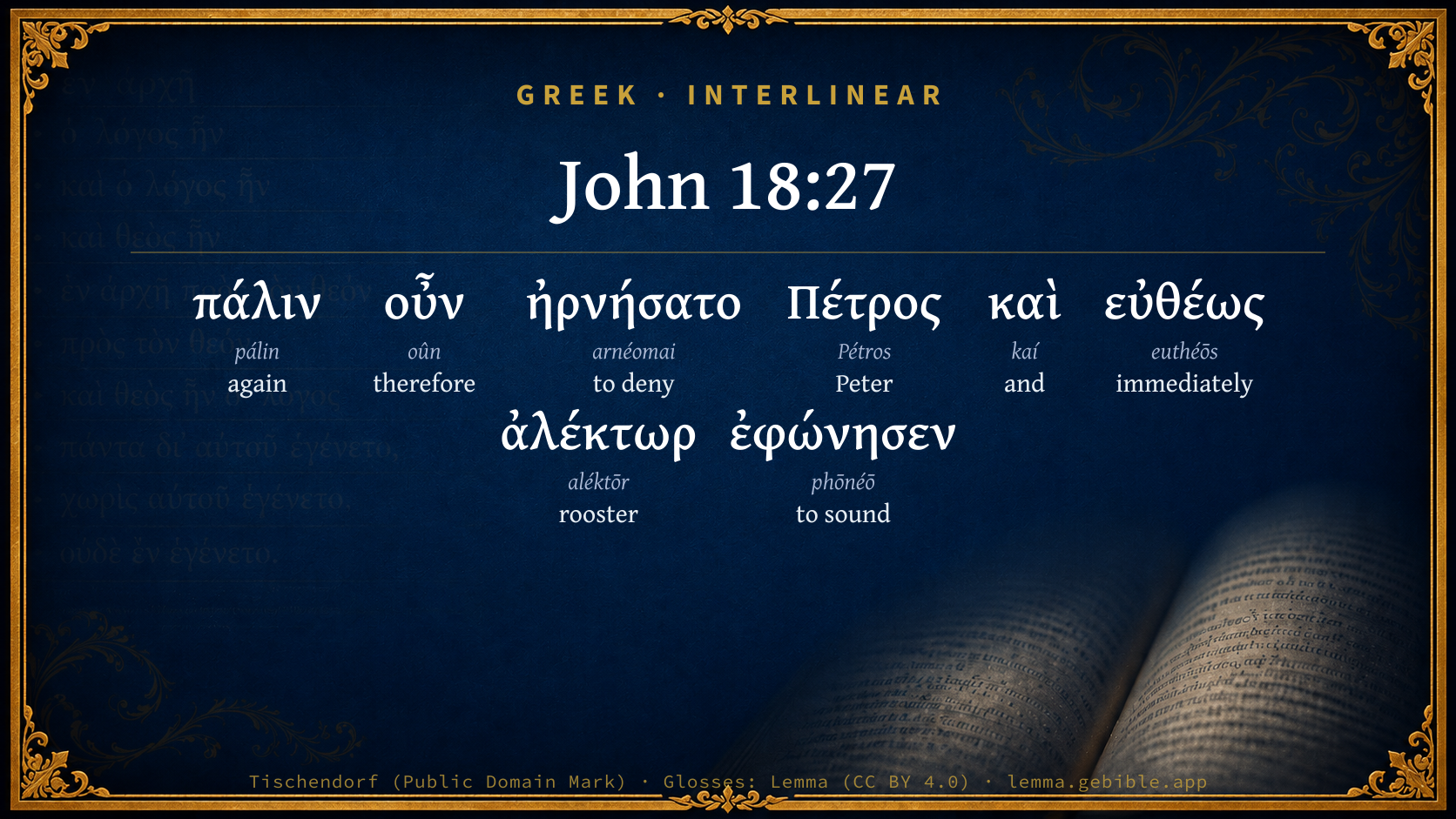
Greek (Tischendorf 8th ed.) John 18:27 appears in the Greek New Testament. The text above is from the Tischendorf 8th edition. Each word links to its Strong’s number and a concise gloss. Click any word for its full Thayer’s Greek Lexicon entry.
Download image
Cite this verse

John 18:27 (World English Bible). Public Domain. Lemma interlinear Bible study tool, https://lemma.gebible.app/v/john/18/27.

Show BibTeX & RIS
BibTeX
RIS
English Translation
Peter therefore denied it again, and immediately the rooster crowed.
World English Bible · Public Domain
Download a study sheet

One document with this verse’s original text, its word-by-word gloss line, the meaning frame, cross-references with their text, attributed commentary, and full source and license credits — printable, and it pastes into notes with its structure intact.

This verse Autodidact and up

Study sheet (.html) Plain text (.txt)

A passage Seminary Student

Up to 50 verses in one chapter. A passage sheet keeps up to 6 commentary sources and 12 cross-references per verse, in the order this page ranks them, and says so on the sheet whenever that leaves anything out. Ask for a single verse and you get the Autodidact verse sheet above.

Everything on this page stays free to read, with no account — the sheet is a download of what is already on screen, not access to it.

Want to remove ads? Support Godless Engineer
Compare translations 3

The same verse in 3 English versions, stacked beneath the original-language interlinear above. Click any original word for its lexicon entry.

Each is an independent rendering of the whole verse — the interlinear is not word-aligned to these translations.

Highlighted words mark where these versions differ — a whole-verse word diff, not a word-by-word alignment.

  • World English Bible Public Domain
    Peter therefore denied it again, and immediately the rooster crowed.
  • King James Version Public Domain
    Peter then denied again: and immediately the cock crew.
  • unfoldingWord Literal Text CC BY-SA 4.0
    Peter then denied again, and immediately a rooster crowed.

unfoldingWord Literal Text — © unfoldingWord, licensed CC BY-SA 4.0. Word-aligned USFM3 via Door43 (git.door43.org/unfoldingWord/en_ult).

Versions to compare (up to 4)

3 of 4 selected

Show all 19 translations

Every available English version of this verse, each an independent rendering of the whole verse.

  • World English Bible Public Domain
    Peter therefore denied it again, and immediately the rooster crowed.
  • Berean Standard Bible Public Domain
    Peter denied it once more, and immediately a rooster crowed.
  • Majority Standard Bible Public Domain
    Peter denied it once more, and immediately a rooster crowed.
  • King James Version Public Domain
    Peter then denied again: and immediately the cock crew.
  • American Standard Version (1901) Public Domain
    Peter therefore denied again: and straightway the cock crew.
  • Revised Version (1885) Public Domain
    Peter therefore denied again: and straightway the cock crew.
  • Geneva Bible (1599) Public Domain
    Peter then denied againe, and immediatly the cocke crewe.
  • Douay-Rheims (1899) Public Domain
    Again therefore Peter denied; and immediately the cock crew.
  • Young's Literal Translation Public Domain
    again, therefore, Peter denied, and immediately a cock crew.
  • Literal Standard Version CC BY-SA 4.0
    Again, therefore, Peter denied, and immediately a rooster crowed.
  • Unlocked Literal Bible CC BY-SA 4.0
    Peter then denied again, and immediately the rooster crowed.
  • unfoldingWord Literal Text CC BY-SA 4.0
    Peter then denied again, and immediately a rooster crowed.
  • Darby Bible Public Domain
    Peter denied therefore again, and immediately [the] cock crew.
  • World Messianic Bible Public Domain
    Peter therefore denied it again, and immediately the rooster crowed.
  • Webster's Bible Public Domain
    Peter then denied again, and immediately the cock crowed.
  • Free Bible Version CC BY-SA 4.0
    Peter denied it again, and immediately a cock crowed.
  • Bible in Basic English Public Domain
    Then again Peter said, No. And straight away a cock gave its cry.
  • Text-Critical English NT CC BY 4.0
    Peter denied it again, and immediately a rooster crowed.
  • Tyndale New Testament (1534) Public Domain
    One of the servauntes of the hye preste (his cosyn whose eare Peter smote of) sayde vnto him: dyd not I se the in the garden with him?

Literal Standard Version (2020), Covenant Press — licensed CC BY-SA 4.0. Text via the HelloAO Bible API (eBible.org). Unlocked Literal Bible (unfoldingWord) — licensed CC BY-SA 4.0. Text via the HelloAO Bible API (eBible.org). unfoldingWord Literal Text — © unfoldingWord, licensed CC BY-SA 4.0. Word-aligned USFM3 via Door43 (git.door43.org/unfoldingWord/en_ult). Free Bible Version, Dr. Jonathan Gallagher — licensed CC BY-SA 4.0. Text via the HelloAO Bible API (eBible.org).

Word by word

More ways to search: Search by grammar → Find every occurrence → Compare this word →

Practice this passage: Drill this verse → Learn its vocabulary →

About this verse

These counts appear in no published source. They are computed here, from the morphology-tagged text and Lemma’s own curated glosses. What Lemma adds →

8
words
8
distinct lemmas
Gospels
section

Notable vocabulary

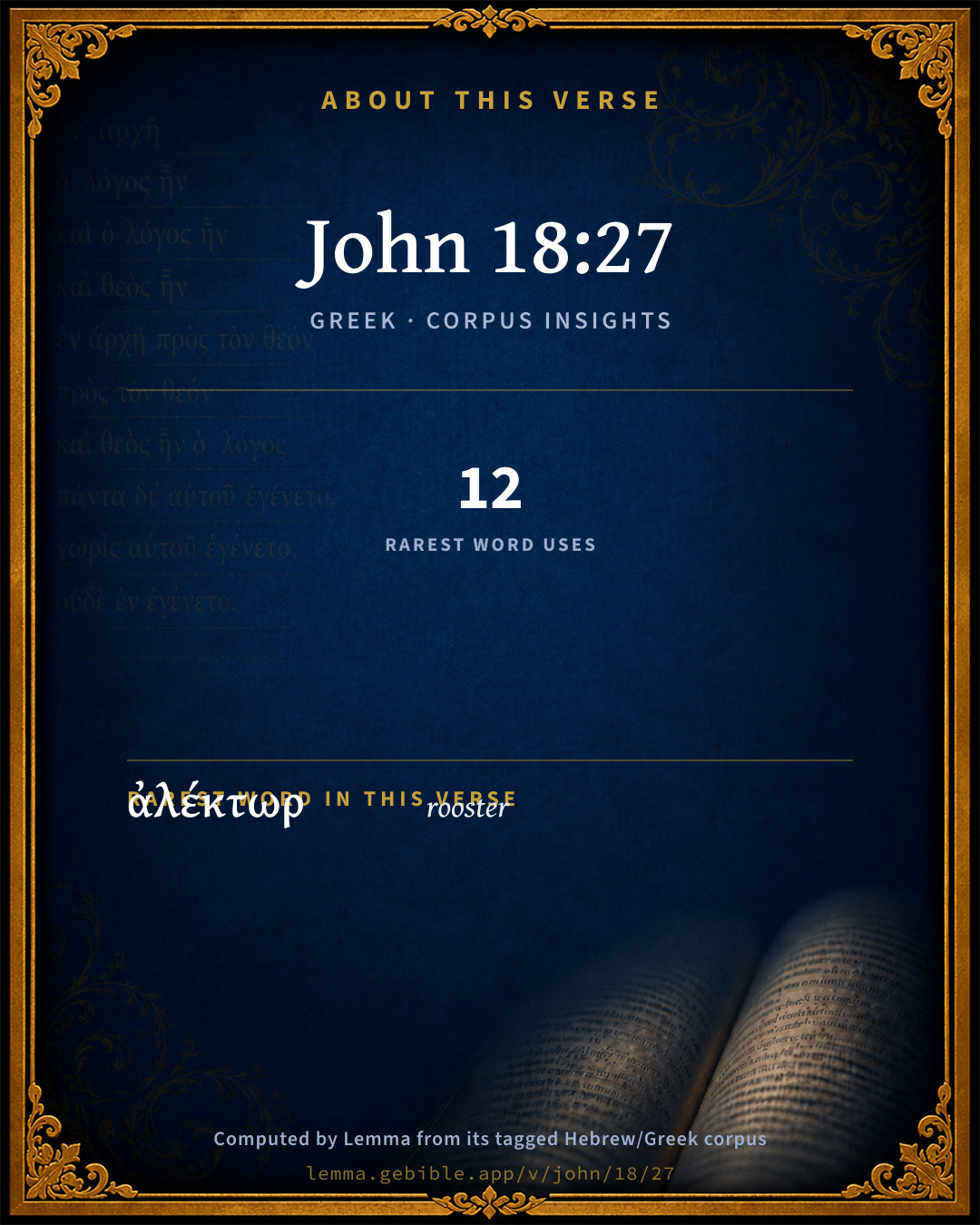
The rarest word here is ἀλέκτωρ rooster G220 — appearing just 12 times in the whole Greek New Testament.

Shared distinctive vocabulary

ἀλέκτωρ rooster G220 occurs in 11 verses of the Greek New Testament. Also found in:

Cross-references

8

Topical passages linked to John 18:27 in the Treasury of Scripture Knowledge — connected by theme and wording, ordered by reader-vote popularity; previews shown in the World English Bible.

  • John 13:38 Jesus answered him, "Will you lay down your life for me? Most assuredly I tell you, the rooster won't crow until you have denied me three times.
  • Mark 14:71–72 But he began to curse, and to swear, "I don't know this man of whom you speak!"
  • Luke 22:60–62 But Peter said, "Man, I don't know what you are talking about!" Immediately, while he was still speaking, a rooster crowed.
  • Matthew 26:34 Jesus said to him, "Most assuredly I tell you that tonight, before the rooster crows, you will deny me three times."
  • Matthew 26:74–75 Then he began to curse and to swear, "I don't know the man!" Immediately the rooster crowed.
  • Mark 14:30 Jesus said to him, "Most assuredly I tell you, that you today, even this night, before the rooster crows twice, you will deny me three times."
  • Mark 14:68 But he denied it, saying, "I neither know, nor understand what you are saying." He went out on the porch, and the rooster crowed.
  • Luke 22:34 He said, "I tell you, Peter, the rooster will by no means crow today until you deny that you know me three times."

Cross-references courtesy of OpenBible.info (CC BY 4.0).

Commentary

Notes on John 18:27 from classic Christian and Jewish commentators (each source and its license shown beneath its notes). The classic Christian expositions comment on the surrounding passage and are grouped to its opening verse, so a note may address several verses; the Jewish commentaries on the Tanakh (Rashi and others) are per-verse, so they appear only where the commentator wrote on this verse.

Lemma curates 59 commentaries, every one of them public domain or Creative Commons licensed, each selected and text-cleaned for this edition rather than reprinted as found. About our sources →

Bengel's Gnomon

Johann Albrecht Bengel

Joh 18:27. Ἐφώνησεν, crew) Concerning the repentance of Peter, John takes for granted those particulars which the other evangelists record. Add ch. Joh 20:2-3 [which presupposes his repentance].

Bengel's Gnomon of the New Testament — English translation (T&T Clark, Edinburgh, 1860) — public domain. Text from a community e-Sword module.

Expositor's Greek Testament

ed. W. Robertson Nicoll

Joh 18:27 . Πάλιν οὖν … ἐφώνησεν … A cock crew, the dawn approaching, and the warning of Joh 13:38 was fulfilled. See on Joh 13:38 .

The Expositor's Greek Testament, edited by W. Robertson Nicoll (1897–1910) — public domain. Text from a community e-Sword module.

Jamieson, Fausset & Brown

Robert Jamieson, A. R. Fausset & David Brown

Peter then denied again--But, if the challenge of Malchus' kinsman was made simultaneously with this on account of his Galilean dialect, it was no simple denial; for Mat 26:74 says, "Then began he to curse and to swear, saying, I know not the man." So Mar 14:71. This was THE THIRD DENIAL.

and immediately--"while he yet spake" (Luk 22:60).

the cock crew--As Mark is the only Evangelist who tells us that our Lord predicted that the cock should crow twice (Mar 14:30), so he only mentions that it did crow twice (Mar 14:72). The other Evangelists, who tell us merely that our Lord predicted that "before the cock should crow he would deny Him thrice" (Mat 26:34; Luk 22:34; Joh 13:38), mention only one actual crowing, which was Mark's last. This is something affecting in this Evangelist--who, according to the earliest tradition (confirmed by internal evidence), derived his materials so largely from Peter as to have been styled his "interpreter," being the only one who gives both the sad prediction and its still sadder fulfilment in full. It seems to show that Peter himself not only retained through all his after-life the most vivid recollection of the circumstances of his fall, but that he was willing that others should know them too. The immediately subsequent acts are given in full only in Luke (Luk 22:61-62): "And the Lord turned and looked upon Peter," from the hall of judgment to the court, in the way already explained. But who can tell what lightning flashes of wounded love and piercing reproach shot from that "look" through the eye of Peter into his heart! "And Peter remembered the word of the Lord, how He had said unto him, Before the cock crow, thou shalt deny Me thrice. And Peter went out and wept bitterly." How different from the sequel of Judas' act! Doubtless the hearts of the two men towards the Saviour were perfectly different from the first; and the treason of Judas was but the consummation of the wretched man's resistance of the blaze of light in the midst of which he had lived for three years, while Peter's denial was but a momentary obscuration of the heavenly light and love to his Master which ruled his life. But the immediate cause of the revulsion, which made Peter "weep bitterly," was, beyond all doubt, this heart-piercing "look" which his Lord gave him. And remembering the Saviour's own words at the table, "Simon, Simon, Satan hath desired to have you that he may sift you as wheat, but I have prayed [rather, 'I prayed'] for thee that thy faith fail not" (see on Luk 22:31-32), may we not say that this prayer fetched down all that there was in that 'look' to pierce and break the heart of. Peter, to keep it from despair, to work in it "repentance unto salvation not to be repented of," and at length, under other healing touches, to "restore his soul?" (See on Mar 16:7).

Jamieson, Fausset & Brown — Commentary Critical and Explanatory on the Whole Bible (1871) — public domain (CC PDM 1.0). Text via the HelloAO Bible API.

Adam Clarke's Commentary

Verse 27. And - the cock crew.] Peter denied our Lord three times: -

Peter's first denial.

I. This took place, when he was without, or beneath, in the hall of Caiaphas's house. He was not in the higher part where Christ stood before the high priest; but without that division of the hall, and in the lower part with the servants and officers, at the fire kindled in the midst of the hall, Joh 18:16; Joh 18:18; and the girl who kept the door had entered into the hall, where she charged Peter.

Peter's second denial.

II. This was in a short time after the first, Lu 22:58. Having once denied his Master, he naturally retired from the place where his accuser was to the vestibule of the hall, Mt 26:71, and it was the time of the first cock-crowing, or soon after midnight. After remaining here a short time, perhaps an hour, another girl sees him, and says to them who were standing by in the vestibule, that he was one of them. Peter, to avoid this charge, withdraws into the hall, and warms himself. The girl, and those to whom she had spoken, follow him; the communication between the two places being immediate. Here a man enforces the charge of the girl, according to Luke; and others urge it, according to St. John; and Peter denies Jesus vehemently.

Peter's third denial.

III. He was now in the hall, and also within sight of Jesus, though at such a distance from him that Jesus could not know what passed, but in a supernatural way. And, about an hour after his second denial, those who stood by founded a third charge against him, on his being a Galilean, which St. Luke says, Lu 22:59, one in particular strongly affirmed; and which, according to John, Joh 18:26, was supported by one of Malchus's relations. This occasioned a more vehement denial than before, and immediately the cock crew the second time, which is eminently called αλεκτοροφωνια. The first denial may have been between our twelve and one; and the second between our two and three.

At the time of the third denial, Lu 22:61 proves that Jesus was in the same room with Peter. We must farther observe that Matthew, Mt 26:57, lays the scene of Peter's denials in the house of Caiaphas: whereas John, Joh 18:15-23, seems to intimate that these transactions took place in the house of Annas; but this difficulty arises from the injudicious insertion of the particle ουν, therefore, in Joh 18:24, which should be omitted, on the authority of ADES, Mt. BH, many others; besides some versions, and some of the primitive fathers. Griesbach has left it out of the text. See Bishop Newcome's Harm. notes, p. 48.

The time of Peter's denials happened during the space of the third Roman watch, or that division of the night, between twelve and three, which is called αλεκτοροφωνια, or cock-crowing, Mr 13:35. Concerning the nature and progress of Peter's denial, see the notes on Mt 26:58; Mt 26:69-75.

Adam Clarke's Commentary on the Bible (1810–1826) — public domain. Text from a community e-Sword/MySword module.

John Calvin's Commentaries

27. Immediately the coch crew. The Evangelist mentions the crowing of the coch, in order to inform us, that Peter was warned by God at the very time; and for this reason the other Evangelists tell us, that he then remembered the words of the Lord, (Matthew 26:75; Mark 14:72,) though Luke relates that the mere crowing of the cock did not produce any effect on Peter, till Christ looked at him, (Luke 22:61.) Thus, when any person has once begun to fall through the suggestions of Satan, no voice, no sign, no warning, will bring him back, until the Lord himself cast his eyes upon him.

John Calvin's Commentaries (1540-1563) — public domain. Text from the Calvin Translation Society English edition (1840s-50s) via the Christian Classics Ethereal Library (ccel.org). Calvin's coverage is partial (roughly two-thirds of the Bible); uncommented books and verses are honest gaps, never fabricated. The 19th-century editor's footnotes and remarks are omitted so the notes are faithfully Calvin's own voice.

Ellicott's Commentary for English Readers

(27) And immediately the cock crew.—Better, . . . a cock crew. (Comp. Mat_26:74, and (on the whole question of the denial, Notes to Mat_26:69-74.)

A Bible Commentary for English Readers, edited by Charles John Ellicott (1878–1897) — public domain. Text from a community e-Sword module.

The Cambridge Bible for Schools and Colleges

gen. ed. J. J. S. Perowne

27. Peter then denied again] Again therefore (Joh_18:3) Peter denied; because he had denied before. S. John, like S. Luke, omits the oaths and curses (Mar_14:71; Mat_26:73). We may believe that S. Peter himself through S. Mark was the first to include this aggravation of his guilt in the current tradition.

the cock crew] Rather, a cock crew. In none of the gospels is there the definite article which our translation inserts. This was the second crowing (Mar_14:72). A difficulty has been made here because the Talmud says that fowls, which scratch in dunghills, are unclean. But (1) the Talmud is inconsistent on this point with itself; (2) not all Jews would be so scrupulous as to keep no fowls in Jerusalem; (3) certainly the Romans would care nothing about such scruples.

Just as the Evangelist implies (Joh_18:11), without mentioning, the Agony in the garden, so he implies (Joh_21:15), without mentioning, the repentance of S. Peter. The question has been raised, why he narrates S. Peter’s fall, which had been thrice told already. There is no need to seek far-fetched explanations, as that “there might be contained in it some great principle or prophetic history, and perhaps both: some great principle to be developed in the future history of the Church, or of S. Peter’s Church.” Rather, it is part of S. John’s own experience which falls naturally into the scope and plan of his Gospel, setting forth on the one side the Divinity of Christ, on the other the glorification of His manhood through suffering. Christ’s foreknowledge of the fall of His chief apostle (Joh_13:38) illustrated both: it was evidence of His Divinity (comp. Joh_2:24-25), and it intensified His suffering. S. John, therefore, gives both the prophecy and the fulfilment. It has been noticed that it is “S. Peter’s friend S. John, who seems to mention most what may lessen the fault of his brother apostle;” that servants and officers were about him; that in the second case he was pressed by more than one; and that on the last occasion a kinsman of Malchus was among his accusers, which may greatly have increased Peter’s terror. Moreover, this instance of human frailty in one so exalted (an instance which the life of the great Exemplar Himself could not afford), is given us with fourfold emphasis, that none may presume and none despair.

On the difficulties connected with the four accounts of S. Peter’s denials see Appendix B.

The Cambridge Bible for Schools and Colleges (gen. ed. J. J. S. Perowne; Cambridge University Press, 1878–1918) — public domain. Text from a community e-Sword module.

John Gill's Exposition

Peter then denied again,.... A third time, as the Ethiopic version renders it; and that, according to other evangelists, with cursing and swearing; for now he was more affrighted than before, lest should he be taken up, and it be proved upon him, that he was the person that cut off Malchus's ear, he should be sentenced to a fine, or it may be some capital punishment. The fine for plucking a man's ears, and which some understand of plucking them off, was four hundred "zuzim" (s), or, pence; which, as they answer to Roman pence, amount to twelve pounds ten shillings; a sum of money Peter perhaps could not have raised, without great difficulty: and therefore, that it might be believed he was not a disciple of Christ, so not the man; he swears in a profane manner, and imprecates the judgments of God upon him:

and immediately the cock crew; the second time; which was a signal by which he might call to remembrance, what Christ had said to him; that before the cock crowed twice, he should deny him thrice, Mar 14:72. It was now early in the morning, about three o'clock, or somewhat after.

(s) Misn. Bava Kama, c. 8, sect. 6. Vid. L'Empereur in ib.

John Gill's Exposition of the Whole Bible (1746–1763) — public domain (CC PDM 1.0). Text via the HelloAO Bible API.

Trapp's Complete Commentary

John Trapp

27 Peter then denied again: and immediately the cock crew.

Ver. 27. Peter then denied again] He that is fallen down one round of hell’s ladder, knows not where he shall stop or stay, till he come to the bottom. Sin is of an encroaching nature, medest and maidenly at first; but yield to it once, and there is no ho with it.

The cock crew] And also Christ looked back upon him, as a piece of his suffering, with και συ τεκνον Πετρε, What thou, my friend, Peter? Scipio had rather Hannibal should eat his heart with salt than Laelius give him a cross word.

John Trapp, A Commentary or Exposition upon All the Books of the Old and New Testament (1647–1656) — public domain. Text from a community e-Sword module.

Cambridge Greek Testament for Schools and Colleges

27. πάλιν οὖν. Again therefore, because he had denied before and yet another denial had become necessary. S. John, like S. Luke, omits the oaths and curses (Mar 14:71; Mat 26:73). We may believe that S. Peter himself through S. Mark was the first to include this aggravation of his guilt in the current tradition.

ἀλέκτωρ ἐφ. A cock crew. In none of the Gospels is there the definite article which our translation inserts. This was the second crowing (Mar 14:72). A difficulty has been made here because the Talmud says that fowls, which scratch in dunghills, are unclean. But (1) the Talmud is inconsistent on this point with itself; (2) not all Jews would be so scrupulous as to keep no fowls in Jerusalem; (3) certainly the Romans would care nothing about such scruples.

Just as the Evangelist implies (Joh 18:11), without mentioning, the Agony in the garden, so he implies (Joh 21:15), without mentioning, the repentance of S. Peter. The question has been raised, why he narrates S. Peter’s fall, which had been thrice told already. There is no need to seek far-fetched explanations, as that “there might be contained in it some great principle or prophetic history, and perhaps both: some great principle to be developed in the future history of the Church, or of S. Peter’s Church.” Rather, it is part of S. John’s own experience which falls naturally into the scope and plan of his Gospel, setting forth on the one side the Divinity of Christ, on the other the glorification of His manhood through suffering. Christ’s foreknowledge of the fall of His chief Apostle (Joh 13:38) illustrated both: it was evidence of His Divinity (comp. Joh 2:24-25), and it intensified His suffering. S. John, therefore, gives both the prophecy and the fulfilment. It has been noticed that it is “S. Peter’s friend S. John, who seems to mention most what may lessen the fault of his brother apostle;” that servants and officers were about him; that in the second case he was pressed by more than one; and that on the last occasion a kinsman of Malchus was among his accusers, which may greatly have increased Peter’s terror. Moreover, this instance of human frailty in one so exalted (an instance which the life of the great Exemplar Himself could not afford), is given us with fourfold emphasis, that none may presume and none despair.

On the difficulties connected with the four accounts of S. Peter’s denials see Appendix B.

Cambridge Greek Testament for Schools and Colleges (Cambridge University Press, 1896; 21 vols, various authors incl. Carr, Maclear, Plummer, Farrar, Lumby, Moule, M. R. James, Simcox) — public domain. Text from a community e-Sword module.

International Critical Commentary

27. πάλιν οὖν ἠρνήσατο. No words are given; only the fact of the denial is recorded. This is in strong contrast to the denial with curses and oaths which is described by Mar 14:71 (followed by Mat 26:74, but not by Lk.).

According to the Lucan narrative, at this point, “the Lord turned and looked upon Peter” (Luk 22:61). Accordingly, we must suppose Jesus to have come down from the chamber where He had been informally examined, and to have been passing through the courtyard on His way to Caiaphas for formal trial and sentence, when Peter again denied his discipleship, and was overheard by his Master. Jn. hurries over this scene of painful memories.

εὐθέως ἀλέκτωρ ἐφώνησεν, “immediately a cock crew.” Luk 22:60 has παραχρῆμα, but Mat 26:74 has εὐθέως as here. In Jn. εὐθέως always connotes immediate consecutiveness (see on 5:9).

All the evangelists speak of the actual crowing of a cock (Mk. speaks of two crowings, 14:68, 72) within the precincts of the palace, and find in it the literal fulfilment of the prediction made by Jesus (13:38). Salmon1 held that this prediction “meant no more than that Peter should deny Him thrice before the hour of cockcrow, viz. that hour of early morning which was technically known as ἡ ἀλεκτοροφωνία” (cf. Mar 13:35). C. H. Mayo made a further suggestion; viz. that the signal heard by Peter was “the gallicinium, the signal given on the buccina at the close of the third night watch, and the change of guard.”2 This is probably what happened. “Before a cock shall crow” (13:38) would be a vague note of time, for cocks are apt to crow at uncertain hours during the night. But “before the ἀλεκτοροφωνία” is precise; and the hour of ἀλεκτοροφωνία was made public by a military signal.

On this interpretation, the word πρωΐ in v. 28 is peculiarly appropriate, for, according to Roman reckoning, the four watches of the night were ὀψέ, μεσονύκτιον, ἀλεκτοροφωνία, and πρωΐ. As soon as the signal had sounded at the close of ἀλεκτοροφωνία, it would be πρωΐ.

Jn. says nothing about Peter’s bitter tears of repentance for his failure. Every one knew, when the Fourth Gospel was written, that Peter had repented, and his return to his Master’s favour is specially recorded in the Appendix (21:15). It is quite in the manner of Jn. to omit something which no Christian needed to be told.

Jesus is Brought Before Pilate and Accused by the Jews (vv. 28-32)

International Critical Commentary — older volumes (1896–1929), various authors — public domain. Text from a community e-Sword module.

Vincent's Word Studies in the New Testament

Marvin R. Vincent

The cock crew. The Greek has not the definite article. See on Mt 26:34. The use of the article would seem to mark the time, cock - crowing, rather than the incident.

28 - 38. Compare Mt 27:1, 2; 11 - 14; Mr 14:1 - 6; Luk 23:1 - 5.

Marvin R. Vincent, Word Studies in the New Testament (1887–1900) — public domain. Text from a community e-Sword/MySword module.

Lesson kit

Teaching starters — assembled from the data on this page, not authored interpretation. Every prompt links to the verse data it draws on. Edit before teaching.

John, in the Gospels, opens this verse with 8 words (8 distinct Greek lemmas). Its most distinctive word is aléktōr (“rooster”). A historical commentator’s framing appears above. Read the whole chapter for the surrounding context.

Discussion questions

  1. How does “rooster” (aléktōr) shape what this verse is saying?
  2. How does Matthew 26:34, which shares the word «rooster», read alongside this verse?
  3. These translations render this verse differently; the difference is in the English rendering, not the original. What questions does that raise?
  4. Compare how Bengel's Gnomon and Expositor's Greek Testament read this verse. Where do they agree or differ?

Things to notice

Reading settings

Reading text

Shown beneath each verse's original-language words.

Old Testament
Old Testament edition

Read the OT as the Masoretic Hebrew (MT) or the Greek Septuagint (LXX).

English shown for the Greek Septuagint (in the Hebrew ↔ Greek comparison).

Comparing translations? Open the Compare panel on any verse page to stack up to four side by side.