
John 20:5

Greek (Tischendorf 8th ed.) John 20:5 appears in the Greek New Testament. The text above is from the Tischendorf 8th edition. Each word links to its Strong’s number and a concise gloss. Click any word for its full Thayer’s Greek Lexicon entry.
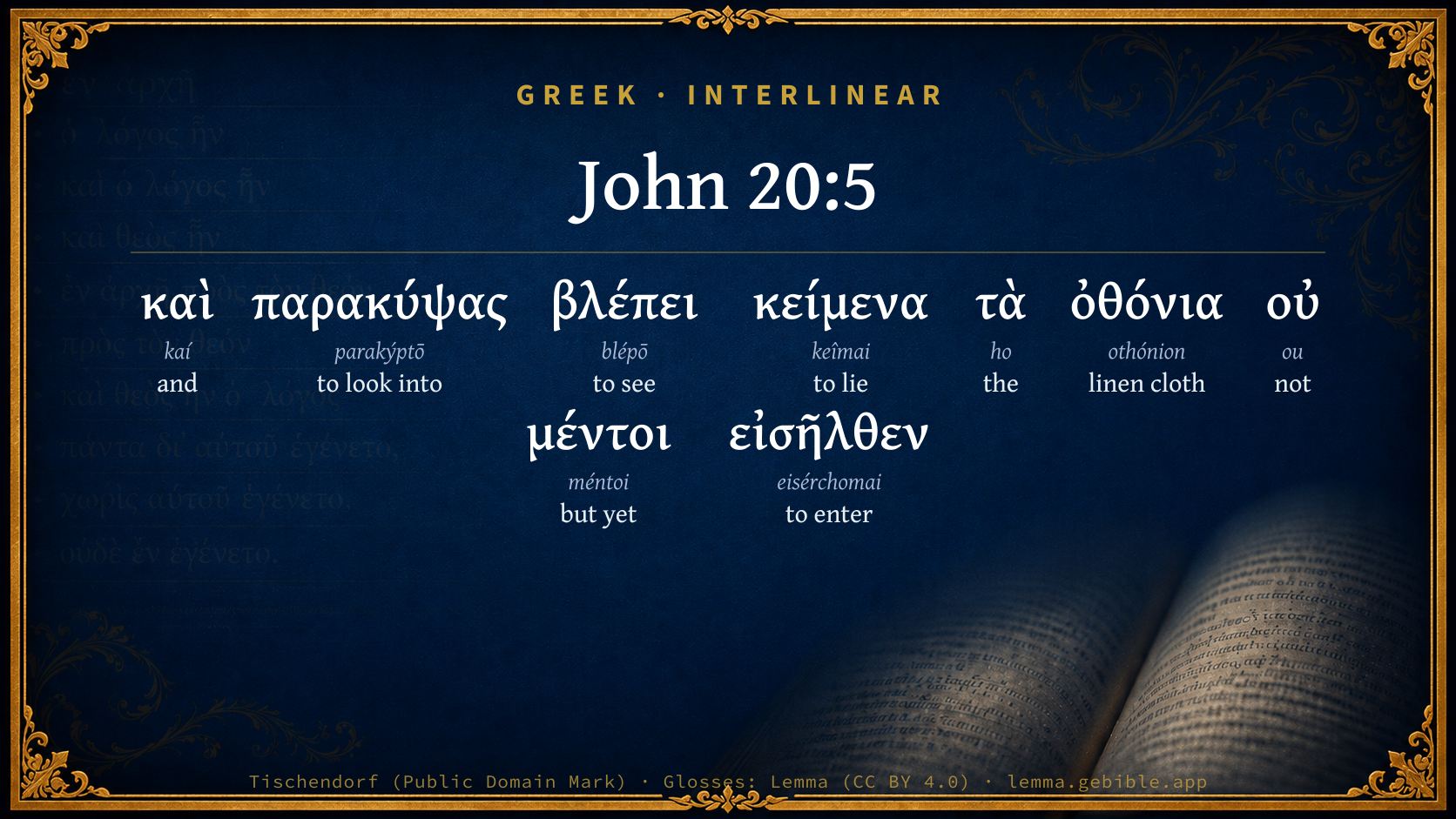
Download image
Cite this verse

John 20:5 (World English Bible). Public Domain. Lemma interlinear Bible study tool, https://lemma.gebible.app/v/john/20/5.

Show BibTeX & RIS
BibTeX
RIS
English Translation
Stooping and looking in, he saw the linen cloths lying, yet he didn't enter in.
World English Bible · Public Domain
Highlights
  • 1 first appearance in the Greek New Testament
Full analysis ↓
Download a study sheet

One document with this verse’s original text, its word-by-word gloss line, the meaning frame, cross-references with their text, attributed commentary, and full source and license credits — printable, and it pastes into notes with its structure intact.

This verse Autodidact and up

Study sheet (.html) Plain text (.txt)

A passage Seminary Student

Up to 50 verses in one chapter. A passage sheet keeps up to 6 commentary sources and 12 cross-references per verse, in the order this page ranks them, and says so on the sheet whenever that leaves anything out. Ask for a single verse and you get the Autodidact verse sheet above.

Everything on this page stays free to read, with no account — the sheet is a download of what is already on screen, not access to it.

Want to remove ads? Support Godless Engineer
Compare translations 3

The same verse in 3 English versions, stacked beneath the original-language interlinear above. Click any original word for its lexicon entry.

Each is an independent rendering of the whole verse — the interlinear is not word-aligned to these translations.

Highlighted words mark where these versions differ — a whole-verse word diff, not a word-by-word alignment.

  • World English Bible Public Domain
    Stooping and looking in, he saw the linen cloths lying, yet he didn't enter in.
  • King James Version Public Domain
    And he stooping down, and looking in, saw the linen clothes lying; yet went he not in.
  • unfoldingWord Literal Text CC BY-SA 4.0
    And having stooped down, he sees the linen cloths lying there, but he did not enter.

unfoldingWord Literal Text — © unfoldingWord, licensed CC BY-SA 4.0. Word-aligned USFM3 via Door43 (git.door43.org/unfoldingWord/en_ult).

Versions to compare (up to 4)

3 of 4 selected

Show all 19 translations

Every available English version of this verse, each an independent rendering of the whole verse.

  • World English Bible Public Domain
    Stooping and looking in, he saw the linen cloths lying, yet he didn't enter in.
  • Berean Standard Bible Public Domain
    He bent down and looked in at the linen cloths lying there, but he did not go in.
  • Majority Standard Bible Public Domain
    He bent down and looked in at the linen cloths lying there, but he did not go in.
  • King James Version Public Domain
    And he stooping down, and looking in, saw the linen clothes lying; yet went he not in.
  • American Standard Version (1901) Public Domain
    and stooping and looking in, he seeth the linen cloths lying; yet entered he not in.
  • Revised Version (1885) Public Domain
    and stooping and looking in, he seeth the linen cloths lying; yet entered he not in.
  • Geneva Bible (1599) Public Domain
    And he stouped downe, and sawe the linnen clothes lying: yet went he not in.
  • Douay-Rheims (1899) Public Domain
    And when he stooped down, he saw the linen cloths lying; but yet he went not in.
  • Young's Literal Translation Public Domain
    and having stooped down, seeth the linen clothes lying, yet, indeed, he entered not.
  • Literal Standard Version CC BY-SA 4.0
    and having stooped down, sees the linen clothes lying, yet, indeed, he did not enter.
  • Unlocked Literal Bible CC BY-SA 4.0
    Then stooping down, he saw the linen cloths lying there, but he did not go inside.
  • unfoldingWord Literal Text CC BY-SA 4.0
    And having stooped down, he sees the linen cloths lying there, but he did not enter.
  • Darby Bible Public Domain
    and stooping down he sees the linen cloths lying; he did not however go in.
  • World Messianic Bible Public Domain
    Stooping and looking in, he saw the linen cloths lying there; yet he didn’t enter in.
  • Webster's Bible Public Domain
    And he stooping down, saw the linen cloths lying; yet he went not in.
  • Free Bible Version CC BY-SA 4.0
    He bent down, and looking in he saw the grave-clothes lying there, but he didn't go in.
  • Bible in Basic English Public Domain
    And looking in, he saw the linen bands on the earth; but he did not go in,
  • Text-Critical English NT CC BY 4.0
    Stooping down to look in, he saw the linen cloths lying there, but he did not go in.
  • Tyndale New Testament (1534) Public Domain
    And he stouped doune and sawe the lynnen clothes lyinge yet wet he not in.

Literal Standard Version (2020), Covenant Press — licensed CC BY-SA 4.0. Text via the HelloAO Bible API (eBible.org). Unlocked Literal Bible (unfoldingWord) — licensed CC BY-SA 4.0. Text via the HelloAO Bible API (eBible.org). unfoldingWord Literal Text — © unfoldingWord, licensed CC BY-SA 4.0. Word-aligned USFM3 via Door43 (git.door43.org/unfoldingWord/en_ult). Free Bible Version, Dr. Jonathan Gallagher — licensed CC BY-SA 4.0. Text via the HelloAO Bible API (eBible.org).

Word by word

More ways to search: Search by grammar → Find every occurrence → Compare this word →

Practice this passage: Drill this verse → Learn its vocabulary →

About this verse

These counts appear in no published source. They are computed here, from the morphology-tagged text and Lemma’s own curated glosses. What Lemma adds →

9
words
9
distinct lemmas
Gospels
section

Notable vocabulary

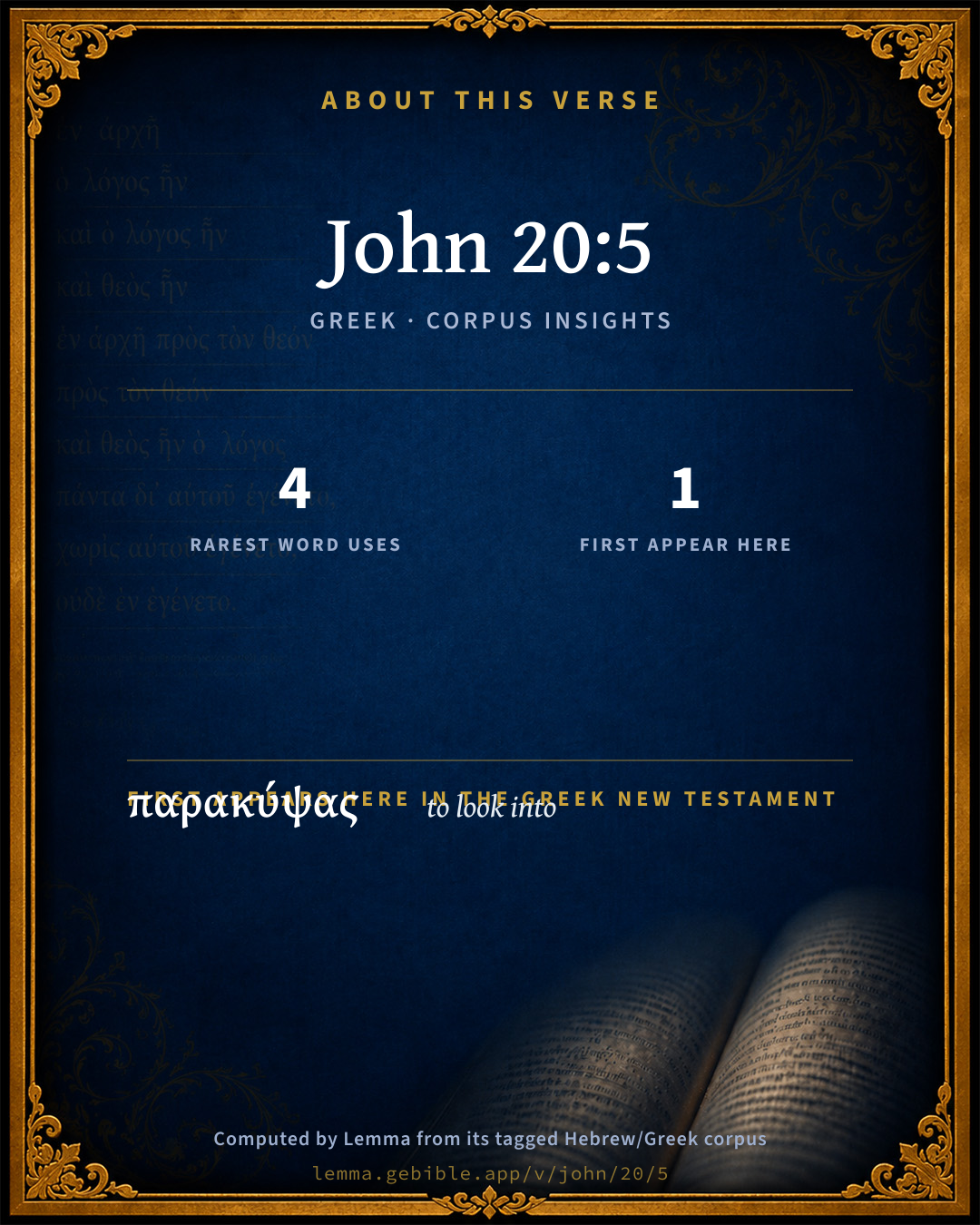
The rarest word here is παρακύψας to look into G3879 — appearing just 4 times in the whole Greek New Testament.

First appearance in Scripture

This word makes its first canonical appearance in the Greek New Testament here:

  • παρακύψας to look into G3879

Shared distinctive vocabulary

παρακύψας to look into G3879 occurs in 4 verses of the Greek New Testament. Also found in:
Cross-references

3

Topical passages linked to John 20:5 in the Treasury of Scripture Knowledge — connected by theme and wording, ordered by reader-vote popularity; previews shown in the World English Bible.

  • John 19:40 So they took Jesus' body, and bound it in linen cloths with the spices, as the custom of the Jews is to bury.
  • John 11:44 He who was dead came out, bound hand and foot with wrappings, and his face was wrapped around with a cloth. Jesus said to them, "Free him, and let him go."
  • John 20:11 But Mary was standing outside at the tomb weeping. So, as she wept, she stooped and looked into the tomb,

Cross-references courtesy of OpenBible.info (CC BY 4.0).

Commentary

Notes on John 20:5 from classic Christian and Jewish commentators (each source and its license shown beneath its notes). The classic Christian expositions comment on the surrounding passage and are grouped to its opening verse, so a note may address several verses; the Jewish commentaries on the Tanakh (Rashi and others) are per-verse, so they appear only where the commentator wrote on this verse.

Lemma curates 59 commentaries, every one of them public domain or Creative Commons licensed, each selected and text-cleaned for this edition rather than reprinted as found. About our sources →

Bengel's Gnomon

Johann Albrecht Bengel

Joh 20:5. Οὐ μέντοι εἰσῆλθεν, he did not however go in) and on this account did not see the napkin (sudarium), etc. He seems to have been kept back through fear.

Bengel's Gnomon of the New Testament — English translation (T&T Clark, Edinburgh, 1860) — public domain. Text from a community e-Sword module.

Meyer's Critical & Exegetical Commentary

Heinrich August Wilhelm Meyer

Joh_20:5-8. John is withheld by natural terror (not dread of pollution, as Wetstein, Ammon, and several others think) from going in at once; the bolder and older Peter, however, goes in, and then, encouraged by his example and presence, John also enters.

Note how earnestly the fourth Gospel also states the fact of the empty grave, which is by no means veiled in the darkness of an experience made in twilight, and of the reports of the women (Weizsäcker).

βλέπει, he sees; on the other hand, Joh_20:6, θεωρεῖ, he contemplates. See Tittmann, Synon. p. 111 f., 120 f.

τὰ ὀθόνια] The handkerchief (Joh_20:7) must consequently have so lain, that it did not meet the eye of John, when he, standing before the grave, bent down (παρακύψας), i.e. bowed his head forwards through the low entrance in order to see within (Luk_24:12; Sir_21:23; Sir_14:23; Lucian, Paras. 42, et al., Aristoph., Theocr., Plutarch, etc.). Observe, further, that τὰ ὀθόν. here in Joh_20:6 is placed first (otherwise in Joh_20:5) in opposition to τὸ σουδάριον.

τὸ σουδάρ.] Joh_11:44; Luk_19:20.

χερίς] used adverbially (separatim) only here in the N. T., very frequently in the Greek writers.

εἰς ἕνα τόπον] belongs to ἐντετυλιγμ.: wrapped up (Aristoph. Plut. 692; Nub. 983) in one place apart, so that it was not, therefore, lying along with the bandages, but apart in a particular place, and was not spread out, but folded together. In so orderly a manner, not in precipitate confusion, did that take place which had been here done. In ἕνα is implied that the ὀθόνια and the handkerchief occupied two places. How thoroughly does this whole pictorial representation, comp. with Luk_24:12, reveal the eyewitness!

εἶδε] Namely, the state of matters in the grave just related.

ἐπίστευσεν] that Jesus was risen. Comp. Joh_20:25. This, the grand object of the history, taken as a matter of course, and, from these unmistakeable indicia, now bringing conviction to the disciples, and see Joh_20:9. Hence neither generally: he believed on Jesus as the Christ, as in Joh_19:35 (Hengstenberg, Godet), nor merely: he believed that which Mary, Joh_20:2, had said (Erasmus, Luther, Aretius, Jansen, Clarius, Grotius, Bengel, Ebrard, Baeumlein, and several others, following Augustine and Theophylact). The articles left behind in the grave and laid aside, as related, in so orderly a manner, testified, in truth, precisely against a removal of the corpse. See already Chrysostom, Euth. Zigabenus, Nonnus. The singular only satisfies the never-to-be-forgotten personal experience of that moment, but does not exclude the contemporaneous faith of Peter also (in answer to Hilgenfeld and others), as is, moreover, unmistakeable from the following plur. ᾔδεισαν, although even Hengstenberg makes Peter, in conformity with Luk_24:12, remain standing only in amazement (in which Godet also substantially follows him), but of which John says never a word.

Meyer — Critical and Exegetical Commentary on the New Testament — English translation by Peter Christie, edited by Frederick Crombie (T&T Clark, 1880) — public domain. Text from a community e-Sword module.

Expositor's Greek Testament

ed. W. Robertson Nicoll

Joh 20:5 . καὶ παρακύψας … The R.V [94] renders παρακύψας by “stooping and looking in,” A.V [95] has merely “stooping down”; the Vulgate “cum se inclinasset,” Weizsäcker “beugte sich vor”. Field ( Otium Norvic. on Luk 24:12 ) prefers “looking in,” although, he says, “peep in” would more accurately define the word παρακύπτειν . He quotes Casaubon’s opinion that the word implies “protensionem colli cum modica corporis incurvatione”. See also Kypke on Luk 24:12 , and Lid. and Scott Lex. ὀθόνια are the strips of linen used for swathing the dead; the cerecloths. ὀθόνη is frequent in Homer ( Il. , 3, 141; 18, 595) to denote the fine material of women’s dress; in Lucian and Herodian of sails; in Act 10:11 of a sheet. σινδών is the word used by Luke (Luk 23:53 ); so Herodotus, ii. 86. οὐ μέντοι εἰσῆλθεν , “he did not however enter,” withheld by dread of pollution, according to Wetstein; by terror, according to Meyer. It is enough to suppose that it did not occur to John to enter the tomb, or that he was withheld by a feeling of reverence or delicacy.

[94] Revised Version.

[95] Authorised Version.

The Expositor's Greek Testament, edited by W. Robertson Nicoll (1897–1910) — public domain. Text from a community e-Sword module.

International Critical Commentary

5. καὶ παρακύψας βλέπει κείμενα τὰ ὀθόνια. This sentence invites comparison with the parallel passage Luk 24:12 in the rec. text, viz.: ὁ δέ Πέτρος ἀναστὰς ἔδραμεν ἐπὶ τὸ μνημεῖον καὶ παρακύψας βλέπει τὰ ὀθόνια κείμενα μόνα· καὶ ἀπῆλθε πρὸς αὑτὸν, θαυμάζων τὸ γεγονός. With ἀπῆλθε πρὸς αὑτόν cf. Joh 20:10, ἀπῆλθον οὖν πάλιν πρὸς αὑτοὺς οἱ μαθηταί.

The verse Luk 24:12 is found in אABLΓΔΘ, the old and the Pesh. Syriac, and in c f ff2, a strong combination. It is omitted in D a b e l r ful etc., and on that account Westcott-Hort place it in double brackets, treating it as a “Western non-interpolation.” They regard it as “condensed and simplified” from Joh 20:5-9, θαυμάζων τὸ γεγονός being added to the Johannine account. Yet Hort’s view of what he calls “Western non-interpolations” is not universally accepted;1 and, in this instance, it is hard to believe that a scribe would be bold enough to alter so materially a statement made in the Fourth Gospel after it had received general acceptance,2 and thus to omit all mention of the Beloved Disciple as Peter’s companion. On the contrary, the evidence for Luk 24:12 being part of the original text of Lk. is too strong to be set aside by the authority of D, an admittedly eccentric manuscript; and the true inference from the verbal similarities between Luk 24:12 and Joh 20:5 seems to be that Jn., here as often elsewhere (see Introd., p. xcix), is using Lk.’s words for the purpose of correcting him. It was not Peter, he says, who peeped into the tomb and saw the linen wrappings lying on the ground, but it was the Beloved Disciple, who had arrived at the tomb before Peter did. He retains the words of Lk. so as to make it clear that he is dealing with the same incident, but he corrects the narrative of Lk. in so far as Peter is represented as being alone. Thus “he went home” in Luk 24:12 becomes “the disciples went home” in Joh 20:10.

The difference between Lk. and Jn. is that between a man who is reproducing a generally accepted tradition, and that of an author relying on and reproducing what he has been told by an eye-witness of, and a participator in, the events narrated. Lk., indeed, implies at 24:24 that he had heard that more than one disciple had gone to the tomb to verify the women’s report that it was empty; but there is no reason to think that he alludes there to the visit of Peter and John. Pseudo-Peter says there were many visitors to the sepulchre.

παρακύψας βλέπει. παρακύπτειν, in its primary and etymological meaning, would suggest “to stoop down for the purpose of looking.”3 But in this sense the verb is seldom used, and in the LXX it always means “to peep” through a door or a window (cf. Gen 26:8, Jdg 5:28, 1Ki 6:4, 1Ch 15:29, Pro 7:6, Son 2:9, Ecclus. 14:23, 21:23), without any stooping being implied4 Cf. also Jas 1:25, 1Pe 1:12. Nor does the word imply an earnest or searching gaze.5 The Beloved Disciple “peeped in and saw” is the rendering which best gives the sense.

κείμενα τὰ ὀθόνια (see on 19:40 for ὀθόνια). The participle κείμενα is put first for emphasis. What startled the disciple was that he saw the grave-cloths lying on the ground. If the body had been removed to some other resting-place, as Mary had suggested, it would presumably have been removed as it had been originally prepared for burial. The cloths would also have disappeared.1

οὐ μέντοι (for μέντοι, see on 12:42) εἰσῆλθεν. That the first disciple to note the presence of the grave-cloths in the tomb did not actually go into it first is not a matter that would seem worth noting, to any one except the man who himself refrained from entering. This strongly suggests that we are dealing with the narrative of an eye-witness. As to why John (for we believe the disciple to have been John) waited for Peter to go in first, we do not know. He may have been afraid, or overcome with emotion. Peter was a man of coarser fibre, more hasty, and more ready to put himself forward. That may be the whole explanation.

International Critical Commentary — older volumes (1896–1929), various authors — public domain. Text from a community e-Sword module.

Adam Clarke's Commentary

Verse 5. Went he not in.] Why? Because he was fully satisfied that the body was not there. But why did he not seize upon the linen clothes, and keep them as a most precious relic? Because he had too much religion and too much sense; and the time of superstition and nonsense was not yet arrived, in which bits of rotten wood, rags of rotten cloth, decayed bones (to whom originally belonging no one knows) and bramble bushes, should become objects of religious adoration.

Adam Clarke's Commentary on the Bible (1810–1826) — public domain. Text from a community e-Sword/MySword module.

John Calvin's Commentaries

5. And seeth the linen clothes lying. The linen clothes might be regarded as the spoils, intended to lead to the belief of Christ’s resurrection; for it was not probable that his body had been stripped naked, in order that it might be removed to another place. This would not have been done by a friend, nor even by an enemy.

John Calvin's Commentaries (1540-1563) — public domain. Text from the Calvin Translation Society English edition (1840s-50s) via the Christian Classics Ethereal Library (ccel.org). Calvin's coverage is partial (roughly two-thirds of the Bible); uncommented books and verses are honest gaps, never fabricated. The 19th-century editor's footnotes and remarks are omitted so the notes are faithfully Calvin's own voice.

Ellicott's Commentary for English Readers

(5) And he stooping down, and looking in, saw the linen clothes lying.—Better, . . . seeth the linen clothes lying. The tense still describes the scene as it actually occurred. The words “looking in” rightly complete the meaning. (Comp. Note on Joh_11:38, and for the word, Note on Luk_24:12.) It is used again in the New Testament only in Joh_20:11, Jas_1:25, and 1Pe_1:12. It meant, originally, to stoop sideways, and was used, e.g., of a harp-player; then, to stoop over, peer into, inquire into. For the “linen clothes,” comp. Joh_19:40.

Yet went he not in.—He is restrained by wonder, not unaccompanied, perhaps, by fear, at what he sees, and waits for his friend and companion.

A Bible Commentary for English Readers, edited by Charles John Ellicott (1878–1897) — public domain. Text from a community e-Sword module.

The Cambridge Bible for Schools and Colleges

gen. ed. J. J. S. Perowne

5. stooping down, and looking in] In the Greek this is expressed in a single word, which occurs again Joh_20:11 and Luk_24:12, in a literal sense, of ‘bending down to look carefully at;’ and in a figurative sense in 1Pe_1:12 and Jas_1:25 (see notes in both places). In Sir_14:23 it is used of the earnest searcher after wisdom, in Joh_21:23 of the rude prying of a fool.

saw] Better, seeth, at a glance (blepei).

The Cambridge Bible for Schools and Colleges (gen. ed. J. J. S. Perowne; Cambridge University Press, 1878–1918) — public domain. Text from a community e-Sword module.

John Gill's Exposition

And he stooping down and looking in,.... That is, John; when he came to the sepulchre, stooped down to look into it, and see what he could see; he only went into the court, or stood upon the floor, where the bearers used to set down the bier, before they put the corpse into one of the graves in the sepulchre, which were four cubits lower; See Gill on Mar 16:5. Hence he was obliged to stoop down, ere he could see anything within: when he

saw the linen clothes lying; in which the body had been wrapped, but that itself not there:

yet went he not in; to the sepulchre itself, but waited in the court or porch, till Peter came; and perhaps might be timorous and fearful of going into such a place alone; the Arabic version reads it, "he dared not go in".

John Gill's Exposition of the Whole Bible (1746–1763) — public domain (CC PDM 1.0). Text via the HelloAO Bible API.

Trapp's Complete Commentary

John Trapp

5 And he stooping down, and looking in, saw the linen clothes lying; yet went he not in.

Ver. 5. Yet went he not in] He dared not; so some fearful are afraid of every step, saying, as Caesar at Rubicon, Yet we may go back; and as the king of Navarre told Beza, that he would launch no further into the sea, than he might be sure to return safe to the haven. Petago se non ira commissurus esset quin, quando liberet, pedem referre posset.

John Trapp, A Commentary or Exposition upon All the Books of the Old and New Testament (1647–1656) — public domain. Text from a community e-Sword module.

Haydock's Catholic Bible Commentary

He saw the linen cloths lying. St. John Chrysostom takes notice, that Christ’s body being buried with myrrh, the linen would stick as fast to the body as pitch, so that it would be impossible to steal, or take away the body without the linen cloths. (Witham)

George Leo Haydock (1774–1849), Haydock's Catholic Family Bible and Commentary, 1859 edition — public domain. Excludes Psalms (Douay-Rheims chapter numbering differs from Protestant) and Deuterocanonical books (Catholic canon only).

Matthew Poole's English Annotations

John stooped down and looked into the sepulchre, and saw the linen clothes lying, but he would not adventure to go in.

Matthew Poole's English Annotations on the Holy Bible (1683–1685) — public domain. Text from a community e-Sword/MySword module.

Whedon's Commentary on the Bible

Daniel D. Whedon

5. Went he not in—The younger disciple was too fleet a runner for the elder, and he paused at the end of the race. Some suppose that he went not in from juvenile inattention, others from fear of pollution. More probably it was from reverence.

Daniel D. Whedon (gen. ed.), Commentary on the Old and New Testaments (1874–1909) — public domain. Text from a community e-Sword module.

The Pulpit Commentary

And having stooped down. Parakuptw is the verb used in Luk_24:12 to describe Peter"s conduct and gesture. It was a necessary preliminary of the subsequent act of Peter, though Luke does not refer to it. Peter himself uses the same word. (1Pe_1:12) It means literally "bending on one side," with a desire to gaze intently on an object. (Ecc 14:23; Ecc 21:23; Jam_1:25) He seeth the linen clothes lying , (see Joh_19:40) untenanted and unused, those very cerecloths which he had helped to wind round the sacred, wounded body, with their affluence of sweet spices. Yet entered he not within. Awe, reverence, mystery, fear, nascent hope, the thought most possibly, "Not here, but risen," began to dawn faintly on his mind. There was ringing in his ears," Your sorrow shall be turned into joy." The touch of the eye-witness, and the personal part of one who is describing his own activity. Weft-stein, on ou mentoi eishlyen , adds, "no pollueretur," and quotes numerous Talmudieal authorities to show how the corpse and the grave and gravestone would pollute the living. (cf. Num_19:16) If so, then Peter, before he came to the conclusion that there was no death in the sepulcher, broke a ritual law which John respected. There seems also rabbinical authority for the fact that disciples might carry "the just" to their grave without such tear of pollution. But at this moment they were both lifted above the region of ritual altogether.

The Pulpit Commentary (1880–1919), ed. H.D.M. Spence-Jones & Joseph S. Exell — public domain. Text from a community e-Sword module.

Cambridge Greek Testament for Schools and Colleges

5. The manifestations were granted to all kinds of witnesses, both male and female, both individuals and companies.

5. παρακύψας. The word occurs again Joh 20:11 and Luke 24. in a literal sense, of ‘bending down to look carefully at;’ in a figurative sense 1Pe 1:12; Jas 1:25 (see notes). In Sir 14:23 it is used of the earnest searcher after wisdom; in Joh 21:23 of the rude prying of a fool. Βλέπει is seeth at a glance, as distinct from θεωρεῖ (Joh 20:6).

Cambridge Greek Testament for Schools and Colleges (Cambridge University Press, 1896; 21 vols, various authors incl. Carr, Maclear, Plummer, Farrar, Lumby, Moule, M. R. James, Simcox) — public domain. Text from a community e-Sword module.

Vincent's Word Studies in the New Testament

Marvin R. Vincent

Stooping down [παρακυψας] . See on James. Jas 1:25, and compare 1Pe 1:12. See also Song of Solomon, Son 2:9 (Sept.). "He looketh forth [παρακυπτων] at the windows."

Seeth [βλεπει] . Simple sight. Compare the intent gaze of Peter [θεωρει] , ver. 6, which discovered the napkin, not seen by John.

Marvin R. Vincent, Word Studies in the New Testament (1887–1900) — public domain. Text from a community e-Sword/MySword module.

Lesson kit

Teaching starters — assembled from the data on this page, not authored interpretation. Every prompt links to the verse data it draws on. Edit before teaching.

John, in the Gospels, opens this verse with 9 words (9 distinct Greek lemmas). Its most distinctive word is parakýptō (“to look into”). A historical commentator’s framing appears above. Read the whole chapter for the surrounding context.

Discussion questions

  1. What does “to look into” (parakýptō) contribute to the verse as a whole?
  2. The word “to look into” first appears here in Scripture. What is being introduced at this debut?
  3. John 20:11 shares the word «to look into» with this verse. How do the two illuminate each other?
  4. These translations render this verse differently; the difference is in the English rendering, not the original. What questions does that raise?
  5. Reading how Bengel's Gnomon and Meyer's Critical & Exegetical Commentary read this verse, where do the two commentators agree and where do they part?

Things to notice

  • 1 word makes its first canonical appearance in Scripture here.
  • These translations choose different wording for 14 words in this verse.
  • 9 distinct Greek lemmas span 9 words in this verse.

Reading settings

Reading text

Shown beneath each verse's original-language words.

Old Testament
Old Testament edition

Read the OT as the Masoretic Hebrew (MT) or the Greek Septuagint (LXX).

English shown for the Greek Septuagint (in the Hebrew ↔ Greek comparison).

Comparing translations? Open the Compare panel on any verse page to stack up to four side by side.