
John 18:19

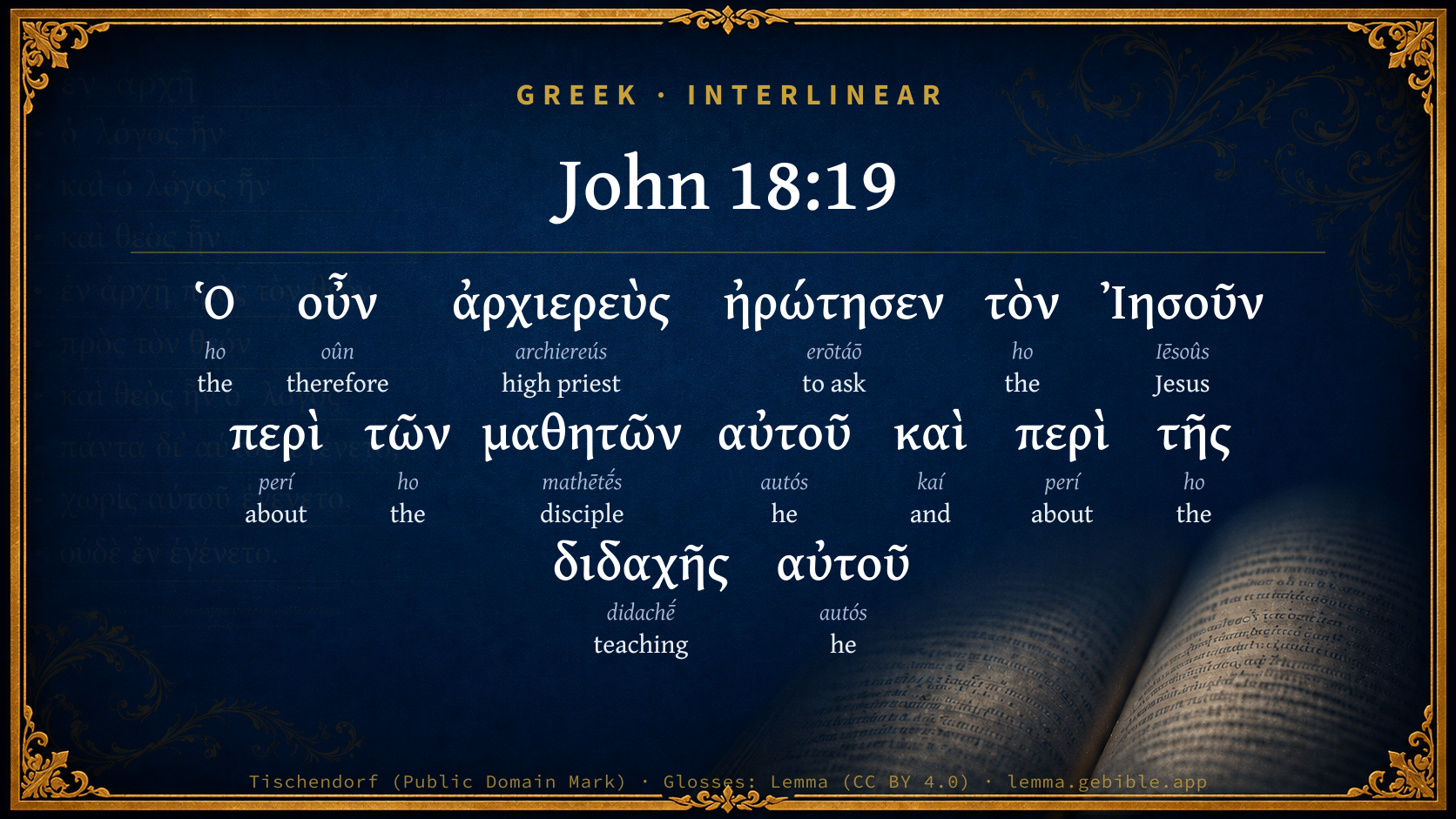
Greek (Tischendorf 8th ed.) John 18:19 appears in the Greek New Testament. The text above is from the Tischendorf 8th edition. Each word links to its Strong’s number and a concise gloss. Click any word for its full Thayer’s Greek Lexicon entry.
Download image
Cite this verse

John 18:19 (World English Bible). Public Domain. Lemma interlinear Bible study tool, https://lemma.gebible.app/v/john/18/19.

Show BibTeX & RIS
BibTeX
RIS
English Translation
The high priest therefore asked Jesus about his disciples, and about his teaching.
World English Bible · Public Domain
Download a study sheet

One document with this verse’s original text, its word-by-word gloss line, the meaning frame, cross-references with their text, attributed commentary, and full source and license credits — printable, and it pastes into notes with its structure intact.

This verse Autodidact and up

Study sheet (.html) Plain text (.txt)

A passage Seminary Student

Up to 50 verses in one chapter. A passage sheet keeps up to 6 commentary sources and 12 cross-references per verse, in the order this page ranks them, and says so on the sheet whenever that leaves anything out. Ask for a single verse and you get the Autodidact verse sheet above.

Everything on this page stays free to read, with no account — the sheet is a download of what is already on screen, not access to it.

Want to remove ads? Support Godless Engineer
Compare translations 3

The same verse in 3 English versions, stacked beneath the original-language interlinear above. Click any original word for its lexicon entry.

Each is an independent rendering of the whole verse — the interlinear is not word-aligned to these translations.

Highlighted words mark where these versions differ — a whole-verse word diff, not a word-by-word alignment.

  • World English Bible Public Domain
    The high priest therefore asked Jesus about his disciples, and about his teaching.
  • King James Version Public Domain
    The high priest then asked Jesus of his disciples, and of his doctrine.
  • unfoldingWord Literal Text CC BY-SA 4.0
    Then the high priest asked Jesus about his disciples and about his teaching.

unfoldingWord Literal Text — © unfoldingWord, licensed CC BY-SA 4.0. Word-aligned USFM3 via Door43 (git.door43.org/unfoldingWord/en_ult).

Versions to compare (up to 4)

3 of 4 selected

Show all 19 translations

Every available English version of this verse, each an independent rendering of the whole verse.

  • World English Bible Public Domain
    The high priest therefore asked Jesus about his disciples, and about his teaching.
  • Berean Standard Bible Public Domain
    Meanwhile, the high priest questioned Jesus about His disciples and His teaching.
  • Majority Standard Bible Public Domain
    Meanwhile, the high priest questioned Jesus about His disciples and His teaching.
  • King James Version Public Domain
    The high priest then asked Jesus of his disciples, and of his doctrine.
  • American Standard Version (1901) Public Domain
    The high priest therefore asked Jesus of his disciples, and of his teaching.
  • Revised Version (1885) Public Domain
    The high priest therefore asked Jesus of his disciples, and of his teaching.
  • Geneva Bible (1599) Public Domain
    (The hie Priest then asked Iesus of his disciples, and of his doctrine.
  • Douay-Rheims (1899) Public Domain
    The high priest therefore asked Jesus of his disciples, and of his doctrine.
  • Young's Literal Translation Public Domain
    The chief priests, therefore, questioned Jesus concerning his disciples, and concerning his teaching;
  • Literal Standard Version CC BY-SA 4.0
    The chief priests, therefore, questioned Jesus concerning His disciples, and concerning His teaching;
  • Unlocked Literal Bible CC BY-SA 4.0
    The high priest then asked Jesus about his disciples and his teaching.
  • unfoldingWord Literal Text CC BY-SA 4.0
    Then the high priest asked Jesus about his disciples and about his teaching.
  • Darby Bible Public Domain
    The high priest therefore demanded of Jesus concerning his disciples and concerning his doctrine.
  • World Messianic Bible Public Domain
    The high priest therefore asked Yeshua about his disciples and about his teaching.
  • Webster's Bible Public Domain
    The high priest then asked Jesus concerning his disciples, and concerning his doctrine.
  • Free Bible Version CC BY-SA 4.0
    Then the chief priest questioned Jesus about his disciples and what he had been teaching.
  • Bible in Basic English Public Domain
    Then the high priest put questions to Jesus about his disciples and his teaching.
  • Text-Critical English NT CC BY 4.0
    Meanwhile, the high priest questioned Jesus about his disciples and his teaching.
  • Tyndale New Testament (1534) Public Domain
    The servauntes and the ministres stode there and had made a fyre of coles: for it was colde: and they warmed them selves. Peter also stode amonge them and warmed him selfe.

Literal Standard Version (2020), Covenant Press — licensed CC BY-SA 4.0. Text via the HelloAO Bible API (eBible.org). Unlocked Literal Bible (unfoldingWord) — licensed CC BY-SA 4.0. Text via the HelloAO Bible API (eBible.org). unfoldingWord Literal Text — © unfoldingWord, licensed CC BY-SA 4.0. Word-aligned USFM3 via Door43 (git.door43.org/unfoldingWord/en_ult). Free Bible Version, Dr. Jonathan Gallagher — licensed CC BY-SA 4.0. Text via the HelloAO Bible API (eBible.org).

Word by word

More ways to search: Search by grammar → Find every occurrence → Compare this word →

Practice this passage: Drill this verse → Learn its vocabulary →

διδαχῆς
didachḗ
G1322
“teaching”
Noun, Genitive, Singular, Feminine
Part of Speech
Noun
Case
Genitive
Number
Singular
Gender
Feminine
Full Thayer's Definition

Origin: from G1321

TDNT: 04:43,2

1. teaching a. that which is taught b. doctrine, teaching, concerning something 2. the act of teaching, instruction a. in religious assemblies of the Christians, to speak in the way of teaching, in distinction from other modes of speaking in public
  1. Ὁ ho G3588 “the” Article, Nominative, Singular, Masculine
  2. οὖν oûn G3767 “therefore” Conjunction
  3. ἀρχιερεὺς archiereús G749 “high priest” Noun, Nominative, Singular, Masculine
  4. ἠρώτησεν erōtáō G2065 “to ask” Verb, Aorist, Active, Indicative, 3rd person, Singular
  5. τὸν ho G3588 “the” Article, Accusative, Singular, Masculine
  6. Ἰησοῦν Iēsoûs G2424 “Jesus” Noun, Accusative, Singular, Masculine
  7. περὶ perí G4012 “about” Preposition
  8. τῶν ho G3588 “the” Article, Genitive, Plural, Masculine
  9. μαθητῶν mathētḗs G3101 “disciple” Noun, Genitive, Plural, Masculine
  10. αὐτοῦ autós G846 “he” Personal pronoun, Genitive, Singular, Masculine
  11. καὶ kaí G2532 “and” Conjunction
  12. περὶ perí G4012 “about” Preposition
  13. τῆς ho G3588 “the” Article, Genitive, Singular, Feminine
  14. αὐτοῦ autós G846 “he” Personal pronoun, Genitive, Singular, Masculine

About this verse

These counts appear in no published source. They are computed here, from the morphology-tagged text and Lemma’s own curated glosses. What Lemma adds →

15
words
10
distinct lemmas
Gospels
section

Shared distinctive vocabulary

διδαχῆς teaching G1322 occurs in 29 verses of the Greek New Testament. Also found in:
Repetition

Words recur within this verse:

  • περὶ about G4012 ×2
  • Ὁ the G3588 ×4
  • αὐτοῦ he G846 ×2

Cross-references

5

Topical passages linked to John 18:19 in the Treasury of Scripture Knowledge — connected by theme and wording, ordered by reader-vote popularity; previews shown in the World English Bible.

  • Matthew 26:59–68 Now the chief priests, the elders, and the whole council sought false testimony against Jesus, that they might put him to death;
  • Mark 14:55–65 Now the chief priests and the whole council sought witnesses against Jesus to put him to death, and found none.
  • Luke 11:53–54 As he said these things to them, the scribes and the Pharisees began to be terribly angry, and to draw many things out of him;
  • Luke 20:20 They watched him, and sent out spies, who pretended to be righteous, that they might trap him in something he said, so as to deliver him up to the power and authority of the governor.
  • Luke 22:63–71 The men who held Jesus mocked him and beat him.

Cross-references courtesy of OpenBible.info (CC BY 4.0).

Commentary

Notes on John 18:19 from classic Christian and Jewish commentators (each source and its license shown beneath its notes). The classic Christian expositions comment on the surrounding passage and are grouped to its opening verse, so a note may address several verses; the Jewish commentaries on the Tanakh (Rashi and others) are per-verse, so they appear only where the commentator wrote on this verse.

Lemma curates 59 commentaries, every one of them public domain or Creative Commons licensed, each selected and text-cleaned for this edition rather than reprinted as found. About our sources →

Joseph Benson's Commentary

Joh 18:19-27. The high-priest then asked Jesus — As he stood before him; of his disciples, and of his doctrine — What it was that he taught, and with what view he had gathered so many followers. In these questions there was a great deal of art. For, as the crime laid to our Lord’s charge was, that he set himself up for the Messiah, and deluded the people, they expected he would claim that dignity in their presence, and so, without further trouble, they would have condemned him on his own confession. But, to oblige a prisoner to confess what might take away his life, being an unjust method of procedure, Jesus complained of it with reason, and bade them prove what they laid to his charge, by witnesses. Jesus answered, I spake openly, &c. — What I have taught has been delivered in the most public manner. I ever taught in the synagogue — As I had opportunity; and in the temple, whither the Jews resort — In the greatest numbers; and in secret have I said nothing — Even to my most intimate friends, but what has been perfectly agreeable to the tenor of my public discourses. Why askest thou me — Whom thou wilt not believe? It was greatly to the honour of our Lord’s character, that all his actions were done in public, under the eye even of his enemies; because, had he been carrying on any imposture, the lovers of truth and goodness would thus have had abundant opportunities to have detected him. With propriety, therefore, in this defence, he appealed to that part of his character; nevertheless, his answer was thought disrespectful. For, when he had spoken, one of the officers — Belonging to the court; struck Jesus, saying, Answerest thou the high- priest so? — With so little reverence? Jesus answered — With his usual mildness; If I have spoken evil — Any thing false or improper; bear witness of the evil — Show wherein it lies; but if well, why smitest thou me — Can reason be answered by blows? Or, can such a sober appeal to it deserve them? Thus Jesus became an example of his own precept, (Mat 5:44,) bearing the greatest injuries with a patience that could not be provoked. Now Annas had sent him bound to Caiaphas the high priest — The evangelist mentions that Jesus was sent to the high-priest, because he had before said that he was sent first to Annas, the high-priest’s father-in-law. Moreover, he takes notice that he was sent bound, to show the inhumanity of the officer who struck him in that condition. Of what took place while Jesus stood before the high-priest, see the notes on Mat 26:59-68.

Joseph Benson's Commentary on the Old and New Testaments (1811–1818) — public domain. Text from a community e-Sword module.

Godbey's Commentary on the New Testament

William B. Godbey

JESUS CONDEMNED BY THE SANHEDRIN

Mat 26:59-68; Mar 14:55-65; Luk 22:63-71;Joh 18:19-24. “Then the high priest asked Jesus concerning His disciples and teaching. Jesus responded to Him, I spoke boldly to the world. I always taught in the synagogue, and in the temple, where all the Jews come together, and I spoke nothing in secret. Why do you ask Me? Ask those who heard what I said to them; behold, they know the things which I said. He, speaking these things, one of the officers standing by struck Jesus with his hand, saying, Do you thus answer the high priest? Jesus responded to him, If I spoke wickedly, testify concerning the wickedness; but if truly, why do you smite Me? Then Annas sent Him bound to Caiaphas the high priest.” Evidently, Annas and Caiaphas had their tribunals in the same great quadrangular building standing on Mount Zion, and now visited by the thirty thousand pilgrims annually going to Jerusalem. Having first been arraigned at the tribunal of Annas, He is now, about day-dawn, led bound to the tribunal of Caiaphas. You see how the high priest endeavored to make Him confess, hoping to utilize His own testimony against Himself, as they had no witnesses to amount to anything, and thus condescended to a very cowardly stratagem, which even if he had succeeded, the law pronounces the weakest of all evidence. It was awfully barbaric for that officer to smite a prisoner in bonds. You see, Jesus vindicates Himself reminding the man of the criminal impropriety of this uncouth assault upon a defenseless prisoner illustrating the right of all His followers to vindicate themselves from false accusation, violence, and tyranny, and refuting the idea somewhat prevalent that we are never to advocate our rights and vindicate ourselves against the oppression of the wicked.

Luk 22:66. “And when it was day, the eldership of the people, the chief priests, and the scribes were assembled, and led Him into the Sanhedrin.” As they had been on His track, like bloodhounds, three years, eager to take, His life (but restrained by the fear of the people; and well they might be, because a bloody civil war would have broken out immediately), such is their fear of the people that they attack Him at midnight, aiming to secure the death-warrant and kill Him before day. In this they are disappointed and woefully disconcerted, being unable to convene the Sanhedrin till day dawn, though keeping couriers running at race-horse speed all night, (notifying and urging them up. The Sanhedrin was the highest court of the politico-ecclesiasticism, the successor of the eldership organized by Jethro, the father-in-law of Moses, during their wilderness peregrinations.

Mar 14:55-59. “And the high priest and all the Sanhedrin continued to seek testimony against Jesus to put him to death, and they found none.” Matthew says “false testimony.” Of course, they preferred true testimony if they could get it; but as there was none, they were anxious to take any kind they could get. “For many continued to testify falsely against Him, and their testimonies were not equal,” i. e., they contradicted one another, which in law invalidates both, so that they are thrown out of court. “And certain ones, rising up, falsely testified against Him, saying, We heard Him saying, That I will destroy this temple, made with hands, and in three days I will build another, made without hands. Indeed their testimony was not equal;” i. e., they contradicted one another. Perhaps some of the witnesses gave it correctly; but you have only to look at Joh 2:19, “Destroy this temple, and I will build it in three days,” to see that the above witnesses were false, as they testified that He said, “I will destroy this temple, made with hands, and build another, made without hands.” By comparison, you see that these witnesses did not quote Him correctly, as their testimony would make it mean that great stone edifice standing on Mount Moriah; while He did not mean that at all, but the temple of His body. Why did He not correct them when so grossly misrepresenting Him? Because it would have done no good, as Satan was in them, and they were thirsting for His blood.

Mat 26:62-66. “The high priest, standing up, said to Him, Do You answer nothing? What are they witnessing against Thee? And Jesus was silent.” Under temptation, the better policy is, like Jesus, to keep silent. You should never speak while under severe provocation. “The high priest, responding, said to Him, I assure Thee by the living God, that Thou mayest tell us if Thou art the Christ, the Son of God. Jesus says to him, Thou sayest it.” That is an Oriental form of affirmation. Here, you see, Jesus answers while under oath of affirmation, administered by the high priest. Hence you see His indirect approval appertaining to the civil oath of affirmation. Paul (1Th 5:23) administers a solemn oath to the Thessalonian saints to read his letter to all the members of the Church.

“Moreover I say unto you, Hereafter you shall see the Son of man sitting on the right hand of power and coming in the clouds of heaven.” The first clause of this wonderful prophecy of our Lord was fulfilled when they saw Him rise from the dead and ascend up to heaven from Mount Olivet; while the second clause, “coming in the clouds of heaven,” will be fulfilled when Jesus shall ride down on a cloud and receive all the kingdoms of this world (Dan 7:9-14) and reign forever. In this wonderful sentence there is not so much as a comma, yet those two clauses are separated by many centuries, the former being verified in a few days, and the latter still pending.

“Then the high priest tore His robes, saying, That He blasphemed; what need of testimony have we yet? Behold, now , you have heard His blasphemy. What seems good to you? And they, responding, said, He is worthy of death.” Mark says this verdict was unanimous, So here you see the issue of His prosecution before the Sanhedrin They unanimously condemned Him to die for blasphemy, according to the law of Moses. (Lev 24:16.) Thus you see, good and just laws become vehicles of tyranny and persecution when in the hands of bad men, and are no guarantee of fight and justice when the devil is in the administrators. Jesus died under the verdict of Divine law, and so did all the martyrs, there being no trouble about the law; but Satan was in the preachers and ruling elders. So it is this day. Some of the brightest saints that walk beneath the skies, have been excommunicated, while drunkards, libertines, blasphemers, and thieves have been retained without impeachment. Such was the case in the days of Luther and Wesley, and always will be so when Diabolus gets into the clergy and official laity.

Luk 22:63-65. “And the men who had charge of Jesus began to mock Him, beating Him; and covering Him, continued to strike His face, and ask Him, saying, Prophesy, who is the one smiting thee? And blaspheming Him as to many other things, they continued to speak against Him.” The truth of it is, Jesus had no trial, it was a mockery; to their infinite shame, barbarically abusing Him while a prisoner in chains, which is revolting to the very idea of civil, not to say ecclesiastical administration. Nicodemus certifies that Jewish law never condemned a man till he met his accusers face to face, and had a fair and impartial trial. Festus, the Roman proconsul, makes the same statement in reference to imperial law. Hence, Jesus was mobbed and outlawed. But did He not come into the world to die? Most assuredly; and He would have died to redeem the world from sin, death, and hell if neither Judas nor Caiphas had ever been born. Yet that is no apology for the diabolical treason, perfidy, and murder which they committed, overtly, without excuse.

William B. Godbey, Commentary on the New Testament (1896–1900) — public domain. Text from a community e-Sword module.

Tyndale Open Study Notes

Tyndale Open Resources

18:19 The high priest began asking Jesus questions, but his inquiry was contrary to Jewish legal procedure. In Jewish court, the priest did not ask questions directly of the defendant but accumulated evidence from witnesses to establish guilt (see Num 35:30; Deut 17:6; 19:15; cp. Matt 18:16). If Jesus said anything incriminating, Annas would later use it to testify against him at Jesus’ trial. He was attempting to follow Roman practice by making Jesus incriminate himself, rather than gathering evidence through witnesses as Jewish law demanded.

Tyndale Open Study Notes — © Tyndale Open Resources, licensed CC BY-SA 4.0. Text via the HelloAO Bible API.

Bengel's Gnomon

Johann Albrecht Bengel

Joh 18:19. Διδαχῆς, doctrine) The High Priest asks the question, just as if the doctrine of Jesus had crept in (spread gradually) in secret. So the world often wishes to make out of the truth a thing done in a corner. Jesus answers as to His doctrine: there was no need of His answering as to His disciples.

Bengel's Gnomon of the New Testament — English translation (T&T Clark, Edinburgh, 1860) — public domain. Text from a community e-Sword module.

Meyer's Critical & Exegetical Commentary

Heinrich August Wilhelm Meyer

Joh_18:19-21. Οὖν] Again connecting the narrative with Joh_18:13-14, after the episode of Peter.

περὶ τ. μαθητ. αὐτ. κ. π. τ. διδαχ. αὐτοῦ] Annas[213] then put general questions, in keeping with a private hearing of the kind, but well planned, so as to connect something further according to the eventual reply.

Jesus, as far as possible, not to inculpate His disciples (Joh_18:8-9), replies, in the first instance (and further questioning was broken off, Joh_18:22), only to the second point of the interrogation, and that by putting it aside as something entirely aimless, appealing to the publicity of His life.

ἘΓῺ ΠΑΡΡΗΣΊᾼ, Κ.Τ.Λ.] I, on my part, have frankly and freely (comp. Joh_7:4, Joh_11:54) spoken to the world; παρρησ. is to be taken subjectively, without reserve, not: openly, which it does not mean, and which is first contained in τῷ ΚΌΣΜῼ. The ΚΌΣΜΟς is the whole public, as in Joh_7:4, Joh_12:19.

ἐν συναγ. κ. ἐν τ. ἱερῷ] in synagogue (see on Joh_6:59) and in the temple. He appeals to His work of teaching not merely in Jerusalem, but as He has always carried it on, though He does not mean by πάντοτε to deny His public discourses in other places (in the open air, etc.), but only to express that He never, in the course of His teaching, withdrew Himself from synagogues and from the temple.

ὍΠΟΥ ΠΆΝΤΕς, Κ.Τ.Λ.] refers to the temple.

καὶ ἐν κρυπτῷ ἐλάλ. οὐδέν] By which, of course, the private instructions given to His disciples (comp. also Mat_10:27) are not denied, since it is the ministry of the Teacher of the people that is here in question; and besides, those private instructions do not fall under the category of that which is secret.

τί-g0- με-g0- ἐρωτ-g0-.] For what object dost thou, ask me? μέ does not bear the emphasis; otherwise ἘΜΈ would have been used.

The second τί, quid, depends on ἐρώτησον.

ἐρώτ. τ. ἀκηκ.] Hoc jubet lex, a testibus incipi, Grotius.

ΟὟΤΟΙ] The ἈΚΗΚΟΌΤΕς, not pointing to John and Peter (Ewald).

[213] Not Caiaphas. Hengstenberg imagines the situation: Annas presides, as it were (?), at the examination, but Caiaphas might not hand over to him the properly judicial function. So also Godet.

Meyer — Critical and Exegetical Commentary on the New Testament — English translation by Peter Christie, edited by Frederick Crombie (T&T Clark, 1880) — public domain. Text from a community e-Sword module.

Expositor's Greek Testament

ed. W. Robertson Nicoll

Joh 18:19 . Ὁ οὖν ἀρχιερεὺς ἠρώτησε … “The high priest then interrogated Jesus about His disciples and about His teaching,” apparently wishing to bring out on what terms He made disciples, whether as a simple Rabbi or as Messiah. But Jesus answered: Ἐγὼ παρρησίᾳ ἐλάλησα … οὐδέν . The high priest’s question was useless. Jesus had nothing to tell which He had not publicly and frequently proclaimed. Similarly Socrates replied to his judges (Plato, Apol. , 33), “If any one says that he has ever learned or heard anything from me in private which the world has not heard, be assured he says what is not true”. παρρησίᾳ “without reserve,” rückhaltslos , Holtzmann. τῷ κόσμῳ , “to everybody,” to all who cared to hear; cf. Socrates’ δημοσίᾳ . “I always taught in synagogue and in the temple”; the article dropped as we drop it in the phrase “in church”; “where,” i.e. , in both synagogue and temple, πάντες “all the Jews assemble”.

The Expositor's Greek Testament, edited by W. Robertson Nicoll (1897–1910) — public domain. Text from a community e-Sword module.

Godet's Commentaries

Frédéric Louis Godet

Vv. 19-21. “The high-priest therefore asked Jesus concerning his disciples and his doctrine. 20. Jesus answered him: I have spoken openly to the world; I have always taught in open synagogue and in the temple, where all the Jews come together, and I have said nothing in secret. 21. Why askest thou me?Ask those who have heard me what I have said to them: behold, these know what I have said.”

It is generally held that, as the examination took place in the house of Annas, it was he who directed the investigation. But this would imply that the high-priest of Joh 18:13-16 was Annas, which we have seen to be contrary to the natural meaning of John’s narrative. This session was a purely private one; it had its necessary place, as we have seen, in the course of the trial; the presence of the officer in Joh 18:22 implies the official character of the scene. The duty of presiding over it fell, therefore, to the high- priest officially. It has been supposed that Annas was exercising functions here in the character of Ab-beth-din (chief of the court of justice). But this dignity appertained to the high-priest himself (Schurer, p. 413). Keim rightly says (certainly not to support the narrative of John): “If Caiaphas was truly the acting high-priest and, at the same time, the soul of the sudden onset which was proposed against Jesus, it belonged to him, and not to his father-in-law, to acquaint himself with the matter and to make a report to the Sanhedrim” (iii. p. 322). If it was otherwise, according to John, what purpose would the characterizing of Caiaphas, in Joh 18:13, have served? When, in Joh 18:22, the officer says to Jesus: Answerest thou the high-priest so? it is unnatural to think of another personage than the actual high-priest, the one who has just been expressly designated as such in Joh 18:13-14. Reuss brings forward in opposition to our view Joh 18:24, in which the high-priest must necessarily be anotherpersonage than the one who is called thus in Joh 18:19. At the first glance, this observation appears just. But if Jesus was led away to the house of Annas, it was quite naturally Annas who gave the order to conduct Him to the house of Caiaphas, while yet it would not follow from this fact that it was Annas himself who presided over the preliminary session.

The question proposed to Jesus had as its design to draw from Him an answer suited to give a ground for His condemnation. For there was embarrassment felt respecting the course to be pursued in this matter, as the recourse to the false witnesses proves.

What is asked of Jesus is not the names of His disciples, as if the question were of a list of accomplices; it is information as to the number of His partisans and the principles which serve them as a standard.

Jesus, understanding that they were only seeking to wrest from Him an expression which might be turned to account against Him, simply appeals to the publicity of His teaching. He is not the head of a secret society, nor the propagator of principles which fear the light of day.— Συναγωγῇ, without an article (according to the true reading): in synagogal assembly; the word ἱερόν, temple, has the article, because this edifice is unique. When Jesus instructed His disciples in private, it was not for the purpose of telling them something different from what He declared in public.— The testimony of the ancient Versions decides in favor of the Alexandrian reading: “all the Jews;” not, the Jews from all parts or continually.

Frédéric Louis Godet — Commentaries on Luke, John, Romans, and 1 Corinthians — English translation (T&T Clark, Edinburgh, 1870s–1890s) — public domain. Text from a community e-Sword module.

Geneva Bible (1599)

Geneva Bible translators

Christ defendeth his cause but slenderly, not that he would withdraw himself from death, but to show that he was condemned as an innocent.

Geneva Bible (1599) marginal notes — public domain. Text via Bolls.life.

Jamieson, Fausset & Brown

Robert Jamieson, A. R. Fausset & David Brown

The high priest . . . asked Jesus of his disciples, and of his doctrine--probably to entrap Him into some statements which might be used against Him at the trial. From our Lord's answer it would seem that "His disciples" were understood to be some secret party. (Also see on Mar 14:54.)

Jamieson, Fausset & Brown — Commentary Critical and Explanatory on the Whole Bible (1871) — public domain (CC PDM 1.0). Text via the HelloAO Bible API.

Adam Clarke's Commentary

Verse 19. Asked Jesus of his disciples, and of his doctrine.] He probably asked him by what authority, or in virtue of what right, he collected disciples, formed a different sect, preached a new doctrine, and set himself up for a public reformer? As religion was interested in these things, the high priest was considered as being the proper judge. But all this, with what follows, was transacted by night, and this was contrary to established laws. For the Talmud states, Sanhed. c. iv. s. 1, that - "Criminal processes can neither commence not terminate, but during the course of the day. If the person be acquitted, the sentence may be pronounced during that day; but, if he be condemned, the sentence cannot be pronounced till the next day. But no kind of judgment is to be executed, either on the eve of the Sabbath, or the eve of any festival." Nevertheless, to the lasting infamy of this people, Christ was judicially interrogated and condemned during the night; and on the night too of the passover, or, according to others, on the eve of that feast. Thus, as I have remarked before, all the forms of justice were insulted and outraged in the case of our Lord. In this his humiliation his judgment was taken away. See Ac 8:33.

Adam Clarke's Commentary on the Bible (1810–1826) — public domain. Text from a community e-Sword/MySword module.

John Calvin's Commentaries

19. The high priest then asked Jesus. The high priest interrogates Christ, as if he had been some seditious person, who had split the Church into parties by collecting disciples; and he interrogates him as if he had been a false prophet, who had endeavored to corrupt the purity of the faith by new and perverse doctrines. Our Lord Jesus Christ, having completely and faithfully discharged the office of teacher, does not enter into a new defense; but, that he may not abandon the cause of truth, he shows that he was prepared to defend all that he had taught. Yet he likewise reproves the impudence of the high priest, who inquires about a matter perfectly well known, as if it had been doubtful. Not satisfied with having rejected the Redeemer offered, together with the salvation promised to them, they likewise condemn all the exposition of the Law.

John Calvin's Commentaries (1540-1563) — public domain. Text from the Calvin Translation Society English edition (1840s-50s) via the Christian Classics Ethereal Library (ccel.org). Calvin's coverage is partial (roughly two-thirds of the Bible); uncommented books and verses are honest gaps, never fabricated. The 19th-century editor's footnotes and remarks are omitted so the notes are faithfully Calvin's own voice.

Ellicott's Commentary for English Readers

(19) The high priest then asked Jesus.—Comp. Notes on Joh_18:15. By the “high priest” is probably-meant Caiaphas, though this preliminary investigation was held before Annas, and in his house, or that part of the high priest’s palace occupied by him.

Of his disciples, and of his doctrine.—This was the general subject of a series of questions. He asked, we may think, about the number of Christ’s followers; the aim they had in view; the principles which He had taught them. The object of the questions was apparently to find some technical evidence in Christ’s own words on which they may support the charges they are about to bring against Him in the legal trial before Caiaphas.

A Bible Commentary for English Readers, edited by Charles John Ellicott (1878–1897) — public domain. Text from a community e-Sword module.

The Cambridge Bible for Schools and Colleges

gen. ed. J. J. S. Perowne

19. The high priest then] Rather, therefore (Joh_18:3), connecting what follows with Joh_18:13-14. Again we are in doubt as to who is meant by the high-priest (see on Joh_18:15), but it will be safest to consider that Caiaphas is meant throughout. Neither hypothesis is free from difficulty. If the high priest here is Caiaphas, the difficulty is to explain Joh_18:24 (see note there). But we may suppose that while Annas is conducting the examination Caiaphas enters and takes part in it.

of his disciples, &c.] It was hoped that some evidence might be obtained which would be of service in the formal trial that was to follow.

The Cambridge Bible for Schools and Colleges (gen. ed. J. J. S. Perowne; Cambridge University Press, 1878–1918) — public domain. Text from a community e-Sword module.

John Gill's Exposition

The high priest then asked Jesus,.... Being now brought from Annas to Caiaphas, who was the high priest and mouth of the sanhedrim, and to whom it appertained to hear and try a cause relating to doctrine. And what he did was by putting questions to him, instead of opening the charge against him, and calling for witnesses to support it. The person he interrogated was a greater high priest than himself; was that prophet Moses spoke of, to whom the Jews were to hearken, and no other than the Son of God, and King of Israel; who, when at twelve years of age, asked the doctors questions, and answered theirs, to their great astonishment. He first inquires

of his disciples, not so much who they were, and what they were, and how many they were, and where they were now, as for what purpose he gathered them together; whether it was not with some seditious views to overturn the present government, and set up himself as a temporal prince; and this he did, that he might be able to send him, with a charge against him, to the Roman governor: he did not ask for his disciples to come and speak on his behalf, if they had anything to say for him, which, by their canons (p), was allowed and encouraged:

"if any of the disciples (of the person accused) says, I have a crime to lay to his charge, they silence him; but if one of the disciples says, I have something to say in his favour, they bring him up, and place him between them; nor does he go down from thence all the day; and if there is anything in what he says, , "they hearken to him".''

The Jews indeed pretend (q) that after Jesus was found guilty, a herald went before him forty days declaring his crime, and signifying, that if anyone knew anything worthy in him, to come and declare it; but none were found: but this is all lies and falsehood, to cover their wickedness; no disciple of his was allowed to speak for him. The high priest next asked Jesus

of his doctrine; not for the sake of information and instruction, nor to see whether it was according to the Scriptures; but if it was a new doctrine, and his own, and whether it tended to idolatry or blasphemy, and whether it was factious and seditious, that so they might have wherewith to accuse him; for though they had got his person, they were at a loss for an accusation; and yet this self-same man that put these questions, and was fishing for something against him, had before given counsel to put him to death, right or wrong: all this was doing, and these questions were put to Jesus, whilst Peter was denying him.

(p) T. Bab. Sanhedrin, fol. 40. 1. Maimon. Hilch. Sanhedrin, c. 10. sect. 8. (q) T. Bab. Sanhedrin, fol. 43. 1.

John Gill's Exposition of the Whole Bible (1746–1763) — public domain (CC PDM 1.0). Text via the HelloAO Bible API.

Trapp's Complete Commentary

John Trapp

19 The high priest then asked Jesus of his disciples, and of his doctrine.

Ver. 19. Asked Jesus of his disciples] Questioned him in the spiritual court first, as a heretic; as afterwards in the temporal court, for a seditious person. So the Papists condemned married priests for Nicolaitanes, in the Synod of Milan, A. D. 1067. Virgilius, a German bishop, and a great mathematician, they condemned for a heretic, for affirming that there were antipodes. {a} Paulus II, pope, pronounced them heretics that did but name the name Academy, either in jest or in earnest. Innocent II condemned Arnoldus Brixius of heresy, for saying that the clergy should have their temporalities taken away, and be tied to their spirituals only. Bonner objected to Philpot the martyr, that he found written in his book, In me Ioanne Philpotto ubi abundavit peccatum, superabundavit et gratia. And when the bishop of Worcester exhorted Philpot, before he began to speak, to pray to God for grace: Nay, my lord of Worcester, said Bonner, you do not well to exhort him to make any prayer; for this is the thing these heretics have a singular pride in, that they can often make their vain prayers, in the which they glory much: for in this point they are like to certain arrant heretics, of whom Pliny makes mention, that they sing Antelucanos hymnos, &c. Was not this well aimed? Those he spoke of were the primitive Christians, whom Pliny excuseth to Trajan the persecutor. But it is easy for malice to make heresy what it pleaseth, when it is armed with power, and can make havoc at pleasure.

{a} Those who dwell directly opposite to each other on the globe, so that the soles of their feet are as it were planted against each other; esp. those who occupy this position in regard to us. ŒD

John Trapp, A Commentary or Exposition upon All the Books of the Old and New Testament (1647–1656) — public domain. Text from a community e-Sword module.

Albert Barnes' Notes on the Bible

The high priest then asked Jesus of his disciples - To ascertain their number and power. The charge on which they wished to arraign him was that of sedition, or of rebellion against Caesar. To make that plausible, it was necessary to show that he had made so many disciples as to form a strong and dangerous faction; but, as they had no direct proof of that, the high priest insidiously and improperly attempted to draw the Saviour into a confession. Of this he was aware, and referred him to the proper source of evidence - his open, undisguised conduct before the world.

His doctrine - His teaching. The sentiments that he inculcated. The object was doubtless to convict him of teaching sentiments that tended to subvert the Mosaic institutions, or that were treasonable against the Roman government. Either would have answered the design of the Jews, and they doubtless expected that he - an unarmed and despised Galilean, now completely in their power - would easily be drawn into confessions which art and malice could use to procure his condemnation.

Albert Barnes' Notes on the Bible (1834–1885) — public domain. Text from a community e-Sword/MySword module.

Matthew Poole's English Annotations

Questions about sedition or rebellion belonged not to the judge of this court, but fell under the cognizance of the Roman governor, they being now a conquered people, and tributary to the Romans; who, though themselves heathens, granted the Jews their liberty as to religion, and courts in order there unto; as also a liberty of courts for civil causes: the high priest therefore saith nothing to Christ about his being a King, but only inquires of him about his doctrine. What particular questions he propounded to him we do not read; only in general he inquired about the doctrine he had preached, and the disciples he had sent out, which was one and the same cause, to see if he could bring him under the guilt of a false prophet; for that, and blasphemy, and idolatry, were three principal causes that fell under the cognizance of this court, as appeareth from Deu 13.

Matthew Poole's English Annotations on the Holy Bible (1683–1685) — public domain. Text from a community e-Sword/MySword module.

Whedon's Commentary on the Bible

Daniel D. Whedon

19. The high priest—Which high priest? Annas or Caiaphas? It is clear that Jesus is not sent to Caiaphas until Joh_18:24, upon which see our note. It is also clear that at Joh_18:13 Jesus is led to the high priest Annas. It is also clear that this is a different examination from the one given by Matthew, as taking place before Caiaphas. We hold, therefore, decidedly with those who maintain that the high priest of this verse is Annas. That Matthew (Mat_26:57) omits the leading to Annas, does not contradict the fact. But in fact the ancient opinion that both high priests had office in the same extended palace may be considered as solving the whole difficulty. Peter went to the house of the high priest; he denied Christ while Christ was before Annas; and Christ was sent from one part of the palace to the other, by Annas to Caiaphas.

Asked Jesus—Before this venerable dignitary, who was high priest before the prisoner was born, the youthful Jesus presents himself in bonds. During his repeated visits to Jerusalem, his teachings in the streets and preaching in the temple, probably Jesus had never been recognized by either high priest; while Jesus probably had seen them both in the exercise of their public office. Yet his name, his teachings, his miracles, and his popularity could not have been unknown to either; for, in fact, the beloved disciple, John, (Joh_18:15,) was known to the high priest. Annas was a Sadducee; a sect which, denying future punishment, endeavoured to deter from crime by severity of judgment in the present world. Before this haughty magistrate the Saviour stands, with little reason to expect mild dealing.

Asked Jesus of his disciples… doctrine—The first thought of Annas is, Who are the disciples, the supporters, the party, of this insurgent. He doubtless had lately heard of their ushering Jesus, with triumphal procession and great popular commotion, into the capital. How strong a party can he rally? And what are their real doctrines, as by him explained, religious or political? Have they a powerful secret combination to destroy the temple, abolish the priesthood, and overthrow the state?

Daniel D. Whedon (gen. ed.), Commentary on the Old and New Testaments (1874–1909) — public domain. Text from a community e-Sword module.

The Pulpit Commentary

The oun connects the following incident with the thirteenth and fourteenth verses. The high priest. Hengstenberg, Godet, and Westcott here say that the high priest is Caiaphas, present i.e. at the examination over which Annas presides as the older man; but Renan, Meyer, Lange, Steinmeyer ("Passion and Resurrection History"), and Moulton, with many others, say Annas was here the high priest in question. Tholuck dismisses the idea of Annas altogether, and, by inverting the place of Ver. 24 or treating the apesteile as pluperfect, suppose that Annas had sent the Lord to Caiaphas (so Calvin, De Wette, Hase, and others), who thus commenced his interrogatory. But the text of Ver. 24, now recovered, will not admit of this rendering. We find it far more satisfactory to accept this less formal examination, under the presidency of Annas, at which an attempt is made to put the Lord, if possible, to a test which will incriminate him. Keim says, "If Caiaphas were the acting high priest, and at the same time the soul of the movement against Jesus, it was for him and not for his father-in-law to take knowledge of the matter and report to the Sanhedrin." We must choose between two difficulties:

(1) Caiaphas is first spoken of as "high priest," who, as we know from the synoptists, conducted the examination-in-chief, and then that Annas, as conducting a preliminary examination, is also styled "high priest" without any explanation;

(2) or we must admit the supposition that after Caiaphas had asked these incriminating questions, Annas (who was not arciereuv), sent Jesus bound to Caiaphas the high priest. The former hypothesis is the easier. The high priest then asked Jesus concerning his disciples, the extent of his following, the number of his accomplices, the ramifications of the society or kingdom he professed to have founded, and concerning his doctrine, the secret teachings that held his followers together. He evidently knows the claims of Jesus well enough; his spies and officers have continually been dogging the steps of Jesus, and hitherto he has failed to gain evidence positively incriminating him. And as his representatives a few days ago were utterly foiled, notwithstanding their clever design, he hopes by his own ingenuity to entrap the Lord in his talk. Our Lord, anxious not to endanger his disciples, points to the publicity of his ministry, and appeals to all and sundry who have heard him.

Vers. 19, 20. The publicity of Christ"s ministry.

Had the high priest questioned Jesus in this manner from any real desire to be his disciple, or from an ordinary and intelligent curiosity, his inquiries would have been received in a very different manner from that in which Jesus did actually respond to them. But it was plain that the whole purpose of the interrogator was to induce Jesus to criminate himself and his disciples. Thus it was that Jesus, taking no notice of the question concerning his adherents, referred the high priest, for information regarding his teaching, to those who had heard him discourse and converse. There could be no difficulty in obtaining evidence upon this; for, as Jesus asserted, his teaching had been open and public, and multitudes of the Jews had heard his doctrine.

I AS A MATTER OF FACT, OUR LORD FULFILLED HIS MINISTRY AS A PUBLIC TEACHER, WITH UNDENIABLE PUBLICITY. In the country districts he taught in the synagogues, the places appointed for public religious instruction and worship. In the metropolis he was wont to frequent the precincts of the temple, not only upon ordinary occasions, but at the great national festivals. He expressly witnessed that his open instructions had been intended for the benefit of the Jews and of the world at large.

II AS A RELIGIOUS TEACHER, JESUS HAD NOTHING TO CONCEAL AND EVERYTHING TO PROCLAIM IN PUBLIC. He had nothing to be ashamed of in the whole cycle of his doctrine. And knowing that his communications were adapted to benefit all mankind, Jesus benevolently desired to bring as many as possible under the sound of his voice, under the influence of his revelation, counsels, and promises. His lessons were as the living waters of the brook, which flow in a ceaseless stream, so that all may drink of them and be refreshed.

III THE PUBLICITY OF CHRIST"S TEACHING SECURED THE ESTABLISHMENT OF HIS INNOCENCE AND OF THE INJUSTICE OF HIS FOES. If he had spoken aught secretly, an opening might have been left for the slanderous imputations of his foes. But all Judea and all Galilee were witnesses to his doctrines concerning God, concerning man, concerning duty, sin, judgment, forgiveness, and life eternal. Of high and holy doctrine unnumbered witnesses were able to testify. But none could be brought forward with any credible account of sayings subversive of order, of peace, of morality. Nothing could be clearer than the inability of Christ"s foes to convict him of any teaching which might justify their charges.

IV IN THIS PUBLICITY CHRIST IS A MODEL FOR ALL HIS FOLLOWERS TO COPY. Christianity has no esoteric doctrines, no secret societies or guilds, no rites or ceremonies for private performance. Christianity is no sect, no party. A world-wide religion, it challenges the attention of all mankind. Those who teach and preach in Christ"s name are bound to follow the example of their Lord to discharge their ministry in public places wherever men resort. The language of the true preacher of wisdom and righteousness is this: "To you, O men, I call, and my voice is unto the sons of men. T.

The Pulpit Commentary (1880–1919), ed. H.D.M. Spence-Jones & Joseph S. Exell — public domain. Text from a community e-Sword module.

Scofield Reference Notes

C. I. Scofield

The high priest

For the order of events on the day of the crucifixion, (See Scofield "Mat 26:57").

The Scofield Reference Bible (1917 edition), notes by C. I. Scofield — public domain. Text from a community e-Sword module.

Kretzmann's Popular Commentary

Paul E. Kretzmann

The preliminary hearing:

v. 19. The high priest then asked Jesus of His disciples and of His doctrine.

v. 20. Jesus answered him, I spake openly to the world; I ever taught in the synagogue and in the Temple, whither the Jews always resort; and in secret have I said nothing.

v. 21. Why askest thou Me? Ask them which heard Me what I have said unto them; behold, they know what I said.

v. 22. And when He had thus spoken, one of the officers which stood by struck Jesus with the palm of his hand, saying, Answerest Thou the high priest so?

v. 23. Jesus answered him, If I have spoken evil, bear witness of the evil; but if well, why smitest thou Me?

v. 24. Now Annas had sent Him bound unto Caiaphas, the high priest.

While they were waiting for the members of the Sanhedrin to assemble for an extraordinary session, Hannas, who is here called high priest by courtesy, as a former incumbent of the office, had a preliminary, private hearing with Jesus. He asked Jesus about His disciples and about His teaching. The information might be of value in several respects. He may have wanted to get the names of the disciples for future use, and a summary of Christ’s teaching in order to garble the information to suit his ends. Or Hannas may simply have wanted to find out whether Jesus was making disciples as simple rabbi or as avowed Messiah. In either event the answer of the Lord was to be used against Him in the trial. And therefore Jesus very properly referred Hannas to His plain and open speaking before the whole world. He had spoken without reserve to anybody and everybody that cared to hear. Both in synagogues and in the Temple, wherever occasion offered, the Lord had taught, where all the Jews regularly assembled. Nothing had He spoken in secret. This applies even to such speeches as He had made in the presence of His disciples only, for even at such times He had taught them facts which they were to reveal to the world at the proper time. Christ’s public doctrine contained everything that any person needed to come to a conclusion regarding His person and office. "But that Christ occasionally taught His disciples something privately, that does not concern His office of teaching and His public preaching; the office of teaching is public, for He had preached and taught publicly in the boat, on the land, on the mountains, in the synagogues, and in the Temple. In addition, He instructed His disciples privately and apart. Both, then, is true, namely, that Christ taught publicly and privately, but thus that His private teaching might also become public and nothing remain in a corner, nor in hiding. " It was a just demand of the Lord’s, therefore, that Hannas at this time apply to those that heard His preaching and hear their testimony. Jesus does not want to repeat here what He had so often taught and testified to. Three years and more He had attended to this part of His office; now the time had come to suffer and die. Note: In the kingdom of Christ everything has its time, also public teaching and preaching. If in some country, where the Word has been established, the majority of the people refuse to listen, then Christ begins to withdraw the pure preaching and takes His Gospel elsewhere. If a person therefore neglects preaching and the Word, he will have to account for his contempt with a severe reckoning. Such a one may in the hour of his death desire to hear of the one thing needful, and will find himself without the comfort of the Gospel. God is not mocked! When Jesus rebuked the former high priest with these words, one of the servants of the Sanhedrin that was standing nearby had the impudence to slap Jesus in the face with his flat hand, a cowardly and unjustified blow. He even accompanied his unwarranted outrage with an explanation in the form of the question: Thus dost Thou answer the high priest? But Jesus did not take this blow without a word of reproof for the cowardly servant. If He had spoken evil, the servant should bear witness to that effect, and not undertake to administer a punishment without authority. And again, if His defense had been right and good, how could he dare to strike in such an unwarranted manner? It was a calm, reasonable, but conclusive rebuke, and in no wise out of harmony with the teaching of Jesus concerning the turning of the other cheek. A disciple of Christ will suffer the wrong, as Christ also did, but he may and should under circumstances reprove the injustice. "That He says to the servant: If I have spoken evil, bear witness of the evil, you must understand thus, that there is a great difference between these two, to turn the other cheek and to rebuke with words him that smites us thus. Christ should suffer, but just the same the word is put into His mouth, that He should speak and rebuke what is wrong. " Meanwhile the purpose of the waiting had been realized, and the trial in the hall of Caiaphas could begin. Therefore Hannas now sent Jesus from his apartments to those of Caiaphas. The Sanhedrin, the spiritual court of the Jews, had convened, and the formal examination could now take place.

Paul E. Kretzmann, Popular Commentary of the Bible (1921–1924) — public domain. Text from a community e-Sword module.

Burkitt's Expository Notes on the New Testament

William Burkitt

Our Saviour being brought before Caiaphas the high-priest, he examines him concerning his doctrine, and his disciples, pretending him to be guilty of heresy in doctrine, and sedition in gathering disciples and followers.

Our Saviour answers, that as to his doctrine, he had not delivered it in holes and corners, but had taught publicly in the temple and synagogues; and that in secret he had said nothing, that is, nothing contrary to what he had delivered in public. Christ never willingly affected corners; he taught openly, and propounded his doctrine publicly and plainly in the world. A convincing evidence, that both he and his doctrine were of God.

Learn hence, 1. That it is not unusual for the best of doctrines to pass under the odious name and imputation of error and heresy. Christ’s own doctrine is here charges: The high-priest asked Jesus of his doctrine.

2. That the ministers of Christ who have truth on their side, may and ought to speak boldly and openly: I spake openly unto the world. "Veritas nihil erubescit, praeterquam abscondi." Truth blushes at nothing, except at its being concealed; In secret, says Christ, have I said nothing.

William Burkitt's Expository Notes on the New Testament (1700–1703) — public domain. Text from a community e-Sword module.

unfoldingWord translationNotes

Door43 World Missions Community

General Information:

Here the story line shifts back to Jesus.

The high priest

This was Caiphas. (See: John 18:13)

about his disciples and his teaching

Here "his teaching" refers to what Jesus had been teaching the people. AT: "about his disciples and what he had been teaching the people" (See: Assumed Knowledge and Implicit Information)

I have spoken openly to the world

You may need to make explicit that the word "world" is a metonym for those people who had heard Jesus teach. Here the exaggeration "the world" emphasizes that Jesus has spoken openly. (See: Assumed Knowledge and Implicit Information and Metonymy and Hyperbole and Generalization)

where all the Jews come together

Here "all the Jews" is an exaggeration that emphasizes that Jesus spoke where anyone who wanted to hear him could hear him. (See: Hyperbole and Generalization)

Why did you ask me?

This remark appears in the form of a question to add emphasis to what Jesus is saying. AT: "You should not be asking me these questions!" (See: Rhetorical Question)

translationWords

high priest

Jesus

disciple

world

synagogue

temple

Jew

unfoldingWord translationNotes — © Distant Shores Media and the Door43 World Missions Community, licensed CC BY-SA 4.0. Source: git.door43.org/Door43/en_tn.

Cambridge Greek Testament for Schools and Colleges

19. ὁ οὖν ἀρχ. The οὖν connects what follows with Joh 18:13-14. Again we are in doubt as to who is meant by the high-priest (see on Joh 18:15), but it will be safest to consider that Caiaphas is meant throughout. Neither hypothesis is free from difficulty. If the high-priest here is Caiaphas, the difficulty is to explain Joh 18:24 (see note there). But we may suppose that while Annas is conducting the examination Caiaphas enters and takes part in it. It was hoped that some evidence might be obtained which would be of service in the formal trial that was to follow.

Cambridge Greek Testament for Schools and Colleges (Cambridge University Press, 1896; 21 vols, various authors incl. Carr, Maclear, Plummer, Farrar, Lumby, Moule, M. R. James, Simcox) — public domain. Text from a community e-Sword module.

Alford’s Greek Testament

Henry Alford

19.] This preliminary enquiry seems to have had for its object to induce the prisoner to criminate himself, and furnish matter of accusation before the Sanhedrim.

τῶν μαθ., His party, or adherents, as the High Priest would understand His disciples to be; how many, and who they were, and with what object gathered together;—and what His customary teaching of them had been. Of these, Jesus says nothing: compare vv. 8, 9. But He substitutes for them ὁ κόσμος, to which He had spoken plainly.

Henry Alford, The Greek Testament (1849–1861) — public domain. Text from a community e-Sword module.

International Critical Commentary

19. ὁ … ἀρχιερεύς. The “high priest” who conducted the informal examination at the house of Annas was most probably Annas himself (see v. 24). Caiaphas, however, may have been present, and it is possible that he was the ἀρχιερεύς of v. 19 and v. 22. But the real leader was Annas (see on 11:49), and it was probably by his orders that Jesus was brought to his house in the first instance (see on v. 13). Jn. does not tell, as the Synoptists do, of the cross-examination by which the hostile priests and scribes tried to make Jesus incriminate Himself, when they found it difficult to get legal evidence as to His alleged blasphemy about the destruction of the Temple (Mar 14:55f., Mat 26:59f.). The episode of the Cleansing of the Temple, and the words “Destroy this Temple and I will raise it up in three days,” have been given by Jn. in another context (2:13-19, where see note). Jn. merely says here that the high priest questioned Jesus about His disciples, probably as to who they were and as to their reasons for attaching themselves to Him, and about His doctrine (διδαχή, cf. 7:16). This latter inquiry would cover everything. But the details given here of the reply of Jesus to the high priest are found only in Jn. (See also on v. 32.)

International Critical Commentary — older volumes (1896–1929), various authors — public domain. Text from a community e-Sword module.

Vincent's Word Studies in the New Testament

Marvin R. Vincent

Asked [ηρωτησεν] . Or, questioned.

Doctrine [διδαχης] . Rev., better, teaching.

Marvin R. Vincent, Word Studies in the New Testament (1887–1900) — public domain. Text from a community e-Sword/MySword module.

Lesson kit

Teaching starters — assembled from the data on this page, not authored interpretation. Every prompt links to the verse data it draws on. Edit before teaching.

John, in the Gospels, opens this verse with 15 words (10 distinct Greek lemmas). Its most distinctive word is didachḗ (“teaching”). A historical commentator’s framing appears above. Read the whole chapter for the surrounding context.

Discussion questions

  1. What does “teaching” (didachḗ) contribute to the verse as a whole?
  2. Matthew 7:28 shares the word «teaching» with this verse. How do the two illuminate each other?
  3. “about” occurs 2× in this one verse. What is the effect of the repetition?
  4. These translations render this verse differently. What is at stake in choosing one wording over another?
  5. Reading how Joseph Benson's Commentary and Godbey's Commentary on the New Testament read this verse, where do the two commentators agree and where do they part?

Things to notice

  • These translations choose different wording for 4 words in this verse.
  • “about” occurs 2× in this single verse.
  • 10 distinct Greek lemmas span 15 words in this verse.

Reading settings

Reading text

Shown beneath each verse's original-language words.

Old Testament
Old Testament edition

Read the OT as the Masoretic Hebrew (MT) or the Greek Septuagint (LXX).

English shown for the Greek Septuagint (in the Hebrew ↔ Greek comparison).

Comparing translations? Open the Compare panel on any verse page to stack up to four side by side.