
John 15:23

Greek (Tischendorf 8th ed.) John 15:23 appears in the Greek New Testament. The text above is from the Tischendorf 8th edition. Each word links to its Strong’s number and a concise gloss. Click any word for its full Thayer’s Greek Lexicon entry.
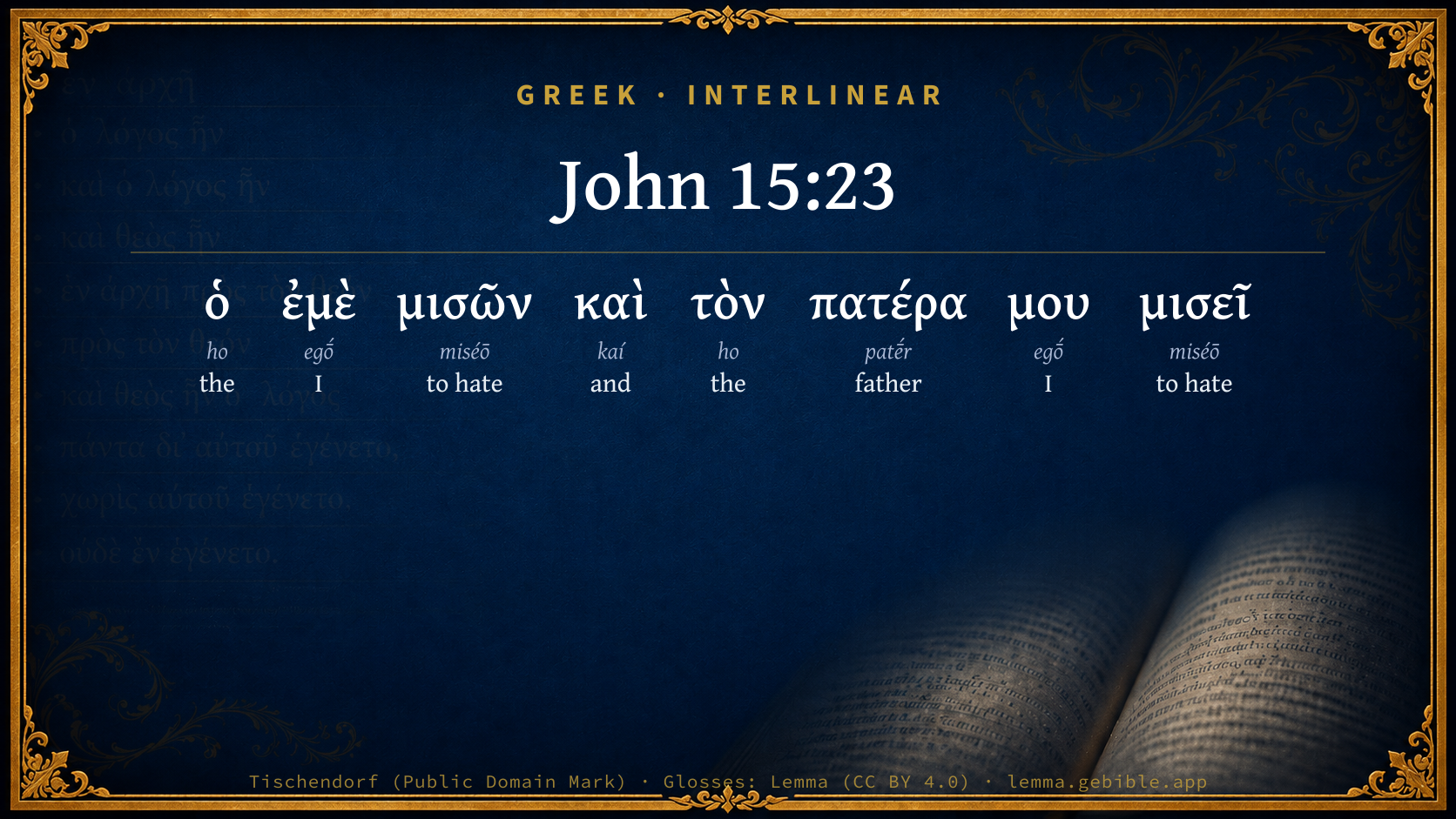
Download image
Cite this verse

John 15:23 (World English Bible). Public Domain. Lemma interlinear Bible study tool, https://lemma.gebible.app/v/john/15/23.

Show BibTeX & RIS
BibTeX
RIS
English Translation
He who hates me, hates my Father also.
World English Bible · Public Domain
Download a study sheet

One document with this verse’s original text, its word-by-word gloss line, the meaning frame, cross-references with their text, attributed commentary, and full source and license credits — printable, and it pastes into notes with its structure intact.

This verse Autodidact and up

Study sheet (.html) Plain text (.txt)

A passage Seminary Student

Up to 50 verses in one chapter. A passage sheet keeps up to 6 commentary sources and 12 cross-references per verse, in the order this page ranks them, and says so on the sheet whenever that leaves anything out. Ask for a single verse and you get the Autodidact verse sheet above.

Everything on this page stays free to read, with no account — the sheet is a download of what is already on screen, not access to it.

Want to remove ads? Support Godless Engineer
Compare translations 3

The same verse in 3 English versions, stacked beneath the original-language interlinear above. Click any original word for its lexicon entry.

Each is an independent rendering of the whole verse — the interlinear is not word-aligned to these translations.

Highlighted words mark where these versions differ — a whole-verse word diff, not a word-by-word alignment.

  • World English Bible Public Domain
    He who hates me, hates my Father also.
  • King James Version Public Domain
    He that hateth me hateth my Father also.
  • unfoldingWord Literal Text CC BY-SA 4.0
    The one hating me also hates my Father.

unfoldingWord Literal Text — © unfoldingWord, licensed CC BY-SA 4.0. Word-aligned USFM3 via Door43 (git.door43.org/unfoldingWord/en_ult).

Versions to compare (up to 4)

3 of 4 selected

Show all 19 translations

Every available English version of this verse, each an independent rendering of the whole verse.

  • World English Bible Public Domain
    He who hates me, hates my Father also.
  • Berean Standard Bible Public Domain
    Whoever hates Me hates My Father as well.
  • Majority Standard Bible Public Domain
    Whoever hates Me hates My Father as well.
  • King James Version Public Domain
    He that hateth me hateth my Father also.
  • American Standard Version (1901) Public Domain
    He that hateth me hateth my Father also.
  • Revised Version (1885) Public Domain
    He that hateth me hateth my Father also.
  • Geneva Bible (1599) Public Domain
    He that hateth me, hateth my Father also.
  • Douay-Rheims (1899) Public Domain
    He that hateth me, hateth my Father also.
  • Young's Literal Translation Public Domain
    `He who is hating me, doth hate also my Father;
  • Literal Standard Version CC BY-SA 4.0
    He who is hating Me, hates My Father also;
  • Unlocked Literal Bible CC BY-SA 4.0
    He who hates me also hates my Father.
  • unfoldingWord Literal Text CC BY-SA 4.0
    The one hating me also hates my Father.
  • Darby Bible Public Domain
    He that hates me hates also my Father.
  • World Messianic Bible Public Domain
    He who hates me, hates my Father also.
  • Webster's Bible Public Domain
    He that hateth me, hateth my Father also.
  • Free Bible Version CC BY-SA 4.0
    Anyone who hates me hates my Father as well.
  • Bible in Basic English Public Domain
    He who has hate for me has hate for my Father.
  • Text-Critical English NT CC BY 4.0
    Whoever hates me hates my Father also.
  • Tyndale New Testament (1534) Public Domain
    He that hateth me hateth my father.

Literal Standard Version (2020), Covenant Press — licensed CC BY-SA 4.0. Text via the HelloAO Bible API (eBible.org). Unlocked Literal Bible (unfoldingWord) — licensed CC BY-SA 4.0. Text via the HelloAO Bible API (eBible.org). unfoldingWord Literal Text — © unfoldingWord, licensed CC BY-SA 4.0. Word-aligned USFM3 via Door43 (git.door43.org/unfoldingWord/en_ult). Free Bible Version, Dr. Jonathan Gallagher — licensed CC BY-SA 4.0. Text via the HelloAO Bible API (eBible.org).

Word by word

More ways to search: Search by grammar → Find every occurrence → Compare this word →

Practice this passage: Drill this verse → Learn its vocabulary →

About this verse

These counts appear in no published source. They are computed here, from the morphology-tagged text and Lemma’s own curated glosses. What Lemma adds →

8
words
5
distinct lemmas
Gospels
section

Shared distinctive vocabulary

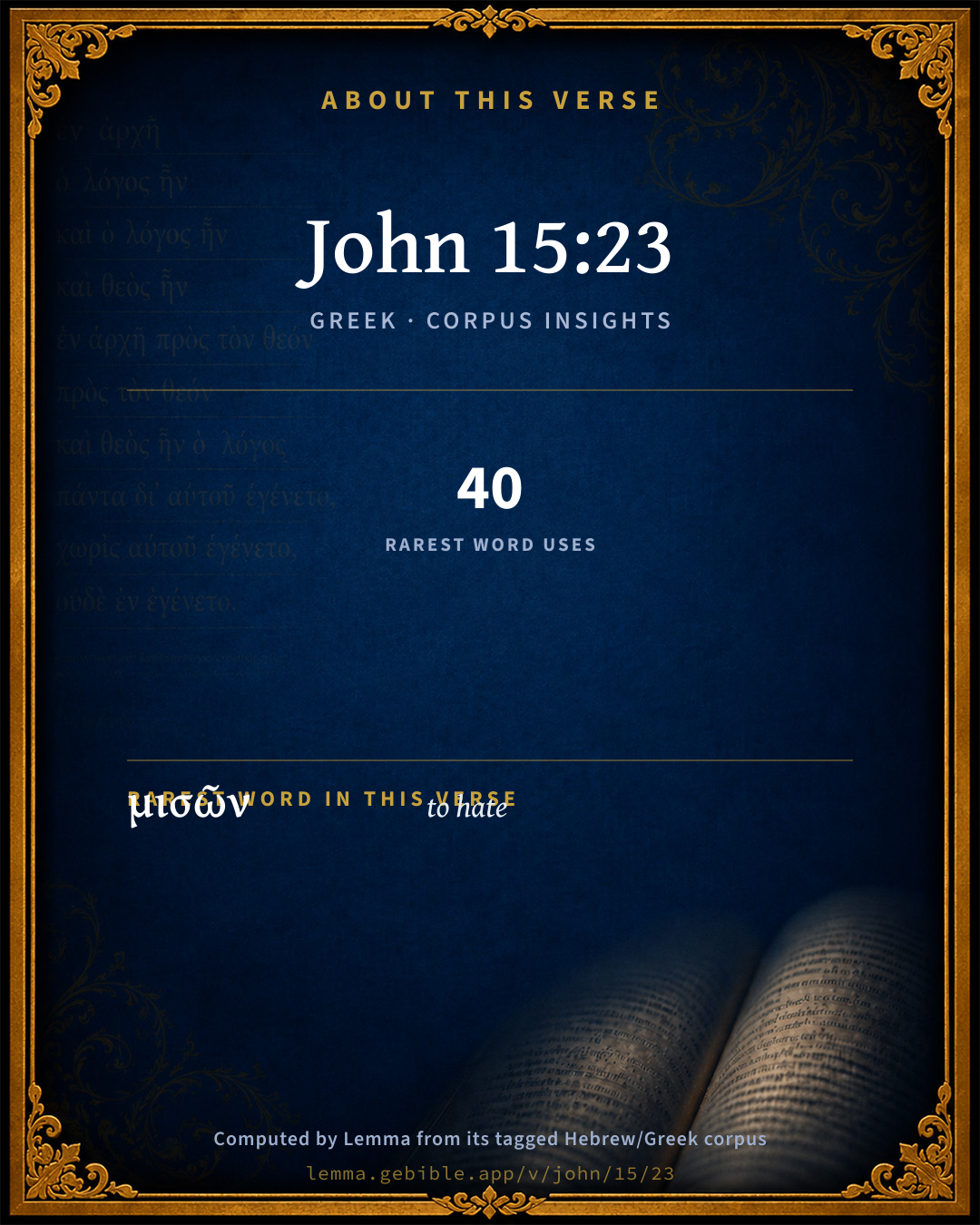
μισῶν to hate G3404 occurs in 36 verses of the Greek New Testament. Also found in:
Repetition

Words recur within this verse:

Cross-references

3

Topical passages linked to John 15:23 in the Treasury of Scripture Knowledge — connected by theme and wording, ordered by reader-vote popularity; previews shown in the World English Bible.

  • John 8:40–42 But now you seek to kill me, a man who has told you the truth, which I heard from God. Abraham didn't do this.
  • 1 John 2:23 Whoever denies the Son, the same doesn't have the Father. He who confesses the Son has the Father also.
  • 2 John 1:9 Whoever transgresses and doesn't remain in the teaching of Christ, doesn't have God. He who remains in the teaching, the same has both the Father and the Son.

Cross-references courtesy of OpenBible.info (CC BY 4.0).

Commentary

Notes on John 15:23 from classic Christian and Jewish commentators (each source and its license shown beneath its notes). The classic Christian expositions comment on the surrounding passage and are grouped to its opening verse, so a note may address several verses; the Jewish commentaries on the Tanakh (Rashi and others) are per-verse, so they appear only where the commentator wrote on this verse.

Lemma curates 59 commentaries, every one of them public domain or Creative Commons licensed, each selected and text-cleaned for this edition rather than reprinted as found. About our sources →

Bengel's Gnomon

Johann Albrecht Bengel

Joh 15:23. Μισῶν, he that hateth) Love accompanies faith; hatred, unbelief: ch. Joh 3:18-19.—καὶ, also) Implying the enormity of that sin of theirs.

Bengel's Gnomon of the New Testament — English translation (T&T Clark, Edinburgh, 1860) — public domain. Text from a community e-Sword module.

Expositor's Greek Testament

ed. W. Robertson Nicoll

Joh 15:23 . In hating me, they hate my Father whom I represent, ὁ ἐμὲ μισῶν … μισεῖ . In hating and persecuting me, it is God they hate.

The Expositor's Greek Testament, edited by W. Robertson Nicoll (1897–1910) — public domain. Text from a community e-Sword module.

John Calvin's Commentaries

23. He who hateth me hateth my Father also. This is a remarkable passage, which teaches us that no man can hate the doctrine of the Gospel without manifesting his impiety against God. There are many, indeed, who profess differently in words; for, though they abhor the Gospel, still they wish to be thought very good servants of God; but it is false, for a contempt of God is concealed within. In this manner Christ discovers the hypocrisy of many by the light of his doctrine; and on this subject we have spoken more largely under that passage,

Whosoever doeth what is evil hateth the light (John 3:20,)

and under that passage,

He who honoureth not the Son honoureth not the Father, (John 5:23.)

John Calvin's Commentaries (1540-1563) — public domain. Text from the Calvin Translation Society English edition (1840s-50s) via the Christian Classics Ethereal Library (ccel.org). Calvin's coverage is partial (roughly two-thirds of the Bible); uncommented books and verses are honest gaps, never fabricated. The 19th-century editor's footnotes and remarks are omitted so the notes are faithfully Calvin's own voice.

Ellicott's Commentary for English Readers

(23) He that hateth me hateth my Father also.—Comp. Note on Joh_5:23, and Joh_15:18 in this context. Again the darkness of the world’s hatred is drawn in the successive degrees of sin. Hatred against the disciples is hatred against the Master whom they represent. Hatred against the Son is hatred against the Father whom He represents. Hatred of the Father! There can be no greater darkness. The sinfulness of sin has in this thought reached its limit. God is love. The heart that can hate love has hardened itself, and cannot be loved.

A Bible Commentary for English Readers, edited by Charles John Ellicott (1878–1897) — public domain. Text from a community e-Sword module.

The Cambridge Bible for Schools and Colleges

gen. ed. J. J. S. Perowne

23. hateth my Father also] Comp. Joh_5:23, Joh_14:9.

The Cambridge Bible for Schools and Colleges (gen. ed. J. J. S. Perowne; Cambridge University Press, 1878–1918) — public domain. Text from a community e-Sword module.

John Gill's Exposition

But when the Comforter is come,.... Or advocate, the Spirit of God; who was to be, and has been an advocate for Christ, against the world, and for his people, against all their enemies; and who as he was to reprove, and did reprove the world of sin, righteousness, and judgment, in favour of Christ, so he was to assist his people, and plead their cause, and help them, in vindication of themselves, before the princes of the earth, as he did: and who also was to act, and has acted the part of a "comforter" to them, under all the hatred and violence they have met with from the world; by taking and applying the things of Christ to them; by shedding the love of God in them; by applying the promises of the Gospel to them; by witnessing their adoption, and sealing them up to the day of redemption:

whom I will send unto you from the Father; visibly, as on the day of Pentecost, in cloven tongues as of fire; and invisibly into their hearts, by the secret influence of his light and grace; which mission, as it suggests no inferiority in the spirit, either to the Father or the Son; since the same spirit with the Father, was the sender of Christ; so it is expressive of the equal deity of Christ, and his joint power and authority with the Father:

even the Spirit of truth; who is the true Spirit, truth itself; yea, the true God, with the Father and Son; the Spirit of him who is truth; the dictator of the Scriptures of truth; who leads his people into all truth; and is the Spirit of truth, as he is a witness or testifier of Christ, hereafter promised:

which proceedeth from the Father; Christ is not content to describe him by his work and office, as, an, advocate and comforter, and as the Spirit of truth: and from his mission by him from the Father; all which shows his usefulness and authority; but also from his nature and essence, which is the same with the Father's; and from his peculiar personal and distinctive character, expressed by his proceeding from the Father; and which is mentioned, as what is distinct from his mission by Christ, from the Father before spoken of; and designs no other, than the eternal, ineffable, and continued act of his procession, from the Father and the Son; in which he partakes of the same nature with them, and which personally distinguishes him from them. The ancient Jews (x) spoke of him just in the same language; "the Spirit of God", in Gen 1:2; they say is the Holy Spirit, "which proceedeth from God": very pertinently does Christ take notice of this his character here, when he was about to speak of him as his testifier:

he shall testify of me: of his deity and sonship, of his incarnation, of his being the Messiah, of his sufferings and death, of his resurrection and ascension, of his exaltation at the right hand of God, and of his ordination to be the Judge of quick and dead; all which he bore testimony to, by the gifts bestowed upon the apostles, and the great grace that was upon them all; by the signs, wonders, and divers miracles, by which the Gospel of Christ was confirmed; and by the power, influence, and success, which attended the preaching of it every where. Thus he testified of Christ, against the blaspheming Jews, and persecuting Gentiles, to the reproof and confusion of them; and he testified of him to the apostles, and all true believers, to their great joy and comfort, and to the support of them, under all the malice and hatred of the world.

(x) Zohar in Gen. fol. 1. 4.

John Gill's Exposition of the Whole Bible (1746–1763) — public domain (CC PDM 1.0). Text via the HelloAO Bible API.

Trapp's Complete Commentary

John Trapp

23 He that hateth me hateth my Father also.

Ver. 23. He that hateth me] It is wonder how any should, yet we read of God-haters, Rom 1:30, and all sin is a kind of God-slaughter, Omne peccatum est Deicidium. All sin is a a God slayer. The wicked wish there were no God, when David cries out, Vivat Deus, Let God live. Psa 18:46.

John Trapp, A Commentary or Exposition upon All the Books of the Old and New Testament (1647–1656) — public domain. Text from a community e-Sword module.

Albert Barnes' Notes on the Bible

He that hateth me ... - To show them that this was no slight crime, he reminds them that a rejection of himself is also a rejection of God. Such is the union between them, that no one can hate the one without also hating the other. See Joh 5:19-20; Joh 14:7, Joh 14:9.

Albert Barnes' Notes on the Bible (1834–1885) — public domain. Text from a community e-Sword/MySword module.

Matthew Poole's English Annotations

This agreeth with what we had, Joh 5:23. It is a common error of the world, that many in it would pretend to love God, while yet they are manifest haters of Christ and his gospel. Now, saith our Saviour, this is impossible; whosoever hateth him who is sent, hateth also him that sent him. God the Father and Christ are one, and no man can hate Christ, or be an enemy to Christ, but he must be an enemy to his Father: and as this is an aggravation of their sin, so it is a great argument of consolation to the disciples of Christ, that those who should be their enemies were such as were in reality God’s enemies.

Matthew Poole's English Annotations on the Holy Bible (1683–1685) — public domain. Text from a community e-Sword/MySword module.

Whedon's Commentary on the Bible

Daniel D. Whedon

23. Hateth me hateth my Father—Their hatred runs through Christ as a conductor and lights upon God. And this is ever true. Men may claim to reject Jesus and yet hold to God. But their God is but a mere natural power, it is not the God of Christ or of the Bible. Some men of science reject Christ, and recognize a Nature, or a system of Laws, as ruling creation. But they ignore Christ, because they really ignore, reject, and scientifically hate the God of Christ. Deism, atheism, are a temper of the heart. Their theories grow out from the spirit and temper of the soul. It is in his heart that the fool saith there is no God; whether that fool be the fool of ignorance, or the greater fool of science. He that hateth me hateth my Father also.

Daniel D. Whedon (gen. ed.), Commentary on the Old and New Testaments (1874–1909) — public domain. Text from a community e-Sword module.

The Pulpit Commentary

He that hateth me, and by implication will hate you, hateth my Father also. The hatred of goodness in me, the refusal to accept my representation of their Father and mine, becomes a distinct hatred of God himself as I have revealed him. A God of war, a God of partisan jealousy for the honor of Israel, a God who would palliate fratricidal feud, and overlook blasphemous indifference to his true character, they might have tolerated; but the Father-God, whom they might have heard and seen in Christ, is hated by them.

The Pulpit Commentary (1880–1919), ed. H.D.M. Spence-Jones & Joseph S. Exell — public domain. Text from a community e-Sword module.

John Wesley's Explanatory Notes

He that hateth me - As every unbeliever doth, For as the love of God is inseparable from faith, so is the hatred of God from unbelief.

John Wesley, Explanatory Notes Upon the Whole Bible (1754–1765) — public domain. Text via the GEBible commentary corpus.

Burkitt's Expository Notes on the New Testament

William Burkitt

These words declare the heinous nature of the Pharisees sin, in hating and persecuting Christ, who had done before their eyes such works as no man besides him, or before him, ever did: he acting by his own power.

Peter healed the lame man, Act 3:1-16. but it was in the name of Jesus of Nazareth: but Christ healed the sick, and raised the dead, in his own name, and by a special word of command: I say unto thee, arise: yet did the Pharisees hate him and his Father, according to the prediction, They hated me without a cause Psa 35:19. Which being spoken of David in type, received a more eminent accomplishment in Christ, the Son of David.

Learn thence, 1. That let men pretend to ever so much holiness or respect to God, yet if they hate Christ, despise his gospel, they are haters of God, who is one in essence and nature with his Son. He that hateth me hateth my Father also.

Learn, 2. That no miracles wrought by mortal men were ever comparable with the miracles wrought by Christ the Son of God; he did surpass them all in number, kind, and manner of doing them; by his own authority, in his own name, and not as others who obtained their power by prayer from God: I have none amongst them the works which none other man did.

Learn, 3. That Christ having confirmed his doctrine by such unparalleled miracles as the world was never before acquainted with doth aggravate the sin of those that are haters of his person, despisers of his doctrine, and reproachers of his miracles; it being just with God, when men obstinately shut their eyes, and will not see, judicially to close their eyes, and say, They shall not see.

William Burkitt's Expository Notes on the New Testament (1700–1703) — public domain. Text from a community e-Sword module.

unfoldingWord translationNotes

Door43 World Missions Community

He who hates me also hates my Father ... they have seen and hated both me and my Father

To hate God the Son is to hate God the Father.

Father

This is an important title for God. (See: Translating Son and Father)

If I had not done the works that no one else did among them, they would have no sin, but

You can translate this double negative in a positive form. AT: "Because I have done among them the works that no one else did, they have had sin, and" (See: Double Negatives)

they would have no sin

"they would not have any sin." See how you translated this in John 15:22.

to fulfill the word that is written in their law

You can translate this in an active form. "Word" here is a metonym for the entire message of God. AT: "to fulfill the prophecy in their law" and "to fulfill the prophecy in their law" (See: Active or Passive and Metonymy)

law

This refers generally to the entire Old Testament, which contained all of God's instructions for his people.

translationWords

God the Father

works

sin

fulfill

word of God

written

law

unfoldingWord translationNotes — © Distant Shores Media and the Door43 World Missions Community, licensed CC BY-SA 4.0. Source: git.door43.org/Door43/en_tn.

Alford’s Greek Testament

Henry Alford

23.] See ch. 14:9. Human regards, whether of love or of hatred, towards Him who is the only manifestation of the Father to His creatures, are in fact directed towards the Father Himself: see Psa 69:9, cited in Rom 15:3.

Henry Alford, The Greek Testament (1849–1861) — public domain. Text from a community e-Sword module.

International Critical Commentary

23. Those who hate Christ, hate God, because in Christ’s words and works God is revealed.

ὁ ἐμὲ μισῶν κτλ Cf. 5:23, 1Jn 2:23.

International Critical Commentary — older volumes (1896–1929), various authors — public domain. Text from a community e-Sword module.

Godet's Commentaries

Frédéric Louis Godet

Ver. 23. In the rejection of Jesus there is hatred towards Him, and in this hatred towards Him, the Jewish malignity reveals itself clearly as hatred of God: it is distinguished thereby from a mere ignorance, like that of the heathen. More than this:

Frédéric Louis Godet — Commentaries on Luke, John, Romans, and 1 Corinthians — English translation (T&T Clark, Edinburgh, 1870s–1890s) — public domain. Text from a community e-Sword module.

Lesson kit

Teaching starters — assembled from the data on this page, not authored interpretation. Every prompt links to the verse data it draws on. Edit before teaching.

John, in the Gospels, opens this verse with 8 words (5 distinct Greek lemmas). Its most distinctive word is miséō (“to hate”). A historical commentator’s framing appears above. Read the whole chapter for the surrounding context.

Discussion questions

  1. How does “to hate” (miséō) shape what this verse is saying?
  2. Matthew 5:43 shares the word «to hate» with this verse. How do the two illuminate each other?
  3. “to hate” occurs 2× in this one verse. What is the effect of the repetition?
  4. These translations render this verse differently; the difference is in the English rendering, not the original. What questions does that raise?
  5. Reading how Bengel's Gnomon and Expositor's Greek Testament read this verse, where do the two commentators agree and where do they part?

Things to notice

  • These translations choose different wording for 5 words in this verse.
  • “to hate” occurs 2× in this single verse.
  • 5 distinct Greek lemmas span 8 words in this verse.

Reading settings

Reading text

Shown beneath each verse's original-language words.

Old Testament
Old Testament edition

Read the OT as the Masoretic Hebrew (MT) or the Greek Septuagint (LXX).

English shown for the Greek Septuagint (in the Hebrew ↔ Greek comparison).

Comparing translations? Open the Compare panel on any verse page to stack up to four side by side.