
John 19:34

Greek (Tischendorf 8th ed.) John 19:34 appears in the Greek New Testament. The text above is from the Tischendorf 8th edition. Each word links to its Strong’s number and a concise gloss. Click any word for its full Thayer’s Greek Lexicon entry.
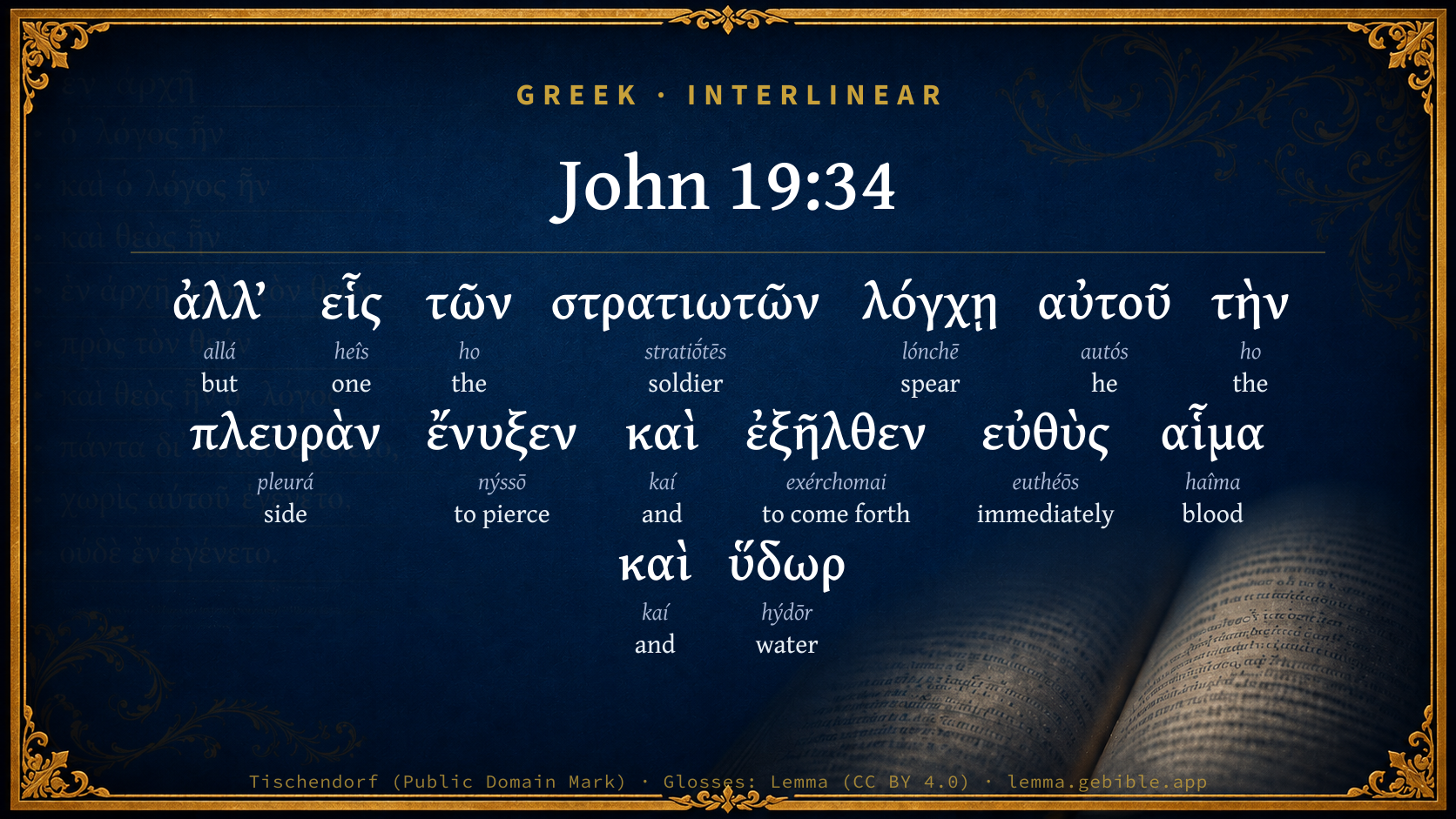
Download image
Cite this verse

John 19:34 (World English Bible). Public Domain. Lemma interlinear Bible study tool, https://lemma.gebible.app/v/john/19/34.

Show BibTeX & RIS
BibTeX
RIS
English Translation
However one of the soldiers pierced his side with a spear, and immediately blood and water came out.
World English Bible · Public Domain
Highlights
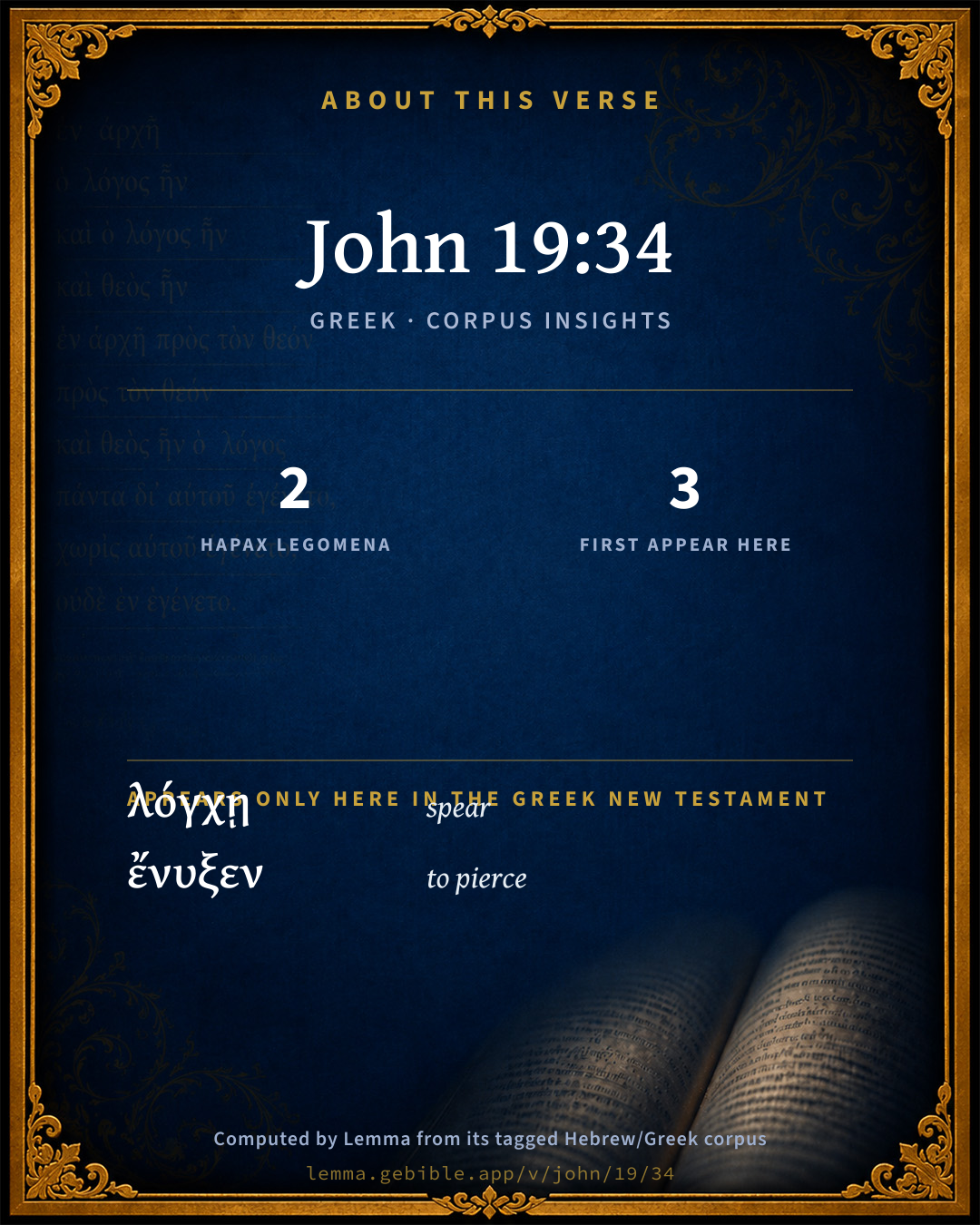
  • 2 hapax legomena — only here in the Greek New Testament
  • 3 first appearances in the Greek New Testament
Full analysis ↓
Download a study sheet

One document with this verse’s original text, its word-by-word gloss line, the meaning frame, cross-references with their text, attributed commentary, and full source and license credits — printable, and it pastes into notes with its structure intact.

This verse Autodidact and up

Study sheet (.html) Plain text (.txt)

A passage Seminary Student

Up to 50 verses in one chapter. A passage sheet keeps up to 6 commentary sources and 12 cross-references per verse, in the order this page ranks them, and says so on the sheet whenever that leaves anything out. Ask for a single verse and you get the Autodidact verse sheet above.

Everything on this page stays free to read, with no account — the sheet is a download of what is already on screen, not access to it.

Want to remove ads? Support Godless Engineer
Compare translations 3

The same verse in 3 English versions, stacked beneath the original-language interlinear above. Click any original word for its lexicon entry.

Each is an independent rendering of the whole verse — the interlinear is not word-aligned to these translations.

Highlighted words mark where these versions differ — a whole-verse word diff, not a word-by-word alignment.

  • World English Bible Public Domain
    However one of the soldiers pierced his side with a spear, and immediately blood and water came out.
  • King James Version Public Domain
    But one of the soldiers with a spear pierced his side, and forthwith came there out blood and water.
  • unfoldingWord Literal Text CC BY-SA 4.0
    However, one of the soldiers pierced his side with a spear, and immediately blood and water came out.

unfoldingWord Literal Text — © unfoldingWord, licensed CC BY-SA 4.0. Word-aligned USFM3 via Door43 (git.door43.org/unfoldingWord/en_ult).

Versions to compare (up to 4)

3 of 4 selected

Show all 19 translations

Every available English version of this verse, each an independent rendering of the whole verse.

  • World English Bible Public Domain
    However one of the soldiers pierced his side with a spear, and immediately blood and water came out.
  • Berean Standard Bible Public Domain
    Instead, one of the soldiers pierced His side with a spear, and immediately blood and water flowed out.
  • Majority Standard Bible Public Domain
    Instead, one of the soldiers pierced His side with a spear, and immediately blood and water flowed out.
  • King James Version Public Domain
    But one of the soldiers with a spear pierced his side, and forthwith came there out blood and water.
  • American Standard Version (1901) Public Domain
    howbeit one of the soldiers with a spear pierced his side, and straightway there came out blood and water.
  • Revised Version (1885) Public Domain
    howbeit one of the soldiers with a spear pierced his side, and straightway there came out blood and water.
  • Geneva Bible (1599) Public Domain
    But one of the souldiers with a speare pearced his side, and foorthwith came there out blood and water.
  • Douay-Rheims (1899) Public Domain
    But one of the soldiers with a spear opened his side, and immediately there came out blood and water.
  • Young's Literal Translation Public Domain
    but one of the soldiers with a spear did pierce his side, and immediately there came forth blood and water;
  • Literal Standard Version CC BY-SA 4.0
    but one of the soldiers pierced His side with a spear, and immediately there came forth blood and water;
  • Unlocked Literal Bible CC BY-SA 4.0
    However, one of the soldiers pierced his side with a spear, and immediately blood and water came out.
  • unfoldingWord Literal Text CC BY-SA 4.0
    However, one of the soldiers pierced his side with a spear, and immediately blood and water came out.
  • Darby Bible Public Domain
    but one of the soldiers pierced his side with a spear, and immediately there came out blood and water.
  • World Messianic Bible Public Domain
    However, one of the soldiers pierced his side with a spear, and immediately blood and water came out.
  • Webster's Bible Public Domain
    But one of the soldiers with a spear pierced his side, and forthwith came out blood and water.
  • Free Bible Version CC BY-SA 4.0
    However, one of the soldiers stuck a spear into his side, and blood mixed with water came out.
  • Bible in Basic English Public Domain
    But one of the men made a wound in his side with a spear, and straight away there came out blood and water.
  • Text-Critical English NT CC BY 4.0
    Instead, one of the soldiers pierced Jesus' side with a spear, and immediately blood and water came out.
  • Tyndale New Testament (1534) Public Domain
    but one of the soudiers with a speare thrust him into the syde and forthwith came ther out bloud and water.

Literal Standard Version (2020), Covenant Press — licensed CC BY-SA 4.0. Text via the HelloAO Bible API (eBible.org). Unlocked Literal Bible (unfoldingWord) — licensed CC BY-SA 4.0. Text via the HelloAO Bible API (eBible.org). unfoldingWord Literal Text — © unfoldingWord, licensed CC BY-SA 4.0. Word-aligned USFM3 via Door43 (git.door43.org/unfoldingWord/en_ult). Free Bible Version, Dr. Jonathan Gallagher — licensed CC BY-SA 4.0. Text via the HelloAO Bible API (eBible.org).

Word by word

More ways to search: Search by grammar → Find every occurrence → Compare this word →

Practice this passage: Drill this verse → Learn its vocabulary →

λόγχῃ
lónchē
G3057
“spear”
Noun, Dative, Singular, Feminine
Part of Speech
Noun
Case
Dative
Number
Singular
Gender
Feminine
Full Thayer's Definition

Origin: perhaps a root word

TDNT: None

1. the iron point or head of a spear 2. a lance, spear (a shaft armed with iron)
  1. ἀλλ’ allá G235 “but” Conjunction
  2. εἷς heîs G1520 “one” Adjective, Nominative, Singular, Masculine
  3. τῶν ho G3588 “the” Article, Genitive, Plural, Masculine
  4. στρατιωτῶν stratiṓtēs G4757 “soldier” Noun, Genitive, Plural, Masculine
  5. αὐτοῦ autós G846 “he” Personal pronoun, Genitive, Singular, Masculine
  6. τὴν ho G3588 “the” Article, Accusative, Singular, Feminine
  7. πλευρὰν pleurá G4125 “side” Noun, Accusative, Singular, Feminine
  8. ἔνυξεν nýssō G3572 “to pierce” Verb, Aorist, Active, Indicative, 3rd person, Singular
  9. καὶ kaí G2532 “and” Conjunction
  10. ἐξῆλθεν exérchomai G1831 “to come forth” Verb, Aorist, Active, Indicative, 3rd person, Singular
  11. εὐθὺς euthéōs G2112 “immediately” Adverb
  12. αἷμα haîma G129 “blood” Noun, Nominative, Singular, Neuter
  13. καὶ kaí G2532 “and” Conjunction
  14. ὕδωρ hýdōr G5204 “water” Noun, Nominative, Singular, Neuter

About this verse

These counts appear in no published source. They are computed here, from the morphology-tagged text and Lemma’s own curated glosses. What Lemma adds →

15
words
13
distinct lemmas
Gospels
section

Notable vocabulary

2 hapax legomena — words that appear only here in the entire Greek New Testament:

  • λόγχῃ spear G3057
  • ἔνυξεν to pierce G3572

First appearance in Scripture

These words make their first canonical appearance in the Greek New Testament here:

  • λόγχῃ spear G3057
  • πλευρὰν side G4125
  • ἔνυξεν to pierce G3572

Shared distinctive vocabulary

πλευρὰν side G4125 occurs in 5 verses of the Greek New Testament. Also found in:
Repetition

Words recur within this verse:

Cross-references

21

Topical passages linked to John 19:34 in the Treasury of Scripture Knowledge — connected by theme and wording, ordered by reader-vote popularity; previews shown in the World English Bible.

  • 1 John 5:6 This is he who came by water and blood, Jesus Christ; not with the water only, but with the water and the blood. It is the Spirit who testifies, because the Spirit is the truth.
  • Zechariah 12:10 I will pour on the house of David, and on the inhabitants of Jerusalem, the spirit of grace and of supplication; and they will look to me whom they have pierced; and they shall mourn for him, as one mourns for his only son, and will grieve bitterly for him, as one grieves for his firstborn.
  • Zechariah 13:1 "In that day there will be a spring opened to the house of David and to the inhabitants of Jerusalem, for sin and for uncleanness.
  • 1 John 5:8 the Spirit, and the water, and the blood; and the three agree as one.
  • Ezekiel 36:25 I will sprinkle clean water on you, and you shall be clean: from all your filthiness, and from all your idols, will I cleanse you.
  • Titus 3:5–7 not by works of righteousness, which we did ourselves, but according to his mercy, he saved us, through the washing of regeneration and renewing by the Holy Spirit,
  • Revelation 7:14 I told him, "My lord, you know." He said to me, "These are those who came out of the great tribulation. They washed their robes, and made them white in the Lamb's blood.
  • Ephesians 5:26 that he might sanctify it, having cleansed it by the washing of water with the word,
  • Revelation 1:5 and from Jesus Christ, the faithful witness, the firstborn of the dead, and the ruler of the kings of the earth. To him who loves us, and washed us from our sins by his blood;
  • Psalms 51:7 Purify me with hyssop, and I will be clean. Wash me, and I will be whiter than snow.
  • Matthew 27:62 Now on the next day, which was the day after the Preparation Day, the chief priests and the Pharisees were gathered together to Pilate,
  • John 13:8–10 Peter said to him, "You will never wash my feet!" Jesus answered him, "If I don't wash you, you have no part with me."
  • 1 Corinthians 1:30 But of him, you are in Christ Jesus, who was made to us wisdom from God, and righteousness and sanctification, and redemption:
  • 1 Corinthians 6:11 Such were some of you, but you were washed. But you were sanctified. But you were justified in the name of the Lord Jesus, and in the Spirit of our God.
  • Titus 2:14 who gave himself for us, that he might redeem us from all iniquity, and purify for himself a people for his own possession, zealous for good works.
  • Hebrews 9:13 For if the blood of goats and bulls, and the ashes of a heifer sprinkling those who have been defiled, sanctify to the cleanness of the flesh:
  • Hebrews 9:22 According to the law, nearly everything is cleansed with blood, and apart from shedding of blood there is no remission.
  • Hebrews 10:19–22 Having therefore, brothers, boldness to enter into the holy place by the blood of Jesus,
  • 1 Peter 3:21 This is a symbol of baptism, which now saves you-- not the putting away of the filth of the flesh, but the answer of a good conscience toward God, through the resurrection of Jesus Christ,
  • 1 John 1:6–9 If we say that we have fellowship with him and walk in the darkness, we lie, and don't tell the truth.
  • Acts 22:16 Now why do you wait? Arise, be baptized, and wash away your sins, calling on the name of the Lord.'

Cross-references courtesy of OpenBible.info (CC BY 4.0).

Commentary

Notes on John 19:34 from classic Christian and Jewish commentators (each source and its license shown beneath its notes). The classic Christian expositions comment on the surrounding passage and are grouped to its opening verse, so a note may address several verses; the Jewish commentaries on the Tanakh (Rashi and others) are per-verse, so they appear only where the commentator wrote on this verse.

Lemma curates 59 commentaries, every one of them public domain or Creative Commons licensed, each selected and text-cleaned for this edition rather than reprinted as found. About our sources →

Albert Barnes' Notes on the Bible

One of the soldiers - One of those appointed to watch the bodies until they were dead. This man appears to have doubted whether he was dead, and, in order to see whether he was not yet sensible, he pierced him with his spear. The Jews designed that his legs should be broken, but this was prevented by the providence of God; yet in another way more satisfactory proof was obtained of his death than would have been by the breaking of his legs. This was so ordered, no doubt, that there might be the fullest proof that he was truly dead; that it could not be pretended that he had swooned away and revived, and so, therefore, that there could not be the least doubt of his resurrection to life.

With a spear - The common spear which soldiers used in war. There can be no doubt that such a stroke from the strong arm of a Roman soldier would have caused death, if he had not been already dead; and it was, doubtless, to furnish this conclusive proof that he was actually dead, and that an atonement had thus been made for mankind, that John mentions so particularly this fact. Let the following circumstances be remembered, showing that death must have ensued from such a wound:

The Saviour was elevated but a little from the ground, so as to be easily reached by the spear of a soldier.

(2)The wound must have been transversely upward, so as to have penetrated into the body, as he could not have stood directly under him.

(3)It was probably made with a strong arm and with violence.

(4)The spear of the Roman soldier was a lance which tapered very gently to a point, and would penetrate easily.

(5)The wound was comparatively a large wound. It was so large as to admit the hand Joh 20:27; but for a lance thus tapering to have made a wound so wide as to admit the hand, it must have been at least four or five inches in depth, and must have been such as to have made death certain. If it be remembered that this blow was probably in the left side, the conclusion is inevitable that death would have been the consequence of such a blow. To make out this fact was of special importance, probably, in the time of John, as the reality of the death of Jesus was denied by the Gnostics, many of whom maintained that he died in appearance only.

Pierced his side - Which side is not mentioned, nor can it be certainly known. The common opinion is that it was the left side. Car. Frid. Gruner (Commentatio Antiquaria Medica de Jesu Christi Morte, 30-36) has attempted to show that it must have been the left side. See Wiseman’s Lectures, pp. 161, 162, and Kuinoel on Joh 19:34, where the arguments of Gruner are fully stated. It is clear that the spear pierced to the region of the heart.

And forthwith came ... - This was evidently a natural effect of thus piercing the side. Such a flowing of blood and water makes it probable that the spear reached the heart, and if Jesus had not before been dead, this would have closed his life. The heart is surrounded by a membrane called the pericardium. This membrane contains a serous matter or liquor resembling water, which prevents the surface of the heart from becoming dry by its continual motion (Webster). It was this which was pierced and from which the water flowed. The point of the spear also reached one of the ventricles of the heart, and the blood, yet warm, rushed forth, either mingled with or followed by the water of the pericardium, so as to appear to John to be blood and water flowing together. This was a natural effect, and would follow in any other case. Commentators have almost uniformly supposed that this was significant; as, for example, that the blood was an emblem of the eucharist, and the water of baptism, or that the blood denoted justification, and the water sanctification; but that this was the design there is not the slightest evidence.

It was strictly a natural result, adduced by John to establish one fact on which the whole of Christianity turns that he was truly dead. On this depends the doctrine of the atonement, of his resurrection, and all the prominent doctrines of religion. This fact it was of importance to prove, that it might not be pretended that he had only suffered a syncope, or had fainted. This John establishes. He shows that those who were sent to hasten his death believed that he had expired; that then a soldier inflicted a wound which would have terminated life if he had not been already dead; and that the infliction of this wound was followed by the fullest proof that he had truly expired. On this fact he dwells with the interest which became a subject of so much importance to the world, and thus laid the foundation for undoubted assurance that the Lord Jesus died for the sins of men.

Albert Barnes' Notes on the Bible (1834–1885) — public domain. Text from a community e-Sword/MySword module.

The Biblical Illustrator

Joseph S. Exell

Joh_19:34

One of the soldiers with a spear pierced His side

The piercing of Christs side

I.

IT WAS AN ACT OF INSULT AND INDIGNITY TO HIS PERSON. To this, indeed, He was no stranger. In the hall of Pilate, and on the cross He encountered indignities of the cruellest kind. But, beyond the moment of death, the malice of His enemies pursued Him. We cannot behold the body, which the Holy Spirit had prepared, thus mangled, without the deepest sorrow and humiliation. We could not see the body of a convicted malefactor thus insulted without the deepest pity. He was wounded for our transgressions. Let us look to Him whom we pierced, and mourn because of Him. And let the believing contemplation of the wounds of Jesus teach us submission under the varied ills and sorrows of our own earthly lot.

II. IT ASCERTAINS, AND PLACES BEYOND QUESTION, THE REALITY OF HIS DEATH. On this some of the most important truths depend.

1. If He had not actually expired, there would have been no sacrifice at all. The true nature of a sacrifice is the actual dying of the victim. If, therefore, the death of Jesus were not put beyond all question, His doctrine might enlighten, and His example direct us, but we should have no assurance that an actual and efficient atonement had been made for sin.

2. The reality of our Lords death is essential to the confirmation of the hopes which are founded on His resurrection. If we could not show that death had actually taken place, our preaching would be vain, your faith would be vain, and you would be yet in your sins. The piercing of His side put His death beyond question. Believing that He both died, and rose, and revived, we look up to Him with sacred satisfaction and joy, and adore Him as Lord both of the dead and of the living.

III. IT WAS THE FULFILMENT OF ANCIENT PROPHECIES.

1. With respect to the first of these, it is obvious, that it is the prescription in reference to the Paschal Lamb that is pointed to. The executioner breaks the legs first of the one malefactor, and then of the other; but why does he stop short? Nobody interferes to arrest the fatal blow. But had it fallen the pretensions of Jesus to be the antitype of the Paschal Lamb, and consequently the Messiah of Israel, would have been for ever annulled. While, therefore, the executioner proceeds to do his work, an invisible Power interposed to restrain him. The honour of Gods Son was at stake--the comfort of the Church was in peril--the mission of Jesus must beestablished by the fulfilment of prophecy.

2. Nor is the piercing of His side a less remarkable fulfilment. In the accomplishing of the one, the soldier abstains from doing to Jesus what he had done to the others, and what he had been told to do to all; while, in accomplishing the other prophecy, another soldier does to him what he did not do to the others, and what he was not told to do. And by this opposite conduct of two Roman soldiers were two memorable predictions of Gods Word accomplished.

IV. IT WAS AN EMBLEM OF THE EXPIATORY AND PURIFYING VIRTUE OF HIS SACRIFICE. The piercing of his Masters side, and the issuing of blood and water from the wound, made a deep and abiding impression on the mind of John, and we find him recurring to it in his first Epistle (verse 6). This is He who came by water and blood. In all languages water has been employed as an emblem of moral cleansing, while the universal prevalence of sacrifice has made blood the proper symbol of expiation. (J. Johnston.)

The piercing of Christs side

I. THE OCCASION. The scrupulosity of the Jews, which teaches us

1. That superstition is fuller of ceremony than of mercy.

2. That the worst of men are usually very solicitous about external worship.

3. That malefactors are not to be taken out of the hands of justice, and left to the malice of the executioner or the fury of the multitude. They had to ask leave of Pilate for the additional punishment.

4. That when a man once gives himself up to please men there is no end to his compliance. Pilate who began by consenting to scourge Christ ends by signing an order for the breaking of His legs.

5. That Christ was willing to die for us, hence He died before the usual time. Had His legs been broken His death would have seemed the effect of violence rather than His own resignation (Joh_10:18).

II. THE CIRCUMSTANCE.

1. AS an act of Christs love and condescension, that He would expose His body to the malice and violence of wicked men. He might have dried up the soldiers arm as He did Jeroboams; but by this stroke Christ would have His heart opened to show how full of love He is to sinners. As at the beginning Adams side was opened and Eve was taken out of it; so is the Church out of Christs side. In this circumstance there is

(1) Hope for all wounded sinners. It is said of those converts (Act_2:37) that they were pricked to their hearts. Christs heart is wounded that they might be healed. This is the cleft of the rock in which guilty men may find refuge when wrath makes inquisition for sinners.

(2) Matter of thankfulness. Soldiers to endear themselves to their country are wont to show their scars received in public service: so Christ (Joh_20:27). In the sacrament these things are presented to faith.

2. As a certain pledge of Christs death. The flowing of blood and water shows that the pericardium was pierced. So His enemies could not say that He was half dead, and that His resurrection was but a reviving out of a swoon. Upon this is based the Resurrection and all its benefits, and the fulness of the expiation which Christ offered to justice.

3. As a Divine necessity. Christ was to die

(1) As a Surety. We deserved death, but our Surety was to pay our debt. This Christ did (1Pe_3:18; 1Ti_2:6).

(2) As a Testator or Maker of the New Testament. We could never have had the benefit of the Covenant if Christ had not died (Heb_9:16). (T. Manton, D. D.)

Forthwith came there out blood and water

Blood and water

In the water and the blood are represented the most essential elements of salvation. The water has a remote reference to baptism, but it chiefly symbolizes the moral purifying power of the word of Christ. The blood points out the ransom paid for our guilt, as well as the atoning sacrifice. The blood flowed separately from the water; justification must not be mingled with, much less substituted for, personal amendment. (F. Krummacher.)

The physical cause of the death of Christ

Since Dr. Stroud published his work on The Physical Causes of Christs Death, we have met with no doubt expressed as to the death of Christ having immediately resulted from rupture of the heart. Joy, or grief, or anger, suddenly or intensely excited, have often been known to produce this effect. The heart, which the universal language of mankind has spoken of as peculiarly affected by the play of the passions, has been found in such cases to have been rent or torn by the violence of its own action. The blood issuing from the fissure thus created has filled the pericardium, or sac, by which the heart is enclosed, and by its pressure has stopped the action of the heart (Dr. Hanna). Common sorrow can, in its sudden extremity, break hearts; why may not that sorrow, deep beyond all other sorrows, have broken His? We believe it did. Now, when blood escapes from its vessels, within a short time it coagulates, its watery part separating from the rest; and there would be, so science tells us, within an hour or two after death such a flow of blood and water from a piercing as that which John saw. The late Sir James Simpson has said on this matter: It has always appeared, to my medical mind at least, that this mode by which death was produced in the human body of Christ intensifies all our thoughts and ideas regarding the immensity of the astounding sacrifice which He made for our sinful race on the cross. Nothing can possibly be more striking and startling than the appalling and terrific passiveness with which God as man submitted, for our sakes, His incarnate body to all the horrors and tortures of the Crucifixion. But our wonderment at the stupendous sacrifice only increases when we reflect that, whilst enduring for our sins the most cruel and agonizing form of corporeal death, He was ultimately slain, not by the effects of the anguish of His corporeal frame, but by the effects of the mightier anguish of His mind; the fleshly walls of His heart, like the veil, as it were, in the Temple of His human body, becoming rent and riven, as for us He poured out His soul unto death. The travail of His soul in that awful hour thus standing out as unspeakably bitterer and more dreadful than the travail of His body. (C. Stanford,D.D.)

The Biblical Illustrator, edited by Joseph S. Exell (c. 1880s–1900s) — public domain. Text from a community e-Sword module.

Tyndale Open Study Notes

Tyndale Open Resources

19:34 To confirm that Jesus was dead, a Roman soldier pierced his side with a spear. • blood and water flowed out: This has several levels of meaning: (1) The spear probably punctured Jesus’ pericardium, the sac around the heart, releasing these fluids. (2) John might have been thinking of more Passover symbolism. The Passover lamb’s blood had to flow as it died. (3) The water flowing from Jesus’ side reminds readers of the language of living water that Jesus had used earlier (see 4:10-14; 7:37-39).

Tyndale Open Study Notes — © Tyndale Open Resources, licensed CC BY-SA 4.0. Text via the HelloAO Bible API.

Bengel's Gnomon

Johann Albrecht Bengel

Joh 19:34. Λὁγχῃ, with a lance or spear) which would not [i.e. in such a way as that he did not] touch Jesus’ bones. Yet the wound was a large open one, wide enough to hold in it not merely a finger, but the whole hand: ch. Joh 20:27, Jesus said to Thomas, “Thrust thy hand into My side:” and an altogether deadly wound, if it were inflicted on any living person.—πλευρὰν, side) the left side perhaps. Comp. Psa 91:7.—εὐθέως ἐξῆλθεν αἷμα καὶ ὕδωρ, forthwith there came out blood and water) That blood came out was strange; that water also came out was still more so; that both came forthwith, at the one time, and yet distinct from one another, was most marvellous of all. From what quarter of the body the blood and water came, from the chest, or from the heart, or from some other part, who will define? The water was pure and real, just as the blood was pure and real: and the water is said to have flowed after the blood, that it might be perceived that the Saviour had wholly poured Himself out. Psa 22:15 (14), “I am poured out like water.” The verb ἐξῆλθεν may be either translated by the Singular [agreeing with each subject, αἷμα and ὓδωρ, separately] or by the Plural [the two neuter nouns being taken as a collective Plural, agreeing with the verb Singular]. The asseveration of the Evangelist, who was at the same time a Spectator and a Witness, shows both the truth and the greatness of the miracle and of the mystery. Comp. 1Jn 5:6; 1Jn 5:8, note, [“This is He that came by water and blood—not by water only, but by water and blood—There are three that bear witness on earth, the Spirit, and the water, and the blood.” Not merely did He undertake the office of fulfilling all righteousness, by submitting to baptism, Mat 3:15, but consummated what He undertook by having shed His blood, Joh 19:30; Joh 19:34.]

Bengel's Gnomon of the New Testament — English translation (T&T Clark, Edinburgh, 1860) — public domain. Text from a community e-Sword module.

Meyer's Critical & Exegetical Commentary

Heinrich August Wilhelm Meyer

Joh_19:34. The soldiers, when they saw, etc. The death of Jesus, in keeping with their attitude of indifference in the matter, had therefore been unobserved by them (in answer to Hengstenberg); they now omitted the leg-breaking in His case, as aimless in the case of one already dead. But one pierced Him with a lance in the side. Wherefore? Not in order to ascertain whether He was actually dead; for, according to the context, the thrust took the place of breaking the legs. Hence it must be assumed, according to the analogy of the latter, that the object of the thrust was to make quite sure of the death of Jesus, i.e. in case He should not yet be altogether dead, to put Him completely to death.

αὐτοῦ τ. πλευράν] His side. Which? is not clear; but the left, if he who dealt the thrust stood before the cross, was most naturally at hand.

ἔνυξε] Neither the word itself (since νύσσειν ordinarily denotes violent thrusting or stabbing; especially frequent in Homer, see Duncan, ed. Rost, p. 796), nor the person of the rude soldier, nor the weapon (lance, belonging to the heavy armour, Eph_6:11), nor the purpose of the thrust, nor the palpable nature of the opening of the wound, to be assumed, according to Joh_20:27, nor ἐξεκέντησαν, Joh_19:37, admit the interpretation, which is implied in the interest of an apparent death, of a superficial scratch (Paulus).

αἷμα κ. ὕδωρ] is, considering the difference and significance of the two substances, certainly not to be taken as a hendiadys (a reddish lymph, Paulus[251]). Whether the blood and water issued forth contemporaneously or after one another, does not appear from the words. In the natural[252] mode of regarding this twofold issue, it is thought either (1) that Jesus was not yet dead, but simply died in consequence of the thrust, which pierced the pericardium with its watery lymph, and at the same time the chamber of the heart, from which the blood welled (so the two physicians Gruner in the Commentat. de Jesu Chr. morte vera non simulata, etc., Halle 1805), to which, however, the mode of contemplation of the entire apostolical church is opposed, which was certain, and had the personal testimonies of Christ Himself to the fact that in His crucifixion itself the putting to death was accomplished. Or (2) it is assumed that the blood had been decomposed in the corpse (Hase, Krabbe, and several others), so that serum, bloody water, and placenta, clots of blood, separately issued forth; which separate outflow, however, of the constituent parts of blood cannot, in the case of a fresh body that had been healthy, be anatomically established. Or (3) the heart is considered, just as the Gruners suppose, as having been pierced through, though the death of Jesus is assumed to have already previously taken place (Beza, Calvin, Grotius, Wetstein, and several others), as also Ewald, Gesch. Chr. p. 584 (the death of Jesus was a sudden breaking of the heart), holds to be most probable. Not substantially different is the view of the English physician William Stroud, A Treatise on the physical cause of the death of Christ, London 1847, comp. Tholuck, who, besides the cavity of the heart, brings into consideration also the two bags of the diaphragm, with the fact of their fluidity in corpses. This mode of regarding the matter renders unnecessary the entirely arbitrary theory of Ebrard, p. 563 ff., of extravasations and sugillations which the thrust occasioned,[253] and would be quite satisfactory if John had desired to give an account generally of a natural, physiological effect of the lance-thrust. But irrespective of the fact that he adduces nothing which would allow us to think in ὕδωρ not of actual water, but of lymph (ἰχώρ), he desires to set forth the phenomenon manifestly as something entirely unexpected (note also the εὐθύς), extraordinary, marvellous. Only thus is his solemn asseveration in Joh_19:35, and the power of conviction for the Messiahship of Jesus, which he finds in the truth of the ἐξῆλθεν, κ.τ.λ., to be comprehended. To him it was not a subsidiary circumstance (Ebrard, comp. Lücke on Joh_19:35, and Baeumlein), which convinced the soldier who gave the thrust of the death of the Crucified One, but a miraculous σημεῖον, which further set forth that the corpse was that of the divine Messiah (τρανῶς διδάσκον, ὅτι ὑπὲρ ἄνθρωπον ὁ νυγείς, Euth. Zigabenus), of whose specific calling and work, blood and water are the speaking symbols, in so far, that is, as He has by blood brought the redemptive work to completion, and by means of water (i.e. by means of the birth from above, which takes place through baptism, Joh_3:5) has appropriated it; a significance which Tholuck also esteems probable in the sense of the Gospel. Comp. also Steinmeyer, who, however, ascribes to the water only the subordinate purpose, to place the blood under the point of view of the definite (purifying) operation. Luther: our redemption is concealed in the miraculous work. Comp. 1Jn_5:6, where, however, τὸ ὕδωρ, agreeably to the standard of the historical point of view (ἐλθών), stands first. See also Weiss, Lehrbegr. p. 255. We must abide by this exegetical conclusion[254] (comp. Hengstenberg on Joh_19:37), and must renounce the demonstration of natural connection not less than in other miraculous appearances of the evangelical history.[255] The figurative interpretation or explaining away of the fact itself (Baur, p. 217 ff.: by reference to Joh_7:38-39 : it is the representation, contemplated by the writer in a spiritual manner, of the idea that with the death of Jesus there immediately begins the fulness of spiritual life, which was to proceed from Him on behalf of the world) is only possible on the assumption that neither John nor He gave an historical account, as further Baur (see p. 272 ff.), whom Scholten follows, refers the entire narrative of the omission to break the legs, and of the side-thrust, simply to the dogmatic interest of representing Jesus as the true Paschal lamb, and thereby the turning-point at which the O. T. economy of religion ceased to exist, and the new began, the essence of which is contemplated in the blood and water that flowed out. See in opposition to Baur: Grimm in the Stud. u. Krit. 1847, p. 181 ff., and 1849, p. 285 ff.

[251] To this conclusion Hofmann also (Weissag. u. Erfüll. II. p. 148 f.) again involuntarily returned, understanding undecomposed, still flowing blood, as a sign that the body of Jesus was exempt from corruption. See, in opposition, also Luthardt. But Hofmann, in his Schriftbew. II. 1, p. 490, has renounced the above interpretation, and now has represented the matter thus: the bleeding away of the dead one had been so complete, that at last not blood, but water flowed, and this was to the apostle a proof that Jesus corpse remained exempt from corruption, which begins with the decomposition of the blood. Comp. also Baumgarten, p. 423 f., and Godet. But so physiological an observation and conclusion is not to be adopted without some more precise indication; and of the complete bleeding away on which, finally, water flowed, the text says nothing, but speaks simply and solely of blood and water, which issued forth.

[252] In a natural way, but in a higher sense, Lange, II. p. 1614 f., explains the phenomenon from the process of change through which the body of Christ was passing. A precarious expedient, in which not only is the possibility of a clear representation wanting, but also the essential and necessary point of the reality of the death, as of the condition of separation from the body, is endangered, and instead of the death, the beginning of another modality of corporeal life is conceived; while, generally also, the process of this assumed change must have been passed through in a very material way. Besides, the body of the Risen One had not yet been transformed (He still eats, still drinks, etc.), though altered and become more spiritual, but the transformation first begins at the ascension (comp. 1Co_15:51-53). A possible preparation for this transformation from the moment of death onwards is beyond the scope of any more exact representation, and very precipitate is the conclusion that this preparation must also have announced itself by some sign in the wounded body.

[253] They originated, he thinks, through the distension of the muscles, and from them the water issued; but in penetrating deeper the lance also touched places of fluid blood.But in this way not αἷμα καὶ ὕδωρ, but ὕδωρ καὶ αἷμα would have issued forth.

[254] Fathers and artists have decked it out in monstrous colours, e.g. Nonnus, διδύμαις λιβάδεσσιν, first blood, then θέσκελον ὕδωρ flowed; Prudentius, Enchir. John 42: both sides were pierced; from one blood, from the other water flowed. See also Thilo, ad Cod. Apocr. p. 587 f. In the two substances the two sacraments were symbolically seen, as Augustine, Chrysostom, and many others; Tertullian, Euth. Zigabenus, and several others saw therein the baptism of water and the baptism of blood. Comp. Cornelius a Lapide in loc. Baptism and the Lords Supper have also recently been found set forth in several ways in water and blood. See particularly Weisse, II. p. 326 f. In this way historic truth is of course given up. Hilgenfeld, Evang. p. 317: The redemptive death is the condition of the Christian sacrament generally, which here in its twofold form figuratively flows forth from the body of the crucified One. This, he thinks, naturally suggested itself to John, since according to his representation Jesus was the true paschal sacrifice, the recognition of which in the Gentile world is brought into view by the lance-thrust of the Roman soldier. Other arbitrary explanations in Strauss.

[255] The symbolic signification in regard to the true expiatio, and the true lavacrum, is also assumed by Calvin; but he disputes the supernatural element in the fact: naturale enim est, dum coagulatur sanguis, omisso rubore fieri aquae similem.

Meyer — Critical and Exegetical Commentary on the New Testament — English translation by Peter Christie, edited by Frederick Crombie (T&T Clark, 1880) — public domain. Text from a community e-Sword module.

Expositor's Greek Testament

ed. W. Robertson Nicoll

Joh 19:34 . But one of the soldiers λόγχῃ αὐτοῦ τὴν πλευρὰν ἔνυξε , “pierced His side with a spear”. But Field prefers “pricked His side” to keep up the distinction between ἔνυξε (the milder word) and ἐξεκέντησε (Joh 19:37 ). He favours the idea of Loesner that the soldier’s intention was to ascertain whether Jesus was really dead, and he cites a very apt parallel from Plutarch’s Cleomenes , 37. But ἔγχεϊ νύξε occurs in Homer ( Il. , John v. 579), where death followed, and as the wound inflicted by this spear thrust seems to have been a hand-breadth wide (Joh 20:25 ) it may be presumed the soldier meant to make sure that Jesus was dead by giving Him a thrust which itself would have been fatal. The weapon with which the blow was inflicted was a λόγχη , the ordinary Roman hasta , which had an iron head, egg-shaped, and about a hand-breadth at the broadest part. Following upon the blow εὐθὺς ἐξῆλθεν αἷμα καὶ ὕδωρ . Dr. Stroud ( Physical Cause of the Death of Christ ) advocates the view that our Lord died from rupture of the heart, and thus accounts both for the speedy cessation of life and for the effusion of blood and water. Previous literature on the subject will be found in the Critici Sacri and select passages in Burton’s Bampton Lec. , 468 9. Without physiological knowledge John records simply what he saw, and if he had an eye to the Docetae, as Waterland (John v. 190) supposes, yet his main purpose was to certify the real death of Jesus. The symbolic significance of the blood and water so abundantly insisted on by the Fathers (see Burton, B. L. , 167 72, and Westcott’s additional note) is not within John’s horizon.

The Expositor's Greek Testament, edited by W. Robertson Nicoll (1897–1910) — public domain. Text from a community e-Sword module.

International Critical Commentary

34. This verse was introduced into St. Matthew’s Gospel at an early period. אBCLΓ, with some cursives, the Ethiopic vs., and several “mixed” Latin texts of the British and Irish type, supply at the end of Mat 27:49 the words ἄλλος δὲ λαβὼν λόγχην ἔνυξεν αὐτοῦ τὴν πλευράν, καὶ ἐξῆλθεν ὓδωρ καὶ αἷμα. Mt. represents one of the bystanders (εἷς ἐξ αὐτῶν) as offering Jesus the sponge of vinegar, while others were for waiting to see if Elijah would come to save Him. Then he adds the incident about the piercing of the Lord’s side, the apparent inference being that it was to render fruitless any intervention on the part of Elijah. As the verse occurs in Mt., it represents Jesus as alive, His death following with a loud cry immediately after the piercing. It has been held that Chrysostom supports this view; but an examination of his homily on Mat 27:49 will show that it is not so, despite some confusion in the order of his comments. For although he mentions the piercing immediately after the giving of the vinegar, he adds: “What could be more brutal than these men, who carried their madness so far as to insult a dead body”; a comment which he briefly repeats on Joh 19:34. Tatian has also been cited in support of the interpolation at Mat 27:49, but there is no trace of it in the Diatessaron. The probability is that εἷς ἐξ αὐτῶν of Mat 27:48 recalled to a copyist εἷς τῶν στρατιωτῶν of Joh 19:34 and suggested the interpolation. Perhaps Jn.’s ἀλλʼ εἷς was read as ἄλλος by the scribe of Mt. The theory that the passage was part of the original Mat_1 (being omitted by the Syriac and O.L. vss. because of its inconsistency with Jn.), and that Jn. here silently corrects Mt. by placing the incident in its true context, is improbable, for there is no evidence to prove that Jn. knew Mt. at all.2

The rendering of the Latin Vulgate aperuit in this verse depends on a corruption of the Greek text. The true Greek reading is ἔνυξεν “pricked,” which is the basis of most of the O.L. vss., pupugit, perfodit, inseruit, etc. But the O.L. codices f and r have aperuit, which presumably indicates a Greek variant ἤνοιξεν “opened.” This was adopted by Jerome, and is supported by the Peshitta and the Jerusalem Syriac. But for the Greek ἤνοιξεν there is no MS. authority. Cod. 56 has ἤνυξε; Cod. 58 has ἔμυξε (corr. to ἔνυξε by a second hand); Cod. 68, the Evangelisteria 257, 259, and (according to Tischendorf) Cod. 225 have ἔνοιξε, all of which are natural corruptions of ἔνυξε, and it is plain that ἤνοιξεν was another corruption of the same kind.1

εἷς τῶν στρατιωτῶν. Jn.’s general usage is to write εἷς ἐκ τῶν … (see on 1:40), but at 12:4, 18:22 as well as here ἐκ is omitted. Tradition gives the name Longinus to this soldier, probably because of the λόγχη (ἄπ. λεγ. in N.T.) or lancea which he carried.

νύσσειν (ἃπ. λεγ. in N.T.) is “to prod,” and is generally used of a light touch (e.g. Ecclus. 22:19 of pricking the eye, and 3 Macc. 5:14 of “prodding” a sleeping person to awake him). Field quotes a passage from Plutarch (Cleom. 37) where it is used of touching a man with a dagger to ascertain if he were dead, and he suggests that it is used similarly here.

On the other hand, νύσσειν is used of a spear wound which kills a man (e.g. Josephus, Bell. Jud. III. 7:35; cf. Acta Thomœ, § 165), and 20:25 indicates that the wound made in Jesus’ side was a large one. Origen (in Mat 27:54) seems to say that a lance thrust was sometimes given as a coup de grâce to hasten the death of those who had been crucified. The language of the text suggests that the soldier was determined to make sure that Jesus was dead.

The λόγχῃ was a long slender spear, not so heavy as the ὓσσος (see v. 29) or pilum which was the usual weapon of the Roman legionaries. The ὓσσος had a barbed iron head, which would inflict a wide and deep wound. If we are to press the use of λόγχη here, it would fall in with the idea, which has been put forward, that the soldier’s act was a mere gesture as he passed; that he perceived Jesus to be dead, and so, without any special purpose, prodded the Body with his lance, the touch being possibly a light one.

The Ethiopic version (sæc. vi.) says that it was the right side of the Body that was pierced. This was widely accepted in ancient times (see e.g. Acta Pilati, B. xi.), and the incident is frequently represented thus in art, e.g. in the sixth-century Syriac Evangeliarium of Rabula at Florence.2 The verse Joh 19:34 is recited at the mixing of the chalice in several Eastern liturgies; and in the Liturgy of St. Chrysostom the rubric preceding its recitation has the words, νύττων δὲ αὐτὸν ἐν τῷ δεξίῳ μέρει μετὰ τῆς λόγχης κτλ.3

ἐξῆλθεν εὐθύς. So אBLNW (cf. 13:30); the rec. has εὐθὺς ἐξῆλθεν. There is emphasis on εὐθύς; the “blood and water” flowed immediately. See on 5:9, and on 1:22.

That there should be a flow of blood from a dead body, when pierced with a spear, is abnormal; and various physical explanations have been offered. W. Stroud1 suggested that the death of Jesus had been caused by rupture of the heart (which explains why it came so soon after His Crucifixion), and that the “blood and water” were the separated clot and serum of the escaped blood in the pericardial sac, which the lance had pierced. This assumes that the wound was on the left side, of which there is no evidence, tradition (whatever it be worth) indicating the right side.

Stroud’s arguments have not approved themselves to all physicians. It is objected, e.g. by Dr. C. Creighton,2 that “the blood escaping into a serum cavity from rupture of a great organ” does not show any tendency to separate into clot and serum, “but remains thick dark-red blood.” Creighton suggests that the stroke of the spear may have been only a light touch (see above), directed to “something on the surface of the body, perhaps a discoloured wheal or exudation, such as the scourging might have left”; and that it “was a thoughtless rather than a brutal act,” Jesus already being dead. “Water not unmixed with blood from some such superficial source is conceivable, but blood and water from an internal source are a mystery.”

We have hardly sufficient data to reach an exact conclusion as to the cause of the gushing forth of blood and water from the wound; or as to the time—possibly a very short interval— which had elapsed since the Death of Jesus; but that blood and water were observed to flow is not doubtful.

It has, however, been frequently urged (e.g. by Westcott and Godet) that we must not expect a complete physical explanation of this incident; inasmuch as, according to the apostolic teaching, the Body of Christ did not suffer corruption after His Death (cf. Act 2:31). He truly died (see on v. 30), but the physical changes which succeed death in our experience did not necessarily follow in His case. We may not assume that the Death of Christ was exactly like the death of an ordinary human being. This view of the matter was put forward by Origen. In dead bodies, he says, blood is clotted and water does not flow; but from the dead Body of Christ blood and water issued, and here was a miracle.3

The language of Jn. is compatible with this interpretation. In that case, the solemn attestation of v. 35 was added because Jn. regarded the incident as so extraordinary as to be difficult of credence. It had not been narrated by earlier evangelists, and exceptionally good testimony would be necessary if it were to be believed.

But it is more probable that Jn. regards the flow of blood and water from the pierced side of Jesus as a natural phenomenon, which he specially notes because he wishes to refute the Docetic doctrines prevalent when the Gospel was composed.1 Alike in the Gospel and in the First Epistle he is anxious to lay stress on the true humanity of Christ (see on 1:14); and when telling of the Passion he would guard against the Docetism which treated the Body of Jesus as a mere phantom. We know from the second-century Acts of John, as well as from other sources, something of the curious teaching which denied humanity to Christ and explained His Crucifixion as an illusion. In this Docetic work (§ 101), Jesus is actually represented as saying that there was no real flow of blood from His Body; αἷμα ἐξ ἐμοῦ ῥεύσαντα καὶ οὐκ ἔρευσεν. In opposition to teaching of this kind, which goes back to the first century, Jn. is earnest in explaining that the Death of Jesus was a human death; His Body bled when it was pierced; it was no phantom.

In like manner, the language of the First Epistle is strongly anti-Docetic. “Every spirit which confesseth that Jesus Christ is come in the flesh is of God,” the spirit which denies this being the spirit of antichrist (1Jn 4:2, 1Jn 4:3). That the language of 1Jn 5:6, “This is He who came by water and blood, even Jesus Christ; not with the water only, but with the water and the blood,” carries a direct allusion to Joh 19:34 is doubtful. Perhaps the words are sufficiently explained of the historic Baptism of Jesus and of His historic Crucifixion. But the whole passage is strikingly similar to Joh 19:34, Joh 19:35 in its insistence on the true humanity of Christ in the circumstances, alike, of His Life and His Death. This was what Jn. was most anxious to teach, viz. that the Man Jesus is the Christ, the Son of God (20:31); and the incident recorded in Joh 19:34 is so apposite in this connexion, as opposed to Docetic mysticism, that he calls attention to it by an emphatic and special attestation (v. 35).

One of the earliest extant comments on Joh 19:34, is that of Irenæus, who takes this view of the evangelist’s purpose. To show the true humanity of Christ, Irenæus calls attention to His being hungry at the Temptation, to His being tired (Joh 4:6), to His tears (Joh 11:35), to His bloody sweat (Luk 22:44), and lastly to the piercing of His side, when blood and water flowed forth. He concludes ταῦτα γὰρ πάντα σύμβολα σαρκός, τῆς ἀπὸ γῆς εἰλημμένης (c. Hær. III. xxii. 2; cf. IV. xxxiii. 2). It will be observed that Irenæus has no thought of a miracle here, nor does he proceed to find any mystical meaning in the incident.

All later fathers are concerned with the symbolism. Among them may be named Claudius Apollinaris, bishop of Hierapolis about 171, a contemporary of Irenæus. A fragment ascribed to him1 runs as follows: ὁ τὴν ἁγίαν πλευρὰν ἐκκενθεὶς (cf. v. 37), ὁ ἐκχέας ἐκ τῆς πλευρᾶς αὐτοῦ τὰ δύο πάλιν καθάρσια, ὕδωρ καὶ αἷμα, λόγον καὶ πνεῦμα. Here the Water and the Blood seem to correspond respectively to the Word and the Spirit (for it is arbitrary to suppose that the order is to be reversed), as they do in the famous Comma Johanneum about the Three Heavenly Witnesses; and this suggests a doubt as to the genuineness of the alleged quotation from Claudius Apollinaris. In any case, the writer holds that the Water and the Blood at the Crucifixion are “the two things that again purify,” 2 πάλιν probably referring to the purifications under the Old Covenant. He may have had in mind the dedication of the Covenant with Israel (Exo 24:6f.), which in Heb 9:19 is said to have been with the blood of the victims and with water (water is not mentioned in Exo_24). The elder Lightfoot3 suggested that this was in the thought of the evangelist here, but there is no hint of anything of the kind in his words.

Tertullian finds in the water and the blood, symbols of the two kinds of baptism, that of the martyr being a baptism with blood (de Pud. 22). In another place, he suggests that there is a prefigurement of the two sacraments, which is the favourite comment of later theologians. The passage (de Bapt. 16) is the first which indicates a connexion with 1Jn 5:6, and must therefore be quoted in full: “Venerat enim per aquam et sanguinem, sicut Joannes scripsit, ut aqua tingerentur, sanguine glorificarentur, proinde nos faceret aqua vocatos, sanguine electos. Hos duos baptismos de vulnere perfossi lateris emisit, quatenus qui in sanguinem eius crederent, aqua lavarentur, qui aqua lavissent, etiam sanguinem potarent.”4

We need not pursue the patristic interpretations further.

International Critical Commentary — older volumes (1896–1929), various authors — public domain. Text from a community e-Sword module.

Geneva Bible (1599)

Geneva Bible translators

Christ being dead upon the cross, witnesseth by a double sign, that he only is the true satisfaction, and the true washing for the believers.

This wound was a most manifest witness of the death of Christ: for the water that issued out by this wound, gave us plainly to understand, that the weapon pierced the very skin that compasseth the heart, which is the vessel that containeth that water, and that being once wounded, that creature which is so pierced and stricken, cannot choose but die.

Geneva Bible (1599) marginal notes — public domain. Text via Bolls.life.

Jamieson, Fausset & Brown

Robert Jamieson, A. R. Fausset & David Brown

But one of the soldiers--to make assurance of the fact doubly sure.

with a spear pierced his side--making a wound deep and wide, as indeed is plain from Joh 20:27, Joh 20:29. Had life still remained, it must have fled now.

and forthwith came thereout blood and water--"It is now well known that the effect of long-continued and intense agony is frequently to produce a secretion of a colorless lymph within the pericardium (the membrane enveloping the heart), amounting in many cases to a very considerable quantity" [WEBSTER and WILKINSON].

Jamieson, Fausset & Brown — Commentary Critical and Explanatory on the Whole Bible (1871) — public domain (CC PDM 1.0). Text via the HelloAO Bible API.

Adam Clarke's Commentary

Verse 34. With a spear pierced his side] The soldier who pierced our Lord's side has been called by the Roman Catholic writers Longinus, which seems to be a corruption of λογχη, lonche, a spear or dart, the word in the text. They moreover tell us that this man was converted-that it was he who said, Truly this was the Son of God-that he travelled into Cappadocia, and there preached the Gospel of Christ, and received the crown of martyrdom. But this deserves the same credit as the other legends of the Popish Church.

Whether it was the right or the left side of Christ that was pierced has been a matter of serious discussion among divines and physicians; and on this subject they are not yet agreed. That it is of no importance we are sure, because the Holy Ghost has not revealed it. Luke Cranache, a famous painter, whose piece of the crucifixion is at Augsburg, has put no wound on either side: when he was asked the reason of this-I will do it, said he, when I am informed WHICH side was pierced.

Blood and water.] It may be naturally supposed that the spear went through the pericardium and pierced the heart; that the water proceeded from the former, and the blood from the latter. Ambrose, Augustin, and Chrysostom, make the blood an emblem of the eucharist, and the water an emblem of baptism. Others represent them as the emblems of the old and new covenants. Protestants have thought them the emblems of justification, which is through the blood of the Lamb, and sanctification, which is through the washing of regeneration; and it is in reference to the first notion that they mingle the wine with water in the sacrament of the Lord's supper. The piercing appears to have taken place because his legs were not broken; and, as the law in this case stated that the criminals were to continue on the cross till they died, the side of our Lord was pierced to secure the accomplishment of the law; and the issuing of the blood and water appears to be only a natural effect of the above cause, and probably nothing mystical or spiritual was intended by it. However, it affords the fullest proof that Jesus died for our sins. Dr. Lightfoot thinks that there is a reference here to the rock in the wilderness which Moses smote twice, and which, according to the Jews, Shemoth Rabba, fol. 122, "poured out blood at the first stroke, and water at the second." Now St. Paul says, 1Co 10:4, That rock was Christ; and here the evangelist says, the soldier pierced his side, and there came out blood and water. St. John therefore, in what he asserts in the 35th and 36th verses, Joh 19:35-36, wishes to call the attention of the Jews to this point, in order to show them that this Jesus was the true Messiah, who was typified by the rock in the wilderness. He knoweth that he saith true, that ye might believe.

Adam Clarke's Commentary on the Bible (1810–1826) — public domain. Text from a community e-Sword/MySword module.

John Calvin's Commentaries

34. But one of the soldiers pierced his side with a spear. When the soldier pierced Christ’s side with his spear, he did so for the purpose of ascertaining if he was dead; but God had a higher object in view, as we shall immediately see. It was a childish contrivance of the Papists, when, out of the Greek word λόγχε, which means a spear, they manufactured the proper name of a man, and called this soldier Longinus, and, to give an air of plausibility to their story, foolishly alleged that he had been formerly blind, and that, after having received his sight, he was converted to the faith. Thus they have placed him in the catalogue of the saints. Since their prayers, whenever they call on God, rest on such intercessors, what, I ask, will they ever be able to obtain? But they who despise Christ, and seek the intercessions of the dead, deserve that the devil should drive them to ghosts and phantoms.

And immediately there came out blood and water. Some men have deceived themselves by imagining that this was a miracle; for it is natural that the blood, when it is congealed, should lose its red color, and come to resemble water. It is well known also that water is contained in the membrane which immediately adjoins the intestines. What has led them astray is, that the Evangelist takes so much pains to explain that blood flowed along with the water, as if he were relating something unusual and contrary to the order of nature. But he had quite a different intention; namely, to accommodate his narrative to the passages of Scripture which he immediately subjoins, and more especially that believers might infer from it what he states elsewhere, that Christ came with water and blood, (1 John 5:6.) By these words he means that Christ brought the true atonement and the true washing; for, on the one hand, forgiveness of sins and justification, and, on the other hand, the sanctification of the soul, were prefigured in the Law by those two symbols, sacrifices and washings. In sacrifices, blood atoned for sins, and was the ransom for appeasing the wrath of God. Washings were the tokens of true holiness, and the remedies for taking away uncleanness and removing the pollutions of the flesh.

That faith may no longer rest on these elements, John declares that the fulfillment of both of these graces is in Christ; and here he presents to us a visible token of the same fact. The sacraments which Christ has left to his Church have the same design; for the purification and sanctification of the soul, which consists in newness of life, (Romans 6:4,) is pointed out to us in Baptism, and the Lord’s Supper is the pledge of a perfect atonement. But they differ widely from the ancient figures of the Law; for they exhibit Christ as being present, whereas the figures of the Law pointed out that he was still at a distance. For this reason I do not object to what Augustine says, that our sacraments have flowed from Christ’s side; for, when Baptism and the Lord’s Supper lead us to Christ’s side, that by faith we may draw from it, as from a fbuntain, what they represent, then are we truly washed from our pollutions, and renewed to a holy life, and then do we truly live before God, redeemed from death, and delivered from condemnation.

John Calvin's Commentaries (1540-1563) — public domain. Text from the Calvin Translation Society English edition (1840s-50s) via the Christian Classics Ethereal Library (ccel.org). Calvin's coverage is partial (roughly two-thirds of the Bible); uncommented books and verses are honest gaps, never fabricated. The 19th-century editor's footnotes and remarks are omitted so the notes are faithfully Calvin's own voice.

Ellicott's Commentary for English Readers

(34) But one of the soldiers with a spear pierced his side.—They had seen that He was dead, and therefore did not break the legs. To cause death was not, then, the object in piercing the side; and yet it may have seemed to make death doubly sure. The word rendered “pierced” occurs nowhere else in the New Testament, but it is certain, from Joh_20:27, that the act caused a deep wound, and that the point of the lance therefore penetrated to the interior organs of the body. If the soldier stood before the cross, this wound would naturally be in the left side.

And forthwith came there out blood and water.—“Various physiological explanations have been given of this fact, such as—(1) that the lance pierced the pericardium, which contained a small quantity of watery lymph, which immediately flowed out; and also the heart, from which the blood flowed, the actual death taking place at this moment; (2) that the physical death of Christ resulted from rupture of the heart, and that the cavities of the heart and the surrounding-vessels contained a watery fluid; (3) that decomposition of the blood in the corpse had taken place, the solid matter being separated from the fluid, so that it would appear to be blood mixed with water. (Comp. Notes on 1Jn_5:5-6.)

Whatever solution we adopt, it is clear that death had taken place some time previously (Joh_19:30), and that, while we cannot say which physical explanation is the true one, there is within the region of natural occurrences quite sufficient to account for the impression on the mind of St. John which he records here. We have to think of the disciple whom Jesus loved looking at the crucified and pierced body of his Lord, and remembering the picture in later years, and telling that there flowed from that pierced side both blood and water.

A Bible Commentary for English Readers, edited by Charles John Ellicott (1878–1897) — public domain. Text from a community e-Sword module.

The Cambridge Bible for Schools and Colleges

gen. ed. J. J. S. Perowne

34. pierced] To make quite sure that He was dead. The Greek word is not the same as that used in Joh_19:37; this means either to ‘prick’ or to ‘stab,’ that to ‘pierce deeply.’

blood and water] There has been very much discussion as to the physical cause of Christ’s death? and those who investigate this try to frame an hypothesis which will at the same time account for the effusion of blood and water. Two or three such hypotheses have been put forward. But it may be doubted whether they are not altogether out of place. It has been seen (Joh_19:30) how the Evangelists insist on the fact that the Lord’s death was a voluntary surrender of life, not a result forced upon Him. Of course it may be that the voluntariness consisted in welcoming causes which must prove fatal. But it is more simple to believe that He delivered up His life before natural causes became fatal. ‘No one,’ neither Jew nor Roman, ‘took it from Him’ by any means whatever: ‘He lays it down of Himself’ (Joh_10:18). And if we decline to investigate the physical cause of the Lord’s death, we need not ask for a physical explanation of what is recorded here. S. John assures us that he saw it with his own eyes, and he records it that we ‘may believe:’ i.e. he regards it as a ‘sign’ that the corpse was no ordinary one, but a Body that even in death was Divine.

We can scarcely be wrong in supposing that the blood and water are symbolical. The order confirms this. Blood symbolizes the work of redemption which had just been completed by His death; and water symbolizes the ‘birth from above,’ with its cleansing from sin, which was the result of His death, and is the means by which we appropriate it. Thus the two great Sacraments are represented.

The Cambridge Bible for Schools and Colleges (gen. ed. J. J. S. Perowne; Cambridge University Press, 1878–1918) — public domain. Text from a community e-Sword module.

John Gill's Exposition

But one of the soldiers,.... Whose name some pretend to say was Longinns, and so called from the spear with which he pierced Christ:

with a spear pierced his side; his left side, where the heart lies; though the painters make this wound on the right, and the Arabic version of Erpenius, as cited by Dr. Lightfoot, adds the word "right" to make the miracle the greater: this the soldier did, partly out of spite to Christ, and partly to know whether he was really dead; and which was so ordered by divine providence, that it might beyond all doubt appear that he really died, and was not taken down alive from the cross; so that there might be no room to call in question the truth of his resurrection, when he should appear alive again:

and forthwith came there out blood and water; this is accounted for in a natural way by the piercing of the "pericardium", which contains a small quantity of water about the heart, and which being pierced, a person, if alive, must inevitably die; but it seems rather to be something supernatural, from the asseverations the evangelist makes. This water and blood some make to signify baptism and the Lord's supper, which are both of Christ's appointing, and spring from him, and refer to his sufferings and death; rather they signify the blessings of sanctification and justification, the grace of the one being represented by water, as it frequently is in the Old and New Testament, and the other by blood, and both from Christ: that Christ was the antitype of the rock in the wilderness, the apostle assures us, in Co1 10:4 and if the Jews are to be believed, he was so in this instance; Jonathan ben Uzziel, in his Targum on Num 20:11 says that

"Moses smote the rock twice, at the first time , "blood dropped out": and at the second time abundance of waters flowed out.''

The same is affirmed by others (h) elsewhere in much the same words and order.

(h) Shemot Rabba, sect. 3. fol. 94. 1. Zohar in Num. fol. 102. 4.

John Gill's Exposition of the Whole Bible (1746–1763) — public domain (CC PDM 1.0). Text via the HelloAO Bible API.

Trapp's Complete Commentary

John Trapp

34 But one of the soldiers with a spear pierced his side, and forthwith came there out blood and water.

Ver. 34. But one of the soldiers with a spear] What an odd conceit is that of the Papists, that from the Greek word λογχη, have made this soldier’s name Longinus! {a} and to make up the tale, they tell the people, that whereas before he had been blind, by the anointing of his eyes with the watery blood that came out of Christ’s side, he received his sight, became a Christian, a martyr, a canonized saint, and that his relics were afterwards worshipped. The lance and nails that tormented Christ were graced with a holy day by Pope Innocent VI, and this eulogy, Ave ferrum triumphale, intrans pectus tu vitale caeli pandis ostia, &c. {b}

There came out blood and water] The pericardium being pierced, which nature hath filled with water to cool the heat of the heart. Hereto St John alludes, when he saith, 1Jn 5:6, that "Christ came by water and blood," to teach us, that he justifieth none by his merit but when he sanctifieth by his Spirit. Possumus etiam hinc asseverare ex latere Christi fluxisse nostra sacramenta, saith Calvin, We may safely say that our sacraments issued out of Christ’s side.

{a} Notetur turpis pontificiorum lapsus in Longino, et inscitia Graecae linguae. Cartw.

{b} In Deorum numerum relatus ut de Francis. Bembus. Hist. Ven.

John Trapp, A Commentary or Exposition upon All the Books of the Old and New Testament (1647–1656) — public domain. Text from a community e-Sword module.

Haydock's Catholic Bible Commentary

There came out blood and water, which naturally could not come from a dead body. (Witham) --- Hence it is, that the sacred mysteries flow; as often, therefore, as thou approachest the awful cup, approach it as if thou wert going to drink from thy Saviour’s sacred side. (St. John Chrysostom, hom. lxxxiv. in Joan.) --- The holy Fathers say, that the spouse [i.e. the Church] of Jesus Christ was here taken out of his side, whilst sleeping on the cross, as Eve was from Adam’s side, when he was cast asleep in Paradise.

George Leo Haydock (1774–1849), Haydock's Catholic Family Bible and Commentary, 1859 edition — public domain. Excludes Psalms (Douay-Rheims chapter numbering differs from Protestant) and Deuterocanonical books (Catholic canon only).

Matthew Poole's English Annotations

But one of the soldiers, to make sure of him, pierced his side, out of which it is said that there presently came forth blood and water. That there should come out blood is no wonder, nor yet that there should come forth water. Blood being congealed, it is ordinary to see water on the top of the vessel where it is. And besides, anatomists tell us, that in the hollow part of the breast there are watery as well as bloody humours in the membrane that encompasses the heart, which being pierced, and the water let out, the living creature dieth necessarily. But yet in regard of the next words,

He that saw it bare record, and he knoweth that he saith true, &c., most divines think, that there was some mystery in this water and blood which came out of Christ’s side pierced. Some would have the two sacraments of the gospel signifies by this water and blood. Christ is said to have come by water and blood, 1Jo 5:6; that is, say interpreters, he brought in a true expiation of sins by his blood, and the laver of regeneration, washing the soul from its filthiness: and thus be proved the true Antitype, answering the Jewish types in sacrifices and divers washings.

Matthew Poole's English Annotations on the Holy Bible (1683–1685) — public domain. Text from a community e-Sword/MySword module.

Whedon's Commentary on the Bible

Daniel D. Whedon

34. One of the soldiers—As if to make assurance doubly sure.

Blood and water—It has been well known in all ages that the blood of a dead man forthwith coagulates and will not flow. So that the ancient Greek commentator, Euthymius, says: “From the body of a dead man, though it should be pierced ten thousand times, no blood would issue.” Hence the early Church held this blood-and-water stream from the side of Jesus to be miraculous. In our own day, also, Mr. Andrews, in his Life of our Lord, holds that as the body of Jesus miraculously suffered no corruption, so the live blood could follow the spear as from the body of a living man. So by divine provision the sacred body of Jesus must be preserved from being marred by stoning to death, according to Jewish law, or by the crucifragium, according to Roman custom. His body must attain its resurrection unviolated, save by those blood wounds without which there could be no remission. The furnishing a natural solution has greatly perplexed anatomists. In the opinion of Tholuck, Ebrard has brought the question to a satisfactory result. Ebrard professes to show that in certain cases of violent contortion the blood might be decomposed into two parts, might become unnaturally collected, be pierced by the spear, and both water and blood flow forth. Of all natural solutions, perhaps that of Stroud is best. He maintains that JESUS DIED OF A BROKEN HEART; and in such a case blood would escape into the region around the heart and there be separated into red clot and watery fluid; thence it would escape through the wound made by the spear. It is a wonderful thought that the mighty heart of Jesus broke under its crushing weight of woe; and it is a striking idea that the apostle’s simple observation should furnish the phenomenon from which modern science verifies such a result.

Daniel D. Whedon (gen. ed.), Commentary on the Old and New Testaments (1874–1909) — public domain. Text from a community e-Sword module.

John Wesley's Explanatory Notes

Forthwith there came out blood and water - It was strange, seeing he was dead, that blood should come out; more strange, that water also; and most strange of all, that both should come out immediately, at one time, and yet distinctly. It was pure and true water, as well as pure and true blood. The asseveration of the beholder and testifier of it, shows both the truth and greatness of the miracle and mystery.

John Wesley, Explanatory Notes Upon the Whole Bible (1754–1765) — public domain. Text via the GEBible commentary corpus.

The People's New Testament

B. W. Johnson

34. Pierced his side. Finding him lifeless, the soldiers did not break his legs, but to make sure of death thrust a spear into his side. Came out blood and water. The water, with clots of blood, can be accounted for only the previous rupture of the heart and the flow of blood into the pericardium, or outer sack of the heart, where it would separate very rapidly into water and clots of blood. Hence, it seems certain that the immediate physical cause of the death of Christ was rupture of the heart.

B. W. Johnson's The People's New Testament with Notes (1889–1891) — public domain. Electronic text from the Christian Classics Ethereal Library (CCEL) ThML edition.

unfoldingWord translationNotes

Door43 World Missions Community

The one who saw this

This sentence gives background information to the story. John is telling readers that he was there and that we can trust what he has written. (See: Background Information)

has testified, and his testimony is true

To "testify" means to tell about something that one has seen. AT: "has told the truth about what he has seen" (See: Assumed Knowledge and Implicit Information)

so that you would also believe

Here "believe" means to put one's trust in Jesus. AT: "so that you will also put your trust in Jesus" (See: Assumed Knowledge and Implicit Information)

translationWords

testimony

true

believe

unfoldingWord translationNotes — © Distant Shores Media and the Door43 World Missions Community, licensed CC BY-SA 4.0. Source: git.door43.org/Door43/en_tn.

Cambridge Greek Testament for Schools and Colleges

34. ἔνυξεν. Pricked or stabbed, a milder word than ἐξεκέντησαν (Joh 19:37). All ancient Versions mark the difference between the two verbs. The Vulgate (aperuit) and Philox. Syriac indicate a reading ἤνοιξεν. The object of the νύττειν was to make sure that He was dead. The word occurs here only in N.T.

αἶμα κ. ὕδωρ. There has been very much discussion as to the physical cause of Christ’s death; and those who investigate this try to frame an hypothesis which will at the same time account for the effusion of blood and water. Two or three such hypotheses have been put forward. But it may be doubted whether they are not altogether out of place. It has been seen (Joh 19:30) how the Evangelists insist on the fact that the Lord’s death was a voluntary surrender of life, not a result forced upon Him. Of course it may be that the voluntariness consisted in welcoming causes which must prove fatal. But it is more simple to believe that He delivered up His life before natural causes became fatal. ‘No one,’ neither Jew nor Roman, ‘took it from Him’ by any means whatever: He lays it down ‘of Himself’ (Joh 10:18). And if we decline to investigate the physical cause of the Lord’s death, we need not ask for a physical explanation of what is recorded here. S. John assures us that he saw it with his own eyes, and he records it that we may believe: i.e. he regards it as a ‘sign’ that the corpse was no ordinary one, but a Body that even in death was Divine.

We can scarcely be wrong in supposing that the blood and water are symbolical. The order confirms this. Blood symbolizes the work of redemption which had just been completed by His death; and water symbolizes the ‘birth from above,’ with its cleansing from sin, which was the result of His death, and is the means by which we appropriate it. Thus the great Sacraments are represented. Some Fathers see in the double effusion the two baptisms, of blood (in martyrdom) and of water. Others see the Church, the Spouse of Christ, issuing in the Sacraments from the side of the sleeping Second Adam, as Eve from the side of the first Adam.

Cambridge Greek Testament for Schools and Colleges (Cambridge University Press, 1896; 21 vols, various authors incl. Carr, Maclear, Plummer, Farrar, Lumby, Moule, M. R. James, Simcox) — public domain. Text from a community e-Sword module.

Alford’s Greek Testament

Henry Alford

34.] The lance must have penetrated deep, for the object was to ensure death,—and, see ch. 20:27, probably into the left side, on account of the position of the soldier, and of what followed.

αἷμα κ. ὕδωρ] The spear perhaps pierced the pericardium or envelope of the heart, in which case a liquid answering the description of ὕδωρ may have flowed with the blood. But the quantity would be so small as scarcely to have been observed. It is hardly possible that the separation of the blood into placenta and serum should so soon have taken place, or that, if it had, it should have been by an observer described as αἷμα καὶ ὕδωρ. It is more probable that the fact, which is here so strongly testified, was a consequence of the extreme exhaustion of the Body of the Redeemer. The medical opinions on the point are very various, and by no means satisfactory. Meyer’s note is well worth consulting. His view after all seems to be the safe and true one—that the circumstance is related as a miraculous sign, having deep significance as to the work of the Redeemer, and shewing Him to be more than mortal. It can be no reason against this, that, as Ewald urges, St. John does not here dwell on any such typical significance, nor can I see how, as he maintains, 1Jn 5:6 ff. can be understood without reference to this fact: see note there.

Henry Alford, The Greek Testament (1849–1861) — public domain. Text from a community e-Sword module.

Vincent's Word Studies in the New Testament

Marvin R. Vincent

With a spear [λογχη] . Only here in the New Testament. Properly, the head of a spear. So Herodotus, of the Arabians : "They also had spears [αιχμας] tipped with an antelope's horn sharpened like a spear - point [λογχης] " (vii. 96). Used also, as here, for the spear itself.

Pierced [ενυξεν] . Only here in the New Testament. The question has been raised whether the Evangelist means to describe a gash or a prick. Another verb is rendered pierced in ver. 37, the quotation from Zechariah Zec 12:10, ejxekenthsan, which occurs also at Rev 1:7, with reference to Christ 's crucifixion, and is used in classical Greek of putting out the eyes, or stabbing, and in the Septuagint of Saul 's request to his armor - bearer : "Draw thy sword and thrust me through therewith" (1Ch 10:4). The verb used here, however, nussw, is also used to describe severe and deadly wounds, as in Homer :

"As he sprang Into his car, Idomeneus, expert To wield the ponderous javelin, thrust [νυξ] its blade Through his right shoulder. From the car he fell, And the dark night of death came over him."

"Iliad," 5 45 - 47.

It has been suggested that the body was merely pricked with the spear to ascertain if it were yet alive. There seems, on the whole, no reason for departing from the ordinary understanding of the narrative, that the soldier inflicted a deep thrust on the side of Jesus (compare Joh 20:25, 27); nor is it quite apparent why, as Mr. Field urges, a distinction should be kept up between the two verbs in vv. 34 and 37.

Blood and water. It has been argued very plausibly that this was a natural phenomenon, the result of a rupture of the heart which, it is assumed, was the immediate cause of death, and which was followed by an effusion of blood into the pericardium. This blood, separated into its thicker and more liquid parts, flowed forth when the pericardium was pierced by the spear.

I think, however, with Meyer, that John evidently intends to describe the incident as something entirely unexpected and marvelous, and that this explanation better suits the solemn asseveration of ver. 35. That the fact had a symbolic meaning to the Evangelist is evident from 1Jo 5:6.

Marvin R. Vincent, Word Studies in the New Testament (1887–1900) — public domain. Text from a community e-Sword/MySword module.

Lesson kit

Teaching starters — assembled from the data on this page, not authored interpretation. Every prompt links to the verse data it draws on. Edit before teaching.

John, in the Gospels, opens this verse with 15 words (13 distinct Greek lemmas). Its most distinctive word is lónchē (“spear”). A historical commentator’s framing appears above. Read the whole chapter for the surrounding context.

Discussion questions

  1. The word lónchē carries the sense “spear.” How does it shape the verse?
  2. This verse holds 2 words here found nowhere else in the Greek New Testament. What might the rare words draw attention to?
  3. 3 words here appear for the first time in Scripture. What is being introduced at this debut?
  4. John 20:20 shares the word «side» with this verse. How do the two illuminate each other?
  5. “the” occurs 2× in this one verse. What is the effect of the repetition?
  6. These translations render this verse differently. What is at stake in choosing one wording over another?
  7. Reading how Albert Barnes' Notes on the Bible and The Biblical Illustrator read this verse, where do the two commentators agree and where do they part?

Things to notice

  • 2 words in this verse appear nowhere else in the Greek New Testament.
  • 3 words make their first canonical appearance in Scripture here.
  • These translations choose different wording for 4 words in this verse.
  • “the” occurs 2× in this single verse.
  • 13 distinct Greek lemmas span 15 words in this verse.

Reading settings

Reading text

Shown beneath each verse's original-language words.

Old Testament
Old Testament edition

Read the OT as the Masoretic Hebrew (MT) or the Greek Septuagint (LXX).

English shown for the Greek Septuagint (in the Hebrew ↔ Greek comparison).

Comparing translations? Open the Compare panel on any verse page to stack up to four side by side.