John 20:28

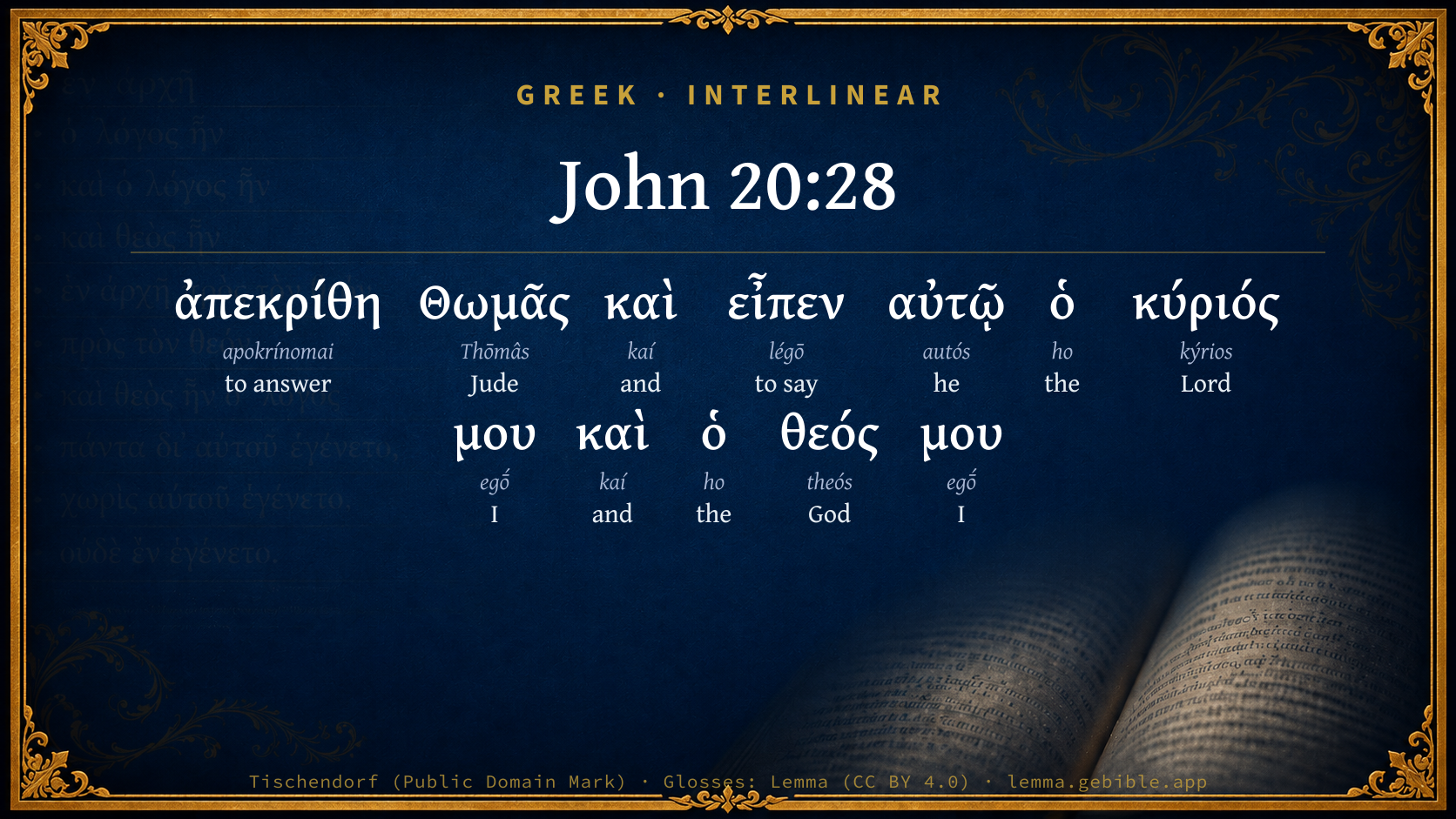
Greek (Tischendorf 8th ed.) John 20:28 appears in the Greek New Testament. The text above is from the Tischendorf 8th edition. Each word links to its Strong’s number and a concise gloss. Click any word for its full Thayer’s Greek Lexicon entry.
Download image
Cite this verse

John 20:28 (World English Bible). Public Domain. Lemma interlinear Bible study tool, https://lemma.gebible.app/v/john/20/28.

Show BibTeX & RIS
BibTeX
RIS
English Translation
Thomas answered him, "My Lord and my God!"
World English Bible · Public Domain
Download a study sheet

One document with this verse’s original text, its word-by-word gloss line, the meaning frame, cross-references with their text, attributed commentary, and full source and license credits — printable, and it pastes into notes with its structure intact.

This verse Autodidact and up

Study sheet (.html) Plain text (.txt)

A passage Seminary Student

Up to 50 verses in one chapter. A passage sheet keeps up to 6 commentary sources and 12 cross-references per verse, in the order this page ranks them, and says so on the sheet whenever that leaves anything out. Ask for a single verse and you get the Autodidact verse sheet above.

Everything on this page stays free to read, with no account — the sheet is a download of what is already on screen, not access to it.

Want to remove ads? Support Godless Engineer
Compare translations 3

The same verse in 3 English versions, stacked beneath the original-language interlinear above. Click any original word for its lexicon entry.

Each is an independent rendering of the whole verse — the interlinear is not word-aligned to these translations.

Highlighted words mark where these versions differ — a whole-verse word diff, not a word-by-word alignment.

  • World English Bible Public Domain
    Thomas answered him, "My Lord and my God!"
  • King James Version Public Domain
    And Thomas answered and said unto him, My LORD and my God.
  • unfoldingWord Literal Text CC BY-SA 4.0
    Thomas answered and said to him, “My Lord and my God.”

unfoldingWord Literal Text — © unfoldingWord, licensed CC BY-SA 4.0. Word-aligned USFM3 via Door43 (git.door43.org/unfoldingWord/en_ult).

Versions to compare (up to 4)

3 of 4 selected

Show all 19 translations

Every available English version of this verse, each an independent rendering of the whole verse.

  • World English Bible Public Domain
    Thomas answered him, "My Lord and my God!"
  • Berean Standard Bible Public Domain
    Thomas replied, “My Lord and my God!”
  • Majority Standard Bible Public Domain
    Thomas replied, “My Lord and my God!”
  • King James Version Public Domain
    And Thomas answered and said unto him, My LORD and my God.
  • American Standard Version (1901) Public Domain
    Thomas answered and said unto him, My Lord and my God.
  • Revised Version (1885) Public Domain
    Thomas answered and said unto him, My Lord and my God.
  • Geneva Bible (1599) Public Domain
    Then Thomas answered, and said vnto him, Thou art my Lord, and my God.
  • Douay-Rheims (1899) Public Domain
    Thomas answered, and said to him: My Lord, and my God.
  • Young's Literal Translation Public Domain
    And Thomas answered and said to him, `My Lord and my God;'
  • Literal Standard Version CC BY-SA 4.0
    And Thomas answered and said to Him, “My Lord and my God!”
  • Unlocked Literal Bible CC BY-SA 4.0
    Thomas answered and said to him, “My Lord and my God.”
  • unfoldingWord Literal Text CC BY-SA 4.0
    Thomas answered and said to him, “My Lord and my God.”
  • Darby Bible Public Domain
    Thomas answered and said to him, My Lord and my God.
  • World Messianic Bible Public Domain
    Thomas answered him, “My Lord and my God!”
  • Webster's Bible Public Domain
    And Thomas answered and said to him, My Lord and my God.
  • Free Bible Version CC BY-SA 4.0
    “My Lord and my God!” Thomas responded.
  • Bible in Basic English Public Domain
    And Thomas said in answer, My Lord and my God!
  • Text-Critical English NT CC BY 4.0
    In response Thomas said to him, “My Lord and my God!”
  • Tyndale New Testament (1534) Public Domain
    Thomas answered and sayde vnto him: my Lorde and my God.

Literal Standard Version (2020), Covenant Press — licensed CC BY-SA 4.0. Text via the HelloAO Bible API (eBible.org). Unlocked Literal Bible (unfoldingWord) — licensed CC BY-SA 4.0. Text via the HelloAO Bible API (eBible.org). unfoldingWord Literal Text — © unfoldingWord, licensed CC BY-SA 4.0. Word-aligned USFM3 via Door43 (git.door43.org/unfoldingWord/en_ult). Free Bible Version, Dr. Jonathan Gallagher — licensed CC BY-SA 4.0. Text via the HelloAO Bible API (eBible.org).

Word by word

More ways to search: Search by grammar → Find every occurrence → Compare this word →

Practice this passage: Drill this verse → Learn its vocabulary →

About this verse

These counts appear in no published source. They are computed here, from the morphology-tagged text and Lemma’s own curated glosses. What Lemma adds →

12
words
9
distinct lemmas
Gospels
section

Notable vocabulary

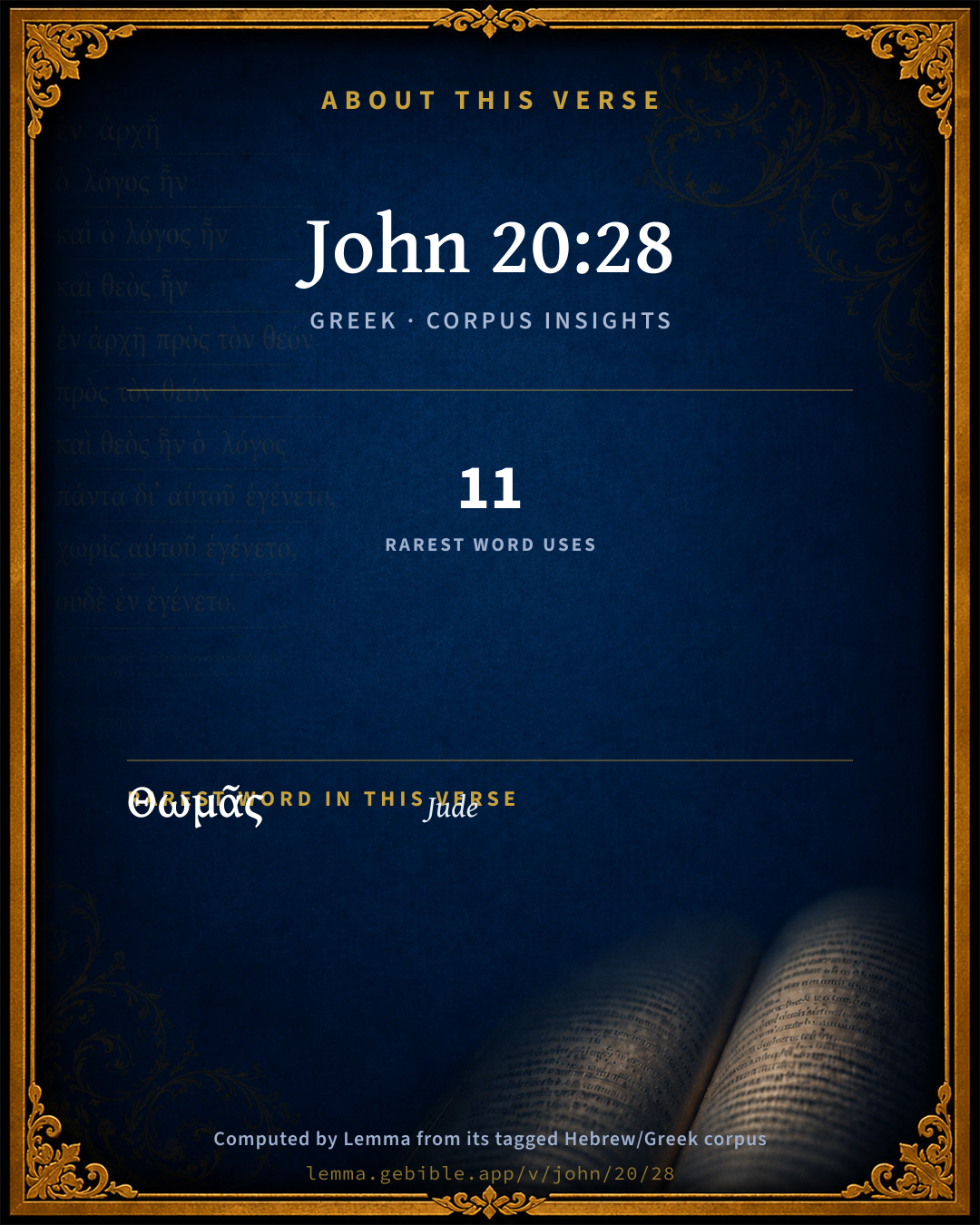
The rarest word here is Θωμᾶς Jude G2381 — appearing just 11 times in the whole Greek New Testament.

Shared distinctive vocabulary

Θωμᾶς Jude G2381 occurs in 11 verses of the Greek New Testament. Also found in:

Repetition

Words recur within this verse:

Cross-references

20

Topical passages linked to John 20:28 in the Treasury of Scripture Knowledge — connected by theme and wording, ordered by reader-vote popularity; previews shown in the World English Bible.

  • John 1:1 In the beginning was the Word, and the Word was with God, and the Word was God.
  • Isaiah 9:6 For to us a child is born, to us a son is given; and the government shall be on his shoulder: and his name shall be called Wonderful, Counselor, Mighty God, Everlasting Father, Prince of Peace.
  • Isaiah 7:14 Therefore the Lord himself will give you a sign. Behold, the virgin will conceive, and bear a son, and shall call his name Immanuel.
  • 1 Timothy 3:16 Without controversy, the mystery of godliness is great: God was revealed in the flesh, Justified in the spirit, Seen by angels, Preached among the nations, Believed on in the world, And received up in glory.
  • Matthew 14:33 Those who were in the boat came and worshiped him, saying, "You are truly the Son of God!"
  • John 5:23 that all may honor the Son, even as they honor the Father. He who doesn't honor the Son doesn't honor the Father who sent him.
  • Isaiah 25:9 It shall be said in that day, Behold, this is our God; we have waited for him, and he will save us: this is Yahweh; we have waited for him, we will be glad and rejoice in his salvation.
  • Luke 24:52 They worshiped him, and returned to Jerusalem with great joy,
  • Acts 7:59–60 They stoned Stephen as he called out, saying, "Lord Jesus, receive my Spirit!"
  • Revelation 5:9–14 They sang a new song, saying, "You are worthy to take the book, And to open its seals: For you were killed, And bought us for God with your blood, Out of every tribe, language, people, and nation,
  • John 9:35–38 Jesus heard that they had thrown him out, and finding him, he said, "Do you believe in the Son of God?"
  • John 20:16 Jesus said to her, "Mary." She turned and said to him, "Rhabbouni!" which is to say, "Teacher!"
  • Psalms 45:6 Your throne, God, is forever and ever. A scepter of equity is the scepter of your kingdom.
  • John 20:31 but these are written, that you may believe that Jesus is the Christ, the Son of God, and that believing you may have life in his name.
  • Psalms 102:24–28 I said, "My God, don't take me away in the midst of my days. Your years are throughout all generations.
  • Psalms 118:24–28 This is the day that Yahweh has made. We will rejoice and be glad in it!
  • Isaiah 40:9–11 You who tell good news to Zion, go up on a high mountain; you who tell good news to Jerusalem, lift up your voice with strength; lift it up, don't be afraid; say to the cities of Judah, Behold, your God!
  • Jeremiah 23:5–6 Behold, the days come, says Yahweh, that I will raise to David a righteous Branch, and he shall reign as king and deal wisely, and shall execute justice and righteousness in the land.
  • Malachi 3:1 "Behold, I send my messenger, and he will prepare the way before me; and the Lord, whom you seek, will suddenly come to his temple; and the messenger of the covenant, whom you desire, behold, he comes!" says Yahweh of hosts.
  • Psalms 45:11 So the king will desire your beauty, Honor him, for he is your lord.

Cross-references courtesy of OpenBible.info (CC BY 4.0).

Commentary

Notes on John 20:28 from classic Christian and Jewish commentators (each source and its license shown beneath its notes). The classic Christian expositions comment on the surrounding passage and are grouped to its opening verse, so a note may address several verses; the Jewish commentaries on the Tanakh (Rashi and others) are per-verse, so they appear only where the commentator wrote on this verse.

Lemma curates 59 commentaries, every one of them public domain or Creative Commons licensed, each selected and text-cleaned for this edition rather than reprinted as found. About our sources →

The Biblical Illustrator

Joseph S. Exell

Joh_20:28

And Thomas answered and said unto Him, My Lord and my God

My Lord and my God

Let us consider

I.

THE EXCLAMATION OF THOMAS. It is as much as a man could say if he wished to assert dogmatically that Jesus is God and Lord (Psa_35:23). To escape from the force of this confession some have charged Thomas with breaking the third commandment, just as thoughtless persons take the Lords name in vain and say, Good God! or O Lord! This could not have been the case. For, in the first place, it was not the habit of a Jew to use any such exclamation when surprised. The Jews in our Lords time were particular beyond everything about using the name of God. In the next place, it was not rebuked by our Lord, and we may be sure He would not have suffered such an unhallowed cry to have gone without a reprimand. Observe, too, that it was addressed to the Lord Jesus.

1. It was not a mere outburst, accepted by our Lord as an evidence of faith, but a devout expression of holy wonder at the discovery that Jesus was his Lord and God, and probably also at the fact that he has not seen it long before. Had he not been present when Jesus trod the sea? &c. Now on a sudden he does know his Lord, and such knowledge is too wonderful for him. How I wish you would all follow Thomas! I will stop that you may do so. Let us wonder and admire!

2. An expression of immeasurable delight. He seems to take hold of the Lord Jesus with both hands, by those two blessed mys. There is here a music akin to my beloved is mine, and I am His. I pray you follow Thomas in this. Before you Jesus now stands, visible to your faith. Delight yourselves in him.

3. An indication of a complete change of mind, a most hearty repentance. Instead of putting his finger into the print of the nails, he cried, My Lord and my God.

4. A brief confession of faith. Whosoever will be saved, before all things it is necessary that he be able to unite with Thomas heartily in this creed.

5. An enthusiastic profession of his allegiance to Christ. Henceforth, thou art my Lord, and I will serve Thee; Thou art my God, and I will worship Thee.

6. A distinct and direct act of adoration.

II. HOW DID HE COME TO THAT EXCLAMATION?

1. He had his thoughts revealed. The Saviour had read them at a distance. Notice that the Saviour did not say, Put thy finger into the nail-prints in My feet. Why not? Why, because Thomas had not said anything about His feet. We, in looking at it, can see the exactness; bat Thomas must have felt it much more.

2. All the past must have risen before his mind, the many occasions in which the Lord Jesus had exercised the attributes of Deity.

3. The very manner of the Saviour, so full of majesty, convinced the trembling disciple.

4. But the most convincing were our Lords wounds.

III. HOW WE MAY COME TO IT. If ever any one of us shall cry in spirit and in truth, My Lord and my God! the Holy Spirit must teach us. We shall so cry

1. At conversion.

2. In deliverance from temptation.

3. In time of trouble, when we are comforted and upheld. There have been other occasions less trying.

4. While studying the story of our Lord.

5. In the breaking of bread.

6. In times when He has blessed our labours, and laid His arm bare in the salvation of men.

7. In the hour of death.

8. In heaven. (C. H. Spurgeon.)

My Lord and my God

I. THIS IS NOT AN EXCLAMATION

1. Because such exclamations were abhorrent to the Jews.

2. It would be without warrant in Scripture.

3. It is by its form necessarily an address--Thomas said to Him.

II. THE MEANING OF THE WORDS.

1. Lord, κύριος, means owner, and as ownership includes control, it expressed

(1) The idea of ownership founded on possession, as Lord of the Vineyard, Lord of Slaves, Lord of the whole earth.

(2) The Lordship without reference to its ground; hence kings are also called lords. So also heads of families, husbands, &c.

(3) Hence a mere title of courtesy as dominus, mister, &c.

(4) As applied to God it retains its relative meaning--the relation of God to His creatures as their Owner and absolute Ruler. It is substituted in the

LXX. for Jehovah, Shaddai, Elohim, and not only for Aden or Adonai. Hence in the New Testament it is used for Christ. He is our Lord in the sense in which Jehovah was the Lord of the Hebrews. Christ owns us both as Creator and Redeemer.

2. God. What this means passes all understanding and imagination. It is easy to say, God is a Spirit, infinite, eternal, &c. But who can comprehend the Infinite? We know that one infinite in His Being and perfections must be

(1) The object of adoration, supreme love, absolute submission.

(2) The ground of confidence.

(3) One in whose favour is eternal life. All that God is, Christ is. All that is due to God is due to Christ.

3. My means not only that Christ is the Person whom we acknowledge and confess to be our Lord and God, to the exclusion of all other persons out of the Godhead; but that He stands in the relation of Lord and God to us, and that we stand in a corresponding relation to Him; that we recognize His ownership and authority; depend on His protection, adore, love, trust, and serve Him as our Lord and God. This it is to be a Christian. (C. Hodge, D. D.)

The confession of Thomas:

The words imply

I. SELF-KNOWLEDGE.

1. When Thomas says this he is confessing that his past life has been a mistake. The arrogance of his former speech contrasts strikingly with the lowliness of this. A new revelation had been given him, making known the one great need of his souls Lord to control his will, and form his judgment, and give law to his inmost spirit. Our great want is a ruler; submission is one of the deepest of human needs.

(1) Let self-will be ever so successful, the heart is still unsatisfied. Ambition is soon sated; and the head that wears a crown is uneasy, not more because of the cares of government than because the monarch is tired of himself. Even the partial stimulus which self-seekers have, while yet they are striving for their object, witnesses to the same truth; a man may choose his aim, but when he has chosen it, it controls him. No man ever found rest till his aim in life was decided on. Seeking an object, men for a time are tranquil, for they are freed from self; but when their object is secured, they fall again into the restlessness of bondage to a self that is insufficient for them.

(2) Look now at another class of men of nobler character. The truth-seeker is freed from self, for he feels truth to be absolute, independent of him, and he yields allegiance to it. The lover of right is under an eternal law of rectitude; righteousness is not something that he invents. Right is, and is his lord. Duty is what we owe, not what we choose to give. But what is truth? Its seekers are all in disagreement. What is right? The standard of rectitude in our England is very different from that of ancient Rome. Has duty any higher standard than statute law, or regard for the greatest happiness of the greatest number? These very words set us again upon a drifting sea of self-will. Truth, duty, rectitude--these are cold words. To stir passion and control affection they must be seen embodied in personal form. Love, reverence--these are the hearts deep wants. Cold abstractions can never deliver us from self

2. Thomas had found all he needed in Christ. Christ was the Truth; His will absolute righteousness; duty was what he owed to Him. There was no coldness nor vagueness in these names when summed up in the person of His Lord. Love rises to worship in his confession; his heart is at rest when he says, my Lord.

(1) This is the secret of Christs power over men. He comes among them as their Lord; He claims authority and submission. Christ does not allure men by pleasures, flattering their self-will. He simply bids them Follow Me, and they leave all and follow Him. He speaks to those to whom self-will is barrenness, and there is fruitfulness. He speaks to those whose selfishness is weakness and disease, and in obedience to Him come health and energy. And herein do we see the meaning of Come unto Me all ye that labour Take My yoke upon you, &c. For in meekness and obedience our spirits find their end and purpose, and herein is rest.

(2) In Christ, too, we see how blessed to yield our wills to the will of God. He who came to tell us that we are ruined, because we seek our own wills and not the will of God, must Himself be submissive. He who came revealing absolute truth and righteousness, claiming our homage for them, must Himself yield them homage. Christ can rule because He knows how to obey.

II. KNOWLEDGE OF THE MEANING OF LIFE.

1. It was Christs perfect knowledge of Thomas which brought from him the confession.

(1) Christ had heard the sceptical words; He had been with Thomas, though Thomas had not been with Him. But Thomas could not stop here; as none can rest in one separate instance of His knowledge and grace. He who knew this must know all. All his past life would flash upon him, and he would recognize it all as Christs plan to educate and bring him to Himself.

(2) Christ had done infinitely more than to simply give Thomas his own test for the resurrection; He had brought Thomas to a better mind, and made that test appear absurd. The touch would only have convinced that the risen Jesus was here; Thomas, without touching Him, calls Him My Lord and my God. Underlying Thomass wish for sensible proof there had been the unquenchable longing for personal intercourse. That John and the others had seen Christ was nothing to him. Nothing can reveal a personal Lord to us but that Lords communion with ourselves. Thomass heart was satisfied now, and to Christs guidance he could absolutely submit.

2. It is such a guide we want; one who can read our heart and supply every need. It is such a guide we preach in Jesus; not one who lived a few years in Palestine; but One who was before all things, and who is ever with His people. He knows you, for He formed you for Himself; your life, with all its difficulties and perplexities, is His plan for educating you for Himself and God. Each doubt He is waiting to clear away; even your wilfulness does not drive Him from your side.

III. KNOWLEDGE OF GOD.

1. Thomas recognized the character of God rather than the dignity of Christ, and herein lay the true value of his confession. The mere confession that Christ is a Divine Person is barren; the knowledge that God is come into actual fellowship with us in Christ is new life to the spirit. The looking for God in awful grandeur obscures the perception of God in the perfection of moral excellence, the influence by which goodness sways the heart. It was to deliver men from this very error that Christ came. The disciples were ever expecting that Christ would communicate some stupendous truth concerning God. Gradually their conceptions of Him became exalted; Christs own words were fulfiled, I am the Way, the Truth, and the Life. Here at length from Thomas breaks the full confession that this is God.

2. Thomas could not say, My Lord, without saying also My God; for it is shocking to yield the whole heart to any other than God. In the fact that he could not but adore Jesus, that Jesus claimed and had won his homage, it was revealed that Jesus was Divine. If He be not God, then are we idolaters; for idolatry is the love and service of the creature as though it were supreme; and higher love and service than Christ has won from Christian hearts is impossible. If He be not God, then have we two Gods: the one a name, a cold abstraction; the other the Jesus who sways our spirits and to whom we render the consecration of our lives.

3. We may now see why so much importance is attached in the New Testament to the Divinity of Christ. The confession of Christ is not an act of the speculative intellect, it is the movement of the heart and the submission of the life to Him. There are Christian Unitarians who call Christ Lord, though they hold back from calling Him God. There are un-Christian Trinitarians who call Christ God, and yet He manifestly is not their Lord. It is sad that the words My Lord and my God should ever be separated. But he is a Christian, whatever the articles of his creed, who finds Christ sufficient for the souls need, and whose life reveals that it is under His rule. (A. Mackennel, D. D.)

Thomass confession of faith:

These words imply

I. JOYFUL RECOGNITION. Partings are painful; but the bereavement of the ten was over. And now the restored fellowship of Christ brought Thomas peace. So every new revelation of Christ brings joy to His disciples now. But recognitions are not always joyful (1Ki_21:20; Mt Mar_1:24; Rev_1:5; Rev_6:15-16). How different the meeting of loved ones (Act_12:14-16; Act_28:15; Gen_45:26; Gen_46:30). So Thomas and all disciples rejoice in Christ who, though He was dead, is alive again, and crowned with glory and honour.

II. DIVINE HOMAGE. Friends rise in our estimation as we know them better. Love tested by trial. Suffering and death reveal the soul. Perhaps we never see so clearly the greatness of our friend as when he is taken from us. So it seems to have been with the disciples. It was only after the Resurrection that they beheld the fulness of His glory. What a testimony to the Divine greatness of Jesus in this confession How horrified was Paul Act_14:15-16); Peter (Act_10:25); the angel (Rev_22:9) at the thought of being worshipped; but Jesus receives it as His right.

III. APPROPRIATING FAITH, My, a little word, but of deep significance. Faith is a personal thing. Mark the difference between Thomass faith and

1. The faith of devils (Jam_2:19; 1Jn_5:10-12).

2. The faith of mere believers in historical Christianity. It is one thing to say, The Lord He is God, and another to say, My Lord and my God. Luther says that the marrow of the gospel is in the possessive pronouns.

IV. SELF-SURRENDERING LOVE. Paul says, Yield yourselves to God. This is the difficulty; but never till it is done are we truly converted. But once done it is done for ever. The sight of Jesus wins the heart. Conclusion: Happy are those who can say, My Lord and my God. Here is

1. The true bond of union (1Co_1:2; 2Co_10:1).

2. The noblest inspiration of life (2Co_5:14).

3. Strength for work.

4. Comfort in trouble.

5. Hope in death (2Co_4:6-8). (W. Forsyth, M. A.)

Christ satisfying the instinct of reverence

I. THE INSTINCT.

1. Reverence is a word by itself, and has no synomym. It is not respect, regard, fear, honour, nor even awe. It would be inaccurate to apply it to wealth, rank or power. If we reverence their possessor it must be for something over and above them. Even if we give it to age, royalty, or genius, it is only because there is in these a touch of sacredness. For reverence is the sense of something essentially and not accidently above us. Old age is above in the incommunicable sanctity of an ampler experience, and a nearer heaven; royalty is the theory of a Divine commission and a theocratic representation; genius is the possession of an original intuition which is to be a voice for mankind.

2. This reverence is an instinct; but there is much to support the theory of an instinct of irreverence. The insolence of lusty youth, clever shallowness which denies admiration, and can see in religion only a sentiment, or a thing for ridicule, such a spirit may be common in literature and society, but it is no instinct; it is a degeneracy. Man worthy of the name has always something above him; and even where self presides at the worship, it is rather as priest than idol

3. It is easy to misdirect this instinct. Man feels himself very little, an atom in a mighty system. There must be something above him. What? The celestial bodies? This instinct enforces a worship. What object so worthy as they? There are those now who reverence nature, and law to them is but a name for deity, and they worship this unknown god. Others a beautiful friend, till they find some day the idol broken in pieces or vanished. Nor do these misdirections cease when at last God becomes the object, inasmuch as reverence for church architecture, decoration, and music may be giving His glory to another.

II. CHRIST SATISFYING THIS INSTINCT.

1. The instinct is abroad seeking its object. It finds it not in an abstraction. Nature cannot satisfy it. It may be a grand thought that I am part of a system which is the universe and whose breath is deity. Yet I, insignificant I, find no rest in this vastness. I go forth among my fellows, and cannot help loving and reverencing: yet the bright illusion vanishes.

2. Shall it always be thus? I see an end of all perfection, and yet there is in me an idea of perfection, might I but attain unto it. Is there none such? Yes, there is God--the Infinite, Eternal, Self-existent. Yet I feel myself in the land of things too high for me and too vast. Cannot I get nearer, until I touch? To answer this Christ comes forth, takes our nature, obeys, loves, suffers, dies, and bids us follow Him with a love as devoted as it is unidolatrous, being very man and very God.

3. Can this one heart contain all the devotions of all men? Can I be assured of attention in the adored of the nations? Yes. If any man thirst, &c. (Dean Vaughan)

.

The Biblical Illustrator, edited by Joseph S. Exell (c. 1880s–1900s) — public domain. Text from a community e-Sword module.

Scofield Reference Notes

C. I. Scofield

My Lord and My God

The deity of Jesus Christ is declared in Scripture:

(1) In the intimations and explicit predictions of the O.T.

(a) The theophanies intimate the appearance of God in human form, and His ministry thus to man Gen 16:7-13; Gen 18:2-23 especially; Gen 18:17; Gen 32:28 with; Hos 12:3-5; Exo 3:2-14. (b) The Messiah is expressly declared to be the Son of God Psa 2:2-9 and God; Psa 45:6; Psa 45:7; Heb 1:8; Heb 1:9; Psa 110:1; Mat 22:44; Act 2:34; Heb 1:13; Psa 110:4; Heb 5:6; Heb 6:20; Heb 7:17-21; Zec 6:13. (c) His virgin birth was foretold as the means through which God could be "Immanuel," God with us; Isa 7:13; Isa 7:14; Mat 1:22; Mat 1:23 (d) The Messiah is expressly invested with the divine names Isa 9:6; Isa 9:7 (e) In a prophecy of His death He is called Jehovah’s "fellow"; Zec 13:7; Mat 26:31. (f) His eternal being is declared; Mic 5:2; Mat 2:6; Joh 7:42.

(2) Christ Himself affirmed His deity.

(a) He applied to Himself the Jehovistic I AM. (The pronoun "he" is not in the Greek; cf Joh 8:24; Joh 8:56-58. The Jews correctly understood this to be our Lord’s claim to full deity. Joh 8:59.

See also, Joh 10:33; Joh 18:4-6 where, also, "he" is not in the original.) (b) He claimed to be the Adonai of the O.T. Mat 22:42-45. (See Scofield "Gen 15:2"). (c) He asserted His identity with the Father; Mat 28:19; Mar 14:62; Joh 10:30, that the Jews so understood Him is shown by; Joh 10:31; Joh 10:32; Joh 14:8; Joh 14:9; Joh 17:5. (d) He exercised the chief prerogative of God; Mar 2:5-7; Luk 7:48-50. (e) He asserted omnipresence; Mat 18:20; Joh 3:13 omniscience, Joh 11:11-14, when Jesus was fifty miles away; Mar 11:6-8, omnipotence; Mat 28:18; Luk 7:14; Joh 5:21-23; Joh 6:19, mastery over nature, and creative power; Luk 9:16; Luk 9:17; Joh 2:9; Joh 10:28. (f) He received and approved human worship,; Mat 14:33; Mat 28:9; Joh 20:28; Joh 20:29.

(3) The N.T. writers ascribe divine titles to Christ: Joh 1:1; Joh 20:28; Act 20:28; Rom 1:4; Rom 9:5; 2Th 1:12; 1Ti 3:16; Tit 2:13; Heb 1:8; 1Jn 5:20.

(4) The N.T. writers ascribe divine perfections and attributes to Christ (e.g.) Mat 11:28; Mat 18:20; Mat 28:20; Joh 1:2; Joh 2:23-25; Joh 3:13; Joh 5:17; Joh 21:17; Heb 1:3; Heb 1:11; Heb 1:12; Heb 13:8; Rev 1:8; Rev 1:17; Rev 1:18; Rev 2:23; Rev 11:17; Rev 22:13.

(5) The N.T. writers ascribe divine works to Christ Joh 1:3; Joh 1:10; Col 1:16; Col 1:17; Heb 1:3.

(6) The N.T. writers teach that supreme worship should be paid to Christ Act 7:59; Act 7:60; 1Co 1:2; 2Co 13:14; Php 2:9; Php 2:10; Heb 1:6; Rev 1:5; Rev 1:6; Rev 5:12; Rev 5:13.

(7) The holiness and resurrection of Christ prove His deity Joh 8:46; Rom 1:4.

The Scofield Reference Bible (1917 edition), notes by C. I. Scofield — public domain. Text from a community e-Sword module.

Tyndale Open Study Notes

Tyndale Open Resources

20:28 “My Lord and my God!” This was not an astonished exclamation but a proclamation of heartfelt belief. It concludes John’s declaration of Jesus’ deity that has framed the whole book (see 1:1-18).

Tyndale Open Study Notes — © Tyndale Open Resources, licensed CC BY-SA 4.0. Text via the HelloAO Bible API.

Bengel's Gnomon

Johann Albrecht Bengel

Joh 20:28. Αὐτῷ, unto Him) Therefore it was Jesus whom he called Lord and God, and that too, his Lord and his God: which is in consonance with the language which is recorded in Joh 20:17: nor do these words form a mere exclamation. The disciples had said, τὸν Κύριον, the Lord, Joh 20:25: now Thomas, being recalled to faith, not merely acknowledges Jesus to be Lord, as previously he had himself acknowledged, and that He was risen again, as his fellow-disciples were affirming; but even confesses His Godhead in a higher sense than any one had yet confessed. Moreover, the language is abrupt through the suddenness of the feeling excited in him, in this sense, “My Lord and my God,” I believe and acknowledge that Thou art my Lord and my God: and the absolute appellation has the force of an enunciation. A similar Vocative occurs twice in Joh 20:16, also in Hos 2:23, “I will say, thou, my people, and they shall say, Thou, my God.” Artemonius in Part i. ch. 24, with which comp. the pref. p. 20 and p. d. 2, brings forward a new explanation, whereby Thomas is made to call Jesus Lord, and the Father who exists in Him inseparably, God: but in that case Thomas would not have addressed both titles unto Him (αὐτῷ); but would have been addressing the one to Jesus, the other to the Father, by a sudden apostrophe, [When the language is suddenly turned to another person present or absent, differently from what was the intention of the speaker at the beginning. Append.] which by no means accords with the admiring astonishment of Thomas. If this had been the intention of Thomas, John would not have added, αὐτῷ, unto Him. Thomas had not before expressly rejected faith in God the Father, but he had, in the case of Christ: therefore now it is not in the Father that he declares expressly his believing again, but in Christ. [This confession moreover is approved of in the following verse.—V. g.]

Bengel's Gnomon of the New Testament — English translation (T&T Clark, Edinburgh, 1860) — public domain. Text from a community e-Sword module.

Meyer's Critical & Exegetical Commentary

Heinrich August Wilhelm Meyer

Joh_20:28-29. The doubts of Thomas, whose faith did not now require actual contact (hence also merely ἑώρακας, Joh_20:29), are converted into a straightforward and devoted confession; comp. Joh_11:16.

ὁ κύριός μου κ. ὁ θεός μου] is taken by Theodore of Mopsuestia (quasi pro miraculo facto Deum collaudat, ed. Fritzsche, p. 41) as an exclamation of astonishment directed to God. So recently, in accordance with the Socinians (see against these Calovius), especially Paulus. Decisively opposed to this view is εἶπεν αὐτῷ, as well as the necessary reference of ὁ κύρ. μου to Christ. It is a confessionary invocation of Christ in the highest joyful surprise, in which Thomas gives the fullest expression of profound emotion to his faith, which had been mightily elevated by the conviction of the reality of the resurrection, in the divine nature of his Lord. The powerful emotion certainly appears in and of itself little fitted to qualify this exclamation, which Ewald even terms exaggerated for the dogmatic conception; but this is outweighed (1) by the account of John himself, who could find in this exclamation only an echo of his own θεὸς ἦν ὁ λόγος, and of the self-testimonies of Jesus concerning His divine nature; (2) and chiefly by the approval of the Lord which follows. Erasmus aptly says: Agnovit Christus utique repulsurus, si falso dictus fuisset Deus. Note further (1) the climax of the two expressions; (2) how the amazed disciple keeps them apart from one another with a solemn emphasis by repeating the article[270] and the μου. This μου, again, is the outflow ex vivo et serio fidei sensu, Calvin.

Joh_20:29. The ὁ κύριός μ. κ. ὁ θεός μου was the complete and highest confession of Messianic faith, by the rendering of which, therefore, the above μὴ γίνου … πιστός was already fulfilled. But it was the consequence of the having seen the Risen One, which he should not have required to do, considering the sufficient ground of conviction which lay in the assurance of his fellow-disciples as eye-witnesses. Hence the loving reproof (not eulogy, which Paulus devises, but also not a confirmation of the contents of faith as conferred by Thomas, as Luthardt assumes, which is first implied in μακάριοι, κ.τ.λ.) for him who has attained in this sensuous way to decisive faith, and the ascription of blessedness to those who, without such a sensuous conviction, have become believers,this is to be left as a general truth, and not to be referred to the other disciples, since it is expressed in a general way, and, in accordance with the supersensuous and ethical nature of faith, is universally valid. In detail, note further: (1) to read πεπίστευκας interrogatively (with Griesbach, Scholz, Lachmann, Ewald) makes the element of reproof in the words, indicated by the emphatic (comp. Joh_1:51) precedence of ὅτι ἑώρ. με, appear with more vivid prominence; (2) the perf. is: thou hast become believing and believest now; the aor. participles ἰδόντες and πιστεύσ. do not denote wont (Lücke), which usage is never found in the N. T., and would here yield no suitable meaning, but those who, regarded from the point of time of the μακαριότης predicated of them, have not seen, and yet have believed; they have become believers without having first seen. (3) The point of time of the μακαριότης is, in correspondence with the general proposition, the universal present, and the μακαριότης itself is the happiness which they enjoy through the already present, and one day the eternal, possession of the Messianic ζωή. (4) The μακαριότης is not denied to Thomas, but for his warning the rule is adduced, to which he also ought to have subjected himself, and the danger is pointed out to him in which one is placed if one demands sight as a way to faith, as he has done. (5) The antithesis to the present passage is, therefore, not that of faith on account of that which has externally taken place, and of faith certain in itself of its contents (Baur, comp. Scholten), but of faith (in a thing that has taken place) with and without a personal and peculiar perception of it by the senses. (6) How significant is the declaration μακάριοι, κ.τ.λ., standing at the close of the Johannean Gospel! The entire historical further development of the church rests in truth upon the faith which has not seen. Comp. 1Pe_1:8.

[270] See Dissen, ad Dem. de Cor. p. 374.

Meyer — Critical and Exegetical Commentary on the New Testament — English translation by Peter Christie, edited by Frederick Crombie (T&T Clark, 1880) — public domain. Text from a community e-Sword module.

Expositor's Greek Testament

ed. W. Robertson Nicoll

Joh 20:28 . Grotius, following Tertullian, Ambrose, Cyril and others, is of opinion that Thomas availed himself of the offered test: surely it is psychologically more probable that the test he had insisted on as alone sufficient is now repudiated, and that he at once exclaims, Ὁ Κύριός μου καὶ ὁ θεός μου . His faith returns with a rebound and utters itself in a confession in which the gospel culminates. The words are not a mere exclamation of surprise. That is forbidden by εἶπεν αὐτῷ ; they mean “Thou art my Lord and my God”. The repeated pronoun lends emphasis. In Pliny’s letter to Trajan (112 A.D.) he describes the Christians as singing hymns to Christ as God. Our Lord does not reject Thomas’ confession; but (Joh 20:29 ) reminds him that there is a higher faith than that which springs from visual evidence: Ὅτι ἑώρακάς με … καὶ πιστεύσαντες . Jesus would have been better pleased with a faith which did not require the evidence of sense: a faith founded on the perception that God was in Christ, and therefore He could not die; a faith in His Messiahship which argued that He must live to carry on the work of His Kingdom. The saying is cited as another instance of the care with which the various origins and kinds of faith are distinguished in this gospel.

The Expositor's Greek Testament, edited by W. Robertson Nicoll (1897–1910) — public domain. Text from a community e-Sword module.

Jamieson, Fausset & Brown

Robert Jamieson, A. R. Fausset & David Brown

Thomas answered and said unto him, My Lord and my God--That Thomas did not do what Jesus invited him to do, and what he had made the condition of his believing, seems plain from Joh 20:29 ("Because thou hast seen Me, thou hast believed"). He is overpowered, and the glory of Christ now breaks upon him in a flood. His exclamation surpasses all that had been yet uttered, nor can it be surpassed by anything that ever will be uttered in earth or heaven. On the striking parallel in Nathanael, see on Joh 1:49. The Socinian invasion of the supreme divinity of Christ here manifestly taught--as if it were a mere call upon God in a fit of astonishment--is beneath notice, save for the profanity it charges upon this disciple, and the straits to which it shows themselves reduced.

Jamieson, Fausset & Brown — Commentary Critical and Explanatory on the Whole Bible (1871) — public domain (CC PDM 1.0). Text via the HelloAO Bible API.

Adam Clarke's Commentary

Verse 28. Thomas answered, c.] Those who deny the Godhead of Christ would have us to believe that these words are an exclamation of Thomas, made through surprise, and that they were addressed to the Father and not to Christ. Theodore of Mopsuestia was the first, I believe, who gave the words this turn and the fifth OEcumenic council, held at Constantinople, anathematized him for it. This was not according to the spirit of the Gospel of God. However, a man must do violence to every rule of construction who can apply the address here to any but Christ. The text is plain: Jesus comes in - sees Thomas, and addresses him; desiring him to come to him, and put his finger into the print of the nails, c. Thomas, perfectly satisfied of the reality of our Lord's resurrection, says unto him,-MY LORD! and MY GOD! i.e. Thou art indeed the very same person,-my Lord whose disciple I have so long been and thou art my God, henceforth the object of my religious adoration. Thomas was the first who gave the title of God to Jesus; and, by this glorious confession, made some amends for his former obstinate incredulity. It is worthy of remark, that from this time forward the whole of the disciples treated our Lord with the most supreme respect, never using that familiarity towards him which they had often used before. The resurrection from the dead gave them the fullest proof of the divinity of Christ. And this, indeed, is the use which St. John makes of this manifestation of Christ. See Joh 20:30-31. Bishop Pearce says here: "Observe that Thomas calls Jesus his God, and that Jesus does not reprove him for it, though probably it was the first time he was called so." And, I would ask, could Jesus be jealous of the honour of the true God-could he be a prophet-could he be even an honest man, to permit his disciple to indulge in a mistake so monstrous and destructive, if it had been one?

Adam Clarke's Commentary on the Bible (1810–1826) — public domain. Text from a community e-Sword/MySword module.

Ellicott's Commentary for English Readers

(28) Thomas answered and said unto him.—It is implied that he did not make use of the tests which his Master offered him, but that he at once expressed the fulness of his conviction. This is confirmed by the words of the next verse, “Because thou hast seen Me.”

My Lord and my God.—These words are preceded by “said unto him,” and are followed by “because thou hast seen Me, thou hast believed;” and the words “my Lord” can only be referred to Christ. (Comp. Joh_20:13.) The sentence cannot therefore, without violence to the context, be taken as an exclamation addressed to God, and is to be understood in the natural meaning of a confession by the Apostle that his Lord was also God.

A Bible Commentary for English Readers, edited by Charles John Ellicott (1878–1897) — public domain. Text from a community e-Sword module.

The Cambridge Bible for Schools and Colleges

gen. ed. J. J. S. Perowne

28. And Thomas answered] Omit ‘and.’ This answer and Christ’s comment, ‘because thou hast seen,’ seem to shew that S. Thomas did not use the test which he had demanded. In accordance with his desponding temperament he had underrated the possibilities of being convinced.

My Lord and my God] Most unnatural is the Unitarian view, that these words are an expression of astonishment addressed to God. Against this are (1) the plain and conclusive ‘said unto Him;’ (2) the words ‘my Lord,’ which manifestly are addressed to Christ (comp. Joh_20:13); (3) the fact that this confession of faith forms a climax and conclusion to the whole Gospel. The words are rightly considered as an impassioned declaration on the part of a devoted but (in the better sense of the term) sceptical Apostle of his conviction, not merely that his Risen Lord stood before him, but that this Lord was also his God. And it must be noted that Christ does not correct His Apostle for this avowal, any more than He corrected the Jews for supposing that He claimed to be ‘equal with God’ (Joh_5:18-19); on the contrary He accepts and approves this confession of belief in His Divinity.

The Cambridge Bible for Schools and Colleges (gen. ed. J. J. S. Perowne; Cambridge University Press, 1878–1918) — public domain. Text from a community e-Sword module.

John Gill's Exposition

And Thomas answered and said unto him,.... Without examining his hands and side, and as astonished at his condescension and grace, and ashamed of his unbelief:

my Lord and my God; he owns him to be Lord, as he was both by creation and redemption; and God, of which he was fully assured from his omniscience, which he had given a full proof of, and from the power that went along with his words to his heart, and from a full conviction he now had of his resurrection from the dead. He asserts his interest in him as his Lord and his God; which denotes his subjection to him, his affection for him, and faith in him; so the divine word is called in Philo the Jew, , "my Lord" (x).

(x) Lib. Allegor. l. 2. p. 101.

John Gill's Exposition of the Whole Bible (1746–1763) — public domain (CC PDM 1.0). Text via the HelloAO Bible API.

Trapp's Complete Commentary

John Trapp

28 And Thomas answered and said unto him, My Lord and my God.

Ver. 28. My Lord and my God] This is true faith indeed, that individuates God, and appropriates him to itself. {a} Were it not for this possessive "mine," the devil might say the creed to as good purpose as we. He believes there is a God and a Christ; but that which torments him is, he can say "my" to never an article of the faith.

{a} η πιστις ιδιοποιεται τον θεον. Chrysost.

John Trapp, A Commentary or Exposition upon All the Books of the Old and New Testament (1647–1656) — public domain. Text from a community e-Sword module.

Albert Barnes' Notes on the Bible

My Lord and my God - In this passage the name God is expressly given to Christ, in his own presence and by one of his own apostles. This declaration has been considered as a clear proof of the divinity of Christ, for the following reasons:

1. There is no evidence that this was a mere expression, as some have supposed, of surprise or astonishment.

2. The language was addressed to Jesus himself - “Thomas ...said unto him.”

3. The Saviour did not reprove him or check him as using any improper language. If he had not been divine, it is impossible to reconcile it with his honesty that he did not rebuke the disciple. No pious man would have allowed such language to be addressed to him. Compare Act 14:13-15; Rev 22:8-9.

4. The Saviour proceeds immediately to commend Thomas for believing; but what was the evidence of his believing? It was this declaration, and this only. If this was a mere exclamation of surprise, what proof was it that Thomas believed? Before this he doubted. Now he believed, and gave utterance to his belief, that Jesus was his Lord and his God.

5. If this was not the meaning of Thomas, then his exclamation was a mere act of profaneness, and the Saviour would not have commended him for taking the name of the Lord his God in vain. The passage proves, therefore, that it is proper to apply to Christ the name Lord and God, and thus accords with what John affirmed in Joh 1:1, and which is established throughout this gospel.

Albert Barnes' Notes on the Bible (1834–1885) — public domain. Text from a community e-Sword/MySword module.

Matthew Poole's English Annotations

My Lord, to whom I wholly yield and give up my self; and my God, in whom I believe. It is observed, that this is the first time that in the Gospel the name of God is given to Christ; he was now by his resurrection declared to be the Son of God with power, Rev 1:4. So as Thomas did not show more weakness and unbelief at the first, than he showed faith at last, being the first that acknowledged Christ as God over all blessed for ever, the object of people’s faith and confidence, and his Lord, to whom he freely yielded up himself as a servant, to be guided and conducted by him.

Matthew Poole's English Annotations on the Holy Bible (1683–1685) — public domain. Text from a community e-Sword/MySword module.

Whedon's Commentary on the Bible

Daniel D. Whedon

28. My Lord and my God—Thomas now does nobly. He has his fill of proof and tact, and he pours heart and soul and body into an act of faith and confession. We may now see that Thomas had never been at bottom an infidel. Even under his I will not believe there was at bottom a spirit of faith; and when the load of despondency is removed, he rises at a spring into a higher confession than apostle ever yet uttered. That Thomas here recognized in Christ that divinity which the great body of the Church attributes to Jesus, has been the view received from antiquity to this day. It is not to be questioned without results fundamentally dangerous.

Daniel D. Whedon (gen. ed.), Commentary on the Old and New Testaments (1874–1909) — public domain. Text from a community e-Sword module.

The Pulpit Commentary

Thomas answered and said to him. Before, so far as we know, any gesture or effort was made on his part to accept the tests which had been so rashly demanded, but so graciously offered. He already found evidence which was far more efficacious than that which he in gross and sensuous fashion had thought indispensable for his peculiarly constituted mind. Before doing more than fill his hungry eyes with these identifying signs of the Lord"s actual objective presence, he did in reality touch his Lord by other powers than finger or hand. He bounded from the depths of despondency to the very top of faith, and he "answered he responded to the proof he had already received of the Lord"s triumph over death, and to the seal that had now been set upon the Lord"s own supreme and majestic claims, by an adoring cry. Thomas "said to him." Observe it is not hinted that he uttered a vague and ejaculatory cry to the eternal Father (as Theodore of Mopsuestia, modern rationalists and Unitarians have repeatedly urged a speculation which is wrecked on the eipen autw). Thomas said to him, My Lord and my God. This is the first time that any of the disciples had ever drawn this lofty conclusion of love and reason. They had called him "the Son of God," "the Lord," as a Being of quite immeasurable claims; and John, in the prologue, after years of meditation, declared that "the Loges which was God" and "with God," and the Creator of all things, and "the Light and Life," had "become flesh," and flashed forth" the glory of the only begotten Son," even in his earthly life; but it was reserved for the most depressed and skeptical mind of them all, the honest doubter, the man who needed immediate and irresistible evidence, infallible proofs, triumphant, invincible demonstrations it was reserved for Thomas to say TO HIM, and to say unrebuked, uncondemned, by the risen Lord," MY LORD AND MY GOD!" Herein is condensed into one burning utterance from the worried heart of humanity the slowly gathering conclusion which had been steadily inwrought in the mind of his disciples by all the teachings of the Savior. It was at last spontaneous and exultant. These words are the climax of the entire Gospel. Every narrative points on to this unchallenged utterance. From the wedding at Cana to the raising of Lazarus, from the testimony of the Baptist to the awful tones of intercessory prayer, every discourse, every miracle, points on to this superlative conclusion, not breathed in loving accents by the enthusiastic Mary, not sounded forth by the rock-like apostle, not whispered in awestruck affection by the beloved disciple, but wrung from the broken heart of the man who had said, "Let us go, that we may die with him;" of him who cried, "We know not whither thou goest: how can we know the way?" of him who had said, "Unless I see the print of the nails, I will not believe." It is not long before it is notorious that St. Paul spoke of him as "God blessed forever," called him the" Image of the invisible God," as endowed with "the Name that is above every name," as "set down on the right hand of the majesty on high;" that the author of the Epistle to the Hebrews called him the "express Image of the Father"s substance," and "the Effulgence of the Father"s glory." The earliest testimonies of heathendom confess that Christians sang hymns to Christ as to God (Pliny, "Letter to Trajan")! but this was the hour of the great confession; this was the birth-cry of Christendom; this was the epoch-making scene, which guided the pen of John from the prologue to the close of the Gospel Thus Thomas doubted that the Church might believe. Thomas did indeed die with his Master, that he might lead a multitude of the dead from their hopelessness and unrest to the resurrection-life. He received a full and all-sufficing evidence of the supernatural and Divine life, and eighteen hundred years of faith have blessed God for the victory which Thomas gained over his despondency, and for the climacteric force with which St. John tells us of it.

The cry of faith and joy.

If St. John begins his Gospel with a clear and full declaration of our Lord"s Deity, he here towards its close gives his readers to understand that his conviction was shared by others who, like himself, had the advantage of prolonged and continuous fellowship with Jesus.

I THE WITNESS OF THIS CRY TO THE NATURE AND AUTHORITY OF CHRIST.

1. This witness is all the more important, because

(1) given after our Lord"s resurrection from the dead, when his ministry was completed, and when its impression was single and perfect; and

(2) given by an incredulous apostle, whose unbelief was overcome by the force of evidence, and whose conviction was accordingly the more valuable.

2. This witness was full and explicit. When Thomas cried, "My Lord and my God!" the two appellations were unquestionably addressed to one and the same Person, who stood before him. The language constitutes a confession of our Lord"s Divinity. This must be acknowledged, even by those who regard the nature of the union of the human and Divine in Christ as matter of speculation, because unrevealed.

3. This witness was accepted by the Savior, who would certainly have rejected it had it been the utterance of mistaken enthusiasm. Jesus, however, in reply to Thomas, said, "Thou hast believed," meaning by this language, "believed the truth concerning me.

II THE WITNESS OF THIS CRY TO THE APPROPRIATING POWER OF FAITH.

1. When we cry, "My Lord and my God!" we imply that, to our apprehension, Christ has not only given himself for us, but has given himself to us. He could not otherwise be ours. The only claim we can have upon him is founded upon his own generosity and sacrifice.

2. If we have property in Christ, it follows that we feel towards him a spiritual and affectionate attachment.

"Jesus, thou art my Lord and God, I joy to call thee mine; For on thy head, though pierced with thorns, I see a crown Divine!

3. The appropriation by the soul of Christ himself is the appropriation of him in all his offices. In approaching the Savior, the soul addresses him thus: "My Prophet! my Priest! my King!

4. When this exclamation is sincere, it is a confession that Christ is an all-sufficient and an everlasting Portion. "Whom have I in heaven but thee? and there is none upon earth that I desire beside thee! T.

The Pulpit Commentary (1880–1919), ed. H.D.M. Spence-Jones & Joseph S. Exell — public domain. Text from a community e-Sword module.

John Wesley's Explanatory Notes

And Thomas said, My Lord and my God - The disciples had said, We have seen the Lord. Thomas now not only acknowledges him to be the Lord, as he had done before, and to be risen, as his fellow disciples had affirmed, but also confesses his Godhead, and that more explicitly than any other had yet done. And all this he did without putting his hand upon his side.

John Wesley, Explanatory Notes Upon the Whole Bible (1754–1765) — public domain. Text via the GEBible commentary corpus.

Burkitt's Expository Notes on the New Testament

William Burkitt

These words may be considered two ways.

1. As an abrupt speech, importing a vehement admiration of Christ’s mercy towards him, and of his own stupidity and dullness to believe.

Learn hence, that the convincing condescension of Christ turns unbelief into a rapture of holy admiration and humble adoration.

2. This expression of Thomas, My Lord and my God, contain a short, but absolute, confession of faith. Thomas rightly collects from this resurrection, that he was Lord, God blessed for evermore, the true Messias, the expected Redeemer, and accordingly with an explicit faith he now professes his interest in him, saying, My Lord and my God.

Yet note, that this resurrection could not make him God, and render him then the object of divine worship, if he had been only a creature before.

And farther observe, that Christ doth not reprove Thomas for owning him as God, which shows that Thomas did not mistake in owning the divinity of Christ.

William Burkitt's Expository Notes on the New Testament (1700–1703) — public domain. Text from a community e-Sword module.

unfoldingWord translationNotes

Door43 World Missions Community

you have believed

Thomas believes that Jesus is alive because he has seen him. AT: "you have believed that I am alive" (See: Assumed Knowledge and Implicit Information)

Blessed are those

This means "God gives great happiness to those."

who have not seen

This means those who have not seen Jesus. AT: "who have not seen me alive" (See: Assumed Knowledge and Implicit Information)

translationWords

Thomas

lord

God

Jesus

bless

unfoldingWord translationNotes — © Distant Shores Media and the Door43 World Missions Community, licensed CC BY-SA 4.0. Source: git.door43.org/Door43/en_tn.

Cambridge Greek Testament for Schools and Colleges

28. Not merely the sight of Jesus but the conviction of His omniscience overwhelms S. Thomas, as it did Nathanael (Joh 1:50), and the Samaritan woman (Joh 4:29). His faith rises with a bound to its full height in the cry of adoration, with which the Gospel closes.

ὁ κύριός μ. κ. ὁ θεός μ. For the nominatives comp. Joh 19:3; Mat 11:26; Luk 8:54; Luk 12:32. Most unnatural is the Unitarian view, that these words are an expression of astonishment addressed to God. Against this are (1) the plain and conclusive εἶπεν αὐτῷ; (2) ὁ κύριός μου, which is manifestly addressed to Christ (comp. Joh 20:13); (3) the fact that this confession of faith forms a climax and conclusion to the whole Gospel. The words are rightly considered as an impassioned declaration on the part of a devoted but (in the better sense of the term) sceptical Apostle of his conviction, not merely that his Risen Lord stood before him, but that this Lord was also his God. And it must be noted that Christ does not correct His Apostle for this avowal, any more than He corrected the Jews for supposing that He claimed to be ἴσον τῷ θεῷ (Joh 5:18); rather He accepts and approves this confession of belief in His Divinity.

Cambridge Greek Testament for Schools and Colleges (Cambridge University Press, 1896; 21 vols, various authors incl. Carr, Maclear, Plummer, Farrar, Lumby, Moule, M. R. James, Simcox) — public domain. Text from a community e-Sword module.

Alford’s Greek Testament

Henry Alford

28.] The Socinian view, that these words, ὁ κύρ. μου κ. ὁ θεός μου, are merely an exclamation, is refuted—(1) By the fact that no such exclamations were in use among the Jews. (2) By the εἶπεν αὐτῷ. (3) By the impossibility of referring ὁ κύριός μου to another than Jesus: see ver. 13. (4) By the N.T. usage of expressing the vocative by the nom. with an article. (5) By the utter psychological absurdity of such a supposition: that one just convinced of the presence of Him whom he deeply loved, should, instead of addressing Him, break out into an irrelevant cry. (6) By the further absurdity of supposing that if such were the case, the Apostle John, who of all the sacred writers most constantly keeps in mind the object for which he is writing, should have recorded any thing so beside that object. (7) By the intimate conjunction of πεπίστευκας—see below. Dismissing it therefore, we observe that this is the highest confession of faith which has yet been made;—and that it shews that (though not yet fully) the meaning of the previous confessions of His being ‘the Son of God’ was understood. Thus John, in the very close of his Gospel (see on vv. 30, 31) iterates the testimony with which he began it—to the Godhead of the Word who became flesh: and by this closing confession, shews how the testimony of Jesus to Himself had gradually deepened and exalted the Apostles’ conviction, from the time when they knew Him only as ὁ υἱὸς τοῦ Ἰωσήφ (ch. 1:46), till now when He is acknowledged as their Lord and their God.

Henry Alford, The Greek Testament (1849–1861) — public domain. Text from a community e-Sword module.

International Critical Commentary

28. ἁπεκρίθη Θωμᾶς. The rec. prefixes καί, but om. אBC*DWLΘ; it also has ὁ before Θωμᾶς, with אL 33, but om. ABCDWΓΔΘ.

καὶ εἶπεν αὐτῷ κτλ. Thomas did not apply the test which he had said was essential. Once he had seen and heard his Master, it seemed to him unnecessary. He breaks out into joyful words of recognition and adoration, ὁ κύριός μου καὶ ὁ θεός μου. Like Mary, who exclaimed Rabboni, when she recognised Jesus (v. 16), Thomas exclaims “my Lord” (see on 4:1 for κύριος). But he goes beyond this, for he now, in a flash, perceives that Jesus was his Lord in a deeper sense than he had understood before; he may henceforth be called ὁ θεός μου. This, indeed (as the Jewish ecclesiastics had vaguely suspected, 5:18), was involved in the claims that Jesus had made for Himself, but He had not expressed them so explicitly.

The Confession of Thomas goes far beyond the Confession of Nathanael (1:49), which had drawn forth the praise of Jesus at the beginning of His ministry. It expresses the deepest of Christian truths, which Jn. had placed in the forefront of his Gospel as governing and explaining all that he is about to narrate, Θεὸς ἦν ὁ Λόγος (1:1). But Jn. does not represent any disciple as having recognised its truth before the eager and enthusiastic Thomas perceived it at this moment of spiritual exaltation.

For the use of ὁ with a nominative case for a vocative, cf. Mar 14:36, Psa 63:1, Psa 65:1, Psa 71:17, and especially Psa 35:23, ὁ θεός μου καὶ ὁ κύριός μου. Milligan (s.v. κύριος) cites, for the combination of θεός and κύριος, a Fayûm inscription of b.c. 24 on a building at Socnopæi, τῷ θεῷ και κυρίῳ Σοκνοπαίῳ. Cf. Abbott, Diat. 2682.

International Critical Commentary — older volumes (1896–1929), various authors — public domain. Text from a community e-Sword module.

Godet's Commentaries

Frédéric Louis Godet

Vv. 28, 29. “Thomas answered and said to him, My Lord and my God! 29. Jesus says to him, Because thou hast seen me, thou hast believed. Blessed are they who, without having seen, have believed.”

What produces so profound an impression upon Thomas is not only the reality of the resurrection, which he touches with his hands, it is also the omniscience of the Lord, which the latter proves by repeating to him, just as they were, the words which he thought he had uttered in His absence. This scene recalls that of Nathanael (ch. 1). Just as in the case of the latter, the light shines suddenly, with an irresistible brightness, even into the depths of the soul of Thomas; and by one of those frequent reactions in the moral life, he rises by a single bound from the lowest degree of faith to the highest, and proclaims the divinity of his Master in a more categorical expression than all those which had ever come forth from the lips of any of his fellow-apostles. The last becomes in a moment the first, and the faith of the apostles attains at length, in the person of Thomas, to the whole height of the divine reality formulated in the first words of the Prologue. It is in vain that Theodore of Mopsuestia, the Socinians and others have wished to apply to God, not to Jesus, Thomas’ cry of adoration, by making it either an expression of praise, or an exclamation in honor of God. It should not be, in that case, εἶπεν αὐτῷ, “He said to Him;” besides, the term my Lord can only refer to Jesus. The monotheism of Thomas is made an objection. But it is precisely because this disciple understands that he bears towards Jesus henceforth a feeling which passes beyond what can be accorded to a creature, that he is forced, even by his monotheism, to place this being in the heart of Deity.

The repetition of the article and that of the pronoun μου give to these words a peculiar solemnity (Weiss).

Frédéric Louis Godet — Commentaries on Luke, John, Romans, and 1 Corinthians — English translation (T&T Clark, Edinburgh, 1870s–1890s) — public domain. Text from a community e-Sword module.

Lesson kit

Teaching starters — assembled from the data on this page, not authored interpretation. Every prompt links to the verse data it draws on. Edit before teaching.

John, in the Gospels, opens this verse with 12 words (9 distinct Greek lemmas). Its most distinctive word is Thōmâs (“Jude”). A historical commentator’s framing appears above. Read the whole chapter for the surrounding context.

Discussion questions

  1. How does “Jude” (Thōmâs) shape what this verse is saying?
  2. How does Matthew 10:3, which shares the word «Jude», read alongside this verse?
  3. What does the repetition of “and” (2× in this one verse) do in this verse?
  4. The translations on this page render this verse differently — a whole-verse word diff, not a word-by-word alignment. What might account for the different wordings?
  5. Compare how The Biblical Illustrator and Scofield Reference Notes read this verse. Where do they agree or differ?

Things to notice

  • These translations choose different wording for 1 word in this verse.
  • “and” occurs 2× in this single verse.
  • 9 distinct Greek lemmas span 12 words in this verse.

Reading settings

Reading text

Shown beneath each verse's original-language words.

Old Testament
Old Testament edition

Read the OT as the Masoretic Hebrew (MT) or the Greek Septuagint (LXX).

English shown for the Greek Septuagint (in the Hebrew ↔ Greek comparison).

Comparing translations? Open the Compare panel on any verse page to stack up to four side by side.