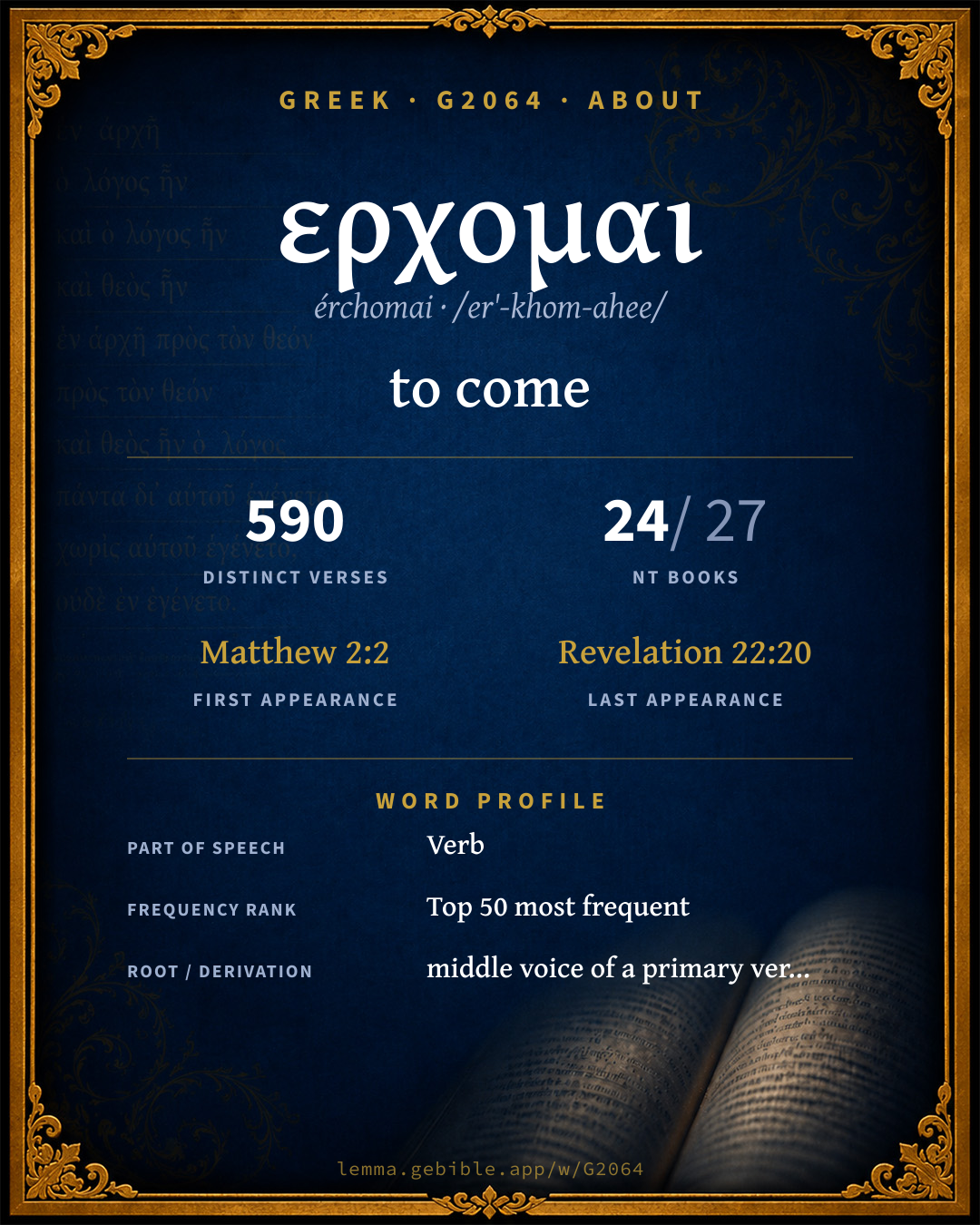
ἔρχομαι
to come
‘to come’ is one of 3 main senses fuller range ↓
Full lexicon entry — Thayer's Greek Lexicon
From Thayer's Greek Lexicon
Where this word appears
See every Present-tense verb in the Greek New Testament →
Grammar key — what these labels mean
Part of speech
- Verb
- An action or state-of-being word.
Tense
- Present
- Ongoing or general action in present time (imperfective aspect).
- Aorist
- Action viewed as a simple whole, without regard to duration — often past (perfective aspect).
- Future
- Action expected in future time.
- Perfect
- A completed past action with continuing present results.
- Imperfect
- Continuous or repeated action in past time (“was writing”).
- Pluperfect
- A past action completed before another past point (“had written”).
Voice
- Middle or Passive deponent
- Middle/passive in form but active in meaning.
- Active
- The subject performs the action.
- Middle deponent
- Middle in form but active in meaning.
Mood
- Indicative
- States a fact or asks a factual question (the mood of reality).
- Participle
- A verbal adjective (“writing,” “having written”).
- Infinitive
- A verbal noun (“to write”), unmarked for person or number.
- Subjunctive
- Expresses probability, purpose, or possibility (the mood of contingency).
- Imperative
- Expresses a command or request.
Case
- Nominative
- The case of the subject (and the predicate nominative).
- Accusative
- The case of the direct object and of extent.
- Genitive
- The case of source, possession, or “of” — answers “whose / from what.”
- Dative
- The case of the indirect object, means, or location — “to / for / with / in.”
Person
- 3rd person
- The one spoken about (“he / she / it / they”).
- 1st person
- The speaker (“I / we”).
- 2nd person
- The one addressed (“you”).
Gender
- Masculine
- Grammatically masculine.
- Feminine
- Grammatically feminine.
- Neuter
- Grammatically neuter.
Number
- Singular
- One.
- Plural
- More than one.
59 verses where G2064 appears in the Aorist tense in the Book of John. Filtered view — show all forms. Click any verse to open its interlinear word-by-word view. Verse text shown in the World English Bible for context — . Each verse’s Greek form is shown with its reference; the English is not keyword-highlighted, since the data carries no word-level English alignment. Use “Compare translations” on any verse to read it across multiple English versions. This concordance covers the Greek New Testament; Septuagint (Greek Old Testament) occurrences of this word are not indexed here.
John
- John 1:7 ἦλθεν aor act ind 3sg The same came as a witness, that he might testify about the light, that all might believe through him.
- John 1:11 ἦλθεν aor act ind 3sg He came to his own, and those who were his own didn't receive him.
- John 1:31 ἦλθον aor act ind 1sg I didn't know him, but for this reason I came baptizing in water: that he would be revealed to Israel."
- John 1:40 ἔρχεσθε ἦλθαν pres mid/pass.dep impv 2pl aor act ind 3pl One of the two who heard John, and followed him, was Andrew, Simon Peter's brother.
- John 3:2 ἦλθεν ἐλήλυθας aor act ind 3sg perf act ind 2sg The same came to him by night, and said to him, "Rabbi, we know that you are a teacher come from God, for no one can do these signs that you do, unless God is with him."
- John 3:22 ἦλθεν aor act ind 3sg After these things, Jesus came with his disciples into the land of Judea. He stayed there with them, and baptized.
- John 3:26 ἦλθον ἔρχονται aor act ind 3pl pres mid/pass.dep ind 3pl They came to John, and said to him, "Rabbi, he who was with you beyond the Jordan, to whom you have testified, behold, the same baptizes, and everyone is coming to him."
- John 4:16 ἐλθὲ aor act impv 2sg Jesus said to her, "Go, call your husband, and come here."
- John 4:25 ἔρχεται ἔλθῃ pres mid/pass.dep ind 3sg aor act subj 3sg The woman said to him, "I know that Messiah comes," (he who is called Christ). "When he has come, he will declare to us all things."
- John 4:27 ἦλθαν aor act ind 3pl At this, his disciples came. They marveled that he was speaking with a woman; yet no one said, "What are you looking for?" or, "Why do you speak with her?"
- John 4:40 ἦλθον aor act ind 3pl So when the Samaritans came to him, they begged him to stay with them. He stayed there two days.
- John 4:45 ἦλθεν ἦλθον aor act ind 3sg aor act ind 3pl So when he came into Galilee, the Galileans received him, having seen all the things that he did in Jerusalem at the feast, for they also went to the feast.
- John 4:46 ἦλθεν aor act ind 3sg Jesus came therefore again to Cana of Galilee, where he made the water into wine. There was a certain nobleman whose son was sick at Capernaum.
- John 4:54 ἐλθὼν aor act ptcp nom sg masc This is again the second sign that Jesus did, having come out of Judea into Galilee.
- John 5:40 ἐλθεῖν aor act inf Yet you will not come to me, that you may have life.
- John 5:43 ἐλήλυθα ἔλθῃ perf act ind 1sg aor act subj 3sg I have come in my Father's name, and you don't receive me. If another comes in his own name, you will receive him.
- John 6:23 ἦλθεν aor act ind 3sg However boats from Tiberias came near to the place where they ate the bread after the Lord had given thanks.
- John 6:24 ἦλθον aor act ind 3pl When the multitude therefore saw that Jesus wasn't there, nor his disciples, they themselves got into the boats, and came to Capernaum, seeking Jesus.
- John 6:44 ἐλθεῖν aor act inf No one can come to me unless the Father who sent me draws him, and I will raise him up in the last day.
- John 6:65 ἐλθεῖν aor act inf He said, "For this cause have I said to you that no one can come to me, unless it is given to him by my Father."
- John 7:31 ἔλθῃ aor act subj 3sg But of the multitude, many believed in him. They said, "When the Christ comes, he won't do more signs than those which this man has done, will he?"
- John 7:34 ἐλθεῖν aor act inf You will seek me, and won't find me; and where I am, you can't come."
- John 7:36 ἐλθεῖν aor act inf What is this word that he said, 'You will seek me, and won't find me; and where I am, you can't come?'"
- John 7:45 Ἦλθον aor act ind 3pl The officers therefore came to the chief priests and Pharisees, and they said to them, "Why didn't you bring him?"
- John 8:14 ἦλθον ἔρχομαι aor act ind 1sg pres mid/pass.dep ind 1sg Jesus answered them, "Even if I testify about myself, my testimony is true, for I know where I came from, and where I am going; but you don't know where I came from, or where I am going.
- John 8:21 ἐλθεῖν aor act inf Jesus said therefore again to them, "I am going away, and you will seek me, and you will die in your sins. Where I go, you can't come."
- John 8:22 ἐλθεῖν aor act inf The Jews therefore said, "Will he kill himself, that he says, 'Where I am going, you can't come?'"
- John 9:7 ἦλθεν aor act ind 3sg and said to him, "Go, wash in the pool of Siloam" (which means "Sent"). So he went away, washed, and came back seeing.
- John 9:39 ἦλθον aor act ind 1sg Jesus said, "I came into this world for judgment, that those who don't see may see; and that those who see may become blind."
- John 10:8 ἦλθον aor act ind 3pl All who came before me are thieves and robbers, but the sheep didn't listen to them.
- John 10:10 ἔρχεται ἦλθον pres mid/pass.dep ind 3sg aor act ind 1sg The thief only comes to steal, kill, and destroy. I came that they may have life, and may have it abundantly.
- John 10:41 ἦλθον aor act ind 3pl Many came to him. They said, "John indeed did no sign, but everything that John said about this man is true."
- John 11:17 Ἐλθὼν aor act ptcp nom sg masc So when Jesus came, he found that he had been in the tomb four days already.
- John 11:32 ἦλθεν aor act ind 3sg Therefore when Mary came to where Jesus was, and saw him, she fell down at his feet, saying to him, "Lord, if you would have been here, my brother wouldn't have died."
- John 11:45 ἐλθόντες aor act ptcp nom pl masc Therefore many of the Jews, who came to Mary and saw what Jesus did, believed in him.
- John 11:56 ἔλθῃ aor act subj 3sg Then they sought for Jesus and spoke one with another, as they stood in the temple, "What do you think--that he isn't coming to the feast at all?"
- John 12:1 ἦλθεν aor act ind 3sg Then six days before the Passover, Jesus came to Bethany, where Lazarus was, who had been dead, whom he raised from the dead.
- John 12:9 ἦλθον aor act ind 3pl A large crowd therefore of the Jews learned that he was there, and they came, not for Jesus' sake only, but that they might see Lazarus also, whom he had raised from the dead.
- John 12:12 ἐλθὼν ἔρχεται aor act ptcp nom sg masc pres mid/pass.dep ind 3sg On the next day a great multitude had come to the feast. When they heard that Jesus was coming to Jerusalem,
- John 12:27 ἦλθον aor act ind 1sg "Now my soul is troubled. What shall I say? 'Father, save me from this time?' But for this cause I came to this time.
- John 12:28 ἦλθεν aor act ind 3sg Father, glorify your name!" Then there came a voice out of the sky, saying, "I have both glorified it, and will glorify it again."
- John 12:47 ἦλθον aor act ind 1sg If anyone listens to my sayings, and doesn't believe, I don't judge him. For I came not to judge the world, but to save the world.
- John 13:1 ἦλθεν aor act ind 3sg Now before the feast of the Passover, Jesus knowing that his time had come that he would depart from this world to the Father, having loved his own who were in the world, he loved them to the end.
- John 13:33 ἐλθεῖν aor act inf Little children, I will be with you a little while longer. You will seek me, and as I said to the Jews, 'Where I am going, you can't come,' so now I tell you.
- John 15:22 ἦλθον aor act ind 1sg If I had not come and spoken to them, they would not have had sin; but now they have no excuse for their sin.
- John 15:26 ἔλθῃ aor act subj 3sg "When the Counselor has come, whom I will send to you from the Father, the Spirit of truth, who proceeds from the Father, he will testify about me.
- John 16:4 ἔλθῃ aor act subj 3sg But I have told you these things, so that when the time comes, you may remember that I told you about them. I didn't tell you these things from the beginning, because I was with you.
- John 16:8 ἐλθὼν aor act ptcp nom sg masc When he has come, he will convict the world about sin, about righteousness, and about judgment;
- John 16:13 ἔλθῃ ἐρχόμενα aor act subj 3sg pres mid/pass.dep ptcp acc pl neut However when he, the Spirit of truth, has come, he will guide you into all truth, for he will not speak from himself; but whatever he hears, he will speak. He will declare to you things that are coming.
- John 16:21 ἦλθεν aor act ind 3sg A woman, when she gives birth, has sorrow, because her time has come. But when she has delivered the child, she doesn't remember the anguish any more, for the joy that a human being is born into the world.
- John 19:32 ἦλθον aor act ind 3pl Therefore the soldiers came, and broke the legs of the first, and of the other who was crucified with him;
- John 19:33 ἐλθόντες aor act ptcp nom pl masc but when they came to Jesus, and saw that he was already dead, they didn't break his legs.
- John 19:38 ἦλθεν aor act ind 3sg After these things, Joseph of Arimathaea, being a disciple of Jesus, but secretly for fear of the Jews, asked of Pilate that he might take away Jesus' body. Pilate gave him permission. He came therefore and took away his body.
- John 19:39 ἦλθεν ἐλθὼν aor act ind 3sg aor act ptcp nom sg masc Nicodemus, who at first came to Jesus by night, also came bringing a mixture of myrrh and aloes, about a hundred pounds.
- John 20:4 ἦλθεν aor act ind 3sg They both ran together. The other disciple outran Peter, and came to the tomb first.
- John 20:8 ἐλθὼν aor act ptcp nom sg masc So then the other disciple who came first to the tomb also entered in, and he saw and believed.
- John 20:19 ἦλθεν aor act ind 3sg When therefore it was evening, on that day, the first day of the week, and when the doors were locked where the disciples were assembled, for fear of the Jews, Jesus came and stood in the midst, and said to them, "Peace be to you."
- John 20:24 ἦλθεν aor act ind 3sg But Thomas, one of the twelve, called Didymus, wasn't with them when Jesus came.
- John 21:8 ἦλθον aor act ind 3pl But the other disciples came in the little boat (for they were not far from the land, but about two hundred cubits away), dragging the net full of fish.
About this entry
At a glance — auto-summarized from this page’s data, not written by a person. Every figure links to its source below. This summary describes the numbers; it doesn’t interpret them.
“to come” is the headline sense of the Greek verb ερχομαι (érchomai). “cometh” is the historic King James Version rendering; modern versions use “came.” See the renderings breakdown. It turns up in 590 verses across 24 books, one of the most common footprint. First canonically at Matthew 2:2, it enters the text early. Catalogued under 3 senses, its meaning is not single-sense. See the sense tree, 590-verse concordance, and the renderings breakdown below.
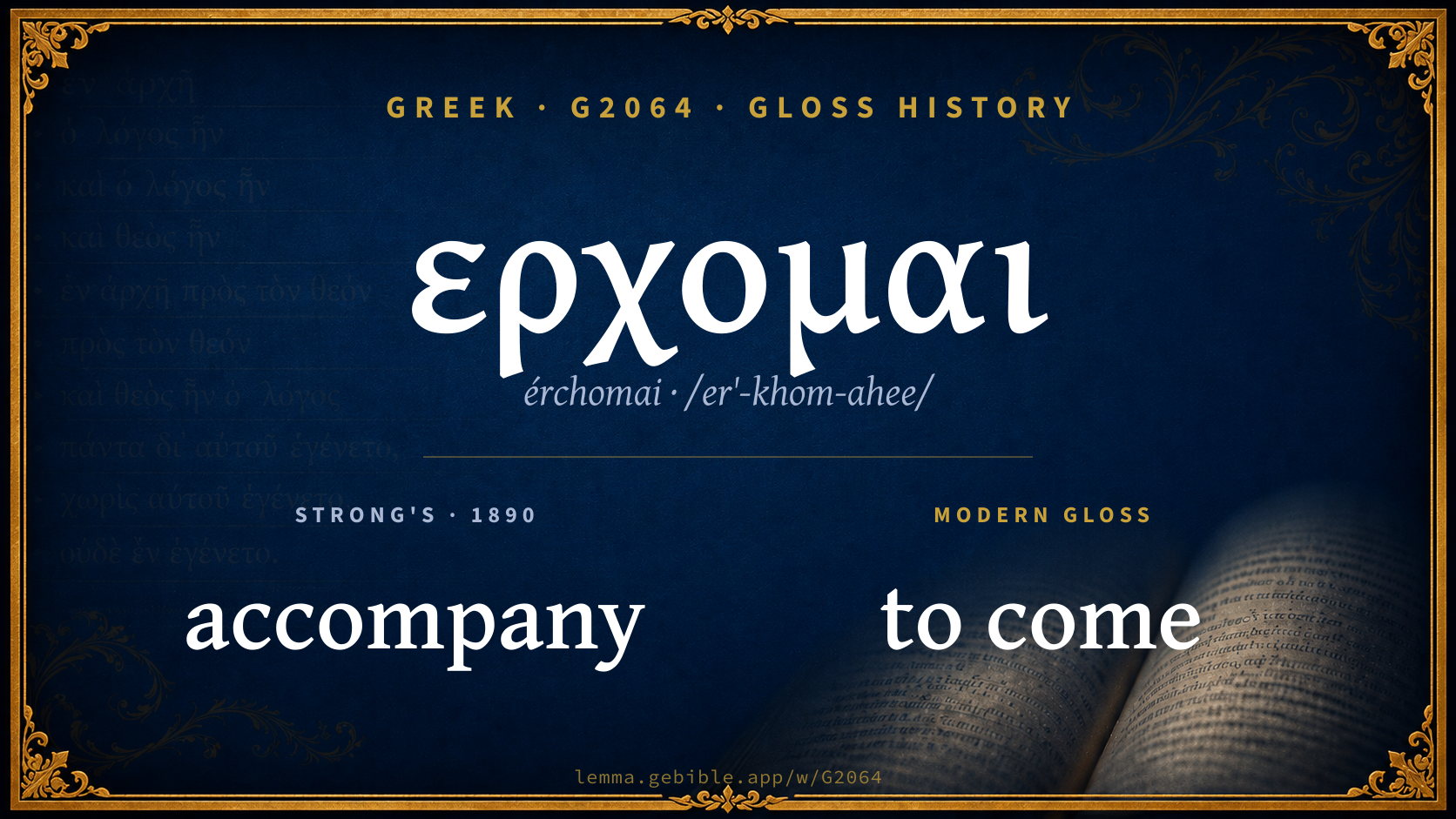
Gloss history
Strong's 1890 vs modern scholarship
About this word
Strong's G2064 catalogs a Greek word from the Greek New Testament.
These counts are not copied from any lexicon or concordance. They are computed here, from the morphology-tagged Greek New Testament. What Lemma adds →
- 590
- distinct verses
- The word appears in 590 distinct verses.
- 24 / 27
- NT books
- The word appears in 24 of 27 New Testament books.
- #33
- by frequency
- Top 50 most frequent Greek words (rank 33 of 5,347 Greek words by occurrence).
View all 590 occurrences in the concordance →
By section of the New Testament
By traditional corpus
Conventional, traditional groupings — biblical authorship is debated, so this is a traditional corpus grouping, not an authorship claim. Some books belong to more than one corpus (Luke is in both the Gospels and the Lukan corpus, and so on), so these shares overlap and need not total 100%. Each figure is a share of the word’s 590 distinct verses.
- Gospels 423 verses · 72%
- Johannine 181 verses · 31%
- Lukan (Luke–Acts) 146 verses · 25%
- Pauline corpus 69 verses · 12%
- Revelation 32 verses · 5%
- General (Catholic) Epistles 10 verses · 2%
- Hebrews 5 verses · 1%
How translations render this word
Counts come from each version’s own published word-to-Strong’s tagging or interlinear alignment — an approximate guide to how each version renders this word, not a word-level alignment the data otherwise carries. Because each total is that version’s own tagged count, the per-version totals vary from one another and need not match the appearance or distinct-verse counts above. These counts may also differ from a printed concordance because Lemma counts each distinctly tagged rendering and does not collapse phrase taggings into a single head-word total. This is a fixed set of word-tagged versions (KJV, ASV, BSB, ULT) and does not change with the reading translation you choose elsewhere. Each version’s license is shown beside its name below (and on Sources).
- King James Version: Came 122×, Come 119×, Cometh 65×
- American Standard Version: Came 111×, Come 100×, Cometh 75×
- Berean Standard Bible: Came 87×, Come 79×, Comes 42×
- unfoldingWord Literal Text: Come 101×, Came 77×, Having come 67×
King James Version Public Domain
Renders G2064 across 660 tagged occurrences — most commonly:
Plus other, less common renderings. Plus 59 renderings that appear only once — usually multi-word phrases or single function words the recovered tagging swept in, not distinct renderings. Not rendered by a distinct English word in 5 further occurrences.
American Standard Version Public Domain
Renders G2064 across 655 tagged occurrences — most commonly:
Plus other, less common renderings. Plus 88 renderings that appear only once — usually multi-word phrases or single function words the recovered tagging swept in, not distinct renderings.
Berean Standard Bible Public Domain
Renders G2064 across 619 tagged occurrences — most commonly:
Plus other, less common renderings. Plus 96 renderings that appear only once — usually multi-word phrases or single function words the recovered tagging swept in, not distinct renderings. Not rendered by a distinct English word in 7 further occurrences.
unfoldingWord Literal Text CC BY-SA 4.0
Renders G2064 across 682 tagged occurrences — most commonly:
Plus other, less common renderings. Plus 44 renderings that appear only once — usually multi-word phrases or single function words the recovered tagging swept in, not distinct renderings.
Senses in Thayer's
The 3 senses Thayer's distinguishes for this word, in lexicon order (not ranked by frequency or importance). The full entry — with sub-senses — is in the Lexicon Entry tab.
- of persons
- metaph.
- to go, to follow one
Word origin
Origin: middle voice of a primary verb (used only in the present and imperfect tenses, the others being supplied by a kindred [middle voice] eleuthomai el-yoo'-thom-ahee, or [active] eltho el'-tho, which do not otherwise occur)
Middle voice of a primary verb (used only in the present and imperfect tenses the others being supplied by a kindred [middle voice] word ἐλεύθομαι eleuthomai or ἔλθω elthō which do not otherwise occur); to come or go (in a great variety of applications literally and figuratively): - accompany appear bring come enter fall out go grow X light X next pass resort be set.
— Strong’s Exhaustive Concordance (1890), public domain.
Forms in the corpus
The 68 distinct written forms G2064 takes in the Greek New Testament, most frequent first — each parse links to that tense’s occurrences in the concordance.
The 60 most common forms are shown; 8 rarer forms follow in the full concordance.
Same root — word family
Other Thayer's entries built from the same root as G2064, grouped by Strong’s listed origin. These share a root / origin per the lexicon — not necessarily a shared meaning. Each links to that word’s own entry.
Derived from this word
Compare all same-root words → They share a root, not necessarily a meaning.
Septuagint usage
The same Greek word ερχομαι appears 805 times in the Greek Old Testament (Septuagint), across 762 verses in 34 books.
- 805
- LXX occurrences
- Tagged occurrences of this Greek word in the Septuagint.
- 762
- verses
- Distinct Septuagint verses containing this word.
- 34 / 39
- OT books
- The word appears in 34 of the 39 Old Testament books.
Sample Septuagint occurrences
- Genesis 10:19 ἔρχομαι
- Exodus 2:8 ἔρχομαι
- Leviticus 13:16 ἔρχομαι
- Numbers 11:26 ἔρχομαι
- Deuteronomy 1:19 ἔρχομαι
- Joshua 2:22 ἔρχομαι
- Judges 2:6 ἔρχομαι
- Ruth 1:2 ἔρχομαι
- 1 Samuel 2:14 ἔρχομαι
- 2 Samuel 1:2 ἔρχομαι
- 1 Kings 1:22 ἔρχομαι
- 2 Kings 1:9 ἔρχομαι
Septuagint occurrences (same lexeme)
Every verse where the same Strong’s number (G2064) appears in the Greek Septuagint — showing the first 50 of 762. Verse text shown in the World English Bible for context; the Greek form is the matched word — the English is not keyword-highlighted.
- Genesis 10:19 ἔρχομαι The border of the Canaanites was from Sidon, as you go toward Gerar, to Gaza; as you go toward Sodom, Gomorrah, Admah, and Zeboiim, to Lasha.
- Genesis 10:30 ἔρχομαι Their dwelling was from Mesha, as you go toward Sephar, the mountain of the east.
- Genesis 11:31 ἔρχομαι Terah took Abram his son, Lot the son of Haran, his son's son, and Sarai his daughter-in-law, his son Abram's wife. They went forth from Ur of the Chaldees, to go into the land of Canaan. They came to Haran, and lived there.
- Genesis 12:5 ἔρχομαι Abram took Sarai his wife, Lot his brother's son, all their substance that they had gathered, and the souls who they had gotten in Haran; and they went forth to go into the land of Canaan. Into the land of Canaan they came.
- Genesis 13:3 ἔρχομαι He went on his journeys from the South even to Bethel, to the place where his tent had been at the beginning, between Bethel and Ai,
- Genesis 13:10 ἔρχομαι Lot lifted up his eyes, and saw all the plain of the Jordan, that it was well watered every where, before Yahweh destroyed Sodom and Gomorrah, like the garden of Yahweh, like the land of Egypt, as you go to Zoar.
- Genesis 13:18 ἔρχομαι Abram moved his tent, and came and lived by the oaks of Mamre, which are in Hebron, and built an altar there to Yahweh.
- Genesis 14:5 ἔρχομαι In the fourteenth year Chedorlaomer came, and the kings who were with him, and struck the Rephaim in Ashteroth Karnaim, and the Zuzim in Ham, and the Emim in Shaveh-kiriathaim,
- Genesis 14:7 ἔρχομαι They returned, and came to En-mishpat (the same is Kadesh), and struck all the country of the Amalekites, and also the Amorites, that lived in Hazazon Tamar.
- Genesis 16:8 ἔρχομαι He said, "Hagar, Sarai's handmaid, where did you come from? Where are you going?" She said, "I am fleeing from the face of my mistress Sarai."
- Genesis 18:21 ἔρχομαι I will go down now, and see whether they have done altogether according to the cry of it, which is come to me. If not, I will know."
- Genesis 18:22 ἔρχομαι The men turned from there, and went toward Sodom, but Abraham stood yet before Yahweh.
- Genesis 19:1 ἔρχομαι The two angels came to Sodom at evening. Lot sat in the gate of Sodom. Lot saw them, and rose up to meet them. He bowed himself with his face to the earth,
- Genesis 19:9 ἔρχομαι They said, "Stand back!" They said, "This one fellow came in to live as a foreigner, and he appoints himself a judge. Now will we deal worse with you, than with them!" They pressed hard on the man, even Lot, and drew near to break the door.
- Genesis 22:3 ἔρχομαι Abraham rose early in the morning, and saddled his donkey, and took two of his young men with him, and Isaac his son. He split the wood for the burnt offering, and rose up, and went to the place of which God had told him.
- Genesis 22:9 ἔρχομαι They came to the place which God had told him of. Abraham built the altar there, and laid the wood in order, bound Isaac his son, and laid him on the altar, on the wood.
- Genesis 23:2 ἔρχομαι Sarah died in Kiriath Arba (the same is Hebron), in the land of Canaan. Abraham came to mourn for Sarah, and to weep for her.
- Genesis 24:30 ἔρχομαι It happened, when he saw the ring, and the bracelets on his sister's hands, and when he heard the words of Rebekah his sister, saying, "This is what the man said to me," that he came to the man. Behold, he was standing by the camels at the spring.
- Genesis 24:41 ἔρχομαι Then will you be clear from my oath, when you come to my relatives. If they don't give her to you, you shall be clear from my oath.'
- Genesis 24:42 ἔρχομαι I came this day to the spring, and said, 'Yahweh, the God of my master Abraham, if now you do prosper my way which I go.
- Genesis 24:63 ἔρχομαι Isaac went out to meditate in the field at the evening. He lifted up his eyes, and saw, and, behold, there were camels coming.
- Genesis 25:18 ἔρχομαι They lived from Havilah to Shur that is before Egypt, as you go toward Assyria. He lived opposite all his relatives.
- Genesis 25:29 ἔρχομαι Jacob boiled stew. Esau came in from the field, and he was famished.
- Genesis 26:27 ἔρχομαι Isaac said to them, "Why have you come to me, since you hate me, and have sent me away from you?"
- Genesis 27:30 ἔρχομαι It happened, as soon as Isaac had made an end of blessing Jacob, and Jacob had just gone out from the presence of Isaac his father, that Esau his brother came in from his hunting.
- Genesis 27:33 ἔρχομαι Isaac trembled violently, and said, "Who, then, is he who has taken venison, and brought it me, and I have eaten of all before you came, and have blessed him? Yes, he will be blessed."
- Genesis 27:35 ἔρχομαι He said, "Your brother came with deceit, and has taken away your blessing."
- Genesis 29:6 ἔρχομαι He said to them, "Is it well with him?" They said, "It is well. See, Rachel, his daughter, is coming with the sheep."
- Genesis 29:9 ἔρχομαι While he was yet speaking with them, Rachel came with her father's sheep, for she kept them.
- Genesis 30:38 ἔρχομαι He set the rods which he had peeled opposite the flocks in the gutters in the watering-troughs where the flocks came to drink. They conceived when they came to drink.
- Genesis 31:24 ἔρχομαι God came to Laban, the Syrian, in a dream of the night, and said to him, "Take heed to yourself that you don't speak to Jacob either good or bad."
- Genesis 32:7 ἔρχομαι Then Jacob was greatly afraid and was distressed: and he divided the people who were with him, and the flocks, and the herds, and the camels, into two companies;
- Genesis 32:9 ἔρχομαι Jacob said, "God of my father Abraham, and God of my father Isaac, Yahweh, who said to me, 'Return to your country, and to your relatives, and I will do you good.'
- Genesis 32:12 ἔρχομαι You said, 'I will surely do you good, and make your seed as the sand of the sea, which can't be numbered because there are so many.'"
- Genesis 33:1 ἔρχομαι Jacob lifted up his eyes, and looked, and, behold, Esau was coming, and with him four hundred men. He divided the children between Leah, Rachel, and to the two handmaids.
- Genesis 33:14 ἔρχομαι Please let my lord pass over before his servant: and I will lead on gently, according to the pace of the cattle that are before me and according to the pace of the children, until I come to my lord to Seir."
- Genesis 33:18 ἔρχομαι Jacob came in peace to the city of Shechem, which is in the land of Canaan, when he came from Paddan Aram; and encamped before the city.
- Genesis 34:5 ἔρχομαι Now Jacob heard that he had defiled Dinah, his daughter; and his sons were with his cattle in the field. Jacob held his peace until they came.
- Genesis 34:7 ἔρχομαι The sons of Jacob came in from the field when they heard it. The men were grieved, and they were very angry, because he had done folly in Israel in lying with Jacob's daughter; which thing ought not to be done.
- Genesis 34:20 ἔρχομαι Hamor and Shechem, his son, came to the gate of their city, and talked with the men of their city, saying,
- Genesis 35:6 ἔρχομαι So Jacob came to Luz, which is in the land of Canaan (the same is Bethel), he and all the people who were with him.
- Genesis 35:16 ἔρχομαι They traveled from Bethel. There was still some distance to come to Ephrath, and Rachel travailed. She had hard labor.
- Genesis 35:27 ἔρχομαι Jacob came to Isaac his father, to Mamre, to Kiriath Arba (the same is Hebron), where Abraham and Isaac lived as foreigners.
- Genesis 37:10 ἔρχομαι He told it to his father and to his brothers. His father rebuked him, and said to him, "What is this dream that you have dreamed? Will I and your mother and your brothers indeed come to bow ourselves down to you to the earth?"
- Genesis 37:14 ἔρχομαι He said to him, "Go now, see whether it is well with your brothers, and well with the flock; and bring me word again." So he sent him out of the valley of Hebron, and he came to Shechem.
- Genesis 37:19 ἔρχομαι They said one to another, "Behold, this dreamer comes.
- Genesis 37:23 ἔρχομαι It happened, when Joseph came to his brothers, that they stripped Joseph of his coat, the coat of many colors that was on him;
- Genesis 37:35 ἔρχομαι All his sons and all his daughters rose up to comfort him; but he refused to be comforted. He said, "For I will go down to Sheol to my son mourning." His father wept for him.
- Genesis 39:16 ἔρχομαι She laid up his garment by her, until his master came home.
- Genesis 41:14 ἔρχομαι Then Pharaoh sent and called Joseph, and they brought him hastily out of the dungeon. He shaved himself, changed his clothing, and came in to Pharaoh.
These are occurrences of the same Greek lexeme (G2064) in the Septuagint — not a translation of any one Hebrew word. The store carries no word-level Hebrew↔Greek alignment, so no Hebrew original is asserted here. Counts come from the recovered LXX Strong's tagging — high-frequency vocabulary is well covered, while rare or late forms may be untagged — so they reflect tagged occurrences and may slightly undercount.