3 John 1:3

Greek (Tischendorf 8th ed.) 3 John 1:3 appears in the Greek New Testament. The text above is from the Tischendorf 8th edition. Each word links to its Strong’s number and a concise gloss. Click any word for its full Thayer’s Greek Lexicon entry.
Download image
Cite this verse

3 John 1:3 (World English Bible). Public Domain. Lemma interlinear Bible study tool, https://lemma.gebible.app/v/3-john/1/3.

Show BibTeX & RIS
BibTeX
RIS
English Translation
For I rejoiced greatly, when brothers came and testified about your truth, even as you walk in truth.
World English Bible · Public Domain
Download a study sheet

One document with this verse’s original text, its word-by-word gloss line, the meaning frame, cross-references with their text, attributed commentary, and full source and license credits — printable, and it pastes into notes with its structure intact.

This verse Autodidact and up

Study sheet (.html) Plain text (.txt)

A passage Seminary Student

Up to 50 verses in one chapter. A passage sheet keeps up to 6 commentary sources and 12 cross-references per verse, in the order this page ranks them, and says so on the sheet whenever that leaves anything out. Ask for a single verse and you get the Autodidact verse sheet above.

Everything on this page stays free to read, with no account — the sheet is a download of what is already on screen, not access to it.

Want to remove ads? Support Godless Engineer
Compare translations 3

The same verse in 3 English versions, stacked beneath the original-language interlinear above. Click any original word for its lexicon entry.

Each is an independent rendering of the whole verse — the interlinear is not word-aligned to these translations.

Highlighted words mark where these versions differ — a whole-verse word diff, not a word-by-word alignment.

  • World English Bible Public Domain
    For I rejoiced greatly, when brothers came and testified about your truth, even as you walk in truth.
  • King James Version Public Domain
    For I rejoiced greatly, when the brethren came and testified of the truth that is in thee, even as thou walkest in the truth.
  • unfoldingWord Literal Text CC BY-SA 4.0
    For I rejoiced greatly when brothers came and attested to your truth, just as you are walking in truth.

unfoldingWord Literal Text — © unfoldingWord, licensed CC BY-SA 4.0. Word-aligned USFM3 via Door43 (git.door43.org/unfoldingWord/en_ult).

Versions to compare (up to 4)

3 of 4 selected

Show all 19 translations

Every available English version of this verse, each an independent rendering of the whole verse.

  • World English Bible Public Domain
    For I rejoiced greatly, when brothers came and testified about your truth, even as you walk in truth.
  • Berean Standard Bible Public Domain
    For I was overjoyed when the brothers came and testified about your devotion to the truth, in which you continue to walk.
  • Majority Standard Bible Public Domain
    For I was overjoyed when the brothers came and testified about your devotion to the truth, in which you continue to walk.
  • King James Version Public Domain
    For I rejoiced greatly, when the brethren came and testified of the truth that is in thee, even as thou walkest in the truth.
  • American Standard Version (1901) Public Domain
    For I rejoiced greatly, when brethren came and bare witness unto thy truth, even as thou walkest in truth.
  • Revised Version (1885) Public Domain
    For I rejoiced greatly, when brethren came and bare witness unto thy truth, even as thou walkest in truth.
  • Geneva Bible (1599) Public Domain
    For I reioyced greatly when the brethren came, and testified of the trueth that is in thee, how thou walkest in the trueth.
  • Douay-Rheims (1899) Public Domain
    I was exceedingly glad when the brethren came and gave testimony to the truth in thee, even as thou walkest in the truth.
  • Young's Literal Translation Public Domain
    for I rejoiced exceedingly, brethren coming and testifying of the truth in thee, even as thou in truth dost walk;
  • Literal Standard Version CC BY-SA 4.0
    for I rejoiced exceedingly, brothers coming and testifying of the truth in you, even as you walk in truth;
  • Unlocked Literal Bible CC BY-SA 4.0
    For I rejoiced greatly when brothers came and bore witness to your truth, just as you walk in truth.
  • unfoldingWord Literal Text CC BY-SA 4.0
    For I rejoiced greatly when brothers came and attested to your truth, just as you are walking in truth.
  • Darby Bible Public Domain
    For I rejoiced exceedingly when [the] brethren came and bore testimony to thy [holding fast the] truth, even as *thou* walkest in truth.
  • World Messianic Bible Public Domain
    For I rejoiced greatly when brothers came and testified about your truth, even as you walk in truth.
  • Webster's Bible Public Domain
    For I rejoiced greatly, when the brethren came and testified of the truth that is in thee, even as thou walkest in the truth.
  • Free Bible Version CC BY-SA 4.0
    I was delighted when some fellow-believers arrived and told me about your commitment to the truth, and how you continue living in the truth.
  • Bible in Basic English Public Domain
    For it gave me great joy when some of the brothers came and gave witness that you had the true faith and were walking in the true way.
  • Text-Critical English NT CC BY 4.0
    For I was overjoyed when the brothers came and testified about yoʋr faithfulness to the truth and how yoʋ walk in the truth.
  • Tyndale New Testament (1534) Public Domain
    I reioysed greatly when the brethren came and testified of the trueth that is in the how thou walkest in trouthe.

Literal Standard Version (2020), Covenant Press — licensed CC BY-SA 4.0. Text via the HelloAO Bible API (eBible.org). Unlocked Literal Bible (unfoldingWord) — licensed CC BY-SA 4.0. Text via the HelloAO Bible API (eBible.org). unfoldingWord Literal Text — © unfoldingWord, licensed CC BY-SA 4.0. Word-aligned USFM3 via Door43 (git.door43.org/unfoldingWord/en_ult). Free Bible Version, Dr. Jonathan Gallagher — licensed CC BY-SA 4.0. Text via the HelloAO Bible API (eBible.org).

Word by word

More ways to search: Search by grammar → Find every occurrence → Compare this word →

Practice this passage: Drill this verse → Learn its vocabulary →

λίαν
lían
G3029
“greatly”
Adverb
Part of Speech
Adverb
Full Thayer's Definition

Origin: of uncertain affinity

TDNT: None

1. greatly, exceedingly, exceedingly beyond measure
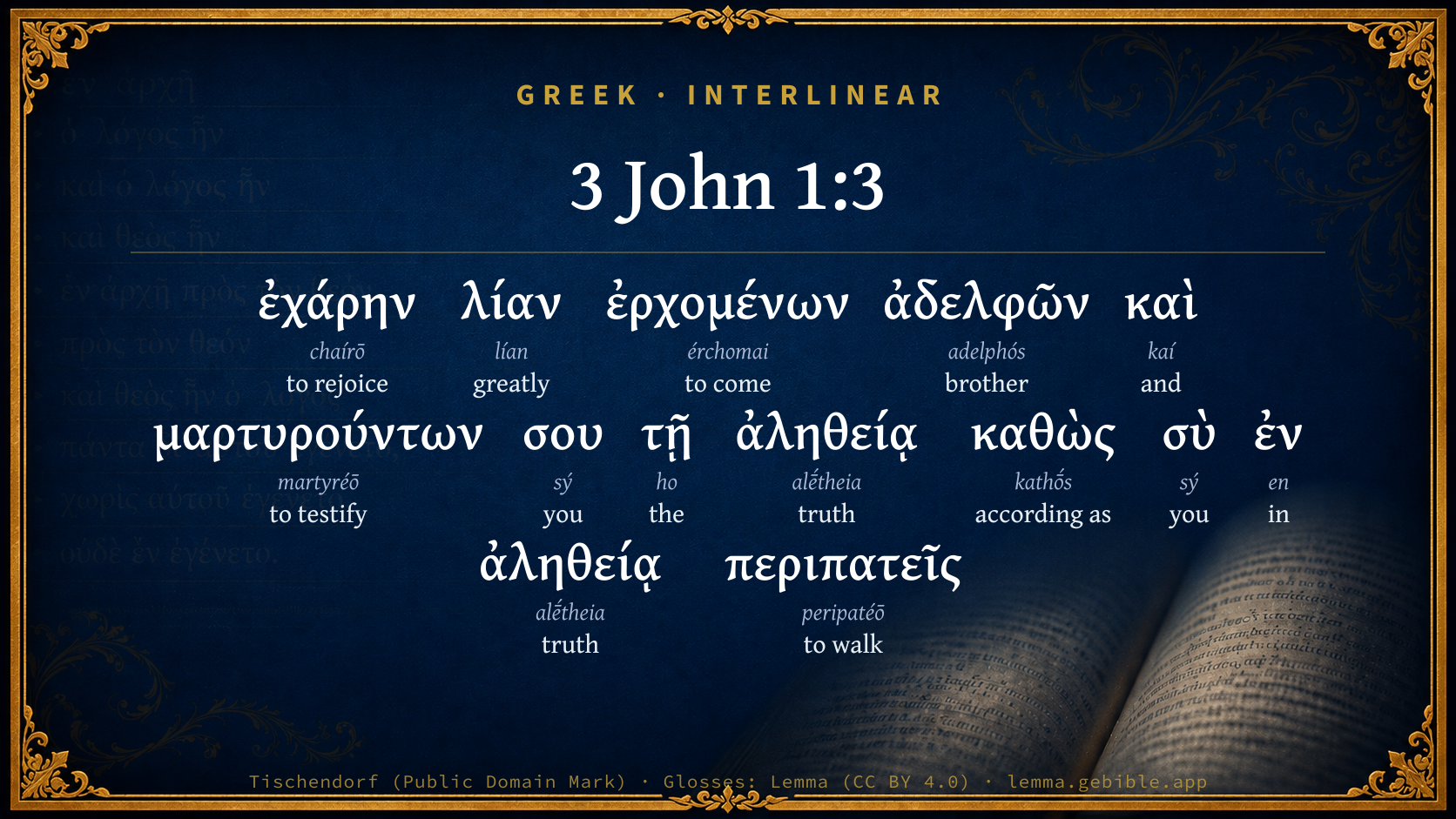
  1. ἐχάρην chaírō G5463 “to rejoice” Verb, Aorist, Passive deponent, Indicative, 1st person, Singular
  2. ἐρχομένων érchomai G2064 “to come” Verb, Present, Middle or Passive deponent, Participle, Genitive, Plural, Masculine
  3. ἀδελφῶν adelphós G80 “brother” Noun, Genitive, Plural, Masculine
  4. καὶ kaí G2532 “and” Conjunction
  5. μαρτυρούντων martyréō G3140 “to testify” Verb, Present, Active, Participle, Genitive, Plural, Masculine
  6. σου sý G4771 “you” Personal pronoun, 2nd person, Genitive, Singular
  7. τῇ ho G3588 “the” Article, Dative, Singular, Feminine
  8. ἀληθείᾳ alḗtheia G225 “truth” Noun, Dative, Singular, Feminine
  9. καθὼς kathṓs G2531 “according as” Adverb
  10. σὺ sý G4771 “you” Personal pronoun, 2nd person, Nominative, Singular
  11. ἐν en G1722 “in” Preposition
  12. ἀληθείᾳ alḗtheia G225 “truth” Noun, Dative, Singular, Feminine
  13. περιπατεῖς peripatéō G4043 “to walk” Verb, Present, Active, Indicative, 2nd person, Singular

About this verse

These counts appear in no published source. They are computed here, from the morphology-tagged text and Lemma’s own curated glosses. What Lemma adds →

14
words
12
distinct lemmas
General Epistles
section

Notable vocabulary

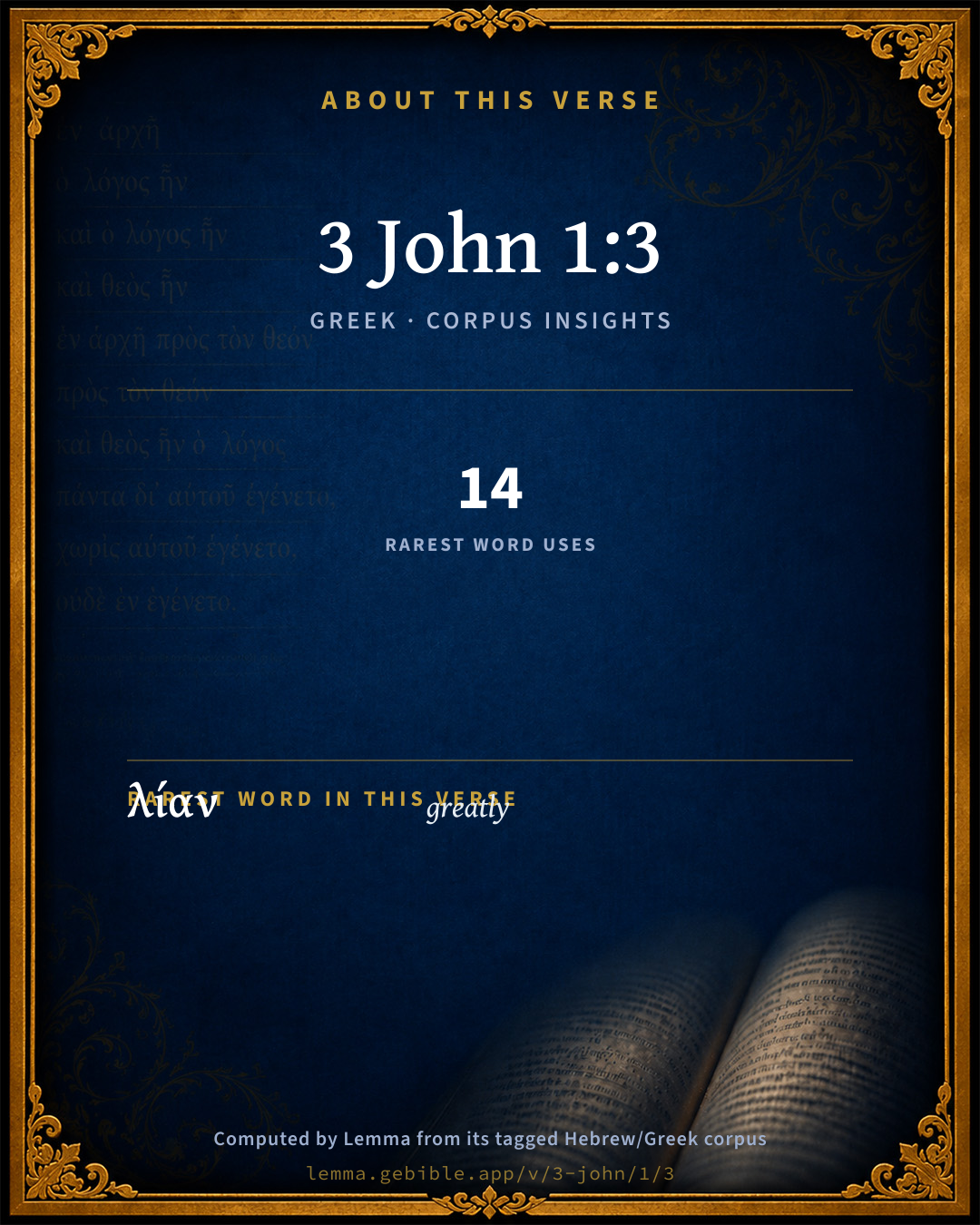
The rarest word here is λίαν greatly G3029 — appearing just 14 times in the whole Greek New Testament.

Shared distinctive vocabulary

λίαν greatly G3029 occurs in 14 verses of the Greek New Testament. Also found in:

Repetition

Words recur within this verse:

  • ἀληθείᾳ truth G225 ×2
  • σου you G4771 ×2

Cross-references

11

Topical passages linked to 3 John 1:3 in the Treasury of Scripture Knowledge — connected by theme and wording, ordered by reader-vote popularity; previews shown in the World English Bible.

  • 2 John 1:4 I rejoice greatly that I have found some of your children walking in truth, even as we have been commanded by the Father.
  • 1 Thessalonians 3:6–9 But when Timothy came just now to us from you, and brought us glad news of your faith and love, and that you have good memories of us always, longing to see us, even as we also long to see you;
  • 2 John 1:2 for the truth's sake, which remains in us, and it will be with us forever:
  • Psalms 119:11 I have hidden your word in my heart, That I might not sin against you.
  • Romans 1:8–9 First, I thank my God through Jesus Christ for all of you, that your faith is proclaimed throughout the whole world.
  • 2 Corinthians 7:6–7 Nevertheless, he who comforts the lowly, God, comforted us by the coming of Titus;
  • 1 Thessalonians 2:19–20 For what is our hope, or joy, or crown of rejoicing? Isn't it even you, before our Lord Jesus at his coming?
  • 3 John 1:4 I have no greater joy than this, to hear about my children walking in truth.
  • Ephesians 1:15–16 For this cause I also, having heard of the faith in the Lord Jesus which is among you, and the love which you have toward all the saints,
  • Philippians 1:4 always in every request of mine on behalf of you all making my requests with joy,
  • Colossians 1:7–8 even as you learned of Epaphras our beloved fellow servant, who is a faithful minister of Christ on our behalf,

Cross-references courtesy of OpenBible.info (CC BY 4.0).

Commentary

Notes on 3 John 1:3 from classic Christian and Jewish commentators (each source and its license shown beneath its notes). The classic Christian expositions comment on the surrounding passage and are grouped to its opening verse, so a note may address several verses; the Jewish commentaries on the Tanakh (Rashi and others) are per-verse, so they appear only where the commentator wrote on this verse.

Lemma curates 59 commentaries, every one of them public domain or Creative Commons licensed, each selected and text-cleaned for this edition rather than reprinted as found. About our sources →

The Biblical Illustrator

Joseph S. Exell

3Jn_1:3

I rejoiced greatly, when the brethren came and testified of the truth that is in thee.

Beautiful is the picture presented in this verse. Here we have brethren engaging in Christian intercourse, ascertaining each others moral condition, and taking a deep and living interest in all that pertains to the education of the soul in the faith of Christ. This is a fine test of moral manhood. When we find men disposed to give the fullest credit for the growth and sincerity of their brethren in the faith, we may accept such witness as a proof that they themselves are firmly rooted in great principles, and are more and more resembling Him whose name they bear, and whose perfections it is the business of their lives to illustrate. (J. Parker, D. D.)

Gaius

We are now to study the character of Gaius, the sincere and generous host of Demetrius, the quiet but sturdy opponent of the intolerance and tyranny of Diotrephes, and the study should be very welcome to us since, if he has not climbed so high as the fervent and zealous Evangelist, still less has he fallen so low as the prating lover of pre-eminence who would not defer even to the apostle himself. With his first touch St. John strikes the ground-note, or the keynote, of the whole music which went to make up the character of the man. Gaius was one who walked in truth, and so walked in it that men bore witness to his truth. The Greek word here rendered truth might, if the change were worth making, be rendered reality. But if I say that Gaius was a true man, a genuine man, a real man, whose life was all of one piece, whose daily conduct was the practical outcome and inference from the truths he believed, I may perhaps help you to some conception of the apostles meaning. Still he implies much more than he says, and we must try to recover his implications also. We may, and must, infer from his stress on the word truth that Gaius cared more for deeds than for words; that there was not that unhappy divorce between his professions and his actions, his creed and his conduct, which we may see in Diotrophes and recognise only too clearly in ourselves. He did not look one way and walk another. He did not say one thing and mean another. He did not approve the better, and follow the worse, course. There was no hypocrisy, no insincerity, in him. He, the whole man, was in the truth. Come what may, no danger, no allurement, will draw or drive him from his steadfast and habitual round, or make him unfaithful to the faith and service of Christ. And we may also infer that Gaius was not one who would bring the spirit and methods of the world into the Church. Diotrephes might be as selfish, as opinionated, as ambitious, as subtle and scheming, as he was before he had entered the Christian fellowship. But that was not possible to a true man, a genuine Christian, such as Gaius, who really believed the truth as it is in Jesus. Nor, again, could a true man, in the apostles sense, yield to that still more subtle and fatal temptation by which those are overcome in whom religion degenerates, as it seems to have done in Diotrephes, into mere ecclesiasticism or sectarianism. A too keen and exclusive interest in the outside of the cup and the platter is as dangerous in the Church as it is anywhere else. And the charity of Gaius was as conspicuous as his unworldliness. Not only had he received and entertained strangers, who were also brethren, setting forward Demetrius and other travelling evangelists on their journey; he continued to receive and serve them even when Diotrephes forbade him, and had persuaded the Church to excommunicate those who ventured to receive them. He could do no other, for he walked in truth. Nor was he to be talked out of his loyalty to truth, or threatened out of it. Truth in every form was welcome to him, let who would teach it, let who would prate against it. It was his duty to receive brethren even if they were strangers. A certain genuineness and wholeness, then, a certain staunchness and loyalty, combined with great breadth and tolerance, seems to have been characteristic of the hospitable and kindly Gaius. He was in the truth. He walked in truth. There was a clear accord, a fruitful harmony, between his principles and his practice which gave unity and force to his life. He could be true to truth, come whence it would. He could be true to men, even when they were reviled and thrust out of the Church. Now this large, steadfast, yet gentle loyalty to truth is as essential to a genuine, a real and strong, Christian character now as it was then: a loyalty which can not only stand against the narrow intolerance of a Diotrephes, and sympathise with the disinterested zeal of a Demetrius, but can also bring the large generous truths in which we believe to bear upon our daily life and practice, and constrain us to receive and set forward all who are serving the truth that we may be fellow-workers with the truth they teach. Before we can put ourselves even on the modest level of Gaius, we must ask ourselves, What risks have we run, what sacrifices have we made, what pleasant fellowships have we put in jeopardy, that we might stand up for unpopular truths, or back up the men who were enforcing and defending them? There are men, no doubt, who have a terrible struggle to wage in the sacred precincts of their own soul before they can make religion the ruling inference and power of their lives; and of these, perhaps, we must not expect much public service until the issue of the inward conflict has been decided; though I believe that, even in this inward personal war, they would be greatly aided were they to make it more impersonal, and to care and contend for the salvation of other men instead of simply fighting for their own hand. And there are other men who are so engrossed and exhausted by the labours and cares, the occupations and irritations, of their daily business that they have as much as they can do in bringing the spirit of religion to bear on their daily task, and have neither leisure nor energy left for works of public usefulness. Remember, we are not told that Gaius talked Diotrephes down, or that he made a masterly defence of St. John, or even that he took a prominent part whether in managing the affairs or conducting the services of the Church. All we are told of him is that he showed much sympathy with the strangers whom John had commended to the Church, that his sympathy took very practical forms, and that he exercised it at the risk, and perhaps at the cost, of losing the sympathy of brethren who were not strangers, and with whom he habitually worshipped. (S. Cox, D. D.)

The testimony of others

I. Faith in possession.

1. The unconditional acceptance of the truth.

2. The harmony of truth with our moral nature.

II. Faith in action.

1. Faith in action is a healthful and energising exercise of our whole life.

2. Faith in action is a power wielded over others.

III. Faith on record. The faithful witnesses who gave their evidence in the presence of St. John were samples of others who gave their evidence before the tribunal of the world.

1. It is a record worth making. To write down the deeds, the trials, and the victories of faith is not a waste of either time or materials.

2. It is worth rehearsing.

3. It is worth preserving. Its influence is marvellous. The lamp of another strengthens the light of our own, to make clearer the Christian path.

IV. The reflex influence of faith. Gaius was the apostles son in the faith. How the soul of the aged minister was lighted up as the brethren related to him the glad tidings concerning the soul he had been instrumental in saving. (T. Davies, M. A.)

Fame

is like a ship that receives all passengers, like a waggon that entertains all, good and bad. Bad things go abroad, and good things go abroad, but here is the difference.

1. Bad things go speedily, good slowly; the one flies like eagles, the other creeps like snails.

2. The one are enlarged, the other diminished.

3. The one all hear of, but a few of the others.

4. Bad things go without ceasing; men are like flies that are ever insisting upon sores; the report of good things is like a hue and cry that quickly falls down in the country.

5. The one we tell of with delight; we take little pleasure in talking of the other, yet we ought to testify of the one rather than of the other. Let us witness of the virtues wherewith God hath adorned any. It shall redound to his glory, and it shall be a spur to prick on others to the like. (W. Jones, D. D.)

The Biblical Illustrator, edited by Joseph S. Exell (c. 1880s–1900s) — public domain. Text from a community e-Sword module.

Tyndale Open Study Notes

Tyndale Open Resources

1:3 The traveling teachers (literally brothers) were probably John’s emissaries who traveled from church to church, teaching the Good News and encouraging Christians (see 1:5, 10). • you are living according to the truth: Gaius was faithful to the apostolic gospel of Jesus Christ. The false teachers denied the reality of the incarnation or the sacrificial death of Jesus Christ (cp. 1 Jn 4:1-3).

Tyndale Open Study Notes — © Tyndale Open Resources, licensed CC BY-SA 4.0. Text via the HelloAO Bible API.

Bengel's Gnomon

Johann Albrecht Bengel

3Jn 1:3. Ἐχάρην, I rejoiced) This is enlarged upon in 3Jn 1:4.—γὰρ, for) A healthy state of the soul is known by the works; and the prayers of the righteous further this state.—καθὼς, even as) is explanatory.—σὺ) thou; opposed to Diotrephes, 3Jn 1:9.

Bengel's Gnomon of the New Testament — English translation (T&T Clark, Edinburgh, 1860) — public domain. Text from a community e-Sword module.

Meyer's Critical & Exegetical Commentary

Heinrich August Wilhelm Meyer

3Jn_1:3. Confirmation of the foregoing statement.

ἐχάρην γὰρ λίαν] see on 2Jn_1:4. When and why the apostle felt such a joy is stated in the two following participial sentences, of which, however, as far as the sense is concerned, the first is subordinate to the second; à Mons: lorsque les frères qui sont venus ont rendu témoignage.

μαρτυρεῖν, with the dative of the thing: to testify of anything; comp. 3Jn_1:6; 3Jn_1:12; Joh_3:26; Joh_5:33; Joh_18:37.

By σου τῇ ἀληθείᾳ it is not the truth in the objective sense (Calovius: veritas evangelii) in so far as Caius had received it, but the truth in the subjective sense, that is to be understood (so also Lücke, Düsterdieck, Braune, etc.): the inner Christian life, which is born of the truth, is itself truth; some commentators incorrectly limit the idea to a single element of it; e.g. Lorinus to liberalitas.

The addition: καθὼς σὺ ἐν ἀληθείᾳ περιπατεῖς (comp. 2Jn_1:4), serves as an explanation of the preceding: namely how thou, etc. In the fact that the brethren testified that Caius was walking in the truth, they bore a testimony to the truth that was in him. The sentence is not a direct sentence (Baumgarten-Crusius: as thou indeed art living in accordance with the truth) by which John adds his testimony to that of the brethren (Besser) in order to confirm it (Ebrard), but an indirect sentence (Brückner) dependent on μαρτυρούντων, on which a special emphasis is laid, as also the ἀκούω in 3Jn_1:4 shows (so also Düsterdieck, Braune). σύ is emphatically used in contrast to those who do not walk ἐν ἀληθείᾳ.

Meyer — Critical and Exegetical Commentary on the New Testament — English translation by Peter Christie, edited by Frederick Crombie (T&T Clark, 1880) — public domain. Text from a community e-Sword module.

Expositor's Greek Testament

ed. W. Robertson Nicoll

3Jn 1:3 . ἐχάρην , see note on 2Jn 1:4 . ἐρχομένων , repeatedly, not on one particular occasion ( ἐλθόντων ). The itinerant brethren ( die reisenden Brüder ) were always at work, going out from Ephesus on their missions and returning with their reports. Cf. 3Jn 1:5-6 . See Introd. p. 155.

The Expositor's Greek Testament, edited by W. Robertson Nicoll (1897–1910) — public domain. Text from a community e-Sword module.

Matthew Henry's Commentary

I. John receives a good report of Gaius's faith and charity from the brethren. Gaius’s love for the brethren and hospitality to strangers proves his sincerity in the faith. II. Gaius is commended for his hospitality, a virtue extended to strangers and those of different churches. III. John expresses great joy in hearing of Gaius's walk in truth. This reflects the joy of ministers when they see their followers living out their faith. IV. John advises Gaius to continue supporting the brethren by aiding them on their journeys in a godly manner, reflecting Christian generosity. V. The brethren went forth preaching for God's sake, taking nothing from the Gentiles. John emphasizes the need for the church to support such ministers, as they help propagate the truth.

Matthew Henry's Commentary on the Whole Bible (1708–1710) — public domain (CC PDM 1.0). Text via the HelloAO Bible API.

Jamieson, Fausset & Brown

Robert Jamieson, A. R. Fausset & David Brown

testified of the truth that is in thee--Greek, "of" (or 'to') thy truth": thy share of that truth in which thou walkest [ALFORD].

even as thou--in contrast to Diotrephes (Jo3 1:9).

Jamieson, Fausset & Brown — Commentary Critical and Explanatory on the Whole Bible (1871) — public domain (CC PDM 1.0). Text via the HelloAO Bible API.

Adam Clarke's Commentary

Verse 3. When the brethren came] Probably the same of whom he speaks in the fifth 3Jo 1:5 and following verses, and who appear to have been itinerant evangelists.

The truth that is in thee] The soundness of thy faith and the depth of thy religion.

Adam Clarke's Commentary on the Bible (1810–1826) — public domain. Text from a community e-Sword/MySword module.

The Cambridge Bible for Schools and Colleges

gen. ed. J. J. S. Perowne

3. For] ‘I know that thy soul is in a prosperous condition, for I have it on good authority.’

I rejoiced greatly] See on 2Jn_1:4. This cannot so well be the epistolary aorist, but rather refers to the definite occasions when information was brought. Of course if ‘rejoiced’ becomes present as epistolary aorist, ‘came’ and ‘bare witness’ must be treated in like manner.

testified of the truth that is in thee] Better, bare witness (see on 1Jn_1:2) to thy truth (see on 3Jn_1:6). The whole, literally rendered, runs thus; For I rejoiced greatly at brethren coming and witnessing to thy truth. Joh_5:33 is wrongly quoted as a parallel. There the Baptist ‘hath borne witness to the truth,’ i.e. to the Gospel or to Christ. Here the brethren bare witness to Gaius’s truth, i.e. to his Christian life, as is shewn by what follows. The ‘thy’ is emphatic, as in 3Jn_1:6; perhaps in contrast to the conduct of Diotrephes. Comp. Luk_4:22.

even as thou walkest in the truth] Omit ‘the,’ as in 2Jn_1:4. This is part of what the brethren reported, explaining what they meant by Gaius’s truth.

The Cambridge Bible for Schools and Colleges (gen. ed. J. J. S. Perowne; Cambridge University Press, 1878–1918) — public domain. Text from a community e-Sword module.

John Gill's Exposition

For I rejoiced greatly when the brethren came,.... From the place where Gaius lived, to that where John now resided; these brethren seem to be preachers of the word, who travelled from place to place to spread the Gospel:

and testified of the truth that is in thee; either of Christ, who was formed in him; or of the Gospel, which had a place in his heart; or of the truth of grace that was in him, as well as of that faithfulness, integrity, and sincerity he appeared to be possessed of, being an Israelite indeed, and without guile:

even as thou walkest in the truth: in Christ, and in the Gospel, and as became it, and with all uprightness; see Jo2 1:4; and this occasioned great joy in the apostle; as it is matter of joy to every one that truly loves Christ, and his Gospel; or has the true grace of charity in him, which envies not the gifts and graces of others, but rejoiceth in the truth, wherever it is found; and especially to the faithful ministers of the word, when they hear of the truth of grace in any souls, and that such continue walking in the truth of the Gospel, and particularly those who have been wrought upon under their ministry, as follows.

John Gill's Exposition of the Whole Bible (1746–1763) — public domain (CC PDM 1.0). Text via the HelloAO Bible API.

Trapp's Complete Commentary

John Trapp

3 For I rejoiced greatly, when the brethren came and testified of the truth that is in thee, even as thou walkest in the truth.

Ver. 3. Testified of the truth] This was their ingenuity, thus, at least, to requite their host by giving testimony of his liberality, and this his liberality proved the truth of his faith, and his good estate to Godward, as did Dorcas’s garments made for the poor. Lipsius conqueritur desiisse homines non modo laudanda facere, sed laudare. (l. ii. Epis. 70.)

John Trapp, A Commentary or Exposition upon All the Books of the Old and New Testament (1647–1656) — public domain. Text from a community e-Sword module.

Albert Barnes' Notes on the Bible

For I rejoiced greatly when the brethren came - Who these were is not certainly known. They may have been members of the same church with Gaius, who, for some reason, had visited the writer of this Epistle; or they may have been the “brethren” who had gone from him with a letter of commendation to the church, 3Jo 1:9, and had been rejected by the church through the influence of Diotrephes, and who, after having been hospitably entertained by Gaius, had again returned to the writer of this Epistle. In that case, they would of course bear honorable testimony to the kindness which they had received from Gaius, and to his Christian character.

And testified of the truth that is in thee - That you adhere steadfastly to the truth, notwithstanding the fact that errors abound, and that there are many false teachers in the world.

Even as thou walkest in the truth - Livest in accordance with the truth. The writer had made the same remark of the children of Cyria, to whom the second Epistle was directed. See the notes at 2Jo 1:4.

Albert Barnes' Notes on the Bible (1834–1885) — public domain. Text from a community e-Sword/MySword module.

Matthew Poole's English Annotations

The truth is familiarly used to signify the pure doctrine of Christianity, which in its principal design aims at correspondent practice. That his children, i.e. such as had been converted to Christ by his ministry, {as 1Co 4:15} of whom it appears Gaius was one, did

walk in the truth; ( an apt expression of such correspondent practice); was greatest matter of joy to this holy apostle, especially when the godly lives of such, to whose conversion he had been instrumental, were so observable, as to gain them a testimony from all others that knew them, as it was in the present instance.

Matthew Poole's English Annotations on the Holy Bible (1683–1685) — public domain. Text from a community e-Sword/MySword module.

Whedon's Commentary on the Bible

Daniel D. Whedon

3. For—Giving reason for assuming that his soul was all right; namely, his accepting and aiding John’s missionaries of truth, instead of the errorists.

The brethren came—The missionaries sent by John, who returned from their first mission into Asia Minor, back to Ephesus, and made report. Their report in regard to their entertainment by Gaius was such that our apostle rejoiced greatly. And he was induced thereby, on their starting for their second journey, to send by them this letter to Gaius.

Daniel D. Whedon (gen. ed.), Commentary on the Old and New Testaments (1874–1909) — public domain. Text from a community e-Sword module.

The Pulpit Commentary

Vers. 3, 4. For I rejoiced greatly. We must not lose sight of the "for," which is full of meaning. The elder has just expressed a wish that the external well-being of Gains may equal the well-being of his soul; and he is quite sure of the latter, for brethren keep coming and bearing witness to the fact. The good report of Gains is still greater joy to the apostle than the evil report of Diotrephes is a sorrow to him. The language in condemnation of Diotrephes, severe as it is, is not so strong as this in thankful delight respecting Gaius: Greater joy have I none than (to hear of) these things. "Greater" is made doubly emphatic, first by position at the beginning of the sentence, and secondly by the double comparative meizoteran.

Vers. 3, 4.

Spiritual prosperity.

I rejoiced greatly when the brethren came and testified of the truth that is in thee," etc. In these and some subsequent verses we have some aspects and evidences of the spiritual prosperity of Gaius.

I ASPECTS OF SPIRITUAL PROSPERITY. "Brethren came and bare witness unto thy truth, even as thou walkest in truth.

1. Truth appropriated in mind and heart. Our interpretation of the words, "thy truth," would be superficial and inadequate if we simply said that they express the sincerity of Gaius. The expression involves this, that he was true in religion and in life; but it means that his religious beliefs were correct that he held the truth concerning the Person and work of Jesus Christ. On these subjects pernicious errors had arisen in the Church. Some denied the Godhead of our Saviour; others denied the reality of his manhood. "The first stumbled at his pre-existence and incarnation, because he suffered indignity and anguish; the other, admitting his Divine nature, thought it beneath him actually to suffer, and therefore denied that his body or his sufferings were anything else but illusory appearances" (Binney). Against each of these errors St. John wrote. And by the expression, "the truth," he generally means the apostolic doctrine concerning the Person and work of Jesus Christ. "This truth Gaius held; held it as his life; it was

2. "in him," as filling his intellect and affections; in his understanding as a source of light, in his heart as the object of love." The apostle, as we have learned from his former Epistles, attached the utmost importance to correct religious belief.

3. Truth manifested in life and conduct. "Thou walkest in truth." His practical life was in harmony with his professed creed. The truth he held was not merely a form of sound words, but a living force in his character and conduct. His faith was not a mere speculation or opinion, but a thing of deep feeling and firm conviction. The faith that does not influence the life towards harmony with itself is not faith in the scriptural sense; it is assent, or opinion; but it is not Christian faith, or saving faith. Our real faith moulds the life into conformity with the truth believed. St. John quite as earnestly insisted upon practicing the truth as upon holding it. "He that doeth good is of God; he that doeth evil hath not seen God" (verse 11; and. (1Jn_3:7, 1Jn_3:10) Let us, like Gaius, hold the truth, make it our own; and also live the truth, walk in it day by day. Cultivate a true faith and a holy life.

II TESTIMONY TO SPIRITUAL PROSPERITY. " Brethren came and bare witness unto thy truth," etc. These brethren were probably those who had been commended to the Church by the apostle, rejected through the influence of Diotrephes (verse 9), and then entertained by Gains. They probably presented this report on their return to the Church of which St. John was pastor, and from which they had been sent forth (verses 5, 6).

1. It is a pleasure to good men to testify to the excellence of others.

2. It is gratifying to a good man to,receive the commendation of good men. "A good name is better than precious ointment." "A good name is rather to be chosen than great riches.

III THE INFLUENCE OF SPIRITUAL PROSPERITY UPON THE GOOD. "Greater joy have I none than this, to hear of my children," etc.

1. The tender relation here mentioned. "My children." It seems that Gains had been converted through the ministry of St. John. He was the spiritual child of the apostle; his "true child in faith;" his "beloved child," as St. Paul says of Timothy. This relationship is very close, tender, and sacred (cf. 1Co_4:14, 1Co_4:15)

2. The great joy here spoken of. "Greater joy have I none than this," etc. Every genuine Christian rejoices to find men walking in the truth; but the apostle had the additional joy which arose from the dear and holy tie by which he and Gains were united. The success of a young man in temporal things is a great joy to his parents. To Christian parents it is a far greater joy when their children give their hearts to God, and walk in truth. And to the Christian minister, and the Sunday school teacher, the spiritual prosperity of those whom they have led to the Saviour is a source of deep and pure rejoicing. Such prosperity is a proof that we have not laboured in vain; it is a distinguished honour conferred upon us by God; and it gives a foretaste of the grand final reward, "Well done, good and faithful servant," etc. To hear of or to behold such fruits of our Christian work both humbles and rejoices us.

Christian brethren, let us aim both to appropriate and to exemplify Christian truth. W.J.

The Pulpit Commentary (1880–1919), ed. H.D.M. Spence-Jones & Joseph S. Exell — public domain. Text from a community e-Sword module.

John Wesley's Explanatory Notes

For - I know thou usest all thy talents to his glory. The truth that is in thee - The true faith and love.

John Wesley, Explanatory Notes Upon the Whole Bible (1754–1765) — public domain. Text via the GEBible commentary corpus.

Burkitt's Expository Notes on the New Testament

William Burkitt

Observe here, 1. The commendable testimony which the brethren that came from Gaius have to St. John concerning his holy and unblamable conversation, according to the direction of the gospel. The brethren testified of thee, that thou walkest in the truth: good reports of our brethren, without detracting any thing from their worth, is a manifest duty.

Observe, 2. With what joy and rejoicing St. John received the notices of Gaius’ adherence to the truth, and of his answerable walking thereunto. I rejoiced when the brethren came and testified of thee; he did not envy the grace of God so largely conferred on Gaius, but rejoiced in it, and no doubt blessed God exceedingly for it: soul-mercies are the greatest mercies, and matters of the greatest joy to gracious souls.

Observe, 3. That additional joy which St. John expresses to hear that his children, that is, those persons whom he had converted to Christianity, and begotten to Christ through the gospel, did walk in the truth, that is, in the sincere practice as well as in the outward profession of religion: I have no greater joy than to hear that my children walk in the truth; the faithful ministers of Christ rejoice more in the welfare of their people’s souls, than in all their worldly wealth or honour.

William Burkitt's Expository Notes on the New Testament (1700–1703) — public domain. Text from a community e-Sword module.

The People's New Testament

B. W. Johnson

3. For I rejoiced greatly. Certain brethren had been where Gaius lived, had enjoyed his hospitality and had spoken well of him to John on their return.

B. W. Johnson's The People's New Testament with Notes (1889–1891) — public domain. Electronic text from the Christian Classics Ethereal Library (CCEL) ThML edition.

Cambridge Greek Testament for Schools and Colleges

3. [939], Vulgate, and Thebaic omit γάρ.

[939] 4th century. Discovered by Tischendorf in 1859 at the monastery of S. Catherine on Mount Sinai, and now at Petersburg. All three Epistles.

3. ἐχάρην γὰρ λίαν. The γάρ has been omitted in some important authorities, perhaps under the influence of 2Jn 1:4. It means ‘I know that thy soul is in a prosperous condition, for I have it on good authority’. For ἐχάρην see on 2Jn 1:4: but here it cannot so well be the epistolary aorist, but refers to the definite occasions when information was brought to the Apostle. Of course if ἐχάρην be rendered ‘I rejoice’ as epistolary aorist ἐρχομένων and μαρτυρούντων must be treated in like manner; as in R.V. margin.

ἐρχομένων. Imperfect participle of what happened repeatedly: so also μαρτυρούντων. When brethren (no article) came and bare witness (see on 1Jn 1:2) to thy truth (see on 3Jn 1:6). The whole, literally rendered, runs thus; For I rejoiced greatly at brethren coming and witnessing to thy truth. Joh 5:33 is wrongly quoted as a parallel. There the Baptist ‘hath borne witness to the truth,’ i.e. to the Gospel or to Christ. Here the brethren bare witness to Gaius’s truth, i.e. to his Christian life, as is shewn by what follows. The σου is emphatic, as in 3Jn 1:6; perhaps in contrast to the conduct of Diotrephes. Comp. Luk 4:22. What follows, καθὼς σὺ κ.τ.λ., is part of what these ἀδελφοί reported, explaining what they meant by Gaius’s truth.

Cambridge Greek Testament for Schools and Colleges (Cambridge University Press, 1896; 21 vols, various authors incl. Carr, Maclear, Plummer, Farrar, Lumby, Moule, M. R. James, Simcox) — public domain. Text from a community e-Sword module.

Vincent's Word Studies in the New Testament

Marvin R. Vincent

Rejoiced greatly. See on 2 John 4.

Brethren came [ερχομενων αδελφων] . Lit., coming. The present participle denotes coming from time to time, and not coming on a single occasion, which would require the aorist. On brethren, see on 1Jo 2:9. Thou walkest in truth. See on 1Jo 1:8. for the phrase walk in, see on 2 John 6. Thou is emphatic, suggesting a contrast with less faithful ones, as Diotrephes, ver. 9.

Marvin R. Vincent, Word Studies in the New Testament (1887–1900) — public domain. Text from a community e-Sword/MySword module.

Westcott on Hebrews & the Epistles of John

Brooke Foss Westcott

3. ἐχάρην yap...| Comp. 2 John 4. The joy which the apostle felt at the tidings of the action of Gaius is given in explanation of his far-reaching wish for his welfare, and not only as an assurance of his spiritual well-being. The words evidently point to some difficulties from false teaching which Gaius had boldly met, though as yet the issue of his work was uncertain.

ἐρχομ. a8.| when brethren came not on one occasion only (ἐλθόντων) but from time to time, though all these visits belonged definitely to the past (ἐχάρην) when the apostle wrote. The words give a vivid picture of continued troubles even in the apostolic church.

ἀδελφῶν] vv. 5,10. Comp. 1 John ili. 14 addit. note.

papr. o. τῇ ἀλ.] testimonium perhibentibus veritati tue V., bore witness to thy truth, attested the perfect and sincere loyalty with which you maintain the fulness of the Christian faith in life. Christian thought and Christian action are inseparable.

καθὼς σύ... even as thou walkest in truth, truly. Comp. 2 John 4. The emphatic pronoun (σύ) suggests ἃ contrast with others as (for example) Diotrephes. Gaius walked not only in word but really (ἐν aAné. 1 John iii. 18) according to the standard of the Christian revelation (ἐν τῇ aA. ‘in the Truth’). The clause seems to

be one of those personal comments in which St John pausing on what is written, as it were, thinks aloud: ‘They witnessed to thy truth; yes, and when the vision of vain professions rises before me I know that thou at least livest indeed as thou teachest.’

Brooke Foss Westcott (1825–1901), The Epistle to the Hebrews (1889) and The Epistles of St John (1883) — public domain (pre-1929). Text recovered from Internet Archive / Google Books OCR scans. Westcott’s Gospel of John commentary is not included (its OCR lost the chapter running-heads required for reliable verse-keying). Some Greek quoted in the Hebrews volume is imperfectly rendered by the OCR.

Lesson kit

Teaching starters — assembled from the data on this page, not authored interpretation. Every prompt links to the verse data it draws on. Edit before teaching.

3 John, in the General Epistles, opens this verse with 14 words (12 distinct Greek lemmas). Its most distinctive word is lían (“greatly”). A historical commentator’s framing appears above. Read the whole chapter for the surrounding context.

Discussion questions

  1. How does “greatly” (lían) shape what this verse is saying?
  2. Matthew 2:16 shares the word «greatly» with this verse. How do the two illuminate each other?
  3. “truth” occurs 2× in this one verse. What is the effect of the repetition?
  4. These translations render this verse differently. What is at stake in choosing one wording over another?
  5. Reading how The Biblical Illustrator and Tyndale Open Study Notes read this verse, where do the two commentators agree and where do they part?

Things to notice

Reading settings

Reading text

Shown beneath each verse's original-language words.

Old Testament
Old Testament edition

Read the OT as the Masoretic Hebrew (MT) or the Greek Septuagint (LXX).

English shown for the Greek Septuagint (in the Hebrew ↔ Greek comparison).

Comparing translations? Open the Compare panel on any verse page to stack up to four side by side.