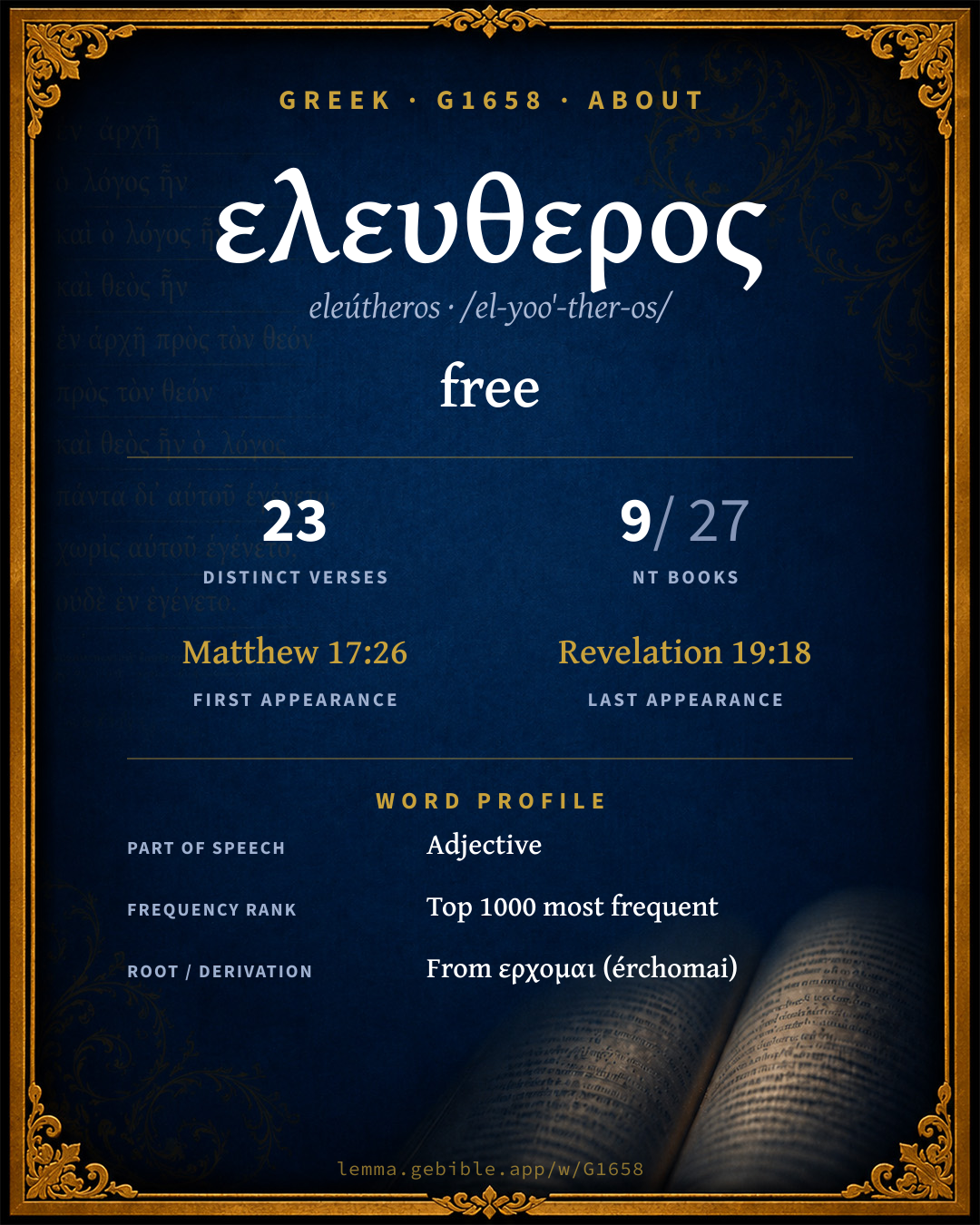
ἐλεύθερος
free
‘free’ is one of 3 main senses fuller range ↓
Full lexicon entry — Thayer's Greek Lexicon
From Thayer's Greek Lexicon
Where this word appears
See every Nominative-case word in the Greek New Testament →
Grammar key — what these labels mean
Part of speech
- Adjective
- A word that describes or qualifies a noun.
Case
- Nominative
- The case of the subject (and the predicate nominative).
- Genitive
- The case of source, possession, or “of” — answers “whose / from what.”
- Accusative
- The case of the direct object and of extent.
Gender
- Masculine
- Grammatically masculine.
- Feminine
- Grammatically feminine.
Number
- Singular
- One.
- Plural
- More than one.
Grammatical forms
- Adjective, Nominative, Singular, Masculine 8 times (35%)
- Adjective, Nominative, Plural, Masculine 6 times (26%)
- Adjective, Genitive, Singular, Feminine 4 times (17%)
- Adjective, Nominative, Singular, Feminine 3 times (13%)
- Adjective, Accusative, Plural, Masculine 1 time (4%)
- Adjective, Genitive, Plural, Masculine 1 time (4%)
Parsed forms decoded from the imported morphology (Robinson–Tischendorf, public domain), counted across 23 parsed occurrences — not distinct verses.
Every verse where G1658 appears — 23 distinct verses across 9 books. Click any verse to open its interlinear word-by-word view. Verse text shown in the World English Bible for context — . Each verse’s Greek form is shown with its reference; the English is not keyword-highlighted, since the data carries no word-level English alignment. Use “Compare translations” on any verse to read it across multiple English versions. This concordance covers the Greek New Testament; Septuagint (Greek Old Testament) occurrences of this word are not indexed here.
Matthew 1 verse
John 2 verses
Romans 2 verses
- Romans 6:20 ἐλεύθεροι adj nom pl masc For when you were servants of sin, you were free in regard to righteousness.
- Romans 7:3 ἐλευθέρα adj nom sg fem So then if, while the husband lives, she is joined to another man, she would be called an adulteress. But if the husband dies, she is free from the law, so that she is no adulteress, though she is joined to another man.
1 Corinthians 6 verses
- 1 Corinthians 7:21 ἐλεύθερος adj nom sg masc Were you called being a bondservant? Don't let that bother you, but if you get an opportunity to become free, use it.
- 1 Corinthians 7:22 ἐλεύθερος adj nom sg masc For he who was called in the Lord being a bondservant is the Lord's free man. Likewise he who was called being free is Christ's bondservant.
- 1 Corinthians 7:39 ἐλευθέρα adj nom sg fem A wife is bound by law for as long as her husband lives; but if the husband is dead, she is free to be married to whoever she desires, only in the Lord.
- 1 Corinthians 9:1 ἐλεύθερος adj nom sg masc Am I not free? Am I not an apostle? Haven't I seen Jesus Christ, our Lord? Aren't you my work in the Lord?
- 1 Corinthians 9:19 Ἐλεύθερος adj nom sg masc For though I was free from all, I brought myself under bondage to all, that I might gain the more.
- 1 Corinthians 12:13 ἐλεύθεροι adj nom pl masc For in one Spirit we were all baptized into one body, whether Jews or Greeks, whether bond or free; and were all given to drink into one Spirit.
Galatians 6 verses
- Galatians 3:28 ἐλεύθερος adj nom sg masc There is neither Jew nor Greek, there is neither slave nor free man, there is neither male nor female; for you are all one in Christ Jesus.
- Galatians 4:22 ἐλευθέρας adj gen sg fem For it is written that Abraham had two sons, one by the handmaid, and one by the free woman.
- Galatians 4:23 ἐλευθέρας adj gen sg fem However, the son by the handmaid was born according to the flesh, but the son by the free woman was born through promise.
- Galatians 4:26 ἐλευθέρα adj nom sg fem But the Jerusalem that is above is free, which is the mother of us all.
- Galatians 4:30 ἐλευθέρας adj gen sg fem However what does the Scripture say? "Throw out the handmaid and her son, for the son of the handmaid will not inherit with the son of the free woman."
- Galatians 4:31 ἐλευθέρας adj gen sg fem So then, brothers, we are not children of a handmaid, but of the free woman.
Ephesians 1 verse
Colossians 1 verse
1 Peter 1 verse
Revelation 3 verses
- Revelation 6:15 ἐλεύθερος adj nom sg masc The kings of the earth, the princes, the commanding officers, the rich, the strong, and every slave and free person, hid themselves in the caves and in the rocks of the mountains.
- Revelation 13:16 ἐλευθέρους adj acc pl masc He causes all, the small and the great, the rich and the poor, and the free and the slave, to be given marks on their right hands, or on their foreheads;
- Revelation 19:18 ἐλευθέρων adj gen pl masc that you may eat the flesh of kings, the flesh of captains, the flesh of mighty men, and the flesh of horses and of those who sit on them, and the flesh of all men, both free and slave, and small and great."
About this entry
At a glance — auto-summarized from this page’s data, not written by a person. Every figure links to its source below. This summary describes the numbers; it doesn’t interpret them.
ελευθερος — transliterated eleútheros — is a Greek adjective carrying the sense “free.” It first appears in Matthew 17:26. With 23 verses in 9 books, it is an uncommon word in the Greek New Testament. Its uses concentrate in 1 Corinthians (26% of all occurrences). Its lexical range runs to 3 senses. See the sense tree, 23-verse concordance, and the renderings breakdown below.
Gloss history
Strong's 1890 vs modern scholarship
About this word
Strong's G1658 catalogs a Greek word from the Greek New Testament.
These counts are not copied from any lexicon or concordance. They are computed here, from the morphology-tagged Greek New Testament. What Lemma adds →
- 23
- distinct verses
- The word appears in 23 distinct verses.
- 9 / 27
- NT books
- The word appears in 9 of 27 New Testament books.
- #563
- by frequency
- Top 1000 most frequent Greek words (rank 563 of 5,347 Greek words by occurrence).
View all 23 occurrences in the concordance →
Most concentrated in
- 1 Corinthians 6 verses 26%
- Galatians 6 verses 26%
- Revelation 3 verses 13%
By section of the New Testament
By traditional corpus
Conventional, traditional groupings — biblical authorship is debated, so this is a traditional corpus grouping, not an authorship claim. Some books belong to more than one corpus (Luke is in both the Gospels and the Lukan corpus, and so on), so these shares overlap and need not total 100%. Each figure is a share of the word’s 23 distinct verses.
- Pauline corpus 16 verses · 70%
- Johannine 5 verses · 22%
- Gospels 3 verses · 13%
- Revelation 3 verses · 13%
- General (Catholic) Epistles 1 verse · 4%
How translations render this word
Counts come from each version’s own published word-to-Strong’s tagging or interlinear alignment — an approximate guide to how each version renders this word, not a word-level alignment the data otherwise carries. Because each total is that version’s own tagged count, the per-version totals vary from one another and need not match the appearance or distinct-verse counts above. These counts may also differ from a printed concordance because Lemma counts each distinctly tagged rendering and does not collapse phrase taggings into a single head-word total. This is a fixed set of word-tagged versions (KJV, ASV, BSB, ULT) and does not change with the reading translation you choose elsewhere. Each version’s license is shown beside its name below (and on Sources).
- King James Version: Free 16×, Freewoman 3×
- American Standard Version: Free 15×, Freewoman 4×, Freeman 2×
- Berean Standard Bible: Free 17×, Free of obligation 2×, Freedom 2×
- unfoldingWord Literal Text: Free 17×, Free woman 4×, Freeman 2×
King James Version Public Domain
Renders G1658 across 23 tagged occurrences — most commonly:
Plus 4 renderings that appear only once — usually multi-word phrases or single function words the recovered tagging swept in, not distinct renderings.
American Standard Version Public Domain
Renders G1658 across 23 tagged occurrences — most commonly:
Plus 2 renderings that appear only once — usually multi-word phrases or single function words the recovered tagging swept in, not distinct renderings.
Berean Standard Bible Public Domain
Renders G1658 across 23 tagged occurrences — most commonly:
Plus 2 renderings that appear only once — usually multi-word phrases or single function words the recovered tagging swept in, not distinct renderings.
unfoldingWord Literal Text CC BY-SA 4.0
Renders G1658 across 25 tagged occurrences — most commonly:
Plus 2 renderings that appear only once — usually multi-word phrases or single function words the recovered tagging swept in, not distinct renderings.
Senses in Thayer's
The 3 senses Thayer's distinguishes for this word, in lexicon order (not ranked by frequency or importance). The full entry — with sub-senses — is in the Lexicon Entry tab.
- freeborn
- free, exempt, unrestrained, not bound by an obligation
- in an ethical sense: free from the yoke of the Mosaic Law
Word origin
Derived from ερχομαι (érchomai) (G2064) — to come.
Probably from the alternate of G2064 ; unrestrained (to go at pleasure) that is (as a citizen) not a slave (whether freeborn or manumitted ) or (generally) exempt (from obligation or liability): - free (man woman) at liberty.
— Strong’s Exhaustive Concordance (1890), public domain.
Forms in the corpus
The 8 distinct written forms G1658 takes in the Greek New Testament, most frequent first — each parse links to that case’s occurrences in the concordance.
| Form | Parsing | Example | Uses |
|---|---|---|---|
| ἐλεύθερος eleútheros | Adjective, Nominative, Singular, Masculine | 1 Corinthians 7:21 | 7 |
| ἐλεύθεροι eleútheroi | Adjective, Nominative, Plural, Masculine | John 8:33 | 5 |
| ἐλευθέρας eleuthéras | Adjective, Genitive, Singular, Feminine | Galatians 4:22 | 4 |
| ἐλευθέρα eleuthéra | Adjective, Nominative, Singular, Feminine | Romans 7:3 | 3 |
| ἐλευθέρους eleuthérous | Adjective, Accusative, Plural, Masculine | Revelation 13:16 | 1 |
| ἐλευθέρων eleuthérōn | Adjective, Genitive, Plural, Masculine | Revelation 19:18 | 1 |
| ἐλεύθεροί eleútheroí | Adjective, Nominative, Plural, Masculine | Matthew 17:26 | 1 |
| Ἐλεύθερος Eleútheros | Adjective, Nominative, Singular, Masculine | 1 Corinthians 9:19 | 1 |
Same root — word family
Other Thayer's entries built from the same root as G1658, grouped by Strong’s listed origin. These share a root / origin per the lexicon — not necessarily a shared meaning. Each links to that word’s own entry.
Derives from
Shares the same root
Derived from this word
Compare all same-root words → Showing 4 of 5 — not the complete family. They share a root, not necessarily a meaning.
Septuagint usage
The same Greek word ελευθερος appears 18 times in the Greek Old Testament (Septuagint), across 18 verses in 8 books.
- 18
- LXX occurrences
- Tagged occurrences of this Greek word in the Septuagint.
- 18
- verses
- Distinct Septuagint verses containing this word.
- 8 / 39
- OT books
- The word appears in 8 of the 39 Old Testament books.
Sample Septuagint occurrences
- Exodus 21:2 ἐλεύθερος
- Deuteronomy 15:12 ἐλεύθερος
- 1 Kings 20:8 ἐλεύθερος
- Ezra 23:17 ἐλεύθερος
- Job 39:5 ἐλεύθερος
- Psalms 87:5 ἐλεύθερος
- Ecclesiastes 10:17 ἐλεύθερος
- Jeremiah 36:2 ἐλεύθερος
Septuagint occurrences (same lexeme)
Every verse where the same Strong’s number (G1658) appears in the Greek Septuagint. Verse text shown in the World English Bible for context; the Greek form is the matched word — the English is not keyword-highlighted.
- Exodus 21:2 ἐλεύθερος If you buy a Hebrew servant, he shall serve six years and in the seventh he shall go out free without paying anything.
- Exodus 21:5 ἐλεύθερος But if the servant shall plainly say, 'I love my master, my wife, and my children. I will not go out free;'
- Exodus 21:26 ἐλεύθερος "If a man strikes his servant's eye, or his maid's eye, and destroys it, he shall let him go free for his eye's sake.
- Exodus 21:27 ἐλεύθερος If he strikes out his man-servant's tooth, or his maid-servant's tooth, he shall let him go free for his tooth's sake.
- Deuteronomy 15:12 ἐλεύθερος If your brother, a Hebrew man, or a Hebrew woman, be sold to you, and serve you six years; then in the seventh year you shall let him go free from you.
- Deuteronomy 15:13 ἐλεύθερος When you let him go free from you, you shall not let him go empty:
- Deuteronomy 15:18 ἐλεύθερος It shall not seem hard to you, when you let him go free from you; for to the double of the hire of a hireling has he served you six years: and Yahweh your God will bless you in all that you do.
- Deuteronomy 21:14 ἐλεύθερος It shall be, if you have no delight in her, then you shall let her go where she will; but you shall not sell her at all for money, you shall not deal with her as a slave, because you have humbled her.
- 1 Kings 20:8 ἐλεύθερος All the elders and all the people said to him, Don't you listen, neither consent.
- 1 Kings 20:11 ἐλεύθερος The king of Israel answered, Tell him, Don't let him who girds on [his armor] boast himself as he who puts it off.
- Ezra 23:17 ἐλεύθερος
- Job 39:5 ἐλεύθερος "Who has set the wild donkey free? Or who has loosened the bonds of the swift donkey,
- Psalms 87:5 ἐλεύθερος Yes, of Zion it will be said, "This one and that one was born in her;" The Most High himself will establish her.
- Ecclesiastes 10:17 ἐλεύθερος Happy are you, land, when your king is the son of nobles, And your princes eat in due season, For strength, and not for drunkenness!
- Jeremiah 36:2 ἐλεύθερος Take a scroll of a book, and write therein all the words that I have spoken to you against Israel, and against Judah, and against all the nations, from the day I spoke to you, from the days of Josiah, even to this day.
- Jeremiah 41:9 ἐλεύθερος Now the pit in which Ishmael cast all the dead bodies of the men whom he had killed, by the side of Gedaliah (the same was who which Asa the king had made for fear of Baasha king of Israel), Ishmael the son of Nethaniah filled it with those who were killed.
- Jeremiah 41:14 ἐλεύθερος So all the people who Ishmael had carried away captive from Mizpah turned about and came back, and went to Johanan the son of Kareah.
- Jeremiah 41:16 ἐλεύθερος Then took Johanan the son of Kareah, and all the captains of the forces who were with him, all the remnant of the people whom he had recovered from Ishmael the son of Nethaniah, from Mizpah, after that he had killed Gedaliah the son of Ahikam, [to wit], the men of war, and the women, and the children, and the eunuchs, whom he had brought back from Gibeon:
These are occurrences of the same Greek lexeme (G1658) in the Septuagint — not a translation of any one Hebrew word. The store carries no word-level Hebrew↔Greek alignment, so no Hebrew original is asserted here. Counts come from the recovered LXX Strong's tagging — high-frequency vocabulary is well covered, while rare or late forms may be untagged — so they reflect tagged occurrences and may slightly undercount.