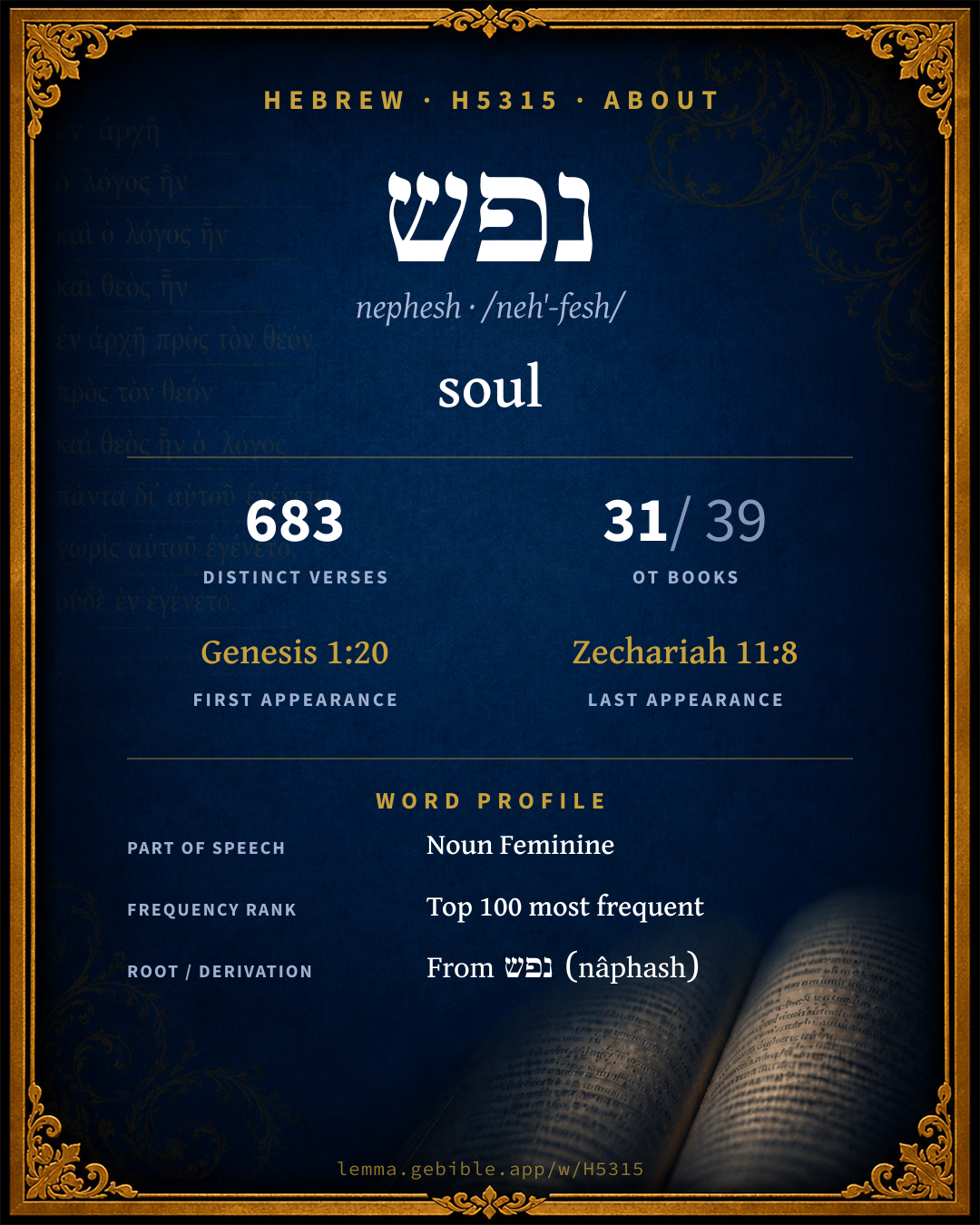
נֶ֫פֶשׁ
soul
also: self, life, creature, person fuller range ↓
Full lexicon entry — Brown-Driver-Briggs (BDB)
From Brown-Driver-Briggs (BDB)
Where this word appears
See every Construct-state word in the Hebrew Bible →
Grammar key — what these labels mean
Part of speech
- Noun
- A naming word — a person, place, thing, or idea.
Noun type
- Common
- A common noun — a general class of person, place, or thing (“king,” “city,” “water”), not a specific name.
State
- Construct
- A noun bound to a following noun in a possessive / “of” relationship (the construct chain).
- Absolute
- The independent form of a noun, not bound to a following word.
Gender
- Both
- Attested as both masculine and feminine.
Number
- Singular
- One.
- Plural
- More than one (in Hebrew, generally three or more).
Every verse where H5315 appears in the Book of Proverbs — 54 distinct verses. Click any verse to open its interlinear word-by-word view. Verse text shown in the World English Bible for context — . Each verse’s Hebrew form is shown with its reference; the English is not keyword-highlighted, since the data carries no word-level English alignment. Use “Compare translations” on any verse to read it across multiple English versions. This concordance covers the Hebrew Bible; Septuagint (Greek Old Testament) occurrences are not indexed here.
Proverbs
- Proverbs 1:18 לְ/נַפְשֹׁתָֽ/ם prep + n c bp cs + sfx pers 3mp But these lay wait for their own blood. They lurk secretly for their own lives.
- Proverbs 1:19 נֶ֖פֶשׁ n c bs cs So are the ways of everyone who is greedy for gain. It takes away the life of its owners.
- Proverbs 2:10 לְֽ/נַפְשְׁ/ךָ֥ prep + n c bs cs + sfx pers 2ms For wisdom will enter into your heart. Knowledge will be pleasant to your soul.
- Proverbs 3:22 לְ/נַפְשֶׁ֑/ךָ prep + n c bs cs + sfx pers 2ms So they will be life to your soul, And grace for your neck.
- Proverbs 6:16 נַפְשֽׁ/וֹ n c bs cs + sfx pers 3ms There are six things which Yahweh hates; Yes, seven which are an abomination to him:
- Proverbs 6:26 נֶ֖פֶשׁ n c bs For a prostitute reduces you to a piece of bread. The adulteress hunts for your precious life.
- Proverbs 6:30 נַ֝פְשׁ֗/וֹ n c bs cs + sfx pers 3ms Men don't despise a thief, If he steals to satisfy himself when he is hungry:
- Proverbs 6:32 נַ֝פְשׁ֗/וֹ n c bs cs + sfx pers 3ms He who commits adultery with a woman is void of understanding. He who does it destroys his own soul.
- Proverbs 7:23 בְ/נַפְשׁ֥/וֹ prep + n c bs cs + sfx pers 3ms Until an arrow strikes through his liver, As a bird hurries to the snare, And doesn't know that it will cost his life.
- Proverbs 8:36 נַפְשׁ֑/וֹ n c bs cs + sfx pers 3ms But he who sins against me wrongs his own soul. All those who hate me love death."
- Proverbs 10:3 נֶ֣פֶשׁ n c bs cs Yahweh will not allow the soul of the righteous to go hungry, But he thrusts away the desire of the wicked.
- Proverbs 11:17 נַ֭פְשׁ/וֹ n c bs cs + sfx pers 3ms The merciful man does good to his own soul, But he who is cruel troubles his own flesh.
- Proverbs 11:25 נֶֽפֶשׁ n c bs cs The liberal soul shall be made fat. He who waters shall be watered also himself.
- Proverbs 11:30 נְפָשׂ֣וֹת n c bp The fruit of the righteous is a tree of life. He who is wise wins souls.
- Proverbs 12:10 נֶ֣פֶשׁ n c bs cs A righteous man regards the life of his animal, But the tender mercies of the wicked are cruel.
- Proverbs 13:2 וְ/נֶ֖פֶשׁ conj + n c bs cs By the fruit of his lips, a man enjoys good things; But the unfaithful crave violence.
- Proverbs 13:3 נַפְשׁ֑/וֹ n c bs cs + sfx pers 3ms He who guards his mouth guards his soul. One who opens wide his lips comes to ruin.
- Proverbs 13:4 נַפְשׁ֣/וֹ וְ/נֶ֖פֶשׁ n c bs cs + sfx pers 3ms conj + n c bs cs The soul of the sluggard desires, and has nothing, But the desire of the diligent shall be fully satisfied.
- Proverbs 13:8 נֶֽפֶשׁ n c bs cs The ransom of a man's life is his riches, But the poor hear no threats.
- Proverbs 13:19 לְ/נָ֑פֶשׁ prep + n c bs Longing fulfilled is sweet to the soul, But fools detest turning from evil.
- Proverbs 13:25 נַפְשׁ֑/וֹ n c bs cs + sfx pers 3ms The righteous one eats to the satisfying of his soul, But the belly of the wicked goes hungry.
- Proverbs 14:10 נַפְשׁ֑/וֹ n c bs cs + sfx pers 3ms The heart knows its own bitterness and joy; He will not share these with a stranger.
- Proverbs 14:25 נְ֭פָשׁוֹת n c bp A truthful witness saves souls, But a false witness is deceitful.
- Proverbs 15:32 נַפְשׁ֑/וֹ n c bs cs + sfx pers 3ms He who refuses correction despises his own soul, But he who listens to reproof gets understanding.
- Proverbs 16:17 נַ֝פְשׁ֗/וֹ n c bs cs + sfx pers 3ms The highway of the upright is to depart from evil. He who keeps his way preserves his soul.
- Proverbs 16:24 לַ֝/נֶּפֶשׁ prep det + n c bs Pleasant words are a honeycomb, Sweet to the soul, and health to the bones.
- Proverbs 16:26 נֶ֣פֶשׁ n c bs cs The appetite of the laboring man labors for him; For his mouth urges him on.
- Proverbs 18:7 נַפְשֽׁ/וֹ n c bs cs + sfx pers 3ms A fool's mouth is his destruction, And his lips are a snare to his soul.
- Proverbs 19:2 נֶ֣פֶשׁ n c bs It isn't good to have zeal without knowledge; Nor being hasty with one's feet and missing the way.
- Proverbs 19:8 נַפְשׁ֑/וֹ n c bs cs + sfx pers 3ms He who gets wisdom loves his own soul. He who keeps understanding shall find good.
- Proverbs 19:15 וְ/נֶ֖פֶשׁ conj + n c bs cs Slothfulness casts into a deep sleep. The idle soul shall suffer hunger.
- Proverbs 19:16 נַפְשׁ֑/וֹ n c bs cs + sfx pers 3ms He who keeps the commandment keeps his soul, But he who is contemptuous in his ways shall die.
- Proverbs 19:18 נַפְשֶֽׁ/ךָ n c bs cs + sfx pers 2ms Discipline your son, for there is hope; Don't be a willing party to his death.
- Proverbs 20:2 נַפְשֽׁ/וֹ n c bs cs + sfx pers 3ms The terror of a king is like the roaring of a lion: He who provokes him to anger forfeits his own life.
- Proverbs 21:10 נֶ֣פֶשׁ n c bs cs The soul of the wicked desires evil; His neighbor finds no mercy in his eyes.
- Proverbs 21:23 נַפְשֽׁ/וֹ n c bs cs + sfx pers 3ms Whoever guards his mouth and his tongue Keeps his soul from troubles.
- Proverbs 22:5 נַ֝פְשׁ֗/וֹ n c bs cs + sfx pers 3ms Thorns and snares are in the path of the wicked: Whoever guards his soul stays from them.
- Proverbs 22:23 נָֽפֶשׁ n c bs For Yahweh will plead their case, And plunder the life of those who plunder them.
- Proverbs 22:25 לְ/נַפְשֶֽׁ/ךָ prep + n c bs cs + sfx pers 2ms Lest you learn his ways, And ensnare your soul.
- Proverbs 23:2 נֶ֣פֶשׁ n c bs Put a knife to your throat, If you are a man given to appetite.
- Proverbs 23:7 בְּ/נַפְשׁ֗/וֹ prep + n c bs cs + sfx pers 3ms For as he thinks about the cost, so he is. "Eat and drink!" he says to you, But his heart is not with you.
- Proverbs 23:14 וְ֝/נַפְשׁ֗/וֹ conj + n c bs cs + sfx pers 3ms Punish him with the rod, And save his soul from Sheol.
- Proverbs 24:12 נַ֭פְשְׁ/ךָ n c bs cs + sfx pers 2ms If you say, "Behold, we didn't know this;" Doesn't he who weighs the hearts consider it? He who keeps your soul, doesn't he know it? Shall he not render to every man according to his work?
- Proverbs 24:14 לְ/נַ֫פְשֶׁ֥/ךָ prep + n c bs cs + sfx pers 2ms So you shall know wisdom to be to your soul; If you have found it, then there will be a reward, Your hope will not be cut off.
- Proverbs 25:13 וְ/נֶ֖פֶשׁ conj + n c bs cs As the cold of snow in the time of harvest, So is a faithful messenger to those who send him; For he refreshes the soul of his masters.
- Proverbs 25:25 נֶ֣פֶשׁ n c bs Like cold water to a thirsty soul, So is good news from a far country.
- Proverbs 27:7 נֶ֣פֶשׁ וְ/נֶ֥פֶשׁ n c bs conj + n c bs A full soul loathes a honeycomb; But to a hungry soul, every bitter thing is sweet.
- Proverbs 27:9 נָֽפֶשׁ n c bs Perfume and incense bring joy to the heart; So does earnest counsel from a man's friend.
- Proverbs 28:17 נָפֶשׁ n c bs A man who is tormented by life blood will be a fugitive until death; No one will support him.
- Proverbs 28:25 נֶ֭פֶשׁ n c bs One who is greedy stirs up strife; But one who trusts in Yahweh will prosper.
- Proverbs 29:10 נַפְשֽׁ/וֹ n c bs cs + sfx pers 3ms The bloodthirsty hate a man of integrity; And they seek the life of the upright.
- Proverbs 29:17 לְ/נַפְשֶֽׁ/ךָ prep + n c bs cs + sfx pers 2ms Correct your son, and he will give you peace; Yes, he will bring delight to your soul.
- Proverbs 29:24 נַפְשׁ֑/וֹ n c bs cs + sfx pers 3ms Whoever is an accomplice of a thief is an enemy of his own soul. He takes an oath, but dares not testify.
- Proverbs 31:6 נָֽפֶשׁ n c bs Give strong drink to him who is ready to perish; And wine to the bitter in soul:
About this entry
At a glance — auto-summarized from this page’s data, not written by a person. Every figure links to its source below. This summary describes the numbers; it doesn’t interpret them.
“soul” is the headline sense of the Hebrew noun נפש (nephesh). It also covers “self”, “life”, and “creature”, alongside “soul” — see its full sense range. With 683 verses in 31 books, it is one of the most common word in the Hebrew Bible. Debuting at Genesis 1:20, it then recurs through the corpus. Related forms include נפש and נפיש. See the sense tree, 683-verse concordance, and the renderings breakdown below.
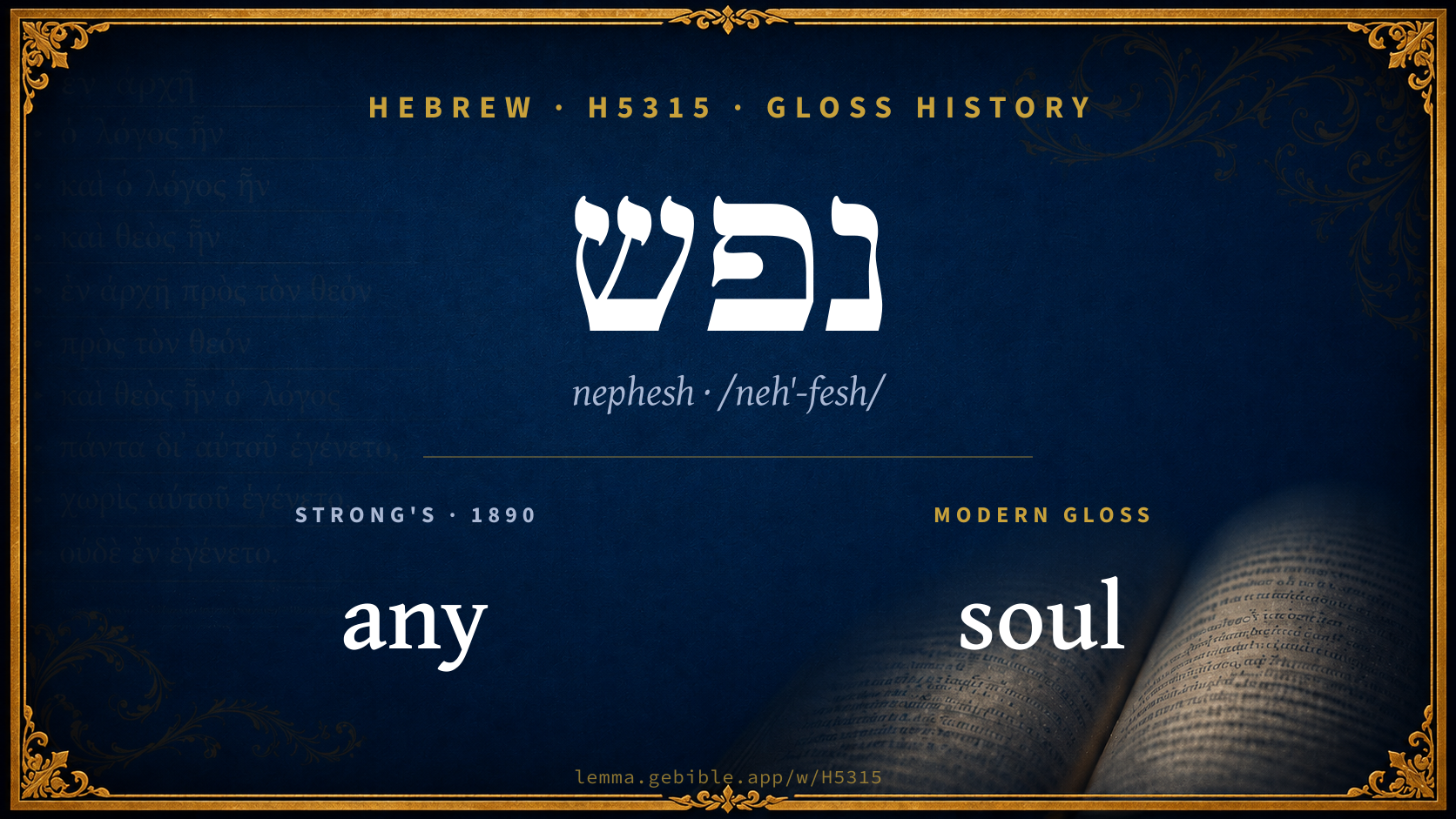
Gloss history
Strong's 1890 vs modern scholarship
About this word
Strong's H5315 catalogs a Hebrew word from the Hebrew Old Testament.
These counts are not copied from any lexicon or concordance. They are computed here, from the morphology-tagged Hebrew Old Testament. What Lemma adds →
- 683
- distinct verses
- The word appears in 683 distinct verses.
- 31 / 39
- OT books
- The word appears in 31 of 39 Old Testament books.
- #65
- by frequency
- Top 100 most frequent Hebrew words (rank 65 of 8,640 Hebrew words by occurrence).
View all 683 occurrences in the concordance →
By section of the Old Testament
By traditional corpus
Conventional, traditional groupings — biblical authorship is debated, so this is a traditional corpus grouping, not an authorship claim. Each share is this word’s portion of its verses in that division of the Hebrew canon. Each figure is a share of the word’s 683 distinct verses.
- Writings (Ketuvim) 269 verses · 39%
- Prophets (Nevi'im) 237 verses · 35%
- Torah (Pentateuch) 177 verses · 26%
How translations render this word
Counts come from each version’s own published word-to-Strong’s tagging or interlinear alignment — an approximate guide to how each version renders this word, not a word-level alignment the data otherwise carries. Because each total is that version’s own tagged count, the per-version totals vary from one another and need not match the appearance or distinct-verse counts above. These counts may also differ from a printed concordance because Lemma counts each distinctly tagged rendering and does not collapse phrase taggings into a single head-word total. This is a fixed set of word-tagged versions (KJV, ASV, BSB, ULT) and does not change with the reading translation you choose elsewhere. Each version’s license is shown beside its name below (and on Sources).
- King James Version: Soul 314×, Life 73×, Souls 34×
- American Standard Version: Soul 279×, Life 71×, Souls 31×
- Berean Standard Bible: Soul 173×, Life 112×, Lives 31×
- unfoldingWord Literal Text: Soul 282×, Life 159×, Person 53×
King James Version Public Domain
Renders H5315 across 738 tagged occurrences — most commonly:
Plus other, less common renderings. Plus 115 renderings that appear only once — usually multi-word phrases or single function words the recovered tagging swept in, not distinct renderings. Not rendered by a distinct English word in 15 further occurrences.
American Standard Version Public Domain
Renders H5315 across 737 tagged occurrences — most commonly:
Plus other, less common renderings. Plus 161 renderings that appear only once — usually multi-word phrases or single function words the recovered tagging swept in, not distinct renderings.
Berean Standard Bible Public Domain
Renders H5315 across 666 tagged occurrences — most commonly:
Plus other, less common renderings. Plus 73 renderings that appear only once — usually multi-word phrases or single function words the recovered tagging swept in, not distinct renderings. Not rendered by a distinct English word in 85 further occurrences.
unfoldingWord Literal Text CC BY-SA 4.0
Renders H5315 across 751 tagged occurrences — most commonly:
Plus other, less common renderings. Plus 55 renderings that appear only once — usually multi-word phrases or single function words the recovered tagging swept in, not distinct renderings.
34 senses and sub-senses in the full BDB
What do BDB’s symbols mean?
BDB uses these scholarly abbreviations:
| Symbol | Meaning |
|---|---|
| 𝔊 | the Septuagint (the ancient Greek translation, LXX) |
| 𝔙 | the Vulgate (the Latin translation) |
| 𝔖 | the Syriac version (the Peshitta) |
| 𝔗 | the Targum (the Aramaic translation) |
| ψ | the Psalms |
| √ | root (the underlying root or stem) |
| ‖ | parallel passage (a synonymous or contrasted parallel) |
| † | the dagger: every passage where the word occurs is cited |
The 34 senses and sub-senses the full Brown-Driver-Briggs lexicon distinguishes for this word, in lexicon order (not ranked by frequency), with BDB’s own verbatim wording and sub-sense lettering. Shown in Hebrew script with BDB’s own scholarly abbreviations. The condensed entry is in the Lexicon Entry tab. See also the Forms in the corpus table below.
- 1. = that which breathes, the breathing substance or being = ψυχή, anima, the soul, the inner being of man:
- a. disting. from בָּשָׂר: מִנֶּפֶשׁ וְעַד בָּשָׂר Is 10:18; הַנֶּפֶשׁ עִם הַבָּשָׂר Dt 12:23; from שְׁאֵר Pr 11:17; from בֶּטֶן body ψ 31:10. e.g. Isaiah 10:18
- b. both the inner נפשׁ and the outer בשׂר are conceived as resting on a common substratum: אַךְ בְּשָׂרוֹ עָלָיו יִכְאָ֑ב וְנַפְשׁוֹ עָלָיו תֶּאֱבָֽל׃ Jb 14:22 only his flesh upon him is in pain, and his soul upon him mourneth; cf. ψ 42:5, 7; 131:2; Jb 30:16; La 3:20 [v. עַל 1 d], all poetical (cf. 6 c). e.g. Job 14:22
- c. נ׳ departs at death and returns with life: וַיְהִי בְּצֵאת נַפְשָׁהּ כִּי מֵתָה Gn 35:18 (E) and it came to pass when her soul was going forth (for she died); נָֽפְחָה נַפְשָׁהּ Je 15:9 she breathed out her soul, cf. 1 K 17:21, 22; Jb 11:20; 31:39. e.g. Genesis 35:18
- d. often desired that the נפשׁ may be delivered: from Sheʾôl ψ 16:10; 30:4; 49:16; 86:13; 89:49; Pr 23:14; from שַׁחַת, the pit of Sheʾôl, Is 38:17 Jb 33:18, 22, 28, 30. e.g. Psalms 16:10
- 2. The נפשׁ becomes a living being: by God’s breathing נשׁמת חיים into the nostrils of its בשׂר; of man Gn 2:7 (J); by implication of animals also Gn 2:19 (J); so ψ 104:29, 30 cf. 66:9 man is נֶפֶשׁ חַיָּה, a living, breathing being Gn 2:7 (J); elsewhere נפשׁ חיּה always of animals Gn 1:20, 24, 30; 9:12, 15, 16 (all P), Ez 47:9; so נפשׁ החיּה Gn 1:21; 9:10 (both P), Lv 11:10, 46 (H); נפשׁ השׁרצת Lv 11:46 (H); נפשׁ כל חי Jb 12:10. נפשׁ is frequently used with the verb חיה: †וחיתה נפשׁ Gn 12:13; 19:20 (both J), 1 K 20:32 (E), ψ 119:175; Je 38:17, 20; †חֵי נַפְשְׁךָ 1 S 1:26; 17:55; 20:3; 25:26 2 S 11:11; 14:19; 2 K 2:2, 4, 6; 4:30 (all JE); cf. †יְחַיֶּה נ׳ 1 K 20:31 (E), Ez 18:27 ψ 22:30; also Gn 19:19 Is 55:3; Pr 3:22. e.g. Genesis 2:7
- 3. The נפשׁ (without חיה noun or verb) is specif.:
- a. a living being whose life resides in the blood [so in Arabic WeSkizzen iii. 217 G. Jacob Arab. Dicht. iv. 9 f.] (hence sacrificial use of blood, and its prohib. in other uses; first in D), Dt 12:23, 24 only be sure that thou eat not the blood, for the blood is the living being (הַדָּם הוּא הַנֶּפֶשׁ); and thou shalt not eat the living being with the flesh (הַנֶּפֶשׁ עִם הַבָּשָׂר); thou shalt pour it upon the earth as water; this enlarged in H, Lv 17:10, 11, 12, 14 and in P Gn 9:4, 5, cf. Je 2:34. e.g. Deuteronomy 12:23
- b. a serious attack upon the life is an attack upon this inner living being 2 S 1:9 Je 4:10; Jon 2:6 ψ 69:2; 124:4, 5; Jb 27:3. e.g. 2 Samuel 1:9
- c. נפשׁ is used for life itself 171 times, of animals Pr 12:10, and of man Gn 44:30 (J); נפשׁ תחת נפשׁ life for life Ex 21:23 (E), Lv 24:18 (H), 1 K 20:39, 42; 2 K 10:24; נפשׁנו תחתיכם Jos 2:14 (J); נפשׁ בנפשׁ Dt 19:21; בנפשׁ for the life of 2 S 14:7 Jon 1:14; שׂם נפשׁ בכף put life in one’s own hand Ju 12:3 1 S 19:5; 28:21 Jb 13:14; חרף נפשׁו למות Ju 5:18 risked his life to die; †בנפשׁ at the risk of life Nu 17:3 (P), 2 S 23:17 = 1 Ch 11:19(×2), 1 K 2:23 Pr 7:23; La 5:9; †בקּשׁ נפשׁ Ex 4:19 (J), 1 S 20:1; 22:23(×2) 23:15; 25:29 2 S 4:8; 16:11; 1 K 19:10, 14; Je 4:30; 11:21; 19:7, 9; 21:7; 22:25; 34:20, 21; 38:16; 44:30(×2) 46:26; 49:37 ψ 35:4; 38:13; 40:15; 54:5; 63:10; 70:3; 86:14; Pr 29:10; †שׁאל נ׳ 1 K 3:11 = 2 Ch 1:11, 1 K 19:4 = Jon 4:8; †הִכָּה נפשׁ smite mortally Gn 37:21 (J), Dt 19:6, 11; Je 40:14, 15; †לקח נ׳ 1 K 19:4; Jon 4:3 ψ 31:14; Pr 1:19; †הִצִּיל נֶפֶשׁ מִמָּוֶת deliver life from death Jos 2:13 ψ 33:19; 56:14; †מלּט נפשׁ 1 S 19:11 2 S 19:6(×4) 1 K 1:12(×2) Je 48:6; 51:6, 45; Ez 33:5; Am 2:14, 15 ψ 89:49; 116:4; †פדה נ׳ 2 S 4:9 1 K 1:29 ψ 34:23; 49:16; 55:19; 71:23; †שׁמר נ׳ ψ 25:20; 97:10; Jb 2:6 Pr 13:3; 16:17; 19:16; 22:5. e.g. Proverbs 12:10
- 4. The נפשׁ as the essential of man stands for the man himself:
- a. paraphrase for pers. pron. especially in poetry and ornate discourse, 70 times; (1) נַפְשִׁי = me: אל תבא נפשׁי Gn 49:6 let me not enter (poem in J); תָּמֹת נ׳ מות ישׁרים Nu 23:10 let me die, etc. (poem); תָּמוֹת נַפְשִׁי Ju 16:30 (J); אמרה נפשׁי La 3:24 I say. (2) נַפְשְׁךָ = thee: לְאֻמִּים תַּחַת נַפְשֶׁ֑ךָ Is 43:4 peoples instead of thee; אָֽמְרוּ לְנַפְשֵׁךְ 51:23. (3) נַפְשׁוֹ = he: נפשׁו בטוב תלין ψ 25:13 he will not dwell in good circumstances. (4) נַפְשֵׁנוּ = we: נַפְשֵׁנוּ כְּצִפּוֹר נִמְלְטָה מִפַּת יוֹקְשִׁים ψ 124:7. (5) נַפְשָׁם = they, them: נַפְשָׁם בַּשְּׁבִי הָלָ֑כָה Is 46:2 they are gone into captivity; אוי לנפשׁם Is 3:9. e.g. Genesis 49:6
- b. = reflexive, self, 53 times: אסר על נפשׁ bind oneself Nu 30:3, 5(×2), 6, 7, 8, 9, 10, 11, 12; לְעַנֹּת נ׳ Nu 30:14 to afflict oneself. (1) נַפְשִׁי = myself: לא אדע נ׳ Jb 9:21; Ct 6:12 I know not myself. (2) נַפְשְׁךָ = thyself: שׁמר נ׳ Dt 4:9 keep thyself. (3) נַפְשׁוֹ = himself: אהב כנ׳ 1 S 18:1, 3; 20:17 loved as himself. (4) נַפְשָׁהּ = herself: צדּקה נ׳ Je 3:11 justified herself. (5) נַפְשָׁם = themselves: הציל נ׳ deliver themselves Is 47:14; Ez 14:14, 20. (6) נַפְשְׁכֶם, נַפְשֹׁתֵיכֶם = yourselves: אַל־תַּשִּׁאוּ נ׳ Je 37:9 deceive not yourselves, also 42:20; 44:7; ענּה נ׳ Lv 16:29, 31; 23:27, 32; Nu 29:7 (P); נשׁמרתם לנ׳ Dt 4:15; Jos 23:11 (D). (7) נַפְשׁוֹתֵינוּ = ourselves: על נ׳ Je 26:19 against ourselves. e.g. Numbers 30:3
- c. = person of man, individual, 144 times, first in D2; especially in H, P, and kindred writers: (1) c. אָדָם: נ׳ אדם Lv 24:17 opp. נ׳ בהמה 24:18 (both H), and so נ׳ אדם human persons Nu 31:35, 40, 46 (P) 1 Ch 5:21; Ez 27:13. Elsewhere without אדם: נ׳ ברכה Pr 11:25 one who blesses; נ׳ רְמִיָּה Pr 19:15 idle person; נ׳ תחת נ׳ person in place of person, Jb 16:4; כפּר על נ׳ Ex 30:15, 16; Nu 15:28; 31:50 (all P) Lv 17:11 (H). †(2) נפשׁ = person, any one: Dt 24:7; 27:25; Pr 28:17; Ez 18:4(×3) 33:6; elsewhere only H P: Lv 2:1; 4:2, 27; 5:1, 2, 4, 15, 17, 21; 7:18, 20, 21, 25, 27; 23:29, 30(×2); Nu 5:6, 15:27, 30; 19:22; 31:19, 28; 35:11, 15, 30(×2); Jos 20:3, 9 (all P), Lv 17:10, 12, 15; 20:6(×2) 22:6, 11 (all H); נכרתה הנ׳ הַהִוא מן that person shall be cut off from: only in Gn 17:14; Ex 12:15, 19; 31:14; Lv 7:20, 21, 27; Nu 9:13; 15:30, 31; 19:13, 20 (all P), Lv 19:8; 22:3 (both H). †(3) נפשׁ coll. for persons, in enumerations: Dt 10:22; Jos 10:28, 30, 32, 35, 37(×2), 39; 11:11 (all D2) Je 43:6; 52:29, 30(×2); Ez 22:25; elsewhere only Gn 12:5; 46:15, 18, 22, 25, 26(×2), 27(×2); Ex 1:5(×2); 12:16; Nu 31:35, 40 (all P). †(4) נְפָשׁוֹת persons Gn 36:6 Ex 12:4; 16:16 Nu 19:18 (all P), Lv 18:29; 20:25; 27:2 (all H), 2 K 12:5; Pr 11:30; 14:25; Ez 13:18(×3); 19(×2); 20(×2); 17:17; 18:4; 22:27 (נפשׁים 13:20 v. supr.). †(5) נפשׁ = deceased person, sometimes c. מֵת, נֶפֶשׁ מֵת Nu 6:6 (P), נַפְשֹׁת מֵת (𝔊 𝔖 נֶפֶשׁ) Lv 21:11 (H); usually without מֵת, נפשׁ (ה)אדם Nu 9:6, 7; 19:11, 13 (P); or simply נפשׁ, Lv 19:28; 21:1; 22:4 (all H) Nu 5:2; 6:11; 9:10 (all P); elsewhere only Hag 2:13. e.g. Leviticus 24:17
- 5. נפשׁ = seat of the appetites, in all periods (46 times)—
- a. hunger: נ׳ רְעֵבָה hungry soul ψ 107:9; Pr 27:7; with noun or verb of שׂבע satisfy Is 56:11; 58:10; Je 50:19; Ez 7:19 ψ 63:6; 107:9; Pr 13:25; 27:7; מתוק לנ׳ Pr 16:24 sweet to the taste. e.g. Psalms 107:9
- b. thirst: נ׳ עֲיֵפָה weary soul Pr 25:25; Je 31:25; נ׳ כארץ עיפה ψ 143:6; צמאה נ׳ ψ 42:3; 63:2. e.g. Proverbs 25:25
- c. appetite in general: אֹיְבַי בנ׳ יַקִּיפוּ עָלָיו ψ 17:9 my enemies compass me about with greed; הִרְחִיבָה שְׁאוֹל נַפְשָׁהּ וּפָֽעֲרָה פִיהָ Is 5:14 Sheʾôl enlarged her appetite, etc., cf. Hb 2:5; Pr 23:2 בַּעַל נֶפֶשׁ; Ec uses נפשׁ only in the sense of a, b, c; the נפשׁ craves, lacks, and is filled with good things: Ec 2:24; 4:8; 6:2, 3, 7, 9; 7:28. e.g. Psalms 17:9
- 6. נ׳ = seat of emotions and passions (151 times)—
- a. desire: †אִוְּתָה נ׳ soul desires Dt 12:20; 14:26 1 S 2:16 2 S 3:21; 1 K 11:37; Jb 23:13 Pr 13:4; 21:10; Mi 7:1; תַּאֲוַת נ׳ ψ 10:3; Is 26:8; †אַוַּת נ׳ Dt 12:15, 20, 21; 18:6 1 S 23:20; Je 2:24; so also לנפשׁ according to one’s desire Dt 21:14 ψ 78:18; Je 34:16; כנפשׁ Dt 23:25; האח נפשׁנו ah, our desire ψ 35:25; בנפשׁ at one’s desire ψ 105:22; Ez 16:27; נ׳ יָֽצְאָה בְדַבְּרוֹ Ct 5:6; †נשׂא נ׳ lift up the soul, desire Dt 24:15 2 S 14:14 (read אליהם, not אלהים), ψ 24:4; 25:1; 86:4; 143:8; Pr 19:8; Je 22:27; 44:14; Ho 4:8. e.g. Deuteronomy 12:20
- b. abhorrence, loathing: געלה נ׳ soul abhorreth Lv 26:11, 15, 30, 43 (H) Je 14:19; וגם נ׳ בחלה בי Zc 11:8 and their soul also fell a loathing against me. e.g. Leviticus 26:11
- c. sorrow and distress: †מרי נ׳ bitter, gloomy, discontented of soul Ju 18:25 (E) 2 S 17:8; Jb 3:20; Pr 31:6; †מר נ׳ 1 S 22:2 cf. Jb 7:11; 10:1; Is 38:15; Ez 27:31; עָֽגְמָה נ׳ Jb 30:25 grieved; אגמי נ׳ sad of soul Is 19:10; תבכה נ׳ my soul shall weep Je 13:17; נ׳ ירעה his soul trembleth Is 15:4; צרת נ׳ distress of soul Gn 42:21 (E). e.g. Judges 18:25
- d. joy: נ׳ תגיל my soul rejoiceth ψ 35:9; Is 61:10; שׂמּח נ׳ rejoice the soul ψ 86:4; also ψ 94:19; 138:3; Pr 29:17. e.g. Psalms 35:9
- e. love: אהבה נ׳ my soul loveth Ct 1:7; 3:1, 2, 3, 4; יְדִדוּת נ׳ darling of my soul Je 12:7; דבקה נ׳ ב׳ his soul clave unto Gn 34:3 (J), c. אחרי ψ 63:9; חשׁקה נ׳ ב׳ soul is attached to Gn 34:8 (P). e.g. Song of Solomon 1:7
- f. alienation, hatred, revenge: †תֵּקַע נ׳ מן the soul is alienated from Je 6:8; Ez 23:17, 18; נקעה נ׳ מן Ez 23:18, 22, 28; שְׂנֻאי נ׳ hated of soul 2 S 5:8 (Qr); שׂנאה נ׳ ψ 11:5 Is 1:14. e.g. Jeremiah 6:8
- g. other emotions and feelings: השׁיב נ׳ bring back soul La 1:11, 19 (i.e. revive, cf. c. שׁוּב 1 K 17:21 f.), hence fig. refresh, cheer, v 16 ψ 19:8 Pr 25:13; Ru 4:15; שׁובב נ׳ ψ 23:3; מַחְמַל נ׳ your souls’ compassion Ez 24:21; קצרה נ׳ soul was impatient Nu 21:4 (E), Ju 10:16; 16:16; Zc 11:8; כי אאריך נ׳ that I should prolong my patience Jb 6:11; ידעתם את־נ׳ הגר ye know the feeling of the stranger Ex 23:9 (RD). e.g. Lamentations 1:11
- 7. נפשׁ is used occasionally for mental acts + לבב (see 10); poss. also alone, owing to unconscious assimilation by late writers; but most, if not all, exx. may be otherwise explained: נפשׁי ידעת מאד ψ 139:14 my soul knoweth well (or I know well; cf. 4 a); בלא דעת נ׳ לא טוב Pr 19:2 that the soul be without knowledge is not good (but RVm desire without knowledge, cf. 6 a); דעה חכמה לנ׳ Pr 24:14 know wisdom for thy soul (or according to thy desire, cf. 6 a); אל תדמי בנ׳ Est 4:13 think not in thy soul (or in thyself, cf. 4 b); כמו שׁער בג׳ Pr 23:7 as he reckoneth in his soul (but RV in himself, cf. 4 b); מה תאמר נ׳ 1 S 20:4 (but AV RV foll. 𝔊 ἐπιθυμεῖ = תְּאַוֶּה; v. 6 a). e.g. Psalms 139:14
- 8. נפשׁ for acts of the will is dub.: אם ישׁ נפשׁכם (את) if it is your purpose Gn 23:8 (P) 2 K 9:15 (or if it is your desire, 6 a); בחרה נ׳ my soul chooseth Jb 7:15; מאנה נ׳ my soul refuseth Jb 6:7 ψ 77:3; נ׳ חפצה their soul delighteth in Is 66:3; נ׳ רצתה my soul delighteth in Is 42:1; (all perhaps emotional, 6 b, d, g). e.g. Genesis 23:8
- 9. נפשׁ = character is still more dub.: לֹא־יָֽשְׁרָה נ׳ בּוֹ Hb 2:4 his soul is not right in him (but 𝔊 οὐκ εὐδοκεῖ ἡ ψυχή μου ἐν αὐτῷ [εὐδοκεῖ = רצתה], v. 6); נַפְשִׁי לֹא מְטֻמָּאָה Ez 4:14 my soul hath not (or I have not, 4 a) been polluted. e.g. Habakkuk 2:4
- 10. נ׳ in D, when used with לבב, is assim. to it, and shares with it the meanings of 7, 8, 9; and so in later writers influenced by D (unless we may think that ל׳ is used of intellect, while נ׳ is used of the feelings): thus, בכל לבב ובכל נפשׁ (see לבב): c. דרשׁ Dt 4:29; 2 Ch 15:12; עשׂה Dt 26:16; אהב Dt 6:5; 13:4; 30:6; ידע Jos 23:14; עבד Dt 10:12; 11:13; Jos 22:5; שׁמע בקלו Dt 30:2; שׁוב אל Dt 30:10 1 K 8:48 = 2 Ch 6:38, 2 K 23:25; שׁמר מצות 2 K 23:3 = 2 Ch 34:31; הלך לפני 1 K 2:4; and Dt 11:18; 1 S 2:35 1 Ch 22:19; 28:9 Je 32:41 ψ 13:3 Pr 2:10; 24:12. e.g. Deuteronomy 4:29
- —In three cases is generally found closer approach to supposed radical meaning breath:—
- a. שׁמן וקטרת ישׂמח לב ומתק רעהו מעצת נפשׁ Pr 27:9. Ges (after Döderlein) renders מעצת נ׳ more than odorous trees, so later edds., even Buhl; but 𝔙 De SS transp. וּמֶתֶק נ׳ מֵעֲצַת רֵעֵהוּ. 𝔊 Hi Bi ומתקרעה = the soul is rent asunder by cares. In any case נפשׁ is ‖ לב, cf. 10. e.g. Proverbs 27:9
- b. נַפְשׁוֹ גֶּחָלִים תְּלַהֵט Jb 41:13 his breath kindleth coals (of the crocodile). The piece is one of the latest in the book; primitive meaning hardly in such a passage; context favours ref. to passion or fury; perhaps sub 6 f, his passion or fury kindleth coals. e.g. Job 41:13
- c. בָּתֵּי הַנֶּפֶשׁ Is 3:20 perfume boxes; meaning evident from context; but not necessarily scent (breath)-boxes; may be 6 a, boxes of desire, or 5, boxes exciting the sense of smell; = smelling boxes or bottles. No sufficient evid. in BH, therefore, for meaning breath, odour.—See, for complete study of נֶפֶשׁ (all passages), BrJBL 1897, 17 ff. e.g. Isaiah 3:20
Senses from the full Brown-Driver-Briggs lexicon (Brown, Driver, Briggs; Oxford 1906 — public domain), digitized via Sefaria, supplemented by the OpenScriptures HebrewLexicon (CC BY 4.0). Full attribution on Sources.
Word origin
n.f. Gn 49:6 (so even Gn 2:19 Nu 31:28 1 K 19:2 v. Albr ZAW xvi (1896), 42 SS) soul, living being, life, self, person, desire, appetite, emotion, and passion (Ecclus 3:18; 4:1(×2), 2(×2) 13:12; 14:11);—נ׳ Gn 1:20 +; נָ֑פֶשׁ Gn 37:21 +; sf. נַפְשִׁי Gn 12:13 +; pl. נְפָשׁוֹת Ez 13:18 + 13 times; נְפָשֹׁת Ex 12:4; Lv 27:2; cstr. נַפְשׁוֹת Gn 36:6 + 4 times; נַפְשֹׁת Lv 21:11; נְפָשִׁים Ez 13:20 (but read חָפְשִׁים, v Co Berthol Toy); sf. נַפְשׁוֹתָם 2 S 23:17 +; נַפְשֹׁתָם Nu 17:3 +: —
— Brown-Driver-Briggs (Oxford 1906, public domain), digitized via Sefaria, supplemented by the OpenScriptures HebrewLexicon (CC BY 4.0). See Sources.
Derived from נפש (nâphash) (H5314) — to refresh.
Jastrow Dictionary
A second Hebrew/Aramaic lexicon for comparison, covering Aramaic and post-biblical (Talmudic, Targumic, Midrashic) usage that the biblical-Hebrew BDB does not. Matched by lemma rather than by Strong’s number, so a lemma may carry more than one Jastrow headword (shown separately below), and the entries cover usage well beyond the Bible.
נָפֵשׁ
- (נָפַשׁ, b. h. Nif.) breathing, resting.—Pl. נְפֵשִׁים, נְפֵשִׁין, נְפֵי׳. Tanḥ. Vaëra 6 (expl. ישעו, Ex. V, 9) אל יהיו משתעשעין כלומר אל יהיו נ׳ (not ואל יהון) let them not play, that is, let them not rest (on the Sabbath); Ex. R. s. 5. e.g. Exodus 5:9
נְפֵשׁ
- , v. נְפֵישׁ
נֶפֶשׁ
- preced. wds.)
- 1. resting place, esp. a structure next to or over a tomb. Ohol. VII, 1 נ׳ אטומה a solid tomb-structure (to which there is no access). Shek. II, 5 מותר המת בונין לו נ׳ וכ׳ from what is left over of the appropriation for funeral expenses, we build a monument &c.; (Gen. R. s. 82 בַּיִת). Tosef. Erub. VI (V), 4, sq.; Erub. 55ᵇ (contrad. to קבר).—Pl. נְפָשׁוֹת. Ib. V, 1 נ׳ sepulchres (containing a place of shelter). Y. Shek. II, 47ᵃ top; Gen. R. l. c. אין עושין נ׳ וכ׳ no monuments need be put up for the righteous, v. זִכָּרוֹן. Tosef. Ohol. XVII, 4 חוקת נ׳ שבא"י וכ׳ the presumption in the case of sepulchres in Palestine is that they are levitically clean, except those marked.
- 2. soul, life; person; will, desire, disposition. B. Mets. IV, 6 שאינו אלא נ׳ רעה for it (the refusal of a coin on the ground of a slight abrasion) proves merely a malevolent soul (illiberality in dealing); ib. 52ᵇ, v. קְהֵי. Gen. R. s. 14 (names of the soul) נ׳ רוח וכ׳. Ib. נ׳ זו הדם nefesh means blood (life). Ib. (ref. to Gen. II, 7, a. VII, 22) כאן הוא עושה נשמה נ׳ וכ׳ here the text calls the soul (נשמה) nefesh, and there, ruaḥ (spirit); ib. s. 32.—Snh. IV, 5 נ׳ אחת one (person’s) life. Y. Taan. III, beg. 66ᵇ מכיון שנתנו ב"ד נַפְשָׁן וכ׳ as soon as the court has declared its will to do a thing. Nidd. 65ᵇ, a. fr. בעל נ׳ one who is master over his desire, a conscientious man.—Ber. 44ᵇ כל נ׳ משיב את הנ׳ all life (animal food) restores life; וכל קרוב לנ׳ וכ׳ and what is nearest life (the neck which contains the jugular vein) &c.—Y. Keth. V, 30ᵇ top דברים שהן קיום נ׳ things required for sustaining life. Yoma 74ᵇ אבידת נ׳, v. אֲבֵירָה; a. v. fr.—דחה נ׳, v. דָּחָה.—Sifra M’tsorʿa, Zab., Par. 3, ch. VI ואם נַפְשְׁךָ לומר וכ׳ (= ואיבעית אימא, v. בְּעֵי) or if you prefer (another argument); Ḥull. 78ᵇ bot. Ib. מה ואם נפשך לומר why should you prefer another argument?, i.e. what objection can there be to the argument offered before?—(מ)מה נפשך, v. מָה.—Ḥull. IV, 7 (77ᵃ) נ׳ היפה one not fastidious.—B. Bath. 89ᵃ נ׳ מאזנים the opening in which the tongue of scales rests (agina).—Pl. as ab. דיני נ׳, v. דִּין II. Snh. l. c. עדי נ׳ witnesses in capital cases.—Yoma VIII, 6 ספק נ׳ the possibility of danger to human life; Sabb. 129ᵃ; a. fr. e.g. Genesis 2:7
נְפַשׁ
- 1. monument. Pesik. B’shall., p. 79ᵇ ועבדון ליה נ׳ וכ׳ and they erected a monument to him (the dog that saved their lives), and to this day they call it נ׳ דכלבא the dog’s monument. Y. Erub. V, 22ᵇ bot. נ׳ דסיריקין, v. סְרִיקִין; a. e.
- 2. soul, will &c. (v. preced.). Targ. Gen. I, 20. Ib. XXIII, 8; a. fr.—Cant. R. to II, 16, v. נְסַב. Sabb. 129ᵃ בשר נ׳ חלף נ׳ meat (is a necessary of life), life for life, v. preced.—נח נַפְשֵׁיה, v. נוּחַ ch. Pes. 68ᵇ נַפְשָׁאִי, v. חֲדֵי. Ib. אדעתא דנפשיה with the intention of benefiting himself. Sot. 16ᵇ, a. e. לא תפיק נַפְשָׁךְ, v. נְפַק; a. v. fr.—Pl. נַפְשָׁן, נַפְשָׁתָא. Targ. Jud. XVIII, 25 (ed. Lag. sing.). Targ. Gen. XIV, 21; a. fr.—[Targ. Y. Lev. XXVI, 15 נַפְשָׁתֵיכוֹן (sing.).]—Y. Ab. Zar. III, 42ᶜ, v. סְכן II.
A Dictionary of the Targumim, the Talmud Babli and Yerushalmi, and the Midrashic Literature (Marcus Jastrow; London, Luzac, 1903) — Public Domain. Digitized via Sefaria. Digitized via Sefaria. Full attribution on Sources.
Forms in the corpus
The 228 distinct written forms H5315 takes in the Hebrew Bible, most frequent first — each parse links to that state’s occurrences in the concordance. Hebrew forms include their vowel points and cantillation, so a single lemma takes many written forms.
The 60 most common forms are shown; 168 rarer forms follow in the full concordance.
Same root — word family
Other BDB entries built from the same root as H5315, grouped by Strong’s listed origin. These share a root / origin per the lexicon — not necessarily a shared meaning. Each links to that word’s own entry.
Derives from
Proper names from this root
People and places named from this root — a name, not an additional meaning of the word.
Compare all same-root words → 1 of the same-root words is a proper name (a person or place). They share a root, not necessarily a meaning.
Septuagint verse parallels
This word appears in 615 verses that also exist in the Greek Old Testament (Septuagint), out of the 683 Hebrew verses it occurs in. You can read those verses in Greek by switching the Old Testament edition to the Septuagint.
Read these verses in the Septuagint
- Genesis 1:20
- Exodus 1:5
- Leviticus 2:1
- Numbers 5:2
- Deuteronomy 4:9
- Joshua 2:13
- Judges 5:18
- Ruth 4:15
- 1 Samuel 1:10
- 2 Samuel 1:9
- 1 Kings 1:12
- 2 Kings 1:13
This is a verse-level parallel only — the same verses exist in both the Hebrew and Greek Old Testaments. No word-level Hebrew↔Greek correspondence is claimed: the data carries no such alignment, so no Greek word is shown as this Hebrew word’s translation. Coverage is not total — the Septuagint omits the deuterocanon and renumbers the Psalms, so some Hebrew verses have no direct Greek parallel.