
Proverbs 19:15

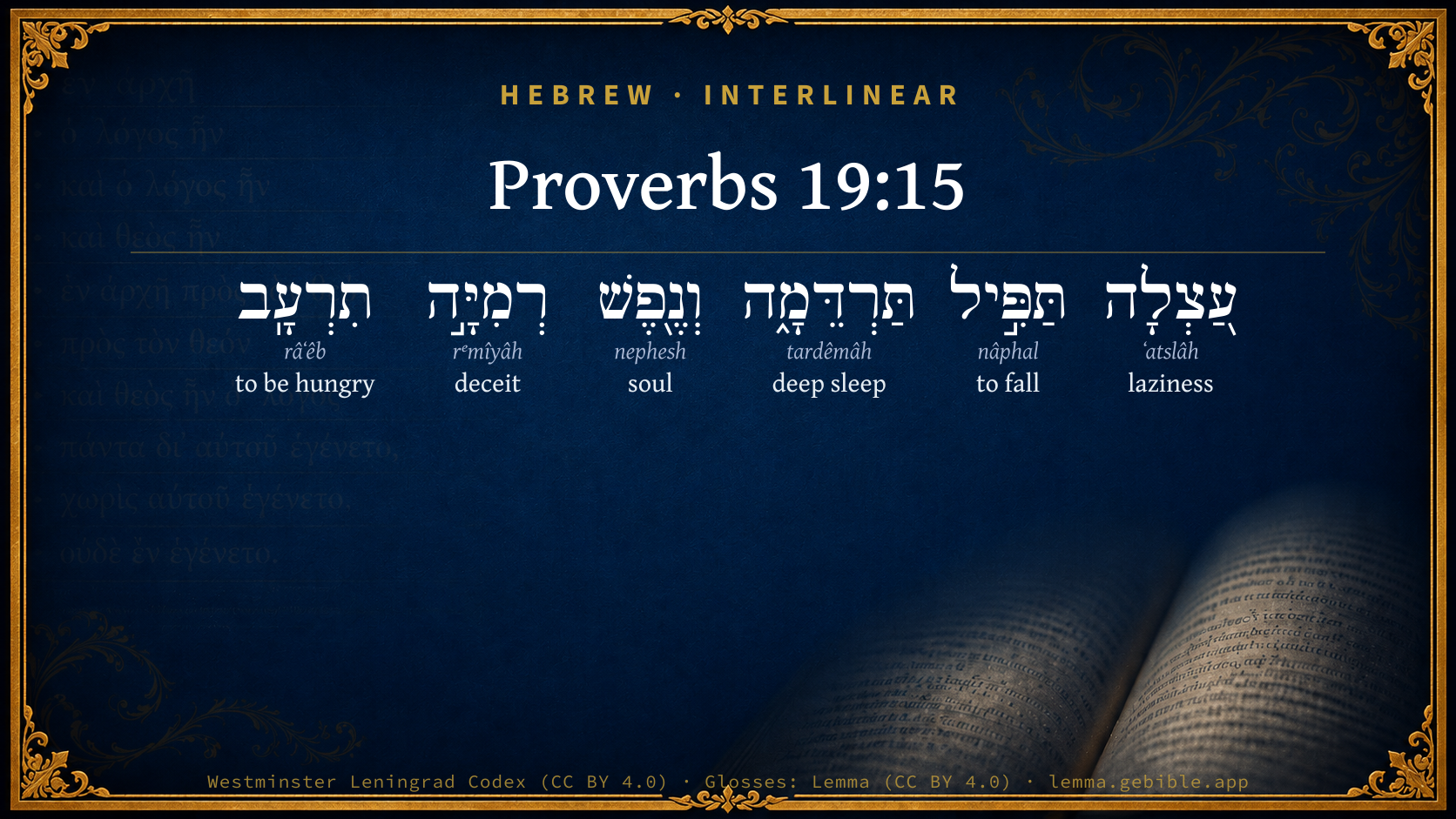
Hebrew (Westminster Leningrad Codex) Proverbs 19:15 appears in the Hebrew Old Testament. The text above is from the Westminster Leningrad Codex. Each word links to its Strong’s number, a concise gloss, and parsing drawn from the Open Scriptures Hebrew Bible morphology. Click any word for its full Brown-Driver-Briggs (BDB) entry.
Download image
Cite this verse

Proverbs 19:15 (World English Bible). Public Domain. Lemma interlinear Bible study tool, https://lemma.gebible.app/v/proverbs/19/15.

Show BibTeX & RIS
BibTeX
RIS
English Translation
Slothfulness casts into a deep sleep. The idle soul shall suffer hunger.
World English Bible · Public Domain
Highlights
  • 1 first appearance in the Hebrew Bible
Full analysis ↓
Download a study sheet

One document with this verse’s original text, its word-by-word gloss line, the meaning frame, cross-references with their text, attributed commentary, and full source and license credits — printable, and it pastes into notes with its structure intact.

This verse Autodidact and up

Study sheet (.html) Plain text (.txt)

A passage Seminary Student

Up to 50 verses in one chapter. A passage sheet keeps up to 6 commentary sources and 12 cross-references per verse, in the order this page ranks them, and says so on the sheet whenever that leaves anything out. Ask for a single verse and you get the Autodidact verse sheet above.

Everything on this page stays free to read, with no account — the sheet is a download of what is already on screen, not access to it.

Want to remove ads? Support Godless Engineer
Compare translations 3

The same verse in 3 English versions, stacked beneath the original-language interlinear above. Click any original word for its lexicon entry.

Each is an independent rendering of the whole verse — the interlinear is not word-aligned to these translations.

Highlighted words mark where these versions differ — a whole-verse word diff, not a word-by-word alignment.

  • World English Bible Public Domain
    Slothfulness casts into a deep sleep. The idle soul shall suffer hunger.
  • King James Version Public Domain
    Slothfulness casteth into a deep sleep; and an idle soul shall suffer hunger.
  • unfoldingWord Literal Text CC BY-SA 4.0
    Laziness causes deep sleep to fall, and a life of idleness is hungry.

unfoldingWord Literal Text — © unfoldingWord, licensed CC BY-SA 4.0. Word-aligned USFM3 via Door43 (git.door43.org/unfoldingWord/en_ult).

Versions to compare (up to 4)

3 of 4 selected

Show all 18 translations

Every available English version of this verse, each an independent rendering of the whole verse.

  • World English Bible Public Domain
    Slothfulness casts into a deep sleep. The idle soul shall suffer hunger.
  • Berean Standard Bible Public Domain
    Laziness brings on deep sleep, and an idle soul will suffer hunger.
  • Majority Standard Bible Public Domain
    Laziness brings on deep sleep, and an idle soul will suffer hunger.
  • King James Version Public Domain
    Slothfulness casteth into a deep sleep; and an idle soul shall suffer hunger.
  • American Standard Version (1901) Public Domain
    Slothfulness casteth into a deep sleep; And the idle soul shall suffer hunger.
  • Revised Version (1885) Public Domain
    Slothfulness casteth into a deep sleep; and the idle soul shall suffer hunger.
  • Geneva Bible (1599) Public Domain
    Slouthfulnes causeth to fall asleepe, and a deceitfull person shall be affamished.
  • Douay-Rheims (1899) Public Domain
    Slothfulness casteth into a deep sleep, and an idle soul shall suffer hunger.
  • Young's Literal Translation Public Domain
    Sloth causeth deep sleep to fall, And an indolent soul doth hunger.
  • Literal Standard Version CC BY-SA 4.0
    Sloth causes deep sleep to fall, || And an indolent soul hungers.
  • Unlocked Literal Bible CC BY-SA 4.0
    Laziness throws a person into a deep sleep, but the one not willing to work will go hungry.
  • unfoldingWord Literal Text CC BY-SA 4.0
    Laziness causes deep sleep to fall, and a life of idleness is hungry.
  • Darby Bible Public Domain
    Slothfulness casteth into a deep sleep, and the idle soul shall suffer hunger.
  • World Messianic Bible Public Domain
    Slothfulness casts into a deep sleep. The idle soul shall suffer hunger.
  • Webster's Bible Public Domain
    Slothfulness casteth into a deep sleep; and an idle soul shall suffer hunger.
  • Free Bible Version CC BY-SA 4.0
    Lazy people are often fast asleep, but idleness means they're hungry.
  • Bible in Basic English Public Domain
    Hate of work sends deep sleep on a man: and he who has no industry will go without food.
  • JPS Tanakh (1917) Public Domain
    Slothfulness casteth into a deep sleep; and the idle soul shall suffer hunger.

Literal Standard Version (2020), Covenant Press — licensed CC BY-SA 4.0. Text via the HelloAO Bible API (eBible.org). Unlocked Literal Bible (unfoldingWord) — licensed CC BY-SA 4.0. Text via the HelloAO Bible API (eBible.org). unfoldingWord Literal Text — © unfoldingWord, licensed CC BY-SA 4.0. Word-aligned USFM3 via Door43 (git.door43.org/unfoldingWord/en_ult). Free Bible Version, Dr. Jonathan Gallagher — licensed CC BY-SA 4.0. Text via the HelloAO Bible API (eBible.org).

Word by word

More ways to search: Search by grammar → Find every occurrence → Compare this word →

Practice this passage: Drill this verse → Learn its vocabulary →

About this verse

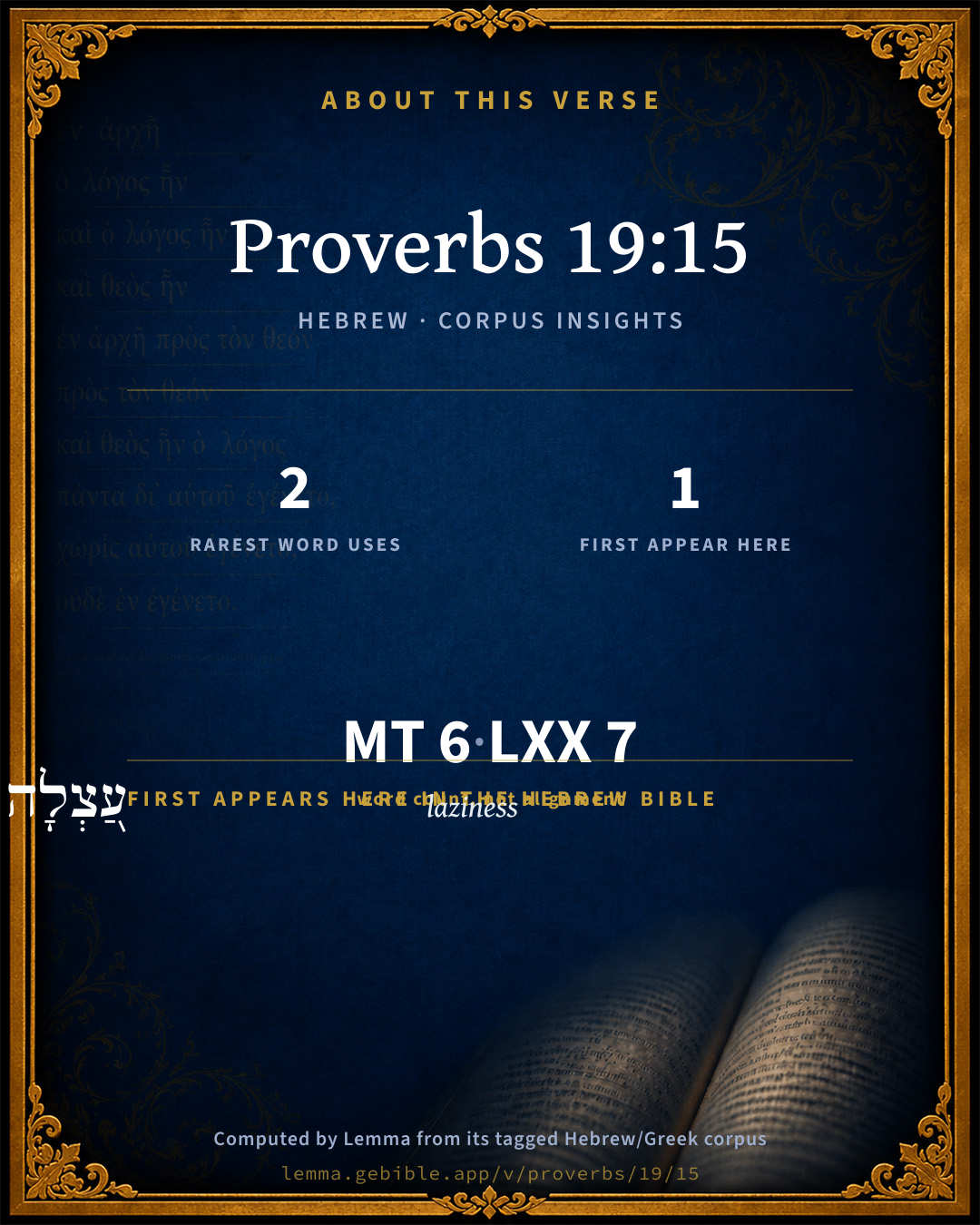
These counts appear in no published source. They are computed here, from the morphology-tagged text and Lemma’s own curated glosses. What Lemma adds →

6
words
6
distinct lemmas
Wisdom
section

Notable vocabulary

The rarest word here is עַ֭צְלָה laziness H6103 — appearing just 2 times in the whole Hebrew Bible.

First appearance in Scripture

This word makes its first canonical appearance in the Hebrew Bible here:

  • עַ֭צְלָה laziness H6103

Shared distinctive vocabulary

עַ֭צְלָה laziness H6103 occurs in 2 verses of the Hebrew Bible. Also found in:

Grammatical profile

  • 2 verbs
  • 4 nouns

Verb forms

  • תַּפִּ֣יל Hiphil · Imperfect
  • תִרְעָֽב Qal · Imperfect

Hebrew & Septuagint length

In English translation the verse runs 12 words from the Hebrew and 13 from the Septuagint (LXX English) — closely comparable.

A rough comparison of the two English renderings, which tokenize alike — not a word-level alignment.

Word counts can differ between the Hebrew and the Greek without any difference in meaning — e.g. the Hebrew direct-object marker אֵת has no separate Greek word, and Greek often adds the article ὁ.

In the original languages it is 6 Hebrew tokens and 7 Greek tokens — but the two are counted differently (Hebrew bundles its prefixes and suffixes into one token; the Greek is in lemma form), so that isn’t a like-for-like length.

Cross-references

10

Topical passages linked to Proverbs 19:15 in the Treasury of Scripture Knowledge — connected by theme and wording, ordered by reader-vote popularity; previews shown in the World English Bible.

  • Proverbs 23:21 For the drunkard and the glutton shall become poor; And drowsiness clothes them in rags.
  • Proverbs 20:13 Don't love sleep, lest you come to poverty; Open your eyes, and you shall be satisfied with bread.
  • 2 Thessalonians 3:10 For even when we were with you, we commanded you this: "If anyone will not work, neither let him eat."
  • Proverbs 6:9–10 How long will you sleep, sluggard? When will you arise out of your sleep?
  • Proverbs 24:33 A little sleep, a little slumber, A little folding of the hands to sleep;
  • Romans 13:11–12 Do this, knowing the time, that it is already time for you to awaken out of sleep, for salvation is now nearer to us than when we first believed.
  • Proverbs 10:4–5 He becomes poor who works with a lazy hand, But the hand of the diligent brings wealth.
  • Ephesians 5:14 Therefore he says, "Awake, you who sleep, and arise from the dead, and Christ will shine on you."
  • Proverbs 19:24 The sluggard buries his hand in the dish; He will not so much as bring it to his mouth again.
  • Isaiah 56:10 His watchmen are blind, they are all without knowledge; they are all mute dogs, they can't bark; dreaming, lying down, loving to slumber.

Cross-references courtesy of OpenBible.info (CC BY 4.0).

Hebrew and Greek witnesses Masoretic Hebrew ↔ Greek Septuagint

The same verse in the two great witnesses to the Old Testament, shown verse-for-verse.

These are two independent witnesses, not word-aligned to each other, and the Septuagint is shown in lemma (dictionary) form.

Hebrew Proverbs 19:15 Masoretic · Westminster Leningrad Codex

עַ֭צְלָה תַּפִּ֣יל תַּרְדֵּמָ֑ה וְנֶ֖פֶשׁ רְמִיָּ֣ה תִרְעָֽב

Slothfulness casts into a deep sleep. The idle soul shall suffer hunger.

World English Bible · Public Domain

Greek LXX Proverbs 19:15 Septuagint · lemma form

δειλία καταἔχω ἀνδρογύναιος ψυχή δέ ἀεργός πεινάω

Cowardice possesses the effeminate man; and the soul of the sluggard shall hunger.

LXX2012 (modern English Septuagint) · Public Domain

On this verse, The Pulpit Commentary discusses the Septuagint’s reading. Read the note in Commentary ↓

Hebrew: Westminster Leningrad Codex (CC BY 4.0). Greek: Septuagint (public domain); English from LXX2012 (modern English Septuagint) (Public Domain). How the Septuagint differs from the Hebrew →

Commentary

Notes on Proverbs 19:15 from classic Christian and Jewish commentators (each source and its license shown beneath its notes). The classic Christian expositions comment on the surrounding passage and are grouped to its opening verse, so a note may address several verses; the Jewish commentaries on the Tanakh (Rashi and others) are per-verse, so they appear only where the commentator wrote on this verse.

Lemma curates 59 commentaries, every one of them public domain or Creative Commons licensed, each selected and text-cleaned for this edition rather than reprinted as found. About our sources →

Trapp's Complete Commentary

John Trapp

Pro 19:15 Slothfulness casteth into a deep sleep; and an idle soul shall suffer hunger.

Ver. 15. Slothfulness casteth into a deep sleep.] Sloth bringeth sleep, and sleep poverty. See this excellently set forth. {Pro 6:9-11; Pro 10:4} {See Trapp on "Pro 6:9"} {See Trapp on "Pro 6:10"} {See Trapp on "Pro 6:11"} {See Trapp on "Pro 10:4"}

John Trapp, A Commentary or Exposition upon All the Books of the Old and New Testament (1647–1656) — public domain. Text from a community e-Sword module.

The Biblical Illustrator

Joseph S. Exell

Pro_19:15

Slothfulness casteth into a deep sleep; and an idle soul shall suffer hunger.

Idlers and idleness

In the big, busy city, the one who seems out of touch with it is the idler. He who has no other business than the wretched one of killing time has no portion, right, or memorial in it; nor has he any right or portion in the age which we are serving. There is the rich idler, who lives to amuse himself. Such provide the demoralising element in our society. They lead the fashion in vice and frivolity. There is the poor idler. There are some who for the sake of equalising poverty and wealth would really equalise indolence and industry. In our great towns, more than half of our poverty is the result, direct or indirect, of that slothfulness which casts into a deep sleep. There is a hereditary pauperism. There is the poverty of recklessness and thoughtlessness and thriftlessness. A third type of idler is the idle-souled. Busy enough with earth, such have no business with heaven, no business with love, no business even with the ideals of duty. Leisure is very different from idleness. There is no leisure at all when the life is spent in idleness. It is the interval between work and work that gives the helpful leisure. Leisure is good, idleness is bad. Above all things, avoid heart indolence, moral and spiritual indolence, the indolence of the soul. (J. Marshall Lang, D. D.)

The Biblical Illustrator, edited by Joseph S. Exell (c. 1880s–1900s) — public domain. Text from a community e-Sword module.

Joseph Benson's Commentary

Pro 19:15. Slothfulness casteth into a deep sleep — “As labour makes men vigorous and rich, so sloth and idleness have these two miserable effects, that they insensibly sink the mind into a dull stupidity and unconcernedness about the most necessary things, and thereby reduce a man to extreme want and beggary; to which may be added a third, that they tempt him to shift and use dishonest arts for a livelihood.” — Bishop Patrick.

Joseph Benson's Commentary on the Old and New Testaments (1811–1818) — public domain. Text from a community e-Sword module.

Matthew Henry's Commentary

See here the evil of a sluggish slothful disposition. 1. It stupefies men, and makes them senseless, and mindless of their own affairs, as they were cast into a deep sleep, dreaming much, but doing nothing. Slothful people doze away their time, bury their talents, live a useless life, and are the unprofitable burdens of the earth; for any service they do when they are awake they might as well be always asleep. Even their souls are idle and lulled asleep, their rational powers chilled and frozen. 2. It impoverishes men and brings them to want. Those that will not labour cannot expect to eat, but must suffer hunger: An idle soul, one that is idle in the affairs of his soul, that takes no care or pains to work out his salvation, shall perish for want of that which is necessary to the life and happiness of the soul.

Matthew Henry's Commentary on the Whole Bible (1708–1710) — public domain (CC PDM 1.0). Text via the HelloAO Bible API.

Jamieson, Fausset & Brown

Robert Jamieson, A. R. Fausset & David Brown

a deep sleep--a state of utter indifference.

idle soul--or, "person" (compare Pro 10:4; Pro 12:24).

Jamieson, Fausset & Brown — Commentary Critical and Explanatory on the Whole Bible (1871) — public domain (CC PDM 1.0). Text via the HelloAO Bible API.

Adam Clarke's Commentary

Verse 15. Into a deep sleep] תרדמה tardemah, the same into which Adam was thrown, before Eve was taken from his side. Sloth renders a man utterly unconscious of all his interests. Though he has frequently felt hunger, yet he is regardless that his continual slothfulness must necessarily plunge him into more sufferings.

Adam Clarke's Commentary on the Bible (1810–1826) — public domain. Text from a community e-Sword/MySword module.

Ellicott's Commentary for English Readers

(15) Slothfulness casteth into a deep sleep.—Or rather, makes it fall upon a man, as upon Adam (Gen_2:21).

A Bible Commentary for English Readers, edited by Charles John Ellicott (1878–1897) — public domain. Text from a community e-Sword module.

John Gill's Exposition

Slothfulness casteth into a deep sleep,.... Slothful persons are generally sleepy, and are very desirous of sleep, and indulge themselves in it; they spend their time, day and night, in sleep and drowsiness; and are quite careless and unconcerned about either their temporal or eternal good; see Pro 6:9;

and an idle soul shall suffer hunger; and perish with it, both in a temporal and spiritual sense: an idle person, that will not work, ought not to eat; and an idle soul, or one that is unconcerned about his soul, and the spiritual food of it, shall perish for want of it.

John Gill's Exposition of the Whole Bible (1746–1763) — public domain (CC PDM 1.0). Text via the HelloAO Bible API.

Albert Barnes' Notes on the Bible

Casteth into a deep sleep - Better, causeth deep sleep to fall.

Albert Barnes' Notes on the Bible (1834–1885) — public domain. Text from a community e-Sword/MySword module.

Haydock's Catholic Bible Commentary

Hunger. Both temporal and eternal. (Calmet) --- Non progredi, regredi est. St. Bernard says, "Not to advance, is to go back."

George Leo Haydock (1774–1849), Haydock's Catholic Family Bible and Commentary, 1859 edition — public domain. Excludes Psalms (Douay-Rheims chapter numbering differs from Protestant) and Deuterocanonical books (Catholic canon only).

Matthew Poole's English Annotations

Casteth into a deep sleep; maketh a man careless and, negligent, and like one asleep in his business, whereby he cometh to want, as it follows.

Matthew Poole's English Annotations on the Holy Bible (1683–1685) — public domain. Text from a community e-Sword/MySword module.

Whedon's Commentary on the Bible

Daniel D. Whedon

15. Casteth — Rather, causeth deep sleep to fall, amounting to stupor and lethargy.

A deep sleep — תרדמה, (tardemah,) the same word used in Gen_2:2, concerning Adam.

An idle soul — Or person. Comp. Pro_6:9-10; Pro_10:4; Pro_12:2.

Daniel D. Whedon (gen. ed.), Commentary on the Old and New Testaments (1874–1909) — public domain. Text from a community e-Sword module.

The Pulpit Commentary

Slothfulness casteth into a deep sleep; " causes deep sleep to fall upon a man". (comp. Pro_6:9 Pro_13:4) The word for "sleep" (hmdert, tardemah) is that used for the supernatural sleep of Adam when Eve was formed, (Gen_2:21) and implies pro. found insensibility. Aquila and Symmachus render it, ekstasin , "trance." Slothfulness enervates a man, renders him as useless for labour as if he were actually asleep in his bed; it also enfeebles the mind, corrupts the higher faculties, converts a rational being into a witless animal. Otium est vivi hominis sepultura, "Idleness is a living man"s tomb." An idle soul shall suffer hunger. We have many gnomes to this effect. (see Pro_10:4 Pro_12:24 Pro_20:13 Pro_23:21) The LXX has introduced something of this verse at Pro_18:8, and here render, Deilia katecei androgunon , "Cowardice holdeth fast the effeminate, and the soul of the idle shall hunger." "Sloth," as the proverb says, "is the mother of poverty."

The Pulpit Commentary (1880–1919), ed. H.D.M. Spence-Jones & Joseph S. Exell — public domain. Text from a community e-Sword module.

John Wesley's Explanatory Notes

Casteth - Makes a man careless, and like one asleep in his business.

John Wesley, Explanatory Notes Upon the Whole Bible (1754–1765) — public domain. Text via the GEBible commentary corpus.

Keil & Delitzsch

C. F. Keil & F. Delitzsch

15 Slothfulness sinketh into deep sleep,

And an idle soul must hunger.

Regarding תּרדּמה and its root-word רדם, vid., at Pro 10:5. הפּיל, to befall, to make to get, is to be understood after Gen 3:21; the obj. על־האדם, viz., העצל, is naturally to be supplied. In 15b the fut. denotes that which will certainly happen, the inevitable. In both of its members the proverb is perfectly clear; Hitzig, however, corrects 15a, and brings out of it the meaning, "slothfulness gives tasteless herbs to eat." The lxx has two translations of this proverb, here and at Pro 18:8. That it should translate רמיה by ἀνδρόγυνος was necessary, as Lagarde remarks, for the exposition of the "works of a Hebrew Sotades." But the Hebrew literature never sunk to such works, wallowing in the mire of sensuality, and ἀνδρόγυνος is not at all thus enigmatical; the Greek word was also used of an effeminate man, a man devoid of manliness, a weakling, and was, as the lxx shows, more current in the Alexandrine Greek than elsewhere.

Keil & Delitzsch — Biblical Commentary on the Old Testament (1861–1891) — public domain (CC PDM 1.0). Text via the HelloAO Bible API. (Old Testament only.)

Bridges on Proverbs

Charles Bridges

All experience and observation attest the fact, that slothful habits destroy mental energy, and idleness is the road to want. What could we expect from a sluggard lying in his bed all the day? As little from the slothful, who goes about his work, as if he was cast into a deep sleep. (Pro 6:9-11 .) And even where the slumber is not a deep sleep, its partial influence is the dead palsy upon active perseverance. He has not the thorough use of his wakeful faculties. And if he has (as who has not?) made a false step, there is no energy of effort to repair it.†1 And if there be any reward of perseverance, sloth will never find it; the idle soul will suffer hunger.

Thoughtless sinner! Think how this applies to the work of God. You persuade yourself that all is well, because you will not trouble yourself to open your eyes to the truth; and you are content to let things run their course. You do not rebel against the Gospel. But has not our Divine Master said — "He that is not with me is against me"? (Mat 12:30 .) You conceive that you have done no harm. But is it no harm to have hitherto wasted every opportunity for eternity? to have wandered about in vanity from your cradle, instead of living to God? You are determined to sleep at any rate. And though the two grand treasures — the favor of God, and your own soul — are in imminent peril; yet still you "say to your soul — Soul, take thine ease." (Luk 12:19 .) Instead of weeping love, wrestling prayer, and working diligence — you are cast into a deep sleep. "Awake, thou that sleepest" (Eph 5:14 ); else wilt thou sleep the sleep of eternal death.

Often do we find men active and laborious, all eyes, all ears, all heart in worldly matters, hating sloth, yet themselves devoured by it. They know that something must be done. But in the vital exercises of denying self, crucifying the flesh, coming to Christ, loving the Lord, and devotedness to his service — here it is a deep sleep. Is then the grace of God to work as a charm, without, or independent of, means? This were a deadly delusion, casting into the deep sleep of presumption. Such an idle soul shall suffer hunger! (Pro 10:4-5 ; Pro 20:4 .) The enduring meat is the gift of God; but, like every other blessing of the Gospel, it is given only to labour.†2 The idle mouth — full only of heartless complaints, perhaps sending up a dull prayer for the present quiet of conscience — shall suffer hunger. The soul can never flourish, if it be not in earnest with God. It may be roused for a while; but only to be cast into a deeper sleep than ever. For godliness can never thrive with this deadly malady. If the slothful may be sincerely religious; so far as he is slothful, he deducts from the privilege and sincerity of his religion. And undoubtedly a slothful habit is utterly inconsistent with the vitality of true godliness. Soon nothing will remain, but the dead form of religion, the bare walls of the house, instead of the temple filled with his glory.

And now let us look at the child of God awakened out of a deep sleep. He has set out in good earnest for the kingdom; he has begun to fight — yea — to conquer. But sleep has followed; and, instead of improving the advantage, a sudden assault of the enemy has laid him low.†3 Mind thy work and thy conflict more than thine ease and comfort; else wilt thou be, not a conqueror, but a captive. In time of ease, how naturally, as Bunyan’s pilgrim found it, does the air of the plain tend to make us drowsy! And then the soul, instead of being "satisfied as with marrow and fatness" (Psa 63:5 ), suffers hunger, and becomes faint for want of its proper nourishment. The heartless externals of godliness will abide. But the spirit that breathed life into them is gone. Nothing but the unceasing prayer and exercise of a mortified spirit can shake off this "evil disease that cleaveth to us." Be thou, Lord, our Helper, our Strength, our Physician!

Footnotes:

†1 Marshall Turénne expressed his warm obligation to a friend, who had given him the following advice, when first setting out in life — ’When you have made a false step, spend not a moment in vexing yourself, and moaning over it; but think how it may best be repaired, and instantly set about it.’

†2 Joh 6:27, with Heb 6:11-12 . 2Pe 1:5-11 .

†3 Invadunt urbem somno vinoque sepultam. — Virg. Æn. ii. 265.

Charles Bridges, An Exposition of the Book of Proverbs (1846) — public domain. Text from a community e-Sword module.

Kretzmann's Popular Commentary

Paul E. Kretzmann

v. 15. Slothfulness casteth into a deep sleep, causing a man to sink into stupor and lethargy, sapping the last bit of his energy, and an idle soul shall suffer hunger, that being the result of sloth.

Paul E. Kretzmann, Popular Commentary of the Bible (1921–1924) — public domain. Text from a community e-Sword module.

unfoldingWord translationNotes

Door43 World Missions Community

Laziness throws a person into a deep sleep

This speaks of how laziness causes a person to sleep a lot as if laziness forcefully throws the person into sleep. AT: "Laziness makes a person sleep a lot" or "A lazy person sleeps a lot" (See: Personification)

go hungry

This is an idiom which means to not eat. AT: "not eat" or "be hungry" (See: Idiom)

the command

"the command that he was taught"

guards his life

"protects his life"

his ways

This is an idiom which refers to how he lives. AT: "the way that he lives" or "how he lives" (See: Idiom)

translationWords

obey

command

life

die

unfoldingWord translationNotes — © Distant Shores Media and the Door43 World Missions Community, licensed CC BY-SA 4.0. Source: git.door43.org/Door43/en_tn.

Rashi

Rabbi Shlomo Yitzchaki (Rashi)

Laziness causes one to fall into a deep sleep Laziness causes one to fall asleep. This is the figure, but the allegory is that it concerns one who neglects his studies; it will ultimately come about that people will ask him words of wisdom, and he will be sound asleep.

and a deceitful soul shall suffer hunger He will ultimately become poor. Similarly, one who is deceitful in his studies, making his Torah into “bundles,” will ultimately forget.

Rashi on the Tanakh — English translations: “The Judaica Press complete Tanach with Rashi, translated by A. J. Rosenberg” (CC BY 4.0); “Pentateuch with Rashi's commentary by M. Rosenbaum and A.M. Silbermann, 1929-1934” (public domain); “The Metsudah Tanach series, Lakewood, N.J” (CC BY 4.0); and “The Book of Joshua, Metsudah Publications, 1997” (CC BY 4.0). Text via Sefaria.

Lesson kit

Teaching starters — assembled from the data on this page, not authored interpretation. Every prompt links to the verse data it draws on. Edit before teaching.

Proverbs, in the Wisdom, opens this verse with 6 words (6 distinct Hebrew lemmas). Its most distinctive word is ʻatslâh (“laziness”). A historical commentator’s framing appears above. Read the whole chapter for the surrounding context.

Discussion questions

  1. How does “laziness” (ʻatslâh) shape what this verse is saying?
  2. This is the first place “laziness” appears in Scripture (first appears here). What does its debut here establish?
  3. How does Ecclesiastes 10:18, which shares the word «laziness», read alongside this verse?
  4. These translations render this verse differently. What is at stake in choosing one wording over another?
  5. «תַּפִּ֣יל» is a Hiphil Imperfect verb. How does that grammatical form shape the action described?
  6. Compare how Trapp's Complete Commentary and The Biblical Illustrator read this verse. Where do they agree or differ?

Things to notice

Reading settings

Reading text

Shown beneath each verse's original-language words.

Old Testament
Old Testament edition

Read the OT as the Masoretic Hebrew (MT) or the Greek Septuagint (LXX).

English shown for the Greek Septuagint (in the Hebrew ↔ Greek comparison).

Comparing translations? Open the Compare panel on any verse page to stack up to four side by side.