
Proverbs 11:17

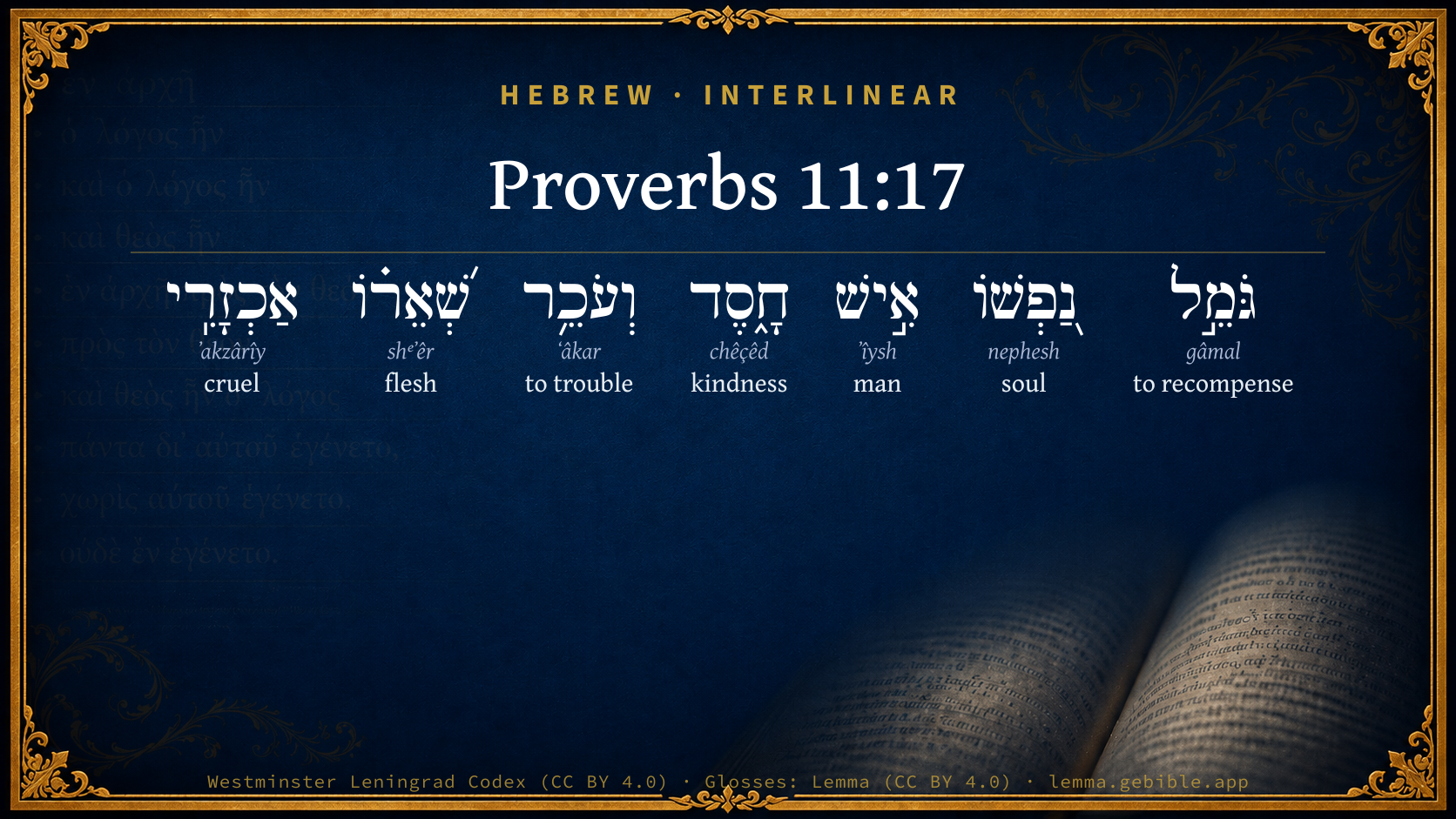
Hebrew (Westminster Leningrad Codex) Proverbs 11:17 appears in the Hebrew Old Testament. The text above is from the Westminster Leningrad Codex. Each word links to its Strong’s number, a concise gloss, and parsing drawn from the Open Scriptures Hebrew Bible morphology. Click any word for its full Brown-Driver-Briggs (BDB) entry.
Download image
Cite this verse

Proverbs 11:17 (World English Bible). Public Domain. Lemma interlinear Bible study tool, https://lemma.gebible.app/v/proverbs/11/17.

Show BibTeX & RIS
BibTeX
RIS
English Translation
The merciful man does good to his own soul, But he who is cruel troubles his own flesh.
World English Bible · Public Domain
Download a study sheet

One document with this verse’s original text, its word-by-word gloss line, the meaning frame, cross-references with their text, attributed commentary, and full source and license credits — printable, and it pastes into notes with its structure intact.

This verse Autodidact and up

Study sheet (.html) Plain text (.txt)

A passage Seminary Student

Up to 50 verses in one chapter. A passage sheet keeps up to 6 commentary sources and 12 cross-references per verse, in the order this page ranks them, and says so on the sheet whenever that leaves anything out. Ask for a single verse and you get the Autodidact verse sheet above.

Everything on this page stays free to read, with no account — the sheet is a download of what is already on screen, not access to it.

Want to remove ads? Support Godless Engineer
Compare translations 3

The same verse in 3 English versions, stacked beneath the original-language interlinear above. Click any original word for its lexicon entry.

Each is an independent rendering of the whole verse — the interlinear is not word-aligned to these translations.

Highlighted words mark where these versions differ — a whole-verse word diff, not a word-by-word alignment.

  • World English Bible Public Domain
    The merciful man does good to his own soul, But he who is cruel troubles his own flesh.
  • King James Version Public Domain
    The merciful man doeth good to his own soul: but he that is cruel troubleth his own flesh.
  • unfoldingWord Literal Text CC BY-SA 4.0
    A man of covenant faithfulness repays his soul, but a cruel troubles his flesh.

unfoldingWord Literal Text — © unfoldingWord, licensed CC BY-SA 4.0. Word-aligned USFM3 via Door43 (git.door43.org/unfoldingWord/en_ult).

Versions to compare (up to 4)

3 of 4 selected

Show all 18 translations

Every available English version of this verse, each an independent rendering of the whole verse.

  • World English Bible Public Domain
    The merciful man does good to his own soul, But he who is cruel troubles his own flesh.
  • Berean Standard Bible Public Domain
    A kind man benefits himself, but a cruel man brings trouble on himself.
  • Majority Standard Bible Public Domain
    A kind man benefits himself, but a cruel man brings trouble on himself.
  • King James Version Public Domain
    The merciful man doeth good to his own soul: but he that is cruel troubleth his own flesh.
  • American Standard Version (1901) Public Domain
    The merciful man doeth good to his own soul; But he that is cruel troubleth his own flesh.
  • Revised Version (1885) Public Domain
    The merciful man doeth good to his own soul: but he that is cruel troubleth his own flesh.
  • Geneva Bible (1599) Public Domain
    Hee that is mercifull, rewardeth his owne soule: but he that troubleth his own flesh, is cruel.
  • Douay-Rheims (1899) Public Domain
    A merciful man doth good to his own soul: but he that is cruel casteth off even his own kindred.
  • Young's Literal Translation Public Domain
    A kind man is rewarding his own soul, And the fierce is troubling his own flesh.
  • Literal Standard Version CC BY-SA 4.0
    A kind man is rewarding his own soul, || And the fierce is troubling his own flesh.
  • Unlocked Literal Bible CC BY-SA 4.0
    A kind person benefits himself, but one who is cruel hurts himself.
  • unfoldingWord Literal Text CC BY-SA 4.0
    A man of covenant faithfulness repays his soul, but a cruel troubles his flesh.
  • Darby Bible Public Domain
    The merciful man doeth good to his own soul; but the cruel troubleth his own flesh.
  • World Messianic Bible Public Domain
    The merciful man does good to his own soul, but he who is cruel troubles his own flesh.
  • Webster's Bible Public Domain
    The merciful man doeth good to his own soul: but he that is cruel troubleth his own flesh.
  • Free Bible Version CC BY-SA 4.0
    If you're kind, you'll be rewarded; but if you're cruel, you'll hurt yourself.
  • Bible in Basic English Public Domain
    The man who has mercy will be rewarded, but the cruel man is the cause of trouble to himself.
  • JPS Tanakh (1917) Public Domain
    The merciful man doeth good to his own soul; but he that is cruel troubleth his own flesh.

Literal Standard Version (2020), Covenant Press — licensed CC BY-SA 4.0. Text via the HelloAO Bible API (eBible.org). Unlocked Literal Bible (unfoldingWord) — licensed CC BY-SA 4.0. Text via the HelloAO Bible API (eBible.org). unfoldingWord Literal Text — © unfoldingWord, licensed CC BY-SA 4.0. Word-aligned USFM3 via Door43 (git.door43.org/unfoldingWord/en_ult). Free Bible Version, Dr. Jonathan Gallagher — licensed CC BY-SA 4.0. Text via the HelloAO Bible API (eBible.org).

Word by word

More ways to search: Search by grammar → Find every occurrence → Compare this word →

Practice this passage: Drill this verse → Learn its vocabulary →

About this verse

These counts appear in no published source. They are computed here, from the morphology-tagged text and Lemma’s own curated glosses. What Lemma adds →

7
words
7
distinct lemmas
Wisdom
section

Notable vocabulary

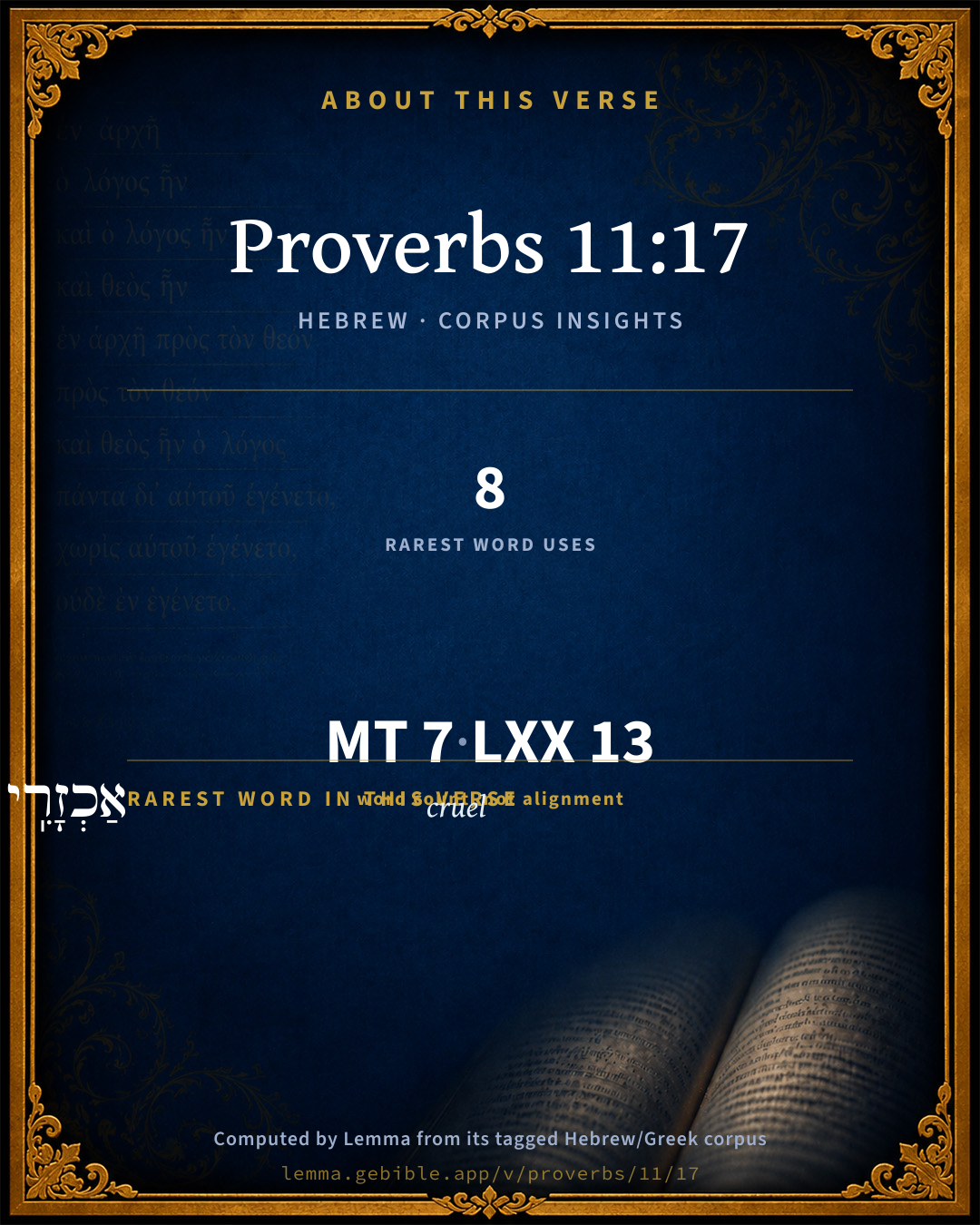
The rarest word here is אַכְזָרִֽי cruel H394 — appearing just 8 times in the whole Hebrew Bible.

Shared distinctive vocabulary

אַכְזָרִֽי cruel H394 occurs in 8 verses of the Hebrew Bible. Also found in:

Grammatical profile

  • 2 verbs
  • 4 nouns
  • 1 adjective

Verb forms

  • גֹּמֵ֣ל Qal · Participle Active
  • וְעֹכֵ֥ר Qal · Participle Active

Hebrew & Septuagint length

In English translation the verse runs 18 words from the Hebrew and 16 from the Septuagint (LXX English) — closely comparable.

A rough comparison of the two English renderings, which tokenize alike — not a word-level alignment.

Word counts can differ between the Hebrew and the Greek without any difference in meaning — e.g. the Hebrew direct-object marker אֵת has no separate Greek word, and Greek often adds the article ὁ.

In the original languages it is 7 Hebrew tokens and 13 Greek tokens — but the two are counted differently (Hebrew bundles its prefixes and suffixes into one token; the Greek is in lemma form), so that isn’t a like-for-like length.

Cross-references

17

Topical passages linked to Proverbs 11:17 in the Treasury of Scripture Knowledge — connected by theme and wording, ordered by reader-vote popularity; previews shown in the World English Bible.

  • Matthew 5:7 Blessed are the merciful, For they shall obtain mercy.
  • Matthew 25:34–40 Then the King will tell those on his right hand, 'Come, blessed of my Father, inherit the Kingdom prepared for you from the foundation of the world;
  • James 2:13 For judgment is without mercy to him who has shown no mercy. Mercy triumphs over judgment.
  • Psalms 41:1–4 Blessed is he who considers the poor: Yahweh will deliver him in the day of evil.
  • Daniel 4:27 Therefore, O king, let my counsel be acceptable to you, and break off your sins by righteousness, and your iniquities by showing mercy to the poor; if there may be a lengthening of your tranquillity.
  • Matthew 6:14–15 "For if you forgive men their trespasses, your heavenly Father will also forgive you.
  • 2 Corinthians 9:6–14 Remember this: he who sows sparingly will also reap sparingly. He who sows bountifully will also reap bountifully.
  • Philippians 4:17 Not that I seek for the gift, but I seek for the fruit that increases to your account.
  • James 5:1–5 Come now, you rich, weep and howl for your miseries that are coming on you.
  • Job 20:19–23 For he has oppressed and forsaken the poor. He has violently taken away a house, and he shall not build it up.
  • Psalms 112:4–9 Light dawns in the darkness for the upright, Gracious, merciful, and righteous.
  • Proverbs 15:27 He who is greedy for gain troubles his own house, But he who hates bribes will live.
  • Ecclesiastes 4:8 There is one who is alone, and he has neither son nor brother. There is no end to all of his labor, neither are his eyes satisfied with wealth. For whom then, do I labor, and deprive my soul of enjoyment? This also is vanity, yes, it is a miserable business.
  • Isaiah 32:7–8 The instruments of the churl are evil: he devises wicked devices to destroy the humble with lying words, even when the needy speaks right.
  • Isaiah 57:1 The righteous perishes, and no man lays it to heart; and merciful men are taken away, none considering that the righteous is taken away from the evil [to come].
  • Isaiah 58:7–12 Isn't it to deal your bread to the hungry, and that you bring the poor who are cast out to your house? when you see the naked, that you cover him; and that you not hide yourself from your own flesh?
  • Luke 6:38 "Give, and it will be given to you: good measure, pressed down, shaken together, and running over, will be given to you. For with the same measure you measure it will be measured back to you."

Cross-references courtesy of OpenBible.info (CC BY 4.0).

Hebrew and Greek witnesses Masoretic Hebrew ↔ Greek Septuagint

The same verse in the two great witnesses to the Old Testament, shown verse-for-verse.

These are two independent witnesses, not word-aligned to each other, and the Septuagint is shown in lemma (dictionary) form.

Hebrew Proverbs 11:17 Masoretic · Westminster Leningrad Codex

גֹּמֵ֣ל נַ֭פְשׁוֹ אִ֣ישׁ חָ֑סֶד וְעֹכֵ֥ר שְׁ֝אֵר֗וֹ אַכְזָרִֽי

The merciful man does good to his own soul, But he who is cruel troubles his own flesh.

World English Bible · Public Domain

Greek LXX Proverbs 11:17 Septuagint · lemma form

ὁ ψυχή αὐτός ἀγαθός ποιέω ἀνήρ ἐλεήμων ἐκὄλλυμι δέ αὐτός σῶμα ὁ ἀνελεήμων

A merciful man does good to his own soul: but the merciless destroys his own body.

LXX2012 (modern English Septuagint) · Public Domain

On this verse, The Pulpit Commentary discusses the Septuagint’s reading. Read the note in Commentary ↓

Hebrew: Westminster Leningrad Codex (CC BY 4.0). Greek: Septuagint (public domain); English from LXX2012 (modern English Septuagint) (Public Domain). How the Septuagint differs from the Hebrew →

Commentary

Notes on Proverbs 11:17 from classic Christian and Jewish commentators (each source and its license shown beneath its notes). The classic Christian expositions comment on the surrounding passage and are grouped to its opening verse, so a note may address several verses; the Jewish commentaries on the Tanakh (Rashi and others) are per-verse, so they appear only where the commentator wrote on this verse.

Lemma curates 59 commentaries, every one of them public domain or Creative Commons licensed, each selected and text-cleaned for this edition rather than reprinted as found. About our sources →

Trapp's Complete Commentary

John Trapp

Pro 11:17 The merciful man doeth good to his own soul: but [he that is] cruel troubleth his own flesh.

Ver. 17. The merciful doth good to his own soul.] His chief business is with and for himself: how to set all to rights within, how to keep a continual sabbath of soul, a constant composedness. He will not violate his conscience to get or retain riches, as Pro 11:16, or purchase earth with the loss of heaven. And inasmuch as the body is the soul’s servant, {a} and should therefore be neither supra negotium, above the business, nor infra negotium, below the business but par negotio, fit for the soul’s business - it ought not to be pined or pinched with penury and overmuch abstinence, as those impostors, {Col 2:23} and our Popish merit mongers, that starve their genius, and are cruel to their own flesh. These shall one day hear, "Who required these things at your hands?"

{a} Corpus, sive corpor, quasi cordis por, - i.e., puer, sive famulus; ea forma qua mancipor. - Quintipot. Camer.

John Trapp, A Commentary or Exposition upon All the Books of the Old and New Testament (1647–1656) — public domain. Text from a community e-Sword module.

The Biblical Illustrator

Joseph S. Exell

Pro_11:17

The merciful man doeth good to his own soul

The merciful man

Our God is a God of mercy.

Since He is full of mercy Himself, He is well pleased when He sees us exercise the same towards our fellow-creatures. The wise man here does not speak of tenderness towards others. The merciful man he here represents is a self-interested individual. He doeth good to his own soul. The merciful is he who is alive to his eternal interests, who is seeking the good of that treasure which is committed to him--his own soul. How may you promote this most desirable of all objects?

1. He who would do good to his own soul must carefully avoid all manner of sin, whether in thought, word, or deed. The thoughts must be watched. We are to be careful of the words which we utter, so that we may not make our tongues the instruments of evil-speaking, lying, and slandering. And careful also of our conduct and action.

2. Another mark of the object being kept in view, is the habitual study of the Word of God. The Scriptures testify of Christ, and point Him out as the way, the truth, and the life.

3. Attention to the means of grace.

4. He endeavours to realise an interest in the merits and atonement of the Lord Jesus Christ.

5. The merciful man, who does good to his own soul, does so only by placing his entire dependence upon the Lord Jesus Christ. (D. Slyman, B.A.)

The generous and the ungenerous

I. A generous disposition is a blessing to its possessor.

1. A merciful man doeth good to his intellectual faculties. It is a psychological fact that the intellect can only see clearly, move freely, and progress vigorously as it is surrounded by the atmosphere of disinterested affection. Selfishness blinds, cripples, enervates the intellect.

2. A merciful man doeth good to his moral sentiments. Conscience approves only of the actions that spring from love.

II. An ungenerous disposition is a curse to its possessor. Unmercifulness of disposition breeds the fiends of envy, jealousy, malice, remorse, fear, suspicion, pride, that torment the soul. (Homilist.)

Mercy to sufferers and to offenders

Mercy to sufferers is the disposition to relieve; mercy to offenders is the disposition to forgive. The two are infinitely united in God. Under His government all sufferers are offenders. It is only as offenders that they are sufferers, and when He pardons the offence He cancels the sentence to suffering. And in every good man the two are united. They should, indeed, be regarded as one principle, operating in different departments. The merciful man, whether considered in the one light or in the other--in exercising forgiveness or in relieving distress--doeth good to his own soul; he effectually consults his own interests. In the exercise of the generous and kindly affections there is a genuine and exquisite happiness. (R. Wardlaw.)

The Biblical Illustrator, edited by Joseph S. Exell (c. 1880s–1900s) — public domain. Text from a community e-Sword module.

Joseph Benson's Commentary

Pro 11:17. The merciful man — Who is compassionate toward persons in distress, bountiful to such as are in want, and kind to all; doth good to his own soul — That is, to himself, because his mercy and liberality shall turn to his own infinite advantage, both in this life and the next. But he that is cruel — That is, hard-hearted, and uncharitable to others; troubleth his own flesh — Either, 1st, His own children and kindred, for whose sakes he is thus covetous and uncharitable, in order that he may lay up for them; but, as these words imply, they shall have nothing but disappointment, trouble, and vexation with what they receive. Or, 2d, Himself, denominated here from his flesh, or body, as in the former clause, from his soul; perhaps to intimate, that the mischievous effects of his covetousness shall not only fall upon his soul, which he despises, but upon his flesh, or outward man, which is the only thing he fears or regards.

Joseph Benson's Commentary on the Old and New Testaments (1811–1818) — public domain. Text from a community e-Sword module.

The Preacher's Complete Homiletical Commentary

Joseph S. Exell (gen. ed.)

CRITICAL NOTES.—

Pro_11:17. Or “He who doeth good to himself is a merciful man, but he who troubleth his own flesh is cruel.” So Stuart and Miller, Zöckler and Delitzsch read as the authorised version.

MAIN HOMILETICS OF Pro_11:17

MERCY AND CRUELTY

I. A blessed human character—“A merciful man.” The blessedness of any human existence depends upon the amount of mercifulness found in it. It will be blessed in itself, and a blessing to others in proportion as this Divine characteristic is found in the spirit. God, as a God of power, would be a wonderful and awe-inspiring Being, but He would not be the “the blessed God” (1Ti_1:11) if this were His only attribute. So far as men are concerned, He would only be a Person who added to the mysteries and miseries of human life. There is plenty of power in the world, but power is not the one thing needful for fallen and sorrowful humanity. A complex and mighty machine may, and does, excite our wonder and even our admiration, but it has no sympathy. God would be no more to us if He were not “The Lord God, merciful and gracious.” He could otherwise add nothing of blessedness to our existence—yea, His very existence would be a calamity for sinful men. So, no man is a real blessing to his fellow-creatures if he is not merciful. He may be a great genius, he may be a great intellectual power, he may be possessed of great influence from one source or another; but none of these things alone, or all of them put together, will add anything to the sum of human happiness if he is not merciful. He is simply a hard machine, and will never make any wilderness heart rejoice or any moral waste blossom as the rose. But mercy is a moral force, which works as subtilly and as certainly upon human hearts to bless them as do the mysterious influences of the spring-time upon the barren earth. The absence of mercifulness makes hell the barren world that it is, and fills heaven with moral light and joy. On earth, mercifulness is felt to be most needful. The scum of humanity are not insensible to its blessed influence, and there is no man, however exalted above his fellow-men, who does not sometimes stand in need of its exercise.

II. The region which is first blest by the exercise of mercy. The merciful man’s “own soul.” There are things which by the constitution of the material universe cannot be separated. Where there is flame, there is certain to be heat; where the sun’s rays come, there must be light. So mercifulness of disposition must bless a man’s own soul. The exercise of kindliness is in harmony with the law of self-love. A man is but obeying this law when he exercises mercy. “Thou shalt love thy neighbour as thyself,” implies that a man is to love himself. Loving his neighbour is the surest way—the only way—of truly doing good to himself. God has ordained that all exercise of loving kindness shall have a reward in the doing and for the doing. “He that watereth others shall be watered himself” (Pro_11:25).

1. His own spirit will be filled with a sense of blessedness.

2. His character will be daily growing more and more like God.

3. He will have mercy extended to him when he stands in need of it. “Blessed are the merciful, for they shall obtain mercy.” “For with what measure you mete, it shall be measured unto you again” (Mat_5:7; Mat_7:2). And so it is that mercy—

“Is twice bless’d;

It blesseth him that gives, and him that takes.”

We have now to consider the opposite character:—

III. A curse to human kind. “A cruel man.” He is an inflicter of pain upon others from a malicious disposition. Pain is the common lot of men. In the present constitution of things in this world it is a necessity, and will remain so while sin remains in human nature. Sometimes pain has to be inflicted upon human beings from the purest motives, and by the most benevolent of beings. The kindest physician in the world is obliged constantly to inflict severe physical pain. The moral teacher—the loving parent or master—must often be the means of inflicting mental pain. But in these cases the motive is not ill-will, but good-will. The pain is contrary to the disposition of the person who inflicts it. He would not give the pain if the end could be obtained without it. He intends by present pain to give future pleasure. But a cruel man inflicts pain from choice, for the purpose of making men miserable. His cruelty is the outcome of his malicious nature. Hence he is a curse to his race. To the unavoidable and necessary pain of the world he adds that which is worse than needless. He would often inflict more than he does, if he had the power. Did not experience teach the contrary, we should not believe it possible that there could be such monsters in the garb of men. They are, indeed, of “their father the devil” (Joh_8:44), who finds his only delight in the misery of others.

IV. That, in the end, the cruel man will inflict the most pain upon himself.

1. He will “trouble his own flesh,” or his whole being in the present. He will be tormented by his conscience which now and again will rise from its deathlike slumber and avenge the miseries of those upon whose rights he has trampled—whose lives he has taken, or worse, whose souls he has ruined. While he is still pursuing his course of cruelty he will have the sting of the serpent remorse poisoning the life-blood of his spirit—a prophecy of future retribution possibly in this world, certainly in the next.

2. He is laying up trouble for himself in the future. Men may return his cruelty with compound interest,—(see comments and illustrations on Pro_11:10), whether they do or not God certainly will. The Divine decree has gone forth, “He shall have judgment without mercy, that hath showed no mercy. (Jas_2:13). His experience will be that of the cruel tyrant of Bezek. “As I have done so God hath requited me,” (Jdg_1:6-7), or that of Shakespere’s Richard

3.

O coward conscience, how thou dost afflict me!

The lights burn blue.—It is now dead midnight.

Cold fearful drops stand on my trembling flesh.

What; do I fear myself? there’s none else by:

Richard loves Richard; that is, I am I.

Is there a murderer here? No;—yes, I am:

Then fly,—What, from myself? Great reason, why?

Lest I revenge. What? myself on myself?

I love myself. Wherefore? for any good

That I myself have done unto myself?

O no; alas, I rather hate myself,

For hateful deeds committed by myself.

My conscience hath a thousand several tongues,

And every tongue brings in a several tale.

And every tale convicts me for a villain

All several sins, all used in each degree,

Throng to the bar, crying all,—Guilty! guilty!

I shall despair.—There is no creature loves me:—

And, if I die, no soul will pity me:—

Nay, wherefore should they, since that I myself

Find in myself no pity to myself.

ILLUSTRATIONS OF THE LATTER CLAUSE OF THE VERSE

Buchanan, the Scotch historian, relates that John Cameron, Bishop of Glasgow, was so given to extortion and oppression, especially upon his tenants and vassals, that he would scarcely afford them bread to eat, or clothes to wear. But one Christmas eve, as he lay in his bed in his house at Lockwood, he heard a voice summoning him to appear before the tribunal of Christ, and give an account of his actions. Being terrified with this notice, and the pangs of a guilty conscience, he called up his servants, and commanded them to stay in the room with him. He himself took a book in his hand, and began to read; but the voice, being heard a second time, struck all the servants with horror. The same voice repeating the summons a third time, and with a louder and more dreadful accent, the bishop, after a most lamentable and frightful groan, was found dead in his bed.

The Last Days of Nero. Nero had landed in Italy about the end of February, and now, at the beginning of June, his cause had already become hopeless. Galba, though stedfast in his resolution, had not yet set his troops in motion; nevertheless, Nero was no longer safe in the city.… Terrified by dreams, stung by ridicule or desertion, when his last hope of succour was announced to have deceived him, the wretched tyrant started from his couch at supper, upset the tables, and dashed his choicest vessels to the ground; then, taking poison from Locusta, and placing it in a golden casket, he crossed from the palace to the Servilian gardens, and sent his trustiest freedman to secure a galley at Ostia. He conjured some tribunes and centurions, with a handful of guards, to join his flight, but all refused; and one, blunter than the rest, exclaimed, tauntingly, “Is it, then, so hard to die?” At last, at midnight, finding that even the sentinels had left their posts, he sent, or rushed himself, to assemble his attendants. Every door was closed; he knocked, but no answer came. Returning to his chamber, he found the slaves fled, the furniture pillaged, the case of poison removed. Not a guard, not a gladiator, was at hand, to pierce his throat. I have neither friend nor foe, he exclaimed. He would have thrown himself into the Tiber but his courage failed him. He must have time, he said, and repose to collect his spirits for suicide, and his freedman Phaon at last offered him his villa in the suburbs, four miles from the city. In undress and barefooted, throwing a rough cloak over his shoulders and a kerchief across his face, he glided through the doors, mounted a horse and, attended by Sporus and three others, passed the city gates with the dawn of a summer morning. The Nomentane road led him beneath the wall of the prætorians, whom he might hear uttering curses against him and pledging vows to Galbo; and the early travellers from the country asked him as they met, What news of Nero? or remarked to one another, These men are pursuing the tyrant. Thunder and lightning, and a shock of earthquake, added terror to the moment. Nero’s horse started at a dead body on the roadside, the kerchief fell from his face, and a prætorian passing by recognised and saluted him. At the fourth milestone the party quitted the highway, alighted from their horses, and scrambled on foot through a canebrake, laying their own cloaks to tread on, to the rear of the promised villa. Phaon now desired Nero to crouch in a sand-pit hard by, while he contrived to open the drain of the bath-room, and so admit him unperceived; but he vowed that he would not go alive, as he said, underground, and remained trembling beneath the wall. At last a hole was made through which he crept on all fours into a narrow chamber of the house, and there threw himself on a pallet. The coarse bread that was offered him he could not eat, but swallowed a little tepid water.… Suddenly was heard the tramp of horsemen, sent to seize the culprit alive. Then at last he placed a weapon to his breast, and the slave Epaphroditus drove it home.… Nero perished at the age of thirty years and six months.—Merivale.

OUTLINES AND SUGGESTIVE COMMENTS

There are two descriptions of mercy. There is mercy to sufferers, and mercy to offenders. Mercy to sufferers is the disposition to relieve; mercy to offenders is the disposition to forgive. The two are infinitely united in God. Under His government all sufferers are offenders. It is only as offenders that they are sufferers; and when He pardons the offence, He cancels the sentence to suffering. And in every good man the two are united. They should, indeed, be regarded as one principle, operating in different departments. Now “the merciful man” whether considered in the one light or the other,—in exercising forgiveness or in relieving distress—effectually consults his own interests. He does so, even for present enjoyment. The divine sentiment of the Saviour—“It is more blessed to give than to receive,” has its full application here. Jesus Himself, above all that ever lived on earth, experienced its truth. He “delighted in mercy.” He came from above on an errand of mercy. The “merciful man” participates in the blessedness of the Son of God.… He, moreover, procures favour with his fellow-men;—he “makes himself friends of the mammon of unrighteousness;” he causes society to feel an interest in him—to regard and treat him as its friend and benefactor. This is eminently gratifying and pleasing;—to know that in the hearts of our fellow-men our names are associated with affection and blessing, and that when we “fail,” there will be some ready to receive us into “everlasting habitations,” who had been made friends by our kindness during their sojourn in the wilderness. But above all, the mercy of the merciful is associated with the favour and blessing of God.… But the cruel stirs up resentment, instead of conciliating favour; so that on every hand, in every face, he sees an enemy, from whom he dreads the fulfilment of the Saviour’s maxim,—“With what measure ye mete it shall be measured to you again.” How can he be happy? There is unhappiness in his very passions. The opposite of the character of God, they cannot but be associated with misery.—Wardlaw.

We are to preserve, as much as in us lies, these two parts of our nature, our souls and our bodies.… He that may truly be called a kind man, is kind to his own soul, in comforting his own heart, and in granting there-unto the delight which may be received by sleep, by food, and the use of all things necessary and pleasant. Wherefore the counsel which the son of Sirach giveth is good and worthy to be followed: “Love thy soul, and comfort thine heart, and put heaviness far away from thee.” (Sir_30:21, etc.) On the contrary side the cruel person, either for niggardliness, or travail, or sorrow, pincheth, consumeth, or pineth his body. He ceaseth not to labour, nor saith, For whom do I travail and deprive my soul of good things.—Muffet.

The merciful man will ever find a merciful God. (Psa_41:1 Mat_5:7). The widow of Sarepta and the woman of Shunem, each for their kindness to the Lord’s prophets received a prophet’s reward. (2Ki_4:16; 2Ki_8:1; 2Ki_8:6). The alms of Cornelius brought good to his own soul. (Act_10:2; Act_10:4). Even now “God is not unrighteous to forget our work and labour of love.” (Heb_6:10; Mat_10:42). At the great day He will honour it before the assembled universe. (Mat_25:34).… Cain found his brother’s murder an intolerable “trouble to his flesh.” (Gen_4:13-14). The doom of Ahab and Jezebel was the curse of their own cruelty. (1Ki_22:38; 2Ki_9:36-37). The treasures of selfishness will eat as a canker in our own flesh. (Jas_5:1; Jas_5:3).—Bridges.

Why did not the wise man say, “he that is cruel troubleth his own soul?” He knew that a cruel man cares nothing for his soul. If you would obtain a hearing from the merciless man, say nothing about his soul. He values it less than his dog. But if you could convince him that his want of mercy will be hurtful to his flesh, he would think a little about his ways. And it is evident from Scripture, that his flesh, no less than his soul, is under a fearful curse.—Lawson.

His chief business is with and for himself: how to set all to rights within, how to keep a continual sabbath of soul, a constant composedness. He will not purchase earth with his loss of heaven. And inasmuch as the body is the soul’s servant, and should therefore be fit for the soul’s business—it ought not to be pinched or pined with penury or overmuch abstinence, as those impostors (Col_2:23), and our Popish merit-mongers, that starve their genius, and are cruel to their own flesh. They shall one day hear, “Who required these things at your hand?”—Trapp.

In every act that mercy prompts there are two parties who obtain a benefit,—the person in need, who is the object of compassion, and the person not in need, who pities his suffering brother. Both get good, but the giver gets the larger share.… The good Samaritan who bathed the wounds and provided for the wants of a plundered Jew, obtained a greater profit on the transaction than the sufferer who was saved by his benevolence. It is like God to constitute His world so. Even Christ himself, in the act of showing mercy, has His reward.… And a man cannot hurt his neighbour without hurting himself. The rebound is heavier than the blow … Such is the fence which the Creator has set up to keep man off his fellows. This dividing line is useful now to keep off the ravages of sin; but when perfect love has come, that divider, no longer needed, will be no longer seen. It is like one of those black jagged ridges of rock that at low water stretch across the sand from the edge of the cultivated ground to the margin of the sea, an impassable, an unapproachable barrier: when the tide rises, all is level, and it is nowhere seen. This law of God, rising as a rampart between man and man, is confined to this narrow six thousand year strip of time. In the perfect state it will act no more, for want of material to act upon.—Arnot.

It is to his own soul that a merciful man doeth good. For it hath been well said, there is nothing so much a man’s own as that which is given to the poor. That which men do, they do as to a poor soul, of as noble birth, and by nature of as great excellency as their own soul is, and so they do it, as it were, to their own. That which God doth, He doth to a sinful soul, degenerate from the birth which He gave it, and turned to be a rebel against Him. So that God is more ready to be good to His enemies, than we are to be good to ourselves.—Jermin.

The Preacher's Complete Homiletical Commentary (gen. ed. Joseph S. Exell; Funk & Wagnalls, c. 1892) — public domain (pre-1929). A full-Bible homiletical/sermon-outline anthology covering 65 of 66 books (2 John is absent from the source module). Text from a community e-Sword module.

Geneva Bible (1599)

Geneva Bible translators

Is both good to himself and to others.

Or, neighbor.

Geneva Bible (1599) marginal notes — public domain. Text via Bolls.life.

Matthew Henry's Commentary

It is a common principle, Every one for himself. Proximus egomet mihi - None so near to me as myself. Now, if this be rightly understood, it will be a reason for the cherishing of gracious dispositions in ourselves and the crucifying of corrupt ones. We are friends or enemies to ourselves, even in respect of present comfort, according as we are or are not governed by religious principles. 1. A merciful, tender, good humoured man, does good to his own soul, makes and keeps himself easy. He has the pleasure of doing his duty, and contributing to the comfort of those that are to him as his own soul; for we are members one of another. He that waters others with his temporal good things shall find that God will water him with his spiritual blessings, which will do the best good to his own soul. See Isa 58:7, etc. If thou hide not thy eyes from thy own flesh, but do good to others, as to thyself, if thou do good with thy own soul and draw that out to the hungry, thou wilt do good to thy own soul; for the Lord shall satisfy thy soul and make fat thy bones. Some make it part of the character of a merciful man, that he will make much of himself; that disposition which inclines him to be charitable to others will oblige him to allow himself also that which is convenient and to enjoy the good of all his labour. We may by the soul understand the inward man, as the apostle calls it, and then it teaches us that the first and great act of mercy is to provide well for our own souls the necessary supports of the spiritual life. 2. A cruel, froward, ill-natured man, troubles his own flesh, and so his sin becomes his punishment; he starves and dies for want of what he has, because he has not a heart to use it either for the good of others of for his own. He is vexatious to his nearest relations, that are, and should be, to him as his own flesh, Eph 5:29. Envy, and malice, and greediness of the world, are the rottenness of the bones and the consumption of the flesh.

Matthew Henry's Commentary on the Whole Bible (1708–1710) — public domain (CC PDM 1.0). Text via the HelloAO Bible API.

Jamieson, Fausset & Brown

Robert Jamieson, A. R. Fausset & David Brown

merciful--kind to others; opposed to cruel. Such benefit themselves by doing good to others (compare Pro 24:5), while the cruel injure themselves as well as others.

flesh--that is, his body, by penuriousness (Col 2:23).

Jamieson, Fausset & Brown — Commentary Critical and Explanatory on the Whole Bible (1871) — public domain (CC PDM 1.0). Text via the HelloAO Bible API.

Adam Clarke's Commentary

Verse 17. The merciful man doeth good to his own soul] Every gracious disposition is increased while a man is exercised in showing mercy. No man can show an act of disinterested mercy without benefiting his own soul, by improving his moral feeling.

But he that is cruel troubleth his own flesh.] We seldom see a peevish, fretful, vindictive man either in good health, or good plight of body. I have often heard it observed of such, "He frets his flesh off his bones."

Adam Clarke's Commentary on the Bible (1810–1826) — public domain. Text from a community e-Sword/MySword module.

Ellicott's Commentary for English Readers

(17) The merciful man.—Rather, one who shows love. (See above on Pro_3:3.) Our good and evil deeds return to us in blessings or curses. (Comp. Pro_11:25.)

A Bible Commentary for English Readers, edited by Charles John Ellicott (1878–1897) — public domain. Text from a community e-Sword module.

John Gill's Exposition

The merciful man doeth good to his own soul,.... Or "to himself": a man of mercy or grace, a liberal bountiful man, he comfortably enjoys what God has given him, Ecc 5:18; and he does good to others with it, and thereby does good to himself also; as well as he is solicitous in a spiritual sense for the good and welfare of his immortal soul;

but he that is cruel troubleth his own flesh; a sordid avaricious man withholds from himself that which is meet, will not allow himself the necessaries of life, nor will he provide that which is fit and convenient for his family; he hides himself from his own flesh, and will not communicate to the wants of his nearest friends and relations, and shuts up his bowels of compassion against his own brother; all which may be called a troubling his own flesh; see Isa 58:7. R. Levi Ben Gersom interprets this of such who place religion in afflicting and macerating the body by fasting, which the law does not require; and it may fitly be applied to the Papists, who do this by penances and fastings, and whippings and scourgings; and which the apostle calls a neglecting of the body, not in any honour to the satisfying of the flesh, Col 2:23.

John Gill's Exposition of the Whole Bible (1746–1763) — public domain (CC PDM 1.0). Text via the HelloAO Bible API.

Haydock's Catholic Bible Commentary

Kindred. Hebrew, "flesh," Genesis xxix. 14. The miser is cruel even to himself.

George Leo Haydock (1774–1849), Haydock's Catholic Family Bible and Commentary, 1859 edition — public domain. Excludes Psalms (Douay-Rheims chapter numbering differs from Protestant) and Deuterocanonical books (Catholic canon only).

Matthew Poole's English Annotations

To his own soul, i.e. to himself, because his liberality shall turn to his own infinite advantage, both in this life and in the next. Cruel; hard-hearted and uncharitable to others.

His own flesh; either,

1. His own children or kindred, who are commonly expressed by this very word, for whose sakes he is thus covetous and uncharitable, that he may hoard it up for them; but they, saith the wise man, shall have nothing but trouble and vexation, and God’s curse with it. Or,

2. Himself, denominated here from his flesh or body, as in the former branch from his soul. But he may seem to mention his flesh rather than his soul, to intimate that the mischiefs of his covetousness shall not only fall upon his soul, which he despiseth, but upon his flesh or outward man, which is the only thing that he feareth.

Matthew Poole's English Annotations on the Holy Bible (1683–1685) — public domain. Text from a community e-Sword/MySword module.

Whedon's Commentary on the Bible

Daniel D. Whedon

17. The merciful — The kind, benevolent, or pious.

Doeth good to his own soul — To himself; the fruit of his kindness comes back to him.

Troubleth his own flesh — Himself. נפשׁ, שׁאר, (nephesh, sheer,) and similar words expressive of parts of the person, are often used in Hebrew with the force of reflexive pronouns, of which the language is destitute. Comp. Psa_61:1; Psa_112:4; Psa_112:9; Isa_32:7-8; Isa_57:1; Dan_4:27; Mat_5:7; Mat_6:14; Luk_6:38; 2Co_9:6; Php_4:17.

Daniel D. Whedon (gen. ed.), Commentary on the Old and New Testaments (1874–1909) — public domain. Text from a community e-Sword module.

The Pulpit Commentary

The merciful man; the kind, loving man. Septuagint, anhmwn . His own soul; i.e. himself. His good deeds return in blessings upon himself. "Blessed are the merciful: for they shall obtain mercy" (Mat_5:7) Troubleth his own flesh; brings retribution on himself. Some commentators, comparing Ecc 14:5 ("He that is evil to himself, to whom will he be good?"), translate, "He who does good to himself is a kind man to others, and he who troubles his own body will be cruel to others." The sentiment is quite untrue. Self-indulgence does not lead to regard for others; and a severe, ascetic life, while it encourages stern views of human weaknesses, does not make a man cruel and uncharitable. The Vulgate takes "his own flesh" to mean "his neighbours," as Judah calls his brother Joseph "our flesh". (Gen_37:27) But the parallelism confirms the Authorized Version.

The merciful man.

It would be our duty to be merciful if we suffered thereby, and indeed we can never be truly merciful solely from motives of self-interest, since genuine mercy must Spring from sympathy. Nevertheless, we sadly need all aids to righteousness the lower as well as the higher; and therefore it may be useful for us to consider how much it makes for our own profit that we should be merciful.

I THE MERCIFUL MAN WILL OBTAIN MERCY FROM OTHER MEN. We never know in what straits the future may find us. Proud in our independence today, we may be in abject need before long, or at least in circumstances which make our welfare largely dependent on others. We are so much members one of another that it is not for our own good that we should injure one another. He is in the most precarious position who has provoked enemies by his cruelty. Let him beware of the turn of the tide of fortune. The tyrant calls forth the assassin. Employers who grind down their work people cause that very indifference to their interests of which they complain. If generosity wins friendship, surely it is a valuable grace. None love so much as they who have been forgiven much.

II ONLY THE MERCIFUL MAN WILL OBTAIN MERCY FROM GOD. This is an absolute principle the importance of which is too little recognized. In the Old Testament God tells us that he desires "mercy, and not sacrifice"; (Hos_6:6) i.e. that the practice of the former, rather than the offering of the latter, is the ground of acceptance by him. Christ signalizes mercy by giving it a place in the Beatitudes, and saying that the blessing of the merciful is that they shall obtain mercy; (Mat_5:7) calls upon us to love our enemies; (Mat_5:44) inserts in his model prayer one sole condition that God "forgives us our debts as we have forgiven our debtors"; (Mat_6:12) and tells us that our offerings to God must be preceded by our forgiveness of men. (Mat_5:23, Mat_5:24)

Therefore the cruel man troubleth his own flesh, for he excludes himself from the enjoyment of God"s mercy the one essential of his eternal welfare. "Consider this That in the course of justice, none of us Should see salvation: we do pray for mercy: And that same prayer should teach us all to render The deeds of mercy.

III THE MERCIFUL MAN Is BLESSED IN THE VERY EXERCISE OF MERCY.

1. The exercise of mercy is pleasing. The temptation to hatred promises a devilish pleasure; but it is a delusive promise. Once the passion is indulged, it works pain in the soul The expression of rage is no sign of pleasure. Cruelty makes a hell within, and peoples it with demons that torture the man himself even more than its victims. By a singular law of nature the exercise of mercy begins in the pain of self-sacrifice, but it soon bears fruit in inward peace and gladness.

2. The exercise of mercy is elevating and ennobling. Cruelty degrades the soul. Charity refines, exalts, sanctifies. The glory of God is in his mercy. "Wilt thou draw near the nature of the gods? Draw near them then in being merciful: Sweet mercy is nobility"s true badge.

Thus, to quote one more familiar saying of Shakespeare"s, we find that mercy "Is twice bleas"d, It blesses him that gives and him that takes.

Religion and self-interest.

The loving man does good to himself, while the cruel afflict their own souls. As examples of the former, see Joseph in prison, (Gen_40:6) the Kenites, (1Sa_15:6) David and the Egyptian slave, (1Sa_30:11-20) David"s conduct to Jonathan, (2Sa_9:7 2Sa_21:7) Job praying for his friends, (Job_42:10) the centurion and the Jews, (Luk_7:2-10) the people of Melita to Paul. (Act_28:1-10) For examples of the latter, see Joseph"s brethren, (Gen 37:42:21) Adoni-bezek, (Jud_1:6, 7) Agag, (1Sa_15:33) Haman. (Est_9:25)

I RELIGION APPEALS TO THE WHOLE RANGE OF OUR MOTIVES, FROM THE LOWEST TO THE HIGHEST. We should cultivate the higher, but not ignore the lower.

II TO DO GOOD TO OTHERS IS TO DO CERTAIN GOOD TO OURSELVES. We thus make friends, and they are a defence.

III. TO INJURE OTHERS IS CERTAINLY TO INJURE OURSELVES. Thus we make enemies. And "he that hath a thousand friends bath not one to spare; he that hath an enemy shall meet him everywhere. J.

Honourable self-love; the effect of conduct on character.

Our great temptation, and therefore our great peril, is to look at all things in a selfish light; to ask ourselves, concerning each event as it unfolds itselfHow will it affect me? This is very far indeed from the spirit of Christ; his spirit is that of unselfishness, of generous regard for the welfare of others. To bear one another"s burdens is to fulfil his law and to reproduce his life. Yet is there one respect in which we certainty do well to consider ourselves. We do well to pay very particular attention to the effect of our conduct on our own character, to ask ourselves How are these actions of mine telling on my manhood? Are they building up, or are they causing to crumble and decay? The consideration is twofold.

I THE INJURY WE MAY DO OURSELVES, ESPECIALLY BY UNKINDNESS. "He that is cruel troubleth his own flesh." Habitual cruelty does even more harm to itself than to its victim. That indeed is bad enough; for it is not only the present suffering which is inflicted by it; it is the diseased sensitiveness and the abjectness of spirit; it it the loss of courage and of confidence and of hopefulness that is left behind, which is the deepest and the darkest mark of cruelty on the object of it. But worse than ever, this is the moral injury which cruelty does to itself. It not only

(1) calls down the strong condemnation of man, and

(2) draws forth the strong rebuke and penalty of God;

(3) it indurates the soul of the sinner. It makes him shockingly insensitive to human suffering. It may go so far as to cause him to take a savage and a diabolical delight in inflicting and in witnessing it. Thus it drags a man down to the very lowest levels. And what is true of cruelty, or of unkindness which very soon becomes cruelty, is true in other ways of other sins. All wrong doing, falsehood, dishonesty, lasciviousness, profanity, covetousness, intemperance, makes its mark and leaves its stain upon the soul of the evil doer; and the further he goes and the deeper he continues in sin, the deeper is the mark and the darker and broader is the stain.

II THE BLESSING WE MAY BRING UPON OURSELVES, ESPECIALLY BY KINDNESS. "The merciful man doeth good to his own soul." Mercy may here stand for any form of kindness or of goodness of heart. It will include kindliness of manner, generosity of disposition, practical helpfulness, pity for those who suffer or are sad, patience with the erring and the froward, magnanimity under ill treatment, considerateness toward the weak and the unprivileged. All these forms of "mercy" bring a blessing to the merciful heart. They secure the appreciation and the affection of the best among men; they gain the approval and benediction of God. And they react with most valuable benignity on the heart itself. They contribute to:

1. A tenderness of spirit, a responsiveness of heart, which allies us very closely to our Divine Lord.

2. An excellency and even nobility of action which makes us "the children of our Father in heaven". (Mat_5:45)

3. A breadth of sympathy and largeness of view which make us ourselves truly wise and worthy in the sight of God. C.

The Pulpit Commentary (1880–1919), ed. H.D.M. Spence-Jones & Joseph S. Exell — public domain. Text from a community e-Sword module.

Keil & Delitzsch

C. F. Keil & F. Delitzsch

Three proverbs regarding benevolence:

17 The benevolent man doeth good to his own soul,

And the violent man brings trouble on his own flesh.

Many interpreters reverse the relation of subject and predicate (Targ. only in 17b, after the phrase ודמוביד, for which the Syr. has only ומובד): qui sibi ipsi benefacit, is quidem erga alios quoque benignus praesumitur, quum caritas ordinata a se ipsa incipiat; qui vero carnem suam male habet, est crudelis erga alios (Michaelis). But this cannot be established; for certainly it occurs that whoever does good to himself does good also to others, and that whoever is hard against himself also judges and treats others harshly; but in by far the greatest number of cases the fact is this, that he who does not deny anything to himself is in relation to others an egoist, and this is not a "benevolent man;" and, on the contrary, that he who denies to himself lawful enjoyments is in relation to others capable of self-denial and self-sacrifice, and thus is the contrast of a "violent man." The word of Sirach, 14:5, ὁ πονηρὸς ἑαυτῷ τίνα ἀγαθὸς ἔσται, to which Bertheau appeals, alludes to the niggard, and it is true indeed that this עכר שׁארו, but not every עכר שׁארו, is a niggard. Thus the "benevolent man" and the "violent man" will be the two subject conceptions, and as it is said of the benevolent (חסר as e.g., Hos 6:6, of a more restricted sense, as Isa 57:1) that he does good (גּמל, viz., טוב, Pro 31:12), so of the violent (unmerciful) (אכזרי as Pro 12:20; Jer 6:23; Jer 50:42) that he brings evil on his own flesh (lxx αὐτοῦ σῶμα); for שׁארו as a parallel word to נפשׁו (cf. p. 141) signifies not blood-relations (Symm., Jerome, Luther, and Grotius), but it has here, as at Mic 3:2, its nearest signification, from which it then comes to signify those who are of our flesh and blood. But for that reason the meaning of the poet cannot be that given by Elster: "he who exercises benevolence toward others creates within himself a determination which penetrates his whole being with generous and fruitful warmth, as on the other hand the feeling of hatred deprives the heart of him who cherishes it of the true fountain of life." If this were meant, then soul and spirit, not soul and flesh, would stand in parallelism. The weal and woe refers thus to the divine retribution which requites the conduct of a man toward his neighbours, according to its character, with reward or punishment (Hitzig, Zckler).

Keil & Delitzsch — Biblical Commentary on the Old Testament (1861–1891) — public domain (CC PDM 1.0). Text via the HelloAO Bible API. (Old Testament only.)

Bridges on Proverbs

Charles Bridges

Mercifulness is not natural benevolence, without God or godliness. It is the "fruit of the Spirit" (Gal 5:22 ); the image of our Father (Luk 6:36 ); the constraint of the love of Christ (2Co 8:9 ); the adorning of "the elect of God." (Col 3:13 .) It is not pity in words and looks. It is when our neighbor’s trouble descends into the depths of our hearts, and draws out thence bowels of kindness and practical sympathy. (Luk 10:33 .) The merciful man will ever find a merciful God. (Psa 41:1 . Mat 5:7 .) The widow of Sarepta and the woman of Shunam, each for their kindness to the LORD’s prophets, "received a prophet’s reward." (2Ki 4:16 ; 2Ki 8:1-6 .) The alms of Cornelius brought good to his own soul. (Act 10:2-4 .) In watering others with our mercy, our own "souls will become a watered garden." (Isa 32:8 . Psa 112:4 .) Even now "God is not unrighteous to forget our work and labour of love." (Heb 6:10 . Mat 10:42 .) At the great day he will honour it before the assembled universe. (Mat 25:34 .)

But not less certainly will cruelty bring its own mischief. (Jas 2:13 . Mat 18:34-35 .) Unsubdued passion is carrying about us the very element of hell, wanting nothing but immortality to perfect the misery. Cain found his brother’s murder an intolerable trouble to his flesh. (Gen 4:13-14 .) Joseph’s brethren severally smarted from their unfeeling wantonness. (Gen 42:21 .) Adoni-bezek was constrained to acknowledge the justice of his chastisement. (Jdg 1:6-7 .) The doom of Ahab and Jezebel was the curse of their own cruelty. (1Ki 22:38 . 2Ki 9:36-37 .) The treasures of selfishness will eat as doth a canker in our own flesh. (Jas 5:1-3 .) O my God, save me from the tyranny of my own lust, and may thy perfect image of mercy be my standard and my pattern!

Charles Bridges, An Exposition of the Book of Proverbs (1846) — public domain. Text from a community e-Sword module.

Kretzmann's Popular Commentary

Paul E. Kretzmann

v. 17. The merciful man doeth good to his own soul, that is, if he practices benevolence, manifests true goodness toward others, he thereby benefits his own soul, the Lord Himself granting him this as a reward; but he that is cruel troubleth his own flesh, for God visits a cruel and hardhearted conduct with a severe penalty.

Paul E. Kretzmann, Popular Commentary of the Bible (1921–1924) — public domain. Text from a community e-Sword module.

unfoldingWord translationNotes

Door43 World Missions Community

one who

"a person who"

sows what is right

To "sow" represents spreading out to gain more. AT: "spreads out what is right" (See: Metaphor)

reaps the wages of truth

To "reap" represents acquiring or gathering in" AT: "will surely be rewarded" (See: Metaphor)

translationWords

evil

plant

reap

true

unfoldingWord translationNotes — © Distant Shores Media and the Door43 World Missions Community, licensed CC BY-SA 4.0. Source: git.door43.org/Door43/en_tn.

Rashi

Rabbi Shlomo Yitzchaki (Rashi)

does himself good He does good to his kin. A kind man lit. a man of kindness, a man who is kind.

but a cruel one troubles his own flesh But the cruel one troubles his kin.

Rashi on the Tanakh — English translations: “The Judaica Press complete Tanach with Rashi, translated by A. J. Rosenberg” (CC BY 4.0); “Pentateuch with Rashi's commentary by M. Rosenbaum and A.M. Silbermann, 1929-1934” (public domain); “The Metsudah Tanach series, Lakewood, N.J” (CC BY 4.0); and “The Book of Joshua, Metsudah Publications, 1997” (CC BY 4.0). Text via Sefaria.

Lesson kit

Teaching starters — assembled from the data on this page, not authored interpretation. Every prompt links to the verse data it draws on. Edit before teaching.

Proverbs, in the Wisdom, opens this verse with 7 words (7 distinct Hebrew lemmas). Its most distinctive word is ʼakzârîy (“cruel”). A historical commentator’s framing appears above. Read the whole chapter for the surrounding context.

Discussion questions

  1. How does “cruel” (ʼakzârîy) shape what this verse is saying?
  2. How does Proverbs 5:9, which shares the word «cruel», read alongside this verse?
  3. The translations on this page render this verse differently — a whole-verse word diff, not a word-by-word alignment. What might account for the different wordings?
  4. «גֹּמֵ֣ל» is a Qal Participle Active verb. How does that grammatical form shape the action described?
  5. Compare how Trapp's Complete Commentary and The Biblical Illustrator read this verse. Where do they agree or differ?

Things to notice

Reading settings

Reading text

Shown beneath each verse's original-language words.

Old Testament
Old Testament edition

Read the OT as the Masoretic Hebrew (MT) or the Greek Septuagint (LXX).

English shown for the Greek Septuagint (in the Hebrew ↔ Greek comparison).

Comparing translations? Open the Compare panel on any verse page to stack up to four side by side.