
Proverbs 22:5

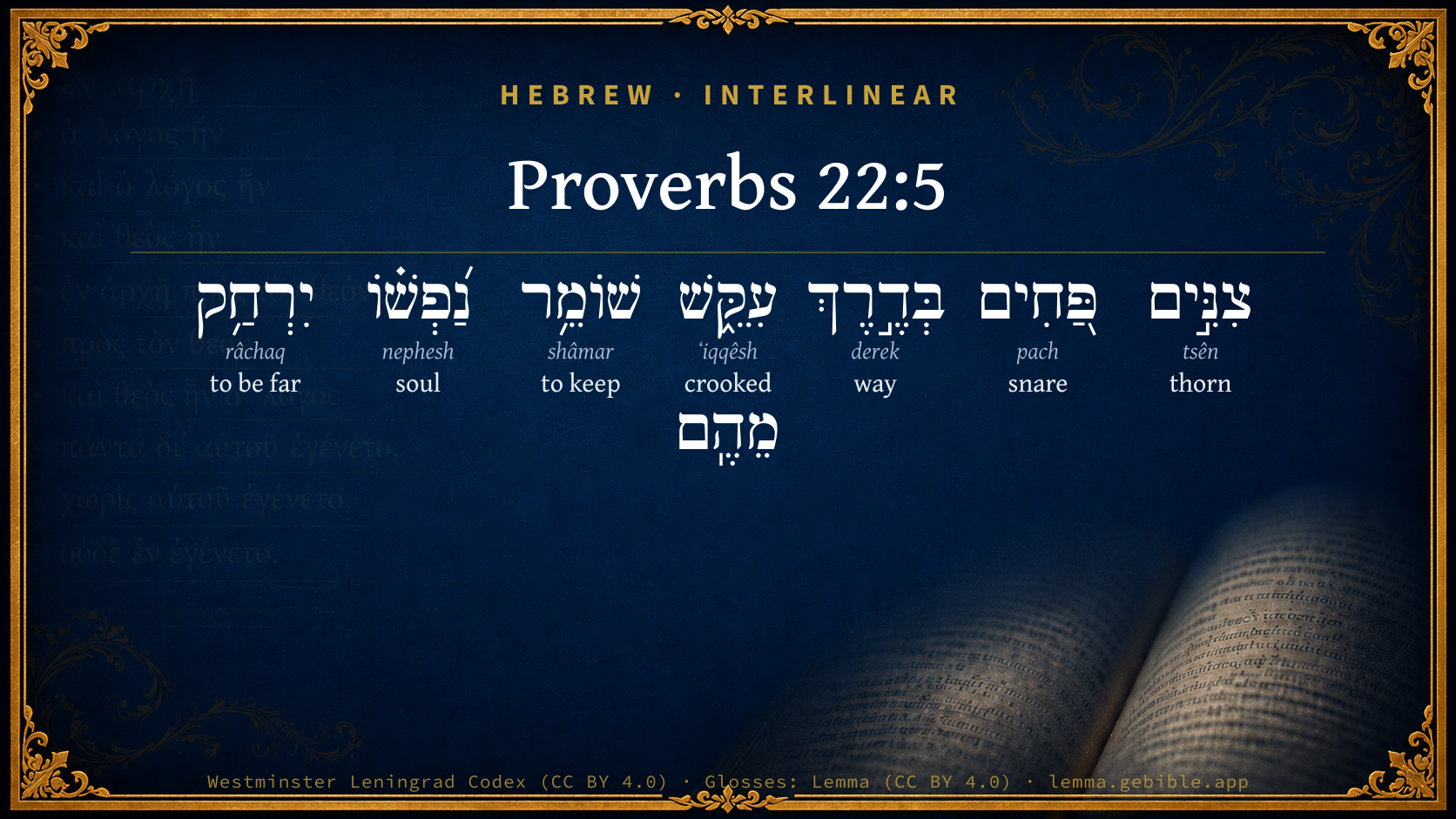
Hebrew (Westminster Leningrad Codex) Proverbs 22:5 appears in the Hebrew Old Testament. The text above is from the Westminster Leningrad Codex. Each word links to its Strong’s number, a concise gloss, and parsing drawn from the Open Scriptures Hebrew Bible morphology. Click any word for its full Brown-Driver-Briggs (BDB) entry.
Download image
Cite this verse

Proverbs 22:5 (World English Bible). Public Domain. Lemma interlinear Bible study tool, https://lemma.gebible.app/v/proverbs/22/5.

Show BibTeX & RIS
BibTeX
RIS
English Translation
Thorns and snares are in the path of the wicked: Whoever guards his soul stays from them.
World English Bible · Public Domain
Download a study sheet

One document with this verse’s original text, its word-by-word gloss line, the meaning frame, cross-references with their text, attributed commentary, and full source and license credits — printable, and it pastes into notes with its structure intact.

This verse Autodidact and up

Study sheet (.html) Plain text (.txt)

A passage Seminary Student

Up to 50 verses in one chapter. A passage sheet keeps up to 6 commentary sources and 12 cross-references per verse, in the order this page ranks them, and says so on the sheet whenever that leaves anything out. Ask for a single verse and you get the Autodidact verse sheet above.

Everything on this page stays free to read, with no account — the sheet is a download of what is already on screen, not access to it.

Want to remove ads? Support Godless Engineer
Compare translations 3

The same verse in 3 English versions, stacked beneath the original-language interlinear above. Click any original word for its lexicon entry.

Each is an independent rendering of the whole verse — the interlinear is not word-aligned to these translations.

Highlighted words mark where these versions differ — a whole-verse word diff, not a word-by-word alignment.

  • World English Bible Public Domain
    Thorns and snares are in the path of the wicked: Whoever guards his soul stays from them.
  • King James Version Public Domain
    Thorns and snares are in the way of the froward: he that doth keep his soul shall be far from them.
  • unfoldingWord Literal Text CC BY-SA 4.0
    Thorns, traps in the way of the crooked; one guarding his life will stay far away from them.

unfoldingWord Literal Text — © unfoldingWord, licensed CC BY-SA 4.0. Word-aligned USFM3 via Door43 (git.door43.org/unfoldingWord/en_ult).

Versions to compare (up to 4)

3 of 4 selected

Show all 18 translations

Every available English version of this verse, each an independent rendering of the whole verse.

  • World English Bible Public Domain
    Thorns and snares are in the path of the wicked: Whoever guards his soul stays from them.
  • Berean Standard Bible Public Domain
    Thorns and snares lie on the path of the perverse; he who guards his soul stays far from them.
  • Majority Standard Bible Public Domain
    Thorns and snares lie on the path of the perverse; he who guards his soul stays far from them.
  • King James Version Public Domain
    Thorns and snares are in the way of the froward: he that doth keep his soul shall be far from them.
  • American Standard Version (1901) Public Domain
    Thorns `and' snares are in the way of the perverse: He that keepeth his soul shall be far from them.
  • Revised Version (1885) Public Domain
    Thorns and snares are in the way of the froward: he that keepeth his soul shall be far from them.
  • Geneva Bible (1599) Public Domain
    Thornes and snares are in the way of the frowarde: but he that regardeth his soule, will depart farre from them.
  • Douay-Rheims (1899) Public Domain
    Arms and swords are in the way of the perverse: but he that keepeth his own soul departeth far from them.
  • Young's Literal Translation Public Domain
    Thorns -- snares `are' in the way of the perverse, Whoso is keeping his soul is far from them.
  • Literal Standard Version CC BY-SA 4.0
    Thorns [and] snares [are] in the way of the perverse, || Whoever is keeping his soul is far from them.
  • Unlocked Literal Bible CC BY-SA 4.0
    Thorns and snares lie in the path of the perverse; whoever guards his life will keep far from them.
  • unfoldingWord Literal Text CC BY-SA 4.0
    Thorns, traps in the way of the crooked; one guarding his life will stay far away from them.
  • Darby Bible Public Domain
    Thorns [and] snares are in the way of the perverse: he that keepeth his soul holdeth himself far from them.
  • World Messianic Bible Public Domain
    Thorns and snares are in the path of the wicked; whoever guards his soul stays far from them.
  • Webster's Bible Public Domain
    Thorns and snares are in the way of the froward: he that doth keep his soul shall be far from them.
  • Free Bible Version CC BY-SA 4.0
    Thorns and traps lie in the path of crooked people; those who value their lives will stay away from them.
  • Bible in Basic English Public Domain
    Thorns and nets are in the way of the twisted: he who keeps watch over his soul will be far from them.
  • JPS Tanakh (1917) Public Domain
    Thorns and snares are in the way of the froward; he that keepeth his soul holdeth himself far from them.

Literal Standard Version (2020), Covenant Press — licensed CC BY-SA 4.0. Text via the HelloAO Bible API (eBible.org). Unlocked Literal Bible (unfoldingWord) — licensed CC BY-SA 4.0. Text via the HelloAO Bible API (eBible.org). unfoldingWord Literal Text — © unfoldingWord, licensed CC BY-SA 4.0. Word-aligned USFM3 via Door43 (git.door43.org/unfoldingWord/en_ult). Free Bible Version, Dr. Jonathan Gallagher — licensed CC BY-SA 4.0. Text via the HelloAO Bible API (eBible.org).

Word by word

More ways to search: Search by grammar → Find every occurrence → Compare this word →

Practice this passage: Drill this verse → Learn its vocabulary →

About this verse

These counts appear in no published source. They are computed here, from the morphology-tagged text and Lemma’s own curated glosses. What Lemma adds →

8
words
7
distinct lemmas
Wisdom
section

Notable vocabulary

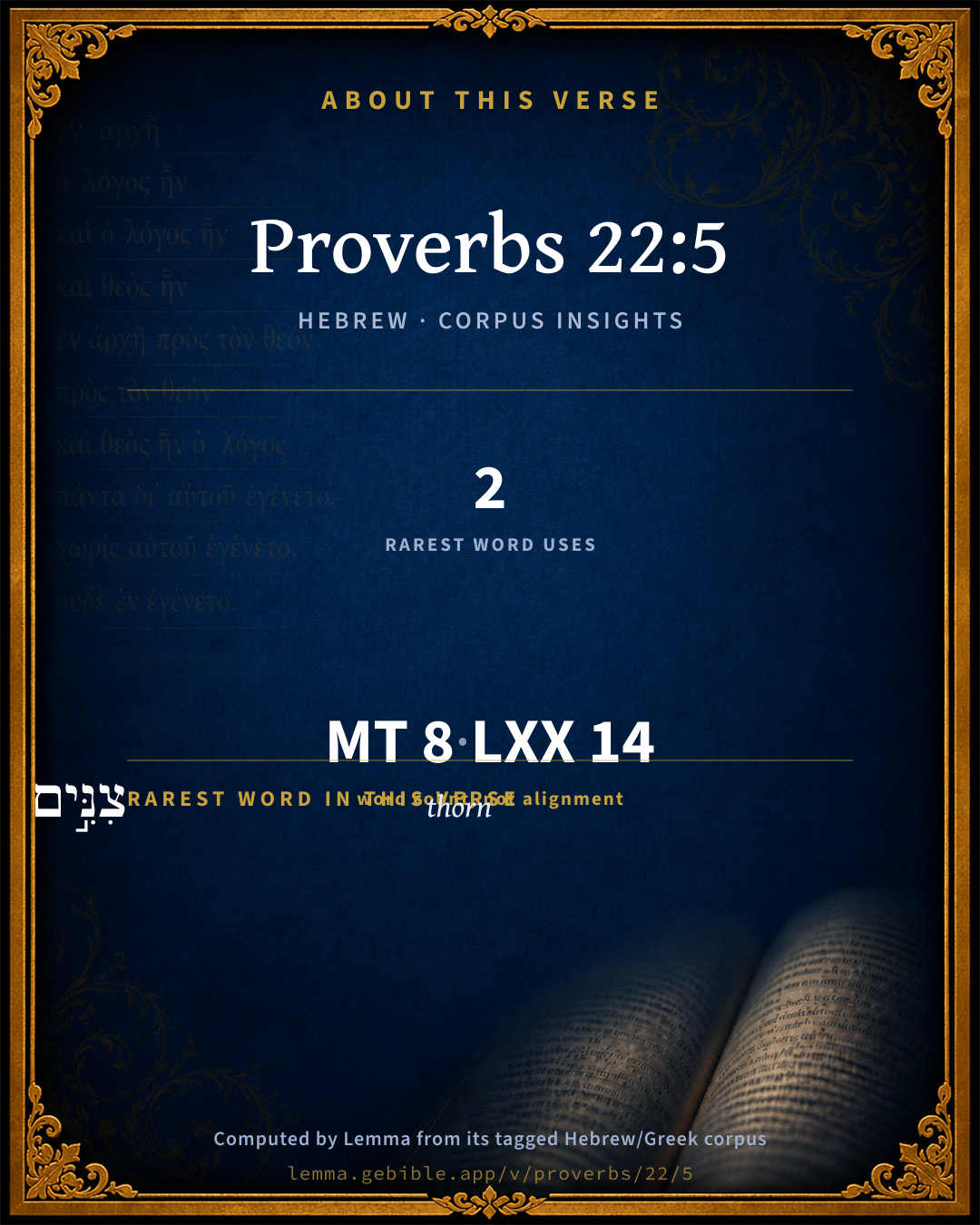
The rarest word here is צִנִּ֣ים thorn H6791 — appearing just 2 times in the whole Hebrew Bible.

Shared distinctive vocabulary

צִנִּ֣ים thorn H6791 occurs in 2 verses of the Hebrew Bible. Also found in:

Grammatical profile

  • 2 verbs
  • 4 nouns
  • 1 adjective
  • 1 preposition

Verb forms

  • שׁוֹמֵ֥ר Qal · Participle Active
  • יִרְחַ֥ק Qal · Imperfect

Hebrew & Septuagint length

In English translation the verse runs 17 words from the Hebrew and 17 from the Septuagint (LXX English) — the same length.

A rough comparison of the two English renderings, which tokenize alike — not a word-level alignment.

Word counts can differ between the Hebrew and the Greek without any difference in meaning — e.g. the Hebrew direct-object marker אֵת has no separate Greek word, and Greek often adds the article ὁ.

In the original languages it is 8 Hebrew tokens and 14 Greek tokens — but the two are counted differently (Hebrew bundles its prefixes and suffixes into one token; the Greek is in lemma form), so that isn’t a like-for-like length.

Cross-references

12

Topical passages linked to Proverbs 22:5 in the Treasury of Scripture Knowledge — connected by theme and wording, ordered by reader-vote popularity; previews shown in the World English Bible.

  • Proverbs 16:17 The highway of the upright is to depart from evil. He who keeps his way preserves his soul.
  • Proverbs 15:19 The way of the sluggard is like a thorn patch, But the path of the upright is a highway.
  • 1 John 5:18 We know that whoever is born of God doesn't sin, but he who was born of God keeps himself, and the evil one doesn't touch him.
  • Jude 1:20–21 But you, beloved, keep building up yourselves on your most holy faith, praying in the Holy Spirit.
  • Job 18:8 For he is cast into a net by his own feet, And he wanders into its mesh.
  • Proverbs 13:15 Good understanding wins favor; But the way of the unfaithful is hard.
  • Proverbs 19:16 He who keeps the commandment keeps his soul, But he who is contemptuous in his ways shall die.
  • Psalms 18:26–27 With the pure, you will show yourself pure. With the crooked you will show yourself shrewd.
  • Proverbs 13:3 He who guards his mouth guards his soul. One who opens wide his lips comes to ruin.
  • Joshua 23:13 know for a certainty that Yahweh your God will no more drive these nations from out of your sight; but they shall be a snare and a trap to you, and a scourge in your sides, and thorns in your eyes, until you perish from off this good land which Yahweh your God has given you.
  • Psalms 11:6 On the wicked he will rain blazing coals; Fire, sulfur, and scorching wind shall be the portion of their cup.
  • Psalms 91:1 He who dwells in the secret place of the Most High Will rest in the shadow of the Almighty.

Cross-references courtesy of OpenBible.info (CC BY 4.0).

Hebrew and Greek witnesses Masoretic Hebrew ↔ Greek Septuagint

The same verse in the two great witnesses to the Old Testament, shown verse-for-verse.

These are two independent witnesses, not word-aligned to each other, and the Septuagint is shown in lemma (dictionary) form.

Hebrew Proverbs 22:5 Masoretic · Westminster Leningrad Codex

צִנִּ֣ים פַּ֭חִים בְּדֶ֣רֶךְ עִקֵּ֑שׁ שׁוֹמֵ֥ר נַ֝פְשׁ֗וֹ יִרְחַ֥ק מֵהֶֽם

Thorns and snares are in the path of the wicked: Whoever guards his soul stays from them.

World English Bible · Public Domain

Greek LXX Proverbs 22:5 Septuagint · lemma form

τρίβολος καί παγίς ἐν ὁδός σκολιός ὁ δέ φυλάσσω ὁ ἑαυτοῦ ψυχή ἀποἔχω αὐτός

Thistles and snares are in perverse ways; but he that keeps his soul will refrain from them.

LXX2012 (modern English Septuagint) · Public Domain

On this verse, The Pulpit Commentary discusses the Septuagint’s reading. Read the note in Commentary ↓

Hebrew: Westminster Leningrad Codex (CC BY 4.0). Greek: Septuagint (public domain); English from LXX2012 (modern English Septuagint) (Public Domain). How the Septuagint differs from the Hebrew →

Commentary

Notes on Proverbs 22:5 from classic Christian and Jewish commentators (each source and its license shown beneath its notes). The classic Christian expositions comment on the surrounding passage and are grouped to its opening verse, so a note may address several verses; the Jewish commentaries on the Tanakh (Rashi and others) are per-verse, so they appear only where the commentator wrote on this verse.

Lemma curates 59 commentaries, every one of them public domain or Creative Commons licensed, each selected and text-cleaned for this edition rather than reprinted as found. About our sources →

Trapp's Complete Commentary

John Trapp

Pro 22:5 Thorns [and] snares [are] in the way of the froward: he that doth keep his soul shall be far from them.

Ver. 5. Thorns and snares are in the way of the froward.] In opposition to the reward of righteousness; {Pro 22:4} which is to say, "The ungodly are not so." Or if they have riches, they prove thorns to them to prick and choke their souls; if honour, and long life to enjoy it, these prove snares to them. Of carnal hearts it may be said, as Pharaoh said of the Israelites, "They are entangled in the land, the wilderness hath shut them in." {Exo 14:3} They have treasures in the field, of wheat, barley, and oil, as those ten men had, {Jer 41:8} and are therefore loath to die. And yet before they die - live they never so long in all abundance of riches and honours - God can bring them to that pass that Charles V was at, whom of all men the world judged most happy. Philip of Mornay reports of him that he cursed his honours in his old age, his victories, trophies, riches, saying, Abite hinc, abite longe: Away, away, get you far away.

He that doth keep his soul, shall be far from them.] As well from the wicked man’s miseries as his misdemeanours; he keeps aloof from both; he dares not meddle with the hole of the asp, lest he meet with a sting. Custos animae elongabit se, &c. Moneo te iterumque monebo, saith Lactantius to his Demetrian, ne oblectamenta ista terrae pro magnis aut veris bonis habere te credas: quae sunt non tantum fallacia quia dubia, verum etiam insidiosa quia dulcia. {a} Set not thine heart upon the asses, since thou art in election for a kingdom, and the hearts of all Israel are upon thee.

{a} Lactant., De Opificio Dei.

John Trapp, A Commentary or Exposition upon All the Books of the Old and New Testament (1647–1656) — public domain. Text from a community e-Sword module.

Joseph Benson's Commentary

Pro 22:5. Thorns and snares are in the way of the froward — The wicked, by their evil practices, expose themselves to many dangers, and occasions both of sin and mischief: he that keeps his soul — That takes heed to himself, and to his actions, and to the saving of his soul; shall be far from them — Will avoid the society of such froward persons; or rather, by that circumspection shall preserve himself from those thorns and snares to which the froward are exposed.

Joseph Benson's Commentary on the Old and New Testaments (1811–1818) — public domain. Text from a community e-Sword module.

Tyndale Open Study Notes

Tyndale Open Resources

22:5 Living by deceit is dangerous; corrupt people never know when their treachery will be discovered or backfire.

Tyndale Open Study Notes — © Tyndale Open Resources, licensed CC BY-SA 4.0. Text via the HelloAO Bible API.

Matthew Henry's Commentary

Note 1. The way of sin is vexatious and dangerous: In the way of the froward, that crooked way, which is contrary to the will and word of God, thorns and snares are found, thorns of grief for past sins and snares entangling them in further sin. He that makes no conscience of what he says and does will find himself hampered by that imaginary liberty, and tormented by his pleasures. Froward people, who are soon angry, expose themselves to trouble at every step. Every thing will fret and vex him that will fret and vex at every thing. 2. The way of duty is safe and easy: He that keeps his soul, that watches carefully over his own heart and ways, is far from those thorns and snares, for his way is both plain and pleasant.

Matthew Henry's Commentary on the Whole Bible (1708–1710) — public domain (CC PDM 1.0). Text via the HelloAO Bible API.

Jamieson, Fausset & Brown

Robert Jamieson, A. R. Fausset & David Brown

he that . . . them--Those who properly watch over their own souls are thus preserved from the dangers which attend the way of perverse men (Pro 16:17).

Jamieson, Fausset & Brown — Commentary Critical and Explanatory on the Whole Bible (1871) — public domain (CC PDM 1.0). Text via the HelloAO Bible API.

Adam Clarke's Commentary

Verse 5. Thorns and snares] Various difficulties, trials, and sufferings.

Adam Clarke's Commentary on the Bible (1810–1826) — public domain. Text from a community e-Sword/MySword module.

Ellicott's Commentary for English Readers

(5) Thorns.—Comp. note on Pro_15:19.

A Bible Commentary for English Readers, edited by Charles John Ellicott (1878–1897) — public domain. Text from a community e-Sword module.

John Gill's Exposition

Thorns and snares are in the way of the froward,.... Who walks contrary to the will and law of God; such a man meets with troubles, which are as thorns, grieving and distressing to him; and is taken in snares, and brought into difficulties, out of which he is not easily extricated; the thorns of affliction, and the snares of Satan: by the one his way is hedged up, and in the other his feet are taken;

he that doth keep his soul shall be far from them; he that is concerned for the good of his soul, is careful for the welfare of that, and takes heed to his ways where and how he walks, will be far both from the way of the froward, and from the thorns and snares which are in his way.

John Gill's Exposition of the Whole Bible (1746–1763) — public domain (CC PDM 1.0). Text via the HelloAO Bible API.

Haydock's Catholic Bible Commentary

Perverse. They are always in danger and in trouble.

George Leo Haydock (1774–1849), Haydock's Catholic Family Bible and Commentary, 1859 edition — public domain. Excludes Psalms (Douay-Rheims chapter numbering differs from Protestant) and Deuterocanonical books (Catholic canon only).

Matthew Poole's English Annotations

Thorns and snares are in the way of the froward; the wicked by their evil courses expose themselves to many dangers and occasions both of sin and mischief.

He that doth keep his soul, that taketh heed to himself, and to his actions, and to the saving of his life and soul,

shall be far from them; either,

1. Will avoid the society of such froward persons. Or,

2. Shall by that circumspection preserve himself from those thorns, &c., with which the pronoun them agrees in number.

Matthew Poole's English Annotations on the Holy Bible (1683–1685) — public domain. Text from a community e-Sword/MySword module.

Whedon's Commentary on the Bible

Daniel D. Whedon

5. Thorns and snares, etc. — There is no conjunction here again. “Thorns” denote the various difficulties, dangers, and sufferings to which the froward, or utterly perverse, are continually exposed, as “snares,” or nets, do the entanglements into which they run.

Keep his soul — That suitably regards his soul or life.

Shall be far from them — Will keep himself far away from such associations.

Daniel D. Whedon (gen. ed.), Commentary on the Old and New Testaments (1874–1909) — public domain. Text from a community e-Sword module.

The Pulpit Commentary

Thorns and snares are in the way of the froward. The words are in the Hebrew without the conjunction (see note, ver. 4), though the versions generally add it. Thus the Septuagint, triboloi kai pagidev ; Vulgate, arma et gladiii but the Venetian, akanyai pagidev . It is a question whether the thorns are what the perverse prepare for others, or what they themselves suffer. In Pro_15:19 the hedge of thorns represented the difficulties in the sluggard"s path; but here, viewed in connection with the following hemistich, the thorns and snares refer to the hindrances proceeding from the froward, which injuriously affect others; "thorns" being a figure of the pains and troubles, "snares" of the unexpected dangers and impediments which evil men cause as they go on their crooked way. The word for "thorns" is which occurs in Job_5:5. The plant is supposed to be the Rhamnus paliurus, but it has not been accurately identified. He that doth keep his soul shall be far from them. (comp. Pro_13:3 Pro_16:17) The man who has regard to his life and morals will go far, will keep wholly aloof, from those perils and traps into which the perverse try to entice them.

The path of the perverse.

By "the froward" we understand the spiritually perverse those that will go on their own way, deaf to the commandments and the entreaties of their heavenly Father.

I THE PATH OF THE PERVERSE, This is:

1. One of guilt. These froward souls who choose their own way, declining that to which God calls them, are most seriously guilty. Whether their disobedience be due to careless inattention or whether to deliberate recusancy, it is disloyal, ungrateful, presumptuous, offensive in a high degree. It is no wonder that it proves to be:

2. One of suffering. No wonder that "thorns" are in that way, thorns that pierce and pain grievous troubles, poverty, sickness, loneliness, fear, remorse, forsakenness of God. Departure from God leads down to tangled places, causes men to be lost in thorny wildernesses where suffering abounds. It is also:

3. One of danger. It is a place of "snares." Without the "lamp unto the feet and the light unto the path," how should the traveller in "this dark world of sin" do otherwise than fall? Outside the service of Christ, and apart from his guidance, when the heart is uncontrolled from above, there is the greatest danger of the spirit giving way to one evil after another, of yielding to that multitude of strong temptations which attend the traveller"s steps.

II THE WAY OF THE WISE. There is no necessity for man finding the path of his life a path full of thorns and snares. It is true that no prudence or wisdom will prove an absolute guard therefrom; but if a man will "keep his soul" as he may keep it, he will be preserved in his integrity, he will even "be far" from the worst evils which overtake the froward and perverse. To "keep our soul" is to:

1. Understand its inestimable worth; to understand that it far transcends in value any property we may hold, or any position we may reach, or any prizes or pleasures we may snatch.

2. Realize that God claims it as his own; that to the Father of spirits, to the Saviour of souls, our hearts and lives belong; that to him they should he willingly and heartily surrendered, that they may be placed in his strong and holy keeping.

3. Guard it by the help of Divine wisdom; apply those precious truths which are in the pages of God"s Word to its necessity; study the life and form the friendship of that One who himself is the Wisdom of God, walking with whom along the path of life we shall be safe from the wiles of the wicked one. C.

The Pulpit Commentary (1880–1919), ed. H.D.M. Spence-Jones & Joseph S. Exell — public domain. Text from a community e-Sword module.

Keil & Delitzsch

C. F. Keil & F. Delitzsch

5 Thorns, snares, are on the way of the crooked;

He that guardeth his soul, let him keep far from them.

Rightly the Venet. ἄκανθαι παγίδες ἐν ὁδῷ στρεβλοῦ. The meaning of צנּים (plur. of צן, or צנּה, the same as צנינים) and פּחים (from פּח, Arab. faḥ), stands fast, though it be not etymologically verified; the placing together of these two words (the lxx obliterating the asyndeton: τρίβολος καὶ παγίδες) follows the scheme שׁמשׁ ירח, Hab 3:11. The עקּשׁ־לב (perverse of heart, crooked, Pro 17:20; Pro 11:20) drives his crooked winding way, corresponding to his habit of mind, which is the contrast and the perversion of that which is just, a way in which there are thorns which entangle and wound those who enter thereon, snares which unexpectedly bring them down and hold them fast as prisoners; the hedge of thorns, Pro 15:19, was a figure of the hindrances in the way of the wicked themselves. The thorn and snares here are a figure of the hindrances and dangers which go forth from the deceitful and the false in the way of others, of those who keep their souls, i.e., who outwardly and morally take heed to their life (Pro 16:17; Pro 13:3, pred. here subj.), who will keep, or are disposed to keep, themselves from these thorns, these snares into which the deceitful and perverse-hearted seek to entice them.

Keil & Delitzsch — Biblical Commentary on the Old Testament (1861–1891) — public domain (CC PDM 1.0). Text via the HelloAO Bible API. (Old Testament only.)

Bridges on Proverbs

Charles Bridges

A forcible image to shew, that nothing stands so much in a man’s way, as the indulgence of his own unbridled will. The man, who is most perversely bent on his purposes, is most likely to be thwarted in them. ’He thinks to carry all before him; whereas his frowardness makes thorns and snares for his way.†1 He is a man on all sides encompassed with thorns and snares. His stubbornness brings him into infinite perplexities, out of which he can find no issue.’†2 Sarah,†3 Jacob,†4 Balaam,†5 found the way of the froward full of hindrance and entanglement. A special mercy is it, when the thorns embitter the way, and bring the froward sinner as an humbled child, asking and seeking the road to his Father’s house. (Luk 15:12-20 .) If there be difficulties in the ways of God, are there none in the ways of sin? A fair balance would prove, which yoke, which burden, is the more "easy and light." The sting of conscience; the rebukes of Providence; the disappointment of cherished desires, the tyranny of lust — all tend to make "the way of transgressors to be hard." (Pro 13:15 .) Nay — not the world only, but even the holy Gospel, is made a snare in the way of the froward. Such are "the depths and devices of Satan"†6 that they "turn the grace of God into lasciviousness," and the occasion or excuse of sin.†7

Our happiness and security therefore lie in an humble submission to the Lord; desiring nothing so much as conformity to his will; dreading nothing so much as being left to our own waywardness. Thus keeping our soul, we shall be far from the thorn and snare of the froward; we shall "make straight" and safe, if not smooth, "paths for our feet," and "all our ways shall be established."†8 "He that is begotten of God keepeth himself, and that wicked one toucheth him not." (1Jn 5:18 .)

Footnotes:

†1 Jer 23:12-13. Jdg 2:2-3 .

†2 Bp. Hall.

†3 Gen 12:10, Gen 12:20 ; Gen 16:1-6 ; Gen 20:2-14 .

†4 Gen 27:1-46

†5 Num 22:22-32.

†6 Rev 2:24; 2Co 2:11 ; 2Co 11:14 .

†7 Rom 3:8; Rom 6:1 . Jud 1:4 .

†8 Heb 12:13. Pro 4:26 .

Charles Bridges, An Exposition of the Book of Proverbs (1846) — public domain. Text from a community e-Sword module.

Kretzmann's Popular Commentary

Paul E. Kretzmann

v. 5. Thorns and snares are in the way of the froward, they are often placed in the way of those who are crooked in their thinking and dealing, or they are naturally found along the paths frequented by them; he that doth keep his soul, in conducting himself according to the precepts of true morality and piety, shall be far from them, he will have no such things to hinder him in his way.

Paul E. Kretzmann, Popular Commentary of the Bible (1921–1924) — public domain. Text from a community e-Sword module.

unfoldingWord translationNotes

Door43 World Missions Community

Thorns and snares lie in the path of the perverse

The writer speaks of the way perverse people live as if it were a path on which the perverse will have trouble because of the natural "thorns" and man-made "snares." (See: Metaphor)

snares

traps to catch animals

the perverse

This nominal adjective can be translated as a noun phrase. AT: "perverse people" (See: Nominal Adjectives)

whoever guards his life

A person doing what he needs to do so he can live a long time is spoken of as if that person were keeping thieves away from a physical object. AT: "people who want to live a long time" (See: Metaphor)

the way he should go

How a person lives is spoken of as if it were a path on which he walks. AT: "how he should live" (See: Metaphor)

translationWords

thorn

perverse

teach

children

turn

unfoldingWord translationNotes — © Distant Shores Media and the Door43 World Missions Community, licensed CC BY-SA 4.0. Source: git.door43.org/Door43/en_tn.

Rashi

Rabbi Shlomo Yitzchaki (Rashi)

Troops [and] snares Heb. צנים, as in (Num. 33:55) “troops (לצנינים) in your sides”; (Ezek. 23: 24) “And they will come upon you, a band (הצן),” an expression of bands and brigands.

Troops and snares are hidden on the ways of the one who perverts his ways; i.e., torments are prepared for him.

he who preserves his soul will distance himself from them He who is upright in his deeds will be saved from them.

Rashi on the Tanakh — English translations: “The Judaica Press complete Tanach with Rashi, translated by A. J. Rosenberg” (CC BY 4.0); “Pentateuch with Rashi's commentary by M. Rosenbaum and A.M. Silbermann, 1929-1934” (public domain); “The Metsudah Tanach series, Lakewood, N.J” (CC BY 4.0); and “The Book of Joshua, Metsudah Publications, 1997” (CC BY 4.0). Text via Sefaria.

Lesson kit

Teaching starters — assembled from the data on this page, not authored interpretation. Every prompt links to the verse data it draws on. Edit before teaching.

Proverbs, in the Wisdom, opens this verse with 8 words (7 distinct Hebrew lemmas). Its most distinctive word is tsên (“thorn”). A historical commentator’s framing appears above. Read the whole chapter for the surrounding context.

Discussion questions

  1. How does “thorn” (tsên) shape what this verse is saying?
  2. Job 5:5 shares the word «thorn» with this verse. How do the two illuminate each other?
  3. The translations on this page render this verse differently — a whole-verse word diff, not a word-by-word alignment. What might account for the different wordings?
  4. The verb «שׁוֹמֵ֥ר» is Qal Participle Active. How does its form color the action?
  5. Reading how Trapp's Complete Commentary and Joseph Benson's Commentary read this verse, where do the two commentators agree and where do they part?

Things to notice

Reading settings

Reading text

Shown beneath each verse's original-language words.

Old Testament
Old Testament edition

Read the OT as the Masoretic Hebrew (MT) or the Greek Septuagint (LXX).

English shown for the Greek Septuagint (in the Hebrew ↔ Greek comparison).

Comparing translations? Open the Compare panel on any verse page to stack up to four side by side.