
Proverbs 16:17

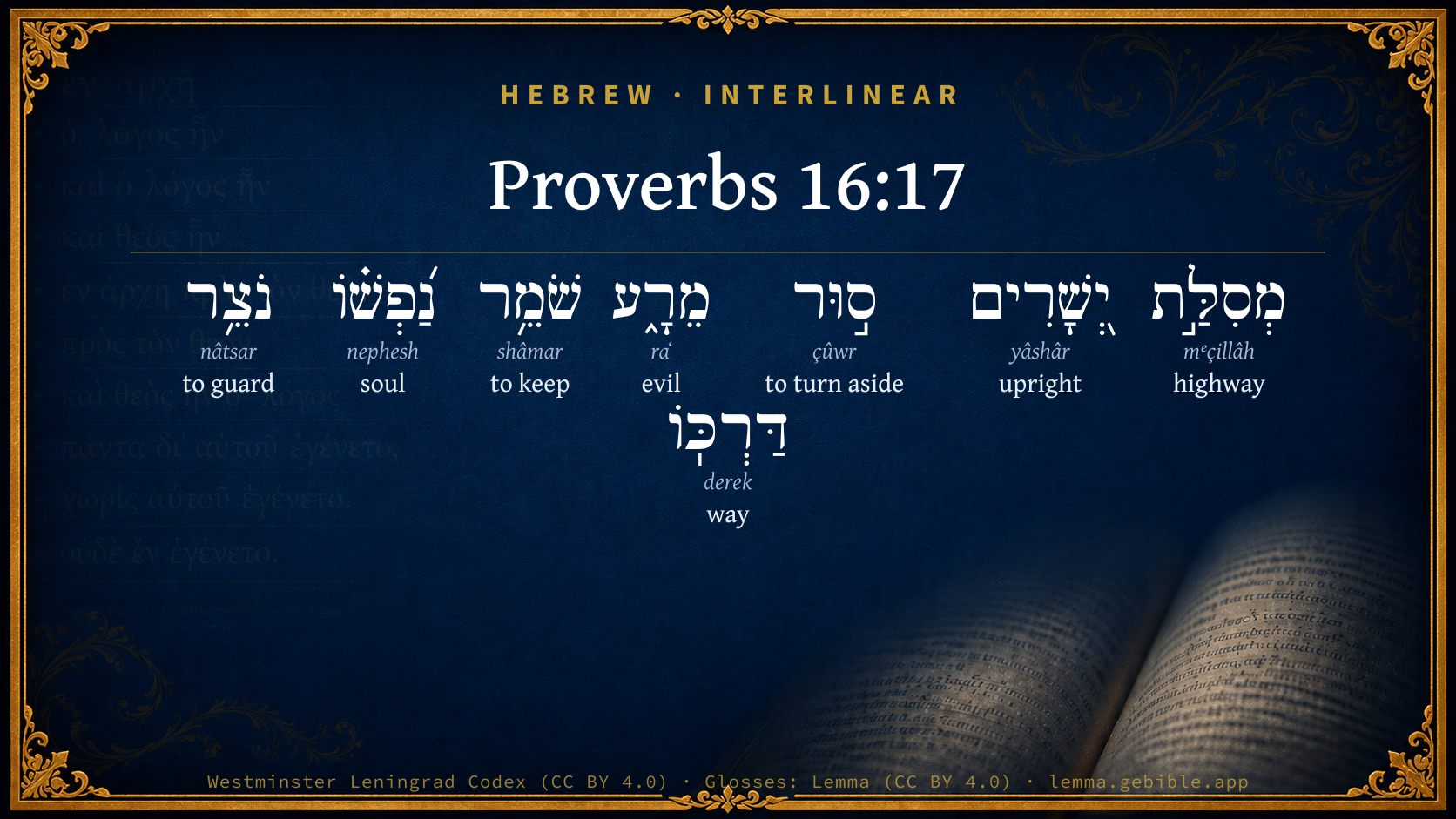
Hebrew (Westminster Leningrad Codex) Proverbs 16:17 appears in the Hebrew Old Testament. The text above is from the Westminster Leningrad Codex. Each word links to its Strong’s number, a concise gloss, and parsing drawn from the Open Scriptures Hebrew Bible morphology. Click any word for its full Brown-Driver-Briggs (BDB) entry.
Download image
Cite this verse

Proverbs 16:17 (World English Bible). Public Domain. Lemma interlinear Bible study tool, https://lemma.gebible.app/v/proverbs/16/17.

Show BibTeX & RIS
BibTeX
RIS
English Translation
The highway of the upright is to depart from evil. He who keeps his way preserves his soul.
World English Bible · Public Domain
Download a study sheet

One document with this verse’s original text, its word-by-word gloss line, the meaning frame, cross-references with their text, attributed commentary, and full source and license credits — printable, and it pastes into notes with its structure intact.

This verse Autodidact and up

Study sheet (.html) Plain text (.txt)

A passage Seminary Student

Up to 50 verses in one chapter. A passage sheet keeps up to 6 commentary sources and 12 cross-references per verse, in the order this page ranks them, and says so on the sheet whenever that leaves anything out. Ask for a single verse and you get the Autodidact verse sheet above.

Everything on this page stays free to read, with no account — the sheet is a download of what is already on screen, not access to it.

Want to remove ads? Support Godless Engineer
Compare translations 3

The same verse in 3 English versions, stacked beneath the original-language interlinear above. Click any original word for its lexicon entry.

Each is an independent rendering of the whole verse — the interlinear is not word-aligned to these translations.

Highlighted words mark where these versions differ — a whole-verse word diff, not a word-by-word alignment.

  • World English Bible Public Domain
    The highway of the upright is to depart from evil. He who keeps his way preserves his soul.
  • King James Version Public Domain
    The highway of the upright is to depart from evil: he that keepeth his way preserveth his soul.
  • unfoldingWord Literal Text CC BY-SA 4.0
    The highway of the upright ones turns away from evil; one who protects his life guards his way.

unfoldingWord Literal Text — © unfoldingWord, licensed CC BY-SA 4.0. Word-aligned USFM3 via Door43 (git.door43.org/unfoldingWord/en_ult).

Versions to compare (up to 4)

3 of 4 selected

Show all 18 translations

Every available English version of this verse, each an independent rendering of the whole verse.

  • World English Bible Public Domain
    The highway of the upright is to depart from evil. He who keeps his way preserves his soul.
  • Berean Standard Bible Public Domain
    The highway of the upright leads away from evil; he who guards his way protects his life.
  • Majority Standard Bible Public Domain
    The highway of the upright leads away from evil; he who guards his way protects his life.
  • King James Version Public Domain
    The highway of the upright is to depart from evil: he that keepeth his way preserveth his soul.
  • American Standard Version (1901) Public Domain
    The highway of the upright is to depart from evil: He that keepeth his way preserveth his soul.
  • Revised Version (1885) Public Domain
    The highway of the upright is to depart from evil: he that keepeth his way preserveth his soul.
  • Geneva Bible (1599) Public Domain
    The pathe of the righteous is to decline from euil, and hee keepeth his soule, that keepeth his way.
  • Douay-Rheims (1899) Public Domain
    The path of the just departeth from evils: he that keepeth his soul keepeth his way.
  • Young's Literal Translation Public Domain
    A highway of the upright `is', `Turn from evil,' Whoso is preserving his soul is watching his way.
  • Literal Standard Version CC BY-SA 4.0
    A highway of the upright [is] to turn from evil, || Whoever is preserving his soul is watching his way.
  • Unlocked Literal Bible CC BY-SA 4.0
    The highway of upright people turns away from evil; the one who protects his life guards his way.
  • unfoldingWord Literal Text CC BY-SA 4.0
    The highway of the upright ones turns away from evil; one who protects his life guards his way.
  • Darby Bible Public Domain
    The highway of the upright is to depart from evil: he that taketh heed to his way keepeth his soul.
  • World Messianic Bible Public Domain
    The highway of the upright is to depart from evil. He who keeps his way preserves his soul.
  • Webster's Bible Public Domain
    The highway of the upright is to depart from evil: he that keepeth his way preserveth his soul.
  • Free Bible Version CC BY-SA 4.0
    The highway of the good leads away from evil. If you watch where you're going you'll save your life.
  • Bible in Basic English Public Domain
    The highway of the upright is to be turned away from evil: he who takes care of his way will keep his soul.
  • JPS Tanakh (1917) Public Domain
    The highway of the upright is to depart from evil; he that keepeth his way preserveth his soul.

Literal Standard Version (2020), Covenant Press — licensed CC BY-SA 4.0. Text via the HelloAO Bible API (eBible.org). Unlocked Literal Bible (unfoldingWord) — licensed CC BY-SA 4.0. Text via the HelloAO Bible API (eBible.org). unfoldingWord Literal Text — © unfoldingWord, licensed CC BY-SA 4.0. Word-aligned USFM3 via Door43 (git.door43.org/unfoldingWord/en_ult). Free Bible Version, Dr. Jonathan Gallagher — licensed CC BY-SA 4.0. Text via the HelloAO Bible API (eBible.org).

Word by word

More ways to search: Search by grammar → Find every occurrence → Compare this word →

Practice this passage: Drill this verse → Learn its vocabulary →

About this verse

These counts appear in no published source. They are computed here, from the morphology-tagged text and Lemma’s own curated glosses. What Lemma adds →

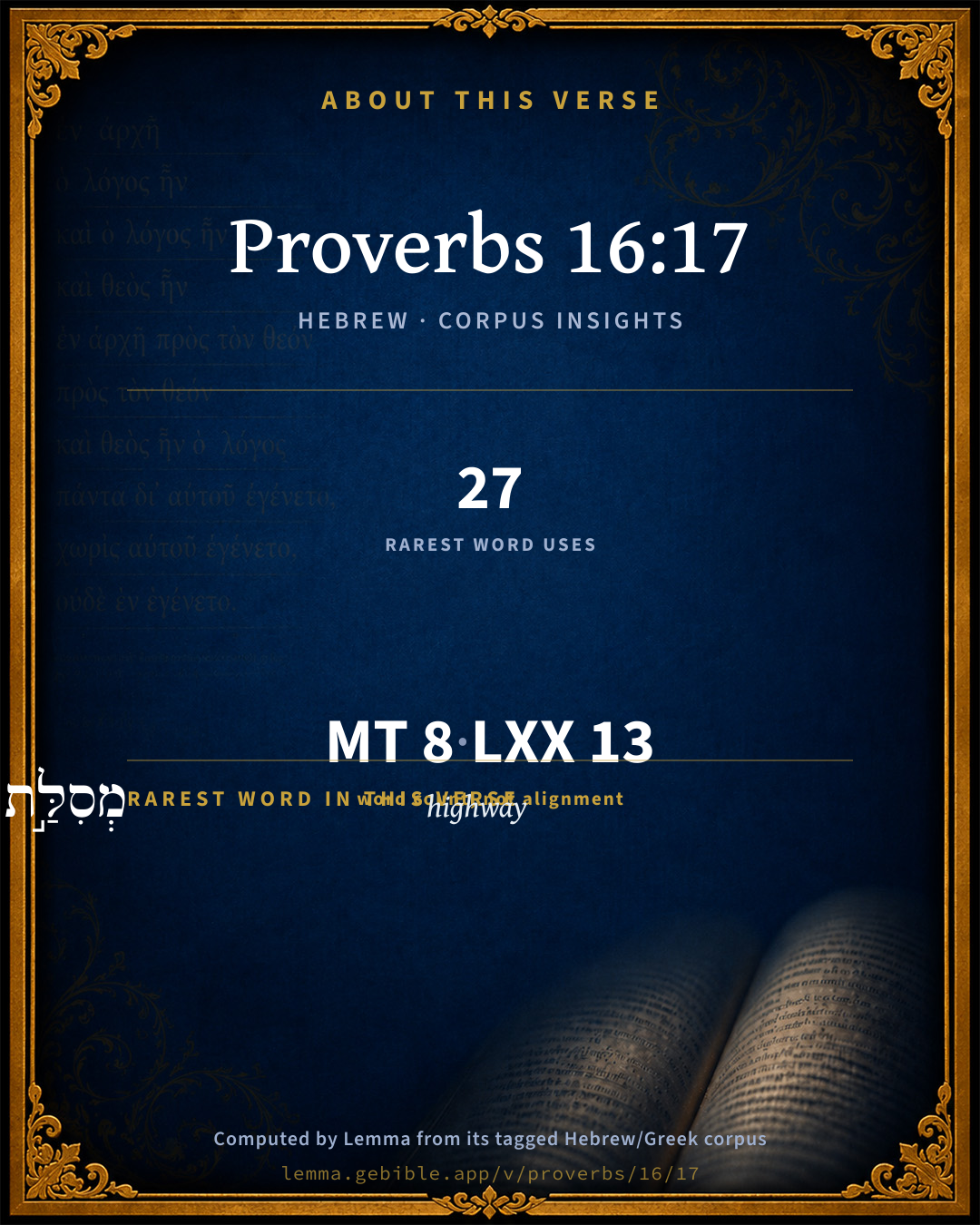
8
words
8
distinct lemmas
Wisdom
section

Shared distinctive vocabulary

מְסִלַּ֣ת highway H4546 occurs in 26 verses of the Hebrew Bible. Also found in:

Grammatical profile

  • 3 verbs
  • 3 nouns
  • 2 adjectives

Verb forms

  • ס֣וּר Qal · Infinitive Construct
  • שֹׁמֵ֥ר Qal · Participle Active
  • נֹצֵ֥ר Qal · Participle Active

Hebrew & Septuagint length

In English translation the verse runs 18 words from the Hebrew and 53 from the Septuagint (LXX English) — the Septuagint runs noticeably longer here. See the side-by-side →

A rough comparison of the two English renderings, which tokenize alike — not a word-level alignment.

Word counts can differ between the Hebrew and the Greek without any difference in meaning — e.g. the Hebrew direct-object marker אֵת has no separate Greek word, and Greek often adds the article ὁ.

In the original languages it is 8 Hebrew tokens and 13 Greek tokens — but the two are counted differently (Hebrew bundles its prefixes and suffixes into one token; the Greek is in lemma form), so that isn’t a like-for-like length.

Cross-references

12

Topical passages linked to Proverbs 16:17 in the Treasury of Scripture Knowledge — connected by theme and wording, ordered by reader-vote popularity; previews shown in the World English Bible.

  • Isaiah 35:8 A highway shall be there, and a way, and it shall be called The way of holiness. The unclean shall not pass over it, but is shall be for for him who walks in the Way. Wicked fools will not go there.
  • Proverbs 10:9 He who walks blamelessly walks surely, But he who perverts his ways will be found out.
  • Proverbs 19:16 He who keeps the commandment keeps his soul, But he who is contemptuous in his ways shall die.
  • Proverbs 4:24–27 Put away from yourself a perverse mouth. Put corrupt lips far from you.
  • Titus 2:10–14 not stealing, but showing all good fidelity; that they may adorn the doctrine of God, our Savior, in all things.
  • Jude 1:21 Keep yourselves in the love of God, looking for the mercy of our Lord Jesus Christ to eternal life.
  • Revelation 3:10 Because you kept my command to endure, I also will keep you from the hour of testing, which is to come on the whole world, to test those who dwell on the earth.
  • Matthew 24:13 But he who endures to the end, the same will be saved.
  • Acts 10:35 but in every nation he who fears him and works righteousness is acceptable to him.
  • Acts 24:16 Herein I also practice always having a conscience void of offense toward God and men.
  • Hebrews 10:39 But we are not of those who shrink back to destruction, but of those who have faith to the saving of the soul.
  • Jude 1:24 Now to him who is able to keep them from stumbling, and to present you faultless before the presence of his glory in great joy,

Cross-references courtesy of OpenBible.info (CC BY 4.0).

Hebrew and Greek witnesses Masoretic Hebrew ↔ Greek Septuagint

The same verse in the two great witnesses to the Old Testament, shown verse-for-verse.

Here the Septuagint runs noticeably longer than the Hebrew — LXX2012 (modern English Septuagint) 53 words vs World English Bible 18. A rough length comparison of the two English translations, not a word-level alignment — read both below.

These are two independent witnesses, not word-aligned to each other, and the Septuagint is shown in lemma (dictionary) form.

Hebrew Proverbs 16:17 Masoretic · Westminster Leningrad Codex

מְסִלַּ֣ת יְ֭שָׁרִים ס֣וּר מֵרָ֑ע שֹׁמֵ֥ר נַ֝פְשׁ֗וֹ נֹצֵ֥ר דַּרְכּֽוֹ

The highway of the upright is to depart from evil. He who keeps his way preserves his soul.

World English Bible · Public Domain

Greek LXX Proverbs 16:17 Septuagint · lemma form

ὁ σοφός καί συνετός φαῦλος καλέω ὁ δέ γλυκύς ἐν λόγος πολύς ἀκούω

The paths of life turn aside from evil; and the ways of righteousness are length of life. He that receives instruction shall be in prosperity; and he that regards reproofs shall be made wise. He that keeps his ways, preserves his own soul; and he that loves his life will spare his mouth.

LXX2012 (modern English Septuagint) · Public Domain

On this verse, The Cambridge Bible for Schools and Colleges discusses the Septuagint’s reading. Read the note in Commentary ↓

Hebrew: Westminster Leningrad Codex (CC BY 4.0). Greek: Septuagint (public domain); English from LXX2012 (modern English Septuagint) (Public Domain). How the Septuagint differs from the Hebrew →

Commentary

Notes on Proverbs 16:17 from classic Christian and Jewish commentators (each source and its license shown beneath its notes). The classic Christian expositions comment on the surrounding passage and are grouped to its opening verse, so a note may address several verses; the Jewish commentaries on the Tanakh (Rashi and others) are per-verse, so they appear only where the commentator wrote on this verse.

Lemma curates 59 commentaries, every one of them public domain or Creative Commons licensed, each selected and text-cleaned for this edition rather than reprinted as found. About our sources →

Trapp's Complete Commentary

John Trapp

Pro 16:17 The highway of the upright [is] to depart from evil: he that keepeth his way preserveth his soul.

Ver 17. The highway of the upright is to depart from evil.] That is his road, his desire and endeavour, his general purpose, though sometimes (by mistake, or violence of temptation), he step out of the way, and turn aside to sin, yet there is no "way of wickedness" {Psa 139:24} in him. His endeavour is, with Paul, to walk in all good conscience, to shape his course by the chart of God’s Word, to shun sin as a serpent in his way, as poison in his meats.

He that keepeth his way, preserveth his soul.] As, if a man be out of God’s precincts, he is out of his protection. "He shall keep thee in all thy ways," {Psa 91:11} not in all thine out strays. He that leaves the highway, and takes to byways, travelling at unseasonable hours, &c., if he fall into foul hands, he may go look his remedy; the law allows him none.

John Trapp, A Commentary or Exposition upon All the Books of the Old and New Testament (1647–1656) — public domain. Text from a community e-Sword module.

The Biblical Illustrator

Joseph S. Exell

Pro_16:17

The highway of the upright is to depart from evil.

Departing from evil

In this text is--

I. The upright. Those who are bent on doing the will of God. Those who keep the commandments of their Maker. Those who endeavour, by Gods grace, so to live as to be justified, and pardoned and acquitted in the clay of judgment.

II. The highway, By this is meant the general course, the mode of living, the habitual practice, the constant endeavour, all the thoughts and words and actions of the man at all times. The way, the royal road, the highway of his life.

III. The term depart. It does not say, The highway of the upright is not to do evil--that is true; but it does not say so here. The text is depart from evil, go from it; give it his back; walk off and leave it behind; shun it as an adder; avoid it as a scorpion; flee from it as a serpent.

IV. Evil. Need not concern ourselves with the origin of evil. We have enough to do with the thing as it is. We find its presence everywhere. The two principles, good and evil, must live as long as the world lasts; and live constantly at variance, constantly fighting against one another, constantly overcoming one another. It is ours to avoid the one and cleave to the other--that is our wisest course; that is our plainest duty. All the actions of life must be either good or evil. There is, and there can be, no neutrality in them. The degree of goodness or badness may be great or small, but the one or the other they must be. We are speaking of moral evil. There is what is called natural evil, i.e., evil belonging to the material and physical world around us. But what is it that makes one thing or action good and another evil? Who is it that pronounces on the quality of actions? Where is the rule by which we are to determine what is right or wrong? It is the will of that Being who gives us the power by which all we do is done--that will makes things right or wrong. It is the manifestation of that will in the Bible; therefore the Bible contains the rule, the law, by which all our actions are to be judged and determined. It is there we must find what is right and what is wrong. We may divide evil into two branches--

1. Actions that are wrong in themselves.

2. Actions that are wrong only on account of their effects.

Thus far we have spoken of actions individually considered. But God has created other men and women beside ourselves, and placed them and us to dwell on the face of the earth together. They bear certain relations to us, and we to them. These relations give rise to certain common interests; and these interests, again, to certain laws and regulations by which they are sustained and guarded. These laws must be consulted in all public acts, and the breach of one of these laws on the part of a member of the community is an evil. These remarks apply to men as members of families and of communities, as citizens of towns and cities, as subjects of countries and kingdoms, as fellows of all men besides. A public act is an evil if it bring more evil than good to the community as a whole, and as a community, therefore, you ought to condemn and prevent an act which brings more evil than good into your midst. (Maxwell M. Ben Oliel.)

The Biblical Illustrator, edited by Joseph S. Exell (c. 1880s–1900s) — public domain. Text from a community e-Sword module.

The Preacher's Complete Homiletical Commentary

Joseph S. Exell (gen. ed.)

MAIN HOMILETICS OF Pro_16:17

SOUL-PRESERVATION

I. The main object of an upright man’s care—his soul. Every human creature is possessed of an instinct to preserve his bodily life and well-being. An upright man has also a spiritual instinct which leads him to guard carefully his spiritual life—his soul. He is desirous of keeping a conscience purged from dead works—free from bruise or moral taint.

1. He seeks to preserve his soul because of the value he places upon its powers. We are wont to value material things according to the power they possess to fulfil certain ends. A skilful workman values a piece of mechanism in proportion to the complicated and various movements which it can execute. And in proportion to the value set upon it will be the care taken to preserve it. Human life is valued according to its abilities to do things which cannot be done by many. The life of a great statesman, of a skilful physician, is of more value to the race than the lives of a hundred ordinary men, because their power to minister to the welfare and health of their fellow-creatures so far surpasses the power of ordinary men. And the upright man values his soul because of its mighty and almost infinite capabilities and powers. In its present undeveloped condition it can suffer much and can enjoy much, it can become a partaker of the “Divine nature” (2Pe_1:4.), and he knows that its powers will be mightily increased and multiplied after the death of the body.

2. He seeks to preserve it because of the value God sets upon it. If we come into possession of a precious gem and desire to know its value, we take it to one whom we are certain is qualified to judge in such matters, and our estimate of it is increased or lessened in proportion to his opinion. He who wants to know the value of his soul must go to the only Being in the universe who is certain not to err in the price he sets upon it. Jesus Christ Himself has given to men His estimate of the worth of the human soul, both in His word and in His deeds. He who is fully acquainted with all its powers and possibilities for good and evil—of suffering and of joy—has said, “What shall it profit a man if he gain the whole world and lose his own soul, or what shall a man give in exchange for his soul?” (Mat_16:26). And He has gone beyond words. To save men’s souls He, “being in the form of God, took upon Him the form of a servant, and was made in the likeness of men, and being found in fashion as a man, humbled Himself and became obedient unto death, even the death of the cross” (Php_2:6). The wise man values his soul according to the estimate of Gethsemane and Calvary, and therefore he counts it the chief business of his life to guard it.

II. There can be no preservation of the soul except by departure from evil. The human nature of even the best men in this world is duplex. The ruling power in a godly man is good, but there are also evil tendencies within him still. He subscribes to the apostolic confession, “evil is present with me” (Rom_8:21). But there must be a constant departure from evil by a constant effort to do good. The strengthening of holy affections will most effectually check the power of sinful desires. The dominion of sin will be weakened by the formation of holy habits. In other words, keeping the highway of the upright is in itself a departure from evil—“following after righteousness is fleeing from sin” (1Ti_6:11).

OUTLINES AND SUGGESTIVE COMMENTS

“The highway,” a way cast up. Such ways were convenient in the East;—first, for being found; second, for being travelled. “Departing from evil” is a way that opens itself as we press on. One evil cured, like the big coal lump in the digging, clears the way to another. So much

(1) for its being found; then

(2) as to its being travelled. Conceive of how a man could get to heaven except on such a “highway.” We cannot move nearer except on some sort of way. There is no sort of “way” except the discipline of wisdom. There is no discipline of wisdom except “the departing from evil.” The only thing a soul can do for itself under the grace of the Spirit is to exercise itself unto godliness (Num_4:7). And therefore the last clause is important, which intimates the fact that we cannot “guard our souls” directly,—that we watch our souls by watching our way—and that the plan to fit a lost spirit for Paradise is, under the grace of the Redeemer, to observe its steps—to see that one by one they are taken so as to depart from evil.—Miller.

The highway of the upright is to depart from evil. That is his road, his desire and endeavour, his general purpose, though sometimes (by mistake, or by the violence of temptation), he step out of the way, and turn aside to sin, yet there is no “way of wickedness in him” (Psa_139:24). He that keepeth his way preserveth his soul. As if a man be out of God’s precincts he is out of His protection. “He shall keep thee in all thy ways” (Psa_91:11), not in all thine outstrays. He that leaves the highway, and takes to byeways, travelling at unseasonable hours, etc., if he fall into foul hands, may go look his remedy, the law allows him none.—Trapp.

I should say that this last clause is a notabile; and the lesson that I should read and give forth from it is: “the reflex influence of the outward walk upon the inner man.—Chalmers.

Our English word highway doth well express the force of the original. And as we call it the highway, either because it is the king’s way, who is the highest, or else because it is made higher than the rest, for the more clearness of it, so the way of the upright is a highway, because it is the way of the King of Heaven; and because it is higher, and so cleaner from the dust of the world.… There is hardly any so perpetual follower of wickedness as that he doth not sometimes depart from evil. And this it is which many other times doth embolden him in the embracing of it. For if a wicked man once do well he conceiveth it so great a matter as that he imagineth that God ought to pardon his doing ill many times for it. But to depart from evil is the way of the upright. It is their common and ordinary course, wherein they go as frequently as passengers do go along the highway of the earth. All may see what they do, they care not who looks on, for their way being to depart from evil they walk as in the highway, where everyone may view them. And there they walk the rather that others also may follow them, and departing from evil may be joined to them in the highway to heaven.—Jermin.

Every man has a highway of his own. It is formed, as our forefathers formed their roads, simply by walking often on it and without a pre-determined plan. Foresight and wisdom might improve the moral path, as much as they have in our day improved the material. The highway of the covetous is to depart from poverty and make for riches with all his might. In his eagerness to take the shortest cut he often falls over a precipice, or loses his way in a wood. The highway of the vain is to depart from seriousness, and follow mirth on the trail of fools. The highway of the ambitious is a toilsome scramble up a mountain’s side towards its summit, which seems in the distance to be a paradise basking in sunlight above the clouds; but when attained is found to be colder and barer than the plain below. The upright has a highway too, and it is to “depart from evil.” The upright is not an unfallen angel, but a restored man. He has been in the miry pit, and the marks of the fall are upon him still.… The power of evil within him is not entirely subdued, the stain of evil is not entirely wiped away. He hates sin now in his heart, but he feels the yoke of it in his flesh still. His back is turned to the bondage that he loathes, his face to the liberty which he loves.… The preserving of your soul depends upon the keeping of your way.… It is in the way, the conduct, the life, that the breach occurs whereby a soul is lost that seemed to bid fair for a better land. It is probable that with nine people out of ten in this favoured land the enemy finds it easier to inject actual impurity into the life than speculative error into the creed. A shaken faith leads a life astray; but also a life going astray makes shipwreck of faith. I do not teach that any righteousness done by the fallen can either please God or justify a man; but I do teach on the authority of the Bible that a slipping from the way of righteousness and purity in actual life is the mainstay of Satan’s kingdom—the chief destroyer of souls.… The miners in the gold-fields of Australia, when they have gathered a large quantity of the dust, make for the city with the treasure. The mine is far in the interior. The country is wild: the bush is infested with robbers. The miners keep the road and the daylight. They march in company, and close to the guard sent to protect them. They do not stray from the path among the woods, for they bear with them a treasure which they value, and they are determined to run no risks. Do likewise, brother, for your treasure is of greater value—your enemies of greater power. Keep the way, lest you lose your soul.—Arnot.

The Preacher's Complete Homiletical Commentary (gen. ed. Joseph S. Exell; Funk & Wagnalls, c. 1892) — public domain (pre-1929). A full-Bible homiletical/sermon-outline anthology covering 65 of 66 books (2 John is absent from the source module). Text from a community e-Sword module.

Matthew Henry's Commentary

Note, 1. It is the way of the upright to avoid sin, and every thing that looks like it and leads towards it; and this is a highway marked out by authority, tracked by many that have gone before us, and in which we meet with many that keep company with us; it is easy to find and safe to be travelled in, like a highway, Isa 35:8. To depart from evil is understanding. 2. It is the care of the upright to preserve their own souls, that they be not polluted with sin, and that by the troubles of the world they may not be put out of the possession of them, especially that they may not perish for ever, Mat 16:26. And it is therefore their care to keep their way, and not turn aside out of it, on either hand, but to press towards perfection. Those that adhere to their duty secure their felicity. Keep thy way and God will keep thee.

Matthew Henry's Commentary on the Whole Bible (1708–1710) — public domain (CC PDM 1.0). Text via the HelloAO Bible API.

Jamieson, Fausset & Brown

Robert Jamieson, A. R. Fausset & David Brown

The highway--A common, plain road represents the habitual course of the righteous in departing from evil.

keepeth--observes.

Jamieson, Fausset & Brown — Commentary Critical and Explanatory on the Whole Bible (1871) — public domain (CC PDM 1.0). Text via the HelloAO Bible API.

Adam Clarke's Commentary

Verse 17. The highway of the upright] The upright man is ever departing from evil; this is his common road: and by keeping on in this way, his soul is preserved.

Adam Clarke's Commentary on the Bible (1810–1826) — public domain. Text from a community e-Sword/MySword module.

Ellicott's Commentary for English Readers

(17) The highway of the upright is to depart from evil.—This is the plain way of duty, which lies right before him, which cannot be mistaken, whatever other difficulties he may have. (See above on Pro_6:23.)

He that keepeth his way.—That looks well to it.

A Bible Commentary for English Readers, edited by Charles John Ellicott (1878–1897) — public domain. Text from a community e-Sword module.

The Cambridge Bible for Schools and Colleges

gen. ed. J. J. S. Perowne

17. The LXX. gives a fuller text here:

“The paths of life depart from evil,

And ways of righteousness are length of life.

He that receiveth instruction shall prosper,

And he that taketh heed to reproofs shall be made wise.

He that taketh heed to his ways keepeth his soul,

And he that loveth his life will be sparing of words.”

The Cambridge Bible for Schools and Colleges (gen. ed. J. J. S. Perowne; Cambridge University Press, 1878–1918) — public domain. Text from a community e-Sword module.

John Gill's Exposition

The highway of the upright is to depart from evil,.... Upright persons, such who are upright in heart, and walk uprightly; these walk in the highway of holiness, in which men, though fools, shall not err; in the King's highway, the highway of the King of kings; in the plain beaten path of God's commandments; and so shun the bypaths of sin, and abstain from all appearance of it: this is their common constant course of life; they are studiously concerned to walk herein, and take delight in so doing; whereby they escape many evils others fall into;

he that keepeth his way preserveth his soul, that keeps on in his way, the way in which the upright walk; whose eyes look right on, and his eyelids straight before him; who ponders the path of his feet, and turns neither to the right hand nor the left; who walks circumspectly and carefully; observes the road he is in, to keep in it, and not go out of it; such a man preserves his soul from many snares and temptations, troubles, dangers, and evils, which he would be otherwise liable to. Here the Masorites put the word signifying that this is the half or middle of the book.

John Gill's Exposition of the Whole Bible (1746–1763) — public domain (CC PDM 1.0). Text via the HelloAO Bible API.

Matthew Poole's English Annotations

The highway of the upright, their common road, in which they constantly purpose, and desire, and customarily use to walk, although sometimes through frailty or temptation they slip into the by-paths of sin, is to depart from evil; from the evil of sin, and consequently from the evil of punishment.

He that keepeth his way, that takes heed to walk in that highway, preserveth his soul from that mischief which befalls those that walk in the crooked paths of wickedness.

Matthew Poole's English Annotations on the Holy Bible (1683–1685) — public domain. Text from a community e-Sword/MySword module.

Whedon's Commentary on the Bible

Daniel D. Whedon

17. Highway of the upright — This proverb would show the meaning better by a little transposition. Departing from evil is the highway of the upright — the way on which they travel. It leads from evil. He that watches or guards his way, preserves his soul or life, that is, himself. Compare Pro_10:17.

Daniel D. Whedon (gen. ed.), Commentary on the Old and New Testaments (1874–1909) — public domain. Text from a community e-Sword module.

The Pulpit Commentary

The highway of the upright is to depart from evil. To avoid the dangerous byways to which evil leads, one must walk straight in the path of duty. (comp. Pro_15:19) Septuagint, "The paths of life decline from evil;" and this version adds some paragraphs in illustration, which are not in the Hebrew: "And the ways of righteousness are length of life. He who receiveth instruction will be among the good or, "in prosperity," en agayoiv , and he who observeth reproof shall become wise." He that keepeth his way preserveth his soul. He who continues in the right way, and looks carefully to his goings, will save himself from ruin and death. (Pro_13:3) Septuagint, "He who watcheth his own ways keepeth his life." And then is added another maxim, "He that loveth his life will spare his mouth."

The Pulpit Commentary (1880–1919), ed. H.D.M. Spence-Jones & Joseph S. Exell — public domain. Text from a community e-Sword module.

John Wesley's Explanatory Notes

The high-way - Their common road, in which they walk, tho' through frailty or temptation they slip into the bypath of sin. From evil - From the evil of sin, and consequently from the evil of punishment. Keepeth - That takes heed to walk in that high-way.

John Wesley, Explanatory Notes Upon the Whole Bible (1754–1765) — public domain. Text via the GEBible commentary corpus.

Keil & Delitzsch

C. F. Keil & F. Delitzsch

17 The path of the righteous is the avoiding of evil,

And he preserveth his soul who giveth heed to his way.

The meaning of מסלּה, occurring only here in the Proverbs, is to be learned from Pro 15:19. The attribution denotes that wherein the way they take consists, or by which it is formed; it is one, a straight and an open way, i.e., unimpeded, leading them on, because they avoid the evil which entices them aside to the right and the left. Whoever then gives heed to his way, preserveth his soul (שׁמר נפשׁו, as Pro 13:3, on the contrary Pro 25:5, subj.), that it suffer not injury and fall under death, for סוּר מרע and סור ממוקשׁי מות, Pro 14:27, are essentially the same. Instead of this distich, the lxx has three distichs; the thoughts presented in the four superfluous lines are all already expressed in one distich. Ewald and Hitzig find in this addition of the lxx a component part of the original text.

Keil & Delitzsch — Biblical Commentary on the Old Testament (1861–1891) — public domain (CC PDM 1.0). Text via the HelloAO Bible API. (Old Testament only.)

Bridges on Proverbs

Charles Bridges

The highway is the plain beaten path. The highway of the upright — his ordinary course of profession — is "the way of holiness" (Isa 35:8 . Psa 119:1-3 ) — departing from evil. Here let him be seen, peculiar in his practice as in his principles. Each of us have our own world of evil — an inner circle, where the conflict is far more sharp; where the need of divine discipline is far more sensibly felt, than in the grosser form of sin. Shew great forbearance to others, but none to ourselves. Admit no foibles or infirmities. Count nothing small, that hinders the completeness or consistency of profession. The real injury is not from our living in the world, but from the world living in us. So delicate is the vital principle, that it never can emit its glowing influence, except in the atmosphere of heaven.

To keep therefore this way is to preserve our soul. (Pro 4:23-27 ; Pro 19:16 .) Indeed ’if religion did possess sincerely and sufficiently the minds of all men, there would need no other restraint from evil.’†1 Joseph was thus saved (Gen 39:9-10 ): while David, forsaking the path, fell into a grievous sin. (2Sa 11:2 .) The quick perception of evil — the sensibility of danger from lawful things — at once proves our heavenly birth, and covers us from many subtle devices. (1Jn 5:18 .) "The unclean shall not pass over this highway; but the redeemed shall walk there." (Isa 35:8-9 .)

Footnotes:

†1 Hooker, Eccl. Pol. B. v. c. i. 2.

Charles Bridges, An Exposition of the Book of Proverbs (1846) — public domain. Text from a community e-Sword module.

Kretzmann's Popular Commentary

Paul E. Kretzmann

v. 17. The highway of the upright; their entire conduct, is to depart from evil, they avoid it by following the highway of strict piety; he that keepeth his way preserveth his soul, for it is by a careful following of God’s will and Word that a person keeps his soul from spiritual and eternal death.

Paul E. Kretzmann, Popular Commentary of the Bible (1921–1924) — public domain. Text from a community e-Sword module.

unfoldingWord translationNotes

Door43 World Missions Community

The highway of upright people

The writer speaks of the lifestyle of upright people as if it were a well-built road, free of obstacles. AT: "The righteous way that upright people live" (See: Metaphor)

turns away from evil

The writer speaks of avoiding or no longer doing evil things as if it were turning away from evil. AT: "keeps them from doing evil" (See: Metaphor)

a haughty spirit

Here the word "spirit" represents the person's attitude and temperament. AT: "an arrogant attitude" (See: Metonymy)

a downfall

"ruin" or "failure"

translationWords

evil

life

proud

haughty

spirit

unfoldingWord translationNotes — © Distant Shores Media and the Door43 World Missions Community, licensed CC BY-SA 4.0. Source: git.door43.org/Door43/en_tn.

Lesson kit

Teaching starters — assembled from the data on this page, not authored interpretation. Every prompt links to the verse data it draws on. Edit before teaching.

Proverbs, in the Wisdom, opens this verse with 8 words (8 distinct Hebrew lemmas). Its most distinctive word is mᵉçillâh (“highway”). The Greek Septuagint runs longer here. A historical commentator’s framing appears above. Read the whole chapter for the surrounding context.

Discussion questions

  1. How does “highway” (mᵉçillâh) shape what this verse is saying?
  2. Numbers 20:19 shares the word «highway» with this verse. How do the two illuminate each other?
  3. Compared with the Hebrew, the Septuagint runs longer here. What questions does that raise?
  4. The translations on this page render this verse differently — a whole-verse word diff, not a word-by-word alignment. What might account for the different wordings?
  5. The verb «ס֣וּר» is Qal Infinitive Construct. How does its form color the action?
  6. Reading how Trapp's Complete Commentary and The Biblical Illustrator read this verse, where do the two commentators agree and where do they part?

Things to notice

Reading settings

Reading text

Shown beneath each verse's original-language words.

Old Testament
Old Testament edition

Read the OT as the Masoretic Hebrew (MT) or the Greek Septuagint (LXX).

English shown for the Greek Septuagint (in the Hebrew ↔ Greek comparison).

Comparing translations? Open the Compare panel on any verse page to stack up to four side by side.