
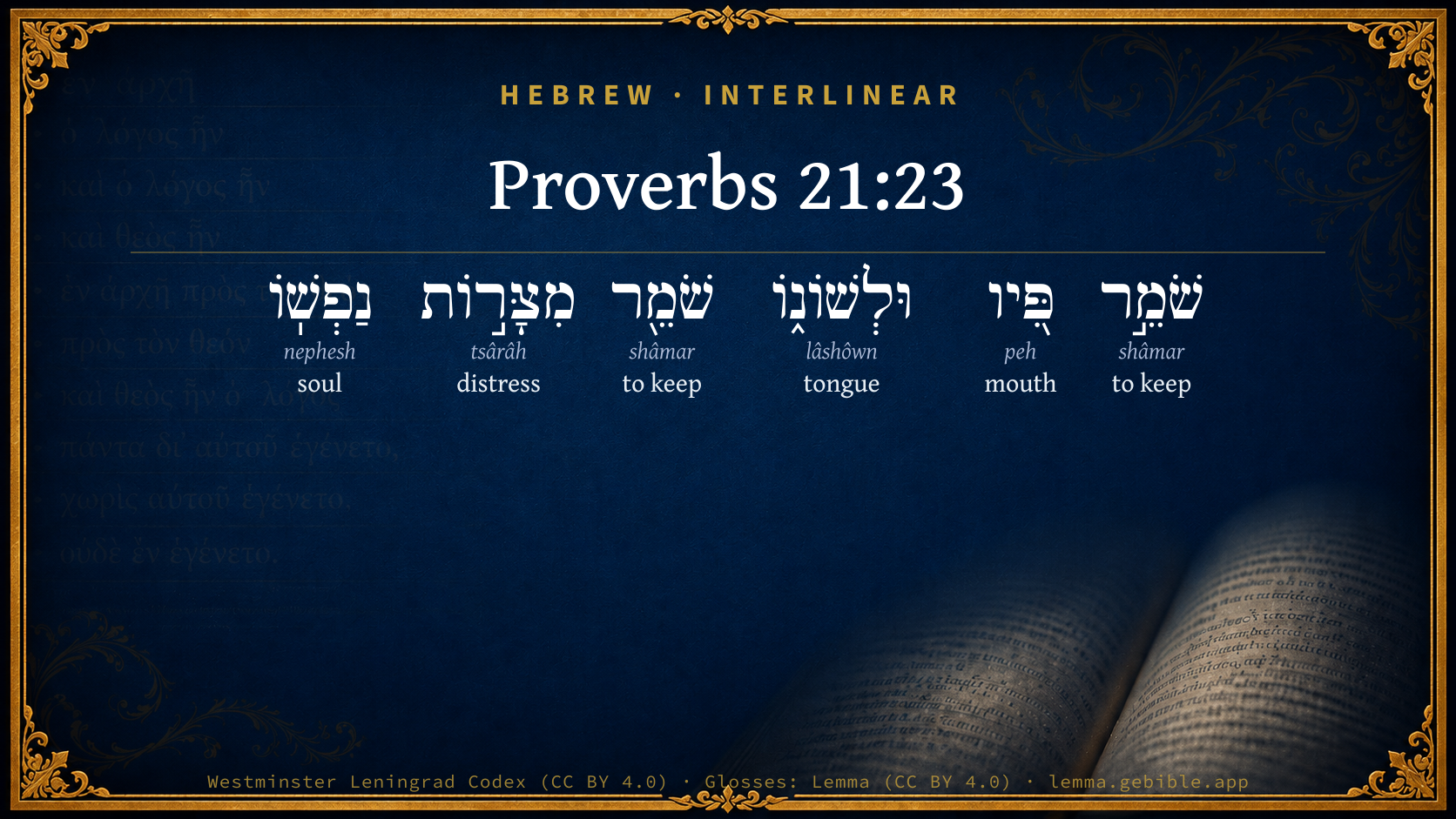
Proverbs 21:23

Hebrew (Westminster Leningrad Codex) Proverbs 21:23 appears in the Hebrew Old Testament. The text above is from the Westminster Leningrad Codex. Each word links to its Strong’s number, a concise gloss, and parsing drawn from the Open Scriptures Hebrew Bible morphology. Click any word for its full Brown-Driver-Briggs (BDB) entry.
Download image
Cite this verse

Proverbs 21:23 (World English Bible). Public Domain. Lemma interlinear Bible study tool, https://lemma.gebible.app/v/proverbs/21/23.

Show BibTeX & RIS
BibTeX
RIS
English Translation
Whoever guards his mouth and his tongue Keeps his soul from troubles.
World English Bible · Public Domain
Download a study sheet

One document with this verse’s original text, its word-by-word gloss line, the meaning frame, cross-references with their text, attributed commentary, and full source and license credits — printable, and it pastes into notes with its structure intact.

This verse Autodidact and up

Study sheet (.html) Plain text (.txt)

A passage Seminary Student

Up to 50 verses in one chapter. A passage sheet keeps up to 6 commentary sources and 12 cross-references per verse, in the order this page ranks them, and says so on the sheet whenever that leaves anything out. Ask for a single verse and you get the Autodidact verse sheet above.

Everything on this page stays free to read, with no account — the sheet is a download of what is already on screen, not access to it.

Want to remove ads? Support Godless Engineer
Compare translations 3

The same verse in 3 English versions, stacked beneath the original-language interlinear above. Click any original word for its lexicon entry.

Each is an independent rendering of the whole verse — the interlinear is not word-aligned to these translations.

Highlighted words mark where these versions differ — a whole-verse word diff, not a word-by-word alignment.

  • World English Bible Public Domain
    Whoever guards his mouth and his tongue Keeps his soul from troubles.
  • King James Version Public Domain
    Whoso keepeth his mouth and his tongue keepeth his soul from troubles.
  • unfoldingWord Literal Text CC BY-SA 4.0
    One who keeps his mouth and his tongue keeps his life from distress.

unfoldingWord Literal Text — © unfoldingWord, licensed CC BY-SA 4.0. Word-aligned USFM3 via Door43 (git.door43.org/unfoldingWord/en_ult).

Versions to compare (up to 4)

3 of 4 selected

Show all 18 translations

Every available English version of this verse, each an independent rendering of the whole verse.

  • World English Bible Public Domain
    Whoever guards his mouth and his tongue Keeps his soul from troubles.
  • Berean Standard Bible Public Domain
    He who guards his mouth and tongue keeps his soul from distress.
  • Majority Standard Bible Public Domain
    He who guards his mouth and tongue keeps his soul from distress.
  • King James Version Public Domain
    Whoso keepeth his mouth and his tongue keepeth his soul from troubles.
  • American Standard Version (1901) Public Domain
    Whoso keepeth his mouth and his tongue Keepeth his soul from troubles.
  • Revised Version (1885) Public Domain
    Whoso keepeth his mouth and his tongue keepeth his soul from troubles.
  • Geneva Bible (1599) Public Domain
    He that keepeth his mouth and his tongue, keepeth his soule from afflictions.
  • Douay-Rheims (1899) Public Domain
    He that keepeth his mouth and his tongue, keepeth his soul from distress.
  • Young's Literal Translation Public Domain
    Whoso is keeping his mouth and his tongue, Is keeping from adversities his soul.
  • Literal Standard Version CC BY-SA 4.0
    Whoever is keeping his mouth and his tongue, || Is keeping his soul from adversities.
  • Unlocked Literal Bible CC BY-SA 4.0
    Whoever guards his mouth and tongue keeps himself out of trouble.
  • unfoldingWord Literal Text CC BY-SA 4.0
    One who keeps his mouth and his tongue keeps his life from distress.
  • Darby Bible Public Domain
    Whoso keepeth his mouth and his tongue keepeth his soul from troubles.
  • World Messianic Bible Public Domain
    Whoever guards his mouth and his tongue keeps his soul from troubles.
  • Webster's Bible Public Domain
    Whoever keepeth his mouth and his tongue keepeth his soul from troubles.
  • Free Bible Version CC BY-SA 4.0
    If you watch what you say, you can save yourself a lot of trouble.
  • Bible in Basic English Public Domain
    He who keeps watch over his mouth and his tongue keeps his soul from troubles.
  • JPS Tanakh (1917) Public Domain
    Whoso keepeth his mouth and his tongue keepeth his soul from troubles.

Literal Standard Version (2020), Covenant Press — licensed CC BY-SA 4.0. Text via the HelloAO Bible API (eBible.org). Unlocked Literal Bible (unfoldingWord) — licensed CC BY-SA 4.0. Text via the HelloAO Bible API (eBible.org). unfoldingWord Literal Text — © unfoldingWord, licensed CC BY-SA 4.0. Word-aligned USFM3 via Door43 (git.door43.org/unfoldingWord/en_ult). Free Bible Version, Dr. Jonathan Gallagher — licensed CC BY-SA 4.0. Text via the HelloAO Bible API (eBible.org).

Word by word

More ways to search: Search by grammar → Find every occurrence → Compare this word →

Practice this passage: Drill this verse → Learn its vocabulary →

About this verse

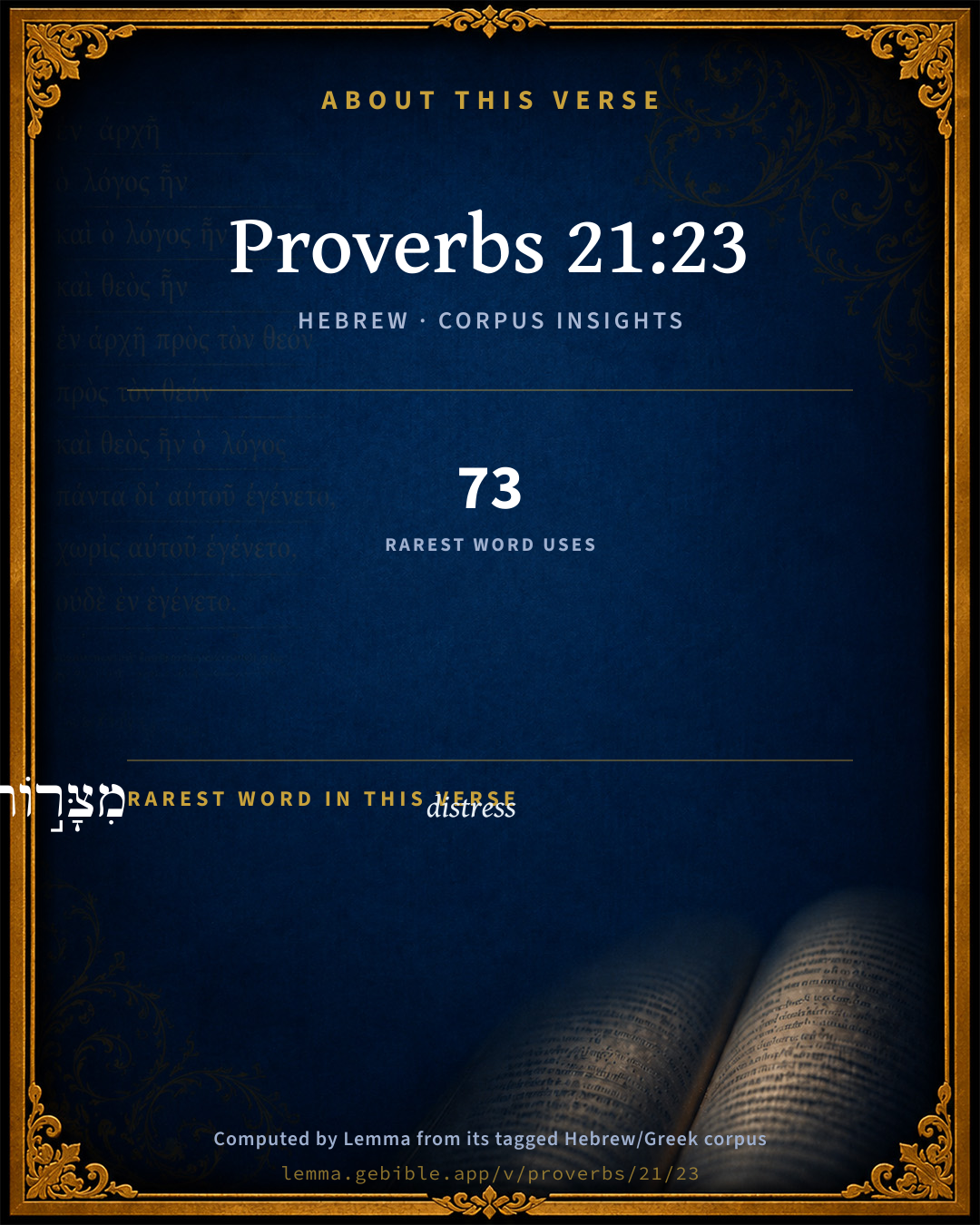
These counts appear in no published source. They are computed here, from the morphology-tagged text and Lemma’s own curated glosses. What Lemma adds →

6
words
5
distinct lemmas
Wisdom
section

Grammatical profile

  • 2 verbs
  • 4 nouns

Verb forms

  • שֹׁמֵ֣ר Qal · Participle Active
  • שֹׁמֵ֖ר Qal · Participle Active

Repetition

A word recurs within this verse — often emphatic in Hebrew:

  • שֹׁמֵ֣ר to keep H8104 ×2

Hebrew & Septuagint length

In English translation the verse runs 12 words from the Hebrew and 13 from the Septuagint (LXX English) — closely comparable.

A rough comparison of the two English renderings, which tokenize alike — not a word-level alignment.

Word counts can differ between the Hebrew and the Greek without any difference in meaning — e.g. the Hebrew direct-object marker אֵת has no separate Greek word, and Greek often adds the article ὁ.

Cross-references

7

Topical passages linked to Proverbs 21:23 in the Treasury of Scripture Knowledge — connected by theme and wording, ordered by reader-vote popularity; previews shown in the World English Bible.

  • Proverbs 13:3 He who guards his mouth guards his soul. One who opens wide his lips comes to ruin.
  • Proverbs 18:21 Death and life are in the power of the tongue; Those who love it will eat its fruit.
  • Proverbs 17:27–28 He who spares his words has knowledge. He who is even tempered is a man of understanding.
  • James 1:26 If anyone among you thinks himself to be religious while he doesn't bridle his tongue, but deceives his heart, this man's religion is worthless.
  • Proverbs 12:13 An evil man is trapped by sinfulness of lips, But the righteous shall come out of trouble.
  • Proverbs 10:19 In the multitude of words there is no lack of disobedience, But he who restrains his lips does wisely.
  • James 3:2–13 For in many things we all stumble. If anyone doesn't stumble in word, the same is a perfect man, able to bridle the whole body also.

Cross-references courtesy of OpenBible.info (CC BY 4.0).

Hebrew and Greek witnesses Masoretic Hebrew ↔ Greek Septuagint

The same verse in the two great witnesses to the Old Testament, shown verse-for-verse.

These are two independent witnesses, not word-aligned to each other, and the Septuagint is shown in lemma (dictionary) form.

Hebrew Proverbs 21:23 Masoretic · Westminster Leningrad Codex

שֹׁמֵ֣ר פִּ֭יו וּלְשׁוֹנ֑וֹ שֹׁמֵ֖ר מִצָּר֣וֹת נַפְשֽׁוֹ

Whoever guards his mouth and his tongue Keeps his soul from troubles.

World English Bible · Public Domain

Greek LXX Proverbs 21:23 Septuagint · lemma form

ὅς φυλάσσω ὁ στόμα αὐτός καί ὁ γλῶσσα διατηρέω ἐκ θλῖψις ὁ ψυχή αὐτός

He that keeps his mouth and his tongue keeps his soul from trouble.

LXX2012 (modern English Septuagint) · Public Domain

Hebrew: Westminster Leningrad Codex (CC BY 4.0). Greek: Septuagint (public domain); English from LXX2012 (modern English Septuagint) (Public Domain). How the Septuagint differs from the Hebrew →

Commentary

Notes on Proverbs 21:23 from classic Christian and Jewish commentators (each source and its license shown beneath its notes). The classic Christian expositions comment on the surrounding passage and are grouped to its opening verse, so a note may address several verses; the Jewish commentaries on the Tanakh (Rashi and others) are per-verse, so they appear only where the commentator wrote on this verse.

Lemma curates 59 commentaries, every one of them public domain or Creative Commons licensed, each selected and text-cleaned for this edition rather than reprinted as found. About our sources →

Trapp's Complete Commentary

John Trapp

Pro 21:23 Whoso keepeth his mouth and his tongue keepeth his soul from troubles.

Ver. 23. Whoso keepeth his mouth and his tongue.] As he that keepeth his doors fast locked, preserveth himself from danger; {See Trapp on "Pro 13:3"} The large and loose use of the tongue brings a man oft to divers straits and miseries.

John Trapp, A Commentary or Exposition upon All the Books of the Old and New Testament (1647–1656) — public domain. Text from a community e-Sword module.

The Biblical Illustrator

Joseph S. Exell

Pro_21:23

Whoso keepeth his mouth and his tongue keepeth his soul from troubles.

The Christian governing his tongue

Instead of simply commanding with supreme authority that men should keep their mouths and tongues, he graciously condescends to annex reward and blessings for its own sake. Keepeth his soul from troubles. In keeping of Gods commandments there is great reward. In proportion as any faculty is important in the use and rightful application of it, so is the neglect of it an evil, and the result of its perversion fatal in the same degree. The government of the tongue, on this principle, assumes at once its due importance. Consider the benefits that must accrue to society from the judicious use of this powerful organ on the part of those who in Gods providence are fitted to exert influence over their fellows. Consider the Christian governing his tongue, with especial reference to the law and will of God. Of the ten commandments two are assigned, one in each table, to this needful admonition. Thou shalt not take the name of the Lord thy God in vain; Thou shalt not bear false witness against thy neighbour. A careless, unreflecting use of the holy name betrays a trifling and unstable heart. But with reference to his neighbour, the Christian has the greatest need of caution as to the government of his tongue. What irreparable injury a severe remark, whether carelessly or wickedly whispered against the character of another, is sure to produce. It may be our duty to speak to the prejudice of others, but we must always be very sure that the duty is clear. In cases where the conduct of our neighbour appears doubtful, we are bound to give him the benefit of that doubt, and to feel towards him, and to speak of him, accordingly. When a Christian is reviled and calumniated, how is he to act? He should in patience possess his soul. One topic remains--the responsible office of the tongue, employed in preaching the gospel of salvation to perishing sinners. (Thos. Nolan, M. A.)

An unbridled tongue

A furious horse needs a bridle to restrain its fierceness, and it seems the tongue of man needs more than a double bridle to keep it in from doing hurt. The wise man never ceases to admonish us about this point. As a high-spirited horse, if its fury is not curbed with a strong hand, will hurry its rider along, without regarding pits, or precipices, or deep waters, and expose him to extreme jeopardy of his life, so an unbridled tongue will make a man hateful to God and men, plunge him into contentions and debates, and expose his estate, and life, and credit, to extreme danger. Who is the man that wishes to enjoy a quiet and peaceable life? Let him set a guard over his mouth, and refrain his tongue from profaneness and corrupt communication, from railing and reviling, and all evil speaking, from foolish talking, and from inconvenient jesting. Let prudence and the fear of God stand continually like sentinels at the door of his lips. (George Lawson, D. D.)

Keeping the tongue

When trouble is brewing, keep still. When slander is getting on its legs, keep still. When your feelings are hurt, keep still till you recover from your excitement, at any rate. Things look differently through an unagitated eye. Silence is the most massive thing conceivable sometimes. It is strength in its very grandeur. It is like a regiment ordered to stand still in the mid fury of battle. To plunge in were twice as easy. The tongue has unsettled more ministers than small salaries ever did, or lack of ability.

The government of the tongue

I. Such a government is necessary. Whoso keepeth his mouth and tongue, keepeth his soul from troubles. What troubles come through an ungoverned tongue?

1. Troubles on self.

(1) The troubles of moral remorse have often been brought into the soul through unguarded language.

(2) The troubles of social distress have often come upon a man through unguarded language. Friends have been sacrificed, enemies created, litigations commenced, and fines and penalties enacted.

2. Troubles on others. An ungoverned tongue is like a river, whose embankments have given way, spreading disasters through a whole neighbourhood. In America the Indians strike a spark from flint and steel, and thus set fire to the dry grass, and the flames spread and spread until they sweep like a roaring torrent over a territory as large as England, and men and cattle have to flee for their lives. An unguarded word can produce a social conflagration greater far.

II. Such a government is practicable. The tongue is not an involuntary organ, an organ that works irrespective of the will, like the heart and lungs; it is always the servant of the mind; it never moves without volition. Heaven has endowed us with a natural sovereignty equal not only to the government of the tongue, but to all the lusts and passions that set it in motion. A finer manifestation of moral majesty you can scarcely have than in reticence under terribly exciting circumstances. (Homilist.)

The Biblical Illustrator, edited by Joseph S. Exell (c. 1880s–1900s) — public domain. Text from a community e-Sword module.

Matthew Henry's Commentary

Note, 1. It is our great concern to keep our souls from straits, being entangled in snares and perplexities, and disquieted with troubles, that we may preserve the possession and enjoyment of ourselves and that our souls may be in frame for the service of God. 2. Those that would keep their souls must keep a watch before the door of their lips, must keep the mouth by temperance, that no forbidden fruit go into it, no stolen waters, that nothing be eaten or drunk to excess; they must keep the tongue also, that no forbidden word go out of the door of the lips, no corrupt communication. By a constant watchfulness over our words we shall prevent abundance of mischiefs which an ungoverned tongue runs men into. Keep thy heart, and that will keep thy tongue from sin; keep thy tongue, and that will keep thy heart from trouble.

Matthew Henry's Commentary on the Whole Bible (1708–1710) — public domain (CC PDM 1.0). Text via the HelloAO Bible API.

Jamieson, Fausset & Brown

Robert Jamieson, A. R. Fausset & David Brown

(Compare Pro 13:2-3; Jam 3:6-10).

Jamieson, Fausset & Brown — Commentary Critical and Explanatory on the Whole Bible (1871) — public domain (CC PDM 1.0). Text via the HelloAO Bible API.

Ellicott's Commentary for English Readers

(23) Whoso keepeth his mouth and his tongue, &c—See above on Pro_12:13.

A Bible Commentary for English Readers, edited by Charles John Ellicott (1878–1897) — public domain. Text from a community e-Sword module.

John Gill's Exposition

Whoso keepeth his mouth and his tongue,.... Guards the one and bridles the other; is careful of what he says, that it is truth, and without dissimulation and guile; and is not injurious to the characters of men, and is not offensive and provoking; who abstains from ill and wrathful language, and which tends to stir up wrath and contention. Aben Ezra distinguishes between the mouth and tongue, and interprets it, that keeps his mouth from eating, that is, immoderately and intemperately; and his tongue from speaking evil: but it is best to understand both of the same thing, of speech or language, which when a man is careful of, he

keepeth his soul from troubles; his conscience clear of guilt and distress, and his person from being concerned in quarrels, contentions, and lawsuits, which such who give their tongues too much liberty are involved in.

John Gill's Exposition of the Whole Bible (1746–1763) — public domain (CC PDM 1.0). Text via the HelloAO Bible API.

Haydock's Catholic Bible Commentary

Mouth, from eating too much. (Lyranus)

George Leo Haydock (1774–1849), Haydock's Catholic Family Bible and Commentary, 1859 edition — public domain. Excludes Psalms (Douay-Rheims chapter numbering differs from Protestant) and Deuterocanonical books (Catholic canon only).

Matthew Poole's English Annotations

Whoso keepeth his mouth and his tongue from offensive and provoking speeches, keepeth his soul, his person, from troubles; which a licentious and abusive tongue frequently brings upon a man.

Matthew Poole's English Annotations on the Holy Bible (1683–1685) — public domain. Text from a community e-Sword/MySword module.

Whedon's Commentary on the Bible

Daniel D. Whedon

23. Keepeth his mouth — Guards well his words. True! true! Comp. Pro_12:13; Pro_13:3; Pro_18:6; Pro_18:21.

Daniel D. Whedon (gen. ed.), Commentary on the Old and New Testaments (1874–1909) — public domain. Text from a community e-Sword module.

The Pulpit Commentary

We have had similar maxims before. (Pro_13:8 and Pro_18:21, where see notes) He keepeth his mouth, who knows when to speak and when to be silent; and he keepeth his tongue, who says only what is to the purpose. We have all heard the proverb, "Speech is silver, silence is gold." One who thus takes heed of his words, keepeth his soul from troubles. The troubles (angores, Vulgate) are such as these remorse for the evil occasioned, distress of conscience, vexation and strife with offended neighbours, danger of liberty and life, and, above all, the anger of God, and retribution in the judgment.

The Pulpit Commentary (1880–1919), ed. H.D.M. Spence-Jones & Joseph S. Exell — public domain. Text from a community e-Sword module.

Keil & Delitzsch

C. F. Keil & F. Delitzsch

23 He that guardeth his mouth and his tongue,

Keepeth his soul from troubles.

Pro 13:3 resembles this. He guardeth his mouth who does not speak when he does better to be silent; and he guardeth his tongue who says no more than is right and fitting. The troubles comprehend both external and internal evils, hurtful incidents and (נפשׁ) צרות לבב, Psa 25:17; Psa 31:8, i.e., distress of conscience, self-accusation, sorrow on account of the irreparable evil which one occasions.

Keil & Delitzsch — Biblical Commentary on the Old Testament (1861–1891) — public domain (CC PDM 1.0). Text via the HelloAO Bible API. (Old Testament only.)

Bridges on Proverbs

Charles Bridges

How frequently does the wise man remind us of the responsibility connected with the use "of the little member!"†1 Yet as the test of a sound or unsound religion, can we have it too often before our eyes? (Jas 1:26 .) Indeed the soundness of the regenerate heart is in nothing more manifest, than in making conscience of speech. The corruption of the heart indeed is the main source. But its evil is fearfully increased by the ebullition of the lips. How large a portion of this world’s ceaseless troubles may be traced to this prolific source! It is the unbridled horse, that brings his rider into fearful jeopardy. The mouth has been opened rashly. The tongue has flowed unguardedly; and "behold how great a matter a little fire kindleth!"†2 Our neighbor has been injured; God has been dishonored; and bitter trouble of soul has been the fruit.

What then is our preventive from this imminent temptation? Cultivate a deep and watchful sensibility. Walk closely with God. Cherish the tender spirit of his constraining obligations. Keep the tongue for his service; asking for his grace at once to restrain and employ it. (Psa 141:3 .) Thus consecrated to God, it becomes "the glory of man" (Psa 57:8 ); not only keeping him from trouble, but elevating him to fellowship in the ceaseless praises of the heavenly world.

Footnotes:

†1 Pro 10:14; Pro 12:13 ; Pro 13:3 ; Pro 14:3 ; Pro 17:20 ; Pro 18:6-7, Pro 18:21 .

†2 Jas 3:5. See how strongly Job protests against the imputation of the injury of the tongue, Pro 31:30 . ’The tongue’ — says Bp. Taylor, in his bold imagery — ’is a fountain both of bitter water and of sweet. It sends forth blessing and cursing. It is sometimes "set on fire," and then it puts whole cities into combustion. It is unruly, and no more to be restrained than the breath of a tempest. It is volatile and fugitive. Reason should go before it; and when it does not, repentance comes after it. It was intended for an organ of divine praises. But the devil often plays on it, and then it sounds like the screech-owl, or the groans of death. Sorrow and shame, folly and repentance, are the notes and forcible accents of this discord.’ — Sermon on the Good and Evil tongue.

Charles Bridges, An Exposition of the Book of Proverbs (1846) — public domain. Text from a community e-Sword module.

Kretzmann's Popular Commentary

Paul E. Kretzmann

v. 23. Whoso keepeth his mouth and his tongue, that is, he who can control them properly, both in refraining from speech and in speaking at the right time and to some definite purpose, keepeth his soul from troubles; for a garrulous fool is always making difficulties for himself.

Paul E. Kretzmann, Popular Commentary of the Bible (1921–1924) — public domain. Text from a community e-Sword module.

unfoldingWord translationNotes

Door43 World Missions Community

Whoever guards his mouth and tongue

Both "mouth" and "tongue" refer to what a person says. AT: "Whoever is careful in what he says" (See: Doublet and Metonymy)

The proud and haughty person ... acts with arrogant pride

"You can expect a proud and haughty people to act with arrogant pride"

proud and haughty

These two words mean basically the same thing and emphasize how prideful the person is. (See: Doublet)

"Mocker" is his name

The word "name" is a metonym for what people would call him. AT: "a mocker is what you should call him" (See: Metonymy)

translationWords

tongue

trouble

proud

haughty

mock

name

arrogant

unfoldingWord translationNotes — © Distant Shores Media and the Door43 World Missions Community, licensed CC BY-SA 4.0. Source: git.door43.org/Door43/en_tn.

Lesson kit

Teaching starters — assembled from the data on this page, not authored interpretation. Every prompt links to the verse data it draws on. Edit before teaching.

Proverbs, in the Wisdom, opens this verse with 6 words (5 distinct Hebrew lemmas). Its most distinctive word is tsârâh (“distress”). A historical commentator’s framing appears above. Read the whole chapter for the surrounding context.

Discussion questions

  1. How does “distress” (tsârâh) shape what this verse is saying?
  2. How does Proverbs 13:3, which shares this passage’s theme, read alongside this verse?
  3. What does the repetition of “to keep” (2× in this one verse) do in this verse?
  4. These translations render this verse differently; the difference is in the English rendering, not the original. What questions does that raise?
  5. «שֹׁמֵ֣ר» is a Qal Participle Active verb. How does that grammatical form shape the action described?
  6. Compare how Trapp's Complete Commentary and The Biblical Illustrator read this verse. Where do they agree or differ?

Things to notice

Reading settings

Reading text

Shown beneath each verse's original-language words.

Old Testament
Old Testament edition

Read the OT as the Masoretic Hebrew (MT) or the Greek Septuagint (LXX).

English shown for the Greek Septuagint (in the Hebrew ↔ Greek comparison).

Comparing translations? Open the Compare panel on any verse page to stack up to four side by side.