
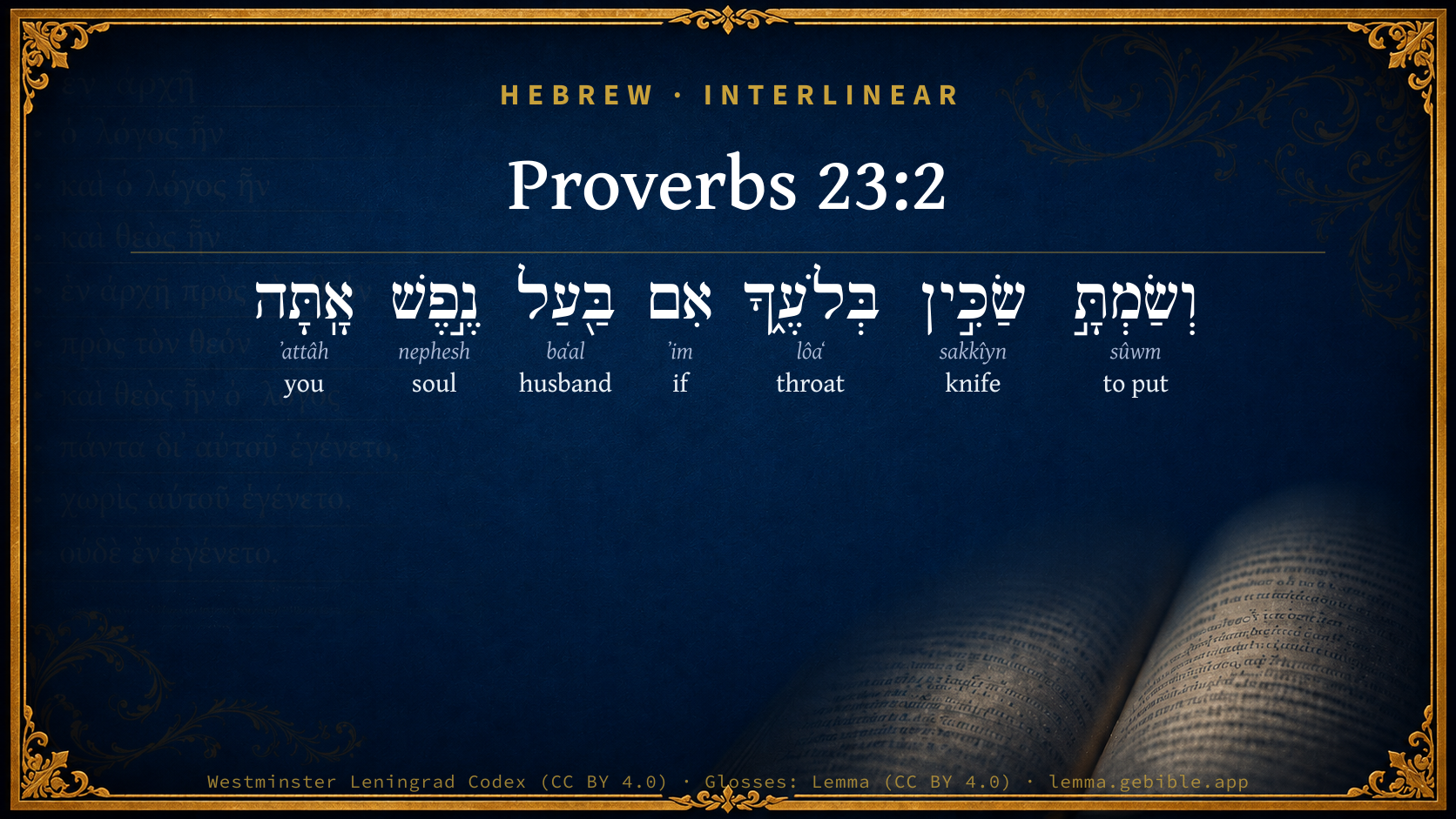
Proverbs 23:2

Hebrew (Westminster Leningrad Codex) Proverbs 23:2 appears in the Hebrew Old Testament. The text above is from the Westminster Leningrad Codex. Each word links to its Strong’s number, a concise gloss, and parsing drawn from the Open Scriptures Hebrew Bible morphology. Click any word for its full Brown-Driver-Briggs (BDB) entry.
Download image
Cite this verse

Proverbs 23:2 (World English Bible). Public Domain. Lemma interlinear Bible study tool, https://lemma.gebible.app/v/proverbs/23/2.

Show BibTeX & RIS
BibTeX
RIS
English Translation
Put a knife to your throat, If you are a man given to appetite.
World English Bible · Public Domain
Highlights
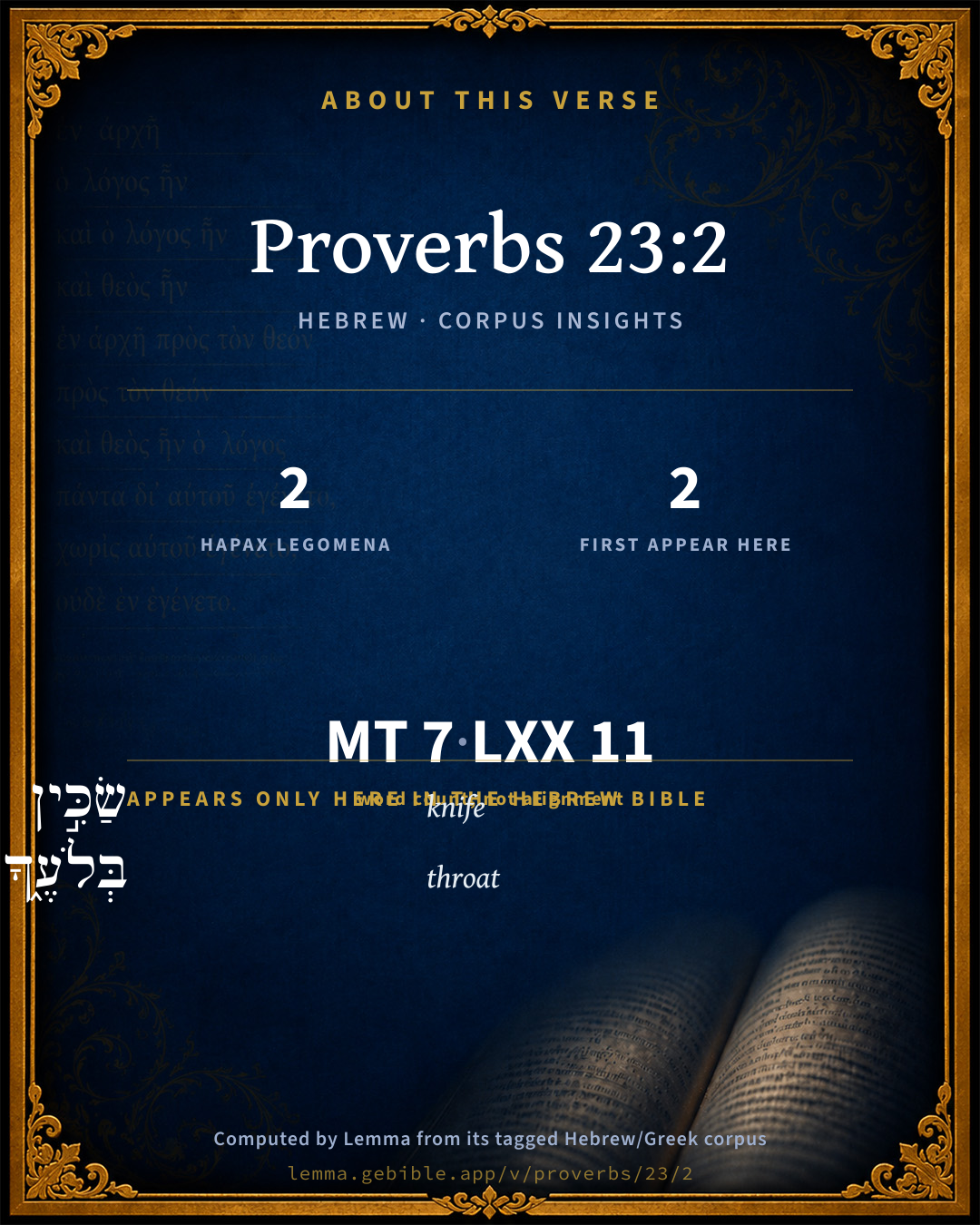
  • 2 hapax legomena — only here in the Hebrew Bible
  • 2 first appearances in the Hebrew Bible
Full analysis ↓
Download a study sheet

One document with this verse’s original text, its word-by-word gloss line, the meaning frame, cross-references with their text, attributed commentary, and full source and license credits — printable, and it pastes into notes with its structure intact.

This verse Autodidact and up

Study sheet (.html) Plain text (.txt)

A passage Seminary Student

Up to 50 verses in one chapter. A passage sheet keeps up to 6 commentary sources and 12 cross-references per verse, in the order this page ranks them, and says so on the sheet whenever that leaves anything out. Ask for a single verse and you get the Autodidact verse sheet above.

Everything on this page stays free to read, with no account — the sheet is a download of what is already on screen, not access to it.

Want to remove ads? Support Godless Engineer
Compare translations 3

The same verse in 3 English versions, stacked beneath the original-language interlinear above. Click any original word for its lexicon entry.

Each is an independent rendering of the whole verse — the interlinear is not word-aligned to these translations.

Highlighted words mark where these versions differ — a whole-verse word diff, not a word-by-word alignment.

  • World English Bible Public Domain
    Put a knife to your throat, If you are a man given to appetite.
  • King James Version Public Domain
    And put a knife to thy throat, if thou be a man given to appetite.
  • unfoldingWord Literal Text CC BY-SA 4.0
    and you should put a knife at your throat if you an owner of appetite.

unfoldingWord Literal Text — © unfoldingWord, licensed CC BY-SA 4.0. Word-aligned USFM3 via Door43 (git.door43.org/unfoldingWord/en_ult).

Versions to compare (up to 4)

3 of 4 selected

Show all 18 translations

Every available English version of this verse, each an independent rendering of the whole verse.

  • World English Bible Public Domain
    Put a knife to your throat, If you are a man given to appetite.
  • Berean Standard Bible Public Domain
    and put a knife to your throat if you possess a great appetite.
  • Majority Standard Bible Public Domain
    and put a knife to your throat if you possess a great appetite.
  • King James Version Public Domain
    And put a knife to thy throat, if thou be a man given to appetite.
  • American Standard Version (1901) Public Domain
    And put a knife to thy throat, If thou be a man given to appetite.
  • Revised Version (1885) Public Domain
    And put a knife to thy throat, if thou be a man given to appetite.
  • Geneva Bible (1599) Public Domain
    And put the knife to thy throte, if thou be a man giuen to the appetite.
  • Douay-Rheims (1899) Public Domain
    And put a knife to thy throat, if it be so that thou have thy soul in thy own power.
  • Young's Literal Translation Public Domain
    And thou hast put a knife to thy throat, If thou `art' a man of appetite.
  • Literal Standard Version CC BY-SA 4.0
    And you have put a knife to your throat, || If you [are] a man of appetite.
  • Unlocked Literal Bible CC BY-SA 4.0
    and put a knife to your throat if you are a person who likes to eat a lot of food.
  • unfoldingWord Literal Text CC BY-SA 4.0
    and you should put a knife at your throat if you an owner of appetite.
  • Darby Bible Public Domain
    and put a knife to thy throat, if thou be a man given to appetite.
  • World Messianic Bible Public Domain
    put a knife to your throat if you are a man given to appetite.
  • Webster's Bible Public Domain
    And put a knife to thy throat, if thou art a man given to appetite.
  • Free Bible Version CC BY-SA 4.0
    and cut down if you have a big appetite.
  • Bible in Basic English Public Domain
    And put a knife to your throat, if you have a strong desire for food.
  • JPS Tanakh (1917) Public Domain
    And put a knife to thy throat, if thou be a man given to appetite.

Literal Standard Version (2020), Covenant Press — licensed CC BY-SA 4.0. Text via the HelloAO Bible API (eBible.org). Unlocked Literal Bible (unfoldingWord) — licensed CC BY-SA 4.0. Text via the HelloAO Bible API (eBible.org). unfoldingWord Literal Text — © unfoldingWord, licensed CC BY-SA 4.0. Word-aligned USFM3 via Door43 (git.door43.org/unfoldingWord/en_ult). Free Bible Version, Dr. Jonathan Gallagher — licensed CC BY-SA 4.0. Text via the HelloAO Bible API (eBible.org).

Word by word

More ways to search: Search by grammar → Find every occurrence → Compare this word →

Practice this passage: Drill this verse → Learn its vocabulary →

About this verse

These counts appear in no published source. They are computed here, from the morphology-tagged text and Lemma’s own curated glosses. What Lemma adds →

7
words
7
distinct lemmas
Wisdom
section

Notable vocabulary

2 hapax legomena — words that appear only here in the entire Hebrew Bible:

  • שַׂכִּ֣ין knife H7915
  • בְּלֹעֶ֑ךָ throat H3930

First appearance in Scripture

These words make their first canonical appearance in the Hebrew Bible here:

  • שַׂכִּ֣ין knife H7915
  • בְּלֹעֶ֑ךָ throat H3930

Grammatical profile

  • 1 verb
  • 4 nouns
  • 1 pronoun
  • 1 conjunction

Verb forms

  • וְשַׂמְתָּ֣ Qal · Perfect

Hebrew & Septuagint length

In English translation the verse runs 14 words from the Hebrew and 19 from the Septuagint (LXX English) — closely comparable.

A rough comparison of the two English renderings, which tokenize alike — not a word-level alignment.

Word counts can differ between the Hebrew and the Greek without any difference in meaning — e.g. the Hebrew direct-object marker אֵת has no separate Greek word, and Greek often adds the article ὁ.

In the original languages it is 7 Hebrew tokens and 11 Greek tokens — but the two are counted differently (Hebrew bundles its prefixes and suffixes into one token; the Greek is in lemma form), so that isn’t a like-for-like length.

Cross-references

3

Topical passages linked to Proverbs 23:2 in the Treasury of Scripture Knowledge — connected by theme and wording, ordered by reader-vote popularity; previews shown in the World English Bible.

  • Philippians 3:19 whose end is destruction, whose god is the belly, and whose glory is in their shame, who think about earthly things.
  • Matthew 18:8–9 If your hand or your foot causes you to stumble, cut it off, and cast it from you. It is better for you to enter into life maimed or crippled, rather than having two hands or two feet to be cast into the eternal fire.
  • 1 Corinthians 9:27 but I beat my body and bring it into submission, lest by any means, after I have preached to others, I myself should be rejected.

Cross-references courtesy of OpenBible.info (CC BY 4.0).

Hebrew and Greek witnesses Masoretic Hebrew ↔ Greek Septuagint

The same verse in the two great witnesses to the Old Testament, shown verse-for-verse.

These are two independent witnesses, not word-aligned to each other, and the Septuagint is shown in lemma (dictionary) form.

Hebrew Proverbs 23:2 Masoretic · Westminster Leningrad Codex

וְשַׂמְתָּ֣ שַׂכִּ֣ין בְּלֹעֶ֑ךָ אִם בַּ֖עַל נֶ֣פֶשׁ אָֽתָּה

Put a knife to your throat, If you are a man given to appetite.

World English Bible · Public Domain

Greek LXX Proverbs 23:2 Septuagint · lemma form

καί ἐπιβάλλω ὁ χείρ σύ ὁράω ὅτι τοιοῦτος σύ δέω παρασκευάζω

and apply your hand, knowing that it behoves you to prepare such meats: but if you are very insatiable,

LXX2012 (modern English Septuagint) · Public Domain

On this verse, Haydock's Catholic Bible Commentary discusses the Septuagint’s reading. Read the note in Commentary ↓

Hebrew: Westminster Leningrad Codex (CC BY 4.0). Greek: Septuagint (public domain); English from LXX2012 (modern English Septuagint) (Public Domain). How the Septuagint differs from the Hebrew →

Commentary

Notes on Proverbs 23:2 from classic Christian and Jewish commentators (each source and its license shown beneath its notes). The classic Christian expositions comment on the surrounding passage and are grouped to its opening verse, so a note may address several verses; the Jewish commentaries on the Tanakh (Rashi and others) are per-verse, so they appear only where the commentator wrote on this verse.

Lemma curates 59 commentaries, every one of them public domain or Creative Commons licensed, each selected and text-cleaned for this edition rather than reprinted as found. About our sources →

Trapp's Complete Commentary

John Trapp

Pro 23:2 And put a knife to thy throat, if thou [be] a man given to appetite.

Ver. 2. And put a knife to thy throat.] Put into thy throat, as Aben Ezra reads it, rather than offend by inordinate appetite. Some read it thus: For thou puttest a knife to thy throat, if thou be a man given to appetite. Thou shortenest thy life, and diggest, as it were, thine own grave with thine own teeth. Meat kills as many as the musket; the board as the sword. Tenuis mensa sanitatis mater: {a} but much meat, much malady.

{a} Chrysost.

John Trapp, A Commentary or Exposition upon All the Books of the Old and New Testament (1647–1656) — public domain. Text from a community e-Sword module.

Geneva Bible (1599)

Geneva Bible translators

Bridle thine appetite, as it were by force and violence.

Geneva Bible (1599) marginal notes — public domain. Text via Bolls.life.

Jamieson, Fausset & Brown

Robert Jamieson, A. R. Fausset & David Brown

put a knife--an Eastern figure for putting restraint on the appetite.

Jamieson, Fausset & Brown — Commentary Critical and Explanatory on the Whole Bible (1871) — public domain (CC PDM 1.0). Text via the HelloAO Bible API.

Adam Clarke's Commentary

Verse 2. Put a knife to thy throat] Repress thy appetite, and do not be incontinent of speech. Eat, drink, and converse, under a check.

Adam Clarke's Commentary on the Bible (1810–1826) — public domain. Text from a community e-Sword/MySword module.

Ellicott's Commentary for English Readers

(2) And put a knife to thy throat.—Use the strongest methods to keep thine appetite in check, if thou art likely to give way to it, and then, overcome by meat and drink, to say or do anything to offend thy host.

A Bible Commentary for English Readers, edited by Charles John Ellicott (1878–1897) — public domain. Text from a community e-Sword module.

The Cambridge Bible for Schools and Colleges

gen. ed. J. J. S. Perowne

2. put a knife] i.e. Restrain forcibly thy appetite as with a knife held to thy throat. Others render, thou wilt put (R.V. marg.) and understand it to mean, that death may be the penalty of indulgence.

The Cambridge Bible for Schools and Colleges (gen. ed. J. J. S. Perowne; Cambridge University Press, 1878–1918) — public domain. Text from a community e-Sword module.

John Gill's Exposition

And put a knife to thy throat,.... Refrain from too much talk at the table; give not too loose to thy tongue, but bridle it, considering in whose presence thou art; do not use too much freedom, either with the ruler or fellow guests; which, when persons have ate and drank well, they are too apt to do, and sometimes say things offensive to one or the other; it is good for a man to be upon his guard; see Ecc 5:2. Or restrain thine appetite; deny thyself of some things agreeable, that would lead thee to what might be hurtful, at least if indulged to excess: put as it were a knife unto thine appetite, and mortify it; which is the same as cutting off a right hand, or plucking out a right eye Mat 5:29. Or while thou art at such a table, at such a sumptuous entertainment, consider thyself as in danger, as if thou hadst a knife at thy throat; and shouldest thou be too free with the food or liquor, it would be as it were cutting thine own throat;

if thou be a man given to appetite; there is then the more danger; and therefore such a person should be doubly on his guard, since he is in the way of temptation to that he is naturally inclined to. Or, "if thou art master of appetite" (r): so the Targum,

"if thou art master of thy soul;''

if thou hast power over it, and the command of it, and canst restrain it with ease; to which agrees the Vulgate Latin version: but the former sense is more agreeable to the Hebrew idiom.

(r) "dominus animae", Vatablus, Mercerus, Michaelis.

John Gill's Exposition of the Whole Bible (1746–1763) — public domain (CC PDM 1.0). Text via the HelloAO Bible API.

Albert Barnes' Notes on the Bible

i. e., “Restrain thy appetite, eat as if the knife were at thy throat.” Others render the words “thou wilt put a knife to thy throat” etc., i. e., “indulgence at such a time may endanger thy very life.”

Albert Barnes' Notes on the Bible (1834–1885) — public domain. Text from a community e-Sword/MySword module.

Haydock's Catholic Bible Commentary

Throat. Restrain intemperance and talkativeness, Ecclesiasticus xxxi. 12. Septuagint, "stretch forth thy hand, knowing that thou must prepare the like; but if thou be more insatiable, (3.) desire not his meats, for he has them of deceitful life." They cannot afford real happiness, (Haydock) and to vie with the rich would only reduce them to poverty, Ecclesiasticus xiii. 2. St. Augustine (tr. xlvii. in Joan.) explains this text of the blessed Eucharist, observing, that we must give our life for our brethren, as Christ did for us. Before communion, we must slay the old man, and subdue our passions. (Calmet) --- Power. Protestants, "if thou be a man given to appetite." The situation of a courtier is very critical. (Haydock) --- Those who eat with the kings of Persia, were nicely observed by an eunuch, lest they should cast their eyes on any of his concubines. (Lucian. de Merced.)

George Leo Haydock (1774–1849), Haydock's Catholic Family Bible and Commentary, 1859 edition — public domain. Excludes Psalms (Douay-Rheims chapter numbering differs from Protestant) and Deuterocanonical books (Catholic canon only).

Matthew Poole's English Annotations

Put a knife to thy throat; restrain and moderate thine appetite, as if a knife or some other thing stuck in thy throat, and hindered thee from swallowing what thou didst desire; or as if a man stood with a knife at thy throat ready to kill thee, if thou didst transgress; or though it be as irksome to thee to do so as if thou hadst a knife put to thy throat. So this is to be understood metaphorically, as that phrase of

cutting off the right hand, & c., Mat 5:29,30. Or, For thou dost (or, lest thou shouldst, as the Syriac interpreter renders it; or, otherwise thou wilt or shouldst) put a knife to thy throat. So the sense is, When thou goest to their feasts, thou dost expose thyself to great and manifest hazards, to thy own intemperance, and to all its dangerous consequences, and to the ill effects of other men’s intemperance.

Given to appetite; prone to excess in eating and drinking.

Matthew Poole's English Annotations on the Holy Bible (1683–1685) — public domain. Text from a community e-Sword/MySword module.

The Pulpit Commentary

And put a knife to thy throat, if thou be a man given to appetite. "Stab thy gluttony," Wordsworth. Restrain thyself by the strongest measures, convince thyself that thou art in the utmost peril, if thou art a glutton or wine bibber (Ecclus. 34 31:12). The LXX gives a different turn to the injunction, "And apply (epiballe ) thy hand, knowing that it behoves thee to prepare such things." This is like the warning of Siracides, in the chapter quoted above, where the disciple is admonished not to attend the banquets of rich men, lest he should be tempted to vie with them, and thus ruin himself by attempting to return their civilities in the same lavish manner. The earlier commentators have used the above verses as a lesson concerning the due and reverent partaking of the Holy Communion, thus: "When you approach the table of Christ, consider diligently what is represented by the elements before you, and have discernment and faith, lest you eat and drink unworthily; and after communicating walk warily, mortify all evil desires, live as in the presence of the Lord Jesus, the Giver of the feast."

The Pulpit Commentary (1880–1919), ed. H.D.M. Spence-Jones & Joseph S. Exell — public domain. Text from a community e-Sword module.

John Wesley's Explanatory Notes

Put a knife - Restrain thine appetite, as if a man stood with a knife at thy throat.

John Wesley, Explanatory Notes Upon the Whole Bible (1754–1765) — public domain. Text via the GEBible commentary corpus.

Kretzmann's Popular Commentary

Paul E. Kretzmann

v. 2. and put a knife to thy throat, if thou be a man given to appetite, keeping the usual gluttonous appetite in leash by the strongest warnings and threats, restraining the least sign of self-indulgence.

Paul E. Kretzmann, Popular Commentary of the Bible (1921–1924) — public domain. Text from a community e-Sword module.

Rashi

Rabbi Shlomo Yitzchaki (Rashi)

and you shall put a knife into your jaw Heb. בלועך, into your jaw. If you see that he is stingy, do not eat of his [food].

if you are a man with a hearty appetite If you are a glutton and long to eat, it is better that you thrust a knife between your teeth. Our Sages expounded this as referring to a disciple sitting before his teacher. If he knows that his teacher will give him an answer for everything he asks, let him investigate the subtle points and ask concerning his tradition, but if not, let him keep his peace.

Rashi on the Tanakh — English translations: “The Judaica Press complete Tanach with Rashi, translated by A. J. Rosenberg” (CC BY 4.0); “Pentateuch with Rashi's commentary by M. Rosenbaum and A.M. Silbermann, 1929-1934” (public domain); “The Metsudah Tanach series, Lakewood, N.J” (CC BY 4.0); and “The Book of Joshua, Metsudah Publications, 1997” (CC BY 4.0). Text via Sefaria.

Lesson kit

Teaching starters — assembled from the data on this page, not authored interpretation. Every prompt links to the verse data it draws on. Edit before teaching.

Proverbs, in the Wisdom, opens this verse with 7 words (7 distinct Hebrew lemmas). Its most distinctive word is sakkîyn (“knife”). A historical commentator’s framing appears above. Read the whole chapter for the surrounding context.

Discussion questions

  1. What does “knife” (sakkîyn) contribute to the verse as a whole?
  2. This verse holds 2 words here found nowhere else in the Hebrew Bible. What might the rare words draw attention to?
  3. 2 words here appear for the first time in Scripture. What is being introduced at this debut?
  4. Philippians 3:19 shares this passage’s theme. How do the two illuminate each other?
  5. The translations on this page render this verse differently — a whole-verse word diff, not a word-by-word alignment. What might account for the different wordings?
  6. The verb «וְשַׂמְתָּ֣» is Qal Perfect. How does its form color the action?
  7. Reading how Trapp's Complete Commentary and Geneva Bible (1599) read this verse, where do the two commentators agree and where do they part?

Things to notice

Reading settings

Reading text

Shown beneath each verse's original-language words.

Old Testament
Old Testament edition

Read the OT as the Masoretic Hebrew (MT) or the Greek Septuagint (LXX).

English shown for the Greek Septuagint (in the Hebrew ↔ Greek comparison).

Comparing translations? Open the Compare panel on any verse page to stack up to four side by side.